‘Corruption’ as a Propaganda Weapon

By Robert Parry

Source: Consortium News

Sadly, some important duties of journalism, such as applying evenhanded standards on human rights abuses and financial corruption, have been so corrupted by the demands of government propaganda – and the careerism of too many writers – that I now become suspicious whenever the mainstream media trumpets some sensational story aimed at some “designated villain.”

Far too often, this sort of “journalism” is just a forerunner to the next “regime change” scheme, dirtying up or delegitimizing a foreign leader before the inevitable advent of a “color revolution” organized by “democracy-promoting” NGOs often with money from the U.S. government’s National Endowment for Democracy or some neoliberal financier like George Soros.

We are now seeing what looks like a new preparatory phase for the next round of “regime changes” with corruption allegations aimed at former Brazilian President Luiz Ignacio Lula da Silva and Russian President Vladimir Putin. The new anti-Putin allegations – ballyhooed by the UK Guardian and other outlets – are particularly noteworthy because the so-called “Panama Papers” that supposedly implicate him in offshore financial dealings never mention his name.

Or as the Guardian writes:Though the president’s name does not appear in any of the records, the data reveals a pattern – his friends have earned millions from deals that seemingly could not have been secured without his patronage. The documents suggest Putin’s family has benefited from this money – his friends’ fortunes appear his to spend.”

Note, if you will, the lack of specificity and the reliance on speculation: “a pattern”; “seemingly”; “suggest”; “appear.” Indeed, if Putin were not already a demonized figure in the Western media, such phrasing would never pass an editor’s computer screen. Indeed, the only point made in declarative phrasing is that “the president’s name does not appear in any of the records.”

A British media-watch publication, the Off-Guardian, which criticizes much of the work done at The Guardian, headlined its article on the Putin piece as “the Panama Papers cause Guardian to collapse into self-parody.”

But whatever the truth about Putin’s “corruption” or Lula’s, the journalistic point is that the notion of objectivity has long since been cast aside in favor of what’s useful as propaganda for Western interests.

Some of those Western interests now are worried about the growth of the BRICS economic system – Brazil, Russia, India, China and South Africa – as a competitor to the West’s G-7 and the International Monetary Fund. After all, control of the global financial system has been central to American power in the post-World War II world – and rivals to the West’s monopoly are not welcome.

What the built-in bias against these and other “unfriendly” governments means, in practical terms, is that one standard applies to a Russia or a Brazil, while a more forgiving measure is applied to the corruption of a U.S. or European leader.

Take, for instance, former Secretary of State Hillary Clinton’s millions of dollars in payments in speaking fees from wealthy special interests that knew she was a good bet to become the next U.S. president. [See Consortiumnews.com’s “Clinton Stalls on Goldman-Sachs Speeches.”]

Or, similarly, the millions upon millions of dollars invested in super-PACS for Clinton, Sen. Ted Cruz and other presidential hopefuls. That might look like corruption from an objective standard but is treated as just a distasteful aspect of the U.S. political process.

But imagine for a minute if Putin had been paid millions of dollars for brief speeches before powerful corporations, banks and interest groups doing business with the Kremlin. That would be held up as de facto proof of his illicit greed and corruption.

Losing Perspective

Also, when it’s a demonized foreign leader, any “corruption” will do, however minor. For example, in the 1980s, President Ronald Reagan’s denounced Nicaraguan President Daniel Ortega for his choice of eyewear: “The dictator in designer glasses,” declared Reagan, even as Nancy Reagan was accepting free designer gowns and free renovations of the White House funded by oil and gas interests.

Or, the “corruption” for a demonized leader can be a modest luxury, such as Ukrainian President Viktor Yanukovych’s “sauna” in his personal residence, a topic that got front-page treatment in The New York Times and other Western publications seeking to justify the violent coup that drove Yanukovych from office in February 2014.

Incidentally, both Ortega and Yanukovych had been popularly elected but were still targeted by the U.S. government and its operatives with violent destabilization campaigns. In the 1980s, the CIA-organized Nicaraguan Contra war killed some 30,000 people, while the U.S.-orchestrated “regime change” in Ukraine sparked a civil war that has left some 10,000 people dead. Of course, in both cases, Official Washington blamed Moscow for all the trouble.

In both cases, too, the politicians and operatives who gained power as a result of the conflicts were arguably more corrupt than the Nicaraguan Sandinistas or Yanukovych’s government. The Nicaraguan Contras, whose violence helped pave the way for the 1990 election of U.S.-backed candidate Violeta Chamorro, were deeply implicated in cocaine trafficking. [See Consortiumnews.com’s “The Sordid Contra-Cocaine Saga.”]

Today, the U.S.-supported Ukrainian government is wallowing in corruption so deep that it has provoked a new political crisis.[See Consortiumnews’com’s “Reality Peeks Through in Ukraine.”]

Ironically, one of the politicians actually named in the Panama Papers for having established a shadowy offshore account is the U.S.-backed Ukrainian President Petro Poroshenko, although he got decidedly second-billing to the unnamed Putin. (Poroshenko denied there was anything improper in his offshore financial arrangements.)

Double Standards

Mainstream Western journalism no longer even tries to apply common standards to questions about corruption. If you’re a favored government, there might be lamentations about the need for more “reform” – which often means slashing pensions for the elderly and cutting social programs for the poor – but if you’re a demonized leader, then the only permissible answer is criminal indictment and/or “regime change.”

One stark example of these double standards is the see-no-evil attitude toward the corruption of Ukraine’s Finance Minister Natalie Jaresko, who is touted endlessly in the Western media as the paragon of Ukrainian good governance and reform. The documented reality, however, is that Jaresko enriched herself through her control of a U.S.-taxpayer-financed investment fund that was supposed to help the people of Ukraine build their economy.

According to the terms of the $150 million investment fund created by the U.S. Agency for International Development (USAID), Jaresko’s compensation was supposed to be capped at $150,000 a year, a pay package that many Americans would envy. But it was not enough for Jaresko, who first simply exceeded the limit by hundreds of thousands of dollars and then moved her compensation off-books as she amassed total annual pay of $2 million or more.

The documentation of this scheming is clear. I have published multiple stories citing the evidence of both her excessive compensation and her legal strategies for covering up evidence of alleged wrongdoing. [See Consortiumnews.com’s “How Ukraine’s Finance Minister Got Rich” and “Carpetbagging Crony Capitalism in Ukraine.”]

Despite the evidence, not a single mainstream Western news outlet has followed up on this information even as Jaresko is hailed as a “reform” candidate for Ukrainian prime minister.

This disinterest is similar to the blinders that The New York Times and other major Western newspapers put on when they were assessing whether Ukrainian President Yanukovych was ousted in a coup in February 2014 or just wandered off and forgot to return.

In a major “investigative” piece, the Times concluded there was no coup in Ukraine while ignoring the evidence of a coup, such as the intercepted phone call between U.S. Assistant Secretary of State for European Affairs Victoria Nuland and U.S. Ambassador to Ukraine Geoffrey Pyatt discussing who they would put into power. “Yats is the guy,” said Nuland – and surprise, surprise, Arseniy Yatsenyuk ended up as prime minister.

The Times also ignored the observation of George Friedman, president of the global intelligence firm Stratfor, who noted that the Ukraine coup was “the most blatant coup in history.” [See Consortiumnews.com’s “NYT Still Pretends No Coup in Ukraine.”]

The Propaganda Weapon

The other advantage of “corruption” as a propaganda weapon to discredit certain leaders is that we all assume that there is plenty of corruption in governments as well as in the private sector all around the world. Alleging corruption is like shooting large fish crowded into a small barrel. Granted, some barrels might be more crowded than others but the real decision is whose barrel you choose.

That’s part of the reason why the U.S. government has spread around hundreds of millions of dollars to finance “journalism” organizations, train political activists and support “non-governmental organizations” that promote U.S. policy goals inside targeted countries. For instance, before the Feb. 22, 2014 coup in Ukraine, there were scores of such operations in the country financed by the National Endowment for Democracy (NED), whose budget from Congress exceeds $100 million a year.

But NED, which has been run by neocon Carl Gershman since its founding in 1983, is only part of the picture. You have other propaganda fronts operating under the umbrella of the State Department and USAID. Last year, USAID issued a fact sheet summarizing its work financing friendly journalists around the globe, including “journalism education, media business development, capacity building for supportive institutions, and strengthening legal-regulatory environments for free media.”

USAID estimated its budget for “media strengthening programs in over 30 countries” at $40 million annually, including aiding “independent media organizations and bloggers in over a dozen countries,” In Ukraine before the coup, USAID offered training in “mobile phone and website security,” which sounds a bit like an operation to thwart the local government’s intelligence gathering, an ironic position for the U.S. with its surveillance obsession, including prosecuting whistleblowers based on evidence that they talked to journalists.

USAID, working with billionaire George Soros’s Open Society, also funds the Organized Crime and Corruption Reporting Project, which engages in “investigative journalism” that usually goes after governments that have fallen into disfavor with the United States and then are singled out for accusations of corruption. The USAID-funded OCCRP also collaborates with Bellingcat, an online investigative website founded by blogger Eliot Higgins.

Higgins has spread misinformation on the Internet, including discredited claims implicating the Syrian government in the sarin attack in 2013 and directing an Australian TV news crew to what looked to be the wrong location for a video of a BUK anti-aircraft battery as it supposedly made its getaway to Russia after the shoot-down of Malaysia Airlines Flight 17 in July 2014.

Despite his dubious record of accuracy, Higgins has gained mainstream acclaim, in part, because his “findings” always match up with the propaganda theme that the U.S. government and its Western allies are peddling. Though most genuinely independent bloggers are ignored by the mainstream media, Higgins has found his work touted by both The New York Times and The Washington Post.

In other words, the U.S. government has a robust strategy for deploying direct and indirect agents of influence. Indeed, during the first Cold War, the CIA and the old U.S. Information Agency refined the art of “information warfare,” including pioneering some of its current features like having ostensibly “independent” entities and cut-outs present U.S. propaganda to a cynical public that would reject much of what it hears from government but may trust “citizen journalists” and “bloggers.”

But the larger danger from this perversion of journalism is that it sets the stage for “regime changes” that destabilize whole countries, thwart real democracy (i.e., the will of the people), and engender civil warfare. Today’s neoconservative dream of mounting a “regime change” in Moscow is particularly dangerous to the future of both Russia and the world.

Regardless of what you think about President Putin, he is a rational political leader whose legendary sangfroid makes him someone who is not prone to emotional decisions. His leadership style also appeals to the Russian people who overwhelmingly favor him, according to public opinion polls.

While the American neocons may fantasize that they can generate enough economic pain and political dissension inside Russia to achieve Putin’s removal, their expectation that he will be followed by a pliable leader like the late President Boris Yeltsin, who will let U.S. operatives back in to resume plundering Russia’s riches, is almost certainly a fantasy.

The far more likely possibility is that – if a “regime change” could somehow be arranged – Putin would be replaced by a hard-line nationalist who might think seriously about unleashing Russia’s nuclear arsenal if the West again tries to defile Mother Russia. For me, it’s not Putin who’s the worry; it’s the guy after Putin.

So, while legitimate questions about Putin’s “corruption” – or that of any other political leader – should be pursued, the standards of evidence should not be lowered just because he or anyone else is a demonized figure in the West. There should be single not double standards.

Western media outrage about “corruption” should be expressed as loudly against political and business leaders in the U.S. or other G-7 countries as it is toward those in the BRICS.


Investigative reporter Robert Parry broke many of the Iran-Contra stories for The Associated Press and Newsweek in the 1980s. You can buy his latest book, America’s Stolen Narrative, either in print here or as an e-book (from Amazon and barnesandnoble.com).

Related Video:

The Slow, Inevitable Collapse of the Two-Party System

march_of_tyranny

By Russell A. Whitehouse

Source: Strategic Culture Foundation

In this election year, it’s clear that a seismic political shift is rumbling through America.  Widespread discontent for the status quo is surfacing from both the left and right.  A year ago, it would have been impossible to envision a card-carrying socialist and a pre-WWII style populist mounting legitimate presidential campaigns (much less without Super PACs).  Now, far-left and far-right sentiments are emerging from the underground as perfectly palatable options to Middle America.  Establishment darlings like Hillary Clinton, Jeb Bush & Marco Rubio have faced extreme pressure from the New Normal in their respective political tents.

It has become clear that the traditional 2-party system in America is starting to erode.  Sanders’ supporters view Clinton as too untrustworthy & beholden to Big Business.   Meanwhile Trump’s blue-collar base has rejected rank-and-file Republicans as being too unsympathetic to their economic concerns, while his surprising chunk of the evangelical contingent is refuting the Bush-flavored puritanism of Ted Cruz.  Conversely, Clinton’s supporters reject Sander’s bold platform as delusional and Cruz’s base is increasingly being filled by #NeverTrump neocon purists and Romey-ite country club Republicans.

One can see political parallels across the pond, in the UK’s 2015 Parliamentary elections.  The two main parties in Westminster Palace, Conservative and Labour (roughly equivalent to the GOP and Democrats), were shaken up by two popular insurgencies.  UKIP, the UK Independence Party, rose up from the rising flames of the relatively conservative British heartland’s fears of free trade in the EU and immigration, winning an eighth of the popular vote in England. To the north, SNP, the Scottish National Party, won 95% of Scotland’s seats by inspiring among other things, record youth turnout and social media support (sound familiar?), with a message of social democracy and defiance against the British status quo.

Intra-party schisms are also forming in the two Anglophone democracies.  The Tories are tearing themselves apart over the Brexit, austerity and jockeying to succeed Cameron as Party Leader, while the American neocons are assessing the fallout of Trump’s ascendance while in free fall.  Labour officials are debating whether to follow their insurgent leader Jeremy Corbyn to the far Left after 20 years of Tony Blair’s New Labour movement, which moved the party to the center to win back the support of big business and blue-collar voters.  The New Labour centrist putsch coincided with Bill Clinton (and later Obama’s) similar efforts as the face of the Democrats.   Now, Democratic voters are beginning to second-guess this political realignment, spearheaded by the presumptive Democratic nominee’s husband.  Her opponent Bernie Sanders is siphoning away the youth vote and blue-collar moderates from the Democratic establishment, two of the Party’s traditional constituencies, by railing against neoliberal policies like free trade and social welfare cuts.

Given the rise of social-democratic populism and nativist-protectionist populism to either flank of American politics, it would make sense to look at the formation of entirely new parties.  Bernie Sanders can form a Stars-and-Pinstripes version of SNP; he too has the momentum of a more secular, progressive generation reaching political maturity as the more religious, conservative Baby Boomers begin to die out.  Assuming Trump completes his takeover of the Grand Old Party at July’s convention, the neocon brain trust can form a new conservative movement; this is already being planned by members of the #NeverTrump triad. Evangelical and free market diehards can unite to mount a serious challenge to Trump’s right by fielding a Texas crusader like Ted Cruz or Rick Perry, or Mormon elder statesman Mitt Romney.

Regardless of how Trump and Sanders fare in their respective conventions, they could still operate a serious race for the White House.  Both New York loudmouths boast a gigantic wave of rabid new voters, as well as a wellspring of working-class Americans desperate to reverse Wall Street’s increasingly oligarchical dominance, mass layoffs/underemployment, stagnant wages, crumbling infrastructure & the other byproducts of the neoliberal-neoconservative economic policy alliance.  Sanders could march into November as the nominee of the new Democratic Socialist Party, with a trail of young, idealistic future leaders tweeting and live-streaming behind him.  Depending on July’s RNC, we could see a Make America Great Again Party (MAGAP, for short) trumpeting Trump’s message of putting power back in the hands of the American working class or a Romney-Cruz True Conservatives Party ticket touting Christian piety and Wall St fiscal policy.

Get used to Sanders, Clinton, Trump & Cruz.  You may see all 4 of them, come November…

A Crisis of the Heart

AAEAAQAAAAAAAANZAAAAJDE2ODFkMTY5LTcyYTktNGIwMi1iMDUxLWQ5MzA4ZDQ3OWU4ZA

By rahkyt

Source: Sacred Space in Time

The loss of life for any reason is always to be commiserated with and in instances of collective horror such as the terrorist attacks that have recently beset the West, the heart of oceanic humanity breaks a bit more.

With that said, our social media feeds become filled with national colors and heartful memes in solidarity with members of the human family hit by unthinkable tragedy. It is right to do so. But it is also right to understand that tragedies are occurring all around us, in our own nations as well as others, every single day.  Middle-aged whites in the US are killing themselves with drugs and alcohol and poor eating habits at a rate never seen before. They are hopeless and despairing as the American dream fades. Blacks remain mired in the same hopelessness caused by the same reasons, economic and social, with the added addition of racism and eugenic tactics centuries in the formation. Native Americans on Reservations continue to experience the effects of genocide, a program running in the collective American consciousness since this nation’s inception. The deaths add up and fade into consciousness as the background cries of the disillusioned and dehumanized.

Inhumanity reigns and the statistics state that people have been growing less and less compassionate toward each other for decades in this nation. These computers and smart phones draw us together but also tear us apart, the virtual world is as real as the real one. People spend hours per day jacked into the matrix, seamlessly moving between one and the other. Death by texting is on the rise,  porn increases objectification and consumer culture further consolidates the banality of social interaction and heart-based intimacy.

These realities indicate a crisis of the soul. Of the heart. When we are upset and outraged about one group of people but care nothing for others, something is very wrong. When there is compassion for those whom we might share something in common with and lack of compassion for those with whom we do not, there is a division of the heart, a dehumanization that speaks to the pervasivity of mainstream media programming of the mind.

Perhaps those who say humanity cannot change are right. Perhaps this is the best we can do. But perhaps it is also true that by consciously examining the memes and events and seeking to understand the issues at levels beyond those trumpeted in the mainstream we will come to realize that we have more in common with the Oppressed everywhere than the privileged so many of us wish to join in their glass mansions and private retreats. It is in the experience of self as seen through the eyes of others and experienced in the visceral engagement of souls on an eternal journey that true empathy and compassion are known.

When life ends, all that matters is the love. The love we give and the love we receive. The divisions dissipate. Living as if each one of us was from Beirut, or Paris, or Chicago, or Kenyan, every, single, day, and sharing our portion of love is how the dogs of war are banished. How the flames of hate are extinguished. The source is never what we are told and the cause goes back so far in the past that the effect is shrouded in mystery.

Share this outpouring of love with the world. Feel the pain of all those sacrificed on the alters of political and economic gain. Those next door, down the street, in the next city and state, and even across the nation. We must stand in solidarity with those who’ve made the ultimate sacrifice, but the war is not just between nations and ideologies. The war is within each of us. Every, single day.

The Weird Politics Of Aspartame: Conspiracy Theory Or Startling Truth?

050406aspartame3

By Paanii Powell Cleaver

Source: Inquisitr

Earlier this month, news wires and Twitter feeds were abuzz with info about the potential danger of certain artificial sweeteners.

In reality, recent reports about the potential perils of low-calorie sweeteners are not exactly breaking news. Almost 20 years ago, on December 29, 1996, Mike Wallace conducted an eye-opening segment about aspartame, also known as NutraSweet, on 60 Minutes.

The segment aired in response to a flurry of reports noting a dramatic increase in brain tumors and other serious health issues following the approval of aspartame for use in dry foods in 1981. Fifteen years after its somewhat dubious approval, (the most controversial FDA decision to date), more than 7,000 consumer reports of adverse reaction to aspartame had been delivered to the FDA. As reported by 60 Minutes, the litany of consumer complaints included severe headaches, dizziness, respiratory issues, and seizures. The FDA countered with a statement that aspartame was the most tested product in FDA history.

Dr. Virginia V. Weldon, a pediatrician from Missouri and Vice President of Public Policy for the Monsanto Company from 1989 through 1998, told 60 Minutes that aspartame is “one of the safest food ingredients ever approved by the Food and Drug Administration.”

Dr. John W. Olney, a neuroscientist at Washington University School of Medicine, vehemently disagreed with Dr. Weldon’s assessment of the controversial super sweetener. Notable for his discovery of the brain-harming effects of an amino acid called glutamate, Dr. Olney was influential in legislating the ban of MSG in baby food. At the time of the 60 Minutes segment, he had been studying the effects of aspartame and other compounds on brain health for more than two decades.

Olney told 60 Minutes’ Mike Wallace that since the approval of aspartame, there had been “a striking increase in the incidence of malignant brain tumors.” The doctor did not directly blame aspartame for the increase. He did, however, state that there was enough questionable evidence to merit reevaluating the chemical compound. He said that the FDA should reassess aspartame and that “this time around, they should do it right.”

Dr. Erik Millstone, Professor of Science Policy at the University of Sussex, told 60 Minutes that Searle’s testing procedures in the early 1970s were so flawed that there was no way to know for certain if aspartame was safe for human consumption. Millstone claimed that the company’s failure to dissect a test animal that died during an aspartame experiment was merely one example of “deficiencies” in Searle’s conduct. He also noted that when test mice presented with tumors, the tumors were “cut out and discarded and not reported.” In addition, Dr. Millstone told Mike Wallace that G.D. Searle and contractors hired by the drug company administered antibiotics to some test animals yet neglected to reveal this information in official reports.

In 1974, after the G.D. Searle company had already manufactured a significant quantity of aspartame, then-commissioner of the FDA, Alexander Schmidt, came very close to approving the chemical for human food purposes. Relying solely on evidence provided by Searle, the FDA allowed a mere 30 days for the public to respond before putting the FDA seal of approval on the now-controversial food additive. Dr. John Olney wasted no time in joining forces with James Turner, a public interest attorney who also worked with consumer advocate Ralph Nader. Just before the allotted time for public response ran out, Dr. Olney and his attorney petitioned the FDA with data that indicated the dangerous similarities between aspartame and glutamate.

In his 1970 best seller, The Chemical Feast, Turner detailed numerous ways the FDA shirked its obligation to protect the American people. At the time of its publication, Time magazine described the tome as “the most devastating critique of a U.S. government agency ever issued.”

In response to Dr. Olney’s allegations that aspartame was potentially as brain-damaging as glutamate, the FDA called for a task force to investigate the matter. By late 1975, the FDA found that Searle’s own research into the safety of aspartame was so flawed that they stayed the approval process, citing “a pattern of conduct which compromises the scientific integrity of the studies.”

Former U.S. Senator Howard Metzenbaum told 60 Minutes that when Searle presented information to the FDA in 1974, the drug company “willfully misrepresented” and omitted facts that may have halted approval of what would soon become its best-selling product. Metzenbaum went on to say that the FDA was so disturbed by its findings, it forwarded a file to the U.S. Attorney’s Chicago office in 1975 in the interest of calling a grand jury to determine whether criminal indictments against Searle were warranted.

When did the grand jury convene? Never. According to 60 Minutes, U.S. Attorney Samuel Skinner requested a grand jury investigation in 1977 but recused himself from the case when he was offered a job at the Sidley & Austin law firm, which also happened to be the Chicago law firm that represented the G.D. Searle company. The investigation was stalled until the statute of limitations ran its course, and no grand jury ever heard the case against Searle’s questionable research standards. Skinner, by the way, did eventually accept the job with Searle’s Chicago law office.

In 1977, a new FDA task force convened in Skokie, Illinois, with the sole purpose of investigating the research methods employed by G.D. Searle in its effort to gain FDA approval of aspartame. The task force examined raw data from 15 studies that Searle used to back up its uniformly positive claims about aspartame. According to journalist Andrew Cockburn, the task force noted numerous “falsifications and omissions” in Searle’s research reports.

In 1980, at the tail end of the Carter administration, the FDA conducted two-panel investigations into claims that aspartame caused brain tumors. Led by scientific and medical experts, each panel concluded that more tests were needed to prove the safety of the sweetener. Both panels concluded that aspartame should not be approved at that time.

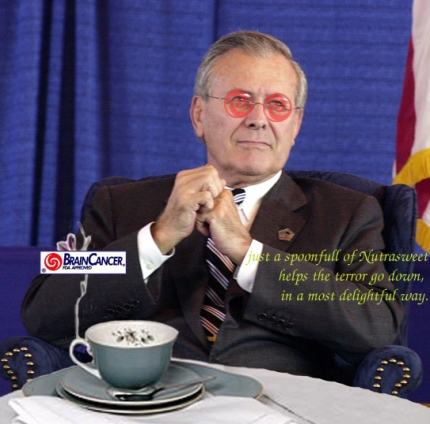
So, how does the fellow in the cover picture figure into this equation?

If you do not recognize the face in the feature photo, here is a memory refresher: The man in the pic — and up to his ears in the aspartame controversy — is Donald Rumsfeld. Perhaps best known as Secretary of Defense during the George W. Bush presidency, Donald Rumsfeld also happened to be CEO of the G.D. Searle drug company when Ronald Reagan was sworn in as President of the United States on January 1981.

Regardless of its safety or potential peril, the fact remains that without the clout and political influence of Donald Rumsfeld, aspartame might never have been approved for human use at all.

Donald Rumsfeld, who at one time aspired to be Reagan’s running mate, was a member of the new president’s transition team. Part of the team’s duties involved the selection of a new FDA Commissioner. Rumsfeld et al chose a pharmacist with no experience in food additive science to lead the agency.

On January 21, 1981, Ronald Reagan’s first full day as president, the G.D. Searle company, headed by Donald Rumsfeld, reapplied for FDA approval of aspartame. That same day, in one of his first official acts, President Reagan issued an executive order that rescinded much of the FDA commissioner’s power.

In April 1981, newly appointed FDA commissioner Arthur Hayes Hull, Jr., put together a five-person panel tasked to reevaluate the agency’s 1975 decision to not approve aspartame as a food additive. At first, the panel voted 3-2 to uphold non-approval of the chemical sweetener. Hayes then invited another member to the official FDA panel, and the vote was retaken. The panel deadlocked, and Hayes contributed his own vote to break the tie. Two months later, the product that the FDA refused to approve for seven long years was suddenly approved for human consumption.

Four years later, in 1985, the Monsanto corporation bought G.D. Searle and established a separate division, The NutraSweet Company, to manage the sales and public relations of one of its best-selling and most profitable products. It may be worth noting that when Monsanto purchased Searle and the patent on aspartame, Donald Rumsfeld reportedly received a fat $12 million bonus.

Before reading this, how much did you know about the origins of aspartame? If you’re like most Americans, the answer is “not much.” And, if you’re like many Americans, your interest in a story such as this one will wane as soon as the next hot topic comes along. Perhaps this is the reason that there has been little if any public outcry regarding aspartame or the weird way that it received FDA approval.

Updates:

In 1987, UPI investigative journalist Gregory Gordon reported that Dr. Richard Wurtman, a neuroscientist at Massachusetts Institute of Technology and a die-hard supporter of aspartame during its 1981 rush to approval, had reversed his thoughts on the sweetener. He noted the once-ardent supporter as saying his views had evolved along with scientific studies and his increased skepticism of industry research standards.

In 1997, the U.K. government obliged makers of sweetened food to prominently include the words “with sweeteners” on product labels. Ten years later, U.K. supermarket chain Mark & Spencer announced the end of artificial sweeteners and coloring in their chilled goods and bakery departments, according to the Daily Mail.

In his well received 2007 book, Rumsfeld: His Rise, Fall and Catastrophic Legacy, author Andrew Cockburn described the results of the 1977 FDA task force that found “falsifications and omissions” in Searle’s research data. The New York Times called author Cockburn’s biographical tome “quite persuasive.”

In 2009, Woolworths, a South African retailer, announced that it would no long brand products containing aspartame.

On February 28, 2010, Dr. Arthur Hayes Hull, Jr., the FDA Commissioner who hurried aspartame to market and later squelched public fear of Tylenol during the 1982 poisoning scare, died in Connecticut. According to his New York Times obituary, Hayes was employed as president of E. M. Pharmaceuticals after his term at the FDA. Hayes succumbed to leukemia at age 76.

A 2011 report in the Huffington Post noted that 10,000 American consumers notified the FDA about the ill effects of aspartame between 1981 and 1995. According to the article, the use of aspartame elicited more complaints than any other product in history, comprising 75 percent of complaints received by the U.S. Food and Drug Administration.

In 2013, the EFSA (the British equivalent of the FDA), reiterated its claim that aspartame is harmless. Professor Erik Millstone responded with his own reevaluation of aspartame, in which he noted that every study the EFSA used to approve aspartame was funded by the same industry that manufactures and profits from the controversial sweetener.

Dr. John W. Olney passed away at the age of 83 on April 14, 2015. In addition to his campaigns against aspartame and glutamate, the doctor devoted half a century of his life to finding a cure for Multiple Sclerosis, the crippling neurological disease that claimed his own sister when she was 16. According to the St. Louis Post Dispatch, cause of death of the pioneering brain researcher included complications of ALS, a neurological disorder more commonly known as Lou Gehrig’s Disease.

Those interested in learning more about the approval of aspartame are invited to read the FDA Commissioner’s Final Report, published by the Department of Health and Human Services on July 24, 1981. A detailed version of the aspartame timeline is available at Rense.com.

The Color Counterrevolution Cometh

color_revolutions

By Dmitry Orlov

Source: Club Orlov

Had Sun Tsu co-authored a treatise on the art of sports with Capt. Obvious, a quote from that seminal work would probably read as follows:

If your team keeps playing an offensive game and keeps losing, eventually it will end up playing a defensive game, and will lose that too.

Stands to reason, doesn’t it? The team I have in mind is the neocon-infested Washington régime, which is by now almost universally hated, both within the US and outside of its borders, and the offensive game is the game that has been played by the Color Revolution Syndicate, with George Soros writing the checks and calling the shots. Having lost ground around the world, it is now turning its attention to trying to hold on to its home turf, which is the US.

Behind the Washington régime stands a group of transnational oligarchs, including many of the richest people in the world, and the game they play is as follows:

1. Saddle countries around the world with unrepayable levels of debt, most of which is stolen as soon as it is disbursed, leaving a population perpetually saddled with onerous repayment terms. This used to be done by the US to countries around the world, and has most recently been done to the US itself.

2. This game often results in rebellion, and the well-bribed national leaders in the rebellious countries are expected to put down the rebellion using any means necessary. But if they fail to suppress the rebellion, or if they side with the rebels, then they need to be regime-changed and replaced with a more subservient leadership, and the Color Revolution Syndicate swings into action.

3. The first ploy is to organize young people into a “nonviolent” protest movement (“nonviolent” is in quotes because mobbing the streets, shutting down commerce and blocking access to public buildings are all acts of violence). Their goal is to erode the boundaries of what’s allowed, until law and order break down and chaos and mayhem take over. At that point, the leadership that is to be regime-changed is supposed to jump on a plane never to be heard from again. But if they fail to do so, the next step in the program is…

4. Mass murder. Snipers are flown in and kill lots of people indiscriminately, while Western media blames the deaths on the soon-to-be-overthrown government. At this point most national leaders, sensing that their lives are at risk, choose to flee. This is what happened with the Ukraine’s Yanukovich. But sometimes, as happened with Egypt’s Hosni Mubarak, they simply retreat to a well-defended residence outside the capital and wait things out. And then a magic thing happens: the revolution chokes on itself. Local self-defense units form to protect neighborhoods; out of them emerges a partisan movement to thwart attempts by foreigners to further destabilize the country; and, after much bloodshed, law and order and a legitimate government return. This could have happened in Egypt, if it weren’t for the efforts of traitors within Mubarak’s own government. But then there is always…

5. Political assassination. If mass murder doesn’t work, it’s time to send in the assassins and physically eliminate the leadership. This has happened in Libya. As Hillary Clinton put it, paraphrasing Julius Caesar, “We came, we saw, he died!” Beware the Ides of March, Hillary!

By this time, it generally has to be conceded that the Color Revolution did not go according to plan, and the Washington régime starts doing its best to pretend that the sad country in question doesn’t exist. If someone manages to make it past face control and has the temerity to point out that it does exist, then the point is made doesn’t matter because it isn’t a vital interest. As Obama just pointed out [paraphrased by Jeffrey Goldberg writing for The Atlantic]: “Ukraine is a core Russian interest but not an American one.” This caused one Zbigniew Brzezinski to spit up all over his shirt. To be sure, there is fine comedy to be had when things don’t go according to plan for the Washington régime.

Recently, things have only been going downhill for the Color Revolution Syndicate. George Soros’s NGOs, which have been used to organize Color Revolutions, have been kicked out of both Russia and China; the silly “Umbrella Revolution” in Hong-Kong went nowhere slowly; Russia used its military training budget to rescue the government in Syria and to thrash ISIS and friends, and then moved on to negotiating a political settlement. And when Soros, in a fit of pique, tried to attack the Chinese currency, the Chinese laughed in his face and beat him about the head and shoulders with a printing press until he retreated.

Not only that, but things haven’t been going so well for the Washington régime either. The fake Democrat/Republican duopoly, which it has been using to simulate democracy and to disguise the fact that it’s all made to order for the same bunch of transnational oligarchs, is in trouble: a barbarian is at the gates. His name is Donald Trump, and he’s had the régime in his sights for many years. And now he is moving in for the kill.

Trump isn’t even that good at it, but this is a super-easy job. As I said, the Washington régime is just as hated within the US as it is around the world, if not more. Trump’s slogan of “Make America great again!” may sound overly ambitious, but what if his promise is to make America great again at exactly one thing—throwing members of the Washington régime on the ground and stomping on their heads until they pop? I am pretty sure that he can get this done.

Moreover, Trump doesn’t even try to be that good, although he is certainly very good at causing people to lose their minds. I came across one commentator who bounced off Carl Jung’s proto-new-age woo-woo on Hitler being a reincarnation of the Norse god Wotan and went on to claim that Trump is a reincarnation of Wotan’s brother Loki the Trickster. But here is a much simpler idea: Trump is an epitome of Trump. He enjoys being himself, and the unwashed multitudes find this aspirational because they are sick and tired of being told how they should think and behave by a bunch of clueless puppets.

Lastly, Trump gets a lot of help—from his enemies. All they have to do for him to prevail is to carry on being themselves—saying politically and perhaps even factually correct things, toeing the party line, carefully distancing themselves from Trump, repeating the talking points fed to them by Washington think tanks and generally being as useless and boring as possible. Then all Trump has to do to win is to distinguish himself from them by being rude, crude, vulgar, crass, obnoxious and raucously fun. Can you figure out on your own which one the people will pick—useless and boring or raucously fun—or will I need to summon Capt. Obvious again?

The Washington régime, and the oligarchs that back it and profit from it, have finally groked all of this, which is why they have been huddling and trying to organize a Color Counterrevolution that can stop Trump in his tracks. Soros and the ‘garchs started throwing around big bags of cash to get the counterrevolution on even before the actual Trump revolution happens. They were initially successful, shutting down a venue in Chicago with the help of Soros-owned Moveon.org. But it seems doubtful that they will prevail in the end. Instead, it seems more likely that they will give rise to a partisan movement.

You see, in the US hatred of the Washington régime runs very deep, with millions of people sick and tired of being swindled by various hated bureaucracies—in government, law, medicine, education, the military, banking… They hate those who took away their jobs and gave them to foreigners and immigrants. They hate those who stole their retirement savings and ruined their children’s futures. They hate the smug university types who keep telling them what to think and how to speak, making them feel inadequate simply for being who they are—salt of the earth Americans, racist, bigoted, small-minded, parochial, willfully ignorant, armed to the teeth and proud of it. There is very little that the régime can ask of these people, because the response to every possible ask is “no, because we hate you.”

And when these people, who are already seething with hatred, look at the political landscape, what do they see? They see the Democrats pushing the candidacy of the banker-crony-crook Clinton, and the only alternative is the full-socialistard “I am from the US government and I am here to help” Sanders who seems to be stuck in some sort of Great Society time warp. (There may be governments that get socialism right; the US government will never be one of them.)

They also see that the Republican establishment, previously so full of pseudorevolutionary puffery, is now so afraid of Trump that it would rather throw the election to the Democrats than support their own candidate, and this fills them with anger and disgust. Take all that seething hatred, mix in lots of anger and disgust, knead it, let it rise, and now you can bake a popular insurgency.

And a popular insurgency, or a partisan movement, is exactly what it takes to defeat the Color Revolution Syndicate. You see, the official authorities, be they the police, the army, the secret service or private security, are limited in the things they can do. In some ways, their hands are tied: if they violate law and order in order to defend law and order, they become mired in self-contradiction, and that just makes it more difficult for them to defend it the next time around.

But the partisans can do anything they want. They can infiltrate the protest movement and commit acts of violence in order to provoke the authorities into taking perfectly justifiable action. They can act to misdirect, demoralize and splinter protest groups. They can use social media to “out” the Color Revolution’s leaders and those who finance them (who, to remain effective, must hide in the shadows). They can liaise with the official authorities and trade favors for information.

If the Color Revolution shows signs of proceeding to the point where the tactics of Massacre and Political Assassination are about to be tried, they can form commando units, to make sure that these tactics lead to some massive unintended consequences, preventing their productive use. And if all else fails, they can form a guerrilla movement which, in order to win, simply has to not lose.

If all goes well then, starting next year, tens of thousands of Washington operatives, along with their friends in various politically connected industries, such as banking, defense, medicine and education, will evacuate to a variety of nonextradition countries (which will no doubt respond by raising the prices of their passports) while thousands more will begin their lengthy sojourns at federal penitentiaries. And thus the crisis will be defused.

And if it doesn’t go well, then we’ll probably be looking at a “deteriorating security environment.” How far it will deteriorate is anyone’s guess, but if you are one of the Washington régime’s stooges then you may want to get yourself a second passport before the prices go up and get out ahead of time.

It’s Not Just the Corrupt, Cronyist Republican Party That’s Imploding–the Corrupt, Cronyist Democratic Party Is Imploding, Too

Democrat-USA-logo-cut

By Charles Hugh Smith

Source: Of Two Minds

Anyone who thinks the Democratic Party isn’t imploding for the exact same reasons the Republican party is imploding is purposefully ignoring reality.

Legions of pundits are crawling out of the woodwork to gloat over the implosion of the Republican Party. Corrupt, crony-capitalist, Imperial over-reach–good riddance.

But far fewer pundits dare declare that the other corrupt, crony-capitalist party of Imperial over-reach–yes, the Democratic Party–is imploding, too, for the same reason: it too is rotten to the core and exists solely to protect the privileges of the few at the expense of the many.

Democrats need to ask themselves: if Hillary Clinton is the shining epitome of what the Democratic Party stands for and represents, then what does the Democratic party stand for other than corruption, greed, pay-to-play, Imperial over-reach, elites who are above the law, and a permanent war state overseen by a corporatocracy bent on protecting the unearned privileges of the few at the expense of the many?

How about the Clintons’ $153 million in speaking fees? Just good ole democracy in action?

How about Hillary’s “super-delegates”–you know, the delegate system that makes the old Soviet Politburo look democratic by comparison. Hillary has rigged the media coverage, a fact that is painfully obvious to anyone who is non-partisan. The New York Times, for example, couldn’t wait to announce in blaring headlines that Hillary regains the momentum after she rigged a couple-hundred vote caucus in Nevada–and barely won that.

The mainstream media fell all over themselves to declare Hillary the clear winner in the Michigan debate, and were delighted to run story after story of Hillary’s commanding 21-point lead– all designed, of course, to discourage Sanders supporters from even going to the polls.

It was obvious to non-partisan observers that Sanders won the debate–no question. And he went on to trounce Clinton despite her “commanding 21-point lead”, which was quickly finessed away by a servile corporate media.

How many pundits are commenting on the fact that Democratic voters are staying away in droves? Or that–according to one zany poll–venereal disease is more popular than Hillary among young quasi-Democratic voters?

Every American knows the system is rigged to guarantee the skim of the protected classes. Insider Peggy Noonan recently penned an essay calling out the protected class, which can only be protected by stripmining the unprotected: Trump and the Rise of the Unprotected.

The only difference between the two parties’ protected class is the Democrats protect public union employees from any market or fiscal realities, until their unaffordable pay and health/pension benefits bankrupt local governments. At that point, the party bosses will come crying to Washington, D.C. to bail out benefit and payroll costs that were never fiscally viable in the first place.

The protected classes love the Status Quo, because it exists to protect their privileges. The unprotected classes loathe the Status Quo for the same reason.

Anyone who thinks the Democratic Party isn’t imploding for the exact same reasons the Republican party is imploding is purposefully ignoring reality–a reality that threaten the protected classes’ lock on wealth and power.


The Control-Matrix is Crashing because the Truth-Seekers are Winning

36da1558948450f9941d79cffcde69e0

By Phillip J. Watt

Source: The Mind Unleashed

The way the masses view the world is a farce. Every single mainstream perspective is either purposely deceptive, or completely misses the point. Even the people in places of influence who we’re meant to trust have either sold out, or are just plain ignorant to the facts. There’s no need to have a heavy heart though; the matrix of control is crashing because the truth-seekers are dealing heavy blows to the false narratives that have for too long shaped the collective mindset of humanity.

Of course the internet can be celebrated for being the primary mechanism which has amplified the sharing of information across location, race, culture and belief systems. In retrospect, the powers-that-will-no-longer-be would be kicking themselves for not trying harder to institute their insidious plan for humanity prior to the birth and growth of the world-wide-web.

Make no mistake though; they have been very successful on many fronts. For example, try to imagine a world where:

      • most journalists don’t report the real news;
      • the majority of doctors don’t truly understand the causes of poor health and how to legitimately resolve it;
      • a high proportion of politicians don’t know how the money supply works and what the agenda is of those who control it;
      • many so-called expert scientists ‘believe’ in a discredited philosophy which resembles a dogmatic religion;
      • the majority of teachers don’t realize they’re teaching a system of indoctrination that nowhere near gets close to the information and critical thinking that should be afforded our kids; and

the masses are not only ill-informed, divided and feverishly fighting against each other over small and irrelevant topics, but they’re also sleepwalking through one of the most majestic and reverent realities that could have ever been conceptualized.

Well, welcome to our world.

As we begin what we call the 21st Century, every system that should be designed to facilitate the health and vitality of the people has been hacked with lies, deception, dysfunction and disharmony. It’s easy to think that this is an embarrassment for our species because it’s beneath our intelligence and ethical capacity, yet there’s no need to lose faith in the inevitable betterment of humanity, including the way in which we organize and economize our societies.

Why? Because all of this dysfunction has been an effective driver of the collective awakening that is rising in the hearts and minds of humanity.

The inspiring fact is that more and more people are slowly waking up and realizing we all have the opportunity to come to our own, informed opinion on the truth, pertaining to both the spiritual and systemic realities. So many more people now understand the mainstream news is not to be taken seriously as its not where we can find information which is aligned with the deeper truths. They’re also acknowledging that we have the choice on what we decide to personally stand and fight for, as well as the legacy we leave for our children and our future generations.

Beware though; once we exit the matrix of control we’re faced with some serious challenges. We have a lot of inner work to do, such as designing a philosophy that ensures we’re at peace, as well as exercising patience in the quest to take back our liberties and design a legitimate and honorable future for humanity.

That’s why we’ve got to feel for those who have been long aware of the many dysfunctions of our world, especially those who have not learned peace and patience. Slowly they’ve watched:

    • the military-industrial-media-politico-banking complex increase their power and continue their pillage across the world;
    • pharmaceutical monopolies amplifying the drugging of society, as well as keeping many of us sick so that they maximize their profits;
    • movements rise up only to be vilified and disassembled, such as the Occupy Movement;
    • science turned into a corporate institution, as well as further hijacked by an inaccurate and small-minded philosophy of reality;
    • wars purposely created with millions of people dying for the whims of the shadow empire;
    • radical extremists massaged into proxy armies to do dirty work for the collapsing power structure;
    • air, medicine, food and water becoming purposely more toxic;
    • governmental policy increasingly being determined by corporate/elite interests;
    • police being militarized all around the globe;
    • the education model struggling to become less of an indoctrination system; and
    • the agenda of global governance becoming closer to fruition.

Some people have known about much of this for decades, so we should commend them for continuing to fight the good fight. They might have witnessed some disheartening developments, yet as much as all this sounds dire, they’ve also seen millions of people disengage from the propaganda narratives and align themselves with the systemic and spiritual pathways that will be the next stage of our evolution.

The point is that even though we need to be patient and persevere, we should recognize and celebrate the achievements that have been made so far. As I discussed in a previous article called “Whilst the Old System Crashes a New One is Being Built”, there are:

    • economists who want to transform the Keynesian model to legitimate alternatives;
    • teachers who understand the massive holes in the indoctrination system called public education;
    • scientists who want to evolve the way energy is created and shared;
    • health practitioners who see the limits of mechanistic and pharmacological medicine and the need for the reintroduction of natural and plant-based therapies;
    • journalists who demand that the media monopolies need to be disassembled;
    • environmentalists who want to transition the way food is grown and distributed;
    • community leaders who aim to reintegrate them to better support its members;
    • politicians who understand the democratic system has been hijacked by big money;
    • activists who campaign for revolutions in our value systems; and
    • futurists who want to change the systemic template for our societal health and well-being.

There are many beautiful souls who are leading the charge by attempting to redesign our society back into alignment with the natural laws of our universe. We should be one of them, regardless of which way we personally decide to contribute.

To do that, we all need to be super clear within ourselves what we believe and what we want to change. There are many ways to do it too, so finding our passions and strengths is critical to playing our own small part in the shift.

It is simply no longer acceptable to keep our heads in the sand; either we’re a minion of the system or we’re not. Of course its difficult to completely disconnect from the way resources flow through the control channels, yet that needn’t stop us from talking about it, sharing information online and somehow contributing, no matter how small, to local and global movements which aim to transition humanity into the new paradigm of abundance.

After all, the truth is what it is, and it is exposing itself to the world by powerfully flowing through all of us.

Ultimately, we needn’t wait for the zombie apocalypse because its already arrived. Most people are good people, yet the masses have been brainwashed into thinking in ways that are absolutely nowhere near aligned to the truth. They might be sleepwalking through a time where the tipping point for the conscious society builds, but that doesn’t mean they’re not salvageable. That’s why we all have a responsibility to help facilitate waking up the collective so that together we’re more empowered and informed to really bring about a future of justice and honor that we can all be proud of.

To do so, let me give you some advice. Don’t get frustrated, don’t be rude, don’t belittle, don’t condemn. We all had to wake up at one stage so its hypocritical if we are. Instead, be calm, be cool, be real, be articulate. Know the information that you advocate like the back of your hand. If we want to be successful in helping others to face the delusions then we need to ensure their defense mechanisms aren’t raised so they’re more likely to be open and receptive to embrace the truth.

And one more thing; hang in there guys and be patient, we’ve still got a long, arduous way to go but we know all the effort will be worth every second.

ABOUT THE AUTHOR
Phillip J. Watt lives in Australia. His written work deals with topics from ideology to society, as well as self-development. Follow him on Facebook or visit his website.

Saturday Matinee: Can Dialectics Break Bricks?

candialectics

From Wikipedia:

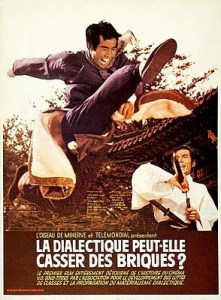
La Dialectique Peut-Elle Casser Des Briques?, in English, “Can Dialectics Break Bricks?”, is a 1973 Situationist film produced by the French director René Viénet which explores the development of class conflict through revolutionary agitation against a backdrop of graphic kung-fu fighting.

The film uses 1972 martial arts film Crush by Tu Guangqi, which tells the story of anti-colonialist revolt in Korea during the period of Japanese occupation, for its visuals which has been dubbed over by the filmmakers in an attempt at détournement. The concept and motivation of this film was to adapt a “spectacular” film into a radical critique of cultural hegemony and thus into tools of subversive revolutionary ideals.

The Narrative is based upon a conflict between the proletarian and bureaucrats within state capitalism. The proletarians enlist their dialectics and radical subjectivity to fight their oppressors whilst the bureaucrats defend themselves using a combination of co-optation and violence. The film is noted for its humorous approach to this serious subject matter.

The film also contains many praising references to revolutionaries who thought and fought for the realisation of a post-capitalist world, including Marx, Bakunin, and Wilhelm Reich, as well as scathing criticism towards the French Communist Party, trade unionism and Maoism. Also Subplots dealing with issues of gender equality, alienation, Paris Commune, May 1968, and the Situationist themselves are riddled throughout the film.

https://vimeo.com/60948078