The truth about « fake news »

While NATO was busy setting up a vast network with which to accuse Russia of perpetuating propaganda from the Soviet era, Washington was suddenly swamped by a wave of hysteria. In an attempt to discredit the new US President, the dominant media accuse him of talking rubbish – in response, the President accuses them of propagating fake news. This cacophony is amplified by the swift development of the social media, which had once been intended for use as weapons of the State Department against nationalist regimes, but which today are popular forums used to combat abuse by all kinds of elites – with Washington at the top of the list.

By Thierry Meyssan

Source: Voltaire Network

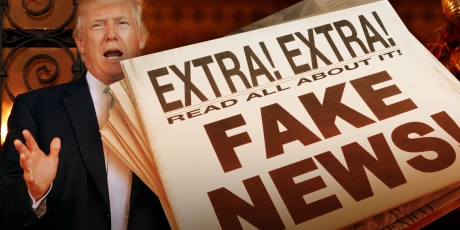
As soon as the announcement of his surprise election was made public, and even before he had access to the White House, the immense majority of US and NATO media began screaming about the negligence and insanity of President Trump. Battle was joined between the media class and the new President, with each side accusing the other of propagating fake news.

Almost everywhere in the NATO countries – and only in these countries – political representatives began denouncing fake news. This was intended to reveal the supposed influence of Russian propaganda within the « Western democracies ». The State which has been the most seriously impacted by this campaign is France, whose President Emmanuel Macron recently announced the drafting of a law specifically aimed at fighting these « attacks on democracy », but only during « an electoral period ».

The fact that the English expression fake news is maintained in all the languages of the NATO countries attests to the Anglo-Saxon origin of the problem, when in fact the phrase designates a phenomenon as old as the world – false information.

At the origin of the campaign against « fake news » – NATO

In 2009, at the NATO summit in Strasbourg-Kehl, President Obama announçed his intention of creating an Alliance « Strategic Communication » service [1]. It took six years to implement, using elements of the 77th Brigade of the British Land Army and the 361st Civil Affairs Brigade of the United States Land Army (based in Germany and Italy).

At first, their mission was to counter communications accusing the US deep state of having itself organised the attacks of 9/11, then those accusing the Anglo-Saxons of having planned the « Arab Springs » and the war against Syria — such communications were termed « conspiracy theories ». However, the situation evolved rapidly in such a way as to convince the populations of the Alliance that Russia was continuing to apply propaganda from the Soviet era – and thus that NATO was still useful.

Finally, in April 2015, the European Union created a « Work Group for Strategic Communications – East » (East StratCom Task Force). Every week, this group addresses a report on Russian propaganda to thousands of journalists. For example, its last edition (dated 11 January 2018) accuses Sputnik of pretending that the Copenhagen zoo feeds its predators with abandoned household pets. Lord help us, the « democracies » are under attack ! Clearly, it is difficult for these specialists to find meaningful examples of Russian interference. In August of the same year, NATO inaugurated its « Centre for Strategic Communication » in Riga (Latvia). The following year, the US State Department created a Global Engagement Center which works on the same principles.

How Facebook, Hillary Clinton’s pet obsession, turned against her

In 2009, Secretary of State Hillary Clinton, at the instigation of Jared Cohen (leading member of the Policy Planning Staff ), persuaded herself that it was possible to overthrow the Islamic Republic of Iran by manipulating the social media. This theory did not have the desired affect. However, two years later, in 2011, the same Jared Cohen — since become the the CEO of Google Ideas — managed to mobilise the youth of Cairo. Although the « revolution » of Tahrir Square had not swayed the opinion of the Egyptian people, the myth of the extension of the American way of life via Facebook was born. As a result, the State Department sponsored a number of associations and assemblies to promote Facebook.

However, the US Presidential election of 2016 was a shock. An outsider, real estate promoter Donald Trump, eliminated all his rivals one by one, including Hillary Clinton, and was swept into the White House, having benefited from the advice of Facebook. For the first time, the dream of the Muse of professional politicians became reality, but worked against her. Overnight, Facebook was demonised by the dominant Press.

It became evident on this occasion that it is possible to artificially create crowd movements with the social media, but that after a few days, media users regain their senses. This is the constant fact for all systems of information manipulation — they are fleeting. The only form of lie which makes it possible to create long-term behaviour patterns supposes that one has forced the citizens into a form of minor engagement, in other words, that one has brainwashed them [2].

Indeed, Facebook understood this very well, creating its « Politics & Government Outreach Program » and handing it over to the care of Katie Harbath. It was intended to create collective emotions in favour of one client or another, but does not seek to organise lasting campaigns [3]. This is why President Macron proposes to legislate the social media only during electoral periods. He was himself elected thanks to a brief disorder created jointly by a weekly newspaper and Facebook against his rival François Fillon — an operation orchestrated by Jean-Pierre Jouyet [4]. Furthermore, Emmanuel Macron’s fear that next time the social media may be used against him fits with NATO’s desire to demonstrate the continuity of USSR-Russia propaganda. As an example of manipulation, Macron therefore cites an interview with Sputnik concerning his private life and the publishing of an allegation concerning a foreign bank account.

The Christopher Steele Report

During the US Presidential campaign, Hillary Clinton’s team ordered an inquiry on Donald Trump from an ex-agent of the British Secret Services, Christopher Steele. Ex-chief of MI6’s « Russia House », he was known for his scandalous and always unverifiable allegations. After having accused Vladimir Putin, without proof, of having commanded the poisoning of Alexander Litvinenko by Polonium 210, he accused him of having caught Donald Trump in a sex trap and blackmailing him. The Steele Report was then discretely handed to various journalists, politicians and master spies, and finally published [5].

This is the source of the hypothesis according to which, seeking to get his puppet elected and hamper the election of Hillary Clinton, the lord of the Kremlin had ordered « his » media to buy publicity on Facebook and spread lies about the ex-Secretary of State – a hypothesis which may be supported by a conversation between the Australian ambassador in London with one of Donald trump’s advisors [6]. It doesn’t matter that Russia Today and Sputnik only spent a total of a few thousand dollars for publicity which rarely concerned Mrs. Clinton, the US ruling class is persuaded that they turned back the popular tide in favour of the Democrat candidate and her 1.2 billion dollar campaign. In Washington, people persist in believing that technological inventions can be used to manipulate the human race.

It is no longer a question of noting that Donald Trump and his partisans ran their campaign on Facebook because the totality of the written and audiovisual Press was hostile to them, but pretending that Facebook was manipulated by Russia in order to prevent the election of the Muse of Washington.

The legal privilege of Google, Facebook and Twitter

By seeking to prove the interference of Moscow, the US Press underlined the exorbitant privilege enjoyed by Google, Facebook and Twitter — these three companies are not considered responsible for their content. From the point of view of US law, they are no more than transporters of information (common carrier).

The experiments carried out by Facebook, which demonstrated the possibility of creating collective emotions on one hand, and the legal non-responsibility of this company on the other, attest to an anomaly in the system.

Particularly since the privilege enjoyed by Google, Facebook and Twitter is clearly undue. Indeed, these three companies act in at least two different ways to modify the content they transport. First of all, they unilaterally censor certain messages, either via the direct intervention of their personnel, or mechanically, via hidden algorithms. Then they promote their vision of the truth to the detriment of other points of view (fact-checking).

For example, in 2012, Qatar ordered from Google Ideas, already directed by Jared Cohen, the creation of software which would make it possible to follow the progression of defections in the Syrian Arab Army. The point was to show that Syria was indeed a dictatorship, and that the people were beginning to revolt. But it very quickly became clear that this vision of affairs was false. The number of soldiers who defected never rose above 25,000 in an army of 450,000 men. This is why, after having promoted the software, Google discretely retired it.

Conversely, for seven years, Google promoted articles which relayed communiqués from the Syrian Observatory for Human Rights (SOHD). Day after day, they gave the exact count of the number of victims in both camps. Of course, these figures are imaginary – it is impossible for anyone to count them. Never, in a time of war, has a state been able to determine, on a daily basis, the number of soldiers killed in combat and the civilians killed behind the lines. And yet, in the United Kingdom, the SOHD claims to know what the people who live there, in Syria, cannot know.

Far from being just the common carriers, Google, Facebook and Twitter are the forgers of the information they transport, and as such, they ought to be counted legally responsible for their content.

The rules of the freedom of expression

Let’s imagine that the efforts of NATO and those of President Macron against Russia in terms of audiovisual Internet traffic meet with failure. It is nonetheless necessary to enter these new medias into general law.

The principles which regulate the freedom of expression are only legitimate if they are identical for all citizens and for all media. This is not the case today. While the general law applies, there is no specific rule concerning denial or the right to reply for the messages on Internet and the social media.

As always in the history of information, the old medias attempt to sabotage the new. Thus I remember the violent editorial that the French daily Le Monde dedicated in 2002 to my work on the Internet concerning the responsibility for the attacks of 9/11. What shocked the newspaper just as much as my conclusions was that the Voltaire Network was free from the financial obligations of which it felt prisoner [7]. This is the same corporatist attitude that it demonstrates again, fifteen years later, with its service, Le Decodex. Rather than developing a critique of the articles or videos of the new medias, Le Monde proposes to note the reliability of its rival Internet sites. Of course, only the sites issued by their paper colleagues find grace in their eyes, all the others are judged less trustworthy.

To shore up the campaign against the social media, the Fondation Jean-Jaures (that is to say the foundation of the Socialist Party linked to the National Endowment for Democracy) has published an imaginary poll [8]. With a display of numbers, it aims to demonstrate that unsophisticated people – the working classes and the partisans of the National Front – are gullible. It claims that 79 % of French people believe in one conspiracy theory or another. As proof of their naïveté, it points out that 9 % of them are convinced that the Earth is flat.

However, neither myself nor any of my French friends consulted by Internet have ever met any of our compatriots who believe that the Earth is flat. The figure is obviously invented and discredits the entire study. As it happens, although it is linked to the Socialist Party, the Fondation Jean-Jaures still has Gerard Collomb as its general secretary – Collomb has since become President Macron’s Minister for the Interior. This same foundation had already published, two years ago, a study aimed at discrediting the political opponents of the system that it already qualified as « conspiracy theorists » [9].


Translation
Pete Kimberley


Freedom Rider: Oligarch Jeff Bezos

By Margaret Kimberley

Source: Intrepid Report

Amazon CEO Jeff Bezos has a net worth of $105 billion and is the richest man in the world. But he is not just the richest man at this moment in history. He is the richest person who has ever lived. As of 2017 he and seven other billionaires had a collective net worth equal to that of the poorest 3.6 billion people on earth.

These figures have been in the news of late but without much useful analysis. The corporate media refuse to state what is obvious. Namely that inequality is worse around the world precisely because these super rich people demand it.

While pundits and politicians go on breathlessly about oligarchs in Russia, they seldom take a look at the wealthiest in their own backyard and the control they exert over the lives of millions of people. When Amazon announced it would choose a site for its new headquarters, cities across the country began a furious race to the bottom. Amazon is not alone in the thievery department. Major corporations like Walmart always request and receive public property and public funds in order to do business.

Some 235 cities have put themselves in the running for this dubious venture. Chicago is willing to give Amazon $1.3 billion in payroll taxes that prospective employees would ordinarily pay that city. If Chicago wins this booby prize, Amazon employees would pay taxes to their employer and not to the government. This is truly cutting out the middle man and makes real the rule of, by, and for the wealthiest.

The potential for public outrage isn’t lost on unprincipled politicians. Some cities now refuse to reveal how much they plan to give away. But the news to date is disheartening with Boston offering $75 million while Houston is willing to part with $268 million. Amazon says it will hire 50,000 people but their business model already pays employees so little that many of them qualify for public assistance, despite being employed.

The United States is as much of an oligarchy as countries it usually disparages but it is far more dishonest about its true nature. All talk of democracy is a lie as the rich get richer, by an additional $1 trillion in 2017, and wield more and more power over the lives of everyone else.

The Bezos juggernaut is not restricted to theft of public money. He is also the sole owner of the Washington Post, one of the most influential newspapers in the country. Bezos owns a newspaper that is an organ of the ruling elite and he also has a $600 million contract to provide the Central Intelligence Agency with cloud computing services.

The Washington Post was the force behind Propaganda or Not, an effort to destroy left wing voices like those at Black Agenda Report. Under the guise of fighting Russia and so-called fake news, the Bezos owned Post began the censorship campaign that has put the left’s presence on the Internet in such jeopardy.

Politicians outdo one another giving away public resources to the richest man on the planet who also owns a major newspaper and services the surveillance state. If it can be said that any one person rules the world, Bezos would be obvious choice. No one in Chicago, Boston, Houston or any of the other cities giving away the store ever voted for Jeff Bezos. All talk of democracy is a sham as long as the richest people take from the rest of humanity.

The effort to make government an irrelevance is thoroughly bipartisan. Republicans and Democrats alike are willing to turn over government coffers to Bezos and his ilk and the rights of the people be damned.

Whoever wins this tarnished brass ring ought to be consigned to political defeat. The mayor, aldermen, city council members or whoever else brings disaster to their locality should be punished for aiding and abetting the theft. If these cities can give to the richest man who ever lived, they can surely use public money to help their residents right now. But they will never do that because they are all bought off and compromised. They are either cynical or afraid to go against the real rulers of the country.

Bezos may look like the villain in a James Bond movie but there is nothing funny about him. He is deadly serious and so are his intentions. In a Bezos run world, every worker will be impoverished, every level of government will subsidize corporations, and anyone who speaks out will be discredited and under surveillance.

The last thing any city needs is a new Amazon headquarters. We need an end to billionaire rule in this country and around the world. That will be the salvation of the people, not more sweatshops run by wealthy people who steal from everyone else.


Margaret Kimberley’s Freedom Rider column appears weekly in BAR, and is widely reprinted elsewhere. She maintains a frequently updated blog as well as at freedomrider.blogspot.com. Ms. Kimberley lives in New York City, and can be reached via e-Mail at Margaret.Kimberley(at)BlackAgendaReport.com.

Financial Tyranny: ‘We the People’ Are the New Permanent Underclass in America

By John W. Whitehead

Source: The Rutherford Institute

“When plunder becomes a way of life for a group of men in a society, over the course of time they create for themselves a legal system that authorizes it and a moral code that glorifies it.” ― Frédéric Bastiat, French economist

Americans can no longer afford to get sick and there’s a reason why.

That’s because a growing number of Americans are struggling to stretch their dollars far enough to pay their bills, get out of debt and ensure that if and when an illness arises, it doesn’t bankrupt them.

This is a reality that no amount of partisan political bickering can deny.

Many Americans can no longer afford health insurance, drug costs or hospital bills. They can’t afford to pay rising healthcare premiums, out-of-pocket deductibles and prescription drug bills.

They can’t afford to live, and now they can’t afford to get sick or die, either.

To be clear, my definition of “affordable healthcare” is different from the government’s. To the government, you can “afford” to pay for healthcare if your income falls above the poverty line. That takes no account of rising taxes, the cost of living, the cost to clothe and feed a household, the cost of transportation and communication and education, or any of the other line items that add up to a life worth living.

As Helaine Olen points out in The Atlantic:

Just because a person is insured, it doesn’t mean he or she can actually afford their doctor, hospital, pharmaceutical, and other medical bills. The point of insurance is to protect patients’ finances from the costs of everything from hospitalizations to prescription drugs, but out-of-pocket spending for people even with employer-provided health insurance has increased by more than 50 percent since 2010.”

For too many Americans, achieving any kind of quality of life has become a choice between putting food on the table and paying one’s bills or health care coverage.

It’s a gamble any way you look at it, and the medical community is not helping.

Healthcare costs are rising, driven by a medical, insurance and pharmaceutical industry that are getting rich off the sick and dying.

Indeed, Americans currently pay $3.4 trillion a year for medical care. We spent more than $10,000 per person on health care in 2016. Those attempting to shop for health insurance coverage right now are understandably experiencing sticker shock with premiums set to rise 34% in 2018. It’s estimated that costs may rise as high as $15,000 by 2023.

As Bloomberg reports, “Rising health-care costs are eating up the wage gains won by American workers, who are being asked by their employers to pick up more of the heftier tab… The cost of buying health coverage at work has increased faster than wages and inflation for years, pressuring household budgets.”

Appallingly, Americans spend more than any developed country on healthcare and have less to show for it. We don’t live as long, we have higher infant mortality rates, we have fewer hospital and physician visits, and the quality of our healthcare is generally worse. We also pay astronomical amounts for prescription drugs, compared to other countries.

Whether or not you’re insured through an employer, the healthcare marketplace, a government-subsidized program such as Medicare or Medicaid, or have no health coverage whatsoever, it’s still “we the consumers” who have to pay to subsidize the bill whenever anyone gets sick in this country. And that bill is a whopper.

While Obamacare (a.k.a. the Affordable Care Act) may have made health insurance more accessible to greater numbers of individuals, it has failed to make healthcare any more affordable.

Why?

As journalist Laurie Meisler concludes, “One big reason U.S. health care costs are so high: pharmaceutical spending. The U.S. spends more per capita on prescription medicines and over-the-counter products than any other country.”

One investigative journalist spent seven months analyzing hundreds of bills from hospitals, doctors, drug companies, and medical equipment manufacturers. His findings confirmed what we’ve known all along: health care in America is just another way of making corporations rich at consumer expense.

An examination of an itemized hospital bill (only available upon request) revealed an amazing amount of price gouging. Tylenol, which you can buy for less than $10 for a bottle, was charged to the patient at a rate of $15 per pill, for a total of $345 for a hospital stay. $8 for a plastic bag to hold the patient’s personal items and another $8 for a box of Kleenex. $23 for a single alcohol swab. $53 per pair for non-sterile gloves (adding up to $5,141 for the entire hospital stay). $10 for plastic cup in which to take one’s medicine. $93 for the use of an overhead light during a surgical procedure. $39 each time you want to hold your newborn baby. And $800 for a sterile water IV bag that costs about a dollar to make.

This is clearly not a problem that can be remedied by partisan politics.

The so-called Affordable Care Act pushed through by the Obama administration is proving to be anything but affordable for anyone over the poverty line. And the Trump administration’s “fixes” promise to be no better. Indeed, for too many Americans who live paycheck to paycheck and struggle just to get by, the tax penalty for not having health insurance will actually be cheaper than trying to find affordable coverage that actually pays for care.

This is how the middle classes, who fuel the nation’s economy and fund the government’s programs, get screwed repeatedly.

When almost 60% of Americans are so financially strapped that they don’t have even $500 in savings and nothing whatsoever put away for retirement, and yet they are being forced to pay for government programs that do little to enhance their lives, we’re not living the American dream.

We’re living a financial nightmare.

We have no real say in how the government runs, or how our taxpayer funds are used, but that doesn’t prevent the government from fleecing us at every turn and forcing us to pay for endless wars that do more to fund the military industrial complex than protect us, pork barrel projects that produce little to nothing, and a police state that serves only to imprison us within its walls.

We have no real say, but we’re being forced to pay through the nose, anyhow.

George Harrison, who died 16 years ago this month, summed up this outrageous state of affairs in his song Taxman:

If you drive a car, I’ll tax the street,
If you try to sit, I’ll tax your seat.
If you get too cold I’ll tax the heat,
If you take a walk, I’ll tax your feet.

Don’t ask me what I want it for
If you don’t want to pay some more
‘Cause I’m the taxman, yeah, I’m the taxman

Now my advice for those who die
Declare the pennies on your eyes
‘Cause I’m the taxman, yeah, I’m the taxman
And you’re working for no one but me.

In other words, in the eyes of the government, “we the people, the voters, the consumers, and the taxpayers” are little more than indentured servants and sources of revenue.

If you have no choice, no voice, and no real options when it comes to the government’s claims on your property and your money, you’re not free.

Consider: The government can seize your home and your car (which you’ve bought and paid for) over nonpayment of taxes. Government agents can freeze and seize your bank accounts and other valuables if they merely “suspect” wrongdoing. And the IRS insists on getting the first cut of your salary to pay for government programs over which you have no say.

It wasn’t always this way, of course.

Early Americans went to war over the inalienable rights described by philosopher John Locke as the natural rights of life, liberty and property.

It didn’t take long, however—a hundred years, in fact—before the American government was laying claim to the citizenry’s property by levying taxes to pay for the Civil War. As the New York Times reports, “Widespread resistance led to its repeal in 1872.”

Determined to claim some of the citizenry’s wealth for its own uses, the government reinstituted the income tax in 1894. Charles Pollock challenged the tax as unconstitutional, and the U.S. Supreme Court ruled in his favor. Pollock’s victory was relatively short-lived. Members of Congress—united in their determination to tax the American people’s income—worked together to adopt a constitutional amendment to overrule the Pollock decision.

On the eve of World War I, in 1913, Congress instituted a permanent income tax by way of the 16th Amendment to the Constitution and the Revenue Act of 1913. Under the Revenue Act, individuals with income exceeding $3,000 could be taxed starting at 1% up to 7% for incomes exceeding $500,000.

It’s all gone downhill from there.

Unsurprisingly, the government has used its tax powers to advance its own imperialistic agendas and the courts have repeatedly upheld the government’s power to penalize or jail those who refused to pay their taxes.

Irwin A. Schiff was one of the nation’s most vocal tax protesters. He spent a good portion of his life arguing that the income tax was unconstitutional. He paid the price for his resistance, too: Schiff served three separate prison terms (more than 10 years in all) over his refusal to pay taxes. He died at the age of 87 serving a 14-year prison term. As constitutional activist Robert L. Schulz noted in Schiff’s obituary, “In a society where there is so much fear of government, and in particular of the I.R.S., [Schiff] was probably the most influential educator regarding the illegal and unconstitutional operation and enforcement of the Internal Revenue Code. It’s very hard to speak to power, but he did, and he paid a very heavy price.”

It’s still hard to speak to power, and those who do are still paying a very heavy price.

All the while the government continues to do whatever it likes—levy taxes, rack up debt, spend outrageously and irresponsibly—with little thought for the plight of its citizens.

The national debt is $20 trillion and growing. The amount this country owes is now greater than its gross national product (all the products and services produced in one year by labor and property supplied by the citizens). We’re paying more than $270 billion just in interest on that debt annually. And the top two foreign countries who “own” our debt are China and Japan.

To top it all off, all of those wars the U.S. is so eager to fight abroad are being waged with borrowed funds. As The Atlantic reports, “For 15 years now, the United States has been putting these wars on a credit card… U.S. leaders are essentially bankrolling the wars with debt, in the form of purchases of U.S. Treasury bonds by U.S.-based entities like pension funds and state and local governments, and by countries like China and Japan.”

If Americans managed their personal finances the way the government mismanages the nation’s finances, we’d all be in debtors’ prison by now.

Still, the government remains unrepentant, unfazed and undeterred in its money grabs.

While we’re struggling to get by, and making tough decisions about how to spend what little money actually makes it into our pockets after the federal, state and local governments take their share (this doesn’t include the stealth taxes imposed through tolls, fines and other fiscal penalties), the police state is spending our hard-earned tax dollars to further entrench its powers and entrap its citizens.

For instance, American taxpayers have been forced to shell out $5.6 trillion since 9/11 for the military industrial complex’s costly, endless so-called “war on terrorism.” That translates to roughly $23,000 per taxpayer to wage wars abroad, occupy foreign countries, provide financial aid to foreign allies, and fill the pockets of defense contractors and grease the hands of corrupt foreign dignitaries.

Mind you, that staggering $6 trillion is only a portion of what the Pentagon spends on America’s military empire.

That price tag keeps growing, too.

The 16-year war in Afghanistan, which now stands as the longest and one of the most expensive wars in U.S. history, is about to get even longer and more costly, thanks to President Trump’s promise to send more troops over.

In this way, the military industrial complex will get even richer, and the American taxpayer will be forced to shell out even more funds for programs that do little to enhance our lives, ensure our happiness and well-being, or secure our freedoms.

As Dwight D. Eisenhower warned in a 1953 speech:

Every gun that is made, every warship launched, every rocket fired signifies, in the final sense, a theft from those who hunger and are not fed, those who are cold and are not clothed. This world in arms is not spending money alone. It is spending the sweat of its laborers, the genius of its scientists, the hopes of its children. The cost of one modern heavy bomber is this: a modern brick school in more than 30 cities. It is two electric power plants, each serving a town of 60,000 population. It is two fine, fully equipped hospitals. It is some fifty miles of concrete pavement. We pay for a single fighter plane with a half million bushels of wheat. We pay for a single destroyer with new homes that could have housed more than 8,000 people. This is, I repeat, the best way of life to be found on the road the world has been taking. This is not a way of life at all, in any true sense. Under the cloud of threatening war, it is humanity hanging from a cross of iron. […] Is there no other way the world may live?

This is still no way of life.

Yet it’s not just the government’s endless wars that are bleeding us dry.

We’re also being forced to shell out money for surveillance systems to track our movements, money to further militarize our already militarized police, money to allow the government to raid our homes and bank accounts, money to fund schools where our kids learn nothing about freedom and everything about how to comply, and on and on.

Are you getting the picture yet?

The government isn’t taking our money to make our lives better. Just take a look at the nation’s failing infrastructure, and you’ll see how little is being spent on programs that advance the common good.

We’re being robbed blind so the governmental elite can get richer.

This is nothing less than financial tyranny.

“We the people” have become the new, permanent underclass in America.

It’s tempting to say that there’s little we can do about it, except that’s not quite accurate.

There are a few things we can do (demand transparency, reject cronyism and graft, insist on fair pricing and honest accounting methods, call a halt to incentive-driven government programs that prioritize profits over people), but it will require that “we the people” stop playing politics and stand united against the politicians and corporate interests who have turned our government and economy into a pay-to-play exercise in fascism.

We’ve become so invested in identity politics that label us based on our political leanings that we’ve lost sight of the one label that unites us: we’re all Americans.

As I make clear in my book Battlefield America: The War on the American People, the powers-that-be want to pit us against one another. They want us to adopt an “us versus them” mindset that keeps us powerless and divided. Trust me, the only “us versus them” that matters anymore is “we the people” against the police state.

We’re all in the same boat, folks, and there’s only one real life preserver: that’s the Constitution and the Bill of Rights.

The Constitution starts with those three powerful words: “We the people.”

The message is this: there is power in our numbers.

That remains our greatest strength in the face of a governmental elite that continues to ride roughshod over the populace. It remains our greatest defense against a government that has claimed for itself unlimited power over the purse (taxpayer funds) and the sword (military might). As Patrick Henry declared in the last speech before his death, “United we stand, divided we fall. Let us not split into factions … or … exhaust [our strength] in civil commotions and intestine wars.”

This holds true whether you’re talking about health care, war spending, or the American police state.

Food for the Moon

By rahkyt

Source: Sacred Space in Time

I don’t know how to say this politely: you are part of a remorseless, psychopathic system that circumscribes your very thought processes and forms your every opinion and belief.

This system of thought, action and being envelops you like air and you can’t see it, feel it or hear it. And yet, you do see it, feel it and hear it every day because it is in your mind as it is in the mind of every person around you.

This system is designed to cull your energy through work and play, to foster its own continuation by way of your personal energetic production. And the production of every, single soul around you. its stability is dependent upon your ignorance.

Because once you become aware of it, you begin to see it everywhere. As it has always been everywhere. Been everything. It notices your awakened state and actively seeks to lull you back to sleep or, failing in that, destroying you utterly and erasing every true sign of your existence from its collective memory.

Once you choose knowledge, you are done. Once you choose truth, you are finished.

It is best to go on ahead and believe you’re dead from that very instant like the ancient Samurais of Japan used to do, for the sake of your own psychological stability moving forward.

Because move forward you must. We must. There is work to do and little time to do it. There are dragons to slay, literally, and they have been awaiting your arrival for millennia.

And now that the time of prophecy and projection is finally upon us, as those awakened souls kindle the flames of love within others and that collective and mighty roar signals the onset of the conflagration of the Ages, your options are reduced to the potentialities of the moment. The Now.

You are brought from the heights of abstract psychological and mental confabulation to the pressing, survivalist instincts that instruct you on how to make it through this moment. And the next. And the one after that.

Don’t worry. There’s no time for wasted energy. You will know what to do.

Your spirit has been preparing for this time for eternity. When the moments of your engagement arrives, you will step the steps predestined, say the words preordained and do the things you were preconceived to do.

And that is just how its going to be. So don’t waste anymore time on worry or regret. The system and its people don’t give a damn about you. Or any of us.

We’re only sustenance. Food for the moon. And Saturn, of course.


America’s Painful Self-delusion

By Allen Marshall

Source: Information Clearing House

America is the only nation brought forth by a set of beliefs, and those beliefs, captured so eloquently in our founding documents, are some of the most powerful and inspiring ever conceived. We consider this to be the land of the free, where the individual is supreme and nothing prevents us from going as far as our talents can take us. That image of America – that “brand” – is incredibly strong.

However, there’s a very large gap between that long-held image and the reality of America today. What was once a government built for the people is now a government run for the rich and powerful, one that throws the people under the bus whenever their interests differ from those of the corporate and political leaders who run the show.

And living in one world (the corrupt) while stubbornly believing you live in another (the ideal), despite mounds of evidence, causes a distinct kind of stress, often called cognitive dissonance.

Psychologists suggest that when people are in a state of cognitive dissonance, they’ll search for a way to resolve it, either by rejecting one view or the other as either wrong or unimportant. If you’re a smoker looking at the link between smoking and cancer, for example, you’ll either quit smoking or decide that the research is biased, wrong, or doesn’t apply (in other words, that you’re smart enough to quit before the long-term damage is done).

But what happens if you can’t resolve the two?

For most of us Americans, resolving our cognitive dissonance would mean either accepting that we’re impotent and living futile (and feudal) lives, or rejecting our lifestyles and actively fighting the rot in the system. If we’re not willing to do either of those, the dissonance stays – and eats at us.

People carrying this kind of ongoing, underlying stress find ways of coping with it; in America we’re doing it with self-medication, compulsive behaviors and distractions. Consider the following examples of the way we cope with the ever-present stress in our lives:

  • Drugs – Our country is awash in drugs, both legal and illegal, that keep us numb. In 2014, there were 245 million prescriptions filled for opioid pain relievers. The number of deaths from drug overdoses has risen from around 30,000 in 2005 to 64,000 in 2016. And communities across the country are being devastated by the opioid epidemic, as explained in this in-depth reporting by Cincinnati.com.
  • Drinking – People don’t only use drugs to self-medicate; drinking does the trick as well, and we’re doing a lot more of it than we used to. According to a new study in JAMA Psychiatry, overall drinking in the US increased by 11% between 2002-13, while high-risk and problem drinking rose even higher: high-risk drinking rose by 29.9%, while problem drinking rose by 50%.
  • Mental Illness – In 2015, 17.9% of adults held a diagnosis for a mental disorder, while a 2010 study found that 46.3% of children ages 13-18 had a mental disorder at some point in their young lives, and the majority of those adults and children are given prescriptions. This includes a dramatic increase in ADHD diagnoses for children: According to SharpBrains, “Among children aged 5 to 18, between 1991-92 and 2008-09, rates of ADHD diagnosis increased nearly 4-fold among boys – from 39.5 to 144.6 per 1000 – and nearly 6-fold for girls – from 12.3 and 68.5 per 1000 visits.”
  • Obesity – If drinking and drugs aren’t your thing – or even if they are – more of us are coping with stress by overeating, and it’s showing up on our waistlines. From 1990 to 2016, the average percentage of obese adults increased from 11.1% to 29.8%; when you add in the number of people who are overweight but not obese, it rises to more than two in three adults.
  • Sleeping problems – Sleep has a significant impact on our physical and mental health, and in America we’re not getting enough of it: The CDC states that 50-70 million American adults have a sleep or wakefulness disorder.
  • Media Usage – Is there any better distraction from life’s problems than media? We certainly spend a lot of our time being passively entertained: In 2016, Americans consumed an average of 10 hours of media per day, compared with 7.5 hours per day globally. Nielson reports that lower income adults spend much more time with media than do affluent adults, with adults in households with include under $25,000 watching 211 hours/month of television, versus 113 hours/month for adults in households earning $75,000 or more. (The trend is similar across other media as well.)
  • The Disease of Debt – According to the New York Fed, household debt reached a new peak in the third quarter of 2017, at $12.8 trillion. Part of our debt problem comes from the compulsive shopping we do as a distraction; the other results from denying the reality that our wages aren’t keeping up with the increase in the cost of living, meaning that we use debt to plug the gap rather than reducing our living standards to align with our reality.

We’re collectively doing so much damage to ourselves, solely to protect our psyches from the reality that the America that used to be is no longer the America we have. And who does that help? As you can see from the points above, it doesn’t help us: Instead, it helps the rich and powerful who are subverting the system. They’re corrupting everything this country once was, and by willfully refusing to acknowledge that reality, we’re inadvertently helping them to do it.

The best thing we can do – for our mental and physical health, as well as for our country – is to open our eyes to what America has become, not what we wish it still was. It’s time to face reality and take action.

Putting an End to the Rent Economy

By Michael Hudson and Vlado Plaga

Source: Unz Review

Interview with Vlado Plaga in the German magazine FAIRCONOMY, September 2017.

Originally, you didn’t want to become an economist. How did it come that you changed your plans and digged so deep into economics?

I found economics aesthetic, as beautiful as astronomy. I came to New York expecting to become an orchestra conductor, but I met one of the leading Wall Street economists, who convinced me that economics and finance was beautiful.

I was intrigued by the concept of compound interest and by the autumnal drain of money from the banking system to move the crops at harvest time. That is when most crashes occurred. The flow of funds was the key.

I saw that these economic cycles were mainly financial: the build-up of debt and its cancellation or wipe-out and bankruptcy occurring again and again throughout history. I wanted to study the rise and fall of financial economies.

But when you studied at the New York University you were not taught the things that really interested you, were you?

I got a PhD as a union card. In order to work on Wall Street, I needed a PhD. But what I found in the textbooks was the opposite of everything that I experienced on Wall Street in the real world. Academic textbooks describe a parallel universe. When I tried to be helpful and pointed out to my professors that the textbooks had little to do with how the economy and Wall Street actually work, that did not help me get good grades. I think I got a C+ in money and banking.

So I scraped by, got a PhD and lived happily ever after in the real world.

So you had to find out on your own… Your first job was at the Savings Banks Trust Company, a trust established by the 127 savings banks that still existed in New York in the 1960s. And you somehow hit the bull’s eye and were set on the right track, right from the start: you’ve been exploring the relationship between money and land. You had an interesting job there. What was it?

Savings banks were much like Germany’s Landesbanks. They take local deposits and lend them out to home buyers. Savings and Loan Associations (S&Ls) did the same thing. They were restricted to lending to real estate, not personal loans or for corporate business loans. (Today, they have all been turned into commercial banks.)

I noticed two dynamics. One is that savings grew exponentially, almost entirely by depositors getting dividends every 3 months. So every three months I found a sudden jump in savings. This savings growth consisted mainly of the interest that accrued. So there was an exponential growth of savings simply by inertia.

The second dynamic was that all this exponential growth in savings was recycled into the real estate market. What has pushed up housing prices in the US is the availability of mortgage credit. In charting the growth of mortgage lending and savings in New York State, I found a recycling of savings into mortgages. That meant an exponential growth in savings to lend to buyers of real estate. So the cause of rising real estate prices wasn’t population or infrastructure. It was simply that properties are worth whatever banks are able and willing to lend against them.

As the banks have more and more money, they have lowered their lending standards.

It’s kind of automatic, it’s just a mathematical law…

Yes, a mathematical law that is independent of the economy. In other words, savings grow whether or not the economy is growing. The interest paid to bondholders, savers and other creditors continues to accrue. That turns out to be the key to understanding why today’s economy is polarizing between creditors and debtors.

You wrote in “Killing the Host” that your graphs looked like Hokusai’s “Great Wave off Konagawa” or even more like a cardiogram. Why?

Any rate of interest has a doubling time. One way or another any interest-bearing debt grows and grows. It usually grows whenever interest is paid. That’s why it looks like a cardiogram: Every three months there’s a jump. So it’s like the Hokusai wave with a zigzag to reflect the timing of interest payments every three months.

The exponential growth of finance capital and interest-bearing debt grows much faster then the rest oft he economy, which tends to taper off in an S-curve. That’s what causes the business cycle to turn down. It’s not really a cycle, it’s more like a slow buildup like a wave and then a sudden vertical crash downward.

This has been going on for a century. Repeated financial waves build up until the economy becomes so top-heavy with debt that it crashes. A crash used to occur every 11 years in the 19th century. But in the United States from 1945 to 2008, the exponential upswing was kept artificially long by creating more and more debt financing. So the crash was postponed until 2008.

Most crashes since the 19th century had a silver lining: They wiped out the bad debts. But this time the debts were left in place, leading to a massive wave of foreclosures. We are now suffering from debt deflation. Instead of a recovery, there’s just a flat line for 99% of the economy.

The only layer of the economy that is growing is the wealthiest 5% layer – mainly the Finance, Insurance and Real Estate (FIRE) sector. That is, creditors living of interest and economic rent: monopoly rent, land rent and financial interest. The rest of the economy is slowly but steadily shrinking.

And the compound interest that was accumulated was issued by the banks as new mortgages. Isn’t this only logical for the banks to do?

Savings banks and S&Ls were only allowed to lend for mortgages. Commercial banks now look for the largest parts of the economy as their customers. Despite the fact that most economic textbooks describe industry and manufacturing as being the main part of economy, real estate actually is the largest sector. So most bank lending is against real estate and, after that, oil, gas and mining.

That explains why the banking and financial interests have become the main lobbyists urging that real estate, mining and oil and gas be untaxed – so that there’ll be more economic rent left to pay the banks. Most land rent and natural resource rent is paid out as interest to the banks instead of as taxes to the government.

So instead of housing becoming cheaper and cheaper it turns out to be much less affordable in our days than in the 1960s?

Credit creation has inflated asset prices. The resulting asset-price inflation is the distinguishing financial feature of our time. In a race tot he bottom, banks have steadily lowered the terms on which they make loans. This has made the economy more risky.

In the 1960s, banks required a 25-30% down payment by the buyer, and limited the burden of mortgage debt service to only 25% of the borrower’s income. But interest is now federally guaranteed up to 43% of the home buyer’s income. And by 2008, banks were making loans no down payment at all. Finally, loans in the 1960s were self-amortizing over 30 years. Today we have interest-only loans that are never paid off.

So banks loan much more of the property’s market price. That is why most of the rental value of land isn’t paid to the homeowner or commercial landlord any more. It’s paid to the banks as interest.

Was this the reason for the savings and loan crisis that hit the US in 1986 and that was responsible for the failure of 1,043 out of the 3,234 savings and loan associations in the United States from 1986 to 1995?

The problem with the savings and loan crisis was mainly fraud! The large California S&L’s were run by crooks, topped by Charles Keating. Many were prosecuted for fraud and sent to jail. By the 1980s the financial sector as a whole had become basically a criminalized sector. My colleague Bill Black has documented most of that. He was a prosecutor of the S&L frauds in the 1980s, and wrote a book “The best way to rob a bank is to own one”.

That’s a famous quotation, I also heard that.

Fraud was the main financial problem, and remains so.

Since 2007 Americans were strangled by their mortgages in the sub-prime crisis…

These were essentially junk mortgages, and once again it was fraud. Already in 2004 the FBI said that the American economy was suffering the worst wave of bank fraud in history. Yet there was no prosecution. Essentially in the United States today, financial fraud is de-criminalized. No banker has been sent to jail, despite banks paying hundreds of billions of dollars of fines for financial fraud. These fines are a small portion of what they took illegally. Such payments are merely a cost of doing business. The English language was expanded to recognize junk loans. Before the financial crash the popular press was using the word “junk mortgages” and “Ninjas”: “No Income, No Jobs, no Assets”. So everybody knew that there was fraud, and the bankers knew they would not go to jail, because Wall Street had become the main campaign contributor to the leading politicians, especially in the Democratic party. The Obama Administration came in basically as representatives of the bank fraudsters. And the fraud continues today. The crooks have taken over the banking system. It is hard for Europeans to realize that that this really has happened in America. The banks have turned into gangsters, which is why already in the 1930s President Roosevelt coined the word “banksters”.

I also heard the nice English sayings “Too big to fail” or “Too big to jail”…
But what has become of those 10 million households that ended up losing their homes to foreclosure? How are their economic and living conditions today? What has become of their houses? The economy has recovered…

Most of the houses that were foreclosed on have been bought out by hedge funds for all cash. In the wake of 2008, by 2009 and 2010 hedge funds were saying “If you have $5,000,000 to invest, we’re going to buy these houses that are being sold at distress prices. We’re going to buy foreclosed properties for all cash, because we can make a larger rate of return simply by renting them out.” So there has been a transfer of property from homeowners to the financial sector. The rate of home-ownership in America is dropping.

The economy itself has not recovered. All economic growth since 2008 has accrued only to the top 5% of the economy. 95% of the economy has been shrinking by about 3% per year… and continues to shrink, because the debts were kept in place. President Obama saved the banks and Wall Street instead of saving the economy.

That’s why we live in an “age of deception” as the sub-title of your latest book suggests, I guess?

“People have the idea that when house prices go up, somehow everybody’s getting richer. And it’s true that the entry to the middle class for the last hundred years has been to be able to own your own home…”

What is deceptive is the fact that attention is distracted away from how the real world works, and how unfair it is. Economics textbooks teach that the economy is in equilibrium and is balanced. But every economy in the world is polarizing between creditors and debtors. Wealth is being sucked up to the top of the economic pyramid mainly by bondholders and bankers. The textbooks act as if the economy operates on barter. Nobel prices for Paul Samuelson and his followers treat the economy as what they call the “real economy,” which is a fictitious economy that in theory would work without money or debt. But that isn’t the real economy at all. It is a parallel universe. So the textbooks talk about a parallel universe that might exist logically, but has very little to do with how the real economy works in today’s world.

If you had a picture you’d see me nodding all the time, because that’s what I also found out: if you look at the mathematics, it is polarizing all the time, it is de-stabilizing. Without government interference we’d have crash after crash… It is not under control anymore.

But you also suggest that there’s another factor that makes housing prices go up – and that’s property tax cuts. Why?

“Taxes were shifted off the Donald Trumps of the world and onto homeowners….”

Whatever the tax collector relinquishes leaves more rental income available to be paid to the banks. Commercial real estate investors have a motto: “Rent is for paying interest.” When buyers bid for an office building or a house, the buyer who wins is the one who is able to get the largest bank loan. And that person is the one who pays all the rent to the bank. The reason why commercial investors were willing to do this for so many decades is that they wanted to get the capital gain – which really was the inflation of real estate prices as a result of easier credit. But now that the economy is “loan up,” prospects for further capital gains are gone. So the prices are not rising much anymore. There is no reason to be borrowing. So the system is imploding.

So, how could we change the situation and make land a public utility?

There are two ways to do this. One way is to fully tax the land’s rental value. Public investment in infrastructure – roads, schools, parks, water and sewer systems – make a location more desirable. A subway line, like the Jubilee tube line in London, increases real estate prices all along the line. The resulting rise in rents increases prices for housing. This rental value could be taxed back by the community to pay for this infrastructure. Roads and subways, water and sewer systems could be financed by re-capturing the rental value of the land that this public investment creates. But that is not done. A free lunch is left in private hands.

The alternative is direct public ownership of the land, which would be leased out to whatever is deemed to be most socially desirable, keeping down the rental cost. In New York City, for instance, restaurants and small businesses are being forced out. They’re closing down because of the rising rents. The character of the economy is changing. It is getting rid of the bookstores, restaurants and low-profit enterprises. Either there should be a land tax, or public ownership of the land. Those are the alternatives. If you tax away the land’s rent, it would not be available to be paid to the banks. You could afford to cut taxes on labor. You could cut the income tax, and you could cut taxes on consumption. That would reduce the cost of living.

To me that’s pretty close to the position of Georgists on how to handle land, isn’t it?

I don’t like to mention Henry George, because he didn’t have a theory of land rent or of the role of the financial sector and debt creation. The idea of land tax came originally from the Physiocrats in France, François Quesnay, and then from Adam Smith, John Stuart Mill, and in America from Thorstein Veblen and Simon Patten. All of these economists clarified the analysis of land rent, who ended up with it, and how it should be taxed. In order to have a theory of how much land rent there is to tax, you need a value and price theory. Henry George’s value theory was quite confused. Worst of all, he spent the last two decades of his life fighting against socialists and labor reformers. He was an irascible journalist, not an economist.

The classical economists wrote everything you need to know about land rent and tax policy. That was the emphasis of Adam Smith, John Stuart Mill… all the classical economists. The purpose of their value and price theory was to isolate that part of the economy’s income that was unearned: economic rent, land rent, monopoly rent, and financial interest. I think it is necessary to put the discussion of tax policy and rent policy back in this classical economic context. Henry George was not part of that. He was simply a right-wing journalist whom libertarians use to promote neoliberal Thatcherite deregulation and anti-government ideology. In Germany, his followers were among the first to support the Nazi Party already in the early 1920s, for instance, Adolf Damaschke. Anti-Semitism also marked George’s leading American followers in the 1930s and ‚40s.

So I guess I have to go back a bit further in history, to read the original Physiocrats as well…

John Stuart Mill is good, Simon Patten is good, Thorstein Veblen is wonderful. Veblen was writing about the financialization of real estate in the 1920s in his Absentee Ownership. I recently edited a volume on him: Absentee Ownership and its Discontents (ISLET, Dresden, 2016).

Germany’s land tax reform seems to go in the wrong direction. Germany has to establish new rules for it’s “Grundsteuer” that in fact is a mingled tax on land and the buildings standing on it, based on outdated rateable values of 1964 (in the West) and 1935 (in the East). The current reform proposals of the federal states will maintain this improper mingling and intend a revenue neutral reform of this already very low tax. It brings about 11 billion Euro to the municipal authorities, but this is only 2% of the total German tax revenue, whereas wage tax and sales tax make up for 25% each. We need a complete tax shift, don’t we?

Germany is indeed suffering from rising housing prices. I think there are a number of reasons for this. One is that Germans have not had a real estate bubble like what occurred in the US or England. They did lose money in the stock market, and many decided simply to put their money in their own property. There is also a lot of foreign money coming into Germany to buy property, especially in Berlin.

The only way to keep housing prices down is to tax away the rise in the land value. If this is done, speculators are not going to buy. Only homeowners or commercial users will buy for themselves. You don’t want speculators or bank credit to push up prices. If Germany lets its housing prices rise, it is going to price its labor out of the market. It would lose its competitive advantage, because the largest expense in every wage-earner’s budget is the cost of housing. In Ricardo’s era it was food; today it is housing. So Germany should focus on how to keep its housing prices low.

I’d like to come back to the issue of interest once more. The English title of “Der Sektor” is “Killing the host – How Financial Parasites and Debt Bondage Destroy the Global Economy”. It’s much more coming to the point. It struck me that you mention John Brown. He wrote a book called “Parasitic wealth or Money Reform” in 1898. I came across his book some years ago and thought that he was somehow America’s Helmut Creutz of the 19th century. He was a supporter of Henry George, but in addition John Brown analyzed and criticized the interest money system and its redistribution of wealth. He said that labour is robbed of 33% of its earnings by the parasitic wealth with subtle and insidious methods, so that it’s not even suspected. Why does almost nobody know this John Brown?

John Brown’s book is interesting. It is somewhat like that of his contemporary Michael Flürscheim. Brown’s book was published by Charles Kerr, a Chicago cooperative that also published Marx’s Capital. So Brown was a part of the group of American reformers who became increasingly became Marxist in the 19th and early 20thcentury. Most of the books published by Kerr discussed finance and the exponential growth of debt.

The economist who wrote most clearly about how debt grew by its own mathematics was Marx in Vol. III of Capital and his Theories of Surplus Value . Most of these monetary writers were associated with Marxists and focused on the tendency of debt and finance to grow exponentially by purely mathematical laws, independently of the economy, not simply as a by-product of the economy as mainstream economics pretends.

So you recommend reading his book?

Sure, it is a good book, although only on one topic. Also good is Michael Flürscheim’s Clue to the Economic Labyrinth (1902). So is Vol. III of Capital.

Brown’s plan of reforms included the nationalization of banks and the establishment of a bank service charge in lieu of interest. The latter sounds remarkably up-to-date. In Germany the banks are raising charges because of the decrease in their interest margins. How is your view on the matter of declining interest rates?

Well, today declining interest rates are the aim of central bank Quantitative Easing. It hasn’t helped. The most important question to ask is: what are you going to make your loans for? Most lending at these declining interest rates has been parasitic and predatory. There’s a lot of corporate take-over lending to companies that borrow to buy other companies. There is an enormous amount of stock market credit that has helped bid up stock prices with low-interest credit and arbitrage. This has inflated asset prices for stocks, bonds and real estate. If the result of low interest rates is simply to inflate asset prices, the only way this can work is to have a heavy tax on capital gains, that is asset price gains. But in the US, England, and other countries there are very low taxes on capital gains, and so low interest rates simply make housing more expensive, and make stocks and buying a flow retirement income (in the form of stocks or bonds that yield dividends and interest) much more expensive.

I guess Brown is getting to the positive aspects of low interest also.

What Brown was talking about were the problems of finance. In the final analysis there is only one ultimate solution: to write down the debts. Nobody really wants to talk about debt cancellation, because they try to find a way to save the system. But it can’t be fixed so that debts can keep growing at compound rates ad infinitum. Any financial system tends to end in a crash. So the key question is how a society is NOT going not to pay debts that go bad. Will it let creditors foreclose, as has occurred in the US? Or are you going to write down the debts and wipe out this overgrowth of creditor claims? That’s the ultimate policy that every society has to face.

Very topical, the German Bundesbank sees the combination of low interest rates and a booming housing market as a dangerous cocktail for the banking sector. “The traffic lights have jumped to yellow or even to dark yellow”, Andreas Dombret said, after the Bundesbank had denied the problem in the last years by dismissing it as Germany’s legitimate catch-up effects. The residential property prices have gone up by 30% since 2010, in the major cities even by more than 60%. The share of real estate loans in the total credit portfolio is significantly rising. The mortgage loans of the households have increased in absolute terms as well as relative to their income. It’s only due to the low interest rates that the debt service has not increased yet. But the banks and savings companies are taking on the risk: the mortgages with terms of more than ten years have risen to more than 40% of the residential real estate loans. The interest-change risks lie with the banks. Don’t we have to face up to the truth that interest rates shouldn’t go up again?

What should be raised are taxes on the land, natural resource rent and monopoly rent. The aim should be to keep housing prices low instead of speculation. Land rent should serve as the tax base, as the classical economists said it should. Adam Smith, John Stuart Mill… all urged that the basis of the tax system should be real-estate and natural resource rent, not income taxes (which add to the cost of labor), the cost of labor and not value-added taxes (which increase consumer prices). So tax policy and debt write-downs today are basically the key to economic survival.

Banking should be a public utility. If you leave banking in the present hands, you’re leaving it in the hands of the kind of crooks that brought about the financial crisis of 2008.

Couldn’t the subprime-crisis have been prevented if the Fed had introduced negative interest rates in the 1990s?

No. The reason there was the crash was fraud and speculation. It was junk mortgages and the financialization of the economy. Pension funds and people’s savings were turned over to the financial sector, whose policy is short-term. It seeks gains mainly by speculation and asset price inflation. So the problem is the financial system. I think the Boeckler foundation has annual meetings in Berlin that focus on financialization and explain what the problem is.

Yes, that’s a big topic. The financial sector is interested, as you said, in short-term gains, but people who want to save for their retirement are interested in long-term stability – that is contradictory. Do you know the “Natural Economic Order by Free Land and Free Money” by Silvio Gesell?

It is not practical for today’s world, it is very abstract. The solution to the financial problem really has to be ultimately a debt write-down, and a shift to the tax system, as the classical economists talked about.

Gesell was also advocating the taxing of land. I think he had something in mind with bidding for the land, letting the market fix the prices.

He did not go beneath the surface to ask what kind of market do you want. Today, the market for real estate is a financialized market. As I said, the basic principle is that most rent is paid out as interest. The value of real estate is whatever a bank will lend against it. Unless you have a theory of finance and the overall economy, you really don’t have a theory of the market.

You are advocating a revival of classical economics. What did the classical economists understand by a free economy?

They all defined a free economy as one that is free from land rent, free from unearned income. Many also said that a free economy had to be free from private banking. They advocated full taxation of economic rent. Today’s idea of free market economics is the diametric opposite. In an Orwellian doublethink language, a free market now means an economy free for rent extractors, free for predators to make money, and essentially free for financial and corporate crime. The Obama Administration de-criminalized fraud. This has attracted the biggest criminals – and the wealthiest families – to the banking sector, because that’s where the money is. Crooks want to rob banks, and the best way to rob a bank is to own one. So criminals become bankers. You can look at Iceland, at HSBC, or at Citibank and Wells-Fargo in the news today. Their repeated lawbreaking and criminal activities have been shown to be endemic in the US. But nobody goes to jail. You can steal as much money as you want, and you’ll never go to jail if you’re a banker and pay off the political parties with campaign contribution. It’s much like drug dealers paying off crooked police forces. So crime is pouring into the financial system.

I think this is what’s going to cause a return to classical economics – the realization that you need government banks. Of course, government banks also can be corrupted, so you need some kind of checks and balances. What you need is an honest legal system. If you don’t have a legal system that throws crooks in jail, your economy is going to be transformed into something unpleasant. That’s what is happening today. I think that most Europeans don’t want to acknowledge that that’s what happened in America (USA). There is such an admiration of America that there is a hesitancy to see that it has been taken over by financial predators (a.k.a. “the market”).

We always hear that oligarchies are in the east, in Russia, but hardly anyone is calling America an oligarchy… although alternative media says that it’s just a few families that rule the country.

Yes.


Michael Hudson is the author of Killing the Host (published in e-format by CounterPunch Books and in print by Islet). His new book is J is For Junk Economics. He can be reached at mh@michael-hudson.com

 

To Liberate Cambodia

By Robert J. Burrowes

A long-standing French protectorate briefly occupied by Japan during World War II, Cambodia became independent in 1953 as the French finally withdrew from Indochina. Under the leadership of Prince Norodom Sihanouk, Cambodia remained officially neutral, including during the subsequent US war on Indochina. However, by the mid-1960s, parts of the eastern provinces of Cambodia were bases for North Vietnamese Army and National Liberation Front (NVA/NLF) forces operating against South Vietnam and this resulted in nearly a decade of bombing by the United States from 4 October 1965. See ‘Bombs Over Cambodia: New Light on US Air War’.

In 1970 Sihanouk was ousted in a US-supported coup led by General Lon Nol. See ‘A Special Supplement: Cambodia’. The following few years were characterized by an internal power struggle between Cambodian elites and war involving several foreign countries, but particularly including continuation of the recently commenced ‘carpet bombing’ of Cambodia by the US Air Force.

On 17 April 1975 the Communist Party of Kampuchea (CPK), otherwise known as the Khmer Rouge, took control of Cambodia. Following four years of ruthless rule by the Chinese-supported Khmer Rouge, initially under Pol Pot, they were defeated by the Vietnamese army in 1979 and the Vietnamese occupation authorities established the People’s Republic of Kampuchea (PRK), installing Heng Samrin and other pro-Vietnamese Communist politicians as leaders of the new government. Heng was succeeded by Chan Sy as Prime Minister in 1981.

Following the death of Chan Sy, Hun Sen became Prime Minister of Cambodia in 1985 and, despite a facade of democracy, he and the Cambodian People’s Party (CPP) have been in power ever since. This period has notably included using the army to purge a feared rival in a bloody coup conducted in 1997. Hun Sen’s co-Prime Minister, Prince Norodom Ranariddh, was ousted and fled to Paris while his supporters were arrested, tortured and some were summarily executed.

The current main opposition party, the Cambodia National Rescue Party (CNRP) was founded in 2012 by merging the Sam Rainsy Party and the Human Rights Party. Emblematic of Cambodia’s ‘democratic’ status, more than two dozen opposition members and critics have been locked up in the past year alone and the CNRP leader, Kem Sokha, known for his nonviolent, politically tolerant views, is currently imprisoned at a detention centre in Tboung Khmum Province following his arrest on 3 September 2017 under allegations of treason, espionage and for orchestrating anti-government demonstrations in 2013-2014. These demonstrations were triggered by widespread allegations of electoral fraud during the Cambodian general election of 2013. See ‘Sokha arrested for “treason”, is accused of colluding with US to topple the government’.

On 16 November 2017 the CNRP was dissolved by Cambodia’s highest court and 118 of its members, including Sokha and exiled former leader Sam Rainsy, were banned from politics for five years.


Cambodian Society

Socially, Cambodia is primarily Khmer with ethnic populations of Chinese, Vietnamese, Cham, Thai and Lao. It has a population of 16 million people. The pre-eminent religion is Buddhism. The adult literacy rate is 75%; few Cambodians speak a European language limiting access to western literature. Most students complete 12 years of (low quality public) school but tertiary enrollment is limited. As in all countries, education (reinforced by state propaganda through the media) serves to intimidate and indoctrinate students into obedience of elites. Discussion of national politics in a school class is taboo and such discussions are rare at tertiary level. This manifests in the narrow range of concerns that mobilize student action: personal outcomes such as employment opportunities. Issues such as those in relation to peace, the environment and refugees do not have a significant profile. In short, the student population generally is neither well informed nor politically engaged.

However, many other issues engage at least some Cambodians, with demonstrations, strikes and street blockades being popular tactics, although the lack of strategy means that outcomes are usually limited and, despite commendable nonviolent discipline in many cases, violent repression is not effectively resisted. Issues of concern to workers, particularly low wages in a country with no minimum wage law, galvanize some response. See, for example, ‘Protests, Strikes Continue in Cambodia: Though their occupations differ, Cambodian workers are united in their push for a living wage’. Garment workers are a significant force because their sector is important to the national economy. Land grabbing and lack of housing mobilize many people but usually fail to attract support beyond those effected. See, for example, ‘Housing Activists Clash With Police in Street Protest’. Environmental issues, such as deforestation and natural resource depletion, fail to mobilize the support they need to be effective.

Having noted that, however, Cambodian activists require enormous courage to take nonviolent action as the possibility of violent state repression in response to popular mobilization is a real one, as illustrated above and documented in the Amnesty International report ‘Taking to the streets: Freedom of peaceful assembly in Cambodia’ from 2015.

Perhaps understandably, given their circumstances, international issues, such as events in the Middle East, North Korea and the plight of the Rohingya in neighbouring Myanmar are beyond the concern of most Cambodians.

Economically, Cambodians produce traditional goods for small local households with industrial production remaining low in a country that is still industrializing. Building on agriculture (especially rice), tourism and particularly the garment industry, which provided the basis for the Cambodian export sector in recent decades, the dictatorship has been encouraging light manufacturing, such as of electronics and auto-parts, by establishing ‘special economic zones’ that allow cheap Cambodian labour to be exploited. Most of the manufacturers are Japanese and despite poor infrastructure (such as lack of roads and port facilities), poor production management, poor literacy and numeracy among the workers, corruption and unreliable energy supplies, Cambodian factory production is slowly rising to play a part in Japan’s regional supply chain. In addition, Chinese investment in the construction sector has grown enormously in recent years and Cambodia is experiencing the common problem of development being geared to serve elite commercial interests and tourists rather than the needs (such as affordable housing) of ordinary people or the environment. See ‘China’s construction bubble may leave Cambodia’s next generation without a home’.

Environmentally, Cambodia does little to conserve its natural resources. For example, between 1990 and 2010, Cambodia lost 22% of its forest cover, or nearly 3,000,000 hectares, largely to logging. There is no commitment to gauging environmental impact before construction projects begin and the $US800m Lower Sesan 2 Dam, in the northeast of the country, has been widely accused of being constructed with little thought given to local residents (who will be evicted or lose their livelihood when the dam reservoir fills) or the project’s environmental impact.

Beyond deforestation (through both legal and illegal logging) then, environmental destruction in Cambodia occurs as a result of large scale construction and agricultural projects which destroy important wildlife habitats, but also through massive (legal and illegal) sand mining – see ‘Shifting Sand: How Singapore’s demand for Cambodian sand threatens ecosystems and undermines good governance’ – poaching of endangered and endemic species, with Cambodian businesses and political authorities, as well as foreign criminal syndicates and many transnational corporations from all over the world implicated in the various aspects of this corruptly-approved and executed destruction.

In the words of Cambodian researcher Tay Sovannarun: ‘The government just keeps doing business as usual while the rich cliques keep extracting natural resources and externalizing the cost to the rest of society.’ Moreover, three members of the NGO Mother Nature – Sun Mala, Try Sovikea and Sim Somnang – recently served nearly a year in prison for their efforts to defend the environment and the group was dissolved by the government in September 2017. See ‘Environmental NGO Mother Nature dissolved’.


Cambodian Politics

Politically, Cambodians are largely naïve with most believing that they live in a ‘democracy’ despite the absence of its most obvious hallmarks such as civil and political rights, the separation of powers including an independent judiciary, free and fair elections, the right of assembly and freedom of the press (with the English-language newspaper The Cambodia Daily recently closed down along with some radio stations). And this is an accurate assessment of most members of the political leadership of the CNRP as well.

Despite a 30-year record of political manipulation by Hun Sen and the CPP – during which ‘Hun Sen has made it clear that he does not respect the concept of free and fair elections’: see ‘30 Years of Hun Sen: Violence, Repression, and Corruption in Cambodia’ – which has included obvious corruption of elections through vote-rigging but also an outright coup in 1997 and the imprisonment or exile of opposition leaders since then, most Cambodians and their opposition leaders still participate in the charade that they live in a ‘democracy’ which could result in the defeat of Hun Sen and the CPP at a ‘free and fair’ election. Of course, there are exceptions to this naïveté, as a 2014 article written by Mu Sochua, veteran Cambodian politician and former minister of women’s affairs in a Hun Sen government, demonstrates. See ‘Crackdown in Cambodia’.

Moreover, as Sovannarun has noted: most Cambodians ‘still think international pressure is effective in keeping the CPP from disrespecting democratic principles which they have violated up until this day. Right now they wait for US and EU sanctions in the hope that the CPP will step back.’ See, for example, ‘The Birth of a Dictator’. He asks: ‘Even assuming it works, when will Cambodians learn to rely on themselves when the ruling party causes the same troubles again? Are they going to ask for external help like this every time and expect their country to be successfully democratized?’

The problem, Sovannarun argues, is that ‘Cambodians in general do not really understand what democracy is. Their views are very narrow. For them, democracy is just an election. Many news reports refer to people as “voters” but in Khmer, this literally translates as “vote owners” as if people cannot express their rights or power beside voting.’

Fortunately, recent actions by the CPP have led to opposition leaders and some NGOs finally declaring the Hun Sen dictatorship for what it is. See, for example, ‘The Birth of a Dictator’. But for Sovannarun, ‘democratization ended in 1997. The country should be regarded as a dictatorship since then. The party that lost the election in 1993 still controlled the national military, the police and security force, and the public administration, eventually using military force to establish absolute control in 1997. How is Cambodia still a democracy?’

However, recent comprehensive research undertaken by Global Witness goes even further. Their report Hostile Takeover ‘sheds light on a huge network of secret deal-making and corruption that has underpinned Hun Sen’s 30-year dictatorial reign of murder, torture and the imprisonment of his political opponents’. See ‘Hostile Takeover: The corporate empire of Cambodia’s ruling family’ and ‘Probe: Companies Worth $200M Linked to Cambodian PM’s Family’.

So what are the prospects of liberating Cambodia from its dictatorship?

To begin, there is little evidence to suggest that leadership for any movement to do so will come from within formal political ranks. Following the court-ordered dissolution of the CNRP on 16 November 2017 – see ‘Cambodia top court dissolves main opposition CNRP party’ – at the behest of Hun Sen, ‘half of their 55 members of parliament fled the country’. And this dissolution was preceded by actions that had effectively neutralized the opposition, with two dozen opposition members (including CNRP leader Kem Sokha) and critics imprisoned in the past year alone, as reported above, and the rapid flight of Opposition Deputy President Mu Sochua on 3 October after allegedly being notified by a senior official that her arrest was imminent. See ‘Breaking: CNRP’s Mu Sochua flees country following “warning” of arrest’. But while Mu Sochua called for a protest gathering after she had fled, understandably, nobody dared to protest: ‘Who dares to protest if their leader runs for their life?’ Sovannarun asks.

Of course, civil society leadership is fraught with danger too. Prominent political commentator and activist Kem Ley, known for his trenchant criticism of the Hun Sen dictatorship, was assassinated on 10 July 2016 in Phnom Penh. See ‘Shooting Death of Popular Activist Roils Cambodia’ and ‘Q&A With Kem Ley: Transparency on Hun Sen Family’s Business Interests is Vital’. Ley was the third notable activist to be killed following the union leader Chea Vichea in 2004 – see ‘Who Killed Chea Vichea?’ – and environmental activist Wutty Chut in 2012. See ‘Cambodian Environmental Activist Is Slain’. But they are not the only activists to suffer this fate.

In addition, plenty of politicians, journalists and activists have been viciously assaulted by the security forces and members of Hun Sen’s bodyguard unit – see, for example, ‘Dragged and Beaten: The Cambodian Government’s Role in the October 2015 Attack on Opposition Politicians’ – and/or imprisoned by the dictatorship. See ‘Cambodia: Quash Case Against 11 Opposition Activists: No Legal Basis for Trumped-Up Charges, Convictions, and Long Sentences’. In fact, Radio Free Asia keeps a record of ‘Cambodian Opposition Politicians and Activists Behind Bars’ for activities that the dictatorship does not like, including defending human rights, land rights and the natural environment.

Moreover, in another recent measure of the blatant brutality of the dictatorship, Hun Sen publicly suggested that opposition politicians Sam Rainsy and Kem Sokha ‘would already be dead’ had he known they were promising to ‘organise a new government’ in the aftermath of the highly disputed 2013 national election result. See ‘Rainsy and Sokha “would already be dead”: PM’. He also used a government-produced video to link the CNRP with US groups in fomenting a ‘colour revolution’ in Cambodia. See ‘Government ups plot accusations with new video linking CNRP and US groups to “colour revolutions”’.

In one response to Hun Sen’s ‘would already be dead’ statement, British human rights lawyer Richard Rogers, who had filed a complaint asking the International Criminal Court (ICC) to investigate the Cambodian ruling elite for widespread human rights violations in 2014, commented that it was simply more evidence of the government’s willingness to persecute political dissidents. ‘It shows that he is willing to order the murder of his own people if they challenge his rule’. Moreover: ‘These are not the words of a modern leader who claims to lead a democracy.’ See ‘Rainsy and Sokha “would already be dead”: PM’. Whether Hun Sen is even sane is a question that no-one asks.

So what can Cambodians do? Fortunately, there is a long history of repressive regimes being overthrown by nonviolent grassroots movements. And nonviolent action has proven powerfully effective in Cambodia as the Buddhist monk Maha Gosananda, and his supporters demonstrated on their 19-day peace walk from Siem Reap to Phnom Penh through war ravaged Khmer Rouge territory in Cambodia in May 1993, defying the expectations of the United Nations Transitional Authority in Cambodia (UNTAC) coordinators at the time that they would be killed by the Khmer Rouge. See ‘Maha Gosananda, a true peace maker’. However, for the Hun Sen dictatorship to be removed, Cambodians will be well served by a thoughtful and comprehensive strategy that takes particular account of their unique circumstances.

A framework to plan and implement a strategy to remove the dictatorship is explained in Nonviolent Defense/Liberation Strategy with Sovannarun’s Khmer translation of this strategy here.

This strategic framework explains what is necessary to remove the dictatorship and, among consideration of many vital issues, elaborates what is necessary to maintain strategic coordination when leaders are at high risk of assassination, minimize the risk of violent repression while also ensuring that the movement is not hijacked by government or foreign provocateurs whose purpose is to subvert the movement by destroying its nonviolent character – see, for example, ‘Nonviolent Action: Minimizing the Risk of Violent Repression’ – as well as deal with foreign governments (such as those of China, the European Union, Japan and the USA) who (categorically or by inaction) support the dictatorship, sometimes by supplying military weapons suitable for use against the domestic population.

Sovannarun is not optimistic about the short-term prospects for his country: Too many mistakes have been repeated too often. But he is committed to the nonviolent struggle to liberate Cambodia from its dictatorship and recognizes that the corrupt electoral process cannot restore democracy or enable Cambodians to meaningfully address the vast range of social, political, economic and environmental challenges they face.


Biodata: Robert J. Burrowes has a lifetime commitment to understanding and ending human violence. He has done extensive research since 1966 in an effort to understand why human beings are violent and has been a nonviolent activist since 1981. He is the author of ‘Why Violence?’ His email address is flametree@riseup.net and his website is here.

Websites:
Nonviolence Charter
Flame Tree Project to Save Life on Earth
‘Why Violence?’
Feelings First
Nonviolent Campaign Strategy
Nonviolent Defense/Liberation Strategy
Anita: Songs of Nonviolence
Robert Burrowes
Global Nonviolence Network

Gaius Publius: Defining Neoliberalism

By Yves Smith

Source: Naked Capitalism

For years I’ve been using the term “neoliberalism” (or sometimes neo-liberalism*) and I’m always uncomfortable, since it sounds so academic. So I usually add one-phrase definitions and move on. For example, this from a recent piece on Puerto Rico:

If neoliberalism is the belief that the proper role of government is to enrich the rich — in Democratic circles they call it “wealth creation” to hide the recipients; Republicans are much more blatant — then the “shock doctrine” is its action plan.

That’s sounds pretty blunt, but it’s a true statement, even among academics. See this great interview (start at about 6:15) with Professor Philip Miroski of the University of Notre Dame on how modern neoliberals have come to see the role of government in society. It’s weedy but excellent.

I want to offer our readers a better description of neoliberalism though, yet not get into too many weeds. So consider these excerpts from a longer Guardian essay by the British writer George Monbiot. (My thanks to Naked Capitalism commenter nonclassical for the link and the idea for this piece.)

Neoliberalism — The Invisible Water the West Is Swimming In

We’ll start with Monbiot’s brief intro, just to set the scope of the problem:

Imagine if the people of the Soviet Union had never heard of communism. The ideology that dominates our lives has, for most of us, no name. Mention it in conversation and you’ll be rewarded with a shrug. Even if your listeners have heard the term before, they will struggle to define it. Neoliberalism: do you know what it is?

Ask people to define “neoliberalism,” even if they’ve heard of it, and almost no one can. Yet the comparison of our governing ideology to that of the Soviet Union’s is a good one — like “communism,” or the Soviet Union’s version of it, neoliberalism defines and controls almost everything our government does, no matter which party is in office.

The Birth of Neoliberalism

What is neoliberalism and where did it come from? Monbiot writes:

The term neoliberalism was coined at a meeting in Paris in 1938. Among the delegates were two men who came to define the ideology, Ludwig von Mises and Friedrich Hayek. Both exiles from Austria, they saw social democracy, exemplified by Franklin Roosevelt’s New Deal and the gradual development of Britain’s welfare state, as manifestations of a collectivism that occupied the same spectrum as nazism and communism.

Neoliberalism is an explicit reaction to Franklin Roosevelt and the welfare state, which by a quirk of history was called “liberalism” at the time, even though, in the nineteenth century, “liberalism” had roughly the same meaning that “neoliberalism” has today. In other words, “FDR liberalism” is in many ways the opposite of classical “liberalism,” which meant “liberty (freedom) from government,” and a quirk of history has confused these terms.

Back to Monbiot and Hayek:

In The Road to Serfdom, published in 1944, Hayek argued that government planning, by crushing individualism, would lead inexorably to totalitarian control. Like Mises’s book Bureaucracy, The Road to Serfdom was widely read. It came to the attention of some very wealthy people, who saw in the philosophy an opportunity to free themselves from regulation and tax. When, in 1947, Hayek founded the first organisation that would spread the doctrine of neoliberalism – the Mont Pelerin Society – it was supported financially by millionaires and their foundations.

With their help, he began to create what Daniel Stedman Jones describes in Masters of the Universe as “a kind of neoliberal international” [a term modeled on “the Communist International]: a transatlantic network of academics, businessmen, journalists and activists. The movement’s rich backers funded a series of thinktanks which would refine and promote the ideology. Among them were the American Enterprise Institute, the Heritage Foundation, the Cato Institute, the Institute of Economic Affairs, the Centre for Policy Studies and the Adam Smith Institute. They also financed academic positions and departments, particularly at the universities of Chicago and Virginia.

As it evolved, neoliberalism became more strident. Hayek’s view that governments should regulate competition to prevent monopolies from forming gave way – among American apostles such as Milton Friedman – to the belief that monopoly power could be seen as a reward for efficiency.

Note the mention of Milton Friedman above. Neoliberalism is a bipartisan ideology, not just a Clintonist-Obamist one.

Democrats, Republicans and Neoliberalism

As Monbiot explains, for a while neoliberalism “lost its name” and was more or less a fringe ideology in a world still dominated by the ideas of John Maynard Keynes and Keynesian economics. When neoliberalism later came back strong in the Republican Party, it wasn’t called “neoliberalism” but “Milton Friedman free market conservativism,” or something similar.

Only when Bill Clinton and his Democratic Party allies adopted it in the 1980s did the term “neoliberal” re-emerge in public discourse.

[I]n the 1970s, when Keynesian policies began to fall apart and economic crises struck on both sides of the Atlantic, neoliberal ideas began to enter the mainstream. As Friedman remarked, “when the time came that you had to change … there was an alternative ready there to be picked up”. With the help of sympathetic journalists and political advisers, elements of neoliberalism, especially its prescriptions for monetary policy, were adopted by Jimmy Carter’s administration in the US and Jim Callaghan’s government in Britain.

After Margaret Thatcher and Ronald Reagan took power, the rest of the package soon followed: massive tax cuts for the rich, the crushing of trade unions, deregulation, privatisation, outsourcing and competition in public services. Through the IMF, the World Bank, the Maastricht treaty and the World Trade Organisation, neoliberal policies were imposed – often without democratic consent – on much of the world. Most remarkable was its adoption among parties that once belonged to the left: Labour and the Democrats, for example. [emphasis added]

Note the role of Jimmy Carter and start of deregulation in the late 1970s. For that reason, many consider Jimmy Carter to be the “proto-neoliberal,” both for the nation and the Democratic Party.

Neoliberalism — “Just Deserts” for Predators and Prey

What makes “neoliberalism” or “free market conservatism” such a radical — and destructive — ideology? It reduces all human activity to economic competition. It creates and glorifies, in other words, a world of predators and prey, a world like the one we live in as today:

Neoliberalism sees competition as the defining characteristic of human relations. It redefines citizens as consumers, whose democratic choices are best exercised by buying and selling, a process that rewards merit and punishes inefficiency. It maintains that “the market” delivers benefits that could never be achieved by planning.

In a world where competition is right and good, a world in which the “market” is the defining metaphor for human activity, all social ties are broken, the individual is an atom left to survive as an individual only, the strongest relentlessly consume the weakest — and that’s as it should be. (It’s easy to imagine how the apex predators of our social order would be attracted to this, and insist on it with force.

Thus the bipartisan world we live in today. Under a neoliberal regime, everyone gets what they deserve. Big fish deserve their meal. Little fish deserve their death. And government sets the table for the feast.

The Role of Government in a Neoliberal World

Since for neoliberals, the “market” is the source of all that is good in human interaction, non-interference in “the market” is rule one for government.

Over time that has changed, however, as winners have grown more successful and their control of government more absolute. The proper role of government in today’s neoliberal regime is not merely to allow the market to operate for the benefit of wealth-holders; it’s to make sure the market operates for the benefit of wealth-holders.

In other words, the role of government is to intervene in the market on behalf of wealth-holders, or, as I put it more colloquially, to proactively enrich the rich. The interview with Professor Mirowski, as I noted above, makes that same point, but from an academic standpoint.

From this it should be also clear that until we free ourselves of rule by neoliberals and the pain and misery they create, we’ll always be victims to the predatory giants — the very very wealthy and the corporations they use as power-extenders — those, in other words, who want merely to own everything else in the world.

This means we need to free ourselves from neoliberals in both parties, not just the ones in current seats of power. But that idea seems to have been excised from most discussions these days. Fair warning though. If the Age of Trump ends with the Restoration of Mainstream Democrats, we’ll have won almost nothing at all.

____________

* I sometimes spell “neo-liberalism” with the hyphen to suggest the following connection: Neo-liberalism is “new liberalism,” and has the same relationship to FDR liberalism as New Labour has to Labour — the two are exactly opposite.