Freedom Rider: Vladimir Putin and war propaganda

By Margaret Kimberley

Source: Intrepid Report

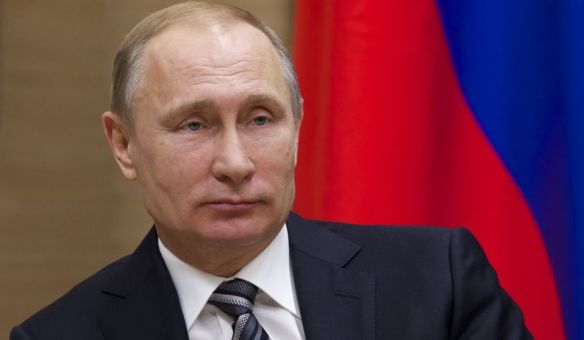
Vladimir Putin is blamed for everything that goes awry in Europe and the United States. In the United Kingdom his country was even blamed for bad weather as tabloid headlines screamed about icy Russian winds. The Brexit vote and Donald Trump’s Electoral College victory are said to be the result of Putin’s interference, even though the machinations of American oligarch Robert Mercer are most responsible for both outcomes.

When high level vitriol is shared by the corporate media and the American political duopoly and then repeated ad nauseum it is clear that the target will be subjected to more than mere slander. Such an attack carried out against a foreign leader is proof that the United States is ready for war by other means if not outright military conflict.

Russia has been a target ever since the fall of the Soviet Union in 1991. In its weakened state it was a victim of its own rapacious oligarch class and aside from having a nuclear arsenal was no match for its former rival. Bill Clinton openly dispatched operatives to meddle in the 1996 election and ensured that Boris Yeltsin kept the country ripe for plunder.

But in a supreme irony of history Yeltsin chose Vladimir Putin to succeed him. He took on the worst of the thieves and in so doing made himself an enemy of forces who hoped to pull his country apart. But he was not antagonistic to the United States. Libya might have been saved if Russia had used its United Nations Security Council veto against the no fly zone resolution in 2011. Only when the United States installed a fascist, anti-Russian government in Ukraine did Putin get the message that America should not be accommodated.

Putin stopped going along to get along but the American appetite for conquest is unstoppable. Syria is the place where Russia drew a line in the sand—and successfully, too. But the United States and NATO won’t admit defeat and continue the suffering of the Syrian people.

Now the drama surrounding the poisoning of former Russian spy Sergie Skripal in the U.K. has ensnared the Russian government. It is far-fetched to think that in the midst of an election campaign and the upcoming world soccer cup in Russia that Putin would decide to attack a former double agent he had allowed to go free eight years ago.

Prime Minister Theresa May is like her American counterparts: a liar and a violator of international law. The Organization for the Prohibition of Chemical Weapons (OPCW) has a process for nations to request information from one another and they are given 10 days to do so. Instead, May demanded that Russia prove the unprovable, that it wasn’t responsible, and that it do so in 24 hours. She declared that Russia was “likely” responsible and expelled 23 Russian diplomats from the country.

Labour party opposition leader Jeremy Corbyn was little better. He did say that the government should actually wait for proof of Russian involvement in Skripal’s poisoning but he also indulged in an anti-Russian screed as he vented against authoritarianism, oligarchs and human rights abuses. Saudi crown prince Mohammed bin Salman had just received a warm welcome in London from May, the royal family and the press. No one said a word about his genocide against the people of Yemen. But facts won’t get in the way of blatant war propaganda.

Putin has created a kind of madness on both sides of the ocean as politicians look for ever more bizarre ways to engage in Russophobia which is intended to damage his nation. Donald Trump’s appointment of Rex Tillerson as secretary of state was said to be influenced by Putin. Of course, everyone conveniently forgot that trope and now Tillerson’s dismissal is said to have been carried out on Putin’s orders.

Putin is even accused of being a racist. The Christopher Steele dossier, a creation of the Democratic Party and the ill-fated Hillary Clinton campaign, alleges that some on Putin’s staff used the “N-word ” in reference to Barack Obama. Any assertions in this dubious document are impossible to prove and it is unlikely that Steele’s second hand Russian sources reached into the Kremlin inner circle. This particular assertion comes from Michael Isikoff, a Steele partner in crime who dutifully leaked information which led to the granting of a FISA warrant and the Mueller investigation of Trump.

The creation of an all purpose villain is meant to cover up Democratic Party electoral failures, end the Trump presidency, and of course make the case for the American exceptionalism and interventions. Regime change, proxy wars, and imperial conquest are all very much a part of the anti-Putin hysteria.

But the Russophobes are playing a very dangerous game. The story of the poisoned man does not take place in a vacuum. While the public are distracted by a tall tale of Putin killing any Russian whoever died outside of that country, the very dangerous Syrian war continues. Lies about the Russian government should be taken very seriously. They are war propaganda and they are meant to get public support for military action against Russia and its allies.

The Skripal story is so murky that it will be difficult to ever determine culpability. But years of lies have had the desired effect. The public will believe anything about Putin and the Russian government no matter how ridiculous the charge. The American media are finally forced to report on the story of Robert Mercer’s Cambridge Analytica and the role it played in getting Trump an Electoral College victory. But the implications of a right-wing oligarch tipping the scales in our so-called democracy are ignored. Instead the New York Times reported on the Russian ancestry of a Cambridge Analytica staffer in a desperate effort to continue the dangerous charade.

Fifteen years ago this same government proclaimed that Iraq was the great danger and used the charge to make the case for war. Little has changed since. America excels at warfare and that is always preceded by propaganda.

In announcing new weapon developments Putin declared that mutually assured destruction (MAD) is not a thing of the past. If the U.S. and its allies were sane this would be a positive development. But they are not sane and every move and every charge brings the world closer to the precipice. The United States, not Russia, poses the greatest threat to peace and life on the planet. That must never be forgotten.


Margaret Kimberley’s Freedom Rider column appears weekly in BAR, and is widely reprinted elsewhere. She maintains a frequently updated blog as well as at freedomrider.blogspot.com. Ms. Kimberley lives in New York City, and can be reached via e-Mail at Margaret.Kimberley(at)BlackAgendaReport.com.
If You Come to a Fork in the Road, Take It

By James Howard Kunstler

Source: Kunstler.com

Various readers, fans, blog commenters, Facebook trolls, and auditors twanged on me all last week about my continuing interest in the RussiaRussiaRussia hysteria, though there is no particular consensus of complaint among them — except for a general “shut up, already” motif. For the record, I’m far more interested in the hysteria itself than the Russia-meddled-in the-election case, which I consider to be hardly any case at all beyond 13 Russian Facebook trolls.

The hysteria, on the other hand, ought to be a matter of grave concern, because it appears more and more to have been engineered by America’s own intel community, its handmaidens in the Dept of Justice, and the twilight’s last gleamings of the Obama White House, and now it has shoved this country in the direction of war at a time when civilian authority over the US military looks sketchy at best. This country faces manifold other problems that are certain to reduce the national standard of living and disrupt the operations of an excessively complex and dishonest economy, and the last thing America needs is a national war-dance over trumped-up grievances with Russia.

The RussiaRussiaRussia narrative has unspooled since Christmas and is blowing back badly through the FBI, now with the firing (for cause) of Deputy Director Andrew McCabe hours short of his official retirement (and inches from the golden ring of his pension). He was axed on the recommendation of his own colleagues in the FBI’s Office of Professional Responsibility, and they may have been influenced by the as-yet-unreleased report of the FBI Inspector General, Michael Horowitz, due out shortly.

The record of misbehavior and “collusion” between the highest ranks of the FBI, the Democratic Party, the Clinton campaign, several top political law firms, and a shady cast of international blackmail peddlars is a six-lane Beltway-scale evidence trail compared to the muddy mule track of Trump “collusion” with Russia. It will be amazing if a big wad of criminal cases are not dealt out of it, even as The New York Times sticks its fingers in its ears and goes, “La-la-la-la-la….”

It now appears that Mr. McCabe’s statements post-firing tend to incriminate his former boss, FBI Director James Comey — who is about to embark, embarrassingly perhaps, on a tour for his self-exculpating book, A Higher Loyalty: Truth, Lies, and Leadership.

A great aura of sanctimony surrounds the FBI these days. Even the news pundits seem to have forgotten the long, twisted reign of J. Edgar Hoover (1924 – 1972), a dangerous rogue who excelled at political blackmail. And why, these days, would any sane American take pronouncements from the CIA and NSA at face value? What seems to have gone on in the RussiaRussiaRussia matter is that various parts of the executive branch in the last months under Mr. Obama gave each other tacit permission, wink-wink, to do anything necessary to stuff HRC into the White House and, failing that, to derail her opponent, the Golden Golem of Greatness.

The obvious lesson in all this huggermugger is that the ends don’t justify the means. I suspect there are basically two routes through this mess. One is that the misdeeds of FBI officers, Department of Justice lawyers, and Intel agency executives get adjudicated by normal means, namely, grand juries and courts. That would have the salutary effect of cleansing government agencies and shoring up what’s left of their credibility at a time when faith in institutions hangs in the balance.

The second route would be for the authorities to ignore any formal response to an evermore self-evident trail of crimes, and to allow all that political energy to be funneled into manufactured hysteria and eventually a phony provocation of war with Russia. Personally, I’d rather see the US government clean house than blow up the world over an engineered hallucination.

The Fall of the American Empire

By W.J. Astore

Source: Bracing Views

Why do empires fall?  Sometimes, it’s easy to identify a cause.  Whether led by the Kaiser or by Hitler, Germany’s Second and Third Empires were destroyed by world wars.  Germany’s ambition was simply too great, its militarism too dominant, its policies too harsh to win long-term converts, its leaders too blinded by the pursuit of power, its enemies too many to conquer or otherwise neutralize.

Other imperial falls are more complex.  What caused Rome’s fall?  (Leaving aside the eastern part of the empire, which persisted far longer as the Byzantine Empire.)  Barbarians and their invasions, say some.  The enervating message and spirit of Christianity, said the historian Edward Gibbon.  Rome’s own corruption and tyranny, say others.  Even lead in Roman water pipes has been suggested as a contributing cause to Rome’s decline and fall.  Taking a longer view, some point to the rise of Islam in the 7th century and its rapid expansion into previously Roman territories as the event that administered the final coup de grâce to a dying empire.

America’s empire, it is clear, is now in decline, and a key reason is imperial overstretch as manifested by endless wars and overspending on the military (with literally trillions of dollars being thrown away on fruitless wars).  An especially fine summary is Alfred McCoy’s article at TomDispatch.com.  As McCoy notes:

In effect, the president and his team, distracted by visions of shimmering ships and shiny planes (with their predictable staggering future cost overruns), are ready to ditch the basics of global dominion: the relentless scientific research that has long been the cutting edge of U.S. military supremacy.  And by expanding the Pentagon while slashing the State Department, Trump is also destabilizing that delicate duality of U.S. power by skewing foreign policy ever more toward costly military solutions (that have proved anything but actual solutions) …

In just one extraordinary year, Trump has destabilized the delicate duality that has long been the foundation for U.S. foreign policy: favoring war over diplomacy, the Pentagon over the State Department, and narrow national interest over international leadership. But in a globalizing world interconnected by trade, the Internet, and the rapid proliferation of nuclear-armed missiles, walls won’t work. There can be no Fortress America.

In this passage, McCoy stresses the damage being done by the Trump administration.  But Trump is just the culmination of certain trends, e.g. favoring the Pentagon over the State Department is nothing new, as I wrote about here in 2010.  And America has been in love with shimmering ships and shiny planes for generations, with several administrations supporting the F-35 jet fighter, a program that may end up costing as much as $1.4 trillion.  Plenty of money for weapons that kill; not so much for medicines that cure: that’s imperial America in a nutshell.

I would stress that America’s strength overseas was (and is) always based on its strength at home in areas such as science, education, infrastructure, medicine, manufacturing, and exports.  But what we’ve witnessed over the last 40 years is an immense and wasteful “investment” in wars and weapons even as our country itself has hollowed out. Science is now marked by the denial of facts (such as global warming). Education is all about students as consumers, with an overall decline in standards and performance. Infrastructure is crumbling. Medicine is too expensive and America’s overall health and life expectancy are both in decline. Manufacturing and exports have withered (except for the production and export of weapons, naturally).

As a result of all this, America is running a national debt of roughly 20 trillion dollars.  The future is being sacrificed for the present, a tragic reality reflected in the latest Republican tax cut, which benefits the richest Americans the most, along with big corporations, and which will likely add another trillion to the national debt.

In short, America’s foreign decline is mirrored (and driven) by its domestic decline as reflected by its choices.  Looking at the USA today, you get the sense it’s the best of times for the richest few, and the worst of times for so many Americans struggling with health care debt, student loan debt, and the uncertainty of low-wage jobs that could be outsourced at any moment.  At the same time, the American political scene is driven by fear: of immigrants, of a nuclear war with North Korea, of Russian meddling (real or imagined), of growing Chinese power, and of the perpetually-hyped threat of terrorist attacks on “the Homeland.”

Empires can fall very quickly, as the “thousand-year” Third Reich did, or they can fall ever so slowly, as the Roman Empire did.  But fall they do.  What is in the cards for the United States?


The most perilous time in world history got worse

By Stephen Lendman

Source: Intrepid Report

Events ongoing should terrify everyone—things likely heading for greater war than already.

Most Americans, Brits, and others in NATO countries are unaware of the danger posed by hardline Western extremists in charge of policymaking—notably in Washington, London and Israel, the Jewish state an alliance Mediterranean Dialogue member.

Businessman Trump was co-opted to be a warrior president—neocon generals in charge of geopolitical policies, their agenda hardened by Mike Pompeo replacing Rex Tillerson at State, along with torturer-in-chief Gina Haspel appointed new CIA director.

An unholy alliance of US extremist policymakers allied with likeminded ones in partner countries risks war winds reaching gale force, a terrifying prospect if confrontation with Russia, Iran or North Korea occurs—the possibility increased by recent events.

Earlier this week, US Defense Secretary Mattis and UN envoy Haley threatened Russia and Damascus.

Russia vowed to retaliate against US attacks on Syrian forces in East Ghouta or elsewhere endangering its personnel in the country.

Anti-Russia hysteria in Britain over the Sergey Skripal poisoning affair, most certainly Moscow had nothing to do with, soured bilateral relations more than already.

In response to British PM Theresa May demanding swift Russian answers to questions posed about the incident, Russian Foreign Ministry spokeswoman (speaking for her government) replied sharply saying, “One does not give 24 hours notice to a nuclear power,” adding the “Skripal poisoning was not an incident but a colossal international provocation,” addin, not a “single international legal mechanism [exists] to probe the Skripal case.”

Russia’s embassy in London said “Moscow will not respond to London’s ultimatum until it receives samples of the chemical substance to which the UK investigators are referring.”

“Britain must comply with the Chemical Weapons Convention which stipulates joint investigation into the incident, for which Moscow is ready.”

“Without that, there can be no sense in any statements from London. The incident appears to be yet another crooked attempt by the UK authorities to discredit Russia.”

“Any threat to take ‘punitive’ measures against Russia will meet with a response. The British side should be aware of that.”

“Not only is Russia groundlessly and provocatively accused of the Salisbury incident, but apparently, plans are being developed in the UK to strike Russia with cyber weapons.”

“Judging by the statements of the prime minister, such a decision can be taken at tomorrow’s meeting of the National Security Council.”

Given the gravity of the situation, the above comments by Russian diplomats were uncharacteristically strong.

Sergey Lavrov warned Washington that “[i]f a new [US] strike . . . takes place [against Syrian forces], the consequences will be very serious,” adding, “I simply don’t have any normal terms left to describe all this.”

What’s coming remains to be seen. Hostile rhetoric from US and UK officials, along with hawkish extremists Pompeo in charge at State and Haspel appointed new CIA chief likely signal more war, not less.

What’s ongoing assures no possibility of improving dismal bilateral relations with Russia, China, Iran and other sovereign independent countries.

Talks with North Korea could either be scuttled or confrontational if they take place.

Given very disturbing ongoing events, the perilous state of world conditions reached a new low.

Be scared about what may follow—be very scared!


Stephen Lendman lives in Chicago. He can be reached at lendmanstephen@sbcglobal.net. His new book as editor and contributor is titled “Flashpoint in Ukraine: How the US Drive for Hegemony Risks WW III.” Listen to cutting-edge discussions with distinguished guests on the Progressive Radio News Hour on the Progressive Radio Network.

8 Signs of a Mind Infected by Political Malware

By Jordan Bates

Source: High Existence

Your mind is similar to a computer.

Your brain is the hardware, your worldview the software.

The operating system you’re running is heavily influenced by your culture, upbringing, education, and many other factors.

Arguably, a well-functioning mind is a mind that can update its operating system.

As new information comes in, a healthy mind will revise its previous conclusions about the world to account for the new data.

The smartest people in the world do this: They’re constantly reading, tinkering, experimenting, and in the process updating their understanding of the world.

After all, the more accurate your models are, the better decisions you’ll make, and the more success you’ll have.

This holds true in virtually every area of life. As the renowned economist John Maynard Keynes put it:

“When my information changes, I alter my conclusions. What do you do, sir?”

Dogma as Malware

Armed with this understanding, we can see that an unhealthy mind is a mind that does not or cannot update itself.

Instead of expanding and revising its models to reflect new information, it will warp and misshape the data to force-fit its existing models.

This problem is captured nicely by a favorite folk saying of the brilliant billionaire investor, Charlie Munger:

“To the man with only a hammer, every problem looks like a nail.”

What causes a mind to misfire in this way?

In a word: dogma: Absolute belief of any kind.

When the mind is convinced that something is incontrovertibly true, it ceases to update its views on that area of reality.

Any dogmatic ideology, then, can be seen as a kind of malware, or virus, attempting to infiltrate our mental computers.

Dogmatic ideologies—religious, political, or otherwise—are essentially trying to convince your mind to freeze into a certain shape and remain that way for the rest of your life.

As previously discussed, to allow one’s mind to freeze is generally disastrous, as a mind incapable of updating itself will tend to adapt very poorly to a complex world.

Unfortunately, certainty feels comfortable to us. It makes us feel like we’re in control, like we’ve got it all figured out. As a result, many minds are frozen by dogmatic malware.

This is an unfortunate state of affairs, as we humans can’t really afford to be non-adaptive at this point in history. We’re facing dire challenges, and we need our collective intelligence and decision-making to be sharp as possible.

8 Symptoms of Political Malware

One way to avoid getting mind-pwnd by dogmatic malware is to learn to recognize the warning signs.

If you can notice other people’s malfunctioning operating systems, you’re much more likely to be able to debug your own.

To hopefully help you do this, I’m going to outline eight telltale symptoms of a brain that’s been compromised by dogmatic political malware.

Political malware is far from the only form of dogma-malware lurking in the world today, but it’s sufficiently common that it should be a useful case to focus on and learn to recognize. And, naturally, many of these points can be extended to other domains.

Here are eight common symptoms of a brain-computer infected by political malware:

1. Inability to explain the arguments or evidence that led to current conclusions.

High-functioning minds don’t just believe things because they feel good or because someone told them to. They require evidence and well-reasoned arguments to support their positions.

If a person is unable to explain the evidence and/or arguments that convinced them of a particular political conclusion, it’s highly likely that they hold that belief simply because their political tribe does.

2. Never says, “I don’t have an opinion on this because I haven’t done enough research and thinking on it.”

Dogmatic, non-adaptive minds tend to have an opinion on everything. Even if they haven’t thought about a given issue for themselves, they just default to whatever opinion is popular with their tribe.

Healthy minds, by contrast, are extremely humble. They realize the world is ridiculously complex and that it’s actually impossible to have an informed opinion on everything. They are honest about what they don’t know, and they realize they should be cautious about forming opinions because humans are so good at deluding themselves and jumping to premature conclusions.

As the genius physicist Richard Feynman put it:

“The first principle is that you must not fool yourself — and you are the easiest person to fool.”

3. Treats affiliation like a badge of honor.

Whatever they happen to be—Republican or Democrat, radical or centrist, libertarian or fascist, conservative or liberal—you know it. Because they advertise it.

They’re proud to be a member of their particular team. But when a person is really proud to be part of something that requires them to hold certain beliefs, what are the chances that they’re going to be able to update those beliefs as they encounter new information? Slim to none. Sharp minds value truth over team and tend not to have strong political affiliations.

4. Views don’t change over time.

Ask a dogmatic person their thoughts on a certain political issue, then ask them again in five years. You’ll almost surely get the same answer. No added nuance, no “Well, I thought about this more and my take is a little bit different now.” Just the same old scripts, repeated ad nauseam.

5. Quickly becomes hostile in political conversations.

The thing about joining a political tribe and thus making your politics a really deep, important part of your identity is that it becomes extremely difficult to have a calm conversation about ideas. 

When you challenge a dogmatic political mind, you’re not just challenging their ideas. You’re challenging their tribe, their identity: the cornerstone of their sense of security in this universe. Naturally, this often doesn’t go over so well.

Healthy minds, by contrast, are interested in the truth, or the best solution, rather than preserving their sense of tribal pride. Therefore they can entertain multiple positions on a single issue without having their feathers ruffled. For them ideas are just ideasand they want to find as many good ideas as possible, let them do battle, and determine which are the best.

6. Absolute faith in the correctness of their own views.

There’s a reason Jordan Greenhall uses the terms “Blue Church” and “Red Religion” to describe the two major political monoliths vying for power in the West.

He’s not the first person to notice that for many people, politics has become a form of religion. With the secularization of the West in recent history, it’s not a surprise that people’s religious drives have been diverted into another dogmatic domain.

Adaptive minds, by contrast, expect to be wrong. The idea that they’ve somehow reached the Final Truth of reality seems ludicrous.

“You should take the approach that you’re wrong. Your goal is to be less wrong.”

― Elon Musk

7. Displays an “If you disagree with me, you must be my enemy” mentality.

For highly dogmatic minds, any disagreement is interpreted as an act of war. If you disagree with them, or even offer an alternate possibility, you must not be on their team, and if you’re not on their team, you must be on an opposing team—an enemy.

This black-and-white thinking is made all the worse when a country has just two major political parties, as in the case of the United States. In a well-functioning bipartisan system, the two parties should at least be able to cooperate, compromise, and realize everyone is ultimately seeking to improve the country, despite disagreeing about how best to do that. Unfortunately, in the profoundly divisive and polarized US political climate of 2018, bipartisan cooperation and understanding has become impossible for many people. This is a grim omen of things to come.

Adaptive minds realize that disagreement is healthy, and that talking through disagreements presents an opportunity to learn and refine one’s views. They furthermore understand that black-and-white thinking fails to account for the complexity of the world. They see that it is unwise to rigidly categorize someone as an enemy or as a member of a certain tribe based on a couple of their positions, considering there are potentially infinite positions one could take on any given issue.

8. All viewpoints are identical to those of a single political camp.

If you can guess a person’s positions on climate change, social welfare, immigration, and gun control, based on their position on some unrelated issue like abortion, you can be fairly certain that they’ve inherited tribal dogmas, rather than forming their own conclusions.

The appeal of subscribing to a dogmatic ideology is that there is an answer for everything. You just repeat the views that are popular with your tribe, and you never have to go to the trouble of analyzing individual issues for yourself.

Active minds, by contrast, hold complex, nuanced, unpredictable views, because they analyze each issue independently. They seek out the best arguments and evidence supporting different positions on the issue, and they form their own conclusions. Or often they’re agnostic on certain issues, because they’ve confronted the true complexity and don’t feel confident enough to favor one compelling view over another.

Conclusion: Activate Your Mind

A healthy mind is a mind that updates itself based on new arguments and evidence.

Cultivating this form of mental health will serve you well in all areas of life. It’s also arguably something that we need more people to do, if we hope to continue to flourish as a species and help other earthly species to flourish.

Humanity currently finds itself in the midst of unprecedented global changes. In such complex and unpredictable times, we surely need to be adaptable and open to good ideas, wherever they may come from. We are gaining the technological power of gods, but without the wisdom and care of gods to accompany this power, we are likely to wield it in disastrous ways.

Gaining the wisdom and care of gods begins with each of us: with our individual decisions to activate our minds—to actively pursue greater knowledge, wisdom, and understanding.

Hopefully this post has offered you some mind-activating inspiration and direction. The need for individuals to take their education and cognitive empowerment into their own hands extends far beyond politics. The degree to which we are collectively successful in this endeavor may well determine whether we create a utopia or an apocalypse in the coming decades and centuries.

All of this is to say that, your mind matters. Take good care of it. Best of luck.

The Singular Pursuit of Comrade Bezos

By Malcolm Harris

Source: Medium

It was explicitly and deliberately a ratchet, designed to effect a one-way passage from scarcity to plenty by way of stepping up output each year, every year, year after year. Nothing else mattered: not profit, not the rate of industrial accidents, not the effect of the factories on the land or the air. The planned economy measured its success in terms of the amount of physical things it produced.

— Francis Spufford, Red Plenty

But isn’t a business’s goal to turn a profit? Not at Amazon, at least in the traditional sense. Jeff Bezos knows that operating cash flow gives the company the money it needs to invest in all the things that keep it ahead of its competitors, and recover from flops like the Fire Phone. Up and to the right.

— Recode, “Amazon’s Epic 20-Year Run as a Public Company, Explained in Five Charts


From a financial point of view, Amazon doesn’t behave much like a successful 21st-century company. Amazon has not bought back its own stock since 2012. Amazon has never offered its shareholders a dividend. Unlike its peers Google, Apple, and Facebook, Amazon does not hoard cash. It has only recently started to record small, predictable profits. Instead, whenever it has resources, Amazon invests in capacity, which results in growth at a ridiculous clip. When the company found itself with $13.8 billion lying around, it bought a grocery chain for $13.7 billion. As the Recode story referenced above summarizes in one of the graphs: “It took Amazon 18 years as a public company to catch Walmart in market cap, but only two more years to double it.” More than a profit-seeking corporation, Amazon is behaving like a planned economy.

If there is one story on Americans who grew up after the fall of the Berlin Wall know about planned economies, I’d wager it’s the one about Boris Yeltsin in a Texas supermarket.

In 1989, recently elected to the Supreme Soviet, Yeltsin came to America, in part to see Johnson Space Center in Houston. On an unscheduled jaunt, the Soviet delegation visited a local supermarket. Photos from the Houston Chronicle capture the day: Yeltsin, overcome by a display of Jell-O Pudding Pops; Yeltsin inspecting the onions; Yeltsin staring down a full display of shiny produce like a line of enemy soldiers. Planning could never master the countless variables that capitalism calculated using the tireless machine of self-interest. According to the story, the overflowing shelves filled Yeltsin with despair for the Soviet system, turned him into an economic reformer, and spelled the end for state socialism as a global force. We’re taught this lesson in public schools, along with Animal Farm: Planned economies do not work.

It’s almost 30 years later, but if Comrade Yeltsin had visited today’s most-advanced American grocery stores, he might not have felt so bad. Journalist Hayley Peterson summarized her findings in the title of her investigative piece, “‘Seeing Someone Cry at Work Is Becoming Normal’: Employees Say Whole Foods Is Using ‘Scorecards’ to Punish Them.” The scorecard in question measures compliance with the (Amazon subsidiary) Whole Foods OTS, or “on-the-shelf” inventory management. OTS is exhaustive, replacing a previously decentralized system with inch-by-inch centralized standards. Those standards include delivering food from trucks straight to the shelves, skipping the expense of stockrooms. This has resulted in produce displays that couldn’t bring down North Korea. Has Bezos stumbled into the problems with planning?

Although OTS was in play before Amazon purchased Whole Foods last August, stories about enforcement to tears fit with the Bezos ethos and reputation. Amazon is famous for pursuing growth and large-scale efficiencies, even when workers find the experiments torturous and when they don’t make a lot of sense to customers, either. If you receive a tiny item in a giant Amazon box, don’t worry. Your order is just one small piece in an efficiency jigsaw that’s too big and fast for any individual human to comprehend. If we view Amazon as a planned economy rather than just another market player, it all starts to make more sense: We’ll thank Jeff later, when the plan works. And indeed, with our dollars, we have.

In fact, to think of Amazon as a “market player” is a mischaracterization. The world’s biggest store doesn’t use suggested retail pricing; it sets its own. Book authors (to use a personal example) receive a distinctly lower royalty for Amazon sales because the site has the power to demand lower prices from publishers, who in turn pass on the tighter margins to writers. But for consumers, it works! Not only are books significantly cheaper on Amazon, the site also features a giant stock that can be shipped to you within two days, for free with Amazon Prime citizensh…er, membership. All 10 or so bookstores I frequented as a high school and college student have closed, yet our access to books has improved — at least as far as we seem to be able to measure. It’s hard to expect consumers to feel bad enough about that to change our behavior.


Although they attempt to grow in a single direction, planned economies always destroy as well as build. In the 1930s, the Soviet Union compelled the collectivization of kulaks, or prosperous peasants. Small farms were incorporated into a larger collective agricultural system. Depending on who you ask, dekulakization was literal genocide, comparable to the Holocaust, and/or it catapulted what had been a continent-sized expanse of peasants into a modern superpower. Amazon’s decimation of small businesses (bookstores in particular) is a similar sort of collectivization, purging small proprietors or driving them onto Amazon platforms. The process is decentralized and executed by the market rather than the state, but don’t get confused: Whether or not Bezos is banging on his desk, demanding the extermination of independent booksellers — though he probably is — these are top-down decisions to eliminate particular ways of life.

Now, with the purchase of Whole Foods, Bezos and Co. seem likely to apply the same pattern to food. Responding to reports that Amazon will begin offering free two-hour Whole Foods delivery for Prime customers, BuzzFeed’s Tom Gara tweeted, “Stuff like this suggests Amazon is going to remove every cent of profit from the grocery industry.” Free two-hour grocery delivery is ludicrously convenient, perhaps the most convenient thing Amazon has come up with yet. And why should we consumers pay for huge dividends to Kroger shareholders? Fuck ’em; if Bezos has the discipline to stick to the growth plan instead of stuffing shareholder pockets every quarter, then let him eat their lunch. Despite a business model based on eliminating competition, Amazon has avoided attention from antitrust authorities because prices are down. If consumers are better off, who cares if it’s a monopoly? American antitrust law doesn’t exist to protect kulaks, whether they’re selling books or groceries.

Amazon has succeeded in large part because of the company’s uncommon drive to invest in growth. And today, not only are other companies slow to spend, so are governments. Austerity politics and decades of privatization put Amazon in a place to take over state functions. If localities can’t or won’t invest in jobs, then Bezos can get them to forgo tax dollars (and dignity) to host HQ2. There’s no reason governments couldn’t offer on-demand cloud computing services as a public utility, but instead the feds pay Amazon Web Services to host their sites. And if the government outsources health care for its population to insurers who insist on making profits, well, stay tuned. There’s no near-term natural end to Amazon’s growth, and by next year the company’s annual revenue should surpass the GDP of Vietnam. I don’t see any reason why Amazon won’t start building its own cities in the near future.

America never had to find out whether capitalism could compete with the Soviets plus 21st-century technology. Regardless, the idea that market competition can better set prices than algorithms and planning is now passé. Our economists used to scoff at the Soviets’ market-distorting subsidies; now Uber subsidizes every ride. Compared to the capitalists who are making their money by stripping the copper wiring from the American economy, the Bezos plan is efficient. So, with the exception of small business owners and managers, why wouldn’t we want to turn an increasing amount of our life-world over to Amazon? I have little doubt the company could, from a consumer perspective, improve upon the current public-private mess that is Obamacare, for example. Between the patchwork quilt of public- and private-sector scammers that run America today and “up and to the right,” life in the Amazon with Lex Luthor doesn’t look so bad. At least he has a plan, unlike some people.

From the perspective of the average consumer, it’s hard to beat Amazon. The single-minded focus on efficiency and growth has worked, and delivery convenience is perhaps the one area of American life that has kept up with our past expectations for the future. However, we do not make the passage from cradle to grave as mere average consumers. Take a look at package delivery, for example: Amazon’s latest disruptive announcement is “Shipping with Amazon,” a challenge to the USPS, from which Amazon has been conniving preferential rates. As a government agency bound to serve everyone, the Postal Service has had to accept all sorts of inefficiencies, like free delivery for rural customers or subsidized media distribution to realize freedom of the press. Amazon, on the other hand, is a private company that doesn’t really have to do anything it doesn’t want to do. In aggregate, as average consumers, we should be cheering. Maybe we are. But as members of a national community, I hope we stop to ask if efficiency is all we want from our delivery infrastructure. Lowering costs as far as possible sounds good until you remember that one of those costs is labor. One of those costs is us.

Earlier this month, Amazon was awarded two patents for a wristband system that would track the movement of warehouse employees’ hands in real time. It’s easy to see how this is a gain in efficiency: If the company can optimize employee movements, everything can be done faster and cheaper. It’s also easy to see how, for those workers, this is a significant step down the path into a dystopian hellworld. Amazon is a notoriously brutal, draining place to work, even at the executive levels. The fear used to be that if Amazon could elbow out all its competitors with low prices, it would then jack them up, Martin Shkreli style. That’s not what happened. Instead, Amazon and other monopsonists have used their power to drive wages and the labor share of production down. If you follow the Bezos strategy all the way, it doesn’t end in fully automated luxury communism or even Wall-E. It ends in The Matrix, with workers swaddled in a pod of perfect convenience and perfect exploitation. Central planning in its capitalist form turns people into another cost to be reduced as low as possible.

Just because a plan is efficient doesn’t mean it’s good. Postal Service employees are unionized; they have higher wages, paths for advancement, job stability, negotiated grievance procedures, health benefits, vacation time, etc. Amazon delivery drivers are not and do not. That difference counts as efficiency when we measure by price, and that is, to my mind, a very good argument for not handing the world over to the king of efficiency. The question that remains is whether we have already been too far reduced, whether after being treated as consumers and costs, we might still have it in us to be more, because that’s what it will take to wrench society away from Bezos and from the people who have made him look like a reasonable alternative.

The political logic of the junk food revolution

By Jonathan Cook

Source: TruePublica

Here is an article on food whose political implications are really worth considering. We already know that people in western societies, particularly the US and UK, are eating far too much junk food, and that this leads to an epidemic of obesity, heart disease and cancer.

But the latest research not only reveals the extent that “ultra-processed” foods have come to dominate our diets in Europe – now comprising more than half of what Britons eat, for example – but raises the question of what effects the consumption of this much junk food will have on our behaviours.

The nutritionists here are reluctant to offer even well-informed speculation, which always seems to be the case with publicly funded scientists until things have moved beyond a critical point. Think of smoking and climate change: we usually learn much later that the corporations’ own pet-scientists had done the research decades earlier proving or predicting exactly what was coming.

But there are hints from the nutritionists to the Guardian of what might be going on:

“People are missing out not only on vitamins and minerals but also bioactive compounds found in natural foods such as phytoestrogens and fibre.

And then you get salt and starch and sugar and fat and all these additives. We are consuming every day an amount of new substances that are these flavours and colours and emulsifiers and we don’t have any idea as to what will be the problem of these items,” [Professor Carlos Monteiro from the University of Sao Paulo in Brazil, who led the research team] said. …

Other cumulative effects of eating these industrially-made substances are not yet known. “The honest answer is we don’t know what is going on,” said Monteiro.’

Here is an educated guess, based in part on experience and in part on the economic and political logic of our current junk food revolution. (Those of us who eat these industrial substances rarely enough that they do not dominate our diets still have a sense of what happens to us on the occasions we do.)

These lab-created, nutritionally empty substances that our bodies have not evolved to digest not only make us physically sick, but emotionally and mentally sick too: addicted, depressed, lazy, sluggish, docile and anxious.

In fact, a mess of emotions that transforms us into the perfect consumers, buying more of this cheap, harmful “food”. That boosts both the profits of food and other corporations and the electoral fortunes of crowd-pleasing, money-grubbing, vacuous politicians who wish to serve those corporations.

That is how an advanced capitalist system – premised on a psychopathic drive by the strongest to maximise profits by exploiting the weakest – will naturally evolve. It needs to make us as dependent, as passive and docile, as possible.

According to the Father of Propaganda an Invisible Government Controls Our Minds with a Thought Prison

By Sigmund Fraud

Source: Waking Times

“Who are the men who without our realizing it, give us our ideas, tell us whom to admire and whom to despise, what to believe about the ownership of public utilities, about the tariff, about the price of rubber, about the Dawes Plan, about immigration; who tell us how our houses should be designed, what furniture we should put in them, what menus we should serve on our table, what kind of shirts we must wear, what sports we should indulge in, what plays we should see, what charities we should support, what pictures we should admire, what slang we should affect, what jokes we should laugh at?” ~ Edward Bernays [b.11/22/1891, d. 3/9/1995]  Propaganda

Authored by Edward Bernays and published in 1928, the book Propaganda still holds its position as the gold standard for influencing and manipulating public behavior. Drawing on his expertise in psychology while using the language of manipulation, Bernays pioneered social engineering via mass media, and his work lives on in the distorted, statist, consumer world we have today.

But who are the ones behind the curtain telling us what to think by directing our attention onto the things which serve interests?

Interestingly, chapter III of Propaganda is titled, ‘The New Propagandists, and is devoted to explaining why the controls for mass manipulation are so closely guarded by a relatively tiny elite who sit in the shadows, out of the public eye, choosing what we are to see and to think, even controlling the politicians we elect to represent us.

If we set out to make a list of the men and women who, because of their position in public life, might fairly be called the molders of public opinion we could quickly arrive at an extended list of persons mentioned in “Who’s Who…”

Such a list would comprise several thousand persons. But it is well known that many of these leaders are themselves led, sometimes by persons whose names are known to few.

Such persons typify in the public mind the type of ruler associated with the phrase invisible government.

An invisible government of corporate titans and behind the scenes influencers who’s mark on culture cannot be understated today. Bernays continues:

The invisible government tends to be concentrated in the hands of the few because of the expense of manipulating the social machinery which controls the opinions and habits of the masses.

The public relations counsel, then, is the agent who, working with modern media communication and the group formation of society, brings an idea to the consciousness of the public. But he is a great deal more than that. He is concerned with courses of action, doctrines, systems and opinions, and the securing of public support for them.

Ultimately, the goal of this type of mass-produced, pop-culture propaganda is to weaken the individual’s ability to think critically, thereby creating an environment where many people look to one another for approval, always second-guessing their own faculties. When this happens, the strength of the collective group begins to take form and multiply, and ideas can be implanted into the popular culture, taking root in the form of widespread conformist behavior.

Thinking critically means making reasoned judgments that are logical and well thought out. It is a way of thinking in which one doesn’t simply accept all arguments and conclusions to which one is exposed without questioning the arguments and conclusions. It requires curiosity, skepticism and humility. People who use critical thinking are the ones who say things such as, “How do you know that?” “Is this conclusion based on evidence or gut feelings?” and “Are there alternative possibilities when given new pieces of information?””  [Source]

Final Thoughts

The takeaway here is that not much has changed in 100 years of corporate/statist American culture, other than the technical capacity to scale this ever upward. Our lives are still heavily influenced by the likes of the described by Bernays. There is one advantage we do have now, however, as technology has given us greater access to the truth and we are now free to split from the matrix psychologically by understanding what it is and how it influences our lives. If we choose to do so, that is, if we choose to take the red pill.

In order to understand your life and your mission here on earth in the short time you have, it is imperative to learn to see the thought prison that has been built around you, and to actively circumnavigate it. Free-thinking is being stamped out by the propagandists, but our human tendency is to crave freedom, and with the aid of truth, we are more powerful than the control matrix and the invisible government.