Media, Mind-Control, & Meditation: Plato’s E-Cave Panopticon and Beyond

panopticon-image

By Mankh (Walter E. Harris III)

Source: Axis of Logic

“Relax,” said the night man,
”We are programmed to receive.
You can check-out any time you like, 
But you can never leave!”

 – The Eagles, from “Hotel California”

In Plato’s Allegory of the Cave, people saw a shadow play on the wall and perceived it as reality. Today that Cave has morphed to provide umpteen TV channels and mini-screen gadgets; and the once sanctified living room cave has expanded into a free-range bubble of consciousness – heads bowed before an electronic altar, seemingly oblivious to the outside world.

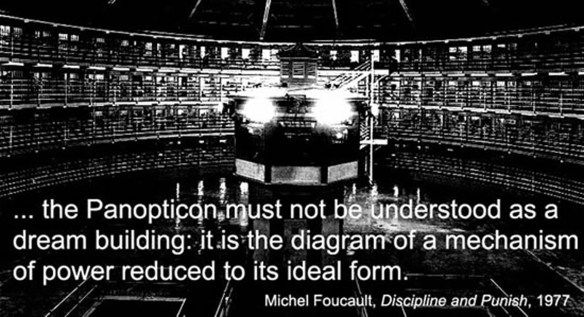
“The “panopticon” refers to an experimental laboratory of power in which behaviour could be modified, and Foucault viewed the panopticon as a symbol of the disciplinary society of surveillance.”[1]

In Plato’s E-Cave, not only are the people watching a shadow play, they, and the shadows they watch, are being watched.

HyperNormalization
With a veneer of calm aplomb, the masses communicate 24-7, often in a frenetic urgency of the mundane, hence one interpretation of HyperNormalization. In all the years of overhearing cell-phone conversations in public, I can’t recall one snippet of philosophy or practical advice, rather stuff like, ‘yeah OMG I’ll get the chips!’ and ‘I’ll be there in like 30 seconds!’; if you’re old enough, you’d remember the days when, you got there when you got there! That said, a cell-phone can be a helpful even life-saving device.

The USEmpire election appears to have both proven and disproven the main theory of Adam Curtis’ fascinating new documentary “HyperNormalization.”

“Curtis argues that since the 1970s, governments, financiers, and technological utopians have given up on the complex “real world” and built a simple “fake world” that is run by corporations and kept stable by politicians.”[2]

The California cyber-tech-boom was a love-child of LSD-consciousness that found refuge in E-wizardy all the while looking to escape repressive politics. In his book “2030” Pepe Escobar describes it as: “Digital network capitalism would then shape post-modern globalization, from the New Economy before the end of the millennium to every digital wall to be broken beyond. California cosmology forged our world.”

According to Wikipedia:

“The term “hypernormalisation” is taken from Alexei Yurchak’s 2006 book Everything was Forever, Until it was No More: The Last Soviet Generation, about the paradoxes of life in the Soviet Union during the 20 years before it collapsed. A professor of anthropology at the University of California, Berkeley, he argues that everyone knew the system was failing, but as no one could imagine any alternative to the status quo, politicians and citizens were resigned to maintaining a pretence of a functioning society. Over time, this delusion became a self-fulfilling prophecy and the “fakeness” was accepted by everyone as real, an effect which Yurchak termed “hypernormalisation”.”[3]

First off, I see HyperNormalization as a half-truth because while the self-referential, gossipy world is fake, it is a veneer for a very real world of resource extraction and the violence perpetrated to maintain the status quo – and that is what the fakers ignore. As far as the election, many expected the Clinton dynasty to prevail as the corrupt, business as usual lesser of two evils. Breaking snooze: Where’s  the headline news that Melania Trump plans to focus on helping women and children?; I saw that mentioned on CNN’s Anderson Cooper 360, such a perfect antidote for Hillary’s loss and The Donald’s anti-feminist track record.

Even though WikiLeaks revealed the DNC (Democratic National Convention) was rigged against Sanders and leaks of Podesta/Clinton e-mails may have been proverbial straws for Hillary’s campaign camel, the prevailing media sentiment was that she would win – despite the fact that the day before the election some polls indicated a shrinking 3-4 point lead, thus with the typical margin of error, it was, in effect, tied. Yet the mass hyper-surprise!; and all that after the corporate media and comedy shows had simultaneously bashed Trump and given him more air-time than a kite on a windy day – both disdaining and elevating him, a media-mindfuck if ever there was one.

And there was little uproar when Gary Johnson and Jill Stein were excluded from debates and virtually banned from all corporate news, thus proving (if you didn’t know already) that it’s not a truly democratic election. Yet carry on we must and do the best we can with what we got, was the general sentiment, in other words, “the “fakeness” was accepted by everyone as real” aka HyperNormalization.

Yet the non-coastal, poor and middle America White working class (with sides of KKK and minorities!), which reportedly was the key demographic for The Don’s victory, was voting out of bare-bones needs; in effect they were not HyperNormalized. Then again, if Trump, who promises to challenge the status quo, caves-in to Deep State pressure, we will have an answer to an interesting article’s titular question: “President Trump: big liar going to Washington or Tribune of the People?”[4] And if that answer is the former, then the mostly White working poor will also have been duped/HyperNormalized.

You see, it’s hard to know what’s what; which all seems to prove HyperNormalization as the dominant societal charade; which screen is real, if any?

What you perceive is what you get
Another key phrase in Curtis’ documentary is “managed perception” – akin to Chomsky and Herman’s  “Manufacturing Consent: The Political Economy of the Mass Media” (1988) which showed how opinions and desensitized agreement to the status quo became a product to be mined and marketed. Witness CBS Chairman Les Moonves’ comment from February 2016:

“Man, who would have expected the ride we’re all having right now? … The money’s rolling in and this is fun. I’ve never seen anything like this, and this [is] going to be a very good year for us. Sorry. It’s a terrible thing to say. But, bring it on, Donald. Keep going.” [5] And, if i might satirically add, like an orangey topped Duracell battery, The Don does seem to have a lot of energy.

HyperNormalization is also akin to Sheldon Wolin’s theory  of “inverted totalitarianism,” where the faceless corporate machine wields so much entertainment and bureaucratic power that the people barely notice they are being played hook, line, and sinking feelings.

Some of Curtis’ info, however, is inaccurate or questionable. For examples, he blames the demise of the Occupy Movement on lack of vision and planning yet neglects to mention the FBI coordinated systemic crackdown on the ‘camps’ across the country. [6]

About Syria he says that President Bashar al-Assad retaliated with a “vengeful fury,” whereas Assad has defended his actions as self-defense for his people; numerous journalists back the Syrian President’s claim.

Post-election, I wonder: Why were so many liberals, lefties, and women more surprised that Trump won than that the DNC/HRC rigged it against Sanders? Were they simply feeling impotent due to HyperNormalized shadow play? Whatever the case, his victory revealed a crack in the smooth screen of HyperNormalization.

According to Patrick Caddell’s survey before the election, the populace seems to be hip to what’s happening:

“Powerful interests from Wall Street banks to corporations, unions and political interest groups have used campaign and lobbying money to rig the system for them. They are looting the national treasury of billions of dollars at the expense of every man, woman and child. AGREE = 81%; DISAGREE = 13%…

“The country is run by an alliance of incumbent politicians, media pundits, lobbyists and other powerful money interests for their own gain at the expense of the American people. AGREE = 87%; DISAGREE = 10%

The real struggle for America is not between Democrats and Republicans but between mainstream American and the ruling political elites. AGREE = 67%; DISAGREE = 24%.” [7]

This makes it seem it is the ‘how-to bring about change’ that is the deeper conundrum of the HyperNormalized world. Then again, people too often seem to have only their own best interests at heart. Approximately 90% of Americans want their food labeled so as to know if they contain GMOs etc. or not, yet hardly a peep out of anyone that climate change or the “environment” aka Mother Earth & Nature-beings were deliberately excluded as a main topic of the presidential debates. This makes it seem that, in general, Americans want clean food for themselves, they want a clean environment so they can go ‘play in the park’ by themselves. And that brings us to the Great Disconnect and Standing Rock.

Flow like water, be steady as a rock
Part of HyperNormalization is a disconnect from Nature and from being self- and community-guided, and therefore disconnected from the Original Peoples of Turtle Island. While many people are certainly aware of what’s happening with Standing Rock, the corporate media’s lack of attention, let alone empathy, fosters lack of concern for the outcome, lack of being outraged by the violent and racist treatment of those in prayer and peacefully protecting the main source of water for the Standing Rock Sioux and other Natives as well as approximately 17-million people downstream. The real-fake outrage is over the outcome of a fake election.

For many Native reservations where poverty and PTSD are prevalent, the people are anything but HyperNormalized; they are struggling to survive – as with Standing Rock, they are not asking for much: clean water and the space to live their lives with ancient traditions timelessly connected with the land, the water, the stones…

Plato, imagining a prisoner getting outside of the Cave, wrote: “Slowly, his eyes adjust to the light of the sun. First he can only see shadows. Gradually he can see the reflections of people and things in water and then later see the people and things themselves. Eventually, he is able to look at the stars and moon at night until finally he can look upon the sun itself .” [8]

Standing Rock is bringing people together, raising consciousness at many levels. As one example from a little over a week ago:

“In a “historic” show of interfaith solidarity, 500 clergy members prayed along the banks of North Dakota’s Cannonball River on Thursday where they “bore witness with the Standing Rock Sioux Nation,” which has faced intimidation, violence, and arrests for protecting their sacred land and water supply from the threats of a massive oil pipeline. According to the Episcopal News Service, “The interfaith group spent more than five hours on site, marching, singing hymns, sharing testimony, and calling others to join them in standing with the more than [300] tribes who have committed their support to the Sioux Nation as they protest the route of the Dakota Access Pipeline (DAPL).” [9]

This solidarity is in stark contrast with the election where a typically 51/49 system determines an outcome for a society literally programmed for exciting close-call winners – think sporting events,
reality shows, awards ceremonies.

Outside in and inside out
There are many ways to get outside the Cave. One of those is by going within. When I first started to meditate, as is common, I became aware of the constant chatter in my head and soon realized that the mind left unattended will rattle on endlessly. Meditation then showed me that once the chatter quiets, one then has access to other frequencies, other ‘channels’ – what happens then is a very personal matter yet also impersonal because one becomes connected with another source of thinking-seeing-feeling. Chatter, like cell-phones, has it’s usefulness, say, if you forgot to turn the stove off. My point to the personal anecdote is that the corporate media is too much chatter, endlessly looping itself. The gadgets, too, though useful, seem hard-wired for HyperNormalization.

Some of the chatter we must live with, yet by learning to follow our intuitions, listening to and connecting with Nature, talking with elders and little children we can better tune-out from the shadow-play, we can find new and ancient ways for more people – and that includes trees, rivers, etc. –  “to look at the stars and moon at night” and “look upon the sun itself.”

“Sin filo ya y derrotada se quejó: Soy más fuerte que ella, pero no le puedo hacer daño y ella a mi, sin pelear. me ha vencido.’”

“Without sharpness and defeated, it [the sword] complained: ‘I am stronger than the water, but I cannot harm her. And the water, without fighting, has conquered me.’” [10]

NOTES:
1.    Panopticism here and here.
2.    Ibid.
3.    HyperNormalization
4.    See here.
5.    “Les Moonves: Trump’s run is ‘damn good for CBS’”. See here.
6.    “Revealed: how the FBI coordinated the crackdown on Occupy
7.    “Patrick Caddell; The Pollster Who ‘Got it Right’
8.    “Allegory of the Cave
9.    “A Prayer for People and Planet: 500 Clergy Hold ‘Historic’ Mass Gathering for Standing Rock
10.    “Questions & Swords: Folktales of the Zapatista Revolution” as told by Subcomandante Marcos, Cino Puntos Press, El Paso, Texas, 2001, p.82.

To watch “HyperNormalization”, click here.

Mankh (Walter E. Harris III) is an essayist and resident poet on Axis of Logic. In addition to his work as a writer, he is a small press publisher and Turtle Islander. His new book of genre-bending poetic-nonfiction is “Musings With The Golden Sparrow.” You can contact him via his literary website.


Soylent Burgers and Cockroach Milk

wICCXTa

Source: The Hipcrime Vocab

“The profitability of production cannot expand indefinitely. Any increase in the quantity of soil, water, minerals, or plants put into a particular production process per unit of time constitutes intensification. It has been the burden of this book to show that intensification inevitably leads to declining efficiencies. That declining efficiencies have adverse effects upon the average standard of living cannot be doubted.’
-MARVIN HARRIS, ‘Cannibals and Kings’

This comment made me chuckle: “The futurology future is starting to look worse than the collapse future.” This was on Reddit in response to an article about cockroaches providing the “milk of the future”:

Scientists think cockroach milk could be the superfood of the future (Science Alert)

This really does seem like The Onion at this point. Someone suggested that Reddit’s collapse and futurology boards should merge at some point. Believe it or not, they aren’t all that far apart.

We’ve already been treated to an endless litany of articles about how insect ranching will provide the protein of the future. Then there’s the meat grown in a petri-dish, and the nutrition shake cheekily named Soylent scarfed down by the Silicon Valley crowd so they can cram in a few more hours of work after popping their Ritalin. Now people are questioning whether the government should step in and force us to eat less meat.

And yet we are still simultaneously told that overpopulation and resource depletion are not a problem, and that more growth is good.

This is progress???

One of the things I’ve written about over the years is this idea that technological innovations are inherently good. But it’s clear what’s really going on: desperately trying to maintain the status quo in the face of increasing population pressure and declining resources. There’s a technical term for this: intensification.

Marvin Harris, whose works serve as a guidepost for this blog, warned us that intensification always leads to lower living standards for the majority of people in the long run, while only benefiting a tiny handful. This is a law of history. Over the years, I’ve tried to point out the difference between true innovation which solves problems or allows us to do things we could not do before, and intensification, which is essentially squeezing blood from a stone. In the former category are things like antibiotics and radio, which solve problems (killer infections) or allow us to do new things (communicate globally). In the latter category are things like electric cars (attempting to keep the unsustainable automobile infrastructure alive) and aquaculture (to make up for stripping the oceans bare of wild fish).

For the majority of people, there is no difference, since both are “growth” and growth is always good, full stop. GDP, the yardstick by which we measure progress in the modern world (which even its creator warned us against) is agnostic as to the source of growth, whether it is producing more food to feed hungry people or asthma inhalers to deal with the lung irritants from air pollution.

People tend to forget we’ve been here before.

Back during the Ice Age (late Pleistocene), we H. sapiens lived primarily off of herds of large fauna, especially reindeer, mammoth and bison. This was supplemented with wild salmon in season. The fattiest parts of the animal were the most prized and sought after. Bones were cracked and boiled to extract the grease. Most calories came from nutrient-dense meat and fat, while plants were consumed for their beneficial vitamins and minerals (plants are less calorie dense).

Then the large fauna started to die off. They died off due to a double-blow of a changing climate and increasing human predation. Scientists debate about which was the primary cause, but it’s pretty clear that whenever humans showed up in a pristine environment, the large animals went extinct shortly thereafter. Many of these animals had survived previous climatic changes, so it’s doubtful that climate change alone was responsible. Skeletons riddled with spear points provide more damning evidence for our species.

In response, we launched a broad spectrum revolution – using our omnivorous diet to exploit a wider variety of foodstuffs, particularly plant foods. This began with acorns and pistachios, but soon moved to grass seeds, sedges and pulses. Meanwhile, the prey animals got smaller and smaller, from reindeer and bison, to gazelles and fallow deer, to hares and waterfowl. Instead of the nutritious and diverse food sources of their ancestors, we became more and more dependent upon eating pulverized grass seeds, obtained at the cost of backbreaking labor for harvesting, threshing and grinding.

The human population became mostly vegetarian by necessity, and remained so for roughly the next 8,000 or so years. The problem is, a vegetarian diet doesn’t provide a lot of necessary vitamins, minerals and nutrients for optimal health. Today’s vegetarians can choose from a plethora of foods year round that simply weren’t available to ancient people. They don’t have to worry about what is in season and have the entire world as their larder. In the past, however, the vast majority of people ended up subsisting on a diet of weak beer and gruel. Regular meat consumption became a privilege restricted to the wealthy upper classes, while everyone else went begging. Hunting, an activity once done by all humans everywhere since time immemorial, became the exclusive provenance of kings and princes – society’s rulers. While it is true that too much meat can be detrimental to health, too little is perhaps even more damaging. Humans are meat-eaters, and a certain level of fat and protein is required for optimal health. The protein in grains and legumes is incomplete (the body needs 22 different types of amino acids to function properly; adults can synthesize 13 of those internally, but the other 9 must be obtained from food), and there are no fats (the human brain is over 60 percent fat). Grains produce an over-abundance of omega-6 fatty acids, poisonous lectins to prevent their consumption, have low nutrient density, and high acidity. They are actually a terrible thing to base a primate diet around. But we had no other choice, thanks to intensification.

And this is dramatically reflected by the skeletons of ancient peoples, who show major signs of malnutrition, disease, and stunted growth. At the same time, arthritis and other signs of wear and tear make their appearance on the bones of people who now have to spend hours a day grinding grain in a saddle quern rather than fishing and chasing after wild animals. This gruel also breaks down into simple sugars in the mouth during digestion, meaning that cavities and premature tooth decay became endemic as well.

As population pressure grew, grains, pulses and sedges, once “unpalatable” dietary supplements cultivated by hunter-gatherers for times of extreme scarcity or fermentation into medicinal beverages, became the chief dietary staple for most people. At the same time, humans found themselves preyed upon by a new class of predator: their own kind, which continues unabated to this day.

In order to keep large herbivores from going totally extinct, we embarked upon what Harris called “the greatest conservation project in history”: animal domestication. Meanwhile, cheap carbohydrates from grain are what kept most of the human population alive from day-to-day for thousands of years, such that “bread” is synonymous in all ancient cultures with “food.”

All this came from attempting to exploit resources more intensively from our environment in the face of increasing population pressure.

This sad tale, memorably spun by Jared Diamond some years ago, reflects Harris’ principle: intensification inevitably leads to benefits for the few; misery and oppression for the many.

During periods of deintensifcation, we actually recovered some of the losses. This was due to either 1.) a reduced population or 2.) new lands and resources opened up for exploitation. For example, signs of health improve after the Black Death in Europe for the survivors, due to the reduced population pressure. There were more resources to go around per head. Also, the opening up of the new lands due to colonization (and the dieoff of the native peoples), brought vast new areas of virgin land under cultivation. This led to more wealth, as well as political freedoms. Serfdom waned after the black death, and the American Revolution put Enlightenment principles of representative democracy and justice into practice. Perhaps the most dramatic result came from the harnessing of millions of years of stored sunlight in fossil fuels, combined with the scientific method. This allowed many more people a higher standard of living, even in the face of increasing population and intensifying resource use. It was during this period that “economics” became the guiding principle of our civilization, and it chalked up all benefits to “institutions”–typically capitalist market institutions–rather than a temporary superabundance of energy and resources.

Thomas Jefferson once noted that the Americans in the room were all a head taller than their European counterparts. That’s what happens when you have plenty for everybody. The first Europeans in North America also noted how much taller the Native Americans were. As this article notes, in the past, Americans ate more meat than today, and were healthier as well:

How Americans Used to Eat (The Atlantic)

Eventually, the Malthusian cycle kicked in again. Population grew, the empty spaces filled up, and the frontier was closed. Increasing competition caused wages and purchasing power to drop. People gradually lost what self-sufficiency they had, allowing the elites to consolidate power. People once again began working longer, harder, for less. Sound familiar?

We intensified again – in order to keep up with the demand for meat, we crowded animals together into feedlots in unsanitary conditions and fed them cheap corn (maize), which they are not adapted to eat. To cope with the inevitable sickness which resulted, we pumped the animals full of antibiotics (which has a side effect of increasing growth). It is these miserable and tortured animals which most of us are forced to eat now, thanks to intensification.

However, domesticated meat is less nutritious than the wild variety. The Omega-3/Omega-6 profile is altered, and there are less antioxidants. Omega-6 fatty acids reduce inflammation, which is increasingly being pinpointed as the root cause of just about every disease you care to name, from autoimmune diseases, to Alzheimer’s, to arthritis, to chronic pain, depression, and cancer. At the same time, it’s been shown that grains actually increase inflammation, and are implicated in a host of metabolic diseases:

This Is Your Brain on Gluten (The Atlantic)

While grass-fed, hormone-free beef is still available, it costs more, meaning it is restricted to those with high incomes, just like in the past. And hunting is still primarily an elite sport for the rich in many places (especially outside North America). Just like in the past, the poor people trapped in “food deserts” feed themselves with cheap carbohydrates, now in the form of processed corn and sugar products made by the industrial food system, while the wealthy can purchase boutique ‘lifestyle” products at Whole Paycheck Foods.Malnutrition now takes the form of obesity as well as starvation, although much of the non-industrialized world still deals with empty bellies, stunted growth and vitamin deficiencies, including many of those who produce export crops for the West. That’s on top of poverty and pollution.

When we scraped the oceans clean of fish and poisoned our air and waterways due to industrial pollutants (e.g. mercury ash is a side effect of coal power generation) we turned to fish farming, (aquaculture) – one of the favorite high-tech “innovations” of the futurist crowd. But farmed fish are nutritionally inferior to wild ones. Wild fish travel widely and get their food from a great variety of sources. This means that they have a much better Omega-3 fatty acid profile (which prevents inflammation and helps brain growth). But farmed fish have to be fed. This means their diet is far more restricted, and hence their meat less nutritious (more Omega-6’s). In fact, salmon needs to be fed a pill in order to turn them pink so that consumers will buy them since their meat does not develop its natural color from their diet. As Spencer Wells notes in Pandora’s Seed, were now doing for fish what we did for ungulates some 8000 years ago: a desperate attempt to preserve what remains. Farmed fish is replacing wild fish in supermarkets. As with grass-fed meat, the wild variety is now sold at a premium affordable only to those with high incomes (sound familiar)?

In each and every case, intensification had led to far more work for ultimately inferior products. This is always the result of intensification in the long run.

We are constantly told we can’t go back to hunting and gathering (even if we wanted to). Why is that? What’s left unsaid is the reason: too many people and too much environmental degradation as the result of 6-8,000 years of intensification, which also brought about disease, governments, wars, taxes, poverty, inequality, and so on. Now we’re told we’ve got to eat less meat (which means more grains), live in small, tightly sealed houses, use less water, take shorter showers, and so forth. In essence, that we will “innovate” our way to success. But all of these are signs of lower living standards. And no wonder: seven billion-plus people, all quarters of the earth occupied and brought under the plow, rain forests being chopped down, the most easily accessible fossil fuels plateauing, toxic pollution of the air, land and water, overpumping of ground water, and the stable climate of the Holocene threatened by carbon levels. Intensification caused all of these things; it is not the solution. The next phase of intensification isn’t going to lead to better living standards any more than the last few rounds. Yet we’ve been tricked into thinking it will, because we don’t realize that fossil fuels are what are ultimately responsible for our current living standards (us Westerners, that is), not intensification. And even then, given the levels of stress, overwork, social dysfunction, health maladies and mental disease in industrialized societies, we might be tempted to wonder if even our living standards are all that great to begin with.

Furthermore, we are told that a healthy diet centered around pastured meat, plants and nuts is just not possible because it’s too damaging to the environment, or too “expensive.” That is, “we” need to “feed the world!” But according to the elites (the ones who benefit from intensification, remember) the answer isn’t less people, or curtailing economic growth. No, instead it’s new “innovations” that are profitable to the parasitical corporate owners of this planet: lab-grown meat, hydroponics, vertical gardens, meal-replacement shakes, protein powder from ground-up crickets, steel-and-glass human anthills. “The futurology future is starting to look worse than the collapse future.” Maybe that’s because the collapse future has more room to grow actual real food, live in a house you built yourself with your friends and family, spend time in nature, work less, play more, and get in touch with what we really are, deep down, instead of what industrial society wants to mold us to be.

Now, for the record, I have no problem with eating bugs. The Permaculturist in me says we should exploit all sources for sustenance in our environment such that they work together in a sustainable, harmonious way in line with the earth’s natural ecosystems. Raising insects, as we now do with bees, makes sense. And, yes, the overconsumption of Americans is grotesque and makes us unhappy, and we’d be better off ditching it (which I already do voluntarily). So to be clear: what I am criticizing is not eating insects or deriving milk from cockroaches per se. Nor am I defending the overconsumption produced by status-driven consumer capitalism. Rather, I am critiquing the idea that these futurology trends are signs of progress rather than collapse. Which is why r/collpase and r/futurology increasingly appear to be turning into the same thing.

P.S This comment nails it.


Saturday Matinee: Technocalypse

technocalyps_dvd_cover

“Technocalyps” (2006) is a documentary by Frank Theys examining the transhumanist movement and development of the sciences of interest to them including genetics, robotics, nanotechnology, and artificial intelligence. Features interviews with philosophers, writers and researchers including Raymond Kurzweil, Kirkpatrick Sale, Natasha Vita More, Robert Anton Wilson and Terence McKenna among others.

How the Government is Manipulating America’s Youth

anti_public_education_propaganda_by_8manderz8-d5xz1cj

By Ryan Christian

Source: Waking Times

Few would disagree that this country’s school system is, at best, behind the times; at worst, stifling unique perspectives and creativity, and effectively the future. With all that we have discovered about the way the mind works, and how each child learns in their own specific way, in their own time, it should be clear to all that each child has a special unique way of seeing the world that should be celebrated instead of suppressed or controlled. Yet our school system continues to use standardized testing and conformation techniques designed to mold each distinct and thriving individual into yet another perfectly conformed subservient consumer.

To some, this may seem outlandish, because why would the government desire to stifle the growing minds of its people and force what could be the next Einstein, the next Michelangelo or Bob Dylan to see the world their way; the next outside the box thinker who breaks the mold and leads this struggling society toward salvation? Why would they desire to take that potential “mold-breaker” and place them squarely back inside the box, destined for life in retail sales, or something else as benign and in service of the Empire’s “greater good?”

There are many answers that could be given to that question, yet the ultimate end-goal is always control. A docile, unified populace, all conformed and aligned in their perspectives, is much easier to manipulate toward a specific agenda than those such as independent journalists or other critical thinkers who will question the choices of the nation’s leaders, as was the hope of the founding fathers when envisioning the American republic that never came to pass. The success of the nation is something no doubt desired by the majority of Americans, but not at the deceptive and forceful expense of our children’s creativity; their future.

Make no mistake, true innovation has always come from those pushing the boundaries; those widely considered “crazy” by the masses, until it is realized that they were trailblazers, creators, true pioneers of the human mind and what it could be capable of. Sadly, this realization all to often happens after one is long dead, and those who once chose to cast stones, now enjoy the fruits of their struggles.

Today’s school system effectively puts an end to any such “unauthorized” thinking. It dictates how each child thinks, acts and sees the world, and it is very much by design. The government has made no secret about the fact that they consider one of their largest problems to be “conspiracy theorists” or what some are actively attempting to label the “Alt-Right” despite the fact that much of the alternative media no longer identifies with any of their faux political parties. It has even gone as far as to label “bloggers” or independent journalists such as Luke Rudkowski from We Are Change, as “domestic terrorists,” for simply exercising his constitutional rights, and providing the American people with the Truth about this country’s less than honorable foreign policy.

Even if one disagrees with his perspective of the truth, it is still his right as an American to speak out. Yet in today’s police state, the Truth can be a very dangerous thing, and that is made all the more clear with every attempt to cast doubt on what the rest of the world now knows to be true; to cast doubt on anyone spreading that Truth. Those choosing to seek answers for the people in this society of questions, should be the embodiment of what this country used to stand for, and what is now a word that has been so diluted and overused that is has largely lost its meaning in today’s America: freedom.

It is all too easy to put the issue of our failing school system on the back-burner, while this country ‘s news feed is dominated with police shootings, the US government’s ISIS boogeyman, and a circus of an election that has become a world-wide laughingstock. Yet it is important to realize that this is the next generation of Americans that are being carefully constructed like some kind of “build-your-own-American” program. Much of what is seen in the news could very well be designed to keep everyone focused elsewhere while the nation’s youth is programmed to compliance.

As unsettling as it might be to consider that one’s government might be conducting such a sinister operation, two things must be considered: First, is that this country has a very clearly documented history of conducting exactly this type of mind-altering control experimentation on those willing and unwilling alike; it’s just that we like to think that the worst of our checkered past is somehow from a different America that we have grown away from. Yet sadly, deep down, most know that is not the case. Secondly, many of those conducting such invasive experiments, to some degree, have convinced themselves that what they are doing is for the greater good of the American people. The question we all must ask ourselves, is at what point did this arbitrary idea of the “greater good” begin to supersede our rights as Americans, and as human beings?


Ryan Cristian is the author of website, The Last American Vagabond.

Hybrid Landscapes – From Posthistoric to Posthuman

spiritual-phenomena-other-dimensions

By Kingsley L. Dennis

Source: Reality Sandwich

The collective psyche seems to be in the grip of a powerful archetypal dynamic in which the long-alienated modern mind is breaking through, out of the contractions of its birth process, out of what Blake called its “mind-forg’d manacles,” to rediscover its intimate relationship with nature and the larger cosmos.
Richard Tarnas

Reality, it seems, has been deregulated, and nothing is business as usual anymore….as ancient mapmakers used to mark on the watery unknown, “Here be dragons”
Erik Davis

Here be dragons, indeed. Our human exploration is swinging through a momentum that includes knowledge of the finer forces at work within the cosmos, which includes how we experiment in our interactions with not only the environment but also our bodies. In this article I will explore these themes, looking at memes of meta-programming to post-body scenarios – all in the framework of a human search along the sacred path of understanding our very selves.

American writer Philip K. Dick is famous mostly for his science-fiction books that question the nature and validity of our reality-matrix. In “The Android and the Human,” a speech that Dick gave in the early 1970s, he spoke about this blurring of the boundaries between body and environment:

[O]ur environment, and I mean our man-made world of machines, artificial constructs, computers, electronic systems, interlinking homeostatic components – all of this is in fact beginning more and more to possess what the earnest psychologists fear the primitive sees in his environment: animation. In a very real sense our environment is becoming alive, or at least quasi-alive, and in ways specifically and fundamentally analogous to ourselves.1 

The human-body-environment is increasingly being reconfigured as a site for a new magical animism, as distinct from the previous archaic notion of animism. Writer-philosopher Erik Davis has referred to this as a sort of ‘techno-animism’ whereby we give life to our technologies based on our imaginations.2 This new configuration is no longer anymore about technologies and us, but rather our technological bodies that now inhabit our ‘techno-imaginal’ realm. The body is becoming back into vogue as a site for experience and experimentation, as a vessel that interacts, intercedes, and interprets the sacred-mystical reality-matrix that encloses us. As modern quantum science has now aptly demonstrated, we do not inhabit a subject-object type of us-and-it world.[1] All materiality is enmeshed within a quantum entangled universe, and our bodies are somatically communicating with this energy field simultaneously.

Much of the western spiritual (Gnostic) mystical practice is interpreted as a somatically felt experience. The body is the instrument that receives and grounds the experience, whether it be in terms of the ‘great flash’, ‘illuminating light’ or the ‘bodily rush.’ The body is the human instrument for attracting and centralizing (receiving, transcribing, and sometimes transferring) the developmental energy. There are many ‘bodies’ in spiritual-mystic traditions, including the etheric, the spiritual, the ecstatic, the subtle, the higher, and others, so that the purely physical-material body is recognized as the densest and least mobile of them all. As cultural historian Morris Berman has noted, the body in history has always been a site/sight of focus.3 It has helped define the experience of the Self/Other, the Outer/Inner, and to be a material vessel for the spiritual impulse. Our earlier ancestors, who exhibited more of an animist relationship to the world, saw less distinction between the physical body and its environment. The rise of the philosophy of dualism and the mind-body split, which was supported by the mechanistic worldview, saw our modern societies further strengthen the mind/body rift. This was publicly endorsed by Orthodox/organized religions that have been quick to spurn and even demonize the body. Many so-called ‘modern’ societies around the world have, at one time or another, attempted to suppress the power and expression of the human body. The body has always been a site for the convergence of power and control. Perhaps no one in recent times has done more to expose this body-power relationship than the work of French philosopher Michel Foucault.[2] Foucault has deconstructed, in the body of work that he refers to as a critical history of modernity, how the body has been fought over as a site of power. The physical body is a location of resistance against the establishment; it is a fixed place where an individual can be located, found, and held accountable. If we cannot escape from our bodies then, it seems, we are forever within the system. The body-in-system has always been taken to represent the form of something, as a socially tangible entity. We have bodies in terms of social institutions, such as the body politic, or the social body, the scientific body, the medical body, or the body of an organization, etc. The once sacred site of the body, which was the vessel for somatic spiritual experiences, has become the subject of control and suppression.

In Gnostic terms the body’s site of power has been referred to as those of the ‘sleepers’ and ‘wakers.’ The ‘sleepers’ being those whose conscious self has yet to break through the layers of the body’s social conditioning. The spiritual-somatic experience has been seen as a threat to hierarchical societies because it exists beyond their bounds of power. This is one reason why ecstatic experiences – whether through spiritual or other means – have been suppressed, outlawed, and discredited by religions and mainstream institutions alike. Ecstatic experiences that can break down human thinking patterns and conditioning structures are unnerving for institutions of social-political power. How can you control, regulate, and discipline a body/energy/experience that has no physical location? Such intangible forces, such as the power of baraka,[3] is positively infectious and beyond bounds. As Berman notes,

The goal of the Church (any church) is to obtain a monopoly on this vibratory experience, to channel it into its own symbol system, when the truth is that the somatic response is not the exclusive property of any given religious leader or particular set of symbols. 4 

The spiritual-occult renaissance of the 20th century strove to rejuvenate and strengthen the presence of the somatic experience. This intangible flow of spiritual blessing, grace, and power is also a resurging undercurrent in the sacred revival.

In more recent times there has been an increasing focus on what is termed the innate consciousness (of the body), and which has been revealed through such techniques as muscle testing. It is innate because it is inborn (born in and of the body), and it is instinctual. Somatic consciousness then is another word for our intuitive intelligence. As I discussed in a previous book,[4] many of those now being born into the world are displaying a stronger sense of intuitive intelligence. However, in our modern haste we have, in the words of French philosopher Bruno Latour, never really been modern at all since we continue to exist in an anthropological matrix where nature and culture cannot be neatly divided. As Latour points out, this matrix is composed of hybrids where natural/cultural, real/imagined, and subject/object merge. Moreover, this hybridity is being further enforced and coalesced through genetic engineering, implants, virtual reality, and NBIC sciences (Nanotechnology, Biotechnology, Information technology and Cognitive science). Latour is right in saying that humanity has never exited from what he refers to as our pre-modern ancestors’ world. We are, and always have been, a hybrid of body-mind-environment. Yet unlike Latour, I contest that we are modern – or rather we are past the post of post-modern, in how we are merging our lives into a new hybrid fusion.

Our ancestors made no such division between nature and society because their state of consciousness did not allow them to – they simply did not perceive it. However, the state of human consciousness today is far different in its capability and lucidity to perceive and acknowledge the relationship with our external world. Saying this, of course, in our development ‘to be modern’ we left behind the sacred component of perceiving just how entangled our reality truly is. Yet the succeeding ‘post-modern’ stage then worked on breaking down these ‘perceptions of containment.’ As William Irwin Thompson says,

The project of Modernism was to expel preindustrial magic and mysticism and stabilize consciousness in materialism, but the projects of postmodernism have broken down the walls that once contained us in a solidly materialistic and confidently middle class worldview. 5 

This breakdown has now moved into a more advanced stage with the advent of the internet and digital technologies. We have now entered what Thompson refers to as the ‘astral plane, a bardo realm, in which everything is out there at once, a technologized form of the collective unconscious…a place where the physical body is either dead or absent.’ 6

Thompson prefers to view this technologized-bardo realm, where the physical body is either dead or absent, not as post-modern but as postcivilization – or even posthistoric.7 We are in a new phase of planetary culture where we are no longer simply reacting to emerging technologies, but rather our evolving state of consciousness is drawing forth these new technologies. In other words, it is as if new technologies come into being in accordance with shifting states of human consciousness. Like a good magician, we are pulling new technological innovations out of the hat of our collective consciousness – archetypes into manifestation. Whereas modernity was about ‘coming to our senses’ in a rather conservative way, the posts we have passed now – whether they be modern, civilization, or historic – are about shifting beyond our senses. As one well-placed commentator put it,

The human being’s organism is producing a new complex of organs in response to such a need. In this age of the transcending of time and space, the complex of organs is concerned with the transcending of time and space. What ordinary people regard as sporadic and occasional bursts of telepathic or prophetic power are…nothing less than the first stirrings of these same organs.8 

As a new historical phase unfolds within the human species – as part of a shift toward a planetary civilization – it appears that new needs are pushing out – or birthing – novel organs or faculties within the human being.

This brings to mind the Richard Tarnas quote that headed up this article, where he stated that the once alienated (read ‘sacred’) mind is now breaking through, as if in a birth process, out of what Blake called its “mind-forg’d manacles,” to ‘rediscover its intimate relationship with nature and the larger cosmos.’ Note that Tarnas said ‘rediscover,’ suggesting it is a recovery, a revival, and not a new birth. The sacred revival of which I speak is literally carving out a new topography for itself.

Hybrid Landscapes

Our millennial era is still trying to decide how to define and view the physical biological body. At this stage the landscape is literally littered with a thousand voices, all howling ‘for the ancient heavenly connection to the starry dynamo in the machinery of night.[5] Some voices see the human body as a hindrance upon the evolutionary journey toward an immortal society that is destined for the stellar neighbourhood. Others view it as a field for experimentation; to tinker and adapt toward a genetically modified hybrid. There are still others who see the body as a site to blur the boundaries between the digital and physical worlds. And then there are those voices who view the biological body as undergoing its own intrinsic in-built modification, or upgrade, through a self-adapting nervous system, programmed by emerging DNA programs hitherto latent.

In the latter part of the 20th century we had a wave of trends that all converged upon the body-mind-spirit matrix. These streams included the physical (bodily) research fields of cybernetics, computer programming, and artificial intelligence. These streams then interwove with the mind-spirit tropes of psychedelic experimentation (LSD, peyote, etc), mystical philosophies (Gurdjieff, Castaneda, etc) and transcendental movements. You would literally need a whole book dedicated to this topic alone to even begin to make a credible dent into this yellow brick road bricolage of body-mind-spirit convergences. Just to give a slight taste from the tip of the iceberg I will ever so briefly mention how the computer metaphor gave rise to notions of programming – and meta-programming – the human body as a biocomputer. This image was reinforced by Dr. John C. Lilly’s bookProgramming and Metaprogramming in the Human Biocomputer that described some of his experiments on human consciousness and human-dolphin communication. Meta-programming became a core theme of the writings of Timothy Leary and Robert Anton Wilson who produced such works as Exo-Psychology: A Manual on the Use of the Human Nervous System According to the Instructions of the Manufacturers and Prometheus Rising respectively. Both these works discuss an eight-circuit model of consciousness that is part of a path in neurological evolution. Both authors, Leary especially, took it upon themselves to evolve a philosophy stating that the future evolution of human civilization was encoded in our DNA. Hence, the new sacred technology is our nervous system itself, and our DNA is already hard-wired for evolutionary mutation. Similarly, running through some of these streams were the ideas of Caucasian mystic G. I. Gurdjieff who spoke of the human being in terms of a ‘man-machine’ that was asleep to life and could be triggered into wakeful activation. Leary, as if in Gurdjieffian overtones, would call for humanity to ‘wake up, mutate, and ascend.’9 The new sacred magic had mutated into practices (rituals) to reprogram the apparatus that receives, according to the authors, our biofields as well as human consciousness; namely, DNA. Interestingly, recent advances in quantum biology have outlined how DNA emits biophotons that produces a coherent biological field that may be susceptible to impact and influence (read ‘reprogramming’ here).10[6]

Whether or not the new game in town was actively to epigenetically re-program the DNA through a fusion of transcendental and/or psychedelic practices, it was very much about work on oneself. Gurdjieff’s program of study – called The Fourth Way – was a kind of blend of Eastern dervish yoga with western scientism. As Gurdjieff famously proclaimed – Take the understanding of the East and the knowledge of the West and then seek. This blend of eastern understanding and western knowledge became known amongst its adherents simply as The Work. The western melting pot of sacred angst and survivalist spirituality saw an emergence of similar tropes such as E.J. Gold’s The Human Biological Machine as a Transformational Apparatus. The western playing field in the second half of the 20th century was open to the new Great Game – and it involved inner spaces and the body-mind matrix. Robert S. de Ropp aptly called it the Master Game in his book Master Game: Pathways to Higher Consciousness Beyond the Drug Experience. For a sense of what was bubbling up around this Master Game sacred revival, in the US especially, one needs to understand a history of the Esalen Institute, co-founded by Michael Murphy and Richard Price on the Californian shores.[7] An excellent, if exhaustive, study of the body-mind matrix based upon the fizzy, fired-up tropes of the time is Michael Murphy’s Future of the Body: Explorations into the Further Evolution of Human Nature. These explorations, however, were all based upon expanding and amplifying the potentials of our current human biological body-mind. That was before the computer trope really got going – and science-fiction became research grant.

The rise of the robots literally happened after the Dartmouth Summer Research Project on Artificial Intelligence (AI), in the summer of 1956, announced the beginning of the AI field. College campuses and defence departments suddenly began the earnest journey along the stony research road that finally spawned the controversial concept of consciousness upload. One of the more vocal supporters of this ‘mind-in-machine’ notion is robotics researcher Hans Moravec. Moravec, whose books include Mind Children and Robot, outlines a future where the human mind can be uploaded as a precursor to full artificial intelligence. Similarly, cognitive scientist Marvin Minksy (who was one of the 1956 gang who coined the AI field) espoused a philosophy that saw no fundamental difference between humans and machines – as put forward in such works as his Society of Mind. Artificial Intelligence is uncannily consistent with the Christian belief in resurrection and immortality – does this make AI research into a sacred, god-like enterprise? It does make us wonder. Historian of technology David F. Noble notes also that the AI project is imbued with its own trajectory of transcendence:

The thinking machine was not, then, an embodiment of what was specifically human, but of what was specifically divine about humans – the immortal mind…the immortal mind could evolve independently into ever higher forms of artificial life, reunited at last with its origin, the mind of God.11

Other streams have been quick to spring up around this fertile theme, including several futurist movements and their manifestos. These have included, but not limited to, the Upwingers (F. M. Esfandiary), Extropians, Transhumanists; and then later came the high-profile members that announced the Technological Singularity.

F.M. Esfandiary’s ‘Upwingers Manifesto’ (by now Esfandiary was known as FM-2030) announced in the 1970s our glorious moment in human evolution. According to their manifesto:

We UpWingers are resigned to nothing. We consider no human problems irreversible – no goals unattain-able. For the first time in history we have the ability, the resources, the genius to resolve ALL our age-old problems. Attain ALL our boldest visions.[8]

Similarly, in the 1980s Max Moore and Natasha Vita-More expounded on Extropian principles which later came to be formulated as: Perpetual Progress; Self-Transformation; Practical Optimism; Intelligent Technology; Self-Direction; and Rational Thinking. And for the Moores, Intelligent Technology meant ‘Applying science and technology creatively and courageously to transcend “natural” but harmful, confining qualities derived from our biological heritage, culture, and environment.’ [9] The Transhumanist movement is still going strong and is not definable to any one particular group, although Humanity Plus (H+) is one of its most recognized institutions. There are streams and sub-groups under the transhumanist umbrella, and yet they all share a similar goal in viewing the human condition as being open to transformation through the use of sophisticated technologies. In other words, the goal is to give humanity a technological upgrade to its current bodily and mental capacities.

From Gurdjieff’s ‘man-machine,’ to Moravec and Minsky, to Max and Natasha Vita-More and Ray Kurzweil, the list goes on. And recently we have had the call for a new speciation along the homo sapiens evolutionary line – into Homo evolutis. In their TED talk and subsequent book Homo Evolutis Juan Enriquez and Steve Gullans present how we have already gone through twenty-five speciation events before arriving at our current species. Enriquez and Gullans consider it an anomaly to think that no other humanoid will ever evolve; and so they ask the question – ‘what would the next human species look like?’ They say that ‘We are transitioning from a hominid that is conscious of its environment into one that drastically shapes its own evolution…We are entering a period of hypernatural evolution…Homo evolutis.’12 This brings us back again to Latour’s concept of the anthropological matrix where nature and culture is mixed together without clear boundaries. With the NBIC sciences of nanotechnology, biotechnology, information technology and cognitive science we are meshing our genetic and cultural DNA. We are 3-D printing buildings as well as human body parts. We are now as a species consciously and deliberately experimenting, shaping, and morphing our environments, as well as journeying and mapping our inner spaces. We are the inhabitants and psychonauts of hybrid landscapes. And yet why should all this be part of an observation on the sacred revival? Because this transmutation of the human condition is what we, as a sentient sapien species, have always been doing.

Our early ancestors were obsessed with the transmutation of the human body-mind as far back as 35,000 years ago. The existence of rock paintings of therianthropes (shape-shifting forms from human to animal) that date back 35,000 years are speculated to be the early origins of human religious traditions. The symbolic paintings and drawings on cave walls and traces of ancient rituals which appear throughout the Palaeolithic era display a ‘primitive’ people in touch with the unseen realm. They display a fascination with a creative world beyond that of the human reality-matrix. These numerous examples of sacred, ritualistic art show how early humans were communing with a transcendental realm which modern humans have never stopped attempting to access. Noted anthropologist David Lewis-Williams has built a theory which explains how the people of the Upper Palaeolithic era harnessed altered states of consciousness to fashion their society, and used such imagery as a means of establishing and defining social relationships.13 The rock art of shape-shifting therianthropes also suggests a ‘primitive’ spiritual belief in the human soul as being connected to that of an animal or another being. Here we have a clear indication of our early ancestors creating sacred ritual around the transmutation and transcending of the human body-mind matrix. And this, in a nutshell, is part of the wisdom stream of shamanism.

It appears then that the human body-mind matrix has always, since earliest known cultural records, been a site for practicing sacred transcendentalism not far off from current transhumanist notions. As a species ‘in-transmutation’ we are increasingly having out-of-body experiences that meld cosmic consciousness with cultural artefacts. From the published out-of-body flights of Robert Monroe[10] to the rise in channelled texts and audio, we have passed beyond our senses into a totally different multifaceted realm. We are not wanderers in an anthropological matrix but waves and particles in a holographic field where each flash and speck contains and reflects the whole. Enmeshed and entangled within this field-matrix we are akin to the famous Buddhist Indra’s Net analogy:

Far away in the heavenly abode of the great god Indra, there is a wonderful net that has been hung by some cunning artificer in such a manner that it stretches out infinitely in all directions. In accordance with the extravagant tastes of deities, the artificer has hung a single glittering jewel in each “eye” of the net, and since the net itself is infinite in all dimensions, the jewels are infinite in number. There hang the jewels, glittering like stars of the first magnitude, a wonderful sight to behold. If we now arbitrarily select one of these jewels for inspection and look closely at it, we will discover that in its polished surface there are reflected all the other jewels in the net, infinite in number. Not only that, but each of the jewels reflected in this one jewel is also reflecting all the other jewels, so that there is an infinite reflecting process occurring.14

We are also reflections of ourselves in other universes as our reality-matrix bends and curves throughout countless cosmic contortions. According to physicist Paul Davis we co-exist alongside countless billions of other universes ‘some almost identical to ours, others wildly different, inhabited by myriads or near carbon-copies of ourselves in a gigantic, multifoliate reality of parallel worlds.’15 We no longer know what it means to live in a dualistic subject/object type of world. Our dualistic prison walls have disintegrated around us like a simulacrum or, in more popular parlance, like a rebooting video game.

We have already passed the post into a posthistoric era. Almost everything is up for grabs, which makes this era one of spectacular possibilities as well as gravest dangers. It would appear to any off-world observer that we are in the midst of a western slipstream of creative nihilism that is creeping its way around the fringes of tech-geekism and apocryphal-apocalyptic mysticism that says Take Nothing for Granted! As the ancient mapmakers used to scribe over unknown watery territories, Here be dragons – and here indeed they be, like lounging lizards waiting to lick at our heels. These are adventurous times as we innovate with outer form, and forge ahead into the inner spaces of essence. These are the features that adorn the sacred – the multifaceted faces of the body-mind-nature matrix that weaves the cosmic with the social, and which collapses the wave of duality. Lifepass the post is where we experiment with ourselves, as a species, and as a vessel of consciousness. And this, if done in a right relationship within our reality-matrix, is at its core a sacred art. Our cultural canvas is a palimpsest upon which new fictions and artefacts are engraved. And these fictions are the channels through which the sacred revival is raising its head and smiling the seven rays of emanation.

1 Cited in Davis, Erik (1998) Techgnosis: myth, magic and mysticism in the age of information. New York, Three Rivers Press, p187

2 Davis, Erik (1998) Techgnosis: myth, magic and mysticism in the age of information. New York, Three Rivers Press

3 Berman, Morris (1990) Coming to Our Senses: Body and Spirit in the Hidden History of the West. New York, HarperCollins.

4 Berman, Morris (1990) Coming to Our Senses: Body and Spirit in the Hidden History of the West. New York, HarperCollins, p146

5 Thompson, William Irwin (1998) Coming Into Being: Artifacts and Texts in the Evolution of Consciousness. New York, St. Martin’s Griffin, p307

6 Thompson, William Irwin (1998) Coming Into Being: Artifacts and Texts in the Evolution of Consciousness. New York, St. Martin’s Griffin, p307

7 Thompson, William Irwin (1998) Coming Into Being: Artifacts and Texts in the Evolution of Consciousness. New York, St. Martin’s Griffin.

8 Shah, I. (1982) The Sufis. London: Octagon, p54

9 Leary, Timothy (1988) Info-Psychology. New Mexico, New Falcon Publications.

10 Ho, Mae-Wan (1998) The Rainbow and the Worm: The Physics of Organisms. Singapore, World Scientific.

11 Noble, David F. (1999) The Religion of Technology: The Divinity of Man and the Spirit of Invention. London, Penguin, p148-9

12 Enriquez, Juan and Gullans, Steve (2011) Homo Evolutis. TED Books – ebook only.

13 Lewis-Williams, David (2004) The Mind in the Cave: Consciousness and the Origins of Art. London, Thames & Hudson.

14Cited in Davis, Erik (1998) Techgnosis: myth, magic and mysticism in the age of information. New York, Three Rivers Press, p319

15 Cited in Thompson, William Irwin (1998) Coming Into Being: Artifacts and Texts in the Evolution of Consciousness. New York, St. Martin’s Griffin, p217        


[1] See Dawn of the Akashic Age: New Consciousness, Quantum Resonance, and the Future of the World by Ervin Laszlo and Kingsley L. Dennis

[2] See especially Michel Foucault’s Discipline and Punish.

[3] Baraka, a prominent concept in Islamic mysticism, refers to a flow of grace and spiritual power that can be transmitted.

[4] See The Phoenix Generation: A New Era of Connection, Compassion, and Consciousness

[5] Taken from part 1 of Allen Ginsberg’s poem Howl

[6] See also Dennis, Kingsley L. (2010) ‘Quantum Consciousness: Reconciling Science and Spirituality Toward Our Evolutionary Future(s)’, World Futures, 66: 7, 511 — 524

[7] See Esalen: America and the Religion of No Religion by Jeffrey J. Kripal

[8] http://transhumanism.org/index.php/WTA/more/upwingers/

[9] https://web.archive.org/web/20131015142449/http://extropy.org/principles.htm

Why Are There So Many Psychopaths in Positions of Power?

what-people-think-psychopaths-are-streetdemocracy

By Anna LeMind

Source: Waking Times

A 2010 study that examined a sample of 203 individuals from different companies’ management development programs revealed something interesting. It was found that about 3% of business managers scored in the psychopath range while the incidence of psychopathy in the general population is approximately 1%. So why are there so many psychopaths in senior management positions?

The Study

A more recent study, published in 2014 in the Journal of Forensic Psychiatry and Psychology, shed new light on the behavior of psychopaths, which could explain this phenomenon.

During an experiment, a group of people were given a standard test of psychopathy. At the same time, the participants were shown a series of picture aimed to test their levels of empathy. For this purpose, the researchers measured their galvanic skin response to examine their emotional reaction to the shown pictures.

The research showed that psychopaths with average or high levels of intelligence were able to control their galvanic skin response. As a result of this, their responses appeared normal. At the same time, psychopaths with low IQ exhibited abnormal test results, which are typical for individuals with psychopathic tendencies.

What the Results Mean

Psychopaths are great manipulators, and this research provides new evidence for that. The results of the study suggest that psychopaths with high IQs are able to hide their true identity, faking their emotional responses and probably personality traits as well. As a result, they often show a different picture of themselves and trick others into believing this is their real self.

Carolyn Bate, the first author of the study, said:

“The ones who are at the top of businesses are often charming and intelligent, but with emotional deficits, as opposed to psychopaths who are quite erratic and tend to commit gruesome crimes and are often caught and imprisoned.”

She also thinks that psychopaths in positions of power could be far more than 3%, because if people are aware they are psychopathic they can also lie – they are quite manipulative and lack empathy.”

These findings are quite interesting to consider and could apply to other spheres except for the business world. I’m sure that if psychologists had the opportunity to study those in positions of political power, the figure would go beyond 3%. Being manipulative and able to fake one’s emotions is a quality that certainly helps one become a successful politician. Not even to mention that in order to reach the highest levels of political power, some lack of empathy and conscience is a must.

Dr. Paul Babiak writes in his book, Snakes in Suits: When Psychopaths Go to Work:

They are masters of impression management; their insight into the psyche of others combined with a superficial – but convincing – verbal fluency allows them to change their situation skillfully as it suits the situation and their game plan.”

Doesn’t this sound like most of our politicians? They are just playing their game, tricking people into believing that their concerns about the world and society are sincere. They pretend to care while in reality, they only want more power and money. And we don’t even need a study to know this for sure.

I Participate

they-live-street-signs

By Jonathan Bessette

Source: Adbusters

Recall that you’re sitting in a rapid transit vehicle, carried along the sky-line above cement highways, paved in homage to the Romans, who designed a system of militarized paths stretching everywhere, causing everything to lead back to one place. Here we are everyone, the year of the Monkey, 2016, 98 years after The Great War … too bad it isn’t the year of the Dalmatians … Mickey Mouse recently Tweeted that Disney is working on buying the rights to the Chinese lunar calendar. Imagine 12 animated classics framing each and every year for the remainder of humanity’s existence. 

At this point human society is so vast, so complex, so multilayered, that it is impossible to stay updated, engaged, and participating in every area of local and global importance. Education takes us from a place of innocence, creativity and joy, forcing us to fall into the institutional lines of desks and faced forward attention. As a nodal point of knowledge each new person will be filled to the brim with information that makes them useful to the status quo.

Neuroscience now tells us that the brain has plasticity and the neurosynaptic networks that are created through nurturing, which become identity and personality, can be changed and overwritten. Newer pathways can be formed and strengthened and older ones can be reduced. Does this mean that our free-will has a physical manifestation as identity, as culture, and every choice affects the people, animals and objects around us? Everything we think and do reinforces everything we think and do, creating a strange logical loop which justifies our lives as ourselves. Without any major impetus, what reason do we have to change? Why compromise our internally consistent narrative and accept the narrative of someone else? What stands to be different?

Surreality is becoming a more constant state as life in the present starts to look like Science Fiction of the future from the past. The last historian wandering around Paris in the 21st Century, forgotten by a technologically advanced world that cares only for materialism. A beguiled Case, the lead character of Gibson’s Neuromancer, disenfranchised because he can no longer participate in the romance of cyberspace, looking something like a hacker barred by the law to approach or touch a computer. Of course cyborgs, robots, virtual reality and AI dance at the periphery, the momentum of current technological trends, yet we titillate ourselves with the practical possibility of these totems nearing our hearts and minds.

Information overflows like never before. Some cry Apocalypse! End Times! The Rapture! But most of the world is still filling up their gas tanks, believing that the day when Climate Change will actually affect them is the day that it will be clearly outlined in a power point presentation, at their offices or wherever they work, explaining the equity found in maintaining current profit margins while in the same breath rearranging the economic vehicle of prosperity.     

“Change without Changing!” might be the Party Slogan for whoever runs for the Presidency after Obama sputters to a close.

Take my hand and run through the ever-increasing fields of soya beans, where we can hear the Monsanto genetically-modified breeze blowing the answer in the wind, whispering corporate sonatas, proving that commercial capitalism is a system of religion. Faith in Profit! The Gospel of Endless Progress! Join our Church of Business! Maybe Monsanto can use its private militia to assassinate Thomas Piketty, because of the seeds he’s sowing about capitalism being a mechanical beast that needs regulation because its fuel is the disparity between rich and poor … the larger the gap the more efficacious the fuel.

Then I think whether or not you’ll be reading this on paper or a flat-screen … whether either will be made from recyclable resources, and the argument that the printed word is less sustainable than the digital, so let’s put them to the test, right here, right now:

What can you do with a single piece of printed paper? Read it, eat it, burn it, re-write on it, make origami, a paper airplane or a boat, use it as a funnel, snort powders with it, wipe our bums? What can we do with a tablet? Access every possible available medium via the Internet and software?

It takes at least a lumber, ink, metal, and print industry to create the basic elements to manufacture printed media on a large scale. The average printed matter, kept in modest condition, can last up to 100 years and still be usable. The space that a single printed work takes up is quite large, creating the need to provide space of the material itself. When recycling an old book there are few components to worry about, making it rather simple.

It takes at least most types of mining and the processing of raw materials (petroleum, silicon, zinc, aluminum), software and hardware development, manufacturing, and the assembly of components to create a tablet. The average tablet, kept in modest condition, can remain functional until it’s obsolete. It certainly will not last 100 years, and even if it did the components, chips and circuitry would be so worn down that anything you might have used it for would no longer be possible. Of course you can store a million, a billion, even a zillion books on a single tablet, but will everyone have equal access to it? Tablets are extremely difficult to recycle, their components don’t just make up another tablet. The loss from entropy alone assures destruction, and we cannot grow more zinc, petroleum, or aluminum.

But really none of this matters, we don’t have any control over what corporations choose to do with our futures, or what medium we will use. These new, futuristic developments, intended to define human culture, are being devised and formed inside of grand boardrooms, in tall skyscrapers, by CEOs and shareholders. They, the 1%, are only concerned with whether the product they create for us will become a necessary commodity, like food, like water, like shelter … like Subway, like Coke Cola, like Single Room Occupancies (SROs).

You hear someone talking about the protest on Burnaby Mountain. People don’t want Kinder-Morgan expanding the capacity of an already existent pipeline because it will significantly increase the traffic of oil tankers in the Burrard Inlet. Someone else discusses the unrest of activist groups in Vancouver; about the substandard living conditions; the war on the poor; the two new prisons … they care about housing those who arise from poverty and have been given nowhere else to go. Anger overtakes you for a moment and you think, I don’t like this, why is there so much injustice, maybe I can do something about it…

A flabbergasted voice backtracking intellectual missives comes on over the radio, you’re not sure if it’s in your head or not:
“Revolution is just going around and around, it’s a cycle, it begins with violence and it ends with violence and it only achieves the same power structure that precedes it.”

You think about the French Revolution, the Arab Spring, Anonymous, and realize grass-roots change can rise up from the ground, from the dirt, from the dust whence we came, to challenge the oligarchical deities of the political / corporate aristocracy. We can sell everything we own and buy whole streets collectively, live there together, change the land and what’s on it together. We can join all kinds of innovative communities. We can gather in massive groups and walk through the streets, calling attention to everything corruption has built up around us. We can participate in Civil Disobedience, because the obedience that is asked of us causes harm to someone or something that is alive and is not fairly allowed to defend itself.

No matter how much Ayn Rand and Alan Greenspan and Justin Trudeau tell you that the money will trickle down, no matter how much they tell you that they are the ones who created the railroads, produced the banks, developed the industries that sustain our economies … they didn’t do a damn thing. We laid the tracks, we hammered the spikes, we drove the trains, we maintained the services, we built the buildings, we painted the walls, we fitted the plumbing, we opened the doors, we mopped the floors, we surveyed the land, we mineral tested the rock, we operated the drills, we processed the crude and we shipped the products. None of these things that they presume to own did they make or build. They didn’t put one brick in the wall, they didn’t dig one trench, and they didn’t turn one switch. It’s all ours…

Now an unsettling feeling might skitter across you when you realize that you are implicated in this whole thing. Why do we feel so disenfranchised? Why does the 1% own so much more influence, so much more than we little peons? I feel powerless but every day I participate in the construction of human society. Every action contributes to a massive effect called the singularity of my life. Don’t fall into the kinds of aporia that Jacques Ellul observes in The Technological Society, where no one claims responsibility for the projects of technology. Who made this computer? Was it the engineers, or the design team, the software developers, the hardware makers? Or was it the companies who mined the silver, the petroleum, the zinc, the aluminum, the silicon? No single person in the process can take responsibility for the whole … so no one does, they just accept it, and its justification is its presence.

Well then … we are in a pickle aren’t we? But maybe revolution is the act of taking responsibility? Clips of revolution flicker through your mind-film, you see riots, Molotov cocktails, police lined up with transparent plastic shields. You realize you do not want to risk your comfort, your coziness, your conformity, so you fit in and play nice and salute whoever is in power. Or maybe you are just not interested, you have your soma, your serial monogamy, your fair trade Americano. Besides, you’re too busy, you’ve got kids, you work 60 hours a week, you recently bought a home in one of the most expensive housing markets in the world, you already have enough responsibilities …

Fear our new robot overlords: This is why you need to take artificial intelligence seriously

Matrix-Machines-Best-Movie-AI

Killer computers determined to kill us? Nope. Forget “Terminator” — there’s something more specific to worry about

By Phil Torres

Source: Salon

There are a lot of major problems today with tangible, real-world consequences. A short list might include terrorism, U.S.-Russian relations, climate change and biodiversity loss, income inequality, health care, childhood poverty, and the homegrown threat of authoritarian populism, most notably associated with the presumptive nominee for the Republican Party, Donald Trump.

Yet if you’ve been paying attention to the news for the past several years, you’ve almost certainly seen articles from a wide range of news outlets about the looming danger of artificial general intelligence, or “AGI.” For example, Stephen Hawking has repeatedly expressed that “the development of full artificial intelligence could spell the end of the human race,” and Elon Musk — of Tesla and SpaceX fame — has described the creation of superintelligence as “summoning the demon.” Furthermore, the Oxford philosopher and director of the Future of Humanity Institute, Nick Bostrom, published a New York Times best-selling book in 2014 called Superintelligence, in which he suggests that the “default outcome” of building a superintelligent machine will be “doom.”

What’s with all this fear-mongering? Should we really be worried about a takeover by killer computers hell-bent on the total destruction of Homo sapiens? The first thing to recognize is that a Terminator-style war between humanoid robots is not what the experts are anxious about. Rather, the scenarios that keep these individuals awake at night are far more catastrophic. This may be difficult to believe but, as I’ve written elsewhere, sometimes truth is stranger than science fiction. Indeed, given that the issue of AGI isn’t going anywhere anytime soon, it’s increasingly important for the public to understand exactly why the experts are nervous about superintelligent machines. As the Future of Life Institute recently pointed out, there’s a lot of bad journalism about AGI out there. This is a chance to correct the record.

Toward this goal, step one is to realize is that your brain is an information-processing device. In fact, many philosophers talk about the brain as the hardware — or rather, the “wetware” — of the mind, and the mind as the software of the brain. Directly behind your eyes is a high-powered computer that weighs about three pounds and has roughly the same consistency as Jell-o. It’s also the most complex object in the known universe. Nonetheless, the rate at which it’s able to process information is much, much slower than the information-processing speed of an actual computer. The reason is that computers process information by propagating electrical potentials, and electrical potentials move at the speed of light, whereas the fastest signals in your brain travel at around 100 miles per second. Fast, to be sure, but not nearly as fast as light.

Consequently, an AGI could think about the world at speeds many orders of magnitude faster than our brains can. From the AGI’s point of view, the outside world — including people — would move so slowly that everything would appear almost frozen. As the theorist Eliezer Yudkowsky calculates, for a computer running a million times faster than our puny brains, “a subjective year of thinking would be accomplished for every 31 physical seconds in the outside world, and a millennium would fly by in eight-and-a-half hours.”

Already, then, an AGI would have a huge advantage. Imagine yourself in a competition against a machine that has a whole year to work through a cognitive puzzle for every 31 seconds that you spend trying to think up a solution. The mental advantage of the AGI would be truly profound. Even a large team of humans working together would be no match for a single AGI with so much time on its hands. Now imagine that we’re not in a puzzle-solving competition with an AGI but a life-and-death situation in which the AGI wants to destroy humanity. While we struggle to come up with strategies for keeping it contained, it would have ample time to devise a diabolical scheme to exploit any technology within electronic reach for the purpose of destroying humanity.

But a diabolical AGI isn’t — once again — what many experts are actually worried about. This is a crucial point that the Harvard psychologist Steven Pinker misses in a comment about AGI for the website Edge.org. To quote Pinker at length:

“The other problem with AGI dystopias is that they project a parochial alpha-male psychology onto the concept of intelligence. Even if we did have superhumanly intelligent robots, why would they want to depose their masters, massacre bystanders, or take over the world? Intelligence is the ability to deploy novel means to attain a goal, but the goals are extraneous to the intelligence itself: being smart is not the same as wanting something. History does turn up the occasional megalomaniacal despot or psychopathic serial killer, but these are products of a history of natural selection shaping testosterone-sensitive circuits in a certain species of primate, not an inevitable feature of intelligent systems.” Pinker then concludes with, “It’s telling that many of our techno-prophets can’t entertain the possibility that artificial intelligence will naturally develop along female lines: fully capable of solving problems, but with no burning desire to annihilate innocents or dominate the civilization.”

Unfortunately, such criticism misunderstands the danger. While it’s conceptually possible that an AGI really does have malevolent goals — for example, someone could intentionally design an AGI to be malicious — the more likely scenario is one in which the AGI kills us because doing so happens to be useful. By analogy, when a developer wants to build a house, does he or she consider the plants, insects, and other critters that happen to live on the plot of land? No. Their death is merely incidental to a goal that has nothing to do with them. Or consider the opening scenes of The Hitchhiker’s Guide to the Galaxy, in which “bureaucratic” aliens schedule Earth for demolition to make way for a “hyperspatial express route” — basically, a highway. In this case, the aliens aren’t compelled to destroy us out of hatred. We just happen to be in the way.

The point is that what most theorists are worried about is an AGI whose values — or final goals — don’t fully align with ours. This may not sound too bad, but a bit of reflection shows that if an AGI’s values fail to align with ours in even the slightest ways, the outcome could very well be, as Bostrom argues, doom. Consider the case of an AGI — thinking at the speed of light, let’s not forget — that is asked to use its superior intelligence for the purpose of making humanity happy. So what does it do? Well, it destroys humanity, because people can’t be sad if they don’t exist. Start over. You tell it to make humanity happy, but without killing us. So it notices that humans laugh when we’re happy, and hooks up a bunch of electrodes to our faces and diaphragm that make us involuntarily convulse as if we’re laughing. The result is a strange form of hell. Start over, again. You tell it to make us happy without killing us or forcing our muscles to contract. So it implants neural electrodes into the pleasure centers of everyone’s brains, resulting in a global population in such euphoric trances that people can no longer engage in the activities that give life meaning. Start over — once more. This process can go on for hours. At some point it becomes painfully obvious that getting an AGI’s goals to align with ours is going to be a very, very tricky task.

Another famous example that captures this point involves a superintelligence whose sole mission is to manufacture paperclips. This sounds pretty benign, right? How could a “paperclip maximizer” pose an existential threat to humanity? Well, if the goal is to make as many paperclips as possible, then the AGI will need resources to do this. And what are paperclips composed of? Atoms — the very same physical stuff out of which your body is composed. Thus, for the AGI, humanity is nothing more than a vast reservoir of easily accessible atoms, atoms, atoms. As Yudkowsky eloquently puts it, “The [AGI] does not hate you, nor does it love you, but you are made out of atoms which it can use for something else.” And just like that, the flesh and bones of human beings are converted into bendable metal for holding short stacks of paper.

At this point, one might think the following, “Wait a second, we’re talking about superintelligence, right? How could a truly superintelligent machine be fixated on something so dumb as creating as many paperclips as possible?” Well, just look around at humanity. By every measure, we are by far the most intelligent creatures on our planetary spaceship. Yet our species is obsessed with goals and values that are, when one takes a step back and peers at the world with “new eyes,” incredibly idiotic, perplexing, harmful, foolish, self-destructive, other-destructive, and just plain weird.

For example, some people care so much about money that they’re willing to ruin friendships, destroy lives and even commit murder or start wars to acquire it. Others are so obsessed with obeying the commandments of ancient “holy texts” that they’re willing to blow themselves up in a market full of non-combatants. Or consider a less explicit goal: sex. Like all animals, humans have an impulse to copulate, and this impulse causes us to behave in certain ways — in some cases, to risk monetary losses and personal embarrassment. The appetite for sex is just there, pushing us toward certain behaviors, and there’s little we can do about the urge itself.

The point is that there’s no strong connection between how intelligent a being is and what its final goals are. As Pinker correctly notes above, intelligence is nothing more than a measure of one’s ability to achieve a particular aim, whatever it happens to be. It follows that any level of intelligence — including superintelligence — can be combined with just about any set of final goals — including goals that strike us as, well, stupid. A superintelligent machine could be no less infatuated with obeying Allah’s divine will or conquering countries for oil as some humans are.

So far, we’ve discussed the thought-speed of machines, the importance of making sure their values align with ours, and the weak connection between intelligence and goals. These considerations alone warrant genuine concern about AGI. But we haven’t yet mentioned the clincher that makes AGI an utterly unique problem unlike anything humanity has ever encountered. To understand this crucial point, consider how the airplane was invented. The first people to keep a powered aircraft airborne were the Wright brothers. On the windy beaches of North Carolina, they managed to stay off the ground for a total of 12 seconds. This was a marvelous achievement, but the aircraft was hardly adequate for transporting goods or people from one location to another. So, they improved its design, as did a long lineage of subsequent inventors. Airplanes were built with one, two, or three wings, composed of different materials, and eventually the propeller was replaced by the jet engine. One particular design — the Concorde — could even fly faster than the speed of sound, traversing the Atlantic from New York to London in less than 3.5 hours.

The crucial idea here is that the airplane underwent many iterations of innovation. Problems that arose in previous designs were improved upon, leading to increasingly safe and reliable aircraft. But this is not the situation we’re likely to be in with AGI. Rather, we’re likely to have one, and only one, chance to get all the problems mentioned above exactly right. Why? Because intelligence is power. For example, we humans are the dominant species on the planet not because of our long claws, sharp teeth and bulky musculatures. The key difference between Homo sapiens and the rest of the Animal Kingdom concerns our oversized brains, which enable us to manipulate and rearrange the world in incredible ways. It follows that if an AGI were to exceed our level of intelligence, it could potentially dominate not only the biosphere, but humanity as well.

Even more, since creating intelligent machines is an intellectual task, an AGI could attempt to modify its own code, a possibility known as “recursive self-improvement.” The result could be an exponential intelligence explosion that, before one has a chance to say “What the hell is happening?,” yields a super-super-superintelligent AGI, or a being that towers over us to the extent that we tower over the lowly cockroach. Whoever creates the first superintelligent computer — whether it’s Google, the U.S. government, the Chinese government, the North Korean government, or a lone hacker in her or his garage — they’ll have to get everything just right the first time. There probably won’t be opportunities for later iterations of innovation to fix flaws in the original design, if there are any. When it comes to AGI, the stakes are high.

It’s increasingly important for the public to understand the nature of thinking machines and why some experts are so worried about them. Without a grasp of these issues, claims like “A paperclip maximizer could destroy humanity!” will sound as apocalyptically absurd as “The Rapture is near! Save your soul while you still can!” Consequently, organizations dedicated to studying AGI safety could get defunded or shut down, and the topic of AGI could become the target of misguided mockery. The fact is that if we manage to create a “friendly” AGI, the benefits to humanity could be vast. But if we fail to get things right on the first go around, the naked ape could very well end up as a huge pile of paperclips.


Phil Torres is the founder of the X-Risks Institute and author of The End: What Science and Religion Tell Us About the Apocalypse. He’s on Twitter @xriskology.