The Cost of Resistance


(Museum of the Revolution, León, Nicaragua)

By Chris Hedges

Source: TruthDig

Resistance entails suffering. It requires self-sacrifice. It accepts that we may be destroyed. It is not rational. It is not about the pursuit of happiness. It is about the pursuit of freedom. Resistance accepts that even if we fail, there is an inner freedom that comes with defiance, and perhaps this is the only freedom, and true happiness, we will ever know. To resist evil is the highest achievement of human life. It is the supreme act of love. It is to carry the cross, as the theologian James Cone reminds us, and to be acutely aware that what we are carrying is also what we will die upon.

Most of those who resist—Sitting Bull, Emma Goldman, Malcolm X and Martin Luther King Jr.—are defeated, at least in the cold calculation of the powerful. The final, and perhaps most important quality of resistance, as Cone writes, is that it “inverts the world’s value system.” Hope rises up out of defeat. Those who resist stand, regardless of the cost, with the crucified. This is their magnificence and their power.

The seductive inducements to conformity—money, fame, prizes, generous grants, huge book contracts, hefty lecture fees, important academic and political positions and a public platform—are scorned by those who resist. The rebel does not define success the way the elites define success. Those who resist refuse to kneel before the idols of mass culture and the power elites. They are not trying to get rich. They do not want to be part of the inner circle of the powerful. They accept that when you stand with the oppressed you get treated like the oppressed.

The inversion of the world’s value system makes freedom possible. Those who resist are free not because they have attained many things or high positions, but because they have so few needs. They sever the shackles used to keep most people enslaved. And this is why the elites fear them. The elites can crush them physically, but they cannot buy them off.

The power elites attempt to discredit those who resist. They force them to struggle to make an income. They push them to the margins of society. They write them out of the official narrative. They deny them the symbols of status. They use the compliant liberal class to paint them as unreasonable and utopian.

Resistance is not, fundamentally, political. It is cultural. It is about finding meaning and expression in the transcendent and the incongruities of life. Music, poetry, theater and art sustain resistance by giving expression to the nobility of rebellion against the overwhelming forces, what the ancient Greeks called fortuna, which can never ultimately be overcome. Art celebrates the freedom and dignity of those who defy malignant evil. Victory is not inevitable, or at least not victory as defined by the powerful. Yet in every act of rebellion we are free. It was the raw honesty of the blues, spirituals and work chants that made it possible for African-Americans to endure.

Power is a poison. It does not matter who wields it. The rebel, for this reason, is an eternal heretic. He or she will never fit into any system. The rebel stands with the powerless. There will always be powerless people. There will always be injustice. The rebel will always be an outsider.

Resistance requires eternal vigilance. The moment the powerful are no longer frightened, the moment the glare of the people is diverted and movements let down their guard, the moment the ruling elites are able to use propaganda and censorship to hide their aims, the gains made by resisters roll backward. We have been steadily stripped of everything that organized working men and women—who rose up in defiance and were purged, demonized and killed by the capitalist elites—achieved with the New Deal. The victories of African-Americans, who paid with their bodies and blood in making possible the Great Society and ending legal segregation, also have been reversed.

The corporate state makes no pretense of addressing social inequality or white supremacy. It practices only the politics of vengeance. It uses coercion, fear, violence, police terror and mass incarceration as social control. Our cells of resistance have to be rebuilt from scratch.

The corporate state, however, is in trouble. It has no credibility. All the promises of the “free market,” globalization and trickle-down economics have been exposed as a lie, an empty ideology used to satiate greed. The elites have no counterargument to their anti-capitalist and anti-imperialist critics. The attempt to blame the electoral insurgencies in the United States’ two ruling political parties on Russian interference, rather than massive social inequality—the worst in the industrialized world—is a desperate ploy. The courtiers in the corporate press are working feverishly, day and night, to distract us from reality. The moment the elites are forced to acknowledge social inequality as the root of our discontent is the moment they are forced to acknowledge their role in orchestrating this inequality. This terrifies them.

The U.S. government, subservient to corporate power, has become a burlesque. The last vestiges of the rule of law are evaporating. The kleptocrats are pillaging and looting like barbarian hordes. Programs instituted to protect the common good—public education, welfare and environmental regulations—are being dismantled. The bloated military, sucking the marrow out of the nation, is unassailable. Poverty is a nightmare for half the population. Poor people of color are gunned down with impunity in the streets. Our prison system, the world’s largest, is filled with the destitute. And presiding over the chaos and the dysfunction is a political P.T. Barnum, a president who, while we are being fleeced, offers up one bizarre distraction after another, much like Barnum’s Feejee mermaid—the head and torso of a monkey sewed to the back half of a fish.

There is no shortage of artists, intellectuals and writers, from Martin Buber and George Orwell to James Baldwin, who warned us that this dystopian era was fast approaching. But in our Disneyfied world of intoxicating and endless images, cult of the self and willful illiteracy, we did not listen. We will pay for our negligence.

Søren Kierkegaard argued that it was the separation of intellect from emotion, from empathy, that doomed Western civilization. The “soul” has no role in a technocratic society. The communal has been shattered. The concept of the common good has been obliterated. Greed is celebrated. The individual is a god. The celluloid image is reality. The artistic and intellectual forces that make transcendence and the communal possible are belittled or ignored. The basest lusts are celebrated as forms of identity and self-expression. Progress is defined exclusively by technological and material advancement. This creates a collective despair and anxiety that feeds and is fed by glitter, noise and false promises of consumer-culture idols. The despair grows ever-worse, but we never acknowledge our existential dread. As Kierkegaard understood, “the specific character of despair is precisely this: it is unaware of being despair.”

Those who resist are relentlessly self-critical. They ask the hard questions that mass culture, which promises an unachievable eternal youth, fame and financial success, deflects us from asking. What does it mean to be born? What does it mean to live? What does it mean to die? How do we live a life of meaning? What is justice? What is truth? What is beauty? What does our past say about our present? How do we defy radical evil?

We are in the grip of what Kierkegaard called “sickness unto death”—the numbing of the soul by despair that leads to moral and physical debasement. Those who are ruled by rational abstractions and an aloof intellectualism, Kierkegaard argued, are as depraved as those who succumb to hedonism, cravings for power, violence and predatory sexuality. We achieve salvation when we accept the impediments of the body and the soul, the limitations of being human, yet despite these limitations seek to do good. This burning honesty, which means we always exist on the cusp of despair, leaves us, in Kierkegaard’s words, in “fear and trembling.” We struggle not to be brutes while acknowledging we can never be angels. We must act and then ask for forgiveness. We must be able to see our own face in the face of the oppressor.

The theologian Paul Tillich did not use the word “sin” to mean an act of immorality. He, like Kierkegaard, defined sin as estrangement. For Tillich, it was our deepest existential dilemma. Sin was our separation from the forces that give us ultimate meaning and purpose in life. This separation fosters the alienation, anxiety, meaninglessness and despair that are preyed upon by mass culture. As long as we fold ourselves inward, embrace a perverted hyper-individualism that is defined by selfishness and narcissism, we will never overcome this estrangement. We will be separated from ourselves, from others and from the sacred.

Resistance is not only about battling the forces of darkness. It is about becoming a whole and complete human being. It is about overcoming estrangement. It is about the capacity to love. It is about honoring the sacred. It is about dignity. It is about sacrifice. It is about courage. It is about being free. Resistance is the pinnacle of human existence.

Saturday Matinee: Land of the Blind

“Land of the Blind” (2006) is a British-American political satire directed by Robert Edwards and starring Ralph Fiennes, Donald Sutherland, Tom Hollander and Lara Flynn Boyle. The story is set in an unnamed place and time where an idealistic soldier named Joe strikes up an illicit friendship with a political prisoner who involves him in a coup d’etat. But in the post-revolutionary world, Joe and his former friend have a bitter feud which escalates until Joe’s co-conspirators conclude they must erase him from history.

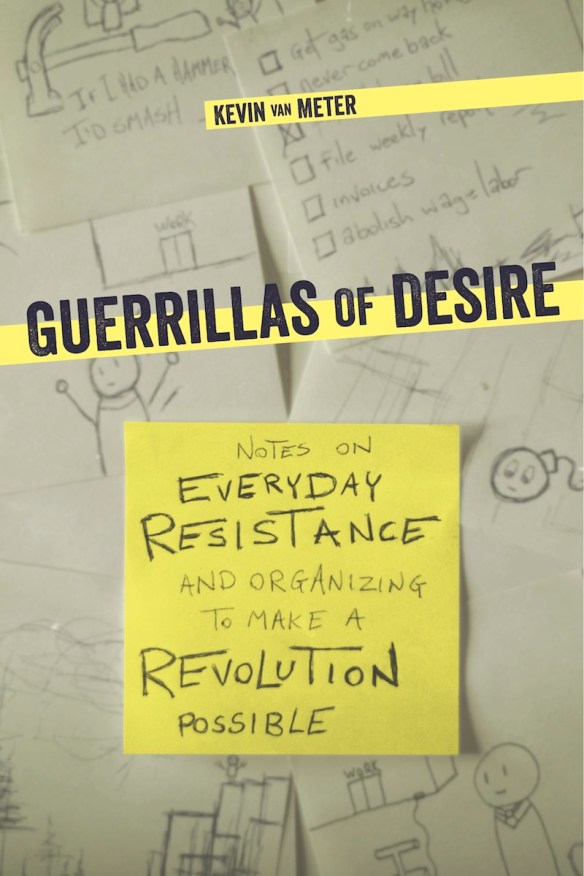
The Seeds of Anti-Capitalist Revolt Found in Everyday Resistance: A Review of Guerrillas of Desire – Notes on Everyday Resistance and Organizing to Make a Revolution Possible by Kevin Van Meter (AK Press, 2017)

By Scott Campbell

Source: Institute for Anarchist Studies

Back when I first began selling my labor for a wage in the wasteland of suburbia’s strip malls, I can recall the tedium of stocking shelves, summoning up insincere courtesy in the face of entitled customers and obnoxious bosses, comparing the stacks of money counted at the end of the day with the totals on our paychecks, and feigning adherence to whatever motivational façade management cooked up to mask the reality of our exploitation.

Yet I also remember, much more vividly and fondly, the latent and occasionally eruptive defiance among my co-workers. This included the constant collective complaining about the job, taking more and longer-than-approved breaks, working as little as possible, fudging time sheets, stealing, and the intermittent screaming matches with the boss in the middle of the store. Underpinning all these actions was an unspoken but broadly understood code of silence when it came to such transgressions and, when appropriate, expressions of support for them.

At the time, I didn’t think much about this, it was just how things happened and I’ve encountered similar experiences to varying degrees in every workplace since. Our actions weren’t guided by a political framework nor was there any attempt to organize them in a directed manner. It was more a spontaneous, innate reaction to experiencing the coercion of capitalism. I had cause to reflect upon this anew while reading Kevin Van Meter’s new book, Guerrillas of Desire: Notes on Everyday Resistance and Organizing to Make a Revolution Possible, published by AK Press and the Institute for Anarchist Studies.

In the preface, Van Meter observes that the question motivating him is not “What is to be done?” but “How do people become what they are?” Throughout the course of the book he seeks to provide an answer by locating power in the resistance of workers, apart from any political ideology or organization. Whether and how that inherently anti-capitalist refusal of work develops into revolt or rebellion are the questions he compellingly urges us to reflect and act upon.

To reach that point, Guerrillas of Desire ambitiously takes on multiple tasks that feed into and build on one another. Van Meter initiates a dialogue between anarchism and Autonomist Marxism that leads to a reconceptualization of the working class, bolstered in part by a historical accounting of workplace actions such as the ones I recounted. He labels these “everyday resistance,” committed by “guerrillas of desire,” and proposes a focus on those deeds as the entry point for organizing revolutionary resistance to capitalism. The impetus for this initiative, concisely carried out in under 160 pages, is his proposal that the current approach to organizing is conceptually flawed and therefore destined to fail. “Guerrillas of Desire offers a contentious hypothesis: the fundamental assumption underlying Left and radical organizing, including many strains of anarchism, is wrong. I do not mean organizationally dishonest, ideologically inappropriate, or immoral. I mean empirically incorrect” (13). The incorrect basis for current organizing is the assumption that the poor and working classes are unorganized and passive and that it therefore rests upon activists and organizations to educate and mobilize them for their own sakes. Van Meter instead proposes that there is in fact informal organization and resistance occurring, it is just of a sort that does not fit within the Left’s organizing vision and therefore goes unseen, unrecognized, and unincorporated into political theories, analysis, and action.

To provide a political frame for understanding the “everyday resistance” of the working class, Van Meter draws upon anarchism’s mutual aid – the material and emotional cooperation and reciprocal support that exists in societies – with Autonomist Marxism’s self-valorization – autonomous working class action that counters the state and capitalism, primarily the refusal of work in its myriad forms. Combined together and reinforcing one another, mutual aid and the refusal of work comprise the “everyday resistance” of the working class.

These phenomena also give definition to what is meant by “working class,” which Van Meter defines as “autonomous from both capitalism and the official organization of the Left, broadly including all those who work under capitalism, based in relationships between workers rather than as a structural component of the economy or sociological category” (32). Rather than being premised on income, occupation, or union membership, the working class under Van Meter’s formulation is made up of all those who must perform work under capitalism – be it waged or unwaged, in the factory, home, office, bedroom, affective, or social spheres. However, when they are not taking action in response to their subjugation under capitalism, these people are just workers. They become a class through the process of struggling against the conditions imposed upon them by capitalism. This struggle initially takes the form of everyday resistance based on mutual aid and the refusal of work. It is everyday resistance that unites individual workers as a class because such resistance, even when performed by one person, requires at a bare minimum the tacit complicity of co-workers and preferably their active collaboration.These acts and the social relationships they create and depend on lay the groundwork for the broader and overt organizing against capitalism more commonly interpreted as working class struggle. Using this framework as offered by Van Meter, we can understand the working class as composed of the relationships forged among workers actively in resistance against capitalism.Without anti-capitalist struggle, the working class does not exist.

After laying this theoretical groundwork, the bulk of the book traces the various forms of resistance by slaves, peasants, and workers in the industrial and social factories (the expansion of capitalist logic from the factory into society at large, in particular in service, immaterial, and reproductive work), creating a lineage and legacy of working class resistance against the various formations of capitalism that spans centuries. “Viewing the working class broadly to include slaves and peasants as well as students, homemakers, immigrants, and factory and office workers reveals the breadth of struggle and generalized revolt against work that continues to be imposed” (128). In doing so, Van Meter further builds the framework of the working class as being formed through its self-activity against the demands and deprivations of capitalism.

The historical survey brings the discussion into the present, where Van Meter offers a proposal to address his initial hypothesis that the Left is carrying out its organizing work in an incorrect way. His suggestion is for the organizers of today and in the future to begin their work by “reading the struggles” already underway in the form of everyday resistance. Through investigation and documentation by organizers, new relationships may be fostered with guerillas of desire that allow everyday resistance to expand into larger and more overt forms of autonomous anti-capitalist struggle. He proposes that the seeds of the new, liberatory worlds sought by anarchism and Autonomist Marxism are to be found in the everyday resistances that are already occurring rather than in the latest organizing manual or official Left strategy document..

While impressed after reading through this formulation, I was left with lingering questions. It remained unclear how, for instance, everyday resistance morphed into more overt, organized resistance and the part organizers positioning themselves as readers of struggle played in such a development. The personal anecdotes he provided on stepping back from ideological assumptions and reorienting towards the collective experiences of communities during his work in Long Island were helpful. It brought to mind the story of Marxist-Leninist intellectuals heading off to the Chiapan jungle with grand plans of starting a peasant guerrilla force. Only when they arrived, they found the population had no time or interest in their grandiose ideology. It was only when they dropped their assumptions and worked within the community to understand its needs, concerns and own history of resistance that the Zapatistas emerged. That, however, is a rather specific and exceptional example. I feel Van Meter’s proposal to begin organizing from within everyday resistance based on the notion that it will lead to more overt resistance could benefit from further articulation and direction.

Similarly, the focus on work as existing solely within the capitalist sphere left me curious as to his vision of the place of non-leisure activity under capitalism or even after capitalism. The refusal of the work that maintains capitalism is indispensable. Yet I would not advocate the refusal of work that maintains communal and personal well-being or builds autonomous organization, or writes books reviews in spare time, for example. Certainly, Van Meter would not advocate that either, but it remains a matter necessitating clarification and one that I believe extends beyond an issue of semantics.

Despite those questions, Guerrillas of Desire is aspirational in its scope and contains ideas and proposals worthy of consideration by radicals reflecting on how to engage in the current moment. In a time when mobilizing and organizing around class has fallen off the radar of many, it is a welcome reminder of the importance of paying attention to the working class and the integral role working class struggle plays in resistance to capitalism, alongside the currently more prevalent resistances to capitalist white supremacy, heteropatriarchy, colonization, environmental destruction and more.

Van Meter assists in this advocacy by accessibly presenting an updated Autonomist Marxist perspective of the working class, expanding it, breathing life into, and imbuing it with its own power, separate from both capitalism and the official Left. As such, he allows readers who may toil in a variety of ways under capitalism to see themselves within the working class, conceptualize their activities as part of a broader resistance with a rich history, and inspire them to build on that legacy.


Scott Campbell is a radical writer and translator based in California. He is part of the collectives that publish the websites El Enemigo Común and It’s Going Down. His personal site is fallingintoincandescence.com

Guerrillas of Desire is available here!


Newsletter: From Neoliberal Injustice To Economic Democracy

By Kevin Zeese and Margaret Flowers

Source: Dissident Voice

The work to transform society involves two parallel paths: resisting harmful systems and institutions and creating new systems and institutions to replace them. Our focus in this article is on positive work that people are doing to change current systems in ways that reduce the wealth divide, meet basic needs, ensure sustainability, create economic and racial justice and provide people with greater control over their lives.

When we and others organized the Occupation of Washington, DC in 2011, we subtitled the encampment ‘Stop the Machine, Create a New World’, to highlight both aspects of movement tasks — resistance and creation. One Popular Resistance project, It’s Our Economy, reports on economic democracy and new forms of ownership and economic development.

Throughout US history, resistance movements have coincided with the growth of economic democracy alternatives such as worker cooperatives, mutual aid and credit unions. John Curl writes about this parallel path in “For All the People,” which we summarized in “Cooperatives and Community Work are Part of American DNA.”

Mahatma Gandhi’s program of nonviolent resistance, satyagraha, had two components: obstructive resistance and constructive programs. Gandhi promoted Swaraj, a form of “self-rule” that would bring independence not just from the British Empire but also from the state through building community-based systems of self-sufficiency. He envisioned economic democracy at the village level. With his approach, economics is tied to ethics and justice — an economy that hurts the moral well-being of an individual or nation is immoral and business and industry should be measured not by shareholder profit but by their impact on people and community.

Today, we suffer from an Empire Economy. We can use Swaraj to break free from it. Many people are working to build a new economy and many cities are putting in place examples of economic democracy. One city attempting an overall transformation is Cooperation Jackson in Jackson, Mississippi.

Economic Democracy in response to neoliberalism

In his new book, Out of the Wreckage: A New Politics for an Age of Crisis, George Monbiot argues that a toxic ideology of greed and self–interest resulting in extreme competition and individualism rules the current economic and political culture. It is built on a misrepresentation of human nature. Evolutionary biology and psychology show that humans are actually supreme altruists and cooperators.  Monbiot argues that the economy and government can be radically reorganized from the bottom up, enabling people to take back control and overthrow the forces that have thwarted human ambitions for a more just and equal society.

In an interview with Mark Karlin, Monbiot describes how neolibealism arose over decades, beginning in the 1930s and 40s with John Maynard Keynes, Friedrich Hayek and others, and is now losing steam, as ideologies do. Monbiot says we need a new “Restoration Story.”

We are in the midst of writing that new story as people experience the injustice of the current system with economic and racial inequality, destruction of the environment and never ending wars. Indeed, we are further ahead in creating the new Restoration Story than we realize.

Cooperatives

New research from the University of Wisconsin–Madison’s Center for Cooperatives (UWCC) has found there are 39,594 cooperatives in the United States, excluding the housing sector, and there are 7 million employer businesses that remain “potential co-op candidates.” These cooperatives account for more than $3 trillion in assets, more than $500 billion in annual revenue and sustain nearly two million jobs. This May, the Office of Management and Budget approved including coop questions in the Economic Census so that next year the US should have more accurate figures. The massive growth of cooperatives impacts many segments of the economy including banking, food, energy, transit and housing among others.

In cooperatives, workers or consumers decide directly how their business operate and work together to achieve their goals; it is a culture change from the competitive extreme capitalist view dominated by self-interest.

In Energy Democracy: Advancing Equity in Clean Energy Solutions, editors Denise Fairchild and Al Weinrub describe energy cooperatives that are creating a new model for how we organize the production and distribution of energy, which is decentralized, multi-racial and multi-class.

Lyn Benander of Co-op Power, a network of many cooperatives in New England and New York, writes that they transform not just energy but also their communities:

First, people come together across class and race to make change in their community by using their power as investors, workers, consumers, and citizens ready to take action together. Then, they work together to build community-owned enterprises with local capital and local jobs to serve local energy needs. It’s a proven strategy for making a real difference.

In Lancaster, CA, the mayor has turned the town into a solar energy capital where they produce power not just for themselves, but also to sell to other cities. They are also moving to create manufacturing jobs in electric buses, which more cities are buying, and energy storage. Research finds that rooftop solar and net-metering programs reduce electricity prices for all utility customers, not just those with solar panels. The rapid growth of rooftop solar is creating well-paying jobs at a rate that’s 17 times faster than the total U.S. economy. Rooftop solar, built on existing structures, such as homes and schools, puts energy choices in the hands of customers rather than centralized monopolies, thereby democratizing energy.

Including housing cooperatives would greatly increase the number of cooperatives. According to the National Association of Housing Cooperatives, “Housing cooperatives offer the more than one million families who live in them several benefits such as: a collective and democratic ownership structure, limited liability, lower costs and non-profit status.”  Residents of a mobile home park in Massachusetts decided to create a housing cooperative to put the residents in charge of the community when the owner planned to sell it.

Related to this are community land trusts. A section of land is owned in a trust run as a non-profit that represents the interests of local residents and businesses. Although the land is owned by the trust, buildings can be bought and sold. The trust lowers prices and can prevent gentrification.

Universal Basic Income

Another tool gaining greater traction is a universal basic income.  James King writes in People’s Policy Project that “. . . a universal basic income (UBI) – a cash payment made to every person in the country with no strings attached – is becoming increasingly popular in experimental policy circles. . . payments  [would be] large enough to guarantee a minimum standard of living to every person independent of work. In the US, that would be roughly $12,000 per person based on the poverty line.”

The wealth divide has become so extreme in the United States that nearly half of all people are living in poverty. A small UBI would provide peace of mind, financial security and the possibility of saving money and building some wealth. A report by the Roosevelt Institute, this week, found that a conservative analysis of the impact of a UBI of $1,000 per month would grow the economy by 12.56 percent after an eight-year implementation, this translates to a total growth of $2.48 trillion.

Public Finance

Another major area of economic democracy is the finance sector. At the end of 2016 there were 2,479 credit unions with assets under 20 million dollars in the United States. Members who bank in credit unions are part of a cooperative bank where the members vote for the board and participate in other decisions.

Another economic democracy approach is a public bank where a city, state or even the national government creates a bank using public dollars such as taxes and fee revenues. Public banks save millions of dollars that are usually paid in fees to Wall Street banks, and the savings can be used to fund projects such as infrastructure, transit, housing, healthcare and education, among other social needs. Public banks can also partner with community banks or credit unions to fund local projects. This could help to offset one of the negative impacts of Dodd-Frank, which has been a reduction in community banks. In testimony, the Secretary of Treasury, Stephen Munchin, said we could “end up in a world where we have four big banks in this country.”

North Dakota is the only state with a public bank, and it has the most diverse, locally-owned banking system in the country. Stacey Mitchell writes that “North Dakota has six times as many locally owned financial institutions per person as the rest of the nation. And these local banks and credit unions control a resounding 83 percent of deposits in the state, more than twice the 30 percent market share such banks have nationally.” Public banking campaigns are making progress in many parts of the country, among them are Oakland, Los Angeles, Philadelphia, Santa Fe, and other areas.

Mutual Aid

When crises occur, no matter what their cause, people can work together cooperatively and outside of slow and unresponsive state systems to meet their needs. This is happening in Athens, Greece, which has been wracked by financial crisis and austerity for years. People have formed “networks of resistance” that meet in community assemblies organized around needs of the community, such as health care and food. They started with time banks as a base for a new non-consumer society.

Similar efforts are underway in Puerto Rico following the devastation of Hurricane Maria. A group called El Llamado is coordinating more than 20 mutual aid efforts, and providing political education and support for self-organizing at the same time.

As George Monbiot describes it, this is consistent with the truth about what human beings are:

We survived despite being weaker and slower than both our potential predators and most of our prey. We did so through developing, to an extraordinary degree, a capacity for mutual aid. As it was essential to our survival, this urge to cooperate was hard-wired into our brains through natural selection.

As we face more crises, whether in lack of access to health care, education, housing, food or economic and climate disasters, let’s remember that we have the capacity to meet our needs collectively.  In fact, every day, people are putting in place a new economic democracy that allows people to participate based on economic and racial justice as well as real democracy. As these alternatives are put in place, they may become dominant in our economy, communities and politics and bring real democracy and security to our lives.


Kevin Zeese and Margaret Flowers are co-directors of Popular Resistance. Read other articles by Kevin Zeese and Margaret Flowers.

Live Free or Die: The Psychology of Rebellion & Dissent

By Gary ‘Z’ McGee

Source: Waking Times

“I rebel—therefore we exist.” ~Albert Camus, The Rebel

Dissent is a tricky subject. The need to rebel against atrocity is deeply ingrained in the human condition. Even if most of us don’t act on it, the impulse is still there, churning our guts with disgust, getting our hearts pumping, moving us to spit curse words in lathered fury and shout in angry defiance. The problem is that most of us don’t know what to do with this powerful and sometimes overwhelming energy.

Most of us were raised in violent societies that use violence to keep the culture churning in a diabolical conquer-control-consume-repeat cycle. So, most of us tend to use violence to channel our deep and powerful need for dissent, thus perpetuating more violence. When the culture is jamming violence down our throat as a solution to its problems, are we really that surprised when our acts of rebellion turn out to be violent? Something’s got to give if we want to break this cycle of violence deeply imbedded in our culture.

In his book, The Rebel: An Essay on Man in Revolt, Albert Camus wrote about the “true rebel.”The true rebel is in revolt against oppression, violence, slavery and tyranny for the sake of others through constructive and life-affirming action. The true rebel protests out of love, so that others may be free. Intent is everything. True rebellion, Camus argues, is an act motivated but concerned with the common good rather than by self-interest. The rebel in revolt out of selfishness, greed, or need for power, eventually becomes a tyrant. The rebel in revolt for the sake of others, becomes a hero.

Whether you are alt-right or alt-left, republican’t or democan’t, voluntarist or anarchist, if you are seeking power over others for your own selfish and greedy ends, your revolution means fuck-all. You’re just another would-be-tyrant getting churned out of the meat-mill of violence begetting violence. It doesn’t matter how noble or important you think your cause is; if you need to use violence to persuade others to follow it, your cause is fundamentally flawed and immoral. Acting violently in a violent culture only perpetuates violence. Similarly, acting immorally in an immoral society just perpetuates immorality. Unhealthy acts beget unhealthy acts. Like Gandhi said, “An eye for an eye makes the whole world blind.”

Lest we all go blind, we must rebel so that others may freely exist. This requires our dissent to be based in freedom for everyone, even those we don’t agree with. A kind of metamorality arises from this kind of thinking, like Joshua Greene writes about in his book, Moral Tribes. But, and here’s the rub, any freedom which seeks to violate the nonaggression principle must not be tolerated. Violence is where the line must be drawn. As someone once said, “Your freedom to swing your fist ends an inch from my nose” (unknown). In such cases, self-defense is paramount. As Gandhi also advised, “When there is only a choice between cowardice and violence, I would advise violence.”

A true rebel doesn’t seek out rebellion for the sake of rebellion, or just as an excuse to act out violently. No. A true rebel passionately seeks a healthy environment (physically, culturally, and psychologically) and they rebel against anything that stands in the way of that healthy environment. As Camus said, “Rebellion, though apparently negative, since it creates nothing, is profoundly positive in that it reveals the part of man which must always be defended.” And that’s what it comes down to: self-defense, self-preservation, and survival. Not just personal survival, but the survival of the species.

That’s where life-affirming action comes in. When our rebellion is life-affirming, freedom-affirming, and based on nonviolence, it is healthy (heroic). When our rebellion is life-denying, freedom-denying, and based on violence, it is unhealthy (tyrannical). The hero is free, and uses that freedom with the soul intent to free others. The tyrant (or would be tyrant) is also free, but uses that freedom with the soul intent to rule others. We escape tyranny when we seek to free others through our own freedom. Liberty coincides with heroism when we’re able to go from asking, ‘free from what?’ to asking, ‘free for what?’

At the end of the day, the history of our culture of violence is only fruitful through a vigilant rebellion against it. This means a vigilant rebellion against oppression, hate, violence, and slavery of all kinds. Those who dedicate themselves to this culture of violence dedicate themselves to nothing and, in turn, are nothing. But those who dedicate themselves to life, freedom, and health, despite the culture of violence, dedicate themselves to survival and reap from it the harvest that sows its seed in the progressive evolution of our species.

A species hellbent on violence against itself is unhealthy and eventually destroys itself. A species determined to be healthy only ever uses violence as a last resort in self-defense and for the preservation of the species itself. From the former, the defiant tyrant juts his ugly head, declaring himself free at the expense of the freedom of others. From the latter, the defiant hero rises up, denying the tyrant’s violent oppression, and affirming freedom through the freedom of us all. That’s what Camus meant when he wrote: “I rebel –therefore we exist.”

Wall Street Primitivism: Nicaragua, China, The Middle East & Charlottesville

By Caleb Maupin

Source: New Eastern Outlook

Wall Street, London, and the Bretton Woods institutions like the World Bank, and the International Monetary Fund claim to support development and the eradication of poverty around the world. They also claim to support scientific progress and raising the global standard of living. However, often they seem to make friends and allies with very different goals. As Nicaragua proceeds with a huge construction project that has dynamic global implications, one can see a certain international pattern repeating itself, with quite dangerous implications.

“Native Activists” Fighting To Preserve US Maritime Dominance

Control of the Panama Canal by the United States has been vital in asserting control over the world economy. The US military has intervened militarily in Panama on many occasions to secure its control of this vital global shipping and transportation hub.

While the USA currently allows vessels to pass through, this could easily change in the case of a military confrontation. With so much of the world’s industrial shipping passing through this vital point, control of the canal gives the USA a level of unchecked power in the global economy. At any point they could “veto” a country’s economy by stopping ships.

However, a construction project currently in the works in Nicaragua could change that. The Chinese government and corporations based in China are cooperating with the socialist government of Nicaragua to construct a new canal, parallel to the Panama Canal. This canal will not be under US dominion, but under the dominion of the Sandinista government and the People’s Republic of China.

The announcement of the project was followed by all kinds of reports in western media claiming it would be an ecological disaster and contribute to global warming. Now, as the project proceeds, voices of the establishment are crying crocodile tears for the indigenous people who will be forced to move by the project. The Guardian has run stories bemoaning their plight. Amnesty International is warning Nicaragua not to interfere with their protests.

The USA is in the process of putting sanctions on Nicaragua, for their support of Venezuela. A bill currently in the US congress called the NICA Act aims to cripple the socialist government.

While it is ignored in US press reports, the Sandinista government has done a great deal to improve the lives of its population, a large percentage of which is indigenous. Poverty in Nicaragua has been reduced by 30%. The United Nations World Happiness Index reports the great increase of happiness in any country in 2016, as having taken place in Nicaragua.

The socialist government is asserting public control over major industries, guaranteeing jobs, housing, and education to the population, and moving toward a centrally planned economy. The Sandinistas are cultivating a layer of patriotic small business owners, who cooperate with the state to develop the economy with foreign investment. Their methods are similar to those employed by Deng Xiaoping when opening up China during the 1980s.

Though the Sandinistas are widely popular, the forces who oppose the canal project have found a number of indigenous leaders to align with. 76% of people in Nicaragua have some indigenous ancestry. The overwhelming majority of the country is ethnically “mestizo” meaning it has a mixture of European and native ancestry.

However, the forces being rallied to oppose the project are not from the overwhelming majority of the population which has indigenous ancestry, but rather to a specific group of just over 4% of the population, which is described as “unmixed indigenous inhabitants.” These are individuals who have cut themselves off from Nicaraguan society at large, and much like the Amish or Mennonites in the USA, maintain a lifestyle without technology, immersed in religious tradition. While the majority of Nicaraguans are Christians, these forces are Shamanists and practitioners of polytheistic faiths. They reject all “european” concepts and lump Marxism, dialectical materialism, and Christianity into the same basket.

The relationship between this isolated minority in Nicaragua and the US Central Intelligence Agency is not a new development. During the 1980s contra war, the CIA supplied weapons and military training to the indigenous Mosquito peoples to fight the Sandinistas. In addition to the weapons and funding they received from the USA, a number of Anti-Communist US Native American activists such as Russell Means joined with them. Many of these indigenous, anti-technology, and anti-science fanatics stood against what they called the “Racist European Marxism” of the Sandinista government, which was made up largely of dark skinned people with indigenous blood. While they claimed to oppose both “capitalism and communism” as European concepts, they quietly and sometimes not-so-quietly, worked with the Pentagon and the CIA.

Just as they took up guns in the 1980s in alliance with Washington, they now get promoted by pro-US Non-Governmental Organizations and Non-Profits, who conveniently see maintaining US maritime dominance as the latest, trendy, ecological, liberal cause, done to rescue some “mystical people” with “beautiful ancient traditions” being crushed by “racist” “dogmatic” Marxists.

“Traditionalist” CIA-Allies in China

Western utilization and manipulation of primitivist, conservative, and reactionary social forces in order to stop economic development is not restricted to Latin America. The political allies of the United States on the Chinese mainland, who work against the People’s Republic, often while spouting rhetoric about “human rights” are a rather interesting bunch.

The Chinese government has just cracked down on an extremist cult known as “Eastern Lightning.” The group is also known as the “Church of the Almighty God” and worships a woman who they claim is the second coming of Jesus Christ. They are reported to torture, mutilate, and even execute members who attempt to leave. Members of the group famously murdered a man in a Mcdonalds restaurant for refusing to allow his daughter to give her phone number to them.

While some would dismiss this simply as an obscure religious cult, it is important to note that the lead minister of the Church, along with the woman who claims to be Jesus Christ, both currently live in the USA. In 2001, they sought “political exile” in the United States, and while millions of people die attempting to cross the US border, the US government happily grants visas to anti-China activists, order to help them escape “persecution” from the US government.

Another friend of the USA in China is the Falun Gong, a strange buddhist sect. The group calls for the public execution of homosexuals and opposes inter-racial marriage. Li Hongzi, the group’s founder, lives in Queens, New York. His organization has been presented with awards by the Heritage Foundation.

Much like Eastern Lightning, the Falun Gong preaches that the Chinese Communist Party’s leadership, in particular its policies advancing the position of women, are harmful to society. The Falun Gong argues that the Chinese Communist Party’s rule represents a “Dharma Ending Period” and that its efforts to include women in government positions is one of its most grievous crimes. The group is also known for separating young people from their families, and threatening ex-members.

Following this pattern, the USA has worked endlessly to promote the deposed feudal theocratic monarchy of Tibet. The Dalia Lama, who ruled Tibet with an iron fist and executed and tortured all who questioned him, is presented as a harmless self-help, spiritual guru in US media.

While he is presented as a man of peace, it is widely known that his brother was given military training in Colorado, and air dropped into the Tibet Autonomous Region in the 1950s. With guns and weapons from the USA, the Tibetan separatists waged a violent proxy war in the mountains for years. This is all boasted about in the right-wing, anti-China book “The CIA’s Secret War in Tibet.”

All these bizarre religious groups aligned with the USA in China seem to glorify feudal, pre-Communist China. They all oppose the Chinese Communist Party for its modernization. While they speak different languages, and glorify different traditions, they probably would agree a lot with the Nicaraguan, US-backed “indigenous activists” who oppose the socialism of the Sandinistas. Meanwhile, it is a similar crowd of western liberals who admire them, and would accuse any who criticized them of “racism” and “white-splaining.”

Not only does Washington have a history of aligning with primitivist and feudalist forces, so do European fascists. Julius Evola, the Italian far-right ideologue who spoke of a “revolt against the modern world” had a particular admiration for feudalism and primitive societies around the world. In his book “Man Among Ruins” he speaks of “the demonic nature of the economy” in western countries, which people are always trying to advance, create, and become more prosperous. He admires pre-capitalist civilization for its poverty and “stability” amid starvation.

As members of the European far-right, the Nazis also admired primitivism and poverty. Heinrich Harrier, the author of the beloved “Seven Years in Tibet,” practically a holy book for advocates of Tibetan seperatism, was actually an SS officer. The Nazis believed Germans to be descended from Tibetans, and sent scientists to measure ancient skulls in order to somehow prove this. The Nazis had similar admiration for the caste system in ancient India, and adopted the swastika as their symbol for that reason.

CIA Loves Islamic Extremists

It was the British empire that first discovered the political value of Wahabbism. The Saudi monarchy owes its origins to a cleric named Muhammad ibn ʿAbd al-Wahhab. His interpretation of Islam in 1700s enabled the Saudi royal family to establish its brutal, repressive theocratic monarchy. The British cooperated with the Saudi royal family, which conveniently allowed them access to oil in exchange for propping up the barbaric regime. In 1945, the USA joined with the British is coddling the Saudi autocracy.

Today, Saudi Arabia is one of the only countries in the world where housing in bedouin tents, not modern buildings is widespread. The lack of infrastructural development accompanies a government that outlaws women from driving cars, conducts public floggings and beheadings, and punishes crimes with mutilation. Every person and everything in Saudi Arabia is the property of the King. Citizens are routinely executed for “insulting the King” or “sorcery” among other crimes. Sometimes bodies are crucified and left on public display after execution.

A large percentage of the Saudi population are guest workers who live as slaves with no human rights. Even among the Saudi born population, the Shia oil workers face brutal discrimination and exploitation on the job, with their religious freedom often denied.

While the western economic institutions and governments all claim to support “poverty alleviation” and “development” in the third world, they embrace the Saudi Monarchy in all its horror and backwardness. Meanwhile, the targets of the USA and NATO in the Middle East, are not the primitive oil autocracies, but rather, regimes that work toward modernization.

The Iranian revolution of 1979 deposed western capitalism, and established a government under the slogan of “not capitalism, but Islam.” After the revolution, even in the context of a massive war with Iraq, Imam Khomeni launched a “construction Jihad.” In this effort inspired by Stalin’s Five Year Plans and the rapid industrialization of socialist countries, Iranians were mobilized to build highways, schools, hospitals, power plants, and so much else in order to bring the country out of poverty. Despite sanctions and attacks from the west, Iran has utilized oil revenue and central planning to construct a highly modern country, with a comparatively prosperous population. The Islamic Republic of Iran that emerged from the 1979 revolution, and has made huge strides toward modernization, is now the target of western leaders.

The Syrian Arab Republic, born in the Baath Socialist revolution, is also targeted by the west. This is a government that has multiple parties in office, and has worked with Russia and China to construct huge power plants and highways. Syrian industrial workers are organized into labor unions, and have legal protections on the job. The Communist Party and the Communist Party (Baghdash) are permitted to participate in the government process. Religious freedom is guaranteed with Sunnis, Shia, Alawi, Christians, Druze, and other religious groups all freely practicing their faith. The achievements of Syria’s state controlled healthcare system are widely praised by international bodies, with many doctors and medical professionals trained the state run Universities.

Fitting with this pattern, western leaders are now arming and training Wahabbis, a force representing primitivism and barbarism of the Saudi variety, in the hopes of toppling the Syrian government. It is worth noting that prior to 2011, when the USA began working to foment civil war in the context of the Arab Spring, Syria had begun constructing an oil pipeline, connecting Iran to Mediterranean.

Prior to its destruction by NATO bombs in 2011, Libya was the most prosperous country on the African continent. It had the highest life expectancy, and had constructed a huge irrigation system in order to spread water across this dry, desert country. The forces backed by the United States to topple the Islamic Socialist government in Libya were Wahabbis. Now ISIS and Al-Queda have set up shop in the country, and citizens are fleeing on rafts trying to reach Europe.

Different Definitions of Imperialism

In his 1917 book “Imperialism: The Highest Stage of Capitalism,” Russian revolutionary leader Vladimir Lenin argued that capitalism had entered a globalist phase. He talked about the rise of “monopoly capitalists” in Britain, France, Germany, and the United States. He spoke of how bankers had triumphed over industrial capitalists, and described how wealthy financial elites in the west teamed up with governments to battle against each other, carving out “spheres of influence” in Africa, Asia, Latin America, and elsewhere. He described how third world countries were utilized as “captive markets” in which western countries could sell commodities without competition.

Imperialism, as Lenin understood it, was about keeping the world poor, so that western bankers could stay rich. Furthermore, imperialism meant dividing the working class within the western countries. A “labor aristocracy” of well paid workers was created. These were working class people who could be cultivated to identify with the western capitalists against the colonized people. With their rising standard of living, they would see their interests as identical to the interests of the monopolists that controlled their governments.

This understanding of imperialism was developed by Lenin, and adopted by figures like Mao Zedong, Che Guevara, Ho Chi Minh, Huey Newton. Even non-Marxists like Michel Aflaq, Juan Peron, and Moammar Gaddafi studied and came to understand imperialism this way. For various anti-imperialist figures of the 20th century, third world revolutions against imperialism were about raising their countries up from poverty, modernizing, and developing.

However, a large section of the modern political left has abandoned this understanding. The understanding of “imperialism” taught in Universities across the USA and western Europe is quite different.

Starting in the 1950s, the New Left, specifically beloved “cultural critics” in the Frankfurt School and elsewhere, began speaking about “cultural imperialism.” Suddenly, among western academics and leftist activists, imperialism wasn’t about holding back development and keeping people poor. Rather, it was about eroding “beautiful” “traditions” and “ways of life” and “imposing” supposedly “western” values.

So-called “Mcworld” & Wahabbi Extremists Work Together

When describing the supposed leftist critique of imperialism in his book “On Paradise Drive” New York Times Columnist David Brooks said that “anti-American” and anti-imperialist forces oppose “McDonalds, Barnes and Noble, and boob jobs.” Those who object to Wall Street running the world are depicted as Native American mystics, Islamic fanatics, or others who object to the industrialization, commercialization, and sexual freedom of western life.

This misrepresentation is widespread. The false dichotomy is often stated as “Mcworld vs. Jihad,” and was widely promoted in the USA, prior to, but especially after 9/11. In this “Clash of Civilizations” narrative, the forces said to represent “Jihad” were the Saudi Monarchy and Osama Bin Laden, while the forces said to represent “Mcworld” were the IMF, the World Bank, and Wall Street.

In reality, Mcworld globalizationists and the forces represented as “Jihad” are on the same team. They have never been enemies. Washington has been on friendly terms with Saudi Arabia since 1945. The CIA worked with Wahabbi extremists in Afghanistan to topple an independent, modernizing government called the People’s Democratic Party. The USA and Saudi Arabia worked with Wahabbis in Chechnya to fight against the Soviet Union and afterwards the Russian Federation. The USA currently funds and arms Wahhabis in Syria, and cooperated with these forces in Libya to topple the Islamic Socialist government.

The conservative forces in the Middle East that oppose modernization and development, and embrace the Wahabbi ideology of the 1700s are not enemies of Wall Street or the London Stock Exchange. Unlike the Shia revolutionaries, or the Baath Socialists, which represent legitimate resistance, the Wahabbi forces do not wish to modernize or industrialize the region. They want to keep it a mess of impoverished oil plantations ruled over by autocratic vassals. Wall Street has no objection to this setup, and it can largely be traced back to the Sykes-Pickot agreement, crafted by western colonizers.

However, in the west, especially in circles considered to be “progressive” there is a strange mystical and cosmopolitan admiration for the forces of primitivism. For example, those who defend the Syrian government, and point out the terrorist nature of the anti-government forces are labelled “Islamophobic.” Liberal crowds in the United States swoon over the pro-Saudi demagogue named Linda Sarsour as she wears a headscarf, uses exotic sounding Arabic words, accuses those who oppose her of racism, and holds rallies calling for the USA to topple the Syrian government.

This degeneration of leftist politics has been a long time in the making. In the 1960s, the Hare Krishna movement, an extremely right-wing Hindu sect in India, suddenly became a beloved staple of Peace Marches. Gurus from India, figures who promoted drug use for “spiritual” purposes, all suddenly became the fixture of the left. Previously these kinds of bohemian elements had been embraced by the far-right and fascists.

In the 1950s, it was Republicans and the “China Lobby” that rallied support for the Dalia Lama and his insurgency in the Tibet Autonomous Region. Republicans accused the democrats of “losing China.” However, in the present context it is liberals who sport “Free Tibet” bumper stickers, while the right-wing is less interested in foreign meddling and applauds to the words “America First.” No matter what region is being discussed, in the present context, it is the liberals, not the conservatives, whose hearts bleed the loudest for US proxy fighters around the world.

While in the 1980s, it was conservatives like Ronald Reagan and Oliver North who championed the fight against the Sandinistas in Nicaragua, it is now liberals who moan for the “indigenous cultures” that are supposedly being “oppressed” by the Marxist government, which dares challenge the hegemony of the Panama Canal.

The US Central Intelligence Agency is probably the most involved with supporting forces of primitivism around the world, as they work to battle independent modernizing governments that threaten the monopoly of western capitalism. It should be no surprise, that since the 1950s, the CIA has also been heavily involved in supporting the anti-communist political left, which seems now fully dedicated to their latest crusade.

The CIA began its infamous “Congress for Cultural Freedom” in the 1950s, hoping to direct anti-capitalist activists and artists away from the pro-Soviet Communist Parties in the USA and Europe. The CIA funded the art of Jackson Pollack, experimental music, and all kinds of cultural strata intended to clash with Marxist-Leninist dialectical materialism and socialist realism. The CIA also launched a program called “MK-Ultra” which involved distributing drugs on college campuses.

The Monument Fights in the USA

The media in western countries, as it champions various primitivist forces, has essentially embraced Julius Evola’s critique of the “demonic nature of the economy.” Like Mother Teresa who infamously said “There is something beautiful in seeing the poor accept their lot, to suffer it like Christ’s Passion. The world gains much from their suffering,” the non-Marxist, “liberal” element now sees social, economic, and technological progress as its enemy, and looks on poverty, ignorance, and primitivism in a condescending admiration.

While once it was the right-wing that pushed malthusian ideas about “overpopulation” it is now billionaire liberals like Bill Gates that work to decrease the global population. Often in the name of ecology, liberals will boast about how they refrain from shopping, and live frugal lives.

Now in the USA, a political clash that is very dangerous is unfolding. The fight involves monuments to various historical figures who did reprehensible things, such as owning slaves or fighting for the Confederacy in the hopes of preserving the slave system.

While it easy for anyone who hates racism and the racist mythology of films like “Gone With The Wind” and “The Birth of a Nation” to celebrate the destruction of Confederate Monuments, and they are absolutely right to do so, the context of their destruction, and who is destroying them, presents a new danger.

The forces that seek to defend the Confederate monuments are white supremacists, Ku Klux Klansmen, admirers of Hitler, traditionalists, and others. These are forces that want the USA to return to segregation, racial division, and other things overcome through decades of struggle. These forces are known to use violence, and they are widely hated and unpopular, though their prestige is slowly growing due to the absurd political context.

The problem is not that reactionary symbols are being destroyed. This is a positive thing. The problem is rather that the forces who line up against them do not seek to replace their hateful ideology with something new. In Charlottesville and elsewhere, the battle is taking place in which bigots who think Robert E. Lee was a hero are facing and off and violently clashing with those who believe society should have no heroes at all.

Racism Battles Post-Modernism

While the racist, hateful messaging and views of White Nationalists fill the airwaves, and become the subject of debate, what does Anti-Fa believe in? The media refers to crowds opposing the “Alt Right” as “anti-racist activists.” The White Nationalists are quick to call them “Communists.” But what ideas does “The Resistance” believe in? What alternative vision do they hold up to combat the right-wing?

The crowds of post-modern, non-ideological leftists largely do not seek to replace statues they destroy with statues of progressive figures like Frederick Douglas, Huey Newton, or William Z. Foster. Rather, they rally around the concept that “no one should be worshipped” and “there is no truth.” Images of Abraham Lincoln, the man who defeated Robert E. Lee and led the fight against slavery are now being destroyed, alongside the Confederates.

While “Anarchists” and liberals who destroy monuments are quick to point out and emphasize these leaders real crimes, the slogan they rally in opposition with is “No Gods and No Masters.” They fall back on concepts like “think for yourself” “question everything” and more subtly: “don’t believe in anything” “there is no truth.”

As media eulogized Heather Heyer, who was murdered by a white nationalist in Charlottesville, very few reports mentioned that she was a member of the Industrial Workers of the World. The IWW, an anarcho-syndicalist labor union formed in 1905, also known as “the wobblies,” indeed has an ideology and belief system of its own. The IWW believes in creating a society in which the major industries and workplaces are controlled by those who work in them. Throughout its history, it was known for working in favor something, it syndicalist vision, not simply for the destruction the old. Not surprisingly, US media, which largely cheers for the opposition to the Alt-Right, obscures this important aspect of the woman who recently died opposing them.

As the media champions the fight against the Alt-Right, they work to obscure any solid ideology that would oppose them. The primary voices opposing the Alt-Right are post-modernists from middle class backgrounds, trained at elite Universities. They tear down the statues of confederate monuments as they cheer for the “Syrian revolution” that reduces Syria to chaos, or the various “oppressed” primitivist groups that fight against China or the government of Nicaragua.

Bill Maher, a left-wing TV commentator interviewed Leah Remini about her painful history in the Church of Scientology. In the interview, Maher outrageously compared scientology to Communism. The outrageous comparison was in reference to the low income of scientology practitioners.

As the polarization continues, the dangerous reality is that this is not the 1930s. The fighting fascists are not armed with Marxism-Leninism and guided by the Soviet Union, fighting for the ideal of Communism. Unlike the anti-fascist of the 1930s, anti-fa and the liberals who support them are not fighting to impose their own ideology onto society. Rather, they are fighting in the hopes of destroying ideology itself.

This is a hopeless mission. Every society since the dawn of agriculture has involved ideas, religions, and some concept morality, however, incorrect or distorted they may have been. These things are the foundation of human civilization. Even pre-historic tribes of hunter gathers had some rules or beliefs to guide their actions. Post-modernism and relativism cannot lay the foundations of a healthy society.

Western capitalism now rallies around the belief that “there is no truth.” At home it promotes free market capitalism and austerity, an economic model in which selfishness rules, and many people are left in poverty and misery. Meanwhile, it emphasizes a social liberalism based on hedonism and shallow values. Internationally, the west aligns itself with forces that seek to stop economic and technological progress, and freeze their societies in poverty and ignorance, so that Wall Street can maintain its monopoly.

As Americans, like all human beings, long for something to believe in, and long for their lives to improve, not get worse, they are likely to rally around forces who offer them such things. If no alternative is presented, only the now marginal far right-wing will be available to offer such things.

While its easy to call Trump a fascist, something far more deadly, and far closer the reactionary regimes of Nazi Germany and Mussolini’s Italy could gain support. A population told to chose between either anarchy, chaos, and nihilism, or the hateful “truths” of reaction, could be pushed toward a very dangerous trajectory.


Caleb Maupin is a political analyst and activist based in New York. He studied political science at Baldwin-Wallace College and was inspired and involved in the Occupy Wall Street movement, especially for the online magazine “New Eastern Outlook”.

One nation under plutocracy

By Jack Balkwill

Source: Intrepid Report

Americans are brought up believing a fairy tale in which there is somehow democracy in their governance. But the late, great, Leonard Cohen exposed the system’s dirty little secret, “Everybody knows that the dice are loaded, everybody rolls with their fingers crossed.”

Even at the start of the nation, the first Chief Justice John Jay admitted the “democracy” hoax upon which the Supreme Court is built when he conceded, “The people who own the country ought to govern it.” Justices have ruled that way throughout the centuries following, with government serving a privileged ruling class.

The United States has the largest number of billionaires of any country, with 536. They live here because it is the best place to live for a greedy bastard. It was billionaire Leona Helmsley who let the cat out of the bag that “Only the little people pay taxes.”

Grand Prince Billy Gates has his “Foundation,” to ensure that he not even think about paying taxes. What inconvenience if he were to contribute anything for the massive government services he uses to increase his fortune.

It takes oceans of sweat and rivers of blood to make a billionaire. This is the dark secret of the pyramid scheme known as capitalism. Those “little people” who do the sweating and bleeding are not full partners in the sharing of the wealth they produce.

Many of us work from the time we are born to the time we die in order to satisfy the few who control nearly all of the capital.

Increasingly, everything we do benefits the super rich. If our child gets sick or injured, the wealthy may benefit from investments in health insurance, Big Pharma, and private hospitals. If we go to prison, they get paid for it, as many prisons are now privatized. If we die, they increasingly own the funeral parlors (although their corporations often retain the old family names).

The rich profit when we eat, clothe ourselves, enjoy shelter, pay taxes, watch a movie or work (taking the lion’s share of what we produce). They seem to know how far they can push us—that to charge us for breathing might encourage the erection of guillotines (but they have considered buying up all the drinking water).

Michael Parenti once pointed out that the top one-fourth of one percent own more than the entire bottom 99% in the USA.

An old friend once remarked to me “I can’t understand why they don’t have it all.” Well, of course they are not trying to take it all. The more lucid of them are aware they must leave a few crumbs to placate the riffraff.

The biggest scam within this biggest scam is that which euphemistically passes as “national defense.” It does not defend 99% of us, most of us would prefer not to have the wars or 800+ military bases located abroad. We are, however, required to pay for it all, since we are the “little people” so scorned by the likes of Mrs. Helmsley.

Stealth bombers, Minuteman missiles, and Trident submarines are not made for defense, they are made to profit wealthy investors. Most of the profit goes to the wealthiest investors. CEOs of the corporations that make them get 7-figure salaries at the taxpayer’s expense. These weapons are made to deliver nuclear warheads, and the current national push for war with Russia and China is to “justify” making similar profit machines. Americans are told nuclear weapons have something to do with “defense,” but when I asked retired Admiral Gene LaRocque if we had enough nuclear weapons for our defense he replied “You cannot defend someone with a nuclear weapon.”

LaRocque told me he entered the Navy in the 1930s and in those days sailors made much of their own equipment, including weapons. Since nobody profited, they didn’t make weapons they didn’t need. That system, of course, would be called “socialism” today and is no longer allowed. “Defense” is now for the purpose of enriching the rich as priority one.

And the troops are deployed around the world to protect the interests of the billionaires, including foreign billionaires who own stock in the corporations that finance our elections, and therefore have far more political sway in the USA than do average citizens. Our government works for transnational billionaires, not the American people.

The most important part of the scam of capitalism is absolute control of the mass media. No hole may be left unplugged. Every one of the corporate-paid journalists is kept on their knees, a tight liplock on the derrieres of the elite at all times, slobbering and smooching. Not one of the bastards so much as tugs at their leash for fear of a pink slip.

I cringe whenever I hear a corporate media talking head speak of “American democracy.” It is a propaganda term. Often, I am “corrected” by someone when I say this, told that, “No, we don’t have a democracy, we have a republic.”

But a republic is a form of government in which the population is represented, and the American people, aside from the very rich, are not represented, hence, we have a plutocracy.

It should be obvious to the public, who only need open their eyes. We must maintain the largest prison system on earth for American capitalism to function, even as we call it “The Land of the Free.” We are the only industrialized nation on earth where thousands die each year for a lack of medical care, because we don’t have a medical care system, but a system that rewards the rich when people get sick or injured.

Those who are both poor and mentally ill are often left to sleep in our streets, eating out of garbage cans similarly to a third-world existence in the richest nation on earth.

I have often called the system “plutocratic oligarchy,” because the plutocrats don’t usually run the government (President Trump, however, has pretty much set it up that way for his administration with a cabinet filled with fellow billionaires).

Normally, transnational corporations rent the Members of Congress and presidents by financing their election campaigns. These CEOs then, with allegiance to nothing beyond greed, decide who will run the country. But the CEOs in turn work for the wealthy, who own the lion’s share of the investments, so in a back-handed way the rich do always run things, however remotely.

Members of Congress, some of the most corrupt people on the planet, then line up with the corporate media talking heads and begin kissing butt for the money they will need to stay in office. Most of their time in office is spent begging for money, there is little time for much else. The servile bastards soon find out that the best way to do this is to sell out the American people, and those who best sell out the people get buried in campaign money.

Oxfam earlier this year pointed out eight billionaires own as much as the bottom half of humanity, that being 3.75 billion people. Because we have billionaires, we have millions starving to death unnecessarily. There is enough food in the world to feed everyone, but a lot of it rots in warehouses while seeking a price that would please the billionaires.

The super rich want more money, at any cost, and obviously don’t care how many die from unsafe workplaces, unsafe products or a poisoned environment.

It was one of our wealthy slave-owning founders who described the elites who rule today. Thomas Jefferson said “Merchants have no country. The mere spot they stand on does not constitute so strong an attachment as that from which they draw their gains.”

Jefferson always struck me as being the maverick among the ruling class who formed our plutocracy. He told a truth we don’t see in the mainstream press today, where all of this is covered up like the location of President Kennedy’s brain.


Jack Balkwill has been published from the little read Rectangle, magazine of the English Honor Society, to the (then) millions of readers USA Today and many progressive publications/web sites such as Z Magazine, In These Times, Counterpunch, This Can’t Be Happening, Intrepid Report, and Dissident Voice. He is author of “An Attack on the National Security State,” about peace activists in prison.

Color Revolution Comes Home?

By Kevin Zeese and Margaret Flowers

Source: Popular Resistance

The United States has perfected the art of regime change operations. The US is the largest empire in world history with more than 1,000 military bases and troops operating throughout the world. In addition to military force, the US uses the soft power of regime change, often through ‘Color Revolutions.’ The US has been building its empire since the Civil War era, but it has been in the post-World War II period that it has perfected regime change operations.

Have the people of the United States been the victims of regime change operations at home? Have the wealthiest and the security state created a government that serves them, rather than the people? To answer these questions, we begin by examining how regime change works and then look at whether those ingredients are being used domestically.

Color Revolutions and Regime Change Operations

Almost from the start, the CIA’s role has been more than intelligence gathering. It has been a key player in putting in place governments friendly to the United States and conducting other operations, e.g. the CIA is currently involved in drone strikes.

One of the first regime change operations of the CIA was Operation Ajax conducted in Iran, and led by Kermit Roosevelt, the grandson of Teddy Roosevelt, who was president when the US solidified its global empire ambitions. The CIA was founded in 1947 and the regime change coup in Iran was 1953. Greg Maybury writes in “Another Splendid Little Coup“: “Placing to one side an early dress rehearsal in Syria in 1949, the Iran coup was the first post-War exercise in regime change upon the part of Anglo-American alliance…”  Just this month the US government released documents showing the CIA and State Department’s planning and implementation of the coup against the democratically-elected prime minister of Iran, Mohammed Mossadegh. This release supplements one from 2013 that did not reveal the full role of the US in the coup.

The Iran coup was crude compared to more modern efforts but had the ingredients that have become common – civil society protests against the government, media reports supporting the protests, agents within the government supporting the coup and replacement of the government with a US-friendly regime. The Iran coup may have been the most costly mistake in US foreign policy because it undermined a secular democratic government in Iranthat could have been the example for the region. Instead the US installed the brutal Shah of Iran, whose rule ended in the 1979 revolution, in which, as Maybury reports, the US was also implicated because it felt the Shah had overstayed his welcome.

The Iran coup was perceived as a great CIA success, so it was copied in other Middle Eastern countries as well as countries in Latin America, Africa, and the Caribbean. Regime change is still a major tool of US foreign policy. There is a long-term ongoing coup campaign in Venezuela, with its most recent episode last week in which a helicopter attack on the Supreme Court was tied to the US DEA and CIA. The US has allied with oligarchs, supported violent protests and provided funds for the opposition, which has also worked to undermine the Venezuelan economy — a tactic the US has used in other coups, e.g. the coup of Allende in Chile.

The coup in Ukraine, which the media falsely calls a ‘democratic revolution,’ was, as the head of the ‘private CIA’ firm Stratfor says, “the most blatant coup in history.” The CIA and State Department played the lead roles.

Victoria Nuland, an assistant secretary of state under Clinton, bragged that the US spent $5 billion to build civil society opposition against a government that leaned toward Russia. The government funded civil society opposition through US AID, which is the open vehicle for what the CIA used to do covertly, along with the National Endowment for Democracy. This funding was used to build oppositional civil society groups and create destabilization. They focused on the issue of corruption, which exists in every government, and built it up to a centerpiece for regime change. The US allied with extremist right-wing groups in Ukraine.

The US picked the new leaders of Ukraine. This included Petro Poroshenko, whom U.S. officials refer to as “Our Ukraine (OU) insider Petro Poroshenko” in a classified diplomatic cable from 2006 . The selected Prime Minister was Arseniy Yatsenyuk. Before the coup, Victoria Nuland told the US Ambassador to Ukraine that ‘Yats’ should be the prime minister. And, the Finance Minister was Natalia Jaresko, a long-time State Department official who moved to Ukraine after the US-inspired coup, the Orange Revolution, to become a conduit for US funding of civil society through her hedge fund. She was a US citizen whom Poroshenko made a Ukrainian on the day she was appointed Finance Minister. To top it off, fmr. Vice President Joe Biden’s son, Hunter Biden, and fmr. Secretary of State John Kerry’s longtime financial ally, Devon Archer, were put on the board of the largest private gas corporation in the Ukraine. Yet, the US media refuses to call this complete take over of the country by the United States a coup and instead describes Russia as the aggressor.

The US has perfected regime change operations from the 1950s up through today. The standard method of operation is finding an issue to cause dissent, building opposition in a well funded civil society ‘movement’, manipulating the media, putting in place US friendly leaders and blaming US opposition for the coup to hide US involvement. This approach is consistent no matter which party is in power in the US.

The Kleptocratic Oligarch Coup In The United States

Let’s apply the lessons from around the world to the United States. There is no question the US is an oligarchy. We say no question because recent political studies have proven it in multiple ways.

One difference in the US is that money plays an outsized influence in US elections. The wealthy can buy the government they want through campaign donations and by anonymous spending but the tools of color revolutions are still needed to legitimize the government. Legitimacy is getting harder to buy. Many realize we live in a mirage democracy. The Associated Press-NORC Center for Public Affairs reported in 2016 the extent of the loss of legitimacy of US government:

“Nine in 10 Americans lack confidence in the country’s political system, and among a normally polarized electorate, there are few partisan differences in the public’s lack of faith in the political parties, the nominating process, and the branches of government.”

Jimmy Carter has pointed to the “unlimited bribery” of government as turning the US into an oligarchy. The government needs to use the tools of regime change at home in order to create an veneer of legitimate government.

The Donald Trump presidency, which we regularly criticize, brings a lot of these tools to the forefront because Trump beat the system and defeated the elites of both parties. As a result, Democratic Party propaganda is being used to undermine Trump not only based on his policies but also through manufactured crises such as RussiaGate. The corporate media consistently hammers home RussiaGate, despite the lack of evidenceto support it. Unlike the Watergate or Iran-Contra scandals, there is no evidence that Trump colluded with Russia to get elected. And, the security state – the FBI and the agencies that conduct regime change operations around the world – is working to undermine Trump in a still unfolding domestic coup.

Civil society also has a strong role. John Stauber writes that:

“The professional Progressive Movement that we see reflected in the pages of The Nation magazine, in the online marketing and campaigning of MoveOn and in the speeches of Van Jones, is primarily a political public relations creation of America’s richest corporate elite, the so-called 1%, who happen to bleed Blue because they have some degree of social and environmental consciousness, and don’t bleed Red.  But they are just as committed as the right to the overall corporate status quo, the maintenance of the American Empire, and the monopoly of the rich over the political process that serves their economic interests.”

Civil society groups created or aligned with the Democratic Party are defining the new form of false-resistance as electing Democrats. The Democrats, as they have done throughout history as the oldest political party, know how to control movements and lead them into ineffectiveness to support the Democratic Party agenda. We described, in “Obamacare: The Biggest Insurance Scam in History,” how this was done skillfully during the health reform process in 2009. This new resistance is just another tool to empower the elites, not resistance to the oligarchic-kleptocrats that control both parties. In fact, a major problem in progressive advocacy is the funding ties between large non-profits and corporate interests. The corruption of money is seen in organizations that advocate for corporate-friendly policies in educationhealth careenergy and climatelabor, and other issues.

Color Revolution Tools Used In The US

Now the tools the US uses for regime change around the world are being used at home to funnel activist energy and efforts into the Democratic party and electoral activities. In order to resist this new “resistance” we need to be aware of it and how it operates. We need to see through propaganda, such as RussiaGate, and attempts to manipulate the masses through scripted events that are portrayed as organic, such as the recent “sit in” by Rep. John Lewis and Sen. Cory Booker on the Capitol steps, or through highly emotional cultural content that portrays the plutocratic parties as parties of the people. We have to remember that the root issue is plutocracy and the US has two plutocratic parties, often referred to as “The Duopoly.”

We must continue to focus on the issues that are in crisis such as the economy, health care, education, housing, racism, inequality and militarization at home and abroad. We must fight for these issues independent of political party. We must be clear and uncompromising in our demands so that we are not taken off track. And we must have a clear vision of the future that we want to see.

Popular Resistance is a co-convener of the People’s Congress of Resistance. The People’s Congress will bring people together from around the US to meet in Washington, DC this September to outline a vision from the grassroots. A draft of that vision will be circulated over the next few months so that many people will provide input. Check out the People’s Congress here and get involved however you are able.