True Revolution

Artwork by Patricia Allingham Carlson

By Caitlin Johnstone

Source: CaitlinJohnstone.com

A radical change in human behavior away from its patterns of oppression, exploitation, war and ecocide will necessarily involve a drastic transformation in humanity’s relationship with thought. I’ve been saying this over and over again in different ways for a long time now, and yet I still get criticisms saying that I have useful insights but I don’t provide any plan of action.

The transformation in human consciousness is the plan of action. I really don’t know how to say it any clearer than that. And I will go so far as to say that that it is the only plan of action which will pull us out of our destructive patterns and into a healthy state of collaboration with each other and with our ecosystem. Unless we radically change the way we function above the neck, we will keep killing, consuming and destroying like a bunch of mindless automatons until everything is dead. I really don’t see any other way out of this.

I understand the criticism, though. When people read about the problem of capitalist ecocide and oligarchic strangulation, they don’t want to hear a bunch of stuff about mass ego death and spiritual enlightenment, they want to hear about nationwide demonstrations or organizing the working class or forming a new political party or cryptocurrencies or ending the Federal Reserve, or something along those lines depending on where they believe the problem is localized. In general, they want a fairy tale about people coming together to effect drastic, sweeping changes and turn the status quo on its head, which they will do because something something reasons, cough cough.

Seriously, why do people think revolution happens? Why do they believe their ideas have a chance of winning out over the existing paradigm? There are many who espouse dissident opinions more as a sort of ideological fashion statement than because they actually want to change the world, but presumably a lot of the people promoting Marxism, libertarianism, anarchism etc are doing so because they genuinely would like to see a world in which the status quo is overturned and replaced with something more wholesome. But why would that happen? Why would millions or billions of people overturn existing power structures and replace the current system with something drastically different in a world where plutocrats buy up massive amounts of media influence to convince everyone to keep everything the same?

It doesn’t seem like many proponents of revolution and change have really thought about this very much. They have a good idea, and they can envision a world in which that idea is implemented, but getting from the idea to its manifestation seems like it’s often a jumbled mess in a lot of dissidents’ minds, not unlike the “Phase 1: Collect underpants / Phase 2: ??? / Phase 3: Profit” model of the Underpants Gnomes from South Park. Most dissident voices I see are primarily interested in Phase 1, and to a much lesser extent in Phase 3. Phase 2 is what I’m interested in, and in my opinion it necessarily involves a drastic shift in human consciousness.

People are not going to deviate from their patterns and suddenly begin shrugging off ruling power structures for no reason. Revolutions historically happen for one of two reasons: (1) things get sufficiently bad to make people lash out against their government out of sheer desperation, and/or (2) people are manipulated into revolting by other powerful forces. Historically neither of these things ever lead to the creation of a stable, beneficent government that takes good care of its citizens or the world, so neither will be sufficient for creating a world in which humanity takes good care of itself and its environment, and even if that were not the case it’s unlikely that either will ever be allowed to occur by an establishment so powerful and skillful at manipulation as the US-centralized empire.

So if there is to be a people’s revolution which is effective in both (A) removing our oligarchic oppressors from power and (B) leading to the creation of a healthy, harmonious new paradigm, it will necessarily come from a place that is historically unprecedented. It will involve people rising up against existing power structures not because things got so bad they had no choice, nor because they were manipulated into it by other rival power structures, but because people realized collectively that it is in their best interests to do so.

This would require a level of wisdom and insight that the majority of human beings simply do not possess right now. Right now, most people are very easily manipulated into advancing establishment interests by plutocrat-controlled media, and until that changes there will never be an effective and beneficial revolution. For that to change, humanity is going to have to shed its ubiquitous habit of creating mental egoic patterns which make us susceptible to manipulation via fear, greed, and herd mentality.

This doesn’t mean that the existing systems of capitalism and government aren’t going to have to change; of course they’ll have to change. But they’re not going to change unless we find a way to wake up from the deeply conditioned egoic patterns which are the norm in the world we were born into. We’ll keep repeating and repeating the same old patterns in whatever way we’ve been conditioned to until we either go the way of the dinosaur or find a way to transcend our conditioning.

So yes, true revolution means abandoning the insane strategy of endless economic expansion in a world made up of finite space and resources, but it also means seeing through the illusory nature of our sense of self and ceasing to believe the babbling mental narratives which are premised upon it. Yes, true revolution means ceasing the worldwide frantic, futile scramble to do what ever it takes in order to get the right kind of numbers in our bank account so we don’t starve to death in an arbitrary economic system based on imaginary bureaucratic fiat, but it also means bringing our unconscious coping mechanisms into consciousness and healing our childhood traumas. Yes, true revolution means organizing and engaging in politics and creating new systems together, but it also means learning to really love the most tender, guarded parts of ourselves which we used to leave unattended running on autopilot in our subconscious mental processes.

I firmly believe that we are capable of such a collective awakening, and there are experts in the field of inner transformation who claim to have observed signs that such an awakening may be underway. Teachers like Eckhart TolleAdyashanti and Jac O’Keefe all say something is very different in their field of work, and individuals are now having an easier time awakening from egoic consciousness than they used to. Spontaneous shifts are becoming commonplace to the point where teachers like Tony Parsons now center their entire body of teaching around the possibility of snapping out of one’s old perceptual frame of reference without engaging in any spiritual practices at all.

Of this potential for large scale awakening, Tolle says the following:

“I see signs that it is already happening. For the first time there is a large scale awakening on our planet. Why now? Because if there is no change in human consciousness now, we will destroy ourselves and perhaps the planet. The insanity of the collective egoic mind, amplified by science and technology, is rapidly taking our species to the brink of disaster. Evolve or die: that is our only choice now. Without considering the Eastern world, my estimate is that at this time about ten percent of people in North America are already awakening. That makes thirty million Americans alone, and in addition to those people in other North American countries, about ten percent of the population of Western European countries are also awakening. This is probably enough of a critical mass to bring about a new earth. So the transformation of consciousness is truly happening even though they won’t be reporting it on tonight’s news. Is it happening fast enough? I am hopeful about humanity’s future, much more so now than when I wrote The Power of Now. In fact that is why I wrote that book. I really wasn’t sure that humanity was going to survive. Now I feel differently. I see many reasons to be hopeful.”

There aren’t many people who’d be in a position to say if human consciousness has been making a marked shift over the last few years, but Tolle, who interfaces with that information constantly as an essential part of his work as a spiritual teacher, is certainly one of them.

So there are reasons to believe it is possible for us to pull up from our omnicidal, ecocidal, exploitative trajectory and create something new together. We may pass this test yet. But even if I’m wrong about that, what the hell else are we going to do? What better chance do we have, and what more productive way is there to spend one’s time on this earth than coming to a deep and abiding insight into your true nature? From my point of view, the front lines of the revolution are in our own consciousness here and now, not as some intriguing marginal facet of the battle for humanity, but as its source, its heart, and its apex.

Know thyself, oh rebel. Know thyself and save the world.

Gandhi’s Despair and the Struggle for Truth and Love

By Robert J. Burrowes

‘When I despair, I remember that all through history the ways of truth and love have always won. There have been tyrants, and murderers, and for a time they can seem invincible, but in the end they always fall. Think of it – always.’ M.K. Gandhi

As we remember Gandhi Jayanti on 2 October, the Mahatma’s 149th birthday and the International Day of Nonviolence, there is plenty of room for despair.

Never before has the Earth and its many inhabitants been under siege as they are now, more than 100 years after Gandhi started warning us of the predicament in which we are embroiled and presenting his strategy for addressing it before it spiraled out of control.

Whether it is the threat of nuclear war, the ongoing wars in many parts of the world and particularly the Middle East, the multiple and synergistic threats to the global environment or the ongoing climate catastrophe, the Earth is under assault on all fronts and its precious lifeforms (human and otherwise) are being killed outright in vast numbers and driven to extinction at the rate of 200 species daily. And the evidence is rapidly accumulating that humans themselves will be extinct by 2026 as well. See ‘Human Extinction by 2026? A Last Ditch Strategy to Fight for Human Survival’.

Moreover, unlike the tyrants to which Gandhi was referring, the current ‘tyrant’ is a global elite that has acquired extraordinary power to kill and destroy as they pursue their insane compulsion to accumulate and control resources at the expense of life. See ‘The Global Elite is Insane Revisited’.

So are we to give up in despair? To quit without a fight? Or even delude ourselves that nothing needs to be done? Obviously, these were not ways that Gandhi would contemplate because, as noted in his words cited above: ‘the ways of truth and love have always won’. Although, as Gandhi did not bother to add: we must struggle, relentlessly, to ensure that truth and love prevail.

And, fortunately, there are many people around the world who agree with him.

Tackling the pervasive violence in our world requires a comprehensive strategy involving many campaigns focused on a wide range of peace, justice and environmental issues, and substantial mobilization. There is no single or simple path. Let me tell you about some of the people engaged in this effort and the nature of their commitment, together with what connects their involvement.

Remarkable activist and progressive journalist Abby Martin, based in the USA, was formerly creator and presenter of the investigative news program ‘Breaking the Set’ and is now creator and presenter of its successor program ‘The Empire Files’. With the support of her fine team, Abby researches and presents reports from ‘inside history’s biggest empire… recording a world shaped by war & inequality’ so that the truth is exposed for all to see. Abby, who is also an artist, interviews a wide range of people from ‘ordinary’ activists to progressive intellectuals to political leaders to penetrate the veil of obscurity cast by the global elite’s corporate media. You can watch Abby’s terrific programs, providing insight into how our incredibly violent world works, on her website ‘The Empire Files’. You can also read about the latest attack on her work and how you can help in the article ‘US Sanctions Shut Down “The Empire Files” with Abby Martin’. Keep fighting Abby! We are with you all the way.

Ina Curic in Romania writes illustrated children’s books designed to teach children a variety of lessons for living an empowered, socially and environmentally conscious life. Her book Queen Rain, King Wind: The Practice of Heart Gardening was published in May and Anagrania’s Challenge: Turning Conflict into Opportunity has just been published. Anagrania’s Challenge is a beautifully created story that offers clear and simple guidance on three subjects vital to our shared future on Earth: what we need to be ourselves, what we need to be healthy, and that acceptance of uniqueness and creatively dealing with conflict are essential if we are to live together and celebrate the benefits and advantages of our differences. If you are looking for children’s books that promote nonviolent living and conflict resolution, you will have trouble finding better books than those by Ina. You can read about Ina, as well as how to obtain her books, on her website Imagine Creatively.

Pakistani Canadian Dr. Mahboob A. Khawaja is a scholar who writes searing critiques of international relations exposing the deep conflicts driving global events. Two of his recent articles are ‘World Affairs and Insanity as Entertainment: Are We at the End of Human Morality?’ and ‘Mankind Must Know: The UNO and Global Leaders are a Menace to Peace and Problem-Solving’.

Moreover, in support of his son Momin, a computer science graduate and IT entrepreneur, who has been unjustly imprisoned since 2004 on terrorism charges (and facing a sentence of life plus 24 years), Mahboob has created a website to raise awareness of Momin’s struggle for justice and freedom, and organized a petition for those who wish to express their support for him.

Edith Rubinstein in Belgium is definitely an ‘activist senior’. Now 86 and in a center of recuperation following a severe depression and bout of unconsciousness earlier this year, Edith still has her computer and continues her work as an activist. ‘Because I am an activist since a very long time, a feminist, a woman in Black, and I translated free Ecofeminism from Maria Mies and Vandana Shiva…. Since many years, I have translated alternative articles and finally it made me sick.’ In fact, Edith admits, ‘I am completely “abnormal”. Somebody who feels bad to live in a world where hundreds of thousand people are killed or die … because they have nothing to eat anymore and nobody seems to care…. I feel very bad to live in this kind of world. Yes, terrible what is happening in the Congo! But unfortunately it is not the only case. And I am very scandalized by the behavior of the Western World!!!!’

Zakia Haddouch in Morocco continues to report the extraordinarily difficult circumstances of people in that country as she and other activists continue their various struggles to bring some semblance of justice to Moroccan affairs. One prominent issue is the ongoing debate in relation to ‘the forced military service (for both young female and male subjects and I don’t say citizens). It was lately decreed by the king.’ Another struggle is taking place in the wake of the death of Mohcine Fikri on 28 October 2016, who was crushed to death in a rubbish truck trying to recover merchandise confiscated by a policeman. Following this event, Hirak (literally ‘The Movement’) was born and it quickly mobilized widespread support for its vigorous protests. While most of Hirak’s concerns are about local issues, it draws upon a national repertory of nonviolent actions fueled by the experiences of activists around the country. Between October 2016 and May 2017, and faced with social unrest of an unprecedented vitality which increasingly challenged him personally, Mohamed VI remained silent. However, when Hirak leader Nasser Zefzazi – who has never failed to stress nonviolence and advocate self-restraint – interrupted a sermon on 26 May 2017 in which an imam claimed the social movement was tantamount to a ‘fratricidal struggle or even civil war within Islam’, the government took this pretext to clamp down on Hirak. Many activists were jailed – over 200 so far – and demonstrations are now systematically broken up. Zefzazi was among those arrested (on 29 May 2017) and, along with other members of Hirak, subsequently jailed for 20 years. The repression has nipped in the bud any hopes for resolving the crisis quickly. But this doesn’t mean that Zakia and other activists have been intimidated into silence or inaction.

Daniel Dalai reports modestly about his visionary initiative Earthgardens in Guatemala. Earthgardens provides opportunities for girls to realize and practice their inherent leadership potential, particularly as part of Eco-Teams in preserving natural biodiversity. ‘More and more 3rd world governments are proving to be a colossal waste of money as corrupt politicians get rich without addressing local needs. The Sembradores’ model of Girl Power is gaining acceptance as people realize girls are more efficient, more concerned, and less corruptible in solving the simple problems of local needs. Clean water, cheap electricity, food production, and tourist development are urgent needs in many parts of the globe. You may become a volunteer working with children or an Eco-Team assessor in Latin America or Africa.’ Please contact Kate Teggins <earthgardens@outlook.com> The beautiful Earthgardens website has just been updated and the stunning photos alone will tell you much about what these remarkable girls are doing. See Earthgardens.

Young Nigerian Idowu Jawando has been reflecting deeply on the shocking state of our world and his own role in fixing that. ‘Over here in Lagos civilization advances steadily with all its domination and exploitation, squeezing the juice out of all of us. But yet here and there, traces of a smile, the fragrance of love releases its perfume… things seem bearable for a while. The big question on my mind is this: Can civilization be deconstructed? A part of me thinks: Yes of course, it is the actions of individuals that create this world, these same individuals also have the power to take everything down. But how about the police, the armies, the nuclear weapons and what-have you? Things are the way they are because of force. And most especially the threat of starvation too. It forces us into activities and relationships not of our choosing. Civilization uses and discards the people, over and over, squeezing them like lemons.

‘Will the global leaders who are driven to this insane struggle for power and profit suddenly grow a compassionate nature, one that has no doubt been lost a long time ago? You and I know they won’t. With all the disasters that go on, we still see them stripping the earth bare of its life, still forcing people into precarious situations. We find ourselves at a quandary. I personally find myself in a very stifling situation, but I try my best not to let it define, instead I study it as one would study a dangerous toy….

‘Indeed I have found that tenderness impacts strength and courage in others, this is something I have seen in my own existence. But can one be tender to an oppressor? I guess if there was a mass refusal of this world and all its mechanisms, there will be a lot of headway. Such a situation in my own thinking, won’t be one of making demands to any government, but collectively and individually deciding how we want to live our beautiful mortal lives and what we want the world around us to reflect: the ugliness of mindless profit-seeking or co-creative play with earthly life.

‘Many just go through life unquestioningly, accepting the state of things as normal; as well, the walls that prevent us from truly connecting with one another, is one major obstacle. The education, religious systems only encourage people to be followers, never masters of themselves…. I will keep thinking about this. I realize it might take my whole life and then more, to tackle the evils of the world. But it would please me if I am moving inch by inch and encouraging others to do the same. The torch of freedom must never be extinguished. But must pass from generation to generation.’

Each of the inspiring individuals mentioned above is a signatory of The Peoples Charter to Create a Nonviolent World. If you feel inclined to join this worldwide movement to end violence in all of its manifestations, you are welcome to sign the Charter pledge too.

Like those individuals mentioned above, signatories of the Nonviolence Charter come from a diverse range of backgrounds. They live all over the world (in 105 countries). They represent a wide range of genders, races, religions, classes and abilities. And they work on a phenomenal variety of issues with an increasing number recognizing the need to work on ending violence against children. As Gandhi noted:

‘If we are to reach real peace in this world and if we are to carry on a real war against war, we shall have to begin with children.’

This requires us to understand the cause of violence, including violence against children – see Why Violence?’ and Fearless Psychology and Fearful Psychology: Principles and Practice – and to consider making ‘My Promise to Children’. In some cases, it means undertaking the personal healing necessary to nurture children powerfully. See ‘Putting Feelings First’.

Recognizing, as Gandhi put it, that ‘Earth provides enough to satisfy every [person’s] needs, but not every [person’s] greed’, others are tackling the full range of environmental and climate challenges by participating in The Flame Tree Project to Save Life on Earth.

And given the elite insanity that drives violence in many contexts, still other signatories are engaged in nonviolent struggles – see Nonviolent Campaign Strategy – or national liberation struggles – see Nonviolent Defense/Liberation Strategy – to tackle violence in these contexts.

So if you are inclined to ponder the meaning of Gandhi’s life, you just need to picture a man dressed simply in khadi, walking to the sea to collect salt in defiance of the law of the British occupying power.

The Reverend Martin Luther King Jr. once noted: ‘The enemy is violence.’ But for Gandhi: ‘The enemy is fear.’

This is because it is fear that drives violence but also fear that prevents us responding strategically and nonviolently to the violence in our world. As Gandhi observed: ‘You may never know what results come of your actions, but if you do nothing there will be no results.’

So as humans are beckoned to extinction within the next few years, Gandhi would remind us that ‘The future depends on what we do in the present.’

What will you do?


Biodata: Robert J. Burrowes has a lifetime commitment to understanding and ending human violence. He has done extensive research since 1966 in an effort to understand why human beings are violent and has been a nonviolent activist since 1981. He is the author of ‘Why Violence?’ http://tinyurl.com/whyviolence His email address is flametree@riseup.net and his website is here. http://robertjburrowes.wordpress.com

Robert J. Burrowes
P.O. Box 68
Daylesford, Victoria 3460
Australia

Email: flametree@riseup.net

Websites:
Nonviolence Charter
Flame Tree Project to Save Life on Earth
‘Why Violence?’
Feelings First
Nonviolent Campaign Strategy
Nonviolent Defense/Liberation Strategy
Anita: Songs of Nonviolence
Robert Burrowes
Global Nonviolence Network

The Richest Sociopath in the World

By John Rachel

Source: Dissident Voice

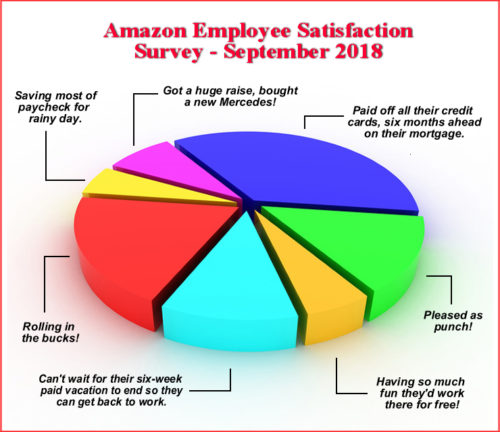
Obviously the above pie chart is a put-on. It is well-documented that working conditions for most employees of Amazon are  abysmaldehumanizing, bordering on abuse we normally associate with slavery.

Moreover, the median employee’s salary under Jeff Bezos’ imperial lordship is $28,446. No one working as a regular there has paid off their credit cards and is driving to work in a Mercedes. 

Jeff Bezos is referred to as The Richest Man in the World and his personal fortune, while growing by $191,000 each minute, is currently estimated at $168 billion.

So …

$28,446 vs. $168,000,000,000? While I can acknowledge the simple math, I find the contrast of such numbers on a gut level difficult to grasp.

To get a handle on such inequality, let’s try approaching it from different angles.

One way to put the disparity into perspective is to recognize it takes Bezos just under 9 seconds to earn what Amazon’s median worker does in an entire year.

Another is to recognize that for a worker to go through Jeff Bezos’ current personal fortune — and, of course, it continues mounting at accelerating levels as I write this — at his/her current median annual income of $28,446 per year, WOULD TAKE 5,905,927 YEARS! That’s close to 6 million years!

For Jeff Bezos himself to go through his current $168 billion, assuming his earnings stopped dead this very moment — which as you and I know they won’t — SPENDING $1,000,000 A DAY, would take NEARLY 460 years. Yes, even spending $1 million a day, in the year 2475 he’d still have plenty of cash, tens of million of dollars mad money. We can feel confident that he wouldn’t be foraging through the dumpster behind 7-11. 

Now, further consider that while the $28,446 median salary is above the national poverty line for a single individual if that person is the sole breadwinner for a family of four, it is marginally above it, which is why many Amazon employees must rely on government assistance to keep from starving.

As well as calculation, I did some speculation — a simple exercise in imagination.

Apparently Bezos’ wealth generating machine is raking it in so fast, he’s currently making $11.5 million per hour … every hour … 24 hours a day … seven days a week. $11,500,000 per hour! 

So here’s what I was picturing in my mind’s eye … 

If for 40 hours of the 168 hours in a week, Bezos were willing to scrape by on a mere $5,840,000 per hour, he could give every one of his 566,000 Amazon employees a $10 per hour raise. Of course, the remaining 128 hours in each week, Bezos could continue earning his normal $11.5 million per hour, not having to share any of it with the pathetic slobs who work for him.

Rhetorical question: Does Jeff Bezos have any concept of what that $10 per hour increase would mean to his employees? 

I’m not going to even suggest here I’m offering this for Bezos to entertain. There are so many advantages to him both as a putative member of the human race and the employer of over a half million workers — advantages that are so OBVIOUS — if they haven’t occurred to him up until now, then his brain functions in ways beyond my understanding. For one thing, he could point to his new fig leaf of “generosity” and ask people to stop calling him a selfish prick. Second, Amazon employees I’m sure would respond to his largesse with greater company loyalty and increased tolerance for his onerous working conditions. He’d still be the richest SOB on the block and could mock the pauperish Bill Gates and Warren Buffett as pitiable wannabees.

Consider …

The most poorly paid Amazon employee now makes $12 per hour. The $10 per hour raise I proposed would boost those $12 per hour workers right up there with Costco employees, who make an average of $21 per hour. And with the across-the-board $10 per hour increase, Bezos’ higher paid employees would be earning among the finest wages in the world provided by a major corporation. 

And by golly, there’s a plus side to the plus side …

Bezos’s bold and gracious gesture would result in a public relations coup of cosmic proportions! Amazon would no longer be demonized — well, not quite as much — by us bleeding-heart lefties as a capitalistic scourge and one-way ticket to Hell for the future of mankind, even if its environmental record is appalling and its business model generally the stuff of steroid-laced neo-feudalism.

Granted, Bezos would have to do some belt-tightening. He’d have to watch his pennies but could probably manage it, eh? Maybe he could skip a couple meals and do some of his own weeding at his estate. After all, after lavishing the $10 per hour raise on all of his employees, he’d only be pulling in $1,705,600,000 per week. I know I know! Like me you’re probably getting all teary-eyed for the poor guy.

Let me get to the extremely anti-climactic conclusion of this lament qua analysis.

Since nothing will change until the system itself changes, meaning the one in place now that creates, incentivizes, and lionizes the obscenely wealthy — reference current holder of the Office of President of the United States of America — I can only recommend this …

We have been labeling Jeff Bezos as ‘The Richest Man in the World’. Yet, quite honestly I don’t personally know any human, man or woman, who behaves like this gluttonous chunk of self-indulgent meat. It actually makes me nauseous to think we’re members of the same species.

Thus, from now on let’s use the correct terminology. Let’s call Jeff Bezos what he really is: the Richest Sociopath in the World.

We could probably order bumper stickers to help correct the record … from Amazon, of course.

Transcending the Hegelian Dialectic and Duality Reality

By Rosanne Lindsay

Source: Waking Times

In our ego-driven, divide-and-conquer world, we live in a duality reality. This reality reflects a matrix of opposites: introvert/extrovert, beginning/end, living/dead, mind/matter, wave/particle, self/other, material/spiritual, on/off, right/left. This is merely a separation of the mind that always wants to compare. We are both and neither. Humanity is a part of Nature and Nature is a continuum. In Nature, there is no separation, no opposition, no self and other, no conflict, and no destruction, unless destruction is balanced with creation. Just as Nature is self-sustaining and self-healing, so are we.

The hierarchical, dual systems in which we find ourselves, from prisons to politics, are grounded in duality, promoting separation over unity, creating leaders and followers. The system is served well by the Hegelian Dialectic.

The Hegelian Dialectic originated with George Hegel, a nineteenth century school teacher, who argued that human nature is a series of conflicts and resolutions that eventually elevate humankind to a unified spiritual state. The process is based in three easy steps: Problem-Reaction-Solution. Create a problem. Foment a reaction (of anger or sympathy). Provide a solution.

Two hundred years later, whatever Hegel’s good intentions, the goal to achieve unity from conflict-resolution has remained unproven and unachievable. Under duality reality, economic chaos has produced increased taxation. Shortages of oil and food have reinforced monopolies. The threat of pandemics has led to vaccine mandates. The threat of terrorism has resulted in restrictions on individual freedoms. Conflict has only bred more conflict.

The obvious truth that refutes Hegel’s idea is that unity is not uniformity. Unity follows no leaders and leads no followers. Unity does not restrict, limit, or conform through education or through more regulations and mandates. Unity fails where players must choose to align with a tribe and plug into the implicit biases of tribal programming. The tribe – wearing the suits of political parties or the robes of religious sects – reinforces the divisions and the information that we already believe and want to hear.

Hegel’s goal for unity can never work because in duality reality we naturally choose competition over compassion. In our system of choosing sides we lose our individuality. We hope for peace and wonder why nothing ever changes. Those who believe they are on the side of peace accuse others of being on the side of war. Each group fights with weapons of words, never able to find peace, unity, or common ground because the very foundation of the system keeps people divided.

Duality Matrix

Each side feels threatened by the other in a struggle over control. The duality matrix creates winners and losers. The media reinforces the infighting that keeps both sides distracted while an imbalance of power is maintained – the few controlling the many. The many are promised protection and security against all their fears. However, no guarantees are granted. As a consequence, the many are left feeling vulnerable and powerless, embracing their servitude and begging for greater protections at the expense of their freedoms.

As a nation, we experience the fear of vulnerability every time we are faced with the consequences of an unexpected natural, or man-made disaster. We have become dependent on the guise of security in the form of the National Weather Service and the Federal Emergency Management Agency (FEMA), so much so, that when the information is incorrect and the system fails, we are left helpless, not knowing how to forage for food, build shelter, or fend for ourselves as our ancestors did. We are a technically advanced nation without a community and without a connection to the land on which we live.

We believe that in giving our allegiance to the State and Federal government that we are protected. However, the State, including local law enforcement has no duty to protect us. The Supreme Court revealed this truth in 1856 in South v. Maryland when it ruled, “Local law-enforcement had no duty to protect individuals but only a general duty to enforce the laws. The Supreme Court uses the Constitution to protect the State in its ruling in Bowers v. Devito:

“there is no constitutional right to be protected by the state against being murdered by criminals or madmen. The Constitution is a charter of negative liberties; it tells the state to let the people alone; it does not require the federal government or the state to provide services, even so elementary a service as maintaining law and order.”

In exchange for votes to uphold a dual system, people receive a false sense of security. However, our inherent rights do not come from the government, The Constitution, or The Bill of Rights, or any paper document. These are merely symbols. Inherent rights and freedoms are not dictated by regulations and statutes but by common sense and morals, as long as no harm or loss is caused. Inherent rights are higher, transcendent rights that are “unalienable.” These rights are God-given under the laws of nature, and can neither be granted nor withdrawn. As Thomas Jefferson wrote in the Declaration of Independence:

We hold these truths to be self-evident, that all men are created equal, that they are endowed by their Creator with certain unalienable rights, that among these are life, liberty, and the pursuit of happiness.

The Tenth Amendment to the United States Constitution reads in part:

The powers not delegated to the United States by the Constitution, nor prohibited by it to the States, are reserved to the States respectively, or to the people.

New Hampshire is the only state in the country to have an express, written right of revolution in the state constitution. The only concern is the non-negotiable prohibition against violence of any sort in the enforcement or manifestation of this right.

Text of Article 10: Right of Revolution:

Government being instituted for the common benefit, protection, and security, of the whole community, and not for the private interest or emolument of any one man, family, or class of men; therefore, whenever the ends of government are perverted, and public liberty manifestly endangered, and all other means of redress are ineffectual, the people may, and of right ought to reform the old, or establish a new government. The doctrine of nonresistance against arbitrary power, and oppression, is absurd, slavish, and destructive of the good and happiness of mankind.

Transcend Duality Reality

The division of opposites will continue to play out in reality until we recognize that all war and peace, introvert and extrovert, light and dark exists within us. To attack another is to attack one’s very nature. To judge another is to judge one’s self. In peaceful resistance, we can either opt out or withdraw consent from any system that would subvert unity and cooperation. Just saying NO can be a powerful stance.

Transcending duality reality comes down to creating new rules under Natural Law, that does away with the hierarchical systems of authority. It also requires real choice. Choosing not to participate in a system that doesn’t serve the greatest good is making an energy statement as powerful as choosing to participate. Choice determines outcome. Withdrawing consent is not apathy but the opposite of apathy. Being vulnerable is not the problem, but fear is. F.E.A.R. is False Evidence Appearing Real. Fear is merely a construct of the mind, but it serves to hold humanity in shackles. The power to transcend conflict, and come together, is found in choosing kindness as our tribe.

Are we ready?


Our Bigoted Brains

Photo credit: Art Killing ApathyBigotry,

By Eleanor Goldfield

Source: Popular Resistance

If you’ve ever moved beyond small talk and vapid pleasantries in conversation then you’ve likely dealt with the infuriating occurrence of trying to convince someone of a fact they just don’t want to accept. Beyond just avoiding the information, they almost seem hardwired to reject your proof in a phenomenon that I like to call “fact fear.” I noticed a sharp rise in fact fear during the 2016 elections and levels continue to hover at disturbing heights today. So, what gives? Are we really in a new era of idiocy or are we just seeing our particularly vapid and anti-intellectual culture ping off the most base and stubborn aspects of the human psyche? Both, I think.

Daniel Patrick Moynihan famously said, “You are entitled to your own opinions but not your own facts.” But in the post-truth, anti-intellectual, “I read it in a blog post so it must be true” era, our opinions and beliefs run the ever-growing risk of being founded on complete bullshit. Filter bubbles (which we covered in Episode 132) and digital spheres protect us from ideas and facts outside our own personal shit heaps and only serve up the information we want to see – which is not always factually accurate. Our culture of quick “news” and a growing lack of intellectual curiosity drive us further into an echo chamber of our own ideas – facts and information be damned. In turn, a false but far from flimsy crust solidifies around our minds –- and the soft light of truth and knowledge can’t get in.

Our brains are wired to find comfort behind that crust. In what’s known as the backfire effect, our minds reject new information that clashes with our belief systems and opinions. As David McRaney, author of the books You Are Not So Smart and You Are Now Less Dumb explains it: “Once something is added to your collection of beliefs, you protect it from harm. You do this instinctively and unconsciously when confronted with attitude-inconsistent information. Just as confirmation bias shields you when you actively seek information, the backfire effect defends you when the information seeks you, when it blindsides you. Coming or going, you stick to your beliefs instead of questioning them. When someone tries to correct you, tries to dilute your misconceptions, it backfires and strengthens those misconceptions instead. Over time, the backfire effect makes you less skeptical of those things that allow you to continue seeing your beliefs and attitudes as true and proper.” In other words, that crust acts as a shield for facts that threaten your beliefs. And you’ve probably seen this in action online. Someone posts something like “climate change isn’t real” so you face palm and proceed to post ample proof that they’re wrong and that in fact, climate change is very real. The problem is that with each fact you post, the crust hardens – for both you AND the other person. Of course, it doesn’t help that you can find just as much if not more bullshit online than you can actual truth but much of it is actually tied to the inherent laziness of our brains. “The more difficult it becomes to process a series of statements, the less credit you give them overall…In experiments where two facts were placed side by side, subjects tended to rate statements as more likely to be true when those statements were presented in simple, legible type than when printed in a weird font with a difficult-to-read color pattern. Similarly, a barrage of counterarguments taking up a full page seems to be less persuasive to a naysayer than a single, simple, powerful statement.”

So does this mean that we should just stop pointing out when someone is wrong? That we should let all kinds of ridiculous notions from lizard people to “homeless people are dangerous” slide? Of course not. Rather, it means that if we want to educate and engage, if we want people to wake the fuck up then we have to consider how the human mind works – and how it doesn’t. Furthermore, our goal shouldn’t be to win an argument as if to suggest that as soon as we win the argument, justice is at hand. Indeed, if your goal is to simply be right, the religious zeal with which you defend your ideas will only turn you into the very monster you are trying to slay. Being right, in other words, is not the point. Progress is not a church. We are not looking for converts. Our aim should always be to engage and empower; to share our knowledge and embrace the knowledge of others. Seek and speak truth – then act on it. And do not think that because you found a nugget of information you hold moral superiority over those who don’t know it. Our minds are just as susceptible to that crust as anyone else’s. We are not special or better. Indeed, we must constantly question our opinions, compare them with facts and new information. By that I mean actual facts, not “alt facts” sourced from a single Google search or indeed even something from a “trusted” publication.

In an interview last March with Robert Scheer of Truthdig, author Joel Whitney discusses the 60 year history of fake news and how it was used in the Cold War era to sew distrust and hatred of all things “commie” and Russian. Major and well-trusted media outlets were a part of the propaganda ring and Whitney notes “that the fearful political atmosphere at the time led to “secrecy being used to preside over and rule over the free press — which we’re supposed to be the champions of.” “They drank the Kool-Aid and thought they were saving freedom,” Scheer agrees. The discussion underscores the need for analysis of Cold War-era media as a way to avoid propagandized journalism today. Scheer says, “I look at the current situation, where we don’t even have a good communist enemy, so we’re inventing Russia as a reborn communist power enemy.” “I call it superpolitics,” Whitney concludes, “where essentially there’s something that’s so evil and so frightening that we have to change how our democratic institutions work.” The latest red scare is but one example of how easy it is to mold minds when you use something like the hatred of Trump as a trigger. Blend some tried and true anti-Russia sentiment in there and you’ve got yourself a brand spanking new enemy – one that allows you to further mold those democratic institutions just as seamlessly as the minds you’ve now crusted and convinced. Russia aside, the same propaganda games go for mass media collusion on everything from fracking to the military industrial complex. For example, leaked email messages show that a writer from the LA times colluded with the CIA not only in terms of getting the CIA’s OK on forthcoming stories but actually offered to write stories for them that would put a positive spin on such issues as drone warfare, saying it would be quote “reassuring to the public” and a “good opportunity” for the CIA. Various other email messages show that the same was true for a list of other media outlets.

All this to say, if I may borrow a phrase: no investigation, no right to speak. Do your own research before you claim to know something. Incidentally this will also help steel you from the rumor mill AND infiltrators. Whether it’s taking someone to task on a rumor or engaging someone in discourse, be vigilant. Be vigilant in your drive, your actions, and be primarily vigilant in your own thinking. Release the flimsy beliefs that would just as soon sink you as keep you afloat. Arm yourself with knowledge and reach out to build and to engage, not to win a Facebook tiff. Consider the goal of engagement and empowerment rather than just being right. Consider the reaction you would have if someone came at you with a barrage of links followed by “read a fucking book, asshole!” You’d more than likely write them off as an unhinged asshole even if their information is solid. Try asking a question or perhaps as Ben Franklin suggested, ask them for a favor, something small that seeds trust, pinging off the human psychology that seeks appreciation and the feel of community. Push past political theory and get down to human connection – to start with. For instance, anarchists in several communities will often engage with would-be white supremacists via the common ground of distrust and disgust in the system. They’ll sit and talk; discuss the pitfalls of a system that’s left them behind and from there grow to a discourse on the roots of their discontent, i.e. not black people. In other words, knock on the door rather than trying to break down the wall. Because that wrought iron shit crust is stronger than steel.

Finally, keep in mind that this won’t always work and nor should it. We have to accept that in our grandiose imaginings of the revolution, many people will either be against us or sitting at home praying we all just shut up. But again, if you’re not looking for converts, if you’re engaging to empower, you’ll not only find more people willing to talk to you, you’ll also more than likely learn something in the process. You might even pick something up that’ll put a dent in your own mental crust.

Time To Make Life Hard For The Rich

By Hamilton Nolan

Source: Splinter

It is time for polite, respectable, rational people to start saying what has become painfully obvious: It is time to stop respecting the rich, and start stealing from them. In earnest.

Inequality is eating America alive. It has been growing for decades. To say that “the American dream is dead” is no longer a poetic exaggeration—it is an accurate description of 40 years of wage stagnation and declining economic mobility that has produced a generation that cannot expect to live better than their parents did. Not because of devastating war or plague, but because of a very specific set of rules governing a very specific economic system that encourages the accumulation of great wealth among a tiny portion of the population, to the detriment of the vast majority of people. Our political and business leaders have chosen to embrace a system that favors capital over labor. A system in which the more you already have, the more you make, and the less you have, the harder it is to build wealth. It is a system designed to increase inequality. It is functioning exactly as designed. And now, it is about to get worse.

How long are people supposed to tolerate being smacked in the face? By the rich? Who already have more than enough? It is not as though the fact that inequality is a crisis is a fact that snuck up on anyone. Economists have seen the trend for decades, and the general public has been well aware of it since at least the financial crisis. Obama called it “the defining challenge of our time.” Thomas Piketty became a rock star by writing a very dry book about it. It’s not an underground thing. It is well known and well understood by the people in control of the institutions with the power to change it. The response to this dire situation by the Republican Party, which a wholly owned subsidiary of the American capital-holding class, has been to pass a tax bill that will horribly exacerbate economic inequality in this country. It is a considered decision to make a bad situation worse. It is a deliberate choice—during a time when the rich already have too much—to take from the poor in order to give the rich (including members of Congress and the President) more. That is not a metaphor. That is the reality. That is what the Republican party is about to accomplish on behalf of the donor class, calling it “middle class tax relief” in the face of mathematical proof to the contrary. Even to my cynical ass, the sheer fuck you-ness of this action towards the majority of the country is breathtaking. This is not just a failure to solve a severe problem; it is the expenditure of vast amounts of political capital to make the severe problem worse so that a tiny handful of people will get wealthier than anyone needs to be.

Ideally, in a democracy, elected leaders reflecting the interests of the people would pass taxes and regulations to reverse the growing inequality here. For that to happen, we would need to end gerrymandering and reform campaign finance and probably abolish the Senate and the Electoral College, and that’s just for starters. It is not imminent, in other words. Our broken political system, which is designed to reward money with political power, is actually moving in the opposite direction of a solution. Who is suffering because of this? Most Americans. Certainly the bottom 50% are acutely suffering—money that would have been in their paychecks has been instead funneled upwards into the pockets of the rich. Every desperate family that has found themselves coming up short for rent or food or medicine, every American who has downgraded her dreams and aspirations because they became financially implausible, has been directly harmed by the political and economic class war perpetuated by the rich, even if they cannot see the perpetrators with their own eyes. I think that people have been more than patient in the face of this slow-moving crisis. In 2009, when the markets crashed and millions were laid off, nobody rioted and kidnapped the financiers and burned their homes. The outcome of that lack of direct action is the situation we find ourselves in today.

Violence against people is morally wrong and a bad way to solve problems. But capital is different. One thing that would help to create the political environment conducive to solving the inequality problem would be to make the cost of accumulating all that capital too high to be worth it. In other words, to create a downside to being too rich. I have personally stood in a room full of hedge fund titans and billionaire investors warning one another explicitly that inequality must be addressed lest the U.S. become a place like Latin America, where rich people are forced to live behind walls, surrounded by armed guards, because of the very real risks from the rage of the poor. Rich people in this country do not want to live like that. If they see that they must stop being so greedy in order to enjoy their own freedom, they will stop being so greedy. Those conditions have to be created by people who want justice.

Our situation is absurd. Not since the Gilded Age has it been more clear that a few people have too much. Furthermore, the people with too much are investing in political clout to give themselves more. It’s just wrong. If the government won’t help, we have to help ourselves. Sticking up a billionaire on the street for $100 is not going to do it. But one can imagine other ways that angry Americans might express their dissatisfaction with our current division of wealth: A large-scale online attack against the holdings of the very rich; yachts sunk in harbors; unoccupied vacation homes in the Hamptons mysteriously burned to the ground. Sotheby’s auctions swarmed by vandals, Art Basel attacked by spraypaint-wielding mobs, protests on the doorsteps of right-wing think tanks, venomous words directed at millionaires as they dine in fancy restaurants. People have a right to life and safety, but property does not. A life spent screwing the little people so that you can acquire lots of stuff loses its allure when you know that all that stuff will be smashed to pieces by angry little people. It is not hard to put together a list of those who should be targeted—Forbes publishes it every year. Likewise, public campaign finance records give us a pretty good idea of exactly who is funding the politicians who are perpetuating this economic war on behalf of the rich.

It is nice to imagine a grand, well-targeted computer hack that would neatly transfer billions of dollars out of the accounts of, say, the Walton family and into a charity account that would disburse the money to the poor in untraceable ways. That seems far-fetched. Realistically, what people can do now is to start thinking about ways to make it uncomfortable to be too rich. Socially uncomfortable and otherwise. When the accumulation of great wealth ceases to be a praiseworthy endeavor and instead becomes viewed as a sick, greedy pastime whose only reward is the hatred of your fellow citizens and the inability to live comfortably without fear of your excessive property being destroyed, rich people will rethink their goals. Until then, inequality will keep rising, and everything, for most people, will continue to slowly, slowly get worse.

Food for the Moon

By rahkyt

Source: Sacred Space in Time

I don’t know how to say this politely: you are part of a remorseless, psychopathic system that circumscribes your very thought processes and forms your every opinion and belief.

This system of thought, action and being envelops you like air and you can’t see it, feel it or hear it. And yet, you do see it, feel it and hear it every day because it is in your mind as it is in the mind of every person around you.

This system is designed to cull your energy through work and play, to foster its own continuation by way of your personal energetic production. And the production of every, single soul around you. its stability is dependent upon your ignorance.

Because once you become aware of it, you begin to see it everywhere. As it has always been everywhere. Been everything. It notices your awakened state and actively seeks to lull you back to sleep or, failing in that, destroying you utterly and erasing every true sign of your existence from its collective memory.

Once you choose knowledge, you are done. Once you choose truth, you are finished.

It is best to go on ahead and believe you’re dead from that very instant like the ancient Samurais of Japan used to do, for the sake of your own psychological stability moving forward.

Because move forward you must. We must. There is work to do and little time to do it. There are dragons to slay, literally, and they have been awaiting your arrival for millennia.

And now that the time of prophecy and projection is finally upon us, as those awakened souls kindle the flames of love within others and that collective and mighty roar signals the onset of the conflagration of the Ages, your options are reduced to the potentialities of the moment. The Now.

You are brought from the heights of abstract psychological and mental confabulation to the pressing, survivalist instincts that instruct you on how to make it through this moment. And the next. And the one after that.

Don’t worry. There’s no time for wasted energy. You will know what to do.

Your spirit has been preparing for this time for eternity. When the moments of your engagement arrives, you will step the steps predestined, say the words preordained and do the things you were preconceived to do.

And that is just how its going to be. So don’t waste anymore time on worry or regret. The system and its people don’t give a damn about you. Or any of us.

We’re only sustenance. Food for the moon. And Saturn, of course.


‘New World Order’ is falling apart

By Wayne Madsen

Source: Intrepid Report

One of the more welcomed outcomes of the paring back of the U.S. State Department bureaucracy is the elimination of scores of “status quo enthusiasts.” Since the end of World War II, the State Department’s ranks have been populated by foreign service officers and career diplomats who have championed the international status quo.

These minions of Foggy Bottom received encouragement for their protective stance on post-World War II and the Cold War in President George H. W. Bush’s speech on September 11, 1990, which was titled, “Toward a New World Order.” Under the “new world order,” regional and global security concerns would supplant democratic independence movements. The immediate effect of this “order” was brutal crackdowns on secession in the periphery of the former Soviet Union, including Abkhazia, South Ossetia, Nagorno-Karabakh, Transnistria, as well as in Somalia, the Kurdish regions of Iraq and Turkey, East Timor, Sudan, and Ethiopia. However, in Yugoslavia, which the United States and European Union wanted to see dissolved, secessionists in seven constituent states were encouraged to secede from the federation. That resulted in the bloodiest military conflicts in Europe since World War II.

Leaders of secessionist groups visiting Washington were traditionally shunned by the State Department. These hapless would-be presidents and prime ministers would be lucky to meet with a low-ranking State Department employee. However, if their independence movements were championed by the Central Intelligence Agency, they would get red carpet treatment. Such was the case with Secretary of State Madeleine Albright’s favorite Balkans “toy boy,” Hashim Thaci, the leader of the terrorist Kosovo Liberation Army and now president of the Republic of Kosovo, which was carved out of Serbia but is still unrecognized by many of the world’s most important nations, including China and Russia.

Today, one of the most-commonly seen words in State Department Country Desk reports is “secession.” In the past, State Department senior bureaucrats would be raising this development with the secretary of state as a major threat to U.S. interests. The CIA would then be instructed to remedy the situation by providing intelligence support to the countries where secessionist activity was a rising problem. “Support” would range from intelligence assistance to full-blown military aid.

As the United States recedes from the “world’s only superpower” status, to the chagrin of neoconservatives who are pouring into the Donald Trump administration in order to right the capsizing ship-of-state, secessionist activity is seen from the streets of Catalonia, which recently re-elected a pro-independence parliament, to virtual city-states in Mexico, which are increasingly going it alone to offset the breakdown in federal security and law enforcement support.

In the secessionist-minded Republika Srpska, a restive constituent region of the Bosnia-Herzegovina federation, Serbian nationalists have held a banned “statehood” celebration in the regional capital of Banja Luka. Srpska President Milorad Dodik demanded more autonomy for his region, declaring there were two Serbian states, Serbia and Republika Srpska. Present at the banned event were Serbian Defense Minister Aleksandar Vulin, Interior Minister Nebojsa Stefanovic, and former Serbian President Tomislav Nikolic. Joining them was Anatoly Bibilov, the president of the breakaway Republic of the Republic of South Ossetia–the State of Alania in the Caucasus region.

To the consternation of Eurocrats in Brussels and in the Balkans, also in attendance was Aleksandar Karadjordjevic and his wife, the heirs presumptive to the throne of the former Yugoslavia, and Johann Gudenus, the chairman of the Austrian Freedom Party (FPO), which makes up half of the governing coalition of Austria. Dodik awarded a Republika Srpska medal to Austrian Vice-Chancellor Hans Christian Strache, the leader of the FPO faction in the Austrian government. In the past, such an international outpouring of support for a secessionist-minded republic would have resulted in a flurry of diplomatic protests and démarches from the State Department.

After a recent election returned a coalition of pro-independence Catalonian parties to a majority of 70 seats in the Catalonian 135-seat parliament, the neofascist Madrid government of Mariano Rajoy has been put into a quandary. The Catalonian parliament has re-elected former Catalonian President Carles Puigdemont, who was removed by Rajoy after an October 1, 2017, referendum that favored independence. Puigdemont, who is in self-exile in Belgium, where he has the support of the powerful Flemish pro-independence party, faces arrest by the Madrid regime if he returns to Catalonia. The thuggish reaction by the Rajoy regime has engendered sympathy for the Catalonian cause in other secessionist-minded regions of Spain, including the Basque region, Valencia, and Galicia, and around the world.

The case of Catalonia has resulted in popular blowback against Spain from other parts of Europe, including Scotland, which is demanding a second referendum on independence upon Britain’s exit from the European Union. Support for continued membership in the EU has also increased demands for independence from Wales and Northern Ireland in the United Kingdom.

Taking a cue from the Madrid government, Nigerian authorities recently arrested Cameroonian Anglophone secessionist movement leader Sessekou Julius Ayuk Tabe, along with some of his aides, in the Nigerian capital of Abuja. The arrests came after Cameroon accused Nigeria of harboring supporters of the breakaway region of Ambazonia on the Nigerian side of the border. French-speaking Cameroon considers the English-speaking secessionist movement to be a “terrorist” organization, the usual appellation assigned by Third World dictatorships to pro-democracy groups and movements.

The newly-inaugurated president of Somaliland, Muse Bihi Abdi, was received with full diplomatic honors on his first trip abroad to neighboring Djibouti. What makes this newsworthy is that no country has formally recognized Somaliland’s self-declared independence from Somalia, even though the country has been independent for 19 years. Somaliland, which has its own currency and issues its own passports, maintains an effective government as compared to that of Somalia’s. In the past, Djibouti’s full honors for the Somaliland president would have resulted in a curt diplomatic note from the U.S. embassy in Djibouti for extending de facto recognition of Somaliland. There is now a scramble for military and political influence in the Horn of Africa by the United States, China, France, Turkey, Germany, Russia, Japan, Britain, the United Arab Emirates, Iran, Saudi Arabia, Egypt, and Qatar.

The UAE sees Somaliland and a restored independent South Yemen as in its national interests, hence, the oil-rich federation is establishing de facto bases in Somaliland’s port of Berbera, the Yemeni island of Socotra in the Gulf of Aden, and two key Yemeni islands in the Red Sea: Perim and Kamaran. In the past, the United States, which always wanted Socotra for its own military use, merely because it was once a Soviet intelligence base, would have threatened Yemen and the UAE with reprisals. However, Yemen is a failed state and the UAE is now overshadowing American influence in the Red Sea/Gulf of Aden region.

In Mexico, the town of Tancítaro, which lies deep within the drug cartel-controlled state of Michoacán, has decided to establish a de facto city-state. The “avocado capital of the world” is now governed by a “junta,” which is backed by wealthy avocado growers who have hired their own security force to contend with the narco-gangs. Similar quasi-city states have been established in Monterrey, where local businesses have taken over security duties from corrupt police, and Ciudad Nezahualcóуotl (or “Neza”), outside of Mexico City, where the local leftist administration has established its control over the local police, monitoring their every activity for corruption or human rights abuses.

The Algerian government has decided, after years of opposition, to acceding to some of the demands of the minority Berber Kabylie Independence Movement. Amazigh, the Berber language, is now an official language of Algeria. Algeria now celebrates January 12 as Yennayer, the Amazigh New Year. An Amazigh language academy is now planned in Algeria. In the past, the U.S. State Department, influenced by U.S. oil and gas firms active in southern Algeria, would have been aghast at concessions by the Algerian government to Berber nationalists. In what worries Spain, Amazigh is now the third most widely spoken language in Catalonia, after Spanish and Catalan. The Catalans and Amazigh share common ancient roots that have manifested themselves in modern cooperation to advance their statehood goals.

In India, some “scheduled tribals,” the name assigned by the government to indigenous tribal groups, are examining historical documents between British colonial officials and their own past leaders and are discovering they have every right to independence from India. Indian police recently arrested for “sedition” the 83-year-old Ramo Birua, from a village in Jharkhand state, because he called for the raising of the flag of an independent Kolhan state. Birua and his followers cited the rule imposed in 1837 by the British Agent for Kolhan region, Sir Thomas Wilkinson. The “Wilkinson Rule” stipulated that the existing civil and criminal laws of tribal states would be recognized by the British authorities. India’s independence did nothing to change the Wilkinson Rule, thus, “scheduled tribes” across India have a legal right to go their own way. In the case of Mr. Birua, he claims his tribe’s right to sovereignty is ensured by British Queen Elizabeth II, as the heir to Queen Victoria, the British monarch whose royal imprimatur was conferred upon the Wilkinson Rule.

Even within the United States, there is talk of “autonomy” by states from federal intrusions. Colorado is prepared to fight the Trump administration’s stated crack down on marijuana sales. In Colorado and other states that have legalized marijuana, Democratic and Republican officials are prepared to fight the Drug Enforcement Administration in any moves against their legalized medical and recreational marijuana industries. The same applies to federal authority to conduct offshore oil exploration and drilling. California, which has also declared its independence from Trump’s withdrawal from the Paris Climate Accord, is standing opposed to drilling in its Pacific waters. Florida successfully persuaded Trump to exempt it from the drilling order, however, Virginia, North Carolina, and other states are seeking similar exemptions. Other matters that are driving states’ rights rebellions against Washington are in the areas of immigration, federal land use, engine emissions standards, voting rights, health care, and public education. Puerto Rico and the U.S. Virgin Islands, abandoned by Washington after repeated hurricane disasters, are subtly re-evaluating their previous opposition to independence.

The demise of neo-colonialist busybody diplomats at the State Department has ushered a “global spring,” where both active and long-dormant independence movements are seeing glimmers of hope for their own nation-states.