Return of the Divine

maxresdefault

By rahkyt

Source: Sacred Space in Time

The skies have always given us our Gods, gods and goddesses, powers and principalities. All peoples, all places, have watched the skies. The stars, the planets, the clouds, the storms, the winds, hail, snow, rain and other things that have fallen from the heavens to earth. Nature has provided us with a bounty of environmental effects that we have anthropomorphized, given character, personality, intentionality.

Who is to say that celestial events of the past, witnessed the world across, did not conspire in essence to form the major and minor religions? That staggering immensities of planetary proportions – great arcs of lightning, waters in brobdingnagian amounts, comets and meteors in impossible numbers, falling to earth, from the skies – did not happen, cowing oceanic humanity, awakening abject fear and humbling terror, awing them into prostrate proselytization of an improbable yet undeniable extraterrestrial consciousness that made it or themselves undeniably known and unavoidably apparent to our distant ancestors, to their everlasting dismay and chagrin?

And who is to say, that these events do not occur cyclically? That collective terror has not resulted in a collective forgetting and mythologizing; that some events, are, indeed, too terrible to admit are true? That the Gods, gods and goddesses, existence – in all of their material and immaterial awesomeness – are too horrific in essence and action to admit are real and extant, somewhere, out there?

At what point, is rationality trumped by practicality? Scientists have recently admitted that we have not even identified 1% of all of the creatures living on this planet. They’ve “discovered” a new moon that circle this earth, new planets in this ancient solar system, new particles at the quantum level, new forms of matter, new energies posited, all indicative of our lack of knowledge and our shared and overwhelming, human insistence that our mere belief in a comprehensive science and its findings is instead the Totality of all that Was, Is, and Ever Shall Be. And that nothing outside of that belief – bolstered by a fledgling science barely a millennium in the formulation – is worthy of formal acknowledgement.

Hubris. Ignorance by definition. Ignoring the Wisdom of the Ages. In the public sphere, at least. The collected oral traditions of the world’s Indigenous peoples. The facts provided by the study of metaphysics and their implications to material science. The discounting of a full half of the human capacity to experience; the subjective, mental realm in favor of the surface, objective reality, alone.  Even when the scientifically-minded among us do give some credence to at least the potentiality of worth being implicit in these other forms of knowing, that acknowledgement is cavalier and pompous, obviously condescending and over-confident of its right to judge, appropriate and dismiss other knowings by sheer force of self-righteousness and arrogance.

Where do you fall along this spectrum? Do you presume to know? Or do you just believe? Can you admit as much, even to yourself? Let alone, others? Perhaps we have a long way to go, collectively.

As civilization cycles along predictable lines of social and material evolution tacit admittance that it is, in fact, a continuing spiral, should be cultivated. Just as our solar system cycles around the sun it spirals as well, the sun leading us thru time and space in the cyclical, galactic dance around the Milky Way’s central Spiritual/Black Sun/Hole. As Above, So Below. And that is where we are now, where other civilizations potentially have already been. At a certain space in an eternal cycle, spaced evenly along an infinite spiral.

What we individually think, has already been thought. What we say, has already been said. There is indeed, nothing new under the sun and even our attitudes of knowing and general sense of cultural – or other superiority complexes – ascendancy is an affectation of awareness, a perhaps unavoidable side-effect of life in the echo-chamber of human arrogance.

Perhaps we should pray that the more rational and less intuitive and “spiritual” among us are correct and the Multiverse is empty of all intelligence of the non-human variety. That our ancestors were indeed simple and dull-witted – despite all evidence to the contrary – and prone to fanciful ramblings and that nothing had come out of the sky or happened in the heavens except those things and types of events we are well familiar with.

Because if they were correct and terrific events did indeed traumatized humanity collectively at some point in Gaia-Sophia’s archaic past, the procession of the cycle and turn of the spiral is here and such events may be  scheduled to happen again, at a higher and more rarified level.

Ignorance is bliss. Do you choose belief? Or knowing? And are you willing to do what it takes, to truly know? Or are you confident enough in you beliefs to continue on, without seeking further information? If not, you may return, now, to your regularly scheduled programming. If you so choose.

Google’s lemmings: Pokémon go where Silicon Valley says

index

An analysis of Ingress and Pokémon Go reveals important truths about corporate control and the ability of our mobile phones to organize our desires.

By Alfie Brown

Source: ROAR Magazine

his article has a clickbaity title but a sobering and concerning point to make. In 2010, Google started up what is now a very important subsidiary, Niantic Inc. Google starts up a lot of companies each year and acquires a great many more, so there is nothing special in this. What is important is that whilst most of us see Google’s acquisition of every “start-up” and endless development of “subsidiary” companies with different names as simply an attempt to completely monopolize the market, the case of Niantic shows us that there is more to the extent of Google’s power.

Six years on from its inception with the launch of its biggest game yet, Pokémon Go, Niantic has hit the headlines and people are finally paying attention to the company, with some apparent leftists even claiming we ought to boycott Pokémon Go. In fact, Niantic have been working on mobile phone psychology and social organization for several years. An analysis of the company’s two big games, Ingress and Pokémon Go, shows us some important truths about the world we are living in, about corporate control and about the ability of our mobile phones to organize our desires.

Niantic developed their first major game, Ingress, in 2011. The game, one of the most important of recent years, is a key ideological tool for Google — one that, unlike Pokémon Go, is little publicized. Ingress has seven million or more players and Ingress tattoos show the degree to which people define themselves by the application. Some players even describe Ingress as a “lifestyle” rather than a “game”. The reader can be forgiven for thinking: “I don’t play it, so why would this apply to me?” But the entertainment coming out of Google via Niantic is in line with Google’s wider project of regulating our movements and experiences of the physical world; unless you don’t use Google or any of its applications, many of which come built-it to our phones and cannot be uninstalled, this applies to you.

Ingress reflects a trend of mobile phone application development (which includes Google Maps and Uber, among other well-known apps) designed to regulate and influence our experience of the city, turning the mobile phone into a new kind of unconscious: an ideological force driving our movements while we remain only semi-aware of what propels us and why we are propelled in the directions we are.

I first considered the importance of mobile phone games to be about a kind of “distraction” — an argument I made in my book and related article in The New Inquiry. Later, when playing Ingress for the first time, I realized there was a lot more to it than this. Ingress, rather than simply distracting us from the city around us, actually trains us to become Google’s perfect citizens. In Ingress, the player moves around the real environment capturing “portals” represented by landmarks, monuments and public art, as well as other less-famous features of the city. The player is required to be within physical range of the “portal” to capture it, so the game constantly tracks the player via GPS. Importantly, it not only monitors where we go, but directs us where it wants us to move.

As such it is very much the counterpart of Google Maps, which is also developing the ability not only to track our movements but to direct them. Of course, Google’s algorithms have long since dictated which restaurants we visit, which cafés we are aware of and which paths we take to get to these destinations. Now though, Google is developing new technology that actually predicts where you will want to go based on the time, your GPS location and your habitual history of movement stored in its infinitely powerful recording system. This, like Ingress, shows us a new pattern emerging in which the mobile phone dictates our paths around the city and encourages us, without realizing it, to develop habitual and repetitious patterns of movement. More importantly still, such applications anticipate our very desires, not so much giving us what we want as determining what we desire.

Here again, the connection with the concept of the unconscious is useful. While some have seen the unconscious as a morass of unregulated desires, followers of Freud and later of Lacanian psychoanalysis have been keen to show precisely how structured the unconscious is by outside forces. Our mobile phones pretend to be about fulfilling our every desire, giving us endless entertainment (games), easy transport (Uber) and instant access to food and drink (OpenRice, JustEat) and even near-instantaneous sex and love (Tindr, Grindr). Yet, what is much scarier than the fact that you can get everything you want via your mobile phone is the possibility that what you want is itself set in motion by the phone.

Into precisely this atmosphere enters Pokémon Go, out just days ago, and already the most significant mobile phone release of 2016. The game is, of course, made by none other than Niantic Labs. A series of hysterical events have already arisen from the ethical minefield that is Pokémon Go. In the case of Ingress, academic study has already been dedicated to the fact that the game has sent young children into unlit city parks at 3am. With Pokémon Go, Australian police have had to respond to a bunch of Pokémon trainers trying to get into a police station to capture the Pokémon within and some people found a dead body instead of a Pokémon. It has already been suggested that Pokémon Go is eventually going to kill someone — and since that article was published someone has crashed into a police car and another has been run-over while hunting Pokemon. But, as with Ingress, it is not the occasional mad story to emerge that should concern us, but the psychological and technological effects of every user’s experience.

The premise of Pokémon Go is simply that you use your GPS to find Pokémon in the real environment and then your camera to make the Pokémon visible, so that the world is enriched by looking through the screen at what lies behind it, as in the image below:

images

The Pokémon itself is an incredible phenomenon deserving of a book length study. Perhaps for now we can say that the Pokémon is the perfect example of what Jacques Lacan called the objet a, that perfectly cute fetishised but illusive object of desire that would truly make us happy if only we could just get our hands on it. We never do, because there is always a newer, cuter and harder to capture version that we just have to catch!

Dystopian visions of what technology and videogames would lead to seem to have got something completely wrong. Depictions of the dystopian videogame future have always tended to see the future as involving each individual isolated from the rest and sat quietly alone in a small room hooked up into a computer through which their lives are exclusively lived. In other words, the importance of the physical environment recedes in favor of the imaginary electronic world. On the contrary to these predictions of the future, we now live in a dystopia where Google and its subsidiaries send us madly around the city almost non-stop in directions of its choosing in search of the objects of desire, whether that be a lover on Tindr, a bowl of authentic Japanese ramen or that elusive Clefairy or Pikachu.

In the 1990s parents could ask their children to “get outside more” to escape the videogame space, but now it is the games that make us charge around the city capturing portals and collecting Pokémon and going on dates. Putting aside the full access that Google gets to your accounts via Pokémon Go, this shows us something really dangerous. It points to the increasing reality that there really is no escape from Google — and that while we are doing what we think we want, believing that we are just using our phones to help us get it, in fact Google has an even greater power, a truly revolutionary one: the ability to create and organize desire itself.

It is this truly revolutionary power that is important when it comes to Pokémon Go and Ingress. To say that these games are revolutionary is not to say that they are doing any good, nor that they are “radical”, and certainly it is not to say that they are left-wing — on the contrary, the revolution in desire appears to be corporate, hegemonic and centralized. If the left is to have any hope, however, it must not resist Pokémon Go, as Jacobin have now famously suggested, but understand and perhaps even embrace the power of the mobile phone to re-organize desire and look for ways forward from here.


Alfie Bown is the author of Enjoying It: Candy Crush and Capitalism (Zero, 2015) and The PlayStation Dreamworld (Polity, forthcoming 2017). He is the co-editor of the Hong Kong Review of Books and writes on the politics of technology and videogames for many publications.

SMARTPHONES, SOCIAL MEDIA AND SLEEP: THE INVISIBLE DANGERS OF OUR 24/7 CULTURE

cell-phone-addiction

By Martijn Schirp

Source: High Existence

If there is one book to read about our addictions to work, phones, consumption, and the current state of capitalism, it’s 24/7: Late Capitalism and the Ends of Sleep by Jonathan Crary, a professor of Modern Art & Theory at Columbia University. Crary argues that sleep is a standing affront to capitalism and while that seems grim, it highlights the very real dark sides of always having glowing LED screens clutched in our hands.

Technology has ushered us into a 24/7 state: we live in a world that never stops producing and is infinitely connected. We have digital worlds in our pockets, and we carry our phones and screens everywhere, feeding our dopamine addictions when we’re bored or lonely, cradling us before bed with endless scrolls of news and waking us up with notifications and emails.

The barrier between work and home life has disappeared, and most professionals are able to and choose to continue working all hours of the day in an increasingly competitive, winner-take-all environment.

Most of our time then, is either spent working or consuming (the upside of working so much is money, which is then used to consume): food, drugs, shopping, films, Youtube videos, Instagram feeds, news articles, updates from friends — even socializing-time has been reduced to a passive “Netflix & Chill”.

There are now very few significant interludes of human existence (with the colossal expectation of sleep) that have not been penetrated and taken over as work time, consumption time, or marketing time.

The social-world and the work-world are both digitized, which makes it increasingly difficult to distinguish between the two, and beyond the pop-ups and video ads, individuals have become their own marketers. Building a “personal brand” as a living is not uncommon.

It is only recently that the elaboration, the modeling of one’s personal and social identity, has been reorganized to conform to the uninterrupted operation of markets, information networks, and other systems. A 24/7 environment has the semblance of a social world, but it is actually a non-social model of machinic performance and a suspension of living that does not disclose the human cost required to sustain its effectiveness.

The average North American adult “now sleeps approximately six and a half hours a night, an erosion from eight hours a generation ago, and down from ten hours in the early twentieth century,” and what suffers most from this lack of sleep is our innate ability to dream. Most people tend to forget or don’t even think about their dreams, much less their extraordinary ability to control them. What is frightening about this is the prevalent attitude of accepting the current state of reality as it is:

The idea of technological change as quasi-autonomous, driven by some process of autopoiesis or self-organization, allows many aspects of contemporary social reality to be accepted as necessary, unalterable circumstances, akin to facts of nature. In the false placement of today’s most visible products and devices within an explanatory lineage that includes the wheel, the pointed arch, moveable type, and so forth, there is a concealment of the most important techniques invented in the last 150 years: the various systems for the management and control of human beings.

What may be the most important fact to remember: Nothing must be as it is. Here are a three ways to escape the never-ending 24/7 state:

Unplug Your Phone & Plug Into Your Imagination

Break your cell phone habit. The dopamine addiction is real. I keep my phone in a Faraday pouch, which blocks signals to my phone and keeps me to my rule of no cell phone or screen use one hour prior to sleeping and one hour after waking.

As “visual and auditory ‘content’ is most often ephemeral, interchangeable material that in addition to its commodity status, circulates to habituate and validate one’s immersion in the exigences of twenty-first-century capitalism,” it is important to focus on the power of our own imagination. The hierarchal and algorithm-driven fields of social media and newsfeeds tend to serve us things we already know or like, and keep us wanting.

Instead, we can explore the limitless field of our imagination. Write down your dreams in the morning and use them as a vehicle for self-exploration, or venture into lucid dreaming to manifest your own desires or to explore creative pursuits. And yet for most of us, when walking, during our daily commute, even sitting on the toilet or in any moment where it’s just us and our thoughts, we turn to our cell phones for comfort, to fill the silence:

One of the forms of disempowerment within 24/7 environments is the incapacitation of daydream or of any mode of absent-minded introspection that would otherwise occur in intervals of slow or vacant time.

Even when socializing with friends, it’s a common habit to check our phones again and again. I’ve found that when one person does this, it enables others:if I see someone sitting across from me at a dinner checking their Instagram feed, I’ll feel less guilty about doing the same. Make it can stop with you — turn off your phone.

Reevaluate Your Drug Habits & Addictions

Beyond digital dopamine, are you addicted to caffeine, sugar, alcohol, adderall, cocaine, Ambien, Lexapro, vicodin, etc., etc.? We live in a self-selecting society, where some drugs are perfectly acceptable as long as they are prescribed by a doctor and other drugs are deemed dangerous. I used to babysit for an eight-year-old who was fed Ritalin daily for his ADHD, and then at night, had to take a tranquilizer to help him fall asleep. He was speedballing throughout his childhood, and I’ve met others who had the same experience only to question the impact of these drugs on their personality and life-path.

There is a multiplication of the physical or psychological states for which new drugs are developed and then promoted as effective and obligatory treatments. As with digital devices and services, there is a fabrication of pseudo-necessities, or deficiencies for which new commodities are essential solutions… Over the last two decades, a growing range of emotional states have been increasingly pathologized in order to create vast new markets for previously unneeded products. The fluctuating textures of human affect and emotion that are only imprecisely suggested by the notions of shyness, anxiety, variable sexual desire, distraction, or sadness have been falsely converted into medical disorders to be targeted by hugely profitable drugs. Of the many links between the use of psychotropic drugs and communication devices, one is their parallel products of forms of social compliance.

Ritalin, adderall (and cocaine) not only make the takers compliant but fueled to tackle the 24/7 lifestyle, deadening empathy, increasing competitiveness and perhaps is linked to “destructive delusions about performance and self-aggrandizement”.

While methamphetamines are regularly fed to children, psychedelic drugs tend to be demonized as extreme and dangerous. Yet, refreshingly, there are organizations now like the Multidisciplinary Association of Psychedelic Studies (MAPS) and other studies looking into how psychedelics can not only treat addictions, anxiety, and disorders, but also how psychedelics can expand consciousness and leave lasting personality changes for the better.

Find Your Passion & Connect With Real Life Communities

Crary argues that “whatever remaining pockets of everyday life are not directed toward quantitative or acquisitive ends, or cannot be adapted to telematic participation, tend to deteriorate in esteem and desirability.” Our tendency to tie our social worth to digital networks takes the saying “if a tree falls in a forest and nobody is around to hear it, does it make a sound?” and turns it into “if you do something fun and meaningful and don’t post it to social media, does it matter?”

But those meaningful moments in real life do matter, as does having a strong community to participate in. After all, addictions are a result mostly of isolation and bad environments:

As stated earlier: it is much easier to fold to the insidious trap of looking at your cell phone or constantly working if the person across from you does so first. Find your passion beyond the screen. Find your source of dopamine, what drives you, what engages you and makes you want to get up every day.

Finding a real community centered around a meaningful activity can help tremendously. For me, rock climbing is a meditative activity that requires focus and attention, and is anchored in a community of people who are invested in your success as much as they are in their own. The nature of the sport is so individual because each person is unique; climbing is a niche that carves out time for people to participate in life without any social rules and concepts of winning over another. Climbing outdoors is a way to be connected to nature and to just hang out with friends.

I just returned from a week in New York City, the city that never sleeps, the capitol of the 24/7 world, and it took me two weeks just to be able to find the time to sit down and write this. It is not easy to accept the bleak claims in Crary’s book because it would be admitting our own addictions and how we play into this non-stop state. It’s just as hard to look away from our screens, but you can. Tonight, don’t put your phone or laptop into “sleep mode” — turn them off, and pay attention to your own dreams.

Further Study:


24/7: Late Capitalism and the Ends of Sleep
 by Jonathan Crary

24/7: Late Capitalism and the Ends of Sleep explores some of the ruinous consequences of the expanding non-stop processes of twenty-first-century capitalism. The marketplace now operates through every hour of the clock, pushing us into constant activity and eroding forms of community and political expression, damaging the fabric of everyday life.

The Eye of the Beholder: There is Never Anything New

414JCSYLsPL._SX332_BO1,204,203,200_

A review of John Steppling’s new book, Aesthetic Resistance and Dis-Interest

By Paul Haeder

Source: Dissident Voice

it is through mimesis, (identification with the mirror image) that one gains a sense of unity, self-containment and mastery over the body. If that was all that there was to it, humanity would be condemned to dwell forever entombed in the hell of mirrors. However, the identification with an Other in the mirror opens out the possibility for symbolic thought.

— John Desmond, author, thinker, who is interested in the history of marketing; construction of knowledge in marketing; consuming culture; morality and marketing; advertising and public policy

The beauty of ideas and words and sculpting frames and philosophical groundings is that we in Western culture having nothing more challenging than the numbness of a consumer-wrecked world where crass hucksterism and financial voodoo wizardry – even with its nuclear tipped propaganda, surveillance and missile dragnet technological orgasm science serves up – pales in comparison to any tried and tested narrative grammar of idea wizards.

Yet, dealing with words now, we see, as one noted playwright and thinker attests, involves PR packaged thinking, possibly a flagrant fascism tied to what can be written (thought) and what cannot be (said).

The title to his book says it all, sometimes – Aesthetic Resistance and Dis-Interest – That Which Will Not Allow Itself to be Said. This is just out in 2016, by playwright, raconteur and philosopher, John Steppling, from the organization, Mimesis International. The book is a compilation of some of his blog postings, and not to denigrate the word “blog” to mean anyone and their uncle expressing anything out there on the world wide web.

Like stepping stones into Steppling’s mind, each essay is a revving reverberating call to mental action, as each essay follows the Introduction with more nitrous oxide pumped into each cylinder of the 12 cylinder motor of his mind: one, Narrative & Empathy; two, Magical Thinking; three, Pedagogy; four, Nothing is Art; five, The Impossible Playwright; six, Someone to Watch Over Me; seven, The Political Uncanny; eight, That Which Will Not Allow Itself to be Said; nine, The Hidden Narrative.

Here, Steppling drills down into the cortex of the American – European, white, patriarchal, Puritan and Elitist – brain, sort of the flash mob mentality we are downloading determinedly. He plugs holes in the tinny junk thinking and pseudo intellectualism hovering around academia, the So Called Liberal Media, the Corporate boardrooms, the waiting rooms at TED Talks 3.0, and the ER’s resuscitating the pop culture that doubles in the minds of the masters of consumption as true art (sic). It’s a violent country, the art is anti-art, and the world of the Imperialist, right-wing or leftie, is predicated on a Heart of Darkness destruction that Steppling decants into the incantation:

The unfinished and fragmentary now emerge as comments all by themselves. When the worst aggressions in society today are often those paraded as benign, or self branded as innocent, even curative, the default response must be one of disconnection. The age of marketing, fueled by Imperialist Capital, has obliterated ideas of belief. Ideas of evidence and trust in our own feelings are all the time under duress and coercion. Aesthetic coercion is the staple of a system of image and narrative control the erases the individual while unrelentingly trumpeting his triumph.

Mimesis conceptually and psychoanalytically is something Theodore Adorno, Robert Hullor-Kentor and Fabo Akcelrud Durao study as they break into the mind of the human condition under the duress of capitalism-hucksterism-market competition-cultural posturing in order to understand how we as thinkers and believers re-narrate when we read a novel or watch a film, as well as engage with poetry and theater. Steppling is looking at this sirocco of thought tied to art, and it’s only that, art, if it changes us somehow. Art can mean buildings, parks, ways entire city blocks and towns are laid out and made to be something more than a mess against nature or utilitarian. Or practical in the Puritanical way. Looking at the Palaeolithic rock paintings around the world, Steppling posits that these sophisticated and voluminous paintings are “exclusively mimetic participation in a magical object .. and that Neolithic artifacts represent a significant change of consciousness, and of the human relationship to the group.”

This short book delves into the heart of what it is to be human, what Pierre Janet (L’Evolution de la Memoire) says how we become the very beingness of “I” – Narration created humanity. This book is just a small sluice into the larger wetlands that spread across the more rarefied postulations of Steppling’s thoughts and comments, here, at this blog: John Steppling – The Practice of Writing – Theatre Film Culture).

Ironically, his most recent post talks about his youth, when he was born in 1951, Laguna Beach, where his mother worked at Woolsworth and father acted in community theater. Steppling looks at Charles Olson and his work in the Yucatan, the same year, 65 years ago, and in that looking back, Steppling unfragments the fragments of memory, youth, childhood, origin, which all boils down to a Western culture seeded with capitalism that is moved by destruction and the boom in the bust:

When Olson dug into the dirt of the Yucatan hills, my parents had moved to Laguna Beach. My mother worked at Woolworths as a counter girl. My father acted in the community theatre there. It was a sleepy beautiful barely touched village, really. It lay off the old Highway — the old PCH. In those years nobody thought about the destruction of entire pine forest in the San Bernadino mountains. Olson didn’t dream of tourist high rises, resorts for white people, all across the Yucatan peninsula.

A half century has been spent in the West destroying things, and destroying people, and destroying beauty. A post apocalyptic treeless suburb, that is the inner circle of hell. Having to live next to affluent white men who bitch about Jews, and then look to play a round of golf at one of the thousands of courses in drought ravaged California. While in far off corners of the globe U.S. made bombs explode and kill and maim. These same guys, over drinks, might discuss topics like ‘reverse racism’. Fifty solid years of this. — John Steppling’s blog

Imagine in this crass, Hollywood-drenched, Chosen Few World of high financial and structural violence and rape and rapine, resource wars, total cultural and physical annihilation of the tribes, and we have Steppling surfing these monster 100-foot waves seeking what it means to be in the present reading the footprints of the past, histories written and rewritten, and into the eye of the poet, which is the vortex of our cultural wars: “The sedimentation of terror into language, specifically into the naming of things, is that magical element in spoken text that differentiates it from reading to oneself silently. Both can be mimetic, but the range of the frightening is greater when it happens on stage.”

Steppling dis-interns the graveyards of humanity and philosophy in a process of eliminating vis-a-vis this modern, scientific and technocratic metallic world the magic, the thoughtful, the greater good of humanity to express, as poets and as the players, actors, in this life theater. He ties this into those who have fought to erase memory, to dominate:

The domination of nature coincided with the neutralizing of Language. Shorn of terror, the cry became the concept, Dionysian energy was expelled, superstition replaced by logic. This was the force of Enlightenment thinking, and the correctives were real, but less observed, the cleansing of that which allowed for the tragic to reveal itself. The tragic as a sensibility; and without that sensibility, the infinite domination, unchecked rational horror grow on the underside of the image and word.

He’s looking at class in most of his work, and Steppling discovers that corporate interests have eliminated the outsider, helped to cull the very idea of class and what the artist’s role is in “the great Spectacle today.” We see threaded like glacial melt Steppling’s look at how we in this punishment society put down the poor, forcing the poor into some crazy reformulaton in our theater or film.

Housebreak them. Make them heel. Make them sentimental. This is the paternalism of ‘encouragement.’ I’ve always felt insulted when anyone wanted to encourage me. Encouragement is the sadism of the ownership class, the good plantation owner, those who enjoy the power that comes from encouragement. I’ve said before, grants and the writing of applications for grants is a form of psychological servitude.

Art, politics, education, and creativity, the word, the intersection of a neoliberalism, a fake Left, all those ideas come into the mental landscape of Steppling, who is a studied playwright, living in a world of intellectual conceptualizations, and he sees the bright line of mimesis as how Adorno formulated it – “as a way out from under the crushing conformity and standardization of mass culture, to trace authentic artworks and to trace the path of their occurrence,” John writes.

I’ve been experiencing first-hand this deadening of culture, ideas, words, poetry, in the education systems I have taught in, and the echo of William Burroughs who called school “the Job” is a place where Steppling and I and so many others see as penal colonies where “the spontaneous fantasies of children are literally beaten out of them . . . the business of extinguishing that fantasy and creativity.”

Mimesis is a form of expression, not a Xerox copier in the head. – John Steppling

This book is a slice on the microscope slide looking at the DNA of modern American psychosis – and the truth is in the antithesis of human and narrative truth, Steppling has discovered in his six decades on the planet:

The only truth now is bureaucratic, administrative, or data based. The fixedness of both ideas and beliefs in those ideas, has disappeared from the contemporary life. One feels that people, in general, deal with quantifications, with administrative rules and regulations. The age of regulations. They do not explore the nature of meaning.

I can digress here, which is one of Steppling’s favorite pastimes writing — entering and exiting the rabbit hole. Punishment, retribution, class war, patriarchal bullshit. Check this out — state of ever-Blue Politics of Washington State:

Division of child support services killing the parent (mostly men) big time if some part of child support has not been paid:

a warning — driver’s license will be suspended; no commercial driver’s license shall be gotten; all Fish and Wildlife licenses issued suspended (can’t fish, hunt, or trap); can’t gather seaweed or shellfish; you won’t be able to maintain insurance coverage; doing business in the state of WA will be affected; your ability to practice your licensed profession, occupation, or trade in WA will be suspended; you shall be held in contempt of court by the state of WA.

In so many ways, Steppling speaks to my own struggle with education and social work and social justice in this state or anywhere. Imagine, you fuck up and don’t pay child support, so, the state goes after you with vengeance. Ahh, then you end up in Haeder’s casebook, homeless, strung out, lost, abandoned. It does happen, these laws and punishments, this retributive society, one that is spittle from Hollywood and the leadership (sic) class that is bent on eviscerating the poor. Steppling says there are no writers, poets, musicians, artists, philosophers really chipping away at the pedantic or the narrow self-important angles to get a real narrative of what sort of fascism that is here now and has been here for decades. Again, time and time again, I talk to these Democrats, these people voting for same sex marriage, same sex adoption, goofy ideas about girls and women in war, all the shitty PC and broken diversity crap, and, alas, we are in a time of collective abandonment, a psyche that is cleaved by trauma, because really very few care to know the cause of so much class hate, class pain.

The bedrock of this lack of thinking and struggle to see meaning as the universal pathway to thought is a society transforming nature and the inclination of the human to work within self outward, working to be original and the same at the time, but now we are a culture denuded of agency, split into identities created by marketing and advertising, and transfixed into a “giant apparatus of policing.” The checks and balances are those so-called culture purveyors, those gesticulating freaks that are unwilling to see a life, live a life, outside of Capital Imperialism, Neoliberalism, Fascism of Privatization.

Steppling doesn’t delve deeply in some of the neo-tribalist thinkers in any of his work; I’ve always been able to make that leap by thinking about the ideas of tribalism cocooned in the philosopher Daniel Quinn’s brain, who calls this a period of remembering, dislodging the great forgetting around what it is to be human outside the narrow constraints of 12,000 or 8,000 years of totalitarian agriculture. John does see tribes of the past living in relatively stable settings. The elimination of so many tribes around the world in the name of capital, manifest destiny, whiteness, is a testament to Western societies slurping up the coin of the realm at a price: “ . . . contemporary societies of the West have perfected a kind of industrial level violence and irrational lust for conquest, and a fetid clenched jaw blindness that has no rival in history. It is the culmination of something that went very wrong.”

Steppling looks at theater, architecture, post-modernism, Freudian and Jungian psychology, the art scene, fine art, photography, Hollywood, propaganda, education, all the lower forms of capitalism, all those devolving collective dendrites of a culture preened by cultural gatekeepers and the models of each generation’s tragically hip pseudo thinkers, all those posing intellectuals.

The crucible of Steppling’s galvanizing thinking is tied to what is authentic artwork, what is the concrete thing that is the spontaneous creative gravity pulling forth this flash-point of the highly creative, which is at the same instance a series of contradictions that make the process magic and concrete.

Edward Said calls this the undefined time and place. Steppling adds, “These are the contours of the imagination. We hear, we invent, we are deaf – but all of it is engaged with, and absorbed.”

In the larger frame of Steppling’s looming and far-ranging essays on/at/in his blog, we are taken into a minefield of the depraved minds of those cultural and propaganda spinners who have not only co-opted liberalism and urbanity . . . but what it means to be a writer, someone telling stories versus someone marketing stories, spinning and PR-lobbing things that are not accurate. This world Steppling covers extensively in his writing, calling to task the posings/posturing and the denaturing of figurative art into something set in a ghost-land of misled identities, narratives and characters.

We get to the data driven shit world of today, all the bureaucracies, this punishment culture, this one driven by a war machine run by USA, Israel, the G-7, the wicked stinger of the scorpion called capitalism. There is a critique of the whiteness of this imperialism, depraved and puritan all in one heave, and there is gentrification of the land and culture and arts, as well as this art-loving haute bourgeoisie class that has denuded meaning and hard work from education, learning, and thinking. This is the class warfare that provides the fodder for ever more Draconian and pervasive punishment and retribution and financial recriminations.

A world people by bearded Duck Dynasty creeps and nerds stuck in Ikea-furnished prisons. It all comes down to lacking curiosity and dependence on technocratic dogma. Titrating back into this deadening tool of marketing and generic history and measured thinking. Steppling calls for open schools which “must offend, must drive some off, must never be bland or generic. Better to be wrong.”

Paulo Freire’s pedagogy, “teaching people to see and hear is the first thing. And then to stimulate the mimetic in relation to all of it. To relearn narrative and story. That is the beginning.”

What Freire posits – He who thinks and does not learn is in great danger.

The vocabulary of our times is not up to snuff in Steppling’s view. It’s torn from our collective memory, reshaped as a kind of amnesia, what Russell Jacoby calls “… the general loss of memory is not to be explained solely psychological . . . . Rather it is social amnesia – memory driven out of mind by the social and economic dynamics of this society.” In the critical mass of the mind in this human condition is what we might like to consider true artwork, a type of “force of negativing the madness of society, the waste and abuse, and this is the negative dialectic; negate the negation, for that is the reality today.”

Daily I toil teaching people around me – younger – to live with resistance and refusal as the underpinning of any life in this hijacked capitalism, the drone warfare of consumerism bombarding us every nano second. Steppling is a friend of Henry Giroux, and in this short book pulls from one of his books, The Violence of Organized Forgetting (2014):

Students are now taught to ignore human suffering and to focus mainly on their own self-interests and by doing so they are being educated to exist in a political and moral vacuum. Education under neoliberalism is a form of radical depoliticization, one that kills the radical imagination and the hope for a world that is more just, equal, and democratic.

This insight Steppling brings to art, unraveling the fabric of mass media, his microscope on those attempts at art in TV, and his dog-earing philosophy-psychology-the dark arts of culture. For him, there is a real sense of lamentation in America, longing for some imagined or pre-invented past where there was “order” or some sense of commonly held beliefs.

We are in a time of conformity, Steppling poses, even in our supposed non-conforming perception, and in that broken covenant this society has a  “narcissistic desire . . . self aggrandizement . . . splitting and projection of our bad selves onto the Other.”

He ventures back to how much we have changed in America, how culture is tied to an infantile psyche, “ever afraid of being found out in its incompleteness, in turn cannot afford to gaze too long at certain things.”

I see it everyday, working in Chinatown, Portland, serving as a case manager for homeless, recovering addicts, early release prisoners, veterans, families. This gaze, this head down society looking at those flip after flip pages of self-loathing and self-aggrandizement, well, it is madness to see the broken people living on pavement, actually in the doorways of fancy restaurants and hip shoe stores. Raging lunacy, pickled brains, entire families and their dogs out there, in the oh so hip Portlandia represents what Steppling pinpoints in his work.

I stop and talk to those really down and out, on my way to my office where I serve people who have at least gotten teeth yanked, bellies checked, and are in temporary housing and tied to the recovery model of Narcotics Anonymous, Heroin Anonymous, Alcoholics Anonymous, you name it, all those sponsors and other case managers. These people on the streets have their stories too, amazing ones, torn from the psychological hell that people create for their children, spouses, friends, lovers.

“The purpose of Western capitalist society is to erase ALL stories and replace them with commercials, or, in other words, with anti-stories,” he writes. This is the crux of what Steppling uncovers throughout his musings and philosophical ministerial show. Until the story we have in 21st America is one where the working stiffs, including social workers and teachers like me, imagine we may be moving up some ladder, to be the kings and queens of our castles, to have those two week trips to Machu Pichu, or wherever, any fantasy that has been peddled in the crap we consume — TV, drama, movies, news, magazines, the WWW, education.

I find it more and more difficult to find empathy coming from these people, and even supposedly successful folk with jobs and mortgages and some flimsy undergraduate degrees can spew some of the most hateful fascist craps — “Way too many people on earth. Seven-point-one billion, so someone has to go. I have no problem putting the needle in the arm of some loser druggies shooting or snorting up. They should be the first to go.”

This propaganda consumed by these suburbanites, calling for eugenics and mass slaughter against those we love to stigmatize. You know, people who were once loved or held as babies, now on the streets, struggling, lunatics panhandling, voices in their heads, forever driven to show us how close we are to disaster. Ourselves.

Steppling cites Arno Gruen, how hatred is fueled to destroy empathy. “Sometimes we blame the victims. They make us feel very uncomfortable; we are ashamed of our empathy because we hate the victim ourselves.” (The Betrayal of the Self, 2007)

This is what Steppling unseals in this hermetically coffined society where the stories of struggle — real struggle, the hardscrabble struggle of barely knowing who we are, let alone the struggle of the streets, this school to prison pipeline and cradle to grave social system that has been set up by Capitalism  — are never written about with depth and empathy and understanding, and the victims grow, and nothing Hollywood or literary-wood or drama-wood produces even is close to the reality of struggle, near death, Dickensian and Kafka-esque, all of the stories that need to be told, never get told.

Just cut-outs, the reality of people who do not exist in the minds of the controllers, those gate-keepers, those plied with money artists and editors and MFA instructors and super-star Oprah Book of the Month folk.

His look at the death of agency and the death of independent thought, the killing of questioning minds and the suffocation of the soul speak loudly in this book and on/in/at his blog.

Just today . . . . Thinking about Steppling’s look at this failure of the punishment state, the war on drugs, the war on people, I ran into story after story on my caseload — people the triple victim of a penality-corrupt legal-penal system. Older women, now clean and sober, in stable housing my organization provides, with some hands up, and yet, story after story of obscene legal bills being busted for possession, spending 75 days in the clinker and coming out with $3000 bills for the court costs and the fees and such, and, then, two years later, after homelessness, after living on the streets, dumpster diving, scrapping, anything but dealing with letter and summons and warrnats, bam, the $3000 is now $5000, and then the driver’s license is suspended, another $1500 owed there for penalities.

Imagine, trying to get these people minimum wage jobs, and then all these fees and retributions and pounds of flesh held against them, in the tens of thousands per person. Former homeless people, who were not worrying about US Postal deliveries or summons or the long arm of the law creating debtors’ fees, prison, etc. These are not the stories of the elite, the vaunted value-added ones educated at Harvard or UCLA. The stories of my people are on the police blotters or are ripped to shreds by the middle class Speilbergs or anyone with hearts of stone and brains channeled for the One Percent, to tell stories that are both lies and false memories.

Imagine this entire gambit broken down as a way to push more propaganda and the dark arts of vilifying and blaming the victim.

Foreclosure after couch surfing after stolen children after endless payments to the ferryman and the financial philanderers.

This is the way Steppling points his readers to, as the underskin of his work:

And one sees it today in corporate news coverage. The control by the state of “message.” The “message” of the Olympics is Russia is bad, and full of stupid people. You see terms like “cassocks” used a lot. You see the control in what is covered and what is NOT covered. Your see it in the idiotic disinformation on the planned covert destabilizing of Venezuela (as an example). . . . The media distorts Israeli violence and apartheid. It treats all dissent in the US as either terrorism or kooks. And most of all, the control is exercised via ” entertainment.” The constant, CONSTANT, outpouring of stupidity.

So we are here, where disagreements with the law, the financial rules, all those bankers’ games, everything that culls any sense of common sense, that is somehow suspect. There is madness in what Steppling points to, and this is a country that is in possession of a stone (stoic) heart of a killer, as D.H, Lawrence wrote.

The struggle to understand and value art that “knows something that we do not know” is a constant theme in John Steppling’s work-world.

Commodifying Dissent: Media, the Arts and the Hope in Cooperatives

Empire-USA-déclin

By Yoav Litvin

Source: CounterPunch

In the latest onslaught of apocalyptic news updates: The European Union is in crisis after the BREXIT vote, endless wars continue to ravage Africa and the Middle East causing millions of refugees to flee for their lives, ISIS strikes again, this time slaughtering over one hundred and fifty innocent Iraqis in Baghdad, and man-made climate change is wreaking havoc, fueling the third major mass extinction of species on Earth.

Meanwhile, back in the halls of empire the theatrics of the electoral process, together with the usual seasonal sports spectacles are mesmerizing and distracting the vast majority of the American public from the pressing issues threatening society. Despair and hatred mar our streets, nightclubs, schools, churches and movie theaters. Greed has overtaken empathy and a few powerful individuals have squashed the collective. Whole communities have been ravaged by neoliberal agendas that imprison and impoverish, all in the name of the almighty greenback.

But it is just another day at the office for the 1%. They own the Executive, Legislative and Judicial branches of government. As Chris Hedges frequently stresses: “We’ve undergone a corporate coup d’etat in slow motion. And it’s over. We’ve lost, and they’ve won.”

The vast majority of media sources, the watchdogs meant to protect democracy and the people’s interests at all costs, have succumbed to the rule of profit, aka “ratings”. They have become de factopropaganda outlets meant to manufacture consent and sell us on the faux virtues of consumerism and the American dream.

The corporate-owned mainstream media has been complicit on many levels. It is business as usual when a major outlet like MSNBC casually interrupts US Congresswoman Jane Harman speaking about NSA mass surveillance to feature the “breaking news” of teen pop star Justin Bieber’s DUI arrest. News networks carry on for hours with mind-numbing repetition about Donald Trump’s racist and misogynist antics, while all but completely ignoring a massive sit-in led by Democracy Spring, a movement that champions an end to the corruption of big money in our politics. Pundits whose job is to cry wolf endlessly discuss ISIS and the “threat of radical Islam”, but thorough analyses of the continued crimes of capitalism and imperialism are taboo, not to mention any productive discussions about systemic alternatives.

In this climate of corrupted news outlets, media that are independent of corporate funding are crucial in providing the people accurate information about systems of power and control.

But historically, the media has not been the only watchdog for the people and against powerful interest groups. Artists and other creatives have often used their works to voice progressive ideals that rebel against widely held conceptions of gender, race and class. As such, artists have been among the first voices of dissent to be targeted by totalitarian and fascist regimes. In the American capitalist culture, artists fall prey to a system that monetizes and commodifies all walks of life, including health care and education. Many artists willfully sell out, becoming court jesters who contribute their art to the needs of empire, i.e. as propaganda. Now studied as a degree at schools for higher education, the bulk of arts have become part of an “art market” – a multi-billion dollar industry that is more about a lifestyle and an investment, than it is about progressive messages or a passion for a new and interesting aesthetic. In the current cynical era when replicas sell for $100,000, there is little room for political art that expresses genuine and independent notions that challenge systemic conventions.

There are exceptions. Some artists refuse to corrupt themselves and their art by adhering to the whims of the “art market”. Notably, since the late sixties, there has been a movement of graffiti and street artists who have claimed public space from private owners. Born in the Washington Heights neighborhood in New York City (arguably) and now a global phenomenon, graffiti and street art often empower disenfranchised communities by serving as a voice of dissent, and providing free, uncensored messages regardless of commercial constraints.

The pathology behind the hijacking of media and the arts by the lords of capital runs deeper than the mere criminality of the 1%. It lies at the roots of one of the fundamental American values- individualism, where the achievements of the lone genius are sanctified, and those of the collective are ignored or even vilified. Individualism divides and conquers, providing the promise of immense spoils for victors, while always blaming failure on individual inadequacies, not systemic ones.

The cult of individualism has been so deeply ingrained in the American psyche that it has degenerated the biological human affinity to empathize rather than disregard, collaborate rather than dominate and has stifled the desire to give without the expectation of immediate return. Individualism has made cooperation a waste of time. But the fact of the matter is that humans have evolved as a social species and naturally yearn for and need connection, affirmation, love and stimulation to survive, thrive and create.

The crises humanity faces leave no choice but to decommodify dissent, abandon notions of individuality at the expense of others, topple hierarchies, and unite around democratic cooperatives that promote community, democracy and solidarity. Returning ownership of dissent to the public is a crucial step towards revolutionizing the workspaceen route toward a truly free and just democratic society.

Yoav Litvin is a Doctor of Psychology/ Behavioral Neuroscience.

Government, Terrorism, Money, Education and Other Important Discussions

images

By Phillip J. Watt

Source: The Mind Unleashed

The elite power structure – which uses the monetary system, war, false flags and the monopolized media as their primary mechanisms of control – has infiltrated every major government of the Western World. How do we know this? It’s simple; if they hadn’t been hijacked, then governments would have already begun a process of revolutionizing the way in which our societies are organized so that it benefits all of us, not just a select few.

The US Presidential race and two of its candidates have shown a small amount of hope for real change in America, something that not just its citizens desperately need, but the entire world too. Once the game is changed in the US – so that the government no longer works for those in control of the multinational and banking corporations – it will undoubtedly reverberate around the world.

Clinton is obviously a mouthpiece of the status quo and therefore cannot be trusted to enact real change. After all, she is an oligarch. On the other hand, Sanders and Trump appear to be anti-establishment, but are they really? It’s difficult to really know, because they could be controlled opposition. Yet even if they are separate to the existing order, can we really trust that they’ll do the job that the world’s peoples, and the environment, truly need?

Actions always speak louder than words, so regardless of the rhetoric of Trump and Sanders, does their policy agenda actually align to the truths that have been exposed by the many independent social researchers who are doing a wonderful job for the betterment of humanity?

Read below and decide for yourself.

The Real Policies for Change

This list is by no means exhaustive, but it reflects the fundamental shifts that we should be implementing in the short term to move into a new era of health and prosperity for humanity, and the environment we inhabit. In other words, these changes are the first essential steps if we want to overcome the dysfunction and deception that plague the hearts and minds of the people, as well as the systems that guide our collective activity.

If a political party or politician does not discuss these topics in general, then they are not aligned to the changes that we need, and therefore true progress. This is most likely because of two reasons; ignorance and/or corruption.

In any case, the exact way forward in each area is of course open for debate, but there must be an open and transparent dialogue held among the people. Simply, we all need to understand not just the issues, but the potential solutions to them.

This is obviously happening within conscious circles and progressive movements, however it’s not yet active within the mainstream mentality. This is just more evidence which illustrates that our politicians have failed us; that’s because it’s their job to bring these issues to the light of day so that everybody can participate in their resolution, if they so choose.

1. Monetary Policy: The way the economy is designed must rid society from the saturation of debt, move beyond indebtment to the oligarchs, cease the creation of fake currency by banks, overcome economic slavery by making the currency supply one of value and guarantee that local economies prosper.

2. Taxation Policy: The tax burden put on the people and the evasion of tax by multinational corporations needs to be resolved. One such method is abolishing all taxes and implementing a 2% debit-transaction taxso that citizens pay less tax, all individuals and businesses pay their fair share and there is an abundance of revenue to heal the wounds of a decaying society.

3. Budgeting Policy: Government revenues must be effectively and efficiently utilized to ensure the development of robust social services, increased wealth equality, the eradication of poverty, widespread sustainable practices, appropriate national defense programs and necessary infrastructure.

4. Defense and Foreign Policy: With unjust wars and false flag terrorism being the norm of the 21st Century, any decision to go to war must be sanctioned by the people via referendum. The reasons must be transparentally documented and validated as based in truth. All events at home and abroad that impact the decision-making of defense and foreign relations must be subject to robust and open investigations. Because national security is the first priority, all international relations should be treated diplomatically as the first line of defense.

5. Media Policy: The way in which information is disseminated throughout society must not be managed by monopolies, or a government. Media must be an open source platform where independent investigations are implemented and presented without bias. Any monopoly on the media must be disassembled so that the populace has unrestricted access to all the information necessary for the health and well-being of each individual and the community as a whole.

6. Education Policy: The way in which our children are educated is an indoctrination into the status quo, particularly economically and politically. The education system must therefore ensure that all children exercise their right to gain access to information that will help them to grow into healthy, happy and honorable adults, as well as question the way in which we organize society so that we can evolve it in alignment with our needs.

7. Governmental Policy: The amalgamation of government and business needs to be dissected. Politicians and bureaucrats are servants of the people and therefore must be representative of the needs and wants of the people. Moreover, government intervention of individual liberty and the free market must be also reduced.

8. Energy Policy: There is no longer any need to rely on fossil fuels, so creating the energy that society needs must be replaced with renewable resources – such as solar, air, water, wave, plant and free-energy technologies. Energy must also be made cheaply available to the public.

9. Health Policy: All foods and so-called medicines which impact the long-term health of the people must be labelled appropriately. Health programs that support emotional, psychological, philosophical, physical, spiritual, social and behavioral vitality must also be deeply embedded into schooling and other educational platforms. Holistic and preventative approaches to dis-ease must also be brought to the forefront of health education instead of relying on a symptomatic and prescriptive medical framework.

10. Medicine Policy: The pharmaceutical monopolies must be transformed into meeting the needs of the people, not shareholders and their profits. All natural and cheap remedies to disease – such as plant-based medicines and meditation – must be fully documented and reincorporated back into health education.

11. Housing Policy: Every person has a right to live in safe, comfortable and affordable housing. No individual should be homeless, unless by choice. Employment and Housing Policy must also be designed to ensure that the purchase of land is affordable and achievable for all.

12. Food Policy: The damaging impacts of industrial agriculture on earth’s natural systems, as well as the erosion of local economies (which is the direct result of trade agreements that primarily benefit the multinationals), needs to be reversed. One such way is by replacing it with a localized/regionalized Permaculture model where individuals and communities are supported to grow their own produce. This will help to increase local employment, as well as reconnect people to nature, the food they eat and their health requirements. In addition, all foods must be properly labelled and contain no toxic ingredients. GMOs must also be abandoned and organic foods must be readily available.

13. Water Policy: All citizens have a right to access safe and clean water. They should be supported to capture their own water needs. Where this is not possible, no toxins such as fluoride will be added to the water supply.

14. Animal Policy: All animal agriculture systems must respect the health and happiness of those animals. They must not subject them to any conditions in which they consistently suffer. One particular approach would be to incorporate it into a widespread permaculture model, in which animals are treated humanely.

15. Environmental Policy: Any practice that is environmentally unsustainable and negatively impacts the health and diversity of our natural systems is to be transformed into the opposite. The increasing extinction of animal and plant life must be reversed, as well as the trends of deforestation, ocean acidification and desertification.

16. Drug Policy: The war-on-drugs has been an epic failure because it has generated more crime, addiction, mental health problems and sent the market underground. It has also stigmatized the natural right to explore one’s own body and consciousness. The therapeutic and developmental aspects of so-called illegal drugs must be holistically researched so that society can be educated on both their positive and negative impacts. All illegal substances must be made legal, as they have begun to do in some countries, and a thoroughly-informed society must have safe access to pure substances for their own therapeutic, developmental and leisurely needs.

17. Sovereignty Policy: All citizens have natural rights, some of which have eroded through the recent policies of Western Governments. One example is privacy and another is the right to protest. This stripping of our rights needs to immediately stop and all rights aligned with natural law are to be reintroduced. No flesh and blood person should be treated as a legal fiction that works for a corporation impersonating as a government. This means that no legislation can impede on the natural laws that all individuals have a right to exercise.

18. Immunization Policy: All vaccines must be robustly studied independent of the pharmaceutical industry and the results made available to the public. All previous disease and death resulting from vaccines must also be publicly available. None will contain any ingredients other than to immunize against a specific disease. In addition, no child or adult will be forced or coerced into taking vaccines; every person must have their natural right to choose intact.

19. Atmospheric Policy: All geoengineering and chemical spraying programs are to immediately cease. The impacts that these programs have already had on the health of humanity, as well as the environment, must be holistically investigated and reversed.

20. Social Security Policy: Pensioners, people with a disability and other persons who require financial support must be treated with respect and must be able to comfortably live above the poverty line. Where possible, they will be supported to increase their education, training and skills so that they reenter the workforce. There should also be widespread volunteering programs with inherent incentives so the knowledge, skills and services of the elderly can be utilized for the benefit of the community.

Further Thoughts

There are many more areas that need to evolve, but its important to focus on the priorities in such as short piece. No doubt, many of you reading this would have been shocked and confused by some of the information herein. You might have even rejected elements to it, because it might have seemed too conspiratorial or challenging to believe. That’s okay; every single one of us who have woken up to these realities felt the same the first time we heard them too.

In any case, if you’d like to do follow up research, the links provided above will help you to initiate the process. Go deep too; it’s only when we individually undertake our own independent and robust research that we can come to a solid understanding of the true state of the world. The tip of course is to not be fooled by the propaganda narratives of the matrix-media and ensure we undertake research through the independent channels and progressive social researchers.

Furthermore, the above plans of attack are designed for the short to mid term. This does not discount the deeper agenda of moving from an economy of scarcity, to one of abundance. There are many models to achieve this, such as several resource-based economies, but until we build the foundations and start moving in that direction we have to work with what’s in front of us, right now.

In addition, of course it’s necessary to build new systems outside of the existing model to make the old ones redundant, yet we still need to use the systems that we’ve got and aim to transform society from within. After all, a balanced and holistic approach, is always the right approach.

Final Thoughts

Never has a government exposed all of the above issues. They might touch on some of them to some degree, but unfortunately we don’t have so-called leaders who actually call out the real challenges that we collectively face. There’s no doubt that some politicians know about these actualities, but the reality is they don’t publicly disclose it in fear of losing their credibility, or their livelihood.

But things are changing. Not only are more and more people joining the awakening community by educating themselves and taking action in response to these dysfunctions, but there are also political parties forming who dare to expose these truths to their audience and design robust policies in response. One such group is The Australian Sovereignty Party (ASP); in fact, many of the links above will direct you to the policies they’ve designed to rectify the failures of past governments.

Many parties around the world could learn a thing or two from this political force.

If you’re Australian, I highly encourage you to read the policy material at their website and join if their ethos resonates with you. Any person from around the world can join as an affiliate member too, so anyone is more than welcome to sign up to learn about how a true political party works. In addition, share this article and the ASPs progressive policies among your friends and family so that the momentum builds to bring Australians (and others) up-to-date with a political outfit that actually represents the real needs of you, me and all of us.

If you also believe in transforming our world into a better place, then at the very least research their policies. I know you’ll be pleasantly surprised (view their website here and follow them on facebook here). Furthermore, following is an interview I did with the President of the ASP, Daniel Huppert. In it he discusses many of the issues found in this article and the ASPs policy response to them. Enjoy.


ABOUT THE AUTHOR

Phillip J. Watt lives in Australia. His written work deals with topics from ideology to society, as well as self-development. Follow him on Facebook or visit his website.

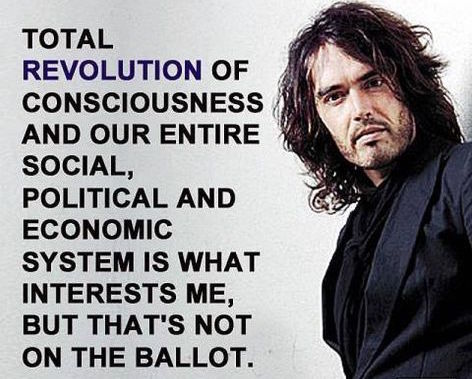
Your Awakening Counts More Than Your Vote

russell-brand-total-revolution-of-consciousness

By Dylan Charles

Source: Waking Times

We live in a world where illusions are held in higher esteem than verifiable truth. This is no accident, as the individual has for decades now been on the receiving end of social engineering programs, advanced political and corporate propaganda, fear programming and outright mind control.

The sum total of all this mass conditioning has been to convince otherwise good-natured and hard-working people to participate in their own enslavement and to willingly acquiesce to the ever-increasing rules, invasions of privacy, taxations, permissions and control schemes of a government and world elite who have long since left public interest in the dust.

The American dream is a mythic idea that was supposedly founded on the principle that public oversight of government is possible thanks to an electoral process which would give an informed citizenry the opportunity to replace undesirable politicians with better ones. Government itself, though, is a brutish and violent force that has time and again proven absolutely wild, reckless and untamable. It has never has obeyed its own laws, policies or regulations, and world history is a bloodstained chronicle of man’s failure to control himself when given power in the form of government.

Just as you cannot stop the tides from rising and falling, you cannot stop government from decaying into tyranny, especially so by following its very own rules and by participating in its token rituals.

This is truth, yet the illusion of so-called ‘democracy’ persists, seeming to grip people ever more feverishly with each passing election season. Even in the face of overt election fraud, party infighting, delegate rigging and widespread disenfranchisement. And so here we are again, facing the embarrassing spectacle of choosing between two undesirables when we all know the game is rigged.

For the powers the be, though, the repeating four-year cycle of presidential politics is the most effective device for keeping the masses high on the illusion of self-governance. It force feeds us on a regular schedule the false narrative that we the people can vote to reign in the power and corruption of the oligarchy of deep state, private and corporate influences that truly control the direction of this nation.

In this light, the purpose of national politics is not to perpetuate self-governance for the benefit of the common person, but rather to eat up personal energy and resources in order to suck the individual into a quagmire of false hope and endless patience with outrage after outrage. It is to make ineffectual action feel like action to the people being most screwed over by the corruption of the elite.

Sure, this may sound negative, cynical or apathetic to those who are over-invested emotionally in this game, but in order to move beyond the insanity of doing the same thing again and again while expecting different results, it’s imperative to be deadly honest about how this program works to enslave us, not to free us. Once we can think beyond the peer pressure, neighbor-hating, and mindless outrage that marks each election cycle, we make ourselves available to the possibility of real change. And real change always begins from within, and never forced from without.

There is no political leader who can make you stand fearlessly in this complex and dangerous world.There is no candidate that can give you the freedom that comes with a healthy mind and body. There is no political ruler who can manifest true and lasting happiness for you. There is no politician who can ensure that you enjoy the experience of your life everyday, under any and all circumstances. And there is no president that can empower you to be the best possible version of yourself so that you may give your best to others.

All of these qualities are vastly more critical to personal, community and planetary renewal than whichever new figurehead is selected to be the perceived front man of a morbidly corrupt American government.

The most effective way to change the world around you is to first focus on and create more value in yourself. This is why your awakening counts far more than your vote does. 

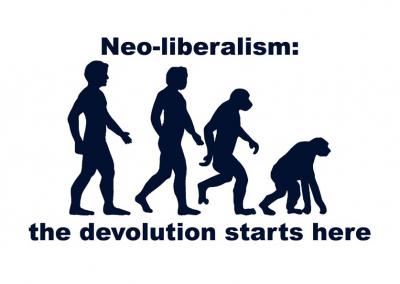
This Is Our Neoliberal Nightmare: Hillary Clinton, Donald Trump, and Why the Market and the Wealthy Win Every Time

neo_liberalism_devolution_via_permanentculturenow.com_

The rage driving our politics stems from cruelty of capitalism. So why do we vote for those who worship the market?

By Anis Shivani

Source: AlterNet

Over the last fifteen years, editors often asked me not to mention the word “neoliberalism,” because I was told readers wouldn’t comprehend the “jargon.” This has begun to change recently, as the terminology has come into wider usage, though it remains shrouded in great mystery.

People throw the term around loosely, as they do with “fascism,” with the same confounding results. Imagine living under fascism or communism, or earlier, classical liberalism, and not being allowed to acknowledge that particular frame of reference to understand economic and social issues. Imagine living under Stalin and never using the communist framework but focusing only on personality clashes between his lieutenants, or likewise for Hitler or Mussolini or Mao or Franco and their ideological systems! But this curious silence, this looking away from ideology, is exactly what has been happening for a quarter century, since neoliberalism, already under way since the early 1970s, got turbocharged by the Democratic party under the Democratic Leadership Council (DLC) and Bill Clinton. We live under an ideology that has not been widely named or defined!

Absent the neoliberal framework, we simply cannot grasp what is good or bad for citizens under Cruz versus Trump, or Clinton versus Sanders, or Clinton versus Trump, away from the distraction of personalities. To what extent does each of them agree or disagree with neoliberalism? Are there important differences? How much is Sanders a deviation? Can we still rely on conventional distinctions like liberal versus conservative, or Democrat versus Republican, to understand what is going on? How do we grasp movements like the Tea Party, Occupy, and now the Trump and Sanders insurgencies?

Neoliberalism has been more successful than most past ideologies in redefining subjectivity, in making people alter their sense of themselves, their personhood, their identities, their hopes and expectations and dreams and idealizations. Classical liberalism was successful too, for two and a half centuries, in people’s self-definition, although communism and fascism succeeded less well in realizing the “new man.”

It cannot be emphasized enough that neoliberalism is not classical liberalism, or a return to a purer version of it, as is commonly misunderstood; it is a new thing, because the market, for one thing, is not at all free and untethered and dynamic in the sense that classical liberalism idealized it. Neoliberalism presumes a strong state, working only for the benefit of the wealthy, and as such it has little pretence to neutrality and universality, unlike the classical liberal state.

I would go so far as to say that neoliberalism is the final completion of capitalism’s long-nascent project, in that the desire to transform everything—every object, every living thing, every fact on the planet—in its image had not been realized to the same extent by any preceding ideology. Neoliberalism happens to be the ideology—unlike the three major forerunners in the last 250 years—that has the fortune of coinciding with technological change on a scale that makes its complete penetration into every realm of being a possibility for the first time in human history.

From the early 1930s, when the Great Depression threatened the classical liberal consensus (the idea that markets were self-regulating, and the state should play no more than a night-watchman role), until the early 1970s, when global instability including currency chaos unraveled it, the democratic world lived under the Keynesian paradigm: markets were understood to be inherently unstable, and the interventionist hand of government, in the form of countercyclical policy, was necessary to make capitalism work, otherwise the economy had a tendency to get out of whack and crash.

It’s an interesting question if it was the stagflation of the 1970s, following the unhitching of the United States from the gold standard and the arrival of the oil embargo, that brought on the neoliberal revolution, with Milton Friedman discrediting fiscal policy and advocating a by-the-numbers monetarist policy, or if it was neoliberalism itself, in the form of Friedmanite ideas that the Nixon administration was already pursuing, that made stagflation and the end of Keynesianism inevitable.

It should be said that neoliberalism thrives on prompting crisis after crisis, and has proven more adept than previous ideologies at exploiting these crises to its benefit, which then makes the situation worse, so that each succeeding crisis only erodes the power of the working class and makes the wealthy wealthier. There is a certain self-fulfilling aura to neoliberalism, couched in the jargon of economic orthodoxy, that has remained immune from political criticism, because of the dogma that was perpetuated—by Margaret Thatcher and her acolytes—that There Is No Alternative (TINA).

Neoliberalism is excused for the crises it repeatedly brings on—one can think of a regular cycle of debt and speculation-fueled emergencies in the last forty years, such as the developing country debt overhang of the 1970s, the savings and loan crisis of the 1980s, the Asian currency crisis of the 1990s, and the subprime mortgage crisis of the 2000s—better than any ideology I know of. This is partly because its very existence as ruling ideology is not even noted by the population at large, which continues to derive some residual benefits from the welfare state inaugurated by Keynesianism but has been led to believe by neoliberal ideologues to think of their reliance on government as worthy of provoking guilt, shame, and melancholy, rather than something to which they have legitimate claim.

It is not surprising to find neoliberal multiculturalists—comfortably established in the academy—likewise demonizing, or othering, not Muslims, Mexicans, or African Americans, but working-class whites (the quintessential Trump proletariat) who have a difficult time accepting the fluidity of self-definition that goes well with neoliberalism, something that we might call the market capitalization of the self.

George W. Bush’s useful function was to introduce necessary crisis into a system that had grown too stable for its own good; he injected desirable panic, which served as fuel to the fire of the neoliberal revolution. Trump is an apostate—at least until now—in desiring chaos on terms that do not sound neoliberal, which is unacceptable; hence Jeb Bush’s characterization of him as the “candidate of chaos.” Neoliberalism loves chaos, that has been its modus operandi since the early 1970s, but only the kind of chaos it can direct and control.

To go back to origins, the Great Depression only ended conclusively with the onset of the second world war, after which Keynesianism had the upper hand for thirty-five years. But just as the global institutions of Keynesianism, specifically the IMF and the World Bank, were being founded at the New Hampshire resort of Bretton Woods in 1944, the founders of the neoliberal revolution, namely Friedrich Hayek, Ludwig von Mises, Milton Friedman, and others were forming the Mount Pelerin Society (MPS) at the eponymous Swiss resort in 1947, creating the ideology which eventually defeated Keynesianism and gained the upper hand during the 1970s.

So what exactly is neoliberalism, and how is it different from classical liberalism, whose final manifestation came under Keynesianism?

Neoliberalism believes that markets are self-sufficient unto themselves, that they do not need regulation, and that they are the best guarantors of human welfare. Everything that promotes the market, i.e., privatization, deregulation, mobility of finance and capital, abandonment of government-provided social welfare, and the reconception of human beings as human capital, needs to be encouraged, while everything that supposedly diminishes the market, i.e., government services, regulation, restrictions on finance and capital, and conceptualization of human beings in transcendent terms, is to be discouraged.

When Hillary Clinton frequently retorts—in response to demands for reregulation of finance, for instance—that we have to abide by “the rule of law,” this reflects a particular understanding of the law, the law as embodying the sense of the market, the law after it has undergone a revolution of reinterpretation in purely economic terms. In this revolution of the law persons have no status compared to corporations, nation-states are on their way out, and everything in turn dissolves before the abstraction called the market.

One way to sum up neoliberalism is to say that everything—everything—is to be made over in the image of the market, including the state, civil society, and of course human beings. Democracy becomes reinterpreted as the market, and politics succumbs to neoliberal economic theory, so we are speaking of the end of democratic politics as we have known it for two and a half centuries. As the market becomes an abstraction, so does democracy, but the real playing field is somewhere else, in the realm of actual economic exchange—which isnot, however, the market. We may say that all exchange takes place on the neoliberal surface.

Neoliberalism is often described—and this creates a lot of confusion—as “market fundamentalism,” and while this may be true for neoliberal’s self-promotion and self-presentation, i.e., the market as the ultimate and only myth, as were the gods of the past, I would argue that in neoliberalism there is no such thing as the market as we have understood it from previous ideologies.

The neoliberal state—actually, to utter the word state seems insufficient here, I would claim that a new entity is being created, which is not the state as we have known it, but an existence that incorporates potentially all the states in the world and is something that exceeds their sum—is all-powerful, it seeks to leave no space for individual self-conception in the way that classical liberalism, and even communism and fascism to some degree, were willing to allow.

There are competing understandings of neoliberal globalization, when it comes to the question of whether the state is strong or weak compared to the primary agent of globalization, i.e., the corporation, but I am taking this logic further, I am suggesting that the issue is not how strong the state is in the service of neoliberalism, but whether there is anything left over beyond the new definition of the state. Another way to say it is that the state has become the market, the market has become the state, and therefore both have ceased to exist in the form we have classically understood them.

Of course the word hasn’t gotten around to the people yet, hence all the confusion about whether Hillary Clinton is more neoliberal than Barack Obama, or whether Donald Trump will be less neoliberal than Hillary Clinton. The project of neoliberalism—i.e., the redefinition of the state, the institutions of society, and the self—has come so far along that neoliberalism is almost beyond the need of individual entities to make or break its case. Its penetration has gone too deep, and none of the democratic figureheads that come forward can fundamentally question its efficacy.

I said almost. The reason why Bernie Sanders, self-declared democratic socialist, is so threatening to neoliberalism is that he has articulated a conception of the state, civil society, and the self that is not founded in the efficacy and rationality of the market. He does not believe—unlike Hillary Clinton—that the market can tackle climate change or income inequality or unfair health and education outcomes or racial injustice, all of which Clinton propagates. Clinton’s impending “victory” (whatever machinations were involved in engineering it) will only strengthen neoliberalism, as the force that couldn’t be defeated even when the movement was as large and transcendent as Sanders’s. Although Sanders doesn’t specify “neoliberalism” as the antagonist, his entire discourse presumes it.

Likewise, while Trump supporters want to take their rebellion in a fascist direction, their discomfort with the logic of the market is as pervasive as the Sanders camp, and is an advance, I believe, over the debt and unemployment melancholy of the Tea Party, the shame that was associated with that movement’s loss of identity as bourgeois capitalists in an age of neoliberal globalization. The Trump supporters, I believe, are no longer driven by shame, as was true of the Tea Party, and as has been true of the various dissenting movements within the Republican party, evangelical or otherwise, in the recent past. Rather, they have taken the shackles off and are ready for a no-holds barred “politically incorrect” fight with all others: they want to be “winners,” even at the cost of exterminating others, and that is not the neoliberal way, which doesn’t acknowledge that there can be winners and losers in the neoliberal hyperspace.

In the current election campaign, Hillary Clinton has been the most perfect embodiment of neoliberalism among all the candidates, she is almost its all-time ideal avatar, and I believe this explains, even if not articulated this way, the widespread discomfort among the populace toward her ascendancy. People can perceive that her ideology is founded on a conception of human beings striving relentlessly to become human capital (as her opening campaign commercialso overtly depicted), which means that those who fail to come within the purview of neoliberalism should be rigorously ostracized, punished, and excluded.

This is the dark side of neoliberalism’s ideological arm (a multiculturalism founded on human beings as capital), which is why this project has become increasingly associated with suppression of free speech and intolerance of those who refuse to go along with the kind of identity politics neoliberalism promotes.

And this explains why the 1990s saw the simultaneous and absolutely parallel rise, under the Clintons, of both neoliberal globalization and various regimes of neoliberal disciplining, such as the shaming and exclusion of former welfare recipients (every able-bodied person should be able to find work, therefore under TANF welfare was converted to a performance management system designed to enroll everyone in the workforce, even if it meant below-subsistence wages or the loss of parental responsibilities, all of it couched in the jargon of marketplace incentives).

The actual cost to the state of the AFDC program was minimal, but its symbolism was incalculable. The end of welfare went hand in hand with the disciplinary “crime bill” pushed by the Clintons, leading to an epidemic of mass incarceration. Neoliberalism, unlike classical liberalism, does not permit a fluidity of self-expression as an occasional participant in the market, and posits prison as the only available alternative for anyone not willing to conceive of themselves as being present fully and always in the market.

I believe that the generation of people—in their forties or older—supporting Hillary have already internalized neoliberal subjectivity, which they like to frame as realism or pragmatism, refusing for instance to accept that free college or health care are even theoretical possibilities. After all, they have maintained a measure of success in the past three or four decades after conceptualizing themselves as marketplace agents. Just as the Tea Party supporters found it intolerable that government should help irresponsible homeowners by bailing them out of unsustainable debt, the Clinton supporters hold essentially the same set of beliefs toward those who dare to think of themselves outside the discipline of the market.

I spoke of the myth of the market, as something that has no existence in reality, because none of the elements that would have to exist for a market to work are actually in place; this is even more true for neoliberalism than it was for the self-conscious annihilation of the market by communism, because at least in that system the market, surreptitiously, as in various Eastern European countries, kept making an appearance. But when the market takes neoliberal shape, i.e., the classical conceptions of the buyer and seller as free agents are gone, then radical inequality is the natural outcome. And inequality in the last four decades, as statistics for the U.S. and everywhere neoliberalism has made inroads prove beyond a doubt, has exploded, thereby invalidating neoliberalism’s greatest claim to legitimacy, that it brings about a general increase in welfare. So neoliberalism, to the extent that the inequality discourse has made itself manifest recently, must insist all the more vocally on forms of social recognition, what Clinton, for example, likes to call the “fall of barriers.”

Neoliberalism likes to focus on public debt—in the Clinton years debt reduction became a mania, though George W. Bush promptly spent all the accumulated surpluses on tax cuts for the wealthy and on wars of choice—rather than inequality, because the only way to address inequality is through a different understanding of public debt; inequality can only be addressed through higher taxation, which has by now been excluded from the realm of acceptable discourse—except when Sanders, Trump, or Jeremy Corbyn in England go off script.

So to recapitulate neoliberalism’s comprehensive success, let us note that we have gone from a liberal, Keynesian, welfare state to a neoliberal, market-compliant, disciplinary state.

Neoliberalism expects—and education at every level has been redesigned to promote this—that economic decision-making will be applied to all areas of life (parenthood, intimacy, sexuality, and identity in any of its forms), and that those who do not do so will be subject to discipline. Everyone must invest in their own future, and not pose a burden to the state or anyone else, otherwise they will be refused recognition as human beings.

This supposed economic “rationality” (though it is the greatest form of irrationality) applies to civil society as much as the state, so that none of the ideals of classical liberalism, or previous ideologies rooted in humanism, are valid any longer, the only value is the iteration of the market (as myth, not reality); in other words, neoliberalism, unlike the elevation of the individual in classical liberalism or the state in fascism or the collectivity in communism, has erected something, the market, that has no real existence, as the only god to serve! And it is just like a god, with an ethereal, unchallengeable, irrefutable, ubiquitous presence. Whatever in state policy does not serve market-conformity is to be banned and banished from memory (the secular scriptures are to be rewritten), which explains neoliberalism’s radical narrowing of public discourse, including the severance of identity politics from any class foundation.

Neoliberalism will continue to perpetuate reduced opportunity, because one of its characteristics—as in any system that wants to thrive on the world stage—is to constantly refine the field upon which the human subject can operate.

As such, those displaced workers who have suffered the most from the erosion of the old industries in the former manufacturing centers of the world are not even factors to contend with, they are invisible and cannot be part of the policy equation. To the extent that their actual presence is reckoned with, the economy can be said to have crashed; but the problem doesn’t arise because of the management of unemployment or underemployment statistics, unlike a housing crash which is palpable and cannot escape statistical definition.

The danger for neoliberalism—as is clear from the support of millions of displaced human beings for Trump—is that with each crisis neoliberalism sheds more workers, makes individuals and firms more “disciplined,” narrows the scope of opportunity even further. At times, the disciplining of the non-neoliberal other—as with the killing of Michael Brown or Eric Garner—explodes to surface consciousness in an unsavory way, so an expert manager like Clinton or Obama is required to tamp down the emotions of such unruly entities as Black Lives Matter which arise in response. If climate change, according to Clinton and her cohort, can and should have market solutions, then surely racial disparity, or police violence, should also have market solutions and no others; it is here that neoliberal multiculturalism, operating in the academy, is so insidious, because at the elite level it functions to validate market discourse, it does not step outside it.

The present breakdown of both major political parties can be explained by the frustration that has built up in the body politic over the past decade, because after the crash there was no sustained intellectual movement to question the myth of the market. The substitution of economic justice with identity politics is something Ralph Nader, Howard Dean, and now Bernie Sanders have contested in a humane manner, while the same process is at work, admittedly in an inhumane way, in the Trump phenomenon.

Thus, also, Hillary Clinton’s animus against free college education; that form of expansion of opportunity, which was a reality from the 1950s to the 1980s, cannot be allowed to return, human beings are supposed to invest in their own future earnings potential, they are not entitled to a transcendent experience without barriers manifesting in discipline and self-correction. Education, like everything else, including one’s own health, becomes an expensive consumer good, not a right, no longer an experience that might lead to a consciousness beyond the market but something that should be fully encapsulated by the market. If one is a capable market player, education as we have classically understood it becomes redundant.

Unlike the interregnum between 1945-1973, the rising tide—no matter the befuddlements Arthur Laffer and his fellow Reaganite ideologues proffered—does not lift all boats today, it is outside the logic of neoliberalism that it do so, so the idea of reforming neoliberalism, or what is often called “globalization with a human face,” is a rhetorical distraction. All of the policy innovations—interpreted as “socialism” by the Tea Partiers—offered by Barack Obama fall within the purview of neoliberalism, above all the Affordable Care Act, whose genesis was hatched in neoliberal think tanks decades ago.

It is important to note that neoliberal economic restructuring necessarily means social restructuring, i.e., a movement toward disciplinarity and away from liberalism; the disciplinarity can take a Bushian, Clintonian, or Trumpian form, but these are manifestations of the same tendency.

When wage growth is decoupled from economic growth (as it has been since Friedman and others inaugurated the revolution in the early 1970s), this means that the human subject is ripe for discipline. Furthermore, wage fairness cannot be rationally discussed (hence the obfuscation surrounding the $15 minimum wage orchestrated by Clinton and others) because the concept of the market has been disembedded from society; the market as abstraction, not a concrete reality, makes any notion of reform or restructuring impossible. Like the minimum wage, something like free child care also remains outside the bounds of discourse, because public policy cannot accommodate discussions that do not take the self-regulating market as unassailable myth.

What neoliberalism can accommodate is relentless tax cuts (Trump has already offered his huge tax cut plan, as Bush did as his first order of business), which only exacerbate the problem, leading to increasing concentrations of wealth. It has to be said, though, that Ted Cruz more comfortably fit the neoliberal paradigm, with his familiar calls for lower taxes along with reduced regulation and further limits on social welfare, whereas Trump shows, for now, some elements of apostasy. If neoliberalism were to get a Cruz, it would have no problem working with him, or rather, Cruz would have had no problem executing neoliberalism, beyond the surface dissimilarities from Hillary Clinton.

As Sanders has consistently noted, economic inequality leads to political inequality, which means that democracy, after a certain point, becomes only theoretical (viz. Citizens United and the electoral influence of such powerful entities as the Koch brothers). Both processes—economic inequality and political inequality—have accelerated after each downturn in the forty-five-year history of neoliberalism, therefore a downturn is always exciting, and even preordained, for a Bush, a Trump, or a Clinton. Again, economic inequality and political polarity (polarity is simply a manifestation of democracy having become dysfunctional) strongly correlate, and both have come to a head in this election.

Neoliberalism’s task, from this point on, is to mask and manage the increasing inequalities that are likely to befall humanity, especially as the planet reaches a crisis point in its health. In a way, George W. Bush threw a wrench—he was a perverted Keynesian in a way, believing in war to prime the pump, or inflating unsustainable bubbles, or spending exorbitantly on grandiose gestures—into the process of neoliberal globalization that was going very smoothly indeed under Bill Clinton and would likely have flourished under Al Gore as well. With Hillary Clinton, the movement will be toward further privatization of social welfare, “reforming” it along market principles, as has been true of every neoliberal avatar, whether it was Bill Clinton’s incentives to work in the performance management makeover of welfare, George Bush’s proposed private social security accounts, Mitt Romney’s proposed private health care accounts, or the school vouchers that tempt all of them from time to time.

What remains to be seen is the extent to which the millennial generation might be capable of thinking outside the neoliberal paradigm, i.e., they don’t just want more of what neoliberal promises to give them yet fails to deliver, but want things that neoliberalism does not or cannot promise. On this rests the near-term future of the neoliberal project.

Beyond Sanders himself, the key question is the ability of the millennial generation to conceive of themselves outside the neoliberal subjectivity they have been pushed to internalize. They have been encouraged to think of themselves as capital producers, turning their intellectuality into social media popularity for the benefit of capital, in the service of the same abstract market that has no place, no role, no definition beyond the fallen liberal calculus. Does the millennial generation believe, even about its most intimate core, that everything has been privatized?

I am not necessarily making a pessimistic prediction. I am merely outlining the strength of an opponent that has refused to be named for forty-five years, although it has been the ruling ideology that long! In defining neoliberalism, I have sought to distance myself from the distraction of personalities, and tried to expose the dark side of our politics which we can only see when we name and understand the ideology as such. We are up against a system that is so strong that it has survived, for the most part, the last crash, as citizens couldn’t get their heads around the idea of nationalizing banks or health care.

It is existentially imperative to ponder what happens beyond Sanders, because neoliberalism has its end-game in sight, letting inequality continue to escalate past the crash point (meaning the point where the economy works for most people), past any tolerable degradation of the planet (which is being reconceptualized in the shape of the market).

What, indeed, does happen beyond Sanders, because as we have seen Hillary Clinton is one of the founders of neoliberal globalization, one of its central historical figures (having accelerated the warehousing of the poor, the attack on trade unions, and the end of welfare and of regulatory prowess), while Trump is an authoritarian figure whose conceptions of the state and of human beings within the state are inconsistent with the surface frictionlessness neoliberalism desires? To go back to Hillary Clinton’s opening campaign commercial, to what extent will Americans continue to believe that the self must be entrepreneurially leveraged toward maximum market gains, molded into mobile human capital ever ready to serve the highest bidder?

As to whether a non-neoliberal globalization is possible and what that might look like on the international stage after a quarter-century of Clinton, Bush, and Obama—which is essentially the frustration Trump is tapping into—I’ll take that up in a follow-up essay, which will further clarify the differences between Sanders versus Clinton, and Trump versus Clinton.

I would suggest that it is not that globalization causes or has caused neoliberalism, but that neoliberalism has pushed a certain form of globalization that suits its interests. This is a crucial distinction, on which everything else hinges. The neoliberal market doesn’t actually exist; at the moment it is pure abstraction; what is actually filling up economic and political space can only be discussed when we step away from this abstraction, as Sanders has so ably done, and as the Occupy and Black Lives Matter movements tentatively set in motion.

 

Anis Shivani is the author of several books of fiction, poetry, and criticism, including, most recently, My Tranquil War and Other Poems. His novel Karachi Raj (HarperCollins/Fourth Estate) was released this summer. His next book is the poetry collection Whatever Speaks on Behalf of Hashish, out in October.