A New Map

Collective-Consciousness-1

By Kingsley L. Dennis

Source: Waking Times

‘It is the tragedy of our time that the average individual learns too late that the materialistic concept of life has failed utterly in every department of living.’  ~Manly P. Hall 

We have entered times of incredible change, readjustment, and upheaval. There are many contrary forces pushing through our diverse societies and straining to breaking point the incumbent structures and institutions that, in many cases, are no longer functional for progress. Politics – politikos, ‘of, for, or relating to citizens’ – is in a sense the science of community. It is also an expression of the science of the soul; it reflects the state of human consciousness, and the political sphere provides a vessel for the growth and transformation of the human being. Our social communities are the incubators for the enhancement and expansion of human consciousness.

Political and social theories and practices do not exist in a philosophical and psychological vacuum. Importantly, they are related to two important factors: i) the human being’s worldview, and view of the universe, and ii) the human being’s view of himself or herself. A concept of society, government and justice always rests on the conceptions we have of the cosmos and our place in it.

The orderly medieval worldview was held together by a largely coherent religious cosmological system. This was then replaced by a scientific paradigm held together by a Cartesian-Newtonian cosmological doctrine. And yet in our modern age of scientific-psychological exploration we are witnessing the demise of this once-dominant consensus. To put it plainly, as a species we are lacking any coherent cosmological view to provide us with meaning and significance. Human consciousness is lacking a coherent and shared vision, which in turn affects how we project ourselves onto society and within socio-political discourse. C.G. Jung said that ‘Every advance in culture is psychologically an extension of consciousness.’ Likewise, an extension of human consciousness lacking coherence and meaning projects dissonance into our societies. This is why it is imperative we adopt a new map of reality that can provide us with a new cosmology and worldview that has meaning for our times. Especially as we are on the cusp of transitioning into a diverse yet hopefully unified planetary civilization.

Modern western society places little or no value upon the inner experience, thus placing no value or attention upon the need for conscious evolution, preferring to dwell within a largely economic rationalization of the world. In this worldview the human ego exalts the individual personality at the expense of compassionate relations, empathy, and connectedness. It is the ego which propels a minority of voices on the world stage to declare separatism, division, and national self interests over and above the need for international cooperation, collaboration, compassion, and understanding. It is this rhetoric which gives the opportunity for a hitherto neglected section of society to come forward through the expression of repressed anger and the unleashing of chaotic, disruptive energy. It also allows for the mindset that economic and political changes and upheavals are able to solve all problems because the source of such ills is in the objective environment rather than in the consciousness of the human being.  And yet whilst the projection of peoples’ anger and negativity onto others creates the illusion of improvement, it is actually an unhealthy mechanism that fails to address the real concern. The projection of repressed anger attaches itself to external socio-political movements and charges them with great power – this has long been the bane of human history!

That is why today we are desperately in need of a new understanding – a new map of reality – that allows us to recognize the greater truth. A truth that shows how our material reality is interconnected at the most fundamental level. It is a truth which shows how all living beings are inherently immersed within a collective field of consciousness that resonates between us. We are not separate individuals – isolated islands – but individualized expressions of a unified consciousness that embraces us all at the very core of our being. The new map of the cosmos tells us that the evolutionary trend is toward ever-greater coherence and cohesion, and not it’s opposite. It is these aspects which are conducive to a thriving, sustainable future – not the elements of division, conflict, competition, or fear.

If we are to transition into an integrative, coherent phase of human civilization we need to adopt as soon as possible the new paradigm – the new map – that comes at a time when it is most needed. Each person determines his or her conduct within the larger context of the nature of the world and the meaning of human life. We find this context through our ideas – our maps of reality. We need to share the new cosmological understanding through our institutions, our educational systems, and most importantly of all – in our human relations with one another. We are a human family, diverse and yet unified; each an expression of a cosmic oneness that seeks expression within a material reality. We are now called upon to reflect that unity, and to represent the true legacy that is the human race. Our time is now.


About the Author

Kingsley L. Dennis is the author of The Phoenix Generation: A New Era of Connection, Compassion, and Consciousness. Visit him on the web at http://www.kingsleydennis.com/.

The Acquisitive Self, Minus the Self

article-2386232-1B30C5F9000005DC-668_634x633

By Natasha Vargas-Cooper

Source: The Baffler

Los Angeles isn’t exactly the place that comes to mind when you think of decorous restraint in the display of wealth, even in the dregs of the Great Recession. Here in my hometown, possibly more than in any other outpost of faux-meritocratic privilege in our republic of getting and spending, untrammeled acquisition is understood as an expression of individual will—and more than that, a matter of taste.

Yet for all the studio money sloshing around our bright, stucco world, most of us have never encountered the miniscule stratum of humans that hovers above the rich: the pure, gilt-edged, entrenched, multigenerational wealthy. Movie star money is food stamps compared to oil money, hedge fund money, and even some of that dank old money that still floats around the haciendas of Pasadena. We might have stood kegside next to Kirsten Dunst once, but we don’t know the kinds of rich people that F. Scott Fitzgerald had in mind when he wrote that the rich “are different from you and me”: the Vanderbilts, Rothschilds, and Astors. Hell, our L.A. doesn’t even boast a new-money Midwestern poultry heiress.

We don’t see these types—let alone interact with them—because they’ve largely seceded from public view. This is the guilt-prone social formation that Paul Fussell dubbed the “top out-of-sight class,” because you typically can’t see their houses/compounds unless you have access to a helicopter. Prior to the mid-twentieth century, the top out-of-sight class had been very much in sight; Manhattan’s Fifth Avenue and Philadelphia’s Main Line mansions are still monuments to their Caligulan self-regard. But ever since the Great Depression, and its attendant booms in Social Realist art and Popular Front politics, they staged a quiet but striking mass retreat. So spooked out were the über-rich that they became almost discreet. “The situation now is very different from the one in the 1890s satirized by Thorstein Veblen in The Theory of the Leisure Class,” Fussell wrote in 1983. “In [Veblen’s] day the rich delighted to exhibit themselves conspicuously. . . . Now they hide.”

Thirty years later, this is still mostly true, but thanks to the exhibition-friendly canons of social media, the scions of excess are back and flaunting it, baby—and it’s an entirely underwhelming display. These aren’t the out-of-sight rich but their twentysomething children, flouting their parents’ wealth-whispers code of silence. With acres of unproductive time on their hands, bored rich kids are using their gold-plated iPhones to post images of their baubles of privilege, their chemical stimulants of preference, and their outlandish bar tabs on Instagram, the photo-sharing service of the moment. It’s a bit as though a Bret Easton Ellis novel has come blandly to life, without the benefit of any irony.

Predictably enough, a Tumblr photo-blog has stirred vacantly into being, to compile all these outpourings of opulence in one convenient place. Launched in 2012 by a founder who remains anonymous, Rich Kids of Instagram (RKOI for short) curates and tags photos posted on Instagram by the likes of Barron Hilton, Tiffany Trump, and other “funemployed” trust-funders. The Tumblr, which slaps a whimsical, intricately scrolled frame around each photo but adds little else, doesn’t come with a explanation or an editorial policy, other than that it purports to show you the lifestyles that the unseen rich had previously shared only with their similarly rich friends. “They have more money than you do and this is what they do,” goes the tagline.

Why should we look? The payoffs for the nonrich civilian viewer are oddly perfunctory. After all of the social mythologies we’ve lovingly constructed to envelop the delusions of the 1 percent, this is the lurid end-of-the-rainbow payoff they’ve decided to lord over the rest of us—a fistful of watches, car interiors, and European spa photos? The content of Rich Kids of Instagram is less the aftermath of an imperial Roman bacchanal than the shamefaced hangover of an especially inane and oversexed (though well-appointed!) frat party. Around about the dozenth selfie featuring a buff and/or emaciated scion nestled into a private jet with a bottle of Cristal and a $10,000 clip of cash (“Always make sure to tip your pilot and co-pilot 10k. #rulesofflyingprivate”), you can’t help but wonder, “Is that all there is?”

The Duller Image

Indeed, in strictly visual terms, the site is hard to distinguish from a luxe Sharper Image catalog—merchandised out, to be sure, but disappointingly clichéd. The rich boys of Instagram—the son of fashion mogul Roberto Cavalli, for example, and a weak-chinned fellow with the handle Lord_Steinberg—post pictures of their IWC Grande Complication Perpetual watches, multiple Lamborghinis, and six-figure bar tabs. Here, all the shiny expensive crap seems to cry out, is what I’ve done with my life in lieu of becoming an adult. The young rich ladies, such as Alexa Dell (of, you know, the Dell computers fortune), mainly document how all this pelf looks from the other side of the gender divide: they snap pics of themselves surrounded by tangerine Hermès shopping bags, eating sushi sprinkled with 24K gold flakes, and holding their American Express Centurion card minimum payment notifications (typically $40,000).

There’s not even much in the way of the makings of righteous socialist outrage. (Swazi Leaks this most definitely is not; that project, by contrast, pairs leaked photographs of Swaziland’s high-rolling absolute monarch with pictures of $1-a-day sub-subsistence conditions in the slums.) Yes, the rich kids seem determined to remind us that they have stuff the rest of us will never have. The captions they post with their photos are, at times, slyly aware of their part in inequality (cf. a picture of a private jet and a luxury car with the caption “The struggle is real”). But for all that, the kids don’t seem especially power-hungry so much as aimless and languid. Behind these faux-provocative posts lurks a desperate clamor for attention that almost verges on a cry for help—something that makes you feel a certain involuntary (and certainly undeserved) pity for these manically self-documented upper-crusters.

Nevertheless, the rich kids keep on multiplying their blandified self-inventories, and some among the rest of us, presumably, keep looking. In the beginning, few of the kids knew their Instagram feeds were being monitored by RKOI; the security detail for Alexa Dell, for one, wasn’t prepared to see some of her pictures, with recognizable details that could give away her whereabouts (usually closely guarded by her family), show up on the site. Her social media presence was quickly scrubbed. But now, many of the kids featured know they’re getting Tumblr’d, and some court the attention by submitting photos for consideration, tagged with #rkoi. Rich Kids of Instagram has earned its subjects thousands of followers for their individual feeds, and even momentarily catapulted some of the sort-of rich, perhaps splashing out on a once-a-year chartered yacht to Saint Tropez, into better company than they could ordinarily afford.

American media culture has done its part by spinning off these social-media maunderings into a full complement of incoherent dreck. Last winter, the E! cable network debuted #RichKids of Beverly Hills, a reality TV series loosely organized around the premise (if we can call it that) of the Tumblr account. (The show even features—wink, wink—an “Instagram-obsessed” cast member named Morgan Stewart, who delivers such walk-on anathemas to viewer interest as “I’ve taken so many selfies on my cell phone today it’s, like, embarrassing.” No, son, what’s embarrassing is that you’re saying this shit out loud, in front of a television camera.)

The PG-13 Class War

If an E! show wasn’t enough, this summer saw the release of a book-like object, also called The Rich Kids of Instagram, credited to the site’s anonymous founder together with a ghostwriter/collaborator named Maya Sloan. Like its “inspiration,” the book—billed for some reason as a novel—is unrelentingly dumb, though it does supply an important clue to the weird demographic marketing strategy behind the Rich Kids franchise. It’s clearly written for kids or, um, young adults, suggesting that the notion of “aspirational” reading and viewing—the grand media euphemism for the lifestyle-voyeurism genre—is ripe for retirement. Instead, this plotless, and nearly character-less, flight of fancy is something far more inert, and less interesting: an empty vessel of careless adolescent fantasy.

The book’s careful observance of PG-13 canons of teen rebellion is so pronounced as to be obtrusive. There’s little in the way of appalling or casual sex; the cussing and chronic drug use (nothing too hard, mind you: pills, weed, blow) is there mainly for box-checking shock value. In this, as well, the book is true to the real-life Tumblr; nowhere do you see anything truly threatening or transgressive, like Jordan Belfort snorting coke out of a hooker’s ass in Martin Scorsese’s The Wolf of Wall Street. No, all you encounter, in the book as on the Tumblr feed, is the sort of teen spliff smoking you’d find at an average Dave Matthews show—but in a jet, bro!!

In the same way that such scenes beg to be seen as transgressive, the Rich Kids oeuvre begs to be seen as a populist-baiting vindication of privilege for privilege’s sake: Take that, plebes! But there’s a telling sleight of hand here. The book’s main gimmick is identical to the Tumblr’s MO: the outrage is all imputed to you, the reader, in advance, by its ostensible targets or by the medium itself. This means, in turn, that the proceedings float serenely above any semblance of real-world criticism. So, not surprisingly, the book suffers from the same thing the actual rich kids of Instagram kids do, only at far more tedious length: a depressing lack of imagination. Here, for example, is one of the novel’s rich kids fuming about her maid while also clumsily name-checking her 1,200-thread-count sateen sheet set: “Woven in Italy. For what I paid, I could buy your illegal Guatemalan cousins. That is, if you weren’t from Jersey.”

There’s no pulse-pounding social tension or class resentment on offer here—unless you’re especially aroused by inarticulate dialogue. The novel doesn’t proceed in a mood of detached anthropological inquiry, the way that, say, Louis Auchincloss or John Marquand’s old-money fictions did. There’s no anger, no weight, no insight. All you have in the way of a rich-kid call-to-arms is the empty bravado of the anonymous site creator’s acknowledgements at the front of the book: “To all the RKOI kids, who are unapologetically themselves; in a world where so few people will live out loud, you guys have guts, and for that you deserve admiration.” (And yes, Rich Kid self-awareness once again stops well short of the obvious irony involved in an anonymous social media impresario’s celebration of the overclass’s bold capacity “to live out loud.”)

For “gutsy” exemplars of individual lifestyle, the kids are distressingly uniform in their motivation, behavior, and dramatic purpose. Far from emblazoning their excellent individuality upon our collective prole brainpan, the novel’s cast of characters merges into an interchangeable ensemble of predictable, privileged reflexes and half-copped attitude. Each member of this brat pack is outfitted with a suffocatingly oversignifying name and a ponderous chapter rendered in his or her voice. To save time, here’s a rundown of the main players in the book (think of it as the literary equivalent of a bar-tab selfie):

• Annalise Hoff, a high-strung media heiress who dotes on her Murdoch/Hearst mashup Daddy: “I know: Freud would have a field day with me. I don’t take the short bus, after all. I have a Bentley waiting.”

• Christian Rixen, a Denmark Royal and jewelry designer, who employs an oddly clinical diction suggesting that this is what Southern Californian rich assholes hear when Europeans speak to them: “The countess may have birthed me, but she was far from maternal.”

• Miller Crawford, a Mayflower legacy, rifle heir, and aspiring record producer—and what passes for a self-starting entrepreneur in these circles: “I made a promise long ago: I won’t be that guy. The kind who orders staff to do petty bullshit. Sure, there are emergencies. Scoring coke for an after-hours, buying last-minute condoms. As for the rest? I can get my own double latte, thanks.”

• Todd Evergreen, a Mark Zuckerberg stand-in with a suitably generic name—an upper-middle-class kid who became an overnight billionaire by captaining an overcapitalized software startup. We don’t hear from Evergreen, who is eventually driven into paranoia and Howard Hughes–like seclusion until the novel’s crashingly unpersuasive, life-affirming coda. “I liked their things,” Evergreen says of the rich kids, “don’t get me wrong. Not for the things themselves, but how excited they got about them. How their faces lit up when they talked about them. But I liked the people for other reasons. Better reasons.”

• Desdemona Goldberg, a bipolar singer/actress: “Wow, I think, that coke was awesomeness.

You don’t say. This novelization rounds out the Rich Kids trifecta: Tumblr, TV show, and book. The net effect is, fittingly enough, akin to that of another notorious plutocratic foray into cultural exhibitionism—a Damien Hirst installation. In both, we see our culture lords courting outrage in the most safely inert and vanity-fed forms of display. Both aim to provoke an aesthetic response that is little more than a fleeting revulsion, compounded by the inevitable gawking at the price tag attached to the finished product. And both make a huge deal of curating predators, whether it be champagne-squirting twentysomethings captured in photo-blog form (RKOI) or a really big shark lifelessly preserved in a bath of acid (Hirst).

Binge and Purge

For that matter, the Rich Kids franchise outdoes even Hirst, and achieves a further refinement of this recursive aesthetic of total consumption: it’s a monument to the acquisitive self minus the actual self. Sometimes the kids don’t even bother to take pictures of items they buy. Instead, they share photos of the shopping bags from whatever luxury store they just blew through. Other times, they display pictures of receipts, personal check stubs, or their names embossed on credit cards.

Capital is always on the verge of dematerializing our common world; as Marx and Engels famously warned back in the day, under the height of bourgeois domination, “all that is solid melts into the air.” Here, however, is a gloss on that crippling dynamic that the founders of socialism never could have anticipated: the children of capital are rendering their innermost selves—their critics-be-damned determination to live out loud—as a random agglomeration of nonsignifying digits. The beauty they transmit back, what they see, is nothing more than a place-holding string of credit limits where a human self, or at least a measure of use value, might once have been.

Still, there are evidently some young self-starters who are gleaning a different aspirational message from the whole enterprise. When frequent RKOI contributor Aleem Iqbal, a nineteen-year-old whose dad owns a luxury car leasing service in England, went on a recent binge of selfie-taking, some unintended consequences ensued. The younger Iqbal saturated his Instagram feed with shots of himself driving really expensive cars with the vanity plate “LORD.” On June 6 the teenager leased a $560,000 Lamborghini Aventador Roadster, and a few hours later someone set it on fire. A week after that, three more of his luxury cars, two Audi R8 Spyder supercars and a Bentley Flying Spur, were torched. This was not his understanding of the new social contract at all. Instead of a reality TV or book deal, all his self-infatuated Instagram entries had earned him was the smoldering hulks of four plute-mobiles. On his Facebook page, the aggrieved teen called the campaign of high-end vandalism “a vile act of jealously towards my business.”

Maybe so; it could be like George Orwell said, and there really are only two classes, the rich and the haters. On the other hand, a follower of some RKOI property might have thought it was high time to perform a salutary act of simple math: subtracting some small amount of indecent luxury from the torrent of inert and unproductive excess that we all, inexplicably, must endure. Vileness, after all, is in the eye of the beholder.
We’ve Been Sold a Lie – Time to Stop Watching the Show

platonic_cave

By Julian Rose

Source: Waking Times

‘The show must go on’ as they say in the theatre. And indeed, so it would appear. Only this particular show seems to have no beginning or end. The curtain never comes down; there isn’t even an interval in which to draw breath and stretch one’s legs.

It’s a 24/7 bonanza, and the cost of a seat is almost certain to put you out-of-pocket. In spite of which, the auditorium is full of expectant faces staring up at the unfolding scenes and drinking in the drama being staged for their consumption.

So few actors, so many spectators. Yet the actors hold the attention and the spectators soon forget that they are in a theatre and have paid for their seats.

We are all at this performance. Its setting is planet Earth. The actors strut around feigning importance, playing the role ascribed to them by the writer of the script and the director of ‘the show’. You know who they are – you see them everyday on TV screens and newspapers. A few are quite convincing, and like most actors they feign true sincerity and then pause for the applause.

The director remains largely invisible, but in the background he has fixed the agenda and set the scene. The script writer also remains largely incognito. However, his words on the page provide the narrative without which the actors would not be able to perform their predesignated roles.

The cast of todays crowd pulling drama have names like May, Merkel and Trump. The play in which they are currently performing is entitled ‘If I Ruled the World’, and there are many other roles for aspiring lesser performers and even for some retired leading-lights of yesteryear.

New scripts continuously emerge so as ‘to keep the show on the road’. A recent hit, for example, was ‘Brexit’, a play in four acts, featuring a strong line-up of music hall performers as well as some fine orators, one of whom cut his teeth in the great performing venues of Continental Europe.

But look, these marionettes of the political charade called ‘democracy’ can only be where they are, and do what they do, because we give them centre stage. We let ourselves become embroiled in their show and convince ourselves that it’s the only show in town. But it’s not, and in spite of being big and noisy, it’s actually a facade designed and orchestrated by the hidden hands who pull the strings that tweak the marionettes into action. Very occasionally a true leader emerges. An individual who stands out for their empathy with a struggling humanity.

But for decades now, it is ‘the show’ that has contrived to dominate. A show kept in place by stage managers who ensure all the rules, regulations and disciplines are operating as they should. But it is we the people who elect the cast of this play. A cast who promise to reflect and represent our needs on the national stage. To bring change where change is needed and to stand firm in the role that they are given.

So you see, we are complicit in the maintenance of ‘the rules of the game’ that keep the control system under which we suffer, alive and well.

Those who we elect mostly fall at the first hurdle – and all their promises go with them. ‘The system’ is in charge, after all, and our elected representatives quickly fall under the spell of its mechanics and become victims of its sinister agenda. An agenda played-out on the global stage with the help of powerful centralized banks, mega corporations and a heavily funded military. Yes, this is the show we have paid to bring to town.

But we have been sold a lie. We have bought into a chimera, a charade, and the biggest part of the problem is that we fail to recognize this fact. We actually believe it is a bona fide happening, without which we would all be thrown into chaos and despair.

So it is that we cling on to this outworn model of ‘democracy’, fearful of what might happen if it were dismantled and consigned it to history. Fearful maybe, of what might emerge in its place.

But that’s no good, and you know it. Because what stands in front of us is a choice; to remain a slave to a system which cannot survive without slaves – or to break free and give form to something altogether different.

Are you ready to take such a step?

So what might bringing about something altogether different actually involve? We must have a go at answering this, because it is the most critical question of this era, one we all face today – whether we realize it or not.

What we are talking about is taking back control of our destinies, not giving responsibility for them to someone else. Try to conceive what this might be like.. Well, for a start, out goes ‘the politician’ and with him/her the central control system called ‘parliament’. By the way, parliament did once represent the venue for an ideal in the making. An aspiration to give voice to those who never had a voice and to introduce collective justice where only the will of a monarch had previously prevailed.

But such a situation has long been redundant, because parliament was hijacked decades ago by the hidden hand of centralised control, and the politician became a stooge for the banking, military and corporate power cartels seemingly beyond his control. That is why this ‘corrupted beyond repair’ model has to go.

There’s a new lightness in the air at the sheer mention of such an action! What is mainstream media going to talk about without the mock democracy to fill its airwaves? Where will attention be turned once the charade of politics is removed from its pompous pedestal? What would we like to see fill the vacant place?

Think about it, because almost nobody is, and that is in large part the reason why it hasn’t yet happened.

It is at around this point that something valuable starts stirring within, and the seeds of a fresh vision put forth their first shoots. The low vibratory rate of energy to which we have adapted, shifts upward a gear. The fog starts to clear. We can see more clearly what we couldn’t see at all before we dared dispense with the old lie.

The new perception looks and feels something like this: we are here on this world having something called ‘a life’. It might last seven or eight decades, or more, or less; but as far as we know, it’s the only one we’ve got. How did we acquire this special gift? What are we going to do with it? Since it’s special and quite unique – isn’t it logical that we would want to do something special and unique with it?

Once we see we’ve been sold a lie, our next logical realization is to recognize that it’s a massive waste of this one life we have, to pretend we can ignore reality. It is then that the possibility of something altogether different entering the arena, makes its unexpected debut.

“My God” it says “I want to live!” “I want to confront this lie head-on and cease running away from it!” And that is a truly revolutionary happening; one which can – in an instant – change our entire outlook on life. For although it’s only a beginning, it’s a real beginning, one full of promise for what might follow.

Looking back at the crazed and confused scenes taking place on the world stage, shifting like tides between high melodrama and low bestiality, we can now see that it is no use trying to paper-over the cracks and pretend that we can go on living life ‘as usual’. The cracks are the dominant factor and what lies in between is so insubstantial as to be of no practical use.

Our only way forward is to invent a new future. Open a fresh page in the book of life. Not ignoring the past, but getting to grips with understanding it – and then bringing it with us on the great new journey upon which one has embarked. Let a new found passion lead the way. Let intuition be your guide. Let awareness be your tool box.

If you had identified yourself with any facet of the crumbling status quo, you will soon find yourself untethered, because there is nothing left able to hold a stake to which you can attach yourself.

There is nowhere left to turn except into your own inner resources. For it is from this region that the new vision emerges. That place where truth still resides, untrammelled by the ways of the world.

And then, on peering ever deeper within, one can begin to see the emerging presence of another world altogether. A world awaiting birth. Longing for birth. Waiting to be born. A world shimmering with expectation and excitement. A world lit-up by luminous energies.

Men and women alike give birth to this great entity. It does not require a womb or a phallus, although it’s composition embraces the essence of female and male, finally liberated to give full focus to the building of the new society which it is our imperative to create.

Now is the time to set aside all that would try to close the window on our true destinies.

Here is where we will find the footings, the solid ground, from which we can start building the World to Come. A place to carry us through the storm which cannot be by-passed. That is our true work from now on.

The mad actors who strut the world stage today do not realize that they are playing-out the final scene of an apocalyptic epic. A drama devised and directed by the architects of control. Criminals, whose full exposure is ever closer at hand.

We are moving into an auspicious time. A time in which mankind frees itself from the prison that has for so long-held it hostage. An event which will break the cords of fear-induced captivity and finally bring down the curtain on this devious age of deception.

Saturday Matinee: Zoom

index

“Zoom” (2015) is a hybrid film on many levels. It’s a Brazilian/Canadian comedy/drama mixing live action and animation directed by Pedro Morelli. The plot is split between three narratives involving comic book artist Emma Boyles (Alison Pill), novelist Michelle (Mariana Ximenes), and film director Edward Deacon (Gael Garcia Bernal). Each exists in parallel realities which become increasingly intertwined as they come together in a metafictional conclusion.

Watch the full film here.

On the Process of Awakening

lifestyle

By Charles Hugh Smith

Source: Of Two Minds

We cannot help but feel a hunger for authenticity, honesty, spiritual solace and human connection, but these are precisely what is scarce in our social and economic structure.

There is a tremendous amount of pain in our society. There are many sources of this pain: the emotional desertification of dysfunctional families, the knowledge that we don’t fit in and never will, a widening disconnect between the narratives we’re told are true and our experience, and a social and economic structure that tosses many of us on the trash heap.

The lifestyle we’re told we need to be happy is unattainable to many, and disconcertingly unsatisfactory to the top 10% who reach it.

We cannot help but feel a hunger for authenticity, honesty, spiritual solace and human connection, but these are precisely what is scarce in our social and economic structure.

The process of awakening has many paths. For some, the path starts with the incoherence of official explanations and narratives. For others, it’s the inner search for truth via psychotherapy or spiritual practice.

For some, it’s an investigation into the way our economic and political hierarchy function. For others, art is the starting point: a film, a novel, a comic, a song.

For many of us, it begins with this simple but devastating realization: I don’t fit in. I don’t fit in, have never fit in and never will fit in. I play along because it’s easier on me and everyone I interact with to do so, and I value my independence which means I have to find a way to support myself. That is difficult, as what I like to do has little to no value in our economy.

What interests me is how the epidemic of pain and alienation that characterizes our society is the direct result of how our economy and social order is structured. Incoherence, self-destruction, pain and alienation are the only possible outputs of the system we inhabit.

I have explored this dynamic in my books, starting with Survival+ in 2009 and working forward to my latest book, Why Our Status Quo Failed and Is Beyond Reform. (My other books are: A Radically Beneficial World: Automation, Technology and Creating Jobs for All; Get a Job, Build a Real Career and Defy a Bewildering Economy; The Nearly Free University and the Emerging Economy: The Revolution in Higher Education; Resistance, Revolution, Liberation: A Model for Positive Change; Why Things Are Falling Apart and What We Can Do About It and An Unconventional Guide to Investing in Troubled Times.)

I recently had an amazing free-form 1:50 hour conversation on these topics with New Zealand talk-show host Vinny Eastwood. Any conversation that stretches from the erosion of community to loneliness to Daniel Ellsberg to Marx to Taoism to alienation to Michelangelo Antonioni and on to the process of awakening is amazing in my view.

Here’s Vinny’s page with listening/viewing/downloading options, and the program on Youtube (please ignore my goofy expressions): The magic of bitcoin and cryptocurrencies (1:49:54)

My conclusion may strike many as radical, but to me it is self-evident: the primary source of the rot, insecurity, inequality and alienation of our society is the way we create and distribute money, which is the conduit for creating and distributing political power.

I explain why this is so in my books A Radically Beneficial World: Automation, Technology and Creating Jobs for All and Why Our Status Quo Failed and Is Beyond Reform.

If we don’t change the way money is created and distributed, we change nothing. Money = power. If we don’t devise a form of money that is beyond the reach of central banks and states, all “reform” is just window-dressing, simulacra of “change” that simply solidifies the system’s bogus claim of being reformable.

Cryptocurrencies are in their infancy. There will be many more iterations of Cryptocurrencies beyond bitcoin and Ethereum; recall that bitcoin went public in 2009.

There are security challenges with cryptocurrencies, and the potential for central-state meddling via backdoors in computer operating systems. But once we understand that community and the potential for a less toxic society and economy are crippled by the centralized structure of the state and its money, then there is no way forward but to develop structures of money, work, community, purpose and meaning that are outside the direct control of the state and central bank.

This sort of “crazy talk” is unwelcome. As I noted earlier this week on my chart of the Ministry of Propaganda, in the status quo, skepticism is always a conspiracy or a hoax.

So instead we consider an exploding opiate epidemic, an epidemic of obesity and metabolic illnesses, a discourse of inchoate rage and a Grand Canyon-sized gap between what we’re told is true and what we experience as true “normal.” These things are not normal; they are manifestations of a system that can only generate one output: self-destruction.

Anarchy vs. Statism: Uncontrolled Order Over Controlled Chaos

23b9159be655ca9b54290bca42db5736

By Gary ‘Z’ McGee

Source: Waking Times

“Knowledge makes a man unfit to be a slave.” ~Frederick Douglas

Caught up, as we are, in the politics of statism, it is often extremely difficult to see the forest for the trees. We’re often so busy pretending to think outside the box that we lose track of what’s “the box” and what’s not. We’re so inured by this system of exploitation that it’s often too easy to kiss each other with lies rather than smack each other with the truth.

Meanwhile, complacency sets in and inertia takes hold. Apathy takes root and ignorance becomes “bliss.” Our lives go on and we placate each other with such cowardly platitudes as, “It’s just the way things are,” or “Why fight it? There’s nothing we can do.” Bullshit!

This is not the way things are. This unhealthy system (statism) has separated you from the way things are (natural anarchy). Why fight? Derrick Jensen said it best, “We are the governors as well as the governed. This means that all of us who care about life need to force accountability onto those who do not.” You think there’s nothing you can do about it? Well, you could begin by educating yourself on what the difference between statism and anarchy really is.

Statism is controlled chaos under the illusion of order. Anarchy is uncontrolled chaos under the delusion of chaos. That’s the difference in a nutshell. But if the nutshell doesn’t suffice, please read on.

Controlled Chaos Under the Illusion of Order (Statism)

“Chaos is what we’ve lost touch with. This is why it is given a bad name. It is feared by the dominant archetype of our world, which is Ego, which clenches because its existence is defined in terms of control.” ~Terence McKenna

Statism is bureaucratic order. When order becomes bureaucratic it becomes an abstraction of an abstraction. It loses the essence of real order because it is in the throes of an “order” pigeonholed by fallible men claiming to hold infallible truths that become ill-conceived laws that generally don’t coincide with cosmic laws. Deception becomes rampant in such an illusory state. And the innocent people who are conditioned, brainwashed, and propagandized to no-end by such an illusory bamboozlement become easily manipulated into believing that man-made laws must be followed. Sometimes even at the expense of cosmic laws that should not be avoided.

Statism is the result of an obsolete idea (that has somehow (stupidly) withstood the test of time) held by a group with outdated notions of power lording such power over an ignorant majority. The small group of individuals harboring outdated notions of power want to remain in power –no matter how misguided, immoral, or downright stupid their notion of power is. And so they manipulate the hierarchical nature of statist dogma to keep themselves entrenched in their parochial seats of power, usually at great expense (exploitation, structural violence, violent expropriation, debt slavery, andenvironmental rape) to others.

Under their deceptive controlled chaos and unhealthy illusion of order, all healthy order falls in polluted disarray. Unnecessary poverty is rampant. Avoidable wars are waged. Needless divisive racism and xenophobic jingoism is rife. Preventable pollutants destroy the land, poison the air, and toxify the oceans. All because of the idiotic statist notion of order, which is nothing more than controlled chaos, which is nothing more than an unhealthy hierarchy high on its own ignorant understanding of power, which leaves the world bleeding and dying at its feet.

It matters not the state; any state pushing its statist dogma onto otherwise free human beings is fundamentally unhealthy and is the opposite of liberty. In fact, it is disguised tyranny. Which is ten-times worse than naked tyranny, because naked tyranny is easily thwarted and thus easily denied by the majority. But the disguised tyranny of the state is not so easily thwarted, for it becomes diabolically entrenched in the mind of the majority of conditioned men, deceiving them into believing the Great Lie, as Nietzsche wisely put it, “State is the name of the coldest of all cold monsters. Coldly it lies; and this lie slips from its mouth: ‘I, the state, am the people.’” Indeed. Such a lie is not easily untold. Much cognitive dissonance must be navigated in order to dissolve it. Cognitive dissonance can cripple even the most intelligent and most open-minded of men.

If the State is the name of the coldest of all cold monsters, then Anarchy is the name of the freest of all free liberators. Anarchy slays the beast that is the state by “being so absolutely free that its very existence is an act of rebellion (Albert Camus).” Anarchy is the only way to deal with the “unfree world” erected by the disguised tyranny of the state.

Uncontrolled Order Under the Illusion of Chaos (Anarchy)

“The multitudes have a tendency to accept whoever is master. Their very mass weighs them down with apathy. A mob easily adds up to obedience. You have to stir them up, push them, treat the men rough using the very advantage of their deliverance, hurt their eyes with the truth, throw light at them in terrible handfuls.” ~Victor Hugo

Anarchy is cosmic order. When order is uncontrolled and allowed to flow, then a healthy equilibrium becomes manifests. It only seems chaotic because the majority of us have been conditioned by statism to think that a world without man-made laws is a world in chaos. Nothing could be further from the truth. On a long enough timeline most man-made laws become irrelevant. Unless they coincide with cosmic laws. As James Russell Lowell surmised, “Time makes ancient good uncouth.” This means that what once seemed right and just and lawful eventually goes out of date, and if we cannot let go of it, if we cannot update our outdated values, we become uncouth, immoral, or even downright stupid for withholding them.

Such is our plight against the heavy shadow of the state. The state is without a doubt an “ancient good” deemed uncouth by the passage of time. And it is on us as rational, healthy, and free human beings, who are attempting to progressively evolve on an ever-changing planet, to discard such parochial values. Indeed, as Eliezer Yudkowsky proclaimed, “You are personally responsible for becoming more ethical than the society you grew up in.”

As it stands, becoming more ethical than the society we grew up in means shedding the too-heavy, overreaching, unhealthy, unsustainable armor of the state and donning the anarchist cape of vulnerable courage. It means adapting to, and overcoming, a world that must continue to change in order to remain healthy. It means embracing the flexible courage of anarchy in the face of the inflexible cowardice of the state. In short, it means becoming healthier than the society we grew up in. Which is easy, really. Because the society we grew up in is fundamentally unhealthy. It means being proactive about finding a cure for the sickness within society. The sickness is statism. The cure is anarchy. It means undeceiving ourselves. It means holding those accountable who deceive, and who are still deceived. It means getting power over power by using our updated understanding of prestigious power to trump their outdated understanding of violent and exploitative power.

There is a way to have our progressive evolution and our freedom as well. It’s not a “you can’t have your cake and eat it too” situation. It’s a freedom begets freedom situation. It’s a situation of ‘I want to be free so that I have a better chance of helping others be free.’ Because with enough people free, who also honor the freedom of others, the less likely the chances are that tyranny and slavery become a problem. Alas, as Voltaire quipped, “It is difficult to free fools from the chains they revere.”

But the problem is the way power is perceived. Statism has conditioned us to think that power means having money, stockpiling possessions and gaining wealth through the violent exploitation of others in a vicious cycle of one-upmanship. Statism preaches the use of exploitative and violent power as its unhealthy dogma. Anarchy advocates the use of cooperative nonviolent power through reciprocity. Because power can be healthy. Power balanced with humility and humor is healthy. Healthy power is moral. Healthy power is prestigious. It is nonviolent. It balances itself out in healthy accord with the natural order of things. It is harmonious with Cosmic Law, The Golden Rule, The Golden Mean, The Golden Ratio, The Nonaggression Principle, and Ubuntu. Indeed. Healthy power is naturally anarchic and egalitarian.

The conclusion? The uncontrolled order of anarchy is healthier than the controlled chaos of statism. It’s healthier not only because its eco-centric freedom trumps the statist’s egocentric tyranny, but also because it frees the independent individual into a deeper freedom, into realizing his/her own interdependent nature, despite a codependent state. Interdependence is what we’ve lost touch with. Anarchy is given a bad name because of this, because interdependence is antithetical (even deemed chaotic) to the codependency of the state (which is nothing more than controlled chaos). But anarchy bridges the gap between nature and the human soul, and thus connects thesis to antithesis, which then becomes the synthesis of interdependence.

In the end, the uncontrolled order (cosmic law) will win out, whether or not our species is still around to experience it. However, if we continue to kowtow to the controlled chaos of unhealthy states, then we will not survive. But if we can learn to embrace anarchy, we will give both ourselves, and the environment that sustain us, a fighting chance at survival. Just remember, as Marcus Aurelius said, “The best revenge is not to be like your enemy.” Have no illusions. The enemy is the state.


Saturday Matinee: HyperNormalisation

maxresdefault

Media, Mind-Control, & Meditation: Plato’s E-Cave Panopticon and Beyond

panopticon-image

By Mankh (Walter E. Harris III)

Source: Axis of Logic

“Relax,” said the night man,
”We are programmed to receive.
You can check-out any time you like, 
But you can never leave!”

 – The Eagles, from “Hotel California”

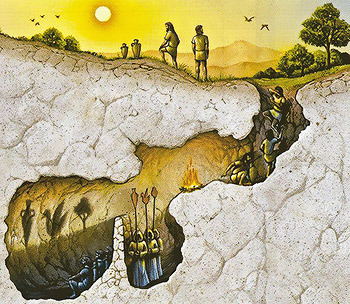
In Plato’s Allegory of the Cave, people saw a shadow play on the wall and perceived it as reality. Today that Cave has morphed to provide umpteen TV channels and mini-screen gadgets; and the once sanctified living room cave has expanded into a free-range bubble of consciousness – heads bowed before an electronic altar, seemingly oblivious to the outside world.

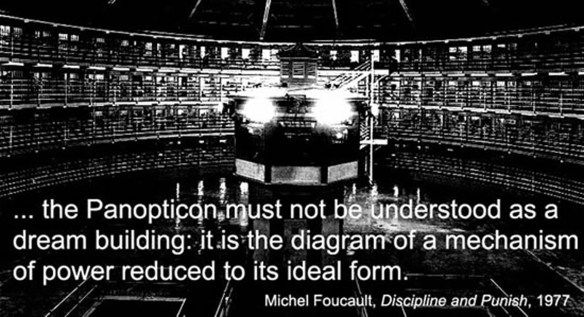
“The “panopticon” refers to an experimental laboratory of power in which behaviour could be modified, and Foucault viewed the panopticon as a symbol of the disciplinary society of surveillance.”[1]

In Plato’s E-Cave, not only are the people watching a shadow play, they, and the shadows they watch, are being watched.

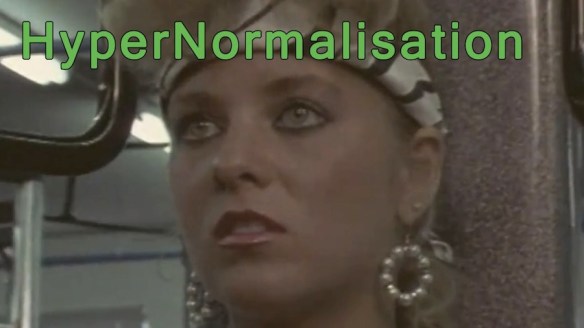
HyperNormalization
With a veneer of calm aplomb, the masses communicate 24-7, often in a frenetic urgency of the mundane, hence one interpretation of HyperNormalization. In all the years of overhearing cell-phone conversations in public, I can’t recall one snippet of philosophy or practical advice, rather stuff like, ‘yeah OMG I’ll get the chips!’ and ‘I’ll be there in like 30 seconds!’; if you’re old enough, you’d remember the days when, you got there when you got there! That said, a cell-phone can be a helpful even life-saving device.

The USEmpire election appears to have both proven and disproven the main theory of Adam Curtis’ fascinating new documentary “HyperNormalization.”

“Curtis argues that since the 1970s, governments, financiers, and technological utopians have given up on the complex “real world” and built a simple “fake world” that is run by corporations and kept stable by politicians.”[2]

The California cyber-tech-boom was a love-child of LSD-consciousness that found refuge in E-wizardy all the while looking to escape repressive politics. In his book “2030” Pepe Escobar describes it as: “Digital network capitalism would then shape post-modern globalization, from the New Economy before the end of the millennium to every digital wall to be broken beyond. California cosmology forged our world.”

According to Wikipedia:

“The term “hypernormalisation” is taken from Alexei Yurchak’s 2006 book Everything was Forever, Until it was No More: The Last Soviet Generation, about the paradoxes of life in the Soviet Union during the 20 years before it collapsed. A professor of anthropology at the University of California, Berkeley, he argues that everyone knew the system was failing, but as no one could imagine any alternative to the status quo, politicians and citizens were resigned to maintaining a pretence of a functioning society. Over time, this delusion became a self-fulfilling prophecy and the “fakeness” was accepted by everyone as real, an effect which Yurchak termed “hypernormalisation”.”[3]

First off, I see HyperNormalization as a half-truth because while the self-referential, gossipy world is fake, it is a veneer for a very real world of resource extraction and the violence perpetrated to maintain the status quo – and that is what the fakers ignore. As far as the election, many expected the Clinton dynasty to prevail as the corrupt, business as usual lesser of two evils. Breaking snooze: Where’s  the headline news that Melania Trump plans to focus on helping women and children?; I saw that mentioned on CNN’s Anderson Cooper 360, such a perfect antidote for Hillary’s loss and The Donald’s anti-feminist track record.

Even though WikiLeaks revealed the DNC (Democratic National Convention) was rigged against Sanders and leaks of Podesta/Clinton e-mails may have been proverbial straws for Hillary’s campaign camel, the prevailing media sentiment was that she would win – despite the fact that the day before the election some polls indicated a shrinking 3-4 point lead, thus with the typical margin of error, it was, in effect, tied. Yet the mass hyper-surprise!; and all that after the corporate media and comedy shows had simultaneously bashed Trump and given him more air-time than a kite on a windy day – both disdaining and elevating him, a media-mindfuck if ever there was one.

And there was little uproar when Gary Johnson and Jill Stein were excluded from debates and virtually banned from all corporate news, thus proving (if you didn’t know already) that it’s not a truly democratic election. Yet carry on we must and do the best we can with what we got, was the general sentiment, in other words, “the “fakeness” was accepted by everyone as real” aka HyperNormalization.

Yet the non-coastal, poor and middle America White working class (with sides of KKK and minorities!), which reportedly was the key demographic for The Don’s victory, was voting out of bare-bones needs; in effect they were not HyperNormalized. Then again, if Trump, who promises to challenge the status quo, caves-in to Deep State pressure, we will have an answer to an interesting article’s titular question: “President Trump: big liar going to Washington or Tribune of the People?”[4] And if that answer is the former, then the mostly White working poor will also have been duped/HyperNormalized.

You see, it’s hard to know what’s what; which all seems to prove HyperNormalization as the dominant societal charade; which screen is real, if any?

What you perceive is what you get
Another key phrase in Curtis’ documentary is “managed perception” – akin to Chomsky and Herman’s  “Manufacturing Consent: The Political Economy of the Mass Media” (1988) which showed how opinions and desensitized agreement to the status quo became a product to be mined and marketed. Witness CBS Chairman Les Moonves’ comment from February 2016:

“Man, who would have expected the ride we’re all having right now? … The money’s rolling in and this is fun. I’ve never seen anything like this, and this [is] going to be a very good year for us. Sorry. It’s a terrible thing to say. But, bring it on, Donald. Keep going.” [5] And, if i might satirically add, like an orangey topped Duracell battery, The Don does seem to have a lot of energy.

HyperNormalization is also akin to Sheldon Wolin’s theory  of “inverted totalitarianism,” where the faceless corporate machine wields so much entertainment and bureaucratic power that the people barely notice they are being played hook, line, and sinking feelings.

Some of Curtis’ info, however, is inaccurate or questionable. For examples, he blames the demise of the Occupy Movement on lack of vision and planning yet neglects to mention the FBI coordinated systemic crackdown on the ‘camps’ across the country. [6]

About Syria he says that President Bashar al-Assad retaliated with a “vengeful fury,” whereas Assad has defended his actions as self-defense for his people; numerous journalists back the Syrian President’s claim.

Post-election, I wonder: Why were so many liberals, lefties, and women more surprised that Trump won than that the DNC/HRC rigged it against Sanders? Were they simply feeling impotent due to HyperNormalized shadow play? Whatever the case, his victory revealed a crack in the smooth screen of HyperNormalization.

According to Patrick Caddell’s survey before the election, the populace seems to be hip to what’s happening:

“Powerful interests from Wall Street banks to corporations, unions and political interest groups have used campaign and lobbying money to rig the system for them. They are looting the national treasury of billions of dollars at the expense of every man, woman and child. AGREE = 81%; DISAGREE = 13%…

“The country is run by an alliance of incumbent politicians, media pundits, lobbyists and other powerful money interests for their own gain at the expense of the American people. AGREE = 87%; DISAGREE = 10%

The real struggle for America is not between Democrats and Republicans but between mainstream American and the ruling political elites. AGREE = 67%; DISAGREE = 24%.” [7]

This makes it seem it is the ‘how-to bring about change’ that is the deeper conundrum of the HyperNormalized world. Then again, people too often seem to have only their own best interests at heart. Approximately 90% of Americans want their food labeled so as to know if they contain GMOs etc. or not, yet hardly a peep out of anyone that climate change or the “environment” aka Mother Earth & Nature-beings were deliberately excluded as a main topic of the presidential debates. This makes it seem that, in general, Americans want clean food for themselves, they want a clean environment so they can go ‘play in the park’ by themselves. And that brings us to the Great Disconnect and Standing Rock.

Flow like water, be steady as a rock
Part of HyperNormalization is a disconnect from Nature and from being self- and community-guided, and therefore disconnected from the Original Peoples of Turtle Island. While many people are certainly aware of what’s happening with Standing Rock, the corporate media’s lack of attention, let alone empathy, fosters lack of concern for the outcome, lack of being outraged by the violent and racist treatment of those in prayer and peacefully protecting the main source of water for the Standing Rock Sioux and other Natives as well as approximately 17-million people downstream. The real-fake outrage is over the outcome of a fake election.

For many Native reservations where poverty and PTSD are prevalent, the people are anything but HyperNormalized; they are struggling to survive – as with Standing Rock, they are not asking for much: clean water and the space to live their lives with ancient traditions timelessly connected with the land, the water, the stones…

Plato, imagining a prisoner getting outside of the Cave, wrote: “Slowly, his eyes adjust to the light of the sun. First he can only see shadows. Gradually he can see the reflections of people and things in water and then later see the people and things themselves. Eventually, he is able to look at the stars and moon at night until finally he can look upon the sun itself .” [8]

Standing Rock is bringing people together, raising consciousness at many levels. As one example from a little over a week ago:

“In a “historic” show of interfaith solidarity, 500 clergy members prayed along the banks of North Dakota’s Cannonball River on Thursday where they “bore witness with the Standing Rock Sioux Nation,” which has faced intimidation, violence, and arrests for protecting their sacred land and water supply from the threats of a massive oil pipeline. According to the Episcopal News Service, “The interfaith group spent more than five hours on site, marching, singing hymns, sharing testimony, and calling others to join them in standing with the more than [300] tribes who have committed their support to the Sioux Nation as they protest the route of the Dakota Access Pipeline (DAPL).” [9]

This solidarity is in stark contrast with the election where a typically 51/49 system determines an outcome for a society literally programmed for exciting close-call winners – think sporting events,
reality shows, awards ceremonies.

Outside in and inside out
There are many ways to get outside the Cave. One of those is by going within. When I first started to meditate, as is common, I became aware of the constant chatter in my head and soon realized that the mind left unattended will rattle on endlessly. Meditation then showed me that once the chatter quiets, one then has access to other frequencies, other ‘channels’ – what happens then is a very personal matter yet also impersonal because one becomes connected with another source of thinking-seeing-feeling. Chatter, like cell-phones, has it’s usefulness, say, if you forgot to turn the stove off. My point to the personal anecdote is that the corporate media is too much chatter, endlessly looping itself. The gadgets, too, though useful, seem hard-wired for HyperNormalization.

Some of the chatter we must live with, yet by learning to follow our intuitions, listening to and connecting with Nature, talking with elders and little children we can better tune-out from the shadow-play, we can find new and ancient ways for more people – and that includes trees, rivers, etc. –  “to look at the stars and moon at night” and “look upon the sun itself.”

“Sin filo ya y derrotada se quejó: Soy más fuerte que ella, pero no le puedo hacer daño y ella a mi, sin pelear. me ha vencido.’”

“Without sharpness and defeated, it [the sword] complained: ‘I am stronger than the water, but I cannot harm her. And the water, without fighting, has conquered me.’” [10]

NOTES:
1.    Panopticism here and here.
2.    Ibid.
3.    HyperNormalization
4.    See here.
5.    “Les Moonves: Trump’s run is ‘damn good for CBS’”. See here.
6.    “Revealed: how the FBI coordinated the crackdown on Occupy
7.    “Patrick Caddell; The Pollster Who ‘Got it Right’
8.    “Allegory of the Cave
9.    “A Prayer for People and Planet: 500 Clergy Hold ‘Historic’ Mass Gathering for Standing Rock
10.    “Questions & Swords: Folktales of the Zapatista Revolution” as told by Subcomandante Marcos, Cino Puntos Press, El Paso, Texas, 2001, p.82.

To watch “HyperNormalization”, click here.

Mankh (Walter E. Harris III) is an essayist and resident poet on Axis of Logic. In addition to his work as a writer, he is a small press publisher and Turtle Islander. His new book of genre-bending poetic-nonfiction is “Musings With The Golden Sparrow.” You can contact him via his literary website.