THE SEVEN REASONS WE OBEY AUTHORITY

By Phillip Schneider

Source: Waking Times

Rebels are a very important part of society, but they rarely get the recognition they deserve. They help us break through old norms and keep us from falling into groupthink. However, human nature urges most of us to remain in our comfort zone even when it means less freedom or more difficult problems down the road.

Why is it the case that so many people ignore the outside world or pass it off as somebody else’s problem until it reaches their own doorstep? In a recent video, Brittany Sellner (Brittany Pettibone before she married) describes the seven reasons men obey authority, even when it is against their best interest.

#1 Habit

“As everybody knows, habits are extremely difficult to break and even if we have gripes about the state of things, accepting our imperfect reality seems better to us than taking on the daunting prospect of change. Conversely… habit ceases to be a reason for obedience in times of political crisis; kind of similar to what we are experiencing now as a consequence of Covid. Despite many of us not wanting to alter our habits, our habits were forcibly altered for us.”

#2 Moral Obligation

“The second reason for obedience is moral obligation which is obviously a motive that is very often found in religion, but politically speaking… some see it as a moral obligation to ‘1) obey for the good of society,’ 2) ‘due to the ruler having superhuman factors such as being a supernatural being or a deity,’ which isn’t something that I think applies to too many Americans… 3) People see it as a moral obligation to obey because they ‘perceive the command as being legitimate, owing to its source an issuer’. For example, a mayor or a police officer [would be considered under this reason], and 4) People see it as a moral obligation to obey due to ‘conformity of commands to accepted norms.’ For example, most people believe that a command such as not committing murder is a moral command and therefore, they obey it.”

#3 Self-Interest

“The third reason for obedience is self-interest and this is perhaps one of the more common motives nowadays. For example, most big corporations are immoral and seek to piggy-back off of current social and political trends in order to gain money, status, and approval. Just look at all the corporations that suddenly became ‘champions of social justice’ after the death of George Floyd; none of them gave a crap about police brutality and Black Lives Matter until it became in their interest to care.

This self-interest can of course also extend to individuals. Famous and non-famous people have a lot to gain by falling in line, or… there is also a negative self-interest wherein the person doesn’t obey simply because they’re going to gain something but so they won’t lose everything: their reputations, jobs, social standing and future career prospects.”

#4 Psychological Identification with the Ruler

“The fourth reason for obedience is psychological identification with the ruler, meaning that people have a close emotional connection with the ruler, regime, or the system. I imagine you would have encountered a lot of this in, for example, Communist Russia or Nazi Germany.”

#5 Zones of Indifference

“The fifth reason for obedience is an extremely common one today and that is ‘zones of indifference,’ meaning that even if people are not fully satisfied with the state of things, they have a margin of indifference or a margin of tolerance for the negative aspects of their society and government.”

#6 Fear of Sanctions

“The sixth reason for obedience is the most obvious reason… and that is ‘fear of sanctions,’ which generally involve the threat or the use of some form of physical violence against the disobedient subject and induce obedience by power merely coercive, a power really operating on people simply through their fears.”

#7 Absence of Self Confidence

“Lastly, the seventh and final reason for obedience is the absence of self confidence among subjects, meaning that many people simply don’t have sufficient confidence in themselves, their judgement, and their capacities to make themselves capable of disobedience and resistance.

Thanks to the internet, I observe this motive quite often. Thousands of people decry on the daily that they’re miserable with the state of things and yet they do nothing because they have no confidence in their personal ability to lead, to organize a peaceful protest, to start a movement and so on.”

Although authority can be legitimate and meaningful, resistance to unnecessary acts of violence or draconian government injustice is often better for the individual and his society and shows greater character than inaction. Although this is certainly not a comprehensive list, perhaps it will help you to better understand your own role in life and greater society.

Watch Brittany Sellner’s analysis on BitChute

The semi-satisfied life

Renowned for his pessimism, Arthur Schopenhauer was nonetheless a conoisseur of very distinctive kinds of happiness

By David Bather Woods

Source: aeon

On 13 December 1807, in fashionable Weimar, Johanna Schopenhauer picked up her pen and wrote to her 19-year-old son Arthur: ‘It is necessary for my happiness to know that you are happy, but not to be a witness to it.’

Two years earlier, in Hamburg, Johanna’s husband Heinrich Floris had been discovered dead in the canal behind their family compound. It is possible that he slipped and fell, but Arthur suspected that his father jumped out of the warehouse loft into the icy waters below. Johanna did not disagree. Four months after the suicide, she had sold the house, soon to leave for Weimar where a successful career as a writer and saloniste awaited her. Arthur stayed behind with the intention of completing the merchant apprenticeship his father had arranged shortly before his death. It wasn’t long, however, before Arthur wanted out too.

In an exchange of letters throughout 1807, mother and son entered tense negotiations over the terms of Arthur’s release. Johanna would be supportive of Arthur’s decision to leave Hamburg in search of an intellectually fulfilling life – how could she not? – including using her connections to help pave the way for his university education. But on one condition: he must leave her alone. Certainly, he must not move to be near her in Weimar, and under no circumstances would she let him stay with her.

What her line of 13 December doesn’t reveal is that Johanna simply couldn’t tolerate Arthur: ‘All your good qualities,’ she wrote on 6 November, ‘become obscured by your super-cleverness and are made useless to the world merely because of your rage at wanting to know everything better than others … If you were less like you, you would only be ridiculous, but thus as you are, you are highly annoying.’ He was, in short, a boorish and tiresome know-it-all.

If people found Arthur Schopenhauer’s company intolerable, the feeling was mutual. He spent long depressive periods in self-imposed isolation, including the first two months of 1832 in his new rooms in Frankfurt, the city that became his adoptive home after a stint in Berlin. He defended himself against loneliness with the belief that solitude is the only fitting condition for a philosopher: ‘Were I a King,’ he said, ‘my prime command would be – Leave me alone.’ The subject of happiness, then, is not normally associated with Schopenhauer, neither as a person nor as a philosopher. Quite the opposite: he is normally associated with the deepest pessimism in the history of European philosophy.

Schopenhauer’s pessimism is based on two kinds of observation. The first is an inward-looking observation that we aren’t simply rational beings who seek to know and understand the world, but also desiring beings who strive to obtain things from the world. Behind every striving is a painful lack of something, Schopenhauer claims, yet obtaining this thing rarely makes us happy. For, even if we do manage to satisfy one desire, there are always several more unsatisfied ones ready to take its place. Or else we become bored, aware that a life with nothing to desire is dull and empty. If we are lucky enough to satisfy our basic needs, such as hunger and thirst, then in order to escape boredom we develop new needs for luxury items, such as alcohol, tobacco or fashionable clothing. At no point, Schopenhauer says, do we arrive at final and lasting satisfaction. Hence one of his well-known lines: ‘life swings back and forth like a pendulum between pain and boredom’.

Schopenhauer knew from his extensive studies of classical Indian philosophy that he wasn’t the first to observe that suffering is essential to life. The Buddhists have a word for this suffering, dukkha, which is acknowledged in the first of its Four Noble Truths. The fourth and final of these truths, magga, or the Noble Eightfold Path that leads to the cessation of dukkha, would also inspire large parts of his moral philosophy.

The second kind of observation is outward-looking. According to Schopenhauer, a glance at the world around us disproves the defining thesis of Gottfried Leibniz’s optimism that ours is the best of all possible worlds. On the contrary, Schopenhauer claims, if our world is ordered in any way, it is ordered to maximise pain and suffering. He gives the example of predatory animals that cannot but devour other animals in order to survive and so become ‘the living grave of thousands of others’. Nature as a whole is ‘red in tooth and claw’, as Alfred, Lord Tennyson later put it, pitting one creature against another, either as the devourer or the devoured, in a deadly fight for survival.

Civilisation doesn’t help much either. It adds so many sites of human suffering. In The World as Will and Representation (1818), Schopenhauer wrote:

if you led the most unrepentant optimist through the hospitals, military wards, and surgical theatres, through the prisons, torture chambers and slave stalls, through battlefields and places of judgment, and then open for him all the dark dwellings of misery that hide from cold curiosity, then he too would surely come to see the nature of this best of all possible worlds.

If you had to guess the world’s purpose just by looking at the results it achieves, you could only think it was a place of punishment.

These observations, the first on human nature and the second on nature itself, support Schopenhauer’s pessimistic claims that life is not worth living and the world should not exist. We are never given in advance the choice whether to exist or not but, if we were, it would be irrational to choose to exist in a world where we can’t profit from life but only lose. Or as Schopenhauer puts it in another key line: ‘life is a business that does not cover its costs’.

Is there a place for happiness in all this? There certainly should be. It can’t be ignored that happiness exists; too many people have experienced happiness for themselves and seen it in others. But once Schopenhauer admits that happiness exists, there is a risk that his pessimism will start to unravel. Even if it’s true that every living thing must encounter suffering, this suffering might be offset by finding some amount of happiness too. Some suffering might be the means to a happiness worth having or even a part of such happiness. If this is so, then Schopenhauer hasn’t yet given us a good reason not to want to exist. Happiness might make life worth living after all.

Schopenhauer doesn’t deny that happiness exists. He does, however, think that we are generally mistaken about what happiness is. According to him, happiness is no more than the absence of pain and suffering; the moment of relief occasionally felt between the fulfilment of one desire and the pursuit of the next. For example, imagine the satisfaction of buying your first home. What makes us happy here, Schopenhauer would say, is not the positive state of being a homeowner, but the negative state of relief from the worries that come with not owning your own home (as well as relief from the notoriously stressful process of buying property itself). This happiness, Schopenhauer would be quick to point out, is likely to be short-lived, as a host of new worries and stresses emerge, such as paying down the mortgage, or doing up the bathroom.

He reinforces his stance on the negative nature of happiness with some astute psychological observations. All of them highlight the difficulty of achieving and appreciating happiness. For example, we tend not to notice all the things that are going well for us, but instead we focus on the bad things, or as Schopenhauer puts it with his keen eye for an analogy: ‘we do not feel the health of our entire body but only the small place where the shoe pinches’. If we do manage to resolve whatever is bothering us, we tend quickly to take it for granted and shift our focus to the next problem: ‘it is like a bite of food we have enjoyed, which stops existing for our feeling the moment it is swallowed.’ Moreover, however small the next problem, we tend to magnify it to match the previous one: ‘it still knows how to puff itself up so that it seems to equal it in size, and so it can fill the whole throne as the main worry of the day.’ Consequently, we rarely feel the benefit of the things we have while we still have them: ‘We do not become aware of the three greatest goods in life as such – that is, health, youth and freedom – so long as we possess them, but only after we have lost them.’ Or as later immortalised in lyrics by Joni Mitchell: ‘You don’t know what you’ve got ’til it’s gone.’

None of this is to say that no one ever feels happy. Again, this would fly in the face of the personal experience of countless people who have felt happy at some point in their lives. It does tell us, however, that happiness differs from pain and suffering in the way that it’s felt. Pain and suffering announce themselves whether we like it or not. They highlight that something is wrong and needs fixing. However small and trivial the problem might be, pain and suffering will make it our number-one priority. Happy feelings, on the other hand, don’t always announce themselves. We can have all the things that should make us feel happy and yet fail to feel happy. It could be because pain and suffering are tirelessly flagging up things not to feel happy about, but it could just be that – like the mouthful of food after it’s swallowed – we have forgotten all the things that are doing us good.

For this reason, Schopenhauer emphasises the essential role of recollection and reflection in generating feelings of happiness: ‘Our cognition of satisfaction and pleasure is only indirect, when we remember the sufferings and privations that preceded them and ceased when they appeared.’ To appreciate the benefit of having things, in other words, we must recall what it was like not to have them. The fact that this happiness is based on the cessation of previous suffering is not incompatible with intense feelings of pleasure. The intensity of the pleasure is proportionate to the intensity of the suffering that preceded it. Although far from happiness, Primo Levi gives a powerful example of the possibilities of profound relief in his book If This Is a Man (1947), his account of imprisonment at Auschwitz, when he reports on the brief moments between the labour tasks he was forced to complete: ‘When we reach the cylinder, we unload the tie on the ground, and I stand stiffly, my eyes vacant, mouth open, and arms dangling, sunk in the ephemeral and negative ecstasy of the cessation of pain.’

In fact, recalling our own actual suffering from the past is not our only option for feeling good about the present. We can instead reflect on all the suffering that was merely possible for us. This kind of reflection might be just as effective in generating feelings of relief, only about the limitless bad things that could have happened to us but fortunately never did. We might even reflect on the bad things that are happening or have happened to other people. In this respect, Levi’s painful recollections offer us another service: it is impossible for observers to read If This Is a Man without feeling extremely fortunate never to have encountered the scarcely imaginable hardships and indignities that Levi describes.

On the pleasure of avoiding another’s misfortune, Schopenhauer quotes Lucretius:

It is a joy to stand at the sea, when it is lashed by stormy winds,
To stand at the shore and to see the skipper in distress,
Not that we like to see another person in pain,
But because it pleases us to know that we are free of this evil.

Schopenhauer wisely cautions us about this kind of pleasure because it ‘lies very near the source of true and positive malice’. He might have in mind its proximity to – or identity with – Schadenfreude, the attitude of taking joy in the suffering of others. Lucretius identifies the thin line that separates Schadenfreude from sadism: it is not that we enjoy someone else’s misfortune, but that their misfortune acts as a reminder of how fortunate we are, and enables us to feel pleased about it.

Sometimes, however, Schopenhauer condemns Schadenfreude in the strongest terms: ‘the worst trait in human nature is Schadenfreude’. The difference between Schadenfreude and cruelty, he says, is merely the difference between attitude and action: ‘As Schadenfreude is simply theoretical cruelty, so cruelty is simply practical Schadenfreude.’ While attitudes such as envy – wanting someone else’s success for yourself – are flawed but merely human and therefore excusable, Schadenfreude is positively ‘devilish’.

On Schopenhauer’s understanding of things, then, in order to be happy, we must aim to eliminate pain and suffering from our lives, and in order to feel happy, we must also take the time to reflect on their absence. In search of an ethical system based on similar insights, Schopenhauer turned not to the moral philosophers of his own day but instead to ancient Greek schools of thought. Of all of these schools, he suggests, his own views on happiness have the closest affinity with Stoicism: like him, he claims, the Stoic philosophers such as Stobaeus, Epictetus and Seneca identified a happy life with a painless existence.

In general, ancient Greece is a good place to start the search for a philosophy of happiness because, according to Schopenhauer, the Greeks agreed on one thing: the task of practical reason is to figure out the best kind of life and how it can be achieved. Furthermore, Schopenhauer says, with the exception of Plato, they all equated this task with providing a guide to a happy life. They cared only about how virtue can improve our earthly lives, and thought little about how it might relate to any life after death or otherworldly realm.

Thinking of happiness as the avoidance of suffering is the view that distinguishes Stoicism from other schools, according to Schopenhauer, as well as the one he shares with it. He identifies two functions of practical reason that the Stoics used in their quest for a painless existence. There is the indirect function, on the one hand, where careful planning and forethought allow the Stoic to pick out and follow the least painful path through life. On the other, there is the direct function, where instead of removing or avoiding obstacles in life’s path, the Stoic reconsiders these obstacles in a way that changes his feelings towards them. One is a change in practice, while the other a change in thinking.

Stoicism’s distinctive contribution to ethics lies in the nature of the change in thinking it recommends, according to Schopenhauer. First, the Stoic observes that painful feelings of privation ‘do not follow immediately and necessarily from not-having, but rather from wanting-to-have and yet not having’. It then becomes obvious that to avoid these painful feelings altogether, we must eliminate the wanting-to-have part. Furthermore, the bigger our ambitions about what we want to have and the higher our hopes of achieving them, the sharper the pain when we fail. If we cannot help wanting to have some things, then we should at least keep those wants within realistic and achievable proportions. Perhaps lapsing back into his own pessimism, Schopenhauer adds that we should become suspicious of ourselves if we begin to expect a great amount of happiness waiting for us in the future; we are almost certainly being unrealistic. ‘Every lively pleasure,’ he says, ‘is a delusion.’

Thus the Stoic aims for ataraxia, a state of inner calmness and serenity however turbulent the world outside might be. Schopenhauer believes his observations about the inevitability of suffering can help to achieve this aim if taken on as convictions. Pain and suffering sting all the more if we think they are accidental and could have been avoided. While it might be true of any particular suffering that it could have been avoided, suffering in general is unavoidable and universal. If we manage to take this on board, Schopenhauer thinks, we might worry less about encountering suffering, or at least worry about it in the way that we worry about other things we can’t avoid, such as old age (for most of us) and death.

The last thing we should do is believe the opposite: that we are destined to find happiness in life rather than encounter suffering. If we believe the world owes us happiness, we are bound to be sorely disappointed, not least because, when we do achieve whatever we think will make us happy, we will have new unfulfilled desires that will supersede the old ones. We are also bound to feel resentment towards the obstacles that stand between us and the happiness we feel entitled to. Some people, Schopenhauer observes, concentrate and externalise this resentment by setting a goal for a happy life that on some level they know is unachievable. Then, when it never materialises, they always have something other than themselves to point to and blame for why they aren’t happy. ‘In this respect,’ Schopenhauer says, ‘the external motive for sadness plays the same role that a blister remedy does on the body, drawing together all the bad humours that would have otherwise been scattered.’

While Schopenhauer does feel an affinity for the Stoic way of thinking, he doesn’t see eye to eye with Stoicism on every issue. In fact, he rejects the basic premise common to all the ancient Greek schools; a happy life is not even possible, according to Schopenhauer, because, remember, all life is suffering. Devising systems of morals to act as a guide to a happy life is, as far as Schopenhauer is concerned, a fool’s errand. The logical end of Stoicism is especially sticky, according to Schopenhauer, because it conceives the goal of happiness as the task of eliminating pain. If he is right that all life is suffering, then the only way really to eliminate suffering is to eliminate life itself. The ultimate end of Stoicism, then, would be suicide.

Instead, Schopenhauer gives us a different picture of a happy life, one that is not total happiness. While suffering can’t be excluded from life altogether, it can be reduced by making sure no kind of suffering goes on for too long. Going back to Schopenhauer’s image of the pendulum, a happy life would include enough success in fulfilling our desires that we are never in too much pain, but also enough failure to ensure that we are never too bored. It would be a ‘game of constantly passing from desire to satisfaction and from this to a new desire, a game whose rapid course is called happiness and slow course is called suffering.’ A well-paced oscillation between wish and fulfilment, which is at most a semi-satisfied life, is the best we can hope for as far as happiness is concerned.

If a good life, conceived as a happy life, is a futile aim for ethics, this raises the question of what the real aim of ethics should be. The background of Schopenhauer’s pessimism is never far away from this question. It’s not obvious to Schopenhauer that the semi-satisfied life presented above is better than nonexistence. Such a life would still contain a preponderance of suffering, even if no kind of suffering would go on for too long.

Rather than trying to make the world into a happy home, then, Schopenhauer opts for an ethics that might save us from the world altogether. He endorses asceticism, the practice of severe self-denial exemplified in the saints and mystics of many world religions, over Stoicism:

How completely different they seem, next to the Stoic sage, those who the wisdom of India sets before us and has actually brought forth, those voluntary penitents who overcome the world; or even the Christian saviour … who, with perfect virtue, holiness and sublimity, nevertheless stands before us in a state of the utmost suffering.

Note that Schopenhauer’s otherworldly ascetics are not happy. They have entirely given up the game of a semi-satisfied life. Instead, they accept, and come to symbolise, the universality and inevitability of suffering, in order to transcend it. In relation to the ascetic, Schopenhauer is more likely to use words such as composure and peace than happiness and pleasure.

To say that Schopenhauer endorsed asceticism might appear to suggest that he practised it himself. Far from it. The most ascetic part of his daily routine in Frankfurt was the cold sponge bath he took between seven and eight every morning. After that, he made his own coffee and settled down to write for a few hours before receiving selected visitors, until his housekeeper appeared at noon, cuing them to leave. He played flute for half an hour each day – an activity that, according to Friedrich Nietzsche, belied the sincerity of his pessimism – and then made his way to his favourite spot to eat, the Hôtel d’Angleterre, for a hearty afternoon meal. After this he might make himself another coffee, take an hour’s nap, then read a little light literature before walking his dog, a white poodle called Atma, while smoking a cigar, all before settling in for his typical nine-hour sleep. The life of the Buddha it was not.

Schopenhauer’s endorsement of asceticism is more admiration than aspiration, then. In his defence, and again unlike the ancient Greeks, Schopenhauer thought that the theoretical study of ethics had little to do with living an ethical life, or vice versa: ‘it is just as unnecessary for the saint to be a philosopher as it is for a philosopher to be a saint,’ he wrote, ‘just as it is completely unnecessary for a perfectly beautiful person to be a great sculptor or a great sculptor to be beautiful.’ Only a small number of exceptional individuals achieve the ascetic life in which true salvation consists, he said. The rest of us have to make do with a semi-satisfied life at best. But if Schopenhauer’s way of living constitutes an example of such a life, it might not seem so bad after all.

Dystopia Isn’t Sci-Fi—for Me, It’s the American Reality

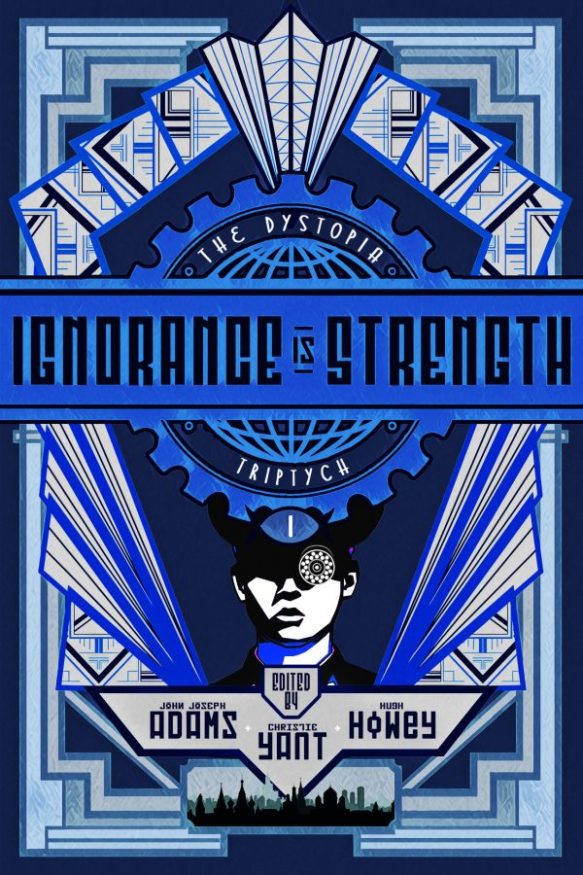
Cadwell Turnbull is a contributing author of The Dystopia Triptych. Photograph: Broad Reach Publishing

By Cadwell Turnbull

Source: Wired

Imagine a city where a group of people have managed against all odds to carve out prosperity for themselves, at least for a little while. These people used to be owned by other people. Now, they are permitted freedom, but only so much, subject to the whims of the once-masters.

Prosperity is a dangerous thing for the oppressed. It is a dry hot day in a forest bound to catch fire. And so, eventually, there is spark. A teenage boy assaults a teenage girl of the once-master class in an elevator, or so the story is told. Truth doesn’t matter here. A story is enough. The once-masters want justice, which means all the once-slaves must be punished. Men, women, and children are dragged from their homes and shot, their stores and houses bombed or burned. The exact number of dead will remain uncertain, the story buried for so long that people will watch it in a television show almost a century later and mistake the dramatization of the event for pure fiction.

Imagine another city where the once-slaves are told they are getting treatment for a devastating illness, when they are in fact receiving a placebo. Imagine four decades of this lie, the originally infected passing on this disease to their spouses, their children, so that the once-masters can study the long-term effects of the disease on people they don’t consider fully human.

Imagine these cities are part of a great nation. The once-slaves are tired of their second-class citizenship so they begin a movement for justice and equity. This movement is met with a violent backlash. The once-slaves are attacked by dogs, blasted by hoses. Their churches are burned, their institutions subject to random acts of retaliation by the once-masters. Their activists are monitored. Their leaders are jailed or assassinated. There are victories, but even after the successes, once-slaves are shot down in the street for minor offenses or looking “suspicious.” Their neighborhoods are over-policed. Their children are denied quality education. Many of them are sent to prison, where they work for pennies or for nothing. But it isn’t called slavery. It is treated as coincidence that this forced labor disproportionately affects the oppressed class, the once-slaves.

These are the makings of dystopian fictions, and yet many in America don’t need to imagine them. It is their reality. However, most Americans would not call America a dystopia.

If the edges are filed off, the names of places and events changed, a few injustices amplified, Americans can pretend the sorts of things that happen in dystopias don’t happen in their backyards. They can call it fiction, create enough distance to make themselves comfortable with their country’s own sins. But this doesn’t change the fact that the American experience is dystopian for many marginalized people. And like in any dystopia, real or imagined, it is up to all Americans to recognize this storyline, imagine a better society outside of the current reality, and then work toward it. Otherwise, America consents to a normal that is grotesque.

I read my first dystopia in high school. As a teenager, 1984 terrified the hell out of me. I didn’t read it as a warning, but as a mirror to my own experience. I identified with the protagonist Winston Smith’s feeling that something was deeply wrong with his society and the overwhelming sense of helplessness that followed. In college, I read my first utopia. The Dispossessed, by Ursula K. Le Guin, in every sense, was an antidote to that despair I felt when reading 1984.

And then, many years later, I read “The Day Before the Revolution,” the prequel short story to The Dispossessed, and found in it the practical application of the novel’s revolutionary ideas. The story is beautifully quiet. It follows Odo, the founder of the radical movement at the heart of The Dispossessed, as she goes through her day and remembers important moments in her political and personal journey. Le Guin prefaced “The Day Before the Revolution” with a brief definition of the Odonian belief system: “Odonianism is anarchism … its principal and moral-practical theme is cooperation (solidarity, mutual aid). It is the most idealistic, and to me the most interesting, of all political theories.”

To be clear, the Odonians are not perfect. They are resistant to change and have allowed other forms of institutional privilege to develop and calcify in their society. But, because they believe in their utopia and have lived their lives in accordance with that belief, they’ve managed to build a reasonably just and equitable society

And this is where, in life just as in science fiction, a distinction must be made. A just and equitable society is not the same as a perfect one. I’d argue that everyone would benefit if we defined utopia as a move toward justice and equity, and not just the state of perfection. But in America, especially in discussions about social justice, “just” and “perfect” are treated as synonymous objectives. And because perfect is never attainable, justice, too, becomes out of reach. Under this framing, injustice becomes normal, oppression is realistic, and any move towards justice and equity must come from struggle. A disturbing unspoken belief is born from this framing, that marginalized people will never receive full humanity because a just society is not possible. By failing to recognize the dystopia, and dismissing the possibility of a utopia, America has resigned itself to its current, dark narrative.

As a result, in America, universal social welfare is too costly and politically unfeasible, while trillion-dollar corporate bailouts and endless wars go unquestioned. Police and prison reform are aimed towards harm reduction for marginalized communities, instead of daring to imagine a society where these institutions are mostly unnecessary. In American discourse, a society can’t take care of all its citizens or remedy the causes of crime.

In a society where injustice is normalized, justice becomes a goal that can only be achieved through sacrifice—tragedy becomes currency, a thing to be used, not prevented. It takes decades of confirmed police brutality before America considers even the most minor reforms. This is not by accident. Black and brown bodies have been the fuel used to drive this society towards slightly lesser states of injustice since the very beginning. The oppressed have always paid the price for progress.

And yet, Americans have never shown this kind of defeatism when it comes to technological advancements. When this nation decided to go to the moon, it was framed in terms of “How do we get there?” not “Is this possible?” And no one ever said, “This rocket may only get half-way to the moon, but first many must die.”

Americans once oblivious to the dystopia are waking up. That’s good. But the price of waking up should be considered, and the lives sacrificed to incrementalism must be mourned. It is easy for a pragmatist to ask for incremental change when the current reality favors them. But pragmatism hits differently when it is forced at gunpoint. Every loss on the way to justice is a collective sin, because it was decided that the road must be long and the oppressed must struggle for every inch.

Do not normalize the losses happening right now because of the gains. Assume where America has always been is a tragedy. What is done in hell isn’t romantic; sacrificing bodies to dystopia isn’t beautiful. As I write this, people protesting brutality are dying at the hands of law enforcement. No one should pay for progress with their life. And it isn’t naive to believe every member of society should have a healthy, empowering, and fulfilling time on earth. The ones that have suffered deserve nothing less than faith in that possibility. This moment may provide a way out of dystopia, but there has to be a collective reckoning with the dystopian aspects of American society as well as the cruel price of progress repeatedly placed on the backs of the oppressed. Through solidarity there is a way out of these bitter realities, but the way there must be just if the destination is to be just.

In science fiction there is a notion that the universe is filled with possible worlds just waiting for humanity to come settle. It has some of its more troubling roots in manifest destiny, but also in hope, and the idea that better worlds are possible. But what if this corner of Earth could be that imagined place? Imagine a better world right here, instead of elsewhere. The price is in going all the way, doing all the work, believing all the work can be done. That’s the only way to get to the moon. Human beings have to believe it exists.

Saturday Matinee: Orson Welles Short Double Feature

Orson Welles Narrates Animations of Plato’s Cave and Kafka’s “Before the Law,” Two Parables of the Human Condition

By Colin Marshall

Source: Open Culture

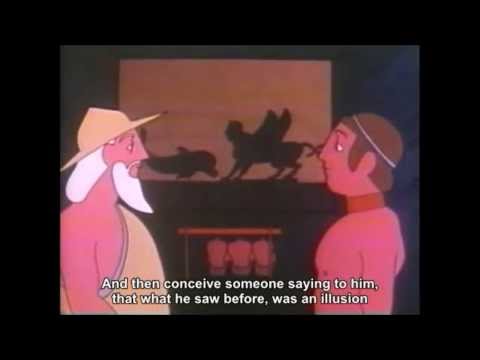
You’re held captive in an enclosed space, only able faintly to perceive the outside world. Or you’re kept outside, unable to cross the threshold of a space you feel a desperate need to enter. If both of these scenarios sound like dreams, they must do so because they tap into the anxieties and suspicions in the depths of our shared subconscious. As such, they’ve also proven reliable material for storytellers since at least the fourth century B.C., when Plato came up with his allegory of the cave. You know that story nearly as surely as you know the ancient Greek philosopher’s name: a group of human beings live, and have always lived, deep in a cave. Chained up to face a wall, they have only ever seen the images of shadow puppets thrown by firelight onto the wall before them.

To these isolated beings, “the truth would be literally nothing but the shadows of the images.” So Orson Welles tells it in this 1973 short film by animator Dick Oden. In his timelessly resonant voice that complements the production’s hauntingly retro aesthetic, Wells then speaks of what would happen if a cave-dweller were to be unshackled.

“He would be much too dazzled to see distinctly those things whose shadows he had seen before,” but as he approaches reality, “he has a clearer vision.” Still, “will he not be perplexed? Will he not think that the shadows which he formerly saw are truer than the objects which are now shown to him?” And if brought out of the cave to experience reality in full, would he not pity his old cavemates? “Would he not say, with Homer, better to be the poor servant of a poor master and to endure anything rather than think as they do and live after their manner?”

Plato’s cave wasn’t the first parable of the human condition Welles narrated. Just over a decade earlier, he engaged pinscreen animator Alexandre Alexeieff (he of Night on Bald Mountain and and “The Nose,” previously featured here on Open Culture) to illustrate his reading of Franz Kafka’s story “Before the Law.” The law, in Kafka’s telling, is a building, and before that building stands a guard. “A man comes from the country, begging admittance to the law,” says Welles. “But the guard cannot admit him. May he hope to enter at a later time? That is possible, said the guard.” Yet somehow that time never comes, and he spends the rest of his life awaiting admission to the law. “Nobody else but you could ever have obtained admittance,” the guard admits to the man, not long before the man expires of old age. “This door was intended only for you! And now, I’m going to close it.”

“Before the Law” describes a grimly absurd situation, as does Welles’ The Trial, the film to which it serves as an introduction. Adapted from another work of Kafka’s, specifically his best-known novel, it also concerns itself with the legal side of human affairs, at least on the surface. But when it becomes clear that the crime with which its bureaucrat protagonist Josef K. has been charged will never be specified, the story plunges into an altogether more troubling realm. We’ve all, at one time or another, felt to some degree like Joseph K., persecuted by an ultimately incomprehensible system, legal, social, or otherwise. And can we help but feel, especially in our highly mediated 21st century, like Plato’s immobilized human, raised in darkness and made to build a worldview on illusions? As for how to escape the cave — or indeed to enter the law — it falls to each of us individually to figure out.


The Political Value of Psychedelics

By Dr. James Cooke

Source: Reality Sandwich

Psychedelics and Politics

Psychedelics are political.  Their use in the 1960s had a political impact that is still being felt today, and their widespread banning was driven by political motives.  But how can a class of chemicals consistently impact our opinions of how we organize and relate to each other?  Psychedelics can affect the brains of individuals in ways that produce consistent insights.  These insights have direct relevance for our individual and collective wellbeing, and can point the way towards political change that would benefit us all.

The 1960s

The LSD-fuelled hippie movement was instrumental in the origins of the modern ecological awareness in politics that is so widespread today.  It helped birth modern anti-war peace movements and the practice of living in sustainable, eco-friendly communes.  What is it about the time we live in and the effects of psychedelic substances that result in their producing this kind of change in political thinking?  To understand this, we have to not only consider how psychedelics act in the brain, but we also have to understand both the unusual situation humans have found themselves in since the advent of civilization and the psychology that gave rise to it.

The Human Animal

We live in an unusual time.  For approximately 97% of human existence our species lived close to nature in small social groups.  Like other animals, evolution programmed us with a survival instinct and fear of death.  This fear incentivized us to control the world around us in order to make us feel safe.  Unlike other animals, however, we succeeded in dominating nature.  Thanks to our capacity for language and our dexterous hands that were freed up by our walking upright, it became possible for us to create culture and technology.  The preservation of knowledge from generation to generation that comes with language allowed for greater and greater control of the world around us.  Eventually we found ourselves in complex civilizations, a very long way from home.

The Price of Progress

This way of being that led to the relentless growth of civilizations is characterized by a particular kind of psychology, one that is governed by fear.  Sacrificing one’s happiness today in order to prepare for tomorrow can often make sense, but being consistently emotionally hijacked by fear without realising it can lead to a lot of unnecessary suffering.  This is true for individuals suffering with trauma and it’s true for our species as a whole.  In such a situation, there is the loss of the ability to find peace and wellbeing in the present.  We desperately look towards the future in the hope that if we just keep pushing forwards we will find a way out of our situation, not realizing that this way of being in itself is the problem.  The result is that, while we may no longer be routinely at risk of being eaten by predators, we are suffering from an epidemic of disorders of alienation, such as addiction, anxiety and depression.

The Fear Trap

Why do we continue to do this?  One reason is that we are naturally fearful creatures.  It makes sense that we would have evolved to sacrifice our wellbeing today in order to ensure our survival tomorrow.  Evolution is about staying alive, it’s not about being happy.  Another reason is that evolution has endowed us with incredible coping mechanisms.  We can be living in agony but, if we see now no other option, our capacity for language allows us to tell ourselves a story about why our situation is actually fine.  It is by taking these stories to be more real than our felt conscious experiences that we manage to repress our anguish.

Civilization and Control

Beyond the individual, there are other dynamics that keep us trapped in the game of “progress” at the expense of our wellbeing.  Once agriculture had been invented it became possible to generate surplus food, paving the way for a minority of individuals to hoard resources.  This made it possible for wealthy individuals to coerce the majority into doing their bidding as they had something that they needed for their very survival.  The ability of humans to live in stories has also been crucial in perpetuating this control.  Our ability to rationalize and normalize our experiences made it possible for each generation to grow up believing that this situation was correct or right in some way, instead of seeing how they are being exploited.

Deep Ecology

It wasn’t always this way.  Prior to the hierarchical arrangements of control that define civilization, humans throughout the world routinely explored their being part of the natural world through religious and spiritual practices.  Psychedelic plant medicines were widely used in order to explore our interconnectedness with the natural world.  The Norwegian philosopher Arne Næss coined the term “deep ecology” to refer to the non-hierarchical principles of interdependence and interconnectedness that are deeper than a superficial concern for the environment.  Ecology in this sense can apply equally to the natural world, to social arrangements or even to the contents of your own mind.

Ecology vs. Hierarchy

While the systems of control that define “civilized” states typically separate and atomize people so they can be used to generate wealth for others, human communities centred around ecological and spiritual principles are based on collaboration and the valuing of individual and collective wellbeing.  Psychedelics promote these ecological and spiritual perspectives, making them a threat to dominating systems of control.

Psychedelics and the Wisdom of Ecology

How do psychedelics promote ecological thinking?  In the brain of the individual, psychedelics can temporarily topple the hierarchical, control-based modes of thought that usually dominate our minds.  As is well attested to in Buddhist philosophy, it is these modes of thought that are responsible for the majority of our suffering.  With these structures of control dissolved, what’s revealed is a sense of interconnection and a more harmonious way of being.  This experience can produce insight into the wisdom of ecological principles such as openness, collaboration and naturalness as opposed to the controlling, atomizing and artificial arrangements that currently dominate society.  As our well-being as social primates depends on the community as a whole, it only follows that their relevance of these insights would extend beyond the individual to those who have an impact on us in society.

Hippies, Peace, Communes and the Environment

LSD use in the 60s pushed the brains of a generation in the direction of ecological thinking.  Many young people who might otherwise have unquestioningly fought in the Vietnam war suddenly saw their situation afresh, the propaganda of their home country replaced with a vision of a world of collective collaboration rather than one of conflict and domination.  The suicidal logic of ecological destruction was also laid bare, the narrative of progress through the domination of nature seemingly nothing more than an excuse for the powerful to line their pockets, a project that would soon take the earth and all of us with it.  A critical mass of young people came to similar conclusions and the hippie movement was born.

Science and Psychedelic Personality Change

Modern science is now mapping how psychedelics change people’s political opinions.  A study published in 2017 found that the number of times people use a psychedelic and the strength of their most powerful ego-dissolving experience correlate with increased nature relatedness, openness and reduced authoritarian thinking [1].  These aspects of the personality all reflect this movement towards greater ecological thinking.

The Psychology of Control

Without the benefit of psychedelics to help us travel in the direction of ecological thinking and greater wellbeing, many get trapped in coping mechanisms of control.  The traumatic nature of existence pushes some to move in the opposite direction, disowning their capacity for empathy and connection and reaffirming their sense of separation.  This process can result in disorders of the ego such as narcissism, sociopathy and psychopathy, all characterized by a lack of empathy and a delusionally high opinion of oneself.  We currently live in a system crafted to suit such personality types.  The coping mechanisms emerge in response to severe trauma early in life, when the child is learning how to connect with the world around them.  Investment in the ego and lack of concern for others is a pathology that can help such people cope with this powerful trauma.  It also represents the psychological dynamic that keeps society sick and blocks collective healing through the widespread adoption of the ecological perspective.

The Key Roadblock to Change

Society only consists of individuals interacting.  As a result, our political crises largely originate in the internal crises of individuals.  The collective trauma carried by the human race is passed on generation after generation.  A critical amount of narcissistic behaviour results in a society based around the separation and atomization of individuals, as well as around domination and control, of the environment and each other.  The extent to which our fellow humans are unconsciously trapped in narcissistic coping mechanisms is the extent to which our species will be trapped in its current mode of domination, control and suffering.

Psychedelic Medicine and the Healing of Collective Trauma

Psychedelic medicine holds the promise of moving culture in the direction of trauma healing and deep ecological thinking that is necessary to save our species and the planet from ecological destruction.  The main challenge will be how we engage with those at the other end of the spectrum, the narcissists and psychopaths so affected by trauma that they will defend their protective systems of domination at all costs. Psychedelic medicine may be able to reach some but perhaps the single greatest impact of psychedelics in years to come will be moving the public conversation toward a greater awareness of how the dynamics of trauma have deranged our world.  The creation of a global ecological culture that centers around trauma healing, emotional wellbeing and an awareness of the psychology of narcissism is the only hope our species and planet has for survival, and psychedelics are perhaps the most powerful tool we have in making this culture a reality.


References:

Nour MM, Evans L, Carhart-Harris RL. Psychedelics, Personality and Political Perspectives. J Psychoactive Drugs. 2017;49(3):182-191. doi:10.1080/02791072.2017.1312643

Abnormalize The Status Quo

By Caitlin Johnstone

Source: CaitlinJohnstone.com

If we’d been living in a healthy society and then suddenly had this society’s sick, insane status quo thrust upon us by powerful people, we’d have all been out in the streets making life very hard for those powerful people in an instant.

We are in the same situation now. We are having a wildly insane status quo thrust upon us by the powerful and for the benefit of the powerful. Only difference is we’re not all out in the streets, and instead of thrusting this horrible situation upon us suddenly, they’ve been doing it this entire time.

Which is precisely why we’re not out in the streets. We were born into this mess, so we assume it’s normal and that things are supposed to be this way. But it isn’t, and they aren’t.

What is normal is health. Health is the normal default condition. If you wake up with a fever and stabbing pain in your abdomen you don’t say “Ah well I guess that’s normal now, you can’t expect to just not have a fever and stabbing abdominal pain,” you recognize that there’s an urgent problem and you take action to fix it.

Even if you’d been sick your entire life, you would understand that your situation is not normal. You would understand that the basic default condition is health, but some dysfunction in your specific system has deprived you of that normal state of being.

In order for us to begin pushing back on the dysfunction of our current system, we need to begin looking at it in the same way. We need to clearly come to see how spectacularly divergent it is from the basic default condition of health. How sick it is. How abnormal it is.

We need to see clearly that health is normal and sickness is abnormal, whether you’re talking about an individual or a society.

It’s not normal for a civilization to be dominated by plutocrats and secretive government agencies and to only get offered the choice between two authoritarian corporate warmongers in a pretend election to a position of leadership that is almost entirely fake.

It’s not normal for there to be enough wealth to feed and care for everyone and yet instead have people with unfathomable amounts of money while others die of lack.

It’s not normal for a globe-spanning empire to dominate our species with endless military violence and starvation sanctions for the sole purpose of maintaining and expanding the unipolar hegemony of a few sociopathic manipulators.

It’s not normal for us to be destroying our ecosystem in order to grow an economy that is ultimately an imaginary construction in our minds instead of learning to collaborate harmoniously with that ecosystem.

It’s not normal for us all to be competing against each other at the expense of the entire world instead of collaborating with each other for the good of the entire world.

We need to get crystal clear that these things are not normal, because our entire society is completely saturated with skilful manipulations telling us that they are.

I write a lot about the more egregious, incendiary lies that the mass media have notoriously promulgated like WMDs in Iraq, Russiagate, the imaginary Labour antisemitism crisis etc. But the most destructive lies the mass media tell us are not the ones that stand out the most in our collective memory. The most damaging lies they tell us are the little ones they tell us many times every single day by way of spin, omission, half-truth and distortion in order to give us the impression that this status quo is normal and inescapable.

You see it in the way they talk about politicians who stand even a tiny bit outside the warmongering oligarchic beltway consensus like they are radical extremists. You see it in the way they’ll focus on protests in Belarus or Hong Kong while ignoring them in Bolivia or France. You see it in the way they ignore Yemen when it’s the single most horrific thing happening on our planet right now. You see it in all the sitcoms and movies where debt and low wages and other symptoms of status quo dysfunction are almost never a featured concern.

You see it in innumerable other ways, day in and day out, and they add up. They add up for someone who was born into a gravely dysfunctional system and has never known anything resembling health to compare it to. They’re like someone who has always been sick, who has also never known or heard about anyone who is healthy.

You can tell me we’ve never had a healthy society since the dawn of civilization all you want. All you are telling me is that we have always been sick. Being sick all your life doesn’t mean health isn’t normal or that health shouldn’t be urgently sought; if anything it means it should be sought more urgently.

It is not human nature to be this sick, and anyone who tells you it is is lying. Anyone who tells you it’s human nature to be greedy, violent, domineering and abusive isn’t telling you about humanity’s nature, they’re telling you about their own nature. And it’s probably a bad idea to turn your back on them.

We can have health. We can have normality. But just as you won’t return to health by pretending that your fever and abdominal pains are normal, we can’t create a healthy society as long as we allow ourselves to be manipulated into the belief that our backwards, insane status quo is what normality looks like.

So abnormalize the status quo. Abnormalize it every chance you get. Abnormalize it by holding a clear idea in your mind of what a healthy society would look like, then point out all the bizarre deviations from that vision at every opportunity. Remind people that this is crazy. Assure them that it doesn’t have to be this way. That the only thing keeping it this way is the fact that the powerful keep pouring vast troves of wealth into manipulating us into thinking that we should.

Help people see what health is so that they can see what sickness is. Interrupt conversations about which flavor of sickness would be preferable this election season to point to what real health would look like. Disrupt all attempts to normalize our status quo, and use whatever reach you have to help abnormalize it.

Halting Our Descent into Tyranny: Defeating the Global Elite’s Covid-19 Coup

By Robert J. Burrowes

As many authors have documented, the global elite is conducting a coup to take complete control of our lives. It is doing this by using a non-existent ‘virus’ to terrorize the human population into believing that we will ‘catch’ Covid-19 if we do not submit to draconian restrictions on our rights and freedoms.

And while the elite is conducting its coup, the most important challenges that confront our world are being largely ignored, as I will briefly discuss below.

If you are not already familiar with it, you can read (or watch) a sample of the overwhelming evidence that this virus does not exist in ‘Unmasking the Lies Around COVID-19: Facts vs Fiction of the Coronavirus Pandemic’, ‘COVID19 PCR Tests are Scientifically Meaningless’, ‘Death by killing old people, not COVID – The Basic Deception’, ‘An Inconvenient Covid-19 Truth: Dr Andrew Kaufman and Del Bigtree’ (republished after being taken down) and ‘COVID-19 Does Not Exist: The Global Elite’s Campaign of Terror Against Humanity’.

Most notably, perhaps, Torsten Engelbrecht and Konstantin Demeter, the authors of the second reference cited above, wrote to the authors of four of the principal, early 2020 papers claiming discovery of a new coronavirus and each of them in their response ‘concede[d] they had no proof that the origin of the virus genome was viral-like particles or cellular debris, pure or impure, or particles of any kind. In other words, the existence of SARS-CoV-2 RNA is based on faith, not fact.’

Moreover, Engelbrecht and Demeter also wrote to Dr Charles Calisher, a prominent and veteran virologist, asking if he knew of ‘one single paper in which SARS-CoV-2 has been isolated and finally really purified’. His answer? ‘I know of no such a publication. I have kept an eye out for one.’

But you can read the paper by Engelbrecht and Demeter if you want to consider the other efforts they made, unsuccessfully, including by contacting prominent institutions such as the Robert Koch Institute in Germany, to locate documented proof that a purified SARS-CoV-2 virus had been isolated.

And in the video above titled ‘An Inconvenient Covid-19 Truth’, Dr Andrew Kaufman states:

‘There is not one scientist who has isolated or purified a virus and made a concrete association with a new illness…. There have been spikes in mortality around the world in different places but we need to look for other causes or explanations for that since there is no solid evidence that there is a virus causing anything.’

So why are some people dying? Some are dying from pre-existing health conditions (‘comorbidities’), some are dying from influenza (as happens to 650,000 people each year: see ‘Up to 650 000 people die of respiratory diseases linked to seasonal flu each year’), some are dying as a result of living in a toxic environment – see ‘The China lockdown: origin of the war against the population of Earth, pretense of containing the virus’ – some are dying in response to the deployment of 5G technologies, some are dying from the fear and other emotional responses to the isolation in which they have been imprisoned, and some are dying of unrelated causes falsely attributed to Covid-19, as the many articles and videos on the statistical manipulation have exposed. See, for example, ‘COVID 19 Is A Statistical Nonsense’.

Given the categorical science that this virus does not exist, it is clear that the restrictions already imposed, and those that will be imposed, supposedly to tackle this non-existent infection labeled Covid-19, make history’s worst despots – as well as those depicted in dystopian novels and films – look benevolent by comparison.

This is because the intended and ongoing consequences of these restrictions, if they are all successfully implemented, will be catastrophic: those human beings still alive will be reduced to digitized identities controlled by forces literally beyond their perception and one (presumably) unintended consequence of this coup will be the extinction of our species. Let me explain why.

The Elite Coup

If you have not been following the literature in relation to the ongoing coup and its rapidly accumulating costs, you can read a sample from the most recent documentation here:

Economist and geopolitical analyst Peter Koenig, formerly of the World Bank, in ‘IMF and WEF – From Great Lockdown to Great Transformation. The Covid Aftermath’ notes as follows:

‘Deep-State-Actors’ behind the scene were using Covid to… cause a total lockdown of people as well as of the world economy…. This mighty lockdown order, instigated from ‘high-up’, way above the world’s governments and the UN, and with such co-opted ‘authorities’, like the WHO, has brought the world economy down on its knees within less than 6 months….

One of the opportunities the IMF sees emerging from this crisis, is ‘the digital transformation – a big winner from this crisis’. The IMF doesn’t say what it means, but it requires foremost digitizing people’s identity and digitizing money – total control over people’s movements, health records, cash flow, bank accounts and more. See also ‘The Coronavirus COVID-19 Pandemic: The Real Danger is “Agenda ID2020”.

Former Air Force Captain David Skripac in What Are the Truly Verifiable Facts Surrounding COVID-19?’ summarizes the non-existent or flawed science around the existence of the SARS-CoV-2 RNA virus, the diagnostic testing, the use of masks and the claim that the Infection Fatality Rate (IFR) for COVID-19 is far greater than the seasonal influenza, and concludes as follows:

What is certain, though, is that all of the medical martial law edicts that have been issued in united fashion have been based on unsubstantiated science. Equally clear is that the drive for a global COVID-19 vaccine regimen and the global surveillance grid are moving ahead in concert to transform the world as we know it – if we allow it to happen.

Professor Michel Chossudovsky in his recently republished timeline ‘COVID-19 Coronavirus “Fake” Pandemic: Timeline and Analysis’ outlining events leading up to and then immediately following declaration of the pandemic by the World Health Organization on 30 January 2020, carefully documents such points as Event 201 held in New York in October 2019, and notes the following:

What we are dealing with is ‘economic warfare’….

Our… analysis reveals that powerful corporate interests linked to Big Pharma, Wall Street and agencies of the US government were instrumental in the WHO’s far-reaching decision.

What is at stake is the alliance of ‘Big Pharma’ and ‘Big Money’, with the endorsement of the Trump Administration. The decision to launch a fake pandemic under the helm of the WHO on January 30, was taken a week earlier at the Davos World Economic Forum (WEF). The media operation was there to spread outright panic.

We are dealing with a complex global crisis with far-reaching economic, social and geopolitical implications.

US constitutional attorney John W. Whitehead in his article ‘One Nation Under House Arrest: How Do COVID-19 Mandates Impact Our Freedoms?’ documents the extensive and ongoing encroachments on rights and freedoms in the USA and highlights the following:

On a daily basis, Americans are already relinquishing (in many cases, voluntarily) the most intimate details of who we are – their biological makeup, our genetic blueprints, and our biometrics (facial characteristics and structure, fingerprints, iris scans, etc.) – in order to navigate an increasingly technologically-enabled world.

COVID-19, however, takes the surveillance state to the next level.

There’s already been talk of mass testing for COVID-19 antibodies, screening checkpoints, contact tracing, immunity passports to allow those who have recovered from the virus to move around more freely, and snitch tip lines for reporting ‘rule breakers’ to the authorities….

In this post-9/11 world, we have been indoctrinated into fearing and mistrusting one another instead of fearing and mistrusting the government. As a result, we’ve been forced to travel this road many, many times with lamentably predictable results each time: without fail, when asked to choose between safety and liberty, Americans historically tend to choose safety.

Failing to read the fine print on such devil’s bargains, ‘we the people’ find ourselves repeatedly on the losing end as the government uses each crisis as a means of expanding its powers at taxpayer expense.

And, technologically, it is now incredibly easy to do this in many ways.

In one of his ongoing videos (that, so far, has not been censored) about the Covid-19 coup – this one titled This Couldn’t Possibly Happen. Could it?’ the transcript for which can be accessed by clicking the ‘Health’ tab after entering his website – the UK’s Dr Vernon Coleman explains one sinister aspect of this technological control:

If you were a mad doctor and you wanted to control an individual it would be a doddle.

You’d just tell them you were giving them an injection to protect them against the flu or something like that and in the syringe there would be a little receiver. And then you’d stick a transmitter on the roof of the house across the road from where they lived.

And then you could send messages to make them do whatever you wanted them to do. You could make them sad or angry or happy or contented. You could make them run or fight or just spend all day in bed.

Remember, that’s what Dr Delgado was doing over half a century ago. It’s nothing new.

Of course, if you wanted to do the same thing for lots of people you’d need a whole lot of people to help you….

And you’d need something to inject into people. A medicine of some kind for example.

And then you’d need someone good at software to help with all the transmitting and the receiving and you’d need people with access to lots of tall poles or roofs where they could put the transmitter things.

But none of that would be any good unless you had a reason for injecting people. You can’t just go around injecting millions of people for no reason.

Ideally, you’d need them all to be frightened of something so that they were keen to let you inject them. And then you could put your tiny receivers into the stuff that was being injected. Or squirted up their noses or whatever.

Whitney Webb provides further insight into the elite intention in this regard. In one of her meticulously-researched articles – ‘Coronavirus Gives a Dangerous Boost to DARPA’s Darkest Agenda’ – she outlines the hidden technological agenda behind the Covid-19 coup that might well be delivered as part of any vaccination program by the Pentagon’s Defense Advanced Research Projects Agency (DARPA). After carefully outlining the history and ‘logic’ of what is taking place, she concludes with the chilling words:

Technology developed by the Pentagon’s controversial research branch is getting a huge boost amid the current coronavirus crisis, with little attention going to the agency’s ulterior motives for developing said technologies, their potential for weaponization or their unintended consequences….

This is especially true given that – without a major crisis such as that currently dominating world events – people would likely be unreceptive to the widespread introduction of many of the technologies DARPA has been developing, whether their push to create cyborg “super soldiers” or injectable Brain Machine Interfaces (BMIs) with the capability to control one’s thoughts. Yet, amid the current crisis, many of these same technologies are being sold to the public as “healthcare,” a tactic DARPA often uses. As the panic and fear regarding the virus continues to build and as people become increasingly desperate to return to any semblance of normalcy, millions will willingly take a vaccine, regardless of any government-mandated vaccination program. Those who are fearful and desperate will not care that the vaccine may include nanotechnology or have the potential to genetically modify and re-program their very being, as they will only want the current crisis that has upended the world to stop.

In this context, the current coronavirus crisis appears to be the perfect storm that will allow DARPA’s dystopian vision to take hold and burst forth from the darkest recesses of the Pentagon into full public view. However, DARPA’s transhumanist vision for the military and for humanity presents an unprecedented threat, not just to human freedom, but an existential threat to human existence and the building blocks of biology itself.

In essence then, the ongoing elite coup is accelerating the so-called fourth industrial revolution as well as development of the technologies with which the Pentagon plans to fight future wars. If they succeed, you will only exist provided you have a biometric digital identity vaccinated into your body – see ‘Africa to Become Testing Ground for “Trust Stamp” Vaccine Record and Payment System’ – that confirms your existence, contains your vaccination record and your ‘authority’ to pay digital money. But, as discussed by Dr Vernon Coleman and Whitney Webb, the ‘vaccine’ might well contain much more than that. In any case, you might not be relieved to know that this system will even work ‘in areas of the world lacking internet access or cellular connectivity’ and that it ‘does not require knowledge of an individual’s legal name or identity to function’.

Who you really are, as a human individual, will be irrelevant and will be largely gone: The nanotechnology in your body will have altered and redefined you. It will be used to control your behaviour in response to a digital signal controlled by others. Whether as worker or soldier, you will do as directed to serve elite ends, no longer having volition of your own.

If this is not enough to convince you of what is at stake, you can read further itemization of the adverse impacts of this coup in other articles such as ‘The Elite’s COVID-19 Coup Against a Terrified Humanity: Resisting Powerfully’ and ‘How the Covid-19 Crisis Affects Individual Rights and Freedoms. A New Crisis in International Law?’

And you can access a substantial list of resources carefully compiled by Roger Brown in ‘The Covid-Lockdown Crisis – Alternative Info & Sources’.

Of course, you do not need to believe the scholars I have cited above. Major elite organizations, such as the World Economic Forum (WEF), have been equally clear, even if they cast what is happening rather more positively given their role in generating the Covid-19 ‘crisis’ to precipitate the coup in the first place. In its document ‘The Great Reset: A Unique Twin Summit to Begin 2021’ the WEF candidly notes that:

COVID-19 has accelerated our transition into the age of the Fourth Industrial Revolution.

But given the deeper agenda of which the fourth industrial revolution (with its military implications) is only a part, the WEF also notes in its recent report, without even a hint of irony after citing a report by sustainability experts – see ‘Scientists’ warning on affluence’ – that:

Affluence is the biggest threat to our world…

True sustainability will only be achieved through drastic lifestyle changes… rather than hoping that more efficient use of resources will be enough.

The World Economic Forum has called for a great reset of capitalism in the wake of the pandemic. See ‘This is now the world’s greatest threat – and it’s not coronavirus’.

Of course, it is entirely possible that the WEF has not heard of Mahatma Gandhi who modeled and espoused substantially reduced consumption more than 100 years ago while also modeling and advocating local self-reliance – ‘Earth provides enough for every person’s need but not for every person’s greed’ – and those activists and experts who have lived and/or articulated such a course since Gandhi.

But, then again, does the WEF really mean what it sounds like it means? Is the global elite about to forego its affluence and return its wealth to those billions of impoverished people who are just the latest of many generations from whom the elite has stolen virtually everything through military conquest, an economic system and other structures of exploitation that ‘allocate’ resources in accord with mechanisms over which ‘ordinary’ people have no control?

Or is the global elite more interested in a new series of mechanisms that further impoverish the human population and exploit the natural world, particularly if the bulk of the human population has been effectively robotized by the nanotechnology in the Covid-19 vaccine and can simply be directed to work (or kill in war), irrespective of working conditions and recompense?

Ignoring the Challenges that Really Threaten Us

But the coup to take greater control of our lives is just one of the many adverse outcomes that we can expect and this is why human extinction, by any of four separate paths, is a likely outcome.

Whether by the ongoing demolition of weapons control agreements – see ‘Trump’s War On Arms Control and Disarmament’ – endlessly fighting and provoking wars – see ‘Largest U.S. Seizure of Iranian Fuel from Four Tankers’ (although this has since been contradicted by Iran) – and even courting the risk of nuclear war – see ‘Kremlin Warns The US Of Nuclear Retaliation If Russia Or Her Allies Are Targeted’ – the current US-generated military environment has not been this close to nuclear armageddon at any time in history. Unfortunately, things have deteriorated dramatically since the Bulletin of the Atomic Scientists 2020 Doomsday Clock Announcement back in January ‘Closer than ever: It is 100 seconds to midnight’.

Of course, it should be noted, the fundamental driver of these latest regressive developments (which simply add to those many regressive developments that have preceded them) is the US nuclear doctrine that has been in place since 2003. As explained by Professor Michel Chossudovsky: ‘The Hiroshima Day 2003 meetings had set the stage for the “privatization” of nuclear war…. This long war against humanity is [now being] carried out at the height of the most serious economic crisis in modern history. It is intimately related to a process of financial restructuring which has resulted in the collapse of national economies and the impoverishment of large sectors of the world population. The ultimate objective is world conquest.’ Watch Secret Meeting on the Privatization of Nuclear War Held on Hiroshima Day 2003.

And in case you believe that ‘world conquest’ is fanciful, consider the following. As mentioned above, the technology now available after decades of effort enables receiver nanochips to be sprayed, injected or otherwise implanted into human bodies. With the ongoing deployment of 5G (which includes extensive space and ground-based technologies), it will be possible to direct the individual behaviour of each of those people. Given that the control technology will be owned by corporate executives, here are just four examples of how the elite might direct that it be used (more or less as a ‘drone pilot’ sitting in the United States controls a drone flying in the Middle East that fires weapons on local people):

1. The official chain of command to launch nuclear weapons can be subverted by using remote control to direct the chosen individual in a particular chain of command to order (or execute) the launch of one or more nuclear weapons at the target(s) nominated at the time(s) specified. Subordinates can be directed to follow orders they might otherwise question.

2. ‘Cyborg soldiers’ (either as mercenaries or formal military personnel) in groups or as individuals can be deployed anywhere to fight as ordered by those in charge of their remote controls.

3. ‘Cyborg workers’ can be instructed to work in dangerous conditions for extended periods and simply be replaced as required. Someone else close by will have been vaccinated too.

4. Activists on any issue can simply to be instructed to refrain from further involvement in their campaign. Or to actively take the opposite position to the one they had previously.

Anyway, just briefly on the other three imminent threats to human survival.

The climate remains under siege. Despite elite propaganda to the contrary, Earth passed 2°C above the 1750 (preindustrial) baseline in February 2020 – see ‘Crossing the Paris Agreement thresholds’ and ‘2°C crossed’ – and given that carbon dioxide emissions generate ‘maximum warming’ about one decade after the emission actually occurred – see ‘Maximum warming occurs about one decade after a carbon dioxide emission’ – ‘the full warming wrath of the carbon dioxide emissions over the past ten years is still to come’. See ‘2°C crossed’.

However, with even most activists accepting the elite-driven narrative in relation to Covid-19, efforts to curb the climate catastrophe are largely on hold despite the fact that ‘global warming is rampaging, running amuck’ with fires in eastern Siberia – ‘the very region of the planet that’s famous for the coldest temperatures of all time… now recording Miami-type summer temperatures’ – according to NASA satellite images ‘depict[ing] an inferno of monstrous proportions’ with which ‘nothing in modern history compares’. See ‘Freakish Arctic Fires Alarmingly Intensify’.

And having mentioned fires, how is the Amazon going after last year’s disastrous season? Not well, according to this latest report: ‘More than 260 major, mostly illegal Amazon fires detected since late May’.

But if fires in Siberia and the Amazon do not concern you, did you realize that the warming temperature is now causing methane to leak from Antarctica (not just the Arctic) too? See ‘Riddles in the cold: Antarctic endemism and microbial succession impact methane cycling in the Southern Ocean’ and ‘As Planet Edges Closer To Climate Tipping Points, Scientists Identify Methane Gas Leak In Antarctica’.

Moreover, while the global industrial shutdown has temporarily reduced emissions of carbon dioxide, methane and nitrous oxide, it has also significantly reduced the aerosol masking effect generated by burning fossil fuels as explained by Professor Guy McPherson in his recently-published paper ‘Will COVID-19 Trigger Extinction of All Life on Earth?’ For reasons he carefully explains in his paper, McPherson concludes:

The ongoing reduction in industrial activity as a result of COVID-19 almost certainly leads to loss of habitat for human animals, hence putting us on the fast track to human extinction.

Apart from the serious threat of nuclear war and the accelerating climate catastrophe, in their latest paper Professor Gerardo Ceballos and his colleagues provide further evidence of the ongoing ‘biological annihilation’ of life on Earth and what it means for ecosystem functioning while documenting the complicating factors that have arisen during the COVID-19 crisis because capturing wildlife for trade or food was one backup economic survival option for many people when other options were shut down.

‘Even though only an estimated 2% of all of the species that ever lived are alive today, the absolute number of species is greater now than ever before. It was into such a biologically diverse world that we humans evolved, and such a world that we are destroying…. Millions of populations have vanished in the last 100 years…. The reason so many species are being pushed to extinction by anthropogenic causes is indicated by humans and their domesticated animals being some 30 times the living mass of all of the wild mammals that must compete with them for space and resources’. But, Dr Ceballos adds: ‘Many of the species endangered or at the brink of extinction are being decimated by the legal and illegal wildlife trade.’ See ‘Vertebrates on the brink’.

But if you want another account, you can read a solid summary in the latest media release of the Intergovernmental Science-Policy Platform on Biodiversity and Ecosystem Services (IPBES) here: ‘Nature’s Dangerous Decline “Unprecedented”; Species Extinction Rates “Accelerating”’.

And for just one of the latest accounts in the ongoing stream of disasters, see ‘Calls for swift action as hundreds of elephants die in Botswana’s Okavango Delta’.

Of course, while the World Economic Forum does not even list electromagnetic radiation (or nuclear war, for that matter) as one its top ten ‘risks’ – see ‘The Global Risks Report 2020’ – because its plan to implement the fourth industrial revolution (with its profound implications for the future of warfare) depends on the deployment of 5G, this deployment is already wreaking havoc (and presumably a driver of at least some of the ill-health and deaths falsely attributed to Covid-19) and is another path to imminent human extinction. See ‘Deadly Rainbow: Will 5G Precipitate the Extinction of All Life on Earth?’

Apart from other, locally disastrous outcomes, this deployment means that the existing fleet of functional satellites orbiting Earth, which totaled 2,666 on 1 April 2020 – see ‘Satellite Database’ – but has already grown by a couple of hundred since then, will be vastly expanded to 100,000 in the near future.

This will disturb, in a way that goes profoundly beyond all previous disturbances, the global electrical circuit, that evolved over eons and sustains all life.

In short, we will have fundamentally altered the very conditions that made the evolution of life on Earth possible.

So why is this all happening?

The coup being conducted by the global elite, that is also fast-tracking four paths to human extinction, is a direct outcome of their unconscious terror and the insanity this causes. The elite is not capable of considering ‘the big picture’ because each member of the elite, as well as all those who serve it, is trapped in a confined psychological state that makes them incapable of perceiving or behaving beyond the terrified imperative to endlessly seek control. This outcome is the direct result of the violence they each suffered as a child and which now leads them to endlessly but dysfunctionally seek the control they were denied as a child. See Why Violence? and Fearless Psychology and Fearful Psychology: Principles and Practice.

In essence, a terrorized child will result in an equally terrified and powerless adult. Powerless individuals are so terrified that they will not get what they want that they fear the idea of cooperation for mutual benefit. Hence, they must endlessly seek total control so that they will feel ‘safe’. Of course, safety based on control of this nature is a delusion and, even if it could be achieved, is dysfunctional. This is partly why the elite coup, which is designed to give them total control, fails to take account of factors beyond the coup, particularly including the paths to extinction they are accelerating.

In contrast, powerful individuals are happy to negotiate in an atmosphere that allows conflicting parties to explore mutually beneficial outcomes. They readily understand that others have needs and these can be met without undermining the satisfaction of their own needs. Control is simply not important to them beyond that which allows it to be shared among equals.

For further discussion of this point, see ‘The Global Elite is Insane Revisited’.

Moreover, it is worth pointing out, wealth accumulation is just another compulsive behaviour: that is, a serious but common psychological disorder in industrialized societies. And these individuals need considerable psychological help. But we do not help them by participating in their delusion that control and wealth are what they need. See ‘Love Denied: The Psychology of Materialism, Violence and War’.

Resisting the Elite Coup so Far

Fortunately, increasing numbers of people are becoming aware of the coup and resistance to it is now building steadily (even if corporate media outlets routinely ignore these actions, underestimate the numbers and/or smear those resisting). Here is just a sample of the most recent ‘demonstrations’ (but not other forms of nonviolent resistance):

A large march and rally – estimated at 1.3 million people – was held in Berlin on 1 August 2020. See ‘Media grossly underestimates massive turnout at Berlin’s “End of the Pandemic” protest’.

The rally included speeches by two police officers to which you can listen. See ‘German police speak out against draconian COVID-19 restrictions, lies and fear-mongering’.

A demonstration was held in London on the same date. See ‘“Masks are Muzzles”: Thousands March in Berlin & London Against Mandatory Masks & Covid-19 measures (PHOTOS, VIDEOS)’.

Another demonstration was held in Stuttgart. See ‘Protesters March in Stuttgart Against Tight COVID Measures’.

And another in Montreal on 8 August 2020. See ‘Thousands rally in downtown Montreal to protest Quebec’s mandatory mask rules’.

On 9 August 2020, 6-7,000 people attended a mega-Church service, despite threats from the police about exceeding the limit of 100, without maintaining social distancing or wearing masks. See ‘Defiance! 6,000 Attend “Illegal” California Church Service’.

On 16 August 2020, thousands of people gathered under the giant Spanish flag that decorates Colon Square in the centre of Madrid to protest against the restrictions imposed to supposedly combat the ‘coronavirus pandemic’. See ‘“Freedom!” Demonstrators Gathered in Madrid Against Wearing of Masks.

John C.A. Manley argues that getting accurate printed information before the eyes of people is important if we are to counter the elite’s propaganda bombardment through the corporate media. See ‘Protest against COVID Disinformation and Social Engineering’.

Research indicates that two-thirds of people in the UK are unwilling to be vaccinated and many of these would go to prison rather than submit to vaccination. See Britons would “go to prison before being injected” as distrust of Covid vaccine grows’.

Of course, this position already has a strong basis in international law given that everyone has the right to accept or reject medical procedures in accordance with the Nuremberg Medical Code 1947 – see Fifty Years Later: The Significance of the Nuremberg Code’ – and article 6.1 of the Universal Declaration on Bioethics and Human Rights.

This is worth remembering given that, apart from the purpose of vaccination mentioned above, ‘the US government has just granted big pharma immunity from liability claims if the vaccine produces damaging side effects’ – see ‘Europeans Are Waking Up to Government Covid Tyranny. Why Are We Still Asleep?’

– and other countries are likely to follow suit, despite the extensively documented record of vaccines causing devastating harms including massive lethality. For a taste of the vast literature on this point, see ‘Gates’ Globalist Vaccine Agenda: A Win-Win for Pharma and Mandatory Vaccination’.

As Dr Stefan Lanka has explained about vaccines generally:

Only ignorant people who blindly trust in the state authorities who are ‘testing’ and approving the vaccines can regard vaccination as a ‘small harmless prick’. The verifiable facts demonstrate the danger and negligence of these scientists and politicians, who claim that vaccines are safe, have little or no side-effects and would protect from a disease. None of these claims is true and scientific. See ‘The Misconception Called “Virus”: Measles as an example’.

Anyway, there are many options and resistance is taking many forms, including individual actions of enormous variety. And they are not all done with great fanfare. People are conducting street parties, joining protests they would not normally attend or just going about their business as if the lockdowns were not in place.

Of course, there is no point pretending that all of this is happening without police repression. At the moment, however, it seems that Melbourne, the capital city of the state of Victoria in (mainland south-eastern) Australia, takes the prize for the most repressive government and police response in a so-called ‘democracy’. See ‘Letters From Melbourne, a “Ghost Town Police State” Under Brutal Covid Lockdown’.

As an aside, it is worth remembering this as you ponder your own response to this coup: People who are terrified will believe the elite-driven narrative promulgated by elite agents such as the World Health Organization, governments and the corporate media. It is those people who can investigate and still think for themselves on whom our resistance must be built. So seek out and work with those in the latter category as a priority. It might not seem like it at times but they are everywhere, as the examples above illustrate.

Resisting the Elite Coup Strategically

While the resistance so far has been crucially important, my own hope is that we can build on this while also tackling each of the key threats to human survival.

If we are to do this effectively, it would be useful to start by giving yourself time to focus on feeling your emotional responses – fear, anger, sadness, pain, dread…. – to whatever is generating an emotional reaction: living in a confined space, someone in your household, wearing a mask, Covid-19, the elite coup, the imminent threats of extinction or anything else. See ‘Putting Feelings First’.

This is always invaluable so that you can engage meaningfully and strategically in the effort, whatever issue you choose to fight.

So once you have a clearer sense of your emotional reactions to this knowledge and have allowed yourself time to focus on feeling these feelings, you will be in a far more powerful position to consider your response to the situation. And, depending on your interests and circumstances, there is a range of possible responses that will each make an important difference.

Fundamentally, you might consider making ‘My Promise to Children’ which will include considering what an education for your children means to you, particularly if you want powerful individuals – not ones who are submissively obedient to elite directives and project their fear onto blameless but ‘legitimized victims’ – who can perceive reality and resist violence. See ‘Do We Want School or Education?’

You might consider supporting others to become more powerful. See ‘Nisteling: The Art of Deep Listening’.

You might also consider how your diet and healthcare could usefully be revised to empower you to resist medical propaganda, particularly given the extensively documented death-dealing for which corporate medicine is responsible. See, for example, ‘Pharma Death Clock’.

If you wish to strategically resist the elite coup, you can read about nonviolent strategy, including strategic goals for doing so, from here: Coup Strategic Aims.

Remaining pages on this website fully explain the twelve components of the strategy, as illustrated by the Nonviolent Strategy Wheel, as well as articles and videos explaining all of the vital points of strategy and tactics, such as those to help you understand ‘Nonviolent Action: Why and How it Works’ and ‘Nonviolent Action: Minimizing the Risk of Violent Repression’.

Given the complexity of the configuration of this conflict, however, which involves the need to fight simultaneously to retain our essential humanity, defeat the elite coup and avert near-term human extinction, it is important that our tactical choices are strategically-oriented (as are those listed on the Strategic Aims page nominated above). Hence, three further considerations assume importance.

First, choose/design tactics that have strategic impact, that is, they fundamentally and permanently alter, in our favor, the power relationship between the elite and us.

Second, when tactical choices are made, focus them on undermining the elite coup, not just features of it, such as ‘social distancing’ or the lockdowns. At its most basic, this can be achieved by using tactical choices that mobilize people to act initially, as is happening, but then inviting them to consider taking further, more focused, action as well (such as those nominated in the strategic goals referenced above). This is important if our actions are to have impact on key underlying measures, such as those being taken by the elite to advance the fourth industrial revolution, including the robotization of humans for war-fighting.

Third, choose/design tactics that also have strategic impact on the greatest threats to human survival, including the collapsing biodiversity on Earth, the threat of nuclear war, the climate catastrophe and the deployment of 5G. Given the incredibly short timeframe in which we are now working to avert human extinction, while people are mobilizing it is important to use this opportunity to give them the chance to perceive the ‘big picture’ of what is taking place – beyond lockdowns and other measures supposedly being used to tackle Covid-19 – and to act powerfully in response.

Fortunately, as more people become aware of the deeper strands of what is taking place, the energy to break the lockdowns, resist other limitations on our rights and freedoms (such as contact tracing, Covid-19 testing/temperature checks, mask-wearing and vaccinations) as well as resist the coup itself will gather pace. As I have previously outlined, using a locally relevant focus, or perhaps several, for which many people would traditionally be together – a cultural, religious or sporting event, a nonviolent action, a community activity such as working to establish a community garden to increase local self-reliance, a celebration and/or a return to work – we can mobilize people to collectively resist. As has been happening.

If you wish to focus on powerfully resisting one of the primary threats to human existence – nuclear war, the deployment of 5G, the collapse of biodiversity and/or the climate catastrophe – you can read about nonviolent strategy, including strategic goals to focus your campaigns, from here: Campaign Strategic Aims.

You might also consider joining those who are powerful enough to recognize the critical importance of reduced consumption and greater self-reliance as essential elements of these strategies by participating in The Flame Tree Project to Save Life on Earth. While you over-consume or are dependent on the elite for your survival, in any way, you are vulnerable.

In addition, you are welcome to consider signing the online pledge of The Peoples Charter to Create a Nonviolent World.

Or, if you want something simpler, consider committing to:

The Earth Pledge

Out of love for the Earth and all of its creatures, and my respect for their needs, from this day onwards I pledge that:

1. I will listen deeply to children. See ‘Nisteling: The Art of Deep Listening’.

2. I will not travel by plane

3. I will not travel by car

4. I will not eat meat and fish

5. I will only eat organically/biodynamically grown food

6. I will minimize the amount of fresh water I use, including by minimizing my ownership and use of electronic devices

7. I will not own or use a mobile (cell) phone

8. I will not buy rainforest timber

9. I will not buy or use single-use plastic, such as bags, bottles, containers, cups and straws

10. I will not use banks, superannuation (pension) funds or insurance companies that provide any service to corporations involved in fossil fuels, nuclear power and/or weapons

11. I will not accept employment from, or invest in, any organization that supports or participates in the exploitation of fellow human beings or profits from killing and/or destruction of the biosphere

12. I will not get news from the corporate media (mainstream newspapers, television, radio, Google, Facebook, Twitter…)

13. I will make the effort to learn a skill, such as food gardening or sewing, that makes me more self-reliant

14. I will gently encourage my family and friends to consider signing this pledge.

Conclusion

There is no SARS-CoV-2 virus. There is no Covid-19 disease. Therefore, you cannot be tested for it, you cannot ‘prevent’ infection by social distancing, wearing a mask, vaccination or being under house arrest. You cannot ‘catch’ a virus that does not exist.

Meanwhile, the elite coup to deny you your rights as a free, autonomous human being tightens its grip, inflicts enormous psychological and physical violence in a staggering variety of forms on those imprisoned in their homes (if they have one), kills those throughout Africa, Asia and elsewhere unable to survive in the severely disrupted global economy – see WFP chief warns of “hunger pandemic” as Global Food Crises Report launched’ and ‘COVID-19 could kill more people through hunger than the disease itself, warns Oxfam’ – and accelerates the rush to extinction on four separate counts.

You can submit to tyranny or you can resist it.

And if you cannot do it for yourself, do it for the children. They deserve a better world than the short-lived one that is rapidly unfolding.


Biodata: Robert J. Burrowes has a lifetime commitment to understanding and ending human violence. He has done extensive research since 1966 in an effort to understand why human beings are violent and has been a nonviolent activist since 1981. He is the author of Why Violence? His email address is flametree@riseup.net and his website is here.

Global Chaos Is The Needed Catalyst To Evolve Consciousness

By Joe Martino

Source: Collective Evolution

IN BRIEF

  • The Facts:The global chaos ensuing with COVID-19 is pushing humanity to ask deep questions and understand deep truths about our world. It also is pushing us to reimagine our reality.
  • Reflect On:Are you truly inspired to go back to normal? Or could this be a good time to observe the frailty of our current systems and perhaps re-imagine a world where we can truly thrive?

Global ‘chaos’ is happening in response to an emerging consciousness within us that no longer resonates with the society we have created. The ‘chaos’ inspires us to let go of many of the current systems we have in place that were created from a way of thinking and being we simply don’t connect with any longer. More than ever, people are feeling the urge to imagine and create new systems and structures in our society that better match this emerging level of consciousness.

Of course, none of this goes without those that wish to hold on to our current ways of living, calling out a desire to go back to ‘normal.’ At the same time, many are looking upon the measures being put in place during this COVID-19 event and are asking: are we headed for a totalitarian state?

From my observation, sure, we can head there, if we choose to collectively stay asleep. But there is another path, one that is being seen by those who are awakening to a new state of being, a new state of consciousness within themselves. This state of consciousness is showing them they are connected to everything and everyone. There is an understanding that what is done unto others is done unto themselves. Oneness is a feeling at the core of this state of being.

From this emerging state of being, most of what we have created in our world no longer makes sense, and a desire to create something new that matches this new state of consciousness is creating ideas that we must have conversations about. YES, it is OK to think outside the box, YES it is OK that you don’t resonate any longer with many of the things and ways of doing things in our current society, there is nothing wrong with you in feeling these things.

Chaos, as it is often called, happens as a way to reflect what we are currently doing and feeling. If we are living in a world almost completely disconnected from our hearts, built and moved by the mind’s incessant desire for more, we will create chaos. We will especially create chaos when we continually miss all the signs that it is time for a change, and instead choose to keep our heads down and simply go about ‘normal life’ as if it’s something that truly fulfills us. This chaos is simply an alarm clock going off telling us to wake up.

Will chaos always be needed? No, but in a world where we are so distracted, unconscious and not paying attention, it is a beautiful catalyst.

Not only does it show us what experience happens when we stay in this level of being that is disconnected and that thinks more about individual survival than anything else, but it also continues to push the needle further and further to destruction, acting as a fire being lit under our asses to wake up.

You may not agree with me on these ideas, and I would love to challenge another way of seeing this. The truth is you can see this chaos in multiple ways. We can stay busy, caught up in the emotion and drama of all that is happening. We can fight and resist all that is happening, and in this way, we might see chaos as something to fear. Another way to look at it is, we can slow down, tale a breath, tune into this emerging consciousness and approach changing our world from this manner.

As I often say, what reality do you want to plug into and keep feeding? You can create change by energetically feeding and nurturing new ideas, anger isn’t necessary. It reinforces the polarity.

Not long ago we did a meditation and conversation afterwards that was designed to explore this topic further, I invite you to check it out below.