Why We’re Doomed: Our Delusional Faith in Incremental Change

By Charles Hugh Smith

Source: Of Two Minds

Better not to risk any radical evolution that might fail, and so failure is thus assured.

When times are good, modest reforms are all that’s needed to maintain the ship’s course. By “good times,” I mean eras of rising prosperity which generate bigger budgets, profits, tax revenues, paychecks, etc., eras characterized by high levels of stability and predictability.

Since stability has been the norm for 75 years, institutions and conventional thinking have both been optimized for incremental change. This is an analog of natural selection in Nature: when the organism’s environment is stable, there’s little pressure to favor random mutations, as these can be risky.

Why risk big changes when everything’s working fine as is?

Absent any big changes in their environment, organisms’ genetic programming remains stable. Unlike natural selection’s process of generating random mutations and testing their efficacy and advantages over the existing programming, human organizations quickly habituate to stable eras by institutionalizing incremental changes as the only available process for reform / change.

Radical reforms are not just frowned on as 1) unneccesary and 2) needlessly risky, there is no institutionalized process to propose, test and adopt radical changes because there is no need for such a process.

Nature has such a process: punctuated equilibirium. When faced with a rapidly changing environment, organisms face intense evolutionary pressure to adapt or die. Mutations which confer a significant advantage in the new environment become part of the species’ genetic programming as those with the adaptation bear offspring who carry the advantageous adaptation. Those without the advantageous adaptation die and those with the adaptation thrive and multiply.

Once the environment stabilizes in “the new normal,” the evolutionary pressure lets up and the species returns to the stability of relatively few changes in its genetic programming.

Organisms which have lost the ability to adapt to rapid change die off once they encounter instability. Species that constantly face instability and rapid change will selectively favor genetic traits which optimize rapid evolution.

Nature tends to retain a basement closet full of fast-evolution tricks just in case the organism faces novel challenges.

Alas, human organizations and conventional thinking have no such closet of fast-evolution tricks. Rather, human organizations and conventional thinking marshal formidable forces to suppress anything which threatens the status quo, because why risk upsetting the feeding trough unless it’s absolutely necessary?

Therein lies the fatal problem: radical adaptation is never absolutely necessary in human organizations and conventional thinking until it’s too late–and even then, the leadership and conventional thinking will fatalistically accept oblivion rather than opt for a risky strategy of testing every mutation and fast-tracking whatever has promise, even though the odds of failure are high since 1) the challenge is novel and therefore unpredictable and 2) most mutations will fail to provide the radical advantages needed to meet the challenge.

In other words, what’s absolutely necessary to human organizations and conventional thinking is the suppression of potentially dangerous novel ideas because the worst-case scenario is that the novel ideas upset the feeding trough all the insiders have come to depend on.

Unfortunately for human organizations and conventional thinking, novel challenges demand precisely what they’re incapable of: risky rapid evolution. The risks will never seem worth it because some insiders might lose their spot at the feeding trough.

Since this loss is viewed as catastrophic by those at risk, they will fight with everything they have to stymie any radical reforms. Ironically, their resistance to rapid evolution only guarantees the demise of the entire organization / status quo, including the spot at the trough they were so eager to defend at all costs.

As the crisis deepens, the default setting in organizations and conventional thinking is that incremental changes and reforms will be enough, because they’ve been enough for four generations. I call this entirely natural default setting the delusional faith in incremental change because this faith isn’t guided by history or the logic of causality; it’s simply convenient and easy.

Nobody gets fired or demoted for agreeing to do more of what’s failed spectacularly.

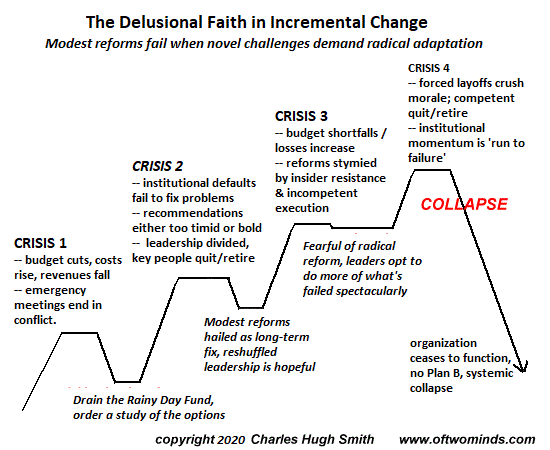
I’ve prepared a chart of the delusional faith in incremental change showing how each new crisis is met by incremental institutionalized defaults that are completely inadequate to the novel challenges that have arisen. The blindness to the need for radical adaption has been institutionalized as well: this is what worked in the past, so it will work nowWhy risk everything when we have procedures that have worked well?

Each stage of the crisis draws whatever conventional response causes the least pain. First, the “rainy day fund” is drained to keep everyone at the feeding trough. Studies of options are funded, and so on.

The recommendations are either too timid and clearly inadequate or they’re too bold and risky. So incremental policy and budget tweaks are adopted as acceptable institutional defaults.

But rifts open in the leadership as the farsighted few demand rapid, radical adaptations and the conventional risk-averse crowd digs in their heels. The farsighted few are pushed out or quit / retire, eliminating the only people who had the ability and experience to actually pull off a radical change of course.

A reshuffling of leadership evokes hope that the modest reforms will work magic. Alas, incremental tweaks only work in eras of stability. They fail miserably in unstable eras of rapidly-evolving challenges.

As everything runs to failure, the only acceptable path is to do more of what’s failed spectacularly, a default to low-risk incrementalism that only accelerates the final inevitable collapse.

The delusional faith in incremental change guarantees systemic failure. Better not to risk any radical evolution that might fail, and so failure is thus assured.

This is why our status quo is doomed:

Working to End Human Violence in the Time of Covid-19

By Robert J. Burrowes

At what is arguably the most important time in human history, with Homo Sapiens confronted by an enormous range of violent challenges that threaten our very survival, the only question of any genuine importance is this:

Can we craft and implement a strategy to end the violence, particularly in each and all of its extinction-threatening dimensions, to ensure that humanity has a chance to thrive on planet Earth indefinitely into the future?

But few are asking that question.

And, unfortunately, if one candidly considers the evidence in several critical domains тАУ notably the threat of nuclear war, the deployment of 5G technology, the collapse of biodiversity and the climate catastrophe тАУ there is little genuine room for optimism. This, of course, is not a reflection on the efforts of those committed to the attempt but it is a measure of the enormity of the task given the almost endless violence perpetrated by so many human inhabitants of Earth.

Moreover, of course, for most of 2020, the ongoing efforts by those committed to working to end violence in one context or another have not only been substantially impeded by the official response тАУ including lockdowns, curfews, social distancing and mask-wearing тАУ to the supposed Covid-19 pandemic, they have also witnessed an explosion of additional violence of many types and in many contexts тАУ see┬атАШThe EliteтАЩs COVID-19 Coup against a Terrified Humanity: Resisting PowerfullyтАЩ┬атАУ that have exacerbated the violence dramatically.

In addition, the combined impacts of the official response have (presumably inadvertently) accelerated the four primary paths to human extinction. See┬атАШThe EliteтАЩs COVID-19 Coup to Destroy Humanity that is also Fast-Tracking Four Paths to Human ExtinctionтАЩ.

Despite the unusual level of impediments, many people have remained steadfast in their efforts to raise awareness of what is at stake, to mobilize an effective response and/or to take action themselves to end the violence in one context or another. This includes individuals and organizations that have committed themselves to this effort by signing the online pledge of┬атАШThe PeopleтАЩs Charter to Create a Nonviolent WorldтАЩ┬аwhich has signatories in 105 countries around the world and organizational endorsements in 39 countries.

These committed individuals and organizations include those few briefly discussed below, with some of them particularly focused on averting one of the paths to imminent human extinction.

Jennifer Wood is an architect and writer who developed near fatal toxic shock from the antibiotic Ciprofloxin and over-exposure to 2G wireless radiation when cell tower services were switched from analog to digital technology in 1996-1997. At this time, cell phone sales skyrocketed globally as did radiation and many public health problems according to epidemiologists. Although Jennifer had never used cell phones, she had spent long hours on a computer (surrounded by unnoticed cell towers) writing for the film director, Oliver Stone who had taken an interest in her novel. She has nearly died at a weight of 77 pounds from microwave radiation poisoning three times since that time. Each torturous period has coincided with exposure to upgrades in wireless technologies. During her third bout with death in 2010-2011, she moved to a radio quiet zone near a radio astronomy observatory that bans cell phone towers. Here Jennifer built by hand, without help, a tiny non-electric cabin without running water in the woods where she lived alone, with minimal suffering, for four years, gaining weight and becoming semi-functional.

Since 2011, she has been reviewing thousands of science studies on the health effects of human-generated electromagnetic radiation (EMR) while doing advocacy work. Prior to her illness, Jennifer lived and worked as an architect in Nepal for many years in the 1980s where she married and had two children. Her condition has forced her to live far away from most of her family much of the time since 1996. You can watch Jennifer in this film┬атАШWi-Fi Refugees: Nowhere to run: Electrosensitive people try to escape wireless technologyтАЩ, read about her struggle and see a photo of her cabin in┬атАШSearch for a Golden CageтАЩ, read about a success in having Wifi technology banned in schools in Israel in┬атАШIsrael Wi-Fi Breakthroughs: TV Documentary, School BanтАЩ┬аand watch videos of a protest rally at the US Supreme Court she co-organized:┬атАШThe Public Has a Right To Know About the Health Risks of 5G Wireless, Cell Phones and the Internet of Things (IoT)тАЩ.

Prominent environmental journalist Robert Hunziker, noted for his capacity to track and report truthfully on the ecological health of planet Earth, recently wrote a sobering article highlighting key elements of the recent┬аLiving Planet Report 2020┬аwhich records тАШan average 68% decrease in population sizes of mammals, birds, amphibians, reptiles and fish between 1970 and 2016 [with a] 94% declineтАж for the tropical subregions of the Americas.тАЩ With its тАШeye-popping description of the forces of humanity versus life in natureтАЩ, Robert noted тАШthe report should really be entitled the┬аDying Planet Report 2020┬аbecause thatтАЩs whatтАЩs happening in the real world. Not much remains alive.тАЩ For some of the detail of this disastrous state of affairs, read┬атАШThe Dying Planet Report 2020тАЩ. For another of RobertтАЩs reports on planetary ill-health, see┬атАШBoundless Dying TreesтАЩ. But if you are not horrified already, you should read RobertтАЩs article┬атАШ10C Above BaselineтАЩ┬аto get a clearer sense of where EarthтАЩs climate is headed with extinction for humans at 4C above baseline.

Starting in February 2020, Joana Aboagyewaa of the Splendors of Dawn Poetry Foundation in Ghana reports making valuable contributions to schools in the eastern region through their work as poets and educators under the FoundationтАЩs тАШSUN ProjectтАЩ. This educational project was undertaken in Abirem, Achiase, St Roses Senior High (Akwatia) and Akim Swedru Secondary Schools where teachers taught poetry and art, тАШthat is deeply human to secondary school studentsтАЩ, for positive change. тАШIn April, The Splendors Performance Team held their National Poetry Month activities to celebrate the importance of poets and poetry in our society and culture.тАЩ SplendorsтАЩ тАШPoetry Exchange DayтАЩ, with poems wrapped as gifts and mailed to classmates and friends, was held in basic schools in the Greater Accra Region. In addition, SplendorsтАЩ тАШPoets in SchoolsтАЩ project тАШwas a huge success because we enrolled a high number of poets in secondary schools, through the poetry awareness campaign, to encourage students to write and read.тАЩ The Covid-19 pandemic тАШhas necessitated our coming up with the Splendors of Dawn online тАЬPoets Read outтАЭ series. Splendors of Dawn Poetry Foundation, Ghana believes that we can change the world and contribute our quota for its development through poetry.тАЩ

The indefatigable Steve Varatharajan, the Vice President but, more importantly, for many years the heart and driving force behind the┬аInternational Association of Educators for World Peace┬а(IAEWP), headquartered in Malaysia, has recently announced that, at yearтАЩs end, he will тАШbe stepping down from all my positions in IAEWP as I am having [serious health] problemsтАж [related to] the aggressive 5G telecommunications network building.тАЩ For those who donтАЩt know Steve, it is unlikely that many people have served any global network with the talent, commitment and productivity that Steve has demonstrated within the IAEWP.

Steve has also recently announced the appointment of Dr. Alfredo Sfeir Younis тАУ the Chilean economist, spiritual leader and healer who had a 29-year career at the World Bank including as its first environmental economist тАУ as Executive Vice President of the IAEWP.┬а In that capacity, Alfredo has already proposed a visionary program to advance IAEWP aims. Separately from this, Dr. Priyaranjan Trivedi, the IAEWP Senior Vice President for Continental Asia and IAEWP Director General of Education, advises that their continental association has just launched a free online buffet of 31 courses. For details, see┬атАШOnline Peace Education, Reconstruction, Accord, Non-Violence and Disarmament InitiativeтАЩ. These courses are available online for India and the rest of the world.

Liz McAlister and Martha Hennessy are two of seven Catholic nuclear disarmament activists known as the┬аKings Bay Plowshares 7. The plowshares activists entered Kings Bay Naval Submarine Base in St. MaryтАЩs, Georgia, USA on 4 April 2018, the 50th anniversary of the assassination of Rev. Dr. Martin Luther King Jr. Carrying hammers and baby bottles of their own blood, the seven attempted to convert weapons of mass destruction to make real the prophet IsaiahтАЩs command to тАШbeat swords into plowsharesтАЩ. Apart from impeding the ever-heightening threat of nuclear armageddon as the worldтАЩs international legal infrastructure against nuclear war rapidly unravels, they also hoped to call attention to the ways in which nuclear weapons kill every day by their mere existence and maintenance.

The nonviolent activists were subsequently тАШfound guilty of trespass, conspiracy and destruction of federal propertyтАЩ in October 2019. After spending time in prison, on 8 June 2020 Liz тАУ the widow of Phil Berrigan тАУ was sentenced to тАШtime served, three years supervised release and for a portion of the restitution for the seven of just over $30,000тАЩ. Martha тАУ a granddaugher of Dorothy Day тАУ is due to be sentenced in November. You can read a detailed account of their action, an inspiring biography of each activist and follow the court outcome for Martha and the others at the website above. You can also see an evocative interview of Martha at┬атАШMartha Hennessy InterviewтАЩ.

Professor Bishnu Pathak in Nepal continues his substantial research output on a variety of subjects, most notably in the past month on subjects related to the fundamental question of whether international law can be used as an instrument to achieve peace. For insightful commentary on two issues in this field, see┬атАШCan Former Child Soldiers File a Complaint at the International Court against NepalтАЩs Maoist Leaders?тАЩ┬аand┬атАШNuremberg Tribunal: A Precedent for VictorтАЩs JusticeтАЩ.

What Can You Do?

If you would like to join those individuals and organizations in 105 countries who have made the commitment to work to end human violence, you can do so by signing the online pledge of┬атАШThe PeopleтАЩs Charter to Create a Nonviolent WorldтАЩ.

If you understand the critical importance of reducing human consumption as the core element of any strategy to preserve a habitable biosphere тАУ encapsulated in GandhiтАЩs observation that тАШEarth provides enough to satisfy every personтАЩs need, but not every personтАЩs greedтАЩ тАУ then you might consider participating in┬атАШThe Flame Tree Project to Save Life on EarthтАЩ┬аwhich he inspired as well.

If you would like to nurture children to become Self-aware individuals who are capable of responding powerfully to the challenges in life while reducing violence in the process, consider making┬атАШMy Promise to ChildrenтАЩ. For a deeper understanding of the cause and pervasiveness of human violence, see┬атАШWhy Violence?тАЩ┬аand┬атАШFearless Psychology and Fearful Psychology: Principles and PracticeтАЩ.

And if you wish to use nonviolent strategy, as Gandhi developed and employed it, for your campaign or liberation struggle, you will be given clear guidance on how to do so on these websites that draw heavily on his work:┬аNonviolent Campaign Strategy┬аand┬аNonviolent Defense/Liberation Strategy.

More simply, if you like, you might consider committing to:

The Earth Pledge

Out of love for the Earth and all of its creatures, and my respect for their needs, from this day onwards I pledge that:

  1. I will listen deeply to children.┬аSee┬атАШNisteling: The Art of Deep ListeningтАЩ.
  2. I will not travel by plane
  3. I will not travel by car
  4. I will not eat meat and fish
  5. I will only eat organically/biodynamically grown food
  6. I will minimize the amount of fresh water I use, including by minimizing my ownership and use of electronic devices
  7. I will not own or use a mobile (cell) phone
  8. I will not buy rainforest timber
  9. I will not buy or use single-use plastic, such as bags, bottles, containers, cups and straws
  10. I will not use banks, superannuation (pension) funds or insurance companies that provide any service to corporations involved in fossil fuels, nuclear power and/or weapons
  11. I will not accept employment from, or invest in, any organization that supports or participates in the exploitation of fellow human beings or profits from killing and/or destruction of the biosphere
  12. I will not get news from the corporate media (mainstream newspapers, television, radio, Google, Facebook, TwitterтАж)
  13. I will make the effort to learn a skill, such as food gardening or sewing, that makes me more self-reliant
  14. I will gently encourage my family and friends to consider signing this pledge.

Conclusion

While most human inhabitants of Earth remain oblivious to the pervasive violence that is destroying us and our world, including the advanced nature of the four primary threats to human existence, there is nevertheless a worldwide network of people deeply aware of this situation who are acting to address these threats.

тАШDoomed to failтАЩ, you might believe. тАШImpossibleтАЩ even. And perhaps you are right. In fact, there is considerable evidence to support these beliefs.

But as Gandhi noted: тАШHesitating to act because the whole vision might not be achieved, or because others do not yet share it, is an attitude that only hinders progress.тАЩ

Given that some of us, including the people above, are already working to end human violence, the main question remaining is тАШWhat about you?тАЩ


Biodata: Robert J. Burrowes has a lifetime commitment to understanding and ending human violence. He has done extensive research since 1966 in an effort to understand why human beings are violent and has been a nonviolent activist since 1981. He is the author of┬атАШWhy Violence?тАЩ┬аHis email address is┬аflametree@riseup.net┬аand his website is┬аhere.

RETURN OF THE WARRIOR

By Elva Thompson

Source: Waking Times

тАЬIt may be that some little root of the sacred tree still lives.
Nourish it then
That it may leaf
And bloom
And fill with singing birds!

Hear me, that the people may once again
Find the good road
And the shielding tree.тАЭ  тАУ Black Elk

Dystopic reality

Are you wondering what the HELL is going on in this shit show reality? The sheer insanity of world events and the palpable madness of our spiritually unplugged leaders is spectacularly obvious even though the masses cannot see it. Floods and fires ravage the planet leaving disaster in their wake. Seventy percent of wildlife has been destroyed in the last decade. Hundreds of thousands of birds are dropping lifeless from the sky, dead fish line many coast lines and whales are beaching and dying.

So what is going on?

The end of a grand cycle

тАЬWe are men and our lot in life is to learn and to be hurled into inconceivable new worlds.тАЭтАХ Carlos Castaneda,

Planetary cycles within cycles are all ending in crescendo. December 21st 2012 was the marker for the end of the twenty six thousand year period known as the Grand Cosmic Year. And, the Old Year has to die before the New Year can begin. Everything is about to changeтАж. and we will be literally hurled into an inconceivable new world. The signs are already here for those who can see beyond the narrative pedaled by the matrix hive mind.

As we speak, there is a magnetic pole reversal in event mode. Two north poles battling it out and playing havoc with the jet stream. The magnetosphere is weakening and as cosmic rays increase we can expect many challenges in the days and years to come. Catastrophe is served up not only by the evil that runs this world but the cosmos in its cycles of creation and destruction. It is time to choose our path amid the chaos that is erupting all around us. We can either ride the mental fear train into oblivion or we can return to the wisdom of our ancestral way of life and find inner peace.

Becoming brave

тАЬWe donтАЩt need anyone to teach us sorcery, because there is really nothing to learn. What we need is a teacher to convince us that there is incalculable power at our fingertips. What a strange paradox!тАЭтАХ Carlos Castaneda

Strange paradox, indeed! For we do have incalculable power at our fingertips. The question is how do we find it?

There is much truth in the old adages: тАЬKnock and the door will open.тАЭ тАЬAsk and you will receive.тАЭ Visualise and knock on the spiritual door. The gate that leads to a re-connection with archetypal aspects of Self. Our eagle nature, wolf nature, bear nature, fox nature, hare nature, deer nature, etc. тАУ our natures both predator and prey. ShamanтАЩs of the older days understood that all things in the outer world were One in inner space and everything that exists is contactable.

All tribal once

Do not forget that we were all tribal once before evil overtook us. It is no accident that our shamans and healers were taken by the government to lunatic asylums many in a ball and chain and later murdered. No accident that sonic language тАУ the language of the spirits was banned along with sacred ceremonies and spirit calling. Indigenous children all over the world were brutalized by the bible toting invaders for speaking their native language.

What was the invading evil so afraid of?

Could it be our spiritual power and the realities attached to them?

The spirit realm

Shamans know that man is two beings. One is physical flesh and earth bound, and the other is his energetic or non physical counterpartтАжa realm of unlimited possibility. Man also has two minds: the physical rational thinking mind called intellect which constantly talks and argues with itself тАУ and the quiet mind that is connected to the spiritual reality of Source тАУ the mysterious force that vitalises all living things with the energy that we call тАШlifeтАЩ.

I live with Native People. My husband is a тАШmedicine manтАЩ in the Sundance way of life. I have had the honour of being taught many things and to become cognizant that all physical life is energetic in essence.

тАЬIn the life of the Indian there was only one inevitable duty, тАУ the duty of prayer тАУ the daily recognition of the Unseen and Eternal. His daily devotions were more necessary to him than daily food. He wakes at day break, puts on his moccasins and steps down to the waterтАЩs edge. Here he throws handfuls of clear, cold water into his face, or plunges in bodily. After the bath, he stands erect before the advancing dawn, facing the sun as it dances upon the horizon, and offers his unspoken orison. His mate may precede or follow him in his devotions, but never accompanies him. Each soul must meet the morning sun, the new sweet earth and the Great Silence alone!тАЭ┬а– Ohiyesa

Indigenous shamans knew that reality consisted of two parallel worlds that in the Yaqui tradition are known as the tonal(physical) and the nagual(the non physical). Because their spiritual power points were not atrophied as ours are today, the shamans of old knew that all life was infused with the spiritual power of Source, and that this invisible realm penetrated every aspect of our being. And, that under certain conditions this power could be contacted and even become visible.

Spirit helpers or allies

To focus power, a shaman needs allies in spiritual reality тАУ this helper can be an animal, bird, reptile, insect, a wanagi (ghost) or any inanimate object such as stones or power infused objects. The allies being non physical beings can in fact take any form they like.The mystical mind of the shaman can fuse with all of life and become it. He can shapeshift into a crow, a wolf  or start a fire with his fingers! See my article https://www.heartstarbooks.com/a-thunder-being-nation/

Making contact

If you are reading these words, the chances are you will have already experienced magic moments of connection. A space where time, the I and the world disappears and, for a brief moment we are in the joyous state of connection to Source. This can happen during a walk in the forest surrounded by the beautiful, patient energy of the trees. Earthing with bare feet on the ground. Drumming to the heartbeat of the planet. Working with plants in the garden is a wonderful opportunity to commune with the standing nations.

For me, sun gazing is the ultimate spiritual experience. A practice that allows me through visualisation to intentionally connect the little sun in my solar plexus to the outside sun in the skyтАж and the inner sun at the centre of the earth. One sun is positive, the other negative and we are the third estate. The children of the two suns and the apex of the triangle. The tetrahedron of the third dimension

Touching base

Research the old religion of your ancestors and even though you might not know how to proceed with ceremonies of your own, if you open your heart and are ready to commit to Source with no agenda, no strings attached, then synchronicity will guide you. Do not be afraid to sail uncharted seas for when we restore our natural energetic balance magic happens. You will soon become aware that everything in the natural world is listening. When we ask questions of spiritual reality the answer can suddenly appear within our mind. This response can be immediate or may take days and even weeks but reply they will.

The obstacle

Have no doubt, there is a spiritual war raging on this planet, and we need to get up to speed. The first obstacle we have to overcome on the road to freedom is our thinking mind, the little тАШIтАЩ that primps and postulates. Somehow we have to shut it up!

I recommend ritual, a reptilian trait that we can use to our advantage. Ritual is ceremonial repetition or mantra and can help us stop the infernal chattering of the egoтАЩs frightened mind. We need a ceremonial direction in our lives as a stepping stone to mastery of ourselves.

Contact

If human beings and nature are a holistic living whole, then we should be able to contact planetary intelligence and awareness directly, and furthermore, we should have the spiritual ability to make changes in physical reality by the use of focused spiritual attention. This is the Art of causing change to occur in conformity with will, and births the sacred magician in ourselves.

This reality we call life, is an all pervading matrix of electromagnetic charge and no matter where we are, whether it be in our front room, prison cell, hospital bed, or high rise block of flats in the middle of the city, our thoughts can with intent, affect the energetic reality of Earth, i.e. physical events can take place тАШoutside of ourselvesтАЩ without us actually being present. A directed loving spiritual action can have a physical response at any point on the planet. Long distance doctoring and absent healings work on the same principle.

If we are the planet, and everything that exists, think of the energy that would be available to us, if we can overcome the deliberately designed and re-enforced illusion of separation. If we focused our spiritual attention and intent without emotion, on a polluted site or waterway, a politician, or an individual that holds the purse strings of the worldтАжthink what might be possible.

This is a very exciting time to be alive. The Rainbow Warriors have returned and like a silent wave waits for the appointed time to rise above the third world and wield the spiritual power so long denied us.

Get together with like minded people, find each other and pray for this world. All you need is love in your heart and the desire to be of service to the planet. You will get your answers and you will intuitively know how to proceed.

Be sure to listen to Wolf Totem by the Mongolian band The Hu.

Until next time, stay strong in spiritual reality.

The End of Reality?

By Edward Curtin

Source: Behind the Curtain

In 1888,  the year before he went insane, Friedrich Nietzsche wrote the following in Twilight of the Idols:

We have got rid of the real world: what world is left?  The apparent world perhaps? тАж But no!  Along with the real world weтАЩve done away with the apparent world as well.

So, if you feel you also may be going insane in the present climate of digital screen life, where real is unreal but realer than real, the apparent is cryptic, and up is down, true is false, and what you see you donтАЩt, it has a history.  One hundred and thirty-two years ago, Nietzsche added that тАЬsomething extraordinarily nasty and evil is about to make its debut.тАЭ  We know it did, and the bloody butcherтАЩs bench known as the twentieth century was the result. Nihilism stepped onto center stage and has been the star of the show ever since, straight through to 2020.  Roberto Calasso puts it this way in Literature and the Gods:

Here we are, announces Nietzsche, and it would be hard not to hear a mocking ring in his voice.  We thought we were living in a world where the fog had lifted, a disenchanted, ascertainable, verifiable world.  And instead everything has gone back to being a тАШfableтАЩ again.  How are we to get our bearings тАж This is the paralysis, the peculiar uncertainty of modern times, a paralysis that all since have experienced.

Obviously, we havenтАЩt gotten our bearings.  We are far more adrift today on a stormy electronic sea where the analogical circle of life has been replaced by the digital, and тАЬtruthsтАЭ like numbers click into place continuously to lead us in wrong, algorithm-controlled directions. The trap is almost closed.

Of course, Nietzsche did not have the Internet, but he lived at the dawn of the electric era, when space-time transformations were occurring at a rapid pace.  Inventions such as photography, the phonograph, the telephone, electricity, etc. were contracting space and time and a disembodied тАЬrealityтАЭ was being born.  With todayтАЩs Internet and digital screen life, the baby is full-grown and completely disembodied.  It does nothing but look at its image that is looking back into a lifeless void, whose lost gaze canтАЩt figure out what itтАЩs seeing.

Take, for example, the phonograph, invented by Thomas Edison in 1878.  If you could record a personтАЩs voice, and if that person died, were you then listening to the voice of a living person or one who was dead?  If the person whose voice was recorded was alive and was miles away, you had also compressed earthly space. The phonograph suppressed absence, conjured ghosts, and seemed to overcome time and death as it captured the flow of time in sound.  It allowed a disembodied human voice to inhabit a machine, an early example of downloading.

тАЬTwo ruling ambitions in modern technology,тАЭ writes John Durham Peters in his wonderful book, Speaking into the Air, тАЬappear in the phonograph: the creation of artificial life and the conjuring of the dead.тАЭ

Many people started to hear voices, and these people were not called deluded. Soon, with the arrival of cinema, they would see ghosts as well.  Today, speaking ghosts are everywhere, hiding in hand-held devices. ItтАЩs Halloween all year round as we are surrounded by electronic zombies in a screen culture.

This technological annihilation of space and time that was happening at a frenetic pace was the material background to NietzscheтАЩs thought.  His philosophical and epistemological analyses emerged from German intellectual life of his time as well, where theologians and philosophers were discovering that knowledge was relative and had to be understood in situ, i.e., within its historical and social place or context.

Without going into abstruse philosophical issues here, suffice it to say, Nietzsche was suggesting that not only was God dead because people killed him, but that knowledge was a fiction that changed over time and was a human construction.  All knowledge, not just science, had to be taken тАЬas ifтАЭ it were true.  This was a consoling mental trick but falsely reassuring, for most people could not accept this, since тАЬknowledgeтАЭ was a protection racket from pain and insanity. It still is. In other words, not only had people murdered God, but they had slain absolutes as well. This left them in the lurch, not knowing if what they knew and believed were really true, or sort of true тАУ maybe, perhaps. The worm of uncertainty had entered modern thought through modern thought.

While the average person did not delve into these revolutionary ideas, they did, through the inventions that were entering their lives, and the news about Darwin, science, religion, etc., realize, however vaguely, that something very strange and dramatic was under way. Life was passing from substance to shadow because of human ingenuity.

It is similar to what so many feel today: that reality and truth are moving beyond their grasp as technological forces that they voluntarily embrace push everyday life towards some spectral denouement.  An inhuman, trans-human, on-line electronic life where everything is a parody of everything that preceded it, like an Andy Warhol copy of a copy of a CampbellтАЩs soup can with a canned mocking laugh track that keeps repeating itself.  All this follows from the nineteenth century relativization of knowledge, or what at least was taken as such, for to say all knowledge is relative is an absolute statement.  That contradiction goes to the heart of our present dilemma.

This old feeling of lostness is perhaps best summarized in a few lines from Mathew ArnoldтАЩs 19th century poem, тАЬDover BeachтАЭ:

The Sea of Faith
Was once, too, at the full, and round earthтАЩs shore
Lay like the folds of a bright girdle furled.
But now I only hear
Its melancholy, long, withdrawing roar,
Retreating, to the breath
Of the night-wind, down the vast edges drear
And naked shingles of the world.

But that was then.  Today, the JokerтАЩs sardonic laughter would suffice.

***

I am sitting outside as I write, sipping a glass of wine before dinner.  Although New England fall weather is approaching, a nasty mosquito is buzzing around my head.  I hear it.  I am in killer mode since these bastards love to bite me.  This is real life.  If I went into the house and connected to the Internet on the computer screen тАУ news, social media, anything тАУ I would be entering another dimension.  Screen life, not real life. The society of the spectacle. No real mosquitoes, no wine, no trees swaying in the evening breeze.

In his novel, The Sun Also Rises, written between NietzscheтАЩs time and now, Ernest Hemingway, a man who surely lived in the physical world, writes of how Robert Cohn, the boxing champion from Princeton University, wants Jake Barnes, the bookтАЩs protagonist, to take a trip with him to South America.  As they sit and talk in Paris, Barnes says no, and tells Cohn, тАЬAll countries look just like the moving pictures.тАЭ

Whether Hemingway was being ironic or not, or simply visionary, I donтАЩt know.  For in the 1920s, before passports and widespread tourism, there were many places you could only see if you traveled to them and they would never appear in moving pictures, while today there is almost no place that is not available to view beforehand on the internet or television.  So why go anywhere if youтАЩve already seen it all on a screen? Why travel to nowhere or to where you have already been?  D├йj├а vu all over again, as Yogi Berra put it and everyone laughed.  Now the laugh is on us.

***

This is neither an argument nor a story.  ItтАЩs real.  I am trying to get my bearings in a disorienting situation. Call it a compass, a weather-vane, a prayer.  You can call me Al or Ishmael.  Call me crazy.  Perhaps this writing is just an тАЬas if.тАЭ

***

About fifteen years ago, I was teaching at a college where most communication was done via email.  I was, as they say, out of the loop since I didnтАЩt do email. I was often asked why I didnтАЩt, and I would repeatedly reply, like MelvilleтАЩs Bartleby, because тАЬI prefer not to.тАЭ  Finally, in order to keep my job, I succumbed and with the laptop computer they provided me, I went тАЬon-line.тАЭ  There were 6,954.7 emails in my in-box from the past three years.  In those three years, I had performed all my duties scrupulously and hadnтАЩt missed a beat.  Someone showed me how to delete the emails, which I did without reading any, but I had entered the labyrinth. I went electronic.  My reality changed. I am still searching for AriadneтАЩs thread.

***

But I am not yet a machine and refuse the invitation to become one.  ItтАЩs a very insistent invitation, almost an order.  Neil Postman (Oh such a rich surname!) sums it up well in Technopoly: The Surrender of Culture to Technology:

The fundamental metaphorical message of the computer, in short, is that we are machines тАУ thinking machines, to be sure, but machines nonetheless.  It is for this reason that the computer is the quintessential, incomparable, near perfect machine for Technopoly.  It subordinates the claims of our nature, our biology, our emotions, our spirituality.  The computer claims sovereignty over the whole range of human experience, and supports its claim by showing that it тАШthinksтАЩ better than we canтАжJohn McCarthy, the inventor of the term тАШartificial intelligenceтАЩтАжclaims that тАШeven machines as simple as thermostats can be said to have beliefsтАжWhat is significant about this response is that it has redefined the meaning of the word тАШbeliefтАЩ тАж rejects the view that humans have internal states of mind that are the foundation of belief and argues instead that тАШbeliefтАЩ means only what someone or something does тАж rejects the idea that the mind is a biological phenomenon тАж In other words, what we have here is a case of metaphor gone mad.

Postman wrote that in 1992, before the computer and the internet became ubiquitous and longer before on-line living had become de rigueur тАУ before it was being shoved down our throats as it is today under the cover of COVID-19.

There is little doubt that we are being pushed to embrace what Klaus Schwab, the Executive Chairman of the World Economic Forum (WEF), calls COVID-19:The Great Reset, that involves a total acceptance of the electronic, on-line life.  On-line learning, on-line news, on-line everything тАУ only an idiot (from Greek, idiotes, a private person who pays not attention to public affairs) would fail to see what is being promoted.  And who controls the electronic life and internet?  Not you, not I, but the powers that be, the intelligence agencies and the power elites. Goodbye  body, goodbye blood тАУ тАЬI donтАЩt think we should ever shake hands ever again, to be honest with you,тАЭ said Dr. Anthony Fauci, the director of the National Institute of Allergy and Infectious Diseases (NIAID) in support of human estrangement.

Peter Koenig, one of the most astute investigators of this propaganda effort, puts it this way:

The panacea of the future will be crowned by the Pearl of the Fourth Industrialization тАУ Artificial intelligence (AI). It will be made possible by a 5G electromagnetic field, allowing the Internet of Things (IoT). Schwab and Malleret [SchwabтАЩs co-author] wonтАЩt say, beware, there is opposition. 5G could still be blocked. The 5G existence and further development is necessary for surveillance and control of humanity, by digitizing everything, including human identity and money.

It will be so simple, no more cash, just electronic, digital money тАУ that is way beyond the control of the owner, the truthful earner of the money, as it can be accessed by the Global Government and withheld and / or used for pressuring misbehaving citizens into obeying the norms imposed from above. You donтАЩt behave according to our norms, no money to buy food, shelter and health services, we let you starve. No more travel. No more attending public events. YouтАЩll be put gradually in your own solitary confinement. The dictatorial and tyrannical global commandeering by digital control of everything is the essence of the 4th Age of Industrialization тАУ highly promoted by the WEFтАЩs Great Reset.

***

Like everything, of course, this push to place life under the aegis of cyberspace has a history, one that deifies the machine and attempts to convince people that they too are machines without existential freedom.  Thus the ongoing meme pumped out for the past three decades has been that we are controlled by our brains and that the brain is a computer and vice versa. Brain research has received massive government funding. Drugs have been offered as the solution to every human problem. So-called diseases and disorders have been created through the Diagnostic and Statistical Manual of  Mental Disorders (DSM) and matched to pharmaceutical drugs (or the revers) for scandalous profits. And the mind has been reduced to a figment of deluded  imaginations. People are machines; thatтАЩs the story, marvelous machines.  They have no freedom.

If one wishes an example of techno-fascism, there is one from the art world. Back in the 1920s and 1930s there was an art movement known as Futurism.  Its leader proponent was an Italian Fascist, friend of Mussolini, Filippo Tommaso Marinetti.  The futurists claimed that all life revolves around the machine, that the machine was god, that it was beyond human control and had to be obeyed.  They extolled war and speed and claimed that humans were no more significant than stones.  Patriotism, militarism, strength, method, and the kingdom of experts were their blueprint for a corporate fascist state.  The human eye and mind would be re-educated to automatically obey the machineтАЩs dictates.

Now we have cyberspace, digital machines, and the internet, an exponential extension of the machine world of the 1930s and the rise of Mussolini, Fascism, and Hitler.  That this online world is being pushed as the new and future normal by trans-national elite forces should not be surprising.  If human communication becomes primarily digitally controlled on-line and on screens, those who control the machines will have achieved the most powerful means of mind control ever invented. That will be MKULTRA on a vast scale.  Surveillance will be complete.

Yes, there are places on the internet where truth is and will be told, such as this site where you are reading this; but as we can see from todayтАЩs growing censorship across the web, those power elites and intelligence forces who  control the companies that do their bidding will narrow the options for dissenting voices. Such censorship starts slowly, and then when one looks again, it is a fait accompli. The frog in the pan of slowly heating cold water never realizes it is being killed until it is too late. Free speech is now being strangled. Censorship is widespread.

The purpose of so much internet propaganda is to confuse, obsess, depress, and then repress the population. The overlords accomplish this by the тАЬpeculiar linking together of opposites тАУ knowledge with ignorance, cynicism with fanaticism тАУ [which] is one of the chief distinguishing marks of Oceanic society,тАЭ writes Orwell in Nineteen Eighty-Four.  тАЬThe official ideology abounds with contradictions even where there is no practical reason for them.тАЭ  One look into oneтАЩs life will suffice to see how the overlords have set people against each other.  ItтАЩs a classic tactic.  Divide and conquer. Trump vs. Biden, Democrats vs. Republicans, whites vs. blacks, liberals vs. conservatives. Pure mind games. Contradictions every day to create social disorientation.  Orwell describes Doublethink as follows:

Doublethink means the power of holding two contradictory beliefs in oneтАЩs mind simultaneously, and accepting both of them.  The Party intellectual knows in which direction his memories must be altered; he therefore knows he is playing tricks with reality; but by the exercise of doublethink he also satisfies himself that reality is not violated.  The process has to be conscious, or it would not be carried out with sufficient precision, but it also has to be unconscious, or it would bring with it a feeling of falsity and hence of guiltтАжTo tell deliberate lies while genuinely believing them, to forget any fact that has become inconvenient, and then, when it becomes necessary again, to draw it back from oblivion for just as long as it is needed, to deny the existence of objective reality and all the while to take account of the reality which one denies тАУ all this is indispensably necessaryтАжIf one is to rule, and to continue ruling, one must be able to dislocate the sense of reality. [authorтАЩs emphasis]

Nietzsche said that along with the real world we have done away with the apparent as well.  Digital online life has accomplished that.  It has allowed the rulers тАУ through the media who are the magicians who serve them тАУ to create counterfeit news and doctored videos at will, to present diametrically opposed points of view within the same paragraph, and to push breaking news items so fast that no one half-way sane could keep up with their magic shows. Nietzsche obviously didnтАЩt foresee this technology, but he sensed the madness that the relativity of knowledge and the technology of his day would usher in.

***

The popular 1990s term тАЬInformation Superhighway,тАЭ meaning the internet and all digital telecommunications, was the perfect term to describe this lunacy. Get on that highway and go as fast as you can while trying to catch the meaning of all the information flashing past you as you speed to nowhere.  For not only does censorship, propaganda, disinformation, mixed messages, and contradictions line the road you are traveling, but contextless information overload is so heavy that even if you were stopped in a traffic jam, there is too much information to comprehend.  And if you think this Superhighway is a freeway, think again, for the cost is high. No one puts out their hand and asks you to pay up; but the more you travel down this road youтАЩll notice you are missing a bit of flesh here and some blood there.  And without a speed pass, you are considered road kill.

To make matters much worse, they say we need 5G to go much faster.

Paul Virilio, who has devoted himself to the study of speed (dromology), puts it this way in Open Sky:

The speed of the new optoelectronic and electroacoustic milieu becomes the final void (the void of the quick), a vacuum that no longer depends on the interval between places or things and so on the worldтАЩs very extension, but on the interface of an instantaneous transmission of remote appearances, on a geographic and geometric retention in which all volume, all relief vanishes.

***

And yet I donтАЩt have a simple answer to the internet dilemma. You are reading it on-line and I am posting it there.  It is very convenient and quick. And yetтАжand yetтАж.

Can we just walk away from it?  Maybe.  Perhaps like those few who, in Ursula K. Le GuinтАЩs excruciating story, тАЬThe Ones Who Walk Away From Omelas,тАЭ we may decide the price for our conveniences and so-called happiness is too high and that there are hidden victims that this techno-scientific тАЬprogressтАЭ creates beneath its veneer of efficiency.  Others, us, our children, all children, who are reaching out not for speed and machines, but for the human touch that the on-line propagandists hope to destroy.  In Le GuinтАЩs story, the price nearly all the citizens of Omelas are willing to pay for their happiness and comfort is the imprisonment of a single child.  Perhaps we should consider what we are doing to all the worldтАЩs children and their futures.

My friend Gary recently sent me this letter.  I believe it sums up what many people feel. There is a vast hunger for reality and truth. The analog life. How to live it тАУ the question hangs in the air as the artificial intelligence/digital controllers try to reduce us to machines.

Although apparently it isnтАЩt clear if Twain ever said this, itтАЩs still a great quote:  (тАЬIf you donтАЩt read the newspaper, youтАЩre uninformed.  If you do, youтАЩre misinformed.тАЭ)  To which тАЬamenтАЭ is the only appropriate response.

I continue to daily stay abreast of events through the web, and these days much of what passed for тАЬprogressive mediaтАЭ simply regurgitates the covid madness as if it had been delivered on stone tablets тАУ rather than by the same MSM that lie to us daily about literally ANYTHING of any importance.

There are days I wonder тАЬwhyтАЭ I continue to bother to follow the unfolding madness as if it made some тАЬdifference.тАЭ  I could certainly play guitar more, and I might even get it together to write a few pieces on the nature of our collective madness, for which I have studiously assembled copious notes.  I really donтАЩt need any more information or examples тАУ I think I have things covered on that front.

Instead I find myself daily doing the little dance weтАЩre all familiar with тАУ uncomfortable with being тАЬuninformedтАЭ тАУ yet at almost every turn finding myself being routinely тАУ тАЬmisinformedтАЭ тАУ and so having to sift through the endless debris to have any chance at developing any coherent understanding of the world.

So yes, I totally get the draw of just saying to hell with the internet.  After years of shifting through the endless propaganda operations our generation has been subject too, I have no doubt you and I see through most the nonsense for what it is before we even have the proof in hand.  Once the rose-colored glasses of тАШAmerican exceptionalismтАЩ are off, one can almost sense and see through the lies in real time even as they are being uttered.

Reading GaryтАЩs words reminded me of those of the Trappist monk Thomas MertonтАЩs definition of the Unspeakable:

It is the void that contradicts everything that is spoken even before the words are said, the void that gets into the language of public and official declarations at the very moment when they are pronounced, and makes them ring dead with the hollowness of the abyss.  It is the void out of which Eichmann drew the punctilious exactitude of his obedienceтАж

Yes, real time, real life тАУ as we do our little dances.

Can we do our little dances and preserve reality?  IтАЩm not sure.

Ireland: Thoughts on Wildness and Domestication

By Renzo Connors

Source: Anarchists Worldwide

тАЬIf I decide to break the chains of domestication, I can only do so because I feel the chains and suffer the effects of domestication on my own skin.тАЭ┬атАУ Alfredo Bonanno

I

While out walking or cycling at night, foxes can always be seen roaming the housing estate. The glow of their eyes in darkness, appearing from dark alleyways suddenly visible under the street lights, they move around without a sound, hardly noticed. These lovely magnificent creatures are the embodiment of wildness. Leviathan towers all around but yet these wild beings live on freely from domestication. The foxes at times live off the scraps and waste that civilization throws away, but long after civilization crumbles these creatures will live on.

These wild beings will live on long after civilization kills itself because they are not dependent on civilization to provide the means of life. They remain wild and undomesticated, still equipped with the knowledge and skills to find food, build shelter, and survive independently for themselves.

The vast majority of humans on the other hand are totally domesticated and dependent on civilization and the vast majority would not be able to survive without shops and machines. Only a tiny percentage of humans that inhabit the earth still live wild, free, and living autonomously. The rest are imprisoned within the concrete and metal structures of techno-industrial society.

Domestication begins from birth, straight away an individual is given a birth certificate and social security number. These will be needed throughout life, to be recognised by whatever state an individual happens to be born into, to go to school, to work, to open a bank account and from there to get loans to buy shit, to get a passport, to register to vote, so the state knows who you are, what taxes you have paid or owe, your credit history: to be controlled and exploited. From birth, through childhood, into adulthood,an individual is moulded and taught how to behave, what is acceptable and what is not; through force and blackmail of collective and religious moralities created by the systems and institutions that make up civilization. The end result: a domesticated and a functional obedient citizen and wage slave.

Everything within the civilized culture is geared towards this. Education, childrenтАЩs stories, TV shows, movies, books, games, and even songs are all exposure to the social norms and control of civilization. The soul purpose of the individual in civilization is to produce and reproduce the social structures, authoritarian institutions and daily subservience to civilized society. There is little room for escape from behind the computer screens and consumerism.

II

Tenalach
Irish тАУ Used to describe a relationship one has with the land, air and water, a deep connection that one literally hears the Earth sing.

IтАЩve always felt an affinity and closeness with wild spaces. From childhood, playing in the fields and woodlands, fishing in the lake and swimming in the rivers that were close to the housing estate I grew up in. As a kid taking day trips to the Wicklow mountains seeing all the views, beauty of the trees and plants, rugged valleys, and at times what seems like inhospitable landscape of bog land and cliff drops.

Being in such spaces conjures up and stores feelings within me I wouldnt be able to adequately describe with words. Perhaps they could be described as something spiritual.

The landscape has been left scarred by civilization. Roads built long ago by the British colonists to flush out any hiding rebels, shells and ruins of buildings left over from the dawn of industrialism scattered across the landscape, electrical dams blocking up rivers, TV and radio transmitter masts, bog land robbed and left mutilated to feed industrial тАЬprogressтАЭ, forests cut down and replaced by animal agriculture and monocrop Sitka tree plantations poisoning the land, and the mass graves from pogroms and genocide of the religious and imperalist conquerers. There isnтАЩt a place left on this island that civilization hasnтАЩt left its mark.

******

In my early 20тАЩs locked up in prison for taking part in the anti-imperialist struggle, I felt these feelings for the wild more intensely.

Not seeing any plants or trees, except the ones I could see from my cell window on the horizon. The urge to walk in grass and sand in my bare feet, wanting to roam in woodland to look up at the sky through the canopy.

For the years spent incarcerated I daydreamed about being in nature, being in the mountains, being by the sea.

After four years with eight months left I was granted temporary release for Christmas.

For the first time outside the concrete walls, iron bars and razor wire of prison there was only one thing I really wanted to do and that was to go to the ocean.

The beach was a short walk from where I was staying. To get there IтАЩd first have to walk through a park. As I walked, even though it was winter there was still a lot of colour. A lot of the big tall trees in the park are evergreen trees so they still had their colour. Going through the park my head and eyes were darting around taking in the landscape, walking under the tall trees, their canopy blocking out the sky. It was an amazing feeling being hit in the face with so many different colours, different shades of green.

Sensory stimulation from the sounds of flowing water making its way down streams, birds chirping and singing, the wind blowing long grass and branches, colors of the landscape and the various shades of browns and greens of foliage was almost overwhelming to the senses.

When I reached the beach I walked for a little bit and then sat on a sand dune for about two hours looking out into the vast ocean of green, reflecting in my thoughts and finding some solace in my mind.

Are these feelings that rush around my mind and body urging me wildness, the inner primal anarchic instinct buried by years of domestication?

Or are they an individual desire and love within me for the wild?

Beware the Transhumanists: How ‘Being Human’ is being Re-engineered by the Elite’s Covid-19 Coup

By Robert J. Burrowes

тАЬIf you tell a lie, tell a big one.тАЭ
тАЬIf you tell a lie long enough, it becomes the truth.тАЭ
тАЬPropaganda works best when those who are being manipulated are confident they are acting on their own free will.тАЭ
тАФ Joseph Goebbels, Nazi Minister of Propaganda, 1933 to 1945

Transhumanism is a set of beliefs based on the premise that human beings can be improved by genetic manipulation and/or implanting technologies into the brain and body to achieve enhanced capacities. Transhumanism has a long history as an idea but since 1990 it has attracted serious attention from an increasing number of technology-lovers and early advocates are readily identified. See тАШWhat is Transhumanism?тАЩ

As part of his research as an investigative reporter throughout his life, which included writing a comprehensive expos├й of how the AIDS hoax was perpetrated in the 1980s, in 2001 Jon Rappoport interviewed a Cold War-era propagandist-turned-anonymous-whistleblower who had spent decades working for the medical and other cartels to promote their agendas to gain increasing control over the human population. Here, in part, is what the propagandist told Rappoport:

Look at the medical cartel. Do they ever declare victory? From now until the end of time theyтАЩll be planting stories in the press about the latest medical advance that will make life better for every person in the world. Most of it is a lie, but that doesnтАЩt stop them. Until the planet is depopulated down to under a billion people and every one left is a robot, these cartels [elsewhere identified as energy, тАйgovernment, intelligence, media,тАй medical, military,тАй money] are not going to quit. And even then, with a lobotomized world, theyтАЩll still push their propaganda. This IS 1984, and people better realize itтАж The medical cartel. TheyтАЩre planning to take over the mindтАж after which PR wonтАЩt really matter.тАж [pp.61-62 & 87.]

TheтАй cartels тАйwereтАй using тАйand тАйcreatingтАй andтАй bolstering тАйthe тАйCold тАйWar тАйas тАйaтАй means тАйtoтАй anтАй end.тАйтАй MakingтАй whatтАй youтАй couldтАй call тАйthe тАйenemyтАРgame тАйaтАй part тАйof тАйthe тАйhuman тАйpsycheтАй atтАй suchтАй aтАй level тАйthat тАйit тАйwould тАйmaintain itself тАйas тАйa тАйliving тАйmythтАй thatтАй couldтАй be тАйtapped тАйintoтАй atтАй anyтАй timeтАй with тАйany тАйenemies тАйinserted тАйinto тАйthe тАйlineтАРup.тАйтАй The тАйenemiesтАРgame тАйis тАйas тАйold тАйasтАй timeтАй itself. тАйтАйBut тАйthis тАйwas тАйthe тАйversion тАйof тАйthe тАйmoment.тАйтАй To тАйinstallтАй a тАйrigid тАйsense тАйofтАй national тАйsecurity тАйas тАйthe тАйoverriding тАйfact or тАйthat тАйwould тАйdamn тАйwell justifyтАй the тАйdeflatingтАй of тАйindividual тАйfreedom тАйon тАйmany тАйfronts. тАйтАйMakeтАй nationalтАй securityтАй theтАй thing тАйyouтАй couldnтАЩtтАй refuseтАж.тАй [p.70.]

A: тАйтАйтАйOnceтАй you тАйfatigueтАй peopleтАй enough тАйwith тАйtheтАй strategies тАйof тАй1984, тАйthey тАйare тАйset тАйup тАйforтАй theтАй medicalization тАйof тАйsociety. тАйтАйWhich тАйis тАйthe тАйbrain тАйstuff. тАйтАйThe тАйaltering тАйof тАйthe тАйhumanтАй brainтАй withтАй drugs тАйandтАй other тАйapproaches. тАйтАйGenes, тАйperhaps. тАйтАйA тАйbrainтАРmachineтАй linkup.тАйтАй Creating тАйa тАйdifferentтАй perception тАйof тАйreality. тАйтАйExternally тАйappliedтАй electromagnetic тАйfields.тАйтАй In тАйwhichтАй peopleтАй will тАйfeel тАйhappy тАйevenтАй though тАйthey тАйare тАйslaves.тАйтАй YouтАй see, тАйin тАй1984 тАйitтАЩs really тАйall тАйabout тАйhysteria. тАйтАйThe тАйpeople тАйare тАйbeingтАй drivenтАй into тАйthe тАйwall тАйwithтАй lies тАйaboutтАй wars тАйand тАйliesтАй about тАйenemies тАйand тАйlies тАйabout тАйpolitical тАйstructure, тАйandтАй the тАйcontrol тАйoverтАй individuals тАйis тАйvery тАйharsh, тАйand тАйthe тАйleadersтАй areтАй notтАй looking тАйto тАйcreate тАйreal тАйhappiness,тАй not тАйthe тАйfluffy тАйstuff.тАйтАй Redemption,тАй yes. тАйтАйForgiveness, тАйperhaps. тАйтАйThe тАйpeople тАйareтАй beingтАй fed тАйpain тАйand тАйbig тАйbrother тАйis тАйcommandingтАй them тАйlike тАйa тАйdrill тАйsergeantтАй through тАйtheir тАйTVтАй sets. ButтАй after тАйthat,тАй after тАйpeople тАйsink тАйintoтАй anтАй acceptance тАйofтАй the тАйdelusions тАйthatтАй areтАй being тАйfoisted тАйon тАйthem, тАйthen тАйcomes тАйthe тАйscience. тАйтАйTheтАй makingтАй of тАйsomeтАй kind тАйof тАйreplicaтАй┬а ofтАй happiness.тАйтАй The тАйoldтАй order тАйisтАй 1984. тАйтАйYouтАй can тАйcall тАйthat тАйtheтАй Plan тАйfromтАй the тАйdawnтАй ofтАй timeтАй to тАйabout тАй1945. тАйтАйAfter тАйthat тАйis тАйthe тАйtransitionтАй to тАйBrave тАйNewтАй World.

Q: тАйтАйтАйAndтАй thatтАЩs тАйwhy тАйthe тАйmedical тАйcartel тАйis тАйthe тАйprince тАйof тАйthe тАйcartels.

A: тАйтАйтАйTheтАй prince, тАйthe тАйking.

Q:тАйтАйтАй 1984тАж

A: тАйтАйтАйLeaves тАйpeople тАйwith тАйno тАйmoralтАй conviction. тАйтАйIt тАйrunsтАй overтАй thatтАй like тАйa тАйfreightтАРtrain.тАйтАй 1984тАй is тАйdark. тАйтАйBrave тАйNew тАйWorld тАйisтАй sunny тАйandтАй light тАйand тАйthe тАйcontrol тАйisтАй appliedтАй soтАй thatтАй the тАйinteriorтАй life тАйchanges.

Q: тАйтАйтАйSoтАй you тАйworked тАйon тАйmedical тАйstories.

A:тАйтАйтАй Yes. тАйтАйMaking тАйthe тАйmedical тАйcartelтАй lookтАй good, тАйlookтАй humane,тАй look тАйrational, тАйlookтАй likeтАй excellent тАйscience тАйthat тАйworks. тАйтАйEspecially тАйpsychiatryтАй andтАй neurology.тАйтАй AndтАй┬а pharmacology.тАйтАй That тАйbecame тАйa тАйmajor тАйjob тАйfor тАйme. BecauseтАжtheyтАЩre тАйexperimentingтАй onтАй the тАйhuman тАйrace, тАйand тАйthey тАйwantтАй their тАйhorrible тАйmistakes тАйwhichтАй areтАй legion,тАй toтАй lookтАй likeтАй advancesтАй and тАйgoodтАй scienceтАй at тАйevery тАйstepтАй until тАйtheyтАй get тАйit тАйright,тАй until тАйtheyтАй have тАйyourтАй brain тАйin тАйtheir тАйhands тАйfromтАй cradle тАйto тАйgrave. [p.71.]

As noted earlier, the words above were penned in 2001. If you would like to read the full transcript of the interview, which offers a reasonably accurate explanation of what is happening around the world at the moment, you can do so in тАШThe Matrix Revealed Volume 1, Jon Rappoport Interviews Ellis Medavoy (Part 1 of 3)тАЩ.

And if you would like to read about the AIDS hoax (тАШcausedтАЩ by the non-existent HIV) and how it was done, using much of the same formula being used to perpetrate the eliteтАЩs Covid-19 hoax (тАШcausedтАЩ by the non-existent SARS-CoV-2), you can do so in AIDS Inc.: Scandal of the Century.

Unfortunately, the Covid-19 hoax is being played for stakes that are infinitely higher than they were during the AIDS hoax.

After 200,000 years of Homo Sapiens, the species is about to тАШevolveтАЩ rapidly and profoundly. But it wonтАЩt be a natural evolution. And it wonтАЩt be an improvement unless you donтАЩt like the many qualities that make humans human, biologically and socially.

If the transhumanists have their way, individual human identity will vanish along with human volition. Homo Sapiens will be superseded by тАШHomo CyborgтАЩ.

If this all sounds like science fiction or just plain ridiculous, let me invite you to consider the evidence below.

As тАШwarnedтАЩ by scientist Andrew Herr in an article тАУ see тАШThis Scientist Wants TomorrowтАЩs Troops to Be Mutant-PoweredтАЩ тАУ published in 2012:

Greater strength and endurance. Enhanced thinking. Better teamwork. New classes of genetic weaponry, able to subvert DNA. Not long from now, the technology could exist to routinely enhance тАУ and undermine тАУ peopleтАЩs minds and bodies using a wide range of chemical, neurological, genetic and behavioral techniques.

ItтАЩs warfare waged at the evolutionary level. And itтАЩs coming sooner than many people think.

Well, that time has arrived. The thin edge of the wedge, if we keep allowing it to happen, is the various restrictions and technologies being introduced under cover of Covid-19 which are supposedly being used to tackle the тАШvirusтАЩ.

However, just as in the тАШAIDS epidemicтАЩ when no (HIV) virus was ever scientifically demonstrated to exist, there is zero science to prove the existence of the тАШvirusтАЩ labeled SARS-CoV-2. Instead, this elite coup is designed and being conducted to achieve a profound transformation in the nature of the human individual and human society, including a substantial тАШdepopulationтАЩ. Moreover, it is proceeding rapidly because it entails a complexity and depth that is not easy to comprehend but also because it seems so preposterous that few people are inclined to contemplate the possibility objectively. Joseph Goebbels knew why. For some of the detail of essential elements of this coup, see тАШCovid-19 Does Not Exist: The Global EliteтАЩs Campaign of Terror Against HumanityтАЩ and тАШHalting our Descent into Tyranny: Defeating the Global EliteтАЩs Covid-19 CoupтАЩ.

But for another recent comprehensive history and critique of the coup being conducted by the тАШbillionaireтАЩs clubтАЩ, see Dr. Jacob Nordang├еrdтАЩs insightful article тАШAnalysis: GlobalistsтАЩ reboot of the world and their plans for usтАЩ which opens with the following words:

The Corona crisis is the trigger for a global coup dтАЩ├йtat of monumental dimensions. It is the beginning of a new era, with a new international economic order that risks completely destroying human freedoms. Tyrants have now taken over to forcibly steer us into a тАШclimate smartтАЩ and тАШhealthyтАЩ world through the World Economic ForumтАЩs new techno-totalitarian roadmap тАУ тАШThe Great ResetтАЩ.

In this article, however, I want to focus on the agenda of the transhumanists under cover of this coup and what this would mean for Homo Sapiens unless it is stopped.

Technotyranny

In one of his videos about the Covid-19 coup тАУ watch тАШThis CouldnтАЩt Possibly Happen. Could it?тАЩ the transcript for which can be accessed by clicking the тАШHealthтАЩ tab after entering his website тАУ the UKтАЩs Dr Vernon Coleman explains the sinister agenda of the technological control sought by the transhumanists:

If you were a mad doctor and you wanted to control an individual it would be a doddle.
YouтАЩd just tell them you were giving them an injection to protect them against the flu or something like that and in the syringe there would be a little receiver. And then youтАЩd stick a transmitter on the roof of the house across the road from where they lived.

And then you could send messages to make them do whatever you wanted them to do. You could make them sad or angry or happy or contented. You could make them run or fight or just spend all day in bed.

Remember, thatтАЩs what Dr Delgado was doing over half a century ago. ItтАЩs nothing new.

Of course, if you wanted to do the same thing for lots of people youтАЩd need a whole lot of people to help youтАж.

And youтАЩd need something to inject into people. A medicine of some kind for example.

And then youтАЩd need someone good at software to help with all the transmitting and the receiving and youтАЩd need people with access to lots of tall poles or roofs where they could put the transmitter things.

But none of that would be any good unless you had a reason for injecting people. You canтАЩt just go around injecting millions of people for no reason.

Ideally, youтАЩd need them all to be frightened of something so that they were keen to let you inject them. And then you could put your tiny receivers into the stuff that was being injected. Or squirted up their noses or whatever.

Introducing her own careful explanation of the agenda of the transhumanists, in her video Dr. Carrie Madej opens with the following words:

So what do you think about going from human 1.0 to human 2.0?тАж TranshumanismтАж is about taking humans, as we know ourselves, and melding with artificial intelligenceтАж. That might seem kinda cool to you, we might have some superhuman abilitiesтАж thatтАЩs the idea, thatтАЩs what you see in sci-fi moviesтАж Thinking about this topicтАж I [had thought that it was] many years in the future.

However, this question, this idea is now right in this moment. We need to make a decisionтАж because I investigated the proposed Covid-19 vaccine and this is my alarm call to the world. I looked at the pros and cons and it frightens me.

And I want you to know about this, you need to be very well informed because this new vaccine is not like your normal flu vaccine. This is something very different, this is something brand new, something completely experimental on the human race. And itтАЩs not just about being a different vaccine. There are technologies that are being introduced with this vaccine that can change the way we live, who we are and what we are. And very quicklyтАж.

Some peopleтАж like Elon Musk, who is the founder of SpaceX and Tesla Automotive, as well as Ray Kurzweil, who is one of the bigwigs of Google, тАж are self-proclaimed тАШtranshumanistsтАЩ. They believe that we should go to human 2.0 and they are very big proponents of this. ThereтАЩs a lot of other peopleтАж involved with thisтАж. I think the easiest way to explain this to you is to go with one of the frontrunners for the vaccine and go into a little bit of the history and tell you how they want to make the vaccine and I think that will speak volumes. So, for instance, Moderna is one of the frontrunners for the Covid-19 vaccineтАж. Watch тАШHuman 2.0 тАУ Transhumanist Vaccine тАУ A Wake Up Call to the WorldтАЩ.

If you doubt the capacity of тАШmedicineтАЩ to achieve this level of human transformation, in this video produced in August 2020, transhumanist Elon Musk explains how his Neuralink microchip will be surgically implanted into the human brain, as has already been done with animals. While he specifically mentions the chipтАЩs capacity to monitor certain health parameters and to play you music, he does not mention its intended uses for digitization of your identity, recording of your personal data such as medical and bank records, any of its surveillance functions or its capacity for emotional, thought and behavioural control. Watch тАШThis Is How Elon MuskтАЩs Neuralink Microchip Will Be Put In Your BrainтАЩ.

As Raul Diego explains in his own article on this subject:

The most significant scientific discovery since gravity has been hiding in plain sight for nearly a decade and its destructive potential to humanity is so enormous that the biggest war machine on the planet immediately deployed its vast resources to possess and control it, financing its research and development through agencies like the National Institutes of Health (NIH), the Defense Advanced Research Projects Agency (DARPA) and HHSтАЩ Biomedical Advanced Research and Development Authority (BARDA).

The revolutionary breakthroughтАж [involved devising] a way to тАШreprogramтАЩ the molecules that carry the genetic instructions for cell development in the human body, not to mention all biological lifeforms.

These molecules are called тАШmessenger ribonucleic acidтАЩ or mRNA and the newfound ability to rewrite those instructions to produce any kind of cell within a biological organism has radically changed the course of Western medicine and science, even if no one has really noticed yet. As [inventor, Professor Derek] Rossi, himself, puts it: тАШThe real important discovery here was you could now use mRNA, and if you got it into the cells, then you could get the mRNA to express any protein in the cells, and this was the big thing.тАЩ See тАШA Transhumanist Dream: A DARPA-Funded Implantable Biochip to Detect COVID-19 Could Hit Markets by 2021тАЩ.

Moreover, as Patrick Wood, who has intensively studied and reported the efforts of the transhumanists for decades, explains in a recent article тАУ тАШThe Siamese Twins of Technocracy and TranshumanismтАЩ тАУ and discusses in a related video тАУ тАШHumans 2.0: GMO Vaccinations and TranshumanismтАЩ тАУ that draws out some of the more nuanced elements of their agenda:

Technocracy and Transhumanism have always been joined at the hip. Technocracy uses its тАШscience of social engineeringтАЩ to merge technology and society. Transhumanism uses its field of NBIC to merge technology directly into humans. To put it another way, Technocracy is to society what Transhumanism is to the humans that live in itтАж.

NBIC stands for Nano (nano-technology), Bio (bio-technology), Info (information technology) and Cogno (cognitive sciences). These four scientific disciplines remained separate avenues of study in Universities around the world until the early 1970s. Today, NBIC has become an established discipline of its own in most major universities with personnel contributed from each separate departmentтАж.

All together, NBIC offers a scientific cauldron to Transhumans in their quest to create Humans 2.0тАж.

ItтАЩs also no wonder that the upcoming vaccine for COVID-19 being produced by Moderna is also using NBIC science to accomplish a merging of the human body with advanced technology. The Trump Administration has contracted with Moderna тАУ see тАШTrump Administration collaborates with Moderna to produce 100 million doses of COVID-19 investigational vaccineтАЩ тАУ to deliver 100 million doses of its investigational vaccine, ostensibly to be kitted and transported to the nation by the U.S. MilitaryтАж.

[Technocracy and Transhumanism are both] extremely dangerous for all of humankind and must be rejected before it is too late to stop them.

And Whitney Webb provides further insight into the elite intention in this regard. In one of her meticulously-researched articles тАУ тАШCoronavirus Gives a Dangerous Boost to DARPAтАЩs Darkest AgendaтАЩ тАУ she outlines the hidden technological agenda behind the Covid-19 coup that might well be delivered as part of any vaccination program by the PentagonтАЩs Defense Advanced Research Projects Agency (DARPA). After carefully outlining the history and тАШlogicтАЩ of what is taking place тАУ such as the development of тАШcyborg тАЬsuper soldiersтАЭтАЩ and тАШinjectable Brain Machine Interfaces (BMIs) with the capability to control oneтАЩs thoughtsтАЩ тАУ she concludes with the chilling words:

Technology developed by the PentagonтАЩs controversial research branch is getting a huge boost amid the current coronavirus crisis, with little attention going to the agencyтАЩs ulterior motives for developing said technologies, their potential for weaponization or their unintended consequences.тАж

Those who are fearful and desperate will not care that the vaccine may include nanotechnology or have the potential to genetically modify and re-program their very being, as they will only want the current crisis that has upended the world to stop.

In this context, the current coronavirus crisis appears to be the perfect storm that will allow DARPAтАЩs dystopian vision to take hold and burst forth from the darkest recesses of the Pentagon into full public view. DARPAтАЩs transhumanist vision for the military and for humanity presents an unprecedented threat, not just to human freedom, but an existential threat to human existence and the building blocks of biology itself.

Of course, if you want to read how involved corporations, DARPA and other elite agencies explain it, you can do so. But unless you dig beneath the surface you will only get their sanitized accounts which, just like Elon Musk, focus on seemingly benign elements like тАШdigitized identityтАЩ and health reporting while not mentioning the technologyтАЩs capacities and intended uses for the invasion of your privacy, the recording of your personal data such as medical and bank records, any of its surveillance functions or its capacity for emotional, thought and behavioural control. See, for example, тАШModernaтАЩs mRNA TechnologyтАЩ, тАШProfusa is pioneering tissue-integrating biosensors for continuous monitoring of body chemistriesтАЩ, тАШA Military-Funded Biosensor Could Be the Future of Pandemic DetectionтАЩ (which discusses the role of тАШhydrogelтАЩ) and DARPAтАЩS тАШDeveloping novel, safe and efficacious treatments for COVID-19тАЩ following its much earlier тАШIn Vivo Nanoplatforms (IVN)тАЩ. For two elite presentations of the importance of your тАШdigital identityтАЩ, see тАШThe Need for Good Digital ID is UniversalтАЩ and тАШID2020 and partners launch program to provide digital ID with vaccinesтАЩ.

What is at Stake?

As discussed above, the technology now available after decades of effort enables receiver nanochips to be sprayed, injected or otherwise implanted into human bodies. With the ongoing deployment of 5G (which includes extensive space and ground-based technologies: see тАШDeadly Rainbow: Will 5G Precipitate the Extinction of All Life on Earth?тАЩ), just one outcome of these combined technologies is that it will be possible to direct the individual behaviour of each person so implanted. Given that the control technology will be owned by corporate executives, here is a list of examples of how the elite might direct that it be used (more or less as a тАШdrone pilotтАЩ sitting in the United States controls a drone flying in the Middle East that fires weapons on local people):

  1. The official chain of command to launch nuclear weapons can be subverted by using remote control to direct the chosen individual in a particular chain of command to order (or execute) the launch of one or more nuclear weapons at the target(s) nominated at the time(s) specified. Subordinates can be directed to follow orders they might otherwise question.
  2. тАШCyborg soldiersтАЩ (either as mercenaries or as members of national military forces) in groups or as individuals can be deployed anywhere to fight as ordered by those in charge of their remote controls.
  3. тАШCyborg workersтАЩ can be directed to work in dangerous conditions for extended periods and simply be replaced as required. Someone else nearby will have been vaccinated too and can be directed to take their place.
  4. тАШCyborg consumersтАЩ can be directed to purchase a particular product, irrespective of its functionality, including health or otherwise, for the person so directed. That is assuming that money is not just taken directly from their bank account, given that it will no longer be under their exclusive control.
  5. тАШCyborg activistsтАЩ on any issue can simply to be directed to refrain from further involvement in their campaign. Or to actively take the opposite position to the one they had previously.

What can we do to halt this transhumanist agenda and the elite coup itself?

Fortunately, we can do a great deal.

For a detailed series of options on how to have strategic impact, see the end of the article тАШтАЬYe are Many, They are FewтАЭ: Nonviolent Resistance to the EliteтАЩs Covid-19 CoupтАЩ.

Importantly, however, if you would like to be part of the campaign to defeat the elite coup and prevent implementation of the transhumanist agenda, see the list of strategic goals necessary to achieve these outcomes here: Coup Strategic Aims.

If you wish to nurture children to be far more able to critique society and elite propaganda, rather than be easily duped, see тАШMy Promise to ChildrenтАЩ.

If you wish to reduce your vulnerability to elite control, consider joining those who recognize the critical importance of reduced consumption and greater self-reliance by participating in тАШThe Flame Tree Project to Save Life on EarthтАЩ. In addition, you are welcome to consider signing the online pledge of тАШThe PeopleтАЩs Charter to Create a Nonviolent WorldтАЩ.

Finally, if you want a better fundamental understanding of how we reached this point, see тАШWhy Violence?тАЩ, тАШFearless Psychology and Fearful Psychology: Principles and PracticeтАЩ and тАШThe Global Elite is Insane RevisitedтАЩ.

Conclusion

In the elegant words of South African liberation activist Steve Biko:

The most potent weapon of the oppressor is the mind of the oppressed.

When he uttered these words before being tortured to death in an Apartheid prison, Biko presumably did not realize the profound meaning they would acquire in 2020.

The transhuman mind will be owned and controlled by the oppressor.

If we are to avert this fate, we must struggle with clarity and purpose.


Biodata: Robert J. Burrowes has a lifetime commitment to understanding and ending human violence. He has done extensive research since 1966 in an effort to understand why human beings are violent and has been a nonviolent activist since 1981. He is the author of тАШWhy Violence?тАЩ His email address is flametree@riseup.net and his website is here.

The Death of Andre Vltchek, A Passionate Warrior for Truth

By Edward Curtin

Source: Behind the Curtin

тАЬIf the world is upside down the way it is now, wouldnтАЩt we have to turn it over to get it to stand up straight?тАЭ тАУ Eduardo Galeano,┬аUpside Down, 1998

For decades, Andre Vltchek, an old-school journalist and artist (but a young man) who traveled the world in search of truth and who always stood up straight, tried to revolve the world and encourage people to revolt against injustice. In this age of arm-chair reporters, he stood out for his boldness and indefatigable courage. He told it straight. This irritated certain people and some pseudo-left publications, who sensed in him a no bullshit fierceness and nose for hypocrisy that frightened them, so they stopped publishing his writing. He went where so many others ┬аfeared to tread, and he talked to people in places that were often the victims of Western imperialistic violence. He defended the defenseless and encouraged their defense.

Now he is dead.┬а He┬аdied┬аin the back seat of a chauffeur driven rental car on an overnight drive to Istanbul, Turkey. He was sleeping, and when his wife attempted to wake him upon arrival at their hotel, she couldnтАЩt.┬а He was 57-years-old.

Let him sleep in peace, but let his words ring out, his passionate cries for justice and peace in a world of violent predators.

Those who knew him and his work feel a great, great loss. His friend and colleague Peter Koenig wrote┬аthis touching goodbye.

As Koenig says, Vltchek was always defending those around the world who are considered disposable non-people, the Others, the non- whites, victims of Western wars, both military and economic, in places such as West Papua, Iraq, Syria, Africa, etc. He had a chip on his shoulder, a well justified chip, against the one-sided Western media and its elites that were always lecturing the rest of the world about their realities.

He was recently in the United States, and here is what he wrote:

But notice one thing: it is┬аthem, telling┬аus, again, telling the world what it is and what it is not! You would never hear such statements in Africa, the Middle East, or Asia. There, people know perfectly well┬аwhat it really is┬аall about, whether it is about race or not!

I have just spent two weeks in the United States, analyzing the profound crises of U.S. society. I visited Washington, D.C., Minneapolis, New York, and Boston. I spoke to many people in all those places. What I witnessed was confusion and total ignorance about the rest of the world. The United States, a country which has been brutalizing our Planet for decades, is absolutely unable to see itself in the context of the entire world. People, including those from the media, are outrageously ignorant and provincial.

And they are selfish.

I asked many times: тАЬDo black lives matter all over the world? Do they matter in the Democratic Republic of Congo, and do they matter in West Papua?тАЭ I swear, I received no coherent answer.

Somebody has to tell themтАж Somebody has to force them to open their eyes.

A few years ago, I was invited to Southern California to show my documentary work from Africa (my feature documentary film┬аRwanda Gambit, about West-triggered genocides in both Rwanda and later in the Democratic Republic of Congo), where millions of black people are dying, in order for the vast majority of the U.S. whites to live in piggish opulence.

But before I was allowed to present, I was warned: тАШRemember, people here are sensitive. Do not show too much of brutal reality, as it could disturb them.тАЩ

Hearing that, I almost left the event. Only my respect for the organizer made me stay.

Now I am convinced: it is time to force┬аthem┬аto watch; to see rivers of blood, which their laziness, selfishness, and greed have triggered. It is time to force them to hear shouts of the agony of┬аthe others.

But as everyone knows, it is nearly impossible to force people to open their eyes and ears when they are dead set against doing so.┬а Andre tried so hard to do that, and his frustration grew apace with those efforts that seemed to fall on deaf ears.

He was a relentless fighter, but he was a lover, too.┬а His love for the people and cultures of the world was profound.┬а Like Albert Camus, he tried to serve both beauty and suffering, the noblest of vocations. A lover of literature and culture, the best art and beauty ever produced, he was appalled at the way so many in the West had fallen into the pit of ignorance, illiteracy, and the grip of propaganda so tight that тАЬwhat is missing is life. Euphoria, warmth, poetry and yes тАУ love тАУ are all in extremely short supply there.тАЭ

He sensed, and said it, that nihilism rules in the United States beneath the compulsive consumerism and the denial of the violence that the U.S. inflicts on people across the world. It was selfishness run amok. Me me me. It was, he felt, soul death, the opposite of all the ostensible religiousness that is a cover story for despair. He wrote:

It has to be stopped. I say it because I do love this life, the life, which still exists outside the Western realm; IтАЩm intoxicated with it, obsessed with it. I live it to the fullest, with great delight, enjoying every moment of it.

Poetry, music, great literature, these he loved as he fought on the barricades for peace.

I urge you to read his article,┬аLove, Western Nihilism and Revolutionary Optimism.

He was a rare and courageous man.┬а Let us ring bells in his honor.

HereтАЩs a Kenneth Rexroth poem for Andre, the fighter with the poetтАЩs heart:

No Word

The trees hang silent

In the heatтАж.

Undo your heart

Tell me your thoughts

What you were

And what you areтАж.

Like the bells no one

Has ever rung

Saturday Matinee: Game of Death

From Bruce LeeтАЩs notes for Game of Death.

Conversation With Alan Canvan

A New Angle on Bruce LeeтАЩs Game of Death

By James Curcio

Source: Modern Mythology

Inthe time since his death, Bruce LeeтАЩs legend has grown astronomically, adding his name to the pantheon of 60s and 70s superstars whose fame was in many ways sealed by their untimely demise. Despite this, his contribution to тАЬmodern mythologyтАЭ is often under-scrutinized, both in terms of the role myth played both in exposing his interests and constructing his persona.

In this conversation with Alan Canvan тАФ producer and editor of┬аThe Game of Death┬аRedux, which can be found on CriterionтАЩs┬аBruce Lee: His Greatest Hits┬аbox set тАФ we attempt to tackle this subjectтАж or at least crack the door open.


James Curcio:┬аHow did you get involved in the Criterion edition of Game of Death?

Alan Canvan:┬аGame of Death┬аhas been on my periphery since first viewing it in 1979. Over the years, like many fans, I attempted to decipher the rumors and evidence of existing footage that told more to the story than what we got in the 1978 film.

Following the release of the full footage in 2000, I began reflecting on the different presentations in relation to the source material. In truth, although those renditions have their merits, I felt that much of the symbolism and dramatic narrative associatedwith LeeтАЩs work was lost in translation.

In the Winter of 2018 I fully committed to the project, and meticulously examined and refined the┬аGame of Death┬аsculpture for a period of 6 months. This garnered the attention of Antony Wong of the Asian American/Asian Research Institute in New York, and resulted in a film screening at AAARI in July, 2019. My good friend Matthew Polly, (author of the outstanding biography┬аBruce Lee: A Life), joined me for the post panel discussion, and we chatted about various thematic elements within the story. The feedback was extremely positive, but I continued to play with the footage until December of that year.

In the interim, Criterion approached Matthew to do film commentary for their then upcoming Bruce Lee box set, and producer Curtis Tsui learned about my edit. After seeing┬аRedux, Curtis was impressed enough to ask me if he could include it as an extra feature on the┬аGame of Death┬аblu-ray disc.

I also need to cite composer John BarryтАЩs incredible score as a crucial component to the┬аGame of Death┬аjigsaw, and I wouldnтАЩt have considered doing┬аRedux┬аwithout it. Going back to the concept of storytelling, what I find particularly remarkable in his compositions is how they seem to sonically narrate the story. Barry creates a work of intimate beauty that is equally classical, ominous, melancholy and heroic.

Because of this, IтАЩve often wondered if he had access to the full footage when creating the compositions (as opposed to the 11 minute edit we got in the 1978 film). Suffice it to say that, either way,┬аGame of Death┬аis all the richer with his music as the driving force of the story.

JC:┬аIтАЩm sure a book could be written on this subject, but in brief, how does mythology relate to a martial arts film like┬аGame of Death?

AC:┬аCarl Jung, a progenitor of the way in which symbols and common myths pervade our thinking, stressed the idea that certain story devices are embedded in the brain тАФ hence, mythologies from different cultures all over the world sharing a common language. These tales often involve death and rebirth.

Mythology, at its core, attempts to examine natureтАЩs cyclical process with stories that often convey the death-rebirth archetype through symbols, and what takes place may not necessarily be happening in the actual world but in the inner world of the mind. He referred to this process as the return of the ego to the unconscious, a momentary death, with a subsequent re-emergence or rebirth. In comparative mythology, ego death is the second phase of CampbellтАЩs description of тАЬThe HeroтАЩs JourneyтАЭ, where the hero returns to enrich the world with his revelations.

This specific arc is reflected in the pagoda sequence of┬аGame of Death. The broader narrative sets up the protagonist to face different iterations of death, revealing early on that he is a retired martial arts champion who inadvertently killed an opponent in his last professional fight. Does this thematically tie into the climax? I believe so. Viewing the central theme being the death of the ego as a fundamental transformation of the psyche, the filmтАЩs title takes on a different meaning. The pagoda therefore stands in for the characterтАЩs emotional landscape, with the true mission being the conquest of his inner fear.

Though, according to the story treatment, his motivation was supposed to be fueled by his family being held hostage. This doesnтАЩt quite gel with the philosophical underpinnings of the pagoda motif, which is partially why Bruce struggled with the script. In fact, a strong argument can be made that the footage itself works best as a mini movie focusing on the themes within the pagoda, as opposed to a feature length film bogged down by 50 minutes of exposition leading up to the big battle.

JC:┬аMerging the symbolic and naturalistic elements of a story is often a struggleтАж that balance between тАЬdream logicтАЭ and тАЬwaking logic.тАЭ

This leads into the next thing I wanted to talk to you about, actuallyтАж When did you realize myth played an important part in Bruce LeeтАЩs art?

AC:┬аUnconsciously, at a very young age. I saw my first photograph of him when I was around 7 years old, and began following him through magazines and тАЩstoriesтАЩ long before seeing his movies.┬аGame of Death,┬аquite fittingly, was my introduction, and by then, he was the size of Mount Olympus to me.

Consciously, my mid to late teens is when I began making the connection between his cinema and classical mythology. At the time I was devouring the works of Homer, Sophocles, Shelley, Stevenson, Wilde, Burroughs and Poe. Adjunctly, I witnessed their heir apparents in the world of comic books тАФ writers and artists who reinvented this stuff in a different, but equally powerful medium. An obvious example is the Biblical overtones that shape SupermanтАЩs origin. In the late 70тАЩs and early 80тАЩs comic book scribes Doug Moench and Frank Miller examined these tropes beautifully in their seminal works тАФ┬аMaster of Kung Fu┬аand┬аDaredevil.

Bruce Lee was heavily influenced by comics in his youth, and, later, became a student of philosophy, but not quite in the way some folks believe.

JC:┬аCan you explain what you mean by that?

AC:┬аBruceтАЩs major in the University of Washington was Drama тАФ not Philosophy, as has been reported. In his junior year, he took two Introductory Philosophy courses, which made up less than 10% of his classes. He may have considered changing his major before dropping out, but that doesnтАЩt negate the fact that his understanding of philosophy at the time was rudimentary at best. He would later study numerous philosophies, selecting principles that could be applied to his martial training.

Over the last 30 years, the Lee Estate has relentlessly promoted the image of Bruce as a Philosopher, who not only developed his own brand philosophy, but lived and breathed it on a daily basis. This is inaccurate. To this day, they continue to release self-help books with titles such as┬аBruce LeeтАЩs Wisdom for Daily Living┬аwhich actually reproduce BruceтАЩs personal notes that paraphrase the work of Krishnamurti, Suzuki, Watts and countless others, in relation to combat. Because the sources arenтАЩt cited, many believe these quotes to be his. I donтАЩt believe the EstateтАЩs intent was to plagiarize the work, but itтАЩs obvious that those involved didnтАЩt do their research. This plays a large part in LeeтАЩs mythology and a contingent of fans not only buy this, but have an almost religious┬аneed┬аto believe it.

Although Bruce studied and preached philosophy, he had considerable difficulty practicing it outside the realm of his martial arts training. He aspired to live by metaphysical principles that were fundamentally at odds with his ambitions: more than anything, Bruce wanted to be famous (and wealthy, by virtue of that). And he worked diligently at perfecting his talents to achieve this goal.

In the late 60тАЩs, Tinsel Town had very little acting roles for Asians, and this allowed Lee to successfully build a тАЬcharacterтАЭ that would demand HollywoodтАЩs attention. It didnтАЩt happen overnight, and, in fact, took 6 years to achieve, but he was astute enough to realize he could parlay his passion for martial arts to the big screen and give the world something they had never seen before. It was a calling card to the industry that he coveted.

Consequently, he spent a great deal of time honing the image of тАЬBruce LeeтАЭ тАФ the alpha and omega of everything martial тАФ that he sought to present to the world. This went a long way in HollywoodтАЩs perception of him, and he wowed stars and executives not only with his physical skills, but a packaged тАЬphilosophyтАЭ to boot, giving him the image of the ultimate Zen Sage/Warrior. Much of the philosophical musings heтАЩs known for really took shape when he came in contact with Steve McQueen, James Coburn and Stirling Silliphant.

ThatтАЩs not to say that he didnтАЩt take philosophy seriously, but he was well aware of the marketing benefits in quoting Zen aphorisms. These guys became his students, and at the peak of the counter-culture movement, Lee reinvented himself as a Guru to the stars.

In fact, the тАЬbe waterтАЭ speech that the world has come to identify as his mantra, was in fact written by Stirling Silliphant (for the character he created for Bruce in the┬аLongstreet┬аTV series).

Granted, it was inspired by LeeтАЩs words over the course of many private lessons, but the poetry of the language is all Silliphant. In the Burton interview, Lee was asked to repeat the monologue and, over the years, that clip was used unsparingly by the Estate to promote Bruce as a real-deal philosopher.

So, to wrap up what I was saying earlierтАж in many ways, his ideas as a storyteller were the perfect union of both interests. ItтАЩs my opinion that the so-called тАЬGreek DichotomyтАЭ is more in line with the yin-yang symbol in that philosophy and mythology are intrinsically connected. They both attempt to answer universal questions and come up with similar answersтАж but one does it much more theatrically!

JC:┬аMythos and Logos could be likened to the yang and yin dynamic in some ways, for sure.

How did these insights influence your editorial decisions with┬аRedux?

AC:┬аI approached the footage as its own three-act structure, with each floor representing a thematic color: Yellow for the Hall of the Tiger, Red for the Hall of the Dragon and Black for the Hall of the Unknown. The Jungian symbolism was quite obvious to me and I chose to characterize this by giving each level its own distinct musical cue. Also, I linked the Inosanto and Jabbar characters with a recurring percussion that that we first hear when BruceтАЩs character sprints up the stairs.

A primary analysis of what the guardians personify:

Hall of the Tiger.┬аHere, Inosanto is the undisputed Rhythm Man тАФ he was, in fact, LeeтАЩs inspiration for the Rhythm Man character in the unproduced┬аSilent Flute┬атАФ an excellent martial artist, who is crippled by his slavish devotion to the art. DanтАЩs character, in a way, could represent what Bruce was at an earlier stage in his evolution as a martial artist. ThereтАЩs symbolic resonance in the way they circle and replicate one anotherтАЩs physical movements in the nunchaku duel, figuratively becoming mirror images of each other. Also significant: DanтАЩs floor is the Hall of the Tiger, while BruceтАЩs characterтАЩs fighting moniker is the тАШYellow Faced Tiger.тАЩ A further parallel between them?

Hall of the Dragon.┬аJae here represents the Dragon, which is obviously the symbol commonly identified with Bruce. ThereтАЩs a regality to his presence exemplified by the way he carries himself, in the way his hair is styled and the majestic gold trim of his Gi and belt. The DragonтАЩs claw is highlighted with a zoom close up of JiтАЩs hand poised like a claw ready to pounce. ItтАЩs also significant that Ji is a grappler, in that it highlights the metaphorical aspects of struggle. Interestingly, LeeтАЩs character ends up defeating Ji by using his own grappling methods against him тАФ right down to the back breaker employed to end the battle. Is it symbolic that Lee breaks the Dragon?

Hall of the Unknown.┬аHere, Lee, the filmmaker, goes fully expressionistic, using JabbarтАЩs character to symbolize the physical manifestation of BruceтАЩs Shadow self. ThereтАЩs a symmetry in their physical movements that echo one other, but more nuanced than in the battle with Inosanto. The character is an elemental force that matches LeeтАЩs prowess and complete freedom in combat. The battle on this floor is less about a тАЬphysical realityтАЭ as it is a metaphorical struggle that represents the protagonistтАЩs inner fear of death. KareemтАЩs physical appearance and surroundings emphasize this тАФ a colossal figure with arachnid limbs that dwells in darkness. His physical reach is symbolic of the length oneтАЩs fears can have.

Also significant: the manner in which Kareem kills James Tien plays on JamesтАЩ character running from and essentially being devoured by his fear. LeeтАЩs character prevails only by confronting his own dark nature/fear of death, and he is symbolically reborn through the process.

JC:┬аIt can be difficult bridging the gap in public perception between ignorance towards mythic tropes, and a sort of paint-by-numbers approach тАФ a common definition of myth that both gets at what captures our imagination and isnтАЩt so generalized or generic that it blends everything under the same bland term can be challenging. Pretty soon it can be like, тАЬthis is a myth,тАЭ тАЬthatтАЩs a mythтАЭ. Everything is a myth, and so what?

I encountered this a lot with fans of Joseph Campbell тАФ he was a great popularizer, but he actually took the time to read the source material. I think from his message a lot of people took a sense of the universal monomyth too far, as if myths at their origin-point come out of a cookie-cutter mold тАФ тАЬthis pantheon needs a tricksterтАЭ, тАЬbetter follow the heroic cycle with this plotтАЭ, etc. This is especially true as his ideas have permeated script-writing, and countless books and lectures now exist suggesting that everyone re-enact the same heroic cycle, since after all, there is only one.

Whereas Campbell himself was quite clear that, although commonalities form, arguably because of the commonality of our bodies and their range of possible experiences, the origin point of myth is never the result of a formula. Myths are maybe generic because of their mutual accessibility, but theyтАЩre contagious for containing something that breaks the old formula.

I noticed mythic tropes in some of Bruce LeeтАЩs later film work, though I assumed тАФ wrongly, I think now тАФ that it was because of the pop cultural movement toward using mythic tropes to help sell a story. (Of course,┬аStar Wars┬аcashed in on that heavily in 77тАУ78, but it didnтАЩt begin there). IтАЩm interested to hear more about his intentions, as IтАЩm sure our readers will be.

AC: As you noted, the monomyth and its effect on modern mythology predates┬аStar Wars, though I feel it wasnтАЩt until┬аStar Wars┬аthat we embraced it in our collective consciousness. Tangentially, over the years, IтАЩve had quite a few discussions with friends and colleagues on the huge influence I believe Bruce Lee to have had on George Lucas as a storyteller. When discussing Bruce Lee, the word тАЬmythтАЭ really takes on a meta- aspect, in that his movie mythology simultaneously informed his cult of personality. This resulted in Bruce Lee, the man, being mythologized more than any other screen icon in the history of film. There are two primary reasons for this: He pioneered (and lived) a cinematic language that defined him as┬аthe┬аemissary of all martial knowledge, and he died incredibly young and beautiful, assuming the form of a 20th century Dorian Gray.

In response to your question, though, in order to understand BruceтАЩs cinematic intention, one has to go back to the initial idea he had for what was to be his first martial art movie тАФ a Hollywood production entitled┬аThe Silent Flute. This unrealized project was conceived by Bruce in collaboration with his two students, Academy Award winning screenwriter Stirling Silliphant, and actor James Coburn, and, in many ways, became the template for LeeтАЩs personal brand of martial art films. It was a well that he would revisit often in the ensuing years, and it allowed him to cherry pick various hallmarks and integrate them into his other projects, eventually culminating in his solo treatment of the material,┬аSouthern Fist, Northern Leg┬а(unproduced).

Game of Death, and more specifically the pagoda motif that comprised the second and third acts of the film, owes more than a passing nod to┬аThe Silent FluteтАЩs thematic structure and subtext, with the pagoda representing the landscape of the human psyche, and the combat used as a vehicle for self-actualization, freedom and enlightenment.

JC:┬аAnother element of this that interests me is the idea of conveying a story with the body. We have a tradition of associating story with language тАФ IтАЩm not sure we need to trace it back to the european tradition, but thereтАЩs a definite association between story, narrative, and language тАФ a sense that itтАЩs fundamentally spoken or written down to be spoken later.

However, thereтАЩs a counter argument that every story begins in the body. Artaud has an interesting take on the alchemical possibilities of the body in motion (The Theater and Its Double). Artaud focused on Balinese dance, but thereтАЩs a similarly rich, mostly silent mythology contained in Noh, and it doesnтАЩt end there.

What are your thoughts on this? Was this more akin to the direction Bruce was moving with his interest?

AC:┬аThe connection you make to Artaud is valid. Interestingly, Noh was highly influential on Chambara cinema, which in turn inspired much of LeeтАЩs performance in┬аFist of Fury. In an interview conducted roughly a year before his passing, Bruce relayed his thoughts on the term тАЬmotion picture,тАЭ stressing that the word motion, by definition, suggests an absence of words (or, at the very least, minimal exposition).

Parenthetical to this, and something thatтАЩs rarely, if ever, examined, is LeeтАЩs substitution for dialogue: the primordial war-cries he developed for film, both fierce and playful, contained their own implicit language, subliminally morphing and communicating a range of emotions underneath the surface.

A key aspect of BruceтАЩs brilliance lies in his ability to create intimate character studies of age-old archetypes within the dynamics of screen violence. His cinema is a meditation on the power of movement тАФ a kinetic poetry, if you will тАФ that not only illustrates action, but narrates rich, textured fables within the action.

Game of Death,┬аthough incomplete, is a preeminent example of LeeтАЩs storytelling sensibilities. His camerawork takes a cinema verite approach to the combat, giving the viewer a voyeuristic sense of close proximity to the fights, but also underscoring the surreal elements within the compositions. Two examples that immediately come to mind are in the final battle against Kareem Abdul-Jabbar: the POV tracking shot of Lee strangling Jabbar that begins underneath the furniture, and tracks up as Jabbar lifts Lee into the air and slams him down into the couch, collapsing the structure; the slow pan camera glide that begins on BruceтАЩs face, struggling as he continues to choke Kareem out, and travels from right to left across KareemтАЩs arm, settling on the veins on the back of his hand. In these instances, the viewer witnesses an expressionistic representation of a central theme that governs many of LeeтАЩs screen battles: the concept of spiritual rebirth attained through the rigors of combat, and violence, in and of itself, as a rite of passage.

These tropes are often neglected though тАФ and thatтАЩs odd, considering the global impact he had on film. тАЬAction CinemaтАЭ is often dismissed as a rudimentary form of escapism, but thereтАЩs a reason why we respond to it. At its best, it intuitively links us to a primal instinct that we hold vital as a species. As with literary mythology, no matter how preposterous the characters or situations seem, we unconsciously relate to the larger than life struggles that shape and reflect who we are and who we want to be. And thatтАЩs part of the appeal of mythology тАФ itтАЩs a platform that allows us to symbolically connect to our better selves.

JC:┬аI think that latter point is worth exploring. The sense I get is that Bruce LeeтАЩs тАЬmythologyтАЭ was very much based around the idea of myth as a route to self-improvement, creating heroic images that we can come to embody through a process of half-stepsтАж and it can certainly play that role.

But there are countless examples of the other directions myth can lead people in тАФ probably the most contrary form of this would be AdornoтАЩs idea that myth was the primary vehicle that fascism employed for amplification. (In his work with Horkheimer in┬аDialectics of Enlightenment.)

What IтАЩm getting at is that strange paradox implied in the transformative possibilities of screen violence, that it can lead us in the opposite direction that real violence quite often does. The very idea of martial arts itself also raises the question of the role of violence in self transformation. For my part, I think both of these formulations are correct in different ways, but IтАЩm curious what your take is hereтАж

AC:┬аAs it pertains to real violence, most martial artists often confuse the categories: 1. Martial Arts (traditional) 2. Combat Sports (MMA) 3. Reality Based Self Defense (traditional martial arts disguised in military or street clothes) and 4. Violent Encounters (chaotic attacks outside a controlled arena).

The first two require preparation and consent, the third confuses technical moves for tactical responses, and the fourth is a complete wildcard which can leave those involved dead. The mind navigates the body, and how one feels affects how they think and vice versa. Both affect movement. True martial training addresses oneтАЩs fears, and the transformational element resides in learning how to manage those fears through training.

On the big screen, violence is an extension of this тАФ it can be catalytic to the emotional arc a character fulfills over the course of their journey. A filmmakerтАЩs stylistic expression is equally important, as screen violence has the capability to elicit different reactions depending on the lens its filtered through. For example, a character shooting someone in┬аTaxi Driver┬аlooks and feels very different, than┬аRaiders of the Lost Ark.┬аFirst Blood┬а(the novel and the film) тАФ explores the psychological ramifications of war on soldiers. In┬аWay of the Dragon, Bruce Lee highlights the emotional aftermath of killing an opponent in battle and uses the fight to illustrate a rite of passage for both characters.

So, I believe it really comes down to the filmmakerтАЩs intent тАФ what are they attempting to say with the violence? Is there a point? Is there an aesthetic? These elements contribute significantly to a body of work.

Incidentally, I havenтАЩt read┬аDialectics of Enlightenment┬аin its entirety, but from what I have read, I canтАЩt help but relate it to Frederic WerthamтАЩs┬аSeduction of the Innocent, a useless book that was published in 1954 warning that comic books were directly responsible for juvenile delinquency.

To answer your question, I donтАЩt believe violent films are responsible for real world violence. There are significant psychological factors that come into play with that kind of response, including their interests, temperament, social environment, family history and personal experience.

JC:┬аI tend to agree, although itтАЩs complicated. There is a certain feedback between the fictional and real, for instance, real world gangsters are known to style themselves after the characters they see onscreen тАФ the documentary┬аThe Act of Killing┬аgives a poignant view of this тАФ and there is ample evidence that media can be used to nudge people with fragile egos towards violent extremism. But the problem resides within the viewer. ThereтАЩs absolutely no reason to believe that horror or action movies in general make people into mass-murderers, as if the тАЬbadтАЭ is spread to the viewer as if by contagion. This moralistic approach to media studies is, among other things, incredibly reductive, and I think it mistakes the fundamental relationship between ethics and aesthetics, or the various roles that onscreen violence can actually play within the viewer.

This is something IтАЩve wrestled with a lot as an artist, IтАЩm sure many do, and it came up again in writing / researching┬аMASKS, a recent anthology that interrogates the role of a constructed persona in the life of an artist:

тАЬWe leave room for cruelty in art so that we might exorcise it from our lives. This demands actual engagement; it canтАЩt be done by rote.тАЭ (Excerpt)

This theme also leads back with your earlier point about Bruce Lee as a constructed identity, or a brand. To some extent this is always the distorting effect of fame тАФ everyone thinks they know you, but the person they know is a fabricated image. This may always be the case in public life, but it is accentuated by fame. We looked at Yukio Mishima and a number of other artists in this context, but in retrospect Bruce Lee would absolutely fit that mold as well.

Sometimes this role is foisted on the person, other times itтАЩs the result of careful construction. But it can also become a trap, like a chrysalis-cocoon the artist has to repeatedly construct and then break free from. ItтАЩs interesting, also, that many of the figures who come to mind when it comes to this sort of тАЬpersona firstтАЭ approach to art either died young, or obsessed over that sort of Dorian Grey concept, as Bowie did. By dying young, an artist might avoid some of this тАФ this may have been a part of MishimaтАЩs obsession with dying young and still in control of that imageтАж

This idea of constant transformation so as to avoid becoming trapped in oneтАЩs own myth seems intrinsic in Bruce LeeтАЩs ideology, тАЬbe like waterтАЭ is a cliche now, but seems like sound advice in this regard.

AC:┬аMASKS┬аlooks great, and seems right up my alley. In the excerpt, you make a wonderful point regarding the revealing and concealing aspect of art, and by extension, the artist. In each singular act, of course, there is an element of the other at play. As you state, this leads to the question of тАЬwhatтАЩs real, whatтАЩs fake?тАЭ No story is accurate, though many tell the truth.

In that respect, the highest art is really triumph over the loss of art. Bowie, I believe, was intuitively aware of this. Iggy Pop. Brando. And, to an extent, Bruce Lee.

As I mentioned previously, Bruce was extremely precise in developing the image that weтАЩve come to associate him with. In truth, heтАЩd worked on тАЬBruce LeeтАЭ for quite a while in the US, honing his presence and stage act in martial art demos long before courting Hollywood. While the Bruce Lee chimera may be rooted in how he sought to present himself to the world, the bigger mythology began almost immediately after his passing. How did it happen? It was easy to do because the groundwork had been laid out. More importantly though, most of the western world knew next to nothing about his personal life. This allowed his wife, and later his daughter, to successfully pass him off as the character in┬аEnter the Dragon.

Reveal/Conceal.

Was Lee self aware? He warned of the pitfalls in not distinguishing between self actualization and self image actualization, though he clearly fell in the latter category. I see him working so hard to put forth that distinct persona in the interview he did with Pierre Burton тАФ тАЬthe word star really turns me off, because itтАЩs an illusionтАЭ тАФ but ultimately revealing the antithesis within the smaller beats of the discussion. Fame is an extremely seductive mistress тАФ especially to anyone who craved it as much as Lee. As I mentioned before, part of the grand illusion lies in the myth that he was a philosopher and fighter (the two most common boxes heтАЩs put in, neither of which are accurate).

WhatтАЩs interesting to me though, is this persona was primarily built around how his characters fought on screen, rather than the actual roles themselves. Audiences often fail to realize that Bruce never once duplicated a character in any of his adult films, but to the masses his characters come across as interchangeable based on their shared physical characteristics (ie hairstyle, facial gestures, combat stances, and signature war cries). These trademarks then became the┬аbrand, and over the course of time, ended up eclipsing all nuance he gave to the roles. As a result, тАЬBruce LeeтАЭ hasnтАЩt been truly recognized as an┬аactor, rather heтАЩs viewed as a martial athlete who just happened to make movies.

People forget that prior to his obsession with martial arts, BruceтАЩs first love was┬аperforming. In fact, I would argue that this passion exceeded his love for martial art. The Nureyev-like precision he brought to his fight scenes hearken back to his younger days as a cha-cha dancer, when he obsessively perfected not only the dance steps, but his presentation as a performer. Much of what made him so unique to cinema, (as opposed to other talented martial artists that would later do movies), was fueled by artistic impulses that were not necessarily related to his martial skill.

I realize that statement will ruffle a few feathers, but when you study his body of work тАФ both as an actor and fight choreographer, it becomes increasingly apparent that a huge part of his iconic imagery came from his intuition of where to place the camera and how to specifically pose for the camera, similar to how bodybuilders spend a significant amount of time learning how to pose for the stage. Interestingly enough, Bruce once stated that he considered himself a martial artist first, and an actor second. Although he may have liked to believe so, evidence suggests otherwise.

If you study LeeтАЩs history, including the 17 films he made as a youth in Hong Kong (from the age of six to eighteen) and particularly┬аThe Orphan┬а(1960), a very different picture of Bruce Lee emerges. The reality is this: Bruce, an upper middle-class kid from a showbiz family, played a variety of roles throughout his vast acting career, many of which were not martial art heroes. ItтАЩs only in his posthumous existence as an┬аicon┬аand designated God of Martial Arts that his story is overlooked because a good portion of it doesnтАЩt match the image thatтАЩs been popularized over the last 47 years. This is significant when attempting to distinguish the man from the myth.

Bruce Lee, the man, differed significantly from the screen characters he played. While there were aspects of his personality infused in them, overall, they bore little resemblance to who he was in real life. Of all of them,┬аGame of DeathтАЩs┬аHai Tiencomes closest to Lee in terms of temperament and expression. The character is distinctly Western, both in speech and fashion, using American colloquialisms and slang, as well as choosing to wear a modern one piece tracksuit that reinforces his combative ideology.

Jeet Kune Do is truly American in spirit.

Game of Death (Theatrical Version)