It should not be considered radical or extremist to oppose mass murder for profit and power.
It should not be considered radical or extremist to oppose the globe-spanning power alliance that is perpetrating most of that mass murder on the world stage today.
It should not be considered radical or extremist to oppose the existence of secretive government agencies which have extensive histories of committing horrific crimes.
It should not be considered radical or extremist to say that everyone ought to have a basic standard of living instead of being deprived of food, shelter and medicine if they have the wrong imaginary numbers in their bank account.
It should not be considered radical or extremist to oppose the existence of a small class of elites who use their vast fortunes to manipulate our entire society toward their advantage.
It should not be considered radical or extremist to want plutocrats and government agencies to stop deliberately manipulating people’s minds using mass media propaganda.
It should not be considered radical or extremist to want everyone to have an equal chance of getting their voice heard in our information ecosystem instead of a few select power-serving lackeys.
It should not be considered radical or extremist to want a society that is ruled by the many for the benefit of the many instead of one that is run by the few for the benefit of the few.
It is very normal, sane and healthy to want a world where everyone has what they need to live, where everyone is free to do, say and think whatever they like as long as it isn’t hurting anyone else, and where nobody is being murdered by powerful governments. This is a very basic, intuitive, common sense desire to have for yourself and for your fellow human beings; it’s wanting for your society what you want for yourself.
Yet people who promote policies which are aimed at creating this kind of world are consistently marginalized and dismissed as radicals and extremists. It’s okay to say you oppose war in principle, but if you oppose any specific acts of warmongering being perpetrated by your government you’ll get labeled a Russian asset, a dictator apologist and all sorts of other pejorative labels which exist solely to justify keeping you off of mainstream platforms. It’s okay to think we should live in peaceful collaboration with each other and our ecosystem, but if you promote specific policies to make that happen you’re an evil commie, a class warrior and a moonbat in the same way.
Simply advocating sanity over insanity gets you shoved out of sight and out of mind by the narrative managers responsible for preserving a world order that is stark raving insane from top to bottom. If you oppose the systems exploited by the ruling power establishment which murders, exploits and oppresses people at home and abroad all day every day while destroying the very ecosystem we depend on for survival, then you are branded a lunatic and your wrongthink quarantined so as not to infect the mainstream herd.
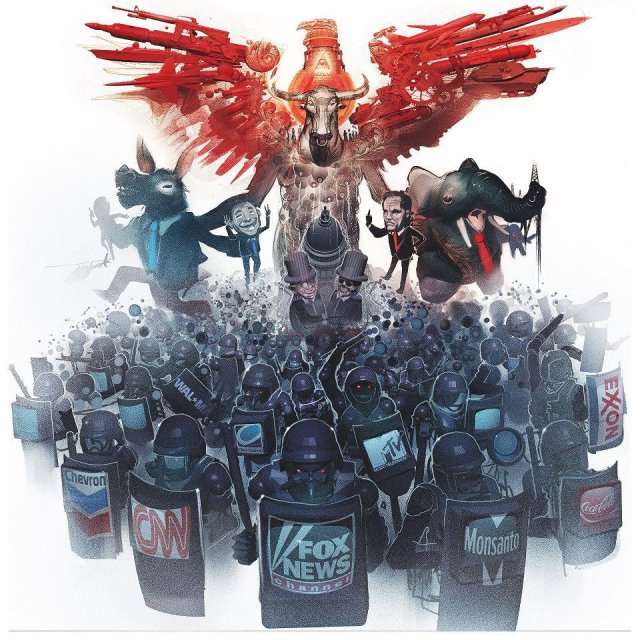
This dynamic is made possible by the fact that the powerful are constantly pouring their wealth and influence into manufacturing the collective delusion that madness is sanity and sickness is health. The plutocrat-controlled political class and the plutocrat-owned media class feed the public an unceasing stream of propaganda aimed at convincing them that capitalism is totally working, that western imperialism is a kooky conspiracy theory, and that the military, police and politicians are our friends. This is what’s constantly being done by mainstream news media, and with varying degrees of subtlety it’s what is being done by every show on television and every movie churned out by Hollywood as well.
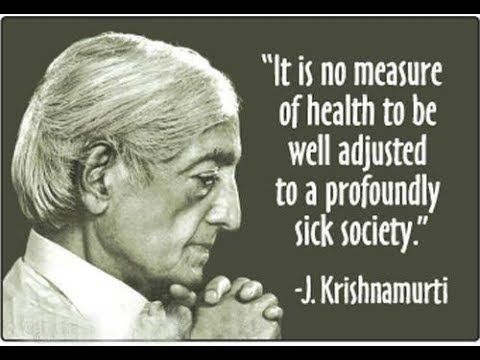
But that’s all it is: a collective propaganda-induced delusion. In reality it is the mainstream promoters of the establishment-authorized status quo who are the violent extremists, and it is those who desire health and sanity who are the moderates.
The madness of our world will necessarily continue for as long as we are unable to collectively find our way out of it, and we will be unable to collectively find our way out of it for as long as they are able to keep us collectively confused about what is madness and what is sanity. About what is normal and what is abnormal. About what is moderate and what is extreme.
If you oppose the madness of our world, don’t make an identity out of being a “radical”. Don’t build an egoic structure around life on the fringe. You are not radical, and your ideas should not be fringe. To live a revolutionary life, you should insist on the normality and mundaneness of your own position. Sanity should not be special and unusual, and we should not participate in the delusion that it is.
Let your life be an expression of the common sense ordinariness of revolution.
A spiritual war is upon us and the individual is challenged to maintain integrity in a sea of greed, egotism, terror and fear. With no clear path toward spiritual evolution, so many of us floundering and losing ourselves to addiction, despair and self-destruction.
When in the past ordinary religions might have served to offer a pathway toward spiritual awakening based upon the experiences of their ancient sages, today, the best they seem to offer is communal support. Far too often, though, modern religions are mired in greed, scandal, pedophilia and outright terrorism. Religions are failing to provide the help one needs to spiritually thrive in this insane world.
“Spirit can hardly be found in noisy, crowded churches and temples. Even where the teachings of the past sages have been established they have been spoiled by the insensitive trend of the times.
The spirit of the world’s religions died long ago and left most temples and churches merely empty shells.
These places continue as superficial social conventions and can only supply their devotees with shallow activities, psychological games of shadow playing, and hypnosis, all of which have absolutely nothing to do with spiritual reality.
This is the faith of today’s world, and most of their achievements are not the true answer.” ~ Taoist Master Hua Ching Ni
What then, is spiritual reality? And what does it look like in a world governed by fear, distracted by materialism, and kept in conflict by egotism? It’s really quite straightforward, says Master Ni, who refers to it as the “plain, simple truth of your life,’ which is best understood as the profoundly important concept of inner peace.
“The first spiritual goal of Taoism is the restoration and realization of one’s own well-balanced being, and then one’s spiritual evolution.
The highest goal of life is to combine oneself with the spiritual energy of the universe. There is one way to eliminate all wonder, bewilderment and confusion and that is to have inner peace.
The primary method or principle for personal cultivation is to keep peace within oneself and maintain normalcy in one’s environment; thus you can dwell with the spiritual energy and the spiritual energy dwells within you.” ~ Taoist Master Hua Ching Ni
Comparing the teachings of ordinary religions to true personal spiritual cultivation, Master Ni notes that undeveloped human beings follow and devote themselves to belief systems, deities and spiritual figureheads. In contrast, individuals seeking genuine spiritual evolution understand these systems for what they are: illusions and traps.
“People mistake religious emotionalism and hypnosis for spiritual reality.
Often in history religious emotion has been exalted as truth itself. This gave birth to all kinds of religious prejudice and persecution. Religious mobs have carried out the mischief caused by the hot-blooded in the forceful image of a spiritual sovereign. This has not the slightest connection with spiritual reality. It is the manifestation of the impure, heavy, bloody energy of undeveloped human beings before having completed their spiritual evolution.
Many people are fooled by their own ignorance or that of others. And in their ignorance they fool others too. People like this have no hope of reaching the spiritual realm. They will have no chance to touch the real spiritual life. So, before you commit yourself to any religion, you should develop the mental ability to discern what is religious emotion and what is the spiritual truth. One is the right way to follow, and the other is only a psychological pitfall and trap. This is very important for a seeker of truth on the spiritual path.” ~ Taoist Master Hua Ching Ni
Generating this type of spiritual emotionalism has become a profitable art form. Take note of the costumes worn by Catholic Cardinals and deference to the Pope in his symbolic Mitre hat. Islamic fundamentalists and ISIS do the same when they emote fear and terror by parading captives in front of religious soldiers clad in all black robes with faces covered, armed with rifles and sabres. Using symbolic imagery as tools of dominance and control, as Master Ni points out, has absolutely nothing to do with true spiritual reality.
What would the world look like if individuals first placed their own spiritual development ahead of their desire to change the world in accordance with their beliefs about spirituality and feelings of religious emotionalism? What if individuals were instead offered a plan of genuine spiritual cultivation, a path that led to actual inner peace?
“The spiritual process itself is a process of the evolution of the human spirit.” ~ Taoist Master Hua Ching Ni
“When the song of the angels is stilled, when the star in the sky is gone, when the kings and princes are home, when the shepherds are back with their flocks, the work of Christmas begins: to find the lost, to heal the broken, to feed the hungry, to release the prisoner, to rebuild the nations, to bring peace among the people, to make music in the heart.” ― Howard Thurman
The Christmas story of a baby born in a manger is a familiar one.
The Roman Empire, a police state in its own right, had ordered that a census be conducted. Joseph and his pregnant wife Mary traveled to the little town of Bethlehem so that they could be counted. There being no room for the couple at any of the inns, they stayed in a stable (a barn), where Mary gave birth to a baby boy, Jesus. Warned that the government planned to kill the baby, Jesus’ family fled with him to Egypt until it was safe to return to their native land.
Yet what if Jesus had been born 2,000 years later?
What if, instead of being born into the Roman police state, Jesus had been born at this moment in time? What kind of reception would Jesus and his family be given? Would we recognize the Christ child’s humanity, let alone his divinity? Would we treat him any differently than he was treated by the Roman Empire? If his family were forced to flee violence in their native country and sought refuge and asylum within our borders, what sanctuary would we offer them?
Those nativity scenes were a pointed attempt to remind the modern world that the narrative about the birth of Jesus is one that speaks on multiple fronts to a world that has allowed the life, teachings and crucifixion of Jesus to be drowned out by partisan politics, secularism, materialism and war, all driven by a manipulative shadow government called the Deep State.
The modern-day church has largely shied away from applying Jesus’ teachings to modern problems such as war, poverty, immigration, etc., but thankfully there have been individuals throughout history who ask themselves and the world: what would Jesus do?
What would Jesus—the baby born in Bethlehem who grew into an itinerant preacher and revolutionary activist, who not only died challenging the police state of his day (namely, the Roman Empire) but spent his adult life speaking truth to power, challenging the status quo of his day, and pushing back against the abuses of the Roman Empire—do about the injustices of our modern age?
Dietrich Bonhoeffer asked himself what Jesus would have done about the horrors perpetrated by Hitler and his assassins. The answer: Bonhoeffer was executed by Hitler for attempting to undermine the tyranny at the heart of Nazi Germany.
Martin Luther King Jr. asked himself what Jesus would have done about America’s warmongering. The answer: declaring “my conscience leaves me no other choice,” King risked widespread condemnation when he publicly opposed the Vietnam War on moral and economic grounds.
Even now, despite the popularity of the phrase “What Would Jesus Do?” (WWJD) in Christian circles, there remains a disconnect in the modern church between the teachings of Christ and the suffering of what Jesus in Matthew 25 refers to as the “least of these.”
Yet this is not a theological gray area: Jesus was unequivocal about his views on many things, not the least of which was charity, compassion, war, tyranny and love.
After all, Jesus—the revered preacher, teacher, radical and prophet—was born into a police state not unlike the growing menace of the American police state. When he grew up, he had powerful, profound things to say, things that would change how we view people, alter government policies and change the world. “Blessed are the merciful,” “Blessed are the peacemakers,” and “Love your enemies” are just a few examples of his most profound and revolutionary teachings.
When confronted by those in authority, Jesus did not shy away from speaking truth to power. Indeed, his teachings undermined the political and religious establishment of his day. It cost him his life. He was eventually crucified as a warning to others not to challenge the powers-that-be.
Can you imagine what Jesus’ life would have been like if, instead of being born into the Roman police state, he had been born and raised in the American police state?
Consider the following if you will.
Had Jesus been born in the era of the America police state, rather than traveling to Bethlehem for a census, Jesus’ parents would have been mailed a 28-page American Community Survey, a mandatory government questionnaire documenting their habits, household inhabitants, work schedule, how many toilets are in your home, etc. The penalty for not responding to this invasive survey can go as high as $5,000.
Instead of being born in a manger, Jesus might have been born at home. Rather than wise men and shepherds bringing gifts, however, the baby’s parents might have been forced to ward off visits from state social workers intent on prosecuting them for the home birth. One couple in Washington had all three of their children removed after social services objected to the two youngest being birthed in an unassisted home delivery.
Then again, had Jesus’ parents been undocumented immigrants, they and the newborn baby might have been shuffled to a profit-driven, private prison for illegals where they first would have been separated from each other, the children detained in make-shift cages, and the parents eventually turned into cheap, forced laborers for corporations such as Starbucks, Microsoft, Walmart, and Victoria’s Secret. There’s quite a lot of money to be made from imprisoning immigrants, especially when taxpayers are footing the bill.
From the time he was old enough to attend school, Jesus would have been drilled in lessons of compliance and obedience to government authorities, while learning little about his own rights. Had he been daring enough to speak out against injustice while still in school, he might have found himself tasered or beaten by a school resource officer, or at the very least suspended under a school zero tolerance policy that punishes minor infractions as harshly as more serious offenses.
Had Jesus disappeared for a few hours let alone days as a 12-year-old, his parents would have been handcuffed, arrested and jailed for parental negligence. Parents across the country have been arrested for far less “offenses” such as allowing their children to walk to the park unaccompanied and play in their front yard alone.
Rather than disappearing from the history books from his early teenaged years to adulthood, Jesus’ movements and personal data—including his biometrics—would have been documented, tracked, monitored and filed by governmental agencies and corporations such as Google and Microsoft. Incredibly, 95 percent of school districts share their student records with outside companies that are contracted to manage data, which they then use to market products to us.
Jesus’ anti-government views would certainly have resulted in him being labeled a domestic extremist. Law enforcement agencies are being trained to recognize signs of anti-government extremism during interactions with potential extremists who share a “belief in the approaching collapse of government and the economy.”
While traveling from community to community, Jesus might have been reported to government officials as “suspicious” under the Department of Homeland Security’s “See Something, Say Something” programs. Many states, including New York, are providing individuals with phone apps that allow them to take photos of suspicious activity and report them to their state Intelligence Center, where they are reviewed and forwarded to law-enforcement agencies.
Viewed by the government as a dissident and a potential threat to its power, Jesus might have had government spies planted among his followers to monitor his activities, report on his movements, and entrap him into breaking the law. Such Judases today—called informants—often receive hefty paychecks from the government for their treachery.
Had Jesus used the internet to spread his radical message of peace and love, he might have found his blog posts infiltrated by government spies attempting to undermine his integrity, discredit him or plant incriminating information online about him. At the very least, he would have had his website hacked and his email monitored.
Had Jesus attempted to feed large crowds of people, he would have been threatened with arrest for violating various ordinances prohibiting the distribution of food without a permit. Florida officials arrested a 90-year-old man for feeding the homeless on a public beach.
Had Jesus spoken publicly about his 40 days in the desert and his conversations with the devil, he might have been labeled mentally ill and detained in a psych ward against his will for a mandatory involuntary psychiatric hold with no access to family or friends. One Virginia man was arrested, strip searched, handcuffed to a table, diagnosed as having “mental health issues,” and locked up for five days in a mental health facility against his will apparently because of his slurred speech and unsteady gait.
Without a doubt, had Jesus attempted to overturn tables in a Jewish temple and rage against the materialism of religious institutions, he would have been charged with a hate crime. Currently, 45 states and the federal government have hate crime laws on the books.
Had anyone reported Jesus to the police as being potentially dangerous, he might have found himself confronted—and killed—by police officers for whom any perceived act of non-compliance (a twitch, a question, a frown) can result in them shooting first and asking questions later.
Rather than having armed guards capture Jesus in a public place, government officials would have ordered that a SWAT team carry out a raid on Jesus and his followers, complete with flash-bang grenades and military equipment. There are upwards of 80,000 such SWAT team raids carried out every year, many on unsuspecting Americans who have no defense against such government invaders, even when such raids are done in error.
Instead of being detained by Roman guards, Jesus might have been made to “disappear” into a secret government detention center where he would have been interrogated, tortured and subjected to all manner of abuses. Chicago police have “disappeared” more than 7,000 people into a secret, off-the-books interrogation warehouse at Homan Square.
Indeed, as I show in my book Battlefield America: The War on the American People, given the nature of government then and now, it is painfully evident that whether Jesus had been born in our modern age or his own, he still would have died at the hands of a police state.
Thus, as we draw near to Christmas with its celebrations and gift-giving, we would do well to remember that what happened on that starry night in Bethlehem is only part of the story. That baby in the manger grew up to be a man who did not turn away from evil but instead spoke out against it, and we must do no less.
I hadn’t planned to give up my smartphone. After all, I was starting my sophomore year of college and I had not met a single adult who lives without one and definitely no other 19-year-old. If you haven’t noticed, it is part of the culture. A few weeks into the semester, I forgot my phone (a Google Pixel 2, for all you phone nerds) in the backseat of an Uber on my way back from shopping off campus. This would lead to an opening to consider a break from the phone and everything that comes with it.
I remember feeling frustrated at myself for being so absentminded and immediately rushed to track it down, anxiously calling the driver from a friend’s phone. While I listened to the open ringing on the line I began to think about this one technology’s central role in my life.
That gateway to other worlds.
Over the next few days I continued to hope my phone would come back to me and also thought further into its role in my relationships. I felt how hindering it was in communicating with the people I love.
How it had required me to be always ready to pluck it from my pocket, pull my focus and as a result, never be truly present. I saw in that reflection the possibility for healthier relationships, less dependent on constant digital connection.
More free, less reliant.
Sure, there were a thousand things that would be made more challenging and tedious, but it would be worth it if I could be more present for my own life.
Days later, after I had given up hope of seeing it again, I used a friend’s phone to call my dad to tell him.
“I will get you another one, what kind do you want?” was the first thing he said.
“Actually I think I’m good,” I responded, to his surprise. “I can write you and my mom by email. If we want to talk, I can call you from my computer.”
Quickly, I started to feel the change. My mood and habits became clearer; I felt happier, more grounded, less looming anxiety, feeling more alone and with myself, more conscious of my space and those in it.
Being alone led to more opportunities for reflection and boredom. I felt calmer, and my walking and pace of day actually slowed down. It is hard to describe how it changed the patterns in my brain but I could feel it readjusting, as it does if you spend a week in the woods or on a beach. One thing I felt was that my days were longer and more connected from one moment to the next.
I also became more aware of the moods and feelings of others around me and was suddenly terrified to see how dependent my peers were on all their screens, and, looking back just a bit, how consumed I,too, had been.
Something else bubbled up from my unconscious: My expectations of college differed from what I was seeing. Between talking to older relatives and seeing college life on TV and in the movies, I was expecting a . . . BIT MORE JOY! Young souls, free minds, positive energy, community. I was seeking some bright spark in the people around me, yet all too often what I saw was dull, void, distractible, unthinking, unfeeling people enveloped in the world of their screens instead of being in community and conversing with the people around them.
Yes, that is harsh. It is also what I see.
So much lost human potential.
I want something or someone to blame, but maybe what I should really be blaming is myself for expecting something else. The truth is, though, I feel right in blaming the phones.
It has been over a year since I gave up my smartphone, but I remember vividly when looking at my phone for hours a day seemed normal to me. I was content to stare at the screen for hours, doing the same thing: Watching mildly entertaining videos or mashing game buttons, swiping on Tinder, scrolling on IG, surfing memes and YouTube videos. In many ways, it’s a drug too good to give up, seemingly a harmless drug, but no. We have opened Pandora’s box of marvels and there is no way to close it now.
We are continually wanting what we do not yet have, an innate motivation amplified and rerouted by capitalism’s hyperdrive marketing engines. A good fix for this constant yearning, or any discomfort is to drown it out with distractions. Feeling an uncontrollable emotion? Existential itch? Low-grade anxiety? No problem: Try scrolling on the social of your choice for a bit, trust me, it takes the edge off.
Trauma or poverty, pain or loneliness, all manner of worry, we have a cure! Or at least the emotional response can be staved off long enough for you to find the next thing to click.
This terrible void of which everyone stays pleasantly unobservant is a part of me as well, the unofficial sickness of my generation. (COVID-19 will be the official one, memorialized in our virtual yearbooks.) This hole, this pit, that is created from not knowing one’s self, not trusting one’s self, or not allowing feelings. So distracted that these insecurities that we act on every day are a mystery. That you cannot see how fundamentally OK everything actually is because you have music constantly in your ear and a fear that, in silence, your own thoughts would be too scary. The sickening thought that your true feelings for someone were no more than an act of comfort-seeking desperation and that “love” is a lifesaver from yourself.
I can’t blame anyone though. The distractions surround us, they surround the people we are with. The collective unfeeling is so great, so vast, it cracked me open, actually made me cry often once I allowed myself to experience it. I felt like I was losing my footing in the world in which I had grown up. Disconnected from my past and unsure of where we were going.
(Side note: If you haven’t yet watched The Social Dilemma, go do that, it’s worth it.)
Walking into a small college class to see no one looking at each other or chatting, the blank vacant stares. The soft glow. It felt … confusing? Why were so many interesting young people ignoring one another? What was a classroom like before these tools were available and allowed everywhere? Why were the screens so celebrated?
Then my confusion grew, and from it rage and pain. These emotions danced together, fueled me and crushed me. I saw, for the first time, the real power that the phones held. Yes, a power we had given them, but a power nonetheless. The power to keep people who were 500 miles apart tethered to one another, or keep people sitting right next to each other brutally apart.
Who can I blame? It is just the world I have been born into, and the technology- and profit-driven changes are coming faster every year. We live in the future with brain equivalents in our pockets and a web that contains all of our collective knowledge but reveals the worst of what we are and so little of the love we contain and of which we are capable.
Is the internet a good idea? Are phones good for humans? These are not questions we have answered or even barely thought to ask in the mainstream of our culture. Of course they are, what else could they be? Progress! Faster communication! More knowledge! More speed! More fun! We will all be more efficient and entertained, and from that we will live better lives.
NO! Stop, slow down. Please. These gadgets, these everywhere-anytime screens, are ruining the minds of the people who have been mesmerized since they were only little children.
To clarify: not ruining, in that people are made stupid (although it definitely does not help develop our attention span), but rather ruining our emotional capacity and spiritual selves. And these limits fetter us as we are already so strained by the pain we are able to see through our little windows; we don’t have a moment to feel, to feel our own pain, or that of our friends.
Or, for that matter, the pain of the world, or the impact of our constant consumption, or where all this STUFF comes from and where it ends up, or the pain of our history and centuries of exploitation of other humans and nature from which all this wealth originally was derived.
Being human is objectively great. We can use language and words to describe how we feel. We can feel the sun on our face and take in the taste of a thousand foods, dance to every song. Feel great pain and great happiness. Yet, all the time I see this discomfort, unrest and fear in my most distracted friends. It is coming from the disconnection from what they are feeling, a disconnection from being.
This is the worst theft of modern-day, first-world life: the theft of being present.
The phones and distractions and speed create this disconnection from the simple fact that you are actually OK, better then OK — you are alive and can feel and that is a gift to cherish.
Worse than the days of sadness are the days of not feeling anything. Some people are depressed not because anything is wrong but because they are numb to their feelings, too distracted and avoidant to feel them; avoidant, and scared of what might happen if they let themselves feel.
Try this: Really study those you love, let their face become new to you, again, and become fascinated in the way they move. Feel the wonder of being with another human.
After more than a year without a smartphone, I am more hopeful than I was in those first few months. Not to say that everything is all right, far from it. Here in the United States our technology has allowed for multiple realities to coexist alongside one another and I don’t see a clear path out of that problem. Distraction and narrow self-interest prevent us from seeing and grappling with the apocalyptic future climate change can bring in a much shorter time frame than even most globally aware people are willing to accept.
However, I do know that change is a constant and I am healed by looking past my own lifetime and by all the simple beauties of life and living. In the end, these technologies do NOT define us. We can work together to change how we coexist.
Postscript: For those who are interested in also letting go of your smartphone, I would recommend downgrading to a flip-phone or phone of a similar level. I now walk around the world with a thick, red brick through which I can communicate with my work and family in case of emergencies.
Anxiety, depression, and fear ravage so many today, but few pause to consider that in addition to the material influences in our lives, we may be also under the influence of beings which exist in dimensions outside of our ordinary perception.
But there is much more to reality than what we can see. feel, hear, taste and touch. In fact, an accounting of the matter that makes up the universe reveals that some 73% of it is made up of dark energy, and another 23% is made up of dark matter, neither of which can we see, nor understand. Furthermore, the human eye is only capable of seeing around .0035% of the entire spectrum of electromagnetic (EM) radiation. When we look into the heavens, 96% of it is invisible to us. Include in this the spiritual realms and there is an entire universe of possibilities which exists beyond our five senses.
Very few scientists today are willing to explore metaphysics to examine life beyond ordinary perception in order to make a connection between the seen and the unseen.
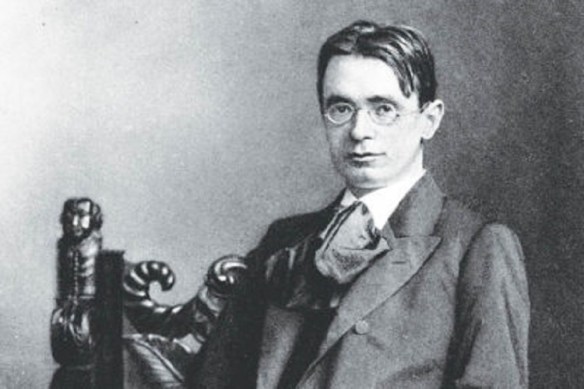
Rudolf Steiner, though, one of the most prolific and gifted scientists, philosophers, and esotericists of his time, devoted much of his work to the task of peering behind the veil, sharing his insight into the deeper nature of life and of the world beyond.
Regarding anxiety and depression, Steiner spoke of hostile beings in the spiritual world which influence and feed off of human emotion; a concept flatly rejected by most today. Yet this also analysis holds true for shamans and others who access the spiritual dimensions in order to alleviate mental suffering for their patients.
Many are familiar with the notion of energy vampires, or people who suck your energy and feed off your negative emotions. On the existence of similar entities which exist in other dimensions, Steiner wrote:
“There are beings in the spiritual realms for whom anxiety and fear emanating from human beings offer welcome food. When humans have no anxiety and fear, then these creatures starve. People not yet sufficiently convinced of this statement could understand it to be meant comparatively only. But for those who are familiar with this phenomenon, it is a reality. If fear and anxiety radiates from people and they break out in panic, then these creatures find welcome nutrition and they become more and more powerful. These beings are hostile towards humanity.
Everything that feeds on negative feelings, on anxiety, fear and superstition, despair or doubt, are in reality hostile forces in supersensible worlds, launching cruel attacks on human beings, while they are being fed. Therefore, it is above all necessary to begin with that the person who enters the spiritual world overcomes fear, feelings of helplessness, despair and anxiety. But these are exactly the feelings that belong to contemporary culture and materialism; because it estranges people from the spiritual world, it is especially suited to evoke hopelessness and fear of the unknown in people, thereby calling up the above mentioned hostile forces against them.” ~Rudolf Steiner
Negative emotions are food for inimical spirits.
A concept such as this isn’t readily accepted into the everyday conversation steered by rigid skepticism and scientific materialism. The traditions of today have sought to expel ancient metaphysical wisdom and its practical application from our lives, and though scientific inquiry is exceptionally valuable, spiritual perception has always been a part of our experience.
“And yet, despite the cynical skepticism, all of the ancient mystery schools, true shamanic insights, and esoteric teachings (much of which have been suppressed and/or distorted over thousands of years for obvious reasons) have conveyed this truth for ‘the ones with eyes to see and ears to hear’, using their own language and symbolism, be it “The General Law” (Esoteric Christianity), Archons (Gnostics), “Lords of Destiny” (Hermeticism), Predator/Fliers – “The topic of all topics” (Shamanism, Castaneda), “The Evil Magician” (Gurdjieff), The Shaitans (Sufism), The Jinn (Arabian mythology), Wetiko (Native American Spirituality), Occult Hostile Forces (Sri Aurobindo & The Mother, The Integral Yoga), etc.” ~Bernhard Guenther
Dealings with extra-sensory or hyper-dimensional beings have long been a part of our history, and are directly accessible to any of us when proper practice and attention is given to the matter. I know this to be true from my experiences with plant medicine shamanism where it is entirely possible to enter into states of consciousness where entire cosmologies of life exist and are available to interact with.
Finding oneself in the rut of spiraling negative self-talk, depression, crippling anxiety, or uncontrollable, irrational fear, is a sign, as Steiner points out, of a disconnection from our true spiritual nature, exacerbated by beings who operate in the spiritual realms. This is why some consider disorders like this to be spiritual illnesses, and until the rift is healed with proper attention given to the development of spirit, the feelings tend to exacerbate and drive one further into distress.
“When humans have no anxiety and fear, then these creatures starve.” ~Rudolph Steiner
In his 1995 book The Demon-Haunted World Carl Sagan lamented as follows:
I have a foreboding of [a] time when… awesome technological powers are in the hands of a very few, and no one representing the public interest can even grasp the issues; when the people have lost the ability to set their own agendas or knowledgeably question those in authority; when, clutching our crystals and nervously consulting our horoscopes, our critical faculties in decline, unable to distinguish between what feels good and what’s true, we slide, almost without noticing, back into superstition and darkness.
The dumbing down… is most evident in the slow decay of substantive content in the enormously influential media… but especially a kind of celebration of ignorance…. The plain lesson is that study and learning – not just of science, but of anything – are avoidable, even undesirable.
We’ve arranged a global civilization in which most crucial elements… profoundly depend on science and technology. We have also arranged things so that almost no one understands science and technology. This is a prescription for disaster. We might get away with it for a while, but sooner or later this combustible mixture of ignorance and power is going to blow up in our faces. See The Demon-Haunted World: Science as a Candle in the Dark.
While it is 25 years since these words of Sagan’s were published a year before his death, one can only lament the ongoing decline of what might simply be labeled the capacity for critical thinking, whether in relation to society and politics, or the science and technology that so concerned Sagan.
At a time in human history when so much is at stake, why is it so difficult to engage most people in anything resembling a thoughtful investigation, consideration and analysis of what is taking place? Why is it that more people do not question what they are told, what they read and what they are shown? In short, why is it that most people do not seek out the evidence for themselves rather than simply believing what is presented to them?
In one sense, the answer to this question might seem simple. People are daily bombarded with ‘information’, in various guises, and a lifetime of submissively accepting what they are told leaves few with any inclination, or energy, to question anything. But let me offer a fuller explanation given the critical importance of this issue if we are to mobilize an effective response to the challenges confronting humanity.
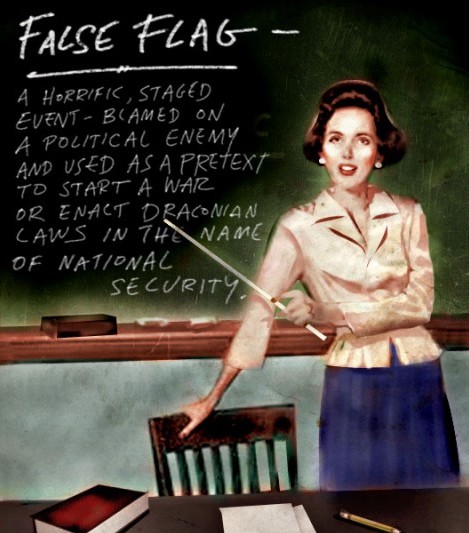
So first: What is propaganda? A false flag attack? Why do most people simply believe what they are told without investigating, carefully, for themselves? And why are those who challenge the elite-driven narrative often labeled ‘conspiracy theorists’ or, depending on the issue, some other pejorative such as ‘peddling debunked science’, ‘anti-vaxxer’ or ‘anti-semitic’ for example?
What is Propaganda?
Propaganda is the deliberate and systematic effort, using a variety of means, to manipulate people into believing and behaving in accordance with something that is not true. For one comprehensive explanation of how this is done, see Trust Us, We’re Experts! How Industry Manipulates Science and Gambles with Your Future, a book which Robert F. Kennedy Jr. observes ‘shows how giant corporations employ sophisticated psychiatric techniques, unscrupulous public figures, junk science, tainted studies and clever PR mercenaries in a relentless effort to market products that routinely kill, maim, deform and poison consumers and our environment’. See ‘Trust Us, We’re Experts!: How Industry Manipulates Science and Gambles with Your Future’.
While some people argue that propaganda can be used for good, the fact is that something that is simply true should appeal to people anyway, even if it is unpleasant. This is because the truth is the only powerful place from which to start to address any circumstance, including unpleasant and difficult ones.
Propaganda is delivered by a variety of means. Aside from that issued, in various ways, by governments and corporations, propaganda is delivered by education systems as ‘knowledge’, by the corporate media as ‘news’ and by the entertainment industry as films, television programs, video games, music, literature and in other forms. But all propaganda is designed to instill and reinforce a limited set of fears, approved beliefs and endorsed behaviours so that the ‘individual’ responds submissively within the carefully managed system of elite political, social and economic control.
For example, education is designed to teach the individual a limited range of technical functions intended to help create, maintain but essentially serve the emerging technocratic tyranny (as it supersedes the existing version of industrial capitalism), make the individual a passive consumer and politically submissive, while ensuring that an intelligent mind capable of seeking out relevant evidence for themselves, critiquing society and responding powerfully does not develop. See ‘Do We Want School or Education?’
What is a False Flag Attack?
A false flag attack occurs when a government carries out a terror attack against its own population and then falsely blames an enemy to justify a political course of action, such as going to war against the country or countries it blames. While, again, those who question false flag attacks are often denounced by elite propagandists as ‘conspiracy theorists’, in fact the documentation of false flag attacks that have later been admitted is quite long. For one list, see ‘53 Admitted False Flag Attacks’. Of course, plenty of false flag attacks have not been admitted, even when the evidence is overwhelming, as in the case of 9/11 for example.
So Why Do Most People Believe Propaganda?
In an early book on propaganda written in 1928 by Sigmund Freud’s nephew, Edward Bernays, he opened with this paragraph:
The conscious and intelligent manipulation of the organized habits and opinions of the masses is an
important element in democratic society. Those who manipulate this unseen mechanism of society constitute an invisible government which is the true ruling power of our country. See Propaganda.
As Bernays makes clear from the outset, his preoccupation is the manipulation of people to do the bidding of others: clearly, a debased and cynical view of the human individual on which many of humanity’s less morally committed characters have capitalized since Bernays wrote the book.
For example, Joseph Goebbels, Nazi Minister of Propaganda from 1933 to 1945 and an avid reader of Bernays’ work, observed that ‘Propaganda works best when those who are being manipulated are confident they are acting on their own free will.’
But to understand why the approach of Bernays and his disciples such as Goebbels even works, we need to consider why it is that most people are so gullible in the first place. Why don’t more people ask deeper questions about what is taking place rather than simply accepting, without serious question, whatever is presented to them (whether by parents, teachers, religious figures, doctors, propagandists, marketing agents, governments or the corporate media)?
The fundamental problem is simply this: parents, teachers, religious figures and other significant adults in the child’s life require obedience. And obedience means that the child not only behaves as directed by the adult but also that the child believes what the adult believes. This latter point is easily overlooked but is actually the key issue. Why? Because a child who does not believe what the adult believes might think and behave in a way that scares the adult. And demanding obedience is essentially about eliminating beliefs (and their consequent behaviours) that would frighten the parent, teacher or other adult.
Parents require obedience virtually from the moment of birth, doing everything from comforting a child to stop them crying – see ‘Comforting a Baby is Violent’ – to punishing them for acting contrary to parental will once they start moving independently. Of course, once the child starts to think or believe differently, especially if this ‘difference’ is too far from a belief of the child’s parents, teachers or religious leaders (or a widely-accepted belief within their society), the child is quickly pulled back into line with some combination of inducements and/or violence. See ‘Punishment is Violent and Counterproductive’.
Despite legal conventions meaninglessly affirming versions of it – such as the Universal Declaration of Human Rights Article 18 declaring ‘Everyone has the right to freedom of thought…’ – the freedom to think for oneself is not a human right in any meaningful sense of the term and, even if it were, it would really only mean the freedom to think for oneself within certain clearly defined and narrow parameters. And only if you are an adult.
This is why, for example, a child who decides not to go to school does not emerge. Such a possibility would be frightening to virtually every parent, so no child is given that option, let alone allowed the opportunity to come up with, consider and act on that option for themself. Why? Because attendance at school, wherever it exists, is legally compulsory (meaning punishment will be inflicted for failure to comply), and only the rarest parent has the vaguest concept of freedom themselves, let alone the courage to defend their child’s freedom, including the freedom to choose how they spend the bulk of their time for the 8-13 years of ‘school age’.
Consequently, the freedom to think for oneself and act accordingly is strangled at a very young age and certainly by the time a child is compelled to attend a prison for children, also known as ‘school’. As a result the child’s concept of freedom, should they ever come across the notion, can only be a parody of the real thing. And the adult who emerges from this childhood is simply incapable of comprehending what freedom might mean for the obvious reason that to be meaningfully understood, freedom must be experienced.
Of course, is it not just parental authority and school that denies any child the experience of liberty. As Jean-Jacques Rousseau noted in his treatise The Social Contract in 1762, ‘Man is born free; and everywhere he is in chains’. Every institution in society is designed to circumscribe freedom, one way or another. It is just that a childhood spent living under the control of their parents and then teachers and religious figures leaves all children devoid of the experience of freedom and so any subsequent limits are not even noticed. In fact, they are expected and ‘taken for granted’.
So with parents, teachers and religious figures endlessly inflicting ‘visible’, ‘invisible’ and ‘utterly invisible’ violence on the child in the name of ‘socialization’ (which includes requiring obedience under threat of violence for non-compliance), the child progressively and rapidly loses several innate capacities, notably including a sense of their own Self-will, the capacities to think and feel for themselves, as well as conscience. See ‘Why Violence?’ and ‘Fearless Psychology and Fearful Psychology: Principles and Practice’. Anything that is too far from the dominant narrative simply becomes ‘unthinkable’ because the child’s innate capacity to perceive the truth is suppressed along with other mental capacities.
But soon it is not just parents, teachers and religious leaders that are the accepted ‘authority figures’ in the child’s life. No longer able to seriously question the imperatives of parents, teachers and religious figures because they have been terrorized out of doing so, the child has also unconsciously ‘learned’ that virtually any information with which they are presented must be true, even when the source is simply a government or corporate media outlet presenting elite propaganda. For the vast bulk of adult humans, the idea of questioning a dominant narrative does not even occur to them and it is certainly not something they can do with any intelligence, persistent research effort or courage.
So just as Hitler, ably supported by his Propaganda Minister Joseph Goebbels, was able to direct most Germans prior to and into World War II, it is quite straightforward for the global elite to be able to direct the bulk of the human population to believe, for example, that President John F. Kennedy was assassinated by the ‘lone gunman’ Lee Harvey Oswald, that the ‘Gulf of Tonkin incident’ justified the United States war on Vietnam, that a ‘virus’ labeled HIV caused a ‘disease’ labeled AIDS, that the three buildings 1,2 and 7 of the World Trade Center were destroyed by two aircraft flown by novice pilots into the top stories of the Twin Towers and justified the subsequently launched US ‘War on Terror’, that a ‘virus’ labeled SARS-Cov-2 exists and causes a ‘disease’ labeled Covid-19 that has justified the destruction of everything from a range of human rights to the global economy while accelerating four distinct paths to human extinction, that we live in a democracy in which each adult has a say in how they are governed, or even that ongoing effort is being made to bring a greater degree of shared prosperity to the people of the world.
In essence: my point is that is it is not the power of the propaganda, increasingly sophisticated though it has become, that makes people believe it, but a ‘socialization’ model designed to produce submissively obedient ‘individuals’ who gullibly interpret what is happening, and even their own ‘experience’, in terms of the information or scenario (that is, propaganda) with which they are presented. And because of the deeply-seated and unconscious fear of holding a divergent view, most people simply believe the widely-promulgated propaganda narrative with which they become familiar and, hence, comfortable. Moreover, those who challenge the elite-driven narrative frighten them, particularly when elite agents in government and the corporate media label them ‘conspiracy theorists’. For one explanation of why the term ‘conspiracy theorist’ emerged to denigrate those who challenge elite orthodoxy, see ‘In defence of conspiracy theories (and why the term is a misnomer)’.
And so this combination of dysfunctional parenting, education and religious exposure leaves the child devoid of their intuitive ‘truth register’ as well as the other mental faculties that would make them question explanations that obviously lack credibility while investigating and analyzing the evidence for themself. In fact, the idea of doing so never even occurs to them. Hence, a terrorized, gullible and easily manipulated individual enters adulthood. And, as the elite intends, galvanizing an effective response by such people to the truth hidden behind the propaganda is very difficult.
Resisting Propaganda
There is no point hoping that the global elite will discontinue their use of propaganda to shape the course of human events. This is largely because the global elite is insane. See ‘The Global Elite is Insane Revisited’. Moreover, attempts to curb the use of propaganda must inevitably run into the institutions and organizations that the elite controls. And while we can strategically resist these if we choose, the most powerful defence we have against elite propaganda is the human mind that can perceive and critique it. Hence, as a priority, I would profoundly alter our parenting model to achieve this outcome. See ‘My Promise to Children’.
If you are uncertain of your own capacity to critique propaganda, you can expand your capacity to do so by feeling the fear (to release it) that limits your mental faculties. See ‘Putting Feelings First’.
If you are interested in planning or participating in a strategy to achieve a peace, environmental or social justice outcome (particularly in relation to those issues that threaten human extinction), or to resist the elite coup currently taking place under cover of Covid-19, you can read sets of strategic goals for doing so in Campaign Strategic Aims or Coup Strategic Aims.
Moreover, if you wish to tackle the environmental threats to human existence while also strengthening your self-reliant capacity to resist the latest elite onslaught to take (much) greater control of your life, consider participating in ‘The Flame Tree Project to Save Life on Earth’. The greater your dependence on elite systems and processes of any kind, the less power you will have to resist as the noose tightens.
I will only eat organically/biodynamically grown food
I will minimize the amount of fresh water I use, including by minimizing my ownership and use of electronic devices
I will not own or use a mobile (cell) phone
I will not buy rainforest timber
I will not buy or use single-use plastic, such as bags, bottles, containers, cups and straws
I will not use banks, superannuation (pension) funds or insurance companies that provide any service to corporations involved in fossil fuels, nuclear power and/or weapons
I will not accept employment from, or invest in, any organization that supports or participates in the exploitation of fellow human beings or profits from killing and/or destruction of the biosphere
I will not get news from the corporate media (mainstream newspapers, television, radio, Google, Facebook, Twitter…)
I will make the effort to learn a skill, such as food gardening or sewing, that makes me more self-reliant
I will gently encourage my family and friends to consider signing this pledge.
Conclusion
The world is complex: it is difficult to understand and requires enormous effort.
Propaganda is designed to give people information that is easy to understand (and sometimes frightening) while distracting them from the truth and offering a simple ‘choice’ (or command) designed to mobilize action in support of an elite-driven narrative.
Only a tiny proportion of the human population has even the vaguest idea of how the world actually works. But not even a tiny proportion of these people recognize that terrorizing children into obedience is the fundamental explanation of why the world works in the way that it does.
Unless we can mobilize greater recognition of our responsibility for giving the global elite the control over us that it has, and tackle this problem at its core – by fundamentally revising existing parenting and education models so that we produce powerful individuals – it will continue to be enormously difficult to mobilize sufficient strategic response to the challenges that confront humanity.
And while we are now fast-tracking four distinct paths to human extinction, there is an urgency about our predicament that accelerates daily.
Biodata: Robert J. Burrowes has a lifetime commitment to understanding and ending human violence. He has done extensive research since 1966 in an effort to understand why human beings are violent and has been a nonviolent activist since 1981. He is the author of ‘Why Violence?’ His email address is flametree@riseup.net and his website is here.
This is a con game, a scam, a grift, a hustle, a bunko, a swindle, a flimflam, a gaffle, and a bamboozle.
In this carefully choreographed scheme to strip the American citizenry of our power and our rights, “we the people” are nothing more than marks, suckers, stooges, mugs, rubes, or gulls.
We are victims of the Deep State’s confidence game.
Every confidence game has six essential stages: 1) the foundation to lay the groundwork for the illusion; 2) the approach whereby the victim is contacted; 3) the build-up to make the victim feel like they’ve got a vested interest in the outcome; 4) the corroboration (aided by third-party conspirators) to legitimize that the scammers are, in fact, on the up-and-up; 5) the pay-off, in which the victim gets to experience some small early “wins”; and 6) the “hurrah”— a sudden manufactured crisis or change of events that creates a sense of urgency.
In this particular con game, every candidate dangled before us as some form of political savior—including Donald Trump and Joe Biden—is part of a long-running, elaborate scam intended to persuade us that, despite all appearances to the contrary, we live in a constitutional republic.
In this way, the voters are the dupes, the candidates are the shills, and as usual, it’s the Deep State rigging the outcome.
Terrorist attacks, pandemics, civil unrest: these are all manipulated crises that add to the sense of urgency and help us feel invested in the outcome of the various elections, but it doesn’t change much in the long term.
No matter who wins this election, we’ll all still be prisoners of the Deep State.
We just haven’t learned to recognize our prison walls as such.
It’s like that old British television series The Prisoner, which takes place in a mysterious, self-contained, cosmopolitan, seemingly idyllic retirement community known only as The Village.
Perhaps the best visual debate ever on individuality and freedom, The Prisoner (17 episodes in all) centers around a British secret agent who abruptly resigns only to find himself imprisoned, monitored by militarized drones, and interrogated in The Village, a beautiful resort with parks and green fields, recreational activities and even a butler.
While luxurious, the Village is a virtual prison disguised as a seaside paradise: its inhabitants have no true freedom, they cannot leave the Village, they are under constant surveillance, all of their movements tracked. Residents of the Village are stripped of their individuality and identified only by numbers.
First broadcast in Great Britain 50-some years ago, The Prisoner dystopian television series —described as “James Bond meets George Orwell filtered through Franz Kafka”—confronted societal themes that are still relevant today: the rise of a police state, the loss of freedom, round-the-clock surveillance, the corruption of government, totalitarianism, weaponization, group think, mass marketing, and the tendency of human beings to meekly accept their lot in life as prisoners in a prison of their own making.
The series’ protagonist, played by Patrick McGoohan is Number Six.
Number Two, the Village administrator, acts as an agent for the unseen and all-powerful Number One, whose identity is not revealed until the final episode.
“I am not a number. I am a free man,” was the mantra chanted on each episode of The Prisoner, which was largely written and directed by Patrick McGoohan, who also played the title role.
In the opening episode (“The Arrival”), Number Six meets Number Two, who explains to him that he is in The Village because information stored “inside” his head has made him too valuable to be allowed to roam free “outside.”
Throughout the series, Number Six is subjected to interrogation tactics, torture, hallucinogenic drugs, identity theft, mind control, dream manipulation, and various forms of social indoctrination and physical coercion in order to “persuade” him to comply, give up, give in and subjugate himself to the will of the powers-that-be.
Number Six refuses to comply.
In every episode, Number Six resists the Village’s indoctrination methods, struggles to maintain his own identity, and attempts to escape his captors. “I will not make any deals with you,” he pointedly remarks to Number Two. “I’ve resigned. I will not be pushed, filed, stamped, indexed, debriefed or numbered. My life is my own.”
Yet no matter how far Number Six manages to get in his efforts to escape, it’s never far enough.
Watched by surveillance cameras and other devices, Number Six’s attempts to escape are continuously thwarted by ominous white balloon-like spheres known as “rovers.” Still, he refuses to give up. “Unlike me,” he says to his fellow prisoners, “many of you have accepted the situation of your imprisonment, and will die here like rotten cabbages.”
Number Six’s escapes become a surreal exercise in futility, each episode an unfunny, unsettling Groundhog’s Day that builds to the same frustrating denouement: there is no escape.
As journalist Scott Thill concludes for Wired, “Rebellion always comes at a price. During the acclaimed run of The Prisoner, Number Six is tortured, battered and even body-snatched: In the episode ‘Do Not Forsake Me Oh My Darling,’ his mind is transplanted to another man’s body. Number Six repeatedly escapes The Village only to be returned to it in the end, trapped like an animal, overcome by a restless energy he cannot expend, and betrayed by nearly everyone around him.”
The series is a chilling lesson about how difficult it is to gain one’s freedom in a society in which prison walls are disguised within the seemingly benevolent trappings of technological and scientific progress, national security and the need to guard against terrorists, pandemics, civil unrest, etc.
As Thill noted, “The Prisoner was an allegory of the individual, aiming to find peace and freedom in a dystopia masquerading as a utopia.”
The Prisoner’s Village is also an apt allegory for the American Police State: it gives the illusion of freedom while functioning all the while like a prison: controlled, watchful, inflexible, punitive, deadly and inescapable.
The American Police State, much like The Prisoner’s Village, is a metaphorical panopticon, a circular prison in which the inmates are monitored by a single watchman situated in a central tower. Because the inmates cannot see the watchman, they are unable to tell whether or not they are being watched at any given time and must proceed under the assumption that they are always being watched.
Eighteenth century social theorist Jeremy Bentham envisioned the panopticon prison to be a cheaper and more effective means of “obtaining power of mind over mind, in a quantity hitherto without example.”
Bentham’s panopticon, in which the prisoners are used as a source of cheap, menial labor, has become a model for the modern surveillance state in which the populace is constantly being watched, controlled and managed by the powers-that-be while funding its existence.
Nowhere to run and nowhere to hide: this is the new mantra of the architects of the Deep State and their corporate collaborators (Facebook, Amazon, Netflix, Google, Instagram, etc.).
Government eyes are watching you.
They see your every move: what you read, how much you spend, where you go, with whom you interact, when you wake up in the morning, what you’re watching on television and reading on the internet.
Every move you make is being monitored, mined for data, crunched, and tabulated in order to amass a profile of who you are, what makes you tick, and how best to control you when and if it becomes necessary to bring you in line.
When the government sees all and knows all and has an abundance of laws to render even the most seemingly upstanding citizen a criminal and lawbreaker, then the old adage that you’ve got nothing to worry about if you’ve got nothing to hide no longer applies.
Apart from the obvious dangers posed by a government that feels justified and empowered to spy on its people and use its ever-expanding arsenal of weapons and technology to monitor and control them, we’re approaching a time in which we will be forced to choose between obeying the dictates of the government—i.e., the law, or whatever a government official deems the law to be—and maintaining our individuality, integrity and independence.
When people talk about privacy, they mistakenly assume it protects only that which is hidden behind a wall or under one’s clothing. The courts have fostered this misunderstanding with their constantly shifting delineation of what constitutes an “expectation of privacy.” And technology has furthered muddied the waters.
However, privacy is so much more than what you do or say behind locked doors. It is a way of living one’s life firm in the belief that you are the master of your life, and barring any immediate danger to another person (which is far different from the carefully crafted threats to national security the government uses to justify its actions), it’s no one’s business what you read, what you say, where you go, whom you spend your time with, and how you spend your money.
Unfortunately, George Orwell’s 1984—where “you had to live—did live, from habit that became instinct—in the assumption that every sound you made was overheard, and, except in darkness, every movement scrutinized”—has now become our reality.
A byproduct of this new age in which we live, whether you’re walking through a store, driving your car, checking email, or talking to friends and family on the phone, you can be sure that some government agency, whether the NSA or some other entity, is listening in and tracking your behavior.
This doesn’t even begin to touch on the corporate trackers that monitor your purchases, web browsing, Facebook posts and other activities taking place in the cyber sphere.
Stingray devices mounted on police cars to warrantlessly track cell phones, Doppler radar devices that can detect human breathing and movement within in a home, license plate readers that can record up to 1800 license plates per minute, sidewalk and “public space” cameras coupled with facial recognition and behavior-sensing technology that lay the groundwork for police “pre-crime” programs, police body cameras that turn police officers into roving surveillance cameras, the internet of things: all of these technologies (and more) add up to a society in which there’s little room for indiscretions, imperfections, or acts of independence—especially not when the government can listen in on your phone calls, read your emails, monitor your driving habits, track your movements, scrutinize your purchases and peer through the walls of your home.
This is the electronic concentration camp—the panopticon prison—the Village—in which we are now caged.
It is a prison from which there will be no escape. Certainly not if the government and its corporate allies have anything to say about it.
As Glenn Greenwald notes:
“The way things are supposed to work is that we’re supposed to know virtually everything about what [government officials] do: that’s why they’re called public servants. They’re supposed to know virtually nothing about what we do: that’s why we’re called private individuals. This dynamic – the hallmark of a healthy and free society – has been radically reversed. Now, they know everything about what we do, and are constantly building systems to know more. Meanwhile, we know less and less about what they do, as they build walls of secrecy behind which they function. That’s the imbalance that needs to come to an end. No democracy can be healthy and functional if the most consequential acts of those who wield political power are completely unknown to those to whom they are supposed to be accountable.”
None of this will change, no matter who wins this upcoming presidential election.
And that’s the hustle, you see: because despite all of the work being done to help us buy into the fantasy that things will change if we just elect the right candidate, the day after a new president is sworn in, we’ll still find ourselves prisoners of the Village.
This should come as no surprise to those who haven’t been taking the escapist blue pill, who haven’t fallen for the Deep State’s phony rhetoric, who haven’t been lured in by the promise of a political savior: we never stopped being prisoners.
So how do you escape? For starters, resist the urge to conform to a group mind and the tyranny of mob-think as controlled by the Deep State.
Think for yourself. Be an individual. As McGoohan commented in 1968, “At this moment individuals are being drained of their personalities and being brainwashed into slaves… As long as people feel something, that’s the great thing. It’s when they are walking around not thinking and not feeling, that’s tough. When you get a mob like that, you can turn them into the sort of gang that Hitler had.”
You want to be free? Remove the blindfold that blinds you to the Deep State’s con game, stop doping yourself with government propaganda, and break free of the political chokehold that has got you marching in lockstep with tyrants and dictators.
As I make clear in my book Battlefield America: The War on the American People, until you come to terms with the fact that the government is the problem (no matter which party dominates), you’ll never be free.
Better not to risk any radical evolution that might fail, and so failure is thus assured.
When times are good, modest reforms are all that’s needed to maintain the ship’s course. By “good times,” I mean eras of rising prosperity which generate bigger budgets, profits, tax revenues, paychecks, etc., eras characterized by high levels of stability and predictability.
Since stability has been the norm for 75 years, institutions and conventional thinking have both been optimized for incremental change. This is an analog of natural selection in Nature: when the organism’s environment is stable, there’s little pressure to favor random mutations, as these can be risky.
Why risk big changes when everything’s working fine as is?
Absent any big changes in their environment, organisms’ genetic programming remains stable. Unlike natural selection’s process of generating random mutations and testing their efficacy and advantages over the existing programming, human organizations quickly habituate to stable eras by institutionalizing incremental changes as the only available process for reform / change.
Radical reforms are not just frowned on as 1) unneccesary and 2) needlessly risky, there is no institutionalized process to propose, test and adopt radical changes because there is no need for such a process.
Nature has such a process: punctuated equilibirium. When faced with a rapidly changing environment, organisms face intense evolutionary pressure to adapt or die. Mutations which confer a significant advantage in the new environment become part of the species’ genetic programming as those with the adaptation bear offspring who carry the advantageous adaptation. Those without the advantageous adaptation die and those with the adaptation thrive and multiply.
Once the environment stabilizes in “the new normal,” the evolutionary pressure lets up and the species returns to the stability of relatively few changes in its genetic programming.
Organisms which have lost the ability to adapt to rapid change die off once they encounter instability. Species that constantly face instability and rapid change will selectively favor genetic traits which optimize rapid evolution.
Nature tends to retain a basement closet full of fast-evolution tricks just in case the organism faces novel challenges.
Alas, human organizations and conventional thinking have no such closet of fast-evolution tricks. Rather, human organizations and conventional thinking marshal formidable forces to suppress anything which threatens the status quo, because why risk upsetting the feeding trough unless it’s absolutely necessary?
Therein lies the fatal problem: radical adaptation is never absolutely necessary in human organizations and conventional thinking until it’s too late–and even then, the leadership and conventional thinking will fatalistically accept oblivion rather than opt for a risky strategy of testing every mutation and fast-tracking whatever has promise, even though the odds of failure are high since 1) the challenge is novel and therefore unpredictable and 2) most mutations will fail to provide the radical advantages needed to meet the challenge.
In other words, what’s absolutely necessary to human organizations and conventional thinking is the suppression of potentially dangerous novel ideas because the worst-case scenario is that the novel ideas upset the feeding trough all the insiders have come to depend on.
Unfortunately for human organizations and conventional thinking, novel challenges demand precisely what they’re incapable of: risky rapid evolution. The risks will never seem worth it because some insiders might lose their spot at the feeding trough.
Since this loss is viewed as catastrophic by those at risk, they will fight with everything they have to stymie any radical reforms. Ironically, their resistance to rapid evolution only guarantees the demise of the entire organization / status quo, including the spot at the trough they were so eager to defend at all costs.
As the crisis deepens, the default setting in organizations and conventional thinking is that incremental changes and reforms will be enough, because they’ve been enough for four generations. I call this entirely natural default setting the delusional faith in incremental change because this faith isn’t guided by history or the logic of causality; it’s simply convenient and easy.
Nobody gets fired or demoted for agreeing to do more of what’s failed spectacularly.
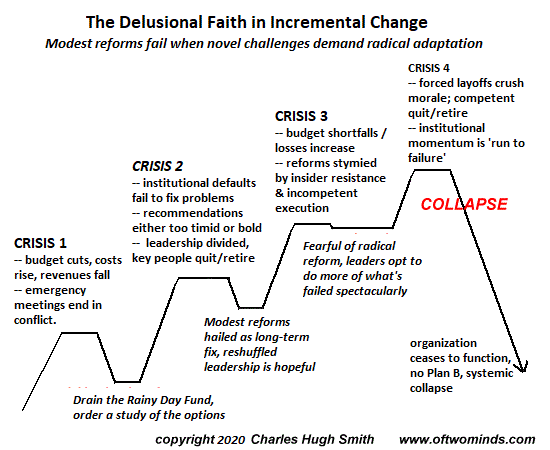
I’ve prepared a chart of the delusional faith in incremental change showing how each new crisis is met by incremental institutionalized defaults that are completely inadequate to the novel challenges that have arisen. The blindness to the need for radical adaption has been institutionalized as well: this is what worked in the past, so it will work now. Why risk everything when we have procedures that have worked well?
Each stage of the crisis draws whatever conventional response causes the least pain. First, the “rainy day fund” is drained to keep everyone at the feeding trough. Studies of options are funded, and so on.
The recommendations are either too timid and clearly inadequate or they’re too bold and risky. So incremental policy and budget tweaks are adopted as acceptable institutional defaults.
But rifts open in the leadership as the farsighted few demand rapid, radical adaptations and the conventional risk-averse crowd digs in their heels. The farsighted few are pushed out or quit / retire, eliminating the only people who had the ability and experience to actually pull off a radical change of course.
A reshuffling of leadership evokes hope that the modest reforms will work magic. Alas, incremental tweaks only work in eras of stability. They fail miserably in unstable eras of rapidly-evolving challenges.
As everything runs to failure, the only acceptable path is to do more of what’s failed spectacularly, a default to low-risk incrementalism that only accelerates the final inevitable collapse.
The delusional faith in incremental change guarantees systemic failure. Better not to risk any radical evolution that might fail, and so failure is thus assured.





 After the Crash