The Economy Continues To Unravel Despite All Stimulus Measures

By Brandon Smith

Source: Alt-Market.com

Since the pandemic lockdowns were first implemented in the US I have been more concerned with the government and central bank response than the virus itself. As I have noted in past articles, the pandemic restrictions and subsequent economic and social crisis events they help to create will cause far more deaths than Covid-19 ever will. Not only that, but the actions of the Federal Reserve continue to con the American public into believing that there is some kind of “plan” to stop the crash that THEY engineered.

The only agenda of the Fed is to increase the pain in the long term; they have no intention of actually preventing any disaster.

This is evidenced in comments by voting members of the Fed, including Neel Kashkari who recently argued for the enforcement of hard lockdowns for at least six weeks in the US, all because the US savings rate was going up. Meaning, because Americans are saving more in order to protect themselves from economic fallout, Kashkari thinks we should be punished with an economic shutdown that would force us to spend whatever we have been able to save.

Do you see how that works?

Fed members and government officials demand hard lockdowns, depleting public savings and destroying small businesses. Then, the public has to beg the Fed and the government for more and more stimulus measures so that they can survive. The people and the system become dependent on a single point of support – fiat money creation and welfare. Yet, the evidence suggests that this strategy is failing to do much of anything except stall the inevitable for a very short time.

If the goal was really to reduce the pain of the pandemic as much as possible, then the strategy should be to keep the economy as open as possible and let the virus run its course.  By initiating lockdowns, all we are doing is extending the economic damage over the span of years instead of months.  We can deal with the comparatively minimal deaths associated with the virus; we cannot handle the disaster that is about to befall the financial system.

The small business sector appears to be the most fragile element of the economy right now. The PPP loans that were supposed to shore up small businesses failed miserably, with data showing only 13% to 19% of applicants getting a loan of any kind. Over 64% of small businesses that received a loan are also worried about being approved for loan forgiveness. In other words, of the few small business owners that got a PPP loan more than half do not have the ability to pay the loan back if they end up not qualifying for exemption.

This problem does not seem to be affecting the corporate sector, however. International companies are enjoying incredible cash infusions from the Fed through overnight loans as well as Fed stimulus propping up stock markets (at least for now). Tech companies in particular are enjoying a rush of investment as the assumption in the daytrading world is that the central bank will not allow these companies to fail.

Maybe they are right, but stock markets today DO NOT reflect the health of our system in any way. Stock tickers are a placebo, a Pavlovian trigger for the public, a tool to make people believe that the situation is improving merely because share values are going up. This is not the case.

Small businesses in the US account for around 50% of all employment and job creation. They are a vital part of the economy. Yet, government and central bank measures seem to have left them out in the cold to die.

To be sure, the $600 weekly unemployment enhancement created through the CARES Act passed in March did boost consumer spending, primarily on durable goods such as computers, TVs, cellphones, etc. Spending on services declined though, which is where the majority of small businesses make their money. And, considering the fact that most durable goods are manufactured overseas, this means that the majority of stimulus dollars that went to consumers did not go into the US economy, but foreign exporters like China.

Now, the unemployment enhancement has ended and its return is in question. It will be interesting to see if the boost to purchases of goods will continue without that extra $600 weekly stimulus. Consumer spending rose in July by 1.9%, but this was already a weak print compared to the increases during the previous two months.

Unemployment numbers have declined due to soft reopenings in numerous states, and at the very least some part time jobs appear to be returning, but nowhere near the level needed to erase the millions of jobs lost since February after the initial lockdowns began. If you count U-6 measurements and unemployed people who have been removed from the rolls for being jobless for too long, the REAL unemployment rate is closer to 30% of working age Americans. This is essentially Great Depression levels of joblessness.

US GDP has continued to decline by 32% according to the Bureau of Economic Analysis (despite statistical rigging by the Fed and government agencies), and while it’s possible that stimulus slowed the effects of GDP loss, there is no indication what the trillions of dollars created by the Fed have actually bought other than a few months of time and a massive bubble in the stock market.

The economy cannot survive extreme lockdown conditions for any length of time, let alone almost two more months. And, if you want to know what it means when elites in government and central banking call for a “hard lockdowns”, just look at Level 4 restrictions in places like Australia and New Zealand, where only one person can leave home at any given time, can only travel 3 miles from home and only for food and supplies, and anyone caught not wearing a mask is subject to arrest or a $10,000 fine.

This mother in Melbourne, Australia was arrested because of a Facebook post calling for protests over the lockdown restrictions.  She later had to take the post down and offered an apology, saying she did not know it was illegal to post such statements on social media:

Yeah, this kind of Orwellian response will do wonders for any economic recovery, and this is what Kashkari is calling for in the US.  It’s almost as if the Fed and certain politicians WANT a financial collapse in America…

The REAL solution is to stop the lockdown restrictions altogether. If the goal is truly to protect as many American lives as possible for the “greater good”, then the pandemic response must stop. Luckily, it seems that more and more people are beginning to see through the facade and are rejecting the restrictions. Even in Europe and Australia there have been some signs of protest and rebellion. The problem is that, at least in terms of the economy, it may be too late.

We have to consider the fact that once a large portion of the business sector (like small businesses) takes a massive hit like the one they have suffered over the past several months, many such businesses and jobs will simply not come back. There are many reasons for this, but primarily it’s a matter of debt. The average small business owner carries almost $200,000 in debt for 3-5 years before he reaches profitability or breaks even. This is assuming that there are no major economic catastrophes in that time.

With the pandemic, the riots, the restrictions, etc., businesses will have to take on much more debt with little guarantee of recovery in the next few years let alone the next few months.  Chapter 11 business bankruptcies in the US rose over 26% in the first half of 2020 alone.

Even if lockdown restrictions were completely eradicated tomorrow, a large number of businesses would go bankrupt anyway.  The “Retail Apocalypse” has been growing over the past decade, LONG before the coronavirus was on issue.  Thousands of businesses shut down last year and tens of thousands more are slated to close this year.   The virus and lockdowns simply accelerated the existing decline.

This is why large banks are cutting off loans to business owners and consumers right now; they know exactly where all this is headed.

Banks act as middlemen for the PPP loans financed by the Fed, yet those loans are not getting to most businesses. Banks have also cut credit card lending in the past few months, and general lending has crashed. All of this despite low interest rates for banks receiving stimulus injections from the Fed. Where is all of the money going? They are keeping it for themselves, buying up hard assets as well as propping up the stock market. As noted above, the elites have NO INTENTION of saving the economy, only themselves.

If the stimulus is not getting to the main-street economy then the only purpose it serves is to give the public a false sense of comfort.  The people who gain the most from the ongoing pandemic chaos are establishment elites that want severe restrictions on personal liberty.  Not to mention, the virus and lockdowns offer a convenient scapegoat for the financial crisis that was already brewing due to central bank mismanagement of stimulus, inflation and interest rates. The bottom line is, the banks do not want the crisis to end.  Why would they?  The longer the panic continues, the more they benefit.

The End of Reality?

By Edward Curtin

Source: Behind the Curtain

In 1888,  the year before he went insane, Friedrich Nietzsche wrote the following in Twilight of the Idols:

We have got rid of the real world: what world is left?  The apparent world perhaps? … But no!  Along with the real world we’ve done away with the apparent world as well.

So, if you feel you also may be going insane in the present climate of digital screen life, where real is unreal but realer than real, the apparent is cryptic, and up is down, true is false, and what you see you don’t, it has a history.  One hundred and thirty-two years ago, Nietzsche added that “something extraordinarily nasty and evil is about to make its debut.”  We know it did, and the bloody butcher’s bench known as the twentieth century was the result. Nihilism stepped onto center stage and has been the star of the show ever since, straight through to 2020.  Roberto Calasso puts it this way in Literature and the Gods:

Here we are, announces Nietzsche, and it would be hard not to hear a mocking ring in his voice.  We thought we were living in a world where the fog had lifted, a disenchanted, ascertainable, verifiable world.  And instead everything has gone back to being a ‘fable’ again.  How are we to get our bearings … This is the paralysis, the peculiar uncertainty of modern times, a paralysis that all since have experienced.

Obviously, we haven’t gotten our bearings.  We are far more adrift today on a stormy electronic sea where the analogical circle of life has been replaced by the digital, and “truths” like numbers click into place continuously to lead us in wrong, algorithm-controlled directions. The trap is almost closed.

Of course, Nietzsche did not have the Internet, but he lived at the dawn of the electric era, when space-time transformations were occurring at a rapid pace.  Inventions such as photography, the phonograph, the telephone, electricity, etc. were contracting space and time and a disembodied “reality” was being born.  With today’s Internet and digital screen life, the baby is full-grown and completely disembodied.  It does nothing but look at its image that is looking back into a lifeless void, whose lost gaze can’t figure out what it’s seeing.

Take, for example, the phonograph, invented by Thomas Edison in 1878.  If you could record a person’s voice, and if that person died, were you then listening to the voice of a living person or one who was dead?  If the person whose voice was recorded was alive and was miles away, you had also compressed earthly space. The phonograph suppressed absence, conjured ghosts, and seemed to overcome time and death as it captured the flow of time in sound.  It allowed a disembodied human voice to inhabit a machine, an early example of downloading.

“Two ruling ambitions in modern technology,” writes John Durham Peters in his wonderful book, Speaking into the Air, “appear in the phonograph: the creation of artificial life and the conjuring of the dead.”

Many people started to hear voices, and these people were not called deluded. Soon, with the arrival of cinema, they would see ghosts as well.  Today, speaking ghosts are everywhere, hiding in hand-held devices. It’s Halloween all year round as we are surrounded by electronic zombies in a screen culture.

This technological annihilation of space and time that was happening at a frenetic pace was the material background to Nietzsche’s thought.  His philosophical and epistemological analyses emerged from German intellectual life of his time as well, where theologians and philosophers were discovering that knowledge was relative and had to be understood in situ, i.e., within its historical and social place or context.

Without going into abstruse philosophical issues here, suffice it to say, Nietzsche was suggesting that not only was God dead because people killed him, but that knowledge was a fiction that changed over time and was a human construction.  All knowledge, not just science, had to be taken “as if” it were true.  This was a consoling mental trick but falsely reassuring, for most people could not accept this, since “knowledge” was a protection racket from pain and insanity. It still is. In other words, not only had people murdered God, but they had slain absolutes as well. This left them in the lurch, not knowing if what they knew and believed were really true, or sort of true – maybe, perhaps. The worm of uncertainty had entered modern thought through modern thought.

While the average person did not delve into these revolutionary ideas, they did, through the inventions that were entering their lives, and the news about Darwin, science, religion, etc., realize, however vaguely, that something very strange and dramatic was under way. Life was passing from substance to shadow because of human ingenuity.

It is similar to what so many feel today: that reality and truth are moving beyond their grasp as technological forces that they voluntarily embrace push everyday life towards some spectral denouement.  An inhuman, trans-human, on-line electronic life where everything is a parody of everything that preceded it, like an Andy Warhol copy of a copy of a Campbell’s soup can with a canned mocking laugh track that keeps repeating itself.  All this follows from the nineteenth century relativization of knowledge, or what at least was taken as such, for to say all knowledge is relative is an absolute statement.  That contradiction goes to the heart of our present dilemma.

This old feeling of lostness is perhaps best summarized in a few lines from Mathew Arnold’s 19th century poem, “Dover Beach”:

The Sea of Faith
Was once, too, at the full, and round earth’s shore
Lay like the folds of a bright girdle furled.
But now I only hear
Its melancholy, long, withdrawing roar,
Retreating, to the breath
Of the night-wind, down the vast edges drear
And naked shingles of the world.

But that was then.  Today, the Joker’s sardonic laughter would suffice.

***

I am sitting outside as I write, sipping a glass of wine before dinner.  Although New England fall weather is approaching, a nasty mosquito is buzzing around my head.  I hear it.  I am in killer mode since these bastards love to bite me.  This is real life.  If I went into the house and connected to the Internet on the computer screen – news, social media, anything – I would be entering another dimension.  Screen life, not real life. The society of the spectacle. No real mosquitoes, no wine, no trees swaying in the evening breeze.

In his novel, The Sun Also Rises, written between Nietzsche’s time and now, Ernest Hemingway, a man who surely lived in the physical world, writes of how Robert Cohn, the boxing champion from Princeton University, wants Jake Barnes, the book’s protagonist, to take a trip with him to South America.  As they sit and talk in Paris, Barnes says no, and tells Cohn, “All countries look just like the moving pictures.”

Whether Hemingway was being ironic or not, or simply visionary, I don’t know.  For in the 1920s, before passports and widespread tourism, there were many places you could only see if you traveled to them and they would never appear in moving pictures, while today there is almost no place that is not available to view beforehand on the internet or television.  So why go anywhere if you’ve already seen it all on a screen? Why travel to nowhere or to where you have already been?  Déjà vu all over again, as Yogi Berra put it and everyone laughed.  Now the laugh is on us.

***

This is neither an argument nor a story.  It’s real.  I am trying to get my bearings in a disorienting situation. Call it a compass, a weather-vane, a prayer.  You can call me Al or Ishmael.  Call me crazy.  Perhaps this writing is just an “as if.”

***

About fifteen years ago, I was teaching at a college where most communication was done via email.  I was, as they say, out of the loop since I didn’t do email. I was often asked why I didn’t, and I would repeatedly reply, like Melville’s Bartleby, because “I prefer not to.”  Finally, in order to keep my job, I succumbed and with the laptop computer they provided me, I went “on-line.”  There were 6,954.7 emails in my in-box from the past three years.  In those three years, I had performed all my duties scrupulously and hadn’t missed a beat.  Someone showed me how to delete the emails, which I did without reading any, but I had entered the labyrinth. I went electronic.  My reality changed. I am still searching for Ariadne’s thread.

***

But I am not yet a machine and refuse the invitation to become one.  It’s a very insistent invitation, almost an order.  Neil Postman (Oh such a rich surname!) sums it up well in Technopoly: The Surrender of Culture to Technology:

The fundamental metaphorical message of the computer, in short, is that we are machines – thinking machines, to be sure, but machines nonetheless.  It is for this reason that the computer is the quintessential, incomparable, near perfect machine for Technopoly.  It subordinates the claims of our nature, our biology, our emotions, our spirituality.  The computer claims sovereignty over the whole range of human experience, and supports its claim by showing that it ‘thinks’ better than we can…John McCarthy, the inventor of the term ‘artificial intelligence’…claims that ‘even machines as simple as thermostats can be said to have beliefs…What is significant about this response is that it has redefined the meaning of the word ‘belief’ … rejects the view that humans have internal states of mind that are the foundation of belief and argues instead that ‘belief’ means only what someone or something does … rejects the idea that the mind is a biological phenomenon … In other words, what we have here is a case of metaphor gone mad.

Postman wrote that in 1992, before the computer and the internet became ubiquitous and longer before on-line living had become de rigueur – before it was being shoved down our throats as it is today under the cover of COVID-19.

There is little doubt that we are being pushed to embrace what Klaus Schwab, the Executive Chairman of the World Economic Forum (WEF), calls COVID-19:The Great Reset, that involves a total acceptance of the electronic, on-line life.  On-line learning, on-line news, on-line everything – only an idiot (from Greek, idiotes, a private person who pays not attention to public affairs) would fail to see what is being promoted.  And who controls the electronic life and internet?  Not you, not I, but the powers that be, the intelligence agencies and the power elites. Goodbye  body, goodbye blood – “I don’t think we should ever shake hands ever again, to be honest with you,” said Dr. Anthony Fauci, the director of the National Institute of Allergy and Infectious Diseases (NIAID) in support of human estrangement.

Peter Koenig, one of the most astute investigators of this propaganda effort, puts it this way:

The panacea of the future will be crowned by the Pearl of the Fourth Industrialization – Artificial intelligence (AI). It will be made possible by a 5G electromagnetic field, allowing the Internet of Things (IoT). Schwab and Malleret [Schwab’s co-author] won’t say, beware, there is opposition. 5G could still be blocked. The 5G existence and further development is necessary for surveillance and control of humanity, by digitizing everything, including human identity and money.

It will be so simple, no more cash, just electronic, digital money – that is way beyond the control of the owner, the truthful earner of the money, as it can be accessed by the Global Government and withheld and / or used for pressuring misbehaving citizens into obeying the norms imposed from above. You don’t behave according to our norms, no money to buy food, shelter and health services, we let you starve. No more travel. No more attending public events. You’ll be put gradually in your own solitary confinement. The dictatorial and tyrannical global commandeering by digital control of everything is the essence of the 4th Age of Industrialization – highly promoted by the WEF’s Great Reset.

***

Like everything, of course, this push to place life under the aegis of cyberspace has a history, one that deifies the machine and attempts to convince people that they too are machines without existential freedom.  Thus the ongoing meme pumped out for the past three decades has been that we are controlled by our brains and that the brain is a computer and vice versa. Brain research has received massive government funding. Drugs have been offered as the solution to every human problem. So-called diseases and disorders have been created through the Diagnostic and Statistical Manual of  Mental Disorders (DSM) and matched to pharmaceutical drugs (or the revers) for scandalous profits. And the mind has been reduced to a figment of deluded  imaginations. People are machines; that’s the story, marvelous machines.  They have no freedom.

If one wishes an example of techno-fascism, there is one from the art world. Back in the 1920s and 1930s there was an art movement known as Futurism.  Its leader proponent was an Italian Fascist, friend of Mussolini, Filippo Tommaso Marinetti.  The futurists claimed that all life revolves around the machine, that the machine was god, that it was beyond human control and had to be obeyed.  They extolled war and speed and claimed that humans were no more significant than stones.  Patriotism, militarism, strength, method, and the kingdom of experts were their blueprint for a corporate fascist state.  The human eye and mind would be re-educated to automatically obey the machine’s dictates.

Now we have cyberspace, digital machines, and the internet, an exponential extension of the machine world of the 1930s and the rise of Mussolini, Fascism, and Hitler.  That this online world is being pushed as the new and future normal by trans-national elite forces should not be surprising.  If human communication becomes primarily digitally controlled on-line and on screens, those who control the machines will have achieved the most powerful means of mind control ever invented. That will be MKULTRA on a vast scale.  Surveillance will be complete.

Yes, there are places on the internet where truth is and will be told, such as this site where you are reading this; but as we can see from today’s growing censorship across the web, those power elites and intelligence forces who  control the companies that do their bidding will narrow the options for dissenting voices. Such censorship starts slowly, and then when one looks again, it is a fait accompli. The frog in the pan of slowly heating cold water never realizes it is being killed until it is too late. Free speech is now being strangled. Censorship is widespread.

The purpose of so much internet propaganda is to confuse, obsess, depress, and then repress the population. The overlords accomplish this by the “peculiar linking together of opposites – knowledge with ignorance, cynicism with fanaticism – [which] is one of the chief distinguishing marks of Oceanic society,” writes Orwell in Nineteen Eighty-Four.  “The official ideology abounds with contradictions even where there is no practical reason for them.”  One look into one’s life will suffice to see how the overlords have set people against each other.  It’s a classic tactic.  Divide and conquer. Trump vs. Biden, Democrats vs. Republicans, whites vs. blacks, liberals vs. conservatives. Pure mind games. Contradictions every day to create social disorientation.  Orwell describes Doublethink as follows:

Doublethink means the power of holding two contradictory beliefs in one’s mind simultaneously, and accepting both of them.  The Party intellectual knows in which direction his memories must be altered; he therefore knows he is playing tricks with reality; but by the exercise of doublethink he also satisfies himself that reality is not violated.  The process has to be conscious, or it would not be carried out with sufficient precision, but it also has to be unconscious, or it would bring with it a feeling of falsity and hence of guilt…To tell deliberate lies while genuinely believing them, to forget any fact that has become inconvenient, and then, when it becomes necessary again, to draw it back from oblivion for just as long as it is needed, to deny the existence of objective reality and all the while to take account of the reality which one denies – all this is indispensably necessary…If one is to rule, and to continue ruling, one must be able to dislocate the sense of reality. [author’s emphasis]

Nietzsche said that along with the real world we have done away with the apparent as well.  Digital online life has accomplished that.  It has allowed the rulers – through the media who are the magicians who serve them – to create counterfeit news and doctored videos at will, to present diametrically opposed points of view within the same paragraph, and to push breaking news items so fast that no one half-way sane could keep up with their magic shows. Nietzsche obviously didn’t foresee this technology, but he sensed the madness that the relativity of knowledge and the technology of his day would usher in.

***

The popular 1990s term “Information Superhighway,” meaning the internet and all digital telecommunications, was the perfect term to describe this lunacy. Get on that highway and go as fast as you can while trying to catch the meaning of all the information flashing past you as you speed to nowhere.  For not only does censorship, propaganda, disinformation, mixed messages, and contradictions line the road you are traveling, but contextless information overload is so heavy that even if you were stopped in a traffic jam, there is too much information to comprehend.  And if you think this Superhighway is a freeway, think again, for the cost is high. No one puts out their hand and asks you to pay up; but the more you travel down this road you’ll notice you are missing a bit of flesh here and some blood there.  And without a speed pass, you are considered road kill.

To make matters much worse, they say we need 5G to go much faster.

Paul Virilio, who has devoted himself to the study of speed (dromology), puts it this way in Open Sky:

The speed of the new optoelectronic and electroacoustic milieu becomes the final void (the void of the quick), a vacuum that no longer depends on the interval between places or things and so on the world’s very extension, but on the interface of an instantaneous transmission of remote appearances, on a geographic and geometric retention in which all volume, all relief vanishes.

***

And yet I don’t have a simple answer to the internet dilemma. You are reading it on-line and I am posting it there.  It is very convenient and quick. And yet…and yet….

Can we just walk away from it?  Maybe.  Perhaps like those few who, in Ursula K. Le Guin’s excruciating story, “The Ones Who Walk Away From Omelas,” we may decide the price for our conveniences and so-called happiness is too high and that there are hidden victims that this techno-scientific “progress” creates beneath its veneer of efficiency.  Others, us, our children, all children, who are reaching out not for speed and machines, but for the human touch that the on-line propagandists hope to destroy.  In Le Guin’s story, the price nearly all the citizens of Omelas are willing to pay for their happiness and comfort is the imprisonment of a single child.  Perhaps we should consider what we are doing to all the world’s children and their futures.

My friend Gary recently sent me this letter.  I believe it sums up what many people feel. There is a vast hunger for reality and truth. The analog life. How to live it – the question hangs in the air as the artificial intelligence/digital controllers try to reduce us to machines.

Although apparently it isn’t clear if Twain ever said this, it’s still a great quote:  (“If you don’t read the newspaper, you’re uninformed.  If you do, you’re misinformed.”)  To which “amen” is the only appropriate response.

I continue to daily stay abreast of events through the web, and these days much of what passed for “progressive media” simply regurgitates the covid madness as if it had been delivered on stone tablets – rather than by the same MSM that lie to us daily about literally ANYTHING of any importance.

There are days I wonder “why” I continue to bother to follow the unfolding madness as if it made some “difference.”  I could certainly play guitar more, and I might even get it together to write a few pieces on the nature of our collective madness, for which I have studiously assembled copious notes.  I really don’t need any more information or examples – I think I have things covered on that front.

Instead I find myself daily doing the little dance we’re all familiar with – uncomfortable with being “uninformed” – yet at almost every turn finding myself being routinely – “misinformed” – and so having to sift through the endless debris to have any chance at developing any coherent understanding of the world.

So yes, I totally get the draw of just saying to hell with the internet.  After years of shifting through the endless propaganda operations our generation has been subject too, I have no doubt you and I see through most the nonsense for what it is before we even have the proof in hand.  Once the rose-colored glasses of ‘American exceptionalism’ are off, one can almost sense and see through the lies in real time even as they are being uttered.

Reading Gary’s words reminded me of those of the Trappist monk Thomas Merton’s definition of the Unspeakable:

It is the void that contradicts everything that is spoken even before the words are said, the void that gets into the language of public and official declarations at the very moment when they are pronounced, and makes them ring dead with the hollowness of the abyss.  It is the void out of which Eichmann drew the punctilious exactitude of his obedience…

Yes, real time, real life – as we do our little dances.

Can we do our little dances and preserve reality?  I’m not sure.

Global billionaire wealth tops $10 trillion as COVID-19 deaths mount

By Jacob Crosse

Source: WSWS.org

The collective wealth of the world’s 2,189 billionaires has risen to $10.2 trillion, an increase of nearly $1.3 trillion in the past three years, according to a new report by the Swiss bank UBS and PricewaterhouseCoopers. The unprecedented surge in wealth takes place amidst a global pandemic that has killed more than one million people worldwide, including more than 215,000 in the United States alone.

The report, “Riding the Storm,” is based on data from 43 markets, including interviews with 60 billionaires, accounting for around 98 percent of global billionaire wealth. It sums up the results: “Most of the decade was a time of exceptional prosperity for billionaires regardless of sector…”

The US continues to have the largest concentration of billionaire wealth, accounting for 36 percent of the world’s total, or $3.6 trillion. China ranked second with $1.6 trillion and saw the largest growth over the decade, by 1,146 percent.

Third was Germany, where billionaire wealth totaled $594.9 billion, an increase of 175 percent from 2009’s $216.1 billion. While fourth in terms of billionaire wealth at $467.6 billion, Russia saw the smallest growth by percentage, 80 percent, from $260.2 billion in 2009 to $467.6 billion in 2020.

The $10.2 trillion amassed by less than .0003 percent of the global population is more than the estimated 2020 Gross Domestic Product of every country on the planet except for the US and China. The staggering total hoarded by less than 2,200 people, or about the number of COVID-19 deaths in the US within the last 72 hours, surpasses the previous high of $8.9 trillion recorded in 2017.

For a household earning the average US median income, it would take over 16 million years to accumulate $1 trillion, not even enough to cover what has been collectively usurped from global society in less than three years. Joel Berg, CEO of Hunger Free America, has calculated the cost of ending hunger in the US at $25 billion, which could be done 400 times over with $1 trillion.

The billionaires who have increased their wealth the most, according to the authors, are in the “technology, healthcare and industrial sectors,” including Amazon CEO Jeff Bezos, Tesla CEO Elon Musk, and Facebook CEO Mark Zuckerberg. The report states: “During 2018, 2019 and the first seven months of 2020, technology billionaires’ total wealth rose by 42.5% to USD 1.8 trillion, supported by the surge in tech shares.”

The surge in technology and medical shares was buoyed by unlimited cash from the Federal Reserve, included as part of the $2.2 trillion CARES Act passed at the end of March in a near-unanimous vote by both Democrats and Republicans.

This financial bailout made a “big difference” in the fortunes of billionaires, with the authors writing: “Billionaire wealth is loosely correlated with equity markets, due to holdings in listed companies, and a few weeks makes a big difference. From the end of March, governments’ huge fiscal and quantitative easing packages drove a recovery in financial markets. By the end of July 2020, billionaire wealth was back above its 2019 level.”

Particularly obscene is the surge in wealth of billionaires in the health care industry, in the midst of a deadly global pandemic. The authors write, “Healthcare billionaires’ total wealth increased by 50.3% to $658.6 billion, boosted by a new age of drug discovery and innovations in diagnostics and medical technology, as well as latterly COVID-19 treatments and equipment.”

The report adds: “The number of tech billionaires grew from 68 in 2009 to 234 in 2020, while the number of healthcare billionaires grew from 48 to 167. Tech and healthcare billionaires’ total wealth both multiplied by four times – from $321.3 billion to $1.3 trillion for tech and from $120.8 billion to $482.9 billion for healthcare.”

And what are these “pandemic profiteers” spending their fortunes on? To get some idea, Christie’s auction house in New York held its latest online auction, “20th Century Evening Sale” live-streamed from the Rockefeller Center in New York on October 6. In one night, the world’s wealthiest spent over $340 million on 59 different 20th and 21st century art pieces. The auction also featured the most expensive dinosaur skeleton ever sold, a fossilized Tyrannosaurus rex, for $27.5 million.

The massive concentration of wealth is a decades’ long and bipartisan policy of redistribution to the rich. The Institute for Policy Studies measured the tax obligations of America’s billionaires as a percentage of their wealth between 1980 and 2018 and found that it had decreased 79 percent. Over the last 20 years, the growth in US billionaire wealth has been 200 times greater than the growth in median wealth.

While the billionaires are richer than ever, the response of the ruling class to the pandemic has produced a massive social catastrophe for the working class. In the United States, tens of millions are unemployed and being cut off of all benefits, facing poverty, homelessness and hunger.

Earlier reports found that the 643 wealthiest Americans increased their wealth by a staggering $845 billion between March 18 and September 15. During that same time, over 62 million people in the US applied for unemployment benefits. An estimated 10.5 million jobs were eliminated, with major companies such as Disney, United Airlines, and Cineworld announcing tens of thousands additional layoffs in the last week.

Inflation Is Stealth Austerity

By Charles Hugh Smith

Source: Of Two Minds

Rather than decry austerity, which demands an open political discussion of trade-offs, we should decry inflation’s stealthy reduction of purchasing power.

Austerity–bad. Inflation–good. Oh wait–they’re the same thing: both are a reduction in purchasing power. The only difference is a reduction via austerity is upfront while inflation is a stealth reduction, obfuscated by “official” distortions and Federal Reserve mumbo-jumbo.

Consider $1,200 in wages, unemployment, stimulus, Social Security payment, etc. If this payment gets cut by 10%–$120–as a result of austerity, pay cut, reduction in hours worked, etc., recipients scream bloody murder.

But if inflation reduces the purchasing power of the $1,200 by 10%, nobody does anything but grumble that “prices keep rising while my income stays the same.” This is the classic boiled frog syndrome: inflation is like the heat being turned up so gradually that the poor frog doesn’t realize he’s about to expire.

Inflation is stealthy because the loss of purchasing power is difficult to monitor. Your $1,200 only buys what $1,080 bought in the recent past; 10% inflation reduced your income exactly the same as if austerity had subtracted the $120 upfront.

Governments and central banks love inflation because the theft goes unnoticed. The public tolerates inflation because it’s easy to passively accept this erosion in their standard of living and difficult to generate the political heat that an outright cut would spark.

Though it’s being openly engineered by the Federal Reserve, inflation appears to be a force nobody controls–unlike austerity which is so clearly a political decision. If Inflation robbed 10% of everyone’s income overnight, people might be roused from their passivity to protest.

But since the theft occurs slowly–what’s 1% a month?–and unevenly across a spectrum of goods and services, this theft doesn’t rouse the same political storm as upfront austerity.

Inflation is a form of sacrifice that few recognize as sacrifice. It seems like everyone’s income is eroded equally, but this isn’t true: the wealthy closest to the Fed’s money spigots are earning multiples of inflation from asset inflation, stock buybacks, etc. Inflation is a pinprick to the wealthy and a stilletto in the kidneys of the bottom 95%.

To the political Aristocracy, inflation is wonderful because they don’t need to ask anyone to sacrifice 10% of their income as they do with austerity; they just steal the 10% a dribble at a time and throw up their hands as if inflation is some mystery force completely beyond their control.

Ironically, austerity–an honest, upfront political decision and sacrifice–is decried, while the dishonest, stealth cut of inflation is passively accepted, even as the Federal Reserve has made a cloaked political decision to reduce the purchasing power of everyone’s income except for the New Nobility (the top 0.1%) that the Fed slavishly serves.

Rather than decry austerity, which demands an open political discussion of trade-offs, we should decry inflation’s stealthy reduction of purchasing power, a Fed policy that benefits the few at the expense of the many.

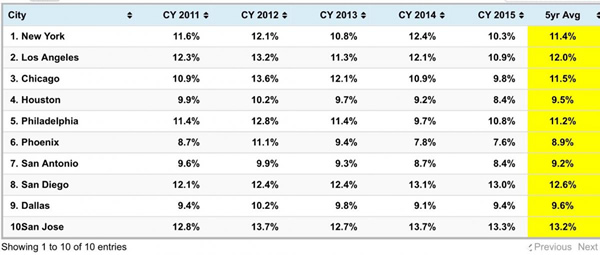
Here is the Chapwood Index of inflation, which carefully measures “apples to apples” costs of essential goods and services in each city:

As inflation erodes purchasing power, workers’ share of the economy has declined dramatically– a double-whammy of declining purchasing power and standard of living.


The USA on the brink of civil war

In this article, the author seeks to draw our attention to a fact that is difficult for Westerners to conceive of: the American people are experiencing a crisis of civilization. They are so deeply divided that the presidential election is not just about electing a leader, but about determining what the country (empire or nation?) should be. Neither side is capable of accepting to lose, so much so that each could resort to violence to impose its point of view.

By Thierry Meyssan

Source: VoltaireNet.org

As the U.S. presidential election approaches, the country is divided into two camps that suspect each other of preparing a coup d’état. On one side are the Democrats and the non-party Republicans, and on the other are the Jacksonians, who have become the majority in the Republican Party without sharing its ideology.

Remember, already in November 2016, a media manipulation company headed by the master of Agit-Prop, David Brock, raised more than 100 million dollars to destroy the image of the President-elect before he was elected [1]. Since then, before he could do anything about it, the international press has portrayed the U.S. president as incapable and an enemy of the people. Some newspapers have even called for his assassination. For almost four years, his own administration has constantly denounced him as a traitor paid by Russia and the international press has violently criticized him.

Currently, another group, the Transition Integrity Project (TIP), is planning scenarios to overthrow him in the 2020 election, whether he loses it or wins it. The case has become national in scope since TIP founder Professor Rosa Brooks leaked a lengthy article in the Washington Post to which she is a regular contributor [2].

The TIP organized four role-playing games last June. It simulated various results to anticipate the reactions of the two candidates. All the participants were Democrats and Republicans (ideologically speaking, not “Republicans” in the sense of party membership), none of them Jacksonian. Unsurprisingly, all of these personalities believe that “the Trump administration has consistently undermined basic standards of democracy and the rule of law. It has adopted many corrupt and authoritarian practices. They therefore concluded that President Trump would attempt a coup d’état and imagined that it was their duty to pre-emptively devise a “democratic” coup d’état [3].

It is a characteristic of contemporary political thought to stand up for democracy, but to reject decisions that run counter to the interests of the ruling class. Indeed, TIP members readily admit that the US electoral system they defend is profoundly “anti-democratic”. The constitution does not attribute the presidential election to citizens, but to an electoral college of 538 people appointed by the governors. The participation of citizens, which was not foreseen at independence, has gradually become the norm in practice, but only as a guide for governors. Thus, in 2000, when George W. Bush was elected, the Florida Supreme Court recalled that it did not have to know the wishes of the citizens of Florida, but only those of the 27 voters appointed by their Florida governor.

Contrary to popular belief, the U.S. Constitution does not recognize popular sovereignty, but only the sovereignty of governors. Moreover, the Electoral College designed by Thomas Jefferson has not functioned properly since 1992: the elected candidate no longer has the majority of the wishes of the citizens in the states that tilt the election [4].

The TIP has highlighted just about everything that could happen in the three months between the election and the nomination. It acknowledges that it will be very difficult to determine the results given the use of absentee voting in times of epidemic. The TIP deliberately did not explore the possibility that the Democratic Party would announce Joe Biden’s election despite an undercount and that House Speaker Nancy Pelosi would swear him in before Donald Trump could be declared the loser. In such a case, there would be two rival presidents, which would mark the beginning of a Second Civil War.

This eventuality encourages some to consider seceding, to unilaterally proclaim the independence of their state. This is particularly true on the West Coast. To prevent this process of disintegration, some advocate dividing California in order to give more members of the Electoral College to its population. However, this solution is already a stance in the national conflict because it favours popular representation at the expense of the power of the governors.

In addition, last March I mentioned the temptation of a putschist coup by some military personnel, [5] to which several high-ranking officers later referred [6].

These different points of view attest to the deep crisis that the United States is going through. The “American empire” should have disintegrated after the dissolution of the Soviet Union. This did not happen. It should have reinvented itself with financial globalization. It did not. Each time, a conflict (the ethnic division of Yugoslavia, the attacks of September 11) came to rekindle the dying. It will no longer be possible to postpone the deadlines for much longer [7].


Translation
Roger Lagassé


[1] “The Clinton system to discredit Donald Trump”, by Thierry Meyssan, Translation Pete Kimberley, Zero Hedge (USA) , Voltaire Network, 28 February 2017.

[2] “What’s the worst that could happen? The election will likely spark violence — and a constitutional crisis”, The Washington Post, September 3, 2020.

[3Preventing a disrupted presidential election and transition, Transition Integrity Project, August 3, 2020.

[4Presidential elections and majority rule, Edward B. Foley, Oxford University Press, 2020.

[5] “Putchists in the Shadow of the Coronavirus”, by Thierry Meyssan, Translation Roger Lagassé, Voltaire Network, 31 March 2020.

[6] “The Pentagon against President Trump”, Voltaire Network, 12 June 2020. Do we risk a miltary coup?, by Colonel Richard H. Black, August 24, 2020.

[7] “United States – reformation or fracture?”, by Thierry Meyssan, Translation Pete Kimberley, Voltaire Network, 26 October 2016.

Kushner-Linked Firm and Gig Economy Set to Reap Huge Profits as Mass Evictions Begin

By Raul Diego

Source: Mint Press News

In 2014, former Blackstone and Goldman Sachs investment banker Ryan Williams got together with his “college buddy,” Joshua Kushner – Jared’s brother – to form a real estate investment platform they called Cadre. Cadre sought to disrupt the real estate industry in the wake of the 2008 subprime mortgage crisis by tinderizing property deals through a tech platform that brought investors and sellers together. According to Williams, whose other investors include George Soros and Peter Theil, Cadre’s mission is “to level the playing field in an industry that is often tilted toward the biggest players” by taking an “offline” industry online and making it “transparent.”

A pre-Covid initiative to capitalize on its platform came in the form of the so-called “opportunity zones,” that Jared Kushner directly lobbied for inclusion in Trump’s 2017 Tax Cut and Jobs Act, billed as a funding mechanism to help poor and distressed communities, which turned into a multi-billion-dollar land heist by the wealthiest Americans, like the Kushner family. The pandemic lockdown protocols forced Cadre to downsize, laying off 25 percent of its workforce in March.

But now, the company is restarting its predatory engines as the home eviction wave forming on the horizon signals potential windfalls for companies like Cadre, that are in a position to profit. It is doing so by launching a pop-up banking operation called “Cadre Cash,” which will try to lure deposits from “investors” by offering a three percent annualized “reward” to finance a new round of land-grabs as millions of Americans teeter on the edge of homelessness and landlords look to unload un-rentable properties.

Another company, Civvl, is tackling a different side of the burgeoning housing crisis in America with its on-demand service model for eviction crews. Just like Uber, the Civvl app lets “frustrated property owners and banks secure foreclosed residential properties” by connecting haulers and the rentier class.

Civvl’s parent company, OnQall, specializes in mobile app platforms that monetize side-hustles like moving, cleaning and lawn care services. The eviction crew app has, predictably, drawn a storm of criticism since Motherboard‘s article on Civvl this past Monday.

“It’s fucked up that there will be struggling working-class people who will be drawn to gigs like furniture-hauling or process-serving,” exclaimed housing activist Helena Duncan, who also pointed out the clear dystopian contours evident in a scenario where working class people are paid to wage economic warfare on fellow working class people. Civvl puts up a disingenuous defense against the earned invectives, comparing itself to Monster.com. “They’re not evicting anyone,” a Civvl spokesperson told Motherboard, “they’re just the help.”

Both Cadre and Civvl are poised to make a killing as eviction moratoriums abate across the country and millions find themselves on one side or another of evictions – tenants forced onto the streets by small landlords who will have little choice but to sell in a depressed market. Only the CDC’s national eviction moratorium, issued three weeks ago, stands in the way of the avalanche of displacement and dispossession at our doorstep. But, even the risks of fines and jail time doesn’t seem to be discouraging companies like OnQall or landlords, in general.


Ridiculous loopholes

Cadre, in particular, is at the head of the pack of “disruptive” real estate tech platforms mostly due to the favor it enjoys in the halls of the Trump administration. “Jared was one of the key people early on. And his contributions were critical,” says Cadre CEO Ryan Williams of Jared Kushner, whose stake is worth over $50 Million, according to 2018 SEC filings.

Despite claims that Kushner sold a “substantial portion” of his shares in the company and that the president’s son-in-law has no role in the business endeavor, recent history surrounding the so-called “opportunity zones” of Trump’s Tax bill revealed Cadre’s and Kushner’s central role in a multi-billion dollar land heist by the wealthiest Americans, like the Kushner family.

Paying lip service to the same “diversity” principles Cadre’s African American founder asserts underlie his company’s vision, the more than 200 federally-designated “opportunity zones” for disadvantaged communities that resulted from the legislation, Cadre’s machine-learning and processed census data was simply serving to make a “ridiculous loophole” available to wealthy investors to buy up land at a serious discount.

The bulk of the opportunity zone funding, some of which was set up by William’s former employer and Cadre investor, Goldman Sachs, went to high-end real estate development projects in affluent areas, retail developments and luxury hotels, such as Richard Branson’s 225-room hotel in William’s home state of Louisiana, less than two miles away from one of the poorest parts of New Orleans. The project had been announced by Branson a year before the tax-cut legislation was signed into law, but nevertheless qualified to participate in the opportunity zone program.


Picking up the bodies

The housing catastrophe in the United States is barley gathering steam, and while many landlords and property owners still face legal challenges in cases where eviction moratoriums remain in place, the loose patchwork of laws governing property rights across the nation – not to mention foundational ideology – gives companies like Civvl and Cadre the chance to circumvent these and rely on naked power to drive people away from their homes or convince them to sell it to massive real estate concerns, like CBRE or Kushner’s rich buddies.

Civvl is confident that they can take advantage of people’s lack of knowledge about their rights to make money as the eviction middle man. Indeed, the company is betting that municipal and federal authorities will see things their way. “This is something that has to be done,” says a company spokesman. “Listen,” he continued, “if someone is killed on the street, someone needs to go pick their body up.”


Related Video:

Sacrifice for Thee But None For Me

By Charles Hugh Smith

Source: Of Two Minds

The banquet of consequences for the Fed, the elites and their armies of parasitic flunkies and factotums is being laid out, and there won’t be much choice in the seating.

Words can be debased just like currencies. Take the word sacrifice. The value of the original has been debased by trite, weepy overuse to the point of cliche. Like other manifestations of derealization and denormalization, this debasement is invisible, profound and ultimately devastating.

Consider the overworked slogan of implied shared sacrifice: we’re all in this together. Pardon my cynicism, but doesn’t this sound like what the first class passengers in the lifeboats shouted to the doomed steerage passengers on the sinking Titanic?

Here is the ice-cold reality of America in 2020: Sacrifice for Thee But None For Me. This isn’t a new trend, of course. Any measurable sacrifices shared by all the socio-economic classes ended with World War II in 1945, and since then it’s been one long slide to Sacrifice for Thee But None For Me.

We’ve seen this slide to decay and collapse many times in history. The elites who once gained social status and political power by making real sacrifices on behalf of the nation / empire become entirely self-serving, accumulating ever greater wealth and power by transferring all the sacrifices and risks onto the lower classes.

Peter Turchin, author of War and Peace and War: The Rise and Fall of Empires, describes how civic virtue is gradually replaced by personal greed and self-interest.

This excerpt perfectly captures the current zeitgeist:

“Virtus included the ability to distinguish between good and evil and to act in ways that promoted good, and especially the common good. Unlike Greeks, Romans did not stress individual prowess, as exhibited by Homeric heroes or Olympic champions. The ideal of hero was one whose courage, wisdom, and self-sacrifice saved his country in time of peril.

Unlike the selfish elites of the later periods, the aristocracy of the early Republic did not spare its blood or treasure in the service of the common interest. When 50,000 Romans, a staggering one fifth of Rome’s total manpower, perished in the battle of Cannae, as mentioned previously, the senate lost almost one third of its membership. This suggests that the senatorial aristocracy was more likely to be killed in wars than the average citizen….

The wealthy classes were also the first to volunteer extra taxes when they were needed… A graduated scale was used in which the senators paid the most, followed by the knights, and then other citizens. In addition, officers and centurions (but not common soldiers!) served without pay, saving the state 20 percent of the legion’s payroll….

The richest 1 percent of the Romans during the early Republic was only 10 to 20 times as wealthy as an average Roman citizen.”

Now compare that to the situation in Late Antiquity when

“An average Roman noble of senatorial class had property valued in the neighborhood of 20,000 Roman pounds of gold. There was no ‘middle class’ comparable to the small landholders of the third century B.C.; the huge majority of the population was made up of landless peasants working land that belonged to nobles. These peasants had hardly any property at all, but if we estimate it (very generously) at one tenth of a pound of gold, the wealth differential would be 200,000! Inequality grew both as a result of the rich getting richer (late imperial senators were 100 times wealthier than their Republican predecessors) and those of the middling wealth becoming poor.”

Compare this to the America of World War II and the America of today. Wealthy, politically influential families such as the Kennedys could only retain their influence if their sons served in positions of combat leadership, and Joe Kennedy was killed in the European theater after volunteering for a highly risky air mission. John F. Kennedy very nearly lost his life in the South Pacific.

And how do our era’s crop of presidents and presidential contenders fare by comparison? The idea that flesh and blood should ever be at risk in defense of the nation /empire–perish the thought.

As Turchin sagely observed, it’s not just the limitless greed and avoidance of sacrifice of the elite that generates destabilizing inequality–it’s the eradication of the middle class as all the risks and sacrifices were shifted from the self-serving top to the middle and lower classes.

As I’ve often noted, risk cannot be made to disappear, it can only be transferred to others. In the grand scheme of things, the inherent risks of globalization and financialization have all been transferred to the middle and working classes (however you define them). The elite class enjoys the near-infinite support of the Federal Reserve and it’s ability to print near-infinite sums of currency to bail out the greediest, most self-serving scum of parasites and speculators.

Meanwhile, all the sacrifices required to support this unfair, corrupt, predatory system have been transferred to the middle and working classes via sleight of hand. The sacrifices weren’t transparent and up front; they were cloaked in the decline of job security, in ever-higher costs, in the decline of social mobility and the erosion of the purchasing power of wages.

The elites’ economist flunkies and factotums claimed that bailing out the freeloaders, parasites and speculators would benefit “the little people” because the grand trade-off delivered by the Federal Reserve (as correspondent R.J. pointed out to me) was: no more financial panics, which caused much misery in the working class due to business failures causing layoffs and unemployment.

But globalization, financialization and the rise of cartel-state monopolies have eviscerated the middle and working classes far more effectively and permanently than any brief financial panic, while greatly enriching the elite class–a rise in wealth that is backstopped by the Federal Reserve: profits are the elites to keep while their losses are socialized, i.e. transferred to the lower classes.

Job security, the purchasing power of wages and social mobility–nothing vital to the middle or working classes is backstopped by the Fed; the Fed’s one and only job is backstopping the wealth of our parasitic, predatory elite.

Sacrifice for Thee But None For Me. The banquet of consequences for the Fed, the elites and their armies of parasitic flunkies and factotums is being laid out, and there won’t be much choice in the seating.

37 Tips For Navigating A Society That Is Full Of Propaganda And Manipulation

By Caitlin Johnstone

Source: Axis of Logic

For as long as there has been human language, humans have been using it to manipulate one another. The fact that it is possible to skillfully weave a collection of symbolic mouth noises together in such a way as to extract favors, concessions, votes and consent from other humans has made manipulation so common that it now pervades our society from top to bottom, from personal relationships between two people to international relationships between government agencies and the public.

This has made it very difficult to figure out what’s going on, both in our lives and in the world. Here are some tips for navigating this complex manipulation-laden landscape, whether that be the manipulations you may encounter in your small-scale personal interactions or the large-scale manipulations which impact the entire world:

1 — Understand the fact that humans are storytelling animals, and that whoever controls the stories controls the humans. Mental narrative dominates human consciousness; thought is essentially one continuous, churning monologue about the self and what it reckons is going on in its world, and that monologue is composed entirely of mental stories. These stories can and will be manipulated, on an individual scale by people we encounter and on a mass scale by skillful propagandists. We base our actions on our mental assessments of what’s going on in the world, and those mental assessments can be manipulated by narrative control.

2 — Be humble and open enough to know that you can be fooled. Your cognitive wiring is susceptible to the same hacks as everyone else, and manipulators of all sorts are always looking to exploit those vulnerabilities. It’s not shameful to be deceived, it’s shameful to deceive people. Don’t let shame and cognitive dissonance keep you compartmentalized away from considering the possibility that you’ve been duped in some way.

3 — Watch people’s behavior and ignore the stories they tell about their behavior. This applies to people in your life, to politicians, and to governments. Narratives can be easily manipulated and distorted in many different ways, while behavior itself, when examined with as much objectivity as possible, cannot be. Pay attention to behavior in this way and eventually you’ll start noticing a large gap between what some people’s actions say and what their words say. Those people are the manipulators. Distrust them.

4 — Be suspicious of people who keep telling you what they are and how they are, because they’re trying to manipulate your narrative about them. Be doubly suspicious of people who keep telling you what you are and how you are, because they’re trying to manipulate your narrative about you.

5 — Learn to see how trust and sympathy are used by manipulators to trick people into subscribing to their narratives about what’s going on. Every manipulator uses trust and/or sympathy as a primer for their manipulations, because if you don’t have trust or sympathy for them, you’re not going to mentally subscribe to their stories. This is true of mass media outlets, it’s true of State Department press releases which implore you to have sympathy for the people of Nation X, and it’s true of family members and coworkers. Once you’ve spotted a manipulator, your task is to kill off all of your sympathy for them and your trust in them, no matter how hard they start playing the victim to suck you back in.

6 — Be suspicious of anyone who refuses to articulate themselves clearly. Word salading is a tactic notoriously used by abusive narcissists, because it keeps the victim confused and unable to figure out what’s going on. If they can’t get a clear handle on what the manipulative abuser is saying, they can’t form their own solid position in relation to it, and the abuser knows this. Insist on lucid communication, and if it’s refused to you, remove trust and sympathy. Apply this to people in your life, to government officials, and to 8chan propaganda constructs.

7 — Familiarize yourself with cognitive biases, the glitches in human cognition which cause us to perceive things in a way that is not rational. Pay special attention to confirmation bias, the backfire effect, and the illusory truth effect. Humans have an annoying tendency to seek out cognitive ease in their information-gathering and avoid cognitive dissonance, rather than seeking out what’s true regardless of whether it brings us cognitive ease or dissonance. This means we tend to choose what we believe based on whether believing it is psychologically comfortable, rather than whether it’s solidly backed by facts and evidence. This is a weakness in our cognitive wiring, and manipulators can and do exploit it constantly. And, again, be humble enough to know that this means you.

8 — Trust your own understanding above anyone else’s. It might not be perfect, but it’s a damn sight better than letting your understanding be controlled by narrative managers and dopey partisan groupthink, or by literally anyone else in a narrative landscape that is saturated with propaganda and manipulation. You won’t get everything right, but betting on your own understanding is the very safest bet on the table. It can be intimidating to stand alone and sort out the true from the false by yourself on an instance-by-instance basis, but the alternative is giving someone else authority over your understanding of the world. Abdicating your responsibility to come to a clear understanding of what’s going on in your world is a shameful, cowardly thing to do. Be brave enough to insist that you are right until such time as you yourself come to your own understanding that you were wrong.

9 — Understand that propaganda is the single most overlooked and under-appreciated aspect of our society. Everyone’s constantly talking about what’s wrong with the world, but hardly any of those discussions are centered around the fact that the public been manipulated into supporting the creation and continuation of those problems by mass media propaganda. The fact that powerful people are constantly manipulating the way we think, act and vote should be at the forefront of everyone’s awareness, not relegated to occasional discussions in fringe circles.

10 — Respect the fact that the science of modern propaganda has been in research and development for over a century. Think of all the military advancements that have been made in the last century to get an idea of how sophisticated this science must now be. They are far, far ahead of us in terms of research and understanding of the methods of manipulating the human psyche toward ends which benefit the powerful. If you ever doubt that the narrative managers could be advanced and cunning enough to pull off a given manipulation, you can lay that particular doubt to rest. Don’t underestimate them.

11 — Understand that western mass media propaganda rarely consists of full, outright lies. At most, such outlets will credulously publish the things that are told to them by government agencies which lie all the time. More often, the deception comes in the form of distortions, half-truths, and omissions. Pay more attention to discrepancies in things that are covered versus things that aren’t, and to what they’re not saying.

12 — Put effort into developing a good news-sense, a sense for what’s newsworthy and what’s not. This takes time and practice, but it lets you see which newsworthy stories are going unreported by the mass media and which non-stories are being overblown to shape an establishment-friendly narrative. When you’ve got that nailed down, you’ll notice “Why are they acting like this is a news story?” and “Why is nobody reporting this??” stories all the time.

13 — Be patient and compassionate with yourself when it comes to developing your narrative navigating skills. Like literally any skill set, you’ll suck at it for a while. If you learn you’ve been wrong about something, just take in the new information, adjust appropriately, and keep plugging away. Don’t expect to have mastered this thing before you’ve had time to master it. Like anything else, if you put in the hours you’ll get good at it.

14 — Find reliable news reporters who have a good sense for navigating the narrative matrix, and keep track of them to orient yourself and stay on top of what’s going on. Use individual reporters, not outlets; no outlet is 100 percent solid, but some reporters are pretty close on some specific subjects. Click this hyperlink for an article on one way to do build a customized and reliable news stream. Click this hyperlink for a list of all my favorite news reporters on Twitter right now.

15 — Don’t let paranoia be your primary or only tool for navigating the narrative matrix. Some people’s only means of understanding the world is to become intensely suspicious of everything and everyone, which is about as useful as a compass which tells you that every direction is north. Spend time in conspiracy and media criticism circles and you’ll run into many such people. Rejecting everything as false leaves you with nothing as true. Find positive tools for learning what’s true.

16 — Hold your worldview loosely enough that you can change it at any time in the light of new information, but not so loosely that it can be slapped out of your head by someone telling you what to think in a confident, authoritative tone. As Carl Sagan once said, “It pays to keep an open mind, but not so open your brains fall out.”

17 — Speaking of confident, authoritative tones, be suspicious of confident, authoritative tones. It’s amazing how much traction people can get with a narrative just by posturing as though they know that what they’re saying is true, whether they’re an MSNBC pundit or a popular conspiracy Youtuber. So many people are just plain faking it, because it works. You run into this all the time in debates on online political forums; people come at you with a supremely confident posture, but if you push them to present their knowledge on the subject and the strength of their arguments, there’s not actually anything there. They’re just accustomed to people assuming they know what they’re talking about and leaving their claims unchallenged, and it completely throws them off when someone doesn’t buy their feigned confidence shtick.

18 — Be aware that sociopaths exist. There are people who, to varying degrees, do not care what happens to others, and these are the types of people who will use manipulation to get their way whenever it serves them. If you don’t care about truth or other people beyond the extent to which you can use them, then there’s no disincentive to manipulating.

19 — Be aware of projection, and be aware of the fact that it cuts both ways: unhealthy people tend to project their wickedness onto others, while healthy people tend to project their goodness. Don’t let your goodness trick you into thinking there aren’t monsters who will deceive and manipulate you, and don’t let sociopaths project their own sinister motives onto you by telling you how rotten you are. This mixes a lot of good people up, especially in their personal lives. Not everyone is good, and not everyone is truthful. See this clearly.

20 — Be suspicious of those who excessively advocate civility, rules and politeness. Manipulators thrive on rules and civility, because they know how to manipulate them. Someone who’s willing to color outside the lines and get angry at someone noxious even when they’re acting within the rules makes a manipulator very uncomfortable. Often times those telling you to calm down and behave yourself when you are rightfully upset are manipulators who have a vested interest in getting you to adhere to the rules set they’ve learned to operate within.

21 — Meditation, mindfulness, self-inquiry and other practices are powerful tools which can help you understand your own inner processes, which in turn helps you understand how manipulators can manipulate you, and how they manipulate others. Just be sure that you are using them for this purpose, not for escapism as most “spiritual” types do. You’re trying to become fully aware of what makes you tick mentally, emotionally and energetically; you’re not trying to become some vapid spiritual bliss bunny. The goal isn’t to feel better, the goal is to get better at feeling. Better at consciously experiencing your own inner world.

22 — Be relentlessly honest with yourself about your own inner narratives and the various ways you engage in manipulation. You can’t navigate your way through the narrative control matrix if you aren’t clear on your own role in it. Look inside and consciously take an inventory.

23 — Understand that truth doesn’t generally move in a way that is pleasing to the ego, i.e. in a way Hollywood scripts are written to appeal to. Any narrative that points to a Hollywood ending where the bad guy gets karate kicked into lava and the hero gets the girl is manufactured. Russiagate and QAnon are both perfect examples of an egoically pleasing narrative with the promise of a Hollywood ending, either by Trump and his cohorts being dragged off in chains or by the “white hats” overcoming the Deep State and throwing all the Democrats and Never-Trumpers in prison for pedophilia. Ain’t gonna happen, folks.

24 — Try to view the world with fresh eyes rather than with your tired old grown-up eyes which have taught you to see all this as normal. Hold an image in your mind of what a perfectly healthy and harmonious world would look like; the sharp contrast between this image and the world we have now allows you see through the campaign of the propagandists to normalize things like war, poverty, ecocide, and impotent electoral systems which keep seeing the same government behavior regardless of who people vote for. None of this is normal.

25 — Know that the truth has no political party, and neither do the social engineers. All political parties are used to manipulate the masses in various ways, and nuggets of truth can and do emerge from any of them. Thinking along partisan lines is guaranteed to give you a distorted view. Ignore the imaginary lines between the parties. You may be certain that your rulers do.

26 — Remain always aware of this simple dynamic: the people who become billionaires are generally the ones who are sociopathic enough to do whatever it takes to get ahead. This class has been able to buy up near-total narrative control via media ownership/influence, corporate lobbying, think tank funding, and campaign finance, and are thus able to manipulate the public into consenting to agendas which benefit nobody but plutocrats and their lackeys. This explains pretty much every major problem that we are facing right now.

27 — Understand that nations are pure narrative constructs; they only exist to the extent that people agree to pretend that they do. The narrative managers know this, and they exploit the fact that most of us don’t. Take Julian Assange, perfect example: he was pried out of the embassy and imprisoned by an extremely obvious collaboration between the US, UK, Sweden, Ecuador, and Australia, yet they each pretended that they were acting as separate, sovereign nations completely independently of one another. Sweden pretended it was deeply concerned about rape allegations, the UK pretended it was deeply concerned about a bail violation, Ecuador pretended it was deeply concerned about skateboarding and embassy cat hygiene, the US pretended it was deeply concerned about the particulars of the way Assange helped Chelsea Manning cover her tracks, Australia pretended it was too deeply concerned about honoring the sovereign affairs of these other countries to intervene on behalf of its citizen, and it all converged in a way that just so happened to look exactly the same as imprisoning a journalist for publishing facts. You see this same dynamic constantly, whether it’s with military interventions, trade deals, or narrative-shaping campaigns against non-aligned governments.

28 — Understand that war is the glue which holds the US-centralized empire together. Without the carrot of military/economic alliance and the stick of military/economic violence, the US-centralized empire would cease to exist. This is why war propaganda is constant and sometimes so forced that glaring plot holes become exposed; it’s so important that they need to force it through, even if they can’t get the narrative matrix around it constructed just right. If they ceased manufacturing consent for the empire’s relentless warmongering, people would lose all trust in government and media institutions, and those institutions would lose the ability to propagandize the public effectively. Without the ability to propagandize the public effectively, our rulers cannot rule.

29 — Remember that when it comes to foreign policy, the neocons are always wrong. They’ve been so remarkably consistent in this for so long that whenever there’s a question about any narrative involving hostilities between the US-centralized power alliance and any other nation, you can just look at what Bill Kristol, Max Boot and John Bolton are saying about it and believe the exact opposite. They’re actually a very helpful navigation tool in this way.

30 — Notice how the manipulators like to split the population in two and then get them arguing over how they should serve the establishment. Arguing over whether it’s better to vote Democrat or Republican, arguing over whether it’s better to increase hostilities with Iran and Venezuela or with Syria and Russia, over whether you should support the US president or the FBI, arguing over how internet censorship should happen and whom should be censored rather than if censorship should happen in the first place. The longer they can keep us arguing over the best way to lick the imperial boot, the longer they keep us from talking about whether we want to lick it at all.

31 — Watch out for appeals to emotion. It’s much easier to manipulate someone by appealing to their feely bits rather than their capacity for rational analysis, which is why any time they want to manufacture support for military interventionism you see pictures of dead children on news screens everywhere rather than a logical argument for the advantages of using military violence based on a thorough presentation of facts and evidence. You see the same strategy used in the guilt trips they lay on third-party voters; it’s all emotional hyperbole that crumbles under any fact-based analysis, but they use it because it works. They go after your heart strings to
circumvent your head.

32 — Pay attention to how much propaganda goes into maintaining the propaganda machine itself. This is done this because propaganda is just that central to the maintenance of dominant power structures. Much effort is spent building trust in establishment narrative management outlets while sowing distrust in sources of dissent. You’ll see entire propaganda campaigns built around accomplishing solely this.

33 — Make a practice of asking “Who benefits from this narrative I’m being sold?” and “Who benefits from this belief I have?” Who benefits from your hating China or the Latest Official Bad Guy? Who benefits from the belief that the status quo is acceptable? Keep asking this about the narratives coming to you, and about the beliefs you already hold in your head.

34 — Learn the art of perceiving life without the perceptual filter of narrative. Mentally “mute” the narrative soundtrack and watch where all the resources are going, where the weapons are moving to and coming from, who’s being killed and imprisoned etc, to get a clear picture of what’s going on in the world.

35 — Whenever the mass media begin declaring that some dastardly deed has been committed which requires immediate military action, your default assumption should be that they’re lying, because they’ve got an extensively documented history of doing so. After lying so consistently about such things so many times, the burden of proof is always on the western power structures who are making the claim, and that burden requires mountains of independently verifiable evidence to be met.

36 — Dismiss all Latest Official Bad Guy narratives. The only ones who benefit from you hating a foreign government are the powerful people who are targeting that government and seeking to manufacture support for future actions against it. Don’t be a pro bono CIA propagandist.

37 — Be acutely aware that the only reason the status quo is accepted as “normal”, and its defenders regarded as “moderate”, is because vast fortunes are poured into making it seem that way. If we could see the status quo of this world with fresh eyes, we’d scream in horror.