Lessons From Washington’s GMO Labeling Campaign

ballot-box-money

As ballots in Washington state are still being counted, current results show that No votes for Ballot Initiative 522 (which would requiring labeling of foods containing GMOs) are leading the Yes votes 54.8% to 45.2%. Though at this point it’s still too close to call, no matter what the outcome there’s important lessons we can learn from the campaign.

Despite increasing awareness of the real dangers of GMOs, thanks largely to independent media and grass-roots organizations, huge influxes of corporate cash can cloud the issue and sway public opinion in an incredibly short period of time. As reported by Al Jazeera:

…in Washington, where television ads of varying levels of accuracy have been running since early September, pro-labeling sentiment has dropped roughly 41 percent in less than 60 days.

Obviously, biotech and processed food companies are extremely alarmed by the notion of people knowing what foods contain GMOs. They must realize there’s enough awareness of the dangers of GMOs for a significant percentage of the population to act on such information and hurt their profits. Why else would they spend a record amount of money in Washington state elections (over $21 million) to defeat I-522? The average donation against I-522 was more than 20,000 times larger than the average donation in support of it. Not surprisingly, the largest percentage was spent by Monsanto. Emma Goldman famously said: “If voting changed anything, they’d make it illegal”. There’s definitely some truth to that, but on the other hand if voting did nothing, corporations like Monsanto wouldn’t spend so much money to influence the outcome.

Not only do they not want the public to know what’s in their foods, they don’t want the public to know who’s spending the money to keep them in the dark. The Grocery Manufacturer’s Association refused to reveal the names of their anti-GMO labeling corporate donors until they were forced to by a lawsuit from the WA State Attorney General. Storylink.com published the following list with respective donation amounts and contact information links:

PepsiCo, Inc. – $1,620,899
Nestle USA Inc. – $1,052,743
The Coca-Cola Company – $1,047,332
General Mills Inc. – $598,819
ConAgra Foods – $285,281
Campbell Soup Company – $265,140
The Hershey Company – $248,305
The J.M. Smucker Company – $241,091
Kellogg Company – $221,852
Mondelez Global LLC – $144,895
Flowers Foods Inc. – $141,288
Abbott Nutrition – $127,459
Pinnacle Foods Group LLC – $120,846
Dean Foods Company – $120,245
McCormick & Company Inc – $102,208
Land O’Lakes, Inc. – $99,803
Cargill Inc. – $98,601
The Hillshire Brands Company – $97,398
Bunge North America, Inc. – $94,993
Bimbo Bakeries USA – $94,693
Del Monte Foods Company – $86,576
Ocean Spray Cranberries Inc. – $55,313
Hormel Foods Corporation – $52,908
Bumble Bee Foods LLC – $36,073
Welch Foods, Inc. $28,859
Shearer’s Foods, Inc. $25,251
Rich Products Corporation – $24,049
Clement Pappas & Company Inc. – $21,043
Sunny Delight Beverages Company – $21,043
Bush Brothers & Company – $16,233
Knouse Foods Cooperative Inc. – $14,429
The Clorox Company – $12,024
Bruce Foods Corporation – $3,006
Moody Dunbar Inc. – $1,804

As can be deduced from this list, there’s probably a lot more GMOs in supermarkets than most people realize. With or without GMO labeling, if one is concerned for personal and planetary health it’d be best to get into the practice of avoiding all processed foods as much as possible and look specifically for foods labeled as “non-GMO”.

As an alternative to the GMO labeling movement, activists such as Jon Rappoport, Mike Adams and others have suggested organizing around banning GMOs as 26 countries have already done and the Los Angeles City Council has recently proposed.

On the lighter side, this should come as no surprise to anyone, but corporate assholes apparently don’t know how to throw a party. While they should’ve been celebrating last night, this is what Seattle’s weekly alternative paper The Stranger reported:

·
MONSANTO DOES NOT KNOW HOW TO THROW A PARTY

8:16 PM
Screen_shot_2013-11-05_at_8.19.36_PM.png

The No on GMO labeling campaign is supposedly hosting a party at the Westin Hotel. They have burned some serious bucks opposing Initiative 522, almost all of it coming from out of state. As for the party? No one is here. There is bottled water, Coca Cola, and cookies on a table. No real food. Seriously, three people in the room—one from Seattle Times. It’s all very strange.

THE MONSANTO MORGUE
8:58 PM

Screen_shot_2013-11-05_at_8.19.36_PM.png

This is what it must feel like to be in a conference room in the Death Star. No one has anything to do. No one is around. But those checking names at the door have to wait and wait like something might happen. Power functions with no one. Power does not need people. People are democracy.


Are Feds Investigating “Boston Bomber” Trail, or Covering It Up?

Feds Accused Of Harassing “Boston Bomber” Friends, And Friends Of Friends

(This story originally ran in Who What Why News)

In the six months since the Boston Marathon bombing, the FBI has by all appearances been relentlessly intimidating, punishing, deporting and, in one case, shooting to death, persons connected, sometimes only tangentially, with the alleged bombers.

All of these individuals have something in common: If afforded constitutional protections and treated as witnesses instead of perpetrators, they could potentially help clear up questions about the violence of April 15. And they might also be able to help clarify the methods and extent of the FBI’s recruitment of immigrants and others for undercover work, and how that could relate to the Bureau’s prior relationship with the bombing suspects—a relationship the Bureau has variously hidden or downplayed.

Who Cares? We Do

The Boston tragedy may seem like a remote, distant memory, yet the bombing warrants continued scrutiny as a seminal event of our times. It was, after all, the only major terror attack in the United States since 9/11. With its grisly scenes of severed limbs and dead bodies, including that of a child, it shook Americans profoundly.

As importantly, in its aftermath we’ve seen public acquiescence in an ongoing erosion of civil liberties and privacy rights that began with 9/11—and to an unprecedented expansion of federal authority in the form of a unique military/law enforcement “lockdown” of a major metropolitan area.

 Ashur Miraliev and Tatian Gruzdeva, threatened with deportation or deported, and Ibragim Todashev, killed during an

FBI victims: Ashur Miraliev and Tatian Gruzdeva, threatened with deportation or deported, and Ibragim Todashev, killed during an interrogation

Nonetheless, at the time, most news organizations simply accepted at face value the shifting and thin official accounts of the strange events. Today few give the still-unfolding saga even the most minimal attention. And it is most certainly still unfolding, as we shall see.

The Little-Noticed Post-Marathon Hunt

The FBI’s strange obsession with marginal figures loosely connected to the bombing story began last May, with the daily questioning of a Chechen immigrant, Ibragim Todashev, and of his girlfriend and fellow immigrant, Tatiana Gruzdeva. Todashev had been a friend of the alleged lead Boston Marathon bomber, Tamerlan Tsarnaev, who died in a hail of police gunfire four days after the bombing. Tsarnaev’s younger brother Dzhokhar barely survived a massive police strafing of a trailered boat in which he was hiding, trapped and unarmed.

During one interrogation in Orlando, Florida, where Todashev was living, something went awry and he ended up dead from gunshots. Although to date the FBI has provided only hazy and inconsistent accounts of that incident, the killing of a suspect and potential witness in custody was clearly a highly irregular and problematical occurrence, replete with apparent violations of Bureau and standard law-enforcement procedure.

On the heels of those two deaths and the one near-death has followed what appears to be a concerted effort directed against a larger circle of people connected, if not to the Tsarnaevs, then to Todashev.

The purpose of this campaign is not clear, but it has raised some eyebrows.

In an interview with WhoWhatWhy, Hassan Shibly, executive director of the Florida chapter of the Center for American Islamic Relations (CAIR), described aggressive behavior directed by FBI agents at vocal friends of the dead Todashev: using suspected informants to monitor their press conferences, following targeted individuals around, interrogating them for hours—often without an attorney, and jailing them on what he says are trumped-up charges.

Shibly further claims that government agents are threatening these immigrants with deportation unless they agree to “cooperate”—a tactic which he portrays as seeking to enroll these people as de facto spies for the federal government.

Two people have left the country to escape further harassment. Another has been deported, while a fourth is currently facing deportation; none  of them has a criminal record. The bulk of this group were at most friends of a friend of Tamerlan Tsarnaev—and apparently didn’t personally know either of the Tsarnaevs.
For the rest of this article, please go to: Who What Why News

Why ‘I Have Nothing to Hide’ Is the Wrong Way to Think About Surveillance

verizon-we-can-hear-you-now

A common defense of mass surveillance used by apologists is “if you have nothing to hide, why worry?” Nevermind that there’s many things that are perfectly legal that we might not “hide” but choose not to reveal indiscriminately (ie. credit card numbers, medical records, nakedness, etc.), we may in fact have something to hide but not even know it. As noted by Moxie Marlinspike of Wired.com:

If the federal government can’t even count how many laws there are, what chance does an individual have of being certain that they are not acting in violation of one of them?

For instance, did you know that it is a federal crime to be in possession of a lobster under a certain size? It doesn’t matter if you bought it at a grocery store, if someone else gave it to you, if it’s dead or alive, if you found it after it died of natural causes, or even if you killed it while acting in self defense. You can go to jail because of a lobster.

If the federal government had access to every email you’ve ever written and every phone call you’ve ever made, it’s almost certain that they could find something you’ve done which violates a provision in the 27,000 pages of federal statues or 10,000 administrative regulations. You probably do have something to hide, you just don’t know it yet.

He also makes a compelling argument for why we should have something to hide:

Over the past year, there have been a number of headline-grabbing legal changes in the U.S., such as the legalization of marijuana in Colorado and Washington, as well as the legalization of same-sex marriage in a growing number of U.S. states.

As a majority of people in these states apparently favor these changes, advocates for the U.S. democratic process cite these legal victories as examples of how the system can provide real freedoms to those who engage with it through lawful means. And it’s true, the bills did pass.

What’s often overlooked, however, is that these legal victories would probably not have been possible without the ability to break the law.

The state of Minnesota, for instance, legalized same-sex marriage this year, but sodomy laws had effectively made homosexuality itself completely illegal in that state until 2001. Likewise, before the recent changes making marijuana legal for personal use in Washington and Colorado, it was obviously not legal for personal use.

Imagine if there were an alternate dystopian reality where law enforcement was 100% effective, such that any potential law offenders knew they would be immediately identified, apprehended, and jailed. If perfect law enforcement had been a reality in Minnesota, Colorado, and Washington since their founding in the 1850s, it seems quite unlikely that these recent changes would have ever come to pass. How could people have decided that marijuana should be legal, if nobody had ever used it? How could states decide that same sex marriage should be permitted, if nobody had ever seen or participated in a same sex relationship?

…We can only desire based on what we know. It is our present experience of what we are and are not able to do that largely determines our sense for what is possible. This is why same sex relationships, in violation of sodomy laws, were a necessary precondition for the legalization of same sex marriage. This is also why those maintaining positions of power will always encourage the freedom to talk about ideas, but never to act.

Read the full article here: http://www.wired.com/opinion/2013/06/why-i-have-nothing-to-hide-is-the-wrong-way-to-think-about-surveillance/

The East German STASI regime also put their citizens under mass surveillance allegedly for their own good. The information collected was used as leverage by authorities to force informants to betray friends, neighbors and family members.  Trust throughout the society crumbled and eventually the government itself crumbled.

Unanswered Questions About Raids in Libya and Somalia

catch-and-release

Today marks the 12th anniversary of the Invasion of Afghanistan, so perhaps it’s no coincidence that there happens to be many news reports about two raids against alleged terrorists which took place over the weekend. The raid getting more attention took place in Libya and resulted in the capture of Abu Anas al-Liby, who is allegedly linked to the 1998 bombings of American embassies in Kenya and Tanzania. Interestingly, al-Liby was reported captured at least twice in the past, once in the late 90s and a second time in January 2002.

The goal of the raid in Somalia was to capture a man named Ikrimah who, according to anonymous U.S. senior officials, claimed responsibility for the Westgate Mall massacre in Kenya. The force carrying out the mission was SEAL Team Six, the same team that allegedly killed Osama Bin Laden and has had a string of suspiciously bad luck ever since. According to other anonymous officials interviewed by the Washington Post and NYT:

[…]troops retreated after an intense gunfight unfolded, fearing that escalating it could result in civilian casualties.

[…]Witnesses described a firefight lasting over an hour, with helicopters called in for air support.

Read the full article here: http://allafrica.com/stories/201310070803.html

An early leaked report posted at the New York Times website on Saturday stated the SEAL team had succeeded in seizing a “senior leader” of al Shabaab. But 45 minutes later, the Times said officials had “backed off” that report.

According to yet another anonymous senior official quoted in a CNN report with the headline Official: Navy SEAL team pulled out when it couldn’t capture suspect alive :

Their mission was to capture him. Once it became clear we were not going to [be] able to take him, the Navy commander made the decision to withdraw.

[…]Another U.S. official told CNN the Navy SEALs reported seeing children at the compound, part of the reason the mission was stopped during the firefight.

It seems unlikely they withdrew due to safety concerns, but it’s also unusual that they attempted a live capture, given how quick they were to drone bomb alleged terrorist leaders (and innocent civillians including children) in Afghanistan, Pakistan, Yemen, Sudan, Somalia, Libya, etc.

Fukushima: The Curse That Keeps on Cursing

david_dees_japanese_tohoku_nuclear_catastrope_radiation_spread

Today The Internet Post brought to my attention a series of updates on Fukushima that paints a grim picture of the scope of ongoing radiation hazards (a story which gets relatively little coverage in corporate news outlets).

On this clip from 10/1, thousands of Japanese are reporting recurring nosebleeds while doctors are forced to keep quiet about suspicions of radiation sickness:

Also, today a new radioactive water leak was found at the Fukushima plant and radioactive Bluefin Tuna was caught off the California coast.

At Energy News, they highlighted these excerpts from an interview with Tetsuro Tsutsui, an engineer of industrial tanks such as the ones used in Fukushima:

[…]the latest problem was emblematic of how TEPCO runs the precarious plant. He said it was “unthinkable” to fill tanks up to the top, or build them on a tilted ground without building a level foundation.

“That’s only common sense,” Tsutsui, also a member of a citizens group of experts proposing safety measures for the plant. “But that seems to be the routine at the Fukushima Dai-ichi. I must say these are not accidents. There must be a systematic problem in the way things are run over there.” […]

Podcast News Updates

the-5th-horseman

There’s been another string of relevant news podcasts in the past few days so it’s time for another roundup post.

Last week Rob Kall of OpEdnews.cominterviewed Peter Ludlow a professor of linguistics and philosophy, on topics including systemic evil, whistleblowers and hacktivism:

https://itunes.apple.com/us/podcast/rob-kall-bottom-up-radio-show/id359765013

On Friday, Abby Martin of Breaking the Set did an excellent job deconstructing the corporatocracy on Coast to Coast AM with John Wells:

http://www.mediaroots.org/abby-martin-deconstructs-the-corporatocracy-on-coast-to-coast-am/

On Monday Nellie Bailey and Glen Ford of Black Agenda Report covered a wide range of important topics including an update on the corporate plan for Detroit (an American apartheid), the struggle to raise the minimum wage in Seattle, and Dave Swanson’s (of WarIsACrime.org) analysis of the multitude of lies in Obama’s recent UN speech : Listen to Black Agenda Radio on the Progressive Radio Network, with Glen Ford and Nellie Bailey – Week of 9/30/13.

From Traces of Reality there were two great consecutive shows. On 9/30 host Guillermo Jimenez interviewed Kevin Gallagher, director of Free Barrett Brown.  Brown is the journalist who faces a 105 year sentence, the bulk of which is related to charges associated with pasting a link in a chat room. On the 10/1 episode, Guillermo is joined by Vice President of The Future of Freedom Foundation, Sheldon Richman. They cover topics including the “government shutdown”, the national debt, taxation, private property, the “social contract,” and the fallacy of the “consent of the governed.”:

9/30

10/1

Government Shutdown: Hate the Players, Hate the Game

Today marks the first day of the latest government shutdown due to failure of the House and Senate to agree on a spending bill. The main point of contention was Obamacare, which Republicans fought to repeal or delay. This conflict can be seen as a symptom of political polarization which, as multiple studies have shown, increases as economic inequality increases. This might seem counter-intuitive to those aware of how both parties receive money from the same corporations. Still, they get paid varying amounts from different corporations and they need to at least appear to be responsive to needs of constituents. Differences between the majority of Democrat and Republican representatives are analogous to differences between neoliberals and neoconservatives. There’s subtle differences in approach and emphasis but both ultimately serve the corporate-security state.

Many will blame the shutdown on Republicans who oppose Obamacare, but will it really increase access to affordable healthcare? It may have been better to delay implementation in order to work out glitches in the bureaucracy and computer systems. Obamacare has already had the unfortunate side-effect of businesses replacing full-time positions with part-time positions, and without any controls over the rising cost of premiums we should expect to see further rate increases. There may be minor improvements but far less than what would have been provided through single-payer and public option alternatives. If we had a Medicare-for-all system as Green Party candidate Jill Stein proposed, we’d have a system people already support providing comprehensive coverage with far less bureaucratic waste and at a fraction of the cost.

One of the many sickening aspects of the government shutdown is that government agencies that truly need to be shutdown, like the NSA, CIA, FBI, DEA, etc., remain essentially untouched. What will be shutdown or reduced are services related to health, work safety, food assistance, housing, education, parks and museums, regulatory agencies, and labor. Once again, money junkies in power have demonstrated their incompetence at doing things they care little about (ie. providing jobs and services that actually help poor and working class people). However, they have proven to be extremely good at funneling more money to themselves and their cronies while consolidating power. On the surface, the shutdown may appear self-defeating, but both parties can benefit by blaming the other side and can more easily push through questionable legislation in an atmosphere of crisis. Just like the sequestration last Spring, it’s a form of austerity which benefits big banks while screwing over average citizens.

Crossed Cloned Cow Cripples Creator in Korea

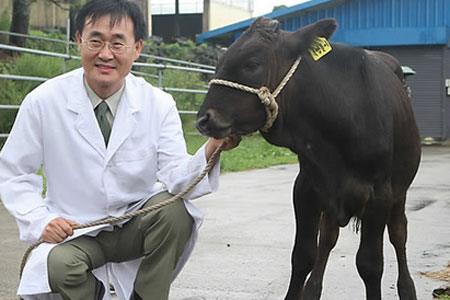
Prof. Park Se-pill of Jeju National University poses with attacker in 2009. Photo: Korea Times file

Prof. Park Se-pill of Jeju National University poses with his attacker in 2009. Photo: Korea Times

Via Slate:

In an event ripped straight of the gothic horror novel Frankenstein, a renowned embryologist was reportedly attacked by one of his cloned creations recently. The beast in this case, though, wasn’t a monster pieced together from the bodies of other animals—no, it was an 800-kilogram, black cow.

“Prof. Park Se-pill at Jeju National University had five of his ribs broken and injured his spine in the Sept. 15 attack,” reports the Korea Times. “Park was video-recording a black cow, which he cloned from species indigenous to Jeju four years ago, and all of a sudden, it charged and attacked him for 15 minutes,” a school official said. The embryologist will need eight weeks of medical treatment for his injuries.

The bovine made headlines in 2009 when Park successfully cloned it using a frozen cell taken from a deceased animal. This means the black cow is, in a sense, a “revival” of the cow that the cell was harvested from. Like a phoenix reborn after it dies—but rather than emerging from ashes, the cow originated from a test-tube.

While Park’s incident is unfortunate, it’s hard not to think of the real life allusions between the attack and Frankenstein. Perhaps if the cow could talk it would have quoted a famous line from the novel in which the monster exclaims to Dr. Frankenstein: “You are my creator, but I am your master—obey!”

Prof. Park is recovering at at Jeju National University and said he wishes to continue his study even if he has to be in a wheelchair. He reported the cow is now in a barn and no special measure will be taken despite the incident. This is some background of Park and his research from the Korea Times article that was cited:

Park has been recognized as one of the world’s leading cloning scientists since 2000 when he successfully took out human stem cell lines from embryos for the third time in history.

In particular, his team developed technologies using frozen eggs for cloning experiments _ the procedure that created the four-year-old cloned cow that gave him global recognition.

Taking advantage of his expertise, Park hoped to become the first scientist to establish stem cell batches from cloned human embryos by 2015 to help cure such degenerative diseases as diabetes and Alzheimer’s.

What Park vies to achieve is the same as what former Seoul National University Prof. Hwang Woo-suk claimed to have done in 2004 and 2005 ㅡ his feats later proved to have been falsified.

The Hwang case prompted the government to ban research with fresh human eggs in response to the ethical debate in the aftermath.

Instead, scientists have had to depend on a roundabout way of thawing frozen ova, typically leftovers after artificial insemination.

The government is unlikely to lift the restriction on the use of fresh eggs, which are deemed most suitable for therapeutic cloning research, in the near future.

Against this backdrop, Park and his team relied on their knowhow of the freeze-and-thaw process to extract stem cell lines from cloned human embryos.