
The Utility of the RussiaGate Conspiracy

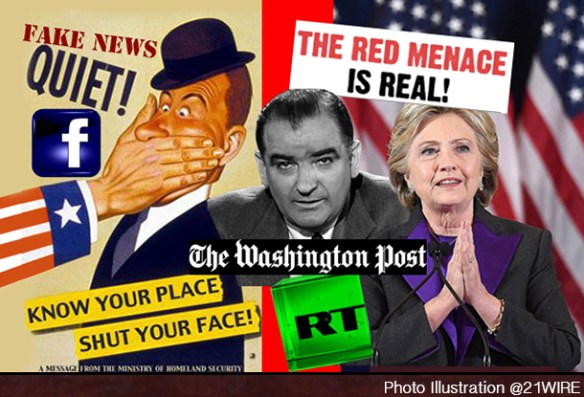
New McCarthyism allows corporate media to tighten grip, Democrats to ignore their own failings

By Alan MacLeod

Source: FAIR

To the shock of many, Donald Trump won the 2016 presidential elections, becoming the 45th president of the United States. Not least shocked were corporate media, and the political establishment more generally; the Princeton Election Consortium confidently predicted an over 99 percent chance of a Clinton victory, while MSNBC’s Rachel Maddow (10/17/16) said it could be a “Goldwater-style landslide.”

Indeed, Hillary Clinton and her team actively attempted to secure a Trump primary victory, assured that he would be the easiest candidate to beat. The Podesta emails show that her team considered even before the primaries that associating Trump with Vladimir Putin and Russia would be a winning strategy and employed the tactic throughout 2016 and beyond.

With Clinton claiming, “Putin would rather have a puppet as president,” Russia was by far the most discussed topic during the presidential debates (FAIR.org, 10/13/16), easily eclipsing healthcare, terrorism, poverty and inequality. Media seized upon the theme, with Paul Krugman (New York Times, 7/22/16) asserting Trump would be a “Siberian candidate,” while ex-CIA Director Michael Hayden (Washington Post, 5/16/16) claimed Trump would be Russia’s “useful fool.”

The day after the election, Jonathan Allen’s book Shattered detailed, Clinton’s team decided that the proliferation of Russian-sponsored “fake news” online was the primary reason for their loss.

Within weeks, the Washington Post (11/24/16) was publicizing the website PropOrNot.com, which purports to help users differentiate sources as fake or genuine, as an invaluable tool in the battle against fake news (FAIR.org, 12/1/16, 12/8/16). The website soberly informs its readers that you see news sources critiquing the “mainstream media,” the EU, NATO, Obama, Clinton, Angela Merkel or other centrists are a telltale sign of Russian propaganda. It also claims that when news sources argue against foreign intervention and war with Russia, that’s evidence that you are reading Kremlin-penned fake news.

PropOrNot claims it has identified over 200 popular websites that “routinely peddle…Russian propaganda.” Included in the list were Wikileaks, Trump-supporting right-wing websites like InfoWars and the Drudge Report, libertarian outlets like the Ron Paul Institute and Antiwar.com, and award-winning anti-Trump (but also Clinton-critical) left-wing sites like TruthDig and Naked Capitalism. Thus it was uniquely news sources that did not lie in the fairway between Clinton Democrats and moderate Republicans that were tarred as propaganda.

PropOrNot calls for an FBI investigation into the news sources listed. Even its creators see the resemblance to a new McCarthyism, as it appears as a frequently asked question on their website. (They say it is not McCarthyism, because “we are not accusing anyone of lawbreaking, treason, or ‘being a member of the Communist Party.’”) However, this new McCarthyism does not stem from the conservative right like before, but from the establishment center.

That the list is so evidently flawed and its creators refuse to reveal their identities or funding did not stop the issue becoming one of the most discussed in mainstream circles. Media talk of fake news sparked organizations like Google, Facebook, Bing and YouTube to change their algorithms, ostensibly to combat it.

However, one major effect of the change has been to hammer progressive outlets that challenge the status quo. The Intercept reported a 19 percent reduction in Google search traffic, AlterNet 63 percent and Democracy Now! 36 percent. Reddit and Twitter deleted thousands of accounts, while in what came to be called the “AdPocalypse,” YouTube began demonetizing videos from independent creators like Majority Report and the Jimmy Dore Show on controversial political topics like environmental protests, war and mass shootings. (In contrast, corporate outlets like CNN did not have their content on those subjects demonetized.) Journalists that questioned aspects of the Russia narrative, like Glenn Greenwald and Aaron Maté, were accused of being agents of the Kremlin (Shadowproof, 7/9/18).

The effect has been to pull away the financial underpinnings of alternative media that question the corporate state and capitalism in general, and to reassert corporate control over communication, something that had been loosened during the election in particular. It also impels liberal journalists to prove their loyalty by employing sufficiently bellicose and anti-Russian rhetoric, lest they also be tarred as Kremlin agents.

When it was reported in February that 13 Russian trolls had been indicted by a US grand jury for sharing and promoting pro-Trump and anti-Clinton memes on Facebook, the response was a general uproar. Multiple senior political figures declared it an “act of war.” Clinton herself described Russian interference as a “cyber 9/11,” while Thomas Friedman said that it was a “Pearl Harbor–scale event.” Morgan Freeman’s viral video, produced by Rob Reiner’s Committee to Investigate Russia, summed up the outrage:  “We have been attacked,” the actor declared; “We are at war with Russia.” Liberals declared Trump’s refusal to react in a sufficiently aggressive manner further proof he was Putin’s puppet.

The McCarthyist wave swept over other politicians that challenged the liberal center. Green Party presidential candidate Jill Stein refused to endorse the Russia narrative, leading mainstream figures like Rachel Maddow to insinuate she was a Kremlin stooge as well. After news broke that Stein’s connection to Russia was being officially investigated, top Clinton staffer Zac Petkanas announced:

Jill Stein is a Russian agent.

Jill Stein is a Russian agent.

Jill Stein is a Russian agent.

Jill Stein is a Russian agent.

Jill Stein is a Russian agent.

Jill Stein is a Russian agent.

Jill Stein is a Russian agent.

Jill Stein is a Russian agent.

“Commentary” that succinctly summed up the political atmosphere.

In contrast, Bernie Sanders has consistently and explicitly endorsed the RussiaGate theory, claiming it is “clear to everyone (except Donald Trump) that Russia was deeply involved in the 2016 election and intends to be involved in 2018.” Despite his stance, Sanders has also been constantly presented as another Russian agent, with the Washington Post (11/12/17) asking its readers, “When Russia interferes with the 2020 election on behalf of Democratic nominee Bernie Sanders, how will liberals respond?” The message is clear: The progressive wave rising across America is and will be a consequence of Russia, not of the failures of the system, nor of the Democrats.

It is not just politicians who have been smeared as Russian agents, witting or unwitting; virtually every major progressive movement challenging the system is increasingly dismissed in the same way. Multiple media outlets, including CNN (6/29/18), Slate (5/11/18), Vox (4/11/18) and the New York Times (2/16/18), have produced articles linking Black Lives Matter to the Kremlin, insinuating the outrage over racist police brutality is another Russian psyop. Others claimed Russia funded the riots in Ferguson and that Russian trolls promoted the Standing Rock environmental protests.

Meanwhile, Democratic insider Neera Tanden retweeted a description of Chelsea Manning as a “Russian stooge,” writing off her campaign for the Senate as “the Kremlin paying the extreme left to swing elections. Remember that.” Thus corporate media are promoting the idea that any challenge to the establishment is likely a Kremlin-funded astroturf effort.

The tactic has spread to Europe as well. After the poisoning of Russian double agent Sergei Skripal, the UK government immediately blamed Russia and imposed sanctions (without publicly presenting evidence). Jeremy Corbyn, the pacifist, leftist leader of the Labour Party, was uncharacteristically bellicose, asserting, “The Russian authorities must be held to account on the basis of the evidence and our response must be both decisive and proportionate.”

The British press was outraged—at Corbyn’s insufficient jingoism. The Sun‘s front page (3/15/18) attacked him as “Putin’s Puppet,” while the Daily Mail (3/15/18) went with “Corbyn the Kremlin Stooge.” As with Sanders, the fact that Corbyn endorsed the official narrative didn’t keep him from being attacked, showing that the conspiratorial mindset seeing Russia behind everything has little to do with evidence-based reality, and is increasingly a tool to demonize the establishment’s political enemies.

The Atlantic Council published a report claiming Greek political parties Syriza and Golden Dawn were not expressions of popular frustration and disillusionment, but “the Kremlin’s Trojan horses,” undermining democracy in its birthplace. Providing scant evidence, the report went on to link virtually every major European political party challenging the center, from right or left, to Putin. From Britian’s UKIP to Spain’s Podemos to Italy’s Five Star Movement, all are charged with being under one man’s control. It is this council that Facebook announced it was partnering with to help promote “trustworthy” news and weed out “untrustworthy” sources (FAIR.org, 5/21/18), as its CEO Mark Zuckerberg met with representatives from some of the largest corporate outlets, like the New York Times, CNN and News Corp, to help develop a system to control what content we see on the website.

The utility of this wave of suspicion is captured in Freeman’s aforementioned video. After asserting that “for 241 years, our democracy has been a shining example to the world of what we can all aspire to”—a tally that would count nearly a century of chattel slavery and almost another hundred years of de jure racial disenfranchisement—the actor explains that “Putin uses social media to spread propaganda and false information, he convinces people in democratic societies to distrust their media, their political process.”

The obvious implication is that the political process and media ought to be trusted, and would be trusted were it not for Putin’s propaganda. It was not the failures of capitalism and the deep inequalities it created that led to widespread popular resentment and movements on both left and right pressing for radical change across Europe and America, but Vladimir Putin himself. In other words, “America is already great.”

For the Democrats, Russiagate allows them to ignore calls for change and not scrutinize why they lost to the most unpopular presidential candidate in history. Since Russia hacked the election, there is no need for introspection, and certainly no need to accommodate the Sanders wing or to engage with progressive challenges from activists on the left, who are Putin’s puppets anyway. The party can continue on the same course, painting over the deep cracks in American society. Similarly, for centrists in Europe, under threat from both left and right, the Russia narrative allows them to sow distrust among the public for any movement challenging the dominant order.

For the state, Russiagate has encouraged liberals to forego their faculties and develop a state-worshiping, conspiratorial mindset in the face of a common, manufactured enemy. Liberal trust in institutions like the FBI has markedly increased since 2016, while liberals also now espouse a neocon foreign policy in Syria, Ukraine and other regions, with many supporting the vast increases in the US military budget and attacking Trump from the right.

For corporate media, too, the disciplining effect of the Russia narrative is highly useful, allowing them to reassert control over the means of communication under the guise of preventing a Russian “fake news” infiltration. News sources that challenge the establishment are censored, defunded or deranked, as corporate sources stoke mistrust of them. Meanwhile, it allows them to portray themselves as arbiters of truth. This strategy has had some success, with Democrats’ trust in media increasing since the election.

None of this is to say that Russia does not strive to influence other countries’ elections, a tactic that the United States has employed even more frequently (NPR, 12/22/16). Yet the extent to which the story has dominated the US media to the detriment of other issues is a remarkable testament to its utility for those in power.
In A Corporatist System Of Government, Corporate Censorship Is State Censorship

By Caitlin Johnstone

Source: CaitlinJohnstone.com

Last year, representatives of Facebook, Twitter, and Google were instructed on the US Senate floor that it is their responsibility to “quell information rebellions” and adopt a “mission statement” expressing their commitment to “prevent the fomenting of discord.”

“Civil wars don’t start with gunshots, they start with words,” the representatives were told. “America’s war with itself has already begun. We all must act now on the social media battlefield to quell information rebellions that can quickly lead to violent confrontations and easily transform us into the Divided States of America.”

Yes, this really happened.

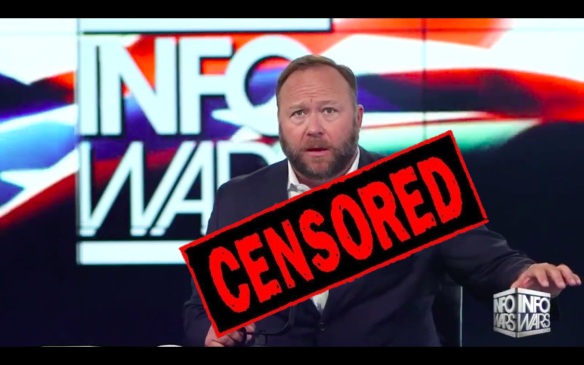
Today [8/7] Twitter has silenced three important anti-war voices on its platform: it has suspended Daniel McAdams, the executive director of the Ron Paul Institute, suspended Scott Horton of the Scott Horton Show, and completely removed the account of prominent Antiwar.com writer Peter Van Buren.

I’m about to talk about the censorship of Alex Jones and Infowars now, so let me get the “blah blah I don’t like Alex Jones” thing out of the way so that my social media notifications aren’t inundated with people saying “Caitlin didn’t say the ‘blah blah I don’t like Alex Jones’ thing!” I shouldn’t have to, because this isn’t actually about Alex Jones, but here it is:

I don’t like Alex Jones. He’s made millions saying the things disgruntled right-wingers want to hear instead of telling the truth; he throws in disinfo with his info, which is the same as lying all the time. He’s made countless false predictions and his sudden sycophantic support for a US president has helped lull the populist right into complacency when they should be holding Trump to his non-interventionist campaign pledges, making him even more worthless than he was prior to 2016.

But this isn’t about defending Alex Jones. He just happens to be the thinnest edge of the wedge.

As of this writing, Infowars has been censored from Facebook, Youtube (which is part of Google), Apple, Spotify, and now even Pinterest, all within hours of each other. This happens to have occurred at the same time Infowars was circulating a petition with tens of thousands of signatures calling on President Trump to pardon WikiLeaks editor-in-chief Julian Assange, who poses a much greater threat to establishment narratives than Alex Jones ever has. Assange’s mother also reports that this mass removal of Infowars’ audience occurred less than 48 hours after she was approached to do an interview by an Infowars producer.

In a corporatist system of government, wherein there is no meaningful separation between corporate power and state power, corporate censorship is state censorship. Because legalized bribery in the form of corporate lobbying and campaign donations has given wealthy Americans the ability to control the US government’s policy and behavior while ordinary Americans have no effective influence whatsoever, the US unquestionably has a corporatist system of government. Large, influential corporations are inseparable from the state, so their use of censorship is inseparable from state censorship.

This is especially true of the vast megacorporations of Silicon Valley, whose extensive ties to US intelligence agencies are well-documented. Once you’re assisting with the construction of the US military’s drone program, receiving grants from the CIA and NSA for mass surveillance, or having your site’s content regulated by NATO’s propaganda arm, you don’t get to pretend you’re a private, independent corporation that is separate from government power. It is possible in the current system to have a normal business worth a few million dollars, but if you want to get to billions of dollars in wealth control in a system where money translates directly to political power, you need to work with existing power structures like the CIA and the Pentagon, or else they’ll work with your competitors instead of you.

And yet every time I point to the dangers of a few Silicon Valley plutocrats controlling all new media political discourse with an iron fist, Democratic Party loyalists all turn into a bunch of hardline free market Ayn Rands. “It’s not censorship!” they exclaim. “It’s a private company and can do whatever it wants with its property!”

They do this because they know their mainstream, plutocrat-friendly “centrist” views will never be censored. Everyone else is on the chopping block, however. Leftist sites have already had their views slashed by a manipulation of Google’s algorithms, and it won’t be long before movements like BDS and Antifa and skeptics of the establishment Syria and Russia narratives can be made to face mass de-platforming on the same exact pretext as Infowars.

This is a setup. Hit the soft target so your oligarch-friendly censorship doesn’t look like what it is, then once you’ve manufactured consent, go on to shut down the rest of dissenting media bit by bit.

Don’t believe that’s the plan? Let’s ask sitting US Senator Chris Murphy:

“Infowars is the tip of a giant iceberg of hate and lies that uses sites like Facebook and YouTube to tear our nation apart,” Murphy tweeted in response to the news. “These companies must do more than take down one website. The survival of our democracy depends on it.”

That sure sounds an awful lot like the warnings issued to the Silicon Valley representatives on the Senate floor at the beginning of this article, no? This is headed somewhere dark.

We’re going to have to find a way to keep the oligarchs from having their cake and eating it too. Either (A) corporations are indeed private organizations separate from the government, in which case the people need to get money out of politics and government agencies out of Silicon Valley so they can start acting like it, and insist that their owners can’t be dragged out on to the Senate floor and instructed on what they can and can’t do with their business, or (B) these new media platforms get treated like the government agencies they function as, and the people get all the First Amendment protection that comes with it. Right now the social engineers are double-dipping in a way that will eventually give the alliance of corporate plutocrats and secretive government agencies the ability to fully control the public’s access to ideas and information.

If they accomplish that, it’s game over for humanity. Any hope of the public empowering itself over the will of a few sociopathic, ecocidal, omnicidal oligarchs will have been successfully quashed. We are playing for all the chips right now. We have to fight this. We have no choice.

Building a Cooperative Economy

By Oliver Sylvester-Bradley

Source: Resilience

In permaculture terms the economy sometimes feels like a segregated monoculture planted with terminator seeds, sprayed with patented pesticides on venture capital backed farms designed to maximise profits in an unsustainable market place full of thieves and cheats. No wonder people prefer to potter in their gardens and allotments – and try to forget the craziness of corporate capitalism!

But no matter how much we try to ignore the corporate machine it ploughs on regardless and at various points in all of our lives we are forced to interact with the unsustainable, greed-based economy whether we like it or not. We all need to travel, buy energy, we like presents and holidays and now we are buying more and more of these goods and services online, from people we do not know.

As local banks close in favour of apps, local taxis are driven out by Uber and the likes of Airbnb and other holiday and comparison websites offer us ‘guaranteed savings’ – the brave new world of digital platforms is being thrust upon us, whether we like it or not.

The dominant form of business in our economy has not changed, but the method of delivery has. Platform businesses which reach further and wider than conventional ‘bricks and mortar’ businesses, that are able to ‘scale up’ and attract customers in their millions are forcing out the smaller players, just like supermarkets killed the traditional garden market. Except these “platform monopolies” are taking things to a new level – often unbeknown to us they’re gathering our data and using sophisticated algorithms to work out how to sell us more things, that quite often we don’t need or want. They’re aggregating data and dissintermediating in ways that we never knew were possible. Uber is valued at over 60 billion dollars but does not own a single taxi…

From monoculture to platform co-ops

To someone practicing permaculture, there is something almost offensive about vast fields where businesses cultivate the same single crop and, in a similar way, the exponents of ‘peer to peer’ and ‘open source’ technologies get equally offended by monolithic platforms that dominate the digital landscape.

Peer to peer, (where individuals share content with other people, rather than relying on centralised servers) and open source software (which is free to use and adapt, without requiring a licence fee) are like the digital community’s own versions of permaculture. They provide a pathway to greater independence, autonomy, diversity and resilience than is offered by the dominant system.

David Holmgreen’s ideas about creating small scale, copyable, adaptable solutions which have the power to change the world by creating decentralised, diverse, and more resilient systems have huge parallels with open source, collaborative software projects, which are developing as a response to the monolithic, proprietary and profit driven enclosures that dominate today’s Internet.

The end goal of this work is to create ‘platform cooperatives’, as alternatives to the venture capital backed platforms. Platform cooperatives that are member owned and democratically controlled – allowing everyone that is affected by the business, be they customers, suppliers, workers or investors, a say in how the business is run and managed. Co-ops are an inherently different form of organisation than Limited or Public companies, which place community before profit, hence have entirely different principles than their corporate rivals. For this reason they are more resilient in downturns, more responsible to their communities and environments and more effective at delivering real (not just financial) value to everyone they interact with.

Platform co-ops provide a template for a new kind of economy built on trust, mutual aid and respect for nature and community. By placing ownership firmly in the hands of the people and applying democratic forms of governance they offer a legitimate alternative to the defacto form of business. There are several platform co-ops that already provide comparable, and often better services than their corporate rivals and with more support others will continue to develop.

On 26 and 27 July the OPEN 2018 conference at Conway Hall in London will showcase platform co-ops such as The Open Food Network – which is linking up local food producers and consumers through Europe, Resonate – the music streaming co-op, and SMart from Belgium which provides support for a network of thousands of freelancers throughout Europe. The beginnings of a viable, self-supporting and sustainable economy are stating to emerge and OPEN 2018, along with similar events in the US and across Europe, is bringing together the people with the ideas, the tech developers and the legal experts to help catalyse the transition.

Shared values and the network effect

There are so many similarities between permaculture’s philosophy and principles and the works of other progressive groups that hope to encourage a more sustainable, more resilient and equitable future. From Occupy to Open sourcePermaculture to Peer to Peer and Collaborative Technology to the Commons Transition groups there are clearly overlapping values.

David Bollier, writing on the Peer to Peer Foundation blog has suggested that “…permaculturists and commoners need to connect more and learn from each other…” and the idea that these communities are ultimately working towards the same objective seems especially important to recognise if we are to accelerate the development of a more sustainable world.

There is already an evolving “shared narrative” between these various, disparate initiatives, but it is often sidelined by our self-selecting filters which lead us back into the communities we know and trust. Collaboration and cooperation can be hard work and as groups get bigger they can become harder still but that’s no reason not to try. The fact that Wikipedia provides a better encyclopaedia for free in more languages than Britannica ever managed proves that online, open source collaboration can deliver greater value than proprietary, closed source systems.

The true value of a collaborative, open networks only really manifests when its members communicate, and work together, through connected systems. Sharing ideas, discussing problems and addressing challenges in larger networks creates positive feedback loops via the network effect – a term which describes how the value of something increases in proportion to the number of people using it (like a phone, or social media network) – something all the various ethical and progressive networks could benefit from enormously.

Parallels between collaborative, open source software development and permaculture principles:

1. Observe and interact

Progressive software projects often utilise ‘user focused’ design strategies to ensure they meet people’s needs. Taking time to understand how users interact with software systems via user experience testing groups and an ongoing, iterative design processes are recognised to deliver higher quality solutions which suit specific user needs.

2. Catch and store energy

Peer to peer networks don’t rely on centralised servers but instead make use of the latent capacity of other user’s machines. Imagine how much more efficient it would be than deploying huge server farms if our computers were not shut off at night, or left idle, when they could be providing valuable processing power for others. The Holochain project aims to make it simple and secure for anyone to join a truly peer to peer network and to share files and processing power in this way – and to even earn credits for hosting other people’s files and applications.

3. Obtain a yield

The Peer Production License provides a means by which open source developers can make the code they develop available for free and still benefit from it’s use. Sites like the Internet of Ownership, which contains a directory of cooperative platforms use the PPL to “permit reuse exclusively for non-commercial and worker-owned enterprises” thereby helping to grow the commons. The ultimate goal of the PPL is to enable mechanisms so commoners can support themselves and ensure their own social reproduction without resorting to capitalism.

4. Apply self-regulation and accept feedback

This principle is particularly integral to open source development since the concepts of ‘user focussed’ and ‘agile development’, ‘branching’ and ‘forking’ are all designed to ensure that software projects are self-regulating by listening to the users needs, driven by user feedback and that they are able to be adapted to changing needs.

5. Use and value renewable resources and services

Open source technology is inherently more renewable in the way it enables the reuse and repackaging of code for new purposes. Ethically minded hosts and developers such as Green Net power their servers with renewable energy.

6. Produce no waste

As above, open source code is often re-used and repurposed but progressive developers still have a lot to gain from better collaboration. There are often multiple teams working on identical problems and ideas and whilst this has benefits in terms of developing strength and resilience through diversity it also leads to waste, mainly in terms of time. At least the waste ‘product’ of web development is only digital and so old technology and code doesn’t littler the streets or pollute the environment as much as physical products can, especially if archives are stored on renewably powered servers.

7. Design from patterns to details

Genuine online collaboration has been slow to evolve, with the best examples being Linux (the open source operating system), Firefox, the open source web browser and Wikipedia, the open source encyclopaedia. It is only recently, with the rise of monolithic capitalist gardens such as Google and Facebook and Amazon that the hive mind of the internet is recognising the need to step back and redesign its systems according to new patterns. The push for “Net neutrality” and Tim Berners-Lee’s Solid project are examples of this in action as is the Holo project, a very exciting and truly peer to peer “community of passionate humans building a distributed cloud, owned and run by users like you and me.”

8. Integrate rather than segregate

The move from centralised to decentralised, to distributed and federated technology is a a key element of open source and collaborative technology design. The entire Peer to Peer philosophy is based on the recognition that the connections and relationships between nodes (people or computers) in a network is what gives it strength and value. Collaborative technologists still have a lot to gain from developing deeper and wider integrations, like we see in nature, and which permaculturists know so well.

9. Use small and slow solutions

Designing a computer system to be slow is not something you will normally (ever?) hear a programmer talk about but they often talk about small, in many guises. Small packages (of code), small apps, “minified” (meaning compressed) code and even small computers, like the Raspberry Pi are key features of collaborative technology which all aim for increased efficiency.

10. Use and value diversity

Diversity is intrinsic to open source and collaborative technology. The plurality and adaptability of open source solutions ensures a highly diverse ecosystem. Users are free to adapt open source code to their needs and the open nature of most open source projects values contributions from anyone, irrespective of race, gender, age or any other factor. It is true that the majority of contributors to open source projects are normally young, white and male but the reasons for that seem more to do with societal inequalities and stereotypes rather than any specific prejudices or practices.

11. Use edges and value the marginal

The explanation of this principle places most value on “the interface between things…” and this is a central component of web design. Web services have now realised the necessity of providing intuitive user interfaces, to allow users to navigate complex data and to investigate deeper informational relationships but, more interestingly the latest developments in linked open data enable users to interface with more specific, more granular and more timely data to provide increase value. The Internet Of Things will facilitate a massive increase in the number and type of products which can interact over the internet. Whilst it is not the norm, drawing diverse information from the edges and valuing the marginal is something the open internet can really facilitate.

12. Creatively use and response to change

Most open source, collaborative projects use some kind of agile development, which advocates adaptive planning, evolutionary development, early delivery, and continuous improvement, and encourages rapid and flexible response to change. Permaculture and open source see eye to eye on this principle which bodes very well for a growing, symbiotic relationship in our rapidly evolving world.

The Bizarre Facebook Path to Corporate Fascism

By Glen Ford

Source: Black Agenda Report

“The Facebook intervention is a qualitative escalation of the McCarthyite offensive.”

Facebook has assumed additional political police powers, disrupting a planned counter-demonstration against white supremacists, set for August 12th in Washington, on the grounds that it was initiated and inspired by “Russians” as part of a Kremlin campaign to “sow dissention” in the U.S. The Facebook intervention is a qualitative escalation of the McCarthyite offensive launched by the Democrat Party and elements of the national security state, and backed by most of the corporate media, initially to blame Hillary Clinton’s 2016 defeat on “collusion” between Wikileaks, “the Russians” and the Trump campaign to steal and publicize embarrassing Clinton campaign emails.

After failing to produce one shred of hard evidence to support their conspiracy theory, the anti-Russia hysteria mongers switched gears, focusing on the alleged purchase of about $100,000 in Facebook ads by the Internet Research Agency (IRA), a St. Petersburg-based Russian company, over a multi-year period. The problem was, most of the ads had no direct connection to the presidential contest, or were posted after the election was over, and many had no political content, at all. The messages were all over the place, politically, with the alleged Russian operatives posing as Christian activists, pro- and anti-immigration activists, and supporters of the Black Lives Matter Movement. Special prosecutor Robert Mueller was forced to flip the scriptindicting 13 Russians for promoting general “discord” and undermining “public confidence in democracy” in the United States – thus creating a political crime that has not previously been codified in the United States.

In doubling down on an unraveling conspiracy tale, the Mueller probe empowered itself to tar and feather all controversial speech that can be associated with utterances by “Russians,” even if the alleged “Russians” are, in fact, mimicking the normal speech of left- or right-wing Americans — a descent, not into Orwell’s world, but that of Kafka (Beyond the Law) and Heller (Catch-22).

Facebook this week announced that it had taken down 32 pages and accounts that had engaged in “coordinated and inauthentic behavior” in promoting the August 12 counter-demonstration against the same white supremacists that staged the fatal “Unite the Right” demonstrations in Charlottesville, Virginia, a year ago. Hundreds of anti-racists had indicated their intention to rally against “Unite the Right 2.0” under the banner of Shut It Down DC, which includes D.C. Antifascist Collective, Black Lives Matter D.C., Hoods4Justice, Resist This, and other local groups.

Facebook did not contend that these anti-racists’ behavior was “inauthentic,” but that the first ad for the event was purchased by a group calling itself “Resisters” that Facebook believes were behaving much like the Internet Research Agency. “At this point in our investigation, we do not have enough technical evidence to state definitively who is behind it,” said Nathaniel Gleicher, Facebook’s head of cybersecurity policy . “But we can say that these accounts engaged in some similar activity and have connected with known I.R.A accounts.”

Chelsea Manning, whose prison sentence for sending secret documents to Wikileaks was commuted by President Obama, said the counter-protest was “organic and authentic”and that activists had begun organizing several months ago. “Folks from D.C. and Charlottesville have been talking about this since at least February,” Manning told The New York Times.

“This was a legitimate Facebook event that was being organized by Washington, D.C. locals,” says Dylan Petrohilos, of Resist This. Petrohilos was one of the defendants in the Trump inauguration “riot” prosecutions. He protested Facebook’s disruption of legitimate free speech and assembly. “DC organizers had controlled the messaging on the no UTR fb page and now FB made it harder for grassroots people to organize,” he tweeted. The organizers insist the August 12 counter-demonstration — “No Unite the Right 2 – DC” — is still a go, as is the white supremacist rally.

Whoever was first to buy a Facebook ad — the suspected Russian “Resisters,” or Workers Against Racism, who told the Daily Beast they decided to host their own anti-“Unite the Right 2.0” event because they thought “Resisters” was an “inexperienced liberal organizer” – there was no doubt whatsoever that the white supremacists would be confronted by much larger numbers of counter-demonstrators, in Washington. Nobody in Russia needed to tell U.S. anti-racists to shut the white supremacists down, or vice versa. The Russians didn’t invent American white supremacy, or the native opposition to it. Even if Mueller, Facebook, the Democratic Party and the howling corporate media mob are to be believed, the “Russians” are simply mimicking U.S. political rhetoric and sloganeeriing – and weakly, at that. The Workers Against Racism thought the “Resisters” weren’t worth partnering with, but that the racist rally must be countered. The Shut It Down DC coalition didn’t need the “Resisters” to crystallize their thinking on white supremacism.

The Democratic Party and corporate media, speaking for most of the U.S. ruling class — and actually bullying one of its top oligarchs, Mark Zuckerberg — is on its own bizarre and twisted road to fascism. (Donald Trump’s proto-fascism is the old fashioned, all-American type that the white supremacists want to celebrate on August 12.) With former FBI Director Robert Mueller at the head of the pack, they have created a pseudo legal doctrine whereby “Russians” (or U.S. spooks pretending to be Russians) can be indicted for launching a #MeToo campaign of mimicry, echoing the rhetoric and memes indigenous to U.S. political struggles, while the genuine, “authentic” American political voices — the people who are being mimicked — are labeled co-conspirators in a foreign-based “plot,” and their rights to speech and assembly are trashed.

That’s truly crazy, but devilishly clever, too. If “Russian” mimics (or cloaked spooks) can reproduce the vocabulary and political program of U.S. dissent, then all of us actual U.S. lefties can be dismissed as “dupes of the Russians” or “co-conspirators” in the speech crimes of our mimics — for sounding like ourselves.


BAR executive editor Glen Ford can be contacted at Glen.Ford@BlackAgendaReport.com.

Jeff Bezos’ Paper Tells You Not to Worry About Those Billionaires

By Dean Baker

Source: FAIR

Just when you thought economic commentary in the Washington Post couldn’t get any more insipid, Roger Lowenstein proves otherwise. In a business section “perspective” (7/20/18), he tells readers:

But what if inequality is the wrong metric. Herewith a modest proposition: economic inequality is not the best yardstick. What we should be paying attention to is social mobility.

Wow, what a novel idea, as though right-wingers have not been pushing this line since the dawn of time: “Don’t worry that your standard of living is awful, the important thing is that your kids will be able to get rich.” (It doesn’t help his story that his poster child for the rich being good is Lloyd Blankfein, who made his fortune shuffling financial assets at Goldman Sachs, and benefited from a massive government bailout.)

But let’s be generous, and try to take Lowenstein’s story seriously. He goes on: “Rising inequality, although a fact, is also very hard to find a culprit for. Not that economists haven’t tried.”

Really? There are plenty of really good explanations for rising inequality, many of which are in my (free) book Rigged. I suppose in the Age of Trump, it is appropriate that the Post has a business columnist determined to flaunt his ignorance.

But then we get the real payday:

It’s also far from proved—to me, it’s not even intuitive—that high incomes on Wall Street and elsewhere are the reason for, say, flatter wages in manufacturing. The fact that Mark Zuckerberg is so rich is annoying, and his separateness from Main Street may not be a great thing socially, but in an economic sense, his fortune did not “come from” the paychecks of ordinary workers.

OK, let’s explain this one so that even someone profoundly ignorant of economics can understand. Suppose that someone, we’ll call them Jeff Bezos or Mark Zuckerberg, were really good at printing counterfeit bills. Imagine that they printed up trillions of these counterfeit bills. This would make them incredibly rich, if they could get away with it. But, as Lowenstein says, how does this make anyone else worse off?

While Lowenstein doesn’t see any problem with our incredibly rich counterfeiters, in the real world, we have the problem that they are creating demand for goods and services with their consumption. If the economy is below full employment, this would be good news, since any source of demand will generate more output and jobs. However, if we are near full employment, or the Federal Reserve Board thinks we are near full employment, then this demand comes at the expense of the paychecks of ordinary workers.

Prices like house prices and rents are driven up by our counterfeiters and the demand created by their servants. The Fed raises interest rates to slow growth and employment, and lessen the ability of ordinary workers to get pay increases, since the labor market will be weaker.

Now, folks may object that Bezos and Zuckerberg are not like counterfeiters; they actually generate value for the economy. While this undoubtedly partly true, it is also the case that much of Bezos’ wealth came from avoiding the requirement that retailers collect state and local sales taxes. Zuckerberg’s wealth came from control of a monopoly platform, and Blankfein’s wealth came from running a too-big-to-fail institution with friends in high places.

Insofar as people get incredibly wealthy from being successful in earning rents at the expense of others in the economy, rather than generating wealth, they are very much like counterfeiters. Furthermore, since productivity has been growing at an incredibly slow rate for the last dozen years (just over 1.0 percent annually), it seems in aggregate that these incredibly rich folks are much better at generating wealth for themselves than for the economy as a whole. This makes the rent-seeker story look very plausible.

While Lowenstein’s plea for greater mobility is about as old as capitalism and has been incredibly unsuccessful, let me propose something considerably more original that you probably won’t see in the Washington Post. Since we have so completely bombed at providing anything like equal opportunity, and no serious person can think this is about to change in the decades ahead, how about we structure our economy so that it makes less difference whether someone ends up at the top end, like Jeff Bezos, or at the bottom, earning the minimum wage?

That one is almost certainly far too simple for the great minds to ever consider.

Western Elites Decrying ‘Populism’ Betrays Fear of Democracy

By Finian Cunningham

Source: Strategic Culture Foundation

A new dreaded word has entered into official Western media speak: “Populism”. Political parties and governments which are deemed to be illegitimate are invariably labeled with the prefix “populist”. There is a vague implication that “populist” parties are imbued with disreputable politics of xenophobia, racism, nationalism and even fascism.

But who is doing the “deeming” here? It is establishment political parties and politicians who have the advantage of establishment news media organizations conveying their words and terminology.

Take French President Emmanuel Macron. He may have coined a new political party, En Marche, but he is nevertheless a politician very much of the prevailing Western establishment. He is pro-European Union as it currently operates, albeit with reforming tweaks; he is pro-NATO, pro-Atlanticist; and pro-neoliberal economic policies.

Recently, Macron decried the rise of “populist” parties across Europe. He compared them to the spread of “leprosy” and claimed they were posing a morbid threat to the conventional order of politics. Macron was referring in particular to the new coalition government in Italy, comprising the anti-establishment Five Star Movement and the League.

The French leader could also have been referring to any number of governments as seen in Austria, Hungary and other Central European states which, like the new Italian government, have challenged the EU’s official stance overEU irregular migration into the bloc.

In this context, the word “populist” as used by Macron and other establishment politicians has the connotation of “racist” or “inhumane” owing to the opposition towards the uncontrolled influx of people from outside Europe.

The “populist” prefix is often used alongside the term “far-right”. Again, the implication is that somehow the largely newcomer parties are something that should be abhorred because they are tarnished with alleged proclivities towards fascism and authoritarianism.

To reinforce that implied demonization, it is often cited by Western establishment politicians and media that the “populist” parties in Europe are aligned with Russian President Vladimir Putin, if not stealthily bankrolled by the Kremlin.

American President Donald Trump also qualifies as “populist” according to the US political and media establishment. Again, the word is loaded to infer a uniquely noxious quality in the Trump presidency and his supporters, in the same way that Democrat presidential rival Hillary Clinton once haughtily denigrated Trump and his voter base as “deplorable”. It’s a way of sanitizing the establishment from any past, and far greater, sins.

The P-word does not always mean “rightwing nationalism”. The recent elected Mexican President, Andrés Manuel Lopez Obrador, has been described in Western media as a “leftwing populist”.

In Italy, the main ruling coalition party, the Five Star Movement, headed by Luigi Di Maio, is associated with leftwing social policy.

Parties and politicians deemed to be “populist” are eclectic and defy an easy categorization, as their detractors would perhaps like to assign them. Certainly, there is a strong common stance of being opposed to uncontrolled immigration. But it is too simplistic to explain such a stance as merely xenophobic or racist.

There are legitimate and reasonable concerns that the issue of large-scale immigration has been exploited by ruling establishments and their ideological backers as a way to undermine national sovereignty and workers’ rights, from the consequent lowering of wages and employment conditions.

There is also the legitimate concern in Europe that the migration phenomenon has been largely created by illegal wars pursued by the US and its European NATO allies. Why should European member states and ordinary taxpayers have to incur financial and cultural integration problems that have been largely manufactured by ruling elites who have never been held to account for their criminal wars?

So-called populist parties are also opposed to the seemingly slavish adherence by the European political establishment to neoliberal capitalism. There is a legitimate popular backlash to economic policies which are oppressive and destructive, and whose sole priority seems to be satisfying the profits of Big Business and transnational capital. Why should European governments be held in hock to fiscal rules and debt limitations set arbitrarily by institutions seemingly under the diktat of private banks?

There are several fundamental issues that form a groundswell of popular opposition towards the conventional ways of governance, both in Europe and the US. The failings of neoliberal capitalism and its rich-get-richer racket is surely top of the grievance list. So too is relentless, irrational militarism by Western governments, unleashing illegal wars and massive refugee problems, as well as stoking unnecessary hostility towards other powers like Russia, China, Iran and North Korea.

The conventional politics, that is, the ruling establishments and their dutiful news media, are increasingly seen as incompetent, if not bankrupt. The establishment across Western countries has lost legitimacy and “moral authority” in the eyes of masses of people. That dwindling authority of the ruling class in Western states is the real, morbid concern.

One factor for this is the growth of global communications and “alternative” media sources, which Western publics are availing of to inform themselves independently from the old information monopolies that served the established order. That is why the “problem” of alleged “Russian influence” has been invented. In a desperate gambit to distract the masses from noticing the real problem, which is the crumbling of legitimacy for the Western establishment and its obedient political parties.

The looming fear among the ruling order is the ever-growing dissent among the populace. It is a fear of their own inherent failing and impending doom in the face of democratic challenge to power.

It is not so much that Trump or the new Italian government or Hungarian leader Viktor Orban, and so on, represent a vanguard for renewed democracy. These changes are merely symptoms of a deeper popular opposition to the established way of conducting politics – the order that has prevailed for most of the seven-decade period following the Second World War.

There has always been a wariness among ruling elites on both sides of the Atlantic towards a genuine democratic order breaking out, as Noam Chomsky discusses in his book ‘Deterring Democracy’. Western elites have typically viewed the masses as “rabble rousers” who are deemed to be “incapable” of governing society in the “proper way” that benefits the elites, protects their profits and property, and safeguards their imperial war-making overseas.

This underlying tension about the control of political power in Western societies encapsulates the present historical juncture where the word “populist” is being increasingly deployed. It is a term of disparagement by a failing Western establishment. What the failed order is trying to do is divert genuine popular challenge by painting it as something uncouth, vulgar, noxious, or manipulated by foreign enemies like Russia.

As American political analyst Randy Martin notes: “Populism is a convenient term for those in power who seek to isolate those who would want to share, or worse, take that power.”

When you think of the original meaning of the word – “the people” – it is starkly revealing what is really at stake for those elites who wield the “populist” term as a disparagement.

This Viral ‘Feel-Good’ Story Is Actually an Indictment of American Labor Hell

By Luke O’Neil

Source: Observer

In what’s quickly become the feel-good story of the week, a young Alabama man named Walter Carr is being lauded across the country for his perseverance and indomitable spirit. It’s the type of story that can instill hope in a divided nation when it’s sorely needed and serve as inspiration for the rest of us that if you work hard enough and keep a positive attitude, good things will come to you. It also happens to be disgusting horse shit and an utter indictment of the brutal, indifferent hell of the nightmare capitalist wasteland we all suffer in. So, a bit of a mixed bag here. 

Carr, a 20-year-old college student, as nearly every news outlet has pointed out in sepia-tinted coverage—from CBS News and USA Today to the BBC—was set to start a new job on Saturday morning with the moving company Bellhops. At the last minute, his car broke down, and he was unable to find a ride from friends to get there. Instead, he decided to walk. He began the trek, which was roughly 20 miles from his home, at midnight, hoping to get there by 8 a.m. the next day to meet the rest of the movers. 

“I didn’t want to defeat myself,” Carr later told ABC News.

Along the way, around 4 a.m. in the morning, Carr, a young person of color, was stopped by local police officers, who, out of the kindness of their hearts, no doubt, asked him where he was headed. When he explained the situation—and after his story checked out—they decided to give him a ride the rest of the way, even going so far as to take him to breakfast.

“He was very polite. It was ‘yes sir’ and ‘no sir,”’ one of the officers later said. I bet he was!

When he arrived at the moving job a few hours later, complete with police escort, they explained the situation to Jenny Lamey, the woman who had hired the movers. Inspired by Carr’s work ethic and apparent decency, she shared the story on Facebook, where it soon went viral. 

The story eventually came to the attention of Bellhops CEO Luke Marklin, who arranged to meet Carr a few days later for a big surprise. 

“This is how you pay it forward… treat your employees with respect and incentivize them and bet you’ll get a much better worker for it,” wrote one commenter on Twitter. “It is awesome to see a young man not make an excuse like it’s too far to go to work, and then see him rewarded for it. Wish the young man and the company all the best in the future,” added another. 

It’s enough to drive you to tears. What kind of tears those are will probably depend on how susceptible you are to the lie at the heart of American capitalism and Horatio Alger nonsense.

Carr who set out the night before with a kitchen knife to protect against stray dogs on the walk, as he explained to The Washington Post, nonetheless floored everyone he encountered along the way. 

“He’s such a humble, kindhearted person,” Lamey said. “He’s really incredible. He said it was the way he was raised.”

“We set a really high bar for heart and grit and… you just blew it away,” Marklin told him, after gifting Carr his 2014 Ford Escape (barely-driven! as alabama.com reported). 

A GoFundMe set up by Lamey to help Carr with his car troubles has since raised almost $40,000. 

“Nothing is impossible unless you say it’s impossible,” she told the Post. 

Nothing except for paying workers an actual salary with benefits, which, you may not be surprised to hear, Bellhops does not do. Essentially Uber for movers, (Marklin came to the company from Uber), Bellhops relies on the labor of young college students, like Carr, who take jobs on a gig-by-gig basis. The company, which operates in dozens of cities around the country, and has raised tens of millions of dollars in rounds of funding since it was founded in 2011, pays movers between $13-16 an hour. 

“It’s a transitional job,” CEO Cameron Doody told BuzzFeed News in a story from 2015. “It’s not a career.”

Alabama, incidentally, is also only one of five states that has traditionally never spent any state money on public transportation. 

Naturally, Bellhops are very proud of themselves, and have been reveling in the attention. You probably didn’t know the company existed before yesterday, and may be thinking about contracting their services in the future now. Win win. 

“I want people to know this—no matter what the challenge is, you can break through the challenge,” Carr, who also wants to become a Marine some day, said of his story. 

“Nothing is impossible unless you make it impossible,” he added. “You can do anything you set your mind to. I’ve got God by my side. I’m really emotional right now trying to hold back the tears.”

It’s a heartwarming reminder that, much like with getting sick or injured in America, which needs to be done in a tragic but endearing enough way to go viral so people will pay your medical bills, all you have to do to make it in this beautiful country is have your life fall apart in such a way that the news wants to write about it, then hope the benign feudal lords will see fit to offer you as an aspirational example to the rest of us so we remain compliant.

Moon-Strzok No More, Lisa Page Spills the Beans

The meaning of a crucial text message between two FBI officials appears to have been finally explained, and it’s not good news for the Russia-gate faithful, as Ray McGovern explains.

By Ray McGovern

Source: Consortium News

Former FBI attorney Lisa Page has reportedly told a joint committee of the House of Representatives that when FBI counterintelligence official Peter Strzok texted her on May 19, 2017 saying there was “no big there there,” he meant there was no evidence of collusion between the Trump campaign and Russia.

It was clearly a bad-luck day for Strzok, when on Friday the 13th this month Page gave her explanation of the text to the House Judiciary and Oversight/Government Reform Committees and in effect threw her lover, Strzok, under the bus.

Strzok’s apparent admission to Page about there being “no big there there” was reported on Friday by John Solomon in the Opinion section of The Hill based on multiple sources who he said were present during Page’s closed door interview.

Strzok’s text did not come out of the blue. For the previous ten months he and his FBI subordinates had been trying every-which-way to ferret out some “there” — preferably a big “there” — but had failed miserably. If Solomon’s sources are accurate, it is appearing more and more likely that there was nothing left for them to do but to make it up out of whole cloth, with the baton then passed to special counsel Robert Mueller.

The “no there there” text came just two days after former FBI Director James Comey succeeded in getting his friend Mueller appointed to investigate the alleged collusion that Strzok was all but certain wasn’t there.

Robert Parry, the late founder and editor of Consortium News whom Solomon described to me last year as his model for journalistic courage and professionalism, was already able to discern as early as March 2017 the outlines of what is now Deep State-gate, and, typically, was the first to dare report on its implications.

Parry’s article, written two and a half months before Strzok texted the self-incriminating comment to Page on there being “no big there there,” is a case study in professional journalism. His very first sentence entirely anticipated Strzok’s text: “The hysteria over ‘Russia-gate’ continues to grow … but at its core there may be no there there.”(Emphasis added.)

As for “witch-hunts,” Bob and others at Consortiumnews.com, who didn’t succumb to the virulent HWHW (Hillary Would Have Won) virus, and refused to slurp the Kool-Aid offered at the deep Deep State trough, have come close to being burned at the stake — virtually. Typically, Bob stuck to his guns: he ran an organ (now vestigial in most Establishment publications) that sifted through and digested actual evidence and expelled drivel out the other end.

Those of us following the example set by Bob Parry are still taking a lot of incoming fire — including from folks on formerly serious — even progressive — websites. Nor do we expect a cease-fire now, even with Page’s statement (about which, ten days after her interview, the Establishment media keep a timorous silence). Far too much is at stake.

As Mark Twain put it, “It is easier to fool people than to convince them that they have been fooled.” And, as we have seen over the past couple of years, that goes in spades for “Russia-gate.” For many of us who have looked into it objectively and written about it dispassionately, we are aware, that on this issue, we are looked upon as being in sync with President Donald Trump.

Blind hatred for the man seems to thwart any acknowledgment that he could ever be right about something—anything. This brings considerable awkwardness. Chalk it up to the price of pursuing the truth, no matter what bedfellows you end up with.

Courage at The Hill 

Solomon’s article merits a careful read, in toto. Here are the most germane paragraphs:

“It turns out that what Strzok and Lisa Page were really doing that day [May 19, 2017] was debating whether they should stay with the FBI and try to rise through the ranks to the level of an assistant director (AD) or join Mueller’s special counsel team. [Page has since left the FBI.]

“‘Who gives a f*ck, one more AD [Assistant Director] like [redacted] or whoever?’” Strzok wrote, weighing the merits of promotion, before apparently suggesting what would be a more attractive role: ‘An investigation leading to impeachment?’ …

“A few minutes later Strzok texted his own handicap of the Russia evidence: ‘You and I both know the odds are nothing. If I thought it was likely, I’d be there no question. I hesitate in part because of my gut sense and concern there’s no big there there.’

“So the FBI agents who helped drive the Russia collusion narrative — as well as Rosenstein’s decision to appoint Mueller — apparently knew all along that the evidence was going to lead to ‘nothing’ and, yet, they proceeded because they thought there was still a possibility of impeachment.”

Solomon adds: “How concerned you are by this conduct is almost certainly affected by your love or hatred for Trump. But put yourself for a second in the hot seat of an investigation by the same FBI cast of characters: You are under investigation for a crime the agents don’t think occurred, but the investigation still advances because the desired outcome is to get you fired from your job. Is that an FBI you can live with?”

The Timing

As noted, Strzok’s text was written two days after Mueller was appointed on May 17, 2017. The day before, on May 16,The New York Times published a story that Comey leaked to it through an intermediary that was expressly designed (as Comey admitted in Congressional testimony three weeks later) to lead to the appointment of a special prosecutor to investigate collusion between the Trump campaign and Russia. Hmmmmm.

Had Strzok forgotten to tell his boss that after ten months of his best investigative efforts — legal and other—he could find no “there there”?

Comey’s leak, by the way, was about alleged pressure from Trump on Comey to go easy on Gen. Michael Flynn for lying at an impromptu interrogation led by — you guessed it — the ubiquitous, indispensable Peter Strzok.

In any event, the operation worked like a charm — at least at first. And — absent revelation of the Strzok-Page texts — it might well have continued to succeed. After Deputy Attorney General Rod Rosenstein named Mueller, one of Comey’s best buddies, to be special counsel, Mueller, in turn, picked Strzok to lead the Russia-gate team, until the summer, when the Department of Justice Inspector General was given the Strzok-Page texts and refused to sit on them.

A Timeline

Here’s a timeline, which might be helpful:

2017

May 16: Comey leak to NY Times to get a special counsel appointed

May 17: Special counsel appointed — namely, Robert Mueller.

May 19: Strzok confides to girlfriend Page, “No big there there.”

July: Mueller appoints Strzok lead FBI Agent on collusion investigation.

August: Mueller removes Strzok after learning of his anti-Trump texts to Page.

Dec. 12: DOJ IG releases some, but by no means all, relevant Strzok-Page texts to Congress and the media, which firstreports on Strzok’s removal in August.

2018

June 14: DOJ IG Report Published.

June 15; Strzok escorted out of FBI Headquarters.

June 21: Attorney General Jeff Sessions announces Strzok has lost his security clearances.

July 12: Strzok testifies to House committees. Solomon reports he refused to answer question about the “there there” text.

July 13: Lisa Page interviewed by same committees. Answers the question.

Earlier: Bob Parry in Action

On December 12, 2017, as soon as first news broke of the Strzok-Page texts, Bob Parry and I compared notes by phone. We agreed that this was quite big and that, clearly, Russia-gate had begun to morph into something like FBI-gate. It was rare for Bob to call me before he wrote; in retrospect, it seemed to have been merely a sanity check.

The piece Bob posted early the following morning was typical Bob. Many of those who click on the link will be surprised that, last December, he already had pieced together most of the story. Sadly, it turned out to be Bob’s last substantive piece before he fell seriously ill. Earlier last year he had successfully shot downother Russia-gate-related canards on which he found Establishment media sorely lacking — “Facebook-gate,” for example.

Remarkably, it has taken another half-year for Congress and the media to address — haltingly — the significance of Deep State-gate — however easy it has become to dissect the plot, and identify the main plotters. With Bob having prepared the way with his Dec.13 article, I followed up a few weeks later with “The FBI Hand Behind Russia-gate,” in the process winning no friends among those still suffering from the highly resistant HWHW virus.

VIPS

Parry also deserves credit for his recognition and appreciation of the unique expertise and analytical integrity among Veteran Intelligence Professionals for Sanity (VIPS) and giving us a secure, well respected home at Consortium News.

It is almost exactly a year since Bob took a whole lot of flak for publishing what quickly became VIPS’ most controversial, and at the same time perhaps most important, Memorandum For the President; namely, “Intelligence Veterans Challenge ‘Russia Hack’ Evidence.”

Critics have landed no serious blows on the key judgments of that Memorandum, which rely largely on the type of forensic evidence that Comey failed to ensure was done by his FBI because the Bureau never seized the DNC server. Still more forensic evidence has become available over recent months soon to be revealed on Consortium News, confirming our conclusions.