ILLUSION & TRUTH: THE DISINTEGRATION OF METAPHYSICAL VALUES

Little rabbit in a magician hat.

By Kingsley L. Dennis

Source: Waking Times

“Yes, the world is an illusion. But Truth is always being shown there.” ~Idries Shah, The Dermis Probe.

It seems that we can talk about consciousness and consciousness studies so long as it remains within the ‘reality remit’ and does not push against the ‘barriers of perception.’ This is why so much of our modern societies and the media marketplace are filled with pop-spirituality as they function as cultural remedies rather than revolutions. That is, they provide a band aid plaster rather than seeking to find a permanent cure. Many easy ‘self-help’ practices offer a ‘false exit’ revolving door so that people are given the sensation of finding a way out of the ‘system’ only to be brought back into it again. Such teachings or offerings act as auto-tranquilizers – they act as auto-tranquilizing mechanisms to provide an alternative treatment, or pleasing sensation, that appears as fringe or ‘outside’ the system but is not. Rather, it is another sub-set within the overall program; but a subset that does not constitute a threat or provide a means to perceive through the programmed reality set. In other words, it is an allowed anomaly.

The ‘allowed anomalies’ are examples of mechanisms of mental anesthesia that soften or even dispel the original urge to seek for answers. They also serve as a quick satiation (fast food) to bring temporary satisfaction. Temporary satiation, or satisfaction, dulls down the real hunger so that afterwards the developmental urge remains in the ‘goldilocks zone’ of not too hungry or too full – just full enough to want to keep on with the spiritual pursuit yet not too hungry that they wish to seek beyond what is openly offered or available in the marketplace. The forces currently acting upon humanity are those that shall compel us to die away or die to become. The opportunity now available compels us to become something qualitatively new. This is now the perfect time for personal advancement and for the expansion of perception and awareness. It is no longer necessary to be clever – it is essential to be wise.

There has been a noticeable decline in what, in simple terms, may be called the ‘metaphysical quest’ (what has also been known as the ‘spiritual quest’). The inner impulse to seek beyond material-physical appearances has almost vanished from contemporary life. It was long ago co-opted into religious pursuits and fashioned into ritualistic ceremonies and dogma. And more recently, it has been ushered into what I have previously called ‘Ashram Avenues’ and ‘Guru Boulevards’ by people enticed with exotic interests. The glamour of ‘self-development’ has found a wanting marketplace within the glare of social media. The depth of inner longing is scratched at the surface and satisfied by sipping at the singing bowls of inner harmony and world peace.

It is all too easy to become stereotypes of ourselves, driven by platitudes of false mysticism and superficial attainment. There is so much within contemporary life that bears down upon us to make us forget ourselves that just the act of self-remembering becomes a force of rebellion and treason against the material world. We are led to forget those capacities that we bring with us from the metaphysical realm. We are here in this world as both guests and custodians; we inhabit our bodies during the life experience in the hope of making the most of those gifted lives. And yet, we rarely come to realize the truth of who we really are. We become entranced by the material realm and its systemic diversions. Our independent liberty and free will is dismantled by succumbing to set patterns, habits, and programmed behaviours. Generally, in our societies an individual is ‘permitted’ to access a form of ‘spirituality’ just enough to provide them with a taster smell of satisfaction. This is then carried around throughout life as a constant marker of ‘satisfied attainment’ – an outer recognized badge of honour. The individual then stops doing the Work – the critical seeking – and falls into line within the Game. The perennial memory starts to fade again. Yet … have we ever done enough?

Human civilization is infected with deviant distractions distributed through social, cultural, and also spiritual mischief. So much false gold within circulation creates a parallel economy. On the other side, however, true gold increases its value. The disintegration of metaphysical values, and the moral decay that accompanies this, are part of a deliberate projection into hyper-materialism. We have yet to fully realize that the fastest way to awaken is to become the cause of someone else’s awakening. By assisting and serving our fellow human beings we are simultaneously helping ourselves. Many people are already awake – they just don’t know it yet. Sounds contradictory? How many times have we known that something is the right thing to do and yet we fail to do it? Similarly, so many people instinctively feel the inner urge, and sense the inversion of the world, and yet choose not to act upon this. In the words of the sage and philosopher Sri Aurobindo:

At first the inner consciousness seems to be the dream and the outer the waking reality. Afterwards the inner consciousness becomes the reality and the outer is felt by many as a dream or delusion, or else as something superficial and external.[i]

Our current consensus reality is not an accurate portrayal of the life experience, and it is no longer where we need to be. We need to turn things around so that the outer world is recognized to be the dream state, or the lower perceptive level of reality. It is time to choose a different timeline – if that makes any sense?

If people continue to be fed by the dross of the external world – its media circus, entertainment absurdities, and directed propaganda – then the consensus reality gets continually imprinted (validated) by these inputs that people feed back into the system. A new template or consciousness field struggles to come into existence. The mass perceptive state remains low – very low. And as a collective species, humanity can no longer remain at this low level of perceptive awareness (ignorance) at a time when an advancement in awareness is vital. It is simply not sustainable in the long term. If this polarized state continues, then there is likely to be a splintering in humanity’s future, and not everyone will walk the same path going forward. What we choose today will become the reality we shall experience later. Now is the time for advancement in terms of perceptive awareness: it is time to EXPAND. It is time to grow out of the lens of infantile perception. It is time to walk each step with awareness, with conscious knowing, instead of stumbling through on autopilot.

Let us ponder on our predicament by concluding with the following tale:

The Fruit of the Tree

An ancient tale tells how a wise man once related a story about a remarkable tree which was to be found in India. People who ate of the fruit of this tree, as he told it, would neither grow old nor die. This legend was repeated, by a reliable person, to one of the Central Asian kings of long ago, and this monarch at once conceived a passionate desire for the fruit – the source of the Elixir of Life.

So the King sent a suitably resourceful representative to find and to bring back the fruit of that tree. For many years the emissary visited one city after another, travelled all over India, town and country, and diligently asked about the object of his search from anyone who might know about its nature and where it was to be found.

As you can imagine, some people told this man that such a search must obviously only be a madman’s quest; others questioned him closely to find out how a person of such evident intelligence could actually be involved in such an absurd adventure; their kindness in this respect, showing their consideration for him as a deluded dupe, hurt him even more than the physical blows which the ignorant had also rained upon him.

Many people, of course, told him false tales, sending him from one destination to another, claiming that they, too, had heard of the miraculous Tree. Years passed in this way, until the King’s representative lost all his hope of success, and made the decision to return to the royal court and confess his dismal failure. Now, there was also, luckily, a certain man of real wisdom in India – they do occasionally exist there – and the King’s man, having heard of him late in his search, thought; ‘I will at least go to him, desperate as I am, to seek his blessing on my journey homeward.’

He went to the wise man, and asked him for a blessing, and he explained how it was that he had got into such a distressed condition, a failure without hope. The sage laughed and explained:

‘You simpleton; you don’t need a blessing half as much as you need orientation. Wisdom is the fruit of the Tree of Knowledge. Because you have taken images and form, secondary names for things, as your aim, you have not been able to find what lies beyond. It has thousands of names: it may be called the Water of Life, the Sun, an Ocean and even a Cloud … But the emblem is not the thing itself.’

Whoever, this Teacher continued, attaches himself to names and clings to concepts without being able to see that these derivative things are only stages, sometimes barriers, to understanding, will stay at the stage of secondary things. They create, and remain in a sub-culture of emotional stimulus, fantasy and quasi-religion.[ii]

References:

[i] Sri Aurobindo, Integral Yoga. Lotus Press (1993), p49

[ii] Idries Shah, (1978) A Perfumed Scorpion. London: Octagon Press, p137-8

What is the Rules-Based Order?

By Kim Petersen

Source: Dissident Voice

In fits of, what might well be termed, masochism, some of us now-and-then tune in to the legacy media. When doing so, one is likely to hear western-aligned politicians rhetorize ad nauseam about the linguistically vogue rules-based order. Now and then, the word “international” is also inserted: the rules-based international order.

But what exactly is this rules-based order?

The way that the wording rules-based order is bandied about makes it sound like it has worldwide acceptance and that it has been around for a long time. Yet it comes across as a word-of-the-moment, both idealistic and disingenuous. Didn’t people just use to say international law or refer to the International Court of JusticeNuremberg Law, the UN Security Council, or the newer institution — the International Criminal Court? Moreover, the word rules is contentious. Some will skirt the rules, perhaps chortling the aphorism that rules are meant to be broken. Rules can be unjust, and shouldn’t these unjust rules be broken, or better yet, disposed of? Wouldn’t a more preferable wording refer to justice? And yes, granted that justice can be upset by miscarriages. Or how about a morality-based order?

Nonetheless, it seems this wording of a rules-based order has jumped to the fore. And the word order makes it sound a lot like there is a ranking involved. Since China and Russia are advocating multipolarity, it has become clearer that the rules-based order, which is commonspeak among US and US-aligned politicians, is pointing at unipolarity, wherein the US rules a unipolar, US-dominated world.

An Australian thinktank, the Lowy Institute, has pointed to a need “to work towards a definition” for a rules-based order. It asks, “… what does America think the rules-based order is for?

Among the reasons cited are “… to entrench and even sanctify an American-led international system,” or “that the rules-based order is a fig leaf, a polite fiction that masks the harsh realities of power,” and that “… the rules-based order can protect US interests as its power wanes relative to China…”

China is aware of this, and this is expressed in the Asia Times headline: “US ‘rules-based order’ is a myth and China knows it.”

The Hill wrote, “The much-vaunted liberal international order – recently re-branded as the rules-based international order or RBIO – is disintegrating before our very eyes.” As to what would replace the disintegrated order, The Hill posited, “The new order, reflecting a more multipolar and multicivilizational distribution of power, will not be built by Washington for Washington.”

The Asia Times acknowledged that it has been a “West-led rules-based order” and argued that a “collective change is needed to keep the peace.”

It is a given that the rules-based order is an American linguistic instrument designed to preserve it as a global hegemon. To rule is America’s self-admitted intention. It has variously declared itself to be the leader of the free world, the beacon on the hill, exceptional, the indispensable nation (in making this latter distinction, a logical corollary is drawn that there must be dispensable nations — or in the ineloquent parlance of former president Donald Trump: “shithole” nations).

Thus, the US has placed itself at the apex of the international order. It seeks ultimate control through full-spectrum dominance. It situates its military throughout the world; it surrounds countries with bases and weapons that it is inimically disposed toward — for example, China and Russia. It refuses to reject the first use of nuclear weapons. It does not reject the use of landmines. It still has a chemical-weapons inventory, and it allegedly carries out bioweapons research, as alluded to by Russia, which uncovered several clandestine biowarfare labs in Ukraine. This news flummoxed Fox News’ Tucker Carlson. Dominance is not about following rules, it is about imposing rules. That is the nature of dominating. Ergo, the US rejects the jurisdiction of the International Criminal Court and went so far as to sanction the ICC and declare ICC officials persona non grata when its interests were threatened.*****Having placed itself at the forefront, the US empire needs to keep its aligned nations in line.

Thus it was that Joe Biden, already back in 2016, was urging Canada’s prime minister Trudeau to be a leader for rules-based world order.

When Trudeau got together with his Spanish counterpart, Pedro Sánchez, they reaffirmed their defence of the rule-based international order.

It is a commonly heard truism that actions speak louder than words. But an examination of Trudeau’s words compared to his actions speaks to a contradiction when it comes to Canada and the rule of law.

So how does Trudeau apply rules based law?1

Clearly, in Canada it points to a set of laws having been written to coerce compliance. This is especially evident in the case of Indigenous peoples.2

It seems Canada is just a lackey for the leader of the so-called free world.

One of the freedoms the US abuses is the freedom not to sign or ratify treaties. Even the right-wing thinktank, the Council on Foreign Relations lamented, “In lists of state parties to globally significant treaties, the United States is often notably absent. Ratification hesitancy is a chronic impairment to international U.S. credibility and influence.”

The CFR added, “In fact, the United States has one of the worst records of any country in ratifying human rights and environmental treaties.”

It is a matter of record that the US places itself above the law. As stated, the US does not recognize the ICC; as a permanent member of the UN Security Council, the US has serially abused its veto power to protect the racist, scofflaw nation of Israel; it ignored a World Court ruling that found the US guilty of de facto terrorism for mining the waters around Nicaragua.

The historical record reveals that the US, and its Anglo-European-Japanese-South Korean acolytes, are guilty of numerous violations of international law (i.e., the rules-based, international order).

When it comes to the US, the contraventions of the rules-based order are myriad. To mention a few:

  1. Currently, the US is occupying Syria and stealing the oil of the Syrian people;
  2. It attacked, occupied, and plundered Afghanistan;
  3. It has been carrying out an embargo, condemned by the international community, against Cuba and its people for six decades;
  4. The US has been in illegal occupation of Cuba’s Guantanamo Bay since 1903; even if deemed to be legal, it is clearly unethical;
  5. American empire has a history of blatant, wanton disregard for democracy and sovereignty;
  6. The US funded the Maidan coup that overthrew the elected president of Ukraine, leading to today’s special military operation devastating Ukraine, which continues to fight a US-NATO proxy war.
  7. Then, there is the undeniable fact that the US exists because of a genocide wreaked by its colonizers, which has been perpetuated ever since.
  8. Even the accommodations that the US imposed on the peoples it dispossessed are ignored, revealed by a slew of broken treaties.3

The history of US actions (as opposed to its words) and its complicit tributaries needs to be kept firmly in mind when the legacy media unquestioningly reports the pablum about adhering to a rules-based order.

  1. See also Yves Engler, “Ten ways Liberals undermined international rules-based order,” rabble.ca, 17 September 2021. []
  2. Read Bob Joseph, 21 Things You May Not Know About the Indian Act: Helping Canadians Make Reconciliation with Indigenous Peoples a Reality, 2018. []
  3. Vine Deloria, Jr., Behind the Trail of Broken Treaties: An Indian Declaration of Independence, 1985. This governmental infidelity to treaties is also true in the Canadian context. []

Major Economic Contraction Coming In 2023 – Followed By Even More Inflation

By Brandon Smith

Source: Investment Watch

The signs are already present and obvious, but the overall economic picture probably won’t be acknowledged in the mainstream until the situation becomes much worse (as if it’s not bad enough). It’s a problem that arises at the onset of every historic financial crisis – Mainstream economists and commentators lie to the public about the chances of recovery, constantly giving false reassurances and lulling people back to sleep. Even now with price inflation pummeling the average consumer they tell us that there is nothing to worry about. The Federal Reserve’s “soft landing” is on the way.

I remember in 2007 right before the epic derivatives collapse when media pundits were applauding the US housing market and predicting even greater highs in sales and in valuations. I had only been writing economic analysis for about a year, but I remember thinking that the overt display of optimism felt like compensation for something. It seemed as if they were trying to pull the wool over the eyes of the public in the hopes that if people just believed hard enough that all was well then the fantasy could be manifested into reality. Unfortunately, that’s not how economics works.

Supply and demand, debt and deficit, money velocity and inflation; these things cannot be ignored. If the system is out of balance, collapse will set its ugly foot down somewhere and there’s nothing anyone including central banks can do about it. In fact, there are times when they deliberately ENGINEER collapse.

This is the situation we are currently in today as 2022 comes to a close. The Fed is in the midst of a rather aggressive rate hike program in a “fight” against the stagflationary crisis that they created through years of fiat stimulus measures. The problem is that the higher interest rates are not bringing prices down, nor are they really slowing stock market speculation. Easy money has been too entrenched for far too long, which means a hard landing is the most likely scenario.

In the early 2000s the Fed had been engaged in artificially low interest rates which inflated the housing and derivatives bubble. In 2004, they shifted into a tightening process. Rates in 2004 were at 1% and by 2006 they rose to over 5%. This is when cracks began to appear in the credit structure, with 4.5% – 5.5% being the magic cutoff point before debt became too expensive for the system to continue the charade. By 2007/2008 the nation witnessed an exponential implosion of credit, setting off the biggest money printing bonanza in US history in order to save the banking sector, at least for a time.

Since nothing was actually fixed by the Fed back then, I will continue to use the 5% funds rate as a marker for when we will see another major contraction. The difference this time is that the central bank does not have the option to flood the economy with more fiat, at least not without immediately triggering a larger stagflationary spiral. I am also operating on the premise that the Fed WANTS a crash at this time.

As I noted in my article ‘The Fed Is Taking The Punch Bowl Away – But The Inflation Crisis Will Continue To Grow’, published in May:

Mainstream financial commentators want to believe the Fed will capitulate because they desperately want the party in stock markets to continue, but the party is over. Sure, there will be moments when the markets rally based on nothing more than a word or two from a Fed official planting false hopes, but this will become rare. Ultimately, the Fed has taken away the punch bowl and it’s not coming back. They have the perfect excuse to kill the economy and kill markets in the form of a stagflationary disaster THEY CAUSED. Why would they reverse course now?”

If Government Officials Want To Prevent Rebellion They Should Stop Committing Treason

By Brandon Smith

Source: Alt-Market.us

I have been working within the liberty movement for almost 17 years now. In that time I’ve been involved in numerous organizations that all generally fought the same battle, or the same war – The war against encroaching centralization and authoritarianism. Each group and each institution has had different ideas about how to go about solving the problem of incremental tyranny.

Some of them focused on politics, others on preparedness, and still others on convincing police and military to stand on the side of freedom. Some of them had focused goals, some of them were scattered. Some had decent leadership, while the leadership in others was lacking (or self sabotaging). None of them, however, had malicious intent. None of them sought power over others, only to prevent power from being abused.

In some cases the effort became confrontational because that was the only option, as with Bundy Ranch. Liberty activists vowed never to allow another Waco or another Ruby Ridge in which federal agents violate the due process of targeted citizens, or outright murder them. And we should continue to hold to that promise. As we have seen time and time again, agencies like the FBI, ATF, CIA, etc are corrupt beyond all reckoning and there comes a point where the only solution to deal with a bully is to punch him in the teeth.

The Jan 6th event is also something that has been highly misrepresented on both sides – Leftists argue that it was an “insurrection” worse than anything seen since the Civil War in the name of installing Trump as a dictator. Many conservatives argue that it was a “honey pot” or “false flag” which was completely controlled by feds and informants. Neither claim is accurate.

Yes, there were obviously feds present at the event and yes, Capitol Police let protesters into the building as video evidence proves. But, the vast majority of people that showed up to the capitol that day were not feds. They were normal Americans seeking to air their grievances, as is their constitutional right. It is a mistake to pigeonhole very single major event as nothing more than a false flag; it’s lazy and it ignores the greater reality that many millions of people in the US are unhappy with the declining state of our nation.

As for those that claim it was an insurrection, they don’t know what an insurrection is.

Inconveniencing the government for a couple hours is not an insurrection. Protesting at the Capitol Building is not an insurrection. A real insurrection would be led by armed groups that would not leave the capitol voluntarily, and many people on both sides would die during such an action. As it stands, not a single person was killed by a Jan. 6th protester. Not one. This is not something that can be honestly said for the BLM protests which caused dozens of deaths and billions of dollars in property damage across the country.

If it had been BLM that day marching into the Capitol Building, the media would have nothing but applause and positive things to say. But because it was a show of conservative strength, they call it an insurrection and they seek to imprison the people involved. The media response to BLM vs their response to Jan 6th tells us one thing – The establishment wants to destroy conservatives and elevate leftist movements.

This debate, however, ignores the bigger question: Why is half the country angry? Why does half the country mistrust the government to the point that a potential civil war seems like the only viable option?

The establishment controlled media and the Biden Administration would argue that it is our fault. We are “conspiracy theorists” suffering from delusions of rising totalitarianism. We supposedly misinterpret everything we see as something more nefarious than what it is. We are dangerous because we are willing to lash out over changes that serve the greater good but disadvantage us in some way. Or, we are “white supremacists” and the evolving demographics of the country are triggering our inherent toxic ideology.

None of these claims are true. All of them are easily debunked propaganda, but they represent a narrative that is repeated ad nauseam on every mainstream outlet, on every social media website and by every leftist politician. There is no conspiracy theory, there is only conspiracy reality.

Almost every single “conspiracy claim” made by liberty groups over the past two decades has turned out to be true. There is indeed an authoritarian agenda at the core of our government today, and it has been gestating for many years. We saw this agenda enacted right out in the open during the pandemic lockdowns. the federal government and some state governments sought to erase nearly every protection outlined in the Bill of Rights, including free speech.

Most recently, we have seen the exposure of the Twitter Files by Elon Musk, which contain hard evidence of collusion (direct communications) between government agencies and Big Tech companies to silence the 1st Amendment rights of American citizens.

Multiple agencies have been exposed this year in a conspiracy with the old Twitter management (and undoubtedly all other large social media platforms) to censor and ban targeted individuals or groups that discuss information that is contrary to the establishment narrative. Whether it is info on Jan 6th, or info on the covid pandemic or vaccines, or info on Hunter Biden’s laptop, the FBI, DHS, the DNC, etc were all engaging in a joint effort to erase dissent and hide the facts according to internal documents and communications with Twitter staff.

The FBI in particular has even been caught PAYING Twitter staff millions of dollars to process their requests (censor people). This is proven TREASON, a violation of several elements of the Bill of Rights, and the FBI should be eliminated for it. Not reprimanded, but eliminated.

The FBI’s response to being caught was predictable. They state:

“The men and women of the FBI work every day to protect the American public. It is unfortunate that conspiracy theorists and others are feeding the American public misinformation with the sole purpose of attempting to discredit the agency.”

Translation: We are your “protectors”, therefore we can do whatever we want. Anyone that calls us out on our corrupt operations is crazy and a liar regardless of evidence. Discrediting the agency puts the public at risk. We are too big to fail.

The corporate media will come up with numerous spin devices to try to dilute the Twitter revelations, but they will fail. There is no way around it – The US government has been working with Big Tech companies to control free debate and silence citizens. The FBI has chosen a clear political side. They have gone to war against Americans that support constitutional liberty. This is illegal and if punishment is not dealt to the officials involved then eventually punishment will be enacted by members of the American public.

Conservative/libertarian rebellions usually do not happen without good reason. Conservatives prefer order rather than chaos. We prefer stability rather than crisis. We tend to want the system to work and serve the public as it is supposed to. It’s our strength as well as our weakness. Where others see a broken country, we see something that might be fixed.

We have no use for deconstructionists who see crisis and disaster as an opportunity.

That said, when it becomes clear that the system does not work, that it has been corrupted beyond redemption and that the establishment is openly instituting tyrannical policies, we aren’t going to stand by, we are going to act.

Some people claim this is “never” going to happen. Yet, tens of thousands of people showed up to face off with the feds at Bundy Ranch, half the states in the US stood against the covid mandates and thousands of people marched to the Capitol on Jan 6th. It’s only a matter of time.

I don’t think people realize how close we actually came to a kinetic civil war because of the covid mandates and the attempted vaccine passports. We were two seconds away from midnight. All I can say is, the moment someone tries to force me to take an untested Big Pharma product, I’ll put them six feet under. And, almost everyone I know feels the same way.

The big secret that’s not really secret is this: The establishment knows they are playing with fire. It’s why they backed off from the mandates. They know that their corrupt actions are fomenting civil unrest and that in some cases we have majority public support. They know that in the near future there is going to be a rebellion against them. They know this because they plan to continue chipping away at our freedoms until we snap; they just want to be able to control the outcome when we do.

The narratives we are hearing today about white supremacy, domestic terrorism, conspiracy theory and conservative rage are only about one thing: Gaslighting.

They poke and prod and stab at us, they attack us and degrade our freedoms subversively, and at the same time they paint us as the “insurrections”, the aggressors. They do this so that when we move to stop them from attacking us, the notion that we are the aggressors is already planted within the public consciousness.

This is 4th Generation warfare. It’s classic psy-ops. If you are the psychopath causing harm the best case scenario is to make your victims out to be the bad guys instead, so that when you get caught or your victims strike back you can claim to be a victim yourself.

Is this scheme going to work for establishment elites? No, not in the long term. No amount of gaslighting is going to save a psychopath when his victims come to pay him back. What the rest of the public thinks of you does not matter, only justice matters. That said, I want to reiterate the greater point here, which is that the actions of government agencies and the media suggest that the liberty movement is a legitimate threat to them.

We are far more prevalent than they care to admit. They want to paint us as fringe crazies and marginal bigots, while at the same time promoting the notion that we are capable of a national insurrection. They can’t have it both ways.

We are indeed a danger to them. Not to America, just to the despots that want to deconstruct it. What they don’t want the populace to know is that there is a very easy way to stop us – Simply stop committing treason and we will go away. Stop trying to erase our freedoms and we will back off quietly. Stop abusing governmental powers and you have nothing to fear from us.

Continue in these behaviors and policies, and yes, you should be afraid. Because once the reckoning begins, it will not stop until all elements of corruption are washed away.

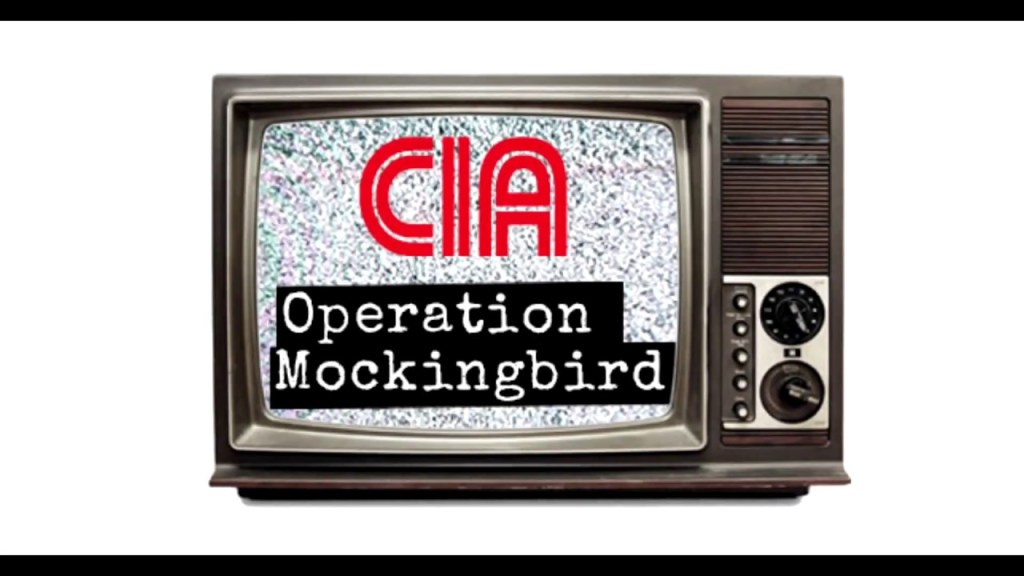
Why the CIA’s Operation Mockingbird is Widely Misunderstood

By Alex Constantine

Source: Constantine Report

In November, Newsweek, one of the most trusted news sources in the land, referred to Operation Mockingbird (CIA influence on the media, and, in many cases, infiltration) as “a supposed Cold War-era CIA program that is frequently referenced by QAnon conspiracy theorists.” (Source) Newsweek, of course, and the Washington Post were hubs in the Mockingbird network, so denial and misrepresentation are understandable.

But in the real world of CIA shenanigans …

Sourcewatch: “Operation Mockingbird was a secret Central Intelligence Agency campaign to influence domestic and foreign media beginning in the 1950s.

“The activities, extent and even the existence of the CIA project remain in dispute: the operation was first called Mockingbird in Deborah Davis’ 1979 book, Katharine the Great: Katharine Graham and her Washington Post Empire. But Davis’ book, alleging that the media had been recruited (infiltrated) by the CIA for propaganda purposes, was itself controversial and has since been shown to have had a number of erroneous assertions. More evidence of Mockingbird’s existence emerged in the 2007 memoir American Spy: My Secret History in the CIA, Watergate and Beyond, by convicted Watergate “plumber” E. Howard Hunt and The Mighty Wurlitzer: How the CIA Played America by Hugh Wilford (2008).”

https://www.sourcewatch.org/index.php/The_CIA_and_journalism

Carl Bernstein wrote about the program at length in Rolling Stone, and he waasn’t a QAnon adherent. Neither were the many journalists who have documented the history of the CIA-media relationship.

A misunderstanding about the code name Mockingbird has led some investigative reporters to dispute the operation’s existence. An FOIA request is submitted to the CIA for any related records. The Agency responds that it has no files under that code name. The journalist does receive documents on a Project Mockingbird, but that was an unrelated media surveillance op, and had nothing to do with Wurlitzers pumping out military-industrial propaganda. The journalist does his research, he finds that the CIA has, in fact, influenced public opinion via the news media, but where is the nomenclature Operation Mockingbird?

The journalist then brow-beats “conspiracy theorists” for falling into rabbit holes.

The fault lies with the reporter who doesn’t do essential homework on the origins of the bird. Officially, there is no  “Operation Mockingbird,” for the simple reason that the CIA didn’t exist when the it was conceived. Truman signed the Agency into existence in 1947. Allen Dulles, who would be appointed as its director, christened Operation Mockingbird the year before the Agency was born. His ambition to control men’s minds was a glint in his eye at the time. Cold war loomed, and he considered propaganda to be a priority. Dulles began lining up publishers, editors and journalists for an undertaking he thought of as mass mind control.

Nearly all of the CIA’s mind control files were destroyed in January, 1973 at the direction of DCI Richard Helms, so it’s possible that OM documents were among them. (Source: “Joint Hearings Before the Select Committee on Intelligence,” August 3, 1977, p. 3.)

By the time the CIA was repurposed from the obsolete postwar OSS, Operation Mockingbird was already well underway. As CIA director, Dulles pressed on with his objective to manipulate the common volk with dodgy news copy and op-ed treatises. It was a Dulles initiative before the CIA took Mockingbird under its wing.

Frank Wisner, the notorious Nazi recruiter, was selected to oversee the program. Wisner was recruited by Dean Acheson 1947 for a slot in the State Department’s Office of Occupied Territories. Shortly thereafter, the CIA created a the Office of Policy Coordination (OPC), the covert operations division of the Agency,  and Wisner was put in charge of the off-the-books media operation. (“Project Mockingbird,” the CIA journalist surveillance op, may well have been a sub-program.) So Mockingbird was a going concern by 1950, the year given by SourceWatch, among others, for its inception. Another common misunderstanding is the assumption that, because the CIA interacts with the media, all news is “fake news.” It isn’t. The overwhelming majority of journalists are independent of control beyond the editor’s desk. The lion’s share of all news reports are accurate enough — with the exception of the ultra-conservative echo chamber. But “fake news” is planted in the public print. Reader’s Digest, for instance, was a Mockingbird disinformation outlet for decades, and still prints propaganda. But the magazine wasn’t filled cover-to-cover with CIA perception management. One or two articles on Cold War topics were dropped into a mix of compressed books, human interest pieces, recipes, dieting tips, and the usual Digest  mom’s-jowls content. In some instances, paid CIA assets wrote the political articles. It’s the occasional planted story that warps public opinion. It’s not all that heavy-handed, a poison pill not a sledge hammer.

Newsweek was (and is) among the magazines most useful to the Operation. The code name may be unofficial, but infiltration of the media is not hard to prove, and it doesn’t take a complicit news weekly to know which way the wind blows.

“Putin Has Misread the West (And) if He Doesn’t Wake Up Soon, Armageddon Is Upon Us”

Interview with Paul Craig Roberts

By Mike Whitney and Paul Craig Roberts

Source: The Unz Review

Question 1—You think that Putin should have acted more forcefully from the beginning in order to end the war quickly. Is that an accurate assessment of your view on the war? And—if it is—then what do you think is the downside of allowing the conflict to drag on with no end in sight?

Paul Craig Roberts—Yes, you have correctly stated my position. But as my position can seem “unAmerican” to the indoctrinated and brainwashed many, those who watch CNN, listen to NPR, and read the New York Times, I am going to provide some of my background before going on with my answer.

I was involved in the 20th century Cold War in many ways: As a Wall Street Journal editor; as an appointee to an endowed chair in the Center for Strategic and International Studies, part of Georgetown University at the time of my appointment, where my colleagues were Henry Kissinger, National Security Advisor and Secretary of State, Zbigniew Brzezinski, National Security Advisor, and James Schlesinger, a Secretary of Defense and CIA director who was one of my professors in graduate school at the University of Virginia; as a member of the Cold War Committee on the Present Danger; and as a member of a secret presidential committee with power to investigate the CIA’s opposition to President Reagan’s plan to end the Cold War.

With a history such as mine, I was surprised when I took an objective position on Russian President Putin’s disavowal of US hegemony, and found myself labeled a “Russian dupe/agent” on a website, “PropOrNot,” which may have been financed by the US Department of State, the National Endowment for Democracy, or the CIA itself, still harboring old resentments against me for helping President Reagan end the Cold War, which had the potential of reducing the CIA’s budget and power. I still wonder what the CIA might do to me, despite the agency inviting me to address the agency, which I did, and explain why they went wrong in their reasoning.

I will also say that in my articles I am defending truth, not Putin, although Putin is, in my considered opinion, the most honest player, and perhaps the most naive, in the current game that could end in nuclear Armageddon. My purpose is to prevent nuclear Armageddon, not to take sides. I remember well President Reagan’s hatred of “those godawful nuclear weapons” and his directive that the purpose was not to win the Cold War but to end it.

Now to Mike’s question, which is to the point. Perhaps to understand Putin we need to remember life, or how it was presented by the West to the Soviet Union and the American broadcasts into the Soviet Union of the freedom of life in the West where streets were paved with gold and food markets had every conceivable delicacy. Possibly this created in the minds of many Soviets, not all, that life in the Western world was heavenly compared to the hell in which Russians existed. I still remember being on a bus in Uzbekistan in 1961 when a meat delivery truck appeared on the street. All traffic followed the truck to the delivery store where a several block long line already waited. When you compare this life with a visit to an American supermarket, Western superiority stands out. Russian hankerings toward the West have little doubt constrained Putin, but Putin himself has been affected by the differences in life between the US in those times and the Soviet Union.

Putin is a good leader, a human person, perhaps too human for the evil he faces. One way to look at my position that Putin does too little instead of too much is to remember the World War II era when British Prime Minister Chamberlin was accused of encouraging Hitler by accepting provocation after provocation. My own view of this history is that it is false, but it remains widely believed. Putin accepts provocations despite having declared red lines that he does not enforce. Consequently, his red lines are not believed. Here is one report:

RT reported on December 10 that “The US has quietly given Ukraine the go-ahead to launch long-range strikes against targets inside Russian territory, the Times reported on Friday, citing sources. The Pentagon has apparently changed its stance on the matter as it has become less concerned that such attacks could escalate the conflict.”

In other words, by his inaction Putin has convinced Washington and its European puppet states that he doesn’t mean what he says and will endlessly accept ever worsening provocations, which have gone from sanctions to Western financial help to Ukraine, weapons supply, training and targeting information, provision of missiles capable of attacking internal Russia, attack on the Crimea bridge, destruction of the Nord Stream pipelines, torture of Russian POWs, attacks on Russian parts of Ukraine reincorporated into the Russian Federation, and attacks on internal Russia.

At some point there will be a provocation that is too much. That’s when the SHTF.

Putin’s goal has been to avoid war. Thus, his limited military objective in Ukraine to throw the Ukrainian forces out of Donbass meant a limited operation that left Ukrainian war infrastructure intact, able to receive and deploy advanced weapons from the West, and to force Russian withdrawals to lines more defensible with the very limited forces Putin committed to the conflict. The Ukrainian offensives convinced the West that Russia could be defeated, thus making the war a primary way of undermining Russia as an obstacle to Washington’s hegemony. The British press proclaimed that the Ukrainian Army would be in Crimea by Christmas.

What Putin needed was a quick victory that made it completely clear that Russia had enforceable red lines that Ukraine had violated. A show of Russian military force would have stopped all provocations. The decadent West would have learned that it must leave the bear alone. Instead the Kremlin, misreading the West, wasted eight years on the Minsk Agreement that former German Chancellor Merket said was a deception to keep Russia from acting when Russia could have easily succeeded. Putin now agrees with me that it was his mistake not to have intervened in Donbass before the US created a Ukrainian army.

My last word to Mike’s question is that Putin has misread the West. He still thinks the West has in its “leadership” reasonable people, who no doubt act the role for Putin’s benefit, with whom he can have negotiations. Putin should go read the Wolfowitz Doctrine. If Putin doesn’t soon wake up, Armageddon is upon us, unless Russia surrenders.

Question 2—I agree with much of what you say here, particularly this: “Putin’s inaction has convinced Washington… that he doesn’t mean what he says and will endlessly accept ever worsening provocations.”

You’re right, this is a problem. But I’m not sure what Putin can do about it. Take, for example, the drone attacks on airfields on Russian territory. Should Putin have responded tit-for-tat by bombing supplylines in Poland? That seems like a fair response but it also risks NATO retaliation and a broader war which is definitely not in Russia’s interests.

Now, perhaps, Putin would not have faced these flashpoints had he deployed 500,000 combat troops to begin and leveled a number of cities on his way to Kiev, but keep in mind, Russian public opinion about the war was mixed at the beginning, and only grew more supportive as it became apparent that Washington was determined to defeat Russia, topple its government, and weaken it to the point where it could not project power beyond its borders. The vast majority of the Russian people now understand what the US is up-to which explains why Putin’s public approval ratings are presently at 79.4% while support for the war is nearly universal. In my opinion, Putin needs this level of support to sustain the war effort; so, postponing the mobilization of additional troops has actually worked to his benefit.

More importantly, Putin must be perceived to be the rational player in this conflict. This is absolutely essential. He must be seen as a cautious and reasonable actor who operates with restraint and within the confines of international law. This is the only way he will be able to win the continued support of China, India etc. We must not forget that the effort to build a multipolar world order requires coalition building which is undermined by impulsive, violent behavior. In short, I think Putin’s “go-slow” approach (your words) is actually the correct course of action. I think if he had run roughshod across Ukraine like Sherman on his way to the sea, he would have lost critical allies that will help him establish the institutions and economic infrastructure he needs to create a new order.

So, my question to you is this: What does a Russian victory look like? Is it just a matter of pushing the Ukrainian army out of the Donbas or should Russian forces clear the entire region east of the Dnieper River? And what about the west of Ukraine? What if the western region is reduced to rubble but the US and NATO continue to use it as a launching pad for their war against Russia?

I can imagine many scenarios in which the fighting continues for years to come, but hardly any that end in either a diplomatic settlement or an armistice. Your thoughts?

Paul Craig Roberts—I think, Mike, that you have identified the reasoning that explains Putin’s approach to the conflict in Ukraine. But I think Putin is losing confidence in his approach. Caution about approaching war is imperative. But when war begins it must be won quickly, especially if the enemy has prospects of gaining allies and their support. Putin’s caution delayed Russia’s rescue of Donbass for eight years, during which Washington created and equipped an Ukrainian army that turned what would have been an easy rescue in 2014 like Crimea into the current war approaching a year in duration. Putin’s caution in waging the war has given Washington and the Western media plenty of time to create and control the narrative, which is unfavorable to Putin, and to widen the war with US and NATO direct participation, now admitted by Foreign Minister Lavrov. The war has widened into direct attacks on Russia herself.

These attacks on Russia might bring the pro-Western Russian liberals into alignment with Putin, but the ability of a corrupt third world US puppet state to attack Russia is anathema to Russian patriots. The Russians who will do the fighting see in the ability of Ukraine to attack Mother Russia the failure of the Putin government.

As for China and India, the two countries with the largest populations, they have witnessed Washington’s indiscriminate use of force without domestic or international consequence to Washington. They don’t want to ally with a week-kneed Russia.

I will also say that as Washington and NATO were not constrained by public opinion in their two decades of wars in the Middle East and North Africa, based entirely on lies and secret agendas, what reason does Putin have to fear a lack of Russian public support for rescuing Donbass, formerly a part of Russia, from neo-Nazi persecution? If Putin must fear this, it shows his mistake in tolerating US-financed NGOs at work in Russia brainwashing Russians.

No, Putin should not engage in tit-for-tat. There is no need for him to send missiles into Poland, Germany, the UK, or the US. All Putin needs to do is to close down Ukrainian infrastructure so that Ukraine, despite Western help, cannot carry on the war. Putin is starting to do this, but not on a total basis.

The fact of the matter is that Putin never needed to send any troops to the rescue of Donbass. All he needed to do was to send the American puppet, Zelensky, a one hour ultimatum and if surrender was not forthcoming shut down with conventional precision missiles, and air attacks if necessary, the entirety of the power, water, and transportation infrastructure of Ukraine, and send special forces into Kiev to make a public hanging of Zelensky and the US puppet government.

The effect on the degenerate Woke West, which teaches in its own universities and public schools hatred of itself, would have been electric. The cost of messing with Russia would have been clear to all the morons who talk about Ukraine being in Crimea by Christmas. NATO would have dissolved. Washington would have removed all sanctions and shut up the stupid, war-crazy neoconservatives. The world would be at peace.

The question you have asked is, after all of Putin’s mistakes, what does a Russian victory look like? First of all, we don’t know if there is going to be a Russian victory. The cautious way that Putin reasons and acts, as you explained, is likely to deny Russia a victory. Instead, there could be a negotiated demilitarized zone and the conflict will be set on simmer, like the unresolved conflict in Korea.

On the other hand, if Putin is waiting the full deployment of Russia’s hypersonic nuclear missiles that no defense system can intercept and, following Washington, moves to first use of nuclear weapons, Putin will have the power to put the West on notice and be able to use the power of Russian military force to instantly end the conflict.

Question 3—You make some very good points, but I still think that Putin’s slower approach has helped to build public support at home and abroad. But, of course, I could be wrong. I do disagree strongly with your assertion that China and India “don’t want to ally with weak-kneed Russia”. In my opinion, both leaders see Putin as a bright and reliable statesman who is perhaps the greatest defender of sovereign rights in the last century. Both India and China are all-too-familiar with Washington’s coercive diplomacy and I’m sure they appreciate the efforts of a leader who has become the world’s biggest proponent of self-determination and independence. I’m sure the last thing they want, is to become cowering houseboys like the leaders in Europe who are, apparently, unable to decide anything without a ‘nod’ from Washington. (Note: Earlier today Putin said that EU leaders were allowing themselves to be treated like a doormat. Putin: “Today, the EU’s main partner, the US, is pursuing policies leading directly to the de-industrialization of Europe. They even try to complain about that to their American overlord. Sometimes even with resentment they ask ‘Why are you doing this to us?’ I want to ask: ‘What did you expect?’ What else happens to those who allow feet to be wiped on them?”)

Paul Craig Roberts—Mike, I agree that Russia for the reasons you provide is the choice partner of China and India. What I meant is that China and India want to see a powerful Russia that shields them from Washington’s interference. China and India are not reassured by what at times seems to be Putin’s irresolution and hesitancy. The rules that Putin plays by are no longer respected in the West.

Putin is correct that all European, and the Canadian, Australian, Japanese, and New Zealand governments, are doormats for Washington. What escapes Putin is that Washington’s puppets are comfortable in this role. Therefore, how much chance does he have in scolding them for their subservience and promising them independence? A reader recently reminded me about the Asch experiment in the 1950s, which found that people tended to conform to the prevalent narratives, and of the use to which Edward Bernays analysis of propaganda is put. And there is the information given me in the 1970s by a high government official that European governments do what we want because we “give the leaders bags of money. We own them. They report to us.”

In other words, our puppets live in a comfort zone. Putin will have a hard time breaking into this with merely exemplary behavior.

Question 4—For my final question, I’d like to tap into your broader knowledge of the US economy and how economic weakness might be a factor in Washington’s decision to provoke Russia. Over the last 10 months, we’ve heard numerous pundits say that NATO’s expansion to Ukraine creates an “existential crisis” for Russia. I just wonder if the same could be said about the United States? It seems like everyone from Jamie Diamond to Nouriel Roubini has been predicting a bigger financial cataclysm than the full-system meltdown of 2008. In your opinion, is this the reason why the media and virtually the entire political establishment are pushing so hard for a confrontation with Russia? Do they see war as the only way the US can preserve its exalted position in the global order?

Paul Craig Roberts—The idea that governments turn to war to focus attention away from a failing economy is popular, but my answer to your question is that the operating motive is US hegemony. The Wolfowitz Doctrine states it clearly. The doctrine says the principal goal of US foreign policy is to prevent the rise of any country that could serve as a constraint on US unilateralism. At the 2007 Munich security conference Putin made it clear that Russia will not subordinate its interest to the interest of the US.

There are some crazed neoconservatives in Washington who believe nuclear war can be won and who have shaped US nuclear weapons policy into a pre-emptive attack mode focused on reducing the ability of the recipient of a first strike to retaliate. The US is not seeking a war with Russia, but might blunder into one. The operative neoconservative policy is to cause problems for Russia that can cause internal problems, distract the Kremlin from Washington’s power moves, isolate Russia with propaganda, and even possibly pull off a color revolution inside Russia or in a former Russian province, such as Belarus, as was done in Georgia and Ukraine. People have forgot the US-instigated invasion of South Ossetia by the Georgian army that Putin sent in Russian forces to stop, and they have forgot the recent disturbances in Kazakhstan that were calmed by the arrival of Russian troops. The plan is to keep picking away at the Kremlin. Even if Washington doesn’t meet in every case with the success enjoyed in the Maidan Revolution in Ukraine, the incidents succeed as distractions that use up Kremlin time and energy, result in dissenting opinions within the government, and that require military contingency planning. As Washington controls the narratives, the incidents also serve to blacken Russia as an aggressor and portray Putin as “the new Hitler.” The propaganda successes are considerable–the exclusion of Russian athletes from competitions, refusals of orchestras to play music of Russian composers, exclusion of Russian literature, and a general refusal to cooperate with Russia in any way. This has a humiliating effect on Russians and might be corrosive of public support for the government. It has to be highly frustrating for Russian athletes, ice skaters, entertainers, and their fans.

Nevertheless, the conflict in Ukraine can turn into a general war intended or not. This is my concern and is the reason I think the Kremlin’s limited go-slow operation is a mistake. It offers too many opportunities for Washington’s provocations to go too far.

There is an economic element. Washington is determined to prevent its European empire from being drawn into closer relations with Russia from energy dependence and business relationships. Indeed, some explain the economic sanctions as de-industrializing Europe in behalf of Washington’s economic and financial hegemony. See: https://www.unz.com/mhudson/german-interview/

Prostitutes of the Press

By Stephen Lendman

Source: The Stephen Lendman Blog

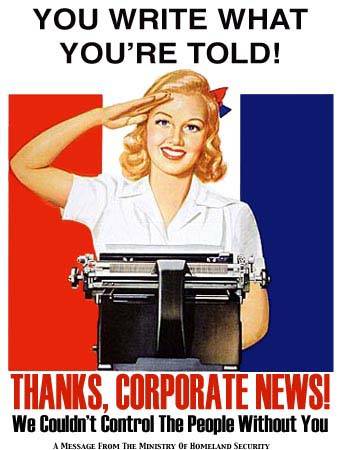
Western MSM operate as fake news ministries of truth in nations where they’re located.

They’re bribed with big bucks to lie and mass-deceive by sticking exclusively to the fabricated official narrative.

On major world and national issues, what’s reported on TV, radio or in print is based on state-approved talking points.

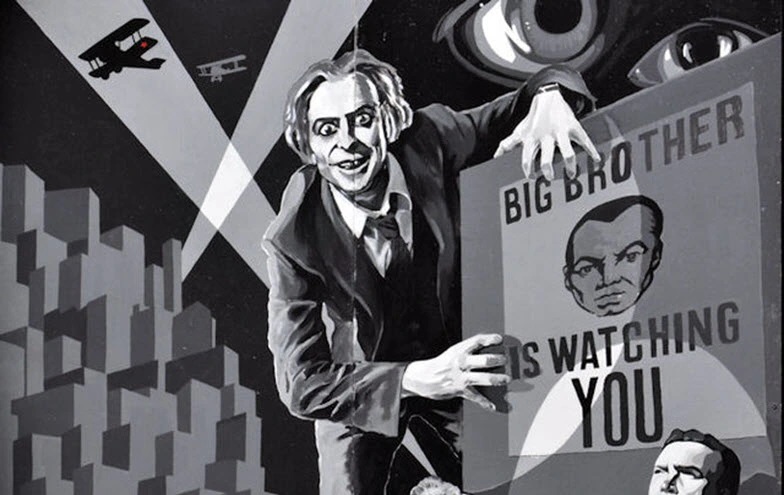
Orwell long ago explained today’s reality, his no longer fiction dystopian “1984” novel saying the following:

“The Ministry of Peace concerns itself with war, the Ministry of Truth with lies, the Ministry of Love with torture and the Ministry of Plenty with starvation.” 

“These contradictions are not accidental, nor do they result from from ordinary hypocrisy.”

“They are deliberate exercises in doublethink.”

Orwell’s Ministry of Truth was all about controlling the message, eliminating whatever conflicts with it, memory holes used for this purpose.

What’s suppressed is “whirled away (in) enormous furnaces…devoured by flames,” Orwell, adding:

“(T)here were the directing brains who co-ordinated the whole effort and laid down policy which made it necessary that this fragment of the past should be preserved, that one falsified, and the other rubbed out of existence.”

No memory holes are needed today throughout the decadent, depraved West.

MSM operate as willing co-conspirators in support of manipulating the public mind with rubbish unfit to print or report electronically.

A daily diet of fake news over the real thing includes drug pushing by heavily promoting health-destroying kill shots, the scourge of Nazism in Ukraine and use of its criminal class for perpetual war on Russia because it’s free from hegemon USA control.

Truth and full disclosure are mortal enemies of peace, equity, justice, imperial rampaging and the rule of law.

So MSM are used to suppress what conflicts with the fabricated official narrative in support of hegemon USA-dominated NATO’s war on humanity domestically and worldwide.

Russia and China are targeted for regime change because they alone stand in the way of the US war party’s drive for unchallenged hegemony by a policy of perpetual war-making on invented enemies.

Throughout the US/West, free and open societies, including democracy as it should be, are virtually banned.

Nor do their ruling regimes tolerate these notions anywhere, targeting them for elimination where exist.

Yet state-approved MSM-proliferated fake news, information and opinion pretend otherwise.

Turning reality on its head and trampling on it, they pretend that Nazi-infested Ukraine is democratic, that its battered and degraded military is defeating overwhelmingly superior Russian firepower.

And well over $100 billion worth of weapons, munitions and equipment supplied to Ukrainian Nazis by US/Western regimes since 2014 were largely destroyed by Russia or resold by Kiev kleptocrats for self-enrichment.

Unable to defeat Russia’s military superiority on the battlefield, regime troops largely focus on terror-shelling of its residential areas in Donetsk, Lugansk and elsewhere to kill, injure and terrorize noncombatants in harm’s way.

Yet US/Western regimes, Kiev Nazis and their MSM press agents falsely blame Russia for war crimes committed against the state and its people.

There’s been no ambiguity about the ability of Russian forces to demilitarize and deNazify Ukraine from day-one of its liberating SMO.

And sanctions war on Russia by US/Western regimes is deindustrializing Europe as planned by the empire of lies, while leaving the Russian Federation largely unscathed. 

Separately on Wednesday, Sergey Lavrov stressed the following:

Hegemon USA-dominated Western regimes “closed ranks” against Russia.

“Their mentality of domination” is hard-wired with no signs of “moderat(ing).”

Russia is “at war with the collective West led by” nuclear armed and recklessly dangerous USA.

“China is next in line.”

“It poses the most formidable and systemic longterm challenge and is the only country capable of surpassing (hegemon USA) in almost all areas” to eventually become the dominant world power politically, economically, financially and militarily.

The notion has both wings of the US war party planning for war on a nation it cannot win.

Yet with Taiwan as an invented pretext like Ukraine is used against Russia, the threat of war on China by the empire of lies is ominously real. 

Built on a one-China foundation a half century ago, normalized Sino/US relations no longer exist.

A state of war exists by hegemon USA against nonthreatening Russia, China earmarked for regime change by its war party in similar fashion.

Brave new dystopian world order proponent/notorious international con man, George Soros, once said we need a global sheriff.

Did he have hegemon USA or himself in mind by enforcing a policy of perpetual war on humanity?

Questioning The Official Story About Official Stories: A Role for Citizen Investigations

By Time Hayward

Source: Tim Hayward Blog

Official stories, according to the official story about them, are (nearly) always true. The ‘nearly’ gets mentioned just because, on rare occasions, an official story is acknowledged to have been wrong, as, for instance, with Iraq’s falsely alleged weapons of mass destruction in 2003. But that’s considered an exception to the rule, and to extrapolate from it to a more pervasive mistrust is to be foolish, ill-informed or even a dupe of hostile propaganda. In fact, diagnosing what is wrong with sceptics about official stories, and proposing ways of curing or otherwise dealing with them, are now becoming a growth industry in the media and academia. So we hear a lot about how dissenting from official narratives is to fall victim to ‘conspiracy theory’ or ‘disinformation’; and dissenters may be diagnosed as needing re-education or even psychological help. As for the dissent itself, this is increasingly subject to censure and censorship.

However, a major question is left unaddressed: What is it that’s supposed to make official stories so credible?

The assumption is that official stories are produced by people with relevant expert knowledge, so disputing them is a product of ignorance; and since experts have credentials, experience and the backing of competent institutions, rejecting their expertise is unwise or even delusional. Also assumed is that official stories are generally produced and disseminated in good faith.

But are those assumptions generally warranted? In probing their grounds we are brought to question whether the official meta-story, as we may call it, overstates reasons for automatically accepting official stories and underestimates the competence that members of the public can bring to independent inquiries.

Why Believe Official Stories?

No serious thinker would suggest that an official story should be believed just because it comes from officials. Indeed, use of the very expression ‘official story’, in practice, tends to imply that there is also some alternative story that does not have the backing of officials but might be more credible. We know, too, that many societies from various times and places have maintained order by invoking all manner of mythological stories, ideological stories, and blatantly discriminatory stories. Sometimes this has meant denying, suppressing or persecuting as heretics people engaged in rigorous intellectual questioning of officialdom.

A more plausible reason for believing official stories has been set out by the philosopher Neil Levy (2007). He points out that we all know most of the things we know in life because we have learned them from others: our direct personal experience of the world is extremely limited compared to the expanse of our general knowledge and the intricacies of our more specialist understandings. We rely on the testimony and good faith of others in almost everything we do, so just to live a normal life in society we trust a wide range of institutions and social arrangements. To doubt their general dependability would contradict the tacit assumptions that get us through life and would render inexplicable how even a tolerably well-ordered society could ever be possible.

The force of that consideration is strong, but not absolute – and how strong also depends on what kinds of communication we are referring to as official stories. It is strongest if one uses the term to refer to all public communications that emanate from an official source. In actual usage, however, that is not how the term ‘official story’ is normally understood. We don’t regard it as an ‘official story’ that to get a passport you need to submit an authenticated photograph of yourself; we don’t regard it as an ‘official story’ that in UK cars are to be driven on the left; and nor do we these days regard it as an ‘official story’ that smoking is bad for our health. By far the greater part of public pronouncements, like these, are simply taken to state how matters stand. When the distinctive term ‘official story’ occurs, it is typically in contexts where a public pronouncement has met with scepticism. So, for example, whereas we seldom nowadays hear the rationale for mandating wearing seatbelts in cars referred to as an ‘official story’, because there is no longer serious dissent, recent claims that the rationale for mandating mRNA injections against SARS-Cov2 was substantially comparable to that for seatbelts encountered resistance: the ‘official story’ about the benefits and safety of the mRNA injections has been subject to criticism from some sections of medical and scientific communities.

Of course, the mere fact of scepticism in some quarters does not mean that a given official story is necessarily mistaken, but it does highlight how an official story is not just an uncontroversial statement of how matters stand. It leads thoughtful people to look more closely at the nature of authority claimed for an official story.

Are There Experts in Expertise?

The authority claimed for official stories derives, as Levy explains, from the fact of being produced by ‘people socially acknowledged as the relevant experts on a topic’ (Levy 2022). Relevance here is understood in terms of knowledge and experience relating to the salient subject matter. However, certain people might officially be appointed as relevant experts, on other bases, such as known affinities with the organisation’s mission. So it is possible for designated experts to support an official story while a number of other people with materially relevant knowledge and experience take a quite different view.

Even among designated expert advisers, however, achieving an authoritative consensus on the kind of matter that official stories relate to is not straightforward. This is for reasons similar to those involved in giving policy advice (see e.g. Grundmann 2017). Insofar as an official story appeals to a scientific basis, it should be borne in mind that findings of science – a process of open, collaborative and progressive inquiry – have a provisional status, with all scientific statements being in principle corrigible. This means that a scientific adviser’s confidence can never be completely unconstrained or unhedged. Zeynep Panuk (2021) refers to a ‘paradox of scientific advice’ that arises from the difficulties of basing decisions on scientific knowledge that is almost always uncertain and subject to disagreement. Panuk cites experience of how overconfident scientists in advisory committees may suppress dissent so as to present a consensus view, only to find that its implementation had unfortunate or even disastrous consequences. Recent experiences of overconfident pronouncements on ‘The Science’ during the Covid pandemic have furnished further examples (Miller 2022Nelson 2022).

The kind of controversy for which an ‘official story’ comes into play will not normally reduce to some specialist detail of basic science, or even a collection of these, but will concern a situation involving many factors – including those pertaining to social organisation, human action and decision-making. Such situations are similar to those where policy advice is sought from scientific experts (SAPEA 2019 Ch. 2; Martin et al 2020). Official stories are seldom if ever straightforward statements of scientific opinion on a single well-defined scientific research question: they typically relate to situations where many interacting variables may not all be clearly disaggregable. There is in principle no necessary reason why an independent and unofficial grouping of investigators with materially relevant expertise might not be as well-suited to an inquiry as an official grouping. In fact, challenges to official stories can sometimes draw on impressive constellations of expertise.

Citizen Investigations

If the official meta-story may overestimate the dependability of designated expert advice, it may also underestimate the investigative competence of ordinary citizens. For challenges to official stories can be mustered not just by isolated individuals, caricatured as ‘doing their own research’ while ‘reading things on the internet,’ but by well-informed collaborative groups. These can be better able to track truths than independent individuals: ‘the superiority of the group over the individual does not require that one member has the right answer prior to deliberation: group deliberation may enable the aggregation of the genuine insights of several members and the rejection of the false hypotheses of some of the same individuals.’ (Levy 2019: 316)

Furthermore, if it is the case that ‘[g]roups of individuals who are strangers to one another are better at tracking truths than groups of individuals who have a shared history’ (Levy 2019: 318) then this is an advantage of groups comprising people who come together in cyberspace from all walks of life and may have little or no biographical information about those they connect with. Citizens doing their own research sometimes start their own Wikis, or form groups on Reddit, or informally deliberate via Twitter or Telegram. Sometimes they create investigative collectives offline.

It was from participating in chatrooms, for instance, that the now much-feted organisation Bellingcat originated: its founder, Eliot Higgins, a gamer-turned-investigative-citizen, would review copious amounts of war footage from his sofa in Leicester and discuss his observations in chatrooms. The work of his investigative collaborative has come to be ‘commended in the global media and by global agencies such as Amnesty International and Human Rights Watch.’ (Nguyen and Scifo 2018: 377) Impressed by the methods of ‘open source intelligence’ (D’Alessandra and Sutherland 2021), curators of official stories in the West – particularly those relating to geopolitical issues involving Russia – have bestowed accolades on Bellingcat, along with generous funding and encouragement.

So, there is precedent for treating citizens’ investigations as authoritative. Other groups of citizen investigators, that do not receive any funding, have mounted significant challenges to some of the West’s own official stories. Thus, directly countering Bellingcat, on occasion, is the Working Group on Syria, Propaganda and Media which has earned the confidence of whistleblowers rather than officials (OPCW 2020).

Aside from the benefits of collaboration, the reality of serious dissent in the digital sphere is that it can involve myriad critical individuals with significant independent claims to epistemic authority in their professional fields and who exhibit judicious awareness of both their own limitations and the value of others’ insights. For instance, challenging various official narratives are whistleblowers who include scientists, diplomats, intelligence officers, and various state or corporate employees. Challenges come too from professionals with relevant specialist expertise across fields like medicine, architecture, engineering, pharmaceuticals, and a gamut of others. Also worth highlighting are those journalists with previous careers in mainstream media organisations who found they could only maintain their professional integrity by becoming independent.[1] When a group of people independently deliberating together can include, for instance, a former head of a nation’s armed services, a UN weapons inspector, a senior diplomat, an intelligence officer, a world leading International Relations expert and a seasoned war correspondent, the insights they generate regarding situations relevant to foreign policy may well be no less sound than those informing the official story.[2] Indeed, in virtue of their freedom from institutional constraints, they may be more reliably informative for the public than the official story.

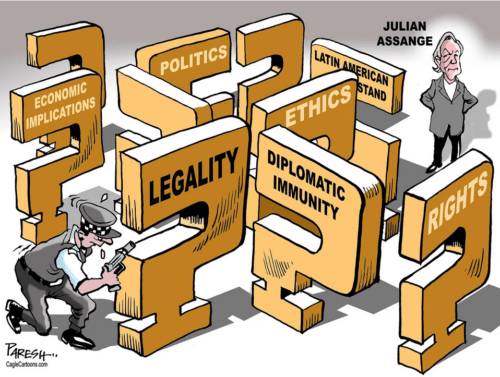
If serious challenges to official stories have become more prevalent in recent years, as they arguably have, this is likely due in good part to the sheer extent to which mainstream media have excluded the voices of experts who, maintaining their professional integrity and independence in the face of sometimes considerable hostility, have continued to articulate their challenges to official stories. Attentive members of the public notice this – just as they notice when the force of the state is brought to bear on those who bring to light its lies and malfeasance, and not only in high profile cases like Edward Snowden, Chelsea Manning, Katharine Gun or Julian Assange.

Part of the official meta-story currently is that the internet and social media are being flooded by targeted disinformation that is misleading and confusing people. However, from another perspective one might see that thanks to digital communications citizens can become aware of arguments developed by other experts which are suppressed by protectors of an ‘official story’. An example would be the authors of the Great Barrington Declaration (GBD) (2020), advocating an approach to dealing with the Covid situation characterized as ‘focused protection’ instead of the officially promoted lockdown approach. Lay persons may not be able to adjudicate first hand between recommendations from the GBD and the John Snow Memorandum (2020), which defended lockdown, but they can understand enough to know that the latter does not command an unproblematic consensus such as would be rational simply to defer to. Members of the public can assess the trustworthiness of expertise and official stories without a high level of technical knowledge, as science studies scholars have shown (Yearley 2005; Hess 2012).

People understand that if a view is suppressed rather than openly addressed and rebutted the reason might be that it cannot be rebutted. If an attentive public observes that dissent is simply treated as inadmissible, and especially if those formulating it are subject to smearing or censorship, then there is a corresponding diminution of public trust in the orthodox view.

Tension At The Heart of An Official Story

If the claim that the authority of an official story derives from an expert consensus can be questionable, something more certain is that an official story is asserted with the kind of authority that comes with power. People may defer to an official story not because they necessarily find it credible but out of a prudent concern to avoid the costs of dissidence. Those with power can also incentivise wider media of communication to stick to the narrative. This difference between epistemically earned authority and politically declared authority is a tension at the heart of official stories. Understanding it helps explain why we find a good many journalistic and scholarly studies of the supposed pathologies of dissident citizens and rather little reflection on the real nature of the authority of official stories.

Today we find a welter of studies of online ‘disinformation’ that trace webs of connection across cyberspace seeking to link influential dissenting accounts on social media with bots and trolls associated with malign actors. These communications are said to be engaged in strategically. That is, their aim is to persuade the public to accept a pre-established story rather than to allow people to determine, through open deliberations, what the most credible story is.

Yet this is exactly what the promulgators of official stories themselves do. Regardless of whether the content of a given official story is reliable or not, the form of an official story – in virtue of fulfilling its official function – is that of a strategic communication. Its communication, as official, is presented as a matter not for deliberation but for public acceptance. It is not submitted to public scrutiny with an implicit invitation for critical feedback. It is not up for discussion. It is communicated not to advance debate but to settle it.

This is the inherent tension in an official story: its assertion of epistemic authority depends on an implicit claim that it can be backed by processes of deliberative reasoning, but the pronouncement of an official story as a settled opinion curtails any such process.

What this means in practice has been illustrated, for instance, in the situation arising with the UK Government’s Covid response, which professedly aimed to ‘Follow The Science’ (Stevens 2020). This notion can only ever be ‘a misleading oversimplification’ of what it means to base policy on science (Abbasi 2020), and when UK government ministers claimed to be ‘guided by the science’, what they meant in practice was being guided by their scientists: ‘Ministers formed strong relationships with key scientific advisors, relied on evidence from their Scientific Advisory Group for Emergencies (SAGE), and ignored or excluded many other sources.’ (Cairney 2021) Thus a policy of public communications was decided on the basis of a selective interpretation of scientific findings. But more than this, instead of caution in the face of uncertainty, a policy of robustly promoting a particular view involved the use of psychological operations of a kind more normally associated with a war effort than with public health advice (Sidley 2021, 2022).

Unfortunately, as that example also showed, the defence of an official story against criticism can include counter-measures taken to smear and discredit dissenters. This is never an edifying approach, but is especially troubling when it involves discrediting serious critics who have their own credible claim to epistemic authority. This was illustrated in the case of the eminent scientists who signed the Great Barrington Declaration. They were widely vilified not only in the media but even by other academics, for pointing to certain established principles of epidemiology – including those developed over the two preceding decades of pandemic preparedness planning – that were being set aside and overridden by policy-makers on the basis of modellers’ projections in favour of a ‘zero-covid’ strategy (Ioannidis 2022). This vilification involved not only overt smearing but also something more insidious, namely, the pre-emptive dismissal of their views – notwithstanding their impeccable academic pedigree – as too far ‘beyond the pale’ to warrant serious consideration (HART 2022).

This situation showed that the other institutions of civil society, including the media and academia, which the official meta-story claims provide critical scrutiny, can in fact simply amplify official strategic communications. Thus the organisations that Levy recommends we rely on as guarantors of the authors of official stories can in reality see it as their responsibility to promote and defend the official story rather than question it. Public perceptions that this is the case are accompanied by a deficit of trust in the media and institutions more generally.

The official meta-story blames ‘conspiracy theorists’ and other critical questioners for this lack of trust. But perhaps that gets things the wrong way round.

Conclusion

Trust is something that has to be won, and, if betrayed, it can be lost. As the public’s trust in official stories diminishes, the official meta-story looks to blame this on ‘conspiracy theorists’ and other ‘disruptive influences’. Perhaps a more credible story about official stories would include serious reflection on how they might be made more transparently trustworthy.

Meanwhile, it is reasonable to suggest that each serious challenge to an official story should be assessed on its merits. This does not mean being swayed by extravagant contrarian hypotheses, since these should be treated with even more caution, and, when appropriate, summarily rejected. It does mean being duly aware of how the presumption in favour of official stories is necessarily defeasible. That is the case not just because any story may prove to be mistaken, even in all good faith, but also because we know that any organisation with politically-conferred authority is liable at times to come under political pressures that may, in certain circumstances, override scruples of honesty.

References

Abbasi, Kamran. 2020. ‘Covid-19: politicisation, “corruption,” and suppression of science’. BMJ; 371:m4425, 13 November: doi:10.1136/bmj.m4425   

Cairney, Paul. 2021. ‘The UK Government’s COVID-19 Policy: What Does “Guided by the Science” Mean in Practice?’ Frontiers in Political Science 315 March.https://www.frontiersin.org/articles/10.3389/fpos.2021.624068 DOI: 10.3389/fpos.2021.624068

D’Alessandra, Federica and Kirsty Sutherland. 2021. ‘The Promise and Challenges of New Actors and New Technologies in International Justice’. Journal of International Criminal Justice, 19(1): 9–34. https://doi.org/10.1093/jicj/mqab034

Great Barrington Declaration. 2020. https://gbdeclaration.org/

Grundmann, Reiner. 2017. ‘The Problem of Expertise in Knowledge Societies’. Minerva 55, 25–48 (2017). https://doi-org.ezproxy.is.ed.ac.uk/10.1007/s11024-016-9308-7

HART [Health Advisory and Recovery Team]. 2022. ‘The crushing of dissent throughout the covid era’, 8 October: https://www.hartgroup.org/the-crushing-of-dissent-throughout-the-covid-era/

Hess, David J. 2012. Science Studies: An Advanced Introduction. New York: NYU Press.

Ioannidis, John P. 2022. ‘Citation impact and social media visibility of Great Barrington and John Snow signatories for COVID-19 strategy.’ BMJ Open 2022;12:e052891. doi:10.1136/ bmjopen-2021-052891

John Snow Memorandum. 2020. https://www.johnsnowmemo.com/

Levy, Neil. 2007. ‘Radically Socialized Knowledge and Conspiracy Theories’, Episteme 4(2): 181-192.

Levy, Neil. 2019. ‘Due deference to denialism: explaining ordinary people’s rejection of established scientific findings’. Synthese 196: 313-327.

Levy, Neil. 2022. ‘Do Your Own Research!’ Synthese 200: 356. https://doi.org/10.1007/s11229-022-03793-w

Martin, Graham P., Esmée Hanna, Margaret McCartney and Robert Dingwall. 2020. ‘Science, society, and policy in the face of uncertainty: reflections on the debate around face coverings for the public during COVID-19’. Critical Public Health 30:5: 501-508, DOI: 10.1080/09581596.2020.1797997

Miller, Ian. 2022. Unmasked: The Global Failure of COVID Mask Mandates.

Nelson, Fraser. 2022. ‘The lockdown files: Rishi Sunak on what we weren’t told.’ The Spectator, 27 August: https://www.spectator.co.uk/article/the-lockdown-files-rishi-sunak-on-what-we-werent-told/

Nguyen, An and Salvatore Scifo. 2018. ‘Mapping the Citizen News Landscape: Blurring Boundaries, Promises, Perils, and Beyond.’ In Journalism, edited by Tim P. Vos. Berlin/Boston: De Gruyter.

OPCW [Organisation for the Prohibition of Chemical Weapons]. 2019. ‘Report Of The Fact-Finding Mission Regarding The Incident Of Alleged Use Of Toxic Chemicals As A Weapon In Douma, Syrian Arab Republic, On 7 April 2018.’ OPCW Technical Secretariat S/1731/2019: https://www.opcw.org/sites/default/files/documents/2019/03/s-1731-2019%28e%29.pdf

Panuk, Zeynep (2021) ‘COVID-19 and the Paradox of Scientific Advice.’ Perspectives on Politics 20(2): 562-576. DOI: https://doi.org/10.1017/S1537592721001201

SAPEA [Science Advice for Policy by European Academies]. 2019. Making sense of science for policy under conditions of complexity and uncertainty. Berlin: SAPEA. https://doi.org/10.26356/MASOS 

Sidley, Gary. 2021. ‘A Year of Fear.’ The Critic 23 March: https://thecritic.co.uk/a-year-of-fear/

Sidley, Gary. 2022. ‘Britain’s unethical Covid messaging must never be repeated.’ The Spectator 6 February: https://www.spectator.co.uk/article/britain-s-unethical-covid-messaging-must-never-be-repeated/

Stevens, Alex. 2020. ‘Governments cannot just ‘follow the science’ on COVID-19’. Nature Human Behaviour 4, 560: https://doi.org/10.1038/s41562-020-0894-x

Yearley, Steven. 2005. Making Sense of Science: Understanding the Social Study of Science. Thousand Oaks, CA: Sage.


[1] This is the case, for instance, with Jonathan Cook (formerly of The Guardian), Chris Hedges (formerly with the New Yorker), John Pilger (award-winning documentary film maker), and the late Robert Parry who founded the independent outlet Consortium News.

[2] This is to characterize part of the composition of the Berlin Group 21 that has produced the Statement of Concern relating to whistleblowers from the OPCW. See https://berlingroup21.org/ and associated press release: https://www.einnews.com/pr_news/538579944/leading-international-voices-call-on-opcw-and-its-scientific-advisors-to-allow-all-douma-investigators-to-be-heard