How To Create NPR’s Propaganda – As Seen In a Hit Piece Against Me

By Lee Camp

Source: Naked Capitalism

I never thought I’d be the target of an NPR attack piece. Through my twenties I even looked to NPR as an outlet full of good, progressive, thoughtful reporting – You know, the soothing voices occasionally interrupted by music no one really listens to but that sounds good between soft-spoken ivy league journalists over the age of 50.  Everything about NPR subtly reinforced the idea, “Everything is fine. You’re probably a middle to upper class white person or you hope to be one day, and that’s just great. Everything is fine.” They might not SAY that, but they say that. And for a long time, I was cool with that message.

Then I woke up. About the time NPR was avoiding Occupy Wall Street – or when they did cover it, acting like those of us who supported it were brainless hippies without a point or at least none that would fit easily into the lives of suburbanites with two kids, one cat, and a robust retirement account. In hindsight I should’ve woken up sooner. I should’ve seen the truth about the time most NPR shows were pushing for war in Iraq, buying into the WMD lie. Or maybe I should’ve realized the truth when Kevin Klose took over as President of NPR in 1998. Klose came straight from a nice seat as director of the US Information Agency, described as “a United States agency devoted to ‘public diplomacy’ (AKA propaganda).” So when you have one of the top government propagandists as your president, one can assume your reporting is slightly biased.

Anyway, that leads me to today. A couple days after NPR’s Weekend Edition hosted by Scott Simon did a rather awesome attack piece on me and my TV show Redacted Tonight with Lee Camp which airs on RT America. I’d like to walk you through how to write such beautiful propaganda, as I did following the NY Times smear job against me, which sounded shockingly similar (more on that later).

STEP ONE: Create a subconscious association to old Cold War Russian propaganda

Scott Simon opens his show with “Russian programming is no longer breathless proclamations about tractor production or accolades to the Kremlin. Look at a show like Redacted Tonight.” This opening sentence essentially tells the listener that everything they’re about to hear is modern Russian propaganda. Sure, he doesn’t use the word “propaganda” yet, but when you say something was ONCE accolades to the Kremlin and is now Redacted Tonight, you are priming your audience, giving them a subconscious opinion of the target before they even know what it is. This would be like saying “American programming is no longer ads where a little girl with a daisy is killed by a nuclear blast. Now it’s the Daily Show.” If you had never heard of the Daily Show, you would assume it must be a modern version of a girl obliterated by a nuclear bomb.

STEP TWO: Lie by omission

Scott Simon knows the truth, but he’s keeping it from his audience. My show is not Russian propaganda. Simon knows I’m an American in America covering American news for Americans. He does slip in that I’m American in the opening sentences, but not until the end does he reveal to his audience that I have never been told to say anything or not to say anything on RT America. And after he says that, he immediately plays a clip of me joking that my show is written by heavily bearded Russian trolls. He seems to play it as if it reveals the truth, rather than being a joke. Furthermore, assuming Simon did even an ounce of research, he knows that I’ve been doing the same type of material in my stand-up comedy act for decades – long before I was every on RT. Saying my show is Russian propaganda would be to say that all the shows on RT America are Russian propaganda including ones hosted by Larry King, Pulitzer Prize-winner Chris Hedges, Governor Jesse Ventura, Mike Papantonio, and former hosts Thom Hartmann and Abby Martin.

I’ve addressed why I do this show on RT America, and you can watch that here. But for NPR’s listeners who have never heard of me, Simon wants to essentially warn them that they are about to hear nefarious neo-propaganda put forward by dastardly Russians.

STEP THREE: Subtly let your listeners know the target is not one of us

In his second sentence Simon says, “The show is hosted and written by an American comic in black jeans with a hipster beard and long, bobbed hair, Lee Camp.” To begin with, I don’t know what a hipster beard is, but I doubt I have one. I guess Scott Simon thinks any beard is a “hipster beard.” I suppose this means Wolf Blitzer has a hipster beard too. I also don’t know what “long bobbed hair” is other than a way of saying, “He’s a fuckin’ long hair!” This description is all basically Simon’s way of letting his elitist older core audience know, “This guy is NOT one of us. He probably doesn’t even OWN a salmon-colored button-down shirt.”

STEP FOUR: Imply that curse words = enemy of the state

Simon next plays a few sentences from my show, bleeping out the word “fuck.” Then he interrupts and says, “A lot of profanity. In fact ONE profanity over and over…” So Simon’s first sentence about me was to insult my clothing and look. His first sentence about my show was to express near horror at the fact I use the word “fuck”. First of all, I take great exception to the idea I only use ONE profanity. My profanity is varied AND prolific. Name another show where you’ve recently heard Congress described as a “Steaming bucket of mangy dicks.” But again this is designed so Simon can let the nice NPR listeners know, “He’s not one of us. He uses dirty language.” Isn’t it amazing that it’s been a half century since the 1960’s and yet the insults against the “counter culture” are all the same – “He’s a long-hair hipster with a dirty mouth!” As George Carlin said, dirty words can “impact your mind, curve your spine and lose the war for the Allies!” Clearly Scott Simon didn’t get the memo that fearing dirty words is not something most of America is doing anymore. Americans are far more worried about where their next paycheck will come from or how to get healthcare for their sick child. If you look at the situation our country is in and don’t say “FUCK” to yourself, then you aren’t paying attention.

STEP FIVE: Bring in an “Expert” who clarifies how awful the target is

Next, Julia Ioffe is brought on to explain how horrible Redacted Tonight truly is and why your children should be asked to leave the room and cover their ears until the terrifying thought bombs are extinguished. NPR identifies Ioffe as simply someone who writes critically about Russia for the Atlantic and other platforms. What Simon doesn’t want his listeners to know is that Ioffe is a hardcore neocon neo-McCarthyist who spends her days spouting fake news about Russia, such as this lovely piece of fact-free reporting entitled “How Russia Hacked America.” In the credits of that piece she thanks two private intelligence firms for helping her out – Fidelis Cybersecurity and Farsight Security. Fidelis used to be owned by General Dynamics, one of the biggest weapons contractors riding the Russia hysteria to billions of dollars in profits. Julia Ioffe is not even close to an unbiased critic of my show. She’s quite the opposite – a useful idiot for the weapons industry which collects bundles of cash from the deaths of millions.

And those Russian hacking claims? I covered the reality of those claims on my show with former 27-year veteran CIA analyst Ray McGovern.

It’s very telling that while Ioffe and Scott Simon breathlessly attack dissenting voices, they choose NOT to cover how our 2016 election was ACTUALLY rigged as reported on by the nonpartisan Project Censored herehere, and here. I have also covered all of these stories extensively on my show.

Ioffe is not only a pure xenophobe, seemingly trying to angle our country towards nuclear war, but she also is – apparently – an expert on comedy! Her opening lines – “[Redacted Tonight] is very shrill. Lee Camp is very shrill. It looks like the kind of rantings I would engage in when I was an angry 15 year-old.” Apparently when Julia Ioffe was a mere teen, she was angrily spouting about how unfettered vulture capitalism destroyed Puerto Rico even before the hurricane did, or the unlimited war powers that both Democrats and Republicans voted to give Donald Trump, or perhaps the secret family making billions from our opioid crisis. I guess little Julia was once very well informed. But now, as an adult, she has changed her ways – becoming a good shill for the corporate state, toeing the pro-war propaganda line without a second thought.

STEP SIX: Shrug off or ignore any positive attributes

At one point Scott Simon talks about attending a taping of the show where the audience “laughed and cheered when prompted – but sincerely.” In the audio version the words “but sincerely” drip with disgust. This is about as close as Simon can come to admitting Redacted Tonight has very large, active, and excited fanbase of people who see through the ridiculous mainstream media and want something more, something deeper.

Another positive attribute of my show, in my opinion, is the fact that we’re left of the corporate-owned Democrats. Simon mentions that I mock both Republicans and Democrats but that’s where he leaves it. If he watched more than ten minutes, he knows that I don’t simply attack everything for the sake of mockery. I go after our ruling elite who are bought and sold by massive corporations, soulless people who seem fine with a level of inequality that surpasses even ancient Rome just before its collapse. This is the most important thing any viewer should know about my show, but NPR intentionally leaves it out. The reasoning is obvious – because it would attract a lot of viewers. And when you’re busy making new Cold War propaganda, you don’t want such stumbling blocks in your path.

STEP SEVEN: Bring in another “expert” to simply lie

Scott Simon next asks executive producer of Second City, Kelly Leonard, if Redacted Tonight is funny. Leonard response: “It is funny, but there’s a problem. ” Leonard says the real trouble is that I avoid certain subjects – such as hacking of the election. But in fact, I HAVE talked about hacking the election herehereherehereherehere – You get the point. I’ve talked about it FAR more than any other comedy news show Leonard can list. The problem is I don’t talk about it from the false narrative Leonard and Simon WANT me to – the narrative that calls it “hacking the election” even though no one is even accusing Russia of actually hacking voting machines, which is essentially impossible from a foreign country. (Instead voting machine rigging happens right here at home.) The accusations only have to do with hacking emails at the DNC (that showed *REAL* corruption) – and even those accusations have been debunked by experts.

So even if Leonard disagrees with my more truth-based views on the hacking, he still provably lied when he said I don’t talk about election hacking. Either he lied or he’s so woefully unfamiliar with my show that he’s hardly seen any of it. Which is worse? Scott Simon then lets this grand lie go unchecked, or Simon doesn’t know that I’ve covered the hacking extensively. Again, which is worse?

STEP EIGHT: Simply call your target evil

Leonard next says, “I think comedy is a superpower. And a very smart person once said, if it can’t be used for evil, it’s not a superpower. And in this case, that’s kind of what I feel is going on.” Yep, my show is clearly being used for evil. A show which tirelessly fights for a more egalitarian and just society – You could hardly find an episode where I’m not covering those issues and giving solutions for how to get there – Such a TV show is using comedy for evil. …Hence the sinister beard and long hair.

STEP NINE: Refuse to have the target on for a live interview

The number one question I’ve gotten about NPR’s attack piece was about this sentence by Simon, “We asked Lee Camp for an interview but couldn’t agree to his ground rules.” Simon is being intentionally vague here. Saying that we couldn’t agree to ground rules makes the listener think I said, “I’ll do an interview but no questions about Russia, and you have to be dressed as a chicken during the entirety of it!” In fact, what Simon doesn’t reveal to his listeners is that I simply said, “I would love to do a live on-air interview.” That is all I said, and I said it repeatedly over email. NPR cannot have me on for a live on-air interview because that would not allow them to cut out all the things they don’t want viewers to know. It would not allow them to redact certain parts and take things out of context. I was told by the producer of Weekend Edition that they rarely do live interviews – which means they do indeed have the capability. I, myself, have an interview show that is never filmed live because it simply doesn’t air live. So I am not opposed to pre-taped interviews played in their entirety, but NPR is not looking for that. If Simon valued honesty, he should’ve stated, “Lee Camp agreed to a live interview, but we were not willing to do that.”

STEP TEN: Bring back the New Cold Warrior faux expert

Julia Ioffe comes back to call me and my team  “co-conspirators” and “useful idiots.” (Which is it? Are we conspiring or are we idiots??) She says we are not creating the show “…for the rights and the lives of the little man or the little person. It’s for Putin’s power.” And although I find it hilarious to respond to a moral attack coming from someone spouting talking points on behalf of weapons contractors, I’ll do it anyway. Ioffe is perfectly wrong in her assertion. I’ve been doing politically minded stand-up comedy for nearly 20 years. Long before I ever created Redacted Tonight, I was speaking about the same issues – endless war, gut-wrenching inequality, environmental destruction – all the topics I continue to cover on my show. When I decided to work with RT America, it came down to one simple thought – I don’t believe we have a lot of time to waste. Our world is collapsing around us – for example the earth has lost half its wildlife in the past 40 years. We have to talk about all these issues, which are redacted from our corporate media. We have to provide information to people in new and interesting ways, and I’ve been trying to do that for two decades. Julia Ioffe on the other hand wants to create war, death, and continued destruction while tearing down anyone who dissents.

STEP ELEVEN: One last parting lie – “No one’s watching anyway.”

Scott Simon closes by saying fewer than 30,000 people are likely watching RT America. He says, “That’s not far from the average attendance at a Milwaukee Brewers baseball game.” But one can assume Simon knows he’s lying. Even without factoring in television views, the average episode of Redacted Tonight gets over 30,000 views on YouTube alone, which does not count Facebook and other platforms. Clips from each episode add hundreds of thousands of more views on YouTube. I have recent web exclusive videos that have over 150,000 views each on YouTube. Assuming Simon can do a simple search, he knows he’s misleading his listeners as to how many people watch my show. If he can’t do a YouTube search, it might be time for him to throw in the ol’ crusty  “journalism” towel.

If I really wanted to get down in the mud with Simon, I might mention that he has nearly 1.25 Million Twitter followers and yet his tweets – almost without exception – receive between zero and ten retweets. This either means Simon isn’t saying much of value or his 1.25 million followers aren’t listening to him to begin with.

It’s also a bit comical Simon picks Milwaukee as the city to use in his parting jab. Milwaukee also happens to be the home of Pabst Blue Ribbon beer, which helps fund NPR and therefore receives glowing segments like this in what seems to be a pay-to-play scenario. Even when corporations are not influencing NPR’s coverage, they are still benefiting from what NPR proudly calls “the halo effect” simply by being an underwriter. Basically NPR brags that they scrub clean the image some of the worst corporations in the world, making them angelic – corporations like ExxonMobil, Goldman Sachs, and Wells Fargo.

Furthermore Fairness and Accuracy In Reporting did a study (“Some Things Considered Mostly By White Men”) that included Weekend Edition and other NPR shows and found that most of the commentary is by white men and in recent years there is less and less political coverage. The lack of political coverage is actually by design. NPR’s job is to cast reality in a pro-corporate pro-war light via two avenues, one is by straight up propaganda, such as hit pieces against dissenting voices – anything outside the corporate unfettered-capitalist paradigm. (I covered this in a recent web exclusive video.)  Another avenue is to simply fill the airwaves with useless information that makes us feel smart and comfortable but contributes nothing to informing the population about what is REALLY happening. This is why Scott Simon produces pieces like this one about waiting in line. (It has 9 retweets as of this writing.) If you listen to the piece, he actually could have gone deeper and made the segment meaningful. He could have talked about how our system seeks profit over all else, even over the innately fair process of waiting in line. He could’ve discussed how those ideals then become codified in our cultural mindset, creating an immense level of misery and inequality. …But instead he left it as a weak version of Andy Rooney (which is impressive because I thought Andy Rooney was a weak version of Andy Rooney).

When he does cover politics, Simon has proven to be war hungry. Right now he seems to be Cold War hungry – which could lead to nuclear war. In the past he supported the Wars in Afghanistan and Iraq. In case it was never mentioned on NPR, the Iraq War killed over one million people according to Reuters. Even in 2003 he reassured his listeners that not finding weapons of mass destruction (the entire premise for the war) didn’t really matter that much anyway because the greatest threat to Iraqis was the regime that the U.S. had taken down. (One assumes he doesn’t mean the greatest threat to the million who were killed during our obliteration of their country.) Simon helped manufacture the consent for such a horrific bloodbath, and I wonder whether that sits with him at all.

Since Weekend Edition did a poor job of finding guests who could speak intelligibly on the issues at hand, I did it for them. Author Max Blumenthal said of this segment, “NPR only interviewed neo-Cold Warriors, giving figures with no expertise on Russia a platform to hold forth on Russian meddling, and offering figures with no experience in comedy a platform to criticize Redacted Tonight‘s comedic value. NPR interviewed Lee Camp’s fans but no media professionals from the left who could have offered a nuanced perspective on RT. And they deliberately obscured Camp’s principled left-wing positions by claiming that he bashes the GOP and Democrats equally, with the Dems as a stand in for the living, breathing left social movement that Camp is part of. If anyone is looking for slanted propaganda under the guise of news, look no further than this piece by the semi-official radio outlet of the US government.”

And Scott Dikkers, co-founder and longtime head of The Onion publicly stated to Scott Simon, “I was disappointed you thought it necessary to tar [Lee Camp] as little more than a Putin Stooge. He happens to be a talented and hard-working comedian on the populist/left end of the spectrum.”

This is the second major attack piece on me and my comedy show in recent months, one on NPR and one on the cover of the NY Times Arts section. These smear jobs are similar in nature, and I’m far from the only one experiencing such attacks. Many dissenting voices have been attacked, suppressed, and maligned, and it’s up to those of us who value truth and open debate to stand up and demand better. The good news is that corporate media [which does include NPR] and the profit-over-people they uphold are right now fighting for their lives, and the only way of maintaining their power is by drumming out those of us calling attention to the reality.

The Acceleration of Censorship in America

By Joe Lauria

Source: The Unz Review

Under increasing pressure from a population angry about endless wars and the transfer of wealth to the one percent, American plutocrats are defending themselves by suppressing critical news in the corporate media they own. But as that news emerges on RT and dissident websites, they’ve resorted to the brazen move of censorship, which is rapidly spreading in the U.S. and Europe. I know because I was a victim of it.

At the end of October, I wrote an article for Consortium News about the Democratic National Committee and Hillary Clinton’s campaign paying for unvetted opposition research that became the basis for much of the disputed story about Russia allegedly interfering in the 2016 presidential election.

The piece showed that the Democrats’ two paid-for sources that have engendered belief in Russia-gate are at best shaky. First was former British spy Christopher Steele’s largely unverified dossier of second- and third-hand opposition research portraying Donald Trump as something of a Russian Manchurian candidate.

And the second was CrowdStrike, an anti-Putin private company, examining the DNC’s computer server to dubiously claim discovery of a Russian “hack.” CrowdStrike, it was later discovered, had used faulty software it was later forced to rewrite. The company was hired after the DNC refused to allow the FBI to look at the server.

My piece also described the dangerous consequences of partisan Democratic faith in Russia-gate: a sharp increase in geopolitical tensions between nuclear-armed Russia and the U.S., and a New McCarthyism that is spreading fear — especially in academia, journalism and civil rights organizations — about questioning the enforced orthodoxy of Russia’s alleged guilt.

After the article appeared at Consortium News, I tried to penetrate the mainstream by then publishing a version of the article on the HuffPost, which was rebranded from the Huffington Post in April this year by new management. As a contributor to the site since February 2006, I am trusted by HuffPost editors to post my stories directly online. However, within 24 hours of publication on Nov. 4, HuffPost editors retracted the article without any explanation.

This broke with the earlier principles of journalism that the Web site espoused. For instance, in 2008, Arianna Huffington told radio host Don Debar that, “We welcome all opinions, except conspiracy theories.” She said: “Facts are sacred. That’s part of our philosophy of journalism.”

But Huffington stepped down as editor in August 2016 and has nothing to do with the site now. It is run by Lydia Polgreen, a former New York Times reporter and editor, who evidently has very different ideas. In April, she completely redesigned the site and renamed it HuffPost.

Before the management change, I had published several articles on the Huffington Post about Russia without controversy. For instance, The Huffington Post published my piece on Nov. 5, 2016, that predicted three days before the election that if Clinton lost she’d blame Russia. My point was confirmed by the campaign-insider book Shattered, which revealed that immediately after Clinton’s loss, senior campaign advisers decided to blame Russia for her defeat.

On Dec. 12, 2016, I published another piece, which the Huffington Post editors promoted, called, “Blaming Russia To Overturn The Election Goes Into Overdrive.” I argued that “Russia has been blamed in the U.S. for many things and though proof never seems to be supplied, it is widely believed anyway.”

After I posted an updated version of the Consortium News piece — renamed “On the Origins of Russia-gate” — I was informed 23 hours later by a Facebook friend that the piece had been retracted by HuffPost editors. As a reporter for mainstream media for more than a quarter century, I know that a newsroom rule is that before the serious decision is made to retract an article the writer is contacted to be allowed to defend the piece. This never happened. There was no due process. A HuffPost editor ignored my email asking why it was taken down.

Support from Independent Media

Like the word “fascism,” “censorship” is an over-used and mis-used accusation, and I usually avoid using it. But without any explanation, I could only conclude that the decision to retract was political, not editorial.

I am non-partisan as I oppose both major parties for failing to represent millions of Americans’ interests. I follow facts where they lead. In this case, the facts led to an understanding that the Jan. 6 FBI/NSA/CIA intelligenceassessment” on alleged Russian election interference, prepared by what then-Director of National Intelligence James Clapper called “hand-picked” analysts, was based substantially on unvetted opposition research and speculation, not serious intelligence work.

The assessment even made the point that the analysts were not asserting that the alleged Russian interference was a fact. The report contained this disclaimer: “Judgments are not intended to imply that we have proof that shows something to be a fact. Assessments are based on collected information, which is often incomplete or fragmentary, as well as logic, argumentation, and precedents.”

Under deadline pressure on Jan. 6, Scott Shane of The New York Times instinctively wrote what many readers of the report must have been thinking: “What is missing from the public report is what many Americans most eagerly anticipated: hard evidence to back up the agencies’ claims that the Russian government engineered the election attack. … Instead, the message from the agencies essentially amounts to ‘trust us.’”

Yet, after the Jan. 6 report was published, leading Democrats asserted falsely that the “assessment” represented the consensus judgment of all 17 U.S. intelligence agencies – not just the views of “hand-picked” analysts from three – and much of the U.S. mainstream media began treating the allegations of Russian “hacking” as fact, not as an uncertain conclusion denied by both the Russian government and WikiLeaks, which insists that it did not get the two batches of Democratic emails from the Russian government.

Yet, because of the oft-repeated “17 intelligence agencies” canard and the mainstream media’s over-hyped reporting, the public impression has built up that the accusations against Russia are indisputable. If you ask a Russia-gate believer today what their faith is based on, they will invariably point to the Jan. 6 assessment and mock anyone who still expresses any doubt.

For instance, an unnamed former CIA officer told The Intercept last month, “You’ve got all these intelligence agencies saying the Russians did the hack. To deny that is like coming out with the theory that the Japanese didn’t bomb Pearl Harbor.”

That the supposedly dissident Intercept would use this quote is instructive about how unbalanced the media’s reporting on Russia-gate has been. We have film of Japanese planes attacking Pearl Harbor and American ships burning – and we have eyewitness accounts of thousands of U.S. soldiers and sailors. Yet, on Russia-gate, we have only the opinions of “hand-picked” intelligence officials who themselves admit their opinions aren’t fact. No serious editor would allow a self-interested and unnamed source to equate Russia-gate and Pearl Harbor in print.

In this atmosphere, it was easy for HuffPost editors to hear complaints from readers and blithely ban my story. But before it was pulled, 125 people had shared it. Ray McGovern, a former CIA analyst, then took up my cause, being the first to write about the HuffPost censorship on his blog. McGovern included a link to a .pdf file that I captured of the censored HuffPost story. It has since been republished on numerous other websites.

Journalist Max Blumenthal tweeted about it. British filmmaker and writer Tariq Ali posted it on his Facebook page. Ron Paul and Daniel McAdams interviewed me at length about the censorship on their TV program. ZeroHedge wrote a widely shared piece and someone actually took the time, 27 minutes and 13 seconds to be exact, to read the entire article on YouTube. I began a petition to HuffPost’s Polgreen to either explain the retraction or restore the article. It has gained more than 2,000 signatures so far. If a serious fact-check analysis was made of my article, it must exist and can and should be produced.

Watchdogs & Media Defending Censorship

Despite this support from independent media, a senior official at Fairness and Accuracy in Reporting, I learned, declined to take up my cause because he believes in the Russia-gate story. I also learned that a senior officer at the American Civil Liberties Union rejected my case because he too believes in Russia-gate. Both of these serious organizations were set up precisely to defend individuals in such situations on principle, not preference.

In terms of their responsibilities for defending journalism and protecting civil liberties, their personal opinions about whether Russia-gate is real or not are irrelevant. The point is whether a journalist has the right to publish an article skeptical of it. I worry that amid the irrational fear spreading about Russia that concerns about careers and funding are behind these decisions.

One online publication decidedly took the HuffPost’s side. Steven Perlberg, a media reporter for BuzzFeed, asked the HuffPost why they retracted my article. While ignoring me, the editors issued a statement to BuzzFeed saying that “Mr. Lauria’s self-published” piece was “later flagged by readers, and after deciding that the post contained multiple factually inaccurate or misleading claims, our editors removed the post per our contributor terms of use.” Those terms include retraction for “any reason,” including, apparently, censorship.

Perlberg posted the HuffPost statement on Twitter. I asked him if he inquired of the editors what those “multiple” errors and “misleading claims” were. I asked him to contact me to get my side of the story. Perlberg totally ignored me. He wrote nothing about the matter. He apparently believed the HuffPost and that was that. In this way, he acquiesced with the censorship.

BuzzFeed, of course, is the sensationalist outlet that irresponsibly published the Steele dossier in full, even though the accusations – not just about Donald Trump but also many other individuals – weren’t verified. Then on Nov. 14, BuzzFeed reporter Jason Leopold wrote one of the most ludicrous of a long line of fantastic Russia-gate stories, reporting that the Russian foreign ministry had sent money to Russian consulates in the U.S. “to finance the election campaign of 2016.” The scoop generated some screaming headlines before it became clear that the money was to pay for Russian citizens in the U.S. to vote in the 2016 Duma election.

That Russia-gate has reached this point, based on faith and not fact, was further illustrated by a Facebook exchange I had with Gary Sick, an academic who served on the Ford and Carter national security staffs. When I pressed Sick for evidence of Russian interference, he eventually replied: “If it walks like a duck and talks like a duck…” When I told him that was a very low-bar for such serious accusations, he angrily cut off debate.

When belief in a story becomes faith-based or is driven by intense self-interest, honest skeptics are pushed aside and trampled. True-believers disdain facts that force them to think about what they believe. They won’t waste time making a painstaking examination of the facts or engage in a detailed debate even on something as important and dangerous as a new Cold War with Russia.

This is the most likely explanation for the HuffPost‘s censorship: a visceral reaction to having their Russia-gate faith challenged.

Why Critical News is Suppressed

But the HuffPost’s action is hardly isolated. It is part of a rapidly growing landscape of censorship of news critical of American corporate and political leaders who are trying to defend themselves from an increasingly angry population. It’s a story as old as civilization: a wealthy and powerful elite fending off popular unrest by trying to contain knowledge of how the elite gain at the others’ expense, at home and abroad.

A lesson of the 2016 campaign was that growing numbers of Americans are fed up with three decades of neoliberal policies that have fabulously enriched the top tier of Americans and debased a huge majority of everyone else. The population has likewise grown tired of the elite’s senseless wars to expand their own interests, which they to conflate with the entire country’s interests.

America’s bipartisan rulers are threatened by popular discontent from both left and right. They were alarmed by the Bernie Sanders insurgency and by Donald Trump’s victory, even if Trump is now betraying the discontented masses who voted for him by advancing tax and health insurance plans designed to further crush them and benefit the rich.

Trump’s false campaign promises will only make the rulers’ problem of controlling a restless population more difficult. Americans are subjected to economic inequality greater than in the first Gilded Age. They are also subjected today to more war than in the first Gilded Age, which led to the launch of American overseas empire. Today American rulers are engaged in multiple conflicts following decades of post-World War II invasions and coups to expand their global interests.

People with wealth and power always seem to be nervous about losing both. So plutocrats use the concentrated media they own to suppress news critical of their wars and domestic repression. For example, almost nothing was reported about militarized police forces until the story broke out into the open in the Ferguson protests and now the story has been buried again.

Careerist journalists readily acquiesce in this suppression of news to maintain their jobs, their status and their lifestyles. Meanwhile, a growing body of poorly paid freelancers compete for the few remaining decent-paying gigs for which they must report from the viewpoint of the mainstream news organizations and their wealthy owners.

To operate in this media structure, most journalists know to excise out the historical context of America’s wars of domination. They know to uncritically accept American officials’ bromides about spreading democracy, while hiding the real war aims.

Examples abound: America’s role in the Ukraine coup was denied or downplayed; a British parliamentary report exposing American lies that led to the destruction of Libya was suppressed; and most infamously, the media promoted the WMD hoax and the fable of “bringing democracy” to Iraq, leading to the illegal invasion and devastation of that country. A recent example from November is a 60 Minutes reporton the Saudi destruction of Yemen, conspicuously failing to mention America’s crucial role in the carnage.

I’ve pitched numerous news stories critical of U.S. foreign policy to a major American newspaper that were rejected or changed in the editorial process. One example is the declassified Defense Intelligence Agency document of August 2012 that accurately predicted the rise of the Islamic State two years later.

The document, which I confirmed with a Pentagon spokesman, said the U.S. and its Turkish, European and Gulf Arab allies, were supporting the establishment of a Salafist principality in eastern Syria to put pressure on the Syrian government, but the document warned that this Salafist base could turn into an “Islamic State.”

But such a story would undermine the U.S. government’s “war on terrorism” narrative by revealing that the U.S.-backed strategy actually was risking the expansion of jihadist-held territory in Syria. The story was twice rejected by my editors and to my knowledge has never appeared in corporate media.

Another story rejected in June 2012, just a year into the Syrian war, was about Russia’s motives in Syria being guided by a desire to defeat the growing jihadist threat there. Corporate media wanted to keep the myth of Russia’s “imperial” aims in Syria alive. I had to publish the article outside the U.S., in a South African daily newspaper.

In September 2015 at the U.N. General Assembly, Russian President Vladimir Putin confirmed my story about Russia’s motives in Syria to stop jihadists from taking over. Putin invited the U.S. to join this effort as Moscow was about to launch its military intervention at the invitation of the Syrian government. The Obama administration, still insisting on “regime change” in Syria, refused. And the U.S. corporate media continued promoting the myth that Russia intervened to recapture its “imperial glory.”

It was much easier to promote the “imperial” narrative than report Putin’s clear explanation to French TV channel TF1, which was not picked up by American media.

“Remember what Libya or Iraq looked like before these countries and their organizations were destroyed as states by our Western partners’ forces?” Putin said. “These states showed no signs of terrorism. They were not a threat for Paris, for the Cote d’Azur, for Belgium, for Russia, or for the United States. Now, they are the source of terrorist threats. Our goal is to prevent the same from happening in Syria.”

But don’t take Putin’s word for it. Then Secretary of State John Kerry knew why Russia intervened. In a leaked audio conversation with Syrian opposition figures in September 2016, Kerry said: “The reason Russia came in is because ISIL was getting stronger, Daesh was threatening the pos­sibility of going to Damascus, and that’s why Russia came in because they didn’t want a Daesh government and they supported Assad.”

Kerry admitted that rather than seriously fight the Islamic State in Syria, the U.S. was ready to use its growing strength to pressure Assad to resign, just as the DIA document that I was unable to report said it would. “We know that this was growing, we were watching, we saw that Daesh was growing in strength, and we thought Assad was threatened. We thought, how­ever, we could probably manage that Assad might then negotiate, but instead of negotiating he got Putin to support him.” Kerry’s com­ment suggests that the U.S. was willing to risk the Islamic State and its jihadist allies gaining power in order to force out Assad.

Why Russia Is Targeted

Where are independent-minded Western journalists to turn if their stories critical of the U.S. government and corporations are suppressed? The imperative is to get these stories out – and Russian media has provided an opening. But this has presented a new problem for the plutocracy. The suppression of critical news in their corporate-owned media is no longer working if it’s seeping out in Russian media and through dissident Western news sites.

Their solution has been to brand the content of the Russian television network, RT, as “propaganda” since it presents facts and viewpoints that most Americans have been kept from hearing.

As a Russian-government-financed English-language news channel, RT also gives a Russian perspective on the news, the way CNN and The New York Times give an American perspective and the BBC a British one. American mainstream journalists, from my experience, arrogantly deny suppressing news and believe they present a universal perspective, rather than a narrow American view of the world.

The viewpoints of Iranians, Palestinians, Russians, North Koreans and others are never fully reported in the Western media although the supposed mission of journalism is to help citizens understand a frighteningly complex world from multiple points of view. It’s impossible to do so without those voices included. Routinely or systematically shutting them out also dehumanizes people in those countries, making it easier to gain popular support to go to war against them.

Russia is scapegoated by charging that RT or Sputnik are sowing divisions in the U.S. by focusing on issues like homelessness, racism, or out-of-control militarized police forces, as if these divisive issues didn’t already exist. The U.S. mainstream media also seems to forget that the U.S. government has engaged in at least 70 years of interference in other countries’ elections, foreign invasions, coups, planting stories in foreign media and cyber-warfare, which Russian media crucially points out.

Now, these American transgressions are projected exclusively onto Moscow. There’s also a measure of self-reverence in this for “successful” people, like some journalists, with a stake in an establishment that underpins the elite, demonstrating how wonderfully democratic they are compared to those ogres in Russia.

The overriding point about the “Russian propaganda” complaint is that when America’s democratic institutions, including the press and the electoral process, are crumbling under the weight of corruption that the American elites have created or maintained, someone else needs to be blamed.

The Jan. 6 intelligence assessment on alleged Russian election meddling is a good example of this. A third of its content is an attack on RT for “undermining American democracy” by reporting on Occupy Wall Street, the protest over the Dakota pipeline and, of all things, holding a “third party candidate debates,” at a time when 71% of American millennials say they want a third party.

According to the Jan. 6 assessment, RT’s offenses include reporting that “the US two-party system does not represent the views of at least one-third of the population and is a ‘sham.’” RT also “highlights criticism of alleged US shortcomings in democracy and civil liberties.” In other words, reporting newsworthy events and giving third-party candidates a voice undermines democracy.

The assessment also says all this amounts to “a Kremlin-directed campaign to undermine faith in the US Government and fuel political protest,” but those protests by are against privileges of the wealthy and the well-connected, a status quo that the intelligence agencies were in essence created to protect.

There are also deeper reasons why Russia is being targeted. The Russia-gate story fits neatly into a geopolitical strategy that long predates the 2016 election. Since Wall Street and the U.S. government lost the dominant position in Russia that existed under the pliable President Boris Yeltsin, the strategy has been to put pressure on getting rid of Putin to restore a U.S. friendly leader in Moscow. There is substance to Russia’s concerns about American designs for “regime change” in the Kremlin.

Moscow sees an aggressive America expanding NATO and putting 30,000 NATO troops on its borders; trying to overthrow a secular ally in Syria with terrorists who threaten Russia itself; backing a coup in Ukraine as a possible prelude to moves against Russia; and using American NGOs to foment unrest inside Russia before they were forced to register as foreign agents.

Accelerated Censorship in the Private Sector

The Constitution prohibits government from prior-restraint, or censorship, though such tactics were imposed, largely unchallenged, during the two world wars. American newspapers voluntarily agreed to censor themselves in the Second World War before the government dictated it.

In the Korean War, General Douglas MacArthur said he didn’t “desire to reestablish wartime censorship” and instead asked the press for self-censorship. He largely got it until the papers began reporting American battlefield losses. On July 25, 1950, “the army ordered that reporters were not allowed to publish ‘unwarranted’ criticism of command decisions, and that the army would be ‘the sole judge and jury’ on what ‘unwarranted’ criticism entailed,” according to a Yale University study on military censorship.

After excellent on-the-ground reporting from Vietnam brought the war home to America, the military reacted by instituting, initially in the first Gulf War, serious control of the press by “embedding” reporters from private media companies. They accepted the arrangement, much as World War II newspapers censored themselves.

It is important to realize that the First Amendment does not apply to private companies, including the media. It is not illegal for them to practice censorship. I never made a First Amendment argument against the HuffPost, for instance. However, under pressure from Washington, even in peacetime, media companies can do the government’s dirty work to censor or limit free speech for the government.

In the past few weeks, we’ve seen an acceleration of attempts by corporations to inhibit Russian media in the U.S. Both Google and Facebook, which dominate the Web with more than 50 percent of ad revenue, were at first resistant to government pressure to censor “Russian propaganda.” But they are coming around.

Eric Schmidt, executive chairman of Alphabet, Google’s parent company, said on Nov. 18 that Google would “derank” articles from RT and Sputnik in the Google searches, making the stories harder for readers to find. The billionaire Schmidt claimed Russian information can be “repetitive, exploitative, false, [or] likely to have been weaponized,” he said. That is how factual news critical of U.S. corporate and political leadership is seen by them: as a weapon threatening their rule.

“My own view is that these patterns can be detected, and that they can be taken down or deprioritized,” Schmidt said.

Though Google would essentially be hiding news produced by RT and Sputnik, Schmidt is sensitive to the charge of censorship, even though there’s nothing legally to stop him.

“We don’t want to ban the sites. That’s not how we operate,” Schmidt said cynically. “I am strongly not in favor of censorship. I am very strongly in favor of ranking. It’s what we do.”

But the “deranking” isn’t only aimed at Russian sites; Google algorithms also are taking aim at independent news sites that don’t follow the mainstream herd – and thus are accused of spreading Russian or other “propaganda” if they question the dominant Western narratives on, say, the Ukraine crisis or the war in Syria. A number of alternative websites have begun reporting a sharp fall-off of traffic directed to their sites from Google’s search engines.

Responding to a deadline from Congress to act, Facebook on Nov. 22 announced that it would inform users if they have been “targeted” by Russian “propaganda.” Facebook’s help center will tell users if they liked or shared ads allegedly from the St. Petersburg-based Internet Research Agency, which supposedly bought $100,000 in ads over a two-year period, with more than half these ads coming after the 2016 U.S. election and many not related to politics.

The $100,000 sum over two years compares to Facebook’s $27 billion in annual revenue. Plus, Facebook only says it “believes” or it’s “likely” that the ads came from that firm, whose links to the Kremlin also have yet to be proved.

Facebook described the move as “part of our ongoing effort to protect our platforms and the people who use them from bad actors who try to undermine our democracy.” Congress wants more from Facebook, so it will not be surprising if users will eventually be alerted to Russian media reports as “propaganda” in the future.

While the government can’t openly shut down a news site, the Federal Communications Commission’s upcoming vote on whether to deregulate the Internet by ending net neutrality will free private Internet companies in the U.S. to further marginalize Russian and dissident websites by slowing them down and thus discouraging readers from viewing them.

Likewise, as the U.S. government doesn’t want to be openly seen shutting down RT operations, it is working around the edges to accomplish that.

After the Department of Justice forced, under threat of arrest, RT to register its employees as foreign agents under the Foreign Agents Registration Act, State Department spokeswoman Heather Nuaert said that “FARA does not police the content of information disseminated, does not limit the publication of information or advocacy materials, and does not restrict an organization’s ability to operate.” She’d earlier said that registering would not “impact or affect the ability of them to report news and information. We just have them register. It’s as simple as that.”

The day after Nuaert spoke the Congressional press office stripped RT correspondents of their Capitol Hill press passes, citing the FARA registration. “The rules of the Galleries state clearly that news credentials may not be issued to any applicant employed ‘by any foreign government or representative thereof.’ Upon its registration as a foreign agent under the Foreign Agents Registration Act (FARA), RT Network became ineligible to hold news credentials,” read the letter to RT.

But Russia-gate faithful ignore these aggressive moves and issue calls for even harsher action. After forcing RT to register, Keir Giles, a Chatham House senior consulting fellow, acted as though it never happened. He said in a Council on Foreign Relations Cyber Brief on Nov. 27: “Although the Trump administration seems unlikely to pursue action against Russian information operations, there are steps the U.S. Congress and other governments should consider.”

I commented on this development on RT America. It would also have been good to have the State Department’s Nuaert answer for this discrepancy about the claim that forced FARA registrations would not affect news gathering when it already has. My criticism of RT is that they should be interviewing U.S. decision-makers to hold them accountable, rather than mostly guests outside the power structure. The decision-makers could be called out on air if they refuse to appear.

Growing McCarthyite Attacks

Western rulers’ wariness about popular unrest can be seen in the extraordinary and scurrilous attack on the Canadian website globalresearch.ca. It began with a chilling study by the North Atlantic Treaty Organization into the relatively obscure website, followed by a vicious hit piece on Nov. 18 by the Globe and Mail, Canada’s largest newspaper. The headline was: “How a Canadian website is being used to amplify the Kremlin’s view of the world.”

“What once appeared to be a relatively harmless online refuge for conspiracy theorists is now seen by NATO’s information warfare specialists as a link in a concerted effort to undermine the credibility of mainstream Western media – as well as the North American and European public’s trust in government and public institutions,” the Globe and Mail reported.

“Global Research is viewed by NATO’s Strategic Communications Centre of Excellence – or StratCom – as playing a key accelerant role in helping popularize articles with little basis in fact that also happen to fit the narratives being pushed by the Kremlin, in particular, and the Assad regime.” The website never knew it had such powers.

I’ve not agreed with everything I’ve read on the site. But it is a useful clearinghouse for alternative media.

Numerous Consortium News articles are republished there, including a handful of mine. But the site’s typical sharing and reposting on the Internet is seen by NATO as a plot to undermine the Free World.

“It uses that reach to push not only its own opinion pieces, but ‘news’ reports from little-known websites that regularly carry dubious or false information,” the he Globe and Mail reported. “At times, the site’s regular variety of international-affairs stories is replaced with a flurry of items that bolster dubious reportage with a series of opinion pieces, promoted on social media and retweeted and shared by active bots.”

The newspaper continued, “’That way, they increase the Google ranking of the story and create the illusion of multi-source verification,’ said Donara Barojan, who does digital forensic research for [StratCom]. But she said she did not yet have proof that Global Research is connected to any government.”

This sort of smear is nothing more than a blatant attack on free speech by the most powerful military alliance in the world, based on the unfounded conviction that Russia is a fundamental force for evil and that anyone who has contacts with Russia or shares even a part of its multilateral world view is suspect.

Such tactics are spreading to Europe. La Repubblica newspaper in Italy wrote a similar hit piece against L’Antidiplomatico, a dissident website. And the European Union is spending €3.8 million to counter Russian “propaganda.” It is targeting Eurosceptic politicians who repeat what they hear on Russian media.

High-profile individuals in the U.S. are also now in the crosshairs of the neo-McCarthyite witch hunt. On Nov. 25 The Washington Post ran a nasty hit piece on Washington Capitals’ hockey player Alex Ovechkin, one of the most revered sports figures in the Washington area, simply because he, like 86 percent of other Russians, supports his president.

“Alex Ovechkin is one of Putin’s biggest fans. The question is, why?” ran the headline. The story insidiously implied that Ovechkin was a dupe of his own president, being used to set up a media campaign to support Putin, who is under fierce and relentless attack in the United States where Ovechkin plays professional ice hockey.

“He has given an unwavering endorsement to a man who U.S. intelligence agencies say sanctioned Russian meddling in last year’s presidential election,” write the Post reporters, once again showing their gullibility to U.S. intelligence agencies that have provided no proof for their assertions (and even admit that they are not asserting their opinion as fact).

Less prominent figures are targeted too. John Kiriakou, a former CIA agent who blew the whistle on torture and was jailed for it, was kicked off a panel in Europe on Nov. 10 by a Bernie Sanders supporter who refused to appear with Kiriakou because he co-hosts a show on Radio Sputnik.

At the end of November, Reporters Without Borders, an organization supposedly devoted to press freedom, tried to kick journalist Vanessa Beeley off a panel in Geneva to prevent her from presenting evidence that the White Helmets, a group that sells itself as a rescue organization inside rebel-controlled territory in Syria, has ties to Al Qaeda. The Swiss Press Club, which hosted the event, resisted the pressure and let Beeley speak.

But as a consequence the club director said its funding was slashed from the Swiss government.

Russia-gate’s Hurdles

Much of this spreading mania and intensifying censorship traces back to Russia-gate. Yet, it remains remarkable that the corporate media has failed so far to prove any significant Russian interference in the U.S. election at all. Nor have the intelligence agencies, Congressional investigations and special prosecutor Robert Mueller. His criminal charges so far have been for financial crimes and lying to federal authorities on topics unrelated to any “collusion” between the Trump campaign and Russians to “hack” Democratic emails.

There will likely be more indictments from Mueller, even perhaps a complaint about Trump committing obstruction of justice because he said on TV that he fired Comey, in part, because of the “Russia thing.” But Trump’s clumsy reaction to the “scandal,” which he calls “fake news” and a “witch hunt,” still is not proof that Putin and the Russians interfered in the U.S. election to achieve the unlikely outcome of Trump’s victory.

The Russia-gate faithful assured us to wait for the indictment of retired Lt. Gen. Michael Flynn, briefly Trump’s national security adviser. But again there was nothing about pre-election “collusion,” only charges that Flynn had lied to the FBI about conversations with the Russian ambassador regarding policy matters during the presidential transition, i.e., after the election.

One of Flynn’s conversations was about trying unsuccessfully to comply with an Israeli request to get Russia to block a United Nations resolution censuring Israel’s settlements on Palestinian land.

As journalist Yasha Levine tweeted: “So the country that influenced US policy through Michael Flynn is Israel, not Russia. But Flynn did try to influence Russia, not the other way around. Ha-ha. This is the smoking gun? What a farce.”

The media is becoming a victim of its own mania. In its zeal to push this story reporters are making a huge number of amateurish mistakes on stories that are later corrected. Brian Ross of ABC News was suspended for erroneously reporting that Trump had told Flynn to contact the Russians before the election, and not after.

There remain a number of key hurdles to prove the Russia-gate story. First, convincing evidence is needed that the Russian government indeed did “hack” the Democratic emails, both those of the DNC and Clinton’s campaign chairman John Podesta – and gave them to WikiLeaks. Then it must be linked somehow to the Trump campaign. If it were a Russian hack it would have been an intelligence operation on a need-to-know basis, and no one in the Trump team needed to know. It’s not clear how any campaign member could have even helped with an overseas hack or could have been an intermediary to WikiLeaks.

There’s also the question of how significant the release of those emails was anyway. They did provide evidence that the DNC tilted the primary campaign in favor of Clinton over Sanders; they exposed the contents of Clinton’s paid speeches to Wall Street, which she was trying to hide from the voters; and they revealed some pay-to-play features of the Clinton Foundation and its foreign donations. But – even if the Russians were involved in providing that information to the American people – those issues were not considered decisive in the campaign.

Clinton principally pinned her loss on FBI Director James Comey for closing and then reopening the investigation into her improper use of a private email server while Secretary of State. She also spread the blame to Russia (repeating the canard about “seventeen [U.S. intelligence] agencies, all in agreement”), Bernie Sanders, the inept DNC and other factors.

As for vaguer concerns about some Russian group “probably” buying $100,000 in ads, mostly after Americans had voted, as a factor in swaying a $6 billion election, it is too silly to contemplate. That RT and Sputnik ran pieces critical of Hillary Clinton was their right, and they were hardly alone. RT and Sputnik‘s reach in the U.S. is minuscule compared to Fox News, which slammed Clinton throughout the campaign, or for that matter, MSNBC, CNN and other mainstream news outlets, which often expressed open disdain for Republican Donald Trump but also gave extensive coverage to issues such as the security concerns about Clinton’s private email server.

Another vague Russia-gate suspicion stemming largely from Steele’s opposition research is that somehow Russia bribed or blackmailed Trump because of past business with Russians. But there are evidentiary and logical problems with these theories, since some lucrative deals fell through (and presumably wouldn’t have if Trump was being paid off).

Some have questioned how Trump could have supported detente with Russia without being beholden to Moscow in some way. But Jeffrey Sommers, a political scientist at the University of Wisconsin, wrote a convincing essay explaining adviser Steve Bannon’s influence on Trump’s thinking about Russia and the need for cooperation between the two powers to solve international problems.

Without convincing evidence, I remain a Russia-gate skeptic. I am not defending Russia. Russia can defend itself. However, amid the growing censorship and the dangerous new McCarthyism, I am trying to defend America — from itself.


An earlier version of this story appeared on Consortium News.

The Other Side of the Post’s Katharine Graham

By Norman Solomon

Source: Consortium News

Movie critics are already hailing “The Post,” directed by Steven Spielberg and starring Meryl Streep as Washington Post publisher Katharine Graham. Millions of people will see the film in early winter. But the real-life political story of Graham and her newspaper is not a narrative that’s headed to the multiplexes.

“The Post” comes 20 years after Graham’s autobiography Personal History appeared and won enormous praise. Read as a memoir, the book is a poignant account of Graham’s long quest to overcome sexism, learn the newspaper business and gain self-esteem. Read as media history, however, it is deceptive.

“I don’t believe that whom I was or wasn’t friends with interfered with our reporting at any of our publications,” Graham wrote. However, Robert Parry — who was a Washington correspondent for Newsweek during the last three years of the 1980s — has shed some light on the shadows of Graham’s reassuring prose. Contrary to the claims in her book, Parry said he witnessed “self-censorship because of the coziness between Post-Newsweek executives and senior national security figures.”

Among Parry’s examples: “On one occasion in 1987, I was told that my story about the CIA funneling anti-Sandinista money through Nicaragua’s Catholic Church had been watered down because the story needed to be run past Mrs. Graham, and Henry Kissinger was her house guest that weekend. Apparently, there was fear among the top editors that the story as written might cause some consternation.” (The 1996 memoir of former CIA Director Robert Gates confirmed that Parry had the story right all along.)

Graham’s book exudes affection for Kissinger as well as Robert McNamara and other luminaries of various administrations who remained her close friends until she died in 2001. To Graham, men like McNamara and Kissinger — the main war architects for Presidents Lyndon Johnson and Richard Nixon — were wonderful human beings.

In sharp contrast, Graham devoted dozens of righteous pages to vilifying Post press operators who went on strike in 1975. She stressed the damage done to printing equipment as the walkout began and “the unforgivable acts of violence throughout the strike.” It is a profound commentary on her outlook that thuggish deeds by a few of the strikers were “unforgivable” — but men like McNamara and Kissinger were lovable after they oversaw horrendous slaughter in Southeast Asia.

Graham’s autobiography portrays union stalwarts as mostly ruffians or dupes. “Only a handful of [Newspaper Guild] members had gone out for reasons I respected,” she told readers. “One was John Hanrahan, a good reporter and a nice man who came from a longtime labor family and simply couldn’t cross a picket line. He never did come back. Living your beliefs is a rare virtue and greatly to be admired.”

But for Hanrahan (whose Republican parents actually never belonged to a union) the admiration was far from mutual. As he put it, “The Washington Post under Katharine Graham pioneered the union-busting ‘replacement worker’ strategy that Ronald Reagan subsequently used against the air-traffic controllers and that corporate America — in the Caterpillar, Bridgestone/Firestone and other strikes — used to throw thousands of workers out of their jobs in the 1980s and the ’90s.”

The Washington Post deserves credit for publishing sections of the Pentagon Papers immediately after a federal court injunction in mid-June 1971 stopped the New York Times from continuing to print excerpts from the secret document. That’s the high point of the Washington Post’s record in relation to the Vietnam War. The newspaper strongly supported the war for many years.

Yet Graham’s book avoids any semblance of introspection about the Vietnam War and the human costs of the Post’s support for it. Her book recounts that she huddled with a writer in line to take charge of the editorial page in August 1966: “We agreed that the Post ought to work its way out of the very supportive editorial position it had taken, but we couldn’t be precipitous; we had to move away gradually from where we had been.” Vast carnage resulted from such unwillingness to be “precipitous.”

Although widely touted as a feminist parable, Graham’s Pulitzer Prize-winning autobiography is notably bereft of solidarity for women without affluence or white skin. They barely seemed to exist in her range of vision; painful realities of class and racial biases were dim, faraway specks. Overall the 625-page book gives short shrift to the unrich and unfamous, whose lives are peripheral to the drama played out by the wealthy publisher’s dazzling peers. The name of Martin Luther King Jr. does not appear in her star-studded, history-drenched book.

Katharine Graham’s decision to publish the Pentagon Papers was indeed laudable, helping to expose lies that had greased the wheels of the war machinery with such horrific consequences in Vietnam. But the Washington Post was instrumental in avidly promoting the lies that made the Vietnam War possible in the first place. No amount of rave reviews or Oscar nominations for “The Post” will change that awful truth.


Norman Solomon is the coordinator of the online activist group RootsAction.org and the executive director of the Institute for Public Accuracy. He is the author of a dozen books including “War Made Easy: How Presidents and Pundits Keep Spinning Us to Death.”

The Collapse of Major Media

By John Rappoport

Source: NoMoreFakeNews.com

As I indicated in a recent article, the B-team, or even the C-team, is now heading up the national evening news in America. These anchors’ faces and voices (Muir, Glor, and Holt) are not even faint reminders of the so-called Golden Age, when father figures like Cronkite and Reasoner fed official truth into the brains of viewers. The new C-team is vague gloss from a paint job on a used car. This is an ominous sign for the news bosses in the upstairs suites. They can’t find adequate hypnotists anymore.

What happened?

Many things—among them, the father figures left the fold. They decided to sell real estate or take corporate work in PR. They saw the handwriting on the wall: the networks were fostering a youth movement, seeking younger and prettier talent. Why? Because Madison Avenue was convinced the younger viewer demographic was the important one, in terms of consumer buying power. Therefore, on-air news faces had to be younger as well. This sounded right, but it overlooked one vital fact. The young news anchors couldn’t pull off the appropriate level of mind control. They were merely bland robots. Friendly, nice, literate to the point of being able read copy. (Lester Holt at NBC is a bit older, but he comes across as a corpse someone dug up at a cemetery for a role in a Frankenstein remake.)

There is another gross miscalculation. The commercials, between news segments, are overwhelmingly pharmaceutical. Those drugs aren’t intended for the youth demographic. They’re for the middle-aged and the seniors, who want to toxify themselves for the rest of their lives.

So the commercials are playing to the older crowd, while the faces of the news are supposedly attracting younger viewers. It’s a mess. The news execs and programmers really have no idea what they’re doing.

They’re basically hoping their game somehow lasts until they can retire.

There’s more.

Terrified by “visionary” Ted Turner, who started CNN as a 24/7 cable news outlet in 1980, NBC decided they had to spin off their own cable news channel. This move, on its own, splintered the unitary hypnotic effect of having one anchor deliver one version of the news to one audience. Suddenly, there were several hypnotists on stage, all talking at once. It was a disaster in the making.

Then you had the various financial news channels, and FOX, and the sports channels, and the weather channel, and Bloomberg, and C-SPAN, etc. Plus all the local news outlets.

This fragmentation began to erode the programmed mind of the viewer. If, hoping to retreat to an earlier time, he sought out one face and one voice and one great father figure on ANY of these channels, he came up empty. The archetype was gone.

In a pinch, a viewer on the political right might opt for Bill O’Reilly, and a viewer on the Globalist left might choose Charlie Rose. But they’re both out of the picture now.

Enter, from stage left, the goo-goo behemoth, the CIA- connected Facebook, which, amidst building a tower of likes for infantile posts, is trying to convince its adherents that it IS the Internet and a source of tailored news that is sufficient unto the day. Unanchored news. No single voice or face.

Big media, in all its forms, has lost the mind control war.

It has lost it from inside itself.

Into the vacuum have swept the million voices of independent media. I’ve written about that revolution at length, and won’t recap it here.

Instead, consider the Youth Phenomenon. You could peg it at the Beatles’ US invasion of 1964.

Why? Because that was the moment when children began to be entertained by other children. Seriously, deeply, religiously.

Add in the drugs, and other factors, and you had the groundswell of the 1960s.

Stay young forever. Never grow up. Adults are dull dolts.

These children eventually became parents, and their children became parents…and you have the whole generation-to-generation, societal, eternal-youth package. “I want to be young. I want to be happy forever.”

How do you sell these people the news?

You put a nice face on it.

And you lose the hypnosis.

You still have all the lies and cover-ups and diversions and omissions…but the trance element at the core grows weaker over time.

Like the snowfall from a great blizzard, the aftermath shows patches of snow disappearing, piece by piece.

This is happening, and the news titans can do nothing to stop it.

It’s a long-term trend, and it’s called good news.

Something is wrong on the internet

By James Bridle

Source: Medium

As someone who grew up on the internet, I credit it as one of the most important influences on who I am today. I had a computer with internet access in my bedroom from the age of 13. It gave me access to a lot of things which were totally inappropriate for a young teenager, but it was OK. The culture, politics, and interpersonal relationships which I consider to be central to my identity were shaped by the internet, in ways that I have always considered to be beneficial to me personally. I have always been a critical proponent of the internet and everything it has brought, and broadly considered it to be emancipatory and beneficial. I state this at the outset because thinking through the implications of the problem I am going to describe troubles my own assumptions and prejudices in significant ways.

One of the thus-far hypothetical questions I ask myself frequently is how I would feel about my own children having the same kind of access to the internet today. And I find the question increasingly difficult to answer. I understand that this is a natural evolution of attitudes which happens with age, and at some point this question might be a lot less hypothetical. I don’t want to be a hypocrite about it. I would want my kids to have the same opportunities to explore and grow and express themselves as I did. I would like them to have that choice. And this belief broadens into attitudes about the role of the internet in public life as whole.

I’ve also been aware for some time of the increasingly symbiotic relationship between younger children and YouTube. I see kids engrossed in screens all the time, in pushchairs and in restaurants, and there’s always a bit of a Luddite twinge there, but I am not a parent, and I’m not making parental judgments for or on anyone else. I’ve seen family members and friend’s children plugged into Peppa Pig and nursery rhyme videos, and it makes them happy and gives everyone a break, so OK.

But I don’t even have kids and right now I just want to burn the whole thing down.

Someone or something or some combination of people and things is using YouTube to systematically frighten, traumatise, and abuse children, automatically and at scale, and it forces me to question my own beliefs about the internet, at every level. Much of what I am going to describe next has been covered elsewhere, although none of the mainstream coverage I’ve seen has really grasped the implications of what seems to be occurring.

To begin: Kid’s YouTube is definitely and markedly weird. I’ve been aware of its weirdness for some time. Last year, there were a number of articles posted about the Surprise Egg craze. Surprise Eggs videos depict, often at excruciating length, the process of unwrapping Kinder and other egg toys. That’s it, but kids are captivated by them. There are thousands and thousands of these videos and thousands and thousands, if not millions, of children watching them.

From the article linked above:

The maker of my particular favorite videos is “Blu Toys Surprise Brinquedos & Juegos,” and since 2010 he seems to have accrued 3.7 million subscribers and just under 6 billion views for a kid-friendly channel entirely devoted to opening surprise eggs and unboxing toys. The video titles are a continuous pattern of obscure branded lines and tie-ins: “Surprise Play Doh Eggs Peppa Pig Stamper Cars Pocoyo Minecraft Smurfs Kinder Play Doh Sparkle Brilho,” “Cars Screamin’ Banshee Eats Lightning McQueen Disney Pixar,” “Disney Baby Pop Up Pals Easter Eggs SURPRISE.”

As I write this he has done a total of 4,426 videos and counting. With so many views — for comparison, Justin Bieber’s official channel has more than 10 billion views, while full-time YouTube celebrity PewDiePie has nearly 12 billion — it’s likely this man makes a living as a pair of gently murmuring hands that unwrap Kinder eggs. (Surprise-egg videos are all accompanied by pre-roll, and sometimes mid-video and ads.)

That should give you some idea of just how odd the world of kids online video is, and that list of video titles hints at the extraordinary range and complexity of this situation. We’ll get into the latter in a minute; for the moment know that it’s already very strange, if apparently pretty harmless, out there.

Another huge trope, especially the youngest children, is nursery rhyme videos.

Little Baby Bum, which made the above video, is the 7th most popular channel on YouTube. With just 515 videos, they have accrued 11.5 million subscribers and 13 billion views. Again, there are questions as to the accuracy of these numbers, which I’ll get into shortly, but the key point is that this is a huge, huge network and industry.

On-demand video is catnip to both parents and to children, and thus to content creators and advertisers. Small children are mesmerised by these videos, whether it’s familiar characters and songs, or simply bright colours and soothing sounds. The length of many of these videos — one common video tactic is to assemble many nursery rhyme or cartoon episodes into hour+ compilations —and the way that length is marketed as part of the video’s appeal, points to the amount of time some kids are spending with them.

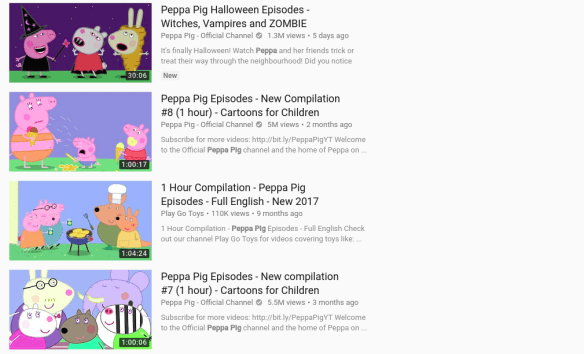
YouTube broadcasters have thus developed a huge number of tactics to draw parents’ and childrens’ attention to their videos, and the advertising revenues that accompany them. The first of these tactics is simply to copy and pirate other content. A simple search for “Peppa Pig” on YouTube in my case yielded “About 10,400,000 results” and the front page is almost entirely from the verified “Peppa Pig Official Channel”, while one is from an unverified channel called Play Go Toys, which you really wouldn’t notice unless you were looking out for it:

Play Go Toys’ channel consists of (I guess?) pirated Peppa Pig and other cartoons, videos of toy unboxings (another kid magnet), and videos of, one supposes, the channel owner’s own children. I am not alleging anything bad about Play Go Toys; I am simply illustrating how the structure of YouTube facilitates the delamination of content and author, and how this impacts on our awareness and trust of its source.

As another blogger notes, one of the traditional roles of branded content is that it is a trusted source. Whether it’s Peppa Pig on children’s TV or a Disney movie, whatever one’s feelings about the industrial model of entertainment production, they are carefully produced and monitored so that kids are essentially safe watching them, and can be trusted as such. This no longer applies when brand and content are disassociated by the platform, and so known and trusted content provides a seamless gateway to unverified and potentially harmful content.

(Yes, this is the exact same process as the delamination of trusted news media on Facebook feeds and in Google results that is currently wreaking such havoc on our cognitive and political systems and I am not going to explicitly explore that relationship further here, but it is obviously deeply significant.)

A second way of increasing hits on videos is through keyword/hashtag association, which is a whole dark art unto itself. When some trend, such as Surprise Egg videos, reaches critical mass, content producers pile onto it, creating thousands and thousands more of these videos in every possible iteration. This is the origin of all the weird names in the list above: branded content and nursery rhyme titles and “surprise egg” all stuffed into the same word salad to capture search results, sidebar placement, and “up next” autoplay rankings.

Play Go Toys’ channel consists of (I guess?) pirated Peppa Pig and other cartoons, videos of toy unboxings (another kid magnet), and videos of, one supposes, the channel owner’s own children. I am not alleging anything bad about Play Go Toys; I am simply illustrating how the structure of YouTube facilitates the delamination of content and author, and how this impacts on our awareness and trust of its source.

As another blogger notes, one of the traditional roles of branded content is that it is a trusted source. Whether it’s Peppa Pig on children’s TV or a Disney movie, whatever one’s feelings about the industrial model of entertainment production, they are carefully produced and monitored so that kids are essentially safe watching them, and can be trusted as such. This no longer applies when brand and content are disassociated by the platform, and so known and trusted content provides a seamless gateway to unverified and potentially harmful content.

(Yes, this is the exact same process as the delamination of trusted news media on Facebook feeds and in Google results that is currently wreaking such havoc on our cognitive and political systems and I am not going to explicitly explore that relationship further here, but it is obviously deeply significant.)

A second way of increasing hits on videos is through keyword/hashtag association, which is a whole dark art unto itself. When some trend, such as Surprise Egg videos, reaches critical mass, content producers pile onto it, creating thousands and thousands more of these videos in every possible iteration. This is the origin of all the weird names in the list above: branded content and nursery rhyme titles and “surprise egg” all stuffed into the same word salad to capture search results, sidebar placement, and “up next” autoplay rankings.

A striking example of the weirdness is the Finger Family videos (harmless example embedded above). I have no idea where they came from or the origin of the children’s rhyme at the core of the trope, but there are at least 17 million versions of this currently on YouTube, and again they cover every possible genre, with billions and billions of aggregated views.

Once again, the view numbers of these videos must be taken under serious advisement. A huge number of these videos are essentially created by bots and viewed by bots, and even commented on by bots. That is a whole strange world in and of itself. But it shouldn’t obscure that there are also many actual children, plugged into iphones and tablets, watching these over and over again — in part accounting for the inflated view numbers — learning to type basic search terms into the browser, or simply mashing the sidebar to bring up another video.

What I find somewhat disturbing about the proliferation of even (relatively) normal kids videos is the impossibility of determining the degree of automation which is at work here; how to parse out the gap between human and machine. The example above, from a channel called Bounce Patrol Kids, with almost two million subscribers, show this effect in action. It posts professionally produced videos, with dedicated human actors, at the rate of about one per week. Once again, I am not alleging anything untoward about Bounce Patrol, which clearly follows in the footsteps of pre-digital kid sensations like their fellow Australians The Wiggles.

And yet, there is something weird about a group of people endlessly acting out the implications of a combination of algorithmically generated keywords: “Halloween Finger Family & more Halloween Songs for Children | Kids Halloween Songs Collection”, “Australian Animals Finger Family Song | Finger Family Nursery Rhymes”, “Farm Animals Finger Family and more Animals Songs | Finger Family Collection – Learn Animals Sounds”, “Safari Animals Finger Family Song | Elephant, Lion, Giraffe, Zebra & Hippo! Wild Animals for kids”, “Superheroes Finger Family and more Finger Family Songs! Superhero Finger Family Collection”, “Batman Finger Family Song — Superheroes and Villains! Batman, Joker, Riddler, Catwoman” and on and on and on. This is content production in the age of algorithmic discovery — even if you’re a human, you have to end up impersonating the machine.

Other channels do away with the human actors to create infinite reconfigurable versions of the same videos over and over again. What is occurring here is clearly automated. Stock animations, audio tracks, and lists of keywords being assembled in their thousands to produce an endless stream of videos. The above channel, Videogyan 3D Rhymes — Nursery Rhymes & Baby Songs, posts several videos a week, in increasingly byzantine combinations of keywords. They have almost five million subscribers — more than double Bounce Patrol — although once again it’s impossible to know who or what is actually racking up these millions and millions of views.

I’m trying not to turn this essay into an endless list of examples, but it’s important to grasp how vast this system is, and how indeterminate its actions, process, and audience. It’s also international: there are variations of Finger Family and Learn Colours videos for Tamil epics and Malaysian cartoons which are unlikely to pop up in any Anglophone search results. This very indeterminacy and reach is key to its existence, and its implications. Its dimensionality makes it difficult to grasp, or even to really think about.

We’ve encountered pretty clear examples of the disturbing outcomes of full automation before — some of which have been thankfully leavened with a dark kind of humour, others not so much. Much has been made of the algorithmic interbreeding of stock photo libraries and on-demand production of everything from tshirts to coffee mugs to infant onesies and cell phone covers. The above example, available until recently on Amazon, is one such case, and the story of how it came to occur is fascinating and weird but essentially comprehensible. Nobody set out to create phone cases with drugs and medical equipment on them, it was just a deeply weird mathematical/probabilistic outcome. The fact that it took a while to notice might ring some alarm bells however.

Likewise, the case of the “Keep Calm and Rape A Lot” tshirts (along with the “Keep Calm and Knife Her” and “Keep Calm and Hit Her” ones) is depressing and distressing but comprehensible. Nobody set out to create these shirts: they just paired an unchecked list of verbs and pronouns with an online image generator. It’s quite possible that none of these shirts ever physically existed, were ever purchased or worn, and thus that no harm was done. Once again though, the people creating this content failed to notice, and neither did the distributor. They literally had no idea what they were doing.

What I will argue, on the basis of these cases and of those I’m going to describe further, is that the scale and logic of the system is complicit in these outputs, and requires us to think through their implications.

(Also again: I’m not going to dig into the wider social implications of such processes outside the scope of what I am writing about here, but it’s clear that one can draw a clear line from examples such as these to pressing contemporary issues such as racial and gender bias in big data and machine intelligence-driven systems, which require urgent attention but in the same manner do not have anything resembling easy or even preferable solutions.)

Let’s look at just one video among the piles of kid videos, and try to parse out where it comes from. It’s important to stress that I didn’t set out to find this particular video: it appeared organically and highly ranked in a search for ‘finger family’ in an incognito browser window (i.e. it should not have been influenced by previous searches). This automation takes us to very, very strange places, and at this point the rabbithole is so deep that it’s impossible to know how such a thing came into being.

Once again, a content warning: this video is not inappropriate in any way, but it is decidedly off, and contains elements which might trouble anyone. It’s very mild on the scale of such things, but. I describe it below if you don’t want to watch it and head down that road. This warning will recur.

The above video is entitled Wrong Heads Disney Wrong Ears Wrong Legs Kids Learn Colors Finger Family 2017 Nursery Rhymes. The title alone confirms its automated provenance. I have no idea where the “Wrong Heads” trope originates, but I can imagine, as with the Finger Family Song, that somewhere there is a totally original and harmless version that made enough kids laugh that it started to climb the algorithmic rankings until it made it onto the word salad lists, combining with Learn Colors, Finger Family, and Nursery Rhymes, and all of these tropes — not merely as words but as images, processes, and actions — to be mixed into what we see here.

The video consists of a regular version of the Finger Family song played over an animation of character heads and bodies from Disney’s Aladdin swapping and intersecting. Again, this is weird but frankly no more than the Surprise Egg videos or anything else kids watch. I get how innocent it is. The offness creeps in with the appearance of a non-Aladdin character —Agnes, the little girl from Despicable Me. Agnes is the arbiter of the scene: when the heads don’t match up, she cries, when they do, she cheers.

The video’s creator, BABYFUN TV (screenshot above), has produced many similar videos. As many of the Wrong Heads videos as I could bear to watch all work in exactly the same way. The character Hope from Inside Out weeps through a Smurfs and Trolls head swap. It goes on and on. I get the game, but the constant overlaying and intermixing of different tropes starts to get inside you. BABYFUN TV only has 170 subscribers and very low view rates, but then there are thousands and thousands of channels like this. Numbers in the long tail aren’t significant in the abstract, but in their accumulation.

The question becomes: how did this come to be? The “Bad Baby” trope also present on BABYFUN TV features the same crying. While I find it disturbing, I can understand how it might provide some of the rhythm or cadence or relation to their own experience that actual babies are attracted to in this content, although it has been warped and stretched through algorithmic repetition and recombination in ways that I don’t think anyone actually wants to happen.

Toy Freaks is a hugely popular channel (68th on the platform) which features a father and his two daughters playing out — or in some cases perhaps originating — many of the tropes we’ve identified so far, including “Bad Baby”, above. As well as nursery rhymes and learning colours, Toy Freaks specialises in gross-out situations, as well as activities which many, many viewers feel border on abuse and exploitation, if not cross the line entirely, including videos of the children vomiting and in pain. Toy Freaks is a YouTube verified channel, whatever that means. (I think we know by now it means nothing useful.)

As with Bounce Patrol Kids, however you feel about the content of these videos, it feels impossible to know where the automation starts and ends, who is coming up with the ideas and who is roleplaying them. In turn, the amplification of tropes in popular, human-led channels such as Toy Freaks leads to them being endlessly repeated across the network in increasingly outlandish and distorted recombinations.

There’s a second level of what I’m characterising as human-led videos which are much more disturbing than the mostly distasteful activities of Toy Freaks and their kin. Here is a relatively mild, but still upsetting example:

A step beyond the simply pirated Peppa Pig videos mentioned previously are the knock-offs. These too seem to teem with violence. In the official Peppa Pig videos, Peppa does indeed go to the dentist, and the episode in which she does so seems to be popular — although, confusingly, what appears to be the real episode is only available on an unofficial channel. In the official timeline, Peppa is appropriately reassured by a kindly dentist. In the version above, she is basically tortured, before turning into a series of Iron Man robots and performing the Learn Colours dance. A search for “peppa pig dentist” returns the above video on the front page, and it only gets worse from here.

Disturbing Peppa Pig videos, which tend towards extreme violence and fear, with Peppa eating her father or drinking bleach, are, it turns out very widespread. They make up an entire YouTube subculture. Many are obviously parodies, or even satires of themselves, in the pretty common style of the internet’s outrageous, deliberately offensive kind. All the 4chan tropes are there, the trolls are out, we know this.

In the example above, the agency is less clear: the video starts with a trollish Peppa parody, but later syncs into the kind of automated repetition of tropes we’ve seen already. I don’t know which camp it belongs to. Maybe it’s just trolls. I kind of hope it is. But I don’t think so. Trolls don’t cover the intersection of human actors and more automated examples further down the line. They’re at play here, but they’re not the whole story.

I suppose it’s naive not to see the deliberate versions of this coming, but many are so close to the original, and so unsignposted — like the dentist example — that many, many kids are watching them. I understand that most of them are not trying to mess kids up, not really, even though they are.

I’m trying to understand why, as plainly and simply troubling as it is, this is not a simple matter of “won’t somebody think of the children” hand-wringing. Obviously this content is inappropriate, obviously there are bad actors out there, obviously some of these videos should be removed. Obviously too this raises questions of fair use, appropriation, free speech and so on. But reports which simply understand the problem through this lens fail to fully grasp the mechanisms being deployed, and thus are incapable of thinking its implications in totality, and responding accordingly.

The New York Times, headlining their article on a subset of this issue “On YouTube Kids, Startling Videos Slip Past Filters”, highlights the use of knock-off characters and nursery rhymes in disturbing content, and frames it as a problem of moderation and legislation. YouTube Kids, an official app which claims to be kid-safe but is quite obviously not, is the problem identified, because it wrongly engenders trust in users. An article in the British tabloid The Sun, “Kids left traumatised after sick YouTube clips showing Peppa Pig characters with knives and guns appear on app for children” takes the same line, with an added dose of right-wing technophobia and self-righteousness. But both stories take at face value YouTube’s assertions that these results are incredibly rare and quickly removed: assertions utterly refuted by the proliferation of the stories themselves, and the growing number of social media posts, largely by concerned parents, from which they arise.

But as with Toy Freaks, what is concerning to me about the Peppa videos is how the obvious parodies and even the shadier knock-offs interact with the legions of algorithmic content producers until it is completely impossible to know what is going on. (“The creatures outside looked from pig to man, and from man to pig, and from pig to man again; but already it was impossible to say which was which.”)

Here’s what is basically a version of Toy Freaks produced in Asia (screenshot above). Here’s one from Russia. I don’t really want to use the term “human-led” any more about these videos, although they contain all the same tropes and actual people acting them out. I no longer have any idea what’s going on here and I really don’t want to and I’m starting to think that that is kind of the point. That’s part of why I’m starting to think about the deliberateness of this all. There is a lot of effort going into making these. More than spam revenue can generate — can it? Who’s writing these scripts, editing these videos? Once again, I want to stress: this is still really mild, even funny stuff compared to a lot of what is out there.

Here are a few things which are disturbing me:

The first is the level of horror and violence on display. Some of the times it’s troll-y gross-out stuff; most of the time it seems deeper, and more unconscious than that. The internet has a way of amplifying and enabling many of our latent desires; in fact, it’s what it seems to do best. I spend a lot of time arguing for this tendency, with regards to human sexual freedom, individual identity, and other issues. Here, and overwhelmingly it sometimes feels, that tendency is itself a violent and destructive one.

The second is the levels of exploitation, not of children because they are children but of children because they are powerless. Automated reward systems like YouTube algorithms necessitate exploitation in the same way that capitalism necessitates exploitation, and if you’re someone who bristles at the second half of that equation then maybe this should be what convinces you of its truth. Exploitation is encoded into the systems we are building, making it harder to see, harder to think and explain, harder to counter and defend against. Not in a future of AI overlords and robots in the factories, but right here, now, on your screen, in your living room and in your pocket.

Many of these latest examples confound any attempt to argue that nobody is actually watching these videos, that these are all bots. There are humans in the loop here, even if only on the production side, and I’m pretty worried about them too.

I’ve written enough, too much, but I feel like I actually need to justify all this raving about violence and abuse and automated systems with an example that sums it up. Maybe after everything I’ve said you won’t think it’s so bad. I don’t know what to think any more.

This video, BURIED ALIVE Outdoor Playground Finger Family Song Nursery Rhymes Animation Education Learning Video, contains all of the elements we’ve covered above, and takes them to another level. Familiar characters, nursery tropes, keyword salad, full automation, violence, and the very stuff of kids’ worst dreams. And of course there are vast, vast numbers of these videos. Channel after channel after channel of similar content, churned out at the rate of hundreds of new videos every week. Industrialised nightmare production.

For the final time: There is more violent and more sexual content like this available. I’m not going to link to it. I don’t believe in traumatising other people, but it’s necessary to keep stressing it, and not dismiss the psychological effect on children of things which aren’t overtly disturbing to adults, just incredibly dark and weird.

A friend who works in digital video described to me what it would take to make something like this: a small studio of people (half a dozen, maybe more) making high volumes of low quality content to reap ad revenue by tripping certain requirements of the system (length in particular seems to be a factor). According to my friend, online kids’ content is one of the few alternative ways of making money from 3D animation because the aesthetic standards are lower and independent production can profit through scale. It uses existing and easily available content (such as character models and motion-capture libraries) and it can be repeated and revised endlessly and mostly meaninglessly because the algorithms don’t discriminate — and neither do the kids.

These videos, wherever they are made, however they come to be made, and whatever their conscious intention (i.e. to accumulate ad revenue) are feeding upon a system which was consciously intended to show videos to children for profit. The unconsciously-generated, emergent outcomes of that are all over the place.

To expose children to this content is abuse. We’re not talking about the debatable but undoubtedly real effects of film or videogame violence on teenagers, or the effects of pornography or extreme images on young minds, which were alluded to in my opening description of my own teenage internet use. Those are important debates, but they’re not what is being discussed here. What we’re talking about is very young children, effectively from birth, being deliberately targeted with content which will traumatise and disturb them, via networks which are extremely vulnerable to exactly this form of abuse. It’s not about trolls, but about a kind of violence inherent in the combination of digital systems and capitalist incentives. It’s down to that level of the metal.

This, I think, is my point: The system is complicit in the abuse.

And right now, right here, YouTube and Google are complicit in that system. The architecture they have built to extract the maximum revenue from online video is being hacked by persons unknown to abuse children, perhaps not even deliberately, but at a massive scale. I believe they have an absolute responsibility to deal with this, just as they have a responsibility to deal with the radicalisation of (mostly) young (mostly) men via extremist videos — of any political persuasion. They have so far showed absolutely no inclination to do this, which is in itself despicable. However, a huge part of my troubled response to this issue is that I have no idea how they can respond without shutting down the service itself, and most systems which resemble it. We have built a world which operates at scale, where human oversight is simply impossible, and no manner of inhuman oversight will counter most of the examples I’ve used in this essay. The asides I’ve kept in parentheses throughout, if expanded upon, would allow one with minimal effort to rewrite everything I’ve said, with very little effort, to be not about child abuse, but about white nationalism, about violent religious ideologies, about fake news, about climate denialism, about 9/11 conspiracies.

This is a deeply dark time, in which the structures we have built to sustain ourselves are being used against us — all of us — in systematic and automated ways. It is hard to keep faith with the network when it produces horrors such as these. While it is tempting to dismiss the wilder examples as trolling, of which a significant number certainly are, that fails to account for the sheer volume of content weighted in a particularly grotesque direction. It presents many and complexly entangled dangers, including that, just as with the increasing focus on alleged Russian interference in social media, such events will be used as justification for increased control over the internet, increasing censorship, and so on. This is not what many of us want.

I’m going to stop here, saying only this:

What concerns me is not just the violence being done to children here, although that concerns me deeply. What concerns me is that this is just one aspect of a kind of infrastructural violence being done to all of us, all of the time, and we’re still struggling to find a way to even talk about it, to describe its mechanisms and its actions and its effects. As I said at the beginning of this essay: this is being done by people and by things and by a combination of things and people. Responsibility for its outcomes is impossible to assign but the damage is very, very real indeed.


I’ve Been Banned From Facebook For Sharing An Article About False Flags

By Caitlin Johnstone

Source: OpEdNews.com

My personal Facebook account, which has the maximum 5,000 friends and an additional 5,000+ followers, has been blocked from posting for three days. My page hasn’t been blocked yet, but we’ll see; I shared the article there, too.

The reason given for this ban by the little pop-up boxes when I logged on just now was that a couple months ago I had shared an article about admitted false flag operations perpetrated by governments around the world. I don’t know what happened that made Facebook’s system decide to crack down on me now all of a sudden, but I do know I’ve been a bit naughtier than usual in my last couple of articles.

The article I got the banhammer for sharing is titled For Those Who Don’t ‘Believe’ In ‘Conspiracies’ Here Are 58 Admitted False Flag Attacks. According to the site’s ticker it has 50,667 shares as of this writing. It’s laden with hyperlinks for further reading, and lists only instances of false flag operations that insiders are on the record as having admitted to themselves. It’s a good compilation of important information. People should be allowed to share it.

The notifications say I can be permanently banned if I continue posting that sort of material. I’ve had that account since 2007.

So. Who wants to see my Barbra Streisand impression?

(Image by Caitlin Johnstone)

(Image by Caitlin Johnstone)

In a corporatist system of government, corporate censorship is state censorship. When there’s no meaningful space between corporate power and government power, it doesn’t make much difference whether the guy silencing your dissent is Mark Zuckerberg or Jeff Sessions. America most definitely has such a system.

If they’re going to get us locked down and propagandized into their vapid brain boxes, this will be how they’ll do it. Not by government censorship, but by corporate censorship. Government can’t make an overt attempt to stop a dissenting voice from speaking, but the corporations who own the venue of their speech can.

In a recent Senate Judiciary Committee hearing, plutocrat-sponsored senators spoke with top legal and security officials for Facebook, Twitter and Google in a very disturbing way about the need to silence dissenting voices.

Democratic Senator Mazie Hirono of Hawaii demanded that the companies adopt a “mission statement” declaring their commitment “to prevent the fomenting of discord.”

A former FBI agent Clint Watts kicked it up even further, saying, “Civil wars don’t start with gunshots, they start with words. America’s war with itself has already begun. We all must act now on the social media battlefield to quell information rebellions that can quickly lead to violent confrontations and easily transform us into the Divided States of America.”

“Stopping the false information artillery barrage landing on social media users comes only when those outlets distributing bogus stories are silenced”—“-silence the guns and the barrage will end,” he added.

This was on the Senate floor. Officials were speaking about the need to censor social media to prevent people from sharing dissenting ideas on the Senate floor.

World Socialist Web Site said of the hearing,

That such a statement could be made in a congressional hearing, entirely without objection, is an expression of the terminal decay of American democracy. There is no faction of the ruling class that maintains any commitment to basic democratic rights.

None of the Democrats in the committee raised any of the constitutional issues involved in asking massive technology companies to censor political speech on the Internet. Only one Republican raised concerns over censorship, but only to allege that Google had a liberal bias.

Former FBI agent says tech companies must “silence” sources of “rebellion”
US Congressional hearing: By Andre Damon 1 November 2017 Top legal and security officials for Facebook, Twitter and” www.wsws.org

I’ll admit right now that this really scares me. Ever the optimist, I’ve been reassuring my readers that the corporatocracy would never risk taking off the black hole sun mask of corporate cheerfulness and move into regular, overt totalitarianism. I’ve contended that they must remain covert in order to keep successfully manufacture consent.

But, here we are. Through a studious application of psy-ops they have their censorship and they have their consent. Remember, in the book “Fahrenheit 451” the public wasn’t unhappy about the book burnings. They cheered them on, and that’s what we have now. The herd is mindlessly clapping their approval at censorship and even volunteering to report naughty behavior like good little hall monitors for the oligarchy. I’m sure that even some of my close friends and family will silently approve of my banning and will meet my distress with the pursed lips of a church lady secretly pleased at my comeuppance.

I tried joining Gab when I saw this coming, but it’s really alt-righty there and the energy there is just gross. Finding a new social media outlet might not even matter anyway, since these creeps just target any place people gather in large numbers.

I don’t know. I always freak out a bit when the eye of corporate censorship focuses on me. I’ve recently been told by a number of people that they’ve been banned for sharing my articles, and now it’s hitting me.

I’m babbling. This is weird. I just really, really don’t want humanity to become what these people are trying to turn it into, you know? Help me make some noise about this stuff, please. Manipulators can’t do their job when there’s a big spotlight pointed at them.

______

Hey you, thanks for reading! My work is entirely reader-funded so if you enjoyed this piece please consider sharing it around, liking me on Facebook, following me on Twitter, and maybe throwing some money into my hat on Patreon or Paypal.

The attack on “fake news” is really an attack on alternative media

As the author of an article labeled “pro-Russia propaganda,” I can testify that unorthodox views are under attack

By Dave Lindorff

Source: Salon.com

These are tough days to be a serious journalist. Report a story now, with your facts all lined up nicely, and you’re still likely to have it labeled “fake news” by anyone whose ox you’ve gored — and even by friends who don’t share your political perspective. For good measure, they’ll say you’ve based it on “alternative facts.”

Historians say the term “fake news” dates from the late 19th-century era of “yellow journalism,” but the term really took off in 2016, a little over a year ago, during Donald Trump’s run for the presidency. It described several different things, from fact-free, pro-Trump online media to sensationalistic and largely untrue stories whose only goal was eyeballs and dollars. During the primary season, Trump himself began labeling all mainstream media stories about him as “fake news.” The idea that there could be different truths, while dating at least back to the administration of President George W. Bush, when his consigliere Karl Rove claimed that the administration “made its own” reality, gained currency when Trump adviser Kellyanne Conway, caught making stuff up in a TV interview, claimed that she was relying on “alternative facts.”

That dodge would be fine, on its own. Most people are primed to believe that politicians lie — whatever party or persuasion they represent — so their attempts to deny it when called a conjurer of falsehoods posing tend to be recognized as such.

The corporate media — The New York Times, The Washington Post, the network news programs and even National Public Radio — have all responded to being called liars and “fake news” fabricators of by promoting themselves as “the reality-based community” (NPR), or claiming they are fighting the good fight against ignorance, as demonstrated by the Post’s new masthead slogan “Democracy dies in darkness.” The Times has stuck with its hoary “All the news that’s fit to print”slogan, but has added a page-three daily feature listing “noteworthy facts from today’s paper” and has taken to calling out Trump administration whoppers as “lies.”

Last December Congress passed a new law, promptly signed by then-President Barack Obama, that enacted an Orwellian amendment to the Defense Authorization Act of 2017. Called the Countering Disinformation and Propaganda Act, this measure tasks the State Department, in consultation with the Department of Defense, the director of national intelligence and an obscure government propaganda organization called the Broadcasting Board of Governors, to establish a “Center for Information Analysis and Response.” The job of this new center, funded by a $160 million, two-year budget allocation, would be to collect information on “foreign propaganda and disinformation efforts” and “proactively advance fact-based narratives that support United States allies and interests.”

What is “fake news”? The target keeps moving

This might all seem laughable, but as a journalist who has worked in this field for 45 years, in both mainstream newspapers and television and in the alternative media, and as a long-time freelancer who has written for publications as widely varied as Business Week, the Nation, the Village Voice and a collectively run news site called ThisCantBeHappening.net, I have watched as this obsession with “fake news” has turned into an attack on alternative news and alternative news organizations.

Last Nov. 24, The Washington Post published a McCarthyite-style front-page article declaring that some 200 news sites on the web were actually witting or unwitting “purveyors of pro-Russian propaganda.” The article, by Post National Security Reporter Craig Timberg, was based on the work of a shady outfit called PropOrNot, whose owner-organizers were kept anonymous by Timberg and whose source of funding was left unexplained. PropOrNot, Timberg wrote, had developed a list of sites which it had determined to be peddling “pro-Russia propaganda.”

For one of the sites on the list, the prominent left-wing journal Counterpunch, founded decades ago by former Village Voice and Nation columnist Alexander Cockburn, PropOrNot offered up two articles as justification for its designation. One of those articles was by me. It was a piece I’d actually written for ThisCantBeHappening, which had been republished with credit by Counterpunch. The reviewer, a retired military intelligence officer named Joel Harding (who I discovered is linked to Fort Belvoir outside Washington, home to the U.S. Army’s Information Operations Command, or INSCOM), labeled my article “absurdly pro-Russian propaganda.”

In fact, the article was a pretty straightforward report on the Sept. 29, 2016 findings by the joint Dutch-Australian investigation into the July 2014 shoot-down of a Malaysian jumbo passenger jet over Ukraine, which concluded that Russia was the culprit. I noted in the article that this investigation was not legitimate, because two nations — Russia and Ukraine — were known to possess the Buk missiles and launchers that had brought down the plane, but only one of them, Ukraine, was permitted to offer evidence. Russian offers of evidence in the case were repeatedly rebuffed. The report also failed to mention that the Ukrainian government had received veto power over any conclusions reached by the investigators.

Was my report “fake news” or propaganda? Not at all.

The fake news in this case has been what has been written and aired by virtually all of the U.S. media, including the Times, the Post and all the major networks, about that horrific tragedy. They all continue to state as fact that a Russian Buk missile downed that plane, though no honest investigation has been conducted. (Technically it is true that the Buk missiles are all “Russian,” in that they were all manufactured in Russia. Left unsaid is that Ukraine’s military had Buk launchers since their nation was part of the Soviet Union and continued to purchase them after independence.)

 Laziest form of media criticism

“Labeling news reports that you don’t like as ’fake news’ is the laziest form of media criticism,” says Jim Naureckas, editor of Fairness and Accuracy In Reporting, a New York-based journalism review. “It’s like putting your fingers in your ears and going ‘la la la’ really loudly. Both the government and the corporate media have reasons for not wanting the public to hear points of view that are threats to their power.”

While Kellyanne Conway claimed her right to offer “alternative facts” as a way to justify getting caught in a lie, there are also alternative facts which are real but don’t get reported in the corporate media. A classic example was in the run-up to the U.S. invasion of Iraq, when the entire corporate media reported as fact that Saddam Hussein had weapons of mass destruction and was attempting to develop a nuclear bomb.

There were plenty of alternative news organizations who quoted UN inspectors saying that none of that was true and there were no WMDs or WMD programs in Iraq, but they were simply blacked out by the corporate media like the Times, the Post and the major news networks.

These days another dubious story is that the Russians “hacked” the server of the Democratic National Committee. It may have happened that way, but in fact, the vast intelligence system the U.S. has constructed to monitor all domestic and foreign telecommunications has offered up no hard evidence of such a hack. National Security Agency whistleblower William Binney and retired CIA analyst Ray McGovern have suggested that some evidence indicates a DNC insider must have been involved.

There is certainly fake news all over the internet, and baseless conspiracies run rampant on both the left and the right. But all too often, articles like mine cited by PropOrNot (a genuine purveyor of fake news!) are being labeled as propaganda in what Naureckas says is simply “the use of irony as a defense mechanism” by news organizations that themselves are actually guilty of publishing really fake news, as the Post did with its PropOrNot blacklist “scoop.”

“What the government and the corporate media are trying to do, with the help of the big internet corporations,” argues Mickey Huff, director of the Project Censored organization in California, “is basically to shut down alternative news sites that question the media consensus position on issues.”

A wide threat to online media

That’s a threat to any online news organization, including this one, that depend upon equal access to the internet and to fast download speeds. Already, Huff charges, there are reports that Facebook is slowing down certain sites that have links on its platform, in a misguided response to charges that it sold ad space to Russian government-linked organizations accused of trying to influence last November’s presidential election.

An end to internet neutrality, the equal access to high-speed internet for surfing and downloading that has been guaranteed to all users — but that is now under attack by the Trump administration, its Federal Communications Commission and a Republican-led Congress — would make it that much easier for such a shutdown of alternative media to happen.

The real answer, of course, is for readers and viewers of all media, mainstream or alternative, to become critical consumers of news. This means not just looking at articles critically, including this one, but going to multiple sources for information on important issues. Relying on just the Times or the Post, or on Fox News or NPR, will leave you informationally malnourished — not just uninformed but misinformed. Even if you were to read both those papers and watch both those networks, you’d often be left with an incomplete version of the truth.

To get to the truth, we need to also check out alternative news sources, whether of the left, right or center — and we need to maintain the critical distinction between unpopular or unorthodox points of view and blatant lies or propaganda. Without such a distinction, and the freedom to make such decisions for ourselves, maintaining democracy will be impossible.