The Richest Sociopath in the World

By John Rachel

Source: Dissident Voice

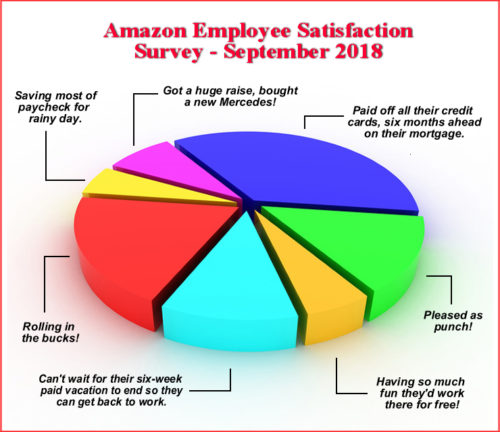
Obviously the above pie chart is a put-on. It is well-documented that working conditions for most employees of Amazon are  abysmaldehumanizing, bordering on abuse we normally associate with slavery.

Moreover, the median employee’s salary under Jeff Bezos’ imperial lordship is $28,446. No one working as a regular there has paid off their credit cards and is driving to work in a Mercedes. 

Jeff Bezos is referred to as The Richest Man in the World and his personal fortune, while growing by $191,000 each minute, is currently estimated at $168 billion.

So …

$28,446 vs. $168,000,000,000? While I can acknowledge the simple math, I find the contrast of such numbers on a gut level difficult to grasp.

To get a handle on such inequality, let’s try approaching it from different angles.

One way to put the disparity into perspective is to recognize it takes Bezos just under 9 seconds to earn what Amazon’s median worker does in an entire year.

Another is to recognize that for a worker to go through Jeff Bezos’ current personal fortune — and, of course, it continues mounting at accelerating levels as I write this — at his/her current median annual income of $28,446 per year, WOULD TAKE 5,905,927 YEARS! That’s close to 6 million years!

For Jeff Bezos himself to go through his current $168 billion, assuming his earnings stopped dead this very moment — which as you and I know they won’t — SPENDING $1,000,000 A DAY, would take NEARLY 460 years. Yes, even spending $1 million a day, in the year 2475 he’d still have plenty of cash, tens of million of dollars mad money. We can feel confident that he wouldn’t be foraging through the dumpster behind 7-11. 

Now, further consider that while the $28,446 median salary is above the national poverty line for a single individual if that person is the sole breadwinner for a family of four, it is marginally above it, which is why many Amazon employees must rely on government assistance to keep from starving.

As well as calculation, I did some speculation — a simple exercise in imagination.

Apparently Bezos’ wealth generating machine is raking it in so fast, he’s currently making $11.5 million per hour … every hour … 24 hours a day … seven days a week. $11,500,000 per hour! 

So here’s what I was picturing in my mind’s eye … 

If for 40 hours of the 168 hours in a week, Bezos were willing to scrape by on a mere $5,840,000 per hour, he could give every one of his 566,000 Amazon employees a $10 per hour raise. Of course, the remaining 128 hours in each week, Bezos could continue earning his normal $11.5 million per hour, not having to share any of it with the pathetic slobs who work for him.

Rhetorical question: Does Jeff Bezos have any concept of what that $10 per hour increase would mean to his employees? 

I’m not going to even suggest here I’m offering this for Bezos to entertain. There are so many advantages to him both as a putative member of the human race and the employer of over a half million workers — advantages that are so OBVIOUS — if they haven’t occurred to him up until now, then his brain functions in ways beyond my understanding. For one thing, he could point to his new fig leaf of “generosity” and ask people to stop calling him a selfish prick. Second, Amazon employees I’m sure would respond to his largesse with greater company loyalty and increased tolerance for his onerous working conditions. He’d still be the richest SOB on the block and could mock the pauperish Bill Gates and Warren Buffett as pitiable wannabees.

Consider …

The most poorly paid Amazon employee now makes $12 per hour. The $10 per hour raise I proposed would boost those $12 per hour workers right up there with Costco employees, who make an average of $21 per hour. And with the across-the-board $10 per hour increase, Bezos’ higher paid employees would be earning among the finest wages in the world provided by a major corporation. 

And by golly, there’s a plus side to the plus side …

Bezos’s bold and gracious gesture would result in a public relations coup of cosmic proportions! Amazon would no longer be demonized — well, not quite as much — by us bleeding-heart lefties as a capitalistic scourge and one-way ticket to Hell for the future of mankind, even if its environmental record is appalling and its business model generally the stuff of steroid-laced neo-feudalism.

Granted, Bezos would have to do some belt-tightening. He’d have to watch his pennies but could probably manage it, eh? Maybe he could skip a couple meals and do some of his own weeding at his estate. After all, after lavishing the $10 per hour raise on all of his employees, he’d only be pulling in $1,705,600,000 per week. I know I know! Like me you’re probably getting all teary-eyed for the poor guy.

Let me get to the extremely anti-climactic conclusion of this lament qua analysis.

Since nothing will change until the system itself changes, meaning the one in place now that creates, incentivizes, and lionizes the obscenely wealthy — reference current holder of the Office of President of the United States of America — I can only recommend this …

We have been labeling Jeff Bezos as ‘The Richest Man in the World’. Yet, quite honestly I don’t personally know any human, man or woman, who behaves like this gluttonous chunk of self-indulgent meat. It actually makes me nauseous to think we’re members of the same species.

Thus, from now on let’s use the correct terminology. Let’s call Jeff Bezos what he really is: the Richest Sociopath in the World.

We could probably order bumper stickers to help correct the record … from Amazon, of course.

For Economic Truth Turn To Michael Hudson

By Paul Craig Roberts

Source: PaulCraigRoberts.org

Readers ask me how they can learn economics, what books to read, what university economics departments to trust. I receive so many requests that it is impossible to reply individually. Here is my answer.

There is only one way to learn economics, and that is to read Michael Hudson’s books. It is not an easy task. You will need a glossary of terms. In some of Hudson’s books, if memory serves, he provides a glossary, and his recent book “J Is for Junk Economics” defines the classical economic terms that he uses. You will also need patience, because Hudson sometimes forgets in his explanations that the rest of us don’t know what he knows.

The economics taught today is known as neoliberal. This economics differs fundamentally from classical economics that Hudson represents. For example, classical economics stresses taxing economic rent instead of labor and real investment, while neo-liberal economics does the opposite.

An economic rent is unearned income that accrues to an owner from an increase in value that he did nothing to produce. For example, a new road is built at public expense that opens land to development and raises its value, or a transportation system is constructed in a city that raises the value of nearby properties. These increases in values are economic rents. Classical economists would tax away the increase in values in order to pay for the road or transportation system.

Neoliberal economists redefined all income as earned. This enables the financial system to capitalize economic rents into mortgages that pay interest. The higher property values created by the road or transportation system boost the mortgage value of the properties. The financialization of the economy is the process of drawing income away from the purchases of goods and services into interest and fees to financial entities such as banks. Indebtedness and debt accumulate, drawing more income into their service until there is no purchasing power left to drive the economy.

For example, formerly in the US lenders would provide a home mortgage whose service required up to 25% of the family’s monthly income. That left 75% of the family’s income for other purchases. Today lenders will provide mortgages that eat up half of the monthly income in mortgage service, leaving only 50% of family income for other purchases. In other words, a financialized economy is one that diverts purchasing power away from productive enterprise into debt service.

Hudson shows that international trade and foreign debt also comprise a financialization process, only this time a country’s entire resources are capitalized into a mortgage. The West sells a country a development plan and a loan to pay for it. When the debt cannot be serviced, the country is forced to impose austerity on the population by cutbacks in education, health care, public support systems, and government employment and also to privatize public assets such as mineral rights, land, water systems and ports in order to raise the capital with which to pay off the loan. Effectively, the country passes into foreign ownership. This now happens even to European Community members such as Greece and Portugal.

Another defect of neoliberal economics is the doctrine’s denial that resources are finite and their exhaustion a heavy cost not born by those who exploit the resources. Many local and regional civilizations have collapsed from exhaustion of the surrounding resources. Entire books have been written about this, but it is not part of neoliberal economics. Supplement study of Hudson with study of ecological economists such as Herman Daly.

The neglect of external costs is a crippling failure of neoliberal economics. An external cost is a cost imposed on a party that does not share in the income from the activity that creates the cost. I recently wrote about the external costs of real estate speculators. https://www.paulcraigroberts.org/2018/04/26/capitalism-works-capitalists/ Fracking, mining, oil and gas exploration, pipelines, industries, manufacturing, waste disposal, and so on have heavy external costs associated with the activities.

Neoliberal economists treat external costs as a non-problem, because they theorize that the costs can be compensated, but they seldom are. Oil spills result in companies having to pay cleanup costs and compensation to those who suffered economically from the oil spill, but most external costs go unaddressed. If external costs had to be compensated, in many cases the costs would exceed the value of the projects. How, for example, do you compensate for a polluted river? If you think that is hard, how would the short-sighted destroyers of the Amazon rain forest go about compensating the rest of the world for the destruction of species and for the destructive climate changes that they are setting in motion? Herman Daly has pointed out that as Gross Domestic Product accounting does not take account of external costs and resource exhaustion, we have no idea if the value of output is greater than all of the costs associated with its production. The Soviet economy collapsed, because the value of outputs was less than the value of inputs.

Supply-side economics, with which I am associated, is not an alternative theory to neoliberal economics. Supply-side economics is a successful correction to neoliberal macroeconomic management. Keynesian demand management resulted in stagflation and worsening Phillips Curve trade-offs between employment and inflation. Supply-side economics cured stagflation by reversing the economic policy mix. I have told this story many times. You can find a concise explanation in my short book, “The Failure of Laissez Faire Capitalsim.” This book also offers insights into other failures of neoliberal economics and for that reason would serve as a background introduction to Hudson’s books.

I can make some suggestions, but the order in which you read Michael Hudson is up to you. “J is for Junk Economics” is a way to get information in short passages that will make you familiar with the terms of classical economic analysis. “Killing the Host” and “The Bubble and Beyond” will explain how an economy run to maximize debt is an economy that is self-destructing. “Super Imperialism” and “Trade, Development and Foreign Debt” will show you how dominant countries concentrate world economic power in their hands. “Debt and Economic Renewal in the Ancient Near East” is the story of how ancient economies dying from excessive debt renewed their lease on life via debt forgiveness.

Once you learn Hudson, you will know real economics, not the junk economics marketed by Nobel prize winners in economics, university economic departments, and Wall Street economists. Neoliberal economics is a shield for financialization, resource exhaustion, external costs, and capitalist exploitation.

Neoliberal economics is the world’s reigning economics. Russia is suffering much more from neoliberal economics than from Washington’s economic sanctions. China herself is overrun with US trained neoliberal economists whose policy advice is almost certain to put China on the same path to failure as all other neoliberal economies.

It is probably impossible to change anything for two main reasons. One is that so many greed-driven private economic activities are protected by neoliberal economics. So many exploitative institutions and laws are in place that to overturn them would require a more thorough revolution than Lenin’s. The other is that economists have their entire human capital invested in neoliberal economics. There is scant chance that they are going to start over with study of the classical economists.

Neoliberal economics is an essential part of The Matrix, the false reality in which Americans and Europeans live. Neoliberal economics permits an endless number of economic lies. For example, the US is said to be in a long economic recovery that began in June 2009, but the labor force participation rate has fallen continuously throughout the period of alleged recovery. In previous recoveries the participation rate has risen as people enter the work force to take advantage of the new jobs.

In April the unemployment rate is claimed to have fallen to 3.9 percent, but the participation rate fell also. Neoliberal economists explain away the contradiction by claiming that the falling participation rate is due to the retirement of the baby boom generation, but BLS jobs statistics indicate that those 55 and older account for a large percentage of the new jobs during the alleged recovery. This is the age class of people forced into the part time jobs available by the absence of interest income on their retirement savings. What is really happening is that the unemployment rate does not include discouraged workers, who have given up searching for jobs as there are none to be found. The true measure of the unemployment rate is the decline in the labor force participation rate, not a 3.9 percent rate concocted by not counting those millions of Americans who cannot find jobs. If the unemployment rate really was 3.9 percent, there would be labor shortages and rising wages, but wages are stagnant. These anomalies pass without comment from neoliberal economists.

The long expansion since June 2009 might simply be a statistical artifact due to the under-measurement of inflation, which inflates the GDP figure. Inflation is under-estimated, because goods and services that rise in price are taken out of the index and less costly substitutes are put in their place and because price increases are explained away as quality improvements. In other words, statistical manipulation produces the favorable picture required by The Matrix.

Since the financial collapse caused by the repeal of Glass-Steagall and by financial deregulation, the Federal Reserve has robbed tens of millions of American savers by driving real interest rates down to zero for the sole purpose of saving the “banks too big to fail” that financial deregulation created. A handful of banks has been provided with free money—in addition to the money that the Federal Reserve created in order to take the banks’ bad derivative investments off their hands—to put on deposit with the Fed from which to collect interest payments and with which to speculate and to drive up stock prices.

In other words, for a decade the economic policy of the United States has been run for the benefit of a few highly concentrated financial interests at the expense of the American people. The economic policy of the United States has been used to create economic rents for the mega-rich.

Neoliberal economists point out that during the 1950s the labor force participation rate was much lower than today and, thereby, they imply that the higher rates prior to the current “recovery” are an anomaly. Neoliberal economists have no historical knowledge as the past is of no interest to them. They do not even know the history of economic thought. Whether from ignorance or intentional deception, neoliberal economists ignore that the lower labor force participation rates of the 1950s reflect a time when married women were at home, not in the work force. In those halcyon days, one earner was all it took to sustain a family. I remember the days when the function of a married woman was to provide household services for the family.

But capitalists were not content to exploit only one member of a family. They wanted more, and by using economic policy to suppress pay while fomenting inflation, they drove married women into the work force, imposing huge external costs on the family, child-raising, relations between spouses, and on the children themselves. The divorce rate has exploded to 50 percent and single-parent households are common in America.

In effect, unleashed Capitalism has destroyed America. Privatization is now eating away Europe. Russia is on the same track as a result of its neoliberal brainwashing by American economists. China’s love of success and money could doom this rising Asian giant as well if the government opens China to foreign finance capital and privatizes public assets that end up in foreign hands.

National (In)Security In the United States of Inequality

By Rajan Menon

Source: Unz Review

So effectively has the Beltway establishment captured the concept of national security that, for most of us, it automatically conjures up images of terrorist groups, cyber warriors, or “rogue states.” To ward off such foes, the United States maintains a historically unprecedented constellation of military bases abroad and, since 9/11, has waged wars in Afghanistan, Iraq, Syria, Libya, and elsewhere that have gobbled up nearly $4.8 trillion. The 2018 Pentagon budget already totals $647 billion — four times what China, second in global military spending, shells out and more than the next 12 countries combined, seven of them American allies. For good measure, Donald Trump has added an additional $200 billion to projected defense expenditures through 2019.

Yet to hear the hawks tell it, the United States has never been less secure. So much for bang for the buck.

For millions of Americans, however, the greatest threat to their day-to-day security isn’t terrorism or North Korea, Iran, Russia, or China. It’s internal — and economic. That’s particularly true for the 12.7% of Americans (43.1 million of them) classified as poor by the government’s criteria: an income below $12,140 for a one-person household, $16,460 for a family of two, and so on… until you get to the princely sum of $42,380 for a family of eight.

Savings aren’t much help either: a third of Americans have no savings at all and another third have less than $1,000 in the bank. Little wonder that families struggling to cover the cost of food alone increased from 11% (36 million) in 2007 to 14% (48 million) in 2014.

The Working Poor

Unemployment can certainly contribute to being poor, but millions of Americans endure poverty when they have full-time jobs or even hold down more than one job. The latest figures from the Bureau of Labor Statistics show that there are 8.6 million“working poor,” defined by the government as people who live below the poverty line despite being employed at least 27 weeks a year. Their economic insecurity doesn’t register in our society, partly because working and being poor don’t seem to go together in the minds of many Americans — and unemployment has fallen reasonably steadily. After approaching 10% in 2009, it’s now at only 4%.

Help from the government? Bill Clinton’s 1996 welfare “reform” program concocted in partnership with congressional Republicans, imposed time limits on government assistance, while tightening eligibility criteria for it. So, as Kathryn Edin and Luke Shaefer show in their disturbing book, $2.00 a Day: Living on Almost Nothing in America, many who desperately need help don’t even bother to apply. And things will only get worse in the age of Trump. His 2019 budget includes deep cuts in a raftof anti-poverty programs.

Anyone seeking a visceral sense of the hardships such Americans endure should read Barbara Ehrenreich’s 2001 book Nickel and Dimed: On (Not) Getting By in America. It’s a gripping account of what she learned when, posing as a “homemaker” with no special skills, she worked for two years in various low-wage jobs, relying solely on her earnings to support herself. The book brims with stories about people who had jobs but, out of necessity, slept in rent-by-the-week fleabag motels, flophouses, or even in their cars, subsisting on vending machine snacks for lunch, hot dogs and instant noodles for dinner , and forgoing basic dental care or health checkups. Those who managed to get permanent housing would choose poor, low-rent neighborhoods close to work because they often couldn’t afford a car. To maintain even such a barebones lifestyle, many worked more than one job.

Though politicians prattle on about how times have changed for the better, Ehrenreich’s book still provides a remarkably accurate picture of America’s working poor. Over the past decade the proportion of people who exhausted their monthly paychecks just to pay for life’s essentials actually increased from 31% to 38%. In 2013, 71% of the families that had children and used food pantries run by Feeding America, the largest private organization helping the hungry, included at least one person who had worked during the previous year. And in America’s big cities, chiefly because of a widening gap between rent and wages, thousands of working poor remain homeless, sleeping in shelters, on the streets, or in their vehicles, sometimes along with their families. In New York City, no outlier when it comes to homelessness among the working poor, in a third of the families with children that use homeless shelters at least one adult held a job.

The Wages of Poverty

The working poor cluster in certain occupations. They are salespeople in retail stores, servers or preparers of fast food, custodial staff, hotel workers, and caregivers for children or the elderly. Many make less than $10 an hour and lack any leverage, union or otherwise, to press for raises. In fact, the percentage of unionized workers in such jobs remains in the single digits — and in retail and food preparation, it’s under 4.5%. That’s hardly surprising, given that private sector union membership has fallen by 50% since 1983 to only 6.7% of the workforce.

Low-wage employers like it that way and — Walmart being the poster child for this — work diligently to make it ever harder for employees to join unions. As a result, they rarely find themselves under any real pressure to increase wages, which, adjusted for inflation, have stood still or even decreased since the late 1970s. When employment is “at-will,” workers may be fired or the terms of their work amended on the whim of a company and without the slightest explanation. Walmart announced this year that it would hike its hourly wage to $11 and that’s welcome news. But this had nothing to do with collective bargaining; it was a response to the drop in the unemployment rate, cash flows from the Trump tax cut for corporations (which saved Walmart as much as $2 billion), an increase in minimum wages in a number of states, and pay increases by an arch competitor, Target. It was also accompanied by the shutdown of 63 of Walmart’s Sam’s Club stores, which meant layoffs for 10,000 workers. In short, the balance of power almost always favors the employer, seldom the employee.

As a result, though the United States has a per-capita income of $59,500 and is among the wealthiest countries in the world, 12.7% of Americans (that’s 43.1 million people), officially are impoverished. And that’s generally considered a significant undercount. The Census Bureau establishes the poverty rate by figuring out an annual no-frills family food budget, multiplying it by three, adjusting it for household size, and pegging it to the Consumer Price Index. That, many economists believe, is a woefully inadequate way of estimating poverty. Food prices haven’t risen dramatically over the past 20 years, but the cost of other necessities like medical care (especially if you lack insurance) and housing have: 10.5% and 11.8% respectively between 2013 and 2017 compared to an only 5.5% increase for food.

Include housing and medical expenses in the equation and you get the Supplementary Poverty Measure (SPM), published by the Census Bureau since 2011. It reveals that a larger number of Americans are poor: 14% or 45 million in 2016.

Dismal Data

For a fuller picture of American (in)security, however, it’s necessary to delve deeper into the relevant data, starting with hourly wages, which are the way more than 58%of adult workers are paid. The good news: only 1.8 million, or 2.3% of them, subsist at or below minimum wage. The not-so-good news: one-third of all workers earn less than $12 an hour and 42% earn less than $15. That’s $24,960 and $31,200 a year. Imagine raising a family on such incomes, figuring in the cost of food, rent, childcare, car payments (since a car is often a necessity simply to get to a job in a country with inadequate public transportation), and medical costs.

The problem facing the working poor isn’t just low wages, but the widening gap between wages and rising prices. The government has increased the hourly federal minimum wage more than 20 times since it was set at 25 cents under the 1938 Fair Labor Standards Act. Between 2007 and 2009 it rose to $7.25, but over the past decade that sum lost nearly 10% of its purchasing power to inflation, which means that, in 2018, someone would have to work 41 additional days to make the equivalent of the 2009 minimum wage.

Workers in the lowest 20% have lost the most ground, their inflation-adjusted wages falling by nearly 1% between 1979 and 2016, compared to a 24.7% increase for the top 20%. This can’t be explained by lackluster productivity since, between 1985 and 2015, it outstripped pay raises, often substantially, in every economic sector except mining.

Yes, states can mandate higher minimum wages and 29 have, but 21 have not, leaving many low-wage workers struggling to cover the costs of two essentials in particular: health care and housing.

Even when it comes to jobs that offer health insurance, employers have been shifting ever more of its cost onto their workers through higher deductibles and out-of-pocket expenses, as well as by requiring them to cover more of the premiums. The percentage of workers who paid at least 10% of their earnings to cover such costs — not counting premiums — doubled between 2003 and 2014.

This helps explain why, according to the Bureau of Labor Statistics, only 11% of workers in the bottom 10% of wage earners even enrolled in workplace healthcare plans in 2016 (compared to 72% in the top 10%). As a restaurant server who makes $2.13 an hour before tips — and whose husband earns $9 an hour at Walmart — put it, after paying the rent, “it’s either put food in the house or buy insurance.”

The Affordable Care Act, or ACA (aka Obamacare), provided subsidies to help people with low incomes cover the cost of insurance premiums, but workers with employer-supplied healthcare, no matter how low their wages, weren’t covered by it. Now, of course, President Trump, congressional Republicans, and a Supreme Court in which right-wing justices are going to be even more influential will be intent on poleaxing the ACA.

It’s housing, though, that takes the biggest bite out of the paychecks of low-wage workers. The majority of them are renters. Ownership remains for many a pipe dream. According to a Harvard study, between 2001 and 2016, renters who made $30,000-$50,000 a year and paid more than a third of their earnings to landlords (the threshold for qualifying as “rent burdened”) increased from 37% to 50%. For those making only $15,000, that figure rose to 83%.

In other words, in an ever more unequal America, the number of low-income workers struggling to pay their rent has surged. As the Harvard analysis shows, this is, in part, because the number of affluent renters (with incomes of $100,000 or more) has leapt and, in city after city, they’re driving the demand for, and building of, new rental units. As a result, the high-end share of new rental construction soared from a third to nearly two-thirds of all units between 2001 and 2016. Not surprisingly, new low-income rental units dropped from two-fifths to one-fifth of the total and, as the pressure on renters rose, so did rents for even those modest dwellings. On top of that, in places like New York City, where demand from the wealthy shapes the housing market, landlords have found ways — some within the law, others not — to get rid of low-income tenants.

Public housing and housing vouchers are supposed to make housing affordable to low-income households, but the supply of public housing hasn’t remotely matched demand. Consequently, waiting lists are long and people in need languish for years before getting a shot — if they ever do. Only a quarter of those who qualify for such assistance receive it. As for those vouchers, getting them is hard to begin with because of the massive mismatch between available funding for the program and the demand for the help it provides. And then come the other challenges: finding landlords willing to accept vouchers or rentals that are reasonably close to work and not in neighborhoods euphemistically labelled “distressed.”

The bottom line: more than 75% of “at-risk” renters (those for whom the cost of rent exceeds 30% or more of their earnings) do not receive assistance from the government. The real “risk” for them is becoming homeless, which means relying on shelters or family and friends willing to take them in.

President Trump’s proposed budget cuts will make life even harder for low-income workers seeking affordable housing. His 2019 budget proposal slashes $6.8 billion(14.2%) from the resources of the Department of Housing and Urban Development’s (HUD) by, among other things, scrapping housing vouchers and assistance to low-income families struggling to pay heating bills. The president also seeks to slash funds for the upkeep of public housing by nearly 50%. In addition, the deficits that his rich-come-first tax “reform” bill is virtually guaranteed to produce will undoubtedly set the stage for yet more cuts in the future. In other words, in what’s becoming the United States of Inequality, the very phrases “low-income workers” and “affordable housing” have ceased to go together.

None of this seems to have troubled HUD Secretary Ben Carson who happily ordered a $31,000 dining room set for his office suite at the taxpayers’ expense, even as he visited new public housing units to make sure that they weren’t too comfortable (lest the poor settle in for long stays). Carson has declared that it’s time to stop believing the problems of this society can be fixed merely by having the government throw extra money at them — unless, apparently, the dining room accoutrements of superbureaucrats aren’t up to snuff.

Money Talks

The levels of poverty and economic inequality that prevail in America are not intrinsic to either capitalism or globalization. Most other wealthy market economies in the 36-nation Organization for Economic Cooperation and Development (OECD) have done far better than the United States in reducing them without sacrificing innovation or creating government-run economies.

Take the poverty gap, which the OECD defines as the difference between a country’s official poverty line and the average income of those who fall below it. The United States has the second largest poverty gap among wealthy countries; only Italy does worse.

Child poverty? In the World Economic Forum’s ranking of 41 countries — from best to worst — the U.S. placed 35th. Child poverty has declined in the United States since 2010, but a Columbia University report estimates that 19% of American kids (13.7 million) nevertheless lived in families with incomes below the official poverty line in 2016. If you add in the number of kids in low-income households, that number increases to 41%.

As for infant mortality, according to the government’s own Centers for Disease Control, the U.S., with 6.1 deaths per 1,000 live births, has the absolute worst record among wealthy countries. (Finland and Japan do best with 2.3.)

And when it comes to the distribution of wealth, among the OECD countries only Turkey, Chile, and Mexico do worse than the U.S.

It’s time to rethink the American national security state with its annual trillion-dollar budget. For tens of millions of Americans, the source of deep workaday insecurity isn’t the standard roster of foreign enemies, but an ever-more entrenched system of inequality, still growing, that stacks the political deck against the least well-off Americans. They lack the bucks to hire big-time lobbyists. They can’t write lavish checks to candidates running for public office or fund PACs. They have no way of manipulating the myriad influence-generating networks that the elite uses to shape taxation and spending policies. They are up against a system in which money truly does talk — and that’s the voice they don’t have. Welcome to the United States of Inequality.


Rajan Menon, a TomDispatch regular, is the Anne and Bernard Spitzer Professor of International Relations at the Powell School, City College of New York, and Senior Research Fellow at Columbia University’s Saltzman Institute of War and Peace Studies. He is the author, most recently, of The Conceit of Humanitarian Intervention 

American Society Would Collapse If It Weren’t for These 8 Myths

By Lee Camp

Source: TruthDig

Our society should’ve collapsed by now. You know that, right?

No society should function with this level of inequality (with the possible exception of one of those prison planets in a “Star Wars” movie). Sixty-three percent of Americans can’t afford a $500 emergency. Yet Amazon head Jeff Bezos is now worth a record $141 billion. He could literally end world hunger for multiple years and still have more money left over than he could ever spend on himself.

Worldwide, one in 10 people only make $2 a day. Do you know how long it would take one of those people to make the same amount as Jeff Bezos has? 193 million years. (If they only buy single-ply toilet paper.) Put simply, you cannot comprehend the level of inequality in our current world or even just our nation.

So … shouldn’t there be riots in the streets every day? Shouldn’t it all be collapsing? Look outside. The streets aren’t on fire. No one is running naked and screaming (usually). Does it look like everyone’s going to work at gunpoint? No. We’re all choosing to continue on like this.

Why?

Well, it comes down to the myths we’ve been sold. Myths that are ingrained in our social programming from birth, deeply entrenched, like an impacted wisdom tooth. These myths are accepted and basically never questioned.

I’m going to cover eight of them. There are more than eight. There are probably hundreds. But I’m going to cover eight because (A) no one reads a column titled “Hundreds of Myths of American Society,” (B) these are the most important ones and (C) we all have other shit to do.

Myth No. 8—We have a democracy.

If you think we still have a democracy or a democratic republic, ask yourself this: When was the last time Congress did something that the people of America supported that did not align with corporate interests? … You probably can’t do it. It’s like trying to think of something that rhymes with “orange.” You feel like an answer exists but then slowly realize it doesn’t. Even the Carter Center and former President Jimmy Carter believe that America has been transformed into an oligarchy: A small, corrupt elite control the country with almost no input from the people. The rulers need the myth that we’re a democracy to give us the illusion of control.

Myth No. 7—We have an accountable and legitimate voting system.

Gerrymandering, voter purging, data mining, broken exit polling, push polling, superdelegates, electoral votes, black-box machines, voter ID suppression, provisional ballots, super PACs, dark money, third parties banished from the debates and two corporate parties that stand for the same goddamn pile of fetid crap!

What part of this sounds like a legitimate election system?

No, we have what a large Harvard study called the worst election system in the Western world. Have you ever seen where a parent has a toddler in a car seat, and the toddler has a tiny, brightly colored toy steering wheel so he can feel like he’s driving the car? That’s what our election system is—a toy steering wheel. Not connected to anything. We all sit here like infants, excitedly shouting, “I’m steeeeering!”

And I know it’s counterintuitive, but that’s why you have to vote. We have to vote in such numbers that we beat out what’s stolen through our ridiculous rigged system.

Myth No. 6—We have an independent media that keeps the rulers accountable.

Our media outlets are funded by weapons contractors, big pharma, big banks, big oil and big, fat hard-on pills. (Sorry to go hard on hard-on pills, but we can’t get anything resembling hard news because it’s funded by dicks.) The corporate media’s jobs are to rally for war, cheer for Wall Street and froth at the mouth for consumerism. It’s their mission to actually fortify belief in the myths I’m telling you about right now. Anybody who steps outside that paradigm is treated like they’re standing on a playground wearing nothing but a trench coat.

Myth No. 5—We have an independent judiciary.

The criminal justice system has become a weapon wielded by the corporate state. This is how bankers can foreclose on millions of homes illegally and see no jail time, but activists often serve jail time for nonviolent civil disobedience. Chris Hedges recently noted, “The most basic constitutional rights … have been erased for many. … Our judicial system, as Ralph Nader has pointed out, has legalized secret law, secret courts, secret evidence, secret budgets and secret prisons in the name of national security.”

If you’re not part of the monied class, you’re pressured into releasing what few rights you have left. According to The New York Times, “97 percent of federal cases and 94 percent of state cases end in plea bargains, with defendants pleading guilty in exchange for a lesser sentence.”

That’s the name of the game. Pressure people of color and poor people to just take the plea deal because they don’t have a million dollars to spend on a lawyer. (At least not one who doesn’t advertise on beer coasters.)

Myth No. 4—The police are here to protect you. They’re your friends.

That’s funny. I don’t recall my friend pressuring me into sex to get out of a speeding ticket. (Which is essentially still legal in 32 states.)

The police in our country are primarily designed to do two things: protect the property of the rich and perpetrate the completely immoral war on drugs—which by definition is a war on our own people.

We lock up more people than any other country on earth. Meaning the land of the free is the largest prison state in the world. So all these droopy-faced politicians and rabid-talking heads telling you how awful China is on human rights or Iran or North Korea—none of them match the numbers of people locked up right here under Lady Liberty’s skirt.

Myth No. 3—Buying will make you happy.

This myth is put forward mainly by the floods of advertising we take in but also by our social engineering. Most of us feel a tenacious emptiness, an alienation deep down behind our surface emotions (for a while I thought it was gas). That uneasiness is because most of us are flushing away our lives at jobs we hate before going home to seclusion boxes called houses or apartments. We then flip on the TV to watch reality shows about people who have it worse than we do (which we all find hilarious).

If we’re lucky, we’ll make enough money during the week to afford enough beer on the weekend to help it all make sense. (I find it takes at least four beers for everything to add up.) But that doesn’t truly bring us fulfillment. So what now? Well, the ads say buying will do it. Try to smother the depression and desperation under a blanket of flat-screen TVs, purses and Jet Skis. Nowdoes your life have meaning? No? Well, maybe you have to drive that Jet Ski a little faster! Crank it up until your bathing suit flies off and you’ll feel alive!

The dark truth is that we have to believe the myth that consuming is the answer or else we won’t keep running around the wheel. And if we aren’t running around the wheel, then we start thinking, start asking questions. Those questions are not good for the ruling elite, who enjoy a society based on the daily exploitation of 99 percent of us.

Myth No. 2—If you work hard, things will get better.

According to Deloitte’s Shift Index survey: “80% of people are dissatisfied with their jobs” and “[t]he average person spends 90,000 hours at work over their lifetime.” That’s about one-seventh of your life—and most of it is during your most productive years.

Ask yourself what we’re working for. To make money? For what? Almost none of us are doing jobs for survival anymore. Once upon a time, jobs boiled down to:

I plant the food—>I eat the food—>If I don’t plant food = I die.

But nowadays, if you work at a café—will someone die if they don’t get their super-caf-mocha-frap-almond-piss-latte? I kinda doubt they’ll keel over from a blueberry scone deficiency.

If you work at Macy’s, will customers perish if they don’t get those boxer briefs with the sweat-absorbent-ass fabric? I doubt it. And if they do die from that, then their problems were far greater than you could’ve known. So that means we’re all working to make other people rich because we have a society in which we have to work. Technological advancements can do most everything that truly must get done.

So if we wanted to, we could get rid of most work and have tens of thousands of more hours to enjoy our lives. But we’re not doing that at all. And no one’s allowed to ask these questions—not on your mainstream airwaves at least. Even a half-step like universal basic income is barely discussed because it doesn’t compute with our cultural programming.

Scientists say it’s quite possible artificial intelligence will take away all human jobs in 120 years. I think they know that will happen because bots will take the jobs and then realize that 80 percent of them don’t need to be done! The bots will take over and then say, “Stop it. … Stop spending a seventh of your life folding shirts at Banana Republic.”

One day, we will build monuments to the bot that told us to enjoy our lives and … leave the shirts wrinkly.

And this leads me to the largest myth of our American society.

Myth No. 1—You are free.

And I’m not talking about the millions locked up in our prisons. I’m talking about you and me. If you think you’re free, try running around with your nipples out, ladies. Guys, take a dump on the street and see how free you are.

I understand there are certain restrictions on freedom we actually desire to have in our society—maybe you’re not crazy about everyone leaving a Stanley Steamer in the middle of your walk to work. But a lot of our lack of freedom is not something you would vote for if given the chance.

Try building a fire in a parking lot to keep warm in the winter.

Try sleeping in your car for more than a few hours without being harassed by police.

Try maintaining your privacy for a week without a single email, web search or location data set collected by the NSA and the telecoms.

Try signing up for the military because you need college money and then one day just walking off the base, going, “Yeah, I was bored. Thought I would just not do this anymore.”

Try explaining to Kentucky Fried Chicken that while you don’t have the green pieces of paper they want in exchange for the mashed potatoes, you do have some pictures you’ve drawn on a napkin to give them instead.

Try running for president as a third-party candidate. (Jill Stein was shackled and chained to a chair by police during one of the debates.)

Try using the restroom at Starbucks without buying something … while black.

We are less free than a dog on a leash. We live in one of the hardest-working, most unequal societies on the planet with more billionaires than ever.

Meanwhile, Americans supply 94 percent of the paid blood used worldwide. And it’s almost exclusively coming from very poor people. This abusive vampire system is literally sucking the blood from the poor. Does that sound like a free decision they made? Or does that sound like something people do after immense economic force crushes down around them? (One could argue that sperm donation takes a little less convincing.)

Point is, in order to enforce this illogical, immoral system, the corrupt rulers—most of the time—don’t need guns and tear gas to keep the exploitation mechanisms humming along. All they need are some good, solid bullshit myths for us all to buy into, hook, line and sinker. Some fairy tales for adults.

It’s time to wake up.


If you think this column is important, please share it. Also, check out Lee Camp’s weekly TV show “Redacted Tonight” and weekly podcast “Common Censored.”

This Viral ‘Feel-Good’ Story Is Actually an Indictment of American Labor Hell

By Luke O’Neil

Source: Observer

In what’s quickly become the feel-good story of the week, a young Alabama man named Walter Carr is being lauded across the country for his perseverance and indomitable spirit. It’s the type of story that can instill hope in a divided nation when it’s sorely needed and serve as inspiration for the rest of us that if you work hard enough and keep a positive attitude, good things will come to you. It also happens to be disgusting horse shit and an utter indictment of the brutal, indifferent hell of the nightmare capitalist wasteland we all suffer in. So, a bit of a mixed bag here. 

Carr, a 20-year-old college student, as nearly every news outlet has pointed out in sepia-tinted coverage—from CBS News and USA Today to the BBC—was set to start a new job on Saturday morning with the moving company Bellhops. At the last minute, his car broke down, and he was unable to find a ride from friends to get there. Instead, he decided to walk. He began the trek, which was roughly 20 miles from his home, at midnight, hoping to get there by 8 a.m. the next day to meet the rest of the movers. 

“I didn’t want to defeat myself,” Carr later told ABC News.

Along the way, around 4 a.m. in the morning, Carr, a young person of color, was stopped by local police officers, who, out of the kindness of their hearts, no doubt, asked him where he was headed. When he explained the situation—and after his story checked out—they decided to give him a ride the rest of the way, even going so far as to take him to breakfast.

“He was very polite. It was ‘yes sir’ and ‘no sir,”’ one of the officers later said. I bet he was!

When he arrived at the moving job a few hours later, complete with police escort, they explained the situation to Jenny Lamey, the woman who had hired the movers. Inspired by Carr’s work ethic and apparent decency, she shared the story on Facebook, where it soon went viral. 

The story eventually came to the attention of Bellhops CEO Luke Marklin, who arranged to meet Carr a few days later for a big surprise. 

“This is how you pay it forward… treat your employees with respect and incentivize them and bet you’ll get a much better worker for it,” wrote one commenter on Twitter. “It is awesome to see a young man not make an excuse like it’s too far to go to work, and then see him rewarded for it. Wish the young man and the company all the best in the future,” added another. 

It’s enough to drive you to tears. What kind of tears those are will probably depend on how susceptible you are to the lie at the heart of American capitalism and Horatio Alger nonsense.

Carr who set out the night before with a kitchen knife to protect against stray dogs on the walk, as he explained to The Washington Post, nonetheless floored everyone he encountered along the way. 

“He’s such a humble, kindhearted person,” Lamey said. “He’s really incredible. He said it was the way he was raised.”

“We set a really high bar for heart and grit and… you just blew it away,” Marklin told him, after gifting Carr his 2014 Ford Escape (barely-driven! as alabama.com reported). 

A GoFundMe set up by Lamey to help Carr with his car troubles has since raised almost $40,000. 

“Nothing is impossible unless you say it’s impossible,” she told the Post. 

Nothing except for paying workers an actual salary with benefits, which, you may not be surprised to hear, Bellhops does not do. Essentially Uber for movers, (Marklin came to the company from Uber), Bellhops relies on the labor of young college students, like Carr, who take jobs on a gig-by-gig basis. The company, which operates in dozens of cities around the country, and has raised tens of millions of dollars in rounds of funding since it was founded in 2011, pays movers between $13-16 an hour. 

“It’s a transitional job,” CEO Cameron Doody told BuzzFeed News in a story from 2015. “It’s not a career.”

Alabama, incidentally, is also only one of five states that has traditionally never spent any state money on public transportation. 

Naturally, Bellhops are very proud of themselves, and have been reveling in the attention. You probably didn’t know the company existed before yesterday, and may be thinking about contracting their services in the future now. Win win. 

“I want people to know this—no matter what the challenge is, you can break through the challenge,” Carr, who also wants to become a Marine some day, said of his story. 

“Nothing is impossible unless you make it impossible,” he added. “You can do anything you set your mind to. I’ve got God by my side. I’m really emotional right now trying to hold back the tears.”

It’s a heartwarming reminder that, much like with getting sick or injured in America, which needs to be done in a tragic but endearing enough way to go viral so people will pay your medical bills, all you have to do to make it in this beautiful country is have your life fall apart in such a way that the news wants to write about it, then hope the benign feudal lords will see fit to offer you as an aspirational example to the rest of us so we remain compliant.

What’s Wrong with the Economy: 9 Toxic Dynamics

By Charles Hugh Smith

Source: Of Two Minds

These nine dynamics are mutually reinforcing.

Beneath the surface signals of an eternally rising stock market and expanding GDP, we all sense something is deeply, systemically wrong with the U.S. economy. These nine structural dynamics generate secondary dynamics, all of which are toxic to social mobility, sustainable prosperity, accountability and democracy:

1. The financialization of the economy, which transformed services, credit, risk and labor into commodities that could be traded globally. Financialization generates enormously asymmetric returns: those with access to low-cost credit, global markets and expertise in finance collect the lion’s share of gains in income and wealth.

2. The technological transformation of the economy, which has placed a substantial scarcity premium on specific tech/managerial/communication skills and devalued ordinary labor and capital. As a result, the majority of gains in wealth and income flow to those with the scarce skills and forms of capital, leaving little for ordinary labor and capital.

3. The end of cheap fossil fuels. The fracking boom/bubble has obscured the long-term secular trend: the depletion of cheap-to-access and process oil. As many analysts have observed (Nate Hagens, Gail Tverberg, Richard Heinberg, Chris Martenson et al.), the global economy only grows if energy and credit are both cheap.

4. Globalization, which transformed the developing world into the environmental dumping ground of the wealthy nations and enabled the owners of capital to offshore waste and labor.

5. The destructive consequences of “growth at any cost” are piling up. “Growth” is the one constant of all existing political-economic systems, and none of the current Modes of Production (i.e. the structures that organize production, consumption, the economy and society) recognize that “growth” is not sustainable.

The first two dynamics drive three other dynamics that have hollowed out the productive economy:

6. The dominance of debt-funded speculation as the means of “getting ahead” as opposed to producing products and services of intrinsic value that serve the core needs of communities.

7. The economy’s gains in income and wealth are concentrated in the very top of the wealth-power pyramid: the top 5%–entrepreneurs, professionals and technocrats, etc., and within this class, most of the gains go to the top 1/10th of 1% –the existing owners of wealth, and financiers/speculators with access to cheap credit.

The net result is the bottom 95% have few opportunities to “get ahead” outside of gambling in the asset bubbles du jour: the stock and housing market. While the average middle class household may be able to borrow enough to speculate in the housing bubble, two factors limit the odds of success for ordinary investors/gamblers:

A. The gains in housing are concentrated in specific markets; outside these hot markets, gains are modest.

B. Asset bubbles eventually pop, leaving those still owning the assets with losses. The risks are thus intrinsic and high. The average investor/gambler lacks the experience needed to recognize the bubble has stopped expanding and exit the market before ll the other speculators rush for the narrowing exit.

8. The devaluation of ordinary labor and capital means the bottom 60% of the economy that lacks the requisite skills with a scarcity premium in the Emerging Economy have lost easy access to the ladder of social mobility.

9. The concentration of wealth and power in the hands of the self-serving few corrupts the economy and democracy. The U.S. economy is dominated by insider and elite rackets, skims, scams and cartels/quasi-monopolies, all of which corrupt the economy by creating perverse incentives for exploitation and gaming the system to benefit the few at the expense of the many.

This corruption in service of maximizing private/personal gains at the expense of the system itself also corrupts the mechanisms of governance, which are now little more than cloaking devices that protect insiders and elites from scrutiny and consequences.

The 20% above the bottom 60% may appear to have some access to social/economic mobility, but this is largely an artifact of the bubble economy since 2009. Once the bubble deflates, the illusion of social mobility for the “middle class” between the bottom 60% and the upper 20% vanishes.

The “upper middle class” between the bottom 80% and the top 5% is being squeezed by the over-production of elites, i.e. the over-abundance of those with college degrees and the relative scarcity of secure jobs within the top 5%. As a result, credential inflation is rampant, with Masters Degrees replacing Bachelors Degrees as the default for a white-collar job, and PhDs replacing Masters diplomas as the new default for positions that lack security and upward mobility.

In other words, the number of people who qualify for and desire a slot in the elite class (top 5%) far exceeds the number of slots available. As Peter Turchin has explained, this competition generates social disorder at the top of economic heap as the top 20% fight over the few positions open in the top 5%. The disgruntled, frustrated losers far outnumber the relatively few winners.

These nine dynamics are mutually reinforcing, meaning that each dynamic strengthens one or more of the others, reinforcing each other so the sum of the nine is far more powerful than a mere addition might suggest.

The New Aristocracy (the top 9.9%) (The Atlantic)


Why America is the World’s First Poor Rich Country

Or, How American Collapse is Made of a New Kind of Poverty

By Umair Haque

Source: Eudaimonia

Consider the following statistics. The average American can’t scrape together $500 for an emergency. A third of Americans can’t afford food, shelter, and healthcare. Healthcare for a family now costs $28k — about half of median income, which is $60k.

By themselves, of course, statistics say little. But together these facts speak volumes. The story they are beginning to tell is this.

America, it seems, is becoming something like the world’s first poor rich country. And that is the elephant in the room we aren’t quite grasping. After all, authoritarianism and extremism don’t arise in prosperous societies — but in troubled ones, which are growing impoverished, like America is today. What do I mean by all that?

Let’s begin with what I don’t mean. I don’t mean absolute poverty. Americans are not living on a few dollars a day, by and large, like people in, for example, Somalia or Bangladesh. America’s median income is still that of a rich country, around $50k, depending on how it’s counted. Nor do I really mean relative poverty — people living below median income. While that’s a growing problem in America, because the middle class is imploding, that is not really the true problem these numbers hint at, either.

America appears to be pioneering a new kind of poverty altogether. One for which we do not yet have a name. It is something like living at the knife’s edge, constantly being on the brink of ruin, one small step away from catastrophe and disaster, ever at the risk of falling through the cracks. It has two components — massive inflation for the basics of life, coupled with crushing, asymmetrical risk. I’ll come to what those mean shortly.

The average American has a relatively high income, that of a person in a nominally rich country. Only his income does not go very far. Most of it is eaten up by attempting to afford the basics of life. We’ve already seen how steep healthcare costs are. But then there is education. There is transport. There is interest and rent. There is media and communications. There is childcare and elderly care. All these things reduce the average American to constantly living right at the edge of ruin — one paycheck away from penury, one emergency away from losing it all.

But this isn’t true for America’s peers. In Europe, Canada, and even Australia, society invests in all these things — and the costs of basic necessities societies don’t provide are regulated. For example, I pay $50 dollars for broadband and TV in London — but $200 for the same thing in New York — yet in London, I get vastly more and better media for my money (even including, yes, American junk like Ancient Aliens). That’s regulation at work. And when basic goods like healthcare or elderly care or education are provided and managed at a social scale, that is when they are cheapest, and often of the best quality, too. Hence, healthcare costs far less in London, Paris, or Geneva — and life expectancy is longer, too.

So if you are earning $50k in America, it is a very different thing than earning $50k in France, Germany, or Sweden — in America, you must pay steeply for the basics of life, for basic necessities. Thus, incomes stretch much further in other countries, which enjoy a vastly higher quality of life, even though people there earn roughly the same amount, because they pay vastly less for basic necessities. Americans are rich, but only nominally — their money doesn’t buy nearly as much as their peers does, where it matters and counts most, for the basics of life.

What happens when societies don’t understand all the above? Well, a strange thing has happened to the American economy. While it’s true that things like TVs and Playstations have gotten cheaper, the costs of the basics of life have skyrocketed. All the things that really elevate people’s quality of life — healthcare, finance, education, transport, housing, and so on — have come to consume such a large share of the average household’s income that they have little left to save, invest, or spend on anything else. And what’s worse, while the basics of life have seen massive inflation, wages and incomes (not to mention savings and benefits and safety nets and opportunities) for most have stagnated. The result is an economy — and a society — that’s collapsing.

Yet all that is the straightforward effect of giving, for example, hedge funds control over drugs, or speculators control over housing, healthcare, and education — they will of course maximize profits, whereas investing in these things socially, or at least regulating them, minimizes real costs, and maximizes accessibility, affordability, and quality.

So the average American, who is left high and dry, must borrow, borrow, borrow, just to maintain a decent quality of life — because handing capitalism control of the basics of life has caused massive, skyrocketing inflation in necessities, while flatlining his income. Healthcare didn’t used to cost half of median income even a decade ago, after all — but now it does. So what happens when, in a decade or two, healthcare costs all of median income? How can an economy — let alone a society — function that way?

Well, what happens if the average American steps over the line? Misses a mortgage payment, gets ill and is unable to pay a few bills on time, can’t pay the costs of healthcare? Then they are punished severely and mercilessly. Their “credit rating” (note how banks and hedge funds don’t have them) is ruined. They can easily find themselves out on the street, without finance, without a second chance, without access to any kind of redress or support . And then they are rejected, shunned, and ostracized. They might not have an address anymore — so who will hire them? They are no longer a part of society — they have fallen through the cracks, and finding one’s way back is often next to impossible. Asymmetrical risk — corporations and lobbies and banks bear no risk at all, precisely because the average American bears them all now.

So Americans aren’t just absolutely or relatively poor, but poor in a new way entirely. First, the basics of life exploded in price, to the point that they are now unaffordable for many, maybe most, households. Second, Americans bear the risks of paying those unaffordable costs to an extreme degree, bearing the risks that institutions should, and so those risks are now ruinously high. A bank or hedge fund or corporation might go bankrupt, and liquidate its assets, and its owners stay rich — but if an American’s credit rating is ruined, loses his job, cannot pay his bills, or even if he declares bankruptcy, he falls through the cracks, hounded, embattled, institutionally black-marked. He finds himself outside society, with little way to get back in. Little wonder then that Americans work so much harder than anywhere else — they are always one step away from losing it all, from genuine ruin, but their peers in truly rich countries aren’t.

Marx probably would have called this immiseration. Neo-Marxist theorists call it precarity. And while there’s truth in both those ideas and perspectives, I think they miss three vital points.

We don’t see America as a poor country, but we should begin to. Americans live fairly abysmal lives — short, lonely, unhappy, full of work and stress and despair, compared to their peers. That is because they cannot afford better ones — predatory capitalism coupled with total economic mismanagement of social investments has made the basics of life ruinously unaffordable. In this way, it’s effectively a poor country — yes, there’s a tiny number of ultra-rich, but they are outliers now, off the map of the normal. Because it’s not just any kind of poverty, yesterday’s poverty, or even poverty as we are used to thinking about it.

America is pioneering a new kind of poverty. The kind of poverty that’s developed in America isn’t just bizarre and gruesome — it’s novel and unseen. It isn’t something that we understand well, economists, intellectuals, thinkers, because we have no good framework to think about it. It’s not absolute poverty like Somalia, and it’s not just relative poverty, like in gilded banana republics. It’s a uniquely American creation. It’s extreme capitalism meets Social Darwinism by way of rugged self-reliance crossed with puritanical cruelty.

The kind of poverty America’s pioneering today isn’t absolute, or even relative , but something more like perfectly tuned poverty, strategic poverty, basic poverty— nominally well-off people whose money doesn’t go far enough to make them actually live well, constantly living at the edge of ruin, and thus forced to choke down their bitter anger and serve the very systems which oppress and subjugate with more and more indignity and fear and servility by the year.

America’s still an innovator today. Unfortunately, what it’s innovating now is a new kind of poverty. Yet poverty is poverty. What happens in societies where poverty is growing? Authoritarianism rises, as people lose faith in democracy, which can’t seem to offer them working social contracts. Authoritarian soon enough becomes fascism — “this country, this land, its harvest — it is only for the true volk!”, the cry goes up, when there is not enough to go around. And the rest of the dark and grim story of the fall into the abyss you should know well enough by now. It ends in words we do not say.

Still, history, laughing, has told this tale to us many times. And it is telling it to tomorrow, again, in the tale of American collapse.

Suicide? American Society is Murdering Us

By Ted Rall

Source: CounterPunch

They say that 10 million Americans seriously consider committing suicide every year. In 1984, when I was 20, I was one of them.

Most people who kill themselves feel hopeless. They are miserable and distraught and can’t imagine how or if their lives will ever improve. That’s how I felt. Within a few months I got expelled from college, dumped by a girlfriend I foolishly believed I would marry, fired from my job and evicted from my apartment. I was homeless, bereft, broke. I didn’t have enough money for more than a day of cheap food. And I had no prospects.

I tried in vain to summon up the guts to jump off the roof of my dorm. I went down to the subway but couldn’t make myself jump in front of a train. I wanted to. But I couldn’t.

Obviously things got better. I’m writing this.

Things got better because my luck changed. But — why did it have to? Isn’t there something wrong with a society in which life or death turns on luck?

I wish I could tell my 20-year-old self that suicide isn’t necessary, that there is another way, that there will be plenty of time to be dead in the end. I’ve seen those other ways when I’ve traveled overseas.

In Thailand and Central Asia and the Caribbean and all over the world you will find Americans whose American lives ran hard against the shoals of bankruptcy, lost love, addiction or social shame. Rather than off themselves, they gathered their last dollars and headed to the airport and went somewhere else to start over. They showed up at some dusty ex-pat bar in the middle of nowhere with few skills other than speaking English and asked if they could crash in the back room in between washing dishes. Eventually they scraped together enough money to conduct tours for Western tourists, maybe working as a divemaster or taking rich vacationers deep-sea fishing. They weren’t rich themselves; they were OK and that was more than enough.

You really can start over. But maybe not in this uptight, stuck-up, class-stratified country.

I remembered that in 2015 when I suffered another setback. Unbeknownst to me, the Los Angeles Times — where I had worked as a cartoonist since 2009 – had gotten itself into a corrupt business deal with the LAPD, which I routinely criticized in my cartoons. A piece-of-work police chief leveraged his department’s financial influence on the newspaper by demanding that the idiot ingénue publisher, his political ally, fire me as a favor. But mere firing wasn’t enough for these two goons. They published not one, but two articles, lying about me in an outrageous attempt to destroy my journalistic credibility. I’m suing but the court system is slower than molasses in the pre-climate change Arctic.

Suicide crossed my mind many times during those dark weeks and months. Although I had done nothing wrong the Times’ smears made me feel ashamed. I was angry: at the Times editors who should have quit rather than carry out such shameful orders, at the media outlets who refused to cover my story, at the friends and colleagues who didn’t support me. Though many people stood by me, I felt alone. I couldn’t imagine salvaging my reputation — as a journalist, your reputation for truthtelling and integrity are your most valuable asset and essential to do your job and to get new ones.

As my LA Times nightmare unfolded, however, I remembered the Texas-born bartender who had reinvented himself in Belize after his wife left him and a family court judge ordered him to pay 90% of his salary in alimony. I thought about the divemaster in Cozumel running away from legal trouble back in the States that he refused to describe. If my career were to crumble away, I could split.

You can opt out of BS without having to opt out of life.

Up 30% since 1999, suicide has become an accelerating national epidemic — 1.4 million Americans tried to kill themselves in a single year, 2015 — but the only times the media focuses on suicide is when it claims the lives of celebrities like Kate Spade and Anthony Bourdain. While the media has made inroads by trying to cover high-profile suicides discreetly so as to minimize suicidal ideation and inspiring others to follow their example, it’s frustrating that no one seems to want to identify societal and political factors so that this trend might be reversed.

Experts believe that roughly half of men who commit suicide suffer from undiagnosed mental illness such as a severe personality disorder or clinical depression. Men commit suicide in substantially higher numbers than women. The healthcare insurance business isn’t much help. One in five Americans is mentally ill but 60% get no treatment at all.

Then there’s stress. Journalistic outlets and politicians don’t target the issue of stress in any meaningful way other than to foolishly, insipidly advise people to avoid it. If you subject millions of people to inordinate stress, some of them, the fragile ones, will take their own lives. We should be working to create a society that minimizes rather than increases stress.

It doesn’t require a lot of heavy lifting to come up with major sources of stress in American society. People are working longer hours but earning lower pay. Even people with jobs are terrified of getting laid off without a second’s notice. The American healthcare system, designed to fatten for-profit healthcare corporations, is a sick joke. When you lose your job or get sick, that shouldn’t be your problem alone. We’re social creatures. We must help each other personally, locally and through strong safety-net social programs.

Loneliness and isolation are likely leading causes of suicide; technology is alienating us from one another even from those who live in our own homes. This is a national emergency. We have to discuss it, then act.

Life in the United States has become vicious and brutal, too much to take even for this nation founded upon the individualistic principles of rugged libertarian pioneers. Children are pressured to exhibit fake joy and success on social media. Young adults are burdened with gigantic student loans they strongly suspect they will never be able to repay. The middle-aged are divorced, outsourced, downsized and repeatedly told they are no longer relevant. And the elderly are thrown away or warehoused, discarded and forgotten by the children they raised.

We don’t have to live this way. It’s a choice. Like the American ex-pats I run into overseas, American society can opt out of crazy-making capitalism without having to opt out.