The Forgotten Legacy of George H.W. Bush That the Media Won’t Tell You About

By John Liberty

Source: The Mind Unleashed

On Friday November 30th, former President George H.W. Bush passed away at the age of ninety four, according to a statement released by his friends and family.

While the establishment celebrates the life of the former president and Americans line up to mourn their fallen leader, the facts that are being reported in the mainstream media are far different than the legacy he is leaving behind.

The Early Years

George Herbert Walker Bush was born on June 12, 1924 in Massachusetts to Prescott Sheldon Bush and Dorothy (Walker) Bush. Shortly after his birth, the family moved to Connecticut where he began his formal education at Greenwich Country Day School. At the age of eighteen, Bush joined the U.S. Navy.

During his tenure in the Navy, Bush was stationed with Torpedo Squadron 51 aboard the USS San Jacinto. On August 1, 1944 his unit launched an operation against the Japanese in the Bonin Islands. On September 2, 1944, Bush’s aircraft was downed leading to the death of eight Navy airmen, leaving Bush as the lone survivor. The episode later became known as the Chichijima incident and led to the future president being hailed as a war hero.

Political Career

Upon graduating from Yale, Bush began his career in politics and was elected chairman of the Harris County, Texas Republican Party in 1963. Three years later, Bush was elected to the US House of Representatives, marking the beginning of a meteoric rise which resulted in him being named director of the Central Intelligence Agency in 1976.

While Bush served less than a year as the head of the CIA, he was caught destroying evidence of US war crimes. As reported by MuckRock,

“Declassified records recently unearthed in CREST show the CIA waffled on a promise to obey the law in destroying records of Agency’s illegal activities and wrongdoing.”

Four years after serving as the director of the CIA, George H.W. Bush was elected as the 43rd Vice President of the United States. Serving under former President Ronald Reagan, Bush kept a low profile and avoided making any key policy decisions or criticisms of the Reagan administration, but attended a large number of ceremonies and public events.

In 1988, Bush was elected president defeating Michael Dukakis of Massachusetts. Within his first year in office, Bush’s approval ratings began to slip due to his inability to deal with Panamanian leader Manuel Noriega. Bush responded by deciding to invade Panama, and on December 20,1989 he deployed 25,000 troops to the tiny nation. Bush justified the invasion— code named operation just cause— on the grounds of national security. The president mislead the country by claiming Noriega had threatened the US, a claim which turned out to be untrue. After two weeks the conflict ended, resulting in the deaths of twenty American soldiers and as many as 2,000 Panamanians.

Less than a year after the invasion of Panama, Bush once again found himself responding to another foreign policy debacle. On August 2, 1990 Iraqi leader Saddam Hussein began an invasion of nearby Kuwait. In response, President Bush and the American media used the testimony of a 15-year-old Kuwaiti girl, known only by her first name of Nayirah to justify US intervention in Kuwait. However, Nayirah was later discovered to be the daughter of a U.S. ambassador, who was being coaxed by military psychological operations specialists.

In 1991, Bush gave his infamous ‘New World Order’ speech, which many people believe signaled the beginning of the PNAC plan also known as the Project For a New American Century.

Life After Politics

After leaving office in 1993, George H.W. Bush retired with his wife Barbara and built a home in a community near Houston, Texas.  Though retired, the former president would still face controversy. Last year, during the height of the #MeToo movement, at least five women women claimed they were abused by the former president. In an interview with Time Magazine, a woman named Roslyn Corrigan claimed Bush sexually assaulted her in 2003 when she was only 16-years-old. At least five more women have accused Bush of sexual assault, including an unnamed Michigan woman who came forward claiming the former president groped her in 1992 at a campaign event. Actress Heather Lind also stated, in a now deleted Instagram post, that Bush groped her during a photo-op in 2014.

Perhaps, instead of blindly praising a documented criminal, Americans should consider asking themselves what other crimes the US government and the media are covering up for the former president.

Written in History: The Death of America’s Hyper-Power Fantasy

By Martin Sieff

Source: Strategic Culture Foundation

In 1987, Paul Kennedy, a British professor of history at Yale University, unleashed a political and intellectual firestorm with the publication of his great (677-page) book, “The Rise and Fall of the Great Powers.” Kennedy produced a magisterial overview of the competition for global power over the past 500 years from 1500 AD to the present.

Kennedy proposed the thesis that any power that achieved, imagined it had achieved or sought to achieve and maintain a dominant hyper-power role of global dominance was doomed to lose it and then rapidly decline in overall power, wealth, prosperity and influence.

Kennedy argued – with a wealth of detail drawn from different nations over his vast period of half a millennium – that the very attempt to achieve and maintain such power forced every nation that attempted it into a ruinous pattern of strategic overstretch.

This demanded every major global empire in their turn to devote ruinously far too many economic resources to unproductive military power and ever more costly global commitments and conflicts.

The more ambitious the commitments, the quicker came military defeat, economic ruin and national collapse, Kennedy documented.

Kennedy published his book however at exactly the wrong moment for its abundantly documented conclusions and arguments to be taken seriously in the United States. The Cold War was just ending. The heroic actions of the Russian people in rejecting communism and leading in the dismantling of the Soviet Union were being misinterpreted as an eternal and lasting victory for the United States and for the forces of free market capitalism and minimum government regulation.

Kennedy was therefore subjected to a furious firestorm of abuse, especially from the emerging neoconservatives who under President George W Bush succeeded in imposing their reckless policies on nations across the Middle East and Eurasia. Kennedy, unlike his enraged critics was a gracious and tolerant gentleman as well as great scholar and took the firestorm in his stride.

Now more than 30 years after Kennedy published his great work, we can see how prescient, wise and visionary it truly was.

In 2016 President Donald Trump was elected on a platform of dealing with domestic crises raging from economic ruin and impoverishment to an out of control drug and opioid abuse epidemic and the collapse of law and order across the long US land border with Mexico.

That outcome provided telling testimony to the previous US policies of wasting at least $2 trillion on entirely unsuccessful nation-building and government-toppling projects ranging from Iraq to Afghanistan and since extended into such nations as Ukraine, Syria, and Libya

All the national pathologies of bankruptcy, exhaustion, decline and ever spreading human misery that Kennedy in his book traced in previous empires can now be clearly delineated in the policies of the post-Cold War United States.

The bottom line lesson to be drawn from Kennedy’s great book that so outraged neoconservatives at the time was a simple and stunning clear one: Unipolar Moments are just that and nothing more. They last for moments not ages.

Instead, the very attempt to maintain a unipolar moment of apparent global supremacy by any power automatically instead will raise up a host of challenges to that power that will rapidly exhaust and then doom it.

Kennedy traced this process of inexorable over – commitment and decline in 17th century Habsburg Spain. He followed it again in 18th century Bourbon France. He documented it once more in the rise, pride and inevitable fall of the British Empire and in the rash German attempts to create dominant global empires in both world wars of the 20th century.

A generation before Kennedy published his great work, British historian Correlli Barnett, focusing only on the British Empire, published in 1972 his own classic “The Collapse of British Power.” Barnett focused on a one, single unipolar moment – the 1920s and 1930s when the British ruling class, like their American successors today imagined that they were the divinely-appointed global policeman charged by Providence with maintaining their own conceptions of right and wrong over the whole world.

The British at least were reluctantly forced to cede independence to their vast global territories. It is doubtful whether the American people will be so lucky: The US Deep State establishment and their tame, unthinking media puppets remain blindly committed to inflexible expansion, conflict and strategic gambling with the peace and even survival of the world.

Thirty years after his magnum opus was published, Paul Kennedy’s message of warning remains unheeded. America’s Unipolar Moment is long since dead and gone. America’s pretensions to rule supreme as the world’s unchallenged hyper-power have become a dangerous and unsustainable fantasy.

A wakening to sanity is long overdue and the hour is late: National catastrophe can be the only other outcome.

Why you might consider the Buddha’s proposal

By Jack Balkwill

Source: Intrepid Report

The Buddha was said to have predicted the day he would die. When that day approached, his followers, weeping, asked him to stay with them. “I’ve told you that life is about suffering,” he reminded them, “would you have me continue suffering?” With that, his followers let go and allowed their beloved teacher to die in peace.

A thousand years after the Buddha’s death, a monk known as Bodhidharma is said to have brought a version of the Buddha’s philosophy from India to China, where it became known as Ch-an. There is no scientific evidence that Bodhidharma ever existed, but I believe he did, the evidence being the existence of Ch-an, which spread to Korea as Sen, and later to Japan as Zen.

Bodhidharma emphasized the Buddhist opposition to what they call the three poisons—hatred, greed and delusion—defining in three words everything which holds mankind back from constructing a heaven on earth. Understanding this enables adherents to define the causes of suffering and address them.

The Buddha had set out as a young man to discover the cause of suffering, and how to end it. Decades of failed attempts did not deter him. He tried to bring about suffering on himself, but told followers this did not work. Finally, he discovered that intense meditation was the answer to that which he was seeking.

Buddhism is said to have a hundred-thousand sects, but Bodhidharma’s philosophy is one of “Northern School” Buddhism, or “Mahayana” Buddhism, and is about living one’s life to make a better world by opposing hatred, greed and delusion with the goal of ending the suffering of others.

The Buddha was said to have laughed when a follower asked him if he were a god or prophet come to teach them, admitting only that “I am awake.” His Mahayana followers believe he was an enlightened person, with no supernatural powers. The Buddha said that anyone may become so enlightened, primarily through deep meditation, in which one comes in contact with the inherent wisdom of the universe.

Within this philosophy of opposing hatred, greed and delusion to perfect one’s world, there is a teaching that all of us have a role to play should we become aware (the first spark of enlightenment). The belief is that if one meditates long enough, one will discover that role. There is no perfect purpose, nor one better than another, so one person realizes a need to feed the hungry, another furthering the cause of world peace—there are countless ways to relieve suffering in the world.

In this philosophy one recognizes that we are here to make a better world in some way, not to accumulate wealth, or power, or fame, which are seen as delusions by Buddhists.

And so it is that we live in a world where there are thousands of heroes who go unrecognized, driven by a need to make this world a better place. Many may be unaware that they are practicing this engaged form of Zen. They are in the shadows, away from the spotlight of mainstream media. Much of what they do is anathema to the teachings of the establishment.

War, for example, is glorified by the establishment’s mainstream media, because the powers behind mainstream media—its owners, board members and advertisers—make a lot of money from war (through their expanded financial portfolios), and wealth is all that concerns our ruling plutocrats. Guests invited on the cable news networks to discuss wars are often retired generals, many of them on the boards of “defense” companies which profit from war. One does not see peace activists giving the other side, only one side is allowed on all of the TV networks, the side promoting war, guiding the beliefs of the masses.

Watching cable news channels for months one is not likely to see a story about world hunger, a daily problem around the globe. The hungry do not buy products, so are of no interest to the TV “news” networks, existing as they do to profit from the sale of products.

There is a massive amount of work to do in easing suffering that lies outside of mainstream media’s viewpoint.

In my meditation classes I finish my basic course with a discussion about “engaged meditation,” said by many meditation masters of the East to be the highest form of meditation. One meditates on one’s chosen role, sometimes for months, until one discovers one’s chosen role in contributing toward making a better world—free of hatred, greed and delusion.

One student asked me if her work at a battered women’s shelter was a good choice. I replied, of course, if that is what you need to do. Another asked if working at an animal shelter was worthwhile, it seemed to her that it might somehow be a lesser cause than working to end human rights [abuses] or some of the other causes. I replied that of course it is a worthy cause—anything that eases suffering in the world.

We live in a laissez faire capitalist empire in which hatred, greed and delusion are emphasized as ideals. One is told by one’s TV news to hate the Russians, Chinese, Iranians, Venezuelans and North Koreans. One is told that to be successful, all that matters is that one acquires large sums of money at any cost to the public interest. One is told that one’s taxes should go to supporting a worldwide empire which serves the plutocrats against the interests of the masses.

The Buddha would have laughed at all of this, pointing out that following the messages of the mainstream press is delusional. Instead, he would tell you that you have a purpose, and you can find it by meditating deeply on what your role should be in making a better world. Imagine the world we could have if more people did this, united in making a civilization dedicated to ending suffering.

THE IMPORTANCE OF ALTERNATIVE MEDIA

By John Scales Avery

Source: Blacklisted News

The superficiality of today’s television

Social critic Neil Postman contrasted the futures predicted in Nineteen Eighty-Four and Brave New World in the foreword of his 1985 book “Amusing Ourselves to Death”.

He wrote:

“What Orwell feared were those who would ban books. What Huxley feared was that there would be no reason to ban a book, for there would be no one who wanted to read one. Orwell feared those who would deprive us of information. Huxley feared those who would give us so much that we would be reduced to passivity and egotism. Orwell feared that the truth would be concealed from us. Huxley feared the truth would be drowned in a sea of irrelevance.”

Neil Postman’s book, “Amusing Ourselves To Death; or Public Discourse in an Age of Show Business” (1985), had its origins at the Frankfurt Book Fair, where Postman was invited to join a panel discussing George Orwell’s “Nineteen Eighty-Four”. Postman said that our present situation was better predicted by Huxley’s “Brave New World”. Today, he maintained it is not fear that bars us from truth. Instead, truth is drowned in distractions and the pursuit of pleasure, by the public’s addiction to amusement.

Postman sees television as the modern equivalent of Huxley’s pleasure-inducing drug, soma, and he maintains that that television, as a medium, is intrinsically superficial and unable to discuss serious issues. Looking at television as it is today, one must agree with him.

The wealth and power of the establishment

The media are a battleground where reformers struggle for attention, but are defeated with great regularity by the wealth and power of the establishment. This is a tragedy because today there is an urgent need to make public opinion aware of the serious problems facing civilization, and the steps that are needed to solve these problems. The mass media could potentially be a great force for public education, but in general their role is not only unhelpful – it is often negative. War and conflict are blatantly advertised by television and newspapers.

Newspapers and war

There is a true story about the powerful newspaper owner William Randolph Hearst that illustrates the relationship between the mass media and the institution of war: When an explosion sank the American warship USS Maine in the harbor of Havana, Hearst anticipated (and desired) that the incident would lead to war between the United States and Spain. He therefore sent his best illustrator, Fredrick Remington, to Havana to produce drawings of the scene. After a few days in Havana, Remington cabled to Hearst, “All’s quiet here. There will be no war.” Hearst cabled back, “You supply the pictures. I’ll supply the war.” Hearst was true to his words. His newspapers inflamed American public opinion to such an extent that the Spanish-American War became inevitable. During the course of the war, Hearst sold many newspapers, and Remington many drawings. From this story one might almost conclude that newspapers thrive on war, while war thrives on newspapers.

Before the advent of widely-read newspapers, European wars tended to be fought by mercenary soldiers, recruited from the lowest ranks of society, and motivated by financial considerations. The emotions of the population were not aroused by such limited and decorous wars. However, the French Revolution and the power of newspapers changed this situation, and war became a total phenomenon that involved emotions. The media were able to mobilize on a huge scale the communal defense mechanism that Konrad Lorenz called “militant enthusiasm” – self-sacrifice for the defense of the tribe. It did not escape the notice of politicians that control of the media is the key to political power in the modern world. For example, Hitler was extremely conscious of the force of propaganda, and it became one of his favorite instruments for exerting power.

With the advent of radio and television, the influence of the mass media became still greater. Today, state-controlled or money-controlled newspapers, radio and television are widely used by the power elite to manipulate public opinion. This is true in most countries of the world, even in those that pride themselves on allowing freedom of speech. For example, during the US-led invasion of Iraq in 2003, the official version of events was broadcast by CNN, and criticism of the invasion was almost absent from their transmissions.

The mass media and our present crisis

Today we are faced with the task of creating a new global ethic in which loyalty to family, religion and nation will be supplemented by a higher loyalty to humanity as a whole. In case of conflicts, loyalty to humanity as a whole must take precedence. In addition, our present culture of violence must be replaced by a culture of peace. To achieve these essential goals, we urgently need the cooperation of the mass media.

The predicament of humanity today has been called “a race between education and catastrophe”: Human emotions have not changed much during the last 40,000 years. Human nature still contains an element of tribalism to which nationalistic politicians successfully appeal. The completely sovereign nation-state is still the basis of our global political system. The danger in this situation is due to the fact that modern science has given the human race incredibly destructive weapons. Because of these weapons, the tribal tendencies in human nature and the politically fragmented structure of our world have both become dangerous anachronisms.

After the tragedies of Hiroshima and Nagasaki, Albert Einstein said, “The unleashed power of the atom has changed everything except our way of thinking, and thus we drift towards unparalleled catastrophes.” We have to learn to think in a new way. Will we learn this in time to prevent disaster? When we consider the almost miraculous power of our modern electronic media, we can be optimistic. Cannot our marvelous global communication network be used to change anachronistic ways of thought and anachronistic social and political institutions in time, so that the system will not self-destruct as science and technology revolutionize our world? If they were properly used, our instantaneous global communications could give us hope.

The success of our species is built on cultural evolution, the central element of which is cooperation. Thus human nature has two sides, tribal emotions are present, but they are balanced by the human genius for cooperation. The case of Scandinavia – once war-torn, now cooperative – shows that education is able to bring out either the kind and cooperative side of human nature, or the xenophobic and violent side. Which of these shall it be? It is up to our educational systems to decide, and the mass media are an extremely important part of education. Hence the great responsibility that is now in the hands of the media.

How do the mass media fulfill this life-or-death responsibility? Do they give us insight? No, they give us pop music. Do they give us an understanding of the sweep of evolution and history? No, they give us sport. Do they give us an understanding of need for strengthening the United Nations, and the ways that it could be strengthened? No, they give us sitcoms and soap operas. Do they give us unbiased news? No, they give us news that has been edited to conform with the interests of the military-industrial complex and other powerful lobbies. Do they present us with the need for a just system of international law that acts on individuals? On the whole, the subject is neglected. Do they tell of of the essentially genocidal nature of nuclear weapons, and the urgent need for their complete abolition? No, they give us programs about gardening and making food.

A consumer who subscribes to the “package” of broadcasts sold by a cable company can often search through all 100 or so channels without finding a single program that offers insight into the various problems that are facing the world today. What the viewer finds instead is a mixture of pro-establishment propaganda and entertainment. Meanwhile the neglected global problems are becoming progressively more severe. In general, the mass media behave as though their role is to prevent the peoples of the world from joining hands and working to change the world and to save it from thermonuclear and environmental catastrophes. The television viewer sits slumped in a chair, passive, isolated, disempowered and stupefied. The future of the world hangs in the balance, the fate of children and grandchildren hang in the balance, but the television viewer feels no impulse to work actively to change the world or to save it. The Roman emperors gave their people bread and circuses to numb them into political inactivity. The modern mass media seem to be playing a similar role.

Our duty to future generations

The future of human civilization is endangered both by the threat of thermonuclear war and by the threat of catastrophic climate change. It is not only humans that are threatened, but also the other organisms with which we share the gift of life. We must also consider the threat of a global famine of extremely large proportions, when the end of the fossil fuel era, combined with the effects of climate change, reduce our ability to support a growing global population.

We live at a critical moment of history. Our duty to future generations is clear: We must achieve a steady-state economic system. We must restore democracy in our own countries when it has been replaced by oligarchy. We must decrease economic inequality both between nations and within nations. We must break the power of corporate greed. We must leave fossil fuels in the ground. We must stabilize and ultimately reduce the global population. We must eliminate the institution of war; and we must develop new ethics to match our advanced technology, ethics in which narrow selfishness, short-sightedness and nationalism will be replaced by loyalty to humanity as a whole, combined with respect for nature.

Inaction is not an option. We have to act with courage and dedication, even if the odds are against success, because the stakes are so high.

The mass media could mobilize us to action, but they have failed in their duty.

Our educational systems could also wake us up and make us act, but they too has failed us. The battle to save the earth from human greed and folly has to be fought in the alternative media.

The alternative media, and all who work with them deserve both our gratitude and our financial support. They alone, can correct the distorted and incomplete picture of the world that we obtain from the mass media. They alone can show us the path to a future in which our children, grandchildren, and all future generations can survive.


A book discussing the importance of alternative media can be freely downloaded and circulated from this address:

http://eacpe.org/app/wp-content/uploads/2018/10/Searching-for-truth-by-John-Scales-Avery.pdf

More freely downloadable books and articles on  other global problems can be found on the following link:

http://eacpe.org/about-john-scales-avery/

Lost in the Theatre of Data, Dada, and Emotional Manipulation

By Edward Curtin

Source: OpEdNews.com

“It is not only information that they need — in this Age of Fact, information often dominates their attention and overwhelms their capacities to assimilate it”What they need, and what they feel they need, is a quality of mind that will help them to use information and to develop reason in order to achieve lucid summations of what is going on in the world and of what may be happening within themselves”what may be called the sociological imagination.”

— C. Wright Mills, The Sociological Imagination, 1959

“‘Our own death is indeed, unimaginable,’ Freud said in 1915, ‘and whenever we make the attempt to imagine it we can perceive that we really survive as spectators.’ It is thus the very habit of military situations that turn them theatrical. And it is their utter unthinkableness: it is impossible for a participant to believe that he is taking part in such murderous proceedings in his own character. The whole thing is too grossly farcical, perverse, cruel, and absurd to be credited as a form of ‘real life.’ Seeing warfare as theatre provides a psychic escape for the participant: with a sufficient sense of theatre, he can perform his duties without implicating his ‘real’ self and without impairing his innermost conviction that the world is still a rational place. Just before the attack on Loos, Major Pilditch testifies to ‘a queer new feeling these last few days, intensified last night. A sort of feeling of unreality as if I were acting on a stage”.'”

— Paul Fussell, The Great War and Modern Memory

“The society whose modernisation has reached the stage of integrated spectacle
is characterised by the combined effect of five principal factors: incessant technological renewal, integration of state and economy, generalised secrecy, unanswerable lies, and eternal present . . . .”

— Guy Debord, The Society of the Spectacle

“Hi-diddle-dee-dee

An actor’s life for me..

Hi-diddle-dee-dum

An actor’s life is fun”

— Walt Disney, “Pinocchio”

It was 100 years ago this November 11th when World War I ended. This “War to End All Wars,” resulted in the death of approximately 9 million soldiers and 9 million civilians. The brilliant leaders who waged this war — the crème de la crème — men who, in their own warped minds, possessed impeccable logic and rigorous reasoning, expected the war to be over in a few months. It lasted four years. Like their more current American counterparts before they launched the war against Iraq in 2003, they expected a “cakewalk” or a “slam-dunk” (the former term is racist and the latter a sports term, perfect unconscious verbiage for the slaughter of “lesser” humans). All these principals were data demented, they had lined up their little toy ducks in a row and expected a neat and logical outcome. Or so they said. The new weapons would make quick mincemeat of the enemy. Technology would expeditiously destroy to expeditiously save. Nothing has changed in one hundred years

Such instrumental logic and its positivistic data reductionism has now deeply infected the popular mind, as common sense has been destroyed by government and mass media propaganda so blatantly ridiculous that only a hypnotized person could believe it. But so many have been hypnotized and follow the repetitious and overwhelming streaming of each day’s markedly ad hoc “news,” following the Pied Piper to their doom via the wizardry of digital technology. Raptly attentive to the “politainment” that passes for journalism, they pin ball between alleged assertions of fact cobbled together with tendentious and faulty logic and theatrical displays of emotion meant to manipulate an audience of spectators in the national theatre of absurdity. It is all show and tell in which the audience is expected to react emotionally rather than think, with images and feelings having replaced concentrated reflection, and facts and evidence having disappeared like a coin from a magician’s hand.

This technological surround-sound theatre has reduced everything to play-acting, with audiences and their puppeteers playing reciprocal parts. Theodor Adorno analogizes thus:

“Real life is becoming indistinguishable from the movies. The sound film, far surpassing the theatre of illusion, leaves no room for imagination or reflection on the part of the audience, who is unable to respond within the structure of the film, yet deviate from its precise detail without losing the thread of the story; hence the film forces its victims to equate it directly with reality. The stunting of the mass-media consumer’s powers of imagination and spontaneity does not have to be traced back to any psychological mechanisms; he must ascribe the loss of those attributes to the objective nature of the products themselves, especially to the most characteristic of them, the sound film. They are so designed that quickness, powers of observation, and experience are undeniably needed to apprehend them at all; yet sustained thought is out of the question if the spectator is not to miss the relentless rush of facts.”

Meanwhile, the real business of murder, mayhem, and economic exploitation continues apace. As one “small” example of a fact relegated to oblivion by our mainstream media, in Gaza this past week, Israeli occupation forces killed Nasser Azim Musabeh (12), Mohammed Nayef Ai (14), Mohammed Ali Mohasmmed Anshasi, (18), Iyar Khalil Al-Sha’er (18), Mohasmmed Bassam Mohammed (24), Mohammed Walid Haniyeh (23), and Mohammed Ashraf Awawdeh (23). But such facts don’t matter since these dead young people were already reduced to invisible people not worthy of a mention.

Rather, pseudo-debates and pseudo-events are created by media and political magicians whose goal is to confuse the audience through information (data) and emotional overload into thinking that they are “freely” choosing what is always the same, to paraphrase Theodor Adorno. It is a conjurer’s act of mind manipulation in support of a repressive political and economic ideology built on false dichotomies. The political/media empire creates its own “reality” that the captivated audience takes as reality, as their emotions swing from outrage to laughter and their electronic clickers jump them from show to show, from CNN or Fox or the New York Times to Saturday Night Live in the land where there is no business but show business. “Amusing ourselves to death,” as Neal Postman so aptly put it. To which I would add: As we put others to death outside the show.

The other day I was in a library and was looking through a large book of World War I photographs from the Imperial War Museum that I found lying on a table. They were arranged chronologically from the start of the war in 1914 to its end in 1918. Fascinating photos, I thought. I went through the book page by page, examining the photos one by one, beginning with the assassination of Archduke Ferdinand by a young guy, on through the photos of stiff British war-hawk leaders in double-breasted suits, through photos of the trenches and the new weapons until I reached photos of the treaty to “end” it. By the conclusion, I felt exhausted and knew nothing new. Photos as data. Click, click, click: How many are enough? It was like spending an hour with the mainstream corporate media, and much of the alternative press. It was like a black and white movie in no motion. Same old, same old, as a young man I know often says when I ask him what’s new. Same old data via photographs. War is hell. Ditto. Bodies get blown to bits and decompose in mud. Ditto. Heads get separated from necks and blood pours forth. Ditto. War is hell. Ditto. Great leaders meet and end the carnage. Ditto.

Ditto Data Dada. I had to imagine the subsequent pages and years as these great leaders, so disgusted by war, prepared for the next one, and the one following, etc. Ditto, data, dada.

I understood then why the first famous Dadaist piece of art that emerged from absolute disgust with the data driven crazies who started and waged WW I was Marcel Duchamp’s 1917 “Fountain,” a porcelain urinal signed by R. Mutt, a message to tell the “great” leaders to piss off.

But Dadaist art, like all avant-garde art, gets quickly sucked into the maw of the entertainment complex, which is another name for the propaganda complex. As the word media means etymologically — magicians — these sorcerer’s have developed and use every bit of black magic to engineer the consent of the bewildered herd, to blend the words of two of America’s key propagandists from the past: Edward Bernays, Freud’s American nephew and President Woodrow Wilson’s master propagandist for WW I, and the famous journalist Walter Lippman. Bernays put it straight and succinctly:

It is impossible to overestimate the importance of engineering of consent. The engineering of consent is the very essence of the democratic process. It affects almost every aspect of our daily lives.

Last week I attended a production of the play Annie in a community theatre in a liberal town in the northeast. The show was sold out, and I was there because my lovely granddaughter was performing in the play, one whose story and music I was very familiar with. The show was delightful and the audience was enraptured by the performances and the wonderful music. If you are not familiar with the story, it is about an 11 year old orphan named Annie who, in 1933 when FDR has assumed the presidency, is in search of her biological parents. Together with other orphans in a NYC orphanage, she is treated miserably by a character named Miss Hannigan. By the play’s end, Annie is adopted by a wealthy man to presumably live happily ever after. At one point in the play, this wealthy man brings Annie to Washington D. C. to meet his friend, President Roosevelt. He says to FDR, Franklin, you need to do something and get my factories humming again. In this scene, Roosevelt and his cabinet, the wealthy man, and Annie sing the very upbeat song — “Tomorrow” — which Roosevelt loves since it offers hope in the dark time of the great depression. Everyone sings the stirring song, many in the audience silently singing along and the mood in the theater elevates. By the play’s end Annie is adopted by the wealthy man, whose name is Daddy Warbucks. This super-capitalist billionaire with a mansion on Fifth Avenue and a heart of gold has made his riches making weapons for WW I, though this is not spelled out in the show. I kept wondering what the audience of liberal-minded people were thinking, or if they were, about the strange fact the hero of the show was a man with a war-monger’s name whose factories had produced armaments that had created tens of thousands of war orphans and who was urging the liberal Roosevelt to get his munitions factories up and running again in 1933. I suspected they weren’t thinking about this at all and that the work of subtle propaganda was being magically induced at an unconscious level. For how could such a nice, caring guy, who adopts the cute Annie and who sings such tuneful songs, be a killer?

I guiltily thought: I shouldn’t be thinking such thoughts, as I also thought how can I not think them. Emotionally I felt one thing, and intellectually another. This was the classic double-bind.

Upon further reflection, I realized that this is how the finest propaganda works. It splits people in two and works subtly. Emotionally you are pulled one way, and intellectually another, if you are thinking at all. There are certain connections you are not supposed to make or verbalize, when to oppose the powerful sway of the media’s emotional appeals is considered a betrayal of your humanity and certain victims, such as a cute orphan or acceptable victims, even when that doesn’t follow logically.

But in the Magic Theatre that is American life, false choices are the essence of the show. Democrats vs. Republicans, Clinton vs. Bush, Bush vs. Obama, Obama vs. Trump, liberals vs. conservatives, and on and on endlessly. It’s Dada, my friends, all theater. The next election will change everything, right? “The sun’ll come out/Tomorrow, So ya gotta hang on/’Till tomorrow/ Come what may.”

Only when we leave the theatre can we see the real play. But that’s a bold act for which no Oscars, Tonys, or Emmys are handed out. And outside the theater’s warm embrace, it’s cold, and you feel like an orphan looking for a home, no matter how much blood-money purchased it. But don’t go in; it’s a trap.

 

CEOs should have been the fall guys; why are they still heroes?

By Carl Rhodes

Source: aeon

On 15 September 2008, the giant financial services firm Lehman Brothers filed for bankruptcy, starting a chain reaction that saw the global economy spiralling toward total collapse. The global financial crisis that ensued revealed just how fragile and unstable the world economic order really was. If there was ever a time that neoliberal capitalism should have faced a legitimation crisis, this was it.

One only needs to think back to December 2008 when the then US president Barack Obama scolded the heads of the largest US auto firms for flying to Washington in private jets to ask for financial bailouts. As one Democratic Party representative added: ‘Couldn’t you all have downgraded to first class or jet-pooled or something to get here? It would have at least sent a message that you do get it.’

For a short time after the crash, those on the top of the corporate ladder seemed as powerless as those on the bottom. The failure demonstrated that neither chief executive officers (CEOs) nor their financial advisors had much of an idea of how the market worked or how to control it. All that was left for modern citizens was to brace themselves as a runaway global free market fell off the proverbial cliff. The CEO suddenly appeared like a fall guy for the crash rather than as a hero.

Fast-forward 10 years, and it’s hard to believe that the economic and political supremacy of the CEO could have even been put into radical question the way it was in 2008. CEOs never really lost their stride and, now more than ever, they are considered to be visionaries and idealised as leaders. Nor did they lose their corporate jets. Other than for a brief symbolic belt-tightening immediately after the crisis, CEOs were soon flying high again on company planes.

Today, business founders such as Elon Musk, Mark Zuckerberg or even Larry Fink epitomise a new class of celebrity CEOs, seen by so many as personal heroes who can save the world, and the same goes for the larger array of employee CEOs such as Jamie Dimon at JPMorgan Chase or Tim Cook at Apple. Yet all the while, CEOs participate in a world economy wracked by increasing inequality, as epitomised by the kind of obscene CEO remuneration that sees the likes of Amazon’s boss Jeff Bezos earning almost a million times that of the workers in his warehouses.

More ominously, millions of Americans voted for an ostentatiously super-rich CEO, electing Donald Trump as their president. In his acceptance speech, Trump praised his own business acumen as being key to his political success: ‘I’ve spent my entire life in business, looking at the untapped potential in projects and in people all over the world. That is now what I want to do for our country.’

The barely interrupted veneration of the CEO as a hero, marked most expressively by the Trump presidency, has brought us to a point today where CEOs are not just valued for their skills in business but have become role models in all walks of life. We now live in what we call a ‘CEO society’: a society where corporate leadership has become the model for transforming not just business, but all human activity, where everyone from politicians to jobseekers to even those seeking love are expected to imitate the qualities of the lionised corporate executive.

The contemporary adulation and admiration of CEOs raises the question of what enabled their continued idolisation, given what could well have been their fall from grace 10 years ago? At the time, many hoped that the sad devastation of the crisis might open the door for an economic and political paradigm shift that would usher in a fairer, more equal and just society. It’s not that this promise of change has not arrived, it’s that it seems farther away than ever.

After 2008, for a brief time, people clamoured for CEOs to be held accountable and be prosecuted. This was, not least, a practical matter. With jobs being lost, shop fronts being boarded up, and politicians crying austerity, what people wanted above all else was economic recovery. Yet with the world’s top executives in disgrace, who could lead such a dramatic economic revival?

What arose from peril was a novel fantasy of executive-led recovery that allowed the shattered reputation of the CEO to stage a prompt, if not miraculous, comeback. This played into an appealing crisis narrative. With such a narrative, all faith must be invested in the recuperation of an imaginary golden past that existed before the upheaval. Most recently, this has manifested in Brexit’s investment in the promise of a renewed British sovereignty, as well as in populist political rallying cries such as ‘Make America Great Again’.

These desires for recovery and return are of course perfectly understandable, and they clearly shed light on why ideologies of free-market heroism thrived again after crisis. But this still only scratches the surface of why CEOs continue to be idolised by so many. Whereas individual executives from Martin Shkreli of Turing Pharmaceuticals to Harvey Weinstein of Miramax might be reviled for their greed, corruption or abuse of power, the CEO – as an ideal – has been reinstated with a solid-gold allure.

The financial crisis pointed to a deep insecurity rested in the fear that it was futile for humans to control the economic world that we had created, and this reverberated with a more general fear that we lack agency more widely. Suddenly, people were pushed into facing the possibility that their lives were lost to the whims and unpredictable fate of a supernatural market. Where since the advent of the 20th century it had been righteously condemned that ‘money is the secular God of the world’, now it was feared that finance had become an even more reckless God, one who cared little for the humans who worshiped at his gilded altar.

The quick rehabilitation of the image of the CEO in the popular imagination was not just a practical matter of wanting to hold on to the material benefits afforded by neoliberal capitalism. It was a psychic measure needed to counteract the fear of dehumanisation at the hands of a runaway Frankenstein economy. In other words, we just wanted to pretend that someone was in control, even if all the facts and evidence were telling us that this wasn’t the case. Everything could be forgiven if hope could be returned.

The retention of the CEO myth was an assertion of the power of individuals to shape events and control their destiny. To achieve this meant holding on to the heroic character of the CEO such that people might regain a sense of control over their own lives too.

Maintaining faith in the CEO was less a matter of empirical fact and more a symptom of a human need to find something to believe in at the end of a hard-earned day; with the reality too hard to bear, the fantasy had to return. Held out was the promise that everyone could receive grace if only he accepted the modern CEO gospel. This is the very same faith that allows people to believe that the business acumen of an impetuous, loud-mouthed, misogynist bully is able to lead America to greatness. When Trump said that he would run the US like a business project, ‘under budget and ahead of schedule’, enough people believed him to pave his way to the White House.

CEOs represent the ability to be in control of a market that appears uncontrollable and uncaring of its profound human costs. This desire for control belies the reality for too many people of being on the wrong side of the rising tide of inequality, and of being subjected to the tyranny of a new singleminded political authoritarian intolerance. Let’s hope that with the next crisis we learn that we need to let go of the fantasy of the CEO.

Western Media Attacks Critics of the White Helmets

By Rick Sterling

Source: Dissident Voice

Introduction

The October 16 issue of NY Review of Books has an article by Janine di Giovani titled “Why Assad and Russia Target the White Helmets“. The article exemplifies how western media promotes the White Helmets uncritically and attacks those who challenge the myth.

Crude and Disingenuous Attack

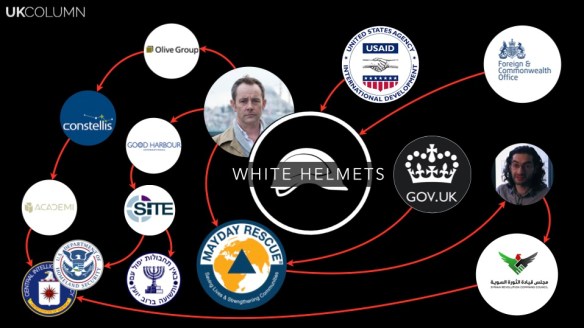
Giovani’s article attacks several journalists by name. She singles out Janine di Giovani and echoes the Guardian’s characterization of Beeley as the “high priestess of Syria propaganda”. She does this without challenging a single article or claim by the journalist. She might have acknowledged that Vanessa Beeley has some familiarity with the Middle East; she is the daughter of one of the foremost British Arabists and diplomats including British Ambassador to Egypt. Giovanni might have explored Beeley’s research in Syria that revealed the White Helmets founder (British military contractor James LeMesurier) assigned the name Syria Civil Defence despite the fact there is a real Syrian organization by that name that has existed since the 1950’s. For the past several years, Beeley has done many on-the-ground reports and investigations in Syria. None of these are challenged by Giovanni. Just days ago Beeley published a report on her visit to the White Helmets headquarters in Deraa.

Giovanni similarly dismisses another alternative journalist, Eva Bartlett. Again, Giovanni ignores the fact that Bartlett has substantial Middle East experience including having lived in Gaza for years. Instead of objectively evaluating the journalistic work of these independent journalists, Giovanni smears their work as “disinformation”. Presumably that is because their work is published at alternative sites such as 21st Century Wire and Russian media such as RT and Sputnik. Beeley and Bartlett surely would have been happy to have their reports published at the New York Review of Books, Newsweek or other mainstream outlets. But it’s evident that such reporting is not welcome there. Even Seymour Hersh had to go abroad to have his investigations on Syria published.

The New McCarthyism

Max Blumenthal is another journalist singled out by Giovanni. Blumenthal is the author of three books, including a New York Times bestseller and the highly acclaimed “Goliath: Life and Loathing in Greater Israel”. Giovanni describes his transition from “anti-Assad” to “pro-Assad” and suggests his change of perspective was due to Russian influence. She says, “Blumenthal went to Moscow on a junket to celebrate RT’s tenth anniversary. We don’t know what happened during that visit, but afterwards, Blumenthal’s views completely flipped.” Instead of examining the facts presented by Blumenthal in articles such as “Inside the Shadowy PR Firm that’s Lobyying for Regime Change in Syria“, Giovanni engages in fact-free McCarthyism. Blumenthal explained the transition in his thinking in a public interview. He also described the threats he experienced when he started to criticize the White Helmets and their public relations firm, but this is ignored by Giovanni.

Contrary to Giovanni’s assumptions, some western journalists and activists were exposing the White Helmets long before the story was publicized on Russian media. In spring 2015 the basic facts about the White Helmets including their origins, funding and role in the information war on Syria were exposed in my article “Seven Steps of Highly Effective Manipulators“. The article showed how the White Helmets were a key component in a campaign pushing for a “No Fly Zone” in Syria. It confirmed that the White Helmets is a political lobby force.

In spring 2016, Vanessa Beeley launched a petition “Do NOT give the Nobel Peace Prize to the White Helmets“. That petition garnered more support than a contrary petition urging the Nobel Prize committee to give the award to the White Helmets. Perhaps because of that, the petition was abruptly removed without explanation from the Change.org website. It was only at this time, with publicity around the heavily promoted nomination of the White Helmets for a Nobel Peace Prize that RT and other Russian media started to publicize and expose the White Helmets. That is one-and-a-half years after they were first exposed in western alternative media.

White Helmets and Chemical Weapons Accusations 

Giovanni ignores the investigations and conclusions of some of the most esteemed American journalists regarding the White Helmets and chemical weapons incidents in Syria.

The late Robert Parry published many articles exposing the White Helmets, for example “The White Helmets Controversy” and “Syria War Propaganda at the Oscars“. Parry wrote and published numerous investigations of the August 2013 chemical weapons attack and concluded the attacks were carried out by an opposition faction with the goal of pressuring the US to intervene militarily. Parry also challenged western conclusions regarding incidents such as April 4, 2017 at Khan Shaykhun. Giovanni breathlessly opens her article with this story while Parry revealed the impossibility of it being as described.

Buried deep inside a new U.N. report is evidence that could exonerate the Syrian government in the April 4 sarin atrocity and make President Trump look like an Al Qaeda dupe.

Legendary American journalist, Seymour Hersh, researched and refuted the assumptions of Giovanni and the media establishment regarding the August 2013 chemical weapons attacks near Damascus. Hersh’s investigation, titled “The Red Line and Rat Line“, provided evidence the atrocity was carried out by an armed opposition group with active support from Turkey. A Turkish member of parliament provided additional evidence. The fact that Hersh had to go across the Atlantic to have his investigation published suggests American not Russian disinformation and censorship.

In addition to ignoring the findings of widely esteemed journalists with proven track records, Giovanni plays loose with the truth. In her article she implies that a UN investigation blamed the Syrian government for the August 2013 attack. On the contrary, the head of the UN investigation team, Ake Sellstrom, said they did not determine who was responsible.

We do not have the evidence to say who did what ….The conflict in Syria is surrounded by a lot of rumors and a lot of propaganda, particularly when comes to the sensitive issue of chemical weapons.

First Responders or Western Funded Propagandists?

Giovanni says, “But the White Helmets’ financial backing is not the real reason why the pro-Assad camp is so bent on defaming them. Since 2015, the year the Russians began fighting in Syria, the White Helmets have been filming attacks on opposition-held areas with GoPro cameras affixed to their helmets.”

In reality, the ‘White Helmets” have a sophisticated media production and distribution operation. They have much more than GoPro cameras. In many of their movie segments one can see numerous people with video and still cameras. Sometimes the same incident will be shown with one segment with an Al Qaeda logo blending into the same scene with a White Helmets logo.

Giovanni claims “The Assad regime and the Russians are trying to neutralize the White Helmets because they are potential witnesses to war crimes.” However, the claims of White Helmet “witnesses” have little credibility. The White Helmet “volunteers” are paid three times as much as Syrian soldiers. They are trained, supplied and promoted by the same western states which have sought to regime change in Syria since 2011. An example of misleading and false claims by a White Helmets leader is exposed in Gareth Porter’s investigation titled “How a Syrian White Helmets Leader Played Western Media” . His conclusion could be directed to Giovanni and the NYReview of Books:

The uncritical reliance on claims by the White Helmets without any effort to investigate their credibility is yet another telling example of journalistic malpractice by media outlets with a long record of skewing coverage of conflicts toward an interventionist narrative.

When the militants (mostly Nusra/al Qaeda) were expelled from East Aleppo, civilians reported that the White Helmets were mostly concerned with saving their own and performing publicity stunts. For example, the photo of the little boy in east Aleppo looking dazed and confused in the back of a brand new White Helmet ambulance was essentially a White Helmet media stunt eagerly promoted in the West. It was later revealed the boy was not injured, he was grabbed without his parent’s consent. Eva Bartlett interviewed and photographed the father and family for her story “Mintpress Meets the Father of Iconic Aleppo Boy and says Media Lied About his Son“.

A Brilliant Marketing Success

The media and political impact of the White Helmets shows what money and marketing can do. An organization that was founded by a military contractor with funding from western governments was awarded the Rights Livelihood Award. The organization was seriously considered to receive the 2016 Nobel Peace Prize just three years after its formation.

The Netflix infomercial “The White Helmets” is an example of the propaganda. The scripted propaganda piece, where the producers did not set foot in Syria, won the Oscar award for best short documentary. It’s clear that lots of money and professional marketing can fool a lot of people. At $30 million per year, the White Helmets budget for one year is more than a decade of funding for the real Syrian Civil Defence which covers all of Syria not just pockets controlled by armed insurgents.

Unsurprisingly, it has been announced that White Helmets will receive the 2019 “Elie Wiesel” award from the heavily politicized and pro-Israel Holocaust Memorial Museum in Washington. This, plus the recent “rescue” of White Helmets by the Israeli government, is more proof of the true colors of the White Helmets. Vanessa Beeley’s recent interview with a White Helmet leader in Deraa revealed that ISIS and Nusra terrorists were part of the group “rescued” through Israel.

The Collapsing White Helmets Fraud

Giovanni is outraged that some journalists have successfully challenged and put a big dent in the White Helmets aura. She complains, “The damage the bloggers do is immense.”

Giovanni and western propagandists are upset because the myth is deflating. Increasing numbers of people – from a famous rock musician to a former UK Ambassador – see and acknowledge the reality.

As described in Blumenthal’s article, “How the White Helmets Tried to Recruit Roger Waters with Saudi Money“, rock legend Roger Waters says:

If we were to listen to the propaganda of the White Helmets and others, we would encourage our governments to start dropping bombs on people in Syria. This would be a mistake of monumental proportions…

Peter Ford, the former UK Ambassador to Syria, sums it up like this:

The White Helmets are jihadi auxiliaries… They are not, as claimed by themselves and by their supporters… simple rescuers. They are not volunteers. They are paid professionals of disinformation.

Giovanni claims her article is a “forensic take down of the Russian disinformation campaign to distort the truth in Syria.” In reality, Giovanni’s article is an example of western disinformation using subjective attacks on critics and evidence-free assertions aligned with the regime change goals of the West.

Freedom Rider: Jamal Khashoggi and U.S. Hypocrisy

Freedom Rider: Jamal Khashoggi and U.S. Hypocrisy

By Margaret Kimberley

Source: Black Agenda Report

The corporate media cry crocodile tears over the apparent murder of an elite, CIA-connected “dissident,” while papering over US complicity in Saudi war crimes in Yemen.

“The Saudis may kill 50 Yemeni children on a school bus and get only a few mild rebukes, but killing a prominent man is another story entirely.”

The disappearance and presumed murder of Jamal Khashoggi puts the corrupt relationship between Saudi Arabia and the United States in high relief. The two countries have been partners in crime over many years. Together they used jihadist proxies to make wars in Afghanistan, Libya and Syria that furthered U.S. interests. The brutal Saudi attack on neighboring Yemen could not happen without U.S. diplomatic and logistical support. The Donald Trump presidency has brought the two even closer. The relationship is now a true love affair complete with personal dealings between Saudi royals and the Trumps.

Khashoggi was a member of a prominent Saudi family with strong ties to the royal house. His uncle, Adnan Khashoggi, was an arms dealer involved in the Iran-Contra and BCCI scandals. But Jamal Khashoggi had a parting of the ways with crown prince Mohammed Bin Salman, the de facto ruler, and he left Saudi Arabia in 2017. He was a long time Saudi spokesman, CIA asset and a Washington Post journalist. All of those credentials made him an elite insider in the United States too.

“His uncle, Adnan Khashoggi, was an arms dealer involved in the Iran-Contra and BCCI scandals.”

Khashoggi entered a Saudi consulate in Istanbul, Turkey on October 2ndand was never seen again. According to media reports the Turkish government has audio and video proof that he was murdered and that his body was dismembered and disposed of elsewhere. The Saudis may kill 50 Yemeni children on a school bus and get only a few mild rebukes. But killing a prominent man who has all the right political and intelligence agency connections is another story entirely.

Ordinarily compliant American senators are now going through the motions of asking questions and proposing sanctions or other punishments against the kingdom. Corporate media like the New York TimesFinancial Times, CNN and CNBC have dropped out of the Future Investment Initiative meeting which is known as Davos in the desert. The plight of starving Yemenis gets little attention, but a hit job committed openly and without fear of recourse is too much. Liberal sensibilities were offended by the crassness of the act and by the position of the victim.

“The plight of starving Yemenis gets little attention, but a hit job committed openly and without fear of recourse is too much.”

The outrage is coming long after the Saudis began their war crime against Yemen. They have been bombing and starving that country since 2014 and are responsible for an estimated 50,000 deaths. They have blockaded ports and denied access to food and medicine. Yemen is in the midst of a cholera outbreak and millions are displaced refugees.

These atrocities were not enough to put Saudi Arabia on the list of infamy where it belongs. Barack Obama, darling of the liberal imperialists, was only slightly less subservient to the kingdom than Trump is today. The Yemen attack began during his term in office. He continued the tradition of $100 billion defense deals with the feudal monarchy and made the relationship a top priority. He cut short a 2015 visit to India in order to meet the newly crowned King Salman and brought along a who’s who entourage including Condi Rice, James Baker, John McCain and Nancy Pelosi. Saudi Arabia was and is a key partner in U.S. imperialism.

Trump differs from Obama and other presidents only in his inability to be diplomatic. When first asked about a possible response to Khashoggi’s disappearance he made it clear that he would do nothing to threaten war contractor profits. In defending the crown prince he mentioned Boeing, Raytheon and Lockheed by name as he dismissed any talk of sanctions.

“Barack Obama was only slightly less subservient to the kingdom than Trump is today.”

Of course Trump style politics provides further complications. Presidential son-in-law Jared Kushner has formed a close friendship with Mohammed bin Salman. Kushner’s security clearance gave him access to information which he gave to the crown prince. Kushner is the likely source who turned in Saudi royals, also connected to the CIA, who opposed the de facto ruler. These people were imprisoned, at least one was killed, their assets were seized and many now live under house arrest. Trump publicly supported the move in one of his famous twitter messages.

It is easy to find yet another reason to look askance at Trump and his vulgar and incompetent family but Saudi Arabia will be a U.S. partner in wrong doing no matter who is in the White House. Prince Bandar bin Sultan was known as “Bandar Bush” because of his close relationship with two presidents and their confidantes.

The nuances of keeping friends on a short leash are lost on Trump. Media reports say that the Trump administration was aware that Khashoggi was in danger of being detained but didn’t protect a man who had worked with and for past administrations since the 1990s. The Saudis started a near war with Qatar in 2017 and were supported by Trump in the effort. Qatar is a close ally of Turkey, the country where they chose to disappear Khashoggi. They would not have acted so recklessly unless they were certain of U.S. compliance.

“The Saudis would not have acted so recklessly unless they were certain of U.S. compliance.”

Trump again tears away the veneer of U.S. foreign policy. He is not smart enough to hide the dirty dealings. He doesn’t know when to reign in friends and he encourages rash behavior. But that doesn’t really make him worse than his predecessors. He is just less savvy and incapable of behaving within the norms laid down by tradition.

The hypocrisy doesn’t end with Trump and Kushner. It can be seen in the corporate media who cover for a war crime against Yemen. They are easily bought off by a prince who opens movie theaters and allows women to drive. But they also know who funds the think tanks and who has the connections with their bosses. They may despise Trump but it isn’t for the reasons they ought to dislike him. They are a party to the hypocrisy, as much as the foreign despots or their presidential partners. There are no heroes in this story. There is only a missing man and corruption in high places in two nations.


Margaret Kimberley’s Freedom Rider column appears weekly in BAR, and is widely reprinted elsewhere. She maintains a frequently updated blog as well at http://freedomrider.blogspot.com . Ms. Kimberley lives in New York City, and can be reached via e-Mail at Margaret.Kimberley(at)BlackAgendaReport.com.