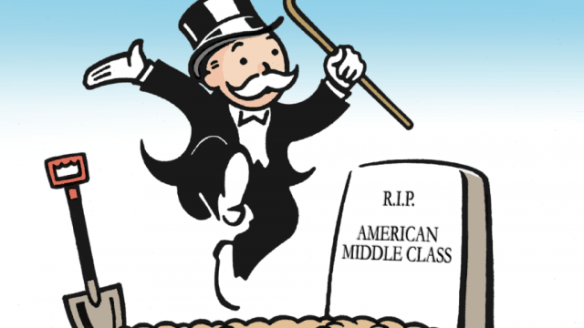
Disposable Americans: The Numbers are Growing

middle-class

By Paul Buchheit

Source: Information Clearing House

As often noted in the passionate writings of Henry Giroux, poor Americans are becoming increasingly ‘disposable’ in our winner-take-all society. After 35 years of wealth distribution to the super-rich, inequality has forced much of the middle class towards the bottom, to near-poverty levels, and to a state of helplessness in which they find themselves being blamed for their own misfortunes.

The evidence keeps accumulating: income and wealth — and health — are declining for middle-class America. As wealth at the top grows, the super-rich feel they have little need for the rest of society.

Income Plummets for the Middle Class

According to Pew Research, in 1970 three of every ten income dollars went to upper-income households. Now five of every ten dollars goes to them.

The Social Security Administration reports that over half of Americans make less than $30,000 per year. That’s less than an appropriate average living wage of $16.87 per hour, as calculated by Alliance for a Just Society.

Wealth Collapses for Half of Us

Numerous sources report that half or more of American families have virtually no savings, and would have to borrow money or sell possessions to cover an emergency expense. Between half and two-thirds of Americans have less than $1,000.

For every $100 owned by a middle-class household in 2001, that household now has just $72.

Not surprisingly, race plays a role in the diminishing of middle America. According to Pew Research, the typical black family has only enough liquid savings to last five days, compared to 12 days for the typical Hispanic household, and 30 days for a white household.

Our Deteriorating Health

In a disgraceful display of high-level disregard for vital health issues, House Republicans are attempting to cut back on lunches for over 3 million kids.

The evidence for the health-related disposability of poor Americans comes from a new study that finds nearly a 15 year difference in life expectancy for 40-year-olds among the richest 1% and poorest 1% (10 years for women). Much of the disparity has arisen in just the past 15 years.

It’s not hard to understand the dramatic decline in life expectancy, as numerous studies have documented the health problems resulting from the inequality-driven levels of stress and worry and anger that make Americans much less optimistic about the future. The growing disparities mean that our children will likely see less opportunities for their own futures.

It May Be Getting Worse

The sense derived from all this is that half of America is severely financially burdened, at risk of falling deeper into debt.

It may be more than half. The Wall Street Journal recently reported on a JP Morgan study’s conclusion that “the bottom 80% of households by income lack sufficient savings to cover the type of volatility observed in income and spending.” Fewer than one in three 25- to 34-year-olds live in their own homes, a 20 percent drop in just the past 15 years.

It may be even worse for renters. The number of families spending more than half their incomes on rent — the ‘severely’ cost-burdened renters — has increased by a stunning 50 percent in just ten years. Billionaire Steve Schwarzman, whose company Blackstone has been buying up tens of thousands of homes at rock-bottom prices and then renting them back while waiting out the housing market, finds the growing anger among voters “astonishing.”

What’s astonishing is the disregard that many of the super-rich have for struggling Americans.


Paul Buchheit is a college teacher, an active member of US Uncut Chicago, founder and developer of social justice and educational websites (UsAgainstGreed.org, PayUpNow.org, RappingHistory.org), and the editor and main author of “American Wars: Illusions and Realities” (Clarity Press). He can be reached at paul@UsAgainstGreed.org.

Bureaucratic Insanity is Yours to Enjoy

1980

Reposted below is Dmitry Orlov’s review of the new publication from Club Orlov Press: “Bureaucratic Insanity: The American Bureaucrat’s Descent into Madness” by Sean J. Kerrigan.

By Dmitry Orlov

Source: ClubOrlov

In contemporary United States a child can be charged with battery for throwing a piece of candy at a schoolfriend. Students can be placed in solitary confinement for cutting class. Adults aren’t much better off: in 2011 the Supreme Court decided in 2011 that anyone the police arrest, even for an offense as minor as an unpaid traffic ticket, can be strip-searched. These acts of official violence are just the tip of the iceberg in our society.

The number of rules and laws to which Americans, mostly unbeknownst to them, are subject, is hilariously excessive. But what makes this comedy unbearable is that these rules and laws are often enforced with an overabundance of self-righteous venom. Increasingly, contemporary American bureaucrats—be they police, teachers or government officials—are obsessed with following strict rules and mercilessly punishing all those who fail to comply (unless they are very rich or politically connected).

In so doing, these bureaucrats have become so liberated from the constraints of common sense that the situation has gone far beyond parody and is now a full-blown farce. Consider this recent news story involving a Virginia sixth-grader, the son of two schoolteachers and a member of the school’s program for gifted students. The boy was targeted by school officials after they found a leaf, probably a maple leaf, in his backpack. Someone suspected it to be marijuana. The leaf in question was not marijuana (as confirmed by repeated lab tests). End of story, wouldn’t you think?

Not at all! The 11-year-old was expelled and charged with marijuana possession in juvenile court. These charges were eventually dropped. He was then forced to enroll in an alternative school away from his friends, where he is subjected to twice-daily searches for drugs and periodic evaluation for substance abuse problems—all of this for possession of a maple leaf.

“It doesn’t matter if your son or daughter brings a real pot leaf to school, or if he brings something that looks like a pot leaf—okra, tomato, maple, buckeye, etc. If your kid calls it marijuana as a joke, or if another kid thinks it might be marijuana, that’s grounds for expulsion,” the Washington Post cheerfully reassures us.

A reasonable school official would recognize the difference between a technical violation caused by an oversight and a conscious attempt to smuggle drugs into the school. But school officials were intent on ignoring their own better sense, instead favoring harsh punishments.

In his new book, Bureaucratic Insanity: The American Bureaucrat’s Descent into Madness, Sean Kerrigan documents dozens of eyebrow-raising examples in which America’s rule-enforcers perversely revel in handing out absurd and unfair punishments for minor infractions. They demand total and complete submission, driven by a perverse compulsion to “put us in our place” and to “teach us a lesson.” They mercilessly punish even the most inconsequential transgressions in order to maximize our terror and humiliation.

When Sean first began following this story several years ago, he became mesmerized by this bizarre carnival of unreason. “Where is all this pent-up rage coming from?” he wondered, “and why is it being directed toward the weakest and most vulnerable members of society?” And then news stories like those mentioned above grew more and more common. Eventually, he started compiling a list of the most egregious abuses, trying to detect patterns, searching for some explanation for why your average garden-variety bureaucrat has morphed into a monster and has started to take sadistic pleasure in the suffering of innocent people.

Some people might argue that this kind of behavior is the result of political correctness gone amok. Others point to the irrational fear of terrorism and mass shootings. Yet others might think that it has to do with the bureaucrats’ fear of losing their jobs—merely for failing to comply with the exact letter of some rule. While there may be some truth to each of these explanations, they are far from adequate. Many of these bureaucratic abuses have nothing to do with political constraints on free speech, or with guns or terrorism, and in most cases the bureaucrats have the power to minimize harm, but instead they choose to maximize it.

In looking closer at each individual instance, it became clear that most of the offending bureaucrats weren’t even attempting to use their judgment but were mindlessly following written rules. Even in the most nurturing and humanistic professions—teachers and physicians—their practitioners have been robotized to such an extent that they now perform a very narrow range of actions. Thanks to all the progress in IT, their work is now quite detached from physical reality. Much of their work now consists of monotonously, mindlessly pounding at the computer keyboard. Consequently, a large portion of their waking lives has taken on an ethereal, pointless quality. Even teachers, who once had a relatively free reign in forming the minds of the next generation, are now forced to behave like machines, teaching to standardized tests and working a grueling average of 53 hours a week.

The psychological effects of this pressure have been profound. Minus the opportunities to make their own decisions and to see those positive effects of their efforts, their work has become personally meaningless, alienating, depersonalizing and psychologically damaging. As a result of this damage, American bureaucrats, although they may look like mild-mannered professionals, have become prone to sudden bouts of aggressive, sadistic behavior. They are unable to act out their repressed rage in any socially acceptable way other than by doling out punishments, fines, rejections, expulsions and other forms of objective, systemic violence.

The road to hell is paved with good intentions, and rest assured that this is all being done for our own good. The purpose of all of these rules and laws, from the perspective of the American system of governance, is to maximize control over everything that can be controlled and to micromanage every possible detail of our lives—in order to make them better! From student testing all the way to global trade, those in leadership positions are trying to centralize as much authority as possible in order to maximize efficiency, profit, American power… while minimizing our dignity, well-being and happiness. Oops!

In his book Bureaucratic Insanity, Sean traces the development of this trend from the early years of the industrial revolution to the modern day, from its initial appearance in factory life and in the military, to it later metastasizing to the office, and now taking over America’s schools. He argues persuasively, based on a careful and thorough review of literature in history, philosophy, psychology, anthropology and social criticism, that the average American bureaucrat is literally, clinically insane. The average American bureaucrat has a warped perception of reality and an intense, repressed self-hatred. Their only way to vent their rage is by punishing others using bureaucratic methods. They demand absolute conformity because it is their only way to give their meaningless lives some semblance of meaning. They suppress all thoughts that might lead them to discover the true nature of their condition, because that would cause them to spiral down into outright schizophrenia.

The book concludes with an assessment of what we can do to insulate ourselves from this seemingly unstoppable trend, and of how we can reinvigorate our lives by giving it real meaning.


Why Do Some Men Rape?


By Robert J. Burrowes

A recent report from Equality Now titled ‘The World’s Shame: The Global
Rape Epidemic‘ offered a series of recommendations for strengthened laws to deter and
punish sexual violence against women and girls.

However, there is substantial evidence that legal approaches to dealing
with violence in any context are ineffective. For example, the empirical
evidence on threats of punishment (that is, violence) as deterrence and
the infliction of punishment (that is, violence) as revenge reveals
variable impact and context dependency, which is readily apparent
through casual observation. There are simply too many different reasons
why people break laws in different contexts. See, for example, ‘Crime
Despite Punishment‘.

Moreover, given the overwhelming evidence that violence is rampant in
our world and that the violence of the legal system simply contributes
to and reinforces this cycle of violence, it seems patently obvious that
we would be better off identifying the cause of violence and then
designing approaches to address this cause and its many symptoms
effectively. And reallocating resources away from the legal and prison
systems in support of approaches that actually work.

So why do some men rape?

All perpetrators of violence, including rapists, suffered enormous
violence during their own childhoods. This violence will have usually
included a great deal of ‘visible’ violence (that is, the overt physical
violence that we all readily identify) but, more importantly, it will
have included a great deal of ‘invisible’ and ‘utterly invisible’
violence as well: the violence perpetrated by adults against children
that is not ordinarily perceived as violent. For a full explanation, see
Why Violence?‘ and ‘Fearless Psychology and Fearful Psychology: Principles and Practice‘.

This violence inflicts enormous damage on a child’s Selfhood leaving
them feeling terrified, self-hating and powerless, among other horrific
feelings. However, because we do not allow children the emotional space
to feel their emotional responses to our violence, these feelings of
terror, self-hatred and powerlessness (among a multitude of others),
become deeply embedded in the child’s unconscious and drive their
behaviour without their conscious awareness that they are doing so.

So what is ‘invisible’ violence? It is the ‘little things’ we do every
day, partly because we are just ‘too busy’. For example, when we do not
allow time to listen to, and value, a child’s thoughts and feelings, the
child learns to not listen to themSelf thus destroying their internal
communication system. When we do not let a child say what they want (or
ignore them when they do), the child develops communication and
behavioural dysfunctionalities as they keep trying to meet their own
needs (which, as a basic survival strategy, they are genetically
programmed to do).

When we blame, condemn, insult, mock, embarrass, shame, humiliate,
taunt, goad, guilt-trip, deceive, lie to, bribe, blackmail, moralize
with and/or judge a child, we both undermine their sense of Self-worth
and teach them to blame, condemn, insult, mock, embarrass, shame,
humiliate, taunt, goad, guilt-trip, deceive, lie, bribe, blackmail,
moralize and/or judge.

The fundamental outcome of being bombarded throughout their childhood by
this ‘invisible’ violence is that the child is utterly overwhelmed by
feelings of fear, pain, anger and sadness (among many others). However,
parents, teachers and other adults also actively interfere with the
expression of these feelings and the behavioural responses that are
naturally generated by them and it is this ‘utterly invisible’ violence
that explains why the dysfunctional behavioural outcomes actually occur.

For example, by ignoring a child when they express their feelings, by
comforting, reassuring or distracting a child when they express their
feelings, by laughing at or ridiculing their feelings, by terrorizing a
child into not expressing their feelings (e.g. by screaming at them when
they cry or get angry), and/or by violently controlling a behaviour that
is generated by their feelings (e.g. by hitting them, restraining them
or locking them into a room), the child has no choice but to
unconsciously suppress their awareness of these feelings.

However, once a child has been terrorized into suppressing their
awareness of their feelings (rather than being allowed to have their
feelings and to act on them) the child has also unconsciously suppressed
their awareness of the reality that caused these feelings. This has many
outcomes that are disastrous for the individual, for society and for
nature because the individual will now easily suppress their awareness
of the feelings that would tell them how to act most functionally in any
given circumstance and they will progressively acquire a phenomenal
variety of dysfunctional behaviours, including some that are violent
towards themselves, others and/or the Earth.

So what is happening psychologically for the rapist when they commit the
act of rape? In essence, they are projecting the (unconsciously
suppressed) feelings of their own victimhood onto their rape victim.
That is, their fear, self-hatred and powerlessness, for example, are
projected onto the victim so that they can gain temporary relief from
these feelings. Their fear, temporarily, is more deeply suppressed.
Their self-hatred is projected as hatred of their victim. Their
powerlessness is temporarily relieved by a sense of being in control,
which they were never allowed to be, and feel, as a child. And similarly
with their other suppressed feelings. For example, a rapist might blame
their victim for their dress: a sure sign that the rapist was endlessly,
and unjustly, blamed as a child and is (unconsciously) angry about that.

The central point in understanding violence is that it is psychological
in origin and hence any effective response must enable the suppressed
feelings (which will include enormous rage at the violence they
suffered) to be safely expressed. For an explanation of what is
required, see ‘Nisteling: The Art of Deep Listening’ which is referenced
in ‘My Promise to Children’.

The legal system is simply a socially endorsed structure of violence and
it uses violence, euphemistically labeled ‘punishment’, in a perverse
attempt to terrorise people into controlling their behaviours or being
treated violently in revenge by the courts if they do not. This approach
is breathtakingly ignorant and unsophisticated in the extreme and a
measure of how far we are from responding powerfully to the pervasive
problem of violence in our world. See ‘The Rule of Law: Unjust and
Violent’  and ‘Punishment is Violent and Counterproductive’.

So what are we to do?

Well we can continue to lament violence against women (just as some
lament other manifestations of violence such as war, exploitation and
destruction of the environment, for example) and use the legal system to
reinforce the cycle of violence by inflicting more violence as
‘punishment’.

Or we can each, personally, address the underlying cause of all
violence.

It might not be palatable to acknowledge and take steps to address your
own violence against children but, until you do, you will live in a
world in which the long-standing and unrelenting epidemic of violence
against children ensures that all other manifestations of human violence
continue unchecked. And our species becomes extinct.

If you wish to participate in the worldwide effort to end human
violence, you might like to make ‘My Promise to Children’ outlined in
the article cited above and to sign the online pledge of ‘The People’s
Charter to Create a Nonviolent World‘.

You might also support initiatives to devote considerable societal
resources to providing high-quality emotional support (by those expert
at nisteling) to those who survive rape. This support cannot be provided
by a psychiatrist. See ‘Defeating the Violence of Psychiatry‘. Nisteling
will enable those who have suffered from trauma to heal fully and
completely, but it will take time.

Importantly, the rapist needs this emotional support too. They have a
long and painful childhood from which they need a great deal of help to
recover. It is this healing that will enable them to accurately identify
the perpetrators of the violence they suffered and about whom they have
so many suppressed (and now projected) feelings which need to be felt
and safely expressed.

You need a lot of empathy and the capacity to nistel to address violence
in this context meaningfully and effectively. You also need it to raise
compassionate and powerful children in the first place.


Biodata: Robert J. Burrowes has a lifetime commitment to understanding
and ending human violence. He has done extensive research since 1966 in
an effort to understand why human beings are violent and has been a
nonviolent activist since 1981. He is the author of ‘Why Violence?
His email address is flametree@riseup.net
and his website is at http://robertjburrowes.wordpress.com


Robert J. Burrowes
P.O. Box 68
Daylesford
Victoria 3460
Australia
Email: flametree@riseup.net

Websites:
Nonviolence Charter
Flame Tree Project to Save Life on Earth
‘Why Violence?’
Nonviolent Campaign Strategy
Nonviolent Defense/Liberation Strategy
Anita: Songs of Nonviolence
Robert Burrowes
Global Nonviolence Network

How the Super-Rich Will Destroy Themselves

HangTheBankers

By Paul Buchheit

Source: Nation of Change

Perhaps they believe that their underground survival bunkers with bullet-resistant doors and geothermal power and anti-chemical air filters and infrared surveillance devices and pepper spray detonators will sustain them for two or three generations.

Perhaps they feel immune from the killings in the streets, for they rarely venture into the streets anymore. They don’t care about the great masses of ordinary people, nor do they think they need us.

Or do they? There are a number of ways that the super-rich, because of their greed and lack of empathy for others, may be hastening their own demise, while taking the rest of us with them.

1. Pandemic (Because of Their Disdain for Global Health)

“A year ago the world was in a panic over Ebola. Now it’s Zika at the gate. When will it end?” –Public health expert Dr. Ali Khan.

It could end with a global pandemic that spreads with the speed of the 1918 Spanish Flu, but with a virulence that kills over half of us, rich and poor alike. Vanderbilt University’s Dr. William Schaffner warned us a decade ago, “You’ve got to really invest vast resources right now to protect us from a pandemic.” Added infectious disease specialist Dr. Stephen Baum, “There’s nobody making vaccines anymore because the profitability is low and the liability is high.”

The flu is just one of our worries. It has been estimated that less than 10 percent of the budget for health research is spent on diseases that cause 90 percent of the world’s illnesses. According to a study in The Lancet, of the 336 new drugs developed in the first decade of this century, only four of them were for diseases impacting third-world peoples. World Health Organization director Margaret Chan lamented the long decades of disregard for the African-centered effects of the Ebola virus: “Ebola has historically been confined to poor African nations. The R&D incentive is virtually non-existent. A profit-driven industry does not invest in products for markets that cannot pay.”

The super-rich had better make sure their anti-chemical air filters are also anti-viral.

2. Terrorism (Because of Global Inequality)

In The Spirit Level, Richard Wilkinson and Kate Pickett document some of the most frightening effects of inequality: higher levels of crime and violence, impacting all classes of people.

Inequality is worst at the global level, and the victims of global greed are getting more violent. The World Protests report concluded that the most recent decade represents one of the most agitated periods in modern history — comparable to pre-Civil-War days, World War 1, and the Civil Rights era. According to expert Scott Atran, terrorism primarily appeals to young men who are bored and underemployed; for them, “jihad is an egalitarian, equal-opportunity employer.”

The terrorism of the future could easily take the form of the viral killers mentioned above. As Dr. Khan notes, “A deadly microbe like smallpox — to which we no longer have immunity — can be easily recreated in a rogue laboratory.”

3. Drought (Because of Their Denial of Environmental Destruction)

National Geographic’s 2012 Greendex Survey reveals a remarkable human response to environmental damage: “[Those] demonstrating the least sustainable behavior as consumers, are least likely to feel guilty about the implications of their choices for the environment.” Citizens of Mexico, Brazil, China, and India tend to be most concerned about climate change, pollution, and species loss, while American, French, and British consumers are more concerned about the state of the economy and the cost of energy and fuel.

Even worse than denial is the outright suppression of climate-saving technologies, as, for example, by the American Legislative Exchange Council (ALEC), which wants to charge the “freeriders” who install solar panels on their roofs.

The result of this environmental contempt, according to a Columbia University study, is the prospect of “drought beyond the sub-tropics and into the Northern Hemisphere mid-latitudes, regions of globally important agricultural production.”

The super-rich can while away the hours in their underground bunkers watching videos of the good old days when the earth was cool.

4. Atrophy (Because of the Debt-Induced Collapse of Innovation)

A Small Business Administration study found that only 2% of the Millennial Generation are entrepreneurs (self-employed or business owners), compared to 6.7% of Baby Boomers and 5.4% in Generation X. According to the Kauffman Foundation, 20- to 34-year-olds made up over a third of all new business startups in 1997, but less than a quarter of them today. The super-rich have manipulated the financial system to the point that would-be entrepreneurs, many of them young and deeply in debt, are unable or unwilling to take chances on new startups.

Yet on a global scale youth entrepreneurship is on the rise. America is exceptional in its entrepreneurial decline.

5. Decay (Because of Their Disregard for Our Crumbling Infrastructure)

The corporate elite may face further business collapse if they continue to ignore the breakdown in our nation’s infrastructure. The American Society of Civil Engineers estimates that every American household is losing $3,400 per year in disposable income due to infrastructure deficiencies.

The tens of billions of dollars already being paid for additional transportation and storage costs may not kill the capitalists, but the losses to China and other fast-developing nations will surely deflate their stock prices and their egos.

How the Super-Rich Could Help Themselves

Amidst all the talk of unity and prayer and peace, a solution exists: job opportunities and affordable housing. The super-rich could prolong life for all of us, including themselves, if they recognized the need to support a strong society. If not, they’ll be ensconced in their bunkers with their children at their sides, with nowhere to go and nothing to do.

On the Process of Awakening

lifestyle

By Charles Hugh Smith

Source: Of Two Minds

We cannot help but feel a hunger for authenticity, honesty, spiritual solace and human connection, but these are precisely what is scarce in our social and economic structure.

There is a tremendous amount of pain in our society. There are many sources of this pain: the emotional desertification of dysfunctional families, the knowledge that we don’t fit in and never will, a widening disconnect between the narratives we’re told are true and our experience, and a social and economic structure that tosses many of us on the trash heap.

The lifestyle we’re told we need to be happy is unattainable to many, and disconcertingly unsatisfactory to the top 10% who reach it.

We cannot help but feel a hunger for authenticity, honesty, spiritual solace and human connection, but these are precisely what is scarce in our social and economic structure.

The process of awakening has many paths. For some, the path starts with the incoherence of official explanations and narratives. For others, it’s the inner search for truth via psychotherapy or spiritual practice.

For some, it’s an investigation into the way our economic and political hierarchy function. For others, art is the starting point: a film, a novel, a comic, a song.

For many of us, it begins with this simple but devastating realization: I don’t fit in. I don’t fit in, have never fit in and never will fit in. I play along because it’s easier on me and everyone I interact with to do so, and I value my independence which means I have to find a way to support myself. That is difficult, as what I like to do has little to no value in our economy.

What interests me is how the epidemic of pain and alienation that characterizes our society is the direct result of how our economy and social order is structured. Incoherence, self-destruction, pain and alienation are the only possible outputs of the system we inhabit.

I have explored this dynamic in my books, starting with Survival+ in 2009 and working forward to my latest book, Why Our Status Quo Failed and Is Beyond Reform. (My other books are: A Radically Beneficial World: Automation, Technology and Creating Jobs for All; Get a Job, Build a Real Career and Defy a Bewildering Economy; The Nearly Free University and the Emerging Economy: The Revolution in Higher Education; Resistance, Revolution, Liberation: A Model for Positive Change; Why Things Are Falling Apart and What We Can Do About It and An Unconventional Guide to Investing in Troubled Times.)

I recently had an amazing free-form 1:50 hour conversation on these topics with New Zealand talk-show host Vinny Eastwood. Any conversation that stretches from the erosion of community to loneliness to Daniel Ellsberg to Marx to Taoism to alienation to Michelangelo Antonioni and on to the process of awakening is amazing in my view.

Here’s Vinny’s page with listening/viewing/downloading options, and the program on Youtube (please ignore my goofy expressions): The magic of bitcoin and cryptocurrencies (1:49:54)

My conclusion may strike many as radical, but to me it is self-evident: the primary source of the rot, insecurity, inequality and alienation of our society is the way we create and distribute money, which is the conduit for creating and distributing political power.

I explain why this is so in my books A Radically Beneficial World: Automation, Technology and Creating Jobs for All and Why Our Status Quo Failed and Is Beyond Reform.

If we don’t change the way money is created and distributed, we change nothing. Money = power. If we don’t devise a form of money that is beyond the reach of central banks and states, all “reform” is just window-dressing, simulacra of “change” that simply solidifies the system’s bogus claim of being reformable.

Cryptocurrencies are in their infancy. There will be many more iterations of Cryptocurrencies beyond bitcoin and Ethereum; recall that bitcoin went public in 2009.

There are security challenges with cryptocurrencies, and the potential for central-state meddling via backdoors in computer operating systems. But once we understand that community and the potential for a less toxic society and economy are crippled by the centralized structure of the state and its money, then there is no way forward but to develop structures of money, work, community, purpose and meaning that are outside the direct control of the state and central bank.

This sort of “crazy talk” is unwelcome. As I noted earlier this week on my chart of the Ministry of Propaganda, in the status quo, skepticism is always a conspiracy or a hoax.

So instead we consider an exploding opiate epidemic, an epidemic of obesity and metabolic illnesses, a discourse of inchoate rage and a Grand Canyon-sized gap between what we’re told is true and what we experience as true “normal.” These things are not normal; they are manifestations of a system that can only generate one output: self-destruction.

Soylent Burgers and Cockroach Milk

wICCXTa

Source: The Hipcrime Vocab

“The profitability of production cannot expand indefinitely. Any increase in the quantity of soil, water, minerals, or plants put into a particular production process per unit of time constitutes intensification. It has been the burden of this book to show that intensification inevitably leads to declining efficiencies. That declining efficiencies have adverse effects upon the average standard of living cannot be doubted.’
-MARVIN HARRIS, ‘Cannibals and Kings’

This comment made me chuckle: “The futurology future is starting to look worse than the collapse future.” This was on Reddit in response to an article about cockroaches providing the “milk of the future”:

Scientists think cockroach milk could be the superfood of the future (Science Alert)

This really does seem like The Onion at this point. Someone suggested that Reddit’s collapse and futurology boards should merge at some point. Believe it or not, they aren’t all that far apart.

We’ve already been treated to an endless litany of articles about how insect ranching will provide the protein of the future. Then there’s the meat grown in a petri-dish, and the nutrition shake cheekily named Soylent scarfed down by the Silicon Valley crowd so they can cram in a few more hours of work after popping their Ritalin. Now people are questioning whether the government should step in and force us to eat less meat.

And yet we are still simultaneously told that overpopulation and resource depletion are not a problem, and that more growth is good.

This is progress???

One of the things I’ve written about over the years is this idea that technological innovations are inherently good. But it’s clear what’s really going on: desperately trying to maintain the status quo in the face of increasing population pressure and declining resources. There’s a technical term for this: intensification.

Marvin Harris, whose works serve as a guidepost for this blog, warned us that intensification always leads to lower living standards for the majority of people in the long run, while only benefiting a tiny handful. This is a law of history. Over the years, I’ve tried to point out the difference between true innovation which solves problems or allows us to do things we could not do before, and intensification, which is essentially squeezing blood from a stone. In the former category are things like antibiotics and radio, which solve problems (killer infections) or allow us to do new things (communicate globally). In the latter category are things like electric cars (attempting to keep the unsustainable automobile infrastructure alive) and aquaculture (to make up for stripping the oceans bare of wild fish).

For the majority of people, there is no difference, since both are “growth” and growth is always good, full stop. GDP, the yardstick by which we measure progress in the modern world (which even its creator warned us against) is agnostic as to the source of growth, whether it is producing more food to feed hungry people or asthma inhalers to deal with the lung irritants from air pollution.

People tend to forget we’ve been here before.

Back during the Ice Age (late Pleistocene), we H. sapiens lived primarily off of herds of large fauna, especially reindeer, mammoth and bison. This was supplemented with wild salmon in season. The fattiest parts of the animal were the most prized and sought after. Bones were cracked and boiled to extract the grease. Most calories came from nutrient-dense meat and fat, while plants were consumed for their beneficial vitamins and minerals (plants are less calorie dense).

Then the large fauna started to die off. They died off due to a double-blow of a changing climate and increasing human predation. Scientists debate about which was the primary cause, but it’s pretty clear that whenever humans showed up in a pristine environment, the large animals went extinct shortly thereafter. Many of these animals had survived previous climatic changes, so it’s doubtful that climate change alone was responsible. Skeletons riddled with spear points provide more damning evidence for our species.

In response, we launched a broad spectrum revolution – using our omnivorous diet to exploit a wider variety of foodstuffs, particularly plant foods. This began with acorns and pistachios, but soon moved to grass seeds, sedges and pulses. Meanwhile, the prey animals got smaller and smaller, from reindeer and bison, to gazelles and fallow deer, to hares and waterfowl. Instead of the nutritious and diverse food sources of their ancestors, we became more and more dependent upon eating pulverized grass seeds, obtained at the cost of backbreaking labor for harvesting, threshing and grinding.

The human population became mostly vegetarian by necessity, and remained so for roughly the next 8,000 or so years. The problem is, a vegetarian diet doesn’t provide a lot of necessary vitamins, minerals and nutrients for optimal health. Today’s vegetarians can choose from a plethora of foods year round that simply weren’t available to ancient people. They don’t have to worry about what is in season and have the entire world as their larder. In the past, however, the vast majority of people ended up subsisting on a diet of weak beer and gruel. Regular meat consumption became a privilege restricted to the wealthy upper classes, while everyone else went begging. Hunting, an activity once done by all humans everywhere since time immemorial, became the exclusive provenance of kings and princes – society’s rulers. While it is true that too much meat can be detrimental to health, too little is perhaps even more damaging. Humans are meat-eaters, and a certain level of fat and protein is required for optimal health. The protein in grains and legumes is incomplete (the body needs 22 different types of amino acids to function properly; adults can synthesize 13 of those internally, but the other 9 must be obtained from food), and there are no fats (the human brain is over 60 percent fat). Grains produce an over-abundance of omega-6 fatty acids, poisonous lectins to prevent their consumption, have low nutrient density, and high acidity. They are actually a terrible thing to base a primate diet around. But we had no other choice, thanks to intensification.

And this is dramatically reflected by the skeletons of ancient peoples, who show major signs of malnutrition, disease, and stunted growth. At the same time, arthritis and other signs of wear and tear make their appearance on the bones of people who now have to spend hours a day grinding grain in a saddle quern rather than fishing and chasing after wild animals. This gruel also breaks down into simple sugars in the mouth during digestion, meaning that cavities and premature tooth decay became endemic as well.

As population pressure grew, grains, pulses and sedges, once “unpalatable” dietary supplements cultivated by hunter-gatherers for times of extreme scarcity or fermentation into medicinal beverages, became the chief dietary staple for most people. At the same time, humans found themselves preyed upon by a new class of predator: their own kind, which continues unabated to this day.

In order to keep large herbivores from going totally extinct, we embarked upon what Harris called “the greatest conservation project in history”: animal domestication. Meanwhile, cheap carbohydrates from grain are what kept most of the human population alive from day-to-day for thousands of years, such that “bread” is synonymous in all ancient cultures with “food.”

All this came from attempting to exploit resources more intensively from our environment in the face of increasing population pressure.

This sad tale, memorably spun by Jared Diamond some years ago, reflects Harris’ principle: intensification inevitably leads to benefits for the few; misery and oppression for the many.

During periods of deintensifcation, we actually recovered some of the losses. This was due to either 1.) a reduced population or 2.) new lands and resources opened up for exploitation. For example, signs of health improve after the Black Death in Europe for the survivors, due to the reduced population pressure. There were more resources to go around per head. Also, the opening up of the new lands due to colonization (and the dieoff of the native peoples), brought vast new areas of virgin land under cultivation. This led to more wealth, as well as political freedoms. Serfdom waned after the black death, and the American Revolution put Enlightenment principles of representative democracy and justice into practice. Perhaps the most dramatic result came from the harnessing of millions of years of stored sunlight in fossil fuels, combined with the scientific method. This allowed many more people a higher standard of living, even in the face of increasing population and intensifying resource use. It was during this period that “economics” became the guiding principle of our civilization, and it chalked up all benefits to “institutions”–typically capitalist market institutions–rather than a temporary superabundance of energy and resources.

Thomas Jefferson once noted that the Americans in the room were all a head taller than their European counterparts. That’s what happens when you have plenty for everybody. The first Europeans in North America also noted how much taller the Native Americans were. As this article notes, in the past, Americans ate more meat than today, and were healthier as well:

How Americans Used to Eat (The Atlantic)

Eventually, the Malthusian cycle kicked in again. Population grew, the empty spaces filled up, and the frontier was closed. Increasing competition caused wages and purchasing power to drop. People gradually lost what self-sufficiency they had, allowing the elites to consolidate power. People once again began working longer, harder, for less. Sound familiar?

We intensified again – in order to keep up with the demand for meat, we crowded animals together into feedlots in unsanitary conditions and fed them cheap corn (maize), which they are not adapted to eat. To cope with the inevitable sickness which resulted, we pumped the animals full of antibiotics (which has a side effect of increasing growth). It is these miserable and tortured animals which most of us are forced to eat now, thanks to intensification.

However, domesticated meat is less nutritious than the wild variety. The Omega-3/Omega-6 profile is altered, and there are less antioxidants. Omega-6 fatty acids reduce inflammation, which is increasingly being pinpointed as the root cause of just about every disease you care to name, from autoimmune diseases, to Alzheimer’s, to arthritis, to chronic pain, depression, and cancer. At the same time, it’s been shown that grains actually increase inflammation, and are implicated in a host of metabolic diseases:

This Is Your Brain on Gluten (The Atlantic)

While grass-fed, hormone-free beef is still available, it costs more, meaning it is restricted to those with high incomes, just like in the past. And hunting is still primarily an elite sport for the rich in many places (especially outside North America). Just like in the past, the poor people trapped in “food deserts” feed themselves with cheap carbohydrates, now in the form of processed corn and sugar products made by the industrial food system, while the wealthy can purchase boutique ‘lifestyle” products at Whole Paycheck Foods.Malnutrition now takes the form of obesity as well as starvation, although much of the non-industrialized world still deals with empty bellies, stunted growth and vitamin deficiencies, including many of those who produce export crops for the West. That’s on top of poverty and pollution.

When we scraped the oceans clean of fish and poisoned our air and waterways due to industrial pollutants (e.g. mercury ash is a side effect of coal power generation) we turned to fish farming, (aquaculture) – one of the favorite high-tech “innovations” of the futurist crowd. But farmed fish are nutritionally inferior to wild ones. Wild fish travel widely and get their food from a great variety of sources. This means that they have a much better Omega-3 fatty acid profile (which prevents inflammation and helps brain growth). But farmed fish have to be fed. This means their diet is far more restricted, and hence their meat less nutritious (more Omega-6’s). In fact, salmon needs to be fed a pill in order to turn them pink so that consumers will buy them since their meat does not develop its natural color from their diet. As Spencer Wells notes in Pandora’s Seed, were now doing for fish what we did for ungulates some 8000 years ago: a desperate attempt to preserve what remains. Farmed fish is replacing wild fish in supermarkets. As with grass-fed meat, the wild variety is now sold at a premium affordable only to those with high incomes (sound familiar)?

In each and every case, intensification had led to far more work for ultimately inferior products. This is always the result of intensification in the long run.

We are constantly told we can’t go back to hunting and gathering (even if we wanted to). Why is that? What’s left unsaid is the reason: too many people and too much environmental degradation as the result of 6-8,000 years of intensification, which also brought about disease, governments, wars, taxes, poverty, inequality, and so on. Now we’re told we’ve got to eat less meat (which means more grains), live in small, tightly sealed houses, use less water, take shorter showers, and so forth. In essence, that we will “innovate” our way to success. But all of these are signs of lower living standards. And no wonder: seven billion-plus people, all quarters of the earth occupied and brought under the plow, rain forests being chopped down, the most easily accessible fossil fuels plateauing, toxic pollution of the air, land and water, overpumping of ground water, and the stable climate of the Holocene threatened by carbon levels. Intensification caused all of these things; it is not the solution. The next phase of intensification isn’t going to lead to better living standards any more than the last few rounds. Yet we’ve been tricked into thinking it will, because we don’t realize that fossil fuels are what are ultimately responsible for our current living standards (us Westerners, that is), not intensification. And even then, given the levels of stress, overwork, social dysfunction, health maladies and mental disease in industrialized societies, we might be tempted to wonder if even our living standards are all that great to begin with.

Furthermore, we are told that a healthy diet centered around pastured meat, plants and nuts is just not possible because it’s too damaging to the environment, or too “expensive.” That is, “we” need to “feed the world!” But according to the elites (the ones who benefit from intensification, remember) the answer isn’t less people, or curtailing economic growth. No, instead it’s new “innovations” that are profitable to the parasitical corporate owners of this planet: lab-grown meat, hydroponics, vertical gardens, meal-replacement shakes, protein powder from ground-up crickets, steel-and-glass human anthills. “The futurology future is starting to look worse than the collapse future.” Maybe that’s because the collapse future has more room to grow actual real food, live in a house you built yourself with your friends and family, spend time in nature, work less, play more, and get in touch with what we really are, deep down, instead of what industrial society wants to mold us to be.

Now, for the record, I have no problem with eating bugs. The Permaculturist in me says we should exploit all sources for sustenance in our environment such that they work together in a sustainable, harmonious way in line with the earth’s natural ecosystems. Raising insects, as we now do with bees, makes sense. And, yes, the overconsumption of Americans is grotesque and makes us unhappy, and we’d be better off ditching it (which I already do voluntarily). So to be clear: what I am criticizing is not eating insects or deriving milk from cockroaches per se. Nor am I defending the overconsumption produced by status-driven consumer capitalism. Rather, I am critiquing the idea that these futurology trends are signs of progress rather than collapse. Which is why r/collpase and r/futurology increasingly appear to be turning into the same thing.

P.S This comment nails it.

 

10 Signs Of Our Global Awakening

trueworldorder-1024x531

By Paul A. Philips

Source: Activist Post

Since time immemorial, under the ruling thumb of the world’s dark overlords, humanity has been hacked, stymied, suppressed and coerced into submission through mind-controlling, soul-destroying atrocities. Those unable to see that just about every subject under the sun is a deception and how their family and friends are affected don’t yet realize the extent to which the dark overlords have us snugly stitched up.

However, alternative media sources tell us that people are awakening exponentially to the realization that they’re being stitched up and in the swathe of these awakened souls, more and more are playing their dutiful part in enlightening others.

So, here are 10 signs of our global mass awakening.

1. The fall and further fall of the mainstream media

Trust in the mainstream media has fallen to an all-time low and continues to plummet. Much of this has to do with an increasingly aware and disgruntled public: More and more people are able to discern a mainstream media totally lacking in integrity, thanks to the rising popularity of the independent/alternative media exposing the dishonesty.

Unlike the alternative/independent sources, the servile corporate-controlled mainstream media has been a highly effective tool used to manipulate the consensus reality of the masses for a number of powerful individuals having political and financial self-interests. A number of us know we have seen attempts by these elitist individuals controlling the mainstream media to thwart the rising popularity of the independent/alternative media through false, baseless accusations of ‘fake news.’  Indeed, it’s an attempt to discredit because it exposes the truth about the elite and reveals their hidden agendas….

Essentially, the unjust ‘fake news’ labelling of the independent/alternative media has backfired on the manipulators: Instead of achieving censorship it has given rise to further increasing support for the alternative/independent media, while the mainstream media has taken an even bigger fall. As many of us know, the real fake news exists in the mainstream media with its propaganda and mind control…

Given that these 2 paradigms cannot live side by side each other, which one will win the information war?

Besides the mainstream media, worldwide, an increasingly aware public show a growing distrust for Big Government and Big Business institutions from multiple polls.

The distrust and unpopularity implicitly expressed by the public on these crooked institutions with their resident crooks mainly come from the truth revelations put out by the alternative/independent media.

Further, this is what happens when Big Government and Big Business not only ignores the people’s voice in decision making, but also demonizes their dissension and public opinion, which only serves to fuel the public’s uprising.

3. Marches against Monsanto have intensified

There couldn’t be a better example of the public’s growing distrust in Big Business than Monsanto. As the years roll by marches against Monsanto from people of many different backgrounds all over the world have risen significantly and don’t look to be cooling down….

Although there are signs of Monsanto clawing back, in recent years earnings have plummeted. The earnings drop for the biotech company suggests a growing public disdain for their GM seeds as more and more people realize the dangers of GMO and its glyphosate herbicide.

More and more realize that Monsanto are out to patent, own and control every seed in the world. This threatens the destruction and diversity of every natural God-given seed….

4. Increasing health awareness

Although still very popular, people’s awareness of the dangers of fast food has increased, as indicated by recent erratic share prices in some of the major fast food corporations who’ve had to pull out all marketing stops to claw back on fallen share prices.

Reports indicate that last year people have shown more interest than ever in organic non-GMO healthier food options. Besides how these choices affect health, people’s increased interest and awareness has extended into concerns over the environment, animals and the workers involved in food production.

5. Increasing recognition of disinformation

People are increasingly seeing right through those various media sources with their dogmatic unhealthy skeptics, shills, trolls, pseudo-debunkers, controlled opposition agents, biasing, filtering and in-your-face lies intended to sell you the spin of disinformation to keep you ignorant, deceived and helplessly anesthetized in the matrix control system…

6. Increasing support for social media

The social media outlet has greatly contributed to our awakening. It has indeed provided a unique and effective platform for the people’s voice. No wonder the mainstream media and elitists are unpopular:  It has allowed us to spread the word on subjects such as PizzaGate and the Clinton conspiracies….

Along with the alternative/independent media, the explosive interest in the social media outlet has not only changed our views but also continues to redefine journalism and how information is shared. How this is redefining media is a subject for another piece.

Simple to say we’re in a golden age of alternative/independent and social media which has contributed greatly to our global awakening.

7. Changing viewpoint towards the ‘Conspiracy Theorist’

Another blatant indicator confirming our awakening is a change in how the term ‘Conspiracy Theorist’ is now generally viewed.

Used frequently over the years in mainstream media the term ‘Conspiracy Theorist’ was invented in the ’60s by the CIA (Crooks IAction). It has been used as a cover up to discredit those aware of the facts on how the dark overlords and their associates have been involved in criminal activity….

No longer generally viewed as a label to slap on crazy kooks believing Richard Nixon was a werewolf… etc… Conspiracy Theory has become more generally viewed as either conspiracy fact or at least something worth investigating rather than flatly dismissing.

For more on this see: 9 Indisputable Truths about “Conspiracy Theorists”

8. Increasing attempts to shut us up

Our global mass awakening has got the dark overlords greatly concerned as they question the effectiveness of their control systems over us. How can they deal with our awakening in growing overwhelming numbers?

Desperately, in cahoots with their associates, they’re throwing everything at us ranging from the grossly suppressive, the extremely petty, the violent and the ridiculous to try to shut us up and deny our self-expression, keep us mentally, spiritually and physically enslaved in the matrix controlling system.

9. Awakening through unknown/unforeseen processes

Our awakening goes beyond the specific and measurable: We cannot simply quantify our awakening: There are circumstances occurring on a spiritual level that go beyond our limited understanding. Such as, for example, claims have been made recently of energetic emissions from our galactic centre that could affect our spirituality and transform us….

10. Rise in local meet-up groups

As already mentioned, the Internet and social media has indeed been great for exchanging information to wake people up but what if these set ups become censored? Further, large groups, virtual or real, run the risk of infiltration for dumbing down and deliberate disinformation.

So the solution lies (in part) in the forming of local community-based in-person groups to cultivate the resistance and humanity; and local meet-up group numbers are already growing.

In conclusion

Will our mass awakening to the deception produce a turnaround — a world that makes a difference for everyone? A world where there are no predators, no controlling hierarchy, no blood-sucking vampiric slave-drivers at the top ruling the numerous enslaved at the bottom… no more fight for self-sufficiency because it’s already been achieved in the communities… etc.

It is up to us all to play our part.


You can read more from Paul A. Philips at his site NewParadigm.ws, where this article first appeared.

How Pure is Your Hate?

trump-obama

By Paul Street

Source: CounterPunch

Fellow workers and citizens, how pure is your hatred? It’s easy to hate on openly authoritarian, loathsome, right-wing political personalities and institutions like Ronald Reagan, George W. Bush, Donald Trump, the Koch brothers, Paul Ryan, the Republican Party, the Heritage Foundation, the American Enterprise Institute, Breitbart News, and FOX News. There’s no serious mystery over what those malicious people and entities are about: the ever upward distribution of wealth and power.

The bigger tests are supposedly liberal and progressive personalities and institutions like Barack Obama, the Clintons, Nancy Pelosi, the Democratic Party, George Soros, the Brookings Institution, the Center for American Progress, the “Public” Broadcasting System (“P”BS), the Washington Post, MSNBC, and the New York Times.

These people and organizations are no less committed than the nation’s more transparently right-wing counterparts to the nation’s unelected deep state dictatorships of money, empire, and white-supremacy, but their allegiance and service to the nation’s reigning oppression structures and ideologies is cloaked by outwardly multicultural, liberal, and even progressive concern for the poor and nonwhite.

“What’s the Something Much Better?”

I was reminded of this distinction for the five thousandth time last Thursday while watching Council of Foreign Relations (CFR) member and PBS NewsHour host Judy Woodruff interview the longtime Senior Obama Advisor and intimate Obama family mentor and confidant Valerie Jarrett.

Read the following passage from the interview last week and then tell me, please, to quote  Alexander Cockburn, “is your hate pure?”

Judy Woodruff, CFR and “P”BS:  Just last night, the United States Senate took another step toward repeal of Obamacare, the Affordable Care Act. There was a budget vote, which is going to lead to other steps, which will lead to repeal. Just yesterday, the president-elect called Obamacare a complete and total disaster.

Valerie Jarrett, White House: I think it’s very easy to say repeal and replace, but we have been encouraging the Republicans, since the president first started embarking on this effort, to put in place a plan for affordable care to come up with their best ideas. And they have had, what, 50, 60 votes to repeal, and not a single replacement plan. So…

Woodruff: Well, they say that’s what they’re going to do. They’re going to get rid of what’s there now and replace it with something much better.

Jarrett: Well, what’s the something much better? That’s my question. That’s the question the president has been asking for eight years right now. So, if there is a something better, let’s hear it. What’s the secret?

Obama, 2003: “What I’d Like to See”

After this exchange, Woodruff moved off the health care topic, with no follow up. That was a statement in itself.  Surely any reasonably informed “public” media journalist would be aware that national Canadian-style single-payer health insurance – Improved Medicare for All – has long been backed by most Americans.  Such a journalist would know that single-payer would provide comprehensive coverage to all the nation’s many millions of uninsured and under-insured while retaining free choice in doctor selection and being the most cost-effective way to go thanks to the elimination of private for-profit insurance corporations’ parasitic control over the system.

A knowledgeable “public” journalist might even know that then state senator Barack Obama endorsed single payer on these very grounds as late as the summer of 2003, when he said the following to the Illinois AFL-CIO:

“I happen to be a proponent of a single payer universal health care program I see no reason why the United States of America, the wealthiest country in the history of the world, spending 14 percent of its Gross National Product on health care cannot provide basic health insurance to everybody. And that’s what Jim is talking about when he says everybody in, nobody out. A single payer health care plan, a universal health care plan. And that’s what I’d like to see.”

Obama would quickly drop those sentiments in the interest of getting campaign backing from the nation’s giant insurance and drug companies and their Wall Street investors on his path to the U.S. Senate and the presidency.

Right after he entered the White House Obama set up a health care reform task force chock full of big insurance company representatives.  Not one of the more than 80 U.S. House of Representative members who had endorsed single payer – not even the veteran Black Congressman John Conyers, author of a House single payer bill – was invited to participate.

A Sicko Game

The outcome was the so-called Affordable Care Act (later dubbed “Obamacare”), a complicated and corporatist bill based on a Republican plan drawn up by the right-wing Heritage Foundation.  Since it left the price- and premium-gouging and profit-taking power of the big insurance and drug syndicates intact, the ACA condemned a vast swath of the nation to continuing inadequate and unaffordable coverage – this while the right-wing noise machine has absurdly railed against “socialized health care.”

Along the way, the new neoliberal president played a sicko (yes, Michael Moore) game to sell his Heritage Foundation bill, promising citizens that his plan would include a public option while having already traded that policy away to get for-profit hospitals to back the ACA. As Miles Moguiescu reported on Huffington Post and as the New York Times confirmed,  “Obama made a backroom deal…with the for-profit hospital lobby that he would make sure there would be no national public option in the final health reform legislation…Even while President Obama was saying that he thought a public option was a good idea and encouraging supporters to believe his healthcare plan would include one,” Moguiescu noted, “he had promised for-profit hospital lobbyists that there would be no public option in the final bill.”

We can be certain that the veteran agent of neoliberal mendacity Valerie Jarrett advised Obama to take this deeply duplicitous path.

The Memory Hole

It’s quite remarkable how completely the dominant “mainstream” media-politics culture manages to throw majority-supported social-democratic policy proposals down George Orwell’s memory hole.

Listening to the Woodruff-Jarrett conversation, you’d think Bernie Sanders had never spoken to giant and enthusiastic crowds on behalf of single payer last year.

You’d think Conyers had never drafted single-payer legislation backed by a considerable number of U.S. Congressman.

You’d think that Canada and most of the industrialized world had never successfully implemented a widely popular nation-wide systems of universal governmental health insurance.

You’d think single-payer didn’t have millions of citizen backers – including many thousands of doctors and National Nurses United – from coast to coast.

You wouldn’t imagine that even Donald Trump has mused that single-payer might be the best way to fund health insurance for all.

So, if there is a something better, let’s hear it. What’s the secret?”

Unreal.

It reminds me of Hillary Clinton’s response as head of newly elected U.S. President Bill Clinton’s health care task force when Dr. David Himmelstien, the head of Physicians for a National Health Program, told her about the incredible possibilities of a comprehensive, single payer “Canadian style” health plan, supported by more than two-thirds of the U.S. public and certified by the Congressional Budget Office as “the most cost-effective plan on offer.”

“David,” Hillary (Michael Moore’s heart throb) commented with fading patience before sending him away in 1993, “tell me something interesting.”

That’s right: tell me something interesting.

Along with the big insurance companies the Clintons deceptively railed against, the co-presidents Bill and Hill decided from the start to exclude the popular health care alternative – single payer – from the national health care “discussion.”  What she advanced instead of the system that bored her was a hopelessly complex and secretly developed program called “managed competition.” Interesting. Obama would have more success with his Heritage Foundation-developed update in 2009 and 2010.

And they wonder why Trump won.

Paul Street’s latest book is They Rule: The 1% v. Democracy (Paradigm, 2014)