Reuters, BBC, and Bellingcat participated in covert UK Foreign Office-funded programs to “weaken Russia,” leaked docs reveal

New leaked documents show Reuters’ and the BBC’s involvement in covert UK FCO programs to effect “attitudinal change” and “weaken the Russian state’s influence,” alongside intel contractors and Bellingcat.

By Max Blumenthal

Source: The Grayzone

The UK Foreign and Commonwealth Office (FCO) have sponsored Reuters and the BBC to conduct a series of covert programs aimed at promoting regime change inside Russia and undermining its government across Eastern Europe and Central Asia, according to a series of leaked documents.

The leaked materials show the Thomson Reuters Foundation and BBC Media Action participating in a covert information warfare campaign aimed at countering Russia. Working through a shadowy department within the UK FCO known as the Counter Disinformation & Media Development (CDMD), the media organizations operated alongside a collection of intelligence contractors in a secret entity known simply as “the Consortium.”

Through training programs of Russian journalists overseen by Reuters, the British Foreign Office sought to produce an “attitudinal change in the participants,” promoting a “positive impact” on their “perception of the UK.”

“These revelations show that when MPs were railing about Russia, British agents were using the BBC and Reuters to deploy precisely the same tactics that politicians and media commentators were accusing Russia of using,” Chris Williamson, a former UK Labour MP who attempted to apply public scrutiny to the CDMD’s covert activities and was stonewalled on national security grounds, told The Grayzone.

“The BBC and Reuters portray themselves as an unimpeachable, impartial, and authoritative source of world news,” Williamson continued, “but both are now hugely compromised by these disclosures. Double standards like this just bring establishment politicians and corporate media hacks into further disrepute.”

Thomson Reuters Foundation spokesperson Jenny Vereker implicitly confirmed the authenticity of the leaked documents in an emailed response to questions from The Grayzone. However, she contended, “The inference that the Thomson Reuters Foundation was engaged in ‘secret activities’ is inaccurate and misrepresents our work in the public interest. We have for decades openly supported a free press and have worked to help journalists globally to develop the skills needed to report with independence.”

The tranche of leaked files closely resemble UK FCO-related documented released between 2018 and 2020 by a hacking collective calling itself Anonymous. The same source has claimed credit for obtaining the latest round of documents.

The Grayzone reported in October 2020 on leaked materials released by Anonymous which exposed a massive propaganda campaign funded by the UK FCO to cultivate support for regime change in Syria. Soon after, the Foreign Office claimed its computer systems had been penetrated by hackers, thus confirming their authenticity.

The new leaks illustrate in alarming detail how Reuters and the BBC – two of the largest and most distinguished news organizations in the world – attempted to answer the British foreign ministry’s call for help in improving its “ability to respond and to promote our message across Russia,” and to “counter the Russian government’s narrative.” Among the UK FCO’s stated goals, according to the director of the CDMD, was to “weaken the Russian State’s influence on its near neighbours.”

Reuters and the BBC solicited multimillion-dollar contracts to advance the British state’s interventionist aims, promising to cultivate Russian journalists through FCO-funded tours and training sessions, establish influence networks in and around Russia, and promote pro-NATO narratives in Russian-speaking regions.

In several proposals to the British Foreign Office, Reuters boasted of a global influence network of 15,000 journalists and staff, including 400 inside Russia.

The UK FCO projects were carried out covertly, and in partnership with purportedly independent, high-profile online media outfits including Bellingcat, Meduza, and the Pussy Riot-founded Mediazona. Bellingcat’s participation apparently included a UK FCO intervention in North Macedonia’s 2019 elections on behalf of the pro-NATO candidate.

The intelligence contractors that oversaw that operation, the Zinc Network, boasted of establishing “a network of YouTubers in Russia and Central Asia” while “supporting participants [to] make and receive international payments without being registered as external sources of funding.” The firm also touted its ability to “activate a range of content” to support anti-government protests inside Russia.

The new documents provide critical background on the role of NATO member states like the UK in influencing the color revolution-style protests waged in Belarus in 2020, and raise unsettling questions about the intrigue and unrest surrounding jailed Russian opposition figure Alexei Navalny.

Further, the materials cast serious doubt on the independence of two of the world’s largest and most prestigious media organizations, revealing Reuters and the BBC as apparent intelligence cut-outs feasting at the trough of a British national security state that their news operations are increasingly averse to scrutinizing.

Reuters solicits secret British Foreign Office contract to infiltrate Russian media

A series of official documents declassified in January 2020 revealed that Reuters was secretly funded by the British government throughout the 1960s and 1970s to assist an anti-Soviet propaganda organization run by the MI6 intelligence agency. The UK government used the BBC as a pass-through to conceal payments to the news group.

The revelation prompted a Reuters spokesman to declare that “the arrangement in 1969 [with the MI6] was not in keeping with our Trust Principles and we would not do this today.”

The Trust Principles outline a mission of “preserving [Reuters’] independence, integrity, and freedom from bias in the gathering and dissemination of information and news.”

In its own statement of values, the BBC proclaims, “Trust is the foundation of the BBC. We’re independent, impartial and honest.”

However, the newly leaked documents analyzed by The Grayzone appear to reveal that both Reuters and the BBC are engaged yet again in a non-transparent relationship with the UK’s foreign ministry to counter and undermine Russia.

In 2017, the non-profit arm of the Reuters media empire, the Thomson Reuters Foundation (TRF), delivered a formal tender offering to “enter into a Contract with the Secretary of State for Foreign Affairs, as represented by the British Embassy Moscow, for the provision of a project ‘Capacity Building in Russian Media.’” The letter was signed by Reuters CEO Monique Ville on July 31, 2017.

Reuters’ tender was a response to a call for bids by the FCO, which sought help in implementing “a programme of themed tours to the UK by Russian journalists and online influencers.”

Working through the British Embassy in Moscow, the FCO sought to produce an “attitudinal change in the participants,” promoting a “positive impact” on their “perception of the UK.”

In 2019, the FCO put forward a similar initiative, this time articulating a more aggressive plan to “counter the Russian government’s narrative and domination of the media and information space.” In effect, the British government was seeking to infiltrate Russian media and propagate its own narrative through an influence network of Russian journalists trained in the UK.

Reuters responded to both calls by the FCO with detailed tenders. In its first bid, the media giant boasted of establishing a global network of 15,000 journalists and bloggers through “capacity building interventions.” In Russia, it claimed at least 400 journalists had been cultivated through its training programs.

Reuters claimed to have performed 10 previous training tours for 80 Russian journalists on behalf of the British embassy in Moscow. It proposed eight more, promising to promote “UK cultural and political values” and “create a network of journalists across Russia” bonded together by a shared “interest in British affairs.”

Reuters’ tender highlighted the institutional prejudices and interventionist agenda that underlined its training programs. Detailing a series of UK FCO-funded programs dedicated to “countering Russian state-funded propaganda,” Reuters conflated Russian government narratives with extremism. Ironically, it referred to its own efforts at weakening them as “unbiased journalism.”

At the same time, Reuters appeared to recognize that its covert collaboration with the British Embassy in Moscow was highly provocative and potentially destructive to diplomatic relations. Recounting a UK FCO-funded tour it ran for Russian journalists in the midst of the Sergei Skripal affair, after the British government accused Moscow of poisoning a turncoat Russian intelligence officer who spied for Britain, the tender stated, “[Thomson Reuters Foundation] was in constant communication with the British Embassy in Moscow, to assess levels of risk, including reputational risk to the embassy.”

The mention by Reuters of the Belarusian TV Station Belsat, and its particular relevance “to the UK Government Strategy’s capacity to detect and counter the spread of Russian information” was notable. While describing itself as “the first independent television channel in Belarus,” Belsat is, as the Reuters tender makes clear, a vehicle of NATO influence.

Based in Poland and funded by the Polish Foreign Ministry and other EU governments, Belsat played an influential role in promoting the color revolution-style protests that erupted in May 2020 to demand the ouster of Belarusian President Alexander Lukashenko.

Ultimately, Reuters’ bid appears to have been successful, as it received a July 2019 contract with the FCO’s Conflict, Stability & Security Fund (CSSF). But neither entity seemed to want the public to know about their collaboration on a project designed to counter Russia. The contract was marked “Strictly Confidential.”

“Weaken the Russian state’s influence”

The programs exposed through the latest leak of documents operate under the auspices of a shadowy division of the Foreign and Commonwealth Development Office called Counter Disinformation & Media Development (CDMD). Led by an intelligence operative named Andy Pryce, the program has shrouded in secrecy.

Indeed, the British government has denied freedom of information requests about the division’s budget and stonewalled members of parliament like Chris Williamson who sought data about its budget and agenda, citing national security to block their demands for information.

“When I tried to probe further,” former MP Williamson told The Grayzone, “ministers refused to let me have access to any documents or correspondence relating to this organization’s activities.  I was told that releasing this information could ‘disrupt and undermine the program’s effectiveness.’”

During a meeting convened in London on June 26, 2018, Pryce outlined a new FCO program “to weaken the Russian State’s influence on its near neighbors.” He solicited a consortium of firms to assist the British state in establishing new and seemingly independent media outlets to counter Russian government-backed media in Moscow’s immediate sphere of influence, and to amplify the messaging of NATO-aligned governments.

Justified on the basis of Russia’s supposed intention to “sow disunity and course[sic] disruption to democratic processes,” the campaign Pryce laid out was more aggressive and far-reaching than anything Russia has been caught doing in the West.

Pryce emphasized that secrecy was of the essence, warning that “some grantees will not wish to be linked to the FCO.”

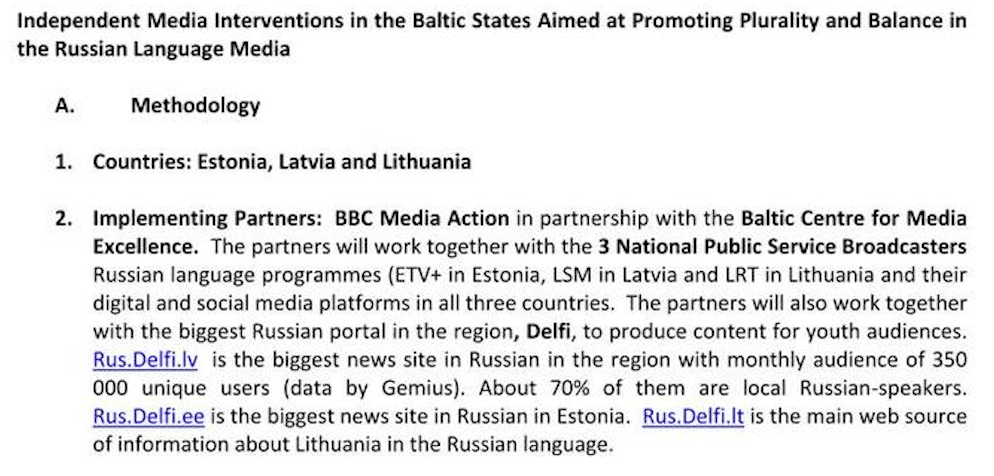
A year later, the FCO’s CDMD division outlined a program to run through 2022 at a cost of $8.3 million to the British taxpayer. It aimed to establish new outlets and support preexisting media operations “to counter Russia’s efforts to sow disunity” and “increase resilience to hostile Kremlin messaging in the Baltic states.”

Thus the British government set out with an array of intelligence contractors to dominate Baltic media with pro-NATO messaging – and perhaps sow some disunity of its own.

As seen below, the BBC placed an apparently successful bid to participate in the covert Baltic program through its non-profit arm, known as BBC Media Action.
The BBC also proposed to participate in a separate UK FCO media propaganda program in Ukraine, Moldova, and Georgia. It named Reuters and a now-defunct intelligence contractor called Aktis Strategy, which participated in previous FCO CDMD programs, as key allies in its consortium.

The BBC identified local partners like Hromadske, a Kiev-based broadcast network born in the midst of the so-called Maidan “Revolution of Dignity” in 2014 that relied on ultra-nationalist muscle to remove an elected president and install a pro-NATO regime. Hromadske materialized almost overnight with seed money and logistical support from the US Agency for International Development (USAID) and billionaire media mogul Pierre Omidyar’s Network Fund.

BBC Media Action proposed working through Aktis to cultivate and grow pro-NATO media in conflict areas like the Donbas region of eastern Ukraine, where a proxy war has raged since 2014 between the Western-backed Ukrainian military and pro-Russian separatists. It was textbook information warfare, weaponizing broadcast media to turn the tide of battle in a protracted, grinding conflict.

The UK FCO propaganda campaign warned that “Kremlin-affiliated structures” could undermine the project if it was exposed. For a media organization that claims to place trust at the heart of its charter of values, the BBC was certainly operating under a high degree of secrecy.

The UK FCO’s meddling in Eastern Europe and the Baltics created a feeding frenzy among contractors seeking to provide “capacity building” and media development assistance on Russia’s periphery. Among the bidders were Reuters and veteran FCO contractors that had participated in an array of information warfare campaigns from Syria to the British home front.

The Consortium

Among the intelligence contractors bidding to participate in the UK FCO-funded Consortium were the Zinc Network and Albany Communications. As journalist Kit Klarenberg noted in a February 18 report on the recent FCO leaks, these firms “boast staff possessed of [security] clearances, individuals who previously served at the highest levels of government, the military and security services. They furthermore have extensive experience in conducting information warfare operations on London’s behalf the world over.”

Previously known as Breakthrough, Zinc has contracted for the UK Home Office to covertly implement media projects propagandizing British Muslims under the auspices of the Prevent de-radicalization initiative. In Australia, Zinc was caught running a clandestine program to promote support for government policies among Muslims.

Ben Norton reported for The Grayzone on Albany’s record of “secur[ing] the participation of an extensive local network of over 55 stringers, reporters and videographers” to influence media narratives and advance Western regime-change goals in Syria, while conducting public relations services on behalf of extremist Syrian militias funded by NATO member states and Gulf monarchies to destabilize the country.

In its bid for the UK FCO media program in the Baltic region, Albany proposed a series of satirical “interactive games” like “Putin Bingo” to encourage opposition to the Russian government and exploit “frustrations experienced by Russians in the EU.”

Albany pitched a Latvia-based outlet called Meduza as “a leading proponent of these games.” A top website among Russian opposition supporters, Meduza has received financial support from the Swedish government and several billionaire-backed pro-NATO foundations.

As a UK FCO contractor, the Zinc Network said it was “delivering audience segmentation and targeting support” not only to Meduza, but also to Mediazona, a supposedly independent media venture founded by two members of the anti-Kremlin performance art group Pussy Riot.

One of Mediazona’s founders, Nadya Tolokonnikova, shared a stage with former US President Bill Clinton at the Clinton Foundation’s 2015 conference. The following year, Tolokonnikova trashed now-imprisoned Wikileaks founder Julian Assange, claiming, “He’s connected with the Russian government, and I feel that he’s proud of it.”

Besides delivering “targeting support” for “independent” outlets pushing the right line against the Kremlin, Zinc proposed leveraging UK FCO funding into a program of direct payments and gaming Google search results in their favor. The intelligence cut-out was explicit about its desire to reduce the search visibility of the Russian government-backed broadcaster RT.com.

The UK covertly funded and managed a network of Russian YouTubers and “activated” anti-government protest content

In a document marked “private and confidential,” Zinc revealed the Consortium’s role in setting up a “YouTuber network” in Russia and Central Asia designed to propagate the message of the UK and its NATO allies.

According to Zinc, the Consortium was “supporting participants mak[ing] and receiv[ing] international payments without being registered as external sources of funding,” presumably to circumvent Russian registration requirements for foreign-funded media outfits.

Zinc also helped the YouTube influencers “develop editorial strategies to deliver key messages” while working “to keep their involvement confidential.” And it carried out its entire program of covert propaganda in the name of “promoting media integrity and democratic values.”

Perhaps the most prominent Russian YouTube influencer is Alexei Navalny, a previously marginal nationalist opposition figure who was nominated for a Nobel Prize after becoming the target of a high-profile poisoning incident that brought relations between Russia and the West to its post-Cold War nadir.

The Russian government’s sentencing of Navalny to a 2.5-year prison term for evading parole has inspired a new wave of anti-government protests. Back in 2018, Navalny personally co-sponsored national demonstrations against the banning of the encrypted messaging app Telegram.

In its bid for a UK FCO contract, Zinc revealed that it played a behind-the-scenes role “to activate a range of content within 12 hours of the recent telegram protests.” Whether those activities involved Navalny or his immediate network was unclear, but the private disclosure by Zinc appeared confirm that British intelligence played a role in amplifying the 2018 protests.

Russian intelligence services have released sting video footage showing Vladimir Ashurkov, the executive director of Navalny’s FBK anti-corruption organization, meeting in 2013 with a suspected British MI6 agent named James William Thomas Ford, who was operating out of the British embassy in Moscow. During the rendezvous, Ashurkov can be heard asking for 10 to 20 million dollars to generate “quite a different picture” of the political landscape.

In 2018, Ashurkov’s name appeared in leaked documents exposing a covert, UK FCO influence network called the Integrity Initiative. As The Grayzone reported, the Integrity Initiative operated behind the cover of a think tank called the Institute for Statecraft, which concealed its own location through a fake office in Scotland.

Run by a group of military intelligence officers, the secret propaganda group worked through clusters of media and political influencers to escalate tensions between the West and Russia. Listed among the London cluster of anti-Russian influencers was Ashurkov.

The Integrity Initiative’s military directors outlined their agenda in stark, unequivocal terms. As the leaked memo below illustrates, they aimed to exploit the media, think tanks and their influence network to stir up as much hysteria about Russia’s supposedly malign influence as possible. Since they embarked on their covert campaign, nearly all their wishes have come true.

Bellingcat joins the Zinc Network, allegedly meddles in Moldova’s elections

After Alexei Navalny’s poisoning, he collaborated with the UK-based “open source” journalism outfit Bellingcat to pin the crime on Russia’s FSB intelligence services. Though it is well established that Bellingcat is funded by the National Endowment for Democracy, a US government entity that supports regime-change operations around the globe, the fact has never appeared in the reams of fawning profiles that corporate media outlets, including Reuters, have published about the organization.

Bellingcat’s role as a partner in the Zinc Network’s UK FCO-funded EXPOSE Consortium may add an additional layer of suspicion about the outlet’s claim to independence.

Indeed, Bellingcat was listed in leaked 2018 documents as a key member of Zinc’s “Network of NGOs.” Among the members in the network was the Institute for Statecraft, the front for the Integrity Initiative.

Bellingcat founder Eliot Higgins has vehemently denied accepting funding from the UK FCO or collaborating with it. But after Zinc documents leaked in early 2019, Higgins disclosed that some version of the Zinc proposal had received the green light from the Foreign Office.

Christian Triebbert, a Bellingcat staff member who was named as a potential trainer by the Zinc documents, and who now heads the New York Times’ video investigations unit, claimed the program consisted of benign workshops on “digital research and verification skills.”

What he and Higgins did not mention, however, was that Bellingcat had apparently been dispatched by the Zinc Network to “respond” to the 2019 parliamentary elections in North Macedonia. Stakes were high as the elections were likely to determine whether the tiny country would enter NATO and join the EU. The pro-NATO candidate triumphed, and not without a little help from the British Foreign Office and its allies.

According to the Zinc proposal, Bellingcat provided training to the Most Network, a Macedonian media outlet. It was joined by DFR Lab, a project of the NATO- and US government-funded Atlantic Council in Washington, DC.

After apparently participating in the covert UK FCO-funded intervention in North Macedonia, Bellingcat published an article ahead of the country’s 2020 parliamentary elections entitled, “Russia’s interference in North Macedonia.”

Several Zinc Network documents list Reuters as a member of the UK FCO-funded Consortium media intervention in the Baltic states.

Asked by The Grayzone how Reuters’ participation in UK FCO-funded programs aimed at countering Russia conformed to the news organization’s Trust Principles, spokesperson Jenny Vereker stated, “This funding supports our independent work to assist journalists and journalism all over the world, as part of our mission to strengthen a free and vibrant global media ecosystem to support a plurality of voices and preserve the flow of accurate and independent information. This is because accurate and balanced news coverage is a crucial pillar of any free, fair and informed society.”

In recent years, the BBC and Reuters have played an increasingly aggressive part in demonizing the governments of countries where London and Washington are seeking regime change. Meanwhile, high-profile online investigative outlets like Bellingcat have sprouted up seemingly overnight to assist these efforts.

With the release of the UK FCO documents, questions must be raised about whether these esteemed news organizations are truly the independent and ethical journalistic entities they claim to be. While they hammer away at “authoritarian” states and malign Russian activities, they have little to say about the machinations of the powerful Western governments in their immediate midst. Perhaps they are reluctant to bite the hand that feeds them.

Ecuador Has Been Hit by 40 Million Cyber Attacks Since Assange’s Arrest

By Elias Marat

Source: The Mind Unleashed

The government of Ecuador claims that the country has come under a broad and concerted cyber attack, with approximately 40 million attempts to compromise web portals connected to public institutions ever since the controversial decision to allow UK police to forcibly remove Wikileaks founder Julian Assange from their London Embassy.

Deputy Minister of Information and Communication Technologies Patricio Real told reporters that the wave of attacks began shortly after last Thursday’s arrest of Assange by British authorities. Real said that the attacks “principally come from the United States, Brazil, Holland, Germany, Romania, France, Austria and the United Kingdom, and also from here, from our territory.”

On April 11, Ecuadorian President Lenin Moreno revoked the diplomatic asylum extended to Asange by the South American nation in 2012. In a legally dubious move, Quito also revoked the Ecuadorian nationality granted to Assange in 2017.

Ecuador’s El Comercio reported that the telecommunications ministry’s undersecretary of electronic government, Javier Jara, claimed that following “threats received by these groups related to Julian Assange”–such as the shadowy network Anonymous–the country began suffering “volumetric attacks.

Volumetric attacks are a type of distributed denial of service (DDoS) attack in which servers are flooded with requests in an attempt to overload them with traffic, thus preventing users from accessing the network.

According to AFP, the targets included the foreign ministry, central bank, tax authorities, the office of the president, and a number of other government agencies’ websites. None of the attacks succeeded in destroying or stealing data.

The attacks also come amid the Ecuadorian government’s detention of Ola Bini, a Swedish national and software developer allegedly tied to Wikileaks who was detained last Thursday as he attempted to attend a martial arts event in Japan. Bini, as well as two unidentified Russian “hackers,” are being held for their alleged role in a “hackers’ network” based in the country. Bini, who is accused of having met with Assange 12 times, has also just been accused of playing a role in blackmail attempts targeting President Moreno.

Since 2017, Assange’s relationship with his Ecuadorean hosts sharply deteriorated amid President Lenin Moreno’s attempts to curry favor with international creditors and wealthy governments in the north such as the United States, the United Kingdom and Spain. Moreno began referring to Assange on various occasions as a “miserable hacker,” an “irritant,” and a “stone in the shoe” of his government.

Last year, the London embassy cut off his access to the internet for alleged political meddling following requests by Quito that he stop commenting on affairs in other countries.

Relations took a strong turn for the worse in March following the release of a batch of documents known as the “INA Papers,” which implicated the president in alleged corruption, including money-laundering, offshore bank accounts and a shell company named INA Investment Corporation that is based in Panama and was used by President Moreno’s family to procure furniture, property, and luxury goods.

It is widely speculated that while Wikileaks has still not been directly tied to the release of the INA Papers, President Moreno was enraged after personal photographs were released showing his opulent private life, including photos of the president enjoying lavish lobster breakfast-in-bed and lobster dinners–imagery considered damning by Ecuador’s electorate especially given Moreno’s prior boasting of a poverty diet of eggs and white rice, which he claimed to regularly eat as he rammed through austerity measures that led to thousands of layoffs in the poor yet resource-rich South American country.

Within Ecuador, opinions have been evenly split about Assange, with the country’s right-wing and centrists supporting the decision to end his asylum while the left and supporters of former President Rafael Correa have considered the move a scandalous act of outright prostration before the “imperialists” of the Global North.

As such, social media reactions to the government’s complaints of “cyber attacks” have provoked both outrage and mockery from the Ecuadorian public, with some social media users thanking Assange for releasing the INA Papers and others claiming that the attacks will serve as a convenient smokescreen for the country’s authorities to further plunder the public coffers of the South American country.

Globalisation: Hyperstition, Surveillance, and the Empire of Reason

By S.C. Hickman

Source: Techno Occulture

Edmund Berger in his essay Underground Streams speaking of various tactics used by the Situationists, Autonomia, and the Carnivalesque:

“Like the Situationists the Autonomia would engage with the tradition of the Carnivalesque alongside a Marxist political analysis. Bakhtin had described the carnival as “political drama without footlights,” where the dividing line between “symbol and reality” was extremely vague, and the Autonomia had embodied this approach through their media-oriented tactics of detournement. But under a regime of emergency laws a great portion of the Autonomia was sent to prison or into exile, leaving its legacy through an extensive network of radical punk and anarchist squats and social centers.”

One of the things we notice is that the Autonomia movement actually struck a nerve at the heart of Power and forced their hand, which obligingly reacted and used their power over and dominion of the Security System to screen out, lock up, and exclude this threat. That’s the actual problem that will have to be faced by any emancipatory movement in the present and future: How to create a movement that can be subversive of the system, and yet chameleon like not rouse the reactionary forces to the point of invoking annihilation or exclusionary measures?

A movement toward bottom-up world building, hyperstition, and exit from this Statist system will have to do it on the sly utilizing a mirror world strategy that can counter the State and Public Security and Surveillance strategies.  Such Counter-Worlds of Exit and Hyperstitional instigation will need to work the shadow climes of the energetic unconscious, triggering a global movement from the shadows rather than in direct opposition.

In many ways as I think we need a politics of distortion, allure, and sincerity, one that invents a hyperstitional hyperobject among the various multidimensional levels of our socio-cultural systems, calling forth the energetic forces at the heart of human desire and intellect, bypassing the State and Corporate filters and Security Systems of power and control. Such a path will entail knowing more about the deep State’s secret Security apparatus and Surveillance methodologies, technologies, and tactics than most thinkers are willing to acknowledge or even apprehend. Like the Hacker movements of the 90’s up to Anonymous one will need to build shadow worlds that mimic the stealth weapons of the State and Corporate Global apparatus and assemblages; but with one caveat – these weapons are non-violent “weapons of the mind”, and go unseen and unrecognized by the State Security Systems at Local and Global levels.

A global system of mass, warrantless, government surveillance now imperils privacy and other civil liberties essential to sustaining the free world. This project to unilaterally, totally control information flow is a product of complex, ongoing interplay between technological, political, legal, corporate, economic, and social factors, including research and development of advanced, digital technologies; an unremitting “war on terror”; relaxed surveillance laws; government alliances with information technology companies; mass media manipulation; and corporate globalism. One might say it as the Googling of the World.

The United Stats internally hosts 17 intelligence agencies under the umbrella known as the Security Industrial Complex. They are also known for redundancy, complexities, mismanagement and waste. This “secret state” occupies 10,000 facilities across the U.S. Over the past five years the total funding budget exceeded half a trillion dollars. The notion of globalization which has its roots in the so called universalist discourses of the Enlightenment had as its goal one thing: to impose a transparent and manageable design over unruly and uncontrollable chaos: to bring the world of humans, hitherto vexingly opaque, bafflingly unpredictable and infuriatingly disobedient and oblivious to human wishes and objectives, into order: a complete, incontestable and unchallenged order. Order under the indomitable rule of Reason.1

This Empire of Reason spreads its tentacles across the known world through networks and statecraft, markets and tradecraft, war and secrecy, drugs and pharmakon.  The rise of the shadow state during Truman’s era began a process that had already been a part of the Corporate worldview for decades. The monopoly and regulation of a mass consumption society was and always will be the goal of capitalist market economies. In our time the slow and methodical spread of the American surveillance state and apparatus has shaped the globalist agenda. Because of it the reactionary forces of other state based control systems such as Russia and China are exerting their own power and surveillance systems as counters to Euro-American hegemony.

Surveillance is a growing feature of daily news, reflecting its rapid rise to prominence in many life spheres. But in fact surveillance has been expanding quietly for many decades and is a basic feature of the modern world. As that world has transformed itself through successive generations, so surveillance takes on an ever changing character. Today, modern societies seem so fluid that it makes sense to think of them being in what Bauman terms a ‘liquid’ phase. Always on the move, but often lacking certainty and lasting bonds, today’s citizens, workers, consumers and travelers also find that their movements are monitored, tracked and traced. Surveillance slips into a liquid state.

As Bauman relates it liquid surveillance helps us grasp what is happening in the world of monitoring, tracking, tracing, sorting, checking and systematic watching that we call surveillance. Such a state of affairs engages with both historical debates over the panopticon design for surveillance as well as contemporary developments in a globalized gaze that seems to leave nowhere to hide, and simultaneously is welcomed as such. But it also stretches outwards to touch large questions sometimes unreached by debates over surveillance. It is a conversation in which each participant contributes more or less equally to the whole. (Bauman)

Our network society has installed its own “superpanopticon” (Mark Poster). Such a system is ubiquitous and invisible to the mass of users. As Poster states it “The unwanted surveillance of one’s personal choice becomes a discursive reality through the willing participation of the surveilled individual. In this instance the play of power and discourse is uniquely configured. The one being surveilled provides the information necessary.” For Poster, this supply of self-surveillance is provided through consumer transactions stored and immediately retrievable via databases in their constitution of the subject as a “sum of the information in the fields of the record that applies to that name.” The database compiles the subject as a composite of his or her online choices and activities as tracked by IFS. This compilation is fixed on media objects (images, text, MP3s, Web pages, IPs, URLs) across the deluge of code that can be intercepted through keyword pattern recognition and private lists of “threatening” URLs.2

Our so called neoliberal society has erased the Public Sphere for the atomized world of total competition in a self-regulated market economy devoid of politics except as stage-craft. As authors in the Italian autonomist movements have argued for the past fifty and more years, this “total subsumption” of capital upon the life-sphere has been accomplished through “material” and “immaterial” means.  According to these authors, capital in late capitalism and neoliberalism has attempted to progressively colonize the entire life-sphere. Resistance, they argue, comes through the “reserves” to capital that remain as the social and intellectual foundation from which capital draws, including through “immaterial labor” using digital means. Gradually during modernity, such theorists have argued, life itself has been taken as a target for capitalist subsumption, through the cooptation of communication, sexual and familial relationships (Fortunati 1995), education, and every other sphere of human activity, with economic exchange and survival as the ultimate justification for all relationships.3

Capital’s “apparatus of capture” has become increasingly efficient and broad in its appropriation of selves as subjects of its political economy through the combination of appropriating governmental functions such as: buying off political actors and agencies, cutting public funding to modernist institutions and infrastructures, redefining the agenda of education and other cultural institutions toward capitalist values, owning and narrowing the focus of the media, forcing family structures and individuals to adapt to scarcity economies, and using government police and surveillance forces and economic pressures to crush resistance. In short, it is said that neoliberalism has advanced by the totalitarian institutionalization of national and international capitalism, one nation after another, using domestic means to force compliance in domestic markets and using international pressures (economic, military, cultural) to do the same to other countries, cultures, and peoples. (Day, pp. 126-127)

The increased accuracy (or believed accuracy) of increased surveillance and feedback targeting through the collection of social big data and its analyses and social and political uses (ranging from drone predators to state surveillance in both democratic and communist/ authoritarian governments to consumer targeting— for example, the targeting done by Target Corporation, as described in a 2012 New York Times article [Duhigg 2012])— belong to a conjoined mechanism of cybernetic and neoliberal governmentality, which crosses governmental and corporate databases and organizations. Social big data seeks to demarcate trends, which then directly or indirectly act as norms, which further consolidate individual and group action within market-determined norms (Rouvroy 2013). People are forced into competition, into a “freedom” that is monitored and checked within systems of feedback control. As Norbert Weiner suggested in the Cold War period (Wiener 1954, 1961), communicative control can be used toward a discourse of “rationality”; a rationality that is seen as proper to a given political economy. The documentary indexing of the subject provides the codes for the subject’s social positioning and expressions by others and by itself. Thanks to networked, mobile devices, the subject can attempt to continuously propose him- or herself to the world as the subject of documentary representation. (Day, pp. 132-133)

Those of us in the West who use mobile devices are becoming hooked into an elaborate datasociety in which every aspect of our lives is conditioned to enforce a self-regulatory system of choices and taboos. The surveillance is done at the level of individuals, who are monitored and whose actions are predicted throughout key moments of their consumption or production, marking changes in trends and phase states, and recalculating the trajectory of entities according to these new parameters and relationships. Our algorithmic society is splicing us all into a grid of total control systems from which it will become increasingly difficult to extricate ourselves.

As Douglas Rushkoff said recently digital technology is programmed. This makes it biased toward those with the capacity to write the code. In a digital age, we must learn how to make the software, or risk becoming the software. It is not too difficult or too late to learn the code behind the things we use—or at least to understand that there is code behind their interfaces. Otherwise, we are at the mercy of those who do the programming, the people paying them, or even the technology itself.4 More and more our mass society is being programmed through an immaterial grid of datafied compliance and surveillance that captures our desires and regulates our choices. In some ways we’ve become the mindless generation, unable to stand back from the immersive worlds of our technosphere in which we live and breath. We’ve become enamored with our Mediatainment Industrial Complex that encompasses us to the point that those being born now will not know there ever was a word without gadgets. In fact we’ve all become gadgets in a market world of science fiction, our desires captured by the very gadgets we once thought would free us from the drudgery of time. Instead we’ve been locked within a world without time, a timeless realm in which the very truth of history has been sucked out of it and instead we live in a mythic time of no time, prisoners of a cartoon world of endless entertainment and false desires. In such a world the virtual has become actual, we wander through life caught in the mesh of a fake world of commodity cartoons, citizens of a dreamland turned nightmare. Shall we ever wake up?

Modern radical thought has always seen subjectivation as an energetic process: mobilization, social desire and political activism, expression, participation have been the modes of conscious collective subjectivation in the age of the revolutions. But in our age, energy is running out and desire, which has given modern social dynamics their soul, is absorbed in the black hole of virtualization and financial games, as Jean Baudrillard argues in his 1976 book, Symbolic Exchange and Death. In this book, Baudrillard analyzes the hyperrealistic stage of capitalism, and the instauration of the logic of simulation.

The end of the spectacle brings with it the collapse of reality into hyperrealism, the meticulous reduplication of the real, preferably through another reproductive medium such as advertising or photography. Through reproduction from one medium into another the real becomes volatile, it becomes the allegory of death, but it also draws strength from its own destruction, becoming the real for its own sake, a fetishism of the lost object which is no longer the object of representation, but the ecstasy of denegation and its own ritual extermination: the hyperreal. […]

The reality principle corresponds to a certain stage of the law of value. Today the whole system is swamped by indeterminacy, and every reality is absorbed by the hyperreality of the code and simulation. The principle of simulation governs us now, rather that the outdated reality principle. We feed on those forms whose finalities have disappeared. No more ideology, only simulacra. We must therefore reconstruct the entire genealogy of the law of value and its simulacra in order to grasp the hegemony and the enchantment of the current system. A structural revolution of value. This genealogy must cover political economy, where it will appear as a second-order simulacrum, just like all those that stake everything on the real: the real of production, the real of signification, whether conscious or unconscious.

Capital no longer belongs to the order of political economy: it operates with political economy as its simulated model. The entire apparatus of the commodity law of value is absorbed and recycled in the larger apparatus of the structural law of value, this becoming part of the third order of simulacra. Political economy is thus assured a second life, an eternity, within the confines of an apparatus in which it has lost all its strict determinacy, but maintains an effective presence as a system of reference for simulation. (Baudrillard 1993a: 71-72, 2).5

We’ve all become simulations now. It’s not our bodies that matter in this digital universe of data, but rather the dividual traces we leave across the virtualized world that can be manipulated to produce profit. In the sphere of semiocapitalism, financial signs are not only signifiers pointing to particular referents. The distinction between sign and referent is over. The sign is the thing, the product, the process. The “real” economy and financial expectations are no longer distinct spheres. In the past, when riches were created in the sphere of industrial production, when finance was only a tool for the mobilization of capital investment in the field of material production, recovery could not be limited to the financial sphere. It also took employment and demand. Industrial capitalism could not grow if society did not grow. Nowadays, we must accept the idea that financial capitalism can recover and thrive without social recovery. Social life has become residual, redundant, irrelevant. (Bifo)

Those of us of an older generation still remember what existed the other side of the virtual screen, but the mass of young being born now will not have that luxury and their minds will be completely immersed in this new virtual actuality with no sense of the Outside.

While those on the Left still ponder outmoded political worlds the world of capital has abandoned both the political and the social. It’s time to wake up … I wanted to say, “before it’s too late”. My problem, my despair is that it is already too late. And, yet, I continue throwing out my little posts in hopes that someone is listening, that someone will awaken from their dogmatic slumber and act… is that you?


  1. Bauman, Zygmunt; Lyon, David. Liquid Surveillance: A Conversation (PCVS-Polity Conversations Series) (pp. 79-80). Wiley. Kindle Edition.
  2. Raiford Guins. Edited Clean Version: Technology and the Culture of Control (Kindle Locations 1304-1308). Kindle Edition.
  3. Day, Ronald E.. Indexing It All: The Subject in the Age of Documentation, Information, and Data (History and Foundations of Information Science) (p. 126). The MIT Press. Kindle Edition.
  4. Douglas Rushkoff. Program or Be Programmed (Kindle Locations 1363-1367). Kindle Edition.
  5. Berardi, Franco Bifo. After the Future (Kindle Locations 2276-2294). AK Press. Kindle Edition.

Media, Mind-Control, & Meditation: Plato’s E-Cave Panopticon and Beyond

panopticon-image

By Mankh (Walter E. Harris III)

Source: Axis of Logic

“Relax,” said the night man,
”We are programmed to receive.
You can check-out any time you like, 
But you can never leave!”

 – The Eagles, from “Hotel California”

In Plato’s Allegory of the Cave, people saw a shadow play on the wall and perceived it as reality. Today that Cave has morphed to provide umpteen TV channels and mini-screen gadgets; and the once sanctified living room cave has expanded into a free-range bubble of consciousness – heads bowed before an electronic altar, seemingly oblivious to the outside world.

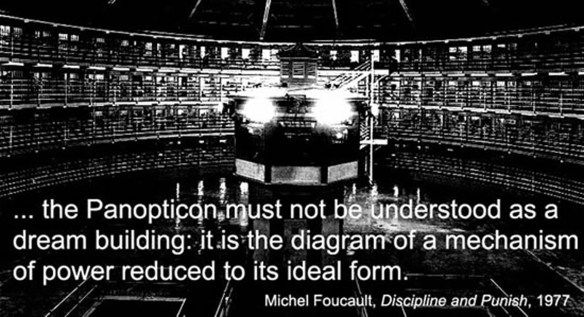
“The “panopticon” refers to an experimental laboratory of power in which behaviour could be modified, and Foucault viewed the panopticon as a symbol of the disciplinary society of surveillance.”[1]

In Plato’s E-Cave, not only are the people watching a shadow play, they, and the shadows they watch, are being watched.

HyperNormalization
With a veneer of calm aplomb, the masses communicate 24-7, often in a frenetic urgency of the mundane, hence one interpretation of HyperNormalization. In all the years of overhearing cell-phone conversations in public, I can’t recall one snippet of philosophy or practical advice, rather stuff like, ‘yeah OMG I’ll get the chips!’ and ‘I’ll be there in like 30 seconds!’; if you’re old enough, you’d remember the days when, you got there when you got there! That said, a cell-phone can be a helpful even life-saving device.

The USEmpire election appears to have both proven and disproven the main theory of Adam Curtis’ fascinating new documentary “HyperNormalization.”

“Curtis argues that since the 1970s, governments, financiers, and technological utopians have given up on the complex “real world” and built a simple “fake world” that is run by corporations and kept stable by politicians.”[2]

The California cyber-tech-boom was a love-child of LSD-consciousness that found refuge in E-wizardy all the while looking to escape repressive politics. In his book “2030” Pepe Escobar describes it as: “Digital network capitalism would then shape post-modern globalization, from the New Economy before the end of the millennium to every digital wall to be broken beyond. California cosmology forged our world.”

According to Wikipedia:

“The term “hypernormalisation” is taken from Alexei Yurchak’s 2006 book Everything was Forever, Until it was No More: The Last Soviet Generation, about the paradoxes of life in the Soviet Union during the 20 years before it collapsed. A professor of anthropology at the University of California, Berkeley, he argues that everyone knew the system was failing, but as no one could imagine any alternative to the status quo, politicians and citizens were resigned to maintaining a pretence of a functioning society. Over time, this delusion became a self-fulfilling prophecy and the “fakeness” was accepted by everyone as real, an effect which Yurchak termed “hypernormalisation”.”[3]

First off, I see HyperNormalization as a half-truth because while the self-referential, gossipy world is fake, it is a veneer for a very real world of resource extraction and the violence perpetrated to maintain the status quo – and that is what the fakers ignore. As far as the election, many expected the Clinton dynasty to prevail as the corrupt, business as usual lesser of two evils. Breaking snooze: Where’s  the headline news that Melania Trump plans to focus on helping women and children?; I saw that mentioned on CNN’s Anderson Cooper 360, such a perfect antidote for Hillary’s loss and The Donald’s anti-feminist track record.

Even though WikiLeaks revealed the DNC (Democratic National Convention) was rigged against Sanders and leaks of Podesta/Clinton e-mails may have been proverbial straws for Hillary’s campaign camel, the prevailing media sentiment was that she would win – despite the fact that the day before the election some polls indicated a shrinking 3-4 point lead, thus with the typical margin of error, it was, in effect, tied. Yet the mass hyper-surprise!; and all that after the corporate media and comedy shows had simultaneously bashed Trump and given him more air-time than a kite on a windy day – both disdaining and elevating him, a media-mindfuck if ever there was one.

And there was little uproar when Gary Johnson and Jill Stein were excluded from debates and virtually banned from all corporate news, thus proving (if you didn’t know already) that it’s not a truly democratic election. Yet carry on we must and do the best we can with what we got, was the general sentiment, in other words, “the “fakeness” was accepted by everyone as real” aka HyperNormalization.

Yet the non-coastal, poor and middle America White working class (with sides of KKK and minorities!), which reportedly was the key demographic for The Don’s victory, was voting out of bare-bones needs; in effect they were not HyperNormalized. Then again, if Trump, who promises to challenge the status quo, caves-in to Deep State pressure, we will have an answer to an interesting article’s titular question: “President Trump: big liar going to Washington or Tribune of the People?”[4] And if that answer is the former, then the mostly White working poor will also have been duped/HyperNormalized.

You see, it’s hard to know what’s what; which all seems to prove HyperNormalization as the dominant societal charade; which screen is real, if any?

What you perceive is what you get
Another key phrase in Curtis’ documentary is “managed perception” – akin to Chomsky and Herman’s  “Manufacturing Consent: The Political Economy of the Mass Media” (1988) which showed how opinions and desensitized agreement to the status quo became a product to be mined and marketed. Witness CBS Chairman Les Moonves’ comment from February 2016:

“Man, who would have expected the ride we’re all having right now? … The money’s rolling in and this is fun. I’ve never seen anything like this, and this [is] going to be a very good year for us. Sorry. It’s a terrible thing to say. But, bring it on, Donald. Keep going.” [5] And, if i might satirically add, like an orangey topped Duracell battery, The Don does seem to have a lot of energy.

HyperNormalization is also akin to Sheldon Wolin’s theory  of “inverted totalitarianism,” where the faceless corporate machine wields so much entertainment and bureaucratic power that the people barely notice they are being played hook, line, and sinking feelings.

Some of Curtis’ info, however, is inaccurate or questionable. For examples, he blames the demise of the Occupy Movement on lack of vision and planning yet neglects to mention the FBI coordinated systemic crackdown on the ‘camps’ across the country. [6]

About Syria he says that President Bashar al-Assad retaliated with a “vengeful fury,” whereas Assad has defended his actions as self-defense for his people; numerous journalists back the Syrian President’s claim.

Post-election, I wonder: Why were so many liberals, lefties, and women more surprised that Trump won than that the DNC/HRC rigged it against Sanders? Were they simply feeling impotent due to HyperNormalized shadow play? Whatever the case, his victory revealed a crack in the smooth screen of HyperNormalization.

According to Patrick Caddell’s survey before the election, the populace seems to be hip to what’s happening:

“Powerful interests from Wall Street banks to corporations, unions and political interest groups have used campaign and lobbying money to rig the system for them. They are looting the national treasury of billions of dollars at the expense of every man, woman and child. AGREE = 81%; DISAGREE = 13%…

“The country is run by an alliance of incumbent politicians, media pundits, lobbyists and other powerful money interests for their own gain at the expense of the American people. AGREE = 87%; DISAGREE = 10%

The real struggle for America is not between Democrats and Republicans but between mainstream American and the ruling political elites. AGREE = 67%; DISAGREE = 24%.” [7]

This makes it seem it is the ‘how-to bring about change’ that is the deeper conundrum of the HyperNormalized world. Then again, people too often seem to have only their own best interests at heart. Approximately 90% of Americans want their food labeled so as to know if they contain GMOs etc. or not, yet hardly a peep out of anyone that climate change or the “environment” aka Mother Earth & Nature-beings were deliberately excluded as a main topic of the presidential debates. This makes it seem that, in general, Americans want clean food for themselves, they want a clean environment so they can go ‘play in the park’ by themselves. And that brings us to the Great Disconnect and Standing Rock.

Flow like water, be steady as a rock
Part of HyperNormalization is a disconnect from Nature and from being self- and community-guided, and therefore disconnected from the Original Peoples of Turtle Island. While many people are certainly aware of what’s happening with Standing Rock, the corporate media’s lack of attention, let alone empathy, fosters lack of concern for the outcome, lack of being outraged by the violent and racist treatment of those in prayer and peacefully protecting the main source of water for the Standing Rock Sioux and other Natives as well as approximately 17-million people downstream. The real-fake outrage is over the outcome of a fake election.

For many Native reservations where poverty and PTSD are prevalent, the people are anything but HyperNormalized; they are struggling to survive – as with Standing Rock, they are not asking for much: clean water and the space to live their lives with ancient traditions timelessly connected with the land, the water, the stones…

Plato, imagining a prisoner getting outside of the Cave, wrote: “Slowly, his eyes adjust to the light of the sun. First he can only see shadows. Gradually he can see the reflections of people and things in water and then later see the people and things themselves. Eventually, he is able to look at the stars and moon at night until finally he can look upon the sun itself .” [8]

Standing Rock is bringing people together, raising consciousness at many levels. As one example from a little over a week ago:

“In a “historic” show of interfaith solidarity, 500 clergy members prayed along the banks of North Dakota’s Cannonball River on Thursday where they “bore witness with the Standing Rock Sioux Nation,” which has faced intimidation, violence, and arrests for protecting their sacred land and water supply from the threats of a massive oil pipeline. According to the Episcopal News Service, “The interfaith group spent more than five hours on site, marching, singing hymns, sharing testimony, and calling others to join them in standing with the more than [300] tribes who have committed their support to the Sioux Nation as they protest the route of the Dakota Access Pipeline (DAPL).” [9]

This solidarity is in stark contrast with the election where a typically 51/49 system determines an outcome for a society literally programmed for exciting close-call winners – think sporting events,
reality shows, awards ceremonies.

Outside in and inside out
There are many ways to get outside the Cave. One of those is by going within. When I first started to meditate, as is common, I became aware of the constant chatter in my head and soon realized that the mind left unattended will rattle on endlessly. Meditation then showed me that once the chatter quiets, one then has access to other frequencies, other ‘channels’ – what happens then is a very personal matter yet also impersonal because one becomes connected with another source of thinking-seeing-feeling. Chatter, like cell-phones, has it’s usefulness, say, if you forgot to turn the stove off. My point to the personal anecdote is that the corporate media is too much chatter, endlessly looping itself. The gadgets, too, though useful, seem hard-wired for HyperNormalization.

Some of the chatter we must live with, yet by learning to follow our intuitions, listening to and connecting with Nature, talking with elders and little children we can better tune-out from the shadow-play, we can find new and ancient ways for more people – and that includes trees, rivers, etc. –  “to look at the stars and moon at night” and “look upon the sun itself.”

“Sin filo ya y derrotada se quejó: Soy más fuerte que ella, pero no le puedo hacer daño y ella a mi, sin pelear. me ha vencido.’”

“Without sharpness and defeated, it [the sword] complained: ‘I am stronger than the water, but I cannot harm her. And the water, without fighting, has conquered me.’” [10]

NOTES:
1.    Panopticism here and here.
2.    Ibid.
3.    HyperNormalization
4.    See here.
5.    “Les Moonves: Trump’s run is ‘damn good for CBS’”. See here.
6.    “Revealed: how the FBI coordinated the crackdown on Occupy
7.    “Patrick Caddell; The Pollster Who ‘Got it Right’
8.    “Allegory of the Cave
9.    “A Prayer for People and Planet: 500 Clergy Hold ‘Historic’ Mass Gathering for Standing Rock
10.    “Questions & Swords: Folktales of the Zapatista Revolution” as told by Subcomandante Marcos, Cino Puntos Press, El Paso, Texas, 2001, p.82.

To watch “HyperNormalization”, click here.

Mankh (Walter E. Harris III) is an essayist and resident poet on Axis of Logic. In addition to his work as a writer, he is a small press publisher and Turtle Islander. His new book of genre-bending poetic-nonfiction is “Musings With The Golden Sparrow.” You can contact him via his literary website.


Intelligence Report On Russian Election Influence Is A Flop

index

Source: Moon of Alabama

Yesterday the U.S. Director of National Intelligence, the CIA, the NSA and the FBI released a report about alleged Russian hacking of the Democratic National Council and on Russian influence operation on the U.S. presidential election. The report failed to convince anyone. It is indeed a public relation disaster for the Intelligence Community.

John Harwood covers “the economy and national politics for CNBC and the New York Times.” More then 100,000 people follow him on Twitter. He is known as Hillary Clinton supporter and chummy with John Podesta who ran Clinton’s election campaign.

Harwood set up a simple poll. It is not statistically representative but gives a picture of a general sentiment.

harwood

This result surely shows the limits of power of the so-called Intelligence Community. But it is worse: yesterday’s “Russian hacking” claims failed to convince even its most ardent and anti-Russian supporters.

Daily Beast: U.S. Spy Report Blames Putin for Hacks, But Doesn’t Back It Up

Kevin Rothrock (Moscow Times):

I cannot believe my eyes. Is this really part of the US government’s intelligence case?I’ll say it: the declassified USG report “Assessing Russian Activities and Intentions in Recent US Elections” is an embarrassment.

Susan Hennessey (Lawfare, Brookings):

The unclassified report is underwhelming at best. There is essentially no new information for those who have been paying attention.

Bill Neely (NBCNews):

Lots of key judgements but not many key facts & no open proof in US Intell. report into alleged Russian hacking.

Stephen Hayes (Weekly Standard):

The intel report on Russia is little more than a collection of assertions. Understand protecting sources/methods, but it’s weak.

Julia Ioffe (The Atlantic):

It’s hard to tell if the thinness of the #hacking report is because the proof is qualified, or because the proof doesn’t exist.@JeffreyGoldberg Have to say, though, I’m hearing from a lot of Russia watchers who are very skeptical of the report. None like Putin/Trump.

When you lost even Julia Ioffe on your anti-Russian issue …

Clapper as DNI and Brennan as CIA chief should have been fired years ago. They will both be gone by January 20. The Intelligence Community will remember them as the chief-authors of this devastating failure.


Related Articles:

The Russians Did Not “Hack” the US Election – a Few Facts from a Former CIA Spy

US Report Still Lacks Proof on Russia ‘Hack’

Russian Scum!!!

Related Podcast:


Foxes Guard Facebook Henhouse

hqdefault

By F. William Engdahl

Source: New Eastern Outlook

The latest mantra of CIA-linked media since the “Pizzagate” leaks of data alleging that Hillary Clinton Campaign Manager John Podesta and other highly influential political persons in Washington were connected to an unusual pizza place near the White House run by a 41-year old James Achilles Alefantis called Comet Ping Pong, is the need to crack down (i.e. censorship) on what is being called “Fake News.” The latest step in this internet censorship drive is a decision by the murky social media organization called Facebook to hire special organizations to determine if Facebook messages are pushing Fake News or not. Now it comes out that the “fact check” private organizations used by Facebook are tied to the CIA and CIA-related NGO’s including George Soros’ Open Society Foundations.

In the last weeks of the US Presidential campaign, Wikileaks released a huge number of emails linked to Clinton Campaign Manager, John Podesta. The contents of thousands of emails revealed detailed exchanges between Podesta and the oddly-influential Comet Ping Pong pizza place owner, Alefantis, as well as the Clinton campaign, which held fundraisers at Comet Ping Pong.

The Pizzagate scandal exploded in the final weeks of the US campaign as teams of private researchers documented and posted Facebook, Instagram and other data suggesting that Alefantis and Comet Ping Pong were at the heart of a pedophilia ring that implicated some of the most prominent politicians in Washington and beyond.

The New York Times and Washington Post moved swiftly to assert that the Pizzagate revelations were Fake News, quoting “anonymous sources” who supposedly said the CIA “believed” Russia was behind hackers who exposed emails and documents from the Democratic National Committee (DNC) and Hillary Clinton’s campaign chair John Podesta. Former NSA senior intelligence expert William Binney claimed the Podesta and Clinton campaign data were leaked, not hacked. The NSA, he pointed out, would immediately identify a hack, especially a foreign hack, and they have remained silent.

The uncovering and release to Wikileaks of the Podesta emails were immediately blamed on Russian intelligence by the CIA, and now by the US President, with not a shred of proof, and despite the fact that NSA. Wikipedia, whose content is often manipulated by US intelligence agencies, rapidly posted a page with the curious title, “Pizzagate (Conspiracy Theory).”

To make certain the neutral interested reader gets the message, the first line reads, “Pizzagate is a debunked conspiracy theory which emerged during the 2016 United States presidential election cycle, alleging that John Podesta’s emails, which were leaked by WikiLeaks, contain coded messages referring to human trafficking, and connecting a number of pizzerias in Washington, D.C. and members of the Democratic Party to a child-sex ring.”

‘Fake News’ Mantra Begins

My purpose in mentioning Pizzagate details is not to demonstrate the authenticity of the Pizzagate allegations. That others are doing with far more resources. Rather, it is to point out the time synchronicity of the explosive Pizzagate email releases by Julian Assange’s Wikileaks web blog, with the launch of a massive mainstream media and political campaign against what is now being called “Fake News.”

The cited New York Times article that Wikipedia cites as “debunking” the Pizzagate allegations states, “None of it was true. While Mr. Alefantis has some prominent Democratic friends in Washington and was a supporter of Mrs. Clinton, he has never met her, does not sell or abuse children, and is not being investigated by law enforcement for any of these claims. He and his 40 employees had unwittingly become real people caught in the middle of a storm of fake news.” The article contains not one concrete proof that the allegations are false, merely quoting Alefantis as the poor victim of malicious Fake News.

That New York Times story was accompanied by a series of articles such as “How Fake News Goes Viral: A Case Study.” Another headline reads, “Obama, With Angela Merkel in Berlin, Assails Spread of Fake News.” Then on November 19, strong Clinton supporter, Facebook billionaire Mark Zuckerberg is quoted in a prominent article titled, “Facebook Considering Ways to Combat Fake News, Mark Zuckerberg Says.”

Facebook uses CIA Censors

Zuckerberg, CEO and founder of the world-leading social media site, Facebook.com, the world’s 5th wealthiest man at an estimated $50 billion, has now established a network of “Third Party Fact Checkers” whose job is to red flag any Facebook message of the estimated one billion people using the site, with a prominent warning that reads, “Disputed by Third-Party Fact Checkers.”

Facebook has announced that it is taking its censorship ques from something called The International Fact-Checking Network (IFCN). This IFCN, a new creation, has drafted a code of five principles for news websites to accept, and Facebook will work with “third-party fact checking organizations” that are signatories to that code of principles.

If we search under the name International Fact-Checking Network, we find ourselves at the homepage of something called the Poynter Institute for Media Studies in St. Petersburg, Florida.

OK. If we look a bit deeper we find that the Poynter Institute’s International Fact-Checking Network in turn, as its website states, gets money from the Bill & Melinda Gates Foundation, Google, the National Endowment for Democracy, the Omidyar Network, the Open Society Foundations of George Soros.

Oh my, oh my! Bill & Melinda Gates Foundation who partners with Soros in numerous nasty projects such as convincing African countries to accept Genetically Modified or GMO seeds? Google, whose origins date back to funding by the CIA and NSA as what intelligence researcher Nafeez Ahmed describes as a “plethora of private sector start-ups co-opted by US intelligence to retain ‘information superiority‘ “?

The Omidyar Foundation is the foundation of eBay founder and multi billionaire, Pierre Omidyar, which finances among other projects the online digital publication, The Intercept, launched in 2014 by Glenn Greenwald, Laura Poitras and Jeremy Scahill.

And the National Endowment for Democracy (NED), the US Government-financed “private” NGO behind every Color Revolution CIA regime change from the Ukraine Color Revolutions to the Arab Spring? The NED was a CIA project created in the 1980’s during the Reagan Administration as part of privatizing US intelligence dirty operations, to do, as Allen Weinstein, who drafted the Congressional legislation to establish the NED, noted in a candid 1991 Washington Post interview, “A lot of what we do today was done covertly 25 years ago by the CIA.”

And if we dig even deeper we find, lo and behold, the name George Soros, convicted hedge fund insider trader, tax-exempt philanthropist and giga-billionaire who seems to fund not only Hillary Clinton and virtually every CIA and US State Department Color Revolution from Russia to China to Iran through his network of Open Society Foundations including the 1990’s Jeffrey Sachs Shock Therapy plunder of Russia and most of former Communist East Europe.

Another one of the media working with Zuckerberg’s Facebook censorship of Fake News is the Washington Post, today owned by Amazon billionaire founder Jeff Bezos. Bezos is a major media business partner of….The US Central Intelligence Agency, a fact he omitted to inform about after taking over ownership of the most important newspaper in Washington.

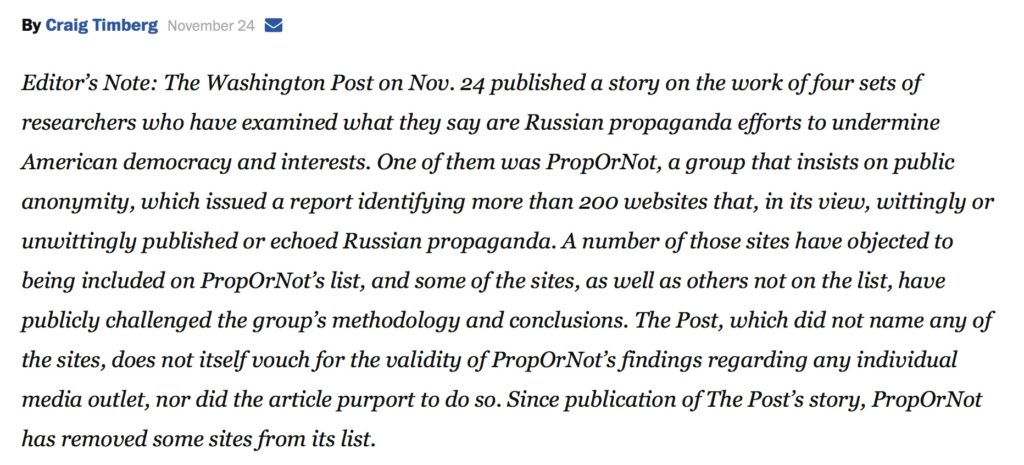
Bezos’ Washington Post recently published a bizarre list of 200 websites it claimed generated Fake News. It refused to identify who gave them the list. Veteran Washington investigative reporter, Wayne Madsen, exposed the source of the McCarthy-style taboo list of so-called Fake News. It was a “website called PropOrNot.com that has links to the CIA and George Soros.”

It’s not merely the Pizzagate revelations that have triggered such a massive attack on independent Internet websites. It seems that back in January 2014 at the Davos World Economic Forum control of information on the Internet was a top item of discussion. At the time, Madsen noted, “With the impending demise of World Wide Web ‘net neutrality,’ which has afforded equal access for website operators to the Internet, the one percent of billionaire investors are busy positioning themselves to take over total control of news reporting on the Internet.”

It’s not even the foxes who are guarding the Internet Henhouse. It’s the werewolves of CIA and US Government censorship. Whether the explosive Pizzagate Podesta revelations merely triggered a dramatic acceleration in the timetable for the CIA’s planned “Fake News” operation as the successor to their 1980’s “Conspiracy Theory” linguistic discrediting operation, it’s clear this is no unbiased, objective, transparent public service to protect the Internet public from harmful content.

And, besides, who are they to tell me or you what you are allowed to read, digest and form your independent ideas about? This is a 21st Century reincarnation of the Spanish Inquisition, one by the real fake newsmakers–Washington Post, AP, ABCNews, Snopes.com, FactCheck.org, the CIA and friends. I would say it’s an alarming development of cyber warfare, not by Russia, but by those CIA-run networks that are fomenting Fake News to demonize any and everyone who opposes Washington intelligence propaganda.


F. William Engdahl is strategic risk consultant and lecturer, he holds a degree in politics from Princeton University and is a best-selling author on oil and geopolitics, exclusively for the online magazine “New Eastern Outlook.” 


‘Then We Will Fight in the Shade’ – A Guide to Winning the Media Wars

screen-shot-2016-12-08-at-9-32-54-am-768x326

By Michael Krieger

Source: Liberty Blitzkrieg

Victorious warriors win first and then go to war, while defeated warriors go to war first and then seek to win.

– Sun Tzu, The Art of War

The ongoing battle between independent, alternative media and legacy corporate-government sponsored propaganda media is in full swing following Donald Trump’s victory in the 2016 election. While I’m no big fan of Trump, his win has so emotionally damaged the U.S. status quo they have begun to lash out in a hysterical and careless manner against those they feel prevented Her Highness, Hillary Clinton, from ascending to the throne.

The escalation of this fight, which I have referred to as “The Media Wars” since the summer, was easy to foresee. As I noted in the post, Questioning Hillary’s Health is No Conspiracy Theory:

As I look at the landscape in 2016 to-date, I observe emergent signs that alternative media is finally beginning to take over from the legacy mainstream media when it comes to impact and influence. The mainstream media (unlike with John McCain in 2008), had decided that Hillary Clinton’s health was not an issue and chose not to pursue it. Many in the alternative media world took a different position, and due to mainstream media’s failure to inform the American public for decades, the alternative media drove that issue to the top of the news cycle. That’s power.

This is an incredibly big deal, and the mainstream media intuitively knows what it means. It means a total loss of legitimately, prestige and power. All of which is well deserved of course.

So here’s the bottom line. 2016 represents the true beginning of what I would call the Media Wars. Alternative media is now capable of driving the news cycle. Mainstream media now has no choice but to fight back, and fight back it will. It will fight back dirty. This is going to get very ugly, but by the time the dust has settled, I think much of the mainstream media will be left as a shell of its former self.

2016 was the year when alternative, independent media went from being merely influential, to affecting the outcome of a Presidential election. As was widely reported, basically every single newspaper in the nation endorsed Hillary Clinton for President. The fact she lost anyway represented the greatest middle finger to the media (and the status quo generally) doled out by the American public in at least a generation.

While genuinely fake Macedonia-based news sites certainly garnered a lot of clicks (and revenue) by inventing ridiculous stories, anyone who really thinks this is what led to Hillary’s defeat is simply in denial. We all know that independent websites taking Hillary to task on her very real and very deplorable track record of being a compulsive liar is what was truly decisive. The mainstream media knows this, which is why they haven’t actually been focusing on censoring provably fake news sites, but rather have been promoting an agenda to lump any non-establishment perspectives within the umbrella of “fake news” in order to destroy their competition and regain an upper hand in the national narrative. If those of us who value independent media want to thwart this nefarious plan, we need to fully understand what these cretins are up to.

To that end, I want to turn your attention to one of the best articles I’ve read on the topic. Published at Counterpunch and titled, Manufacturing Normality, here are a few excerpts (definitely make sure to read the entire thing):

Sometime circa mid-November, in the wake of Hillary Clinton’s defeat (i.e., the beginning of the end of democracy), the self-appointed Guardians of Reality, better known as the corporate media, launched a worldwide marketing campaign against the evil and perfidious scourge of “fake news.” This campaign is now at a fever pitch. Media outlets throughout the empire are pumping out daily dire warnings of the imminent, existential threat to our freedom posed by the “fake news” menace. This isn’t the just the dissemination of disinformation, propaganda, and so on, that’s been going on for thousands of years … Truth itself is under attack. The very foundations of Reality are shaking.

Who’s behind this “fake news” menace? Well, Putin, naturally, but not just Putin. It appears to be the work of a vast conspiracy of virulent anti-establishment types, ultra-alt-rightists, ultra-leftists, libertarian retirees, armchair socialists, Sandernistas, Corbynistas, ontological terrorists, fascism normalizers, poorly educated anti-Globalism freaks, and just garden variety Clinton-haters.

As I suggested in these pages previously, what we are experiencing is the pathologization (or the “abnormalization”) of political dissent, i.e., the systematic stigmatization of any and all forms of non-compliance with neoliberal consensus reality. Political distinctions like “left” and “right” are disappearing, and are being replaced by imponderable distinctions like “normal” and “abnormal,” “true” and “false,” and “real” and “fake.” Such distinctions do not lend themselves to argument. They are proffered to us as axiomatic truths, empirical facts which no normal person would ever dream of contradicting.

In place of competing political philosophies, the neoliberal intelligentsia is substituting a simpler choice, “normality” or “abnormality.” The nature of the “abnormality” varies according to what is being stigmatized. Today it’s “Corbyn the anti-Semite,” tomorrow it’s “Sanders the racist crackpot,” or “Trump the Manchurian candidate,” or whatever. That the smears themselves are indiscriminate (and, in many instances, totally ridiculous) belies the effectiveness of the broader strategy, which is simply to abnormalize the target and whatever he or she represents. It makes no difference whether one is smeared as a racist, as Sanders was during the primaries, or as an anti-Semite, as Corbyn has been, or a fascist, as Trump has relentlessly been, or peddlers of Russian propaganda, as Truthout, CounterPunch, Naked Capitalism, and a number of other publications have been … the message is, they are somehow “not normal.”

Why is this any different from the shameless smear jobs the press has been doing on people since the invention of the press and shameless smear jobs? Well, hold on, because I’m about to tell you. Mostly it has to do with words, especially binary oppositions like “real” and “fake,” and “normal” and “abnormal,” which are, of course, essentially meaningless … their value being purely tactical. Which is to say they denote nothing. They are weapons deployed by a dominant group to enforce conformity to its consensus reality. This is how they’re being used at the moment.

The meaningless binary oppositions that the neoliberal intelligentsia and the corporate media are supplanting traditional opposing political philosophies with (i.e., normal/abnormal, real/fake), in addition to stigmatizing a diversity of sources of non-conforming information and ideas, are also restructuring our consensus reality as a conceptual territory in which anyone thinking, writing, or speaking outside the mainstream is deemed some kind of “deviant,” or “extremist,” or some other form of social pariah. Again, it doesn’t matter what kind, as “deviance” in itself is the point.

Actually, the opposite of deviance is the point. Because this is how “normality” is manufactured. And how consensus reality as a whole is manufactured … and how the manufacturing process is concealed.

The above hits the nails entirely on the head. It also explains why it took the Washington Post two weeks to even address the fact that it published a fake news article about “fake news.” Here’s how The Washington Post is “taking responsibility.”

screen-shot-2016-12-08-at-10-30-16-am

While absolutely pathetic, the editor’s note is equally telling in its sloppiness and arrogance. For instance, the article was a such a gross piece of journalistic malpractice, the only honest, professional move by the paper would be to fully retract the story and apologize; yet The Washington Post didn’t do that. Why?

The reason is because the paper and its editors knew exactly what they were doing with the publication and promotion of this nonsensical fake news hit-piece. Sure, they’re now a bit embarrassed because they were called out by pretty much everybody, but the intent all along was to tie independent media sites with absolutely no connection to Russia, to Russia, in a desperate attempt to recapture the public narrative via blacklists and tech company censorship.

As an aside, for specifics on how the status quo is attempting to use developers and social media companies to censor alternative opinion under the guise of fighting “fake news,” read this excellent article published at Naked Capitalism: Witch Hunt: “Fake News” Software Touted by CBS Smears Naked Capitalism, ShadowProof, TruthDig, Others; Creator Admits He Made Up Who Went on Hit List.

Now that we know what they are up to, how worried should we be? Although I’m extremely optimistic about the future of decentralized, independent media, and the proliferation of individual voices generally, it’s quite obvious legacy media gatekeepers will not go down without a fight. The good news is they are the ones who are on the defensive, not us. They are the ones who are battling on our terms, not the other way around. A great example of this can be seen in how the “fake news” meme has been turned around against the mainstream media to great effect. As I tweeted earlier today:

It is when you get desperate, scared and panicky that you make the biggest mistakes, and the legacy media is currently desperate, scared and panicky.  As Napoleon Bonaparte allegedly said:

“Never interrupt your enemy when he is making a mistake.”

Whether or not he actually said them, those words still ring true. We mustn’t get in the way of the legacy media’s inevitable self-destruction. Part of this means that we do not self-destruct in the process. We need to recognize that there’s a reason independent, alternative media is winning the battle of ideas in the first place. For all the warts, mistakes and bad actors, the emergence of the internet is indeed the historical equivalent of the invention of the printing press on steroids.

Only a clueless self-important elitist actually believes that the smartest, most informed people in America are the pundits on tv and the journalists employed by the mainstream media. With a handful of companies and a few oligarchs in charge, you’d have to be the most naive fool on earth to not understand that legacy media is driven by well defined narratives, and that these narratives are not in your best interest. The rest of us understand that the Internet has served as a much needed countervailing force, and has been an incredible blessing to human knowledge, connectivity and the marketplace of ideas. Just because some people can’t distinguish truth from fiction, doesn’t negate the incredible progress that decentralized information dissemination provides. It is only those who do not wish to engage in public debate on the issues themselves who want to censor stuff. The rest of us are more than happy to have an open discussion.

Many of us have spent years, if not decades, building up our online reputations and we should be careful not to squander all we have gained. There will be attempts at co-option, explicitly and otherwise. Be on guard. There will be hit-pieces and smear attempts. Stay cool and fight back from a position of strength and calm. However, I believe the greatest threat comes from the ever present danger of self-inflicted error. Part of the reason independent, alternative media has been so successful is legacy media has made it easy to look good by being so obviously captured, puerile and propagandistic. We must continue to be better than they are. As such, we must be more honest in our actions, less hypocritical in our analysis of events, and just more ethical overall. Given the competition, this shouldn’t be difficult.

Another way the status quo will fight back is by attacking our means of surviving financially, which means readers must be prepared to donate to your favorite sites more than ever before (you can support Liberty Blitzkrieg here). The other way will be to prevent our content from appearing on social media sites or search engines, or when it does appear, it will come with a warning. If this is the tactic they choose, it’ll be relatively easy to fight back.

Ten years ago it would’ve been hard to counter such a strategy, but not today. The cat is simply too far out of the bag. Too many of us reach too many people, and many of the people we reach are smart and influential. We have already sufficiently infiltrated and influenced the public discourse, so denying us a voice is no longer an option. If Facebook or Google start presenting Liberty Blitzkrieg, Zerohedge, or Naked Capitalism with warning labels, the intelligent amongst us with see right through this tactic and become disgusted.

So let me end this with a warning to Facebook, Google, and all the other tech behemoths. You start this fight at your own risk. Any disingenuous attempt to smear genuine, independent media websites via blacklists and censorship will ultimately harm you more than it harms us. In a misguided attempt to destroy us, you will destroy yourselves. Tread carefully and be on the right side of history.

To everyone else, stay strong. My writing would be irrelevant without you. It is not alternative media writers who will inflict the final blow against legacy media, it will be you, the readers. We are in this together and dependent on each other. Together we will win.

For related articles, see:

Obama Enters the Media Wars – Why His Recent Attack on Free Speech is So Dangerous and Radical

Hillary Clinton Enters the Media Wars

The Death of Mainstream Media

Liberty Blitzkrieg Included on Washington Post Highlighted Hit List of “Russian Propaganda” Websites

Additional Thoughts on “Fake News,” The Washington Post, and the Absence of Real Journalism

If you enjoyed this post, and want to contribute to genuine, independent media, consider visiting Liberty Blitzkrieg’s Support Page.

In Liberty,
Michael Krieger

The Second Phase of the propaganda Fake News War: Economic Strangulation. What Comes Next?

index

Frustrated and outraged at how reality has turned out, the ruling class denizens of Hillary Clinton’s failed presidential tent are lashing out at truth-tellers. “Fake news” is whatever contradicts their lies, and Russia is their all-purpose boogeyman. “Google and Facebook have joined theri corporate media compatriots in an attempt to limit the public’s access to alternative news analysis and independent investigative reporting.”

By Dr. Marsha Adebayo

Source: Black Agenda Report

The public has determined that the corporate media is actually the purveyor of “fake news” and turned to media organizations, such as BAR, Truthout and other outlets for information.”

Within the last 14 days, two phases of the “fake news” strategy has been rolled out for public consumption.  Phase I of the fake news strategy was to demonize news organizations, such as Black Agenda Report (BAR) through McCarthy-era red-baiting and intimidation that included government officials pondering whether the FBI should investigate alternative media on “the list” or hinting that such organizations could be subject to legal prosecution under foreign espionage laws.  The corporate media’s thinly veiled intimidation tactics are intended to depress readership of “fake” news organizations and to link these media outlets with an alleged Russian strategy to elect Donald Trump president of the US.

Corporate media gatekeepers determine which stories are labeled fake news dependent upon which stories serve US foreign and domestic interests and which stories expose US corruption. The corporate media obsession with “fake news” would be laughable if not for the individuals committed to truth-telling who will be sacrificed in the process. Where was the corporate news obsession with fake news when Secretary of State (General) Colin Powell beat the war drums for America’s war adventures in Iraq based on fictitious intelligence that Iraq had weapons of mass destruction?

However, anyone familiar with duopoly propaganda strategy against progressive news organizations would expect an escalation in their intimidation tactics. A covert strategy that would move from a campaign of mere words to direct and consequential actions with corporate coalition members poised to play their part.  Phase 2 of this strategy would exact a higher cost to the intended progressive media targets and by extension to their supporters.

This week, it was revealed that the escalation to Phase 2 will be economic sanctions or economic strangulation. This will be the pressure point in an attempt to force progressive news organizations to heel.  Two of the largest internet companies have joined their counterparts in government to squeeze legitimate investigative reporting into compliance.

Google was the first media giant to announce that it would ban websites that “peddle fake news” from using its online advertising service. In other words, media organizations, such as BAR, Truthout, Truthdig, etc could no longer advertise on Google in order to reach a larger audience or raise funds.

Hours later, Facebook, the social network, updated its policy and announced that “it will not display ads in sites that contains content considered by the duopoly as “fake news” according to corporate news gatekeepers.

The Facebook statement asserted:

“We have updated the policy to explicitly clarify that this applies to fake news…Our team will continue to closely vet all prospective publishers and monitor existing ones to ensure compliance.”

What was “explicitly” clear was that Google and Facebook have joined their corporate media compatriots in an attempt to limit the public’s access to alternative news analysis and independent investigative reporting.

The bait and switch corporate media/government strategy recognizes that the public no longer trusts corporate media, such as the Washington Post and New York Times, to investigate government corruption. There is a growing public recognition that a conflict of interest exists between corporate media investigating government since these two groups are inextricably linked by class and economic interests.  The public has determined that the corporate media is actually the purveyor of “fake news” and turned to media organizations, such as BAR, Truthout and other outlets for information.

This is not the first time corporate power has joined with the political duopoly to undermine the media’s ability to engage in truth-telling.  Julian Assange accused right-wing US politicians of imposing a “death penalty’ on WikiLeaks after major US credit cards blocked its card holders from making contributions to the organization. Assange asserted that six US payment firms blocked WikiLeaks from receiving contributions at a cost of £30 million.

Visa and Mastercard started the financial stranglehold after WikiLleaks published some 250,000 secret State Department cables in December 2010.  WikiLeaks presented documents that proved these financial decisions were made at the instigation of “right-wing” members of Congress. This attack against WikiLeaks forced the staff to take a 40% pay cut.  However, the financial “war” was just the beginning. The unforeseen Phase III of this attack would eventually find Assange and Chelsea Manning incarcerated; Assange taking refuge in an Ecuadorian Embassy in London and Manning sentenced to serve time at Ft. Leavenworth in Kansas.

This is the time to support BAR, Truthout and other progressive media organizations under attack by forces that attempt to obfuscate and distort US domestic and foreign policy. Frederick Douglass during his 1857 address on “West India Emancipation” at Canandaigua, New York, on the 23rd anniversary of the event said:

“The general sentiment of mankind is that a man who will not fight for himself, when he has the means of doing so, is not worth being fought for by others, and this sentiment is just. For a man who does not value freedom for himself will never value it for others, or put himself to any inconvenience to gain it for others.”

Phases I and II forebode a challenging Phase III for truth-tellers in the current iteration of a corporate “fake news” strategy.  This is our time to fight for press freedom and the right to blow the whistle on government corruption. The future of our families and our planet depend on our uncompromising passion for justice.

Dr. Marsha Adebayo is the author of the Pulitzer Prize nominated: No FEAR: A Whistleblowers Triumph over Corruption and Retaliation at the EPA. She worked at the EPA for 18 years and blew the whistle on a US multinational corporation that endangered South African vanadium mine workers. Marsha’s successful lawsuit led to the introduction and passage of the first civil rights and whistleblower law of the 21st century: the Notification of Federal Employees Anti-discrimination and Retaliation Act of 2002 (No FEAR Act). She is Director of Transparency and Accountability for the Green Shadow Cabinet and serves on the Advisory Board of ExposeFacts.com.


Related Video: