We Have Met the Alien and He Is Us

73e633dab43437b78c926c0403c06bcc

By William Astore

Source: TomDispatch.com

We Are The Empire
Of U.S. Military Interventions, Alien Disaster Movies, and Star Wars
By William J. Astore

Perhaps you’ve heard the expression: “We have met the enemy and he is us.” Cartoonist Walt Kelly’s famed possum, Pogo, first uttered that cry. In light of alien disaster movies like the recent sequel Independence Day: Resurgence and America’s disastrous wars of the twenty-first century, I’d like to suggest a slight change in that classic phrase: we have met the alien and he is us.

Allow me to explain. I grew up reading and watching science fiction with a fascination that bordered on passion. In my youth, I also felt great admiration for the high-tech, futuristic nature of the U.S. military. When it came time for college, I majored in mechanical engineering and joined the U.S. Air Force. On graduating, I would immediately be assigned to one of the more high-tech, sci-fi-like (not to say apocalyptic) military settings possible: Air Force Space Command’s Cheyenne Mountain.

For those of you who don’t remember the looming, end-of-everything atmosphere of the Cold War era, Cheyenne Mountain was a nuclear missile command center tunneled out of solid granite inside an actual mountain in Colorado. In those days, I saw myself as one of the good guys, protecting America from “alien” invasions and the potential nuclear obliteration of the country at the hands of godless communists from the Soviet Union. The year was 1985 and back then my idea of an “alien” invasion movie was Red Dawn, a film in which the Soviets and their Cuban allies invade the U.S., only to be turned back by a group of wolverine-like all-American teen rebels. (Think: the Vietcong, American-style, since the Vietnam War was then just a decade past.)

Strange to say, though, as I progressed through the military, I found myself growing increasingly uneasy about my good-guy stature and about who exactly was doing what to whom. Why, for example, did we invade Iraq in 2003 when that country had nothing to do with the attacks of 9/11? Why were we so focused on dominating the Earth’s resources, especially its oil? Why, after declaring total victory over the “alien” commies in 1991 and putting the Cold War to bed for forever (or so it seemed then), did our military continue to strive for “global reach, global power” and what, with no sense of overreach or irony, it liked to call “full-spectrum dominance”?

Still, whatever was simmering away inside me, only when I retired from the Air Force in 2005 did I fully face what had been staring back at me all those years: I had met the alien, and he was me.

The Alien Nature of U.S. Military Interventions

The latest Independence Day movie, despite earning disastrous reviews, is probably still rumbling its way through a multiplex near you. The basic plot hasn’t changed: ruthless aliens from afar (yet again) invade, seeking to exploit our precious planet while annihilating humanity (something that, to the best of our knowledge, only we are actually capable of). But we humans, in such movies as in reality, are a resilient lot. Enough of the plucky and the lucky emerge from the rubble to organize a counterattack. Despite being outclassed by the aliens’ shockingly superior technology and awe-inspiring arsenal of firepower, humanity finds a way to save the Earth while — you won’t be surprised to know — thoroughly thrashing said aliens.

Remember the original Independence Day from two decades ago? Derivative and predictable it may have been, but it was also a campy spectacle — with Will Smith’s cigar-chomping military pilot, Bill Pullman’s kickass president in a cockpit, and the White House being blown to smithereens by those aliens. That was 1996. The Soviet Union was half-a-decade gone and the U.S. was the planet’s “sole superpower.” Still, who knew that seven years later, on the deck of an aircraft carrier, an all-too-real American president would climb out of a similar cockpit in a flight suit, having essentially just blown part of the Middle East to smithereens, and declare his very own “mission accomplished” moment?

In the aftermath of the invasion of Afghanistan and the “shock and awe” assault on Iraq, the never-ending destructiveness of the wars that followed, coupled with the U.S. government’s deployment of deadly robotic drones and special ops units across the globe, alien invasion movies aren’t — at least for me — the campy fun they once were, and not just because the latest of them is louder, dumber, and more cliché-ridden than ever. I suspect that there’s something else at work as well, something that’s barely risen to consciousness here: in these years, we’ve morphed into the planet’s invading aliens.

Think about it. Over the last half-century, whenever and wherever the U.S. military “deploys,” often to underdeveloped towns and villages in places like Vietnam, Afghanistan, or Iraq, it arrives very much in the spirit of those sci-fi aliens. After all, it brings with it dazzlingly destructive futuristic weaponry and high-tech gadgetry of all sorts (known in the military as “force-multipliers”). It then proceeds to build mothership-style bases that are often like American small towns plopped down in a new environment. Nowadays in such lands, American drones patrol the skies (think: the Terminator films), blast walls accented with razor wire and klieg lights provide “force protection” on the ground, and the usual attack helicopters, combat jets, and gunships hover overhead like so many alien craft. To designate targets to wipe out, U.S. forces even use lasers!

In the field, American military officers emerge from high-tech vehicles to bark out commands in a harsh “alien” tongue. (You know: English.) Even as American leaders offer reassuring words to the natives (and to the public in “the homeland”) about the U.S. military being a force for human liberation, the message couldn’t be more unmistakable if you happen to be living in such countries: the “aliens” are here, and they’re planning to take control, weapons loaded and ready to fire.

Other U.S. military officers have noticed this dynamic. In 2004, near Samarra in Iraq’s Salahuddin province, for instance, then-Major Guy Parmeter recalled asking a farmer if he’d “seen any foreign fighters” about. The farmer’s reply was as simple as it was telling: “Yes, you.” Parmeter noted, “You have a bunch of epiphanies over the course of your experience here [in Iraq], and it made me think: How are we perceived, who are we to them?”

Americans may see themselves as liberators, but to the Iraqis and so many other peoples Washington has targeted with its drones, jets, and high-tech weaponry, we are the invaders.

Do you recall what the aliens were after in the first Independence Day movie? Resources. In that film, they were compared to locusts, traveling from planet to planet, stripping them of their valuables while killing their inhabitants. These days, that narrative should sound a lot less alien to us. After all, would Washington have committed itself quite so fully to the Greater Middle East if it hadn’t possessed all that oil so vital to our consumption-driven way of life? That’s what the Carter Doctrine of 1980 was about: it defined the Persian Gulf as a U.S. “vital interest” precisely because, to quote former Deputy Secretary of Defense Paul Wolfowitz’s apt description of Iraq, it “floats on a sea of oil.”

Of Cold War Memories and Imperial Storm Troopers

Whether anyone notices or not, alien invasion flicks offer a telling analogy when it comes to the destructive reality of Washington’s global ambitions; so, too, do “space operas” like Star Wars. I’m a fan of George Lucas’s original trilogy, which appeared in my formative years. When I saw them in the midst of the Cold War, I never doubted that Darth Vader’s authoritarian Empire in a galaxy far, far away was the Soviet Union. Weren’t the Soviets, whom President Ronald Reagan would dub “the evil empire,” bent on imperial domination? Didn’t they have the equivalent of storm troopers, and wasn’t it our job to “contain” that threat?

Like most young Americans then, I saw myself as a plucky rebel, a mixture of the free-wheeling, wisecracking Han Solo and the fresh-faced, idealistic Luke Skywalker. Of course, George Lucas had a darker, more complex vision in mind, one in which President Richard Nixon, not some sclerotic Soviet premier, provided a model for the power-mad emperor, while the lovable Ewoks in The Return of the Jedi — with their simple if effective weaponry and their anti-imperial insurgent tactics — were clearly meant to evoke Vietnamese resistance forces in an American war that Lucas had loathed. But few enough Americans of the Cold War-era thought in such terms. (I didn’t.) It went without question that we weren’t the heartless evil empire. We were the Jedi! And metaphorically speaking, weren’t we the ones who, in the end, blew up the Soviet Death Star and won the Cold War?

How, then, did an increasingly gargantuan Pentagon become the Death Star of our moment? We even had our own Darth Vader in Dick Cheney, a vice president who actually took pride in the comparison.

Think for a moment, dear reader, about the optics of a typical twenty-first-century U.S. military intervention. As our troops deploy to places that for most Americans might as well be in a galaxy far, far away, with all their depersonalizing body armor and high-tech weaponry, they certainly have the look of imperial storm troopers.

I’m hardly the first person to notice this. As Iraq war veteran Roy Scranton recently wrote in the New York Times, “I was the faceless storm trooper, and the scrappy rebels were the Iraqis.” Ouch.

American troops in that country often moved about in huge MRAPs (mine-resistant, ambush-protected vehicles) described to me by an Army battalion commander as “ungainly” and “un-soldier like.” Along with M1 Abrams tanks and Bradley fighting vehicles, those MRAPs were the American equivalents of the Imperial Walkers in Star Wars. Such vehicles, my battalion commander friend noted drolly, were “not conducive to social engagements with Iraqis.”

It’s not the fault of the individual American soldier that, in these years, he’s been outfitted like a Star Wars storm trooper. His equipment is designed to be rugged and redundant, meaning difficult to break, but it comes at a cost. In Iraq, U.S. troops were often encased in 80 to 100 pounds of equipment, including a rifle, body armor, helmet, ammunition, water, radio, batteries, and night-vision goggles. And, light as they are, let’s not forget the ominous dark sunglasses meant to dim the glare of Iraq’s foreign sun.

Now, think how that soldier appeared to ordinary Iraqis — or Afghans, Yemenis, Libyans, or almost any other non-Western people. Wouldn’t he or she seem both intimidating and foreign, indeed, hostile and “alien,” especially while pointing a rifle at you and jabbering away in a foreign tongue? Of course, in Star Wars terms, it went both ways in Iraq. A colleague told me that during her time there, she heard American troops refer to Iraqis as “sand people,” the vicious desert raiders and scavengers of Star Wars. If “they” seem like vicious aliens to us, should we be surprised that we just might seem that way to them?

Meanwhile, consider the American enemy, whether the Taliban, al-Qaeda, or any of our other opponents of this era. Typically unburdened by heavy armor and loads of equipment, they move around in small bands, improvising as they go. Such “terrorists” — or “freedom fighters,” take your pick — more closely resemble (optically, at least) the plucky human survivors of Independence Day or the ragtag yet determined rebels of Star Wars than heavy patrols of U.S. troops do.

Now, think of the typical U.S. military response to the nimbleness and speed of such “rebels.” It usually involves deploying yet more and bigger technologies. The U.S. has even sent its version of Imperial Star Destroyers (we call them B-52s) to Syria and Iraq to take out “rebels” riding their version of Star Wars “speeders” (i.e. Toyota trucks).

To navigate and negotiate the complex “human terrain” (actual U.S. Army term) of “planets” like Iraq and Afghanistan, U.S. troops call on a range of space-age technologies, including direction-finding equipment, signal intercept, terrain modeling, and satellite navigation using GPS. The enemy, being part of that “human terrain,” has little need for such technology to “master” it. Since understanding alien cultures and their peculiar “human terrains” is not its forte, the U.S. military has been known to hire anthropologists to help it try to grasp the strange behaviors of the peoples of Planet Iraq and Planet Afghanistan.

Yet unlike the evil empire of Star Wars or the ruthless aliens of Independence Day, the U.S. military never claimed to be seeking total control (or destruction) of the lands it invaded, nor did it claim to desire the total annihilation of their populations (unless you count the “carpet bombing” fantasies of wannabe Sith Lord Ted Cruz). Instead, it promised to leave quickly once its liberating mission was accomplished, taking its troops, attack craft, and motherships with it.

After 15 years and counting on Planet Afghanistan and 13 on Planet Iraq, tell me again how those promises have played out.

In a Galaxy Far, Far Away

Consider it an irony of alien disaster movies that they manage to critique U.S. military ambitions vis-à-vis the “primitive” natives of far-off lands (even if none of us and few of the filmmakers know it). Like it or not, as the world’s sole superpower, dependent on advanced technology to implement its global ambitions, the U.S. provides a remarkably good model for the imperial and imperious aliens of our screen life.

We Americans, proud denizens of the land of the gun and of the only superpower left standing, don’t, of course, want to think of ourselves as aliens. Who does? We go to movies like Independence Day or Star Wars to identify with the outgunned rebels. Evidence to the contrary, we still think of ourselves as the underdogs, the rebels, the liberators. And so — I still believe — we once were, a long time ago in a galaxy far, far away.

We need to get back to that time and that galaxy. But we don’t need a high-tech time machine or sci-fi wormhole to do so. Instead, we need to take a long hard look at ourselves. Like Pogo, we need to be willing to see the evidence of our own invasive nature. Only then can we begin to become the kind of land we say we want to be.


A TomDispatch regular, William Astore is a retired lieutenant colonel (USAF) and history professor. He blogs at Bracing Views.

Future Crimes

precrime-777x437

By John Steppling

Source: CounterPunch

“Precrime Analytical Wing: Contains the precognitives and the machinery needed to hear and analyze their predictions of future crimes.”

Philip K. Dick, Minority Report

“I must confess that over the past few years I have been gravely disappointed with the white moderate. I have almost reached the regrettable conclusion that the Negro’s great stumbling block in his stride toward freedom is not the White Citizen’s Counciler or the Ku Klux Klanner, but the white moderate, who is more devoted to “order” than to justice; who prefers a negative peace which is the absence of tension to a positive peace which is the presence of justice…”

Martin Luther King

“The intellectuals are the dominant group’s ‘deputies,’ exercising the subaltern functions of social hegemony and political government”.

Gramsci

There was a jaw dropping but not unexpected article at The Guardian this week. It was actually part of a series of pieces at that paper that have sought to manufacture a legacy for Obama, the outgoing president, since his actual legacy is one of imperialist foreign policy, CIA support of jihadists, right wing coups, and most acutely, perhaps, a massive subverting of free speech and civil liberties. What Robert Parry has called a ‘war on dissent’. The Guardian piece took the form of asking novelists, public intellectuals {sic} and TV hacks what they perceived to be Obama’s legacy — and even the use of that word, *legacy* is a loaded indicator of the direction this piece was headed. What struck me most was not the predictable support for Obama policy (more on that later) but the utter banality of the writing. There were writers in this group who I have admired (Richard Ford for one, Marilynne Robinson, as well) but the sentiments were so stupefyingly superficial, so fatuous and fawning that it was hard not to see this as a kind of mini referendum on the state of Western culture.

Joyce Carol Oates (for whom ten words is usually better than the right word) described Obama as…“Brilliant and understated, urbane, witty, compassionate, composed..”. Siri Hutsvedt (who honestly I had to look up…finding her most notable achievement was being married to Paul Auster) wrote…“For eight years, we have been represented by an elegant, well-spoken, funny, highly educated, moderate, morally upright, preternaturally calm black man”. Richard Ford wrote…“This cold morning, when I think about Obama, immersed in what must be a decidedly mixed brew of emotions – mixed about his deeds, mixed about his effects on the US, decidedly mixed about our future – I’m confident he is thinking, right to his last minute in the office, as the president, and not much about, or for, himself. That’s what I expected when I voted for him – that he’d be a responsible public servant who’d try to look out for the entire country.” I know, I know, but that’s what he wrote. Look it up if you don’t believe me. Perhaps this is what a career of University teaching does to one. Edmund White called him one of our great presidents (love the use of *our*).

Jane Smiley, who at the least mentioned TPP and drones, but ended with…“As a national leader, he has engendered more chaos, but it is necessary chaos – a loud and meaningful return to the question of what constitutes the real America.” A necessary chaos? The fuck does that mean? I ask that sincerely, sort of. By the time I reached the end of this saccharine mind numbing bathos I thought back to the 1968 Democratic Convention and to Esquire Magazine, in its golden era, who sent William Burroughs, Jean Genet, Terry Southern and John Sack to cover the convention. I thought back to Robert Bly and his organizing of Writers against the Vietnam war. The readings he gave with Galway Kinnell and Ginsburg, and a dozen others. And to the way Bly spoke of art and the role of art in a society. In an interview with Michael Ventura, around the time of the Iraq invasion…

Bly:I don’t think we believe that a Great Mother is lying to us. It’s a father who’s lying to us. Thee whole system, in a way, is a father system.Ventura: It’s a patriarchy, so it’s a father who’s lying.Bly: Exactly. And we eventually get the sense that our ownfather is lying to us. { } Whenever you have a culture completely run by grosscapitalism, all of the gods are driven away. Well, then what?What does that mean when those gods are not present?

Later Bly says…

“When I talk about the world being mad, I tell people,“You won’t believe how bad television is going to be in ten years.You’re going to literally have to protect your children from it.”And we’re not going to be able to change that. The only thingwe can do is recognize that it’s mad, and reach inside ourselvesand bring out our own genuine madness in the form of art,and then teach our children to do the same.”

In 68, a corporate owned magazine, and hardly a socialist magazine, thought it reasonable to ask Genet or Burroughs to discuss a political convention. I mean even Norman Mailer wrote intelligently on Kennedy for Esquire, and Mailer isn’t exactly Gramsci. My point is, or I hope my first point, is that it is not always crucial to demand ideological analysis. For art’s radical nature is outside ideology. Just speaking from a radical perspective, an anti bourgeois perspective, can be enough. But in 1968 the U.S. still had artists. What artist could you invite today? What public intellectual? The Guardian picked Sarah Churchwell (who again, I’d never heard of) who wrote…

“The Obamas changed the rules for what it means to inhabit the White House, and not only because they were the first black family to do so. They were also the first modern family to do so, to be informal yet classy, upright yet kind, and, most important, themselves.”

That’s it then, just be yourself. But the lesson here, if there is one, is that the radical tradition in American life has been rendered invisible. Just as the history of labor and unions and strikes has been erased. There are plenty of great artists out there, actually. Tons of intellectuals, but they aren’t invited by corporate media. Was anyone from Black Agenda Report asked to comment? Or from, well, CounterPunch? Was Harry Belefonte asked? The manufacturing of an image of a culture, rather than an actual culture, is what organs of disinformation such as The Guardian are in the business of doing. And this is also what Hollywood does, of course. Look at the stuff that gets on in the flagship theatres of the U.S. What is the season at Lincoln Center? Does it matter? No, it really doesn’t. And running across all of this discussion is the question of class. In fact, that may be the most important aspect in all of this. The working class voice is erased. In total. And this is hugely significant. Even fifty years ago the stages of American theatres were filled by work from playwrights who did not have MFAs. Novels were written by criminals and outsiders. This is no less true, really, in the U.K. From Brendan Behan to Martin Amis is the road travelled. Now of course one can site exceptions to this, I think anyway. There are always celebrity outsiders, branded renegades. Usually this takes the form of a confessional. My time on oxycodone while writing Sit Coms. I was a teenage prostitute and was addicted to anti depressants, but then I found a higher power. But god forbid you express condemnation of the bourgeoisie. For that is the greatest of all crimes.

When I worked in Hollywood, I felt the class estrangement acutely. But I did get work and had some modest success. And I remember when a major cable producer of the era asked me, during a pitch meeting, for the names of writers I thought would be good to employ for an anthology series they wanted to put together. I said, well, Iceberg Slim (Robert Beck) and John Rechy. A silence fell on the room. I was very very naive. Hollywood today seems infested with lawyers, former political interns, and business school graduates. Most from Ivy league schools. And the world that is manufactured is one that reflects their class. And the effect this has had is to alienate the younger artists who do not come from affluent backgrounds. It has also normalized the a vision of the world that belongs to perhaps ten per cent of the population. The rest are strangers in their own land. Strangers to the official sanctioned culture. And in that sense, Hollywood has sort of merged with Madison Avenue.

The class divide is being starkly revealed this last few months. And it has also served to put in stark relief the real impetus of U.S. foreign policy (and to domestic policy, too, only not as drastically). After WW2 and the formation of the CIA, the shaping of a political intention was being finalized. This came from George Kennan and the Dulles Brothers. And Henry Kissinger was the premier exemplar of this thinking. Kissinger, who supported the Shah and his death squads in Iran, and chaired the Presidential Commission on Central America in the 1980s,(employing Ollie North) and which unleashed an unimaginable terror on that region, and who orchestrated the Pinochet coup in Chile to protect ITT and, as a side bar, to teach a lesson to any government not readily obedient. This has been the seamless and never changing foreign policy of the U.S. for seventy some years. Punish the disobedient (meaning anything smacking of socialism or any nation even the tiniest bit resistant to Western business) and to continue toward global hegemony, and at the same time perpetuating conflicts which make both defense contractors and giant service providers such as Halliburton a lot of money.

The U.S. has cultivated compliant nations (Australia, the U.K. most notably) to enforce its policy (think East Timor, Iraq and Libya et al) and now owns a complient organization with international standing: NATO. And NATO serves as a legitimizing international (sic) institution of pacification.

John Pilger writes…

“The other day, an Indonesian friend took me to his primary school where, in October 1965, his teacher was beaten to death, suspected of being a communist.
The murder was typical of the slaughter of more than a million people: teachers, students, civil servants, peasants. Described by the CIA as “one of the worst mass murders of the 20th century”, it brought to power the dictator Suharto, the west’s man. Within a year of the bloodbath, Indonesia’s economy was redesigned in America, giving western capital access to vast mineral wealth, markets and cheap labour. “

Stephan Gowans writes…

“The United States had waged a long war against Syria from the very moment the country’s fiercely independent Arab nationalist movement came to power in 1963. Assad and his father Hafez al-Assad were committed to that movement. Washington sought to purge Arab nationalist influence from the Syrian state and the Arab world more broadly. It was a threat to Washington’s agenda of establishing global primacy and promoting business-friendly investment climates for US banks, investors and corporations throughout the world.”

The rise of the neo cons, which rather officially began with Project for a New American Century (just prior to Bush Jr’s presidency) was really just an extension of that original plan for global domination. At that time this was articulated by a seething nearly hysterical hatred of the Soviet Union. And the structural aspect of this remains in place with today’s rabid and massive propaganda campaign directed at Putin. And indeed even on the left one hears the echoes of a Russophobic sensibility. It is as if these faux leftists can not allow a critique of U.S. imperialism (in Syria for example) without off handedly smearing Russia, too. One need only look at who is surrounding whom with military bases. And the same holds true, with slightly less hysteria, for China.

In 2012 Ed Herman, speaking in a radio interview, said

“…humanitarian intervention {has} been used strictly for the interests of the United States and other Western powers and Israel. Strictly. So there’s no intervention in Saudi Arabia or Israel or Yemen or Bahrain. There was none in Egypt…And there was Egypt, here you had a miserable dictator for decades, and then you had an uprising where a lot of people were being beaten and killed in the streets, and you never had Mrs. Clinton ever asking for any application of humanitarian intervention. Not once. Never. They’re getting away with the most unbelievable double standard imaginable.”

This is, none of it, new. And yet, despite the obvious record of Obama in furthering exactly this world vision, the liberal organs of *real* news continue to paint their revisionist narratives of American heroism and goodness. And it is breathtaking in a way to read this new class of quisling artist, the court eunuchs for the Democratic Party establishment. And Obama’s apparent anger and petulance belies, certainly, descriptions such as ‘preternaturally calm’, and ‘dignified’. But there is a thread of liberal guilt running through this as well. Obama’s race (and his perfect wife and kids — and one longs for Ron Reagan Jr or to go back to James Madison’s son John, and shit, even the Bush girls might be a relief from these Stepford children.) is the psychological glue for a visibly excessive adoration. And this is a white liberal class that is haunted, I suspect, in their heart of hearts, by the knowledge of their own privilege and that that privilege has resulted in oceans of blood, and the knowledge, if they were ever to question themselves, that they would sell out anyone to retain that privilege. They love Obama and Obama is black, therefore…etc.

As Ajamu Baraka noted

“In the face of the Neo-McCarthyism represented by this legislation and the many other repressive moves of the Obama administration to curtail speech and control information — from the increased surveillance of the public to the use of the espionage act to prosecute journalists and whistleblowers — one would reasonably assume that forces on the left would vigorously oppose the normalization of authoritarianism, especially in this period of heightened concerns about neo-fascism.
Unfortunately, the petit-bourgeois “latte left” along with their liberal allies have been in full collaboration with the state for the past eight years, with the predictable result that no such alarm was issued, nor has any critique or even debate been forthcoming.”

The openly Imperialist U.S. state has tortured, illegally kidnapped, and simply murdered both leaders of sovereign states as well as countless innocent victims. That Samantha Power’s motorcade in rushing through a village in Cameroon happened to run over a ten year old boy, and didn’t stop — this barely made the evening news at all (but hey, they did send the family fifteen hundred dollars by way of an apology). They have acted covertly to destabilize governments and have manufactured enemies at a rate that is staggering to contemplate. Obama’s tight relationship with the most odious autocratic and murderous country on earth, Saudi Arabia, speaks to the cynicism of the political elite.

And yet, the artistic communities by and large continue to focus on identity issues (once they have attended to their career moves and spoken with their agents), most of which affect their own class. The dire suffering of the poor makes good voyeuristic source material, but the segregation of classes is enforced zealously. Token exceptions are simply that.

How is it possible to become so alarmed by Trump, while supporting Democrats? Those millions on the street protesting the looming invasion of Iraq must have noticed that every single Democrat in government voted FOR the invasion (save for the honorable Barbara Lee). And yet here they all are wringing their hands in dismay that Hillary lost. Here they are constantly repeating the litanies of Trump evil and never noticing the crimes of earlier democratic presidents and administrations. So, yes Trump’s appointments are awful. But I refuse to even dig into that until a discussion of Obama’s appointments are dissected. First came Rahm Emanuel, former memeber of the IDF, all around thug and bully and lover of never ending war to help expand Israeli power. Penny Pritzker, heiress and elitist and friend to the 1%, or Robert Rubin or Tim Geithner (!!!) or Tom Daschle, the senator from Citibank. I’m just scratching the surface. Joe Biden and Hillary Clinton. The point is that I am coming to feel that almost any focus on Trump feels misplaced. Certainly now it does since he isn’t even president yet. The deconstruction of liberal Obama is far from complete and the propaganda apparatus is working overtime to rewrite not just recent history, but the present. And the anti Russian propaganda is so absurd, so transparent, that this feels far more important than the predictable stupidity of Trump. I mean Obama is massing troops near the Russian border. Obama is ramping up the building of purpose built navel bases near China. Obama is still looking to prosecute Chelsea Manning and every other whistleblower. And he is still signing draconian legislation to curb free speech and institutionalize legitimacy for the new McCarthyism. Talking about Trump is a form of forgetting. I can’t do it. And if there is an easier target for parody or even non parodic narrative than Donald Trump, I havent met them. And easy is never an act of rigorous self examination.

Thomas Bates writes, discussing Gramsci…

“Gramsci retained a skepticism towards these alienated fils de bourgeois, a
skepticism which was not, however, mere prejudice, but was an historical
judgment informed by the experience of the Italian labor movement. How was
one to explain the passing of entire groups of left-wing intellectuals into the
enemy camp? More precisely, how was one to explain the phenomena of socialists
entering into bourgeois governments and of revolutionary syndicalists
entering into the nationalist and then the Fascist movement? Gramsci viewed
these puzzling events as the continuation on a mass scale of the ‘trasformismo’
of the nineteenth century. The “generation gap” within the ruling class had resulted
in a large influx of bourgeois youth into the popular movements, especially
during the turbulent decade of the 1890’s. But in the war-induced crisis
of the Italian State in the early twentieth century, these prodigal children
returned to the fold…”

And Gramsci adds..

“The bourgeoisie fails to educate its youth (struggle of generations). The youth
allow themselves to be culturally attracted by the workers, and right away
they … try to take control of them (in their “unconscious” desire to impose
the hegemony of their own class on the people), but during historical crises
they return to the fold.”

White affluent self identifying liberals believe they are the decision makers. That is their destiny. They believe that. One must build a new culture. Not endlessly ratify a decrepit and atrophying one. One must stop perceiving *liberals* as being on the side of change. For they are not. Guy Debord began his situationist masterpiece (1967) by quoting Feuerbach, Preface to the second edition of The Essence of Christianity:

“But certainly for the present age, which prefers the sign to the thing signified, the copy to the original, representation to reality, the appearance to the essence… illusion only is sacred, truth profane. Nay, sacredness is held to be enhanced in proportion as truth decreases and illusion increases, so that the highest degree of illusion comes to be the highest degree of sacredness. “


John Steppling is an original founding member of the Padua Hills Playwrights Festival, a two-time NEA recipient, Rockefeller Fellow in theatre, and PEN-West winner for playwriting. Plays produced in LA, NYC, SF, Louisville, and at universities across the US, as well in Warsaw, Lodz, Paris, London and Krakow. Taught screenwriting and curated the cinematheque for five years at the Polish National Film School in Lodz, Poland. A collection of plays, Sea of Cortez & Other Plays was published in 1999, and his book on aesthetics, Aesthetic Resistance and Dis-Interest was published this year by Mimesis International.

Washington’s Global Economic Wars

bf82233ae78cbffa718c3c7768ed31afc418d015

By James Petras

Source: Axis of Logic

Introduction
During most of the past two decades Washington has aggressively launched military and economic wars against at least nine countries, either directly or through its military aid to regional allies and proxies.  US air and ground troops have bombed or invaded Afghanistan, Iraq, Pakistan, Libya, Somalia, Syria, Yemen and Lebanon.

More recently Washington has escalated its global economic war against major economic rivals as well as against weaker countries.  The US no longer confines its aggressive impulses to peripheral economic countries in the Middle East, Latin America and Southern Asia:  It has declared trade wars against world powers in Asia, Eastern and Central Europe and the Gulf states.

The targets of the US economic aggression include economic powerhouses like Russia, China, Germany, Iran and Saudi Arabia, as well as Syria, Yemen, Venezuela, Cuba and the Donbas region of Ukraine.

There is an increasingly thinner distinction between military and economic warfare, as the US has frequently moved from one to the other, particularly when economic aggression has not resulted in ‘regime change’ – as in the case of the sanctions campaign against Iraq leading up to the devastating invasion and destruction.

In this essay, we propose to examine the strategies and tactics underlying Washington’s economic warfare, their successes and failures, and the political and economic consequences to target nations and to world stability.

Washington’s Economic Warfare and Global Power
The US has used different tactical weapons as it pursues its economic campaigns against targeted adversaries and even against its long-time allies.

Two supposed allies, Germany and Saudi Arabia, have been attacked by the Obama Administration and US Congress via ‘legal’ manipulations aimed at their financial systems and overseas holdings.  This level of aggression against sovereign powers is remarkable and reckless.  In 2016 the US Justice Department slapped a $14 billion dollar penalty on Germany’s leading international bank, Deutsche Bank, throwing the German stock market into chaos, driving the bank’s shares down 40% and destabilizing  Germany’s financial system.  This unprecedented attack on an ally’s major bank was in direct retaliation for Germany’s support of the European Commission’s $13 billion tax levy against the US-tax evading Apple Corporation for its notorious financial shenanigans in Ireland.  German political and business leaders immediately dismissed Washington’s legalistic rhetoric for what it was: the Obama Administration’s retaliation in order to protect America’s tax evading and money laundering multinationals.

The chairman of the German parliament’s economic committee stated that the gross US attempt to extort Deutsche Bank had  all the elements of an economic war.   He noted that Washington had a “long tradition of using every available opportunity to wage what amounted to a  trade war if it benefits their own economy” and the “extortionate damages claim” against Deutsche Bank were a punitive example.  US economic sanctions against some of Germany’s major trade partners, like Russia, China and Iran, constitute another tactic to undermine Germany’s huge export economy.  Ironically, Germany is still considered “a valued ally” when it comes to the US wars against Syria, Afghanistan and Iraq, which have driven millions of refugees to Europe creating havoc with Germany’s political, economic and social system and threatening to overthrow the government of ‘ally’ Angela Merkel.

The US Congress launched an economic-judicial war against its closest ally in the Gulf region when it approved legislation granting US victims of Islamist terrorism, especially related to the attacks on September 11, 2001, the right  to sue the government of Saudi Arabia and seize its overseas assets.  This included the Kingdom’s immense ‘sovereign funds’ and constitutes an arbitrary and blatant violation of Saudi sovereignty.  This opens the Pandora’s Box of economic warfare by allowing victims to sue any government for sponsoring terrorism, including the United States!   Saudi leaders immediately reacted by threatening to withdraw billions of dollars of assets in US Treasuries and investments.

The US economic sanctions against Russia are designed to strengthen its stranglehold on the economies of Europe which rely on trade with Russia.  These have especially weakened German and Polish trade relations with Russia, a major market for German industrial exports and Polish agriculture products.   Originally, the US-imposed economic sanctions against Moscow were supposed to harm Russian consumers, provoke political unrest and lead to ‘regime change’.   In reality, the unrest it provoked has been mainly among European exporters, whose contracts with Russia were shredded and billions of Euros were lost.  Furthermore, the political and diplomatic climate between Europe and Russia has deteriorated while Washington has ‘pivoted’ toward a more militaristic approach.

Results in Asia have been even more questionable:  Washington’s economic campaign against China has moved awkwardly in two directions:  Prejudicial trade deals with Asian-Pacific countries and a growing US military encirclement of China’s maritime trade routes.

The Obama regime dispatched Treasury Secretary Jack Lew to promote the Trans- Pacific Partnership (TPP) among a dozen regional governments, which would blatantly exclude China, Asia’s largest economic power.   In a slap to the outgoing Obama Administration, the US Congress rejected his showpiece economic weapon against China, the TPP.

Meanwhile, Obama ‘encouraged’ his erstwhile ‘allies’ in the Philippines and Vietnam to sue China for maritime violations over the disputed ‘Spratly Islands’ before the Permanent Court of Arbitration.   Japan and Australia signed military pacts and base agreements with the Pentagon aimed at disrupting China’s trade routes.  Obama’s so-called ‘Pivot to Asia’ is a transparent campaign to block China from its markets and trading partners in Southeast Asia and Pacific countries of Latin American.  Washington’s flagrant economic warfare resulted in slapping harsh import tariffs on Chinese industrial exports, especially steel and tires.  The US also sent a ‘beefed up’ air and sea armada for ‘joint exercises’ along China’s regional trade routes and its access to critical Persian Gulf oil, setting off a ‘war of tension’.

In response to Washington’s ham-fisted aggression, the Chinese government deftly rolled out the Asian Infrastructure Investment Bank (AIIB) with over fifty countries eagerly signing on for lucrative trade and investment deals with Beijing.  The AIIB’s startling success does not bode well for Obama’s ‘Pivot to Pacific Hegemony’.

The so-called US-EU-Iran accord did not end Washington’s trade war against Teheran.  Despite Iran’s agreement to dismantle its peaceful uranium enrichment and nuclear research programs, Washington has blocked  investors and tried to undermine trade relations, while still holding billions of dollars of Iranian state assets, frozen since the overthrow of the Shah in  1979.  Nevertheless, a German trade mission signed on a three billion trade agreement with Iran in early October 2016 and called on the US to fulfill its side of the agreement with Teheran – so far to no avail.

The US stands alone in sending its nuclear naval armada to the Persian Gulf and threatens commercial relations. Even the Kingdom of Saudi Arabia, the longstanding enemy of the Iranian Islamic Republic, has agreed to a cooperative oil production arrangement at a recent OPEC meeting.

Washington’s declaration of economic warfare against two of its most strategic powerful allies, Germany and Saudi Arabia and three rising competitor world powers, has eroded US economic competitiveness, undermined its access to lucrative markets and increased its reliance on aggressive military strategies over diplomacy.

What is striking and perplexing about Washington’s style of economic warfare is how costly this has been for the US economy and for US allies, with so little concrete benefit.

US oil companies have lost billions in joint exploitation deals with Russia because of Obama’s sanctions.  US bankers, agro-exporters, high-tech companies are missing out on lucrative sales just to ‘punish’ Russia over the incredibly corrupt and bankrupt US coup regime in Ukraine.

US multi-national corporations, especially those involved in Pacific Coast transport and shipyards, Silicon Valley high tech industry and Washington State’s agro-export producers are threatened by the US trade agreements that exclude China.

Iran’s billion dollar market is looking for everything from commercial airplanes to mining machinery.  Huge trade deals have has been lost to US companies because Obama continues to impose de facto sanctions.  Meanwhile, European and Asian competitors are signing contracts.

Despite Washington’s dependence on German technical knowhow and Saudi petro-dollar investments as key to its global ambitions, Obama’s irrational policies continue to undermine US trade.

Washington has engaged in economic warfare against ‘lesser economic powers’ that nevertheless play significant political roles in their regions.  The US retains the economic boycott of Cuba; it wages economic aggression against Venezuela and imposes economic sanctions against Syria, Yemen and the Donbas region in eastern Ukraine.  While these countries are not costly in terms of economic loss to US business interests, they exercise significant political and ideological influence in their regions, which undermine US ambitions.

Conclusion
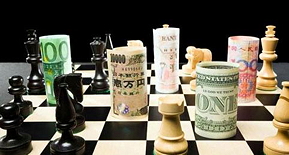
Washington’s resort to economic warfare complements its military fueled empire building.

But economic and military warfare are losing propositions.  While the US may extract a few billion dollars from Deutsch Bank, it will have lost much more in long-term, large-scale relations with German industrialists, politicians and financiers.  This is critical because Germany plays the key role in shaping economic policy in the European Union.  The practice of US multi-national corporations seeking off-shore tax havens in the EU may come to a grinding halt when the European Commission finishes its current investigations.  The Germans may not be too sympathetic to their American competitors.

Obama’s Trans-Pacific Partnership (TPP) has not only collapse, it has compelled China to open new avenues for trade and cooperation with Asian-Pacific nations – exactly the opposite of its original goal of isolating Beijing.  China’s Asia Infrastructure and Investment Bank (AIIB) has attracted 4 time more participants than Washington’s TPP and massive infrastructure projects are being financed to further bind ASEAN countries to China.  China’s economic growth at 6.7% more than three times that of the US at 2%.  Worse, for the Obama Administration, Washington has alienated its historically most reliable allies, as China, deepens economic ties and cooperation agreements with Thailand, Philippines, Pakistan, Cambodia and Laos.

Iran, despite US sanctions, is gaining markets and trade with Germany, Russia, China and the EU.

The Saudi-US conflict has yet to play-out but any escalation of law suits against the kingdom will result in the flight of hundreds of billions of investment dollars from the US.

In effect, Obama’s campaign of economic warfare may lead to the infinitely more costly military warfare and the massive loss of jobs and profits for the US economy.   Washington is increasingly isolated. The only allies supporting its campaign of economic sanctions are second and third rate powers, like Poland and current corrupt parasites in Ukraine.  As long as the Poles and Ukrainians can ‘mooch’ off of the IMF and grab EU and US ‘loans’, they will cheerlead Obama’s charge against Russia.  Israel, as long as it can gobble up an additional $38 billion dollars in ‘aid’ from Washington, remains  the biggest advocate for war against Iran.

Washington spends billions of US tax-payer dollars on its military bases in Japan, Philippines and Australia to maintain its hegemony in the Asia-Pacific region.   Its allies, though, are salivating at the prospect for greater trade and infrastructure investment  deals with China.

Economic warfare doesn’t work for the Washington because the US economy cannot compete, especially when it attacks its own allies and traditional partners.  Its regional allies are keen to join the ‘forbidden’ markets and share in major investment projects funded by China.  Asian leaders increasingly view Washington, with its ‘pivot to militarism’ as politically unreliable, unstable and dangerous.  After the Philippine government economic mission to China, expect more to ‘jump ship’.

Economic warfare against declared adversaries can only succeed if the US is committed to free trade with its allies, ends punitive sanctions and stops pushing for exclusive trade treaties that undermine its allies’ economies.   Furthermore, Washington should stop catering to the whims of special domestic interests.  Absent these changes, its losing campaign of economic warfare can only turn into military warfare – a prospect devastating to the US economy and to world peace.


Please note James Petras’s new collection of essays with Clarity Press:
THE END OF THE REPUBLIC AND THE DELUSION OF EMPIRE

ISBN: 978-0-9972870-5-9
$24.95 / 252 pp. / 2016

And the Beat Goes On: Mega-rich get richer. Society Crumbles

FollowTheMoney-Bank-Pyramid

By Robert De Filippis

(OpEdNews.com)

While most of us have been taking our kids to Little League games, betting on the Super Bowl, taking an occasional vacation and waiting for the American Dream to become a reality, we haven’t noticed something important happening all around us. Society has been crumbling at the edges for the last several decades.

This is not to say that lots of human beings haven’t already experienced the early stages of this societal disintegration. But they tend to be the people at the margins. People without a voice. People whose interests are not understood, let alone represented in the great debates of our times.

Think of the Mideast. Think ISIS here. Think of terrorism. Terrorists don’t attack us because of our freedoms. They attack out of desperation. Out of a frustration that comes with no future, and a feeling of impotence in the face of the continued economic violence committed in the name of corporate profits and greed. Corporations protected by the most powerful military in the history of the world. Ours!

Is it any mystery why we have over six hundred military installations in other countries around the world? We’re not under threat from anyone, but our corporation’s interests in those countries must be protected while they rape them of their labor and natural resources.

History is written by the victors and the popular public narratives are circumscribed by those whose interests they serve and not those who suffer. At the core of this phenomenon is complicity. A subconscious complicity made up of an ultra-resistant trifecta of human thinking — greed, ignorance, and certainty.

Greed now normalized has made the great American dream indistinguishable from having basic financial security to making everyone a billionaire-in-waiting. An inability to distinguish fact from opinion leads the wave of ignorance that engulfs us. Our arrogance disguised as fervent patriotism defends our ignorance and allows us to reject the knowledge we need to save ourselves.

Our generalized confusion of what constitutes a fact allows an individual’s certainty to form a resistance similar to the bacterial infections that threaten to make modern antibiotics useless. It continues to evolve. “If I can’t figure out who’s lying, I’ll believe the one who confirms my point of view. Of that I’m certain.”

Until we learn that having our beliefs validated by a media being paid to manipulate us for political gain, society will continue to disintegrate for larger and larger groups of people.

Seems like a stretch, I know. But think about how we’ve become polarized. How we are so sure of our positions that we just can’t have a conversation with those from the other side. The very conversation we need to have to figure out how we’re being duped. Then think about how our politicians use the greed, ignorance and certainty on both sides to work us up into an emotional lather. And finally, how they ignore our interests while they do the bidding of their owners keeping us distracted with our petty differences with each other.

This will come to an end. There will either be a major social revolution at the least or outright raw violence at the worst. As the authority structures lose the willing conformance of the masses, all that’s left to police them is force. And at some point – like is beginning now — the response will be violence in return. Think of the proliferation of guns in America. Think of people shooting police.

It doesn’t take much discernment to see that corporate structures are highly sophisticated mechanisms for funneling money upwards. That government collusion protects the interests of the owners of capital at the expense of the employees, customers, the general public. And the military protects their international interests.

The largest wealth producer in the world is the financial industry that simply makes money from money and produces nothing. It serves no interests but its own. Yes, some of us fortunate to have salvaged what’s left of our life savings after repeated financial crashes still enjoy the crumbs from the tables of the elite. I do mean crumbs.

Do the math. At the current rate of the upward movement of wealth, there is no other outcome but final disaster. The top 1/10th of 1 percent — not 1 percent — but 1/10th of 1 percent in America owns almost as much wealth as the bottom 90 percent in America, and it gets worse as you leave our shores.

At this rate, the world will eventually consist of gated enclaves of the mega-wealthy guarded by elite corps of paid mercenaries surrounded by billions of impoverished people.

This trajectory has increased dramatically for the last several decades. More and more of the world’s wealth is pouring into the coffers of the mega-rich. This is a zero sum game. When the masses have no wealth left, the game will be over. No matter how powerful the wealthy are, no matter how much wealth they possess, the game will be over.

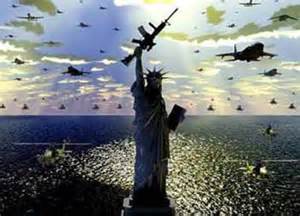
Neoliberalism and The Globalization of War: America’s Hegemonic Project

aa-American-Empire-statue-of-liberty-and-military

By Prof Michel Chossudovsky

Source: GlobalResearch.ca

The world is at a dangerous crossroads.  The United States and its allies have launched a military adventure which threatens the future of humanity. Major military and covert intelligence operations are being undertaken simultaneously in the Middle East, Eastern Europe, sub-Saharan Africa, Central Asia and the Far East. The US-NATO military agenda combines both major theater operations as well as covert actions geared towards destabilizing sovereign states.

America’s hegemonic project is to destabilize and destroy countries through acts of war, covert operations in support of terrorist organizations, regime change and economic warfare. The latter includes the imposition of deadly macro-economic reforms on indebted countries as well the manipulation of financial markets, the engineered  collapse of national currencies, the privatization of State property, the imposition of economic sanctions, the triggering of inflation and black markets.

The economic dimensions of  this military agenda must be clearly understood. War and Globalization are intimately related. These military and intelligence operations are implemented alongside a process of economic and political destabilization targeting specific countries in all major regions of World.

Neoliberalism is an integral part of this foreign policy agenda. It constitutes an all encompassing mechanism of  economic destabilization. Since the 1997 Asian crisis, the IMF-World Bank structural adjustment program (SAP) has evolved towards a broader framework which consists in ultimately undermining national governments’ ability to formulate and implement national economic and social policies.

In turn, the demise of national sovereignty was also facilitated by the instatement of the World Trade Organization (WTO) in 1995, evolving towards the global trading agreements (TTIP and TPP) which (if adopted) would essentially transfer state policy entirely into the hands of corporations. In recent years, neoliberalism has extend its grip from the so-called developing countries to the developed countries of both Eastern and Western Europe. Bankruptcy programs have been set in motion. Island, Portugal, Greece, Ireland, etc, have been the target of  sweeping austerity measures coupled with the privatization of key sectors of the national economy.

The global economic crisis is intimately related to America’s hegemonic agenda. In the US and the EU, a  spiralling defense budget backlashes on the civilian sectors of economic activity. “War is Good for Business”: the powerful financial groups which routinely manipulate stock markets, currency and commodity markets, are also promoting the continuation and escalation of the Middle East war. A worldwide process of impoverishment is an integral part of the New World Order agenda.

Beyond the Globalization of Poverty 

Historically, impoverishment of large sectors of the World population has been engineered through the imposition of IMF-style macro-economic reforms. Yet, in the course of the last 15 years, a new destructive phase has been set in motion. The World has moved beyond the “globalization of poverty”: countries are transformed in open territories,

State institutions collapse, schools and hospitals are closed down, the legal system disintegrates, borders are redefined, broad sectors of economic activity including agriculture and manufacturing are precipitated into bankruptcy,  all of which ultimately leads to a process of social collapse, exclusion and destruction of human life including the outbreak of famines, the displacement of entire populations (refugee crisis).

This “second stage” goes beyond the process of impoverishment instigated in the early 1980s by creditors and international financial institutions. In this regard, mass poverty resulting from macro-economic reform sets the stage of  a process of outright destruction of human life.

In turn, under conditions of widespread unemployment, the costs of labor in developing countries has plummeted. The driving force of the global economy is luxury consumption and the weapons industry.

The New World Order

Broadly speaking, the main corporate actors of the New World Order are

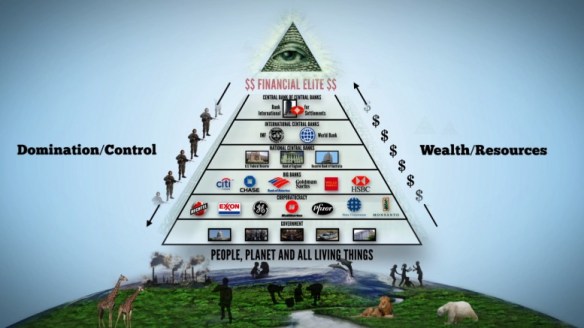
• Wall Street and the Western banking conglomerates including its offshore money laundering facilities, tax havens, hedge funds and secret accounts,

• the Military Industrial Complex regrouping major “defense contractors”, security and mercenary companies, intelligence outfits, on contract to the Pentagon;

• the Anglo-American Oil and Energy Giants,

• The Biotech Conglomerates, which increasingly control agriculture and the food chain;

• Big Pharma,

• The Communication Giants  and Media conglomerates, which constitute the propaganda arm of the New World Order.

There is of course overlap, between Big Pharma and the Weapons industry, the oil conglomerates and Wall Street, etc.

These various corporate entities interact with government bodies, international financial institutions, US intelligence.  The state structure has evolved towards what Peter Dale Scott calls the “Deep State”, integrated by covert intelligence bodies, think tanks, secret councils and consultative bodies, where important New World Order decisions are ultimately reached on behalf of powerful corporate interests.

In turn, intelligence operatives increasingly permeate the United Nations including its specialized agencies, nongovernmental organizations, trade unions, political parties.

What this means is that the executive and legislature constitute a smokescreen, a mechanism for providing political legitimacy to decisions taken by the corporate establishment behind closed doors.

Media Propaganda

The corporate  media, which constitutes the propaganda arm of the New World Order, has a long history whereby intelligence ops oversee the news chain. In turn, the corporate media serves the useful purpose of obfuscating war crimes, of presenting a humanitarian narrative which upholds the legitimacy of politicians in high office.

Acts of war and economic destabilization are granted legitimacy. War is presented as a peace-keeping undertaking.

Both the global economy as well as the political fabric of Western capitalism have become criminalized. The judicial apparatus at a national level as well the various international human rights tribunals and criminal courts serve the useful function of upholding the legitimacy of US-NATO led wars and human rights violations.

Destabilizing Competing Poles of Capitalist Development

There are of course significant divisions and capitalist rivalry within the corporate establishment. In the post Cold War era, the US hegemonic project consists in destabilizing competing poles of capitalist development including China, Russia and Iran as well as countries such as India, Brazil and Argentina.

In recent developments, the US has also exerted pressure on the capitalist structures of the member states of the European Union. Washington exerts influence in the election of heads of State including Germany and France, which are increasingly aligned with Washington.

The monetary dimensions are crucial. The international financial system established under Bretton Woods prevails. The global financial apparatus is dollarized. The powers of money creation are used as a mechanism to appropriate real economy assets. Speculative financial trade has become an instrument of enrichment at the expense of the real economy. Excess corporate profits and multibillion dollar speculative earnings (deposited in tax free corporate charities) are also recycled towards the corporate control of politicians, civil society organizations, not to mention scientists and intellectuals. It’s called corruption, co-optation, fraud.

Latin America: The Transition towards a “Democratic Dictatorship”

In Latin America, the military dictatorships of the 1960s and 1970s have in large part been replaced by US proxy regimes, i.e. a democratic dictatorship has been installed which ensures continuity. At the same time the ruling elites in Latin America have remoulded. They have become increasingly integrated into the logic of global capitalism, requiring an acceptance of the US hegemonic project.

Macro-economic reform has been conducive to the impoverishment of  the entire Latin america region.

In the course of the last 40 years, impoverishment has been triggered by hyperinflation, starting with the 1973 military coup in Chile and the devastating reforms of the 1980s and early 1990s.

The implementation of these deadly economic reforms including sweeping privatization, trade deregulation, etc. is coordinated in liaison with US intelligence ops, including the “Dirty war” and Operation Condor, the Contra insurrection in Nicaragua, etc.

The development of a new and privileged elite integrated into the structures of Western investment and consumerism has emerged. Regime change has been launched against a number of Latin American countries.

Any attempt to introduce reforms which departs from the neoliberal consensus is the object of “dirty tricks” including acts of infiltration, smear campaigns, political assassinations, interference in national elections and covert operations to foment social divisions. This process inevitably requires corruption and cooptation at the highest levels of government as well as within the corporate and financial establishment. In some countries of the region it hinges on the criminalization of the state, the legitimacy of money laundering and the protection of the drug trade.


The above text is an English summary of Prof. Michel Chossudovsky’s Presentation, National Autonomous University of Nicaragua, May 17, 2016. This presentation took place following the granting of a Doctor Honoris Causa in Humanities to Professor Chossudovsky by the National Autonomous University of Nicaragua (UNAN)

Understanding Evil: From Globalism To Pizzagate

2350633195_d69a16ab76

By Brandon Smith

Source: Alt-Market.com

I have spent the better part of the last 10 years working diligently to investigate and relate information on economics and geopolitical discourse for the liberty movement. However, long before I delved into these subjects my primary interests of study were the human mind and the human “soul” (yes, I’m using a spiritual term).

My fascination with economics and sociopolitical events has always been rooted in the human element. That is to say, while economics is often treated as a mathematical and statistical field, it is also driven by psychology. To know the behavior of man is to know the future of all his endeavors, good or evil.

Evil is what we are specifically here to discuss. I have touched on the issue in various articles in the past including Are Globalists Evil Or Just Misunderstood, but with extreme tensions taking shape this year in light of the U.S. election as well as the exploding online community investigation of “Pizzagate,” I am compelled to examine it once again.

I will not be grappling with this issue from a particularly religious perspective. Evil applies to everyone regardless of their belief system, or even their lack of belief. Evil is secular in its influence.

The first and most important thing to understand is this — evil is NOT simply a social or religious construct, it is an inherent element of the human psyche. Carl Gustav Jung was one of the few psychologists in history to dare write extensively on the issue of evil from a scientific perspective as well as a metaphysical perspective.  I highly recommend a book of his collected works on this subject titled ‘Jung On Evil’, edited by Murray Stein, for those who are interested in a deeper view.

To summarize, Jung found that much of the foundations of human behavior are rooted in inborn psychological contents or “archetypes.”  Contrary to the position of Sigmund Freud, Jung argued that while our environment may affect our behavior to a certain extent, it does not make us who we are. Rather, we are born with our own individual personality and grow into our inherent characteristics over time. Jung also found that there are universally present elements of human psychology. That is to say, almost every human being on the planet shares certain truths and certain natural predilections.

The concepts of good and evil, moral and immoral, are present in us from birth and are mostly the same regardless of where we are born, what time in history we are born and to what culture we are born. Good and evil are shared subjective experiences.  It is this observable psychological fact (among others) that leads me to believe in the idea of a creative design — a god.  Again, though, elaborating on god is beyond the scope of this article.

To me, this should be rather comforting to people, even atheists.  For if there is observable evidence of creative design, then it would follow that there may very well be a reason for all the trials and horrors that we experience as a species.  Our lives, our failures and our accomplishments are not random and meaningless.  We are striving toward something, whether we recognize it or not.  It may be beyond our comprehension at this time, but it is there.

Evil does not exist in a vacuum; with evil there is always good, if one looks for it in the right places.

Most people are readily equipped to recognize evil when they see it directly.  What they are not equipped for and must learn from environment is how to recognize evil disguised as righteousness.  The most heinous acts in history are almost always presented as a moral obligation — a path towards some “greater good.”  Inherent conscience, though, IS the greater good, and any ideology that steps away from the boundaries of conscience will inevitably lead to disaster.

The concept of globalism is one of these ideologies that crosses the line of conscience and pontificates to us about a “superior method” of living.  It relies on taboo, rather than moral compass, and there is a big difference between the two.

When we pursue a “greater good” as individuals or as a society, the means are just as vital as the ends.  The ends NEVER justify the means.  Never.  For if we abandon our core principles and commit atrocities in the name of “peace,” safety or survival, then we have forsaken the very things which make us worthy of peace and safety and survival.  A monster that devours in the name of peace is still a monster.

Globalism tells us that the collective is more important than the individual, that the individual owes society a debt and that fealty to society in every respect is the payment for that debt.  But inherent archetypes and conscience tell us differently.  They tell us that society is only ever as healthy as the individuals within it, that society is only as free and vibrant as the participants.  As the individual is demeaned and enslaved, the collective crumbles into mediocrity.

Globalism also tells us that humanity’s greatest potential cannot be reached without collectivism and centralization.  The assertion is that the more single-minded a society is in its pursuits the more likely it is to effectively achieve its goals.  To this end, globalism seeks to erase all sovereignty. For now its proponents claim they only wish to remove nations and borders from the social equation, but such collectivism never stops there.  Eventually, they will tell us that individualism represents another nefarious “border” that prevents the group from becoming fully realized.

At the heart of collectivism is the idea that human beings are “blank slates;” that we are born empty and are completely dependent on our environment in order to learn what is right and wrong and how to be good people or good citizens.  The environment becomes the arbiter of decency, rather than conscience, and whoever controls the environment, by extension, becomes god.

If the masses are convinced of this narrative then moral relativity is only a short step away. It is the abandonment of inborn conscience that ultimately results in evil. In my view, this is exactly why the so called “elites” are pressing for globalism in the first place. Their end game is not just centralization of all power into a one world edifice, but the suppression and eradication of conscience, and thus, all that is good.

To see where this leads we must look at the behaviors of the elites themselves, which brings us to “Pizzagate.”

The exposure by Wikileaks during the election cycle of what appear to be coded emails sent between John Podesta and friends has created a burning undercurrent in the alternative media. The emails consistently use odd and out of context “pizza” references, and independent investigations have discovered a wide array connections between political elites like Hillary Clinton and John Podesta to James Alefantis, the owner of a pizza parlor in Washington D.C. called Comet Ping Pong. Alefantis, for reasons that make little sense to me, is listed as number 49 on GQ’s Most Powerful People In Washington list.

The assertion according to circumstantial evidence including the disturbing child and cannibalism artwork collections of the Podestas has been that Comet Ping Pong is somehow at the center of a child pedophilia network serving the politically connected. Both Comet Ping Pong and a pizza establishment two doors down called Besta Pizza use symbols in their logos and menus that are listed on the FBI’s unclassified documentation on pedophilia symbolism, which does not help matters.

Some of the best documentation of the Pizzagate scandal that I have seen so far has been done by David Seaman, a former mainstream journalist gone rogue. Here is his YouTube page.

I do recommend everyone at least look at the evidence he and others present. I went into the issue rather skeptical, but was surprised by the sheer amount of weirdness and evidence regarding Comet Pizza.  There is a problem with Pizzagate that is difficult to overcome, however; namely the fact that to my knowledge no victims have come forward.  This is not to say there has been no crime, but anyone hoping to convince the general public of wrong-doing in this kind of scenario is going to have a very hard time without a victim to reference.

The problem is doubly difficult now that an armed man was arrested on the premises of Comet Ping Pong while “researching” the claims of child trafficking.  Undoubtedly, the mainstream media will declare the very investigation “dangerous conspiracy theory.”  Whether this will persuade the public to ignore it, or compel them to look into it, remains to be seen.

I fully realize the amount of confusion surrounding Pizzagate and the assertions by some that it is a “pysop” designed to undermine the alternative media.  This is a foolish notion, in my view.  The mainstream media is dying, this is unavoidable.  The alternative media is a network of sources based on the power of choice and cemented in the concept of investigative research.  The reader participates in the alternative media by learning all available information and positions and deciding for himself what is the most valid conclusion, if there is any conclusion to be had.  The mainstream media simply tells its readers what to think and feel based on cherry picked data.

The elites will never be able to deconstruct that kind of movement with something like a faked “pizzagate”; rather, they would be more inclined to try to co-opt and direct the alternative media as they do most institutions.  And, if elitists are using Pizzagate as fodder to trick the alternative media into looking ridiculous, then why allow elitist run social media outlets like Facebook and Reddit to shut down discussion on the issue?

The reason I am more convinced than skeptical at this stage is because this has happened before; and in past scandals of pedophilia in Washington and other political hotbeds, some victims DID come forward.

I would first reference the events of the Franklin Scandal between 1988 and 1991. The Discovery Channel even produced a documentary on it complete with interviews of alleged child victims peddled to Washington elites for the purpose of favors and blackmail.  Meant to air in 1994, the documentary was quashed before it was ever shown to the public. The only reason it can now be found is because an original copy was released without permission by parties unknown.

I would also reference the highly evidenced Westminster Pedophile Ring in the U.K., in which the U.K. government lost or destroyed at least 114 files related to the investigation.

Finally, it is disconcerting to me that the criminal enterprises of former Bear Sterns financier and convicted pedophile Jeffrey Epstein and his “Lolita Express” are mainstream knowledge, yet the public remains largely oblivious.  Bill Clinton is shown on flight logs to have flown on Epstein’s private jet at least a 26 times; the same jet that he used to procure child victims as young as 12 to entertain celebrities and billionaires on his 72 acre island called “Little Saint James”.  The fact that Donald Trump was also close friends with Epstein should raise some eyebrows – funny how the mainstream media attacked Trump on every cosmetic issue under the sun but for some reason backed away from pursuing the Epstein angle.

Where is the vast federal investigation into the people who frequented Epstein’s wretched parties?  There is none, and Epstein, though convicted of molesting a 14 year old girl and selling her into prostitution, was only slapped on the wrist with a 13 month sentence.

Accusations of pedophilia seem to follow the globalists and elitist politicians wherever they go. This does not surprise me. They often exhibit characteristics of narcissism and psychopathy, but their ideology of moral relativity is what would lead to such horrible crimes.

Evil often stems from people who are empty. When one abandons conscience, one also in many respects abandons empathy and love.  Without these elements of our psyche there is no happiness. Without them, there is nothing left but desire and gluttony.

Narcissists in particular are prone to use other people as forms of entertainment and fulfillment without concern for their humanity.  They can be vicious in nature, and when taken to the level of psychopathy, they are prone to target and abuse the most helpless of victims in order to generate a feeling of personal power.

Add in sexual addiction and aggression and narcissists become predatory in the extreme. Nothing ever truly satisfies them. When they grow tired of the normal, they quickly turn to the abnormal and eventually the criminal.  I would say that pedophilia is a natural progression of the elitist mindset; for children are the easiest and most innocent victim source, not to mention the most aberrant and forbidden, and thus the most desirable for a psychopathic deviant embracing evil impulses.

Beyond this is the even more disturbing prospect of cultism. It is not that the globalists are simply evil as individuals; if that were the case then they would present far less of a threat. The greater terror is that they are also organized. When one confronts the problem of evil head on, one quickly realizes that evil is within us all. There will always be an internal battle in every individual. Organized evil, though, is in fact the ultimate danger, and it is organized evil that must be eradicated.

For organized evil to be defeated, there must be organized good. I believe the liberty movement in particular is that good; existing in early stages, not yet complete, but good none the less.  Our championing of the non-aggression principle and individual liberty is conducive to respect for privacy, property and life.  Conscience is a core tenet of the liberty ideal, and the exact counter to organized elitism based on moral relativity.

Recognize and take solace that though we live in dark times, and evil men roam free, we are also here. We are the proper response to evil, and we have been placed here at this time for a reason. Call it fate, call it destiny, call it coincidence, call it god, call it whatever you want, but the answer to evil is us.

Deep State America Why U.S. Policies Serve No National Interests

deep_state_2_0

By Philip Giraldi

Source: Information Clearing House

On September 9th the Washington Post featured a front page article describing how the Defense Department had used warplanes to attack targets and kill suspected militants in six countries over the Labor Day weekend. The article was celebratory, citing Pentagon officials who boasted of the ability to engage “multiple targets” anywhere in the world in what has become a “permanent war.” The article did not mention that the United States is not currently at war with any of the six target countries and made no attempt to make a case that the men and women who were killed actually threatened the U.S. or American citizens.

Actual American interests in fighting a war without limits and without an end were not described. They never are. Indeed, in the U.S. and elsewhere many citizens often wonder how certain government policies like the Washington’s war on terror can persist in spite of widespread popular opposition or clear perceptions that they are either ineffective or even harmful. This persistence of policies regarding which there is no debate is sometimes attributed to a “deep sThe phrase “deep state” originated in and was often applied to Turkey, in Turkish “Derin Devlet,” where the nation’s security services and governing elite traditionally pursued the same chauvinistic and inward-looking agenda both domestically and in foreign affairs no matter who was prime minister.

In countries where a deep state dominates, real democracy and rule of law are inevitably the first victims. A deep state like Turkey’s is traditionally organized around a center of official and publicly accepted power, which means it often includes senior government officials, the police and intelligence services as well as the military. For the police and intelligence agencies the propensity to operate in secret is a sine qua non for the deep state as it provides cover for the maintenance of relationships that under other circumstances would be considered suspect or even illegal.

It has been claimed that deep state activities in Turkey are frequently conducted through connivance with politicians who are able to provide cover for the activity, with corporate interests and sometimes even with criminal groups, which can operate across borders and help in the mundane tasks of political corruption to include money laundering. This connection of political power with the ability to operate under the radar and generate considerable cash flows are characteristic of deep state.

As all governments for sometimes good reasons engage in concealment of their more questionable activities or even resort to out and out deception, one must ask how the deep state differs. While an elected government might sometimes engage in activity that is legally or morally questionable there are normally some checks and balances in place to limit resort to such activity as well as periodic elections to repudiate what is done. For players in the deep state, there are no accountability and no legal limits and everything is based on self-interest justified through assertion of patriotism and the national interest if they are ever challenged.

Every country has a deep state of some kind even if it goes by another name. “The Establishment” or “old boys’ network” was widely recognized in twentieth century Britain. “Establishment” has often also been used in the United States, describing a community of shared values and interests that has evolved post-Second World War from the Washington-New York axis of senior government officials and financial services executives. They together constitute a group that claims to know what is “best” for the country and act accordingly, no matter who sits in the White House. They generally operate in the shadows but occasionally surface and become public, as when 50 foreign so-called policy experts or former senior officials write letters staking out political positions, as has been occurring recently. The “experts” are currently weighing in to both support and fund the campaign of Hillary Clinton, who, they believe, shares their views and priorities.

The deep state principle should sound familiar to Americans who have been following political developments over the past twenty years. For the deep state to be effective it must be intimately associated with the development or pre-existence of a national security state. There must also be a perception that the nation is in peril, justifying extraordinary measures undertaken by self-described patriots to preserve life and property of the citizenry. Those measures are generically conservative in nature, intended to protect the status quo with the implication that change is dangerous.

Those requirements certainly prevail in post 9/11 America and also feed the other essential component of the deep state, that the control should work secretly or at least under the radar. Consider for a moment how Washington operates. There is gridlock in Congress and the legislature opposes nearly everything that the White House supports. Nevertheless, certain things happen seemingly without any discussion, including the bipartisan, unconstitutional and extremely dangerous assumption of increased executive authority by the White House.

As the Post article demonstrates, there is also widespread acceptance by our country’s elites of the fiction that America is threatened and that Washington has a right to intervene preemptively anywhere in the world at any time. Unpopular and unconstitutional wars continue in Afghanistan, Syria and Iraq while the American president routinely claims the meaningless title “leader of the free world” even as he threatens countries that do not adhere to norms dictated by Washington. In the case of Russia, some American leaders actually believe a potentially nuclear war can be won and should be considered while at least one general has taken steps to bring about such a conflict.

Meanwhile both targeted citizens and often innocent foreigners who fit profiles are assassinated by drones without any legal process or framework. Lying to start a war as well as the war crimes committed by U.S. troops and contractors on far flung battlefields including torture and rendition are rarely investigated and punishment of any kind is so rare as to be remarkable when it does occur.

Here at home banks are bailed out and corporate interests are protected by law. Huge multi-year defense contracts are approved for ships and planes that are both vulnerable and money pits. The public is routinely surveilled, citizens are imprisoned without being charged or are tried by military tribunals, the government increasingly cites state secrets privilege to conceal its actions and whistleblowers are punished with prison. America the warlike predatory capitalist operating with little interference or input from the citizenry might be considered a virtual definition of deep state.

Some observers believe that the deep state is driven by the “Washington Consensus,” a subset of the “American exceptionalism” meme. It is plausible to consider it a 1950s creation, the end product of the “military industrial complex” that Dwight Eisenhower warned about, but some believe its infrastructure was actually put in place through the passage of the Federal Reserve Act prior to the First World War. Several years after signing the bill, Woodrow Wilson reportedly lamented “We have come to be one of the worst ruled, one of the most completely controlled and dominated governments in the civilized world, no longer a government by conviction and the vote of the majority, but a government by the opinion and duress of a small group of dominant men.”

As I have noted, America’s deep state is something of a hybrid creature that operates along a New York to Washington axis. Where the Turks sometimes engage in unambiguous criminal activity like drug trafficking to fund themselves the Washington elite instead turns to the banksters, lobbyists and defense contractors, operating much more in the open and, ostensibly, legally. U.S. style deep state includes all the obvious parties, both public and private, who benefit from the status quo to include key players in the police and intelligence agencies, the military, the treasury and justice departments and in the judiciary. It is structured to materially reward those who play along with the charade and the glue to accomplish that comes ultimately from Wall Street. “Financial services” might well be considered the epicenter of the entire process. Even though government is needed to implement desired policies, the banksters comprise the truly essential element, capable of providing genuine rewards for compliance. As corporate interests increasingly own the media, little dissent comes from the Fourth Estate as the process plays out while many of the proliferating Washington think tanks that provide deep state “intellectual” credibility are similarly funded by defense contractors.

The cross fertilization that is essential to make the system work takes place through the famous revolving door whereby senior government officials enter the private sector at a high level. In some cases the door revolves a number of times, with officials leaving government before returning in an even more elevated position. This has been characteristic of the rise of the so-called neoconservatives. Along the way, those select individuals are protected, promoted and groomed for bigger things. The senior government officials, ex-generals, and high level intelligence operatives who participate find themselves with multi-million dollar homes for their retirement years, cushioned by a tidy pile of investments.

The deep state in American is completely corrupt because it exists to sell out the public interest and it includes both major political parties as well as government officials. Politicians like the Clintons who leave the White House “broke” and accumulate more than $100 million in a few years exemplify how it rewards its friends while a bloated Pentagon churns out hundreds of unneeded flag officers who receive munificent pensions and benefits for the rest of their lives. And no one is punished, ever. Disgraced former general and CIA Director David Petraeus is now a partner at the KKR private equity firm even though he knows nothing about financial services. More recently, former Acting CIA Director Michael Morell, who supports Hillary and is publicly advocating assassinating Russians and Iranians, has become a Senior Counselor at Clinton-linked Beacon Global Strategies. Both Petraeus and Morell are being rewarded for their loyalty to the system.

What makes the deep state so successful? It wins no matter who is in power by creating bipartisan supported money pits within the system. Unending wars and simmering though hard to define threats together invite more spending on national security and make for good business. Monetizing the completely unnecessary and hideously expensive global war on terror benefits the senior government officials, beltway industries and financial services that feed off it. Because it is essential to keep the money flowing, the deep state persists in promoting policies that otherwise make no sense, to include the unwinnable wars currently enjoying marquee status in Iraq/Syria and Afghanistan. The deep state knows that a fearmongered public will buy its product and does not even have to make much of an effort to sell it.

The United States of America is not exactly deep state Turkey but to be sure any democracy can be subverted by particular interests hiding behind the mask of patriotism buttressed by phony international threats. Ordinary Americans frequently ask why politicians and government officials appear to be so obtuse, rarely recognizing what is actually occurring in the country. That is partly due to the fact that the political class lives in a bubble of its own creation but it might also be because many of America’s leaders actually accept and benefit from the fact that there is an unelected, un-appointed and unaccountable presence within the system that actually manages what is taking place from behind the scenes. That would be the American deep state.

[This article is a lightly edited version of a paper presented at the Ron Paul Institute’s conference on peace and prosperity held on September 10, 2016 in Dulles, Virginia]

Libeled by the Washington Post in a ‘False News’ McCarthyite Attack on Alternative Media

america-under-communism

By Dave Lindorff

Source: This Can’t Be Happening

Is the Pentagon behind this massive hit on independent journalism?