‘Stop Drinking the Kool-Aid, America: Political Fiction in an Age of Televised Lies’

20120527040549-stop-drinking-kool-aid

By John W. Whitehead

Source: A Government of Wolves

“We’ve got to face it. Politics have entered a new stage, the television stage. Instead of long-winded public debates, the people want capsule slogans—‘Time for a change’—‘The mess in Washington’—‘More bang for a buck’—punch lines and glamour.”— A Face in the Crowd (1957)

Politics is entertainment.

It is a heavily scripted, tightly choreographed, star-studded, ratings-driven, mass-marketed, costly exercise in how to sell a product—in this case, a presidential candidate—to dazzled consumers who will choose image over substance almost every time.

This year’s presidential election, much like every other election in recent years, is what historian Daniel Boorstin referred to as a “pseudo-event”: manufactured, contrived, confected and devoid of any intrinsic value save the value of being advertised. It is the end result of a culture that is moving away from substance toward sensationalism in an era of mass media.

As author Noam Chomsky rightly observed, “It is important to bear in mind that political campaigns are designed by the same people who sell toothpaste and cars.” In other words, we’re being sold a carefully crafted product by a monied elite who are masters in the art of making the public believe that they need exactly what is being sold to them, whether it’s the latest high-tech gadget, the hottest toy, or the most charismatic politician.

Tune into a political convention and you will find yourself being sucked into an alternate reality so glossy, star-studded, emotionally charged and entertaining as to make you forget that you live in a police state. The elaborate stage show, the costumes, the actors, the screenplay, the lighting, the music, the drama: all carefully calibrated to appeal to the public’s need for bread and circuses, diversion and entertainment, and pomp and circumstance.

Politics is a reality show, America’s favorite form of entertainment, dominated by money and profit, imagery and spin, hype and personality and guaranteed to ensure that nothing in the way of real truth reaches the populace.

After all, who cares about police shootings, drone killings, SWAT team raids, asset forfeiture schemes, private prisons, school-to-prison pipelines, overcriminalization, censorship or any of the other evils that plague our nation when you can listen to the croonings of Paul Simon, laugh along with Sarah Silverman, and get misty-eyed over the First Lady’s vision of progress in America.

But make no mistake: Americans only think they’re choosing the next president.

In truth, however, they’re engaging in the illusion of participation culminating in the reassurance ritual of voting. It’s just another Blue Pill, a manufactured reality conjured up by the matrix in order to keep the populace compliant and convinced that their vote counts and that they still have some influence over the political process.

Stop drinking the Kool-Aid, America.

The nation is drowning in debt, crippled by a slowing economy, overrun by militarized police, swarming with surveillance, besieged by endless wars and a military industrial complex intent on starting new ones, and riddled with corrupt politicians at every level of government. All the while, we’re arguing over which corporate puppet will be given the honor of stealing our money, invading our privacy, abusing our trust, undermining our freedoms, and shackling us with debt and misery for years to come.

Nothing taking place on Election Day will alleviate the suffering of the American people.

The government as we have come to know it—corrupt, bloated and controlled by big-money corporations, lobbyists and special interest groups—will remain unchanged. And “we the people”—overtaxed, overpoliced, overburdened by big government, underrepresented by those who should speak for us and blissfully ignorant of the prison walls closing in on us—will continue to trudge along a path of misery.

With roughly 22 lobbyists per Congressman, corporate greed will continue to call the shots in the nation’s capital, while our elected representatives will grow richer and the people poorer. And elections will continue to be driven by war chests and corporate benefactors rather than such values as honesty, integrity and public service. Just consider: it’s estimated that more than $5 billion will be spent on the elections this year, yet not a dime of that money will actually help the average American in their day-to-day struggles to just get by.

And the military industrial complex will continue to bleed us dry. Since 2001 Americans have spent $10.5 million every hour for numerous foreign military occupations, including in Iraq and Afghanistan. There’s also the $2.2 million spent every hour on maintaining the United States’ nuclear stockpile, and the $35,000 spent every hour to produce and maintain our collection of Tomahawk missiles. And then there’s the money the government exports to other countries to support their arsenals, at the cost of $1.61 million every hour for the American taxpayers.

Then again, when faced with the grim, seemingly hopeless reality of the American police state, it’s understandable why Americans might opt for escapism. “Humankind cannot bear too much reality,” T. S. Eliot once said. Perhaps that is one reason we are so drawn to the unreality of the American political experience: it is spectacle and fiction and farce all rolled up into one glossy dose of escapism.

Frankly, escapism or not, Americans should be mad as hell.

Many of our politicians live like kings. Chauffeured around in limousines, flying in private jets and eating gourmet meals, all paid for by the American taxpayer, they are far removed from those they represent. Such a luxurious lifestyle makes it difficult to identify with the “little guy”—the roofers, plumbers and blue-collar workers who live from paycheck to paycheck and keep the country running with their hard-earned dollars and the sweat of their brows.

Conveniently, politicians only seem to remember their constituents in the months leading up to an election, and yet “we the people” continue to take the abuse, the neglect, the corruption and the lies. We make excuses for the shoddy treatment, we cover up for them when they cheat on us, and we keep hoping that if we just stick with them long enough, eventually they’ll treat us right.

People get the government they deserve.

No matter who wins the presidential election come November, it’s a sure bet that the losers will be the American people.

As political science professor Gene Sharp notes in starker terms, “Dictators are not in the business of allowing elections that could remove them from their thrones.” As I make clear in my book Battlefield America: The War on the American People, the Establishment—the shadow government and its corporate partners that really run the show, pull the strings and dictate the policies, no matter who occupies the Oval Office—are not going to allow anyone to take office who will unravel their power structures. Those who have attempted to do so in the past have been effectively put out of commission.

So what is the solution to this blatant display of imperial elitism disguising itself as a populist exercise in representative government?

Stop playing the game. Stop supporting the system. Stop defending the insanity. Just stop.

Washington thrives on money, so stop giving them your money. Stop throwing your hard-earned dollars away on politicians and Super PACs who view you as nothing more than a means to an end. There are countless worthy grassroots organizations and nonprofits working in your community to address real needs like injustice, poverty, homelessness, etc. Support them and you’ll see change you really can believe in in your own backyard.

Politicians depend on votes, so stop giving them your vote unless they have a proven track record of listening to their constituents, abiding by their wishes and working hard to earn and keep their trust.

Stop buying into the lie that your vote matters. Your vote doesn’t elect a president. Despite the fact that there are 218 million eligible voters in this country (only half of whom actually vote), it is the electoral college, made up of 538 individuals handpicked by the candidates’ respective parties, that actually selects the next president. The only thing you’re accomplishing by taking part in the “reassurance ritual” of voting is sustaining the illusion that we have a democratic republic. What we have is a dictatorship, or as political scientists Martin Gilens and Benjamin Page more accurately term it, we are suffering from an “economic élite domination.”

A healthy, representative government is hard work. It takes a citizenry that is informed about the issues, educated about how the government operates, and willing to make the sacrifices necessary to stay involved, whether that means forgoing Monday night football in order to attend a city council meeting or risking arrest by picketing in front of a politician’s office.

It takes a citizenry willing to do more than grouse and complain. We must act—and act responsibly—keeping in mind that the duties of citizenship extend beyond the act of voting.

Most of all, it takes a citizenry that cares enough to get mad and get active. As Howard Beale declares in the 1976 film Network:

“I want you to get up right now, sit up, go to your windows, open them and stick your head out and yell, ‘I’m as mad as hell and I’m not going to take this anymore.’ Things have got to change. But first, you’ve gotta get mad!…You’ve got to say, ‘I’m as mad as hell, and I’m not going to take this anymore!’ Then we’ll figure out what to do about the depression and the inflation and the oil crisis. But first get up out of your chairs, open the window, stick your head out, and yell, and say it.”


The Eye of the Beholder: There is Never Anything New

414JCSYLsPL._SX332_BO1,204,203,200_

A review of John Steppling’s new book, Aesthetic Resistance and Dis-Interest

By Paul Haeder

Source: Dissident Voice

it is through mimesis, (identification with the mirror image) that one gains a sense of unity, self-containment and mastery over the body. If that was all that there was to it, humanity would be condemned to dwell forever entombed in the hell of mirrors. However, the identification with an Other in the mirror opens out the possibility for symbolic thought.

— John Desmond, author, thinker, who is interested in the history of marketing; construction of knowledge in marketing; consuming culture; morality and marketing; advertising and public policy

The beauty of ideas and words and sculpting frames and philosophical groundings is that we in Western culture having nothing more challenging than the numbness of a consumer-wrecked world where crass hucksterism and financial voodoo wizardry – even with its nuclear tipped propaganda, surveillance and missile dragnet technological orgasm science serves up – pales in comparison to any tried and tested narrative grammar of idea wizards.

Yet, dealing with words now, we see, as one noted playwright and thinker attests, involves PR packaged thinking, possibly a flagrant fascism tied to what can be written (thought) and what cannot be (said).

The title to his book says it all, sometimes – Aesthetic Resistance and Dis-Interest – That Which Will Not Allow Itself to be Said. This is just out in 2016, by playwright, raconteur and philosopher, John Steppling, from the organization, Mimesis International. The book is a compilation of some of his blog postings, and not to denigrate the word “blog” to mean anyone and their uncle expressing anything out there on the world wide web.

Like stepping stones into Steppling’s mind, each essay is a revving reverberating call to mental action, as each essay follows the Introduction with more nitrous oxide pumped into each cylinder of the 12 cylinder motor of his mind: one, Narrative & Empathy; two, Magical Thinking; three, Pedagogy; four, Nothing is Art; five, The Impossible Playwright; six, Someone to Watch Over Me; seven, The Political Uncanny; eight, That Which Will Not Allow Itself to be Said; nine, The Hidden Narrative.

Here, Steppling drills down into the cortex of the American – European, white, patriarchal, Puritan and Elitist – brain, sort of the flash mob mentality we are downloading determinedly. He plugs holes in the tinny junk thinking and pseudo intellectualism hovering around academia, the So Called Liberal Media, the Corporate boardrooms, the waiting rooms at TED Talks 3.0, and the ER’s resuscitating the pop culture that doubles in the minds of the masters of consumption as true art (sic). It’s a violent country, the art is anti-art, and the world of the Imperialist, right-wing or leftie, is predicated on a Heart of Darkness destruction that Steppling decants into the incantation:

The unfinished and fragmentary now emerge as comments all by themselves. When the worst aggressions in society today are often those paraded as benign, or self branded as innocent, even curative, the default response must be one of disconnection. The age of marketing, fueled by Imperialist Capital, has obliterated ideas of belief. Ideas of evidence and trust in our own feelings are all the time under duress and coercion. Aesthetic coercion is the staple of a system of image and narrative control the erases the individual while unrelentingly trumpeting his triumph.

Mimesis conceptually and psychoanalytically is something Theodore Adorno, Robert Hullor-Kentor and Fabo Akcelrud Durao study as they break into the mind of the human condition under the duress of capitalism-hucksterism-market competition-cultural posturing in order to understand how we as thinkers and believers re-narrate when we read a novel or watch a film, as well as engage with poetry and theater. Steppling is looking at this sirocco of thought tied to art, and it’s only that, art, if it changes us somehow. Art can mean buildings, parks, ways entire city blocks and towns are laid out and made to be something more than a mess against nature or utilitarian. Or practical in the Puritanical way. Looking at the Palaeolithic rock paintings around the world, Steppling posits that these sophisticated and voluminous paintings are “exclusively mimetic participation in a magical object .. and that Neolithic artifacts represent a significant change of consciousness, and of the human relationship to the group.”

This short book delves into the heart of what it is to be human, what Pierre Janet (L’Evolution de la Memoire) says how we become the very beingness of “I” – Narration created humanity. This book is just a small sluice into the larger wetlands that spread across the more rarefied postulations of Steppling’s thoughts and comments, here, at this blog: John Steppling – The Practice of Writing – Theatre Film Culture).

Ironically, his most recent post talks about his youth, when he was born in 1951, Laguna Beach, where his mother worked at Woolsworth and father acted in community theater. Steppling looks at Charles Olson and his work in the Yucatan, the same year, 65 years ago, and in that looking back, Steppling unfragments the fragments of memory, youth, childhood, origin, which all boils down to a Western culture seeded with capitalism that is moved by destruction and the boom in the bust:

When Olson dug into the dirt of the Yucatan hills, my parents had moved to Laguna Beach. My mother worked at Woolworths as a counter girl. My father acted in the community theatre there. It was a sleepy beautiful barely touched village, really. It lay off the old Highway — the old PCH. In those years nobody thought about the destruction of entire pine forest in the San Bernadino mountains. Olson didn’t dream of tourist high rises, resorts for white people, all across the Yucatan peninsula.

A half century has been spent in the West destroying things, and destroying people, and destroying beauty. A post apocalyptic treeless suburb, that is the inner circle of hell. Having to live next to affluent white men who bitch about Jews, and then look to play a round of golf at one of the thousands of courses in drought ravaged California. While in far off corners of the globe U.S. made bombs explode and kill and maim. These same guys, over drinks, might discuss topics like ‘reverse racism’. Fifty solid years of this. — John Steppling’s blog

Imagine in this crass, Hollywood-drenched, Chosen Few World of high financial and structural violence and rape and rapine, resource wars, total cultural and physical annihilation of the tribes, and we have Steppling surfing these monster 100-foot waves seeking what it means to be in the present reading the footprints of the past, histories written and rewritten, and into the eye of the poet, which is the vortex of our cultural wars: “The sedimentation of terror into language, specifically into the naming of things, is that magical element in spoken text that differentiates it from reading to oneself silently. Both can be mimetic, but the range of the frightening is greater when it happens on stage.”

Steppling dis-interns the graveyards of humanity and philosophy in a process of eliminating vis-a-vis this modern, scientific and technocratic metallic world the magic, the thoughtful, the greater good of humanity to express, as poets and as the players, actors, in this life theater. He ties this into those who have fought to erase memory, to dominate:

The domination of nature coincided with the neutralizing of Language. Shorn of terror, the cry became the concept, Dionysian energy was expelled, superstition replaced by logic. This was the force of Enlightenment thinking, and the correctives were real, but less observed, the cleansing of that which allowed for the tragic to reveal itself. The tragic as a sensibility; and without that sensibility, the infinite domination, unchecked rational horror grow on the underside of the image and word.

He’s looking at class in most of his work, and Steppling discovers that corporate interests have eliminated the outsider, helped to cull the very idea of class and what the artist’s role is in “the great Spectacle today.” We see threaded like glacial melt Steppling’s look at how we in this punishment society put down the poor, forcing the poor into some crazy reformulaton in our theater or film.

Housebreak them. Make them heel. Make them sentimental. This is the paternalism of ‘encouragement.’ I’ve always felt insulted when anyone wanted to encourage me. Encouragement is the sadism of the ownership class, the good plantation owner, those who enjoy the power that comes from encouragement. I’ve said before, grants and the writing of applications for grants is a form of psychological servitude.

Art, politics, education, and creativity, the word, the intersection of a neoliberalism, a fake Left, all those ideas come into the mental landscape of Steppling, who is a studied playwright, living in a world of intellectual conceptualizations, and he sees the bright line of mimesis as how Adorno formulated it – “as a way out from under the crushing conformity and standardization of mass culture, to trace authentic artworks and to trace the path of their occurrence,” John writes.

I’ve been experiencing first-hand this deadening of culture, ideas, words, poetry, in the education systems I have taught in, and the echo of William Burroughs who called school “the Job” is a place where Steppling and I and so many others see as penal colonies where “the spontaneous fantasies of children are literally beaten out of them . . . the business of extinguishing that fantasy and creativity.”

Mimesis is a form of expression, not a Xerox copier in the head. – John Steppling

This book is a slice on the microscope slide looking at the DNA of modern American psychosis – and the truth is in the antithesis of human and narrative truth, Steppling has discovered in his six decades on the planet:

The only truth now is bureaucratic, administrative, or data based. The fixedness of both ideas and beliefs in those ideas, has disappeared from the contemporary life. One feels that people, in general, deal with quantifications, with administrative rules and regulations. The age of regulations. They do not explore the nature of meaning.

I can digress here, which is one of Steppling’s favorite pastimes writing — entering and exiting the rabbit hole. Punishment, retribution, class war, patriarchal bullshit. Check this out — state of ever-Blue Politics of Washington State:

Division of child support services killing the parent (mostly men) big time if some part of child support has not been paid:

a warning — driver’s license will be suspended; no commercial driver’s license shall be gotten; all Fish and Wildlife licenses issued suspended (can’t fish, hunt, or trap); can’t gather seaweed or shellfish; you won’t be able to maintain insurance coverage; doing business in the state of WA will be affected; your ability to practice your licensed profession, occupation, or trade in WA will be suspended; you shall be held in contempt of court by the state of WA.

In so many ways, Steppling speaks to my own struggle with education and social work and social justice in this state or anywhere. Imagine, you fuck up and don’t pay child support, so, the state goes after you with vengeance. Ahh, then you end up in Haeder’s casebook, homeless, strung out, lost, abandoned. It does happen, these laws and punishments, this retributive society, one that is spittle from Hollywood and the leadership (sic) class that is bent on eviscerating the poor. Steppling says there are no writers, poets, musicians, artists, philosophers really chipping away at the pedantic or the narrow self-important angles to get a real narrative of what sort of fascism that is here now and has been here for decades. Again, time and time again, I talk to these Democrats, these people voting for same sex marriage, same sex adoption, goofy ideas about girls and women in war, all the shitty PC and broken diversity crap, and, alas, we are in a time of collective abandonment, a psyche that is cleaved by trauma, because really very few care to know the cause of so much class hate, class pain.

The bedrock of this lack of thinking and struggle to see meaning as the universal pathway to thought is a society transforming nature and the inclination of the human to work within self outward, working to be original and the same at the time, but now we are a culture denuded of agency, split into identities created by marketing and advertising, and transfixed into a “giant apparatus of policing.” The checks and balances are those so-called culture purveyors, those gesticulating freaks that are unwilling to see a life, live a life, outside of Capital Imperialism, Neoliberalism, Fascism of Privatization.

Steppling doesn’t delve deeply in some of the neo-tribalist thinkers in any of his work; I’ve always been able to make that leap by thinking about the ideas of tribalism cocooned in the philosopher Daniel Quinn’s brain, who calls this a period of remembering, dislodging the great forgetting around what it is to be human outside the narrow constraints of 12,000 or 8,000 years of totalitarian agriculture. John does see tribes of the past living in relatively stable settings. The elimination of so many tribes around the world in the name of capital, manifest destiny, whiteness, is a testament to Western societies slurping up the coin of the realm at a price: “ . . . contemporary societies of the West have perfected a kind of industrial level violence and irrational lust for conquest, and a fetid clenched jaw blindness that has no rival in history. It is the culmination of something that went very wrong.”

Steppling looks at theater, architecture, post-modernism, Freudian and Jungian psychology, the art scene, fine art, photography, Hollywood, propaganda, education, all the lower forms of capitalism, all those devolving collective dendrites of a culture preened by cultural gatekeepers and the models of each generation’s tragically hip pseudo thinkers, all those posing intellectuals.

The crucible of Steppling’s galvanizing thinking is tied to what is authentic artwork, what is the concrete thing that is the spontaneous creative gravity pulling forth this flash-point of the highly creative, which is at the same instance a series of contradictions that make the process magic and concrete.

Edward Said calls this the undefined time and place. Steppling adds, “These are the contours of the imagination. We hear, we invent, we are deaf – but all of it is engaged with, and absorbed.”

In the larger frame of Steppling’s looming and far-ranging essays on/at/in his blog, we are taken into a minefield of the depraved minds of those cultural and propaganda spinners who have not only co-opted liberalism and urbanity . . . but what it means to be a writer, someone telling stories versus someone marketing stories, spinning and PR-lobbing things that are not accurate. This world Steppling covers extensively in his writing, calling to task the posings/posturing and the denaturing of figurative art into something set in a ghost-land of misled identities, narratives and characters.

We get to the data driven shit world of today, all the bureaucracies, this punishment culture, this one driven by a war machine run by USA, Israel, the G-7, the wicked stinger of the scorpion called capitalism. There is a critique of the whiteness of this imperialism, depraved and puritan all in one heave, and there is gentrification of the land and culture and arts, as well as this art-loving haute bourgeoisie class that has denuded meaning and hard work from education, learning, and thinking. This is the class warfare that provides the fodder for ever more Draconian and pervasive punishment and retribution and financial recriminations.

A world people by bearded Duck Dynasty creeps and nerds stuck in Ikea-furnished prisons. It all comes down to lacking curiosity and dependence on technocratic dogma. Titrating back into this deadening tool of marketing and generic history and measured thinking. Steppling calls for open schools which “must offend, must drive some off, must never be bland or generic. Better to be wrong.”

Paulo Freire’s pedagogy, “teaching people to see and hear is the first thing. And then to stimulate the mimetic in relation to all of it. To relearn narrative and story. That is the beginning.”

What Freire posits – He who thinks and does not learn is in great danger.

The vocabulary of our times is not up to snuff in Steppling’s view. It’s torn from our collective memory, reshaped as a kind of amnesia, what Russell Jacoby calls “… the general loss of memory is not to be explained solely psychological . . . . Rather it is social amnesia – memory driven out of mind by the social and economic dynamics of this society.” In the critical mass of the mind in this human condition is what we might like to consider true artwork, a type of “force of negativing the madness of society, the waste and abuse, and this is the negative dialectic; negate the negation, for that is the reality today.”

Daily I toil teaching people around me – younger – to live with resistance and refusal as the underpinning of any life in this hijacked capitalism, the drone warfare of consumerism bombarding us every nano second. Steppling is a friend of Henry Giroux, and in this short book pulls from one of his books, The Violence of Organized Forgetting (2014):

Students are now taught to ignore human suffering and to focus mainly on their own self-interests and by doing so they are being educated to exist in a political and moral vacuum. Education under neoliberalism is a form of radical depoliticization, one that kills the radical imagination and the hope for a world that is more just, equal, and democratic.

This insight Steppling brings to art, unraveling the fabric of mass media, his microscope on those attempts at art in TV, and his dog-earing philosophy-psychology-the dark arts of culture. For him, there is a real sense of lamentation in America, longing for some imagined or pre-invented past where there was “order” or some sense of commonly held beliefs.

We are in a time of conformity, Steppling poses, even in our supposed non-conforming perception, and in that broken covenant this society has a  “narcissistic desire . . . self aggrandizement . . . splitting and projection of our bad selves onto the Other.”

He ventures back to how much we have changed in America, how culture is tied to an infantile psyche, “ever afraid of being found out in its incompleteness, in turn cannot afford to gaze too long at certain things.”

I see it everyday, working in Chinatown, Portland, serving as a case manager for homeless, recovering addicts, early release prisoners, veterans, families. This gaze, this head down society looking at those flip after flip pages of self-loathing and self-aggrandizement, well, it is madness to see the broken people living on pavement, actually in the doorways of fancy restaurants and hip shoe stores. Raging lunacy, pickled brains, entire families and their dogs out there, in the oh so hip Portlandia represents what Steppling pinpoints in his work.

I stop and talk to those really down and out, on my way to my office where I serve people who have at least gotten teeth yanked, bellies checked, and are in temporary housing and tied to the recovery model of Narcotics Anonymous, Heroin Anonymous, Alcoholics Anonymous, you name it, all those sponsors and other case managers. These people on the streets have their stories too, amazing ones, torn from the psychological hell that people create for their children, spouses, friends, lovers.

“The purpose of Western capitalist society is to erase ALL stories and replace them with commercials, or, in other words, with anti-stories,” he writes. This is the crux of what Steppling uncovers throughout his musings and philosophical ministerial show. Until the story we have in 21st America is one where the working stiffs, including social workers and teachers like me, imagine we may be moving up some ladder, to be the kings and queens of our castles, to have those two week trips to Machu Pichu, or wherever, any fantasy that has been peddled in the crap we consume — TV, drama, movies, news, magazines, the WWW, education.

I find it more and more difficult to find empathy coming from these people, and even supposedly successful folk with jobs and mortgages and some flimsy undergraduate degrees can spew some of the most hateful fascist craps — “Way too many people on earth. Seven-point-one billion, so someone has to go. I have no problem putting the needle in the arm of some loser druggies shooting or snorting up. They should be the first to go.”

This propaganda consumed by these suburbanites, calling for eugenics and mass slaughter against those we love to stigmatize. You know, people who were once loved or held as babies, now on the streets, struggling, lunatics panhandling, voices in their heads, forever driven to show us how close we are to disaster. Ourselves.

Steppling cites Arno Gruen, how hatred is fueled to destroy empathy. “Sometimes we blame the victims. They make us feel very uncomfortable; we are ashamed of our empathy because we hate the victim ourselves.” (The Betrayal of the Self, 2007)

This is what Steppling unseals in this hermetically coffined society where the stories of struggle — real struggle, the hardscrabble struggle of barely knowing who we are, let alone the struggle of the streets, this school to prison pipeline and cradle to grave social system that has been set up by Capitalism  — are never written about with depth and empathy and understanding, and the victims grow, and nothing Hollywood or literary-wood or drama-wood produces even is close to the reality of struggle, near death, Dickensian and Kafka-esque, all of the stories that need to be told, never get told.

Just cut-outs, the reality of people who do not exist in the minds of the controllers, those gate-keepers, those plied with money artists and editors and MFA instructors and super-star Oprah Book of the Month folk.

His look at the death of agency and the death of independent thought, the killing of questioning minds and the suffocation of the soul speak loudly in this book and on/in/at his blog.

Just today . . . . Thinking about Steppling’s look at this failure of the punishment state, the war on drugs, the war on people, I ran into story after story on my caseload — people the triple victim of a penality-corrupt legal-penal system. Older women, now clean and sober, in stable housing my organization provides, with some hands up, and yet, story after story of obscene legal bills being busted for possession, spending 75 days in the clinker and coming out with $3000 bills for the court costs and the fees and such, and, then, two years later, after homelessness, after living on the streets, dumpster diving, scrapping, anything but dealing with letter and summons and warrnats, bam, the $3000 is now $5000, and then the driver’s license is suspended, another $1500 owed there for penalities.

Imagine, trying to get these people minimum wage jobs, and then all these fees and retributions and pounds of flesh held against them, in the tens of thousands per person. Former homeless people, who were not worrying about US Postal deliveries or summons or the long arm of the law creating debtors’ fees, prison, etc. These are not the stories of the elite, the vaunted value-added ones educated at Harvard or UCLA. The stories of my people are on the police blotters or are ripped to shreds by the middle class Speilbergs or anyone with hearts of stone and brains channeled for the One Percent, to tell stories that are both lies and false memories.

Imagine this entire gambit broken down as a way to push more propaganda and the dark arts of vilifying and blaming the victim.

Foreclosure after couch surfing after stolen children after endless payments to the ferryman and the financial philanderers.

This is the way Steppling points his readers to, as the underskin of his work:

And one sees it today in corporate news coverage. The control by the state of “message.” The “message” of the Olympics is Russia is bad, and full of stupid people. You see terms like “cassocks” used a lot. You see the control in what is covered and what is NOT covered. Your see it in the idiotic disinformation on the planned covert destabilizing of Venezuela (as an example). . . . The media distorts Israeli violence and apartheid. It treats all dissent in the US as either terrorism or kooks. And most of all, the control is exercised via ” entertainment.” The constant, CONSTANT, outpouring of stupidity.

So we are here, where disagreements with the law, the financial rules, all those bankers’ games, everything that culls any sense of common sense, that is somehow suspect. There is madness in what Steppling points to, and this is a country that is in possession of a stone (stoic) heart of a killer, as D.H, Lawrence wrote.

The struggle to understand and value art that “knows something that we do not know” is a constant theme in John Steppling’s work-world.

#Brexit confirms: the neoliberal center cannot hold

eu-broken1-701x351

By Jerome Roos

Source: ROAR Magazine

The post-Brexit pandemonium has less to do with Britain’s relationship to Europe than it has with elites losing control over the monsters they have created.

Britain finds itself in a general state of pandemonium. The UK is in the midst of a full-blown constitutional crisis, Prime Minister David Cameron has resigned, and both the country’s governing party and the opposition are in the throngs of a fierce internal power struggle.

As the cheerleaders of the leave campaign dither with no clear plan on how to move forward, the financial consequences continue to ripple through the City: within days, the pound collapsed to its lowest level since 1985, the government’s credit rating was slashed by two full points, and world markets were sent into a tailspin, with a record $3 trillion shaved off stock values on Friday and Monday alone. As if things could not get any worse, recent days have also seen reports of an epidemic of hate crimes spreading across the UK.

Reading the headlines, one could easily be forgiven for experiencing the creeping sensation of living through the postmodern equivalent of the apocalypse: the financial press is providing minute-to-minute coverage of the “battering” of world markets; liberal establishment columnists repeatedly declare this to be Britain’s and Europe’s “worst crisis” since the Second World War; and the New York Times has already held Brexit up as the telltale sign of a world order that is slowly falling apart.

To top it all off, a hysterical Tony Blair took to the same pages last weekend to make a desperate plea in defense of globalization and for more of his failed Third Way recipe, proclaiming in characteristic platitudes that “the center must hold” ­— as if Yeats’ “blood-dimmed tide” and “mere anarchy” were about to be loosed upon the world once more.

The immediate cause for all the commotion is clear: Cameron’s risky bet to hold a referendum on Britain’s EU membership has backfired disastrously. The unexpected victory for the leave camp has shaken both Unions to their very core, dividing left and right on either side of the Channel and burning all bridges between them. There is no denying the historic nature of these developments; the world is a different place after last Thursday, and it is clear that Europe and Britain now find themselves in uncharted territory.

Yet the unspeakable truth is that, at a deeper level, the financial fallout and political pandemonium of recent days has less to do with Britain’s place in Europe than it has with the widening gulf between political elites and European citizens more generally. While racism and anti-immigrant sentiment have been central to the leave campaign from the very start, it is difficult to believe that all 52 percent of Britons who voted leave are committed fascists. Many of these people are ordinary working class folks who are simply fed up with the erosion of their living standards, the disintegration of their communities, and the lack of responsiveness of their political representatives and the unaccountable technocracy that has “taken control” over their lives. Brexit was first and foremost a political statement by the dispossessed and disempowered.

The reason this statement has proven so explosive is because the referendum happened to sit on the convergence point of a number of profoundly unstable social and political fault-lines, all of which were shaking well before Brexit, all of which would have trembled even in the absence of Brexit, and all of which will continue to quake and thunder for a very long time after Brexit. It is highly unlikely that a victory for remain would have produced a very different outcome in the long run — it would certainly not have stemmed any of the discontent, pacified any of the social tensions, or resolved any of the political conflicts that underlie the referendum’s shock outcome.

While Brexit clearly hands victory to the bigots of UKIP and the Tory right, a victory for remain would simply have perpetuated the anti-democratic neoliberal masochism that produced the motivation for people to align themselves with these bigots in the first place. In this light, we have to stop seeing the rabid nationalism of the far-right and the neoliberal cosmopolitanism of the pro-EU camp as polar opposites — in reality, the former is the logical outgrowth of the latter; its deformed Siamese twin in flesh and blood. The only thing the pro-EU camp was able to offer British voters was a continuation of the structural conditions that led to Brexit, combined with fanatical fear-mongering over the consequences of that outcome.

Ultimately, the British vote to leave the EU, whether it eventually materializes or not (and there is no guarantee that it will), is symptomatic of a much deeper and much more debilitating crisis: a structural crisis of democratic capitalism that has in recent years evolved from a global financial crisis into a deepening legitimation crisis of the political establishment, which is now in turn exploding into a full-blown crisis of governability of the existing social and political order. The fault-lines currently opening up in British and European politics would have eventually laid waste to the stability of the continent’s postwar order regardless of the outcome of this particular referendum. Brexit will simply speed up that ongoing process of political decomposition.

It is important to remember in this respect that David Cameron did not call this referendum because he truly cared about the opinion of ordinary people on the EU. Like Alexis Tsipras last year, he called the referendum in a risky and desperate gambit to keep his flailing party together — to silence the Tories’ eurosceptic right wing, disarm the constant backbencher challenges to his leadership, and inoculate the government against future defections to UKIP. This vote was never really about the EU; it was about one of the figureheads of Europe’s crumbling neoliberal center trying to reassert his hold over a party that was once the stable bedrock of the UK’s landed aristocracy and its metropolitan bourgeoisie, but that is now rapidly disintegrating in the face of a resurgent reactionary right.

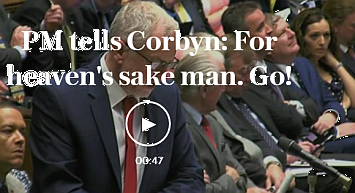
The ongoing coup against Jeremy Corbyn similarly has little to do with Europe. As an article in the Telegraph from June 13 confirms, Labour MPs and the Blairite wing of the party have been plotting an anti-Corbyn revolt for weeks, if not months, aiming to bring down their leftist leader in “a 24-hour blitz” after the referendum, regardless of its outcome. Again, this is not about the EU; it is about the incompetent lackeys of a crumbling neoliberal center trying to reclaim their hold over a party that was once Europe’s most enthusiastic cheerleader of neoliberalism, financialization and overseas military intervention, but that is now rapidly disintegrating — or realigning itself — in the face of an insurgent “hard” left.

In this respect, Blair’s apocalyptic reference to Yeats in his New York Times opinion piece was awkwardly on point: things are falling apart; the center cannot hold. This is the crux of the matter, and it helps explain the hysterical doomsday discourse of the centrist establishment: their globalized post-democratic fantasy world is crumbling before their very eyes, as their once-passive voter-cum-consumer base is suddenly gobbled up and mobilized by a motley crew of “angry populists” who thrive on the electoral spoils of a crippling legitimation crisis and feast on the popular discontent sowed by years of austerity and decades of neoliberal restructuring.

The answer to the steady disintegration of the established political order clearly cannot be more of the same. Against Blair’s hopeless cries that “the center must hold”, and against the thinly-veiled conspiracies of his neoliberal acolytes in Parliament — who are now closing in on Jeremy Corbyn in a last-ditch attempt to reclaim the Labour Party and destroy from within, once and for all, the only political force that could possibly pose an electoral counterweight to the far-right in this defining moment in British history — against all of these turncoats, the left must stand firm and insist: the center will fall.

But to avoid ceding the resulting void to the racists and reactionaries, the weakened and dispersed forces of the left will need to rally in face of the historic battles now coming their way. Despair as one may, this means the choice is now fairly straightforward: it’s Corbyn or nothing. Not because the embattled Labour leader will bring democratic socialism or fully automated luxury communism to a newly independent Britain, but because this decent, principled leftist is now the only bulwark still standing between ordinary working people of all colors, and the monsters that are about to be unleashed on them.

About the author:

Jerome Roos is the founder and editor of ROAR Magazine, and a researcher in International Political Economy at the European University Institute. For more on his research and writings, visit jeromeroos.com.

LONDON CALLING! The DNC in England on ‘hols’

By Daniel Hopsicker

Source: MadCowNews

Primaries polished off, the Democratic National Committee has apparently decided to pop over to swinging London on holiday.  Because what’s happening right now in Great Britain explains how Bernie Sanders somehow “lost” the California Democratic primary to a candidate who couldn’t fill a high school auditorium there without trucking in busloads of middle-aged white women wearing boxy pantsuits and smug smiles.

What’s happening in London puts what happened in California in the context of globalization.

hols

Voting in the “Brisket” Referendum

They were voting on “Brisket,” the surprisingly highly-contested election about choosing the Best BBQ in the UK.

In the end, newspaper columnists were shocked by the voter’s bad taste. Members of the commentariat were said to be absolutely appalled, especially at a few sneers and dirty looks conflated into a rise in racist and anti-immigrant hate crimes, like the non-existent chairs that weren’t thrown after the Nevada Democratic convention.

Disinformation acknowledges no borders, knows no terrestrial bounds!

“The Brexit vote has precipitated the deepest political crisis in Britain in a generation. The nation is divided and the climate is lurching dangerously towards the far right. At this critical moment for the future of the country, the Blairites have opportunistically mounted an anti-Corbyn coup. They have been incubating this coup from day one despite Corbyn’s overwhelming mandate.”

Some guy Americans have never heard of—or if they’ve heard of him don’t know how to pronounce his name— named Jeremy Corbyn, head of the Labor Party (only they spell it “Labour,” like teen-aged girls spelling their names cute: “That Cyndy! She’s special!”

Dozens of Labour Members of Parliament (confusing, don’t they know “MP’” stands for Military Police?) want this Corbyn guy to resign.

It seems they never liked him from the get-go, and would have shrugged him off long before now, except he won a massive victory from the Party’s rank-and-file in an election.

And now he won’t go!

mod

I thought, OMG! He’s just like Bernie!

And that’s when everything began to make sense.

The ‘objective correlative’ 

Remember how just after the California primary everything looked very “Through the Looking Glass? Remember? Bernie Sanders drawing monster crowds all up and down California… and then going on to “defeat” in the Democratic Presidential primary?

Losing to a candidate who couldn’t fill a third-grade classroom without sprinkling the crowd with California Democratic officials?

hill

Sure ya do, mate.


“Mister Peabody Almost Goes to Washington”

We’ve all seen the movie. A candidate barnstorms across the state. Draws multitudes. Enthusiastic slogans chanted all around.

11

Election night is always the next scene in the montage. Basking in the approval of an excited crowd at a victory party roaring in celebration. The candidate waves for quiet (who are they kidding? Everyone knows they don’t mean it.)

But not this time. Not in California. Lucy picked up the football, took it home. It was DEFLATE-GATE  writ large.


Romeo wakes up, sees Juliet dead, tears all around. 

Many thought, “I must be dreamin’. This can’t be real.” Because there was no “objective correlative” to help bring sense to the experience. No recognizable human moment, as in “Romeo wakes up, sees Juliet dead, tears all around.”

bb

On Youtube, a baby struggles to stand; we all smile. Watch a toddler stumble across a room, swaying side to side like a drunk on a gambling cruise unexpectedly caught in high seas.

We silently urge the drooling little thing on. “Trust your tiny gyroscope, diapered one. In your forehead. Behind your Third Eye.”

There was no recognizable human moment in California, nor many of the other Democratic primaries.

Just a sinking feeling that—once again—we’ve been had.


Hey! That sinking feeling! Stay outta London 

But the jury’s still out on London.

“A massive show of support for Jeremy Corbyn has left the coup coalition of media pundits and disgruntled MPs with their jaws to the floor. With only 24 hours notice, over 10,000 people marched on parliament square to reinforce the Labour leader’s unprecedented democratic mandate.”

sup

Being Britain, things quickly got snarky.

gotime


We wish them well. They’re a plucky bunch. Some have even had their lips surgically removed, which must be a pretty painful procedure.

lip

Brexit Is What Happens When the Pie Is Shrinking

brexit-uk-leaving-eu

By Charles Hugh Smith

Source: Of Two Minds

This process of withdrawal into the relative safety of internally cohesive groups and group identities is intrinsically messy in globalized, multicultural societies.

A great many narratives are drifting around the Brexit pool: a return to sovereignty, class war, “controlled demolition,” nothing-but-another-political-Kabuki- spectacle, end of the European Union, etc.

I think it boils down to something much simpler: the pie is shrinking, and the illusion that it’s about to start growing has been shattered. For many communities in the developed world, the pie started shrinking in the 1970s, and has been shrinking (despite the narrative of “45 years of strong growth”) since then.

Labor’s share of the GDP has been declining for 45 years. Occasional blips higher during debt-fueled bubbles quickly fade when the bubble du jour pops, and the decline of labor’s share of the economy resumes its trendline decline.

wages-GDP5-16a

Since 2008, the only group who feels the pie is growing is the class that has benefited from the unparalleled expansion of debt and leverage, financialization, globalization and central planning–roughly 20% of the work force, with the top 5% gathering most of the gains in income and wealth, and the top .1% gathering most of the increase in wealth. (See chart below)

For seven long years, the citizenry has been told the economy is expanding and therefore they’re “doing better.” But this narrative is not supported by their actual lived experience. Inflation is woefully under-reported by official statistics, and the rosy “rising employment” narrative is based largely on part-time jobs in hospitality and food services (bartenders, waiters, etc.) that are highly contingent on the spending of the top 10%.

While supporters of the status quo are quick to deride supporters of Brexit, the cold reality is the economic pie is shrinking, and Brexit is a direct result of that reality.

A shrinking economic pie generates widespread insecurity that pressures every status quo arrangement as people circle the wagons in an attempt to protect their remaining slice of the pie from others’ claims for a larger piece of the dwindling pie.

The general media line is that the Brexit vote arose out of anger with the status quo’s inequalities and asymmetries of wealth and power. While this is largely self-evident, it isn’t the most fundamental dynamic at work. I see Brexit as a reflection of our naturally-selected defensive response to insecurity and instability: circle the wagons.

By circle the wagons, I mean our tendency to withdraw into an internally cohesive group with defined membership and boundaries.

The largest such political group is the nation-state, and so it is natural for people with strong national identities to circle the wagons around their national identity.

We can also expect people to circle the wagons around ethnic, religious, localized and economic-social class identities. (Some people might feel more kinship with other fans of Manchester United than they do with any religion, ethnicity or state.)

As people identify themselves as members of the class that has not benefited from neoliberal/globalized crony capitalism, the ruling Elites become the “other,” i.e. “foreigners” with whom we have little contact, people who “aren’t like us”– in effect, an “enemy class” that is inherently opposed to our self-interests.

This process of withdrawal into the relative safety of internally cohesive groups and group identities is intrinsically messy in globalized, multicultural societies. No wonder populations are dividing into camps of increasingly angry people with little interest in compromise. Our instinct is to seek clear delineations of “us” and “them” and to seek the relative comfort of “us,” which in a multicultural nation, can contain quite a mixed bag of people who nonetheless feel a shared identity.

Much to the chagrin of political parties whose success is based solely on “identity politics,” the emerging group identities are not conforming to the political classes’ conventional fault lines. “Us” for many people includes everyone who isn’t a protected insider of the status quo, and “the enemy” is any protected insider of the status quo.

That includes virtually the entire political class, the entire class of state nomenklatura/technocrats, the entire banking sector and the wealthy class that’s benefited so handsomely from the globalized, debt-leverage bubbles and state / central bank support that characterize this era of neoliberal/globalized crony capitalism.

wage-inequality3-16a

wealth-distribution10-15a

A Radically Beneficial World: Automation, Technology and Creating Jobs for All is now available as an Audible audio book.


This Is Our Neoliberal Nightmare: Hillary Clinton, Donald Trump, and Why the Market and the Wealthy Win Every Time

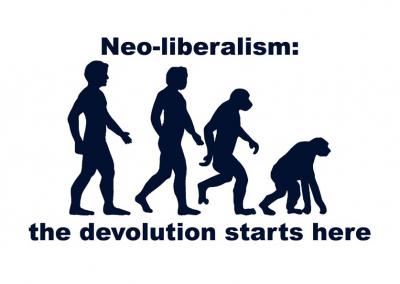
neo_liberalism_devolution_via_permanentculturenow.com_

The rage driving our politics stems from cruelty of capitalism. So why do we vote for those who worship the market?

By Anis Shivani

Source: AlterNet

Over the last fifteen years, editors often asked me not to mention the word “neoliberalism,” because I was told readers wouldn’t comprehend the “jargon.” This has begun to change recently, as the terminology has come into wider usage, though it remains shrouded in great mystery.

People throw the term around loosely, as they do with “fascism,” with the same confounding results. Imagine living under fascism or communism, or earlier, classical liberalism, and not being allowed to acknowledge that particular frame of reference to understand economic and social issues. Imagine living under Stalin and never using the communist framework but focusing only on personality clashes between his lieutenants, or likewise for Hitler or Mussolini or Mao or Franco and their ideological systems! But this curious silence, this looking away from ideology, is exactly what has been happening for a quarter century, since neoliberalism, already under way since the early 1970s, got turbocharged by the Democratic party under the Democratic Leadership Council (DLC) and Bill Clinton. We live under an ideology that has not been widely named or defined!

Absent the neoliberal framework, we simply cannot grasp what is good or bad for citizens under Cruz versus Trump, or Clinton versus Sanders, or Clinton versus Trump, away from the distraction of personalities. To what extent does each of them agree or disagree with neoliberalism? Are there important differences? How much is Sanders a deviation? Can we still rely on conventional distinctions like liberal versus conservative, or Democrat versus Republican, to understand what is going on? How do we grasp movements like the Tea Party, Occupy, and now the Trump and Sanders insurgencies?

Neoliberalism has been more successful than most past ideologies in redefining subjectivity, in making people alter their sense of themselves, their personhood, their identities, their hopes and expectations and dreams and idealizations. Classical liberalism was successful too, for two and a half centuries, in people’s self-definition, although communism and fascism succeeded less well in realizing the “new man.”

It cannot be emphasized enough that neoliberalism is not classical liberalism, or a return to a purer version of it, as is commonly misunderstood; it is a new thing, because the market, for one thing, is not at all free and untethered and dynamic in the sense that classical liberalism idealized it. Neoliberalism presumes a strong state, working only for the benefit of the wealthy, and as such it has little pretence to neutrality and universality, unlike the classical liberal state.

I would go so far as to say that neoliberalism is the final completion of capitalism’s long-nascent project, in that the desire to transform everything—every object, every living thing, every fact on the planet—in its image had not been realized to the same extent by any preceding ideology. Neoliberalism happens to be the ideology—unlike the three major forerunners in the last 250 years—that has the fortune of coinciding with technological change on a scale that makes its complete penetration into every realm of being a possibility for the first time in human history.

From the early 1930s, when the Great Depression threatened the classical liberal consensus (the idea that markets were self-regulating, and the state should play no more than a night-watchman role), until the early 1970s, when global instability including currency chaos unraveled it, the democratic world lived under the Keynesian paradigm: markets were understood to be inherently unstable, and the interventionist hand of government, in the form of countercyclical policy, was necessary to make capitalism work, otherwise the economy had a tendency to get out of whack and crash.

It’s an interesting question if it was the stagflation of the 1970s, following the unhitching of the United States from the gold standard and the arrival of the oil embargo, that brought on the neoliberal revolution, with Milton Friedman discrediting fiscal policy and advocating a by-the-numbers monetarist policy, or if it was neoliberalism itself, in the form of Friedmanite ideas that the Nixon administration was already pursuing, that made stagflation and the end of Keynesianism inevitable.

It should be said that neoliberalism thrives on prompting crisis after crisis, and has proven more adept than previous ideologies at exploiting these crises to its benefit, which then makes the situation worse, so that each succeeding crisis only erodes the power of the working class and makes the wealthy wealthier. There is a certain self-fulfilling aura to neoliberalism, couched in the jargon of economic orthodoxy, that has remained immune from political criticism, because of the dogma that was perpetuated—by Margaret Thatcher and her acolytes—that There Is No Alternative (TINA).

Neoliberalism is excused for the crises it repeatedly brings on—one can think of a regular cycle of debt and speculation-fueled emergencies in the last forty years, such as the developing country debt overhang of the 1970s, the savings and loan crisis of the 1980s, the Asian currency crisis of the 1990s, and the subprime mortgage crisis of the 2000s—better than any ideology I know of. This is partly because its very existence as ruling ideology is not even noted by the population at large, which continues to derive some residual benefits from the welfare state inaugurated by Keynesianism but has been led to believe by neoliberal ideologues to think of their reliance on government as worthy of provoking guilt, shame, and melancholy, rather than something to which they have legitimate claim.

It is not surprising to find neoliberal multiculturalists—comfortably established in the academy—likewise demonizing, or othering, not Muslims, Mexicans, or African Americans, but working-class whites (the quintessential Trump proletariat) who have a difficult time accepting the fluidity of self-definition that goes well with neoliberalism, something that we might call the market capitalization of the self.

George W. Bush’s useful function was to introduce necessary crisis into a system that had grown too stable for its own good; he injected desirable panic, which served as fuel to the fire of the neoliberal revolution. Trump is an apostate—at least until now—in desiring chaos on terms that do not sound neoliberal, which is unacceptable; hence Jeb Bush’s characterization of him as the “candidate of chaos.” Neoliberalism loves chaos, that has been its modus operandi since the early 1970s, but only the kind of chaos it can direct and control.

To go back to origins, the Great Depression only ended conclusively with the onset of the second world war, after which Keynesianism had the upper hand for thirty-five years. But just as the global institutions of Keynesianism, specifically the IMF and the World Bank, were being founded at the New Hampshire resort of Bretton Woods in 1944, the founders of the neoliberal revolution, namely Friedrich Hayek, Ludwig von Mises, Milton Friedman, and others were forming the Mount Pelerin Society (MPS) at the eponymous Swiss resort in 1947, creating the ideology which eventually defeated Keynesianism and gained the upper hand during the 1970s.

So what exactly is neoliberalism, and how is it different from classical liberalism, whose final manifestation came under Keynesianism?

Neoliberalism believes that markets are self-sufficient unto themselves, that they do not need regulation, and that they are the best guarantors of human welfare. Everything that promotes the market, i.e., privatization, deregulation, mobility of finance and capital, abandonment of government-provided social welfare, and the reconception of human beings as human capital, needs to be encouraged, while everything that supposedly diminishes the market, i.e., government services, regulation, restrictions on finance and capital, and conceptualization of human beings in transcendent terms, is to be discouraged.

When Hillary Clinton frequently retorts—in response to demands for reregulation of finance, for instance—that we have to abide by “the rule of law,” this reflects a particular understanding of the law, the law as embodying the sense of the market, the law after it has undergone a revolution of reinterpretation in purely economic terms. In this revolution of the law persons have no status compared to corporations, nation-states are on their way out, and everything in turn dissolves before the abstraction called the market.

One way to sum up neoliberalism is to say that everything—everything—is to be made over in the image of the market, including the state, civil society, and of course human beings. Democracy becomes reinterpreted as the market, and politics succumbs to neoliberal economic theory, so we are speaking of the end of democratic politics as we have known it for two and a half centuries. As the market becomes an abstraction, so does democracy, but the real playing field is somewhere else, in the realm of actual economic exchange—which isnot, however, the market. We may say that all exchange takes place on the neoliberal surface.

Neoliberalism is often described—and this creates a lot of confusion—as “market fundamentalism,” and while this may be true for neoliberal’s self-promotion and self-presentation, i.e., the market as the ultimate and only myth, as were the gods of the past, I would argue that in neoliberalism there is no such thing as the market as we have understood it from previous ideologies.

The neoliberal state—actually, to utter the word state seems insufficient here, I would claim that a new entity is being created, which is not the state as we have known it, but an existence that incorporates potentially all the states in the world and is something that exceeds their sum—is all-powerful, it seeks to leave no space for individual self-conception in the way that classical liberalism, and even communism and fascism to some degree, were willing to allow.

There are competing understandings of neoliberal globalization, when it comes to the question of whether the state is strong or weak compared to the primary agent of globalization, i.e., the corporation, but I am taking this logic further, I am suggesting that the issue is not how strong the state is in the service of neoliberalism, but whether there is anything left over beyond the new definition of the state. Another way to say it is that the state has become the market, the market has become the state, and therefore both have ceased to exist in the form we have classically understood them.

Of course the word hasn’t gotten around to the people yet, hence all the confusion about whether Hillary Clinton is more neoliberal than Barack Obama, or whether Donald Trump will be less neoliberal than Hillary Clinton. The project of neoliberalism—i.e., the redefinition of the state, the institutions of society, and the self—has come so far along that neoliberalism is almost beyond the need of individual entities to make or break its case. Its penetration has gone too deep, and none of the democratic figureheads that come forward can fundamentally question its efficacy.

I said almost. The reason why Bernie Sanders, self-declared democratic socialist, is so threatening to neoliberalism is that he has articulated a conception of the state, civil society, and the self that is not founded in the efficacy and rationality of the market. He does not believe—unlike Hillary Clinton—that the market can tackle climate change or income inequality or unfair health and education outcomes or racial injustice, all of which Clinton propagates. Clinton’s impending “victory” (whatever machinations were involved in engineering it) will only strengthen neoliberalism, as the force that couldn’t be defeated even when the movement was as large and transcendent as Sanders’s. Although Sanders doesn’t specify “neoliberalism” as the antagonist, his entire discourse presumes it.

Likewise, while Trump supporters want to take their rebellion in a fascist direction, their discomfort with the logic of the market is as pervasive as the Sanders camp, and is an advance, I believe, over the debt and unemployment melancholy of the Tea Party, the shame that was associated with that movement’s loss of identity as bourgeois capitalists in an age of neoliberal globalization. The Trump supporters, I believe, are no longer driven by shame, as was true of the Tea Party, and as has been true of the various dissenting movements within the Republican party, evangelical or otherwise, in the recent past. Rather, they have taken the shackles off and are ready for a no-holds barred “politically incorrect” fight with all others: they want to be “winners,” even at the cost of exterminating others, and that is not the neoliberal way, which doesn’t acknowledge that there can be winners and losers in the neoliberal hyperspace.

In the current election campaign, Hillary Clinton has been the most perfect embodiment of neoliberalism among all the candidates, she is almost its all-time ideal avatar, and I believe this explains, even if not articulated this way, the widespread discomfort among the populace toward her ascendancy. People can perceive that her ideology is founded on a conception of human beings striving relentlessly to become human capital (as her opening campaign commercialso overtly depicted), which means that those who fail to come within the purview of neoliberalism should be rigorously ostracized, punished, and excluded.

This is the dark side of neoliberalism’s ideological arm (a multiculturalism founded on human beings as capital), which is why this project has become increasingly associated with suppression of free speech and intolerance of those who refuse to go along with the kind of identity politics neoliberalism promotes.

And this explains why the 1990s saw the simultaneous and absolutely parallel rise, under the Clintons, of both neoliberal globalization and various regimes of neoliberal disciplining, such as the shaming and exclusion of former welfare recipients (every able-bodied person should be able to find work, therefore under TANF welfare was converted to a performance management system designed to enroll everyone in the workforce, even if it meant below-subsistence wages or the loss of parental responsibilities, all of it couched in the jargon of marketplace incentives).

The actual cost to the state of the AFDC program was minimal, but its symbolism was incalculable. The end of welfare went hand in hand with the disciplinary “crime bill” pushed by the Clintons, leading to an epidemic of mass incarceration. Neoliberalism, unlike classical liberalism, does not permit a fluidity of self-expression as an occasional participant in the market, and posits prison as the only available alternative for anyone not willing to conceive of themselves as being present fully and always in the market.

I believe that the generation of people—in their forties or older—supporting Hillary have already internalized neoliberal subjectivity, which they like to frame as realism or pragmatism, refusing for instance to accept that free college or health care are even theoretical possibilities. After all, they have maintained a measure of success in the past three or four decades after conceptualizing themselves as marketplace agents. Just as the Tea Party supporters found it intolerable that government should help irresponsible homeowners by bailing them out of unsustainable debt, the Clinton supporters hold essentially the same set of beliefs toward those who dare to think of themselves outside the discipline of the market.

I spoke of the myth of the market, as something that has no existence in reality, because none of the elements that would have to exist for a market to work are actually in place; this is even more true for neoliberalism than it was for the self-conscious annihilation of the market by communism, because at least in that system the market, surreptitiously, as in various Eastern European countries, kept making an appearance. But when the market takes neoliberal shape, i.e., the classical conceptions of the buyer and seller as free agents are gone, then radical inequality is the natural outcome. And inequality in the last four decades, as statistics for the U.S. and everywhere neoliberalism has made inroads prove beyond a doubt, has exploded, thereby invalidating neoliberalism’s greatest claim to legitimacy, that it brings about a general increase in welfare. So neoliberalism, to the extent that the inequality discourse has made itself manifest recently, must insist all the more vocally on forms of social recognition, what Clinton, for example, likes to call the “fall of barriers.”

Neoliberalism likes to focus on public debt—in the Clinton years debt reduction became a mania, though George W. Bush promptly spent all the accumulated surpluses on tax cuts for the wealthy and on wars of choice—rather than inequality, because the only way to address inequality is through a different understanding of public debt; inequality can only be addressed through higher taxation, which has by now been excluded from the realm of acceptable discourse—except when Sanders, Trump, or Jeremy Corbyn in England go off script.

So to recapitulate neoliberalism’s comprehensive success, let us note that we have gone from a liberal, Keynesian, welfare state to a neoliberal, market-compliant, disciplinary state.

Neoliberalism expects—and education at every level has been redesigned to promote this—that economic decision-making will be applied to all areas of life (parenthood, intimacy, sexuality, and identity in any of its forms), and that those who do not do so will be subject to discipline. Everyone must invest in their own future, and not pose a burden to the state or anyone else, otherwise they will be refused recognition as human beings.

This supposed economic “rationality” (though it is the greatest form of irrationality) applies to civil society as much as the state, so that none of the ideals of classical liberalism, or previous ideologies rooted in humanism, are valid any longer, the only value is the iteration of the market (as myth, not reality); in other words, neoliberalism, unlike the elevation of the individual in classical liberalism or the state in fascism or the collectivity in communism, has erected something, the market, that has no real existence, as the only god to serve! And it is just like a god, with an ethereal, unchallengeable, irrefutable, ubiquitous presence. Whatever in state policy does not serve market-conformity is to be banned and banished from memory (the secular scriptures are to be rewritten), which explains neoliberalism’s radical narrowing of public discourse, including the severance of identity politics from any class foundation.

Neoliberalism will continue to perpetuate reduced opportunity, because one of its characteristics—as in any system that wants to thrive on the world stage—is to constantly refine the field upon which the human subject can operate.

As such, those displaced workers who have suffered the most from the erosion of the old industries in the former manufacturing centers of the world are not even factors to contend with, they are invisible and cannot be part of the policy equation. To the extent that their actual presence is reckoned with, the economy can be said to have crashed; but the problem doesn’t arise because of the management of unemployment or underemployment statistics, unlike a housing crash which is palpable and cannot escape statistical definition.

The danger for neoliberalism—as is clear from the support of millions of displaced human beings for Trump—is that with each crisis neoliberalism sheds more workers, makes individuals and firms more “disciplined,” narrows the scope of opportunity even further. At times, the disciplining of the non-neoliberal other—as with the killing of Michael Brown or Eric Garner—explodes to surface consciousness in an unsavory way, so an expert manager like Clinton or Obama is required to tamp down the emotions of such unruly entities as Black Lives Matter which arise in response. If climate change, according to Clinton and her cohort, can and should have market solutions, then surely racial disparity, or police violence, should also have market solutions and no others; it is here that neoliberal multiculturalism, operating in the academy, is so insidious, because at the elite level it functions to validate market discourse, it does not step outside it.

The present breakdown of both major political parties can be explained by the frustration that has built up in the body politic over the past decade, because after the crash there was no sustained intellectual movement to question the myth of the market. The substitution of economic justice with identity politics is something Ralph Nader, Howard Dean, and now Bernie Sanders have contested in a humane manner, while the same process is at work, admittedly in an inhumane way, in the Trump phenomenon.

Thus, also, Hillary Clinton’s animus against free college education; that form of expansion of opportunity, which was a reality from the 1950s to the 1980s, cannot be allowed to return, human beings are supposed to invest in their own future earnings potential, they are not entitled to a transcendent experience without barriers manifesting in discipline and self-correction. Education, like everything else, including one’s own health, becomes an expensive consumer good, not a right, no longer an experience that might lead to a consciousness beyond the market but something that should be fully encapsulated by the market. If one is a capable market player, education as we have classically understood it becomes redundant.

Unlike the interregnum between 1945-1973, the rising tide—no matter the befuddlements Arthur Laffer and his fellow Reaganite ideologues proffered—does not lift all boats today, it is outside the logic of neoliberalism that it do so, so the idea of reforming neoliberalism, or what is often called “globalization with a human face,” is a rhetorical distraction. All of the policy innovations—interpreted as “socialism” by the Tea Partiers—offered by Barack Obama fall within the purview of neoliberalism, above all the Affordable Care Act, whose genesis was hatched in neoliberal think tanks decades ago.

It is important to note that neoliberal economic restructuring necessarily means social restructuring, i.e., a movement toward disciplinarity and away from liberalism; the disciplinarity can take a Bushian, Clintonian, or Trumpian form, but these are manifestations of the same tendency.

When wage growth is decoupled from economic growth (as it has been since Friedman and others inaugurated the revolution in the early 1970s), this means that the human subject is ripe for discipline. Furthermore, wage fairness cannot be rationally discussed (hence the obfuscation surrounding the $15 minimum wage orchestrated by Clinton and others) because the concept of the market has been disembedded from society; the market as abstraction, not a concrete reality, makes any notion of reform or restructuring impossible. Like the minimum wage, something like free child care also remains outside the bounds of discourse, because public policy cannot accommodate discussions that do not take the self-regulating market as unassailable myth.

What neoliberalism can accommodate is relentless tax cuts (Trump has already offered his huge tax cut plan, as Bush did as his first order of business), which only exacerbate the problem, leading to increasing concentrations of wealth. It has to be said, though, that Ted Cruz more comfortably fit the neoliberal paradigm, with his familiar calls for lower taxes along with reduced regulation and further limits on social welfare, whereas Trump shows, for now, some elements of apostasy. If neoliberalism were to get a Cruz, it would have no problem working with him, or rather, Cruz would have had no problem executing neoliberalism, beyond the surface dissimilarities from Hillary Clinton.

As Sanders has consistently noted, economic inequality leads to political inequality, which means that democracy, after a certain point, becomes only theoretical (viz. Citizens United and the electoral influence of such powerful entities as the Koch brothers). Both processes—economic inequality and political inequality—have accelerated after each downturn in the forty-five-year history of neoliberalism, therefore a downturn is always exciting, and even preordained, for a Bush, a Trump, or a Clinton. Again, economic inequality and political polarity (polarity is simply a manifestation of democracy having become dysfunctional) strongly correlate, and both have come to a head in this election.

Neoliberalism’s task, from this point on, is to mask and manage the increasing inequalities that are likely to befall humanity, especially as the planet reaches a crisis point in its health. In a way, George W. Bush threw a wrench—he was a perverted Keynesian in a way, believing in war to prime the pump, or inflating unsustainable bubbles, or spending exorbitantly on grandiose gestures—into the process of neoliberal globalization that was going very smoothly indeed under Bill Clinton and would likely have flourished under Al Gore as well. With Hillary Clinton, the movement will be toward further privatization of social welfare, “reforming” it along market principles, as has been true of every neoliberal avatar, whether it was Bill Clinton’s incentives to work in the performance management makeover of welfare, George Bush’s proposed private social security accounts, Mitt Romney’s proposed private health care accounts, or the school vouchers that tempt all of them from time to time.

What remains to be seen is the extent to which the millennial generation might be capable of thinking outside the neoliberal paradigm, i.e., they don’t just want more of what neoliberal promises to give them yet fails to deliver, but want things that neoliberalism does not or cannot promise. On this rests the near-term future of the neoliberal project.

Beyond Sanders himself, the key question is the ability of the millennial generation to conceive of themselves outside the neoliberal subjectivity they have been pushed to internalize. They have been encouraged to think of themselves as capital producers, turning their intellectuality into social media popularity for the benefit of capital, in the service of the same abstract market that has no place, no role, no definition beyond the fallen liberal calculus. Does the millennial generation believe, even about its most intimate core, that everything has been privatized?

I am not necessarily making a pessimistic prediction. I am merely outlining the strength of an opponent that has refused to be named for forty-five years, although it has been the ruling ideology that long! In defining neoliberalism, I have sought to distance myself from the distraction of personalities, and tried to expose the dark side of our politics which we can only see when we name and understand the ideology as such. We are up against a system that is so strong that it has survived, for the most part, the last crash, as citizens couldn’t get their heads around the idea of nationalizing banks or health care.

It is existentially imperative to ponder what happens beyond Sanders, because neoliberalism has its end-game in sight, letting inequality continue to escalate past the crash point (meaning the point where the economy works for most people), past any tolerable degradation of the planet (which is being reconceptualized in the shape of the market).

What, indeed, does happen beyond Sanders, because as we have seen Hillary Clinton is one of the founders of neoliberal globalization, one of its central historical figures (having accelerated the warehousing of the poor, the attack on trade unions, and the end of welfare and of regulatory prowess), while Trump is an authoritarian figure whose conceptions of the state and of human beings within the state are inconsistent with the surface frictionlessness neoliberalism desires? To go back to Hillary Clinton’s opening campaign commercial, to what extent will Americans continue to believe that the self must be entrepreneurially leveraged toward maximum market gains, molded into mobile human capital ever ready to serve the highest bidder?

As to whether a non-neoliberal globalization is possible and what that might look like on the international stage after a quarter-century of Clinton, Bush, and Obama—which is essentially the frustration Trump is tapping into—I’ll take that up in a follow-up essay, which will further clarify the differences between Sanders versus Clinton, and Trump versus Clinton.

I would suggest that it is not that globalization causes or has caused neoliberalism, but that neoliberalism has pushed a certain form of globalization that suits its interests. This is a crucial distinction, on which everything else hinges. The neoliberal market doesn’t actually exist; at the moment it is pure abstraction; what is actually filling up economic and political space can only be discussed when we step away from this abstraction, as Sanders has so ably done, and as the Occupy and Black Lives Matter movements tentatively set in motion.

 

Anis Shivani is the author of several books of fiction, poetry, and criticism, including, most recently, My Tranquil War and Other Poems. His novel Karachi Raj (HarperCollins/Fourth Estate) was released this summer. His next book is the poetry collection Whatever Speaks on Behalf of Hashish, out in October.

Wasserman Schultz Has a Change of Heart, but Too Little, Too Late

debbie-wasserman-schultz

Just follow the money on this one.

By Bill Moyers and Michael Winship

Source: Alternet

Return with us now to the saga of Debbie Wasserman Schultz and the soul of the Democratic Party.

First, a quick recap: Rep. Wasserman Schultz (D-FL), chair of the Democratic National Committee, also has been an advocate for the payday loan industry. The website Think Progress even described her as the “top Democratic ally” of “predatory payday lenders.” You know — the bottom-feeding bloodsuckers of the working poor. Yes, them.

Low-income workers living from paycheck to paycheck, especially women and minorities, are the payday lenders’ prime targets — easy pickings because they’re often desperate. Twelve million Americans reportedly borrow nearly $50 billion a year through payday loans, at rates that can soar above 300 percent, sometimes even beyond 500 percent. Bethany McLean at The Atlantic recently reported that the government’s Consumer Financial Protection Bureau (CFPB) studied millions of payday loans and found that “67 percent went to borrowers with seven or more transactions a year and that a majority of those borrowers paid more in fees than the amount of their initial loan.”

Yet when the CFPB was drawing up new rules to make it harder for payday predators to feast on the poor, Rep. Wasserman Schultz co-sponsored a bill to delay those new rules by two years. How, you ask, could the head of the party’s national committee embrace such an appalling exploitation of working people?

Just follow the money. Last year, the payday loan industry spent $3.5 million lobbying; and as we wrote two weeks ago, in Wasserman Schultz’s home state, since 2009, payday lenders have bought protection from Democrats and Republicans alike by contributing $2.5 million or so to candidates from both parties, including her. That’s how “Representative” Wasserman Schultz, among others, wound up representing the predators instead of the poor.

That position became a major issue in her campaign for reelection to the House this year — she has a primary opponent for the first time since she entered Congress — and was even threatening the prospect of her continuing as DNC chair and presiding over the Democratic National Convention next month in Philadelphia. More than 40,000 have signed a petition calling for her removal from that post.

She had become a symbol of the failure of Democratic elites to understand that there is an uprising in the land. Millions of Americans are rebelling against the leadership of both parties. They are fed up with inside-the-Beltway politicians who pay only lip service to the deep needs of everyday people and the country; fed up with incumbents who ask for their votes, are given them in good faith, and then return to Washington to do the bidding of the donor class and its lobbyists.

Donald Trump gets it. He has roiled and humiliated and conquered an out-of-touch Republican establishment in Washington that also ignored the popular uprising against corporate domination and crony capitalism, and now GOP titans such as Senate Majority Leader Mitch McConnell and Speaker of the House Paul Ryan, spear carriers for Big Money, are being hauled around the talk-show circuit in Trump’s tumbrel, eating crow and swearing fealty to the misogynistic, bigoted and pathologically lying brute who bestrides their party.

Democratic insiders like Wasserman Schultz, however, continued to whistle past the graveyard, believing that the well-funded and well-connected Clinton machine — and general fear of a Trump regime — were enough to carry them to victory in November, despite the grass-roots disgust with a party that reeks of rot from the top. Once the champions of people who came home from work with hands dirty from toil and sweat, too many establishment Democrats went over to the dark side, taking up the cause of the well-manicured executives (think: Goldman Sachs) who write the checks and the mercenaries who deliver them (for a substantial cut, of course).

The lust for loot, which now defines the Democratic establishment, became pronounced in the Bill Clinton years, when the Clinton-friendly Democratic Leadership Council (DLC) abandoned its liberal roots and embraced “market-based solutions” that led to deregulation, tax breaks, and subsidies for the 1 percent. Seeking to fill coffers emptied by the loss of support from a declining labor movement, Democrats rushed into the arms of big business and crony capitalists.

Another case in point (and, alas, there are many): the Democratic governor of Connecticut, Dan Malloy, who seems to treat his state’s corporate residents far better than the 1 in 10 of his citizens who live at or below the poverty line.

At International Business Times last week, investigative reporter David Sirota analyzed the proposed merger of Cigna and Anthem Blue Cross Blue Shield, a deal that would create the biggest health insurance company in the country. Cigna is based in Connecticut and Katharine Wade, the state’s insurance commissioner, appointed by Governor Malloy, is a former Cigna lobbyist with deep family ties to the company.

Sirota reported, “Malloy’s decision to appoint Wade to such a powerful regulatory post on the eve of the merger was not made in a vacuum,” Sirota reported. “It came after employees of Cigna, its lobbying firm Robinson & Cole and Anthem delivered more than $1.3 million to national and state political groups affiliated with Malloy, including the Democratic Governors Association (DGA), the Connecticut Democratic Party, Malloy’s own gubernatorial campaign and a political action committee supporting Connecticut Democrats [our italics].

“Since Malloy’s first successful run for governor in the 2010 election cycle, donors from the insurance companies and the lobbying firm have given more than $2 million to Malloy-linked groups, according to the figures compiled by PoliticalMoneyLine and the National Institute on Money In State Politics. Almost half that cash has come in since 2015, the year the merger was announced.”

Sirota now reports that since his investigation first was published, the state has “formally denied open records requests for information about their meetings with Cigna and Anthem, and declared that ‘any’ documents about the health insurance companies’ proposed merger that haven’t already been made public will be kept secret.” His FOIA request was turned down “one day after Anthem requested [state insurance commissioner] Wade approve an average 26 percent increase in health insurance premiums for individual plans.” So much for transparency.

And while we’re in Connecticut, let’s also take a look at what Malloy is doing for the world’s biggest hedge fund — Bridgewater Associates, based in his state, with an estimated worth of $150 billion. The founder of the firm, Ray Dalio, is the richest man in Connecticut, by one estimate weighing in at $14.3 billion.

Dalio made $1.4 billion in 2015 alone, according to Institutional Investor’s Alpha magazine. That same year, his top two executives pulled in $250 million each. Yet as part of Connecticut’s campaign to keep companies from leaving the state, Malloy is taking $22 million of the public’s money and giving it to Dalio to stay put.

You might think a Democratic governor would have thrown down the gauntlet and told Bridgewater’s top three, “Get outta here! You guys made almost $2 billion among yourselves. Shake your piggy bank or look under your sofa cushions for the $22 million; we’re not milking the public for it.”

But no, Malloy and his fellow Democrats buckled. Buckled to the one-tenth of the one-tenth of the one-hundredth percent of the rich. Ordinary taxpayers will now ante up.

So given all of that, guess who’s the chairman of the platform committee for the upcoming Democratic National Convention? Right: Dan Malloy, governor of Connecticut, subsidizer of billionaires. Guess who named him? Right again: Wasserman Schultz, “top Democratic ally” of “predatory payday lenders.” We’re not making this up.

Not only will Malloy be presiding over the priorities of the Democratic platform at the convention next month, he doubtless will be making the rounds with Wasserman Schultz and other party elites as they genuflect before the corporate sponsors and lobbyists she has invited to pay for the lavish fun-and-games that will surround the coronation. Many of those corporate sponsors and lobbyists have actively lobbied against progressive policies like health-care reform and a Wall Street cleanup and even contributed large sums to Republicans. Yes, we know, shocking.

So take the planks in the platform and the platitudes and promises in the speeches with a grain of salt. It’s all about the money.

Except when it’s not. Except for those moments when ordinary people rise up and declare: “Not this time!”

Which brings us back to predatory lenders and their buddy, Debbie Wasserman Schultz.

Look around: There’s an uprising in the land, remember, and it isn’t going away after Hillary Clinton, now the presumptive nominee, is crowned. This year even Wasserman Schultz couldn’t ignore the decibel level of an aroused public. Unaccustomed to a challenge in the Democratic “wealth primary” where money usually favors incumbents, she now finds herself called to account by an articulate opponent who champions working people, Tim Canova. Across the country tens of thousands of consumer advocates — and tens of thousands of other progressives angry at her perceived favoritism toward Hillary Clinton — have been demanding that Wasserman Schultz resign as the party’s chair or be dumped before the convention opens Philadelphia.

So last week the previously tone-deaf Wasserman Schultz perked up, did an about-face and announced she will go along with the proposed new rules on payday lending after all. At first blush, that’s good; the rules are a step in the right direction. But all that lobbying cash must have had some effect, because the new rules only go so far. A New York Times editorial calls them “a lame response” to predatory loans and says the final version of the new regulations “will need stronger, more explicit consumer protections for the new regulatory system to be effective.”

Nick Bourke, director of small-dollar loans for the Pew Charitable Trusts, is a man who closely follows these things and got to the heart of the matter: Not only do the proposed new rules “fall short,” they will allow payday lenders to lock out attempts at lower-cost bank loans.

His judgment is stark: “As drafted, the CFPB rule would allow lenders to continue to make high-cost loans, such as a line of credit with a 15-percent transaction fee and 299-percent interest rate, or a $1,250 loan on which the borrower would repay a total of $3,700 in fees, interest and principal,” Bourke wrote. “These and many other high-cost payday installment loans are already on the market in most states, and they will thrive if the regulation takes effect without change.”

Nonetheless, the new rules were improvement enough for Allied Progress, an organization that has taken on Wasserman Schultz in Florida’s late August primary, to declare victory. And they were enough for Wasserman Schultz to do a 180-degree turn which she clearly hopes will not too dramatically reveal her hypocrisy. “It is clear to me,” she said, “that the CFPB strikes the right balance and I look forward to working with my constituents and consumer groups as the CFPB works toward a final rule.”

All well and good, but if she survives her primary to return to Washington, be sure to keep the lights on in those rooms where the final version of the rules are negotiated. A powerful member of Congress with support from a Democrat in the White House could seriously weaken a law or a rule when the outcome is decided behind closed doors and money whispers in the ear of a politician supplicant: “I’m still here. Remember. Or else.”

But the times, they really may be a-changing, as the saga of Wasserman Schultz reveals. You can be deaf to the public’s shouts for only so long. The insurgency of popular discontent that has upended politics this year will continue no matter the results in November. For much too long now it’s been clear that money doesn’t just rule democracy, it is democracy.

Until we prove it isn’t.

After Empowering the 1% and Impoverishing Millions, IMF Admits Neoliberalism a Failure

neoliberalizam

By

Source: CounterPunch

Last week a research wing of the International Monetary Fund came out with a report admitting that neoliberalism has been a failure. The report, entitled, “Neoliberalism: Oversold?” is hopefully a sign of the ideology’s death. They were only about 40 years late. As Naomi Klein tweeted about the report, “So all the billionaires it created are going to give back their money, right?”

Many of the report’s findings which strike to the core of the ideology echo what critics and victims of neoliberalism have been saying for decades.

“Instead of delivering growth,” the report explains that neoliberal policies of austerity and lowered regulation for capital movement have in fact “increased inequality.” This inequality “might itself undercut growth…” As a result, the report states that “policymakers should be more open to redistribution than they are.”

However, the report leaves out a few notable items on neoliberalism’s history and impact.

The IMF suggests neoliberalism has been a failure. But it has worked very well for the global 1%, which was always the IMF and World Bank’s intent. As Oxfam reported earlier this year, the wealthiest 1% in the world now has as much wealth as the rest of the planet’s population combined. (Similarly, investigative journalist Dawn Paley has proven in her book Drug War Capitalism that far from being a failure, the Drug War has been a huge success for Washington and multinational corporations.)

The IMF report cites Chile as a case study for neoliberalism, but never mentions once that the economic vision was applied in the country through the US-backed Augusto Pinochet dictatorship – a major omission which was no casual oversight on the part of the researchers. Across Latin America, neoliberalism and state terror typically went hand in hand.

The fearless Argentine journalist Rodolfo Walsh, in a 1977 Open Letter to the Argentine Military Junta, denounced the oppression of that regime, a dictatorship which orchestrated the murder and disappearance of over 30,000 people.

“These events, which stir the conscience of the civilized world, are not, however, the greatest suffering inflicted on the Argentinean people, nor the worst violation for human rights which you have committed,” Walsh wrote of the torture and killing. “It is in the economic policy of this government where one discovers not only the explanation for the crimes, but a greater atrocity which punishes millions of human beings through planned misery. . . . You only have to walk around greater Buenos Aires for a few hours to check the speed with which such a policy transforms the city into a ‘shantytown’ of ten million people.”

This “planned misery,” as Naomi Klein’s Shock Doctrine vividly demonstrates, was the neoliberal agenda the IMF has pushed for decades.

The day after Walsh mailed the letter to the Junta he was captured by the regime, killed, burned, and dumped into a river, one of neoliberalism’s millions of casualties.


Benjamin Dangl has worked as a journalist throughout Latin America, covering social movements and politics in the region for over a decade. He is the author of the books Dancing with Dynamite: Social Movements and States in Latin America, and The Price of Fire: Resource Wars and Social Movements in Bolivia. Dangl is currently a doctoral candidate in Latin American History at McGill University, and edits UpsideDownWorld.org, a website on activism and politics in Latin America, and TowardFreedom.com, a progressive perspective on world events. Twitter: https://twitter.com/bendangl Email: BenDangl(at)gmail(dot)com