Saturday Matinee: Soldier/Demon With a Glass Hand

“Soldier” and “Demon With a Glass Hand” (both 1964) are two classic Outer Limits episodes with screenplays by science fiction author Harlan Ellison. Both take place in the shared universe of the Earth-Kyba War, a backdrop Ellison also used for a series of stories compiled in the graphic novel anthology “Night and the Enemy” as well as the short story “The Human Operators” which became an episode of the New Outer Limits. Soldier is notable for being the screenplay for which Ellison filed a lawsuit against producers of The Terminator for plagiarism. Demon With a Glass Hand features an excellent performance from Robert Culp as a man who carries the burden of being the last chance for humanity’s survival. Most of the episode’s action takes place in the Bradbury Building (most famous for the final scenes in Blade Runner) which adds to its creepy atmosphere.

Saturday Matinee: The Twilight Samurai

“The Twilight Samurai” (aka Tasogare Seibei たそがれ清兵衛, 2002), is a realist Samurai drama co-written and directed by Yoji Yamada set in mid-19th century Japan. It stars Hiroyuki Sanada as Seibei, a low-ranking samurai widower struggling to support his daughters and dementia-afflicted mother, who is forced by his clan’s leaders to kill a skilled rogue samurai. The film was inspired by the short story “The Bamboo Sword” by Shuhei Fujisawa and was groundbreaking for its approach to the genre; a samurai equivalent to a revisionist western.

Watch the full film here.

Saturday Matinee: An Open Secret

“An Open Secret” (2014) is a documentary film about Hollywood child sexual abuse directed by Amy Berg (Deliver Us From Evil). The film features interviews with victimized performers, who were targeted when they were young boys (including Corey Feldman and Todd Bridges), as well as industry figures, the predators themselves, and journalists. The documentary originally had a very limited theatrical run and has never had a home video release causing widespread suspicion that there was a campaign to bury the film. Regardless, according to Wikipedia a pirated version was viewed at least 900,000 times. Due to the exposure of Harvey Weinstein and other Hollywood sexual predators, on October 12 2017 the film was made available for free for nine days on Vimeo. Because it went viral, with over 3 million viewings on various social media platforms in two weeks, the free viewing period has been extended until early November.

Watch the full film for free for a limited time here: https://vimeo.com/142444429

Revolutionary Terror: Mark Steven’s ‘Splatter Capital’

By Michael Grasso

Source: We Are the Mutants

Splatter Capital: The Political Economy of Gore Films
By Mark Steven
Repeater Books, 2017

“Splatter confirms and redoubles our very worst fears. It reminds us of what capital is doing to all of us, all of the time—of how predators are consuming our life-substances; of how we are gravely vulnerable against the machinery of production and the matrices of exchange; and of how, as participants of an internecine conflict, our lives are always already precarious.”

—from the Introduction to Splatter Capital

Political readings or interpretations of horror films are nothing new. But in Mark Steven’s 2017 study, Splatter Capital, an explicit connection is made between the bloody gore of what Steven terms “splatter” horror films and the dehumanizing, mutilative forces of global capitalism. Moreover, Steven posits the artistic motivation behind splatter horror as an explicit repudiation of this system: “It is politically committed and its commitment tends toward the anti-capitalist left.” In splatter films, Steven tells us, the images of gory dismemberment do double duty. They both offer a clear metaphor for capitalism’s cruelty, and act as a cathartic revenge in which the bloody legacy of capitalist exploitation is often visited upon its perpetrators and profiteers among the bourgeoisie.

Some definitions are in order here, given that Steven’s schema of genres—“splatter,” “slasher,” “extreme horror”—draws distinctions that might not be apparent even to horror fans. Splatter horror, according to Steven, is all about the violence that can be visited upon the human body and all the abjection that follows. It is machinery tearing apart flesh, blood, and guts: the moment a human body becomes meat. It differs from the personalized and often sexualized “hunt” of the slasher flick. The protagonist in a slasher movie is an individual (often female) resisting violent death at the hands of another individual (often male). In victory against Jason, Freddy, or Michael Myers, this protagonist, in Steven’s words, “restores a social order, which is all too regularly white, middle-class, and suburban.” Splatter horror not only expands the horizons of mutilation and violence allowable in a horror film but systematizes it. The splatter enemy is an implacable, impersonal force, full of shock and awe; its grudge is not personal, but instead overwhelming, inescapable, and, most importantly, class-based.

The language of violence and horror has been with Marxist thought from the beginning. Steven gives us a good précis of Marx’s use of explicitly Gothic (along with bloody and cannibalistic) imagery throughout his works, as well as a splatter-tastic explanation of the exploitation behind surplus value, using an imaginary case study in the manufacturing of chainsaws and knives. The October Revolution in Russia is viewed as a reaction to the inhuman mechanized slaughter of the first World War; Eisenstein’s early filmic paeans to the necessity of revolution such as Strike (1925) demonstrate, thanks to Eisenstein’s pioneering use of montage, capitalism’s role as butcher. Steven also discusses avowed leftist filmmakers from outside the Soviet Union such as Godard, Makavejev, and Pasolini—specifically their use of gore to embody the cruelty of the ruling classes.

As we enter the world of Hollywood film in Chapter Three, Steven examines splatter film as a specifically American reaction to the constant churning crisis of capitalism. Specifically, Steven looks at the two peaks of gore-flecked horror—the mid ’60s through the early ’80s, and the post-Cold War “torture porn” trend of the early ’00s—as expressions of two very important economic and political shifts. The first splatter peak in the ’70s is seen as a clear reaction to the slow, inexorable widening of neoliberal and globalist postindustrial economics and its impact on the American industrial worker. (The aftermath of this trend continues into the 1980s with the evaporation of industry and the establishment of a new information-and-finance-based economy.) The splatter/torture porn trend of the ’00s and beyond is a reaction to the crises of capitalism under a new world order of neocolonialist conflict: the War on Terror, the final disestablishment of the Western industrial base in favor of cheap labor in the developing world, and the new interconnected, networked world’s rulership by speculative capital in the form of the finance sector.

Steven cites too many splatter movies to cover in this review, but central to his thesis is the seminal 1974 Tobe Hooper film, The Texas Chain Saw Massacre. The death of local industry leads Leatherface and family to keep their slaughterhouse traditions alive by carving up and eating young people. These young people, Steven is quick to point out, are only here at all because they were unable to get gas for their car (thanks to the first of two 1970s oil crises). American decline is everywhere; betrayal by global economic forces are central to the trap that’s being laid by the cannibals. (Of course, the carnage of the Vietnam War can’t be overlooked here either, given the visual language of ambush, capture, and torture; Hooper himself has cited this in subsequent interviews.) Steven notes that the victims in The Texas Chain Saw Massacre are representative of a bourgeoisie who don’t know how the sausage is made. It’s important and vital, Steven says, that the cannibalistic side of splatter involves the bourgeoisie being forced to eat members of their own class. It’s Burroughs’s famous “naked lunch“: “the frozen moment when everyone sees what is at the end of every fork.”

As the neoliberal takeover of the world economy begins in earnest in the 1980s, as complex and largely ephemeral systems of mass media and finance take the place of the visceral, grinding monomania of industrial capitalism, splatter horror follows suit. Steven’s analysis of David Cronenberg’s Videodrome (1983) is especially sharp, examining the links between the body horror of the film and the Deleuzian body without organs. Max Renn’s body becomes an endlessly modular media node, able to accommodate video cassettes, to generate and fuse with phallic weapons (used to assassinate and destroy the media forces who’ve made him this way), to mesh and mold and mix with the hard plastic edges of media technology. By the end of the film, Renn is a weapon reprogrammed and re-trained on the very media-industrial complex that made him. More body horror: the cult classic Society (1989) and its shocking conclusion posits the ruling class as a cancerous monster, an amorphous leviathan straight out of a Gilded Age political cartoon, eating and fucking and vomiting, red in tooth and claw and pseudopod. Barriers between bodies break down; the system begins swallowing up all alternate possibilities.

By the time the Cold War is finished, the era of post-9/11 eternal war, of Abu Ghraib and Guantanamo, led to the popular new splatter sub-genre of “torture porn.” Steven identifies the genre’s distinguishing aesthetic feature: the indisputable, systematic, and worldwide victory of capitalism and the hypnotic Spectacle that accompanies it. In this era, there are no longer any alternatives. Everyone, rich and poor, is trapped in the system, and the system reintegrates torture into a worldwide video spectacle. This is embodied in both the global conspiracies of the wealthy in Roth’s Hostel series and in the Jigsaw Killer’s industrially-themed Rube Goldberg devices in the Saw franchise—devices of dismemberment explicitly linked to moral quandaries reminiscent of capitalism’s impossible everyday Hobson’s choices for the working class. The system will go on consuming you, whether you’re unlucky enough to be a splatter film’s victim, or “lucky” enough to wield the power to splatter (for example, Hostel: Part II‘s reversal of fate on the ultra-wealthy hunters, or the Jigsaw Killer’s death from cancer in Saw III—ultimately due to… a lack of health insurance).

Possibly the most intriguing aspect of this already very good book is Steven’s interspersing of personal anecdotes on when and where he discovered some of his favorite horror and genre films. By placing his personal and psychological experience of splatter films front and center, and linking it to his personal growth and increasing political maturity, he demonstrates the personal impact of the political, and the necessity of personal epiphany, mediated by culture, to achieve political awareness. Splatter Capital ultimately is not a book for the already-convinced and committed leftist, the Marxian thinker already well-versed in theory. (Another of Splatter Capital‘s very strong points is how Steven largely eschews jargon and obscurantism for an approachable tone and topic that laypeople can dive into easily.) It is for the fans of these films who’ve always wondered about the ineluctable appeal of visceral, shocking violence on screen, and perhaps why it all feels so strangely familiar.

Saturday Matinee: The People Under the Stairs

“The People Under the Stairs” (1991) is one of most overt and subversive social critiques in horror film format from the late great Wes Craven. The film’s plot, which also serves as a parable for America’s racial/class divide, focuses on Poindexter “Fool” Williams (Brandon Adams), whose family faces eviction by their landlords the Robesons (Everett McGill and Wendy Robie (who also played a quirky but far less menacing couple in Twin Peaks). Due to his desperate circumstances, Fool gets involved in a plot by his uncle Leroy and an associate to break into the Robesons’ house. The plan quickly spirals out of control and Fool escapes by hiding in the house with the help of children who were horrifically punished for breaking the Robesons’ “see/hear/speak no evil” rules.  Against the odds, Fool must escape to save his family and free the prisoners of the household.

Watch the full film here. (Streaming speed may be slowed by pop-up ads.)

Saturday Matinee: Collective Unconscious

From CollectiveUnconsciousFilm.com:

A man and his grandmother hide out from an ominous broadcast. A suicidal Grim Reaper hosts a children’s TV show. The formerly incarcerated remember and reinterpret their first days of freedom. A suburban mom’s life is upturned by the beast growing inside of her. And a high school gym teacher runs drills from inside a dormant volcano.

Welcome to collective:unconscious, a new collaborative feature in which five of independent film’s most adventurous and acclaimed filmmakers join forces to adapt each other’s dreams for the screen.

Featuring new work by Lily Baldwin (Sleepover LA),  Frances Bodomo (Afronauts), Daniel Patrick Carbone (Hide Your Smiling Faces), Josephine Decker (Thou Wast Mild and Lovely), and Lauren Wolkstein (The Strange Ones), collective:unconscious pushes at the boundaries of narrative and surrealism, inviting viewers to immerse themselves inside a literal dream state. It’s “like nothing you’ve ever seen with your eyes open.” (Rolling Stone).

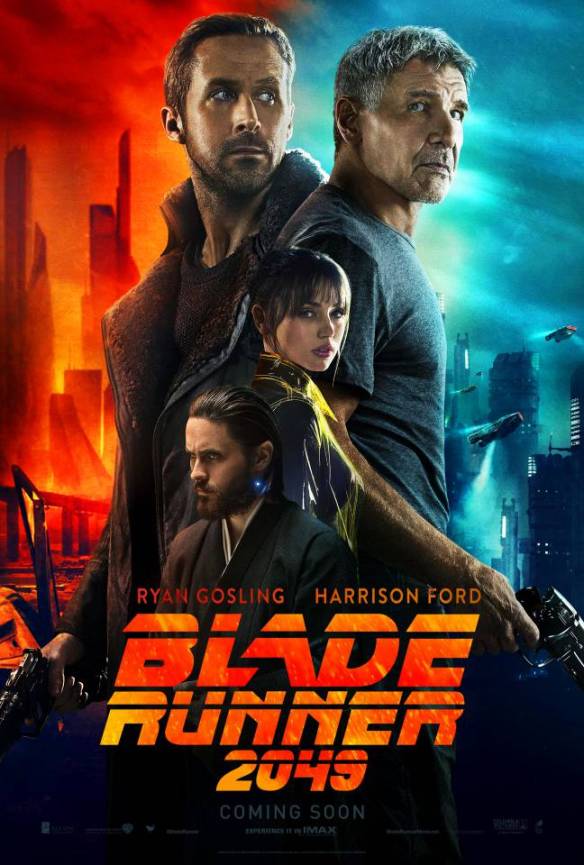
Initial Thoughts on Blade Runner 2049

Upon hearing early reports of a planned Blade Runner sequel a couple years ago, I felt both anticipation and dread. I considered it a singular vision which didn’t necessarily need a sequel, yet could understand the desire to re-immerse oneself in the compelling world it introduced. Re-experiencing the film through its Director’s Cut and Final Cut versions in subsequent years seemed to me as satisfying as watching sequels since even the relatively minor changes had a significant impact on its meaning and the richness of the sound and production design allows for the discovery of new details with every viewing. Also, one’s subjective experience watching even the same movie can be vastly different depending on one’s age and other circumstances.

One of my earliest cinematic memories was seeing the first Star Wars film as a toddler. At around the same time I remember staying up late with my parents to watch the network television premiere of 2001: A Space Odyssey. Though I was too young to fully comprehend those films’ narratives, the spectacle and sounds definitely left an impression and established a lifelong appreciation for the sci-fi genre and it’s mind-expanding possibilities.

Flash forward to an evening sometime in early 1982. After viewing a commercial for Blade Runner I instantly knew it was a movie I had to see. In the short trailer there were glimpses of flying cars over vast cityscapes, the guy that played Han Solo in a trench coat, bizarre humanoid robots within settings as strange yet detailed as 2001: a Space Odyssey. My parents, responsible as they were, refused to give in to incessant demands to see Blade Runner and that Summer I must have been the only kid who reluctantly agreed to see “E.T.” as a compromise. I probably did enjoy it more than I expected to, but might have enjoyed it more had I not viewed it as a weak Blade Runner substitute and if I actually paid attention to the entire film.

Back then our family usually saw films at drive-in theaters and the one we went to that night had two screens, one showing E.T. and the other, to my delight and frustration, happened to be Blade Runner. Even without sound and at a distorted angle I was awestruck by the establishing shots of LA in 2019 (which I glanced over to witness just as E.T.’s ship was landing on the screen in front of us, and for the entire duration of the films my eyes would switch back and forth between screens. Even without understanding anything about the plot of Blade Runner it made the most fantastical elements of E.T. pale in comparison. Judging from the box-office receipts of its theatrical run, the majority must have thought otherwise since Blade Runner earned a relatively meager $28 million while E.T. was the breakout hit of the year with nearly $360 million.

Within a few years I’d see portions of Blade Runner on cable TV at a friend’s house and finally saw the complete film after my family got a VCR and it was one of the first videos I rented. The film served as a gateway to many other interests such as cyberpunk, film noir, electronic music, but most importantly, an appreciation of the novels of Philip K. Dick. Like a psychedelic drug, they inspired philosophical questioning regarding the nature of reality, consciousness, society and what it means to be human.

This background, which is probably not too dissimilar to other stories of obsessive fandom, outlines how one’s immersion in media is rooted not just in the work itself but how it resonates with and shapes aspects of one’s identity and personal narrative as much as other memories. There’s also a nostalgia factor involved because, similar to a souvenir or any object with sentimental value, revisiting such media can recapture a sense of the feelings and sensations associated with the initial experience and sometimes the milieu of the content as well. Nostalgia is a longing for the past, even a past one has never directly experienced, never was and/or never will be, often prompted by loneliness and disconnectedness. Because it can sometimes provide comfort and hope it’s a feeling too often exploited by the marketing industry as well as media producers such as those behind reboots and sequels. Though Blade Runner 2049 may not have been solely created to cash in on nostalgia for the original, as with most big studio sequels it’s still a factor.

The type of nostalgia evoked by Blade Runner is singular, for it envisions a (near and soon to be past) future through the lens of the early eighties combining a pastiche of styles of previous eras. The film also serves as a meditation on the importance of memory and its relation to identity and the human experience. In a sense, being a longtime fan of the film is like having nostalgia for distilled nostalgia. Also unique is the fact that it took 35 years for the sequel to get made, just a couple years shy of the year in which the original takes place. The long delay is largely due to Blade Runner being so far ahead of its time it took over a decade for it to be widely regarded as a science fiction masterwork. Also, it took an additional decade and a half to develop plans for a sequel. But perhaps now is the ideal time for a follow-up as aspects of our world become more dystopian and there’s a greater need for nostalgic escape, even through narratives predicting dystopia.

While the future world of the original Blade Runner was definitely grim, it was also oddly alluring due to it’s depiction of a chaotic globalized culture, exotic yet functional-looking technology and hybrid retro/futuristic aesthetic shaped by sources as diverse as punk rock fashion, Heavy Metal magazine, film noir and Futurism among many others. The imagery of Blade Runner 2049 expands on the original by visualizing how the future (or alternate reality) LA has evolved over the course of 30 years as well as the environmentally and socially devastating impact of trying to sustain a technocratic corporate global system for so long.

Blade Runner opens with shots of oil refineries in the city intercut with close-ups of a replicant’s eye. 2049 opens with a close-up of an eye and transitions to an overhead shot of an endless array of solar panels, indicating a post peak-oil world. Despite the use of cleaner energy, the world of 2049 is far from clean with the entirety of San Diego depicted as a massive dumping ground for Los Angeles. Scavengers survive off the scraps which are recycled into products assembled by masses of orphaned child laborers in dilapidated sweatshop factories.

The Los Angeles of Blade Runner 2049 looks (and is) even colder and more foreboding than before. Gone are the Art Deco-inspired architecture and furnishings, replaced by Brutalist architecture and fluorescent-lit utilitarian interiors (with a few exceptions such as Deckard’s residence, Stelline Corporation headquarters and the Wallace Corporation building). Aerial shots reveal a vast elevated sprawl of uniform city blocks largely consisting of dark flat rooftops with glimmers of light emanating from below, visible only in the deep but narrow chasms between.

One of the more prominant structures is the LAPD headquarters which looks like an armored watchtower, signalling its role as a hub of the future surveillance state panopticon. Though an imposing feature of the city’s skyline, it’s dwarfed by larger structures housing even more powerful institutions. Just as a massive ziggurat owned by the Tyrell Corporation dominated the cityscape of the first film, by 2049 the Wallace Corporation has bought out the Tyrell Corporation and not only claims the ziggurat but has constructed an absurdly large pyramid behind it. Protecting the entire coastline of the city is a giant sea wall, presumably to prevent mass flooding from rising sea levels.

In a referential nod to the original film, city scenes of 2049 display some of the same ads such as Atari, Coca-Cola and Pan Am, but even more distracting are product placements for Sony, one of the companies which produced the new film. Such details might work as “Easter eggs” for fans (and shareholders), but takes away from the verisimilitude of the world depicted in the film where the Wallace Corporation has such seeming dominance over the economy and society in general, it probably wouldn’t leave much room for competition large enough to afford mass advertising.

While the background characters in the city of the first film seemed rude or largely indifferent to one another, 30 years later citizens are more outwardly hostile. This could reflect increasing social tensions from economic stratification as well as hostility towards replicants because the protagonist of this film is openly identified as one. Speaking of which, Ryan Gosling turns in an excellent performance as the new Blade Runner, Officer K (aka Joe, an obvious reference to Joseph K from Kafka’s “The Trial”).

Ironically, the replicants and other forms of AI in 2049 seem a little more self-aware and human-like while the humans and social institutions have become correspondingly android-like. From the perspective of the future CEOs (and some today), both replicants and non-wealthy humans (known as “little people” in cityspeak) exist to be exploited for labor and money and then “retired” when no longer needed. Reflecting this brutal reality are the largely grey and drab color scheme of the landscapes, interiors, and fashions. Adding to the mood is the soundtrack which, while at times evoking the calmer and more subtle Vangelis music of the original, is more often louder and harsher, sometimes blending with the noisy diegetic (background) soundscape.

2049‘s screenplay is almost a meta-sequel, introducing plot elements seemingly designed to address problems and inconsistencies in the original which have been pointed out by fans and critics through the years. Numerous references to Blade Runner, while nostalgic and crowd-pleasing, are almost distracting enough to break the spell of the film (at least for those who’ve re-watched the original enough times to memorize every detail). Fortunately, just as frequently new revelations, concepts and hints at potential new directions pulls one back in. I especially appreciated the further exploration of the origins and impact of false memories and its parallels to the creation and consumption of media and the way the film expanded the scope of the story beyond the city. Also surprising were references to films partly inspired by the works of Philip K. Dick such as Ghost in the Shell, The Matrix, and Her as well as stylistic influences from more contemporary aesthetic subcultures such as glitch and vaporwave.

Like with most sequels, the main draw for fans is the chance to see familiar faces from the original and 2049 doesn’t disappoint too much. Judging from the posters, trailers, interviews, etc. it was clear Harrison Ford would make a return, but unfortunately it wasn’t until after the majority of the duration of the film had passed. Nevertheless, the reappearance of Ford’s character Deckard was memorable, found by Agent K as a disheveled hermit in an abandoned casino surrounded by copious amounts of alcohol and ancient pop culture detritus. Deckard is apparently as much of a drinker as in the first film, but now not just to block out the pain of the past and present but to escape to an idealized past. Though his involvement in the plot seemed too brief it nevertheless plays a pivotal role in resolving the central mystery of the film and providing additional metacommentary.

Ford’s performance is arguably more compelling than his work in the original, though his character’s lack of charisma in the first film could be seen as intentional. Deckard’s character arc in the film, as well as that of Ford’s last two iconic roles from the 80s he reprised, cements his status as our culture’s archetype for the deadbeat father. This seems inevitable in hindsight because for a generation of latchkey kids (many with actual deadbeat dads), stars such as Harrison Ford were virtually surrogate father figures. Thus, it makes sense that the beloved characters Ford drifted away from for so long would be written as variations of a long absent deadbeat parent in their last installments.

An interesting detail about the way Deckard was characterized in the film was how he seemed more in line with a typical baby-boomer today than the gen x-er one would be at that age 32 years from now.  For example, people in their seventies today are probably more likely to be nostalgic for Elvis and Sinatra than a seventy-something person in 2049 who in our actual timeline would have more likely spent formative years listening to grunge or hiphop. A possible subtextual meaning might be that like false memories, nostalgia for media of enduring cultural value transcends lived experience. The referencing of “real” pop-culture figures within the world of the film seemed anachronistic at first, but the way it was done was interesting and worked with the themes and aesthetic (I suppose it’s preferable to having something like Beastie Boys’ “Sabotage” shoe-horned into the film like in the Star Trek reboots). Getting back to the point, in the original Blade Runner, nostalgia permeated the film through its themes, production design, costumes and soundtrack. In Blade Runner 2049, nostalgia is a subtext of repeated callbacks to the original film, Agent K’s idealized retro relationship with his AI girlfriend Joi and Deckard’s hideout within the ruins of a city once associated with fun and glamour. The simulacrum of iconic figures from the past like Elvis and Marilyn Monroe (and Ford) haunting the deserted casino like ghosts reinforces the idea of media and culture’s ability to “implant” memories and resultant nostalgia.

As for the finale, I was disappointed that it was so far from the unconventional conclusion of the showdown between Roy Batty and Deckard. One could argue it’s a reflection of the state of the world (in and of film and reality), but it’d be nice to have a little more creativity and risk-taking. Though viscerally exciting and suspenseful, it wasn’t distinguishable enough from countless modern action films to be truly memorable. More satisfying was the epilogue which paralleled the contemplative nature of the original while reconnecting to the film’s recurring themes.

In a sense, the writers and director of Blade Runner 2049 were in a catch-22 situation. Creating a film too unlike or similar to the original Blade Runner would provoke criticism from fans. What director Denis Villeneuve and co-writers Hampton Fancher and Michael Green have managed to pull off is a balancing act of a film that’s unique in many ways yet interwoven with the original; nostalgic, but not in an obvious or overly sentimental way. Both have their flaws, but while I admire the thought and craft put into the sequel, I prefer the originality, tone, texture and atmosphere of Blade RunnerBlade Runner 2049 will likely satisfy most sci-fi fans, but I’m not sure it proves a sequel was necessary or that it stands alone as a classic.

Though not given the recognition it deserved in its time, Blade Runner was a groundbreaking and visionary film upping the bar for intellectual depth, moral complexity, production design and special effects to a degree not seen since 2001: a Space Odyssey. Its influence can be spotted in countless dystopian science fiction films made since. Though it’s too early to tell how influential Blade Runner 2049 will be, it doesn’t seem to have pushed the genre forward to a similar extent (of course contemporaneous opinions can seem wildly off the mark in hindsight). Regardless, it’s an above-average science fiction film by any reasonable standard so it’s unfortunate that judging from disappointing initial box-office reports, it seems to be following in the footsteps of the first Blade Runner pretty closely in that regard. Time will tell whether it achieves a similar cult status in years to come. Perhaps in 35 years?

 

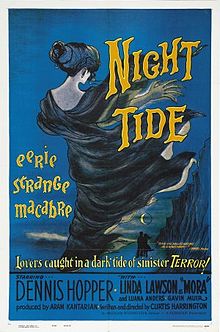
Saturday Matinee: Night Tide

By Steve Johnson

Source: Bright Lights

The first shot proper in Curtis Harrington’s 1961 feature film debut, Night Tide, situates main character Johnny Drake leaning over a pier in his sailor gear, slightly off-angle, so we understand that there’s something unresolved in his character, something at un-rest. The setting is Venice, California, a long way off from the Poe-like submerged city it’s named for, as are many of the film’s characters from their similar sources. A clairvoyant later calls Johnny innocent and searching, and everything about the moody composition reinforces this notion as he gazes into the reflective waters. There at the brink between land and sea, consciousness and dream, he’s Narcissus regarding himself in the pool, much like the protagonist of Harrington’s attention-getting 1946 short Fragment of Seeking.

In that earlier, experimental film, Harrington’s character — played by the director himself — pursues a robed figure after the fashion of Maya Deren’s “Meshes of the Afternoon,” only to discover that what he had taken to be a woman is instead himself, in drag. (The scenario is a gloss on such Poe tales as “William Wilson” and “The Assignation”; Harrington’s first short was an adaptation of “The Fall of the House of Usher,” a new version of which was also his final film work.) This motif of inquiring into gender and the self is revisited in film after film of Harrington’s no matter how personal or indifferent, from the exploration of the twin-gendered Venus and Mars of his next feature, Queen of Blood, through the various pursuits of his ’70s TV movies The Dead Don’t Die and How Awful About Allan, the latter climaxing in the reverse-unmasking of the lead’s veiled malefactor — whom he had assumed was a male boarder — as in fact his own sister.

This lunar pull toward some split-off aspect of the self is part allegorical, part autobiographical. In Night Tide, the division in Johnny’s object of fascination, the sideshow mermaid named Mora who believes she’s the real thing, represents our peculiarly human nature, being not entirely animal yet not entirely separate, either. In both evolutionary and individually developmental terms, she recalls the amniotic origins Johnny contemplates from his privileged perspective at the start of the picture, which viewpoint the film reiterates at other key points and in other key locations. That tension between our innocent beginnings and present “fallen” state reflects the director’s own attitude toward his ambitions and the course his career would take in the baroque and carnivalesque Hollywood where he found himself working for the next 25 years after this self-written and -financed calling card of a film.

Though Harrington’s character, and indeed the tone of his feature, is naïve, Harrington himself was not. True to the Hollywood Babylon of friend and early co-conspirator Kenneth Anger’s series of infamous industry exposés, the portrait of that town in such later Harringtons as What’s the Matter with Helen? maintains the grime on the city’s underbelly. For the novice filmmaker, Tinseltown was the Mora-like Lorelei whose song lured many a hapless romantic to his ruin. As his career lost its way from the wide-eyed optimism on display here, it bent itself to an increasing sordidness, the decadence that underlay his scenarios become less and less berobed with the illusion of glamor. By the time of his penultimate theatrical feature, the Exorcist knockoff Ruby, the putative Golden Age apostrophized throughout his work in the casting of mostly played-out Hollywood luminaries was at last seen as a nest of gangsters reduced to working for the title singer at her drive-in theater, her daughter the innocent supernatural woman of Night Tide become the actual agent of the violent deaths of which Mora, in her film, is falsely accused.

In conversation with David Del Valle on the latter’s cable interview program, The Sinister Image, Harrington described his first studio film, Games, as concerning the seeping of “European decadence” into innocent America. In that film, Night Tide‘s boardwalk attractions are literally internalized in the pinball-filled apartment and juvenile, prank-prone relationship of its socialite couple — based on Night Tide star Dennis Hopper and his Hollywood-royalty wife, Brooke Hayward — all of which turn malevolent under the influence of a French mystic played by Simone Signoret. In Night Tide this figure appears in the form of the Greek-speaking Mystery Woman (played by Marjorie Cameron, a consort of reputed Black Arts practitioner Aleister Crowley) and in Queen of Blood the vampiric cod-European extraterrestrial; in later tele-films The Dead Don’t Die it’s the zombie leader Varek, Killer Bees‘ queen-bee Madame von Bohlen, and the witchy Martine Beswick character of Devil Dog: Hound of Hell, as well as the soigné Nazi psychologist of theatrical career-closer Mata Hari.

Which is not to say that this influence need necessarily be European. The director just as easily gave it a domestic face in the form of Helen‘s radio evangelist played by Agnes Moorehead and her disturbed disciple Shelley Winters, and The Killing Kind‘s mother, Ann Sothern — symbols of Golden Age Hollywood, all, as was Bees‘ Gloria Swanson. The decadence, if any, is organic to its milieu; if it hails from any Old World to speak of, it’s a world within.

Harrington has said that all of his films are tragedies. Night Tide, at least, ends hopefully. When Ellen Sands, the land girl who vies for his affections, sees Johnny off, the implication is that she’ll be a soft place for him to land when he comes down from his guilty obsession over Mora; her offer of coffee on his way out is as Ariadne’s gift to Theseus of the thread of consciousness that would lead him out of the minotaur maze. With the more exotic love of Mora suggesting the primitive, deep and unfathomable artistic nature (she being first encountered in a subterranean jazz club and later doing an improvisational dance to a bongo beat) that Harrington would leave behind in the pursuit of bigger budgets, greater technical resources, and a wider audience, Ellen’s boardwalk merry-go-round suggests the simple, commercial (if mechanical) pleasures of an “innocent,” old-fashioned entertainment, and Night Tide the chronicle of a passage from avant-garde mother to the feature-length mainstream cinema Harrington would spend a quarter of a century courting with varying degrees of success.

We take solace in Johnny’s being escorted out by the Shore Patrol, suggesting that the questing sailor has found his feet and will one day return to the merry-go-round girl. It’s an odd early endorsement of heterosexual love and normality for a director the overwhelming bulk of whose later work describes such relations and their familial expression in grotesque terms — the undead marathon dancers of The Dead Don’t Die, the forced rape-participation of The Killing Kind, the suburban kennel that is Devil Dog‘s home and family (with its figurative “breeders”), as the ancestral-home hive of Bees. It’s no surprise, then, that the further Harrington came from the hopes of establishing the kind of career he may have envisioned, the harsher the satire became, until the disaster of the attempted Sylvia Kristel vehicle Mata Hari crumbled under the weight of its disinterest in the softcore couplings that were its generic reason for being. Afterward, it was series television for him, the likes of which — Dynasty, primarily — offered a more comfortable haven for his outright cynical — no longer conflicted — attitudes. It was as if Johnny had returned to find Ellen had given up the wait for him and gone. All that was left now was to join the amusements.