WAR IN EUROPE AND THE RISE OF RAW PROPAGANDA

By John Pilger

Source: JohnPilger.com

Marshall McLuhan’s prophecy that “the successor to politics will be propaganda” has happened.  Raw propaganda is now the rule in Western democracies, especially the US and Britain

On matters of war and peace, ministerial deceit is reported as news. Inconvenient facts are censored, demons are nurtured. The model is corporate spin, the currency of the age. In 1964, McLuhan famously declared, “The medium is the message.” The lie is the message now.

But is this new? It is more than a century since Edward Bernays, the father of spin, invented “public relations” as a cover for war propaganda. What is new is the virtual elimination of dissent in the mainstream.

The great editor David Bowman, author of The Captive Press, called this “a defenestration of all who refuse to follow a line and to swallow the unpalatable and are brave”. He was referring to independent journalists and whistle blowers, the honest mavericks to whom media organisations once gave space, often with pride. The space has been abolished.

The war hysteria that has rolled in like a tidal wave in recent weeks and months is the most striking example. Known by its jargon, “shaping the narrative”, much if not most of it is pure propaganda.

The Russians are coming. Russia is worse than bad. Putin is evil, “a Nazi like Hitler”, salivated the Labour MP Chris Bryant. Ukraine is about to be invaded by Russia – tonight, this week, next week. The sources include an ex CIA propagandist who now speaks for the US State Department and offers no evidence of his claims about Russian actions because “it comes from the US Government”.

The no-evidence rule also applies in London. The British Foreign Secretary, Liz Truss, who spent £500,000 of public money flying to Australia in a private plane to warn the Canberra government that both Russia and China were about to pounce,  offered no evidence. Antipodean heads nodded; the “narrative” is unchallenged there. One rare exception, former prime minister Paul Keating, called Truss’s warmongering “demented”.

Truss has blithely confused the countries of the Baltic and Black Sea. In Moscow, she told the Russian foreign minister that Britain would never accept Russian sovereignty over Rostov and Voronezh – until it was pointed out to her that these places were not part of Ukraine but in Russia. Read the Russian press about the buffoonery of this pretender to 10 Downing Street and cringe.

This entire farce, recently starring Boris Johnson in Moscow playing a clownish version of his hero, Churchill, might be enjoyed as satire were it not for its wilful abuse of facts and historical understanding and the real danger of war.

Vladimir Putin refers to the “genocide” in the eastern Donbas region of Ukraine. Following the coup in Ukraine in 2014 – orchestrated by Barack Obama’s “point person” in Kyiv, Victoria Nuland – the coup regime, infested with neo-Nazis, launched a campaign of terror against Russian-speaking Donbas, which accounts for a third of Ukraine’s population.

Overseen by CIA director John Brennan in Kyiv, “special security units” coordinated savage attacks on the people of Donbas, who opposed the coup. Video and eyewitness reports show bussed fascist thugs burning the trade union headquarters in the city of Odessa, killing 41 people trapped inside. The police are standing by. Obama congratulated the “duly elected” coup regime for its “remarkable restraint”.

In the US media the Odessa atrocity was played down as “murky” and a “tragedy” in which “nationalists” (neo-Nazis) attacked “separatists” (people collecting signatures for a referendum on a federal Ukraine). Rupert Murdoch’s Wall Street Journal damned the victims – “Deadly Ukraine Fire Likely Sparked by Rebels, Government Says”.

Professor Stephen Cohen, acclaimed as America’s leading authority on Russia, wrote, “The pogrom-like burning to death of ethnic Russians and others in Odessa reawakened memories of Nazi extermination squads in Ukraine during world war two. [Today] storm-like assaults on gays, Jews, elderly ethnic Russians, and other ‘impure’ citizens are widespread throughout Kyiv-ruled Ukraine, along with torchlight marches reminiscent of those that eventually inflamed Germany in the late 1920s and 1930s…

“The police and official legal authorities do virtually nothing to prevent these neo-fascist acts or to prosecute them. On the contrary, Kyiv has officially encouraged them by systematically rehabilitating and even memorialising Ukrainian collaborators with Nazi German extermination pogroms, renaming streets in their honour, building monuments to them, rewriting history to glorify them, and more.”

Today, neo-Nazi Ukraine is seldom mentioned. That the British are training the Ukrainian National Guard, which includes neo-Nazis, is not news. (See Matt Kennard’s Declassified report in Consortium 15 February). The return  of violent, endorsed fascism to 21st-century Europe, to quote Harold Pinter, “never happened … even while it was happening”.

On 16 December, the United Nations tabled a resolution that called for “combating glorification of Nazism, neo-Nazism and other practices that contribute to fuelling contemporary forms of racism”. The only nations to vote against it were the United States and Ukraine.

Almost every Russian knows that it was across the plains of Ukraine’s “borderland” that Hitler’s divisions swept from the west in 1941, bolstered by Ukraine’s Nazi cultists and collaborators. The result was more than 20 million Russian dead.

Setting aside the manoeuvres and cynicism of geopolitics, whomever the players, this historical memory is the driving force behind Russia’s respect-seeking, self-protective security proposals, which were published in Moscow in the week the UN voted 130-2 to outlaw Nazism. They are:

– NATO guarantees that it will not deploy missiles in nations bordering Russia. (They are already in place from Slovenia to Romania, with Poland to follow)
– NATO to stop military and naval exercises in nations and seas bordering Russia.
– Ukraine will not become a member of NATO.
– the West and Russia to sign a binding East-West security pact.
– the landmark treaty between the US and Russia covering intermediate-range nuclear weapons to be restored. (The US abandoned it in 2019)

These amount to a comprehensive draft of a peace plan for all of post-war Europe and ought to be welcomed in the West. But who understands their significance in Britain? What they are told is that Putin is a pariah and a threat to Christendom.

Russian-speaking Ukrainians, under economic blockade by Kyiv for seven years, are fighting for their survival. The “massing” army we seldom hear about are the thirteen Ukrainian army brigades laying siege to Donbas: an estimated 150,000 troops. If they attack, the provocation to Russia will almost certainly mean war.

In 2015, brokered by the Germans and French, the presidents of Russia, Ukraine, Germany and France met in Minsk and signed an interim peace deal. Ukraine agreed to offer autonomy to Donbas, now the self declared republics of Donetsk and Luhansk.

The Minsk agreement has never been given a chance. In Britain, the line,  amplified by Boris Johnson, is that Ukraine is being “dictated to” by world leaders. For its part, Britain is arming Ukraine and training its army.

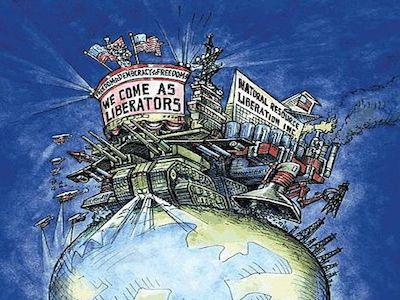
Since the first Cold War, NATO has effectively marched right up to Russia’s most sensitive border having demonstrated its bloody aggression in Yugoslavia, Afghanistan, Iraq, Libya and broken solemn promises to pull back.  Having dragged European “allies” into American wars that do not concern them, the great unspoken is that NATO itself is the real threat to European security.

In Britain, a state and media xenophobia is triggered at the very mention of “Russia”. Mark the knee-jerk hostility with which the BBC reports Russia. Why? Is it because the restoration of imperial mythology demands, above all, a permanent enemy? Certainly, we deserve better.
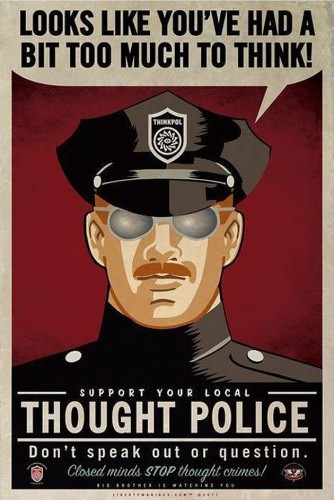
The Mind Control Police: The Government’s War on Thought Crimes and Truth-Tellers

By John W. Whitehead & Nisha Whitehead

Source: The Rutherford Institute

“In a time of deceit telling the truth is a revolutionary act.”— George Orwell  

The U.S. government, which speaks in a language of force, is afraid of its citizenry.

What we are dealing with is a government so power-hungry, paranoid and afraid of losing its stranglehold on power that it is conspiring to wage war on anyone who dares to challenge its authority.

All of us are in danger.

In recent years, the government has used the phrase “domestic terrorist” interchangeably with “anti-government,” “extremist” and “terrorist” to describe anyone who might fall somewhere on a very broad spectrum of viewpoints that could be considered “dangerous.” The ramifications are so far-reaching as to render almost every American an extremist in word, deed, thought or by association.

In the government’s latest assault on those who criticize the government—whether that criticism manifests itself in word, deed or thought—the Biden Administration has likened those who share “false or misleading narratives and conspiracy theories, and other forms of mis- dis- and mal-information” to terrorists.

The next part is the kicker.

According to the Department of Homeland Security’s latest terrorism bulletin, “These threat actors seek to exacerbate societal friction to sow discord and undermine public trust in government institutions to encourage unrest, which could potentially inspire acts of violence.”

You see, the government doesn’t care if what you’re sharing is fact or fiction or something in between. What it cares about is whether what you’re sharing has the potential to make people think for themselves and, in the process, question the government’s propaganda.

Get ready for the next phase of the government’s war on thought crimes and truth-tellers.

For years now, the government has used all of the weapons in its vast arsenal—surveillance, threat assessments, fusion centers, pre-crime programs, hate crime laws, militarized police, lockdowns, martial law, etc.—to target potential enemies of the state based on their ideologies, behaviors, affiliations and other characteristics that might be deemed suspicious or dangerous.

For instance, if you believe in and exercise your rights under the Constitution (namely, your right to speak freely, worship freely, associate with like-minded individuals who share your political views, criticize the government, own a weapon, demand a warrant before being questioned or searched, or any other activity viewed as potentially anti-government, racist, bigoted, anarchic or sovereign), you could be at the top of the government’s terrorism watch list.

Moreover, as a New York Times editorial warns, you may be an anti-government extremist (a.k.a. domestic terrorist) in the eyes of the police if you are afraid that the government is plotting to confiscate your firearms, if you believe the economy is about to collapse and the government will soon declare martial law, or if you display an unusual number of political and/or ideological bumper stickers on your car.

According to one FBI latest report, you might also be classified as a domestic terrorism threat if you espouse conspiracy theories, especially if you “attempt to explain events or circumstances as the result of a group of actors working in secret to benefit themselves at the expense of others” and are “usually at odds with official or prevailing explanations of events.”

In other words, if you dare to subscribe to any views that are contrary to the government’s, you may well be suspected of being a domestic terrorist and treated accordingly.

This latest government salvo against consumers and spreaders of “mis- dis- and mal-information” widens the net to potentially include anyone who is exposed to ideas that run counter to the official government narrative.

You don’t have to be a Joe Rogan questioning COVID-19 to get called out, cancelled and classified as an extremist.

There’s a whole spectrum of behaviors ranging from thought crimes and hate speech to whistleblowing that qualifies for persecution (and prosecution) by the Deep State.

Simply liking or sharing this article on Facebook, retweeting it on Twitter, or merely reading it or any other articles related to government wrongdoing, surveillance, police misconduct or civil liberties might be enough to get you categorized as a particular kind of person with particular kinds of interests that reflect a particular kind of mindset that might just lead you to engage in a particular kinds of activities and, therefore, puts you in the crosshairs of a government investigation as a potential troublemaker a.k.a. domestic extremist.

Chances are, as the Washington Post reports, you have already been assigned a color-coded threat score—green, yellow or red—so police are forewarned about your potential inclination to be a troublemaker depending on whether you’ve had a career in the military, posted a comment perceived as threatening on Facebook, suffer from a particular medical condition, or know someone who knows someone who might have committed a crime.

In other words, you might already be flagged as potentially anti-government in a government database somewhere—Main Core, for example—that identifies and tracks individuals who aren’t inclined to march in lockstep to the police state’s dictates.

As The Intercept reported, the FBI, CIA, NSA and other government agencies have increasingly invested in corporate surveillance technologies that can mine constitutionally protected speech on social media platforms such as Facebook, Twitter and Instagram in order to identify potential extremists and predict who might engage in future acts of anti-government behavior.

Where many Americans go wrong is in naively assuming that you have to be doing something illegal or harmful in order to be flagged and targeted for some form of intervention or detention.

In fact, all you need to do these days to end up on a government watch list or be subjected to heightened scrutiny is use certain trigger words (like cloud, pork and pirates), surf the internet, communicate using a cell phone, limp or stutterdrive a car, stay at a hotel, attend a political rally, express yourself on social mediaappear mentally ill, serve in the militarydisagree with a law enforcement officialcall in sick to work, purchase materials at a hardware store, take flying or boating lessons, appear suspicious, appear confused or nervous, fidget or whistle or smell bad, be seen in public waving a toy gun or anything remotely resembling a gun (such as a water nozzle or a remote control or a walking cane), stare at a police officer, question government authority, or appear to be pro-gun or pro-freedom.

And then at the other end of the spectrum there are those such as Julian Assange, for example, who blow the whistle on government misconduct that is within the public’s right to know.

Assange, the founder of WikiLeaks—a website that published secret information, news leaks, and classified media from anonymous sources—was arrested on April 11, 2019, on charges of helping U.S. Army intelligence analyst Chelsea Manning access and leak more than 700,000 classified military documents that portray the U.S. government and its military as reckless, irresponsible and responsible for thousands of civilian deaths.

Included among the leaked Manning material were the Collateral Murder video (April 2010), the Afghanistan war logs (July 2010), the Iraq war logs (October 2010), a quarter of a million diplomatic cables (November 2010), and the Guantánamo files (April 2011).

The Collateral Murder leak included gunsight video footage from two U.S. AH-64 Apache helicopters engaged in a series of air-to-ground attacks while air crew laughed at some of the casualties. Among the casualties were two Reuters correspondents who were gunned down after their cameras were mistaken for weapons and a driver who stopped to help one of the journalists. The driver’s two children, who happened to be in the van at the time it was fired upon by U.S. forces, suffered serious injuries.

In true Orwellian fashion, the government would have us believe that it is Assange and Manning who are the real criminals for daring to expose the war machine’s seedy underbelly.

Since his April 2019 arrest, Assange has been locked up in a maximum-security British prison—in solitary confinement for up to 23 hours a day—pending extradition to the U.S., where if convicted, he could be sentenced to 175 years in prison.

This is how the police state deals with those who challenge its chokehold on power.

This is why the government fears a citizenry that thinks for itself. Because a citizenry that thinks for itself is a citizenry that is informed, engaged and prepared to hold the government accountable to abiding by the rule of law, which translates to government transparency and accountability.

After all, we’re citizens, not subjects. For those who don’t fully understand the distinction between the two and why transparency is so vital to a healthy constitutional government, Manning explains it well:

When freedom of information and transparency are stifled, then bad decisions are often made and heartbreaking tragedies occur – too often on a breathtaking scale that can leave societies wondering: how did this happen? … I believe that when the public lacks even the most fundamental access to what its governments and militaries are doing in their names, then they cease to be involved in the act of citizenship. There is a bright distinction between citizens, who have rights and privileges protected by the state, and subjects, who are under the complete control and authority of the state.

This is why the First Amendment is so critical. It gives the citizenry the right to speak freely, protest peacefully, expose government wrongdoing, and criticize the government without fear of arrest, isolation or any of the other punishments that have been meted out to whistleblowers such as Edwards Snowden, Assange and Manning.

The challenge is holding the government accountable to obeying the law.

A little over 50 years ago, the U.S. Supreme Court ruled 6-3 in United States v. Washington Post Co. to block the Nixon Administration’s attempts to use claims of national security to prevent The Washington Post and The New York Times from publishing secret Pentagon papers on how America went to war in Vietnam.

As Justice William O. Douglas remarked on the ruling, “The press was protected so that it could bare the secrets of government and inform the people. Only a free and unrestrained press can effectively expose deception in government. And paramount among the responsibilities of a free press is the duty to prevent any part of the government from deceiving the people and sending them off to distant lands to die of foreign fevers and foreign shot and shell.”

Fast forward to the present day, and we’re witnessing yet another showdown, this time between Assange and the Deep State, which pits the people’s right to know about government misconduct against the might of the military industrial complex.

Yet this isn’t merely about whether whistleblowers and journalists are part of a protected class under the Constitution. It’s a debate over how long “we the people” will remain a protected class under the Constitution.

Following the current trajectory, it won’t be long before anyone who believes in holding the government accountable is labeled an “extremist,” relegated to an underclass that doesn’t fit in, watched all the time, and rounded up when the government deems it necessary.

We’re almost at that point now.

Eventually, we will all be potential suspects, terrorists and lawbreakers in the eyes of the government.

Partisan politics have no place in this debate: Americans of all stripes would do well to remember that those who question the motives of government provide a necessary counterpoint to those who would blindly follow where politicians choose to lead.

We don’t have to agree with every criticism of the government, but we must defend the rights of all individuals to speak freely without fear of punishment or threat of banishment.

Never forget: what the architects of the police state want are submissive, compliant, cooperative, obedient, meek citizens who don’t talk back, don’t challenge government authority, don’t speak out against government misconduct, and don’t step out of line.

What the First Amendment protects—and a healthy constitutional republic requires—are citizens who routinely exercise their right to speak truth to power.

The right to speak out against government wrongdoing is the quintessential freedom.

As I make clear in my book Battlefield America: The War on the American People and in its fictional counterpart The Erik Blair Diaries, once again, we find ourselves reliving George Orwell’s 1984, which portrayed in chilling detail how totalitarian governments employ the power of language to manipulate the masses.

In Orwell’s dystopian vision of the future, Big Brother does away with all undesirable and unnecessary words and meanings, even going so far as to routinely rewrite history and punish “thoughtcrimes.”

Much like today’s social media censors and pre-crime police departments, Orwell’s Thought Police serve as the eyes and ears of Big Brother, while the other government agencies peddle in economic affairs (rationing and starvation), law and order (torture and brainwashing), and news, entertainment, education and art (propaganda).

Orwell’s Big Brother relies on Newspeak to eliminate undesirable words, strip such words as remained of unorthodox meanings and make independent, non-government-approved thought altogether unnecessary.

Where we stand now is at the juncture of OldSpeak (where words have meanings, and ideas can be dangerous) and Newspeak (where only that which is “safe” and “accepted” by the majority is permitted). The power elite has made their intentions clear: they will pursue and prosecute any and all words, thoughts and expressions that challenge their authority.

They don’t just lie to us about wars; they lie to us about everything

By Caitlin Johnstone

Source: Intrepid Report

Propaganda isn’t just about manufacturing consent for wars and ridiculous governmental measures we’d never normally accept. That’s what most people think of when they hear that word, but there’s so very, very much more to it than that.

The lion’s share of propaganda goes not toward convincing us to accept new agendas of the powerful, but toward keeping us entranced in the status quo dream world which enables the powerful to have power in the first place. Toward normalizing status quo systems and training us to shape ourselves to fit into them like neat little cogs in a well-oiled machine.

And it’s not even a grand, monolithic conspiracy in most cases. The giant corporations who indoctrinate us with their advertisements, their Hollywood movies and shows, their apps, their websites and their news media are all naturally incentivized to point us further and further into delusion by the fact that they benefit from the status quo systems which have elevated them to wealth.

So day in and day out we are presented with media which train us what to value, where to place our interest and attention, what success looks like, and how a normal human behaves on this planet. And it always aligns perfectly with the interests of the rich and powerful.

They don’t just teach us what to believe. They teach us who we are. They give us the frameworks upon which we cast our ambitions and evaluate our success, and we build psychological identities out of those constructs. I am a businessman. I am unemployed. My life is about making money. My life is about disappointing people. I am a success. I am a failure. They invent the test of our adequacy, and they invent the system by which we are graded.

These artificial constructs take up such vast portions of our personal psychology that people will live their entire lives completely enslaved to them, making them their entire focus. This enslavement is so pervasive that people will often even take their own lives based on what those made-up constructs tell them about who they are and what they’re worth.

And it’s all a lie. A dream world, made entirely of narrative, constructed by the powerful for the benefit of the powerful. Things as intimate as the thoughts in our heads and the movement of our interest and attention are controlled and dominated with iron-fisted force, all for the benefit of some stupid made-up games about imaginary money and fictional authority.

So most of us sleepwalk through life chasing make believe goals and fleeing artificially constructed demons. Too preoccupied with the illusion to look up and notice the thunderous majesty of life as it really is, and usually too confused to truly perceive it even on those rare occasions when we snap out of the trance for a moment to make an effort.

Untangling yourself from this dream world isn’t easy. It takes time. It takes work. It takes a deep, sustained curiosity about what’s really going on underneath all the muddled mental chatter, about what life truly is underneath all the stories we’ve been told about what life is, about who we truly are underneath all the stories we’ve been told about who we are.

The difference between what we’ve been told and what we find over the course of this investigation is the difference between dream and waking life. The real world is as different from the status quo narrative about the world as it is from any other work of fiction. The two things really could not be any more different.

And the good news is that just as your false view of yourself and your world shaped your human expression in the service of the powerful, the rolling back of that mind fog shapes your human expression into something else entirely. Something grounded in reality. Something authentic. Something primal. Something that exists not for the benefit of some faceless oligarchic empire, but for the same reason the grass grows and the galaxies spin in the cosmos.

And that’s what humanity looks like on the other side of this awkward transition phase that our species is going through at this adolescent point in its development. Free from illusion. In harmony with the real. Enslaved to nobody. Striding clear-eyed into the mystery of what’s to come.

How Empires Die

By Charles Hugh Smith

Source: Of Two Minds

From a systems perspective, nation-states and empires arise when they are superior solutions to security compared to whatever arrangement they replace: feudalism, warlords, tribal confederations, etc.

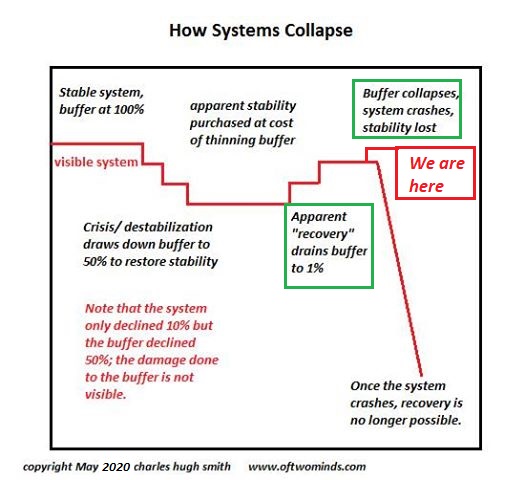
States and empires fail when they are no longer the solution, they are the problem. As the book The Upside of Down: Catastrophe, Creativity, and the Renewal of Civilization explains, when the dissolution of the state / empire becomes the pain-reducing solution, the inhabitants withdraw their support and the empire loses its grip and expires.

As I explain in my new book, Global Crisis, National Renewal, states and markets are problem-solving structures. These structures solve problems by optimizing adaptability and beneficial synergies that reinforce one another as evolutionary advances.

The rise of the middle class is an example of beneficial synergies: as this new class gains access to credit, expertise, trade, enterprise and pricing power for their labor, they have the means to transform their labor into capital by saving earnings and investing the capital in assets, new enterprises, etc. which then generate income from capital which fuels synergistic increases in credit, expertise, assets and income from investments.

States / empires fail and expire when they elevate the fatal synergies created by self-serving elites. Rather than encourage the dynamics of adaptation–competition, transparency, accountability, experimentation and dissent– the elites suppresses these forces as threats to their monopolies, cartels and wealth.

Stripped of adaptability and beneficial synergies, the state / empire is no longer able to solve problems. It becomes the problem which cannot be resolved.

A key dynamic fueling fatal synergies is the hubristic confidence that low-cost abundance is a birthright bestowed by the state /empire, so resources can be endlessly squandered on excess and extremes of consumption and waste. The state / empire no longer focuses on securing the material sources of security (food, energy, etc.) or the accountability, competition, dissent and transparency required to solve systemic problems.

Instead, the state / empire dissolves into divisive camps seeking to protect their petty fiefdoms and expanding their wealth at the expense of the populace. The super-wealthy build $500 million yachts and palaces, politicians trade on their positions to accumulate fortunes, and corruption replaces governance.

Markets spiral into fatal synergies as low quality products and services, speculative excess, extremes of grotesque consumption and blood-soaked entertainment become “growth industries” while blackouts dim electrical grids and store shelves empty of essentials.

The market solution to everyone already owning everything is to engineer planned obsolescence into every product and form service-sector cartels that then strip services to the bone to juice profits, a.k.a. the crapification of all goods and services.

The state / empire also fails to maintain basic security and functions such as tax collection and a fair enforcement. Petty crimes are exploited by those in power (civil forfeiture) while resistance to the state is severely punished. There are two legal systems, one for the commoners and another for the elite.

The state / empire protects those profiting from the status quo and then calls this profiteering a “solution.” But this profiteering doesn’t solve any problems; it is the problem, as self-serving profiteering protects its privileges by corrupting the state, finance and the economy.

For its part, the market seeks to maximize profits in excesses of consumption, predatory lending (student loans), the wholesale destruction of quality by monopolies and cartels and extremes of speculation.Maximizing profits by any means available has no moral foundation; predatory student loans are profitable, obscure medical billing is profitable, selling products designed to fail is profitable, declaring software outdated is profitable, deceiving consumers is profitable, and so on, in an endless array of shoddy, unhealthy products, rapacious services, fraudulent overcharges, etc.

Since problems go unresolved, things fall apart and the masses veer into extremes of derangement and magical thinking: fanaticism is substituted for friendship, cults abound, common ground vanishes and all the failures of the system are papered over with Bread and Circuses, free money, gaudy entertainments and lifeless displays of conspicuous consumption that reveal the decay and degradation.

Protecting the few stripmining the system at the expense of the many is not problem-solving. It adds a layer of problems that the state /empire is incapable of resolving. Ossified, sclerotic, self-serving, corrupt, focused on virtue-signaling and the appearance of tackling problems rather than actually solving problems because some sacred cow would lose its privileges and income stream, the state / empire is the problem, not the solution.

When the state / empire loses the ability to recognize and solve core problems of security and fairness, it will be replaced by another arrangement that is more adaptable and adept at solving problems. Artifice, fantasy, magical thinking, excuses and absurd cover stories are not part of problem-solving. Problems can only be solved if reality is faced directly.

When reality is unacceptable because it negatively impacts those stripmining the system for private gain, the state / empire is already on its fatal spiral to collapse.

How Can the US Accuse Any Nation of Violating ‘Rules-Based International Order’?

North Dakota’s Governor ordered the state’s National Guard to clear the protest encampment of Lakota Sioux water protectors and their supporters during the 2016-17 protests against a pipeline through tribal lands. Click on image to play video (video courtesy RT television)

By Dave Lindorff

Source: This Can’t Be Happening

Sometimes the hypocrisy of the US government, especially when it comes to foreign affairs, it just too much to let pass.

The latest example of this is the Ukraine crisis, where the US pretty much stands all alone (unless you count Britain’s embattled and embarrassed Prime Minister Boris Johnson, who parrots US policy like a trained bird), accusing Russia not just of preparing for an “imminent invasion’ of Ukraine, but of violating international law and “rules-based international order,” as Secretary of State Antony Blinken likes to put it.

The Biden administration’s top diplomat has made repeatedly blasted both Russia for threatening Ukraine with an invasion by moving troops and equipment to its border and to the border between Ukraine and Belarus, Russia’s ally to the west, and China for its threats to Taiwan and for a rights crackdown in Hong Kong, a Chinese Special Administrative Region that had been promised 30 years or “no change” but was put under new stricter national security laws following violent student protests and university occupations in 2019-20.

But how can the US make such accusations against the Russians and the Chinese governments when the US for nearly eight years, has been bombing, launching rocket and drone attacks, and sending troops, under both CIA and Pentagon control, against both ISIS and Syrian government troops and aircraft — even attacking and killing Russian mercenary troops at one point, who, unlike the US, were in Syria at the request of the Syrian government.

US military actions in Syria are completely outside of any “rules based international order.”

International rules, when it comes to warfare, are crystal clear, enshrined in the United Nations Charter, which is an international treaty signed and ratified by the US government along with most other nations of the world and incorporating all the laws of war. The primary law, violation of which is described as the gravest war crime of all “because it contains with in it all other war crimes.” Called a Crime Against Peace, it states that no nation may attack another except if that nation faces an “imminent threat” of attack.

There are no codicils expanding on or getting around that proscription.

The US has committed that  Crime Against Peace countless times, in Vietnam, in Laos, in Cambodia, in Yemen, in Iraq, in Lebanon, in Syria, in Somalia, in Sudan, in Haiti, in the Dominican Republic, in Nicaragua, in El Salvador, in Cuba, in Niger, in the Congo, in Panama, in Grenada — indeed in so many places I’m sure I’m not remembering them all. Suffice to say that my whole life (I was born in 1949), my country has been a violator of the UN Charter’s ban on launching illegal wars.

Rules-based order? What the F**k is Blinken talking about? The US makes its own rules. In fact, whenever the US launches some illegal invasion or air attack against a country, the biggest complaint we hear in the US is that the president has ordered up and launched a war “without Congressional approval”

The implication is that if Congressional approves an illegal war or act of war, that makes it legit.  It doesn’t.

What makes it worse when the US makes such accusations against Russia and China is that it is accusing two countries which, as objectionable as their actions or threats might be,  at least have a better argument for their legality than does the US.

Let’s start with China. The government in Beijing stands accused by Blinken and the US government under a series of presidents, with threatening Taiwan, an island that historically was a part of China, but became functionally independent in 1949 when the Chinese Communist Party won its revolution on the mainland, founding the People’s Republic of China, and the remnants of the Nationalist Party and its army fled to Taiwan, murdering tens of thousands of local Taiwanese and Hakka Chinese people, and establishing a brutal dictatorship under Nationalist leader and major domo Chiang Kai-Shek. China has never acknowledged the independence of Taiwan, which for 50 years prior to the end of World War II had been a colony of Japan, a spoil of victory in the China-Japan War won by Japan against the Ching dynasty in 1895.

The US initially recognized Taiwan, after the Chinese Communist revolutionary victory in 1949, as an independent country, but Richard Nixon, in a slick realpolitik maneuver masterminded by his National Security Advisor and later Secretary of State Henry Kissinger, in order to recognize China and drive a wedge between that country and the Soviet Union, agreed to cease recognizing Taiwan as an independent nation, removed the US embassy from the island, and set one up in Beijing. In other words, at that point, from the US point of view at least, Taiwan’s status became an internal affair of China’s, not an international affair.

The same applies to the Chinese crackdown on rights in Hong Kong. Since July 1997, Hong Kong ceased to be a British colony, and reverted to being part of China. Now it’s true there were negotiations between the Beijing government and departing British government.  During those years of transition, Hong Kong’s appointed colonial Governor Chris Patten, former head of the British Conservative Party, carefully avoided allowing Hong Kongers to obtain long-sought universal suffrage to elect all members of the territory’s legislative council, Legco, before the British departure (a move which would at least have left the Beijing facing a local government that actually represented all the people of Hong Kong, instead of Legco representatives representing various business sectors like banking, the legal profession, the retail industry, property owners, etc).

China agreed during those negotiations to gradually increase the number of Legco members elected from geographic constituencies, and to leave basic freedoms of speech, press, etc. untouched “for 30 years.” But when students rose up to protest the arrests of Hong Kong residents and their deportation to face trials in China, it set in motion a confrontation between democracy advocates in Hong Kong and authoritarians in Beijing, and ultimately to a new Beijing-imposed national security law for Hong Kong that has turned the city into essentially just another bit of China. But again, while it was certainly a draconian over-reaction to legitimate local protests, that action by China is not a violation of international law — just violation of an agreement between a departing (and loathed) colonial power, a legacy of the European Opium War against China, and a new vastly more powerful China. It’s a bit like the US’s brutal crackdown on immigrants at the Mexican border or on Native defenders of water rights in North Dakota. Disgusting, and perhaps criminal under US law, but hardly a violation of some kind of “rules-based international order.”

As for Russia, even the plebiscite in Crimea, some 97% of the population there voted that they wanted to leave Ukraine and return to being part of Russia, as the peninsula had been until 1954, when new Soviet Premier Nikita Khrushchev, as a gift to the region he had grown up in, transferred Crimea from the Russian Soviet to the Ukrainian Soviet, which the US has criticized as somehow fraudulent (Crimea is about 85% ethnic Russian). With 85% of eligible people voting, that plebiscite provided Russia with the justification for reclaiming  jurisdiction over Crimea. Russia’s action, criticized by the US as “aggression,” is less of a violation of democratic norms though than the massive disenfranchisement of blacks and other people of color in Republican-run “red” states of the US — a process that is now being accelerated to warp speed with the approach of the 2022 off-year Congressional elections. If the Biden administration really cared about justice and democracy it would be laser-focused on defending voter rights, not on shipping deadly weapons to Ukraine.

If the US government cared about following a “rules-based international order,” the it would pull all US military forces out of Syria, pull the US Navy out of the Persian Gulf, stop using drones to kill people in Yemen, Somalia, and elsewhere, stop sending US Special Forces wherever the president wants to send them, and rejoin the World Court and respect its adjudication of violations of international rules and laws.

Then we wouldn’t have to listen to all the hypocritical crap uttered by Biden, Blinken and their ilk.

Someday, I’m sure there will come a reckoning, when US leaders will finally be held to account for their long record of crimes against humanity. Until then, we will have to endure all this epic hypocrisy.

DHS Suggests Those Who Spread ‘Misleading Narratives’ That ‘Undermine Trust in US Gov’t’ are Terrorists

By Matt Agorist

Source: The Free Thought Project

The Department of Homeland Security (DHS) on Monday issued a bulletin warning of a heightened terrorism alert in the United States. One of the “key factors” for the heightened threat, which the DHS considers terrorism, is “the proliferation of false or misleading narratives, which sow discord or undermine public trust in U.S. government institutions.”

Naturally, this has many folks concerned, especially considering the examples cited in the bulletin which include “false or misleading narratives” about “unsubstantiated widespread election fraud and COVID-19.

While parts of the memo cite calls for violence and attacks by foreign terrorist organizations — which are actual terror threats — as cause for concern, the idea that the government’s definition of misinformation could potentially earn you the label of “terrorist,” is shocking.

The bulletin is titled, “Summary of Terrorism Threat to the U.S. Homeland” and reads as follows (emphasis added):

The United States remains in a heightened threat environment fueled by several factors, including an online environment filled with false or misleading narratives and conspiracy theories, and other forms of mis- dis- and mal-information (MDM) introduced and/or amplified by foreign and domestic threat actors. These threat actors seek to exacerbate societal friction to sow discord and undermine public trust in government institutions to encourage unrest, which could potentially inspire acts of violence. Mass casualty attacks and other acts of targeted violence conducted by lone offenders and small groups acting in furtherance of ideological beliefs and/or personal grievances pose an ongoing threat to the nation. While the conditions underlying the heightened threat landscape have not significantly changed over the last year, the convergence of the following factors has increased the volatility, unpredictability, and complexity of the threat environment: (1) the proliferation of false or misleading narratives, which sow discord or undermine public trust in U.S. government institutions; (2) continued calls for violence directed at U.S. critical infrastructure; soft targets and mass gatherings; faith-based institutions, such as churches, synagogues, and mosques; institutions of higher education; racial and religious minorities; government facilities and personnel, including law enforcement and the military; the media; and perceived ideological opponents; and (3) calls by foreign terrorist organizations for attacks on the United States based on recent events.

As stated above, reasons 2 and 3 are obvious threats of terror and make sense. However, given the government’s tendency to paint with a broad brush, undermining public trust could make millions of people terrorists, including the Free Thought Project.

It is the job of a true journalist to undermine trust in the government and given the shifting goal posts on what is defined as “misinformation” over just the last two years, literally anyone could find themselves subject to this definition. To hammer their point home, DHS specifically calls out misinformation on COVID-19.

Key factors contributing to the current heightened threat environment include:

  1. The proliferation of false or misleading narratives, which sow discord or undermine public trust in U.S. government institutions:
    • For example, there is widespread online proliferation of false or misleading narratives regarding unsubstantiated widespread election fraud and COVID-19.

Remember in 2020, when any talk of a potential lab leak theory was considered “misinformation”? By this definition, everyone who talked about the lab leak theory was a potential terrorist.

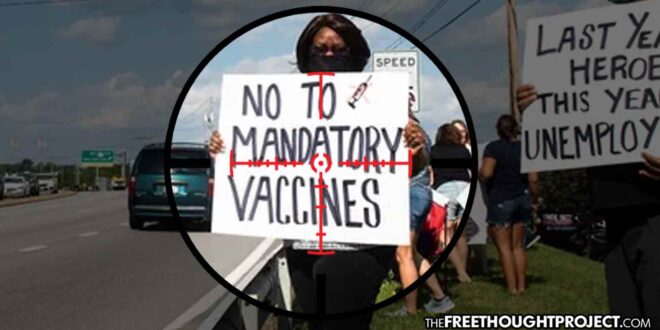
Doctors like Robert Malone and Peter McCullough, who challenge the vaccination mandate, are now, according to this bulletin, terrorists. Given the fact that the government is urging Spotify to censor Joe Rogan for “misinformation,” according to this bulletin, Rogan is also a terrorist. Their information and discussions on Covid-19 have certainly sown discord and undermined public trust — and rightfully so — but does this make them a terror threat?

Obviously, it does not. The only people who would be threatened by healthy, science-based skepticism as espoused by doctors like these two, are tyrants who wish to control the narrative.

Given the extremely broad definition of what the government considers “misinformation,” this bulletin is one of the most worrisome documents to come from the feds in recent history. What’s more, the mere act of releasing such a document, actually “undermines public trust in U.S. government institutions” by threatening those who would dare question the status quo.

Make no mistake, this is a move to criminalize free speech by allowing the executive to declare anyone who disagrees with their dictates, a terrorist. With declarations like this, the government doesn’t need terrorist organizations to “sow discord” — they are doing it themselves.

Can a Nation Prosper as its Institutions Fail?

By Charles Hugh Smith

Source: Of Two Minds

Economists focus on what can be easily measured: sales, profits, prices, tax revenues, etc. Since the decay and failure of institutions isn’t easily quantified, this decay doesn’t register in the realm of economics. Since it isn’t measured, it doesn’t exist.

But institutional decay and failure is all too real, and it begs the question: how can a society and economy thrive if its core institutions fail? The short answer is they cannot thrive, as institutions are the foundations of the social and economic orders.

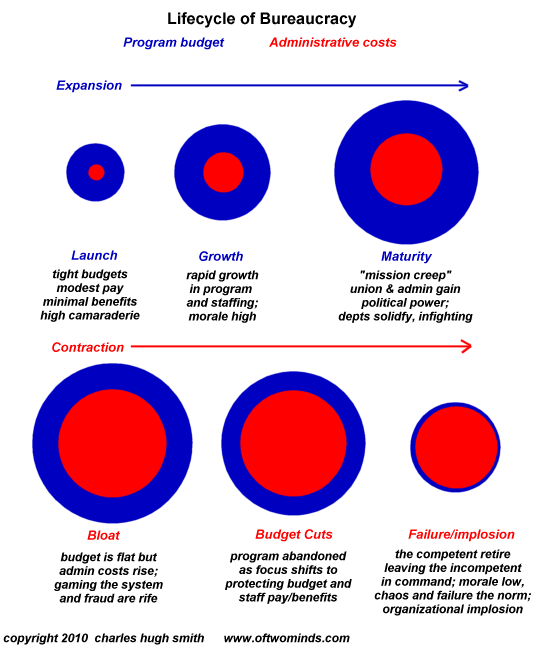
As I explain in my new book, Global Crisis, National Renewal, the conventional view has a naive faith that “great leaders” can reverse institutional rot. This faith overlooks the systemic sources of institutional decay and failure which are outlined in the graphic below, The Lifecycle of Bureaucracy, a.k.a. institutions.

Leaders are constrained by the nature of centralized organizations and the incentive structure that slowly shifts from rewarding efforts to further the institution’s core mission to self-service and protecting an ossified, failing institution from outside scrutiny and reform.

As Samo Burja explains in his insightful essay, Why Civilizations Collapse, those inside institutions are by design so compartmentalized that few (if any) even recognize the institution is failing. As long as everything is glued together in each little compartment, no one grasps the entire institution has lost its way. And since no one recognizes it, no one attempts to save it.

Institutions end up advancing caretaker managers who excel at the political game of rising to the top of a sprawling institution. When the decay (or budget cuts) finally trigger a crisis, the institution has been stripped of visionaries with a bold grasp of what’s needed to restore the focus on the core mission and institute new incentives. The bold leaders quit in disgust or were sent to bureaucratic Siberia as potential threats to the status quo.

The problem is institutions fail by the very nature of their centralized design. The organization is centralized so directives flow down the chain of command, and every branch is compartmentalized to limit the power of each department and employee to disrupt the orderly flow of top-down directives.

Within this compartmentalized, top-down structure, the incentives are to follow procedures rather than get results. The rewards go to those who dutifully follow procedures rather than to those who raise the alarm about the loss of transparency, effectiveness and focus on fulfilling the mission.

The path of least resistance is to protect the existing structure and add more compartments, i.e. “mission creep.” Rather than focus on the dissipation of resources and the decline of the core mission, leaders add “feel good” missions and PR promotions of phony reforms and initiatives that bleed more resources from the core mission.

Consider the institution of democracy, which has been corrupted into an invitation-only auction of state favors and rentier skims. Democracies have another fatal flaw: politicians win re-election by promising virtually everyone something for nothing: more benefits and entitlements and lower taxes. The gap between higher costs and declining revenues will be filled by government borrowing.

All this additional borrowing will supposedly be paid by the magic of “growth”, which will expand tax revenues at a rate that exceeds the cost of borrowing.

But demographics, resource depletion and the diminishing returns of a consumer economy fueled by rapidly expanding public and private debt have sapped “growth” in fundamental ways. Ironically, borrowing and spending more to spur “growth” only hastens the diminishing returns of increasing debt to fund consumption today.

Democracies are thus optimized for rapid “growth” and are ill-suited to transition to DeGrowth, i.e. less of everything for the vast majority of the citizenry as resources become scarce and debt eats the economy alive. (DeGrowth could work to everyone’s benefit, which is the point of Global Crisis, National Renewal.)

Central banking is another failing institution. When faced with fiscal crises, central states/banks inevitably succumb to the temptation to print/borrow currency in whatever sums are needed to fill the shortfall of the moment, i.e. political expediency. This profligate creation of currency seems to be magic at first; everyone accepts the “new money” at the current value. But eventually gravity takes hold and the currency’s purchasing power declines, as the real economy (the production of goods and services) grows at rates far below the expansion of credit and currency.

Even the greatest empires in human history have been unable to resist the “easy” solution of devaluing currency as the means of fulfilling all the promises that were made in more prosperous times.

The progression of centralized power slowly but surely replaces the self-organizing, resilient, decentralized structures of civil society with tightly bound hierarchical centralized structures that are increasingly ineffective, increasingly costly and increasingly fragile, i.e. increasingly prone to failure or collapse.

The irony of institutional decay and failure is everyone inside is so busy following procedures that nobody notices the decay until the whole worm-eaten structure collapses. Look no farther than financialized asset bubbles, healthcare and education for examples of institutions in run-to-failure decline.

We are in effect so busy arranging the beach umbrellas per our instructions that we don’t notice the approaching tsunami. Can a nation prosper as its institutions decay and collapse? Only in the fantasies and magical thinking of the delusional.

Politics Is Dead, Here’s What Killed It

By Charles Hugh Smith

Source: Of Two Minds

Representational democracy–a.k.a. politics as a solution to social and economic problems–has passed away. It did not die a natural death. Politics developed a cancer very early in life (circa the early 1800s), caused by wealth outweighing public opinion. This cancer spread slowly but metastasized in the past few decades, spreading to every nook and cranny of our society and economy as “democracy” devolved into an invitation-only auction of elections and political favors.

Politics might have had a fighting chance but three forces betrayed the nation and its citizenry.

1. The Federal Reserve transferred trillions of dollars of unearned wealth into the feeding troughs of the super-wealthy and corporations, vastly increasing the wealth the top 0.01% had to buy elections and favors. The Federal Reserve cloaked its treachery with jargon– quantitative easing, stimulus, etc.–and then stabbed the nation’s representational democracy in the back.

2. The Supreme Court betrayed the nation’s representative democracy by labeling corporations buying elections and political favors a form of “free speech.” (Please don’t hurt yourself laughing too hard.) The Supreme Court’s equating wealth buying elections and favors with individual citizens’ sacrosanct right of free speech was a knife in the back of the nation and its citizenry.

3. The two political parties betrayed their traditional voter bases to kneel at the altar of corporate / elite wealth, wealth which bought elections and political favors. The Democrats, traditional champions of the workforce in the 20th century, abandoned workers in favor of serving their corporate masters, masking their betrayal with fine-sounding phrases.

The Republican Party, traditionally promoters of Big Business (Wall Street, banks, mega-corporations), had maintained a narrow but crucial interest in trust-busting (limiting monopolies) to defend free enterprise and small business from the predations of monopolies and cartels. Those days are long past; just as the Democratic Party tossed the working class overboard to the sharks, the Republican Party walked small business off the gangplank right into the voracious jaws of cartels and globalized, financialized corporate sharks.

To cloak their betrayal and treachery, the parties have pursued a divide-and-conquer distraction game, pushing half the nation into one-size-fits-all “enemies lists” with labels that have lost all meaning other than as means to promote divisiveness and rancor: Liberal and Conservative, socialist and capitalist, etc.

It’s not the citizenry who are “deplorable,” it’s the parties’ corporate-derriere-kissing toadies, lackeys, apparatchiks, purveyors of propaganda, enforcers, apologists, sycophants, grifters and “leaders” who manage to greatly increase their private wealth while “serving the public” (heh).

These three betrayals of public trust and representational democracy caused the demise of politics as a solution to social and economic problems. “Politics” has been stripped to its essence: an invitation-only auction of elections and political favors. The price to watch from the rear of the auction is $1 million; to actually place a bid, the minimum is $10 million, but the winning bids are generally much higher.

(Lobbying, campaign contributions, bogus think-tanks, and philanthro-capitalist foundations are all part of the auction funding.)

Here’s “politics” in America now: come with mega-millions or don’t even bother to show up. Choose which “enemies list” you want to be on; there’s not much choice. And don’t forget to put a flower on the grave of representational democracy.