A Nonviolent Strategy to Defeat the US Coup Attempt in Venezuela

By Robert J. Burrowes

To the People of Venezuela

Yet again, the United States elite has decided to attempt to impose its will on the people of another nation, in this case, and not for the first time either, your country Venezuela.

On 23 January 2019, following careful secret planning in the preceding weeks and a late night telephone call the previous day from US Vice President Mike Pence – see ‘Pence Pledged U.S. Backing Before Venezuela Opposition Leader’s Move’ and ‘Venezuela – Trump’s Coup Plan Has Big Flaws’ – the US initiated a coup against your President, Nicolás Maduro, and his Government, whom you democratically re-elected to represent you on 20 May 2018. See ‘The Case for the Legitimacy of Maduro’s Second Term’.

By organizing, recognizing and supporting as ‘interim president’ the US puppet trained for the purpose over the past decade – see ‘The Making of Juan Guaidó: How the US Regime Change Laboratory Created Venezuela’s Coup Leader’ – the United States government has simply brought into clearer focus and now precipitated its long-standing plan to seize control of Venezuela’s huge oil, gas, gold, water and other natural resources, with the oil and gas conveniently close to Texan refineries. In relation to gold, for example, see ‘Bank of England refused to return $1.2bn in gold to Venezuela – reports’ and then ‘Bank Of England Urged To Hand Over Venezuela’s Gold To Guaidó’.

Of course, this coup is perfectly consistent with US foreign policy for the past two centuries, the essential focus of which has been to secure control over key geostrategic areas of the world and to steal the resources of foreign nations. For a list of only the ‘most notable U.S. interventions’ in Central/South America over that period, see ‘Before Venezuela: The long history of U.S. intervention in Latin America’. But you can also read a more complete list of US interventions overseas (only since 1945) in William Blum’s ‘Overthrowing other people’s governments: The Master List’.

Needless to say, this latest attempt at ‘regime change’ is in clear violation of international law on so many counts it is difficult to document them concisely. First, the ongoing US intervention over an extended period has always been a violation of international law, including Chapter IV, Article 19 of the Charter of the Organization of American States. Second, sanctions are illegal under so many treaties it is sickening. See ‘Practice Relating to Rule 103. Collective Punishments’. And third, the coup is a violation of Venezuela’s constitution. See ‘The Failure of Guaido’s Constitutional Claim to the Presidency of Venezuela’.

Unfortunately, international law (like domestic law) is simply used as another means to inflict violence on those outside the elite circle and, as casual observation of the record demonstrates, is routinely ignored by elites in the US and elsewhere when their geopolitical, economic and/or other interests ‘require’ it.

As usual, there is no remotely reasonable pretext for this coup, despite the usual alphabet of sycophantic US allies such as Australia, Britain, Canada, France, Germany, Israel…. – see, for example, ‘Australia recognises Juan Guaidó as Venezuela president’ and ‘Emmanuel Macron, Pedro Sanchez, Angela Merkel and Theresa May Have No Right to Issue an Ultimatum to Venezuela’ – as well as the elite-controlled corporate media, lying that there is such pretext. Mind you, given the flagging domestic support for many of these political leaders in light of their obvious incompetence in dealing with issues of critical import to their own constituencies – is this where we mention words like ‘Brexit’ and ‘Yellow Vests’, for example? – it is little wonder that the distraction offered by events elsewhere is also used to provide some relief from the glare focused on their own ineptitude.

Of course, Luis Almagro, the submissive head of the Organization of American States (OAS), recognized Guaidó in violation of both the OAS Charter and a majority vote of that organization – see ‘Message of the OAS Secretary General on Venezuela’ and ‘Caricom to Almagro: “You Don’t Speak For The Entire OAS”’ – and the cowardly European Union (EU), also kneeling in the face of US pressure to ignore international law, simply add to the picture of a global system devoid of moral compass and the rule of law, let alone courage.

It is true, as most of you are well aware, that Venezuela has been experiencing dire economic circumstances but, as most of you also know, these circumstances have been caused by ‘outside intervention, internal sabotage and the decline in oil prices’, particularly including the deepening economic sanctions imposed by the United States in recent years. For solid accounts of what has taken place in Venezuela in recent times, particularly the external factors causing these dire economic circumstances, see the report on behalf of the United Nations Human Rights Council written by Alfred de Zayas ‘Report of the Independent Expert on the promotion of a democratic and equitable international order on his mission to the Bolivarian Republic of Venezuela and Ecuador’ which identified the crisis the US ‘economic warfare’ was precipitating – see ‘Former UN Rapporteur: US Sanctions Against Venezuela Causing Economic and Humanitarian Crisis’ – as well as the research reported in ‘Opposition Protests In Venezuela Rooted In Falsehoods’, ‘Trump’s Sanctions Make Economic Recovery in Venezuela Nearly Impossible’, ‘US Regime Change in Venezuela: The Documented Evidence’ and ‘Venezuela: What Activists Need To Know About The US-Led Coup’.

But lest some people think this US coup is only about resources, geopolitical control is also vital. As noted by Garikai Chengu: ‘America seeks control of Venezuela because it sits atop the strategic intersection of the Caribbean, South and Central American worlds. Control of the nation, has always been a remarkably effective way to project power into these three regions and beyond.’ See ‘Sanctions of Mass Destruction: America’s War on Venezuela’.

Of course, even though the outstanding problems in Venezuela have been primarily caused by the ongoing illegal US inteference, the eminently reasonable government of your country remains willing to engage in dialogue to resolve these problems. See, for example, ‘Venezuela leader Nicolas Maduro seeks talks with Obama’ and ‘Maduro Reaffirms Willingness For Dialogue’. However, this willingness for dialogue does not interest the US elite or its sycophantic western and local (both within Central/South America and within Venezuela) allies who, as noted above, are intent on usurping control from the people of Venezuela and stealing your resources.

In any case, and most importantly, for those of us paying attention to the truth, rather than the garbage reported in the elite-controlled corporate media – see, for example, ‘Can Venezuela Have a Peaceful Transition?’ but outlined more fully in ‘“Resistance” Media Side With Trump to Promote Coup in Venezuela’ – we are well aware of what you all think about this. Because, according to recent polling, you are heavily against US and other outside intervention in any form. See 86% of Venezuelans Oppose Military Intervention, 81% Are Against U.S. Sanctions, Local Polling Shows’.

Fortunately, of course, you have many solidarity allies including countries such as Russia, China, Cuba and Turkey who acknowledge your right to live with the government you elected and do not wish to steal your resources. Moreover, at an ‘emergency’ meeting of the UN Security Council on 26 January 2019, called by the United States to seek authorization for interference in Venezuela, the Council was divided as China, Equatorial Guinea, Russia and South Africa opposed the move, with Côte d’Ivoire and Indonesia abstaining. See ‘UN political chief calls for dialogue to ease tensions in Venezuela; Security Council divided over path to end crisis’.

And there is a vast number of people, including prominent public intellectuals, former diplomats and ordinary people who are solidly on your side as you defend yourselves from the latest bout of western imperialism. For example, Professor Noam Chomsky and other prominent individuals have publicly declared their support – see ‘Open Letter by Over 70 Scholars and Experts Condemns US-Backed Coup Attempt in Venezuela’ – and former UK ambassador Craig Murray has argued that ‘The Coup in Venezuela Must Be Resisted’.

Anyway, given your existing and ongoing resistance to the coup in defense of your elected government, I would like to offer another avenue of support for you to consider. My support, if you like, to plan and implement a comprehensive nonviolent strategy to defeat the coup.

So what is required?

I have explained in detail how to formulate and implement a strategy for defeating coup attempts such as this in the book The Strategy of Nonviolent Defense: A Gandhian Approach.

However, I have also outlined the essential points of this strategy on the website Nonviolent Defense/Liberation Strategy. The pages of this website provide clear guidance on how to easily plan and then implement the twelve components of this strategy.

If you like, you can see a diagrammatic representation of this strategy by looking at the Nonviolent Strategy Wheel.

And on the Strategic Aims page you can see the basic list of 23 strategic goals necessary to defeat a coup of the type you are resisting at the moment. These strategic goals can easily be adopted, modified and/or added to if necessary, in accordance with your precise circumstances as you decide.

If you want to read a straightforward account of how to plan and conduct a nonviolent tactic so that it has strategic impact, you can do so here: ‘Nonviolent Action: Why and How it Works’.

This will require awareness of the difference between ‘The Political Objective and Strategic Goal of Nonviolent Actions’.

And, to ensure that your courage is most powerfully utilized, you are welcome to consider the 20 points designed to ensure that you are ‘Minimizing the Risk of Violent Repression’ whenever you take nonviolent action where repression is a risk. The information is useful for both neutralizing violent provocateurs but also in the event that sections of the police or army defect to support the US puppet Guaidó in the days or weeks ahead, as often happens in contexts such as these.

In essence, your ongoing resistance to the coup is essential if you are to defeat the coupmakers and defend your elected government. But the chances of success are vastly enhanced if your struggle, and that of your solidarity allies around the world, is focused for maximum strategic impact and designed to spread the cost of doing so.

Remember, it is you who will decide the fate of Venezuela. Not the US elite and not even your President and government.

Of course, whether or not you decide to consider and/or adopt my proposed strategy, you have my solidarity.


Biodata: Robert J. Burrowes has a lifetime commitment to understanding and ending human violence. He has done extensive research since 1966 in an effort to understand why human beings are violent and has been a nonviolent activist since 1981. He is the author of Why Violence? His email address is flametree@riseup.net and his website is here.

Robert J. Burrowes
P.O. Box 68
Daylesford, Victoria 3460
Australia

Email: flametree@riseup.net

Websites:
Nonviolence Charter
Flame Tree Project to Save Life on Earth
‘Why Violence?’
Feelings First
Nonviolent Campaign Strategy
Nonviolent Defense/Liberation Strategy
Anita: Songs of Nonviolence
Robert Burrowes
Global Nonviolence Network
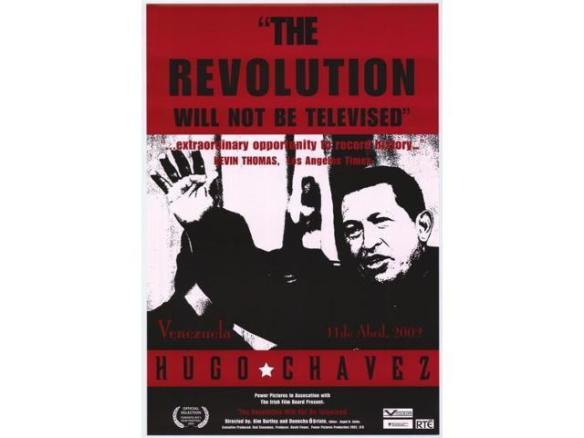
Saturday Matinee: The Revolution Will Not Be Televised

Source: Top Documentary Films

The Revolution Will Not Be Televised (a.k.a. Chavez: Inside the Coup) is a 2002 documentary about the April 2002 Venezuelan coup attempt which briefly deposed Venezuelan President Hugo Chávez.

A television crew from Ireland’s Radio Telifís Éireann happened to be recording a documentary about Chávez during the events of April 11, 2002.

Shifting focus, they followed the events as they occurred. During their filming, the crew recorded images of the events that they say contradict explanations given by Chávez opposition, the private media, the US State Department, and then White House Press Secretary Ari Fleischer.

The documentary says that the coup was the result of a conspiracy between various old guard and anti-Chávez factions within Venezuela and the United States.

US Backs Coup in Oil-Rich Venezuela, Right-Wing Opposition Plans Mass Privatization and Hyper-Capitalism

The US has effectively declared a coup in Venezuela. Trump recognized unelected right-wing opposition leader Juan Guaidó as new “president,” who plans mass privatization and neoliberal capitalist policies.

By Ben Norton

Source: GrayZone

The United States has effectively declared a political coup d’état in Venezuela, from abroad. Trump announced on January 23 that the US recognizes the unelected, illegitimate right-wing opposition leader Juan Guaidó as the supposed new “interim president” of Venezuela’s supposed new “government.”

Venezuela’s US-backed opposition has pledged to carry out a mass privatization of state assets and to implement harsh neoliberal capitalist policies. The opposition-controlled legislatures declared in its “transition” plans that the “centralized model of controls of the economy will be replaced by a model of freedom and market based on the right of each Venezuelan to work under the guarantees of property rights and freedom of enterprise.”

The US has also hinted at violence in Venezuela. During a background briefing after Trump’s declaration, journalist Dan Cohen heard a US official declare that if the government of actual President Nicolás Maduro responds with any violence, “They have no immediate future, they have no immediate livelihood. One way or another they have their days counted.”

Trump administration officials added, “When we say all options are on the table, all options are on the table… Let’s hope Maduro and his cronies see the magnitude of the message.”

Region’s Right-Wing Countries Join US in Recognizing Coup

Canada’s Liberal government, led by Prime Minister Justin Trudeau; Brazil’s new far-right leader Jair Bolsonaro; and the overtly pro-US Organization of American States (OAS) and its Secretary General Luis Almagro have joined Trump in endorsing this diplomatic coup in Venezuela.

Likewise, the right-wing, US-allied countries in Latin America, including Argentina, Chile, Colombia, Costa Rica, and Ecuador have joined Trump in anointing Guaidó as leader.

The region’s few remaining leftist governments, Bolivia, Cuba, and Nicaragua, have continued recognizing Venezuela’s legitimate government, as has Mexico’s newly elected left-wing President Andrés Manuel López Obrador.

Bolivian President Evo Morales warned that “the claws of imperialism again seek to fatally wound the democracy and self-determination of the peoples of South America,” adding, “No longer will we be the backyard of the US.”

The US government, its right-wing allies, and an obeisant corporate media have repeatedly referred to Venezuela’s actual president, Nicolás Maduro, as an “authoritarian dictator.” What they have failed to mention is that Venezuela still has regular elections, but the US-backed right-wing opposition, which is notoriously disunited and incompetent, has chosen to boycott these elections, preferring to call for foreign-backed military coups instead.

One of the only elected officials in the US who has spoken out against the coup is left-wing California Congressman Ro Khanna. Other progressive and anti-Trump US politicians, including self-declared “democratic socialists,” have remained silent on Trump’s effective declaration of a coup in Latin America.

Opposition Plans for Privatized ‘Free Market’ Economy

While supporters of regime change in Venezuela insist this blatantly undemocratic move is necessary to “defend democracy,” make no mistake, the upheaval is clearly not motivated by resistance to authoritarianism.

Venezuela, which has the world’s largest oil reserves and has challenged the hegemony of the US dollar, has long been a target of US aggression. In 2002, the United States supported a military coup that briefly ousted democratically elected President Hugo Chávez and replaced him with the right-wing oligarch Pedro Carmona. US intervention, including crippling economic sanctions, has only continued since then.

Elements of Venezeula’s opposition have portrayed themselves to credulous foreign observers as “social democratic,” but their real intentions are very clear: The opposition-controlled legislature has demanded mass privatization of state assets and a return to a capitalist oligarch-controlled economic system built on “property rights and freedom of enterprise.”

In 2017, the Venezuelan government declared the creation of the Constituent Assembly, to rewrite the constitution. Venezuela’s opposition refused to recognize this body and boycotted the elections. The opposition instead remained in control of the National Assembly and decided to run it as a separate parallel legislature.

The opposition-controlled National Assembly drafted a “transition” law that openly outlines what policies the opposition, led by Juan Guaidó, would pursue in its illegitimate, US-recognized “government” in Venezuela. Analyst Jorge Martín, explained what this means in an article published by VenezuelaAnalysis:

The “transition law” drafted by the Assembly National (in contempt) is explicit about the central objectives of the coup in the political and economic field:

“[C]entralized controls, arbitrary measures of expropriation and other similar measures will be abolished… For these purposes, the centralized model of controls of the economy will be replaced by a model of freedom and market based on the right of each Venezuelan to work under the guarantees of property rights and freedom of enterprise.”

In other words, the nationalised companies will be returned to their former private owners (including telecommunications, electrical, SIDOR, cement, etc), as will expropriated landed estates. It is noteworthy that there is a lot of talk of property and business rights, but no mention is made of workers’ rights, which would certainly be abolished. It continues:

“Public companies will be subject to a restructuring process that ensures their efficient and transparent management, including through public-private agreements.”

What this means, in plain language, is massive dismissal of workers from state companies and the entry of private capital into them: a policy of looting which has already proved to be a disaster in all countries where it has been applied.

The model of the opposition’s new coup regime in Venezuela — backed by the US, Canada, and Brazil — is the reimposition of neoliberal capitalism and the recolonization of Latin America. Any bluster about restoring democracy is a mere pretense at this point.

Degrowth: closing the global wealth divide

Contradicting the dominant paradigm that economic growth equals development, degrowth theorists argue that serious cutbacks are crucial to protect life on our planet.

By Riccardo Mastini

Source: ROAR

Today, some 4.3 billion people — more than 60 percent of the world’s population — live in debilitating poverty, struggling to survive on less than the equivalent of $5 per day (which is the mean average of all the national poverty lines in the Global South). Half do not have access to enough food. And these numbers have been growing steadily over the past few decades.

With these data, Jason Hickel, an anthropology professor and global development expert, starts his controversial book, The Divide: A Brief Guide to Global Inequality and Its Solutions, in which he meticulously and convincingly debunks the narrative told by the UN and the likes of Bill Gates and Steven Pinker. In fact, while the good-news story leads us to believe that poverty has been decreasing around the world, in reality the only places this holds true are in China and East Asia. And these are some of the only places in the world where free-market capitalism was not forcibly imposed by the World Bank and the IMF, allowing these governments to pursue state-led development policies and gradually liberalize their economies on their own terms.

Development agencies, NGOs and the world’s most powerful governments explain that the plight of poor countries is a technical problem — one that can be solved by adopting the right institutions and the right economic policies, by working hard and accepting a bit of help. As Hickel writes: “It is a familiar story, and a comforting one. It is one that we have all, at one time or another, believed and supported. It maintains an industry worth billions of dollars and an army of NGOs, charities and foundations seeking to end poverty through aid and charity.” But it’s against this narrative that Hickel takes aim.

ECONOMIC UNEQUAL EXCHANGE OVER THE CENTURIES

The main argument presented in the book is that the discourse of aid distracts us from seeing the broader picture. It hides the patterns of extraction that are actively causing the impoverishment of the Global South today and actively impeding meaningful development. “The charity paradigm obscures the real issues at stake: it makes it seem as though the West is ‘developing’ the Global South, when in reality the opposite is true. Rich countries aren’t developing poor countries; poor countries are effectively developing rich countries — and they have been since the late 15th century,” argues Hickel.

In the book it is laid bare for all to see that underdevelopment in the Global South is not a natural condition, but a consequence of the way Western powers have organized the world economic system.

It’s not that the $128 billion in aid disbursements that the West gives to the Global South every year doesn’t exist — it does. But if we broaden our view and look at it in context, we see that it is vastly outstripped by the financial resources that flow in the opposite direction.

If all of the financial resources that get transferred between rich and poor countries each year are tallied up, we find that in 2012, the last year of recorded data, developing countries received a little over $2 trillion, including all aid, investment and income from abroad. But more than twice that amount, some $5 trillion, flowed out of them in the same year. In other words, developing countries “sent” $3 trillion more to the rest of the world than they received.

What do these large outflows from the Global South consist of? “Well, some of it is payments on debt. Today, poor countries pay over $200 billion each year in interest alone to foreign creditors, much of it on old loans that have already been paid off many times over, and some of it on loans accumulated by greedy dictators,” states Hickel. Another major contributor is the income that foreigners make on their investments in developing countries and then repatriate. Think of all the profits that Shell extracts from Nigeria’s oil reserves, for example, or that Anglo American pulls out of South Africa’s gold mines.

But by far the biggest chunk of outflows has to do with capital flight. A big proportion of this takes place through “leakages” in the balance of payments between countries. Another takes place through an illegal practice known as “trade misinvoicing.” Basically, corporations report false prices on their trade invoices in order to spirit money out of developing countries directly into tax havens and secrecy jurisdictions. A similarly large amount flows out annually through “abusive transfer pricing”, a mechanism that multinational companies use to steal money from developing countries by shifting profits illegally between their own subsidiaries in different countries. But perhaps the most significant loss has to do with exploitation through trade.

Hickel explains that “from the onset of colonialism through to globalization, the main objective of the North has been to force down the cost of labor and goods bought from the South. In the past, colonial powers were able to dictate terms directly to their colonies. Today, while trade is technically “free,” rich countries are able to get their way because they have much greater bargaining power.” On top of this, trade agreements often prevent poor countries from protecting their workers in ways that rich countries do. And because multinational corporations now have the ability to scour the planet in search of the cheapest labor and goods, poor countries are forced to compete to drive costs down. As a result of all this, there is a yawning gap between the “real value” of the labor and goods that poor countries sell and the prices they are actually paid for them. This is what economists call “unequal exchange.”

Since the 1980s, countries of the West have been using their power as creditors to dictate economic and trade policies to indebted countries in the South, effectively governing them by remote control, without the need for bloody interventions. “Leveraging debt,” argues Hickel, “they imposed “structural adjustment programs” that reversed all the economic reforms that Global South countries had painstakingly enacted in the previous two decades. In the process, the West went so far as to ban the very protectionist and Keynesian policies that it had used for its own development, effectively kicking away the ladder to success.”

DEGROWTH FOR SUSTAINABLE AND FAIR LIVELIHOODS

Hickel then ponders over how — if these unfair trade and business practices were amended — poor countries could actually go about developing their economies following the same path as the one embraced by the Global North over the past two centuries. He references a study by the economist David Woodward in which the latter shows that given our existing economic model, poverty eradication can’t happen. Not that it probably won’t happen, but that it physically can’t. It is a structural impossibility.

He explains that:

Right now, the main strategy for eliminating poverty is to increase global GDP growth. The idea is that the yields of growth will gradually trickle down to improve the lives of the world’s poorest people. But all the data we have shows quite clearly that GDP growth doesn’t really benefit the poor. While global GDP per capita has grown by 65 percent since 1990, the number of people living on less than $5 a day has increased by more than 370 million. Why does growth not help reduce poverty? Because the yields of growth are very unevenly distributed. The poorest 60 percent of humanity receive only 5 percent of all new income generated by global growth. The other 95 percent of the new income goes to the richest 40 percent of people. And that’s under best-case-scenario conditions.

Given this distribution ratio, Woodward calculates that it will take more than 100 years to eradicate absolute poverty at $1.25 a day. At the more accurate level of $5 a day, eradicating poverty will take 207 years. To eradicate poverty at $5 a day, global GDP would have to increase to 175 times its present size. In other words, we need to extract, produce and consume 175 times more commodities than we presently do. It is worth pausing for a second to think about what this means. Even if such outlandish growth were possible, the consequences would be disastrous. We would quickly chew through our planet’s ecosystems, destroying the forests, the soils and, most importantly, the climate.

According to data compiled by researchers at the Global Footprint Network in Oakland, our planet only has enough ecological capacity for each of us to consume 1.8 “global hectares” annually — a standardized unit that accounts for resource use, waste, pollution and emissions. Anything over this means a degree of resource consumption that the Earth cannot replenish, or waste that it cannot absorb; in other words, it locks us into a pathway of progressive degradation. The figure of 1.8 global hectares is roughly what the average person in Ghana or Guatemala consumes.

By contrast, Europeans consume 4.7 global hectares per person, while in the US and Canada the average person consumes 8 — many times their fair share. To get a sense of how extreme this overconsumption is: if we were all to live like the average citizen of the average high-income country, we would require the ecological capacity equivalent to 3.4 Earths. Hickel elaborates:

Scientists tell us that even at existing levels of aggregate global consumption we are already overshooting our planet’s ecological capacity by about 60 percent each year. And all of this is just at our existing levels of aggregate economic activity — with the existing levels of consumption in rich and poor countries. If poor countries increase their consumption, which they will have to do to some extent in order to eradicate poverty, they will only tip us further towards disaster. Unless, that is, rich countries begin to consume less.

If we want to have a chance of keeping within the 2°C threshold — which the Paris Agreement on climate change sets as an absolute cap — we can emit no more than another 805 gigatons of CO2 at the global level. Now, let’s accept that poor countries will need to use a portion of this carbon budget in order to grow their incomes enough to eradicate poverty; after all, we know that for poor countries human development requires an increase in emissions, at least up to a relatively lowish point. This principle is already widely accepted in international agreements, which recognize that all countries have a “common but differentiated responsibility” to reduce emissions. Because poor countries did not contribute much to historical emissions, they have a right to use more of the carbon budget than rich countries do — at least enough to fulfill basic development goals (as I also argue in this article). This means that rich countries have to figure out how to make do with the remaining portion of the budget.

Professor Kevin Anderson, one of Britain’s leading climate scientists, has been devising potential scenarios for how to make this work. If we want to have a 50 percent chance of staying under 2°C, there’s basically only one feasible way to do it — assuming, of course, that negative emissions technologies is not a real option. In this scenario, poor countries can continue to grow their economies at the present rate until 2025, using up a disproportionate share of the global carbon budget. That’s not a very long time, so this strategy will only work to eradicate poverty if the gains from growth are distributed with a heavy bias towards the poor.

As Hickel writes: “The only way for rich countries to keep within what’s left of the carbon budget is to cut emissions aggressively, by about 10 percent per year. Efficiency improvements and clean energy technologies will contribute to reducing emissions by at most 4 percent per year, which gets them part of the way there. But to bridge the rest of the gap, rich countries are going to have to downscale production and consumption by around 6 percent each year. And poor countries are going to have to follow suit after 2025, downscaling economic activity by about 3 percent per year.” This strategy of downscaling the production and consumption of a country is called “degrowth.”

Hickel describes this visionary idea as follows: “All it means is easing the intensity of our economy, cutting the excesses of the very richest, sharing what we have instead of plundering the Earth for more, and liberating ourselves from the frenetic consumerism that we all know does nothing to improve our wellbeing or happiness.” And since the book first came out in 2017, Hickel has been developing an increasingly clearer position on how we can go about making such changes happen.

His thinking on degrowth was recently encapsulated in a captivating blog exchange he had with Branko Milanović, another global development expert. But Milanović still maintains that economic growth should be at the core of poverty relief. Paraphrasing a passage from Kate Raworth’s Doughnut Economics, we could summarize Milanović’s position as “economic growth is still necessary, and so it must be possible,” while Hickel argues that “economic growth is no longer possible, and so it cannot be necessary.” I side with the latter, simply because the laws of physics trump the laws of economics.

In light of this, perhaps we should regard countries like Costa Rica not as underdeveloped, but rather as appropriately developed. We should look at societies where people live long and happy lives at low levels of income and consumption not as backwaters that need to be developed according to Western models, but as exemplars of efficient living — and begin to call on rich countries to cut their excess consumption.

US plotting coups in Venezuela, Cuba and Nicaragua?

By Stephen Lendman

Source: Intrepid Report

The US wants all nations worldwide colonized, their resources looted, their people exploited as serfs, including ordinary Americans.

Sovereign independent governments everywhere are targeted for regime change—by coups d’état or wars.

That’s what imperialism is all about, a diabolical plot for unchallenged global dominance by whatever it takes for the US to achieve its aims, Republicans and undemocratic Dems allied for the same geopolitical objectives.

Humanitarian intervention, responsibility to protect, and democracy building are code words by both right wings of America’s war party for wanting fascist tyranny replacing governance of, by, and for everyone equitably everywhere—legitimate governments replaced by US-controlled puppet ones.

Post-9/11 alone, the US orchestrated coups in Haiti, Honduras, Paraguay, Brazil, Ukraine, Egypt, and elsewhere in the Middle East.

The so-called Arab spring was made in the USA. Uprisings were orchestrated. Nothing was spontaneous. CIA dirty hands were involved in replacing unpopular regimes with despotic ones considered more reliable.

Spring never bloomed, just the illusion of change for the better. It was pure deception. Everything changed in targeted countries but stayed the same.

In Egypt, Yemen and elsewhere things worsened, notably in Occupied Palestine. No spring bloomed there or anywhere else in the Middle East.

Plan Colombia was and remains all about Washington’s aim to control Latin America, eliminating opposition to regimes it controls, plotting coups against ruling authorities unwilling to bend to its will, along with pursuing anti-Sino/Russian regional policies.

Since Soviet Russia’s dissolution, the US escalated wars on humanity, using NATO as a killing machine. Republicans and Dems colluded to thirdworldize America, banana republicanize it, wrecking the economy, handing its wealth to Wall Street, war-profiteers and other corporate predators.

Both right wings of duopoly governance mock democratic values and rule of law principles they abhor, governing under a police state apparatus, hardened over time, risking global war to achieve its aims.

Venezuela, Cuba, Nicaragua, and Bolivia are the remaining sovereign independent Latin and Central American nations.

Trump regime hardliners want fascist tyranny replacing their legitimate governments. In early January, State Department deputy spokesman Robert Palladino turned truth on its head, saying the US “support[s] the people of Venezuela, Cuba and Nicaragua in restoring democratic governance and their human rights”—notions Washington abhors.

Venezuelan Bolivarian social democracy is the Trump regime’s top Latin American target for regime change. Pompeo made US intentions clear.

He turned truth on its head, saying President Nicolas Maduro is “illegitimate and the United States will continue . . . to work diligently to restore a real democracy to that country,” adding, “We are very hopeful that we can be a force for good to allow the region to come together to deliver that.”

Fact: Last May, Maduro was overwhelmingly re-elected by a two-thirds majority.

Fact: Scores of international observers from 30 countries monitored the election, judging it open, free and fair.

Fact: Venezuela’s political process is the world’s best.

Fact: It’s polar opposite America’s money-controlled system, one-party rule with two right wings, ordinary people having no say over how they’re governed.

Fact: US democracy is pure fantasy. Venezuelans have the real thing, why Republicans and Dems want its government toppled, their eyes on the prize—the world’s largest oil reserves they want handed to Big Oil.

On January 10, Maduro was inaugurated for a second six-year term, saying he’s committed to continue “fight[ing] for social and economic prosperity and to build 21st century socialism”—despite relentless US political, economic, financial, and propaganda war against the country’s social democracy.

Despite the Trump regime’s all-out efforts to mobilize international opposition to his legitimate rule, delegations from over 90 countries attended the inaugural ceremonies—including from Russia, China, Cuba, Nicaragua, Bolivia, Mexico, El Salvador, Iran, Turkey, and Ireland’s Sinn Fein.

Representatives from US colonized EU nations were absent, a spokeswoman for foreign policy chief Federica Mogherini lied saying that “the presidential elections were not free nor fair”—a falsified statement, serving US imperial interests.

Representatives from the African Union, CARICOM, the Arab League, the ALBA Bolivarian Alliance for the Peoples of Our Americas, OPEC, and the UN also attended.

In his inaugural address, Maduro said, “I tell the people. This presidential sash is yours. This power is yours. It does not belong to the oligarchy or to imperialism. It belongs to the sovereign people of Venezuela.”

He denounced the diabolical aims of “the most powerful empire in history,” urging dialogue to serve Venezuelan interests, including UN support for “peace, mutual recognition, harmony, (and) coexistence of different political visions,” adding: “I would like to sit down with the opposition, stop the sterile, useless, unnecessary conflict, talk about economic issues; with the experience of the UN we can achieve it.”

Trump regime hardliners falsely call genuine democracies dictatorships, how neocon John Bolton reacted to Maduro’s inauguration, saying the US “will not recognize” his legitimacy to rule.

The US-controlled Organization of American States (OAS), headquartered in Washington, reacted the same way. Most of its member states support longstanding US plans for regime change.

The US-controlled 13-nation Lima Group issued a statement, refusing to recognize Maduro’s legitimacy.

Caracas slammed what it called a “humiliating subordination” to US imperial interests—applying to all nations allied with Washington against Venezuela’s social democracy and sovereign independence.

On January 12, State Department deputy spokesman Palladino openly called for regime change, saying, “It is time to begin the orderly transition to a new government.”

Previous US orchestrated coup attempts failed—against Hugo Chavez and Maduro. Will the Trump regime try again in the new year?

If unable to succeed by coup d’etat, will an attempt be made to assassinate Maduro? If economic, financial, political, and other tactics fail, will military intervention be the Trump regime’s fallback option?

Will Iran be targeted the same way in the new year? Imperialism isn’t pretty.

Endless US belligerence and state-sponsored terrorism is virtually certain ahead, the way hardliners in Washington always operate—hostile to peace, stability, equity and justice at home and abroad.

Two New Reports Point to Further US Decline & Higher Risk of War

By James ONeill

Source: New Eastern Outlook

Two recent reports from the United States strongly suggest the United States is planning a major war with Russia and China, but are far from certain that they could in fact succeed in such a war. The reports also provide insights into how the United States will meet the budgetary demands of such war preparations, but almost zero appreciation of the social and human costs of such policies.

The first of these reports is entitled “Providing for the Common Defence” (November 2018). It is the report prepared for the purpose of assessing the National Defence Strategy document released in early 2018.

It acknowledges that changes “at home and abroad are diminishing US military advantages,” and that this diminution of these “advantages” poses a threat to “vital United States interests.”

Geopolitical shifts in the regional power structures are “undermining deterrence of United States adversaries and confidence of United States allies, thus increasing the likelihood of military conflict”. Should such a conflict eventuate, the United States could “suffer unacceptably high casualties and a loss of major capital assets.”

The report says that “America is losing its advantage in key war fighting areas such as air and missile defence, cyber and space operations, anti-surface and anti- submarine warfare, long range ground-based fires, and electronic warfare”.

It further acknowledges that “America’s edge is diminishing or has disappeared in many key technologies that underpin US military superiority”.

Such frankness is not without precedent in US strategy papers and the implications of the above quotations are a probable reason why the report has received almost zero coverage in the western mainstream media.

Acknowledgements of technological deficiency and strategic disadvantage do not sit comfortably with the image of an all-powerful America willing and able to defeat any threat to its own global interests or those of its allies. The latter prefer the comfortable delusion of an omnipotent US “umbrella.”

The Commission’s strategy for addressing this perceived falling behind and consequent loss of military omnipotence is however itself fatally flawed. The proposed “solution” is to spend vastly greater sums of money at a rate of 3-5% above inflation.

That means that a significantly greater share of the federal budget would have to be devoted to military spending. The only way that could be achieved, given that the United States government already has a huge growing deficit ($22 trillion and counting) would have to come, the report acknowledges, by cuts to social spending such as pensions, Medicare and social security. The “trade-offs” the report acknowledges will be “difficult”, a statement that seriously under- estimates the social devastation that such cuts would bring about.

This argument is put forward in a society which already spends more on defence than that spent by the next eight national military budgets combined. United States national infrastructure, in everything from bridges to schools is already crumbling; and these proposals will only accelerate that downward trend.

It does not seem to occur to the report writers that the entire premise that the United States should maintain its attempt to control the world for the benefit of the United States is neither desirable nor wanted by the vast majority of the worlds nations as evidenced by multiple UN General Assembly resolutions.

The second report is issued by the United States Government Accountability Office (GAO) and is entitled: National Security: Long Range Emerging Threats Facing the United States as Identified by Federal Agencies (December 2018.) It has received even less publicity then the ‘Providing for the Common Defence’ document.

The probable reason for this mainstream media reticence is because the GAO report actually details where the United States is lagging in military capability viz a viz its two perceived principal rivals: Russia and China.

The fact of relative military weakness is not new. Andrei Martyanov in his book Losing Military Supremacy (2018) provided a detailed analysis of why Russian military technology was superior to the United States in several important fields. What Martyanov said about Russia applies with equal validity to Chinese technology.

Martyanov’s argument was dramatically illustrated by President Putin’s 1st March 2018 address to the Russian Parliament. The initial American reaction was to discount Putin’s claims, although within days the military industrial complex was demanding more funds to counteract the superiority of Russian weaponry outlined in Putin’s speech.

The GAO Report now provides an authoritative acknowledgement that Putin was not bluffing. Under the section of the report headed “Weapons” it has this to say:

Hypersonic weapons. China and Russia are pursuing hypersonic weapons because their speed, altitude, and maneuverability may defeat most missile defence systems, and they may be used to improve long range conventional and nuclear strike capabilities. There are no existing countermeasures.

Missiles. Adversaries are developing missile technology to attack the United States in novel ways and challenge US missile defence, including conventional and nuclear ICBMs, sea launched land attack missiles, and space based missiles that could orbit the earth.

Aircraft. China and Russia are developing new aircraft, including stealth aircraft, which could fly faster, carry advanced weapons, and achieve greater ranges. Such aircraft could force US aircraft to operate at further distances and put more US targets at risk.

There is more in the same vein. The only caveat to add to those points is the use of the conditional tense. The use of such words as “may” or “could” is redundant. That technology is already operational (www.thesaker.is 1 March 2018).

A number of commentators have argued that the technology gap between Russian and Chinese systems and that of United States is now measured in decades. There is no evidence to suggest this gap could be bridged in the foreseeable future. A more likely scenario is that the technological gap could widen.

Although there are powerful voices in the United States administration and ‘deep state’ generally sufficiently delusional and frankly crazy enough to believe that the United States could “win” a nuclear war with Russia and/or China, the GAO report should act as a constraint on their wilder ambitions.

History demonstrates that it is unwise to underestimate the extent to which the United States will go to maintain its self appointed role is the world’s dominant hegemon, (see Michael Pembroke’s Korea (2018). The reality is that the era of United States dominance is now well past.

Rather than risk a nuclear war that would wreak unimaginable losses upon all the world’s peoples, including for the first time the United States, the more likely scenario will be an intensification of what Andrei Korybko calls ‘hybrid warfare.’ A current illustration of this is the campaign being waged against Huawei, ostensibly because of the potential for Chinese cyber espionage but in reality to weaken and undermine China’s 2025 program for leadership in artificial intelligence, quantum information and other sophisticated technologies, and enforce America’s allies to buy their inferior products.

Proxy wars in the Middle East, Africa, Asia and Latin America are also likely to increase exponentially.

These two reports demonstrate that the United States has lost its previous technological and military superiority, but equally, that it is willing to go to extraordinary lengths to prevent any further erosion of its world wide role and its replacement by the two emerging countervailing superpowers, Russia and China. Whether or not that American determination will tip the world into a catastrophic nuclear exchange will be one of the major questions for 2019.

The Recession Will Be Unevenly Distributed

By Charles Hugh Smith

Source: Of Two Minds

Those households, enterprises and organizations that have no debt, a very low cost basis and a highly flexible, adaptable structure will survive and even prosper.

The coming recession will be unevenly distributed, meaning that it will devastate many while leaving others relatively untouched. A few will actually do better in the recession than they did in the so-called “recovery.”

I realize many of the concepts floated here are cryptic and need a fuller explanation: the impact of owning differing kinds of capital, fragmentation, asymmetry, opacity, etc. ( 2019: Fragmented, Unevenly Distributed, Asymmetric, Opaque).

These dynamics guarantee a highly uneven distribution of recessionary consequences and whatever rewards are generated will be reaped by a few.

One aspect of the uneven distribution is that sectors that were relatively protected in recent recessions will finally feel the impact of this one. Large swaths of the tech sector (which is composed of dozens of different industries and services) that were devastated in the dot-com recession of 2000-02 came through the 2008-09 recession relatively unscathed.

This time it will be different. The build-out of mobile telephony merging with the web has been completed, social media has reached the stagnation phase of the S-Curve and many technologies that are widely promoted as around the corner are far from profitability.

Then there’s slumping global demand for mobile phones and other consumer items that require silicon (processors) and other tech components: autos, to name just one major end-user of electronics.

The net result will be mass layoffs globally across much of the tech sector.Research is nice but it doesn’t pay the bills today or quiet the restive shareholders as profits tank.

The public sector is also ripe for uneven distribution of recessionary impacts.Local government and its agencies in boomtowns such as the SF Bay Area, Seattle, Los Angeles, NYC, etc. have feasted on soaring tax revenues and multi-billion dollar municipal bonds.

The Powers That Be in these boomtowns are confident that the good times will never end, and so the modest rainy-day funds they’ve set aside are widely viewed as immense bulwarks against recession when in reality they are mere sand castles that will melt away in the first wave.

A $1 billion reserve looks impressive in good times but not when annual deficits soar to $10 billion. Local governments depend on various revenue streams, and most rely on a mix of property, sales and income taxes, both wages (earned) and capital gains (unearned). All of these will be negatively impacted in the next recession.

Local governments are especially prone to The Ratchet Effect, the dynamic in which expenses move higher as revenues climb but the organization is incapable of shrinking, i.e. it only knows how to expand. This defines government as an organizational type.

Inefficiencies (including low-level corruption and fraud) pile up and are offset with higher revenues. When revenue crashes, the system is incapable of eliminating the inefficiencies or reducing benefits and headcount.

I call the endgame of The Ratchet Effect the Rising Wedge Model of Breakdown:

The Ratchet Effect is visible in organizations of all scales, from households to sprawling bureaucracies. The core of the Ratchet Effect is the ease with which the cost basis of an organization rises and the extreme resistance to any reduction in funding.

The psychology of this resistance is easy to understand: everyone hired in the expansion will fight to keep their job, regardless of the needs of the organization or the larger society. Every individual, department and division will fight with the fierceness of a cornered animal to retain their share of the budget, for their self-interest trumps the interests of the organization or society.

Since each “ratchet” will fight with desperate energy to resist being cut while those attempting to do the cutting are simply following directives, the group that has pulled out all the stops to resist cuts will typically win bureaucratic battles.

Broad-based cuts trigger Internecine Warfare Between Protected Fiefdoms as entrenched vested interests battle to shift the cuts to some politically less favored fiefdom. Bureaucracies facing cuts quickly shift resources to protecting their budget, leaving their mission on auto-control. (The Lifecycle of Bureaucracy December 2, 2010)

These dynamics create a rising wedge in which “minimum” costs continue to rise over time even if modest cuts are imposed from time to time. The eventual consequence is a cost basis that is so high that even a modest reduction collapses the organization.

In other words, incremental reductions and reforms have zero impact on the endgame. The organization has become so brittle that any structural reform triggers a breakdown.

Those households, enterprises and organizations that have no debt, a very low cost basis and a highly flexible, adaptable structure will survive and even prosper. Those with high debt loads, high fixed expenses and inflexible responses will find incremental reductions and reforms will have little impact on the endgame of breakdown and collapse.

This is one of the core topics of my latest book, Pathfinding our Destiny: Preventing the Final Fall of Our Democratic Republic.

Here’s a household example of the type of organization that won’t just survive but thrive in the recession: a household with $100,000 in revenues from multiple income sources and fixed expenses of $35,000, no debt and a management team (the spouses/adults) that’s willing to implement radical changes in lifestyle, expenses and work at the first disruption of revenues. The household that doesn’t just survive but thrives sees crisis / disruption as an opportunity, not a disaster to be mitigated with denial and wishful thinking.

Five Reasons I’m Excited About Tulsi Gabbard’s Candidacy

By Caitlin Johnstone

Source: CaitlinJohnstone.com

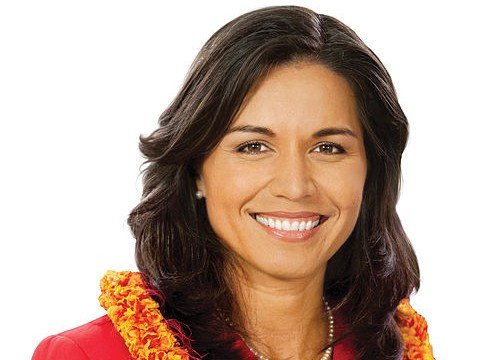
Hawaii Representative Tulsi Gabbard has announced her intent to campaign for President of the United States, and the entire political spectrum is shitting bricks about it. Mainstream liberals and neocons are calling her a Putin puppet and Assad’s BFF, leftists and progressives are criticizing her associations with right-wing factions in India and anti-LGBT comments she made in the early 2000s, conspiracy analysts are criticizing her Council on Foreign Relations membership, and the Zionist elements of Trump’s base are openly promising to destroy her candidacy. A lot of others, myself included, got a lot more interested in the 2020 elections when she threw her hat in.

I’m not interested in defending Gabbard from the criticisms that have been leveled at her at this time; many articles have been written toward that end already, and if she’s going to run for the most powerful elected office on the planet it’s fair to scrutinize and question what kind of person she is. I’m also not interested in endorsing anyone for the presidency. What I am interested in is the way Gabbard’s presence in the Democratic presidential primary race is already in January 2019 upsetting the standard establishment script and forcing foreign policy debates that need to happen.

Here are a five thoughts on that subject:

1 – Gabbard will definitely be the most antiwar candidate on the debate stage by a wide margin, except in the highly unlikely event that someone steps up from way out of left field to run like Dennis Kucinich. Being the most antiwar candidate in anything associated with the Democratic Party is a very low bar, but her vocal positions on SyriaIranYemenRussiaNorth KoreaAfghanistanGaza, and previous US regime change interventions set her so far from the establishment orthodoxy that she’ll look as different from the other candidates as Ron Paul looked on the Republican debate stage.

2 – Make no mistake, it is this opposition to significant aspects of the US war machine that is the driving force behind the overwhelming bulk of the shrieking objection to Gabbard’s candidacy, not any of the more valid criticisms. We have learned from the mainstream acceptance of Bernie Sanders and Alexandria Ocasio-Cortez that some criticism of the status quo will be tolerated when it comes to domestic policy, but it’s an excommunicable offense when it comes to foreign policy. The idea that the US should forcefully control world affairs using the carrot of alliance and the stick of military violence is so ubiquitous in both of America’s mainstream parties that it takes a Washington Postcolumnist getting dismembered alive to start a debate about something so self-evidently evil as the Saudi-led destruction of Yemen.

3 – Foreign policy is undeniably the area in which the greater part of US government depravity takes place, and as far as America’s permanent government is concerned it is by far the most important. Forcing a debate on an issue you’re not even supposed to bring up on mainstream media will get a lot of ordinary Americans asking questions that very powerful individuals don’t want asked. The DNC went from scheduling over 20 debates in 2008 to trying to limit it to six in 2016 because they didn’t want Sanders’ excellent domestic policy ideas getting out to the public and making their coronated status quo candidate look bad. Gabbard could have the same impact on foreign policy in an audience that has been aggressively propagandized by MSNBC warmongering.

4 – Gabbard’s progressive positions on issues like Medicare for Allenvironmentalism$15 minimum wageWall Street accountability, the failed war on drugsmarijuana legalizationcriminal justice reform and indigenous water rights will also set her further to the left on domestic policy than anyone on the debate stage besides Sanders should he run. This is a self-evident fact, but a lot of narrative control efforts are being poured into painting her as a right-winger. She will definitely help force the debate to the left, and her position on withdrawing from expensive interventionist war policies answers the “But how are you going to PAY for it??” questions the MSM talking heads are so fond of grilling progressives with on social programs.

5 – For me the most telling thing about Gabbard is the way she resigned from her position as vice chair of the DNC in order to endorse Bernie Sanders in 2016. Other DNC operatives remained inside the Committee and actively schemed to give Clinton every unfair advantage in the primary, but Gabbard showed integrity and refused to advance a biased agenda in violation of the DNC charter. It showed that she’s a real person operating within one of the phoniest places in the world, and that she’s willing to throw a spanner in the works of the machine when it’s in the highest interest. This unwillingness to march to the beat of the establishment drum for such proceedings could lead to some very interesting things as the presidential race heats up.

And that’s good enough for me. She’s not perfect, she’s a major long shot to actually win, but Tulsi Gabbard’s campaign for president will definitely shake things up in all the right places, and good things will come from it. Which is why all the right people are outraged by her bid today.