GHW Bush: Honoring a War Criminal

By Stephen Lendman

Source: StephenLendman.org

America honors its worst. Throughout his career as a House member, UN envoy, GOP National Committee chairman, ambassador to China, CIA director, vice president and president, GHW Bush was an unapologetic imperial spear carrier.

He supported all US wars of aggression and launched his own – against nations threatening no one. His actions showed profound indifference to rule of law principles and human suffering.

Countless millions were grievously harmed by an agenda he backed and led as president. Major media shamefully praised what demands condemnation and accountability, even posthumously.

Praising “his leadership and choices on the global stage,” the NYT claimed “historians will almost certainly treat him more kindly than the voters did in 1992” – establishment ones only, not honorable truth-tellers.

A Jeb Bush/James Baker op-ed shamefully said they “never met a man as remarkable as George HW Bush” – a profound perversion of truth.

Wall Street Journal editors praised his war on Iraq, ignoring his naked aggression and genocidal sanctions, the latter responsible for the deaths of around 5,000 Iraqi children under age-five monthly while in force.

He was involved in Washington’s Contra war in Nicaragua. It followed the Sandinista National Liberation Front’s (FSLN) overthrow of US-supported tyrannical Anastasio Somoza’s fascist regime.

As president, he ordered the invasion of Panama on December 20, 1989, aiming to prove his toughness against a defenseless nation no match against America’s military might.

Manuel Noriega was Washington’s man in Panama from December 1983 until yearend 1989, a valued CIA asset until forgetting who’s boss.

No longer being convenient stooge enough for his imperial master led to his downfall.

Bush’s machismo and imperial arrogance bore full responsibility for thousands of Panamanian civilian deaths and injuries, many more thousands displaced.

Residential neighborhoods were destroyed in poorest parts of the country, including by incendiary devices used to torch structures.

Tanks crushed victims. Panamanian defense force members, civilians, journalists, and others were executed in cold blood.

Bush proved his cajones by mass slaughter and destruction. In the aftermath, he shamefully said it was “worth it” – smashing nations a US specialty before and after the rape of Panama.

William Blum earlier called (fantasy) “democracy” America’s deadliest export. Its agenda makes the world safe for Wall Street and other corporate favorites at the expense of ordinary people everywhere.

Commenting on carnage in Panama, Blum said “(t)he invasion and ensuing occupation produced gruesome scenes: People burning to death in the incinerated dwellings, leaping from windows, running in panic through the streets, cut down in cross fire, crushed by tanks, human fragments everywhere.”

Accountability never follows the highest of US high crimes, victims blamed for US wrongdoing every time.

Most Americans know nothing about the so-called 1989 Christmas invasion, why it was launched, the devastation caused, or human toll.

Raping Panama, deposing and arresting Noriega, along with Bush’s Gulf War walkover of Iraq let him crow that “we’ve kicked the Vietnam syndrome once and for all.”

Horrendous Nuremberg-level crimes don’t matter. Noriega fell out of favor for not cooperating with Washington’s contra war on Nicaragua.

Media hysteria vilified him, citing things that didn’t matter when he was Washington’s man in Panama.

When no longer wanted, his fate was sealed, how Washington treats other foreign leaders no longer useful, notably Saddam Hussein.

The January 1991 Gulf War followed imposition of sanctions in August 1990. Enforced for over a dozen years, they were genocidal. A Kuwait-funded PR campaign whipped up public support for naked aggression – ending on February 28.

US forces committed high crimes of war and against humanity, including mass slaughter and destruction of essential to life facilities.

Terror-bombing blasted power plants, dams, water purification facilities, sewage treatment and disposal systems, telephone and other communications, hospitals, schools, residential areas, mosques, irrigation sites, food processing, storage and distribution facilities, hotels and retail establishments.

Transportation infrastructure, oil wells, pipelines, refineries and storage tanks, chemical plants, factories and other commercial operation, civilian shelters, government buildings, and historical sites were also destroyed.

The Panama and Gulf War were two of history’s great crimes. In Iraq, virtually everything needed for normal life was destroyed or heavily damaged.

Genocidal sanctions killed up to two millions Iraqis, two-thirds of them children under age-five. Bush II’s 2003 “shock and awe” blitzkrieg through 2007 took up to 2.0 million more lives, mostly young children.

Two imperial wars of aggression and genocidal sanctions destroyed the cradle of civilization. War and related violence in Iraq continues to this day, the nation occupied as a US colony.

Bush I’s new world order agenda, continued by his successors, including Bush II, features endless wars of aggression, state terror on a global scale, along with growing homeland tyranny, heading toward becoming full-blown.

A special place in hell awaits GHW Bush, Bush II when he passes, and all other US war criminals.

They include everyone supporting Washington’s imperial agenda, including congressional  members authorizing funds without which wars can’t be waged.

An earlier article said the Bush I, II, and entire family dynasty speaks for itself – a crime family for over a century.


Related Articles:

The Amazing GWHB Hagiography

If There’s A Hell Below, That’s Where He’ll Go: The BAR Obituary on George H.W. Bush


Human Delusion and Our Destruction of the Biosphere: We Aren’t Even Trying!

By Robert J. Burrowes

Have you heard the expression ‘climate change’? That lovely expression that suggests a holiday in a place with a more pleasant climate.

Unfortunately, only the rarest individual has the capacity to see through the elite-promulgated delusion that generated this benign expression and its twin notions that 1.5 degrees celsius (above the preindustrial level) is an acceptable upper limit for an increase in global temperature and that the timeframe for extinction-threatening outcomes of this ‘climate change’ is the ‘end of the century’.

If you believe that this 1.5 degree increase is achievable or even viable for sustaining life on Earth and that the ‘end of the century’ is our timeframe then you are the victim of your own fear, which is suppressing your capacity to seek out, analyze and comprehend the evidence that is readily available and to then behave powerfully in response to it. For an explanation, see Why Violence?’ and Fearless Psychology and Fearful Psychology: Principles and Practice.

Therefore, your fear, rather than the climate catastrophe and other critical assaults on Earth’s biosphere, is the real problem.

The most casual perusal of the evidence in relation to what is happening to Earth’s biosphere – as distinct from the propaganda that is endlessly promulgated in the global elite’s corporate media – clearly indicates that the cataclysmic assault on our biosphere in a wide range of synergistic ways is now driving the sixth mass extinction event in Earth’s history and that, as a direct result of our relentless and rampaging destruction of habitat, it will take down humanity with it. Well within 10 years. See ‘Human Extinction by 2026? A Last Ditch Strategy to Fight for Human Survival’.

Now if your fear hasn’t already been triggered so that you ceased reading this article, let me offer the barest outline of the nature and extent of the assault on Earth’s biosphere and why the climate catastrophe is only one part of it which nonetheless needs to be seriously, rather than tokenistically, addressed, as is usually suggested whether by most climate lobby groups or, of course, elite-controlled governments and the IPCC.

But before ranging beyond the climate to highlight other threats to the biosphere, did you know that governments and corporations around the world are currently planning or have under construction 1,380 new coal plants? That’s right. 1,380 new coal plants. In 59 countries. See ‘NGOs Release List of World’s Top Coal Plant Developers’ and ‘2018 Coal Plant Developers List’.

For just a taste of the detail on this rapid coal expansion, try the report ‘Tsunami Warning: Can China’s Central Authorities Stop a Massive Surge in New Coal Plants Caused by Provincial Overpermitting?’ and ‘The World Needs to Quit Coal. Why Is It So Hard?’

So if we are deluding ourselves about coal, what about oil? Can we expect a dramatic reduction in oil use to compensate for the substantial increase in coal use? Well, according to the just-released report of the International Energy Agency (IEA), while there is some projected improvement in fuel economy for cars and a projected increase in the number of electric vehicles, cars only account for about one-quarter of the world’s oil consumption and there is no projected reduction in the oil used to fuel freight trucks, ships and airplanes; for heating; and to make plastics and other petrochemicals. As a result, the agency expects global oil demand to keep rising through 2040.

To summarize: the IEA report notes that global carbon dioxide emissions rose 1.6% in 2017 and are on track to climb again in 2018 and, on the current trajectory, emissions will keep rising until 2040. See ‘World Energy Outlook 2018’ and ‘Clean Energy Is Surging, but Not Fast Enough to Solve Global Warming’.

So, given that we are led to believe that there is supposed to be some sort of international consensus to limit the global temperature increase to 1.5 (which is far too high in any case) above the preindustrial level, why is this happening? Well, in relation to coal: ‘Powerful companies, backed by powerful governments, often in the form of subsidies, are in a rush to grow their markets before it is too late. Banks still profit from it. Big national electricity grids were designed for it.’ See ‘The World Needs to Quit Coal. Why Is It So Hard?’

And just to illustrate what those of us who are genuinely concerned are up against, if you want to read the latest breathtakingly delusional account of the state of the world’s climate which prodigiously underestimates the nature of the climate catastrophe and utterly fails to consider the synergistic impact of other critical environmental destruction, you can do so in the US government’s just-released report ‘Fourth National Climate Assessment Volume II: Impacts, Risks, and Adaptation in the United States’ which is summarized here: ‘Fourth National Climate Assessment Volume II: Impacts, Risks, and Adaptation in the United States; Report-in-Brief’.

This report is presented in one of the global elite’s primary propaganda outlets as follows: ‘A major scientific report issued by 13 federal agencies on [23 November 2018] presents the starkest warnings to date of the consequences of climate change for the United States, predicting that if significant steps are not taken to rein in global warming, the damage will knock as much as 10 percent off the size of the American economy by century’s end.’ See ‘U.S. Climate Report Warns of Damaged Environment and Shrinking Economy’.

At this point I must confess that despite my substantial knowledge of human psychology and widespread human insanity (and the fear that drives it), certainly afflicting the global elite, sometimes even I am impressed with the level of delusion that elites can propagate and have so many believe. See ‘The Global Elite is Insane Revisited’.

Still, as Joseph Goebbels, Nazi Minister of Propaganda and Public Enlightenment under Adolf Hitler once noted:

‘If you tell a lie big enough and keep repeating it, people will eventually come to believe it. The lie can be maintained only for such time as the State can shield the people from the political, economic and/or military consequences of the lie. It thus becomes vitally important for the State to use all of its powers to repress dissent, for the truth is the mortal enemy of the lie, and thus by extension, the truth is the greatest enemy of the State.’

What Goebbels didn’t know is that someone must be terrified – as we terrorize our children – so that they can be so victimized by propaganda as adults.

Anyway, apart from our destruction of Earth’s climate by burning coal and oil, not to mention gas, elites use geoengineering to wage war on Earth’s climate, environment and ultimately us. For the latest update on the geoengineering assault on Earth’s biosphere, listen to Dane Wigington’s latest superb ‘Geoengineering Watch Global Alert News, #172’ and read, watch and listen to the vast documentary record available on the Geoengineering Watch website which remind us how climate engineering is annihilating plants, toxifying soils and water, and destroying the ozone layer among many other outcomes. For a video explaining the role of geoengineering in the latest wildfires in California, see ‘Climate Engineering Total Desperation, Engineering Catastrophic Wildfires To Temporarily Cool Earth’.

All of the above is happening despite the existing temperature increase (about one degree) triggering the now-endless succession of deadly wildfires, droughts, cold snaps, floods, heat waves and catastrophic hurricanes (often in parts of the world where the corporate media can ignore them), as well as the out-of-control methane releases into the atmosphere that are occurring. See ‘7,000 underground gas bubbles poised to “explode” in Arctic’ and ‘Release of Arctic Methane “May Be Apocalyptic,” Study Warns’.

Moreover, these methane releases coupled with other ongoing climate impacts such as sea ice melt and permafrost thawing in the Arctic – summarized in ‘Will humans be extinct by 2026?’ – which has led to the ‘Arctic’s strongest sea ice break[ing] up for first time on record’ and the dramatic weakening of the Gulf Stream – see ‘Anomalously weak Labrador Sea convection and Atlantic overturning during the past 150 years’, ‘Observed fingerprint of a weakening Atlantic Ocean overturning circulation’ and Gulf Stream current at its weakest in 1,600 years, studies show’ – threaten imminent human extinction.

So do you think we are even trying? Or are we tinkering around the edges of this accelerating catastrophe and deluding ourselves that we are doing enough?

But this is far from the end of it. There are other critical threats to Earth’s biosphere that horribly complicate the nature and extent of this catastrophe. What are these threats?

Well, to leave aside a series of threats only marginally less drastic, here are some of the key ones, all of which seriously degrade (or destroy outright) vital components of the interrelated ecosystems (‘the web of life’) that make life on Earth possible.

Rainforests

We are currently destroying the world’s rainforests, mainly by logging them for timber and burning them down to make way for cattle ranches or palm oil plantations. In an extensive academic study, more than 150 joint authors of a report advised that ‘most of the world’s >40,000 tropical tree species now qualify as globally threatened’. See ‘Estimating the global conservation status of more than 15,000 Amazonian tree species’.

Why are more than 40,000 tropical tree species threatened with extinction? Because ‘Upwards of 80,000 acres of rainforest are destroyed across the world each day, taking with them over 130 species of plants, animals and insects.’ See ‘Half of Amazon Tree Species Face Extinction’ and ‘Measuring the Daily Destruction of the World’s Rainforests’. If you missed that, it was 80,000 acres of rainforest destroyed each day.

Oceans

We are destroying the Earth’s oceans by dumping into them everything ranging from excess carbon dioxide and vast amounts of synthetic poisons to plastic and the radioactive contamination from Fukushima. The oceans absorb carbon dioxide as one manifestation of the climate catastrophe and, among other outcomes, this accelerates ocean acidification, adversely impacting coral reefs and the species that depend on these reefs.

In addition, a vast runoff of agricultural poisons, fossil fuels and other wastes is discharged into the ocean, adversely impacting life at all ocean depths – see Staggering level of toxic chemicals found in creatures at the bottom of the sea, scientists say’ – and generating ocean ‘dead zones’: regions that have too little oxygen to support marine organisms. See Our Planet Is Exploding With Marine “Dead Zones”’.

Since the Fukushima nuclear reactor disaster in 2011, and despite the ongoing official coverup, vast quantities of radioactive materials are being ongoingly discharged into the Pacific Ocean, irradiating everything in its path. See ‘Fukushima: A Nuclear War without a War: The Unspoken Crisis of Worldwide Nuclear Radiation’.

Finally, you may not be aware that there are up to 70 ‘still functional’ nuclear weapons as well as nine nuclear reactors lying on the ocean floor as a result of accidents involving nuclear warships and submarines. See ‘Naval Nuclear Accidents: The Secret Story’ and ‘A Nuclear Needle in a Haystack: The Cold War’s Missing Atom Bombs’.

Soil

But not all of our destruction is as visible as our vanishing rainforests and contaminated oceans. Have you considered the Earth’s soil recently? Apart from depleting it, for example, by washing it away (sometimes in dramatic mudslides but usually unobtrusively) because we have logged the rainforest that held it in place, we also dump vast quantities of both inorganic and organic pollutants into it as well. Some of the main toxic substances in waste are inorganic constituents such as heavy metals, including cadmium, chromium, lead, mercury, nickel and zinc. Mining and smelting activities and the spreading of metal-laden sewage sludge are the two main culprits responsible for the pollution of soils with heavy metals. See ‘Soil-net’.

Far more common, however, is our destruction of the soil with organic based pollutants associated with industrial chemicals. Thousands of synthetic chemicals reach the soil by direct or indirect means, often in the form of fertilizers, pesticides, herbicides and other poisons that destroy the soil, by reducing the nutrients and killing the microbes, in which we grow our food (which many people actually eat, at great cost to their health). See, for example, ‘Glyphosate effects on soil rhizosphere-associated bacterial communities’.

Using genetically modified organisms, and the chemical poisons on which they rely, exacerbate this problem terribly. But two other outcomes of the use of such poisons are that the depleted soil can no longer sequester carbon and the poisons also kill many of the beneficial insects, such as bees, that play a part in plant pollination and growth.

And, of course, military contamination and destruction of soil is prodigious ranging from the radioactive contamination of vast areas to the extensive and multifaceted chemical contamination that occurs at military bases.

Partly related to military violence but also a product of using nuclear power, humans generate vast amounts of waste from exploitation of the nuclear fuel cycle. This ranges from the pollution generated by mining uranium to the radioactive waste generated by producing nuclear power or firing a nuclear weapon. But it also includes the nuclear waste generated by accidents such as that at Chernobyl and Fukushima.

Again, for just a taste of the monumental nature of this problem, see Emergency Declared at Nuclear Waste Site in Washington State, ‘Disposing of Nuclear Waste is a Challenge for Humanity’ and ‘Three Years Since the Kitty Litter Disaster at Waste Isolation Pilot Plant’.

Like destroying the rainforests and oceans, destroying the soil is an ongoing investment in future extinctions. And so is our overconsumption and contamination of the Earth’s finite fresh water supply.

Fresh Water

Whether wetland, river, creek, lake or acquifer, Earth’s fresh water is under siege. Given corporate negligence, this includes all of the chemical poisons and heavy metals used in corporate farming and mining operations, as well as, in many cases around the world where rubbish removal is poorly organized, the sewage and all other forms of ‘domestic’ waste discharged from households. Contamination of the world’s creeks, rivers, lakes and wetlands is now so advanced that many are no longer able to fully support marine life. For one summary of the problem, see ‘Pollution in Our Waterways is Harming People and Animals – How Can You Stop This!’

Beyond this, however, Earth’s groundwater supplies (located in many underground acquifers such as the Ogallala Aquifer in the United States) are also being progressively contaminated by gasoline, oil and chemicals from leaking storage tanks; bacteria, viruses and household chemicals from faulty septic systems; hazardous wastes from abandoned and uncontrolled hazardous waste sites (of which there are over 20,000 in the USA alone); leaks from landfill items such as car battery acid, paint and household cleaners; and the pesticides, herbicides and other poisons used on farms and home gardens. See ‘Groundwater contamination’.

Moreover, while notably absent from the list above, these contaminants also include radioactive waste from nuclear tests – see ‘Groundwater drunk by BILLIONS of people may be contaminated by radioactive material spread across the world by nuclear testing in the 1950s’ – and the chemical contamination caused by hydraulic fracturing (fracking) in search of shale gas, for which about 750 chemicals and components, some extremely toxic and carcinogenic like lead and benzene, have been used. See ‘Fracking chemicals’.

By the way, if you didn’t know it, our purchase and use of all of those hitech products – cars, computers, mobile phones, televisions… – coupled with our consumption of intensively-farmed animal products, all of which are produced using huge quantities of fresh, clean water, is rapidly depleting and degrading the remaining fresh water on Earth, as well as savagely exploiting the people from whose countries we take the strategic minerals and water necessary for such production. See, for example, ‘500 Years is Long Enough! Human Depravity in the Congo’.

War

In addition to the above (and many other biosphere-destroying activities not mentioned), relying on our ignorance and fearful complicity, elites have a budget of hundreds of billions of dollars annually – see the US budget for war in ‘Costs of Post-9/11 U.S. Wars to 2019: $5.9 Trillion’ – to kill huge numbers of our fellow human beings but also to destroy vast areas of Earth’s biosphere through war and other military violence. See, for example, the Toxic Remnants of War Project and the film ‘Scarred Lands & Wounded Lives’.

Unfortunately, too few activists have the awareness and courage to acknowledge the role that war plays in destroying the climate and environment, and include anti-war efforts in their campaigns. Campaigns that will fail dismally, and spectacularly, if the threatened nuclear war should eventuate. See ‘The War to End War 100 Years On: An Evaluation and Reorientation of our Resistance to War’.

Extinction beckons

In summary, our multifaceted, monumental and unrelenting assault on Earth’s biosphere is generating an extinction rate of 200 species (plants, birds, animals, fish, amphibians, insects and reptiles) each day with another 26,000 species already identified as ‘under threat’ – see ‘Red list research finds 26,000 global species under extinction threat’ – with some prominent scholars explaining how even these figures mask a vital component of the rapidly accelerating catastrophe of species extinctions: the demise of local populations of a species. See ‘Biological annihilation via the ongoing sixth mass extinction signaled by vertebrate population losses and declines’.

For further evidence from the vast literature on this subject touching only on impacts in relation to insects and its subsequent impact on birds, see ‘Death and Extinction of the Bees’, ‘Insectageddon: farming is more catastrophic than climate breakdown’ and ‘“Decimated”: Germany’s birds disappear as insect abundance plummets 76%’.

So severe is this assault on the biosphere that recent research warns that the ‘alarming loss of insects will likely take down humanity before global warming hits maximum velocity…. The worldwide loss of insects is simply staggering with some reports of 75% up to 90%, happening much faster than the paleoclimate record rate of the past five major extinction events’. Without insects ‘burrowing, forming new soil, aerating soil, pollinating food crops…’ and providing food for many bird species, the biosphere simply collapses. See ‘Insect Decimation Upstages Global Warming’.

So what can we do?

If you are genuinely powerful, you can stop lobbying governments to tinker with their policies, for example, in the direction of renewable energy (which, alone, cannot solve the multiplicity of ecological crises).

Governments are not the problem. And they simply do as elites direct them in any case. (If you believe that voters decide governments and their policies, and that lobbying them is effective, then your fear is deluding you again.)

The real problem is you and me. We have swallowed one of the ‘big lies’ that Joseph Goebbels talked about: we have believed and acted on the capitalist imperative to endlessly overconsume so that economic growth can rise perpetually in our finite world: a planet that has ecological limits.

But, as I noted above, the big lie only works because our fear makes us believe delusion. Why? Because we were terrorized as a child into accepting material goods as a substitute for our capacity to be our unique and powerful Self. See ‘Love Denied: The Psychology of Materialism, Violence and War’.

The monstrous assault on Earth’s biosphere, that goes far beyond the climate catastrophe, is the outcome of each of us consuming more than we need and then fearfully deluding ourselves that it is necessary (or that the harm it caused was too little to matter or justified by some other consideration). Well, you can delude yourself as much as you like but it is still just that: a fearful delusion.

And the point is simply that you can choose differently and powerfully, if you have the courage. For a start, you can forego all air travel. You can travel without owning your own car. You can eat well without consuming meat or fish (and eating biodynamically/organically grown vegetarian/vegan food instead). In essence: If the demand for planet-destroying products is reduced, corporations will not produce them (and destroy the Earth in doing so). This is how the law of supply and demand works under capitalism.

Beyond these simple but vital measures, you can consider many other powerful options, particularly including (accelerated) participation in the fifteen-year strategy outlined in ‘The Flame Tree Project to Save Life on Earth’ which provides a simple plan for people to systematically reduce their consumption, by at least 80%, involving both energy and resources of every kind – water, household energy, transport fuels, metals, meat, paper and plastic – while dramatically expanding their individual and community self-reliance in 16 areas, so that all environmental concerns are effectively addressed.

The Flame Tree Project was inspired by Mohandas K. Gandhi who identified the environmental crisis decades before it became an issue in the West, and who lived his own life in extraordinary simplicity and self-reliance, symbolized by his daily spinning of khadi. ‘Earth provides enough for every person’s need but not for every person’s greed.’ He also invited us to powerfully follow our conscience, reminding us that ‘Hesitating to act because others do not yet see the way only hinders progress.’

But, critically important though he believed personal action to be, Gandhi was also an extraordinary political strategist and he knew that we needed to do more than transform our own personal lives. We need to provide opportunities that compel others to consider doing the same.

So if your passion is campaigning for change, consider doing it strategically as outlined in Nonviolent Campaign Strategy. For example, see the Nonviolent Strategy Wheel and the list of strategic goals necessary to halt the climate catastrophe and end war. Choose one or a few goals appropriate to your circumstances and conduct a strategically-oriented nonviolent campaign, as explained on the same website, to achieve those goals.

Sound strategy is vital given the insanity driving elite behaviour (such as planning/building 1,380 new coal plants). As mentioned above, see ‘The Global Elite is Insane Revisited’.

If your fear makes it difficult to do things such as those suggested above, consider healing as explained in Putting Feelings First’.

If you want your children to be able to respond powerfully in the face of the biosphere’s progressive collapse, consider making ‘My Promise to Children’.

And if you want to join the worldwide movement to end all violence against humans and the biosphere, you can do so by signing the online pledge of The Peoples Charter to Create a Nonviolent World.

The bottom line is this. You can systematically and rapidly reduce your personal consumption and, one way or another, mobilize others or nonviolently compel them to do the same. Or you can let your fear delude you that the ongoing destruction of Earth’s biosphere is somehow unrelated to your personal choices about consumption and the choices of those around you.

Extinction beckons. The choice is yours.


Biodata: Robert J. Burrowes has a lifetime commitment to understanding and ending human violence. He has done extensive research since 1966 in an effort to understand why human beings are violent and has been a nonviolent activist since 1981. He is the author of ‘Why Violence?’ http://tinyurl.com/whyviolence His email address is flametree@riseup.net and his website is here. http://robertjburrowes.wordpress.com

Robert J. Burrowes
P.O. Box 68
Daylesford, Victoria 3460
Australia

Email: flametree@riseup.net

Websites:
Nonviolence Charter
Flame Tree Project to Save Life on Earth
‘Why Violence?’
Feelings First
Nonviolent Campaign Strategy
Nonviolent Defense/Liberation Strategy
Anita: Songs of Nonviolence
Robert Burrowes
Global Nonviolence Network

Why Are so Few Americans Able to Get Ahead?

By Charles Hugh Smith

Source: Of Two Minds

Our entire economy is characterized by cartel rentier skims, central-bank goosed asset bubbles and stagnating earned income for the bottom 90%.

Despite the rah-rah about the “ownership society” and the best economy ever, the sobering reality is very few Americans are able to get ahead, i.e. build real financial security via meaningful, secure assets which can be passed on to their children.

As I’ve often discussed here, only the top 10% of American households are getting ahead in both income and wealth, and most of the gains of these 12 million households are concentrated in the top 1% (1.2 million households). (see wealth chart below).

Why are so few Americans able to get ahead? there are three core reasons:

1. Earnings (wages and salaries) have not kept up with the rising cost of living.

2. The gains have flowed to capital, which is mostly owned by the top 10%, rather than to labor ((wages and salaries).

3. Our financialized economy incentivizes cartels and other rentier skims, i.e. structures that raise costs but don’t provide any additional value for the additional costs.

It’s instructive to compare today’s household with households a few generations ago. As recently as the early 1970s, 45 years ago, it was still possible for a single fulltime-earner to support the household and buy a home, which in 1973 cost around $30,000 (median house price, as per the St. Louis FRED database).

As recently as 20 years ago, in 1998, the median house price in the U.S. was about $150,000— still within reach of many two-earner households, even those with average jobs.

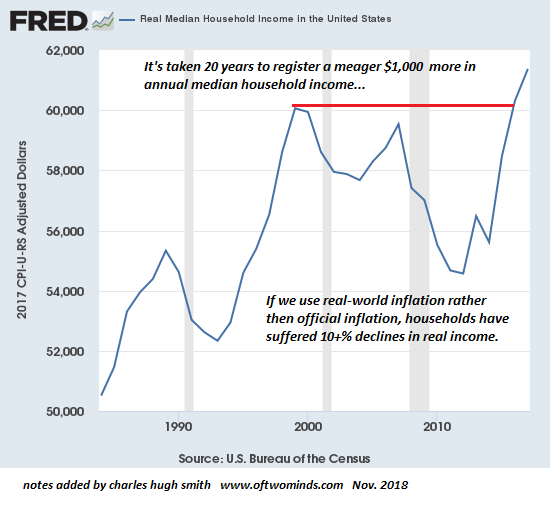
As the chart below shows, real median household income has only recently exceeded the 1998 level— and only by a meager $1,000 annually. If we use real-world inflation rather than the under-estimated official inflation, real income has plummeted by 10% or more in the past 20 years.

This reality is reflected in a new study of wages in Silicon Valley, which we might assume would keep up due to the higher value of the region’s output. The study found the wages of the bottom 90% declined when adjusted for inflation by as much as 14% over the past 20 years:

“The just-released report showed that wages for 90 percent of Silicon Valley workers (all levels of workers except for the top 10 percent)are lower now than they were 20 years ago, after adjusting for inflation. That’s in stark contrast to the 74 percent increase in overall per capita economic output in the Valley from 2001 to 2017.”

source: Why Silicon Valley Income Inequality Is Just a Preview of What’s to Come for the Rest of the U.S.

Meanwhile, the median house price has more than doubled to $325,000 while median household income has stagnated. Please note this price is not adjusted for inflation, like the median income chart. But if we take nominal household income in 1998 (around $40,000 annually) and compare it to nominal household income now in 2018 (around $60,000), that’s a 50% increase–far below the more than doubling of house prices.

To raise stagnant incomes, the Federal Reserve and other central banks have attempted to generate a wealth effect by boosting the valuations of risk-on assets such as stocks, bonds and commercial real estate. But the Fed et al. overlooked the fact that the vast majority of these assets are owned by the top 10%–and as noted above, the ownership of the top 10% is concentrated in the top 1% and .1%.

As a result, the vast majority of the wealth effect capital gains have flowed to the top 1%:

Lastly, the cartel structure of the U.S. economy has raised costs while providing no additional value. One example is higher education, a cartel that issues diplomas with diminishing economic value that now cost a fortune, a reality reflected in this chart of student loan debt, which simply didn’t exist a generation ago:

Our entire economy is characterized by cartel rentier skims, central-bank goosed asset bubbles and stagnating earned income for the bottom 90%. Given these realities, the bottom 90% are left with few pathways to get ahead in terms of financial security and building secure family wealth.


Written in History: The Death of America’s Hyper-Power Fantasy

By Martin Sieff

Source: Strategic Culture Foundation

In 1987, Paul Kennedy, a British professor of history at Yale University, unleashed a political and intellectual firestorm with the publication of his great (677-page) book, “The Rise and Fall of the Great Powers.” Kennedy produced a magisterial overview of the competition for global power over the past 500 years from 1500 AD to the present.

Kennedy proposed the thesis that any power that achieved, imagined it had achieved or sought to achieve and maintain a dominant hyper-power role of global dominance was doomed to lose it and then rapidly decline in overall power, wealth, prosperity and influence.

Kennedy argued – with a wealth of detail drawn from different nations over his vast period of half a millennium – that the very attempt to achieve and maintain such power forced every nation that attempted it into a ruinous pattern of strategic overstretch.

This demanded every major global empire in their turn to devote ruinously far too many economic resources to unproductive military power and ever more costly global commitments and conflicts.

The more ambitious the commitments, the quicker came military defeat, economic ruin and national collapse, Kennedy documented.

Kennedy published his book however at exactly the wrong moment for its abundantly documented conclusions and arguments to be taken seriously in the United States. The Cold War was just ending. The heroic actions of the Russian people in rejecting communism and leading in the dismantling of the Soviet Union were being misinterpreted as an eternal and lasting victory for the United States and for the forces of free market capitalism and minimum government regulation.

Kennedy was therefore subjected to a furious firestorm of abuse, especially from the emerging neoconservatives who under President George W Bush succeeded in imposing their reckless policies on nations across the Middle East and Eurasia. Kennedy, unlike his enraged critics was a gracious and tolerant gentleman as well as great scholar and took the firestorm in his stride.

Now more than 30 years after Kennedy published his great work, we can see how prescient, wise and visionary it truly was.

In 2016 President Donald Trump was elected on a platform of dealing with domestic crises raging from economic ruin and impoverishment to an out of control drug and opioid abuse epidemic and the collapse of law and order across the long US land border with Mexico.

That outcome provided telling testimony to the previous US policies of wasting at least $2 trillion on entirely unsuccessful nation-building and government-toppling projects ranging from Iraq to Afghanistan and since extended into such nations as Ukraine, Syria, and Libya

All the national pathologies of bankruptcy, exhaustion, decline and ever spreading human misery that Kennedy in his book traced in previous empires can now be clearly delineated in the policies of the post-Cold War United States.

The bottom line lesson to be drawn from Kennedy’s great book that so outraged neoconservatives at the time was a simple and stunning clear one: Unipolar Moments are just that and nothing more. They last for moments not ages.

Instead, the very attempt to maintain a unipolar moment of apparent global supremacy by any power automatically instead will raise up a host of challenges to that power that will rapidly exhaust and then doom it.

Kennedy traced this process of inexorable over – commitment and decline in 17th century Habsburg Spain. He followed it again in 18th century Bourbon France. He documented it once more in the rise, pride and inevitable fall of the British Empire and in the rash German attempts to create dominant global empires in both world wars of the 20th century.

A generation before Kennedy published his great work, British historian Correlli Barnett, focusing only on the British Empire, published in 1972 his own classic “The Collapse of British Power.” Barnett focused on a one, single unipolar moment – the 1920s and 1930s when the British ruling class, like their American successors today imagined that they were the divinely-appointed global policeman charged by Providence with maintaining their own conceptions of right and wrong over the whole world.

The British at least were reluctantly forced to cede independence to their vast global territories. It is doubtful whether the American people will be so lucky: The US Deep State establishment and their tame, unthinking media puppets remain blindly committed to inflexible expansion, conflict and strategic gambling with the peace and even survival of the world.

Thirty years after his magnum opus was published, Paul Kennedy’s message of warning remains unheeded. America’s Unipolar Moment is long since dead and gone. America’s pretensions to rule supreme as the world’s unchallenged hyper-power have become a dangerous and unsustainable fantasy.

A wakening to sanity is long overdue and the hour is late: National catastrophe can be the only other outcome.

Why you might consider the Buddha’s proposal

By Jack Balkwill

Source: Intrepid Report

The Buddha was said to have predicted the day he would die. When that day approached, his followers, weeping, asked him to stay with them. “I’ve told you that life is about suffering,” he reminded them, “would you have me continue suffering?” With that, his followers let go and allowed their beloved teacher to die in peace.

A thousand years after the Buddha’s death, a monk known as Bodhidharma is said to have brought a version of the Buddha’s philosophy from India to China, where it became known as Ch-an. There is no scientific evidence that Bodhidharma ever existed, but I believe he did, the evidence being the existence of Ch-an, which spread to Korea as Sen, and later to Japan as Zen.

Bodhidharma emphasized the Buddhist opposition to what they call the three poisons—hatred, greed and delusion—defining in three words everything which holds mankind back from constructing a heaven on earth. Understanding this enables adherents to define the causes of suffering and address them.

The Buddha had set out as a young man to discover the cause of suffering, and how to end it. Decades of failed attempts did not deter him. He tried to bring about suffering on himself, but told followers this did not work. Finally, he discovered that intense meditation was the answer to that which he was seeking.

Buddhism is said to have a hundred-thousand sects, but Bodhidharma’s philosophy is one of “Northern School” Buddhism, or “Mahayana” Buddhism, and is about living one’s life to make a better world by opposing hatred, greed and delusion with the goal of ending the suffering of others.

The Buddha was said to have laughed when a follower asked him if he were a god or prophet come to teach them, admitting only that “I am awake.” His Mahayana followers believe he was an enlightened person, with no supernatural powers. The Buddha said that anyone may become so enlightened, primarily through deep meditation, in which one comes in contact with the inherent wisdom of the universe.

Within this philosophy of opposing hatred, greed and delusion to perfect one’s world, there is a teaching that all of us have a role to play should we become aware (the first spark of enlightenment). The belief is that if one meditates long enough, one will discover that role. There is no perfect purpose, nor one better than another, so one person realizes a need to feed the hungry, another furthering the cause of world peace—there are countless ways to relieve suffering in the world.

In this philosophy one recognizes that we are here to make a better world in some way, not to accumulate wealth, or power, or fame, which are seen as delusions by Buddhists.

And so it is that we live in a world where there are thousands of heroes who go unrecognized, driven by a need to make this world a better place. Many may be unaware that they are practicing this engaged form of Zen. They are in the shadows, away from the spotlight of mainstream media. Much of what they do is anathema to the teachings of the establishment.

War, for example, is glorified by the establishment’s mainstream media, because the powers behind mainstream media—its owners, board members and advertisers—make a lot of money from war (through their expanded financial portfolios), and wealth is all that concerns our ruling plutocrats. Guests invited on the cable news networks to discuss wars are often retired generals, many of them on the boards of “defense” companies which profit from war. One does not see peace activists giving the other side, only one side is allowed on all of the TV networks, the side promoting war, guiding the beliefs of the masses.

Watching cable news channels for months one is not likely to see a story about world hunger, a daily problem around the globe. The hungry do not buy products, so are of no interest to the TV “news” networks, existing as they do to profit from the sale of products.

There is a massive amount of work to do in easing suffering that lies outside of mainstream media’s viewpoint.

In my meditation classes I finish my basic course with a discussion about “engaged meditation,” said by many meditation masters of the East to be the highest form of meditation. One meditates on one’s chosen role, sometimes for months, until one discovers one’s chosen role in contributing toward making a better world—free of hatred, greed and delusion.

One student asked me if her work at a battered women’s shelter was a good choice. I replied, of course, if that is what you need to do. Another asked if working at an animal shelter was worthwhile, it seemed to her that it might somehow be a lesser cause than working to end human rights [abuses] or some of the other causes. I replied that of course it is a worthy cause—anything that eases suffering in the world.

We live in a laissez faire capitalist empire in which hatred, greed and delusion are emphasized as ideals. One is told by one’s TV news to hate the Russians, Chinese, Iranians, Venezuelans and North Koreans. One is told that to be successful, all that matters is that one acquires large sums of money at any cost to the public interest. One is told that one’s taxes should go to supporting a worldwide empire which serves the plutocrats against the interests of the masses.

The Buddha would have laughed at all of this, pointing out that following the messages of the mainstream press is delusional. Instead, he would tell you that you have a purpose, and you can find it by meditating deeply on what your role should be in making a better world. Imagine the world we could have if more people did this, united in making a civilization dedicated to ending suffering.

America’s Social Depression Is Accelerating

By Charles Hugh Smith

Source: Of Two Minds

We need to value honesty above optimism. Once we can speak honestly, there is a foundation for optimism.

Beneath the rah-rah statistics of “the greatest economy ever,” the social depression is accelerating. The mainstream is reluctantly waking up to the future of the American Dream: downward mobility for all but the top 10% of households. A 2015 Atlantic article fleshed out the zeitgeist with survey data that suggests the Great Middle Class/Nouveau Proletariat is also waking up to a future of downward mobility: The Downsizing of the American DreamPeople used to believe they would someday move on up in the world. Now they’re more concerned with just holding on to what they have.

I have been digging into the financial and social realities of what it takes to be middle class in today’s economy for years: Are You Really Middle Class?

The reality is that the middle class has been reduced to the sliver just below the top 5%–if we use the standards of the prosperous 1960s as a baseline.

The downward mobility isn’t just financial–it’s a decline in political power, control of one’s work and income-producing assets. This article reminds us of what the middle class once represented: What Middle Class? How bourgeois America is getting recast as a proletariat.

The costs of trying to maintain a toehold in the upper-middle class are illuminated in these recent articles on health and healthcare–both part of the downward mobility:

Health Care Slavery and Overwork

How a toxic workplace could, literally, destroy your health

We’re afraid our work is killing us, and we are right

This reappraisal of the American Dream is also triggering a reappraisal of the middle class in the decades of widespread prosperity: The Myth of the Middle Class: Have Most Americans Always Been Poor?

Downward mobility excels in creating and distributing what I term social defeat: In my lexicon, social defeat is a spectrum of anxiety, insecurity, chronic stress, powerlessness, and fear of declining social status.

Downward mobility and social defeat lead to social depression. Here are the conditions that characterize social depression:

1. High expectations of endless rising prosperity have been instilled in generations of citizens as a birthright.

2. Part-time and unemployed people are marginalized, not just financially but socially.

3. Widening income/wealth disparity as those in the top 10% pull away from the shrinking middle class.

4. A systemic decline in social/economic mobility as it becomes increasingly difficult to move from dependence on the state (welfare) or one’s parents to financial independence.

5. A widening disconnect between higher education and employment: a college/university degree no longer guarantees a stable, good-paying job.

6. A failure in the Status Quo institutions and mainstream media to recognize social recession as a reality.

7. A systemic failure of imagination within state and private-sector institutions on how to address social recession issues.

8. The abandonment of middle class aspirations by the generations ensnared by the social recession: young people no longer aspire to (or cannot afford) consumerist status symbols such as luxury autos or homeownership.

9. A generational abandonment of marriage, families and independent households as these are no longer affordable to those with part-time or unstable employment, i.e. what I have termed (following Jeremy Rifkin) the end of work.

10. A loss of hope in the young generations as a result of the above conditions.

The rising tide of collective anger arising from social depression is visible in many places: road rage, violent street clashes between groups seething for a fight, the destruction of friendships for holding the “incorrect” ideological views, and so on. I Think We Can Safely Say The American Culture War Has Been Taken As Far As It Can Go.

A coarsening of the entire social order is increasingly visible: The Age of Rudeness.

Depressive thoughts (and the emotions they generate) tend to be self-reinforcing, and this is why it’s so difficult to break out of depression once in its grip.

One part of the healing process is to expose the sources of anger that we are repressing. As psychiatrist Karen Horney explained in her 1950 masterwork, Neurosis and Human Growth: The Struggle Towards Self-Realization, anger at ourselves sometimes arises from our failure to live up to the many “shoulds” we’ve internalized, and the idealized track we’ve laid out for ourselves and our lives.

The recent article, The American Dream Is Killing Us does a good job of explaining how our failure to obtain the expected rewards of “doing all the right things”(getting a college degree, working hard, etc.) breeds resentment and despair.

Since we did the “right things,” the system “should” deliver the financial rewards and security we expected. This systemic failure to deliver the promised rewards is eroding social mobility and the social contract while generating frustration, anger, etc.

We are increasingly angry at the system, but we reserve some anger for ourselves, because the mass-media trumpets how well the economy is doing and how some people are doing extremely well. Naturally, we wonder, why them and not us? The failure is thus internalized.

One response to this sense that the system no longer works as advertised is to seek the relative comfort of echo chambers–places we can go to hear confirmation that this systemic stagnation is the opposing political party’s fault.

We don’t just self-sort ourselves into political “tribes” online– we are congregating in increasingly segregated communities and states:.

Americans are moving to communities that align more with their politics. Liberals are moving to liberal areas, and conservatives are moving to conservative communities. It’s been going on for decades. When Jimmy Carter was elected in 1976, 26.8% of Americans lived in landslide counties; that is counties where the president won or lost by 20% of the vote.

By 2004, 48.3% of the population lived in these counties. This trend continues to worsen. As Americans move to their preferred geographic bubbles, they face less exposure to opposing viewpoints, and their own opinions become more extreme. This trend is at the heart of why politics have become so polarizing in America.

We’re self-sorting at every level. Because of this, Americans are only going to grow more extreme in their beliefs, and see people on the other side of the political spectrum as more alien.”

Part of the American Exceptionalism we hear so much about is a can-do optimism: set your mind to it and everything is possible.

The failure to prosper as anticipated is generating a range of negative emotions that are “un-American”: complaining that you didn’t get a high-paying secure job despite having a college degree (or advanced degree) sounds like sour-grapes: the message is you didn’t work hard enough, you didn’t get the right diploma, etc.

It can’t be the system that’s failed, right? I discuss this in my book Why Our Status Quo Failed and Is Beyond Reform: the top 10% who are benefiting mightily dominate politics and the media, and their assumption is: the system is working great for me, so it must be working for everyone. That’s the implicit narrative parroted by status quo mouthpieces.

The inability to express our despair and anger generates depression. Some people will redouble their efforts, others will seek to lay the blame on “the other” (some external group) and others will give up. What few people will do is look at the sources of systemic injustice.

Perhaps we need a national dialog about declining expectations, rising inequality and the failure of the status quo that avoids the blame-game and the internalization trap (i.e. it’s your own fault you’re not well-off).

We need ways to express our resentment, anger, despair, etc. that are directed at the source, the complex system we inhabit, not “the other.” We need to value honesty above optimism. Once we can speak honestly, there is a foundation for optimism.

Happy ThanksGetting Day. Poverty and Social Inequality in America

By Philip A Farruggio

Source: Global Research

Yes, we need to finally absolve ourselves, as Amerikans, from the con job concerning Thanksgiving Day. All the ‘pomp and circumstance’ revolving around this holiday is just that, to quote Ebenezer Scrooge (one month early): Humbug!

Of course, even the southern Colonial slaves and Northern ‘indentured servants’ of that era would be thankful to just have a roof over their heads and enough to eat each day. Yet, it was only the slave masters and owners of property and capital who could kneel in their churches or bow in reflected prayer at their lavish dinner tables in true thanksgiving.

Amerika 2018 consists of well over 100 million of our citizens who are lucky just to stay head above water financially… perhaps a few paychecks from being out on the street… literally!

How many families who live next door to me and to YOU (or maybe YOU yourself the reader) who have to have two (or more?)  wage earners full time to just be able to function? How many single parents of even just one child need to live with their parents (if lucky to be able to) in order to function properly?

What about a single mom all on her own? Do the math: How can a single Mom with let us say just one child, who works a blue or even white collar full time job on one salary, be able to stay head above water on let us say the USA median salary for a woman ($ 39,900)? She most likely pays rent, and in my area of North Central Florida even a small two bedroom apt. goes for on average $ 1200 a month in a somewhat ‘safe’ low crime neighborhood.

With her take home pay of $ 725 plus her health insurance contribution (usually 50%) of $ 80 a week, the figure is now $ 645. She would most likely need a car to get around (my area is mostly ‘car driven’ with not the greatest mass transit) and let us say that for even a low end car her payments would be $ 225 monthly for a new car loan, bringing her take home figure to now $ 420. Factor in her car insurance of $ 100 a month, and her take home figure is now $ 320 a week. She and her child need some sort of cable television, and even the low end cable is going to be at least $ 50 a month… and her take home figure is now $ 270 a week. Her phone/internet cost, even at the low end, would have to be at least $ 80 a month, bringing her figure down to $ 190 a week. Then you have food costs for her and her child, clothing costs, gas for her car, and God forbid one of them gets sick, or needs dental work, which is not covered….

The CEOs of all the companies that this single mom pays her hard earned money to earn in excess of a minimum of $ 20 million a year. Some earn double that figure! Within their own companies these CEOs earn in excess of 300 times the pay of their average workers. These folks have lots to be thankful of next Thursday! Mind you: Where is the outrage?

Where is the outcry of millions of working stiffs to say ‘Something is wrong here!?’ This column is just about one tiny example of the unfairness of this current corporate/ capitalist system. Those CEOS and top execs  of Amerikan capitalism, who are even much less than what many label The ONE PERCENT, are paying federal taxes of a top rate of 37%. Now that is before their accountants cut it down to much lower figure than that. Mitt Romney, now a Senator from Utah, admitted a few years ago that he, as a mega mega millionaire, only paid at a rate of perhaps 15%. Please remember that when JFK was president, in 1961, the top tax bracket was at 90%.

Again, with a good accountant, those mega rich may have paid at a rate of maybe 50%. Yet, my late uncle, who was in the 81% bracket then, earning $ 140k a year, still was able to enjoy two brand new twin Cadillacs for he and my aunt, his exclusive country club membership and a new home in the burbs.

Folks, for this Thanksgiving it is time for we hundreds of millions of working stiffs to begin to accept the need for Socialism. It may just be the only way for our great nation to turn the corner economically and morally. Reread some of the scriptures, for all of you who adhere (as this writer does) to the teachings of Jesus, and see what he said about the mega rich: Again I tell you, it is easier for a camel to pass through the eye of a needle than for a rich man to enter the kingdom of God.”

The Wealth Hiding in Your Neighborhood

From country farmland to big city skyscrapers, absentee billionaires may be hiding wealth in your town — and driving up your cost of living.

By Chuck Collins

Source: OtherWords

The rich are hiding trillions in wealth.

You’ve probably heard about their offshore bank accounts, shell corporations, and fancy trusts. But this wealth isn’t all sitting in the Cayman Islands or Panama. Much of it’s hiding in plain view: maybe even in your town.

America’s big cities are increasingly dotted with luxury skyscrapers and mansions. These multi-million dollar condos are wealth storage lockers, with the ownership often obscured by shell companies.

In Boston, where I live, there’s a luxury building boom. According to a study I just co-authored, out of 1,805 luxury units — with an average price of over $3 million — more than two-thirds are owned by people who don’t live here.

One-third are owned by shell companies and trusts that mask their ownership. And of these units, 40 percent are limited liability companies (LLCs) organized in Delaware.

Why Delaware?

Criminals around the world set up their shell companies in Delaware, the premiere secrecy jurisdiction in the United States — where you don’t have to disclose who the real owners are. As a result, human traffickers, drug smugglers, and tax evaders all enjoy the anonymous cover of a Delaware company.

Many of these companies use illicit funds to purchase real estate in North American cities to launder their ill-gotten money.

In New York City, dozens of luxury towers have been connected to global money laundering. In Vancouver, Chinese investors disrupted the city’s housing market so badly that the province of British Columbia established a foreign investor tax and a tax on vacant properties.

With European countries now insisting on more transparency, illicit cash is now cascading into the United States. In fact, the U.S. is now the world’s second-biggest tax haven and secrecy jurisdiction, after Switzerland.

The U.S. Treasury Department’s Financial Crimes Enforcement Network (FinCEN) has increased its scrutiny over real estate markets in Miami, New York, and parts of California, Texas, and Hawaii.

But that just makes the rest of the country more attractive for secret cash — even far from big cities. In a small Vermont town, I met a Russian investor who lives in Dubai. He was buying up thousands of acres of Green Mountain farmland.

Our communities are being fundamentally transformed by land grabs and luxury building booms. These drive up the cost of land in central neighborhoods, with ripple impacts throughout a community. And this worsens the already grotesque inequalities of income, wealth, and opportunity.

Our communities should defend themselves.

Property ownership should have to pass the “fishing license” or “library card” test. In most communities, to get a library card or a fishing license, you need to prove who you are and where you actually live.

In Boston, they’re pretty strict — you need to show a utility bill with your name on it. Cities should require the same for real estate purchases.

At a national level, bi-partisan legislation from Senators Marco Rubio and Sheldon Whitehouse would require real estate owners to be disclosed when buyers use shell corporations and pay millions in cash. That would be a welcome development.

Better still, cities should tax luxury real estate transactions on properties selling for over $2 million to fund local services. Such a tax in San Francisco generated $44 million last year that’s been used to fund free community college and help the city’s neglected trees.

Communities could discourage high-end vacant properties by taxing buildings that sit empty for more than six months a year. Cities like Vancouver have created incentives to house people, not wealth.

We need to defend our communities for the people who live in them, not just store their wealth there.