Here’s How We’ll Have Labor Shortages and High Unemployment at the Same Time

By Charles Hugh Smith

Source: Of Two Minds

This is how we’ll end up with severe shortages of truly skilled labor and high unemployment of those who lack the necessary skills.

The labor force and the job market are referred to as if they were monolithic structures. But they’re not monolithic, they are complex aggregates of very different cohorts of age, skills, mobility, education, experience, opportunity, potential and motivation.

As a result, numbers such as the unemployment rate tell us very little about the labor force and the job market in terms of what matters going forward. So what does matter going forward?

1. Demographics–the aging and retirement of key sectors of the work force.

2. Skills and experience that will be increasingly scarce due to mismatched demand for skills that are diminishing as older workers retire.

3. What skills and experience will be demanded by re-industrialization, reshoring and expanding the electrification of the economy.

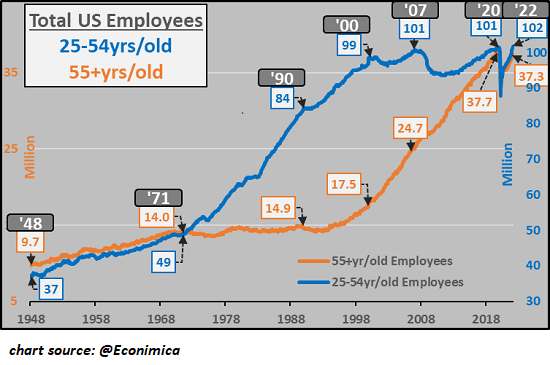
Consider these two charts of the US work force by age. (Courtesy of CH @econimica) In the first chart, Total US Employees, note that the prime working age work force (ages 25-54) has been flatlined for the past 20 years at 101-102 million. In contrast, the 55-and-older cohort of employees soared from 17 million to 37 million. This increase of 20 million accounts for virtually all growth in the employed work force.

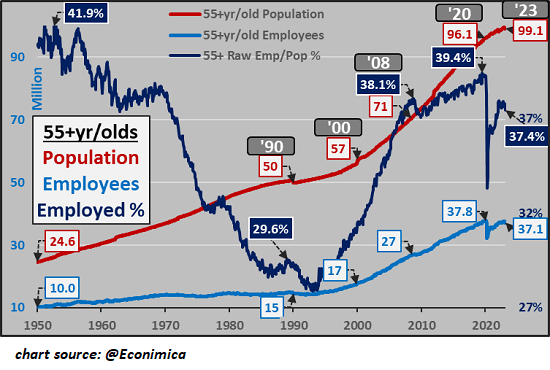
A funny thing happens as workers get old; they retire and leave the work force. Their skills and experience are no longer available to employers or the nation’s economy. The second chart shows the aging of the American populace, as the 55+ cohort increased from 57 million to 99 million since 2000, as the number of older employees skyrocketed from 17 million to 37 million.

While the total US population increased by 18% from 281 million in 2000 to 331 million today, the 55+ cohort increased 74% (from 57 million to 99 million).

The key takeaway here is the number of experienced workers who will retire in the next decade will track the explosive growth in the 55+ cohort. The general consensus is this will not be a problem because there are plenty of younger workers available to fill the vacated slots.

But this overlooks the qualitative and quantitative differences in the millions leaving the work force and those joining the work force. This is especially consequential in real-world jobs, i.e. all those jobs that require engaging real-world materials rather than staring at screens.

Though few analysts and commentators will admit to it, the implicit assumption is that the jobs that matter all involve staring at screens–processing data, finance, entertainment and shaping narrative make the world go round. All the real-world stuff (boring!) will magically get done by tax donkeys who are out of sight, out of mind.

This mindset has it backwards: it’s the real-world work of changing the industrial / energy / energy distribution foundation of the economy that matters going forward, not the staring-at-screens jobs.

What few seem to realize is the work force that’s aging and retiring is the cohort with the real-world skills. It’s a nice idea to remake the entire electrical grid of the nation to transport much larger quantities of electrical power, but who’s going to do all that work? Young people whose career goals are becoming YouTube influencers or day-traders? No. All the ChatAI bots in the world aren’t going to get the real work done, either.

In other words, there is a massive mismatch between the skills available to hire in the young-worker cohort and the skills and experience needed to rebuild the material, real-world foundations of the US economy. It’s well-known but apparently not worth worrying about that the average age of the US farmer is pushing 60 years of age. Nobody left to grow all our food? Hey, isn’t there a ChatAI bot to do all that for us? It can all be automated, right? No? Well, why not? Somebody out there, get it done! Food in super-abundance should be delivered to everyone staring at screens 24/7, it’s our birthright.

The average age of skilled tradespeople is also skewed to the aging work force. There is no easy way to quantify real-world skills gained by on-the-job experience. I suspect it follows a power-law distribution: the newly minted worker just out of school / apprenticeship can handle basic functions, but when tough problems arise, the number of workers with the requisite experience to diagnose and fix the problem diminishes rapidly.

This distribution presents an enormous problem for the economy and employers. Once the super-experienced workers who can solve any problem leave, they cannot be replaced by inexperienced workers. So when the really big problems arise, the systems will break down because those who knew how to deal with the problems are no longer available.

This is how you can have 10 million unemployed workers and 1 million unfilled positions that can’t be filled because few are truly qualified. You want to erect new electrical transmission lines? Nice, but you’re not going to get the job done with green workers accustomed to staring at screens. It takes years of hard labor to acquire even a bare minimum of the skills required. These are not assembly-line jobs that can be filled by unskilled labor, these are jobs in the messy real world, not a distribution center.

As I note in my book on Self-Reliance, individuals with a full spectrum of real-world skills are now extremely rare. Skills that were once common are now performed by specialists. We seem to have all the time in the world to stare at hundreds of cooking programs on TV but how many people actually prepare three meals a day, week in, week out, month in, month out, year in, year out? How many people know how to repair anything, build anything, or maintain a machine?

My direct experience is that many young people don’t know how to put air in the tires of the vehicle Mom and Dad gave them. Young people with graduate-level diplomas don’t know what a green bean plant looks like. (Eeew, gross, it grows in dirt?) The cultural value system that only values wealth, regardless of its source, and minting money from staring at screens has generated a fundamental mismatch between the skills that will be needed going forward and the skills being presented as oh-so-valuable.

Yes, there are many young workers with sharp real-world skills. The question is, are there enough?

This is how we’ll end up with severe shortages of truly skilled labor and high unemployment in the cohort of workers with few real-world skills and a surplus of skills for which there is limited demand. As a real-world experiment, go find a tough old rancher and ask them a series of questions about livestock, machinery, fencing, generators, etc., and then ask the average newly minted college graduate that followed the warped values embedded in our economy the same questions.

Of course the young worker can’t match the experience of the old worker, but do they have any experience at all of a spectrum of essential real-world skills? If not, do they have the requisite physical endurance and commitment needed to acquire real-world skills?

Who’s going to do all the real-world work going forward? A few people talk about it as an abstraction, but it’s not an issue to everyone focused on Federal Reserve policy or GDP. But eventually, the real world will matter more than staring at screens and day-trading, because when the systems break down due to lack of truly qualified employees, we’ll all wake up. But by then it will be too late. We’ll be staring at dead screens begging for somebody somewhere to restore power so we can continue playing with ChatAI to trade zero-day options.

New York Times Is Now Telling Bigger Lies Than Iraq WMDs and More Effectively

By David Swanson

Source: War Is a Crime

The New York Times routinely tells bigger lies than the clumsy nonsense it published about weapons in Iraq. Here’s an example. This package of lies is called “Liberals Have a Blind Spot on Defense” but mentions nothing related to defense. It simply pretends that militarism is defensive by applying that word and by lying that “we face simultaneous and growing military threats from Russia and China.” Seriously? Where?

The U.S. military budget is more than those of most nations of the world combined. Only 29 nations, out of some 200 on Earth, spend even 1 percent what the U.S. does. Of those 29, a full 26 are U.S. weapons customers. Many of those receive free U.S. weapons and/or training and/or have U.S. bases in their countries. Only one non-ally, non-weapons customer (albeit a collaborator in bioweapons research labs) spends over 10% what the U.S. does, namely China, which was at 37% of U.S. spending in 2021 and likely about the same now despite the highly horrifying increases widely reported in the U.S. media and on the floor of Congress. (That’s not considering weapons for Ukraine and various other U.S. expenses.) While the U.S. has planted military bases around Russia and China, neither has a military base anywhere near the United States, and neither has threatened the United States.

Now, if you don’t want to fill the globe with U.S. weaponry and provoke Russia and China on their borders, the New York Times has some additional lies for you: “Defense spending is about as pure an application of a domestic industrial policy — with thousands of good-paying, high-skilled manufacturing jobs — as any other high-tech sector.”

No, it is not.  Just about any other way of spending public dollars, or even not taxing them in the first place, produces more and better jobs.

Here’s a doozie:

“Liberals also used to be hostile to the military on the assumption that it skewed right wing, but that’s a harder argument to make when the right is complaining about a ‘woke military.’”

What in the world would it mean to oppose organized mass murder because it skews right wing? What the hell else could it skew? I oppose militarism because it kills, destroys, damages the Earth, drives homelessness and illness and poverty, prevents global cooperation, tears down the rule of law, prevents self-governance, produces the dumbest pages of the New York Times, fuels bigotry, and militarizes police, and because there are better ways to resolve disputes and to resist the militarism of others. I’m not going to start cheering for mass killings because some general doesn’t hate enough groups.

Then there’s this lie: “The Biden administration touts the size of its $842 billion budget request, and in nominal terms it’s the largest ever. But that fails to account for inflation.”

If you look at U.S. military spending according to SIPRI in constant 2021 dollars from 1949 to now (all the years they provide, with their calculation adjusting for inflation), Obama’s 2011 record will probably fall this year. If you look at actual numbers, not adjusting for inflation, Biden has set a new record each year. If you add in the free weapons for Ukraine, then, even adjusting for inflation, the record fell this past year and will probably be broken again in the coming year.

You’ll hear all sorts of different numbers, depending on what’s included. Most used is probably $886 billion for what Biden has proposed, which includes the military, the nuclear weapons, and some of “Homeland Security.” In the absence of massive public pressure on a topic the public hardly knows exists, we can count on an increase by Congress, plus major new piles of free weapons to Ukraine. For the first time, U.S. military spending (not counting various secret spending, veterans spending, etc.) will likely top $950 billion as predicted here.

War profiteer-funded stink tankers like to view military spending as a philanthropic project to be measured as a percentage of an “economy” or GDP, as if the more money a country has, the more it should spend on organized killing. There are two more sensible ways to look at it. Both can be seen at Mapping Militarism.

One is as simple amounts per nation. In these terms, the U.S. is at a historic high and soaring far, far over the rest of the world.

The other way to look at it is per capita. As with a comparison of absolute spending, one has to travel far down the list to find any of the designated enemies of the U.S. government. But here Russia jumps to the top of that list, spending a full 20% of what the U.S. does per person, while only spending less than 9% in total dollars. In contrast, China slides down the list, spending less than 9% per person what the United States does, while spending 37% in absolute dollars. Iran, meanwhile, spends 5% per capita what the U.S. does, compared to just over 1% in total spending.

Our New York Times friend writes that the U.S. needs to spend more to dominate four oceans, while China need worry only about one.  But here the U.S. desire to treat economic competition as a form of war blinds the commentator to the fact that a lack of war facilitates economic success. As Jimmy Carter told Donald Trump, “Since 1979, do you know how many times China has been at war with anybody? None. And we have stayed at war. . . . China has not wasted a single penny on war, and that’s why they’re ahead of us. In almost every way.”

But you could drop the idiotic economic competition and still understand the benefits of investing in something other than death since tiny fractions of military spending could transform the United States and the rest of the world. Surely there would remain plenty of other things to lie about.

The Loss Of Free Speech Was Predictable And Preventable

By Patrick Wood

Source: Technocracy News & Trends

As technology has disrupted key elements of society, Technocrats have taken advantage of the chaos to not only implement their own agenda but also to erect barriers to competition or resistance. If this had been recognized early enough, it could have been easily blocked. Now, the mere barriers have hardened into fortresses.⁃ TN Editor

The First Amendment is at a critical juncture. Recent congressional hearings on the Twitter Files brought the matter into full public view. Freedom of speech and of the press are hanging by a precarious thread. Do we want a future in which information flows freely, or one in which an information elite controls those flows “for our own good?” The choices we make over the next few years will determine which of those futures we get.

It’s tragic that we have let the problem reach this dangerous state. What heightens the tragedy, however, is that the war against America’s most cherished freedoms was predictable and preventable. If those of us who value freedom want to win, we’re going to need a strategy grounded in a clear understanding of what’s happening and why.

The Twitter Files story is shocking. Allegations that big tech and social media manipulate information have been around for as long as we’ve had tech and social media companies. Allegations of bias among the mainstream media are even older. In recent years, however, both the allegations and the supporting evidence have ratcheted upward to unprecedented levels.

When Elon Musk acquired Twitter, he opened his company’s internal archives to scrutiny. He assembled a team of journalists with a curious pedigree: registered Democrats with a distaste for Donald Trump and his supporters, whose track records skewed considerably left of center, and whose recent work has demonstrated deep concern about the politicization of journalism.

Musk gave them unfettered access. They found a deep, broad, and disturbing pattern of collaboration between big government and big tech designed to promote “official stories” on multiple issues, throttle competing theories and arguments, and sanction those who dared to question government propaganda.

When two of those journalists – Matt Taibbi and Michael Shellenberger – testified before Congress, their Democratic inquisitors sought to belittle their credentials, question their motives, and tar them as part of some Republican-funded, far-right conspiracy. The still-left-leaning journalists are trying to absorb their shock at the depths to which the formerly civil-libertarian left has fallen.

Far from shocking, however, that fall was predictable – and predicted. In 2001, amidst the public disgust with tech companies following the collapse of the dotcom bubble, I set out to make sense of life during the transition from the late industrial age to the early information age. I analyzed what I called the first four front-page stories of the information age: the dotcom bubble, the Microsoft antitrust trial, the rise of open-source software, and the Napster-driven wars over digital music. Contrary to popular opinion of the time, I believed that these stories were far from distinct. I saw them as four manifestations of a single underlying phenomenon. My goal was to understand that phenomenon.

I found it. It appeared most clearly in the digital music arena, but it ran through all four stories – and through much that has happened since. It appears just as clearly in today’s war on free speech. It involves an entirely predictable pattern of opportunity, action, and reaction.

The starting point is digitization and quantification. The Internet changed the economics of information. Throughout human history, information was scarce, hard to acquire, and expensive to process. Skilled professionals – spies, scholars, lawyers, accountants, clerics, doctors – could command a premium for their knowledge. When the Internet went public, anything that could be digitized and quantified suddenly flowed freely. Information was there for the asking. The premium shifted to filtering – the ability to discard unwanted information and arrange what remained.

Economic shifts generate massive opportunities for creative, entrepreneurial people and bring glorious benefits to millions of consumers. The Internet was no exception in this regard, and neither was the predictable backlash against it. Anything that benefits new businesses and empowers consumers is a warning shot across the bow of powerful incumbents who’d grown accustomed to serving those consumers in a predictable, profitable, manner.

In the music industry, anything that let individual consumers share digital music files reduced the revenues, profits, power, and control of record labels. Pre-digitization, these powerful incumbents determined what music got recorded and how it was packaged, distributed, presented, and priced. It was a comfortable business model that gave us the music industry “as we knew it.” The Internet undermined it entirely.

Powerful incumbents never fade quietly into the night when challenged. They fight, using whatever weapons they can muster. In our society, the most effective ways to undermine new technological and economic opportunities tend to lie in law, regulation, and public policy. The record labels fought – largely successfully – to apply and reinterpret existing laws and to change laws in ways favorable to their interests.

There’s the pattern: Technology creates opportunities. New businesses exploit those opportunities. Consumers benefit. Powerful incumbents fear their loss of control. Threatened incumbents seek allies in government. Government changes laws and regulations to protect incumbent interests. Media campaigns “educate” the public on the merits of the new policies. The new laws ensure that the next wave of technological change runs largely through the powerful incumbents, rather than against them.

By 2003, I had distilled this pattern, showed numerous ways that it had already unfolded, predicted that it would soon hit parts of our economy and our lives far more significant than the music industry, and suggested some ways that we might prepare ourselves for the coming battles.

It took another two years to get my analysis published. It went largely unnoticed. Twelve years later, then-Senator Ben Sasse described the ways that this pattern had forever disrupted the dynamics of employment. This, too, went largely unnoticed.

Today, we see that disruptive pattern threatening the most basic of our civil liberties. Its manifestation in the arenas of speech, propaganda, and censorship is clear. Consider how each step in the process I identified above has played out here:

Technology creates opportunities. The Internet opened entirely new vistas for the creation and exchange of ideas, information, theories, opinions, propaganda, and outright lies.

New businesses exploit those opportunities. The companies founded since 1995 that created and control the world’s most important conduits for information have joined the ranks of history’s most powerful entities.

Consumers benefit. The centrality of these communication systems to our lives (for better or for worse) proves that they confer real value.

Powerful incumbents fear their loss of control. The twin political shocks of 2016 – Brexit and Donald Trump – highlighted the extent to which official channels had lost control of the narrative. With the entirety of elite media, government, big business, and the intelligentsia aligned behind Remain and Hillary, the newly empowered masses understood – for the first time – that there were viable alternatives to the official story.

Threatened incumbents seek allies in government. A coalition of elite forces assembled quickly, laser-focused on stomping out the populist threat. Masses empowered to conduct their own analyses, draw their own conclusions, and share their opinions among themselves threatened the stability of the power structure “as we know it.”

Government changes laws and regulations to protect incumbent interests. Prior to Musk’s Twitter, the entirety of Silicon Valley committed itself to “protecting” the public from “disinformation,” roughly defined as anything that threatened to undermine an official, sanctioned narrative. Allies throughout the administrative state, Congress, and the Biden White House are working to embed those “protections” in law.

Media campaigns “educate” the public on the merits of the new policies. The same mainstream media that vilified Napster, Grokster, and Peer-to-Peer (P2P) file sharing is now working to turn public opinion against the evil purveyors of alleged “disinformation.”

Will the information age be an era of informed, empowered citizens – or an era of a dominant, information-controlling elite? Stay tuned. That’s the question we need to answer.

How Does Degrowth Apply to Our Minds?

By Erin Remblance

Source: resilience

As an Australian, it troubles me that if the whole world lived like us, we would need 4.5 planet Earths. Thanks to over-consuming nations like mine, worldwide we are living as if we have 1.75 planet Earths, a figure that has increased from 1 (that is, living within our means) since 1970. What this boils down to is that those of us in the global north are taking from both countries in the global south and future generations to fuel our lifestyles today. The ‘Earth Overshoot’ research is supported by the work of the late Earth System Scientist, Professor Will Steffen, who brought to our attention The Great Acceleration, whereby “[a]fter 1950 we can see that major Earth System changes became directly linked to changes largely related to the global economic system.” Steffen is referring to our growth-based economies, and while three percent economic growth each year might sound small, it means that within 24 years we will be consuming twice as many resources as today, and within 100 years 19 times as many. As economist Kenneth Boulding said: “[a]nyone who believes that exponential growth can go on forever in a finite world is either a madman or an economist.”

For this reason, I am a big proponent of degrowth in over-consuming nations in order to fit back within planetary boundaries. For anyone not familiar with the term, degrowth is a planned, democratic reduction in material and energy use in high-income nations while improving the well-being of people in those nations. It is more than this though. While very often the focus of degrowth is on how life can be better in a smaller economy, Federico Demaria and Serge Latouche argue that “[t]he point of degrowth is to escape from a society that is absorbed by the fetishism of growth…. It implies decolonization of the imaginary and the implementation of other possible worlds”. In this respect, the former definition of degrowth applies only to over-consuming nations, while the latter definition applies to all nations, and to all people. It is this second definition of degrowth to which this essay relates.

The concept of degrowth is powerful because it is clear that we need systemic change to avoid ecological collapse: business as usual with a “green tinge” isn’t going to be enough. It is also true that individual change drives cultural change which can be the key to unlocking political change leading to fundamental change. On this point, I find it fascinating to consider how “growth has entered our minds and souls”, and how an awareness of these “mental infrastructures of growth” might free us from growthism and help unlock the cultural changes that will bring about the necessary systemic changes.

With this in mind, here are a couple of points to consider in relation to how growth may be enshrined in the psychological structure of our collective minds, largely based on the work of Harald Welzer:

  • Our dreams for the future are centred around it being better than today, in the sense of ‘more’ (e.g., a bigger house, a larger salary, more travel).
  • We see ourselves as something to continually develop and optimise, our lives are seen as a process of creating biographies or filling curriculum vitae.
  • While we used to see paid labour as drudgery and something we did until we had met our needs, now we view it as noble, esteemed even, to be sought out and with no end. Sadly, this cultural 180° turnaround becomes a regret of many as they are dying.
  • Similarly, society views ‘hard-work’ as virtuous and thus ‘hard-work’ entitles those who undertake it to whatever their heart desires without limit or consideration of the harm caused, their purchases being the fruits of their labour.
  • We typically live by the rhythms of the industrial workday via a standardised worldwide time regime, unaware that there is a natural rhythm of time (for example, consider that in 2023 there will be 13 moons but only 12 calendar months or that, on the whole, our pace of work is unchanged by the seasons).
  • It is a collective belief that we should be able to own parcels of land, excluding others from that land. An example of this is that home (and correspondingly land) ownership in Australia is described as the ‘Great Australian Dream’, a term derived from the ‘American Dream’ of the same nature.

In various ways, these – and probably many more aspects of our modern day lives – relate back to the surpluses created by industrialisation (enabling the future to have more than today, a concept that is “historically quite recent”), the enclosure of the commons (the very foundation of growth-dependent capitalism) and the subsequent imperative to work to have our needs met (rather than simply being able to directly meet our needs). Our ability to recognise and unpick these ‘mental infrastructures’ – that is, the worldview that influences all of our actions – will be key to throwing off the shackles of growth and unlocking a culture of sufficiency, whereby we recognise when we have ‘enough’ in a material sense and from then on meet our “nonmaterial needs nonmaterially”, increasing our sense of wellbeing and contentment.

The work of Antonio Gramsci on cultural hegemony is relevant in unlocking a culture of sufficiency. Michael Mezz describes Gramsci’s theory on how the ruling class maintains power via a cultural form of dominance:

“…the ruling class creates an ideology in which its own values become common sense for the rest of society and Gramsci argued that the role of the state is to maintain institutions such as media and the education system that educate the masses on the cultural ideology of the ruling class. The goal of that education being that the working class develop a sense of freedom and a good life that serves the purposes of the people in power. In other words, the working class starts to value things like innovation and productivity and economic growth that doesn’t actually serve them.”

Gramsci tells us that the way to overcome cultural hegemony is by creating a new culture that is not based on the values of the ruling class. A counter-culture, if you like.

So, what are the counter-hegemonic narratives that we can begin to embrace? What would a mind and soul not infiltrated by growth look like? There is much to learn from indigenous cultures on this topic. As Jeff Sparrow highlights in his book, Crimes Against Nature, First Nation Australians found paid labour to be antithetical to their egalitarian lifestyles:

“Today, we take the wages system for granted. It appears normal, almost eternal, since we can barely conceive of an alternative. It did not seem normal to pre-colonial people. In Australia, as elsewhere in the world, they found capitalist practices utterly horrifying…. Indigenous people, accustomed to an egalitarian ethos and to work carried out for the collective good, saw the authority exerted by employers as tyranny. As late as 1888, a churchman complained of the difficulty he had in persuading Indigenous people that one man was innately better than another, that a certain individual, by virtue of his possessions, mandated obedience from his fellows…. Indigenous people did not despise wage labour primarily because of the effort that it entailed. Rather, they thought the work demanded by capitalists stripped life of its humanity.”

Furthermore, First Nations people lived with the rhythms of nature, not the industrial workday, and there was no private land ownership, they had the wisdom to know that “… you are undone if you once forget that the fruits of the earth belong to us all, and the earth itself to nobody” (Jean-Jacques Rousseau).

There are many examples of counter-hegemonic narratives arising more recently too. The following list is skewed more towards examples from the global North because the global North represents the vast majority of the over-consumption and is therefore where cultural change is most needed. Such examples include:

  • Those people, like the Futuresteaders and others who practice voluntary simplicity and frugal abundance, who appreciate the simple things in life, and find happiness in what they have rather than what they want. Seeking only ‘enough’ and not ‘more’ represents an affront to the dominant culture of dreams of the future being materially greater than today. This point is relevant only to those whose needs are already met. Of course, those who are living in conditions of deprivation should have access to ‘more’, until they too have ‘enough’.
  • People who choose to spend their time doing work that is traditionally undervalued and lacking in both career trajectory and pay increases, but is socially valuable, forgoing future surpluses (think of the stay-at-home parents, childcare workers, teachers, nurses, carers, small farmers, those who work part-time voluntarily, and those who volunteer their time to worthy but under-funded causes).
  • The move towards minimalism which seeks to value time and non-material items over ‘the grind’ and the accumulation of things as a reward for hard work. The Tiny House Movement shows us that it is possible to enjoy living with less, including the freedom of a smaller mortgage.
  • The tang ping (lying flat) movement in China and quiet quitting in the U.S.A. are taking back our right to be humans, not simply workers who devote more time than they would like to paid labour.
  • Anyone advocating for job guarantees, enabling anyone who wants to work to do so. Job guarantees seek to remove the artificial scarcity of employment we see today, where the threat of joblessness looms ever large and we constantly need to better ourselves so that we can compete for work. Those who advocate for a Universal Basic Income – an unconditional liveable wage for all – are fighting to remove the need for waged employment at all.
  • People organising for the community rather than the individual are prioritising others over their own interests, giving up the opportunity to build their own CVs in favour of the greater good, and there are some wonderful examples of such union building herehere and here.
  • The move towards a 4-day work week challenges the dominant narrative that more time at work is better.
  • The Nap Ministry and the related manifesto Rest Is Resistance empowers us to value rest over productivity.
  • The many activists calling out the harm caused by the carbon-intensive lifestyles revered by the dominant culture, such as Greta Thunberg (who beautifully articulated in her book, The Climate Book, that “we all have a responsibility to find quick ways of making that [extremely high-emitting] lifestyle socially unacceptable”), activists who block private jets, people promoting going flight free, and those seeking to reduce the dominance of cars on our streets. For these people, simply having the means to live a materially intensive lifestyle – regardless of the hard work involved in acquiring those means – isn’t enough to justify the harm it causes.
  • The locals of the Greek Island Ikaria, who do things in their own time, not that of the industrial workday. This fascinating paper describes “people arriving to appointments in ‘Ikarian time’, that is, a ‘few hours late’ or shopkeepers telling bewildered tourists that ‘the shop will open when it is time to open’”.
  • Co-operative housingcommunity land trusts and Vienna’s enviable form of social housing show us that there are other ways of providing a community’s housing and land needs that don’t rely on private ownership.

There are, of course, many other wonderful counter-culture examples beyond this short list – this is merely scratching the surface – but the point is that we need to advance these, and those of the same theme, until they become the leading narrative.

Unpicking the dominant, growth-based worldview will mean closely analysing the stories we have been told (and who those stories might serve), and bravely and courageously assessing whether all of this growth really does bring us ‘the good life’. We will likely find that we can achieve ‘a good life’ (that is, harmony with ourselves, our community, and the physical world) by living simpler but more meaningful lives. Perhaps we will even come to realise the very wise words of English writer, Alan Watts: “the meaning of life is just to be alive. It is so plain and so obvious and so simple. And yet, everybody rushes around in a great panic as if it were necessary to achieve something beyond themselves”. The way that growth manifests in our minds, our thoughts, our dreams, and our souls is important to consider because if we can create a culture of sufficiency, we will have found the key to systemic change and avoiding ecological catastrophe. I’m sure we can all agree that this is a worthy task indeed.

“Facing Clear Evidence of Peril” in a Country of Lies

By Edward Curtin

Source: Behind the Curtain

“In my seventy-plus years from 1946 to now, the chorus of fear-mongering bullshit has never ceased – only grown louder. The joke is on us. Ha Ha Ha.”

– Oliver Stone, Chasing the Light

Perhaps silence is the best response to the endless cavalcade of official lies that is United States history. The Internet and digital technology have allowed those lies to increase exponentially in number and frequency with the result that people’s minds have become like 7-Eleven stores, open 24/7 for snack-crap “news.”

But once you become conscious that it’s lies night and day, it sets your head aswirl and plunges your soul into depths of despair.  You are tempted to retreat from such knowledge and talk of trees and trivia.  But you are ashamed of your country.  It’s hard to laugh.  You feel you are drowning.  You flounder and gasp for air.  You look around and wonder why most people are able to go their merry ways believing the lies and whistling in the dark.  Junk news nation, indeed.

Yes, there are alternative voices who tell the truth, but their audiences and monetary support are very small or non-existent compared to the corporate mainstream media and those who shout and scream across the Internet as they take in a lot of money from naive followers. The recent revelations about Alex Jones’s wealth probably don’t bother his diehard fans, but they should.  Likewise, the funding sources for websites and writers of various persuasions are important to know, for they reveal possible biases in their work.  Snake oil salesmen are commonplace, and there are many naive customers lining up for their wares.

Wealth and power are the main drivers of the media chicanery that has captured so many minds. Writers, of course, should be fairly paid for their work, but in this Internet age, most are not.  As with the movies and book publishing, the income gap between the big names – the celebrity stars – and less well-known writers, even if their work is excellent, is huge.

Some sites and writers make a lot of money, but who they are is a guessing game.  No one’s talking.  Some regularly tell their readers that if they don’t receive enough contributions, they will be unable to continue to write or publish, even when the sites do not pay their contributors.  Whether this is good marketing or income-by-threat is up for grabs.  Whichever it is, it seems to work, as far as I can tell, for these writers and websites don’t disappear.

Money is the dirty secret of all news and commentary.  To paraphrase someone: It is very difficult to get truth from writers whose income is dependent on pleasing those who fund them.

You may have noticed how many former military officers, CIA agents, mainstream journalists, pharmaceutical company executives, and sundry other government and corporate bigwigs appear in the mainstream and alternative media to support or oppose government policies.  The mainstream ones doing the propaganda they always did, while the alternative ones appear as converts to the dissident faith.  No one ever explains how and by whom these people are financed or how their lucrative pensions affect their consciences.  “Former” is a funny word.  Ha Ha Ha.

Confidence “men” come in all shapes and sizes with no one talking money.

So let me fess up.  I received about $200 in support last year for edwardcurtin.com, my website.  Nothing before that and not a cent over the last 5-6 years for many hundreds of articles that have appeared very widely across the Internet.  Before the Internet, publications paid for work, mine and others.  Not now, at least for me.  How much money writers are receiving, and who is supporting their sites, is a taboo subject.

So I am thinking about selling mugs at my site with my name and mug shot on them and a line of supplements that will increase one’s testosterone and estrogen in equal measure to make sure no one takes offense in this era of delicate feelings.  Ha Ha Ha.  Yes, the joke is on us.  I identify as a man since I am one.  Don’t be offended.

Jokes aside, as Leonard Cohen sang:

“Oh, like a bird on the wire
Like a drunk in a midnight choir
I have tried in my way to be free”

If you are stubborn enough and have the good fortune to find inspiration from those brave dissidents who have gone before us and those who continue to lead us on, you realize silence is betrayal and that you must speak, even if all seems hopeless at times. Even when no one is paying you, or maybe more accurately, because no one is paying you. Even though it is hopeless, even though it isn’t.  This is another secret.  There are many.

It’s been twenty years since the U.S. brutally invaded Iraq.  When George W. Bush, at a staged pseudo-event in Cincinnati on October 7, 2002, as he set Americans up for the invasion of Iraq in March 2003, said, “Facing clear evidence of peril, we cannot wait for the final proof, the smoking gun, that could come in the form of a mushroom cloud,” no one laughed him out of the house.  His claim was simply an evil joke that was reported as truth.  It was all predictable, blatant deception.  And the media played along with such an absurdity, which is their job and what they always do.  I pointed it out at the time in a newspaper column, but who listened to a hick writer in a regional newspaper.

Iraq obviously had no nuclear weapons or the slightest capability to deliver even a firecracker on the U.S.  But the mainstream media, Senator Joe Biden, politicians galore, celebrities like Oprah Winfrey with her guest, the eventually disgraced Judith Miller of the New York Times, the despicable Tony Blair, et al., all supported Bush’s blatant lies.  Soon Colin Powell, the “hero” of George H. W. Bush’s 1991 made-for-TV Gulf War of aggression against Iraq, would do his Pinocchio act at the United Nations and the U.S. military was off to get Saddam Hussein, Osama bin Laden’s evil twin, both the latest Hitlers until Vladimir Putin replaced them.  I guess I skipped some others such as Muammar Gaddafi and Bashar Al-Assad.  New Hitlers proliferate so fast it’s hard to keep track of them.  Ha Ha Ha.  The joke is on us.

As everyone knows, or should, more than a million Iraqis died because of George W. Bush, but how many cared?  How many cared when once Bush was gone, Barack Obama, aided and abetted by the cackling Hilary Clinton, destroyed Libya and ignited the war against Syria?  You want examples?  There are too many to name here.  But let it be said these lies span all American administrations, whether it’s Bill Clinton continuously bombing Iraq and Serbia through Trump bombing Syria and Somalia, up to the present day with Biden attacking Russia via Ukraine, etc.  All these presidents are liars, but their followers treat them otherwise.  Biden says Jimmy Carter asked him to deliver his eulogy.  What does that tell you?  Shall we laugh?  Sing?

On the clear understanding
That this kind of thing can happen
Shall we laugh?
Shall we laugh?
Shall we laugh?

Shall we laugh harder if I mention the Covid-19 propaganda and all those writers who have failed to even address it, as they have failed to question 9/11 and other obvious official lies?  Is it not evident that if they did so, their money flows might dry up?  Here and no further is a widespread rule, for they must adhere to the boundaries imposed by “responsible thought” and the “no go” zones with which they tie their own hands in order to keep their wallets full.

If you are lucky, as I was, when you are young you discover how fearful of free thought and how corrupt our institutional authorities are.  You don’t spend decades feasting off the spoils of those institutions only to “wake up” once you have made your name and secured your fortune, which seems to be the way of so many wise luminaries of the Internet Age who are either trying to ease their consciences as they get ready to kick the bucket or are perhaps putting us on.

When I was twenty-four years-old, I accepted my first teaching job at a small Catholic college where I taught theology.  I had been trained in the latest and best scholarly work of the most renown international theologians.  Rather than indoctrinating my students with rote learning, I taught them to read widely and think deeply in the tradition of a liberal arts education.  To seek out the best scholarship.

But doing so became quickly apparent to the college and Church authorities who were stuck in the inquisitorial age of obedience or else and no thinking allowed.   Although my students loved my courses and felt freed up for the first time to think about their spiritual lives, I was hounded to correct my heretical teaching, which of course I refused to do.

At one point when I was at lunch in the cafeteria, a nun who was a professor, stole my brief case with my notes and left the cafeteria.  One of my students saw her do this and chased her into the ladies’ room where the nun hid in a stall.  The nun kept flushing the toilet to scare the student away, but the student wouldn’t let her out until she returned the briefcase.  Ha Ha Ha.  It sounds funny to recount but was an example of my experience at this college.  Someone vandalized my office door and ripped down anti-war posters that were on it.  I was gone from that college soon thereafter.  It taught me a lot.  Obey or else.

Heresy: The Latin word is from Greek hairesis, a taking or choosing for oneself, a choice.

At another teaching job a year or so later, I had a more chilling experience.  I was known as an anti-war activist, a conscientious objector from the Marines, etc., and one day, a late Friday afternoon when few were around, an administrator asked to meet me on a deserted stairwell where he proceeded in hushed tones to try to convince me to join him in Army Intelligence to spy on others.  He said I would be perfect for the job since I was known as an anti-war dissident.  I told him to fuck off, but I was shocked by his double life and his request.

I have since learned that this guy the spy was not an anomaly, for government confidence men are widespread.

I’ve had many other such early experiences for which I am very grateful, even though when I was fired from jobs and lost income it was traumatic at the time.  By my thirtieth year, I knew the system was corrupt to its core and subsequent experience has only ratified that conclusion.  I got the joke.

I recount these incidents not because my experiences are singular and I’m special, for others have suffered the same youthful fate.  But such good fortune can fortify you for life or break your spirit.  If the former, you don’t wait to retire to push back against all the lies or regret your past.  You find that it’s all good and life has set you on the heretic’s path of freedom and choice. You realize that what you went through is absolutely nothing compared to people around the world who have and continue to suffer at the hands of the U.S. military industrial complex.  You realize your experiences are trivial in the larger scope of things and that your government’s conduct is beyond condemnation.  It is an abomination.  You feel ashamed to live in a land where killing is a game.

The sociologist Peter Berger puts it well in his little classic, Invitation to Sociology, when he discusses experiences that lead to seeing through the play-acting nature of social life:

Experiences such as these may lead to a sudden reversal in one’s view of society – from an awe-inspiring vision of an edifice made of massive granite to the picture of a toy-house precariously put together with papier mâché. While such metamorphosis may be disturbing to people who have hitherto had great confidence in the stability and rightness of society, it can also have a very liberating effect on those more inclined to look upon the latter as a giant sitting on top of them, and not necessarily a friendly giant at that. It is reassuring to discover that the giant is afflicted with a nervous tick.

Notice the giant George W. Bush’s clicking eyes as he delivers his “facing clear evidence of peril” lies for the invasion of Iraq.  He and his presidential good friends are cardboard cartoon characters whose eyes reveal their evil intentions.  “It’s a Barnum and Bailey world/Just as phony as it can be,” but it would all fall to pieces if it weren’t for you and me failing to see through all the bad actors, not just presidents but the whole cast of characters that populate the Spectacle of news and opinion.

The Russians are coming!  Ha Ha Ha.  Yes, Oliver, the joke’s on us.

But it’s not really funny, except in the most sardonic and dark way, for we now do really face clear evidence of peril as a result of Biden and his crazy predecessors who have run U.S. foreign policy for so long. They have brought us to the edge of nuclear war with Russia by surrounding Russia with NATO bases and nuclear weapons, while doing the same to China.

Bertolt Brecht was right in his poem “To Those Born After”:

Truly I live in dark times!

Frank speech is naïve. A smooth forehead

Suggests insensitivity. The man who laughs

Has simply not yet heard

The terrible news.

What kind of times are these, when

To talk about trees is almost a crime

Because it implies silence about so many horrors?

When the man over there calmly crossing the street

Is already perhaps beyond the reach of his friends

Who are in need?

Fiscal Insanity: The Government Borrows $6 Billion a Day, and We’re Stuck with the Bill

By John & Nisha Whitehead

Source: The Rutherford Institute

We’re not living the American dream.

We’re living a financial nightmare.

The U.S. government is funding its existence with a credit card.

The government—and that includes the current administration—is spending money it doesn’t have on programs it can’t afford, and “we the taxpayers” are the ones being forced to foot the bill for the government’s fiscal insanity.

According to the number crunchers with the Committee for a Responsible Federal Budget, the government is borrowing roughly $6 billion a day.

As the Editorial Board for the Washington Post warns:

“The nation has reached a hazardous moment where what it owes, as a percentage of the total size of the economy, is the highest since World War II. If nothing changes, the United States will soon be in an uncharted scenario that weakens its national security, imperils its ability to invest in the future, unfairly burdens generations to come, and will require cuts to critical programs such as Social Security and Medicare. It is not a future anyone wants.

Let’s talk numbers, shall we?

The national debt (the amount the federal government has borrowed over the years and must pay back) is $31 trillion and will grow another $19 trillion by 2033. That translates to roughly $246,000 per taxpayer or $94,000 for every single person in the country.

The bulk of that debt has been amassed over the past two decades, thanks in large part to the fiscal shenanigans of four presidents, 10 sessions of Congress and two wars.

It’s estimated that the amount this country owes is now 130% greater than its gross domestic product (all the products and services produced in one year by labor and property supplied by the citizens).

In other words, the government is spending more than it brings in.

The U.S. ranks as the 12th most indebted nation in the world, with much of that debt owed to the Federal Reserve, large investment funds and foreign governments, namely, Japan and China.

Interest payments on the national debt are estimated to top $395 billion this year, which is significantly more than the government spends on veterans’ benefits and services, and according to Pew Research Center, more than it will spend on elementary and secondary education, disaster relief, agriculture, science and space programs, foreign aid, and natural resources and environmental protection combined.

According to the Committee for a Reasonable Federal Budget, the interest we’ve paid on this borrowed money is “nearly twice what the federal government will spend on transportation infrastructure, over four times as much as it will spend on K-12 education, almost four times what it will spend on housing, and over eight times what it will spend on science, space, and technology.”

In ten years, those interest payments will exceed our entire military budget.

This is financial tyranny.

We’ve been sold a bill of goods by politicians promising to pay down the national debt, jumpstart the economy, rebuild our infrastructure, secure our borders, ensure our security, and make us all healthy, wealthy and happy.

None of that has come to pass, and yet we’re still being loaded down with debt not of our own making while the government remains unrepentant, unfazed and undeterred in its wanton spending.

Indeed, the national deficit (the difference between what the government spends and the revenue it takes in) remains at more than $1.5 trillion.

If Americans managed their personal finances the way the government mismanages the nation’s finances, we’d all be in debtors’ prison by now.

Despite the government propaganda being peddled by the politicians and news media, however, the government isn’t spending our tax dollars to make our lives better.

We’re being robbed blind so the governmental elite can get richer.

In the eyes of the government, “we the people, the voters, the consumers, and the taxpayers” are little more than pocketbooks waiting to be picked.

“We the people” have become the new, permanent underclass in America.

Consider: The government can seize your home and your car (which you’ve bought and paid for) over nonpayment of taxes. Government agents can freeze and seize your bank accounts and other valuables if they merely “suspect” wrongdoing. And the IRS insists on getting the first cut of your salary to pay for government programs over which you have no say.

We have no real say in how the government runs, or how our taxpayer funds are used, but we’re being forced to pay through the nose, anyhow.

We have no real say, but that doesn’t prevent the government from fleecing us at every turn and forcing us to pay for endless wars that do more to fund the military industrial complex than protect us, pork barrel projects that produce little to nothing, and a police state that serves only to imprison us within its walls.

If you have no choice, no voice, and no real options when it comes to the government’s claims on your property and your money, you’re not free.

It wasn’t always this way, of course.

Early Americans went to war over the inalienable rights described by philosopher John Locke as the natural rights of life, liberty and property.

It didn’t take long, however—a hundred years, in fact—before the American government was laying claim to the citizenry’s property by levying taxes to pay for the Civil War. As the New York Times reports, “Widespread resistance led to its repeal in 1872.”

Determined to claim some of the citizenry’s wealth for its own uses, the government reinstituted the income tax in 1894. Charles Pollock challenged the tax as unconstitutional, and the U.S. Supreme Court ruled in his favor. Pollock’s victory was relatively short-lived. Members of Congress—united in their determination to tax the American people’s income—worked together to adopt a constitutional amendment to overrule the Pollock decision.

On the eve of World War I, in 1913, Congress instituted a permanent income tax by way of the 16th Amendment to the Constitution and the Revenue Act of 1913. Under the Revenue Act, individuals with income exceeding $3,000 could be taxed starting at 1% up to 7% for incomes exceeding $500,000.

It’s all gone downhill from there.

Unsurprisingly, the government has used its tax powers to advance its own imperialistic agendas and the courts have repeatedly upheld the government’s power to penalize or jail those who refused to pay their taxes.

While we’re struggling to get by, and making tough decisions about how to spend what little money actually makes it into our pockets after the federal, state and local governments take their share (this doesn’t include the stealth taxes imposed through tolls, fines and other fiscal penalties), the government continues to do whatever it likes—levy taxes, rack up debt, spend outrageously and irresponsibly—with little thought for the plight of its citizens.

To top it all off, all of those wars the U.S. is so eager to fight abroad are being waged with borrowed funds. As The Atlantic reports, “U.S. leaders are essentially bankrolling the wars with debt, in the form of purchases of U.S. Treasury bonds by U.S.-based entities like pension funds and state and local governments, and by countries like China and Japan.”

Of course, we’re the ones who have to repay that borrowed debt.

For instance, American taxpayers have been forced to shell out more than $5.6 trillion since 9/11 for the military industrial complex’s costly, endless so-called “war on terrorism.” That translates to roughly $23,000 per taxpayer to wage wars abroad, occupy foreign countries, provide financial aid to foreign allies, and fill the pockets of defense contractors and grease the hands of corrupt foreign dignitaries.

Mind you, that’s only a portion of what the Pentagon spends on America’s military empire.

The United States also spends more on foreign aid than any other nation, with nearly $300 billion disbursed over a five-year period. More than 150 countries around the world receive U.S. taxpayer-funded assistance, with most of the funds going to the Middle East, Africa and Asia. That price tag keeps growing, too.

As Forbes reports, “U.S. foreign aid dwarfs the federal funds spent by 48 out of 50 state governments annually. Only the state governments of California and New York spent more federal funds than what the U.S. sent abroad each year to foreign countries.”

Most recently, the U.S. has allocated nearly $115 billion in emergency military and humanitarian aid for Ukraine since the start of the Russia invasion.

As Dwight D. Eisenhower warned in a 1953 speech, this is how the military industrial complex continues to get richer, while the American taxpayer is forced to pay for programs that do little to enhance our lives, ensure our happiness and well-being, or secure our freedoms.

This is no way of life.

Yet it’s not just the government’s endless wars that are bleeding us dry.

We’re also being forced to shell out money for surveillance systems to track our movements, money to further militarize our already militarized police, money to allow the government to raid our homes and bank accounts, money to fund schools where our kids learn nothing about freedom and everything about how to comply, and on and on.

There was a time in our history when our forebears said “enough is enough” and stopped paying their taxes to what they considered an illegitimate government. They stood their ground and refused to support a system that was slowly choking out any attempts at self-governance, and which refused to be held accountable for its crimes against the people. Their resistance sowed the seeds for the revolution that would follow.

Unfortunately, in the 200-plus years since we established our own government, we’ve let bankers, turncoats and number-crunching bureaucrats muddy the waters and pilfer the accounts to such an extent that we’re back where we started.

Once again, we’ve got a despotic regime with an imperial ruler doing as they please.

Once again, we’ve got a judicial system insisting we have no rights under a government which demands that the people march in lockstep with its dictates.

And once again, we’ve got to decide whether we’ll keep marching or break stride and make a turn toward freedom.

But what if we didn’t just pull out our pocketbooks and pony up to the federal government’s outrageous demands for more money?

What if we didn’t just dutifully line up to drop our hard-earned dollars into the collection bucket, no questions asked about how it will be spent?

What if, instead of quietly sending in our tax checks, hoping vainly for some meager return, we did a little calculating of our own and started deducting from our taxes those programs that we refuse to support?

As I make clear in my book Battlefield America: The War on the American People and in its fictional counterpart The Erik Blair Diaries, if we don’t have the right to decide what happens to our hard-earned cash, then we don’t have any rights at all.

Technology and a Tyranny Worse than Prison 

By Bert Olivier

Source: Brownstone Institute

In an outstanding piece of political-theoretical writing, titled ‘The Threat of Big Other’ (with its play on George Orwell’s ‘Big Brother’) Shoshana Zuboff, succinctly addresses the main issues of her book, The Age of Surveillance Capitalism – The Fight for a Human Future at the New Frontier of Power (New York: Public Affairs, Hachette, 2019), explicitly linking it to Orwell’s 1984

Significantly, at the time she reminded readers that Orwell’s goal with 1984 was to alert British and American societies that democracy is not immune to totalitarianism, and that “Totalitarianism, if not fought against, could triumph anywhere” (Orwell, quoted by Zuboff, p. 16). In other words, people are utterly wrong in their belief that totalitarian control of their actions through mass surveillance (as depicted in 1984, captured in the slogan, “Big Brother is watching you”) could only issue from the state, and she does not hesitate to name the source of this threat today (p. 16):

For 19 years, private companies practicing an unprecedented economic logic that I call surveillance capitalism have hijacked the Internet and its digital technologies. Invented at Google in 2000, this new economics covertly claims private human experience as free raw material for translation into behavioural data. Some data are used to improve services, but the rest are turned into computational products that predict your behaviour. These predictions are traded in a new futures market, where surveillance capitalists sell certainty to businesses determined to know what we will do next. 

By now we know that such mass surveillance does not merely have the purpose – if it ever did – of tracking and predicting consumer behaviour with the aim of maximising profits; far from it. It is generally known among those who prefer to remain informed about global developments, and who do not only rely on the legacy media for this, that in China such mass surveillance has reached the point where citizens are tracked through a myriad of cameras in public places, as well as through smartphones, to the point where their behaviour is virtually completely monitored and controlled. 

Small wonder that Klaus Schwab of the World Economic Forum (WEF) does not let an opportunity pass to praise China as the model to be emulated by other countries in this respect. It should therefore come as no surprise that investigative reporter, Whitney Webb, also alluding to Orwell’s prescience, draws attention to the striking similarities between mass surveillance that was developed in the United States (US) in 2020 and Orwell’s depiction of a dystopian society in 1984, first published in 1949. 

In an article titled “Techno-tyranny: How the US national security state is using coronavirus to fulfil an Orwellian vision,” she wrote:

Last year, a government commission called for the US to adopt an AI-driven mass surveillance system far beyond that used in any other country in order to ensure American hegemony in artificial intelligence. Now, many of the ‘obstacles’ they had cited as preventing its implementation are rapidly being removed under the guise of combating the coronavirus crisis.

Webb proceeds to discuss an American government body that focused on researching ways in which artificial intelligence (AI) could promote national security and defence needs, and which provided details concerning the “structural changes” which American society and economy would have to undertake to be able to maintain a technological advantage in relation to China. According to Webb the relevant governmental body recommended that the US follow China’s example in order to surpass the latter, specifically regarding some aspects of AI-driven technology as it pertains to mass surveillance. 

As she also points out, this stance on the desired development of surveillance technology conflicts with (incongruous) public statements by prominent American politicians and government officials, that Chinese AI-technological surveillance systems instantiate a significant threat for Americans’ way of life), which did not, however, prevent the implementation of several stages of such a surveillance operation in the US in 2020. As one knows in retrospect, such implementation was undertaken and justified as part of the American response to Covid-19. 

None of this is new, of course – by now it is well-known that Covid was the excuse to establish and implement Draconian measures of control, and that AI has been an integral part of it. The point I want to make, however, is that one should not be fooled into thinking that strategies of control will end there, nor that the Covid pseudo-vaccines were the last, or worst, of what the would-be rulers of the world can inflict upon us to exercise the total control they wish to achieve – a level of control that would be the envy of the fictional Big Brother society of Orwell’s 1984

For example, several critically thinking people have alerted one to the alarming fact that the widely touted Central Bank Digital Currencies (CBDCs) are Trojan horses, with which the neo-fascists driving the current attempt at a ‘great reset’ of society and the world economy aim to gain complete control over people’s lives. 

At first blush the proposed switch from a fractional reserve monetary system to a digital currency system may seem reasonable, particularly in so far as it promises the (dehumanising) ‘convenience’ of a cashless society. As Naomi Wolf has pointed out, however, far more than this is at stake. In the course of a discussion of the threat of ‘vaccine passports’ to democracy, she writes (The Bodies of Others, All Seasons Press, 2022, p. 194):

There is now also a global push toward government-managed digital currencies. With a digital currency, if you’re not a ‘good citizen,’ if you pay to see a movie you shouldn’t see, if you go to a play you shouldn’t go to, which the vaccine passport will know because you have to scan it everywhere you go, then your revenue stream can be shut off or your taxes can be boosted or your bank account won’t function. There is no coming back from this.

I was asked by a reporter, ‘What if Americans don’t adopt this?’

And I said, ‘You’re already talking from a world that’s gone if this succeeds in being rolled out.’ Because if we don’t reject the vaccine passports, there won’t be any choice. There will be no such thing as refusing to adopt it. There won’t be capitalism. There won’t be free assembly. There won’t be privacy. There won’t be choice in anything that you want to do in your life.

And there will be no escape.

 In short, this was something from which there was no returning. If indeed there was a ‘hill to die on,’ this was it. 

This kind of digital currency is already in use in China, and it is being rapidly developed in countries like Britain and Australia, to mention only some.

Wolf is not the only one to warn against the decisive implications that accepting digital currencies would have for democracy. 

Financial gurus such as Catherine Austin Fitts and Melissa Cuimmei have both signalled that it is imperative not to yield to the lies, exhortations, threats and whatever other rhetorical strategies the neo-fascists might employ to force one into this digital financial prison. In an interview where she deftly summarises the current situation of being “at war” with the globalists, Cuimmei has warned that the drive towards digital passports explains the attempt to get young children ‘vaccinated’ en masse: unless they can do so on a large scale, they could not draw children into the digital control system, and the latter would therefore not work. She has also stressed that the refusal to comply is the only way to stop this digital prison from becoming a reality. We have to learn to say “No!”

Why a digital prison, and one far more effective that Orwell’s dystopian society of Oceania? The excerpt from Wolf’s book, above, already indicates that the digital ‘currencies’ that would be shown in your Central World Bank account, would not be money, which you could spend as you saw fit; in effect, they would have the status of programmable vouchers that would dictate what you can and cannot do with them. 

They constitute a prison worse than debt, paralysing as the latter may be; if you don’t play the game of spending them on what is permissible, you could literally be forced to live without food or shelter, that is, eventually to die. Simultaneously, the digital passports of which these currencies would be a part, represent a surveillance system that would record everything you do and wherever you go. Which means that a social credit system of the kind that functions in China, and has been explored in the dystopian television series, Black Mirror, would be built into it, which could make or break you.  

In her The Solari Report, Austin Fitts, for her part, elaborates on what one can do to “stop CBDCs,” which includes the use of cash, as far as possible, limiting one’s dependence on digital transaction options in favour of analog, and using good local banks instead of the banking behemoths, in the process decentralising financial power, which is further strengthened by supporting small local businesses instead of large corporations. 

One should be under no illusion that this will prove to be easy, however. As history has taught us, when dictatorial powers attempt to gain power over people’s lives, resistance on the part of the latter is usually met with force, or ways of neutralising resistance.

As Lena Petrova reports, this was recently demonstrated in Nigeria, which was one of the first countries in the world (Ukraine being another), to introduce CBDCs, and where there was initially a very tepid response from the population, where most people prefer using cash (partly because many cannot afford smartphones). 

Not to be outdone, the Nigerian government resorted to dubious shenanigans, such as printing less money and asking people to hand in their ‘old’ banknotes for ‘new’ ones, which have not materialised. The result? People are starving because they lack cash to buy food, and they do not have, or do not want, CBDCs, partly because they lack smartphones and partly because they resist these digital currencies. 

It is difficult to tell whether Nigerians’ doubts about CBDCs is rooted in their awareness that, once embraced, the digital passport of which these currencies will comprise a part, would allow the government complete surveillance and control of the populace. Time will tell whether Nigerians will accept this Orwellian nightmare lying down.

Which brings me to the significant philosophical point underpinning any argument about resisting the drive for dictatorial power through mass surveillance. As every enlightened person should know, there are different kinds of power. One such variety of power is encapsulated in Immanuel Kant’s famous motto for enlightenment, formulated in his famous 18th-century essay, “What is Enlightenment?” The motto reads: “Sapere aude!” and translates as “Have the courage to think for yourself,” or “Dare to think!” 

This motto may be said to correspond with what contributors to the activities of Brownstone Institute engage in. Hence, the emphasis on critical intellectual engagement is indispensable. But is it sufficient? I would argue that, while speech act theory has demonstrated, accurately – emphasising the pragmatic aspect of language – that speaking (and one could add writing) is already ‘doing something,’ there is another sense of ‘doing.’ 

This is its meaning of acting in the sense one encounters in discourse theory – which demonstrates the interwovenness of speaking (or writing) and acting through the imbrication of language with power relations. What this implies is that language use is intertwined with actions that find their correlate(s) in speaking and writing. This is compatible with Hannah Arendt’s conviction, that of labour, work and action (the components of the vita activa), action – the verbal engagement with others, broadly for political purposes, is the highest embodiment of human activity.

Philosophers Michael Hardt and Antonio Negri have shed important light on the question of the connection between Kant’s “Sapere aude!” and action. In the third volume of their magisterial trilogy, Commonwealth (Cambridge, Mass., Harvard University Press, 2009; the other two volumes being Empire and Multitude), they argue that although Kant’s “major voice” shows that he was indeed an Enlightenment philosopher of the transcendental method, who uncovered the conditions of possibility of certain knowledge of the law-governed phenomenal world, but by implication also of a practical life of dutiful social and political responsibility, there is also a seldom-noticed “minor voice” in Kant’s work. 

This points, according to them, towards an alternative to the modern power complex that Kant’s “major voice” affirms, and it is encountered precisely in his motto, articulated in the short essay on enlightenment referred to above. They claim further that the German thinker developed his motto in an ambiguous manner – on the one hand “Dare to think” does not undermine his encouragement, that citizens carry out their various tasks obediently and pay their taxes to the sovereign. Needless to stress, such an approach amounts to the strengthening of the social and political status quo. But on the other hand, they argue that Kant himself creates the aperture for reading this enlightenment exhortation (p. 17): 

[…] against the grain: ‘dare to know’ really means at the same time also ‘know how to dare’. This simple inversion indicates the audacity and courage required, along with the risks involved, in thinking, speaking, and acting autonomously. This is the minor Kant, the bold, daring Kant, which is often hidden, subterranean, buried in his texts, but from time to time breaks out with a ferocious, volcanic, disruptive power. Here reason is no longer the foundation of duty that supports established social authority but rather a disobedient, rebellious force that breaks through the fixity of the present and discovers the new. Why, after all, should we dare to think and speak for ourselves if these capacities are only to be silenced immediately by a muzzle of obedience? 

One cannot fault Hardt and Negri here; notice, above, that they include ‘acting’ among those things for which one requires the courage to ‘dare.’ As I have previously pointed out in a discussion of critical theory and their interpretation of Kant on the issue of acting, towards the conclusion of his essay, Kant uncovers the radical implications of his argument: if the ruler does not submit himself (or herself) to the very same rational rules that govern the citizens’ actions, there is no obligation on the part of the latter to obey such a monarch any longer. 

In other words, rebellion is justified when authorities themselves do not act reasonably (which includes the tenets of ethical rationality), but, by implication, unjustifiably, if not aggressively, towards citizens. 

There is a lesson in this as far as the ineluctable need for action is concerned when rational argument with would-be oppressors gets one nowhere. This is especially the case when it becomes obvious that these oppressors are not remotely interested in a reasonable exchange of ideas, but summarily resort to the current unreasonable incarnation of technical rationality, namely AI-controlled mass surveillance, with the purpose of subjugating entire populations. 

Such action might take the form of refusing ‘vaccinations’ and rejecting CBDCs, but it is becoming increasingly apparent that one will have to combine critical thinking with action in the face of merciless strategies of subjugation on the part of the unscrupulous globalists.

The Everything Bubble and Global Bankruptcy

By Charles Hugh Smith

Source: Of Two Minds

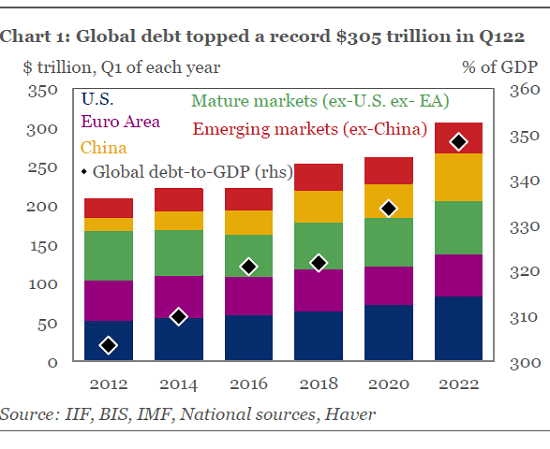
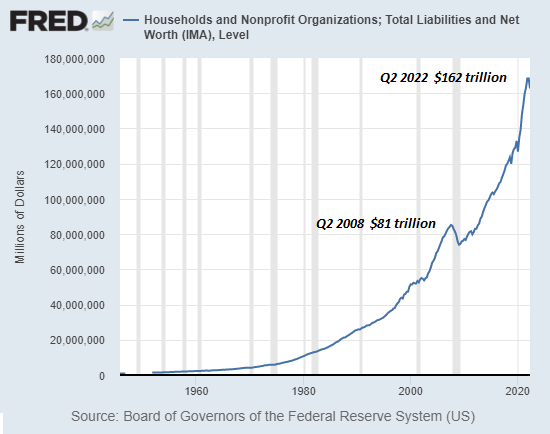
The resulting erosion of collateral will collapse the global credit bubble, a repricing/reset that will bankrupt the global economy and financial system.

Scrape away the complexity and every economic crisis and crash boils down to the precarious asymmetry between collateral and the debt secured by that collateral collapsing. It’s really that simple.

In eras of easy credit, both creditworthy and marginal borrowers are suddenly able to borrow more. This flood of new cash seeking a return fuels red-hot demand for conventional assets considered “safe investments” (real estate, blue-chip stocks and bonds), demand which given the limited supply of “safe” assets, pushes valuations of these assets to the moon.

In the euphoric atmosphere generated by easy credit and a soaring asset valuations, some of the easy credit sloshes into marginal investments (farmland that is only briefly productive if it rains enough, for example), high-risk speculative ventures based on sizzle rather than actual steak and outright frauds passed off as legitimate “sure-fire opportunities.”

The price people are willing to pay for all these assets soars as the demand created by easy credit increases. And why does credit continue increasing? The assets rising in value create more collateral which then supports more credit.

This self-reinforcing feedback appears highly virtuous in the expansion phase: the grazing land bought to put under the plow just doubled in value, so the owners can borrow more and use the cash to expand their purchase of more grazing land. The same mechanism is at work in every asset: homes, commercial real estate, stocks and bonds: the more the asset gains in value, the more collateral becomes available to support more credit.

Since there’s plenty of collateral to back up the new loans, both borrowers and lenders see the profitable expansion of credit as “safe.”

This safety is illusory, as it’s resting on an unstable pile of sand: bubble valuations driven by easy credit. We all know that price is set by what somebody will pay for the asset. What attracts less attention is price is also set by how much somebody can borrow to buy the asset.

Once the borrower has maxed out their ability to borrow (their income and assets-owned cannot support more debt) or credit conditions tighten, then those who might have paid even higher prices for assets had they been able to borrow more money can no longer borrow enough to bid the asset higher.

Since price is set on the margin (i.e. by the last sales), the normal churn of selling is enough to push valuations down. At first the euphoria is undented by the decline, but as credit tightens (interest rates rise and lending standards tighten, cutting off marginal buyers and ventures) then buyers become scarce and skittish sellers proliferate.

Questions about fundamental valuations arise, and sky-high valuations are found wanting as tightening credit reduces sales, revenues and profits. Once the “endless growth” story weakens, the claims that bubble prices are “fair value” evaporate.

As defaults rise, lenders are forced to tighten credit further. The first tumbling rocks are ignored but eventually the defaults trigger a landslide, and the credit-inflated bubble in asset valuations collapses.

As valuations plummet, so too does the collateral backing all the new debt. Debt that appeared “safe” is soon exposed as a potential push into insolvency. When the bungalow doubled in value from $500,000 to $1 million, the trajectory of valuation gains looked predictably rosy: every decade housing prices went up 30% or more. So originating a mortgage for $800,000 on a house that looked to be worth $1.3 million in a few years looked rock-solid safe.

But the $1 million was a bubble based solely on easy, abundant, low-cost credit. When credit tightens, the home is slowly but surely repriced at its pre-bubble valuation ($500,000) or perhaps much lower, if that value was merely an artifact of a previous unpopped bubble.

Now the collateral is $300,000 less than the mortgage. The owner who made a down payment of $200,000 will be wiped out by a forced sale at $500,000, and the lender (or owner of the mortgage) will take a $300,000 loss.

Given the banking system is set up to absorb only modest, incremental losses, losses of this magnitude render the lender insolvent. The lender’s capital base is drained to zero by the losses and then pushed into negative net-worth by continued losses.

The collateral collapses when bubbles pop, but the debt loaned against the now-phantom collateral remains.

This is the story of the Great Depression, a story that’s unloved because it calls into question the current series of credit-inflated bubbles and resulting financial crises. So the story is reworked into something more palatable such as “the Federal Reserve made a policy error.”

This encourages the fantasy that if central banks choose the right policies, credit bubbles and valuations detached from reality can both keep expanding forever. The reality is credit bubbles always pop, as the expansion of borrowing eventually exceeds the income and collateral of marginal borrowers, and this tsunami of cash eventually pours into marginal high-risk speculative vebtures that go bust.

There is no way to thread the needle so credit-asset bubbles never pop. Yet here we are, watching the global Everything Bubble finally start collapsing, guaranteeing the collapse of collateral and all the debt issued on that collateral, and the rabble is arguing about what policy tweaks are needed to reinflate the bubble and save the global economy from bankruptcy.

Sorry, but global bankruptcy is already baked in. Too much debt has been piled on phantom-collateral and income streams derived from bubble assets rising (for example, capital gains, development taxes, etc.). The asymmetry is now so extreme that even a modest decline in asset valuations/collateral due to a garden-variety business-cycle recession of tightening financial conditions will trigger the collapse of The Everything Bubble and the mountain of global debt resting on the wind-blown sands of phantom collateral.

There are persuasive reasons to suspect global debt far exceeds the official level around $300 trillion, most saliently, the largely opaque shadow banking system. When assets roughly double in a few years, bubble symmetry suggests that valuations will decline back to the starting point of the bubble in roughly the same time span.

The resulting erosion of collateral will collapse the global credit bubble, a repricing/reset that will bankrupt the global economy and financial system.