The Key to a Sustainable Economy Is 5,000 Years Old

By Ellen Brown

Source: Truthdig

We are again reaching the point in the business cycle known as “peak debt,” when debts have compounded to the point that their cumulative total cannot be paid. Student debt, credit card debt, auto loans, business debt and sovereign debt are all higher than they have ever been. As economist Michael Hudson writes in his provocative 2018 book, “…and forgive them their debts,” debts that can’t be paid won’t be paid. The question, he says, is how they won’t be paid.

Mainstream economic models leave this problem to “the invisible hand of the market,” assuming trends will self-correct over time. But while the market may indeed correct, it does so at the expense of the debtors, who become progressively poorer as the rich become richer. Borrowers go bankrupt and banks foreclose on the collateral, dispossessing the debtors of their homes and their livelihoods. The houses are bought by the rich at distress prices and are rented back at inflated prices to the debtors, who are then forced into wage peonage to survive. When the banks themselves go bankrupt, the government bails them out. Thus the market corrects, but not without government intervention. That intervention just comes at the end of the cycle to rescue the creditors, whose ability to buy politicians gives them the upper hand. According to free-market apologists, this is a natural cycle akin to the weather, which dates all the way back to the birth of modern economics in ancient Greece and Rome.

Hudson counters that those classical societies are not actually where our financial system began, and that capitalism did not evolve from bartering, as its ideologues assert. Rather, it devolved from a more functional, sophisticated, egalitarian credit system that was sustained for two millennia in ancient Mesopotamia (now parts of Iraq, Turkey, Kuwait and Iran). Money, banking, accounting and modern business enterprise originated not with gold and private trade, but in the public sector of Sumer’s palaces and temples in the third century B.C. Because it involved credit issued by the local government rather than private loans of gold, bad debts could be periodically forgiven rather than compounding until they took the whole system down, a critical feature that allowed for its remarkable longevity.

The True Roots of Money and Banking

Sumer was the first civilization for which we have written records. Its notable achievements included the wheel, the lunar calendar, our numerical system, law codes, an organized hierarchy of priest-kings, copper tools and weapons, irrigation, accounting and money. It also produced the first written language, which took the form of cuneiform figures impressed on clay. These tablets were largely just accounting tools, recording the flow of food and raw materials in the temple and palace workshops, as well as IOUs (mainly to these large public institutions) that had to be preserved in writing to be enforced. This temple accounting system allowed for the coordinated flow of credit to peasant farmers from planting to harvesting, and for advances to merchants to engage in foreign trade.

In fact, it was the need to manage accounts for a large labor force under bureaucratic control that is thought to have led to the development of writing. The people willingly accepted this bureaucratic control because they viewed the gods as having decreed it. According to their cuneiform writings, humans were genetically engineered to work the fields and the mines after certain lower gods tasked with that hard labor rebelled.

Usury, or the charging of interest on loans, was an accepted part of the Mesopotamian credit system. Interest rates were high and remained unchanged for two millennia. But Mesopotamian scholars were well aware of the problem of “debts that can’t be paid.” Unlike in today’s academic economic curriculum, Hudson writes:

Babylonian scribal students were trained already c. 2000 BC in the mathematics of compound interest. Their school exercises asked them to calculate how long it took a debt at interest of 1/60th per month to double. The answer is 60 months: five years. How long to quadruple? 10 years. How long to multiply 64 times? 30 years. It must’ve been obvious that no economy can grow in keeping with this rate of increase.

Sumerian kings solved the problem of “peak debt” by periodically declaring “clean slates,” in which agrarian debts were forgiven and debtors were released from servitude to work as tenants on their own plots of land. The land belonged to the gods under the stewardship of the temple and the palace and could not be sold, but farmers and their families maintained leaseholds to it in perpetuity by providing a share of their crops, service in the military and labor in building communal infrastructure. In this way, their homes and livelihoods were preserved, an arrangement that was mutually beneficial, since the kings needed their service.

Jewish scribes, who spent time in captivity in Babylon in the sixth century B.C, adapted these laws in the year or jubilee, which Hudson argues was added to Leviticus after the Babylonian captivity. According to Leviticus 25:8-13, a Jubilee Year was to be declared every 49 years, during which debts would be forgiven, slaves and prisoners freed and their property leaseholds restored. As in ancient Mesopotamia, property ownership remained with Yahweh and his earthly proxies. The Jubilee law effectively banned the outright sale of land, which could only be leased for up to 50 years (Leviticus 25:14-17). The Levitican Jubilee represented an advance over the Mesopotamian “clean slates,” Hudson says, in that it was codified into law rather than relying on the whim of the king. But its proclaimers lacked political power, and whether the law was ever enforced is unclear. It served as a moral rather than a legal prescription.

Ancient Greece and Rome adopted the Mesopotamian system of lending at interest, but without the safety valve of periodic “clean slates,” since the creditors were no longer the king or the temple, but private lenders. Unfettered usury resulted in debt bondage and forfeiture of properties, consolidation into large landholdings, a growing wedge between rich and poor, and the ultimate destruction of the Roman Empire.

As for the celebrated development of property rights and democracy in ancient Greece and Rome, Hudson argues that they did not actually serve the poor. They served the rich, who controlled elections, just as rich donors do today. Taking power away from local governments by privatizing once-communal lands allowed private creditors to pass laws by which they could legally confiscate property when their debtors could not pay. “Free markets” meant the freedom to accumulate massive wealth at the expense of the poor and the state.

Hudson maintains that when Jesus Christ preached “forgiveness of debts,” he was also talking about economic debt, not just moral transgressions. When he overturned the tables of the money changers, it was because they had turned a house of prayer into “a den of thieves.” But creditors’ rights had by then gained legal dominance, and Christian theologians lacked the power to override them. Rather than being a promise of economic redemption in this life, forgiveness of debts thus became a promise of spiritual redemption in the next.

How to Pull Off a Modern Debt Jubilee

Such has been the fate of debtors in modern Western economies. But in some modern non-Western economies, vestiges of the debt write-off solution remain. In China, for instance, nonperforming loans are often carried on the books of state-owned banks or canceled rather than putting insolvent debtors and banks into bankruptcy. As Dinny McMahon wrote in June in an article titled “China’s Bad Data Can Be a Good Thing”:

In China, the state stands behind the country’s banks. As long as authorities ensure those banks have sufficient liquidity to meet their obligations, they can trundle along with higher delinquency levels than would be regarded safe in a market economy.

China’s banking system, like that of ancient Mesopotamia, is largely in the public sector, so the state can back its banks with liquidity as needed. Interestingly, the Chinese state also preserves the ancient Near Eastern practice of retaining ownership of the land, which citizens can only lease for a period of time.

In Western economies, most banks are privately owned and heavily regulated, with high reserve and capital requirements. Bad loans mean debtors are put into foreclosure, jobs and capital infrastructure are lost, and austerity prevails. The Trump administration is now aggressively pursuing a trade war with China in an effort to level the playing field by forcing it into the same austerity regime, but a more productive and sustainable approach might be for the U.S. to engage in periodic debt jubilees itself.

The problem with that solution today is that most debts in Western economies are owed not to the government but to private creditors, who will insist on their contractual rights to payment. We need to find a way to pay the creditors while relieving the borrowers of their debt burden.

One possibility is to nationalize insolvent banks and sell their bad loans to the central bank, which can buy them with money created on its books. The loans can then be written down or voided out. Precedent for this policy was established with “QE1,” the Fed’s first round of quantitative easing, in which it bought unmarketable mortgage-backed securities from banks with liquidity problems.

Another possibility would be to use money generated by the central bank to bail out debtors directly. This could be done selectively, by buying up student debt or credit card debt or car loans bundled as “asset-backed securities,” then writing the debts down or off, for example. Alternatively, debts could be relieved collectively with a periodic national dividend or universal basic income paid to everyone, again drawn from the deep pocket of the central bank.

Critics will object that this would dangerously inflate the money supply and consumer prices, but that need not be the case. Today, virtually all money is created as bank debt, and it is extinguished when the debt is repaid. That means dividends used to pay this debt down would be extinguished, along with the debt itself, without adding to the money supply. For the 80% of the U.S. population now carrying debt, loan repayments from their national dividends could be made mandatory and automatic. The remaining 20% would be likely to save or invest the funds, so this money too would contribute little to consumer price inflation; and to the extent that it did go into the consumer market, it could help generate the demand needed to stimulate productivity and employment. (For a fuller explanation, see Ellen Brown, “Banking on the People,” 2019).

In ancient Mesopotamia, writing off debts worked brilliantly well for two millennia. As Hudson concludes:

To insist that all debts must be paid ignores the contrast between the thousands of years of successful Near Eastern clean slates and the debt bondage into which [Greco-Roman] antiquity sank. … If this policy in many cases was more successful than today’s, it is because they recognized that insisting that all debts must be paid meant foreclosures, economic polarization and impoverishment of the economy at large.

Is the U.S. Becoming a Third World Nation?

By Charles Hugh Smith

Source: Of Two Minds

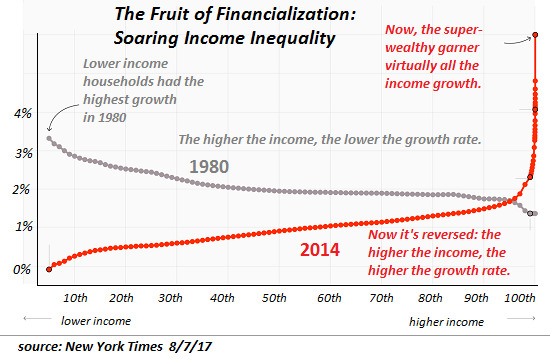
This is a chart of an informal kleptocracy which cloaks itself in the faux finery of democracy and a (rigged) “market” economy.

Back in the day, nations that didn’t qualify as either developed (First World) or developing (Second World) were by default Third World, impoverished, corrupt and what we now refer to as failed states–governments that were incapable of improving the lives of their people and the machinery of governance, generally as a result of corruption and self-serving elites, i.e. kleptocracies.

Is the U.S. slipping into Third World status? While many scoff at the very question, others citing the rise of homelessness, entrenched pockets of abject poverty and the decaying state of infrastructure might nod “yes.”

These are not uniquely Third World problems, they’re symptoms of a status quo that’s fast losing First World capabilities. What characterizes Third World/Failing States isn’t just poverty, crumbling infrastructure and endemic corruption; at a systems level these are the key dynamics in Third World/Failing States:

1. The status quo protects insiders at the expense of everyone else.

2. There is no real accountability; failure has no consequences, bureaucrats are never fired for incompetence, reforms are watered down or neutered by institutional sclerosis.

3. Pay-to-play is the most cost-effective way to influence policy or evade consequences.

4. The status quo is incapable of differentiating between complexity that serves the legitimate purposes of transparency and accountability and complexity that serves no purpose beyond guaranteeing insiders’ paper-shuffling jobs. As a consequence, complexity that adds no value chokes the economy and the government.

5. There are two sets of laws: one for insiders and the super-wealthy, and another harsher set for everyone else.

6. The super-wealthy fear nothing because the system functions to serve their interests.

7. The super-wealthy and state insiders control the media’s narratives and the machinery of governance to serve their interests. Reforms are in name only; the faces of elected officials change but nothing changes structurally.

8. Insiders, well-paid pundits and the technocrats serving the corporate and state elites believe the status quo is just fine because they’re doing fine; they are blind to the soaring inequality, systemic corruption, stupendous waste and the impossibility of real reform.

Does America’s status quo protect insiders at the expense of everyone else? Yes. As for the other seven characteristics: yes, yes, yes, yes, yes, yes and yes.

And lets’ not forget #9: the vast majority of the economic gains flow to the elite at the very top of the wealth-power pyramid: is this true in the U.S.? Definitively yes. Just look at this chart: this is a chart of an informal kleptocracy which cloaks itself in the faux finery of democracy and a (rigged) “market” economy.

That’s the very definition of a Third World failed state.

Related Video:

How to Avert a Digital Dystopia

By Jumana Abu-Ghazaleh

Source: OneZero

“What I find [ominous] is how seldom, today, we see the phrase ‘the 22nd century.’ Almost never. Compare this with the frequency with which the 21st century was evoked in popular culture during, say, the 1920s.”

—William Gibson, famed science-fiction author, in an interview on dystopian fiction.

The 2010s are almost over. And it doesn’t quite feel right.

When the end of 2009 came into view, the end of the 2000s felt like a relatively innocuous milestone. The current moment feels so much more, what’s the word?

Ah, yes: dystopian.

Looking back, “dystopia” might have been the watchword of the 2010s. Black Mirror debuted close to the beginning of the decade, and early in its run, it was sometimes critiqued for how over-the-top it all felt. Now, at the end of the decade, it’s regularly critiqued as made obsolete by reality.

And it’s not just prestige TV like Black Mirror reflecting the decade’s mood of incipient collapse. Of the 2010s top 10 highest-grossing films, by my count at least half involve an apocalypse either narrowly averted or, in fact, taking place (I’m looking at you, Avengers movies).

People have reasons to wallow. I get it. The existential threat of climate change alone — and seeing efforts to mitigate it slow down precisely as it becomes more pressing — could fuel whole libraries of dystopian fiction.

Meanwhile, our current tech landscape — the monopolies, the wild spread of disinformation, the sense that your most private data could go public whenever, with no recourse, all the things that risk making Black Mirror feel quaint — truly feels dystopian.

We enjoy watching distant, imaginary dystopias because they distract us from oncoming, real dystopias.

Since no one in a position to actually do something about our dystopian reality seems to be admitting it — no business leaders, politicians or legacy media — it makes sense that you might get catharsis of acknowledgment from pop culture instead. And yet, the most popular end-of-the-world fiction isn’t about actual imminent threats from climate or tech. It’s about Thanos coming to snap half of life out of existence. Or Voldemort threatening to destroy us Muggles.

Maybe that kind of pop culture, which acknowledges dystopia but not the actual threats we currently face, gives us a feeling of control: Sure, Equifax could leak my social security number and face zero consequences, but there are no Hunger Games. Wow — it really could be so much worse! Maybe we enjoy watching distant, imaginary dystopias because they distract us from oncoming, real dystopias.

But let’s look at those actual potential dystopias for a moment and think about what we need to do to avert them.

I’d suggest the big four U.S. tech giants — Amazon, Facebook, Apple, Google — each have a distinct possible dystopia associated with them. If we don’t turn around our current reality, we will likely get all four — after all, for all the antagonistic rhetoric among the giants, they are rather co-dependent. Let’s look at what we might have, ahem, look forward to — unless we demand the tech giants deliver on the utopia they purportedly set out to achieve when their respective founders raised their rounds of millions. I would argue not only that we can, but that we must hold them accountable.

“Mad Max,” or, slowly then all at once: starring Apple

“‘How did you go bankrupt?’ Bill asked. ‘Two ways,’ Mike said. ‘Gradually and then suddenly.’”

—Ernest Hemingway, The Sun Also Rises.

When you think of Mad Max, you probably think of an irradiated, post-apocalyptic desert hellscape. You’re also not thinking of Mad Max.

In the original 1979 film, the apocalypse hasn’t quite yet happened. There’s been a substantial social breakdown, but things are getting worse in slow motion. There are still functioning towns. Our protagonist, Max, is a working-class cop; and while there’s reason to believe a big crash is coming, or has even begun, society is still hanging on. (It’s only in the sequels that we’re well into the post-apocalyptic landscape people are thinking of when they say “Mad Max.”)

A relatively subtle dystopia, where things gradually decline in the background, is also a good day-to-day description of a society overrun by algorithms, even without the attention-grabbing mega-scandals of a Cambridge Analytica or massive data breach. A kind of dystopia “light” — and Apple is its poster child.

After all, Apple has a genuinely better track record than some of the other tech giants on a few key privacy issues. But it’s also genuinely aware of the value of promulgating that vision of itself — and that can lead Apple users into danger.

In January, Apple purchased a multistory billboard outside the Consumer Electronics Show in Las Vegas, with this message: “What happens on your iPhone, stays on your iPhone.” Sounds great — but it’s deeply misleading, and as journalist Mark Wilson noted, Apple’s mismatch between rhetoric and behavior fuels the nightmare that is our current data security crisis:

“[iPhone] contents are encrypted by default […] But that doesn’t stop the 2 million or so apps in the App Store from spying on iPhone users and selling details of their private lives. “Tens of millions of people have data taken from them — and they don’t have the slightest clue,” says [the] founder of [the] cybersecurity firm Guardian […] The Wall Street Journal studied 70 iOS apps […] and found several that were delivering deeply private information, including heart rate and fertility data, to Facebook.” [Emphasis mine.]

A tech giant that is claiming it’s the path to salvation, while effectively creating a trap for those who believe it, sounds ironically familiar given Apple’s famous evocation of Big Brother.

After all, when people talk about habit-forming technology in terms so terrifying they’ve convinced Silicon Valley executives to limit their children’s access to their own products, let’s be real: They’re talking about iPhones.

When academic child psychology researcher Jean Twenge talks about a possible teenage mental health epidemic fueled by social media, we know what’s at the heart of it: She’s talking about iPhones.

All those aforementioned horror stories, and a huge slice of those algorithms you’ve heard so much about, are likely first reaching you on smartphones that, with world market share above 50%, are largely, you guessed it, iPhones. (And none of these stories even mention Apple workers at overseas at facilities like Foxconn who create our iPhones and who really are living in a kind of explicit dystopia.)

What happens on your iPhone almost certainly doesn’t stay on your iPhone. But who created that surveillance capitalism running it all in the first place?

Enter Google.

“Black Mirror:” “Nosedive,” or, welcome to surveillance capitalism: starring Google

“We know where you are. We know where you’ve been. We can more or less know what you’re thinking about.”

—Google’s then-CEO Eric Schmidt, in a 2011 interview.

You’ve probably heard it before: “if you’re not paying, you’re the product.” This is usually in reference to ostensibly “free” services like Facebook or Gmail. It’s a creepy thought. And, according to Shoshana Zuboff, professor emeritus at Harvard and economic analyst of what she’s termed “surveillance capitalism,” the selling of your personal information undermines autonomy. It’s worse than you being the product: “You are not the product. You are the abandoned carcass.”

Google, according to Zuboff, is the original inventor of Surveillance Capitalism. In their early “Don’t Be Evil” days, the idea of accessing people’s private Google searches and selling them was considered unthinkable. Then Google realized it could use search data for targeting purposes — and never stopped creating opportunities to surveil their users:

“Google’s new methods were prized for their ability to find data that users had opted to keep private and to infer extensive personal information that users did not provide. These operations were designed to bypass user awareness. […]In other words, from the very start Google’s breakthrough depended upon a one-way mirror: surveillance.”

Twenty years later, surveillance capitalism has become so ubiquitous that it’s hard to live in Western society without being surveilled constantly by private actors.

As far as I know, no mass popular culture has really yet captured this reality, but one small metaphor that kind of hits on its effects is a Black Mirror episode called “Nosedive.”

In “Nosedive,” everyday people’s lived experience is very clearly the picked-apart carcass for an entire economic and social order; a kind of surveillance-driven social credit score affects every aspect of your daily life, from customer service to government resources to friendships, all based on your app usage and, most creepily, how other people rate you in the app.

If surveillance capitalism has been the engine powering our economy in the background for nearly two decades, it’s now having a coming-out party. Increasingly, Google isn’t just surveilling us in private — with its “designing smart cities” initiatives, the company will literally be making city management decisions instead of citizens: Sidewalk Labs, a Google sister company, plans to develop “the most innovative district in the entire world” in the Quayside neighborhood of Toronto, and Google itself is planning on siphoning every bit of data about how Quayside residents live and breathe and move via ubiquitous monitoring sensors that will likely inform — for a fee naturally — how other cities will develop.

If surveillance capitalism has been the engine powering our economy in the background for nearly two decades, it’s now having its coming-out party.

Much like Apple, Google takes pains to present itself as a conscientious corporate citizen. They might be paternalistic, or antidemocratic — but they have learned it’s important to their brand that they’re seen as responsive to their workers and the broader public, largely thanks to the courageous and persistent effort of their workers and consumer advocates in civil society.

Not so much with Amazon.

“Elysium,” or, dystopia for some, Prime Day for others: starring Amazon

“[The New York Times] claims that our intentional approach is to create a soulless, dystopian workplace where no fun is had and no laughter heard. Again, I don’t recognize this Amazon and I very much hope you don’t either.” —Jeff Bezos, August 17, 2015 letter to staff after the New York Times investigation into working conditions at the company.

In 2015, Jeff Bezos felt the need to set the record straight: The New York Times was wrong about Amazon. Working there did not feel like a dystopia.

The years since have only validated the New York Times story, which focused on life for coders and executives at Amazon. Notably, when the Times and other investigative journalists have probed life for the far more numerous warehouse workers employed by Amazon, Bezos has largely stayed silent.

In fact, the further down the corporate ladder you get at Amazon, the more likely it seems that Jeff Bezos will stay quiet on any controversy. Just this month, in a report published almost exactly four years after Bezos’ “Amazon is not a dystopia” declaration, the New York Times has uncovered almost a dozen previously unreported deaths allegedly caused by Amazon’s decentralized delivery network. Rather than defend itself out loud, Amazon has kept quiet while repeating the same argument in the courts: Those delivery people aren’t Amazon workers at all, and thus Amazon is not liable.

Amazon, like every major tech giant, has a key role in the dystopia of surveillance capitalism — the monopolylike market share of Amazon Web Services, and Amazon’s involvement in increasingly ubiquitous facial recognition software, represent their own deeply dystopian trends. But the most visible dystopia Amazon creates, for all to see, is dystopia in the workplace.

In many ways, Amazon is the single company that best explains the appeal of an Andrew Yang figure to a certain slice of economically alienated young voters. When speaking near Amazon’s HQ in Seattle, Yang explicitly talked about the surveillance of Amazon workers, and how reliable those jobs are in any case:

“All the Amazon employees [here] are like, ‘Oh shit, is Jeff watching me right now?’… [Amazon will] open up a fulfillment warehouse that employs, let’s call it 20,000 people. How many retail workers worked at the malls that went out of business because of Amazon? [The] greatest thing would be if Jeff Bezos just stood up one day and said, ‘Hey, the truth is we are one of the primary organizations automating away millions of American jobs.’ […] I have friends who work at Amazon and they say point-blank that ‘we are told we are going to be trying to get rid of our own jobs.’”

You can flat-out disagree with Yang’s proposed solutions, but a lot of his appeal stems from the fact that he’s diagnosing a problem that broad swaths of people don’t feel is being talked about. Yang validates his supporters’ concerns that they are, in fact, living in a dystopia of the corporate overlord variety.

In the movie Elysium, most work is done in warehouses, under constant surveillance, with workers creating the very automation systems that surveil and punish them. The movie takes place in a company townlike setting, with no such thing as a class system or social mobility. Meanwhile, the ruling class in Elysium lives in space, having left everyone else behind to work on Earth, a planet now fully ravaged by climate change.

That might sound particularly far-fetched, but given Bezos’ explicit intention to colonize space because “we are in the process of destroying this planet,” it suddenly doesn’t feel so off the mark. And in an era where Governors and Mayors openly genuflect to Amazon, preemptively giving up vast swaths of democratic powers for the mere possibility that Amazon might host an office building there, it’s hard not to feel like we’re already in an Elysium-flavored dystopia.

Amazon has their dystopia picked out, flavor and all. But what happens when the biggest social network in the world can’t decide which dystopia it wants to be when it grows up?

Pick a dystopia — any dystopia!: starring Facebook

“Understanding who you serve is always a very important problem, and it only gets harder the more people that you serve.”

—Mark Zuckerberg, 2014 interview with the New York Times.

Ready Player One is one of the more popular recent dystopian novels.

The bleak future it depicts is relatively straightforward: In the face of economic and ecological collapse, the vast majority of human interaction and commercial activity happens over a shared virtual reality space called Oasis.

In Oasis, the downtrodden masses compete in enormous multiplayer video games, hoping to win enough prizes and gain sufficient corporate sponsorship to scrape out a decent existence. Imagine a version of The Matrix, where people choose to constantly log into unreality because actual reality has gotten so unbearably terrible, electing to let the real world waste away. Horrific.

Ready Player One is also the book that Oculus founder and former Facebook employee Palmer Luckey used to give new hires, working on virtual reality to get them “excited” about the “potential” of their work.

Sound beyond parody? In so many ways, Facebook is unique among the tech giants: It’s not hiding the specter of dystopia. It’s amplifying dystopia.

It’s hard to pick a popular dystopia Facebook isn’t invested in.

Surveillance capitalism? Google invented it, but Facebook has taken it to a whole new level with its social and emotional contagion experiments and relentless tracking of even nonusers.

1984? Sure, Facebook says, quietly patenting technology that lets your phone record you without warning.

Brave New World? Lest we forget, Facebook literally experimented with making depression contagious in 2014.

28 Days Later, or any of the various other mass-violence-as-disease horror movies like The Happening? Facebook has been used to spread mass genocidal panics far more terrifying than any apocalyptic Hollywood film.

What about the seemingly way out there dystopias — something like THX-1138 or a particularly gnarly Black Mirror episode where a brain can have its thoughts directly read, or even electronically implanted? It won’t comfort you to know that Facebook just acquired CTRL-Labs, which is developing a wearable brain-computer interface, raising questions about literal thought rewriting, brain hacking, and psychological “discontinuity.”

Roger McNamee, an early Zuckerberg advisor and arguably its most important early investor, has become unadorned about it: Facebook has become a dystopia. It’s up to the rest of us to catch up.

We spent the 2010s on dystopia—let’s spend the 2020s on utopia instead

“Plan for the worst, hope for the best, and maybe wind up somewhere in the middle.” —Bright Eyes, “Loose Leaves”

People generally seem to think dystopias are possible, but utopias are not. No one ridicules you for conceiving of a dystopia.

I think part of that is because it gives us an easy out. Dystopias paralyze us. They overwhelm. They make us feel small and powerless. Envisioning Dystopia is like getting married anticipating the divorce. All we can do is make sure it’s amicable.

Is there room for a utopian counterweight? There’s not only room, there’s an urgent need if we want to look forward (as opposed to despondently) to the 22nd century. We cannot avert or undo dystopias without believing in their counterparts.

But we need to make the utopian alternative feel real, accessible, and achievable. We need to be rooting not for the lesser of two evils, but for something actually good.

Dystopias — real, about-to-unfold dystopias — have been averted before. The threat of nuclear apocalypse during the Cold War. The shrinking hole in the ozone layer (which is both distinct from, and has lessons to teach us about, the climate crisis). We didn’t land in utopia, but it was only by hitching our wagons to a utopian vision that we averted the worst.

In 2017, cultural historian Jill Lepore penned a kind of goodbye letter to dystopian fiction, calling for a renewal of utopian imagination. “Dystopia,” she lamented, “used to be a fiction of resistance; it’s become a fiction of submission.” Dystopian narratives once served as stark warnings of what might be in store for us if we do nothing, spurring us on to devise a brighter future. Today, dystopian fiction is so prevalent and comes in so many unsavory flavors that our civic imaginations are understandably confined to identifying the one we deem most likely to inevitably happen, and to come to terms with it.

But we don’t have to.

A new decade is on the way. Let’s spend the 2020s exercising our utopian imaginations — the muscles we use to envision dystopia are now all too-well-developed, and a body that only exercises one set of muscles quickly grows off-balance.

Dystopias disempower. We are tiny, inconsequential — how could we do anything about them? Utopias, on the other hand, are rhetorical devices calling upon us to build. They invite our participation. Because a utopia where we don’t matter is a contradiction in terms.

Let’s envision a world where those creating algorithms are thinking not only about their reach, but also about their impact. A world in which we are not the carcass left behind by surveillance capitalism. A world in which calling for ethical norms and standards is in itself a utopian act.

Let’s spend the next decade fighting for what we actually want: A world in which the powerful few are held to a higher standard; an industry in which ethics aren’t an afterthought, and the phrase “unintended consequences” doesn’t absolve actors from the fall out of their very deliberate acts.

Let’s actualize the utopia which, ironically enough, the tech giants themselves so enthusiastically promised us when they set out to change the world.

Let’s spend this next decade asking for what we actually want.

A New Aesthetic

By Damaris Zehner

Source: Resilience

There are all these good ideas – intensive agriculture, organic farming, permaculture, the local food movement. But why is most food still not grown this way, if it really is better? Why don’t farmers switch to sustainable land use methods? It seems to me there are at least four reasons.

First is the conservative nature of farming. Any activity that involves a large and long investment for an uncertain outcome is going to be conservative; no one wants to experiment when a year’s income is riding on the results. Farmers tend to stick to what has seemed to work. The psychology of previous investment plays a part in their choices as well. Once you’ve bought the huge combine, well, you have to use it.

Even when things don’t work so well, farmers will keep doing them if there are financial incentives to do so. This is the second reason. Government programs have tended to encourage big agribusinesses and have been less friendly to smaller, more varied farms.

Third, farmers love their machines. All Americans do. We fall every time for the promise that new technology will make our lives easier, more fun, more productive, and more sophisticated, and people with outdated technology, whether cell phones or tractors, get made fun of. Many people don’t have the time or the patience for more manual ways of working. I knew of a horse farmer who recently complained that he wouldn’t hire young men on his farm because they got impatient with the horses and, as he put it, just wanted to be roaring off with an internal combustion engine. (His workers were young women). These young men have become habituated to the speed and power made possible by fossil fuels and get rattled when asked to move more slowly.

Finally, there is an unconscious but still powerful motivation why farmers don’t want to stop spraying and switch to more natural methods of food production. It is a mistaken aesthetic that dictates how people see and judge the land around them, that tells us what looks beautiful and productive and “American” – that is, efficient, high-tech, and gleaming with the promise of the future. Perfect, undisturbed expanses of commodity crops, synchronized lines of combines churning through thousand-acre wheat fields, shiny factories, and brightly colored grocery stores are our proof that we are not a third-world nation, or Amish, or hippies – that we are still orthodox worshipers of the god of progress.

I don’t dispute the attraction of the aesthetic. Honestly, the land around here looks pretty good. Or at least it looks pretty. But the cost of those perfect fields and vast expanses of monoculture may be more than we can pay. Our aesthetics are as damaging to the environment as our greed or carelessness. So we need to move toward a new aesthetic.

Before we can do so, we need to ask ourselves: how much of the world are we responsible for tidying up? Nature is messy by our standards. A patch of disturbed earth becomes populated with a swirling mob of what we’d call weeds – dock, plantain, dandelion, mulberry, crabgrass, lamb’s quarters, and a hundred plants I don’t have a name for. And that bothers us. We spray, mow, and weed, in the process disturbing the natural succession of plants. We say that keeping our lawns, gardens, and fields as pure monoculture is more efficient and attractive. I drove with farmers past fields of soybeans shortly after the introduction of Round-Up herbicide, and they talked about how beautiful the thick carpet of identical plants is. They’re not wrong. The lush uniformity is beautiful. But I’m not sure we have the right to expect the same sort of beauty from nature that we can create within our houses. Should a farm field look like wall-to-wall carpeting? Should every molehill be leveled, every fence row scorched, whatever t cost, just because we think it looks nicer?

We have neighbors down the road whose property has been described as a doll’s house because of its detailed perfection. It’s a good description – they treat their two acres as if it were as entirely under their control as a doll’s house. The fences have lines of brown under them where the mower can’t reach and herbicide has been sprayed. Their lawn is grass only, no violets or dandelions. Their mature hardwood trees are all pollarded to be a matching height. It’s pretty, I suppose. It’s also horrifying as an illustration of their attitude toward natural beauty. To speak in hyperbolic terms, those friendly neighbors are conducting an all-out war on nature, with policies of scorched earth and ethnic cleansing, and the result is extreme totalitarianism. This stands in striking contrast to the permaculture sites I’ve visited, which look like a hodgepodge of annuals, perennials, weeds, and small creatures and don’t involve any mowing. I suspect that everyone’s first reaction to seeing permaculture in action is, in fact, “Why don’t they mow?” They have their reasons, and they have a different aesthetic.

I admit I like the cleanliness and order that humans impose. I’m all right with keeping my house clean, but I have to decide how far my household extends. If I find insects on my kitchen counter, I kill them. But should I kill the insects in my yard? All the insects in the world? Because if farmers adopt a policy of insect genocide, as most do, it’s going to have costs to the surroundings – which include me. When the summer crop-dusting airplanes fly overhead carpet-bombing bugs and weeds, I have to run to bring the laundry inside and shut the windows if it’s windy, which it usually is, because – call me a crazy tree-hugger – I prefer my sheets and towels to smell of fresh air and not the toxin du jour. That’s where my aesthetic differs from the farmers’.

Farmers around here will tell you that they are aiming for efficiency, and I do appreciate that harvesting crops is easier when the equipment is not clogged with morning glory vines and ragweed stalks. I also understand that weeds and other plants compete with the crops and lower farmers’ yields, so there is a financial as well as an aesthetic motivation for them to keep their fields clean. But there’s no question that these farmers are also driven by the false aesthetic of human-imposed purity. I watch while they grub out a small patch of trees that they had no problem maneuvering around, just so the field looks “clean.”

It’s a competitive aesthetic, too. People in this small community will gossip about and criticize landowners whose fields aren’t clean – I hear them every year talking about whose land isn’t yet sprayed, tilled, or ditched. People from out of our area have asked me when they’ve come over to visit, “Whose land is that down the road? It looks bad.” What they mean when they say that farmers are not keeping their land “clean” is that farmers are not leaving a toe-hold for nature on their property. Rabbits and deer have no right to a corridor of shelter; killdeer and quail have to keep packing up and moving as their surroundings are cut down; coyotes are shot. And once we’ve expunged the aborigines, we can live the mindless imperialist lifestyle we like.

I have some sympathy, I guess. I don’t want coyotes eating my goats or rabbits ruining my garden. But I have to ask the question again: how much of the natural world do we have the right to control at the same level that we control our houses and yards? If we are going to live in a better balance with nature than we do now, we have to change not only our acquisitiveness and our focus on profit and exploitation; we also have to learn to see beauty in what we now consider messiness.

Guns for Hire: No, the Government Shouldn’t Be Using the Military to Police the Globe

By John W. Whitehead

Source: The Rutherford Institute

“Of all the enemies to public liberty war is, perhaps, the most to be dreaded because it comprises and develops the germ of every other. War is the parent of armies; from these proceed debts and taxes… known instruments for bringing the many under the domination of the few.… No nation could preserve its freedom in the midst of continual warfare.” — James Madison

Eventually, all military empires fall and fail by spreading themselves too thin and spending themselves to death.

It happened in Rome.

It’s happening again.

At the height of its power, even the mighty Roman Empire could not stare down a collapsing economy and a burgeoning military. Prolonged periods of war and false economic prosperity largely led to its demise. As historian Chalmers Johnson predicts:

The fate of previous democratic empires suggests that such a conflict is unsustainable and will be resolved in one of two ways. Rome attempted to keep its empire and lost its democracy. Britain chose to remain democratic and in the process let go its empire. Intentionally or not, the people of the United States already are well embarked upon the course of non-democratic empire.

The American Empire—with its endless wars waged by U.S. military servicepeople who have been reduced to little more than guns for hire: outsourced, stretched too thin, and deployed to far-flung places to police the globe—is approaching a breaking point.

War has become a huge money-making venture, and America, with its vast military empire and its incestuous relationship with a host of international defense contractors, is one of its best buyers and sellers. In fact, as Reuters reports, “[President] Trump has gone further than any of his predecessors to act as a salesman for the U.S. defense industry.”

Under Trump’s leadership, the U.S. military is dropping a bomb every 12 minutes.

This follows on the heels of President Obama, the so-called antiwar candidate and Nobel Peace Prize winner who waged war longer than any American president and whose targeted-drone killings resulted in at least 1.3 million lives lost to the U.S.-led war on terror.

Most recently, the Trump Administration signaled its willingness to put the lives of American troops on the line in order to guard Saudi Arabia’s oil resources. Roughly 200 American troops will join the 500 troops already stationed in Saudi Arabia. That’s in addition to the 60,000 U.S. troops that have been deployed throughout the Middle East for decades.

As The Washington Post points out, “The United States is now the world’s largest producer — and its reliance on Saudi imports has dropped dramatically, including by 50 percent in the past two years alone.”

So if we’re not protecting the oil for ourselves, whose interests are we protecting?

The military industrial complex is calling the shots, of course, and profit is its primary objective.

The military-industrial complex is also the world’s largest employer.

America has long had a penchant for endless wars that empty our national coffers while fattening those of the military industrial complex.

Aided and abetted by the U.S government, the American military-industrial complex has erected an empire unsurpassed in history in its breadth and scope, one dedicated to conducting perpetual warfare throughout the earth.

Although the U.S. constitutes only 5% of the world’s population, America boasts almost 50% of the world’s total military expenditure, spending more on the military than the next 19 biggest spending nations combined. Indeed, the Pentagon spends more on war than all 50 states combined spend on health, education, welfare, and safety.

Unfortunately, this level of war-mongering doesn’t come cheap to the taxpayers who are forced to foot the bill.

Having been co-opted by greedy defense contractors, corrupt politicians and incompetent government officials, America’s expanding military empire is bleeding the country dry at a rate of more than $32 million per hour.

In fact, the U.S. government has spent more money every five seconds in Iraq than the average American earns in a year.

With more than 800 U.S. military bases in 80 countries, the U.S. is now operating in 40 percent of the world’s nations at a cost of $160 to $200 billion annually.

Despite the fact that Congress has only officially declared war eleven times in the nation’s short history, the last time being during World War II, the United States has been at war for all but 21 of the past 243 years.

It’s cost the American taxpayer more than $4.7 trillion since 2001 to fight the government’s so-called “war on terrorism.” That’s in addition to “$127 billion in the last 17 years to train police, military and border patrol agents in many countries and to develop antiterrorism education programs, among other activities.” That does not include the cost of maintaining and staffing the 800-plus U.S. military bases spread around the globe.

The cost of perpetuating those endless wars and military exercises around the globe is expected to push the total bill upwards of $12 trillion by 2053.

The U.S. government is spending money it doesn’t have on a military empire it can’t afford.

As investigative journalist Uri Friedman puts it, for more than 15 years now, the United States has been fighting terrorism with a credit card, “essentially bankrolling the wars with debt, in the form of purchases of U.S. Treasury bonds by U.S.-based entities like pension funds and state and local governments, and by countries like China and Japan.”

War is not cheap, but it becomes outrageously costly when you factor in government incompetence, fraud, and greedy contractors.

For example, a leading accounting firm concluded that one of the Pentagon’s largest agencies “can’t account for hundreds of millions of dollars’ worth of spending.”

Unfortunately, the outlook isn’t much better for the spending that can be tracked.

Consider that the government lost more than $160 billion to waste and fraud by the military and defense contractors. With paid contractors often outnumbering enlisted combat troops, the American war effort dubbed as the “coalition of the willing” has quickly evolved into the “coalition of the billing,” with American taxpayers forced to cough up billions of dollars for cash bribes, luxury bases, a highway to nowhere, faulty equipment, salaries for so-called “ghost soldiers,” and overpriced anything and everything associated with the war effort, including a $640 toilet seat and a $7600 coffee pot.

A government audit found that defense contractor Boeing has been massively overcharging taxpayers for mundane parts, resulting in tens of millions of dollars in overspending. As the report noted, the American taxpayer paid:

$71 for a metal pin that should cost just 4 cents; $644.75 for a small gear smaller than a dime that sells for $12.51: more than a 5,100 percent increase in price. $1,678.61 for another tiny part, also smaller than a dime, that could have been bought within DoD for $7.71: a 21,000 percent increase. $71.01 for a straight, thin metal pin that DoD had on hand, unused by the tens of thousands, for 4 cents: an increase of over 177,000 percent.

That price gouging has become an accepted form of corruption within the American military empire is a sad statement on how little control “we the people” have over our runaway government.

There’s a good reason why “bloated,” “corrupt” and “inefficient” are among the words most commonly applied to the government, especially the Department of Defense and its contractors. Price gouging has become an accepted form of corruption within the American military empire.

It’s not just the American economy that is being gouged, unfortunately.

Driven by a greedy defense sector, the American homeland has been transformed into a battlefield with militarized police and weapons better suited to a war zone. Trump, no different from his predecessors, has continued to expand America’s military empire abroad and domestically, calling on Congress to approve billions more to hire cops, build more prisons and wage more profit-driven war-on-drugs/war-on-terrorism/war-on-crime programs that pander to the powerful money interests (military, corporate and security) that run the Deep State and hold the government in its clutches.

Mind you, this isn’t just corrupt behavior. It’s deadly, downright immoral behavior.

Essentially, in order to fund this burgeoning military empire that polices the globe, the U.S. government is prepared to bankrupt the nation, jeopardize our servicemen and women, increase the chances of terrorism and blowback domestically, and push the nation that much closer to eventual collapse.

Making matters worse, taxpayers are being forced to pay $1.4 million per hour to provide U.S. weapons to countries that can’t afford them. As Mother Jones reports, the Pentagon’s Foreign Military Finance program “opens the way for the US government to pay for weapons for other countries—only to ‘promote world peace,’ of course—using your tax dollars, which are then recycled into the hands of military-industrial-complex corporations.”

Clearly, our national priorities are in desperate need of an overhauling.

As Los Angeles Times reporter Steve Lopez rightly asks:

Why throw money at defense when everything is falling down around us? Do we need to spend more money on our military (about $600 billion this year) than the next seven countries combined? Do we need 1.4 million active military personnel and 850,000 reserves when the enemy at the moment — ISIS — numbers in the low tens of thousands? If so, it seems there’s something radically wrong with our strategy. Should 55% of the federal government’s discretionary spending go to the military and only 3% to transportation when the toll in American lives is far greater from failing infrastructure than from terrorism? Does California need nearly as many active military bases (31, according to militarybases.com) as it has UC and state university campuses (33)? And does the state need more active duty military personnel (168,000, according to Governing magazine) than public elementary school teachers (139,000)?

The illicit merger of the global armaments industry and the Pentagon that President Dwight D. Eisenhower warned us against more than 50 years ago has come to represent perhaps the greatest threat to the nation’s fragile infrastructure today.

The government is destabilizing the economy, destroying the national infrastructure through neglect and a lack of resources, and turning taxpayer dollars into blood money with its endless wars, drone strikes and mounting death tolls.

This is exactly the scenario Eisenhower warned against when he cautioned the citizenry not to let the profit-driven war machine endanger our liberties or democratic processes:

“Every gun that is made, every warship launched, every rocket fired signifies, in the final sense, a theft from those who hunger and are not fed, those who are cold and are not clothed. This world in arms is not spending money alone. It is spending the sweat of its laborers, the genius of its scientists, the hopes of its children. The cost of one modern heavy bomber is this: a modern brick school in more than 30 cities. It is two electric power plants, each serving a town of 60,000 population. It is two fine, fully equipped hospitals. It is some fifty miles of concrete pavement. We pay for a single fighter plane with a half million bushels of wheat. We pay for a single destroyer with new homes that could have housed more than 8,000 people. This is, I repeat, the best way of life to be found on the road the world has been taking. This is not a way of life at all, in any true sense. Under the cloud of threatening war, it is humanity hanging from a cross of iron.”

We failed to heed Eisenhower’s warning.

The illicit merger of the armaments industry and the government that Eisenhower warned against has come to represent perhaps the greatest threat to the nation today.

What we have is a confluence of factors and influences that go beyond mere comparisons to Rome. It is a union of Orwell’s 1984 with its shadowy, totalitarian government—i.e., fascism, the union of government and corporate powers—and a total surveillance state with a military empire extended throughout the world.

This is how tyranny rises and freedom falls.

As I make clear in my book Battlefield America: The War on the American People, the growth of and reliance on militarism as the solution for our problems both domestically and abroad bodes ill for the constitutional principles which form the basis of the American experiment in freedom.

After all, a military empire ruled by martial law does not rely on principles of equality and justice for its authority but on the power of the sword. As author Aldous Huxley warned: “Liberty cannot flourish in a country that is permanently on a war footing, or even a near-war footing. Permanent crisis justifies permanent control of everybody and everything by the agencies of the central government.”


Billionaires are a Sign of Economic Failure

Inherited wealth and crony capitalism have created an aristocratic class that undermines social mobility and democracy

By Max Lawson

Source: Inequality.org

The New York Times published an editorial comment on its front page in January 2019, provocatively entitled “abolish billionaires.” The editorial raised a serious question: what if instead of being a sign of economic success, billionaires are a sign of economic failure?  In what ways can the boom in billionaires, and the dramatic increase in extreme wealth generally, be harmful?

To answer this question, we need to understand the origins of billionaire wealth, and to understand how that wealth is used once it is gained.  The answer to both these questions I think rightly casts doubt on the value of the super-rich in our society.

Approximately one third of billionaire wealth comes from inheritance. It is very hard to make the case for the economic utility of inherited wealth, and instead there is a strong case for the fact that it undermines social mobility and economic progress. It creates instead a new aristocracy who are rich simply because their parents were rich which is hard to see as a good thing.

Whether inherited or secured in other ways, extreme wealth takes on a momentum of its own.  The super-rich have the money to spend on the best investment advice, and billionaire wealth has increased since 2009 by an average of 11 percent a year, far higher than rates ordinary savers can obtain.

Bill Gates is worth nearly $100 billion dollars in 2019, almost twice what he was worth when he stepped down as head of Microsoft.  This is despite his admirable commitment to giving his money away.  As Thomas Piketty said in his book Capital in the 21st Century, “No matter how justified inequalities of wealth may be initially, fortunes can grow beyond any rational justification in terms of social utility.”

My Oxfam colleague Didier Jacobs calculated a few years ago that another third of billionaire wealth comes from crony connections to government and monopoly.  This could be for example when billionaires secure concessions to provide services exclusively from government, using crony connections and corruption.  The Economist has developed a similar measure of crony capitalism with similar findings. What is clear it seems to me is that corruption and crony connections to governments are behind a significant proportion of billionaire wealth.

Almost all sectors of our global economy are also now characterized by monopoly power, as is detailed by Nick Shaxson in his great new book, the Finance Curse. Whether food, pharmaceuticals, media, finance, or technology, each sector is characterized by a handful of huge corporations.

Decades of largely unquestioned mergers and acquisitions, where corporations have bought up competitors, have led to this.  Historically, and especially in the United States in the early part of the 20th century, monopoly power was rightly viewed as a serious threat to the economy and to society, and steps were taken to break up monopolies.  It was President Franklin Roosevelt who famously said that “government by organized money is just as dangerous as government by organized mob.” However, in recent decades, neoliberal economics has led a much more benign view of monopoly power, and very little action is now taken to dismantle them. I think this is a key distinction between neoliberalism and classical liberal economics.  These monopolies impose hidden monopoly taxes on every consumer, as it enables these companies, and their wealthy shareholders, to extract excessive profits from the market, directly fueling the growth in extreme wealth at the expense of ordinary citizens.

The actions of corporations, including the move towards monopoly, are driven by a relentless focus on ever-increasing returns to shareholders — shareholders who are primarily the very same extremely wealthy people.  Our new Oxfam paper on the “Seven Deadly Sins” of the G7, released this week, shows how returns to shareholders have increased dramatically whilst real wages have barely increased.

Behind corporate power and corporate actions is increasingly the power of super-rich shareholders.

Once billionaire wealth is accumulated, the way it is used also casts doubt on how useful it is to have billionaires.  The super-rich use their wealth to pay as little tax as possible, making active use of a secretive global network of tax havens, as revealed by the Panama Papers and other exposes.

One ground-breaking study that made use of this leaked information showed that the super-rich are paying as much as 30 percent less tax than they should, denying governments billions in lost tax revenue, that could have been spent on schools or on hospitals.  The super-rich are supported in this by the Society of Trust and Estate Practitioners (STEP), a secretive organization of over 20,000 wealth managers that actively pressures governments to reduce taxes on the richest.

Billions are not just used to ensure lower taxes. They can also be used to buy impunity from justice, to buy politicians, or to buy a pliant media.  The use of “dark” money to influence elections and public policy is a growing problem all over the world. The Koch brothers — Charles and the recently deceased David — two of the richest men in the world, have had a huge influence over conservative politics in the United States.

Another recent Oxfam study  showed the many ways in which politics has been captured by the very rich in Latin America.  Many of today’s new breed of nationalist, racist leaders have substantial financial backing.

This active political influencing by the super-rich directly drives greater inequality, by constructing reinforcing feedback loops, in which the winners of the game get even more resources to win even bigger next time.

For all these reasons, I think there is a strong case to be made that rather than being celebrated, as one U.S. commentator recently said, “every billionaire is a policy failure,” and that in particular if we are to end poverty and build fairer societies, we need to bring an end to extreme wealth.

Wealth Identity Politics: Billionaires Acting Like A Persecuted Minority Is Peak Capitalism

By Caitlin Johnstone

Source: CaitlinJohnstone.com

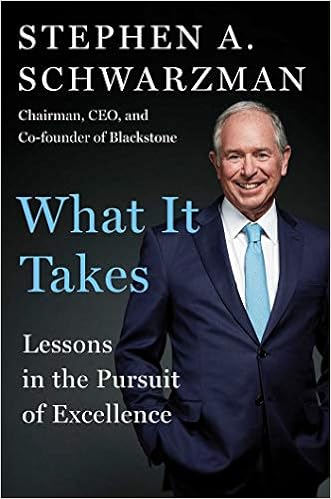
“I guess maybe Bernie Sanders shouldn’t exist,” said billionaire Steve Schwarzman while seated in a library building named after billionaire Steve Schwarzman and promoting a book with billionaire Steve Schwarzman’s face on it.

According to Bloomberg this humble response from the always modest billionaire Steve Schwarzman came in response to a question posed by an audience member about a Sanders tweet in which the Vermont Senator said that billionaires should not exist. The comment was reportedly met with enthusiastic applause.

Blackstone CEO Schwarzman, who has previously compared tax increases on the wealthy to the Nazi invasion of Poland, is an oligarch by any reasonable definition. As one of America’s top individual campaign donors he is immensely influential; his plutocratic power is so deeply interwoven with the highest levels of government that his book’s 14 pages of acknowledgements describe cuddly relationships with a who’s-who of top US officials, including the last five presidents. According to a recent report by The Intercept, two Brazilian firms owned by Schwarzman “are significantly responsible for the ongoing destruction of the Amazon rainforest, carnage that has developed into raging fires that have captivated global attention.”

It is very telling that this oligarch sees an equivalence between (A) saying that an elite class should not control such vast amounts of wealth and (B) saying actual people should not exist. What this tells us is that Schwarzman sees being a billionaire as a fundamental part of his identity, making the idea that he shouldn’t control billions of dollars indistinguishable from saying that he himself should not exist. From his point of view he’s just doing the same thing that Sanders is doing: Bernie’s saying the thing that Schwarzman is shouldn’t exist, and Schwarzman is saying that Bernie himself shouldn’t exist. To him they’re the same.

This statement gives us a bit of insight into the way billionaires see themselves as fundamentally different than the rest of us, forming an egoic identity construct out of being a billionaire in the same way a medieval king would form an egoic identity construct out of that position. This anti-billionaire rhetoric is perceived as an attack on their very identity, which is why they are spinning it as though Sanders is calling for the elimination of actual people.

Predictably, Fox News is now trotting out billionaires to defend themselves from this outrageous billionairephobic bigotry, with Home Depot founder and major Republican Party donor Ken Langone receiving a warmly sycophantic reception from Fox’s Mornings with Maria.

“What the hell has he done for the little people?” Langone asked his host Maria Bartiromo. “What jobs has he created?”

Langone went on to detail all the many jobs he’s “created” (read: how many people he’s needed to hire to help him reap lucrative profits from an already existing demand) without bothering to explain what hoarding billions of dollars in offshore accounts has to do with job creation. Exponents of the “billionaires create jobs” argument always avoid this glaring plot hole like the plague.

Again, we see in Langone’s emotional response two things: that he sees ordinary citizens as “the little people” innately different from himself, and that he perceives the push toward greater economic equality as an existential threat.

“If you go back to 1933, with different words, this is what Hitler was saying in Germany,” Langone has said of the rising pushback against wealth and income inequality. “You don’t survive as a society if you encourage and thrive on envy or jealousy.”

These outbursts are reminiscent of one we saw a couple of years ago on an MSNBC interview with resort tycoon Stephen Cloobeck, who expressed outrage at the way progressives are using “the millionaire or billionaire word” to discuss issues with class and economic justice, saying he’d instructed Democratic Party leaders to bring a stop to this rhetoric or lose plutocratic funding.

“It is very, very disturbing when I hear the millionaire or billionaire word,” Cloobeck said, as though he was uttering an ethnic slur for an oppressed minority and not a conventional label for a class that effectively owns the US government. “And I’ve told them to stop it. Knock it off.”

We’re seeing this hilarious conflation of economic justice with the persecution of minorities and the elimination of actual human beings more and more often, so we should probably come up with a name for it. I’d like to propose that we label this phenomenon “wealth identity politics”, and it is capitalism’s dumbest turn yet.

It’s especially dumb because the billionaire class has already proven with its actions that it cannot exist without actively working to manipulate governments in a way that undeniably subverts democracy and the will of the people. The debate over whether or not billionaires should exist is long settled. They should not.

A few million dollars will buy you a nice car, a nice house and some nice clothes. A few billion dollars will buy you the ability to control public narratives using media ownership, lobbyists and think tanks, thereby manipulating entire governments and international affairs. Believing that it makes sense to have an elite class which controls this much wealth and power is exactly as stupid as believing it makes sense to have a total monarchy.

Billionaires should not exist, for the same reason that kings and pharaohs should not exist. The leadership of our world should not belong to a class of highly mediocre people who have nothing noteworthy between their ears apart from a knack for accumulating dollars. The ability to amass wealth is not a valid basis upon which to determine who leads us. Our fate as a species should be in all our hands.

Nuclear War: Just Another Day


By Colin Todhunter

Source: OffGuardian

Catastrophic events that send the world into turmoil happen on ‘just another day’. The atom bomb that exploded over Hiroshima took place while thousands of ordinary folk were just going about their everyday business on ‘just another day’.

A missile attack on a neighbourhood in Gaza or a drone attack on unsuspecting civilians in Afghanistan: death and destruction come like a bolt from the blue as people shop at the local market or take their kids to school on ‘just another day’.

Will it be ‘just another day’ when the next nuclear bomb is exploded in anger, an ordinary day when people are just going about their daily business? By then it might be too late to do anything, too late to act to try to prevent an unfolding global catastrophe on a scale never before witnessed by humans.

Yet so many appear too apathetic and wrapped up in a world of gadgets, technology, shopping malls, millionaire sports players and big-time sports events to think that such a thing could be imminent.

Are they so preoccupied with the machinations of their own lives in cotton-wool cocooned societies to think that what is happening in Syria or Iraq is just too boring to follow or that it doesn’t really concern them or it is ‘not my problem’?

Do they think they are untouchable, that only death, war and violence happens in faraway places?

Could any of us even contemplate that on some not-too-distant day a series of European cities could be laid waste within a matter of minutes? It isn’t worth thinking about. Or is it.

The US (and the West’s) foreign policy is being driven on the basis of fake morality and duplicity. Millions lie dead in Iraq, Afghanistan, Syria and Libya as a result of US-led imperialism, and nuclear-armed Russia is constantly demonised simply because it will not acquiesce to Washington and serve as a vassal state.

And now, as the US continues to stir up tensions with Iran and as China warns neighbouring countries about allowing US nuclear missiles aimed at it on their territories, much of the Western public and media remain oblivious to the dangers of conflict escalation and the biggest immediate threat to all life on Earth: nuclear war.

The threat of mass murder

Some fell to the ground and their stomachs already expanded full, burst and organs fell out. Others had skin falling off them and others still were carrying limbs. And one in particular was carrying their eyeballs in their hand.”

The above extract comes from an account by a Hiroshima survivor talking about the fate of her schoolmates. In 2016, it was read out in the British parliament by Scottish National Party MP Chris Law during a debate about Britain’s nuclear arsenal.

In response to a question from MP George Kereven, the then British PM Theresa May said without hesitation that, if necessary, she would authorise the use of a nuclear weapon that would kill hundreds of thousands of innocent men, women and children. May also implied that those wishing to scrap Britain’s nuclear weapons are siding with the nation’s enemies.

Politicians like May read from a script devised by elite interests. This transnational capitalist class dictates global economic policies and decides on who lives and who dies and which wars are fought and inflicted on which people.

The mainstream narrative tends to depict individuals who belong to this class as ‘wealth creators’. In reality, however, these ‘high flyers’ have stolen ordinary people’s wealth, stashed it away in tax havens, bankrupted economies and have imposed a form of globalisation that results in devastating destruction and war for those who attempt to remain independent or structurally adjusted violence via privatisation and economic neo-liberalism for millions in countries that have acquiesced.

While ordinary folk across the world have been subjected to policies that have resulted in oppression, poverty and conflict, this is all passed off by politicians and the mainstream media as the way things must be.

The agritech sector poisons our food and agriculture. Madelaine Albright says it was worth it to have killed half a million kids in Iraq to secure energy resources for rich corporations and extend the wider geopolitical goals of ‘corporate America’. The welfare state is dismantled and austerity is imposed on millions. The rich increase their already enormous wealth.

Powerful corporations corrupt government machinery and colonise every aspect of life for profit. Environmental destruction and ecological devastation continue apace.

And nuclear weapons hang over humanity like the sword of Damocles.

The public is supposed to back this status quo in support of what? Austerity, powerlessness, imperialism, propping up the US dollar and a moribund system. For whom? Occidental Petroleum, Soros, Murdoch, Rothschild, BP, JP Morgan, Boeing and the rest of the elite and their corporations whose policies are devised in think tanks and handed to politicians to sell to a largely ignorant public: those who swallow the lie about some ‘war on terror’ or Washington as the world’s policeman, protecting life and liberty.

Rejecting hegemonic thought

Many believe nuclear weapons are a necessary evil and fall into line with hegemonic thinking about humanity being inherently conflictual, competitive and war-like.

Such tendencies do of course exist, but they do not exist in a vacuum. They are fuelled by capitalism and imperialism and played upon by politicians, the media and elite interests who seek to scare the population into accepting a ‘necessary’ status quo.

Co-operation and equality are as much a part of any arbitrary aspect of ‘human nature’ as any other defined characteristic. These values are, however, sidelined by a system of capitalism that is inherently conflict-ridden and expansionist.

Much of humanity has been convinced to accept the potential for instant nuclear Armageddon hanging over its collective head as a given, as a ‘deterrent’. However, the reality is that these weapons exist to protect elite, imperialist interests or to pressure others to cave into their demands.

If the 20th century has shown us anything, it is these interests are adept at gathering the masses under notions of flag, god and country to justify their slaughter.

To prevent us all shuddering with the fear of the threat of instant nuclear destruction on a daily basis, it’s a case of don’t worry, be happy, forget about it and watch TV.

It was the late academic Rick Roderick who highlighted that modern society trivialises issues that are of ultimate importance: they eventually become banal or ‘matter of fact’ to the population.

People are spun the notion that nuclear-backed militarism and neoliberalism and its structural violence are necessary for securing peace, defeating terror, creating prosperity or promoting ‘growth’. The ultimate banality is to accept this pack of lies and to believe there is no alternative, to acquiesce or just switch off to it all.

Instead of acquiescing and accepting it as ‘normal’, we should listen to writer and campaigner Robert J Burrowes:

Many people evade responsibility, of course, simply by believing and acting as if someone else, perhaps even ‘the government’, is ‘properly’ responsible. Undoubtedly, however, the most widespread ways of evading responsibility are to deny any responsibility for military violence while paying the taxes to finance it, denying any responsibility for adverse environmental and climate impacts while making no effort to reduce consumption, denying any responsibility for the exploitation of other people while buying the cheap products produced by their exploited (and sometimes slave) labour, denying any responsibility for the exploitation of animals despite eating and/or otherwise consuming a range of animal products, and denying any part in inflicting violence, especially on children, without understanding the many forms this violence can take.”

Burrowes concludes by saying that ultimately, we evade responsibility by ignoring the existence of a problem. The evasion of responsibility, acquiescence and acceptance are, of course, part of the conditioning process.

The ‘problem’ encompasses not only ongoing militarism, but the structural violence of neoliberal capitalism, aided and abetted by the World Bank, IMF and the WTO. It’s a type of violence that is steady, lingering and a daily fact of life under globalised capitalism.

Of course, oppression and conflict have been a feature throughout history and have taken place under various economic and political systems. Indeed, in his various articles, Burrowes goes deep into the psychology and causes of violence.

But there is potentially a different path for humanity.

In 1990, the late British MP Tony Benn gave a speech in parliament (above) that indicated the kind of values that such a route might look like.

Benn spoke about having been on a crowded train, where people had been tapping away on calculators and not interacting or making eye contact with one another. It represented what Britain had apparently become under Thatcherism: excessively individualistic, materialistic, narcissistic and atomised.

The train broke down. As time went by, people began to talk with one another, offer snacks and share stories. Benn said it wasn’t too long before that train had been turned into a socialist train of self-help, communality and comradeship.

Despite the damaging policies and ideology of Thatcherism, these features had survived her tenure, were deeply embedded and never too far from the surface.

For Tony Benn, what had been witnessed aboard that train was an aspect of ‘human nature’ that is too often suppressed, devalued and, when used as a basis for political change, regarded as a threat to ruling interests.

It is an aspect that draws on notions of unity, solidarity, common purpose, self-help and finds its ultimate expression in the vibrancy of community, the collective ownership of productive resources and co-operation.

The type of values far removed from the destructive, divisive ones of imperialism and capitalism which key politicians and the corporate media protect and promote.