Stagflation Subterfuge: The Real Disaster Hidden By The Pandemic

By Brandon Smith

Source: Alt-Market.us

In recent economic news, headlines are being dominated by concerns over rising bond yields. Increased bond yields are a sign of a possible spike in inflation and, logically, they call for the Federal Reserve to raise interest rates in order to prevent that inflation.

Higher bond yields also mean there is a competitive alternative to stocks for investors – both factors that could trigger a plunge in the stock market.

If one studies the real history behind the stock market crash during the Great Depression, they will find that it was the Federal Reserve’s interest rate hikes that caused and prolonged the disaster after they had created an environment of cheap and easy money throughout the 1920s. Former Chairman Ben Bernanke openly admitted the Fed was responsible back in 2002 in a speech honoring Milton Friedman. He stated:

“In short, according to Friedman and Schwartz, because of institutional changes and misguided doctrines, the banking panics of the Great Contraction were much more severe and widespread than would have normally occurred during a downturn. Let me end my talk by abusing slightly my status as an official representative of the Federal Reserve. I would like to say to Milton and Anna: Regarding the Great Depression. You’re right, we did it. We’re very sorry. But thanks to you, we won’t do it again.”

This then raises the question – inflation or deflation? Will the Fed “do it again?”

Probably not in exactly the same way, but we will see elements of both inflation and deflation soon in the form of stagflation.

It’s a Catch-22 that the central bank has created, and many (including myself) believe that the Fed has created the conundrum deliberately. All central banks are tied together by the Bank for International Settlements (BIS) and the BIS is a globalist institution through and through. The globalist agenda seeks to trigger what they call the “Great Reset,” a complete reformation of the global economy and capitalism into a single one world socialist system… managed by the globalists themselves, of course.

In my view the Fed has always been a kind of institutional suicide bomber; its job is to self-destruct at the right moment and take the U.S. economy down with it, all in the name of spreading its cult-like globalist ideology.

The only unknown at this point is how they will go about their sabotage. Will the central bank continue to allow inflation to explode the cost of living in the U.S., or will they intervene with higher interest rates and allow stock markets to crash?

Either way, we face a serious economic crisis in the near future.


Increasing Inflation Means Economic Recovery?

Mainstream economists will often argue that rising yields and inflation are a “good thing.” They claim this is a sign of rapid economic recovery. I disagree.

If “inflation” was the same as “recovery,” then there would not have been total economic collapses in Argentina in 2002, in Yugoslavia in 1994, or in Weimar Germany in the early 1920s.

I do not see recovery. What I see is the rapid devaluation of the dollar’s buying power due to massive fiat printing through stimulus measures. The Fed and the U.S. government are buying a short-term surge in economic activity, but at a hidden cost. This is a condition that the Dollar Index does not even begin to address, but obvious in prices of necessary goods and commodities.

Keep in mind that all of this is being done in the name of responding to the pandemic. The pandemic is the ultimate excuse for the active destruction of the U.S. economy. Stimulus measures have devolved into helicopter money being thrown about haphazardly as billions are siphoned primarily by major corporations and through fraud. People who are clamoring for a $2,000 relief check from the government have no idea that corporate welfare has been ongoing for the past year along with billions in retroactive tax refunds. All of that money printing is going to cause damage somewhere. It cannot be avoided.


It’s Not About The Pandemic

Let’s make something clear first: The pandemic is NOT the reason for the stimulus flood. The pandemic did very little to hurt actual business in the U.S. Rather, it was the lockdowns that did most of the damage.

Think about that for a moment – federal and state governments crushed the economy through lockdowns, then offered the solution of vast stimulus measures. This in turn is destroying financial stability and generating rapid price inflation.

Conservative states and counties that refused to shut down are recovering at a much faster pace than leftist states which imposed draconian restrictions on citizens. Yet, the lockdowns did nothing to stop the spread of COVID-19 in blue states. So, the lockdowns accomplished no discernible advantage for the public, but they did give the central bank a perfect rationale to further erode the dollar.

This resulting price inflation is something that not even the red states can escape.

For example, home prices are rapidly expanding beyond the market bubble of 2006. This is partially due to millions of people participating in perhaps the largest migration in the U.S. since the Great Depression. Anyone who is able is moving away from major cities into suburban and rural areas. But, home prices also have a historic habit of inflating along with currency devaluation. The cost of maintaining and remodeling an older home, or building a new home, rises as the prices of commodities like lumber inflate.

And lumber prices are certainly inflating! Softwood lumber prices are up at least 110% from a year ago, and are climbing as much as 10% in a week.

Home rentals also do not escape inflation, as the rising cost of maintaining properties forces landlords to increase rents. The only places where rents are decreasing are major cities that Americans are seeking to flee, such as New York and San Francisco.


Inflation In More Than Just Housing

The majority of commodities continue to see price inflation across the board. Food and energy prices have been creeping higher for the past year. Governments are once again blaming the pandemic and “stresses on the supply chain,” which may have been a believable claim nine months ago, but not today. Anything to hide the fact that all that stimulus has inflationary consequences.

Dollar devaluation is the most visible in terms of imported goods. In other words, it costs more dollars to buy goods outside the U.S. as the value of the dollar falls. And since the majority of U.S. retail is supplied by foreign producers, this means that average American consumers will suffer the brunt of inflationary consequences. Public stress and anger will be high.


Pandemic Lockdowns Are Just An Excuse

This is why the COVID-19 lockdowns must continue and the pandemic fear factory must remain active. The globalists need a cover event for the Reset and they need to keep the citizenry under control, and the pandemic can be blamed for just about anything. I think this is why we are already seeing the media hyping the existence of “COVID mutations.” Do not be surprised if the Biden Administration tries to implement a national lockdown sometime this year in the name of stopping the spread of a “more deadly” COVID-19 variant.

It won’t matter that the previous lockdowns were useless and all the data shows that keeping the economy open is a superior policy. It might seem like logic is going completely out the window, but there is a very logical reason for what is happening in the minds of globalists.

Stagflation comes into play through losses in certain sectors of the economy, high unemployment and the inability of wages to keep up with costs.

There is the continued dismantling of the small business sector, which, again, I believe is being destroyed deliberately. It’s not a mistake that small businesses were predominantly targeted as “non-essential” during the lockdowns. It’s also not a coincidence that the majority of COVID-19 PPP loans went to big box corporations while small businesses received almost nothing. The small business sector is being erased, leaving only the corporate sector to provide for consumers.

This may be why Democrats are so adamant about raising the federal minimum wage to $15 an hour. Wages are already rising according to market demand and region. The average non-skilled worker in the U.S. is making around $11 an hour. There is no need for the government to interfere, unless they have ulterior motives.

A $15 minimum wage would likely crush what’s left of small businesses, and only corporations that are receiving the bulk of stimulus dollars will be able to afford to pay workers the higher rate. On top of that, years from now the government could claim they “took action” to front-run stagflation by increasing people’s pay. But a $15 minimum wage is most useful to the establishment in the short term because it muddies the waters on the inflation issue.

Prices will continue to rise due to dollar devaluation, but the media and government will say that it has nothing to do with the dollar and everything to do with companies raising shelf prices to offset increased labor costs.


The Biggest Threat In The History Of American Society

I suspect that the establishment will do everything in its power to distract the public from the biggest threat in the history of American society – the stagflationary time bomb.

If they admit to its existence then the public could prepare for it, and they don’t want that. If Americans were to decentralize their local economies, support local small businesses instead of big box retailers, start producing necessities for themselves, and if they started developing currency alternatives like local scrip backed by commodities… then they would be able to survive a national financial crisis.

In fact, I guarantee that any community, county or state that takes these steps will immediately be targeted by the federal government, further revealing the truth: The establishment wants the public to suffer.

They want economic disaster. They do not want people to have the option of taking care of themselves. They need people scared, desperate and malleable, or they will never achieve their Reset agenda.

The Mainstream Bubble

By Ralf Arnold, translation by S. Robinson

Source: Off-Guardian

At the beginning of the already memorable year 2020, a term forced its way into public and private consciousness, which should increasingly determine and overshadow all of our lives: The “novel corona virus”, also called SARS-CoV-2. The name was officially announced by the WHO on February 11th. After that everything happened in quick succession.

At first I saw the pictures of Chinese people with masks only in the Tagesschau (the flagship evening news program by ARD, one of the two main public broadcasters in Germany; S.R.), which was not an unusual sight, but soon corona also reached our newsroom.

On the day when the first suspected corona case surfaced in our region, I was urged by our news chief to use it as a “lead story”, i.e. as the first report in the next news program.

At that time I was already extremely skeptical and found it excessive to use a mere suspected case as the lead story. However, I couldn’t escape the general excitement around me and put the message on “one”. But a bad feeling remained and that should intensify massively over the next few weeks.

A dynamic set in that seemed unstoppable.

More and more suspected cases, then confirmed corona cases, at some point the first death in Germany, some time later the first in our region. And more and more I noticed that not only colleagues, but also people in my private environment let themselves be infected by a vague fear and even panic.

Not that I dismissed the deaths, the so-called “corona deaths”, but didn’t we have many deaths in every flu epidemic, especially among the elderly? I checked our archives and found that we had only a handful of reports in three months during the 2018 flu epidemic. More than 25,000 people are said to have died of the flu at that time.

The now famous Johns Hopkins University dashboard was quickly featured on all television and online news. The so-called “new infections” were simply accumulated on this. It became clear to me that the graph with the constantly rising curve contained more psychological effects rather than factual information. In this way the curve could never sink again, in the best case it would stay horizontal. But that didn’t seem to bother anyone.

Part of the basic training of a journalist is that he never reports figures without meaningful reference. He must always provide comparisons, references and proportionalities so that the viewer / listener / reader can contextualise the information. I stuck to it for many years, and it seemed a matter of course for other journalists too. However, I saw this basic principle practically vanish into thin air in the first weeks of the pandemic. Absolute numbers, always only absolute numbers, without any meaningful reference.

To this day, people like to say that the USA is the country most severely affected by corona, with mere reference to the absolute numbers of infections and deaths, regardless of the size of the population, to which the numbers are rarely put in relation.

An ominous alliance

Our newsroom also adopted all these counting methods with a sleepwalking naturalness. Everything that was communicated by the health authorities, the district administration and the regional government was adopted and reported without questioning and without doubt. Almost all critical distance disappeared, and the authorities became supposed allies in the fight against the virus.

I have to point out, however, that I have never been called or written to directly by politicians to influence me in any way. There were only the usual press releases from the ministries and offices, which are of course written from their point of view. Nor have I been pressured by superiors, at least not directly. The whole thing is far more subtle, as will be shown.

March was the start of the first restrictions: major events were banned and soon after the first lockdown was imposed. Almost all journalists of the “mainstream”, so the so-called “leading media”, including my editorial team, seemed to immediately develop an ‘inhibition to bite’ towards politicians and the authorities. Why this uncritical reluctance among journalists?

I can only explain it to myself that particularly the pictures from Bergamo and New York also put the experienced editors and reporters into an emotional state of shock, even if they might not admit it. But they, too, are only people who are afraid of illness and death, or who worry about elderly or sick relatives; this was repeatedly an issue in conversations with colleagues. They rallied around the government, the RKI (Robert-Koch-Institute; the German equivalent of the CDC; S.R.) and the health authorities, as if one really had to stick together now to combat this dire, external threat.

You couldn’t throw a club between the legs of those in charge, who were having a difficult time already, by fundamentally questioning their measures – that was how the attitude seemed to me.

In our conversations, too, it was said more and more frequently that “the government is really doing a good job”. Most were firmly convinced that the lockdown and the restrictions of our fundamental rights were necessary and certainly only temporary. I heard only a few skeptical voices.

And then there were the TV interviews with politicians. Esteemed journalists, who in conversation with politician XY eagerly nodded and verbally agreed when they presented their assessment of the situation and made their demands. I couldn’t believe my eyes and ears!

What was the motto of the legendary television journalist Hanns-Joachim Friedrichs?

You can recognize a good journalist by the fact that he does not make common cause with anything, not even with a good cause; that he is everywhere, but doesn’t belong anywhere.”

There was nothing left of this guiding principle, and very little in the way of tough and critical inquiries. But even that didn’t seem to bother anyone, yes to not even attract attention.

A decay of reporting language

In the news of all the leading media, including ours, important, little words like “alleged”, “supposed”, “apparently” suddenly died out. For example, the Tagesschau said that Twitter wanted to delete “false information about corona” in the future. There is clearly no “alleged” or “supposed” as an addition, because it is assumed that Twitter can judge without any doubt what is false and what is correct information in terms of the corona virus (or in general). Which of course is absurd.

Sometimes I made my colleagues in the newsroom aware of such things and sometimes even earned a nod of approval, but often just a helpless shrug.

In this day and age, news need to be short, easy to understand, and interesting. We have been trained to do this for many years. This has a lot of advantages, namely the ease of understanding on the part of the consumer. But there are also significant disadvantages, namely that the news are written more and more simplistic. Deeper connections and backgrounds or complicated differentiations are increasingly disappearing. The trick is to shorten and leave out.

From early summer, one could increasingly observe the phenomenon that the corona virus and the measures against it were equated in the media. For example, it was said: “Because of the corona pandemic, the municipalities are collecting significantly less taxes” or: “The WHO fears that the corona pandemic will plunge one and a half million more people into poverty.”

This is wrong, because not the pandemic, but the lockdowns have this effect, regardless of whether they are justified and appropriate. By ignoring this distinction, however, the anti-corona measures of the governments are being turned into something inevitable and without alternative and are no longer called into question.

The cause and therefore the scapegoat is always the virus, not politics.

This practice also crept into our newsroom. Advice from me was kindly noted, but nobody really took it to heart. I had the freedom to formulate this differently, but again nobody seemed to notice the small but subtle difference.

It is also often said that Covid-19 patients in the intensive care units “have to be ventilated”. Have to? They are being ventilated, that’s the fact. The attending doctor has to decide whether this is really medically necessary, and this question is quite controversial. There are a number of well-known experts who warn against intubating too quickly. So here too, as a journalist, you should remain neutral.

The dreadful number of “new infections”

In spring 2020 I began to increasingly question the counting method of the RKI and thus also of the government. I pointed out to my superiors that all numbers such as the “new infections” reported daily or the “R-value” were basically worthless if we did not relate them back to the number of tests performed. They took note of this, but thought no further verification or inquiries were necessary, because the trend of rapidly increasing numbers could not be misunderstood, regardless of how much was tested, it said.

The number of so-called “new infections” rose from week 11 to week 12 from 8,000 to 24,000. At the end of March, the RKI announced (after multiple inquiries by the online magazine Multipolar) that the number of PCR tests had almost tripled from 130,000 to 350,000 during the same period. The relative increase in new infections was thus far less than the absolute. There had been no “exponential increase”.

When the number of “new infections” continued to fall in early summer, the politicians still constantly conjured up the risk of the “second wave” if one were to ease the efforts – that is to say, the restrictions contrary to fundamental rights. In fact, most of my colleagues also agreed with these fears, while to me – who was no less of a medical and epidemiological layperson – it was pretty clear that there would be no second wave in summer, but an even bigger in autumn / winter because that is when the number of respiratory diseases routinely increase sharply. It was easy to foresee.

The whole issue of the PCR tests and the alleged “new infections” has to this day not been questioned by the leading media. Although over time there have been more and more studies and statements by virological and epidemiological experts harshly criticising the PCR test and its particular use, hardly any of it has penetrated our mainstream bubble. The CT values ​​that were probably far too high in the tests, which give ample room to possible manipulation, were not an issue at all.

I suspect a lot of my colleagues haven’t even heard of it.

In general, the terms continue to be mixed up in this context. Even after ten months of corona, many colleagues still do not seem to know the difference between the SARS-CoV-2 virus and the lung disease Covid-19. “Infected” (that is, those who have tested positive) are often equated with “sick”, regardless of whether they have symptoms or not.

The term “recovered” is also adopted uncritically by the authorities, although it implies that those affected were actually all sick, which is highly doubtful: On the one hand because there is most likely a proportion of false-positive test results that should not be underestimated, and, on the other hand, because many “infected” people do not develop any symptoms at all and it is therefore very dubious to call them sick.

Selective perception and herd instinct

In the meantime, all kinds of regulations have been introduced in our broadcasting corporation: mask requirements, physical distancing between desks, many colleagues have moved to home office, disinfectants everywhere and so on. This and the regular, ominous-sounding situation assessments by the management, of course, still exert a psychological influence and pressure on every employee. A subtle fear is built up here too, whether intentionally or unintentionally. There is literally an invisible threat in the air that is difficult to shield yourself from.

In addition, television screens are running in the newsroom and in other offices, on which reports about corona are broadcast almost continuously.

Everywhere reporters, pictures from intensive care units, running texts with the latest, ever higher numbers – it is almost impossible to avoid this influence. In addition, there are the newspapers and agency reports that also constantly report on corona, here a study, there another apocalyptic warning from a politician, and again and again sad individual stories which are particularly highlighted.

Although we continue to have daily conferences, now mostly by telephone, right from the start – at least during the conferences in which I participated – the current narrative of the national and regional government was never fundamentally questioned, namely that we have an extremely dangerous pandemic that can only be controlled, or at least slowed down, by tough government measures. Why is that?

Everyone probably knows the effect of “selective perception”. For example, if you or your wife are pregnant, you will most likely see more and more pregnant women on the street. Or if you fall in love with someone who drives a certain make of car, then you suddenly discover that make of car, in the same color, permanently on the streets. This effect also occurs in journalism.

Years ago, for example, there was a serious incident in Germany with several attack dogs biting a three-year-old girl to death. At that time there was great shock, a political discussion about the consequences was set in motion, a “character test” for dogs and stricter rules for dog owners were demanded, the media reported about it for days and weeks. And at the same time, suddenly more and more cases of dog attacks were reported. Sudden reports of even very minor incidents came from the police.

One would have thought that all dogs in Germany, like Hitchcock’s birds, would have agreed to meet for a general attack.

What happened? The general perception had become sensitised and extremely focused, on all levels. A dachshund bit someone in the calf in the park, they immediately reported this to the police and reported the owner, the police immediately passed the report on to the press, which turned it into a news report, although it was ultimately a triviality.

Due to the alarmed attitude and the narrowed perception of all those involved, however, the triviality that would normally have fallen under the table was given an oversized significance. And the readers, listeners or viewers noticed and thought: “Not again! This is piling up now.”

The same effect can of course also be observed in crime reporting. The media user can get the impression, for example, that the situation in the country is getting worse and more dangerous and that you can hardly dare go out in the streets. It might very well be that the pure statistics show that the total number of violent crimes continues to decline. That contradicts the subjective impression, but strangely enough, hardly anyone calms down. The pictures and reports of individual fates weigh far more than the sober numbers.

You can guess what I’m getting at.

In my opinion, in the corona crisis we are basically experiencing the same effect in a global, completely exaggerated and downright paranoid dimension. And that affects just about everyone: the common man, the police officer, the journalist, the politician and even the doctor and the scientist. Nobody is per se free from it. Unless he breaks free and dares to think for himself and think outside the box.

But there is a widespread journalistic herd instinct. Most journalists look at the daily newspapers that are delivered to the editorial office every day. And of course these are all newspapers that are mainstream: Welt, FAZ, Frankfurter Rundschau, Süddeutsche [the leading national papers; S.R.] and the regional newspapers.

In the evening, one watches “heute” [the evening news program of ZDF, the second of the two main public broadcasters in Germany; S.R.] and the “Tagesschau”, followed by the relevant talk shows, from Anne Will to Maischberger [two of the leading talk shows; S.R.] Mainstream almost always dominates there too. Real critics of the corona narrative are, with rare exceptions, categorically not invited.

Still, most of the journalists I know are of the opinion that the discussions there are quite controversial. But they do not notice – for lack of comparison – that these controversies are only fig-leaf discussions. It is only discussed when and to what extent the measures should be relaxed, but the corona narrative itself remains untouched.

All of this is not to say that there is no disease or death, but the perception of this is downright neurotically excessive. There are many reports on the Internet from the last few years that describe completely overcrowded hospitals, intensive care units at the limit and overburdened crematoria. With appropriate media support, one could have caused great panic in the population back then.

Another effect is that the media now also present their journalistic content online. There it is easier and faster for everyone to access than would be the case with hardcopy newspapers and broadcasts on radio or television. This means that this content can be easily copied and adopted.

As long as it is not personal, lengthy reporting or comments, but “only” news reports, it is easy to copy-paste these into your own reports, at least parts of them. Again and again you can find almost identical formulations and messages from different providers. Even if one does not copy-paste, one is tempted to orient oneself at the selection of topics by colleagues from other leading media.

A perfidious framing

I cannot say for sure whether the corona virus can be proven with the PCR tests, where it ultimately comes from, how dangerous it really is and what the right measures are to be taken against it. But this not what this is about. I do not deny that there is a bad illness, that people die from it and that you have to take it seriously.

And that brings us to the next emotive word, the so-called “corona denier” (Corona-Leugner). A term that has been gaining ground since the summer and is now regularly used by the mainstream media to label critics of the government’s anti-corona measures. The comparison with the “God denier” and the “Holocaust denier” is obvious.

While the term “God denier” has long been history, at least in our society, the term “Holocaust denier” is still relevant and it is no coincidence that the “corona denier” is involuntarily associated with it. There is now broad consensus that one cannot deny God at all, but only not believe in him. The “Holocaust denier” is the only generally recognized exception in which journalists use the word “deny”. Otherwise it is a taboo, at least it should be. Quite simply because it contains “lie” (lügen) in the stem of the word and thus implies a lie.

Responsible journalists know that defendants never deny the allegations in court, they contest them. This should be the case even after a final judgment, because courts can also be wrong and lawsuits can be reopened.

The term “corona denier” is now infamous in three ways. Firstly because of the linguistic similarity to the socially ostracized “Holocaust denier”, secondly because the corona critics are generally claimed to deny the existence of the virus (which is not the case with the vast majority of them) and finally because they are also accused of conscious lying. This is not just bad style, it is perfidious and ensures that the rifts in society are deepened even further.

An equally dubious term used as defamatory framing is that of the “conspiracy theorist”. It basically says everything and nothing. It can be someone who believes in chem trails or that the Americans’ moon landing was only staged, but it can also be someone who exposes a Watergate scandal or who claims (as happened) that Iraq did not hoard any weapons of mass destruction, and who is later confirmed in his assumptions.

Basically every investigative journalist has to be partly a conspiracy theorist, because of course the rulers of this world do not want to have all their activities published and therefore keep them secret. In this respect, it is somewhat grotesque that the media adopt the rulers’ fighting term and use it thoughtlessly.

Alleged conspiracy theorists are also made fun of internally. Many colleagues are joking that they are crazies, who believe that Bill Gates wants to open a vaccination station with Hitler on the back of the moon. Or similar childish nonsense.

A negative highlight was the reporting of the “leading media” about the large demonstrations in Stuttgart, Leipzig and especially Berlin in the summer. It started with the number of participants. Actually, it is common for journalists to name both the number of demonstrators as announced by the police and the number of demonstrators as announced by the organisers (which is naturally always higher) at rallies.

On August 1st 2020 in Berlin, however, these details diverged so widely that one had to become suspicious. The “leading media” solved the problem by only naming the small number from the police and ignoring the high numbers that the organisers and participants mentioned. How high the number actually was is still unclear today, but here too the media acted against journalistic practices.

Were a few right-wing radicals and Reich citizens among the demonstrators? Were there many or were they even dominating the action? Numerous video streams showed that a large, if not overwhelming, proportion of the demonstrators apparently came from the middle of society. On average a little older, educated and from a middle-class background. There are also surveys and studies that confirm this.

Of course, you can argue about it, but in our editorial team, too, the matter was clear: the focus of the reporting was clearly on the right-wing radicals and Reichsbürger.

One reason for this can be found in the increasingly important part of online media. In contrast to newspapers, television and radio, it is possible to analyse exactly how many hits an individual post has, or how many “likes” on the Facebook pages, which are now also operated by all leading media.

As a result, the spectacular, and the supposedly scandalous, comes more and more to the fore because it promises more attention and thus more clicks. Various media critics say that almost everything in our society is increasingly being scandalised, no matter how casual. If so, then it is surely largely due to the “leading media” (including their tabloids).

A sealed bubble

Why is the “mainstream media” a closed bubble? Because they always get their information from the same, pre-sorted sources – and that is largely the news agencies that belong to the same bubble. They are like the gatekeepers of published opinion. That has always been the case, of course, but in the corona crisis it has become clearer than ever.

The major agencies mainly report on what supports the official corona narrative and what is propagated and implemented by the vast majority of governments around the world.

For example, almost only studies from around the world are reported which highlight the danger of the virus and the effectiveness of tough government measures. A Chinese study of around ten million people in Wuhan, which found that non-symptomatic transmission of the virus (almost all government measures are based on this assumption) was as good as irrelevant, did not feature in the agencies. It could only be found in the alternative online media.

By contrast, a study by the US-American CDC, which had contrary results, was reported. Numerous studies that showed that government lockdowns have virtually no impact on the infection rate have also been ignored by the agencies so far.

For me personally in my work this means that I cannot use any studies or information that I have found by myself on the Internet, because I would almost certainly be accused of using an uncertain source. But if DPA, AP, AFP or Reuters reported the study, I would be more or less on the safe side and could report it. If there were inquiries, I would refer to the agency. This could still lead to discussions as to whether the study is credible and whether it is worth reporting, but that would be part of a normal journalistic decision-making process.

Yes, it does happen again and again that critical experts or politicians are interviewed in the leading media or that the RKI and the federal government are criticized. But mostly it’s just fig leaves and they don’t really get to the heart of the matter.

There are statements from leading editors-in-chief of the public services that say that people like Wolfgang Wodarg or Sucharit Bhakdi [two high-profile critics with an accomplished medical / research background; S.R.] are generally not to be invited to talk shows on the subject. The bubble should stay as tightly sealed as possible.

An attempt at an explanation

Again and again I wonder why almost all of my colleagues so willingly and uncritically adopt this narrative from the government and from a few scientists (selected by the government) and disseminate it further. As already mentioned, concern for your own health or that of relatives certainly plays a role. But there is more.

In the last few years, something called “attitude journalism” has emerged. It is an intellectual and moralising arrogance that I think is spreading more and more. You simply belong to the “good guys”, to those who are on the “right side”. One believes that one has to instruct the mistaken citizen.

It is no longer a question of neutrality, but of representing the “right cause”, and surprisingly often this coincides with the interests of the government. The sentence by Hanns-Joachim Friedrichs mentioned above has even been completely reinterpreted in the meantime, in the sense of “attitude journalism”.

But this is increasingly alienating journalists from a good part of their clientele.

In the 1990s, the red carpet was rolled out to us reporters, editors, and presenters when we showed up anywhere in the country. Today we almost have to be happy when people don’t shout “Lying press!” [Lügenpresse; a term adopted by the Nazis in the Third Reich for the Jewish, communist, and foreign press; S.R.]. Of course, this term is wrong and should be rejected because of its history, but we journalists play a large part in the increasing alienation.

To be fair, the aforementioned “attitude journalism” only applies to some of the journalists, but mostly to their prominent representatives. Many of my colleagues seem to be overwhelmed by the complexity of the subject. Not intellectually, but rather because there is no time to dig into these things alongside the daily routine work. Close to impossible if you still have to do homeschooling with the children in the evening. Others simply lack interest in the subject.

In any case, one reason is the fear of attracting negative attention through overly critical statements. The self-reinforcing momentum of the mainstream bubble ensures that hardly anyone wants to swim against the current. Although a good number of the editors are on permanent contracts, there is great concern about the consequences. As I can observe in myself.

A fundamental problem with the mainstream bubble is that it either ignores or suppresses what is outside the bubble or perceives and interprets it from within that bubble. And so most mainstream journalists know the statements and positions of critical thinkers like Wodarg and Bhakdi (to name just two of many) only from reports in the mainstream media, which are of course biased accordingly. Hardly anyone takes the trouble to actually draw from the numerous alternative sources.

An afterword

This report is of course only a subjective assessment. Most of my fellow journalists would see it completely differently. However, I am not so concerned here with assessing the danger of the corona virus or the appropriateness of government measures. My concern is that in the corona crisis, in my opinion, journalistic standards and principles have been increasingly thrown overboard, as I have tried to at least indicate.

This in turn ensures that the media have become virtually meaningless as a democratic corrective, which in turn plays into the hands of political aspirations to power.

George Orwell is reported to have said that journalism is when you publish something that someone does not want published. Everything else is propaganda. Measured against this claim, it has to be said that the mainstream media in the corona crisis to 99 percent only deliver propaganda.

I myself have the naive hope of still being able to make a difference, in whatever way, because freedom of the press is in and of itself an extremely important asset in a democratically free society. I still believe in that.


The author of the following text has been an editor and newscaster for public broadcasting for many years and writes here under a pseudonym. He reports from the inner workings of a newsroom during the corona crisis. The article was originally published by the German online magazine Multipolar. Culture-specific explanations have been added by the translator.

Post-Pandemic Landscapes: Behavior Modification as the New Consensus Reality

By Kingsley L. Dennis

Source: Waking Times

The ‘Covid Event’ gave the unreal world its great coup over the place of the real. This perception intervention gave the final stimulus necessary to tip the twenty-first century into an awaiting technologically manipulated reality. A new landscape is emerging where, for the first time, the human mind is finding itself out-of-place within its own territory. What are now being termed the emerging ‘post-pandemic’ landscapes are likely to be hazardous territory for our mental, emotional, and physical states. The human condition is under modification.

New forms of power are on the rise, embedded within structures of health security, that are re-imagining our social lives, living and workspaces, and our physical and digital movements. Until now, the spider’s web of social control mainly operated below the waterline in a space where an almost intangible world existed beyond governance or accountability.  Now the Kraken awakes and is unashamedly coming to the surface. The beast of behavior modification is spreading its tentacles through our most established social and cultural institutions without shame – all in the name of health security (the new nom de plume of social management).  These institutions include the media, city life, the office, and – perhaps most of all – the online-digital world. The modification of these spaces is set to further desensitize, anesthetize, and dehumanize us. It is as if the collective human mind is being groomed and prepared for a new consensus reality of ‘normalized dissonance.’

The post-pandemic landscape is merging physical pandemics with its own viral digital epidemics that are infecting the human psyche. The Italian philosopher Franco Berardi has noted that our ‘electronic mediascape’ is putting ‘the sensitive organism in a state of permanent electrocution.’[1] The social body is being deliberately targeted by strategies that cause anxiety, fragmentation, exhaustion, confusion, polarization, and fear. We can see this through national and local lockdowns; social distancing; anti-social interaction; social ostracization; loss of economic independence, and more. In early July, Prof Sir Venki Ramakrishnan, president of the Royal Society (the UK’s national academy of science) stated publicly that face masks should be worn in all public spaces (as they already are in many places in Europe and worldwide). Not wearing a face covering, he added, ‘should be regarded as “anti-social” in the same way as drink driving or failing to wear a seatbelt.’[2] This is nothing short of encouraging a regime of public shaming. The human condition is being subjected to a new rhythm of the modern power-machine that is breaking down our social alliances.

The established conditions that created a sense of social reality are being dissolved and replaced with processes aimed at managing the masses through forms of separation and quantification. That is, the techniques necessary to begin the formation of a technologized humanity. These processes seek to reduce human life, and its environment, to something measurable and predicable – a life ordained by algorithms. These imposed changes are creating a disequilibrium in the human psyche – a fragmentation of the human self. Furthermore, they are seeking to break down our trusted social relations.

There is something insidious creeping up into the global collective that is attempting to create a world of sleepwalkers, plied with fear-pills, updated with vaccines, programmed with nonsense, and dismissive of alternative thinking. As a conscious, biological organism we are being prepared to mimic the automation of the machine. Humanity is mentally sleeping and slipping into the void where a new form of the ‘social collective’ awaits us.

Techniques are being devised and employed to produce normalized and standardized behavior in order to create a socially managed populace. The collective human mind is being adapted and adopted into an infrastructure of control that operates largely through modes of digital connectivity. I refer to this rising mechanism of social engineering as the modern power-machine (MPM) that exerts control over human expression and autonomy of behavior. To enact this, a consortium of institutions have been selected to structure contemporary societies toward specific functions that give the promise of security and human well-being whilst developing increased social dependency. This is the post-pandemic landscape now rapidly arising and to which all future generations shall be born into.

Childhood’s End

Luciano Floridi, a professor of philosophy and the ethics of information, believes that human civilization is shifting into a phase of ‘hyperhistory.’ A hyperhistorical society that is dependent upon integrative technologies, says Floridi, could also become human-independent – that is, not needing us. Life on this planet is being developed into an infrastructure that favors machinic intelligence and artificial organisms, thus de-territorializing the human experience. Our urban environments may soon be more conducive to artificial life than biological ones. No one is yet ready for the mutation at hand. We are being programmed to take on a new position in the world that will erode the possibility of human transcendence; a world where the ‘flesh robot’ will eventually become the reality consensus.

We are witnessing an unprecedented migration of humanity from its physical space to the digital-sphere – an environment of surveillance and technocratic social management. The incoming generations will recognize no fundamental difference between the digital-sphere and the physical world as this mergence will form the reality they are born into. To the new generations, the digital-physical-sphere will be their only reality for they will have been born without the offline-online distinction. In the words of Luciano Floridi, they were born onlife. This is now their reality, and it is ‘onlife.’ The world that many of us recognized as being human will never be the same again. With the ‘onlife’ mode, a new era of history begins. Childhood comes to an end when they stop being a child and become a user. It is then that they inhabit whole new realities – realities they may believe to be ‘user-generated’ when in fact the reverse is more the case.

Connectivity and access will be part of the regime of the new power-machine. And the rights of access are going to be a matter of consensus health security (as addressed in New Dawn 180/181).  To be a part of the power-machine will mean opting-in to its sanctioned, and on-surveillance, connections. Soon, opting out will be made an almost impossible alternative. Connecting into the power-machine will become the new cartography of the ‘human reality.’ Living ‘manually’ will become one of the last few remaining sites of resistance as human life becomes regulated-by-automation.

The City as Machine Cradle

Modern living, especially within dense urban metropolises, as well as within poverty-stricken neighborhoods, severely affects the human psychological condition, as well as affecting the nervous system. Journalist Naomi Klein has noted how a form of ‘Pandemic Shock Doctrine’ is emerging where city metropolises are forming suspicious partnerships with large tech conglomerates to re-design city living. Klein has stated that the quarantine lockdowns were not so much to save lives ‘but as a living laboratory for a permanent — and highly profitable — no-touch future.’[3] One tech CEO that Klein interviewed commented that: ‘There has been a distinct warming up to human-less, contactless technology…Humans are biohazards, machines are not.’[4] Several local city governments are in negotiations with large private tech companies to create a ‘seamless integration’ between city government, education, health, and policing operations. Further, the individual home will become a smart-enclosed hub for the urban dweller. All this, and more, as a ‘frontline pandemic response.’

Online learning, the home office, telehealth, and online commerce are all now a part of an emerging investment landscape to convert existing physical-digital infrastructures to cloud-based ones that will be incorporated into the arriving fully-completed 5G network. All in the name of providing citizens with a securitized ‘virus free’ landscape. Erich Schmidt, ex-CEO of Google/Alphabet and now chair of the Defense Innovation Board that advises the Department of Defense on military A.I., announced publicly with a straight face:

‘The benefit of these corporations, which we love to malign, in terms of the ability to communicate, the ability to deal with health, the ability to get information, is profound. Think about what your life would be like in America without Amazon.’[5]

Schmidt has now been hired to head up the task force commissioned to reimagine New York’s post-Covid reality. And he won’t be alone. High-tech is now jumping to get into partnerships with local governments in order to bring a safer, more ‘securitized’ landscape into civil society – all for ‘our’ benefit.

The business office landscape is also under re-organization to further regulate and isolate the social interactions of working colleagues. It can be said that a new form of business behavior modification is in the works. In a recent business analysis published in Bloomberg by Jeff Green and Michelle F. Davis, they suggested that:

The pre-Covid workplace, with its shared desks and common areas designed for “creative collisions,” is getting a makeover for the social distancing era. So far, what employers have come up with is a mash-up of airport security style entrance protocols and surveillance combined with precautions already seen at grocery stores, like sneeze guards and partitions.[6]

The authors of the report also foresee that the newly returned office worker will likely be encased in a makeshift cubicle made of plexiglass sheets. A new mode of anti-interaction is clearly in the works.

Hundreds of major companies, at least, are planning what they call ‘employee re-orientation programs’ and have already hired ‘thermal scanners’ to monitor employees for fevers, according to the article’s sources. The authors also noted that there has been a spike in job postings for ‘tracers,’ who would track down the contacts of anyone who tests positive for the covid-19 virus. In short, companies are now looking for a range of solutions to keep people away from one another throughout the working day. IBM, for example, is looking into using existing sensors or finding new technology to detect when people are too close together or ‘trending’ in that direction. Another report from the UK[7] noted how companies were looking into developing their own specialist employee smartphone apps that would operate elevators hands-free. The language employers are using includes creating ‘safe bubbles’ around employees and monitoring so that these ‘safe bubbles’ do not overlap. How would they manage such monitoring?

Various companies, the UK report goes on to say, are looking to teach artificial intelligence (AI) to monitor the video cameras that are monitoring the employees. Dr Mahesh Saptharishi, Motorola Solutions’ chief technology officer (based in Boston) explained that AI algorithms can offer feedback about ‘pinch points’ where people are too close together. Instead of employers (read ‘humans’) having to spend time (read ‘waste time’) watching the actual video, they can ‘ask’ the AI how well social distancing is being observed overall, and where problem points are.[8] So that’s the issue solved then. We’ll just rely on AI algorithms to tell us how to ‘social distance’ in our non-interacting bubbles and we can modify our behavior accordingly. Job done!

What this also signifies is that in order to be able to modify our behavior, machine intelligence will need to gather ever greater datasets about us. That is, ‘smart cities’ and ‘secure offices’ equals increased surveillance which equals expanded datasets. The ‘Black Iron Prison’ that Philip K. Dick saw coming is now hitting us squarely in the form of surveillance capitalism.

Surveillance Capitalism

Professor Shoshana Zuboff, the author of the widely acclaimed The Age of Surveillance Capitalism, has said that digital connection is now a means to others’ commercial ends. With the rapid rise of data collection for commercial gain, Zuboff says that: ‘The result is that both the world and our lives are pervasively rendered as information.’[9] People are reduced to being less than products because they are rendered into being a mere ‘input’ for the creation of the real product which is the data. Predictions about peoples’ futures are sold to the highest bidder so that these futures can be profited from or altered to favor better commercial gains. Zuboff considers surveillance capitalism to be, at its core, parasitic and self-referential – a parasite that feeds on every aspect of every human’s experience.

Human experience is considered free to be taken as raw material and it is this that becomes the product of value. From this material, organizations decide to intervene in our lives to shape and modify human behavior in order to favor the outcomes that are most desirable for commercial gains. Behavioral modification is now in the hands of private capital – and undertaken with the minimal amount of external oversight. At its most basic, humans have been reduced to ‘batteries’ that produce datasets for algorithms and machine learning to process. What is most worrying is that, by and large, the general populations are ignorant of what is going on quite literally beneath their fingertips. As Zuboff notes, people unknowingly end up funding their own forms of domination.

Through its operations of technocratic ‘normalization’ and the deliberate breaking up of social alliances, the power-machine age is manufacturing a new standardization of the human body and mind. With the encroachment of socially managed interventions, people are made vulnerable to the increased destabilizing of the human self. The human sense of ‘self’ and identity has become a fragile thing; it is analyzed, scrutinized, and criticized through social media; it is modified through surveillance capitalism; and it is increasingly being rendered by AI facial recognition systems such as Clearview. As these post-pandemic landscapes become increasingly rolled out in more social environments, we are likely to see, as a consequence, an ever-greater fragmentation of the human self.

The Fragmented Self

It is no exaggeration to say that humanity is entering a period of existential crisis that has perhaps not been last witnessed since the Middle Ages. Only this time, we don’t have our religious institutions to offer us salvation. The responsibility is upon our shoulders of finding salvation through becoming fully human in the face of dehumanizing forces. At present, we are being bombarded with such contradictory information that many people are unable to find coherence or to make a whole picture out of the shards. That is, the human mind is finding it increasingly difficult to see the patterns and to connect the dots. Many people will also now be experiencing forms of cognitive dissonance. One definition of this state is: ‘Cognitive dissonance refers to a situation involving conflicting attitudes, beliefs or behaviours. This produces a feeling of mental discomfort leading to an alteration in one of the attitudes, beliefs or behaviours to reduce the discomfort and restore balance.’[10]

The result of this is that the mind desperately wishes to reduce this discomfort and restore balance by seeking – or being provided with – a coherent picture, or closure. The danger here is that this ‘closure’ or ‘coherent picture’ may be provided by an external source, institution, or body (a structure of orthodox ‘authority’) and many people will jump onto it as a way of gaining closure, and thus comfort. When, in truth, we need to find this coherence and closure within ourselves, through our own resources. With the increasing breakdown of social relations and an interactive human environment, people’s consciousness is being further pushed into compartmentalization where events are seen as random rather than interrelated and meaningful. This lack of meaningfulness will be compensated for by the rise of virtual attractions as the digital-sphere increasingly becomes the ‘safe and secure’ home that people turn to. Critical thought, perceptive observation, and intuitive knowing will be under the onslaught of nullifying behavior modification.

As we are now seeing in the public space, self-identity (race, sexuality, etc) is becoming a target of division, further creating doubt, anxiety, and social polarization. Psychologically, people are being pushed to acquiesce, submit, and accept the measures that are being implemented as the ‘new normal’ post-pandemic landscapes. And the more we submit, the more we become vulnerable to further submission and disempowerment. Bureaucratic regimes and administrative structures will creep further into our living, work, and leisure lives until a form of what French philosopher Michel Foucault calls disciplinary power will dominate over the human condition. New forms of social discipline and collective obedience are fostering an artificial and engineered state of perception. We are right in the middle of a time of intense ‘enforced socialization,’ or what Edward Snowden recently referred to as an ‘architecture of oppression.’ For some, the only response to this overwhelming ‘architecture of oppression’ will be to find their comfort zones – such as sitting in their chairs at home with their ‘surrogates’ roaming the digital-physical landscape on their part.[11] Or, as the 2008 computer-animated sci-fi film Wall-E depicted, growing lazy and obese while robots cater to all their needs, while indulging in infantile entertainments. We can only hope this shall never be the case.

Humanity has entered unprecedented times. Such times demand an unprecedented response. It appears that we are now being asked to ‘step up’ to accept our responsibility for our human becoming, and so to become fully human. By doing nothing, we are allowing our behavior to be modified and our self-identities to be splintered. In these post-pandemic landscapes, the choices we make will be choices that, like never before, determine our future as a human species. I suggest it is time now for declaring our unity as an empowered fully human species – by not accepting the push of the power-machine into distanced and disempowered individuals.

Saturday Matinee: Puffball Studio double feature

With films like Swipe, Shehr e Tabassum, Pakistan’s Puffball Studio depicts dystopias that feel all too real

An app that mirrors mob justice. A dystopia where smiling is the only expression allowed. Pakistan’s Puffball Studio and its founder Arafat Mazhar skewer the mechanisms of intolerance and hate through their films.

By Manik Sharma

Source: Firstpost.

In the animated short film Shehr e Tabassum, the ‘Supreme Leader’ of a dystopian Pakistan in 2071 passes a law declaring all expressions other than smiling a crime. It’s the state’s way of manufacturing both consent and a flimsy yet persuasive image of a happy civilisation. People who refuse are deemed as traitors. The drugged, exclusionary vision of the future that the short film offers is eerily echoed by the present of many countries around the world.

Mimicking to an extent the consumerist hell of Blade RunnerShehr e Tabassum released earlier this year on YouTube. Behind the film is Puffball Studio, a group of young creators from the country, led by Arafat Mazhar. In November, Puffball released its second film Swipe, a Black Mirror-ish reflection of the intolerance of today, through the lens of technology. In Swipe, an app basically mimics mob justice, by enabling users to have people executed via a simple swipe.

“My research has been centered around the way ideas like ghairat (honour), ishq (love) ghaddar (traitor) and tauheen (insult) have been distorted in the recent past and forcibly circumscribed to violence while at the same time, the definition for blasphemous or traitorous acts continue to broaden,” Mazhar says. Curiously, the protagonist of Swipe is a child. “I have seen so many videos of young people at rallies organised by religious activists and NGOs calling for violence against other groups, videos of children taking part in mob violence. I can’t help but think that we’re failing our children when we teach them manufactured meanings of honour and love that are devoid of any spirituality,” he adds.

Mazhar and his team created Swipe during the pandemic. The intersection of technology and culture is something the filmmaker has always been interested in. He also leads other initiatives like Engage Pakistan, a project that counters the country’s blasphemy laws with research and alternative histories. Procuring funding for all these projects can’t possibly be a cakewalk.

Swipe and Shehr e Tabassum were both self-financed for the most part,” Mazhar explains. “What helps is that our team is very versatile: we have excellent traditional artists but also an excellent 3D and motion graphics team which means that we do premium service work for clients too. Aside from that, we also have an alternative critical histories channel called Hashiya, where we collaborate with local and international universities to create historical short films and explainers.”

Both Shehr e Tabasum and Swipe cross paths with technology, intolerance and the brutalising nature of consumerist economies. If empathy and humanism are shown the door, the natural course culture takes is the commodification of everything human — from faith to love. It’s a lesson the young protagonist of Swipe learns the hard way.

“We knew from the outset that both Shehr e Tabassum and Swipe would be unapologetically political films but I was just as set on making them a thrilling and evocative experience for viewers. So when we wanted to explore how different fundamental freedoms — to express, to protest etc. — are stifled in a hyper-surveillant and increasingly oppressive society, we used the allegory of a smile as the only expression allowed to citizens,” Mazhar says of his first film.

“Other times, the story writes itself: when we wanted to show a city hooked to an app (iFatwa) that generates allegations against citizens and gamifies extrajudicial violence, we would look to news stories around us to draw inspiration for the app cases,” he adds about Swipe. (The anecdotal stories that feature on iFatwa are reminiscent of outrage we witness every other day on this side of the border.)

Through both films, Mazhar channels a kind of activism that he promises the group will continue to work on. But with activism these days comes the risk of outing yourself to trolls and self-appointed moralists. It’s a price some have paid heavily for on both sides of the border, and perhaps around the world.

“I believe storytelling, fiction or otherwise, speaks to possibilities of greater awareness, understanding and connection between people and communities. I believe in creating art that speaks to our collective humanity, that forces us to think beyond our biases and our conditioned hate towards those who are different from us. With Swipe, there was no pretense about what we had set out to do: we aren’t claiming to change the fabric of our society or our thinking. Swipe is just a heartfelt plea to pause and reflect collectively,” Mazhar says.

Filmmaking is hard enough; such provocative, truthful and political filmmaking even more so. “For those who attack us online because they fear an agenda behind our films, I always try and respond to their anxieties which usually stem from perceived threats to tradition, religion, etc. Beyond that, there isn’t much that anyone can do. I think our viewers recognise and appreciate that though our films are uncomfortable to watch, they go beyond mere cynicism and derision,” Mazhar says, optimistic that his work will be afforded the tolerance his films paint the absence of.

Is the American Dream Still Alive? (Infographic)

Source: Strategic Culture Foundation

The post-WWII United States was at the peak of its soft power. One of its pillars was the American Dream. Every American could expect that his children would be better off – better off in every respect: healthier, longer-lived, better educated, happier, richer – than he was. Seventy years later, this dream seems to be blown to bits.

Lee Camp: It’s Time for Major Wealth Redistribution — Yes, I Mean It.

No need to be all apologetic about it, either, since we would just be reclaiming the trillions taken by the billionaires.

By Lee Camp

Source: ScheerPost.org

It’s time for wealth redistribution. There, I said it.

I know it’s the third rail of politics, but I’m not running for a damn thing, which makes me free to speak the truth. (Well, I am running for president of my neighborhood elementary school’s PTA, but I’m pretty sure I’ll win easily since my campaign slogan is “Extend the school day to 20 hours because we don’t want to deal with those little monsters. You take ‘em!” . . . Well, I’ll win as long as they don’t find out I don’t have a child.)

Anyway, we desperately need wealth redistribution. And before anyone starts yelling something about Joseph Stalin, here’s the part that’s going to blow your mind — in the United States we’ve already had wealth redistribution for decades.

Fifty trillion dollars has been redistributed from the poorest Americans to the top one percent over the past several decades. That’s right, a new study shows the richest people in the world have stolen trillions from average Americans. To put this in easier to access terms — you know how mad you get when someone takes the last donut? Well, imagine that multiplied by 50 trillion. (Quick reminder: If you make $40,000 a year, it would take you 1.25 Billion years to make $50 trillion.)

The new study reveals, “…that the cumulative tab for our four-decade-long experiment in radical inequality has grown to over $47 trillion from 1975 through 2018. At a recent pace of about $2.5 trillion a year, that number we estimate crossed the $50 trillion mark by early 2020.”

And to be clear, this money has been stolen from nearly every American. Had income distribution and buying power remained the same as it was from the end of World War II to 1975, ” . . . the aggregate annual income of Americans earning below the 90th percentile would have been $2.5 trillion higher in the year 2018 alone. That is … enough to pay every single working American in the bottom nine deciles an additional $1,144 a month. Every month. Every single year.”

The richest people in America are pilfering over $1,100 from you personally and everyone you know every single month of every single year. Just imagine what each living soul in America could do with an extra $13,700 per year — how many people that would feed, how much less stressful their lives would be, how many fewer foreclosures there would be, and how many more people would get the healthcare they need. Yet every time the most modest tax increases are proposed on the richest Americans, or every time someone so much as mumbles about putting in a public jungle gym or putting in filters to take the metal chunks out of the water or fixing the holes in our bridges that are bigger than the ones in Maria Bartiromo’s head — every time someone brings up these common sense solutions, the elites of our society (who own the media outlets and the levers of the state and the law enforcement and the courts) start screaming from their wine-soaked ski resort orgy balconies, “That’s wealth redistribution! That’s class war!”

Meanwhile, most so-called “progressives” tip-toe around this subject, saying things like, “Well, we just want to slightly increase the taxes on the giant swimming pools filled with money of the wealthiest people. It would only impact people with billions of dollars, which is only a few individuals. We’re sorry. We’re so sorry to ask for this, Mr. Boss Man. Please forgive us.”

Enough of the pussy-footing. It’s time to demand true, full-on wealth redistribution. It’s time to say to the billionaires, “We’re taking your shit, and we’re giving it back to the society you stole it from. We’re taking your cars and your marble statues of your own ass and your boats that park inside your other boats and your emerald bathtubs filled with naked man servants and your inbred cross eyed ugly-ass dogs! . . . But you can keep your children. We don’t want those sociopaths in training. But other than that, we’re taking your stuff because this level of inequality is what most rational economists call ‘fucking nuts’.”

I will however give one caveat to make this go smoother. We only take back everything over $10 million. It’s estimated that there are about 1.4 million American households who have over $10 million. So that means what I’m proposing would impact less than one-half of one percent of Americans. The average American has never even met someone with over $10 million unless they shook Jim Carrey’s hand one time on a sidewalk in New York.

So we — the 99 percent — would take everything over $10 million from the people who have over $10 million. And we would give it out with the bottom 50 percent getting the vast majority of it. This means 99.5 percent of Americans would benefit from this redistribution of wealth. So, before you argue against this idea — Remember: you benefit. You would receive money. Because I promise there is no one with over $10 million reading this column right now, unless one banker accidentally clicked on this because it was next to the Wall Street Journal in his Twitter feed.

Do you need more numbers to hammer home the point? The billionaires in this country have increased their wealth by over $1.3 Trillion, an increase of 44 percent, just since the beginning of the pandemic.

One out of every three people in America have had trouble paying their bills during this pandemic.

Nearly 15 million people have lost their healthcare coverage just since the beginning of this pandemic.

And if you are the one person with over $10 million reading this, don’t give me that horse shit about, “I worked for that money. I earned that money.” No, no, no, no, you did not earn over $10 million. I know you didn’t because that’s impossible. It’s madness. It’s Gary Busey inside Charlie Sheen inside Ted Nugent. Taking the laws of physics into account, there is no way you worked a thousand times harder than a janitor or a sanitation worker or a nurse or a busboy or a fluffer or a fluffer’s second assistant fluffer intern. It’s physically impossible that you worked a thousand times harder than every “essential worker.” (Yes, fluffers are essential.)

What you did was merely take advantage of a system that is set up to exploit the vast majority of the society while most people don’t even realize what happened. That’s what you did because you’re a sociopath. Indeed, most of the Americans with over $10 million are sociopaths. They would kick a puppy down a flight of stairs into the teeth of a wool thresher if it meant they could make an extra $1,000. But I will acknowledge that not all of them are sociopaths. Some of them are relatively okay people working inside a breathtakingly corrupt system. So for the ones who are sociopaths, why should we feel bad for taking their wealth — over $10 million — and redistributing it? (They’re sociopaths after all. Lest we forget: they kick puppies.)

And then for the other ones, who are not sociopaths but still have over $10 million, they’re not going suffer because at the end of the day, they still have ten million goddamn dollars! It’s not like they’d suddenly be scraping by, clothing their children with cardboard boxes painted to look like shirts and bow ties.

So the next time someone says to you, “You can’t raise the taxes on the top 1% because that’s class war. It’s redistribution of wealth,” don’t respond the way most squishy liberals respond — “Ummm, ahhh, errr, no, uhhhh, I’m sorry.” Instead respond, “You’re damn right it is! I want redistribution of wealth. I want a nonviolent class war — because it has been done to the rest of us for the past 50 years at least. We have been exploited and abused, beaten down and defeated, kicked and slapped and scratched and drained and sucked dry and extracted and even burgled!” (Oh man, do I hate being burgled.)

Now is our time to fight back against this terrible machine that has allowed this unbelievable level of exploitation. Screw this system that allows some people to have enough money to end world hunger (literally Jeff Bezos could end world hunger many times over) and yet never do it, while other individuals sleep on a bench hoping no one steals their one box of cereal in the night. To put my conclusion into more sophisticated academic language — Fuck that.

This is an abusive relationship, and it’s time to get out.

The Mechanism of Invisible Empire

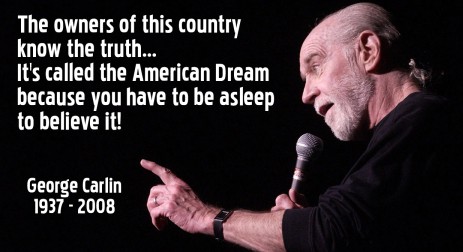
“The invisible hand has created an invisible cage…blinding us and dividing us, allowing the ruling class to exploit us and subjugate us.”

By Hiroyuki Hamada

Source: Off-Guardian

When the whole society becomes a theater of absurdity, the puppeteers become kings and queens of insanity. The society loses its logic, history, facts, honesty, sincerity, creativity and imagination, as the monstrous imaginations of the deranged ruling class devour humanity and nature.

The invisible cage of authoritarianism comes in the shape of a bottomless pyramid. Fear and hopelessness fill the dimly lit bottom layers. Layers and layers separate us, alienate us and dehumanize us. The​ pain of “others” becomes your gain. The power of oppressors becomes your safety: The safety of living in the dangerous imaginations of the kings and queens.

But​ such a thought vanishes as quickly as our minds get flooded back with the numbing noises of the insane theater, while our remaining logic, seriousness and honesty are ridiculed and attacked by fearful fellow humans with cynicism, hopelessness and cowardliness.

The world doesn’t look like that at all for those who belong to the club of kings and queens. The unruly mass with no understanding of the righteous path of “humanity” has been inherently expendable for them. This has been shown over and over: colonization of natives by Europeans, enslavement of African people, genocides of many sorts.

But one also sees the same blunt inhumanity embedded among us today: homelessness, deaths by treatable diseases, hunger, deaths by substance abuse, suicide, poverty, refugees, mass incarceration, state violence, the psychological torture of alienation. The kings and queens don’t recognize those as issues to be solved with their resources.

Instead those issues represent forms of punishment for those who fail to secure viable positions within the capitalist hierarchy. The fear of the punishment and the fear of the authority work together to lock us in positions in the hierarchy, forcing us to protect our positions which systemically and structurally threaten our wellbeing 24/7; we live in a system of structural extortion.

As we have become free-range people in the “divine farm” of modern-day kings and queens, we have lost our access to the fundamental material reality. A sterile cage with screens, mandatory injections, electronic tracking within the invisible fence; human mice for profits, feed for data harvesting, an ever greater degree of spiritual death. It is not hard to start connecting the dots to see how things can lead into a grim future.

But what does such a fear do to the population, which has tolerated an assortment of abuses as their “punishment”? To those who manage to ignore their fellow humans living on the streets as invisible beings or fail to feel the pain of those being cornered into substance use and desperate acts of self-destruction?

Would they believe the words of those who question, or the words of the ruling class promising a glorious future of AI, green capitalism, genetic engineering, digitization and financialization?

And before we ask such a question, one must wonder if such a question is even allowed when the socioeconomic/political trajectory of the empire has been firmly within the imperial framework of the two capitalist political parties.

The capitalist hierarchy absorbs what it needs by allocating special positions within it: Natural resources, narratives, facts, history, people, political ideologies or anything that sits in time and space. The kings and queens monopolize them— material resources as well as people with skills and knowledge are captured to serve. Once monopolized, the valued items are commodified, to be distributed in ways that benefit those same kings and queens.

Meanwhile such a process occurs in layers and layers, projecting myths, exploitive narratives, false history and erroneous facts onto our collective consciousness—a fake reality which covers our eyes while we push our mortal bodies around in the real world.

The images projected onto our psyche vary according to our positions in the hierarchy. Each narrative validates and justifies our positions in the hierarchy. Kings and queens find themselves to be worthy rulers of the universe, while the masses see themselves as freedom-loving people who do their best in a world of opportunities.

In such an equation authoritarianism presents itself as a swinging pendulum between fascism and social democracy as it moves forward on the capitalist path in space and time. The carrot and stick carefully manage projected images to stay within the capitalist framework of acceptable ideas. Corporate politics and corporate activism play crucial roles in making the pendulum swing, therefore ensuring that the capitalist interests always go forward while appearing to be “democratic”.

Those who rely on terrorist tactics of various sorts attempt to resist the system by attacking the valuable, captured elements that work for the system. The damage compromises social dynamics in ways that deprive those who are already deprived, while dividing the population that should be uniting to dismantle the oppressive system.
Guided by agent provocateurs and corporate NGOs, righteous anger against oppressors turns into a justification for draconian measures, destruction of communities for urban renewal, and a catalyst for new projects of exploitation.

As a set of capitalist imperatives pushes the capitalist contradiction to the limit, completely depriving people’s ability to reconcile the false perceptions and the material reality, it is time for an urgent mobilization to change the trajectory of exploitation into a new field with a new set of rules. We are told that enemies are coming, a natural disaster is coming or a disease is coming, forcing us to mobilize ourselves to adjust to a new path of plundering for the kings and queens.

Any crisis, real or not, against the backdrop of a hierarchical structure imposes two sets of momentum that keep us within the capitalist farm. The first set has to do with fear of the authority, which keeps our frustration directed against ourselves, each other and oppressed “others”, while firmly gripping the destabilized psyche of the population—creating an ironic psychology of supporting oppressive authority against our own interests.

The second set has to do with the material constraints imposed by the particular crisis—we become enemies to each other fighting amongst ourselves to survive. We are put in the capitalist cage. And we are forced to protect our cage, which is constructed with vertical strength to withstand fear of the authority, horizontal strength to withstand attacks by competitors, and a solid floor to prevent one from falling down from the position in the hierarchy. The whole structure is held together with violent force of exploitation and subjugation.

THE GREAT RESET

”The Great Reset” is packaged as a “great solution”. Just like how the ruling class has marketed “green capitalism”—carbon trading, carbon capture, reforestation, and other resource exhausting green schemes and technologies for profit, it’s designed to prop up capitalism but it is also intended to transform capitalism to have more effective control of social relations while keeping the capitalist hierarchy intact.

Capitalism is getting a new OS, and it needs to be restarted. Just as “green capitalism” has destroyed real environmentalism in the name of saving the planet, it is designed to destroy anti-capitalist activism in the name of “revolution”.

One of the prominent leftist tools under a capitalist framework has been grass roots activism to affect state regulations and state guidelines to contain momentums of exploitation and subjugation created by Wall Street as well as capitalist social institutions. The stock market guided economy (falsely advertised as the only system that works) allows the ruling class to dominate social policies according to their interests; it prioritizes ruling class wealth accumulation while sacrificing social relations among the general population; it is extremely inefficient, unstable and economically unjust.

The capitalist state has been a great tool in ensuring the interests of the ruling class to be a priority. The socialist revolution takes over the capitalist state, it nationalizes corporate entities and sets up the economy, education and the rest of social institutions and social relations to be guided by people’s interests. Various incarnations of the above strategies to counter capitalist exploitation and encroaching imperial hegemony have attempted to do two major things.

First, they have prioritized people’s interests by emphasizing projects that benefit the general population while providing social safety nets, infrastructure for the people, environmental regulations and so on. Second, they have allowed economic activities based on people’s needs which can grow organic community dynamics based on humanity and nature.

“The Great Reset,” on the other hand, is a project of the ruling class meant to take away those measures from the people and utilize them to further solidify their dominance over the people. Since the owners of the farm are plenty rich already, they won’t need a big farm. Their social engineering skills as well as the greater control over the economy will be put to a test in building a sustainable farming business with a smaller herd.

This is why it seems that all activism has turned into enforcing or defying the various virus lockdown measures which have been instrumental in enforcing the trajectory of “The Great Reset.” Remember how all environmental activism was swallowed by the single idea of reducing carbon emission? Fearmongering slogans of apocalyptic narratives involving climate change, strong NGO guided activism, and corporate science emphasizing the topic of global warming have created the huge snowballing momentum to fight climate change at all costs, sidelining and coopting all other important environmental activism.

This has also contributed to the idea that it is no longer relevant to insist on being a part of systematic efforts in dismantling the capitalist system and building an alternate system which allows humanity and nature to prevail in harmony; we are told that we don’t have time to build socialism anymore. We are encouraged to be a part of green solutions by the capitalists as a result.

We are being told that casino capitalism for profits must end to introduce “stakeholder capitalism”. But of course, since the notion is coming from the profiteers who have colonized, corporatized, militarized and financialized, we can presume that they are talking about ensuring their own interests by directly guiding the economic decisions instead of continuing the show called the economy by the “invisible hand.” We are told that we should be provided with universal basic income, free housing and other social services as long as we follow the regulations and policies of public-private partnership.

What sort of conditioning will we be subjected to after being deprived of our inherent relationships to ourselves, to each other, to our communities and to nature, forced to be a part of destructive industrial farming, digitalization of everything with massive resource extraction, colonization of our communities with multinational franchises and enslavement of our souls in the invisible cage of indoctrination and propaganda?

We already have such a system in the US—it’s called mass incarceration in the private prison system. We are being told that the economy must not be merely guided by growth and it must be replaced by a sustainable one.

However, coming from those who have greatly restricted meaningful economic growth among the general population in order to subject livelihoods to the brutal capitalist framework, what they really mean is to restrict productive social relations among the people so that they must subsist with bare minimum requirements, eventually cornered to be a smaller herd, more manageable with less resources—an economic solution which can only be conceived by criminal minds. Who knows what role vaccines will play in it.

Who knows what sort of living hell people will be subjected to as our lives are treated like numbers in high frequency trading, or our entire lives are put on hold by AI customer representatives.

Note how the policies will be designed to be achieved by co-opting leftist agendas. The invisible hand has been busy building a brand new invisible cage to perpetuate the violent reign of kings and queens in the name of “revolution”—a fascist revolution that is.

Now, I would like to emphasize that these trajectories are not set in stone. The problem is that those possibilities are highly unlikely to be examined by concerned people within the capitalist framework. There is a structural problem in the system. Let me go back to the pendulum. Just like any other capitalist social institution, the capitalist political institution serves the ruling class; it can serve as a crime laundering devise. As soon as a topic involving criminal activities is destined to be “political”—it dissociates itself from criminal elements and becomes “legitimate”.

Various social institutions kick in to support such a view since they are all funded by the ruling class—media presents it as such, legislature codifies it as such, executive branch executes it as such, judicial branch judges it as such, academics support it as such, educational institution cements it as such and so on. It becomes normalized to be a part of social policies.

Once the topic is on the political table embellished with a glorious history and myths of the nationhood of the United States of America, the topic becomes officially “political”, not criminal, and it is now safely and generously handled by the corporate entities.

The rendered topic floats in an artificial realm of political myths, tradition, and the gladiator battle culture of political authorities as a commodified symbol representing a fictitious version of the actual topic. Ordinary people can’t approach it coherently for what it is anymore unless they are rich and influential enough to access all moneyed social institutions. Moreover, all the criminal records of officials are discarded, forgiven and forgotten as a new regime comes in every four years.

This is how destructive foreign policies of colonialism, corporatism and militarism, and exploitive predatory domestic policies of all sorts have been implemented against people in the name of freedom, justice and humanity. This is how environmental concerns have turned into “green capitalism”. This is how we are being mobilized today under the guise of virus lockdowns.

People watch and cheer the pendulum swing between political extremes within the capitalist framework. Bits and pieces of awareness beyond the imperial framework can only be perceived with tools approved by the framework, effectively keeping those with the awareness within the ideas of the ruling class.

If you hold a world view that does not fit in it, you end up being categorized as a supporter of a political villain or simply labeled as “fascist”, “communist” and so on. Needless to say those terms are solely defined by acceptable ideas, acceptable history and acceptable myths of the capitalist hegemony.

The fact that the US government has supported fascist regimes across the globe while brutally intervening against socialist countries across the globe won’t be admitted for instance.

HOW CAPITALIST HIERARCHY SHAPES IDEAS

If one holds a view that defies the prevalent narrative, the individual can become a target of the authority as well as a target of multiple political extremes within the capitalist hegemony. For instance, if you oppose Israeli war crimes from an anti-capitalist/anti-imperialist position, you can be persecuted as a dissident by the establishment, while being labeled as anti-Semitic by supporters of Israeli policies. (You may also be labeled a Zionist shill by those who believe that Jews are taking over the world and so on).

The position that points out that Israel is a crucial part of the imperial structure, serving the imperial hierarchy while benefiting from its generous support, cannot be fully discussed due to how narratives are formed by the network of the imperial institutions.

The political pendulum doesn’t only create an illusion of “democracy”, it also defines what is acceptable while tearing communities apart. It utilizes its violence as a springboard to perpetuate and strengthen its grip on the exploited.

That’s why the living hell for Palestinian people keeps functioning as a devise for imperialism—the more Palestinians suffer, the more anti-Semitic sentiment emerges, which in turn justifies Israeli violence, which in turn serves the imperial agendas. That’s why victims of Katarina had to be victimized by “urban renewal” after going through the gravely tragic event.

Capitalist hegemony does not allow an honest discussion because imperialism is kept invisible by default, the capitalist cage is invisible and the guiding hand of capitalists is invisible. The capitalist framework simply corners people into having dead-end arguments. Period.

With the virus situation, we are told that there are good people who wear masks and stay home and bad people who selfishly defy the rules and spread “conspiracy theories”. The dynamics among acceptable narratives within the capitalist framework create the circular arguments of a screaming match. These dynamics exclude and belittle any understanding which goes beyond the artificial range of ideas created by the capitalist institutions: you are fake news, you are a denier, you are a conspiracy theorist, you are a grandma killer, communists are taking over and so on. Without recognizing this mechanism, any attempt to unify the momentums will result in a populism which emulates the existing social structure—another reactionary revolution at best, but more likely it will create more divisions and destabilization among the people, resulting in perpetuation of the capitalist hierarchy.

This is why there is no discussion of accountability for the death and suffering created by lockdown measures and there is no discussion about the meaning of why we are going through a structural shift. And when the deaths and sufferings will be put on the political table, financial vultures will devour them in the emerging social impact bond markets (see studies by WRENCH IN THE GEARS).

The invisible hand that is supposed to guide us to freedom, justice and humanity has created an empire ruled by the unprecedented accumulation of power for the few. The invisible hand has created an invisible cage over us, and it has been blinding us and dividing us, allowing the ruling class to exploit us and subjugate us.

Now, it must be clearly stated that what we perceive as the dystopian future of The Fourth Industrial Revolution—AI, blockchain, digitalization, financialization, green capitalism and so on—can’t be separated from the invisible hand and the invisible cage. It cannot be allowed to be defined by capitalist institutions as a “legitimate political topic” instead of what it really is.

The newly built cage hasn’t been built, but if we fail to see it for what it is in its context, we will simply be forced to embrace some version of it as one of the “legitimate” capitalist trajectories. That’s how it works when our society is a theater of absurdity.

I want to live a life that breaks open the invisible cage and firmly shake hands with nature and humanity. If you have stuck around this far with me, I trust that you feel the same…or not. Either way, we must start our conversations.

What “Normal” Are We Returning To? The Depression Nobody Dares Acknowledge

By Charles Hugh Smith

Source: Of Two Minds

Perhaps we need an honest national dialog about declining expectations, rising inequality, social depression and the failure of the status quo.

Even as the chirpy happy-talk of a return to normal floods the airwaves, what nobody dares acknowledge is that “normal” for a rising number of Americans is the social depression of downward mobility and social defeat.

Downward mobility is not a new trend–it’s simply accelerating. As this RAND Corporation report documents, ( Trends in Income From 1975 to 2018) $50 trillion in earnings has been transferred to the Financial Aristocracy from the bottom 90% of American households over the past 45 years.

Time magazine’s article on the report is remarkably direct: The Top 1% of Americans Have Taken $50 Trillion From the Bottom 90% — And That’s Made the U.S. Less Secure.

“The $50 trillion transfer of wealth the RAND report documents has occurred entirely within the American economy, not between it and its trading partners. No, this upward redistribution of income, wealth, and power wasn’t inevitable; it was a choice–a direct result of the trickle-down policies we chose to implement since 1975.

We chose to cut taxes on billionaires and to deregulate the financial industry. We chose to allow CEOs to manipulate share prices through stock buybacks, and to lavishly reward themselves with the proceeds. We chose to permit giant corporations, through mergers and acquisitions, to accumulate the vast monopoly power necessary to dictate both prices charged and wages paid. We chose to erode the minimum wage and the overtime threshold and the bargaining power of labor. For four decades, we chose to elect political leaders who put the material interests of the rich and powerful above those of the American people.”

I’ve been digging into downward mobility and social depression for years: Are You Really Middle Class?

The reality is that the middle class has been reduced to the sliver just below the top 5%–if we use the standards of the prosperous 1960s as a baseline.

The downward mobility isn’t just financial–it’s a decline in political power, control of one’s work and ownership of income-producing assets. This article reminds us of what the middle class once represented: What Middle Class? How bourgeois America is getting recast as a proletariat.

This reappraisal of the American Dream is also triggering a reappraisal of the middle class in the decades of widespread prosperity: The Myth of the Middle Class: Have Most Americans Always Been Poor?

Downward mobility excels in creating and distributing what I term social defeat: In my lexicon, social defeat is the spectrum of anxiety, insecurity, chronic stress, fear and powerlessness that accompanies declining financial security and social status.

Downward mobility and social defeat lead to social depression. Here are the conditions that characterize social depression:

1. High expectations of endlessly rising prosperity instilled as a birthright no longer align with economy reality.

2. Part-time and unemployed people are marginalized, not just financially but socially.

3. Widening income/wealth disparity as those in the top 10% pull away from the bottom 90%.

4. A systemic decline in social/economic mobility as it becomes increasingly difficult to move from dependence on the state or one’s parents to financial independence.

5. A widening disconnect between higher education and employment: a college/university degree no longer guarantees a stable, good-paying job.

6. A failure in the Status Quo institutions and mainstream media to recognize social depression as a reality.

7. A systemic failure of imagination within state and private-sector institutions on how to address social depression issues.

8. The abandonment of middle class aspirations: young people no longer aspire to (or cannot afford) consumerist status symbols such as luxury autos or conventional homeownership.

9. A generational abandonment of marriage, families and independent households as these are no longer affordable to those with part-time or unstable employment.

10. A loss of hope in the young generations as a result of the above conditions.

The rising tide of collective anger arising from social depression is visible in many places: road rage, violent street clashes between groups seething for a fight, the destruction of friendships for holding “incorrect” ideological views, and so on.

A coarsening of the entire social order is increasingly visible: The Age of Rudeness.

Depressive thoughts (and the emotions they generate) tend to be self-reinforcing, and this is why it’s so difficult to break out of depression once in its grip.

One part of the healing process is to expose the sources of anger that we are repressing. As psychiatrist Karen Horney explained in her 1950 masterwork, Neurosis and Human Growth: The Struggle Towards Self-Realization, anger at ourselves sometimes arises from our failure to live up to the many “shoulds” we’ve internalized, and the idealized track we’ve laid out for ourselves and our lives.

The article The American Dream Is Killing Us does a good job of explaining how our failure to obtain the expected rewards of “doing all the right things” (getting a college degree, working hard, etc.) breeds resentment and despair.

Since we did the “right things,” the system “should” deliver the financial rewards and security we expected. This systemic failure to deliver the promised rewards is eroding the social contract and social cohesion. Fewer and fewer people have a stake in the system.

We are increasingly angry at the system, but we reserve some anger for ourselves, because the mass-media trumpets how well the economy is doing and how some people are doing extremely well. Naturally, we wonder, why them and not us? The failure is thus internalized.

One response to this sense that the system no longer works as advertised is to seek the relative comfort of echo chambers–places we can go to hear confirmation that this systemic stagnation is the opposing ideological camp’s fault.

Part of the American Exceptionalism we hear so much about is a can-do optimism: set your mind to it and everything is possible.

The failure to prosper as anticipated is generating a range of negative emotions that are “un-American”: complaining that you didn’t get a high-paying secure job despite having a college degree (or advanced degree) sounds like sour-grapes: the message is you didn’t work hard enough, you didn’t get the right diploma, etc.

It can’t be the system that’s failed, right? I discuss this in my book Why Our Status Quo Failed and Is Beyond Reform: the top 10% who are benefiting mightily dominate politics and the media, and their assumption is: the system is working great for me, so it must be working great for everyone. This implicit narrative carries an implicit accusation that any failure is the fault of the individual, not the system.

The inability to express our despair and anger generates depression. Some people will redouble their efforts, others will seek to lay the blame on “the other” (some external group) and others will give up. What few people will do is look at the sources of systemic injustice and inequality.

Perhaps we need an honest national dialog about declining expectations, rising inequality and the failure of the status quo that avoids polarization and the internalization trap (i.e. it’s your own fault you’re not well-off).

We need to value honesty above fake happy-talk. Once we can speak honestly, there will be a foundation for optimism.