Brussels Bombing Psyop a Victory for the Ruling Elite and Global Police State

images

By Bernie Suarez

Source: Waking Times

There are many signs pointing to a false flag attack in Brussels on 3-22-16. Independent and alternative media, as usual, has been right on top of the story catching many of the usual oddities, lies and coincidences which are characteristic of false flags and are now piling on top of each other as they always do. And here’s another thing everyone should take note of; something we also observed during the Paris attacks on 11-13-15. As we saw in the Paris attacks, once again we’re seeing a “global” component to the “reaction” phase of the usual problem-reaction-solution dialectic employed by the controllers. Look for it. Problem at point A, subsequent “reaction” to the problem at point B, all the way on the other side of the world. This then leads to a “solution” that applies to both point A and B. This also serves to endorse the illusion that the bogeymen, in this case ISIS of course, involved in the Brussels attack are somehow everywhere at once.

One of the key purposes of this event, among other purposes like maintaining an excuse for U.S. military intervention in Syria, is to reinforce the need for a global police which is being sold as a “global solution” to a “global problem.” This global police state is a very clear agenda of the U.S., NATO and the U.N. This entire event is also designed to push the Authorization for Unlimited Military Force (AUMF) the Pentagon wants so badly and it’s a perfect quick and easy event in NATO’s and the European Union’s home turf to push for all of these goals at once. What am I talking about?

Following the Brussels “attacks,” which were immediately and deliberately linked to “ISIS,” we saw how in the city of Atlanta, Georgia halfway across the world, police were “on edge” and completely evacuated the Atlanta airport because of an unattended “package” they thought could be related or connected to the “ISIS” Brussels attacks. Though the whole thing turned out to be nothing at all, make no mistake this is part of the mass conditioning that comes with the entire quest for global police and perpetuation of the ISIS psyop. Even the officers involved in the airport evacuations I’m sure got caught up in the hysteria simply following protocol. Can you imagine how easy it would be for someone to purposely leave an unattended package just to extract the reaction, fear and hysteria from the masses while at the same time endorsing the idea of “global terrorism” and conditioning the masses to accept the idea of a need for a “global police.” One tiny fake package in Atlanta accomplishes all of this and more. And it wasn’t just Atlanta caught in the psyop, in Denver we saw “evacuations” as well:

Atlanta’s airport was briefly evacuated on Wednesday over a suspicious package while U.S. law enforcement agencies and travelers were on edge a day after deadly suicide bombings by Islamist militants rocked Brussels.

Passengers were ordered out of public areas of the domestic terminal at Hartsfield-Jackson International Airport, the United States’ busiest by passenger volume, but the site was quickly cleared and operations resumed, airport officials said.

Parts of Denver airport were also evacuated on Tuesday, hours after at least 31 people were killed and 271 wounded in attacks on Brussels airport and a rush-hour metro train, as airports across the United States tightened security.

As you can see, the hysteria wasn’t just in Atlanta. Notice the article doesn’t even bother to discuss what exactly happened in Denver. Was it also a “suspicious package” there? Was it a phone call from ISIS? Who cares, right? Because apparently the only thing that matters is that it’s part of the “reaction” phase; and the true answer is, this is part of the mass conditioning for the new world order’s global police state which is now being born with every ISIS “attack.”

Historic Mass Conditioning

So for the first time in human history an event at point A in one side of the world forces a Pavlov-style reaction at point B, on the opposite side of the world; even though the 2 events (in the organic reality) have no association with each other other than the conditioned response. The conditioning of the masses can be compared to Pavlov’s dog experiment. In the Pavlov dog salivation experiment, Russian physiologist Ivan Pavlov was able to demonstrate that dogs can be conditioned to organically react a certain way by simply associating one artificial stimulus enough times with a natural stimulus. Eventually Pavlov demonstrated that you wouldn’t need the natural stimulus (food) to elicit the conditioned response (salivation) if you provide the artificial stimulus (a bell).

If you understand Pavlov’s classical conditioning then you should understand the mass conditioning of the masses going on right now via the mainstream media and politicians. The Brussels attacks is no different from the Paris “attacks” of November of 2015. Isn’t it a coincidence that less than a week ago the mainstream media brought back the Paris attack “story” as if to prepare the masses subconsciously for the upcoming Brussels attacks in Belgium? How about the fact the Turkish president Recep Tayyip Erdogan basically subliminally announced the upcoming attacks 4 days prior? Are we surprised given that Erdogan’s Turkey is right now the primary lifeline for ISIS purchasing their oil and supporting fighters with resources in the Turkey-Syrian border while blowing up Russian planes that interfere with that mission? This has all the markings of a mass psychological operation.

First of all, we don’t know who planted those explosives in the Brussels airport or subway system and we don’t know why or who told them to do it. With ISIS being credited, that alone is proof as far as I’m concerned that this is a state crime funded by NATO countries. We must all shed the myth that ISIS fighters are freely doing what they want, independent of the will of the states that created, funded, trained and armed them. Think about this. No one trains fighters only to let them go away and fight for someone else. Whoever trained these guys is still giving the orders or they wouldn’t have wasted their resources training these guys. Just like in the U.S. military, you wouldn’t train a Marine in boot camp, show them how to survive and offer weapons training only to watch them leave the Marines after boot camp and fight elsewhere. Yet this is precisely what Americans are asked to believe every day by the mainstream media. We’re told to believe these fighters just so happened to switch sides AFTER being trained to fight for the “Free Syrian Army.”

If it wasn’t that ISIS is a mercenary group employed by NATO countries, they’d be long gone by now. The only reason ISIS is still “alive” in our consciousness is because nations like Turkey, US, Israel and Saudi Arabia are keeping them alive both literally and figurative using their controlled media. ISIS is therefore alive because they (U.S., NATO and company) want and need them to be alive for political reasons. No ISIS means no Syria, no PNAC Middle East plan completion, no fear, no war on terror, no global police and no stripping away of individual rights, it’s that simple.

Incidentally the location of the explosions in Brussels Belgium is immensely convenient. There’s no question that the headquarters of NATO and the European Union would be a perfect place to execute and control a false flag like this. This is also the perfect false flag to quickly put together during this election year campaign hysteria pause. It likely took very little coordination and effort requiring a couple of explosives and a patsy or 2. Here’s the sequence as I see it: Boom! ISIS did it, lockdown airports in the U.S. due to an unattended package, goals and conditioning reinforced by media, back to election campaign with the candidates calling for “solution” to ISIS.

This is the part where ALL politicians running for president get to offer their “solution” to the same artificially created “problem.” In other words, this is a win-win for the ruling elite. And in this sense the Brussels attack is already part of the election campaign itself. Be on the look out for candidates endorsing ideas “global solutions” to ISIS.

Finally, I call on readers to observe how these false flags are getting easier and easier for them to do. I’m sure there was a time when a false flag attack like this took years to prepare (think 9/11). Now we are seeing quick attacks being strung together with minimal preparation, attacks which nonetheless have long-lasting implications for freedom, the rise of the global police, obtaining their AUMF license to kill, and obtaining all the excuses they need to justify U.S. aggression in Syria in hopes of forcibly removing their democratically elected president.

Remember practice makes perfect. So as they get better and more efficient at pulling these false flag attacks, let us get better and more efficient at diagnosing them and spreading the word. I believe both phenomenons are happening simultaneously. Hopefully, the ability of alternative and independent media to quickly diagnose these attacks by simply observing the process of problem-reaction-solution will help us turn a corner in changing minds at the highest level and thus effect much needed change sooner rather than later.

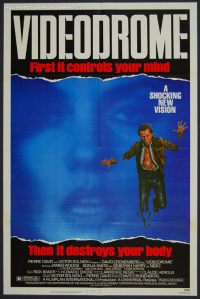
David Cronenberg’s Videodrome Was a Technology Prophecy

videodrome_one_sheet_movie_poster_l

Editor’s note: Since today marks director David Cronenberg’s 73rd birthday, it’s a good time to appreciate one of his greatest and most notorious works. Though my favorite of his remains the distinctly PKD-like eXistenZ, a close runner up is the cult classic Videodrome, which the following analysis reappraises in the context of contemporary social media-fixated culture.

By Nathan Jurgenson

Source: Omni Reboot

David Cronenberg’s vision of technology as the “new flesh” in Videodrome isn’t so shocking anymore.

Videodrome is the best movie ever made about Facebook.
What felt “vaguely futuristic” about it in 1983 is prescient today: technology and media are ever more intimate, personal, embodied, an interpenetration that David Cronenberg’s film graphically explores.
Videodrome offers a long-needed correction to how we collectively view and talk about technology. As the anti-Matrix, Videodrome understood that media is not some separate space, but something which burrows into mind and flesh. The present has a funny habit of catching up with David Cronenberg.
Still, Videodrome is deeply of its time and place. It’s set in Toronto, where Cronenberg was born and studied at the same time as University of Toronto superstar media theorist Marshall McLuhan, who coined the phrase “the medium is the message.” Beyond McLuhan’s reputation, Toronto was also known as a wired city; among other things, it was an early adopter of cable television.
In suit, Videodrome follows a Toronto cable television president, Max Renn (James Woods). He becomes involved with a radio psychiatrist named Nikki Brand (Debbie Harry, of Blondie fame), who reminds us of popular criticisms of television culture: we want to be stimulated until we’re desensitized, becoming (at best) apolitical zombies and (at worst) amoral monsters. Television signal saturates this film. The satellite dishes, screens, playback devices, and general aesthetics of analogue video are on glorious, geeked-out display. Although Videodrome’s operating metaphor is television, this film can be understood as being a fable about media in general. And what seemed possible with television in 1983 seems obvious today with social media.
Over the course of the film, Max comes to know a “media prophet” named Professor Brian O’Blivion—an obvious homage to Marshall McLuhan. O’Blivion builds a “Cathode Ray Mission,” named after the television set component which shoots electrons and creates images. The Cathode Ray Mission gives the destitute a chance to watch television in order to “patch them back into the world’s mixing board,” akin to McLuhan’s notion of media creating a “global village,” premised on the idea that media and technology, together, form the social fabric. O’Blivion goes on to monologue, “The television screen is the retina of the mind’s eye. Therefore, the television screen is part of the physical structure of the brain. Therefore, whatever appears on the television screen appears as raw experience for those who watch it. Therefore, television is reality; and reality is less than television.”
This is Videodrome’s philosophy. It’s the opposite of The Matrix’s reading of Baudrillard’s theories of simulation, and it goes completely against the common understanding of the Web as “virtual,” of the so-called “offline” as “real.” O’blivion would agree when I claim that “it is wrong to say ‘IRL’ to mean offline: Facebook is real life.”
This logic—that the Web is some other place we visit, a “cyber” space, something “virtual” and hence unreal—is what I call “digital dualism” and I think it’s dead wrong. Instead, we need a far more synthetic understanding of technology and society, media and bodies, physicality and information as perpetually enmeshed and co-determining. If The Matrix is the film of digital dualism, Videodrome is its synthetic and augmented opponent.
As P.J. Rey illustrates, fictional Web-spatiality is the favorite digital dualist plot device. Yet more than fiction books and films, what has come to dominate much of our cultural mythology around the Web is the idea that we are trading “real” communication for something simply mechanical: that real friendship, sex, thinking, and whatever else lazy op-ed writers can imagine are being replaced by merely simulated experiences. The non-coincidental byproduct of inventing the notion of a “cyber” space is the simultaneous invention of “the real,” the “IRL,” the offline space that is more human, deep, and true. Where The Matrix’s green lines of code or Neal Stephenson’s 3D Metaverse may have been the sci-fi milieu of the 1990s, the idea of a natural “offline” world is today’s preferred fiction.
Alternatively, what makes Videodrome, and Cronenberg’s oeuvre in general, so useful for understanding social media is their fundamental assumption that there is nothing “natural” about the body. Cronenberg’s trademark flavor of body-horror is highly posthuman: boundaries are pushed and queered, first through medical technologies in Shivers , Rabid , The Brood , and Scanners , then through media technology in Videodrome  and eXistenZ , then, most notoriously, in The Fly, where the human and animal merge. If The Matrix is René Descartes, Videodrome is Donna Haraway.
Cronenberg’s characters are consistent with Haraway’s theory of the cyborg: not the half-robot with the shifty laser eye, but you and me. In the film, the goal is never to remove the videodrome signal that is augmenting the body, but to reprogram it. To direct it. As Haraway famously wrote, “I’d rather be a cyborg than a goddess.” “Natural” was never a real option anyways.
Max Renn is especially good at finding the real in the so-called “virtual” because he is equally good at seeing virtuality in the “real.” From the beginning, he understands that much of everyday life is a massive media event devoid of meaning. The old flesh is tired, used up, and toxic. The world is filled with a suffering assuaged only by glowing television screens. As the film progresses, the real and unreal blur, making each seem hyperbolic: hallucinations become tangible, while the tangible drips with a surrealism that’s gritty, jumpy, dirty, erotic, and violent—closer to Spring Breakers than The Wizard of Oz. As such, Cronenberg’s universe is always a little sticky: an unease which begs the nightmares to come true, so that we at least know what’s real.
Videodrome’s depiction of techno-body synthesis is, to be sure, intense; Cronenberg has the unusual talent of making violent, disgusting, and erotic things seem even more so. The technology is veiny and lubed. It breaths and moans; after watching the film, I want to cut my phone open just to see if it will bleed. Fittingly, the film was originally titled “Network of Blood,” which is precisely how we should understand social media, as a technology not just of wires and circuits, but of bodies and politics. There’s nothing anti-human about technology: the smartphone that you rub and take to bed is a technology of flesh. Information penetrates the body in increasingly more intimate ways.
This synthesis of the physical and the digital is mirrored in the film’s soundtrack, too. In his book on Videodrome’s production, Tim Lucas calls Howard Shore’s score “bio-electronic” because it was written, programmed into a synthesizer, and played back on a computer in a recording studio while live strings played along. Early in the film, the score is mostly those strings, but as time passes the electronic synthesizers creep up in the mix, forming the bio-electronic synthesis.
The most fitting example of techno-human union in Videodrome is the famous scene of Max inserting his head into a breathing, moaning, begging video screen; somewhere between erotic and hilarious, media and humanity coalesce. There isn’t a person and then an avatar, a real world and then an Internet. They’re merged. As theorists like Katherine Hayles have long taught, technology, society, and the self have always been intertwined. Videodrome knows this, and it shows us with that headfirst dive into the screen—to say nothing of media being inserted directly into a vaginal opening in Max’s stomach, or the gun growing into his hand.

Thirty years after its release, Videodrome remains the most powerful fictional representation of technology-self synthesis. This merger wasn’t invented with the Internet, or even television. Humans and technology have always been co-implicated. We often forget this when talking about the Web, selling ourselves instead a naive picture of defined “virtual” spaces which somehow lack the components of “real” reality. This is why The Matrix and “cyberspace” have long outworn their welcome as a frame for understanding the Internet. It should be of no surprise that body horror is as useful for understanding social media as cyberpunk.

Fukushima@5

radioaktivitaet-fukushima-ia

(Source: Fairewinds.org)

Modern ghost towns, abandoned houses, and far stretching roads lined with plastic bags of radioactive garbage have replaced the once bustling neighborhoods and cities of the Fukushima Prefecture. Formerly home to thousands, the massive release of radiation has forced residents to evacuate their beautiful homeland, leaving the land they love behind without knowing whether or not they may ever return without putting their lives at risk. Join the Fairewinds Crew and ask yourself this: With 99 operating atomic power reactors generating electricity in the U.S., what’s so different about your home, your town, your state that what happened to Fukushima couldn’t happen to you and your family?

Many Japanese and millions of Americans are currently living in the shadow of atomic reactors, plutonium reprocessing plants, and atomic waste dumps. It will be five years in March since the triple meltdown at Fukushima Daiichi began and the Japanese public and people around the world continue to search for the truth about nuclear risk and honest answers to their energy future. Fukushima@5 exposes the truth of the ongoing atomic devastation caused by the nuclear meltdown at Fukushima Daiichi.

Related Podcast: Project Censored 03.08.16

Mother Earth May Have Good Reason to Slaughter Us

jing-jang-yin-yang-planet-hd-high-definition-fullscreen

By Jack Balkwill

Source: Dissident Voice

Decades ago James Lovelock constructed a principle called the Gaia hypothesis, contending that a biosphere teeming with life works together with inorganic matter to self-regulate conditions for maintaining a livable planet.

The oxygen levels in our air are maintained, and the salinity of the seas – everything that’s needed to keep conditions within the zones which nurture life on the planet.  This is a theory embraced by many deep environmentalists because it offers hope for the future of life forms on the planet.

When one creature (such as man) gets to be so out of control that it threatens the other life forms, Gaia, or Mother Earth, pushes back toward a healthy balance, according to some theorists (the Gaia principle has many variations).

In the ancient Greek religion, before Zeus was king of the gods in the classical period, or Zeus’ father Cronus was king of the gods, or Cronus’ father Uranus was king of the gods, there was Gaia, the earth mother, who created the heavens, the various gods, and man.  Gaia regulated the growing of crops, healed the sick, and was the earth itself to her followers.

Many of the most ancient religions around the world had as their chief deity a female, and my guess is because they reasoned that since it is the female who gives birth, a creator must be female.

The universe within us

Each of us humans is a microcosm of the Gaia principle.  Within us, we have about a hundred trillion unique creatures which do not share our DNA.  Cells containing our DNA only number about ten trillion, so they are vastly outnumbered.  The microbes within us are in many forms — bacteria, fungi, archaea and viruses.

When our microbes are out of balance, it can be life-threatening, so a major function of our immune system is to regulate them, to keep one species from over reproducing, just as, in the Gaia theory, life forms are regulated within the massive biosphere.

If, for example, Candida reproduces to a high level, our immune system will try to destroy enough of it to get back to a balance.  Candida at normal levels may actually be beneficial, and is thought to attack some harmful invaders. At extreme levels of overgrowth Candida may become deadly to us.

Most of the life forms within us are friendly, and we would die without them.  They have a great many functions, working together to keep us alive.  In the end, if we die, they no longer have a home.

And most of the life forms outside of us are also beneficial, aiding Mother Nature in maintaining a delicate balance.

Symbioses

Oak trees have dropped their heavy acorns for millions of years, right beside their trunks.  In such a place, the acorn has little chance of growing with no sunlight under the canopy of mother tree.  But squirrels are happy to carry the acorns away from the tree to bury them in case they are needed for food during an extreme winter.  The squirrels don’t eat all of what they bury most years, giving the oak an opportunity to spread its genetic material.

In return the oak provides a home for the squirrel, which builds nests in oak trees and eats the acorns.  There are interactions between species all over the planet with which we are not yet familiar, but it is clear that species depend on one another for survival, just as the microbes within us are maintained in a balance that sustains life.

A flower may provide pollen to the bee, and in return the bee pollinates other flowers, benefiting both species.

But sometimes man gets in the way

Who would think a massive animal like a moose would rely on the lowly beaver for its well being?  When beaver hats were a popular fad, beaver were killed off in such large numbers that moose began to starve.  One of the favorite foods of moose is the shoots growing in wetlands, and without beavers to dam streams creating wetlands, moose began to go hungry and started feeding on tree bark, killing trees.

Of course, it was inadvertent that a fad of humans started killing off moose.  But we’ve done such things throughout our history and have more control over nature than we realize.

When sperm whales were slaughtered to near extinction, giant squid began to rise up to the surface in the oceans, no longer having to fear their primary enemy, the sperm whales that fed upon them.  Giant squid previously stayed in deep parts of the ocean to avoid sperm whales.  We have no idea what happens in the long term when a creature like the giant squid, with a ravenous appetite, begins feeding in a part of the biosphere from which it was banned for millions of years, but certainly it must upset the food chain.

It is thought that some animals, such as mammoths, became extinct at the hand of man.  Such creatures disappeared in North America about the time it was populated by humans.

Whether directly or indirectly, we are responsible for the extinction of a great many species.

Intelligence, whatever that is

Many people seem to think that humans are somehow superior creatures.  We have a formula for determining intelligence which predicts that a species is intelligent when its brain is large enough to take care of all of the functions of its body, with something left over.  That something left over is intelligence.  So it’s largely brain size in proportion to body size that suggests degrees of intelligence.

There is an old belief that elephants have a pea brain, but it is not true.  An elephant has a large brain, but needs most of it for maintaining its massive bodily functions, so what’s left over may not be great intelligence, but the elephant is certainly an intelligent animal.

The cetaceans, the large toothed whales, all have brains larger than human brains.  Some scientists have speculated that they may be more intelligent than humans.

When people say, “But cetaceans haven’t invented nuclear weapons,” they are showing, perhaps, a flaw in the human being, not a comparative virtue.

Those who support the theory that cetaceans are more intelligent theorize that they may understand that being more in harmony with nature is the intelligent thing to do for long term survival, rather than making automobiles which pollute the planet and the many other destructive things humans do.

At any rate the other creatures appear to help maintain the balance of life within the biosphere, interrelating in complex ways, while humans have reproduced out of control, crowding out other life forms, taking more than our share of resources, and polluting the planet.

So another way to look at the Gaia theory is to describe it as a kind of immune system for the biosphere.  When it has an organism that is overpopulating and causing other organisms to die, that organism must be regulated, just as for a Candida overgrowth or cancer within a human.

The traditional way that Mother Nature has regulated the human population is with disease.  It worked well up to the twentieth century, when humans began to poison their drinking water with chlorine or other agents to kill off water-borne diseases, which had previously wiped out the populations of entire cities.

Will humans be brought under control by Mother Nature?

In the 1970’s there was a movement to reduce the human population, quite popular with many.  I donated to that cause, and was surprised to see it vanish.  I suspected that it was killed by the capitalists, who have a vision that the population must continue to grow for there to be more consumers, hence, more profit.  Capitalists insist that “growth” continue without considering finite limits consistent with the size of the planet.

So how will Gaia maintain the delicate balance with the human organism out of control?  She might introduce a new disease for which we have no antidote.  It was the first thing I thought of when the AIDS epidemic began decades ago.  A perfect killer, to destroy the immune function, allowing almost anything to then kill the host.  But mankind seems to now have that disease under control.

Or Mother Nature might allow us to commit suicide by climate change from our nasty habit of spewing carbon emissions, and other anti-environmental things we are doing in destroying our little blue planet. We are releasing massive toxins into the environment in the form of dioxins from paper and plastic making, radiation from nuclear power plants and bomb making, insecticides, herbicides, and other dangerous chemicals.

A recent report by The World Economic Forum and Ellen MacArthur Foundation stated that at the current rate, the weight of plastic in the oceans will exceed the weight of the fish.  When I heard this a few weeks ago I posted on Facebook, “The epitaph for human beings will read ‘they thought they were an intelligent species.’”

As an old man I take heart that young people seem to be far more aware of the degradation of the planet’s environment, giving me hope that they will find a solution and assist Mother Gaia in her quest for purification and renewal.

The alternative is to leave her no choice but to see us as a cancer that must be eliminated for the good of the whole.


Jack Balkwill is an activist in Virginia. He can be reached at libertyuv@hotmail.com Read other articles by Jack.

Saturday Matinee: Snowpiercer

Snowpiercer_poster

Snowpiercer (2013) is a film adaptation of French graphic novel Le Transperceneige by Jacques Lob and Jean-Marc Rochette directed by Bong Joon-ho (The Host, Mother, Haemoo). The majority of the movie takes place on a perpetually globe-spanning train containing the last surviving members of the human race after a geoengineering scheme creates an apocalyptic ice-age. Though the film has its share of plot holes (which become more apparent with repeat viewings), it remains the best cinematic metaphor for today’s dominant political/economic system. Snowpiercer also features outstanding performances from Chris Evans, Song Kang-ho, Tilda Swinton, Octavia Spencer, John Hurt, and Ed Harris among others.

Watch the full film here.

(Note: annoying pop-up ad windows may need to be closed after clicking the “play” button.)

The Age of Authoritarianism: Government of the Politicians, by the Military, for the Corporations

what-corporate-america-wants

By John W. Whitehead

Source: The Rutherford Institute

“I was astonished, bewildered. This was America, a country where, whatever its faults, people could speak, write, assemble, demonstrate without fear. It was in the Constitution, the Bill of Rights. We were a democracy… But I knew it wasn’t a dream; there was a painful lump on the side of my head… The state and its police were not neutral referees in a society of contending interests. They were on the side of the rich and powerful. Free speech? Try it and the police will be there with their horses, their clubs, their guns, to stop you. From that moment on, I was no longer a liberal, a believer in the self-correcting character of American democracy. I was a radical, believing that something fundamental was wrong in this country—not just the existence of poverty amidst great wealth, not just the horrible treatment of black people, but something rotten at the root. The situation required not just a new president or new laws, but an uprooting of the old order, the introduction of a new kind of society—cooperative, peaceful, egalitarian.” ― Historian Howard Zinn

America is at a crossroads.

History may show that from this point forward, we will have left behind any semblance of constitutional government and entered into a militaristic state where all citizens are suspects and security trumps freedom.

Certainly, this is a time when government officials operate off their own inscrutable, self-serving playbook with little in the way of checks and balances, while American citizens are subjected to all manner of indignities and violations with little hope of defending themselves.

As I make clear in my book Battlefield America: The War on the American People, we have moved beyond the era of representative government and entered a new age—the age of authoritarianism. Even with its constantly shifting terrain, this topsy-turvy travesty of law and government has become America’s new normal.

Don’t believe me?

Let me take you on a brief guided tour, but prepare yourself. The landscape is particularly disheartening to anyone who remembers what America used to be.

The Executive Branch: Whether it’s the Obama administration’s war on whistleblowers, the systematic surveillance of journalists and regular citizens, the continued operation of Guantanamo Bay, or the occupation of Afghanistan, Barack Obama has surpassed his predecessors in terms of his abuse of the Constitution and the rule of law. President Obama, like many of his predecessors, has routinely disregarded the Constitution when it has suited his purposes, operating largely above the law and behind a veil of secrecy, executive orders and specious legal justifications. Rest assured that no matter who wins this next presidential election, very little will change. The policies of the American police state will continue.

The Legislative Branch:  It is not overstating matters to say that Congress may well be the most self-serving, semi-corrupt institution in America. Abuses of office run the gamut from elected representatives neglecting their constituencies to engaging in self-serving practices, including the misuse of eminent domain, earmarking hundreds of millions of dollars in federal contracting in return for personal gain and campaign contributions, having inappropriate ties to lobbyist groups and incorrectly or incompletely disclosing financial information. Pork barrel spending, hastily passed legislation, partisan bickering, a skewed work ethic, graft and moral turpitude have all contributed to the public’s increasing dissatisfaction with congressional leadership. No wonder 86 percent of Americans disapprove of the job Congress is doing.

The Judicial Branch: The Supreme Court was intended to be an institution established to intervene and protect the people against the government and its agents when they overstep their bounds. Yet through their deference to police power, preference for security over freedom, and evisceration of our most basic rights for the sake of order and expediency, the justices of the United States Supreme Court have become the guardians of the American police state in which we now live. As a result, sound judgment and justice have largely taken a back seat to legalism, statism and elitism, while preserving the rights of the people has been deprioritized and made to play second fiddle to both governmental and corporate interests.

Shadow Government: America’s next president will inherit more than a bitterly divided nation teetering on the brink of financial catastrophe when he or she assumes office. He or she will also inherit a shadow government, one that is fully operational and staffed by unelected officials who are, in essence, running the country. Referred to as the Deep State, this shadow government is comprised of unelected government bureaucrats, corporations, contractors, paper-pushers, and button-pushers who are actually calling the shots behind the scenes right now.

Law Enforcement: By and large the term “law enforcement” encompasses all agents within a militarized police state, including the military, local police, and the various agencies such as the Secret Service, FBI, CIA, NSA, etc. Having been given the green light to probe, poke, pinch, taser, search, seize, strip and generally manhandle anyone they see fit in almost any circumstance, all with the general blessing of the courts, America’s law enforcement officials, no longer mere servants of the people entrusted with keeping the peace but now extensions of the military, are part of an elite ruling class dependent on keeping the masses corralled, under control, and treated like suspects and enemies rather than citizens. In the latest move to insulate police from charges of misconduct, Virginia lawmakers are considering legislation to keep police officers’ names secret, ostensibly creating secret police forces.

A Suspect Surveillance Society: Every dystopian sci-fi film we’ve ever seen is suddenly converging into this present moment in a dangerous trifecta between science, technology and a government that wants to be all-seeing, all-knowing and all-powerful. By tapping into your phone lines and cell phone communications, the government knows what you say. By uploading all of your emails, opening your mail, and reading your Facebook posts and text messages, the government knows what you write. By monitoring your movements with the use of license plate readers, surveillance cameras and other tracking devices, the government knows where you go. By churning through all of the detritus of your life—what you read, where you go, what you say—the government can predict what you will do. By mapping the synapses in your brain, scientists—and in turn, the government—will soon know what you remember. And by accessing your DNA, the government will soon know everything else about you that they don’t already know: your family chart, your ancestry, what you look like, your health history, your inclination to follow orders or chart your own course, etc. Consequently, in the face of DNA evidence that places us at the scene of a crime, behavior sensing technology that interprets our body temperature and facial tics as suspicious, and government surveillance devices that cross-check our biometricslicense plates and DNA against a growing database of unsolved crimes and potential criminals, we are no longer “innocent until proven guilty.”

Military Empire: America’s endless global wars and burgeoning military empire—funded by taxpayer dollars—have depleted our resources, over-extended our military and increased our similarities to the Roman Empire and its eventual demise. The U.S. now operates approximately 800 military bases in foreign countries around the globe at an annual cost of at least $156 billion. The consequences of financing a global military presence are dire. In fact, David Walker, former comptroller general of the U.S., believes there are “striking similarities” between America’s current situation and the factors that contributed to the fall of Rome, including “declining moral values and political civility at home, an over-confident and over-extended military in foreign lands and fiscal irresponsibility by the central government.”

I haven’t even touched on the corporate state, the military industrial complex, SWAT team raids, invasive surveillance technology, zero tolerance policies in the schools, overcriminalization, or privatized prisons, to name just a few, but what I have touched on should be enough to show that the landscape of our freedoms has already changed dramatically from what it once was and will no doubt continue to deteriorate unless Americans can find a way to wrest back control of their government and reclaim their freedoms.

That brings me to the final and most important factor in bringing about America’s shift into authoritarianism: “we the people.” We are the government. Thus, if the government has become a tyrannical agency, it is because we have allowed it to happen, either through our inaction or our blind trust.

Essentially, there are four camps of thought among the citizenry when it comes to holding the government accountable. Which camp you fall into says a lot about your view of government—or, at least, your view of whichever administration happens to be in power at the time.

In the first camp are those who trust the government to do the right thing, despite the government’s repeated failures in this department. In the second camp are those who not only don’t trust the government but think the government is out to get them. In the third camp are those who see government neither as an angel nor a devil, but merely as an entity that needs to be controlled, or as Thomas Jefferson phrased it, bound “down from mischief with the chains of the Constitution.”

Then there’s the fourth camp, comprised of individuals who pay little to no attention to the workings of government, so much so that they barely vote, let alone know who’s in office. Easily entertained, easily distracted, easily led, these are the ones who make the government’s job far easier than it should be.

It is easy to be diverted, distracted and amused by the antics of the presidential candidates, the pomp and circumstance of awards shows, athletic events, and entertainment news, and the feel-good evangelism that passes for religion today. What is far more difficult to face up to is the reality of life in America, where unemployment, poverty, inequality, injustice and violence by government agents are increasingly norms.

The powers-that-be want us to remain divided, alienated from each other based on our politics, our bank accounts, our religion, our race and our value systems. Yet as George Orwell observed, “The real division is not between conservatives and revolutionaries but between authoritarians and libertarians.”

The only distinction that matters anymore is where you stand in the American police state. In other words, you’re either part of the problem or part of the solution.

Philip K. Dick’s Moral Vision

731200982635AM

[Editor’s note: on this 34th anniversary of the death of Philip K. Dick, I’m sharing the 10th and final chapter of Patricia S. Warrick’s bibliographical retrospective “Mind in Motion” (1987). It’s a good reminder of what makes PKD’s work so unique and enduringly relevant.]

This critical study of Dick’s fiction is a work without a concluding chapter – and appropriately so. To summarize his ideas, to categorize his work, to deliver the final word would be to violate Dick’s vision. He saw a universe of infinite possibility, with shapes that constantly transformed themselves – a universe in process. He had not delivered his final word when he died on March 2, 1982, because for him the Word was truly the Living Word, the power that creates and re-creates patterns. Trapped in the stasis of a final statement, the Word would have been defeated by entropy and death.

But if we cannot make a final statement, we can at least note the significance of his opus of fiction for the times in which we live. Great creative personalities often see the essence of an age with a clarity denied to the mass of people. their vision is so vivid that when subsequent events confirm it, humanity, slower at arriving at a realization of its present, hails them as prophetic. I believe that Dick may well be one of those creative personalities whom we hail as visionaries. The claim seems a strange one, considering the literary form in which he worked. Blake, Wordsworth, Yeats – the Romantics with the the elegance of poetic diction make up the visionary company, not writers working in a prose form often regarded as trash. But let us for the moment ignore the form in which he was forced to write and consider instead his vision.

He had a remarkable sense of the cultural transformation taking place in the last half of the twentieth century. He pointed out the cracks in our institutions, our ideologies, and our value systems that would inevitably lead to their collapse. He understood that what had been functional in an industrial age would not work as our culture transformed itself and moved into an Information Age. Such changes often march in with violence. As Dick’s fiction declares again and again, the late twentieth century is a time at war with itself, not with an external enemy. To fight against what one abhors without realizing it lies within is to destroy all. Dick warns us against doing this to ourselves. The cloud of chaos inevitably hangs above the Dickian landscape, a reminder that a like chaos will descend on the real world and envelop us if we continue to make war.

Dick’s fiction calls up our basic cultural assumptions, requires us to reexamine them, and points out the destructive destinations to which they are carrying us. The American Dream may have succeeded as a means of survival in the wilderness of early America; it allowed us to subdue that wilderness and build our holy cities of materialism. But now, the images in Dick’s fiction declare, we live in a new kind of wilderness, a wasteland wilderness, because those cities and the culture that built them are in decay. We need a new American dream to overcome this wasteland. Dick’s ubiquitous wasteland landscape is a moral mirror asking us to journey within and explore the universe of mind and psyche where all the forms that shape the outer world are created. The critical journey of discovery is into the mysterious realm of inner space. Just as Dick’s Fomalhaut Cosmos was a universe created by his imagination, so the universe in which we live is constructed of our ideas about it. To change it we must change our ideas.

Dick’s work makes no new declarations about our time; we knew early in the twentieth century that ours was an Age of Anxiety. But the gift of his powerful mythmaking ability is to give us the stories that help us see both what we are and what we may become as we move into the Space Age. His novel contribution is the bizarre images he creates that so vividly picture our anxieties. Phantasmagoric  shapes, the Dickian protagonist calls them, as he muses about the swirl of awesome possibilities sweeping through his mind. They are disorienting images – without clear boundary, inconsistent, contradictory, fragmented, at war with one another. They force us to reconsider our conventional conception of reality. Dick said that “science fiction is uniquely a kind of semi-reality. It is not a statement that ‘this is,’ but a statement, ‘What if this were.’ The difference is crucial in every respect.” Frightening as are some of the futures Dick imagines for mankind, they are not fixed. We are Leo Buleros, we are “choosers,” Dick tells us in the Three Stigmata of Palmer Eldritch; and The Divine Invasion envisions another future than nuclear destruction that we can choose.

We have noted Dick’s wide acquaintance with the classics. But much as Dick loved classical literature, he did not draw on this source in creating his characters. The Dickian fictional world is a world without Titans or Heroes; instead it is a world cut off from the gods. It is filled with little people lacking in power or wisdom, who daily face the dilemma of trying to survive in the face of the inexplicable destructive forces that constantly try to snuff them out. Yet they are not the conventional antiheroes of modern fiction. Perhaps the oxymoron heroic antihero best describes Dick’s protagonist. finally, the Dickian hero acts. He may writhe and struggle to escape, but in the end he accepts the burden of his existential freedom. Daily, he finally learns, he must once again to push the boulder of moral responsibility up the hill of right action. Freedom thus becomes of highest value in Dick’s code. The individual must be free to make moral choices, even though he may often fail to make the right choice. Dick declares again and again, for the individual to be turned into a machine programmed to carry out the decisions of others is “the greatest evil imaginable; the placing on what was a free man who laughed and cried and made mistakes and wandered off into foolishness and play a restriction that limits him, despite what he may imagine or think, to fulfilling an aim outside his own personal – however puny – destiny.”

Our study of Dick’s writings has traced the journey of his restless mind, watching as it grasped an idea, created a metaphor for it in a fictional pattern of antimonies, discarded it for another idea – always spiraling forward albeit often in a wobbling, erratic course. Yet from the beginning one element remains constant in all the fiction – Dick’s faith in the power of empathy. The idea was not well developed or labeled when it first appeared. We see empathy in two of his early short stories as through a glass darkly. He has not yet given it a name. Instead, his characters act it out, and only later does he recognize what his fiction has said. In “Roog” Dick pictures a dog who guards the garbage can of his owners against the garbage men who come to collect it each week. The dog is driven crazy because he cannot offer protection to his owners against these weekly raids. Years later, Dick commented on the story, explaining that he was describing an actual dog owned by a Berkeley neighbor. “I watched the dog suffer, and I understood a little of what was destroying him, and I wanted to speak for him. That’s the whole of it right there. Snooper couldn’t talk. I could. In fact I could write it down, and someone could publish it and many people could read it. Writing fiction has to do with this: becoming the voice for those without voices. It’s not your own voice, you the author; it is all those other voices which normally go unheard.”

“Beyond Lies the Wub,” Dick’s first published story, also dramatizes the concept of empathy. It tells the story of a pig-like alien captured and eventually eaten be a crew of space adventurers despite the fact that the wub possesses human characteristics. Captain Franco and his men lack the ability to see beneath the wub’s appearance. Twenty years later Dick said of the story”:

The idea I wanted to get down on paper had to do with the definition of “human.” The dramatic way I trapped the idea was to present ourselves, the literal humans, and then an alien life form that exhibits the deeper traits that I associate with humanity: not a biped with an enlarged cortex — a forked radish that thinks, to paraphrase the old saying — but an organism that is human in terms of its soul.

I’m sorry if the word “soul” offends you, but I can think of no other term. Certainly, when I wrote the story “Beyond Lies the Wub” back in my youth in politically active Berkeley, I myself would never have thought of the crucial ingredient in the wub being a soul; I was a fireball radical and atheist, and religion was totally foreign to me. However, even in those days (I was about twenty-two years old) I was casting about in an effort to contrast the truly human from what I was later to call the “android or reflex machine” that looks human but is not — the subject of the speech I gave in Vancouver in 1972 [“The Android and the Human,” included herein] — twenty years after “Beyond Lies the Wub” was published. The germ of the idea behind the speech lies in this, my first published story. It has to do with empathy, or, as it was called in earlier times, caritas or agape.

In this story, empathy (on the part of the wub, who looks like a big pig and has the feelings of a man) becomes an actual weapon for survival. Empathy is defined as the ability to put yourself in someone else’s place. The wub does this even better than we ordinarily suppose could be done: Its spiritual capacity is its literal salvation. The wub was my idea of a higher life form; it was then and it is now. On the other hand, Captain Franco (the name is deliberately based on General Franco of Spain, which is my concession in the story to political considerations) looks on other creatures in terms of sheer utility; they are objects to him, and he pays the ultimate price for this total failure of empathy. So I show empathy possessing a survival value; in terms of interspecies competition, empathy gives you the edge. Not a bad idea for a very early story by a very young person!

Two years after writing “The Wub,” Dick again explored the concept in “The Last of the Masters” (1954) and now he named it and actually called it empathy. In the story a young freedom fighter, Silvia, finally encounters the head of the coercive government and discovers he is a robot. She says in horror, “My God, you have no understanding of us. You run all this, and you’re incapable of empathy. You’re nothing but a mechanical computer.”

By the second period of Dick’s fiction when he writes his great novels of the 1960s, empathy is regularly used as the key element defining the authentic human being. the concept is made concrete most vividly in “The Little Black Box,” published in 1964. Dick then incorporates the black empathy box in Do Androids Dream where those like J.R. Isidore who use it regularly gain the strength to climb up through the difficulties of their daily lives. Beyond that, the power of empathy frees the individual from the prison house of his own consciousness and allows him to slip through the mirror forever reflecting back his own image. Once beyond, he sees the world from an alien consciousness to which he gives the same rights and worth as his own awareness. All life, not just his own, becomes sacred.

At first glance, Dick seems to be a contemporary writer who in many ways espouses an old-fashioned moral view that places him in the long tradition of humanistic writers. From the beginning, his writing insists that each individual has a responsibility to act in a moral way, even though that early fiction makes no reference to God. And of course by the end of his career, the novels focus on the major concepts of the Judeo-Christian tradition. While these concepts are never accepted in their entirety – in fact they are almost always revised – they are never denied or negated.

A closer examination of Dick’s moral code, however, shows us that given the complexities of the contemporary world, the values of traditional Christian humanists are too simple to be workable. He develops a code of valor that is much more demanding. Choice is no longer a choice between good and evil, as the moralist in an earlier age would have declared. Today the problem facing each man is that even when he practices empathy and yearns to make the right moral choice, he often finds himself in a moral dilemma where in order to do right he must also do wrong. Again and again the Dickian hero is faced with this tragic choice: to do the right thing he must violate his own moral nature: for example, Tagomi, Glen Runciter, Joseph Adams, Joe Chip, Rick Deckard. The moral road is not an easy one. The critical metaphor for this arduous journey is the upward climb – Wilbur Mercer on the hill, Joe Chip on the stairs.

In an interview near the end of his life Dick once again reinforced his belief that moral values are the ultimate values: “In a sense what I’m saying is that all life is a moral issue. Which is a very Jewish idea. The Hebrew idea about god is that God is found in morality, not in epistemology. That is where the Almighty exists, in the moral area. It isn’t just what I said once, that in Hebrew monotheism ethics devolve directly god. that’s not it. It’s that God and ethics are so interwoven that where you have one you have the other.”

Dick is an iconoclastic literary figure. His fiction refuses to conform to the characteristics of any particular category. Because he uses many of the techniques of science fiction, he is customarily labeled as a writer in that genre. But the strong, often overwhelming, elements of realism in his fiction – novels Martian Time-Slip and Dr. Bloodmoney, for example – make that label somewhat inaccurate. In many ways he seems to fit into the tradition of Absurdist literature, and he readily admitted the influence in his formative stage of Beckett, Genet, and other Absurdist dramatists. The typical Absurd hero inhabits a grotesque world whose structures violate reason and common sense but are nevertheless true. He is constantly frustrated, muddled, or horrified by the inexplicable events that seem to happen only to him and finally lead him in paranoiac panic to decide that Fate is deliberately playing pranks on him. Not the Fall of Man but his pratfalls are the concern of the Absurdist writer. So, too, are pratfalls often Dick’s concerns. Yet in fuller assessment, we find that Dick does not fit neatly into this category because he refuses to give in to the nihilism of the French Absurdists.

Dick on occasion proclaimed himself a writer in the Romantic tradition who was particularly influenced by German Romanticism. He read Goethe and Schiller when he was young, and the works of Beethoven and other German romantic composers were among his favorites. His intuitive mode of creativity and his emotional excesses characterize him as a romantic, as does his rebellion against all institutions that violate individual freedom. “I’m a Sturm and Drang romantic,” he himself declares in one interview.

When we continue to look for Dick’s literary ancestors, we discover that the ones from which he is rooted most directly are the metaphysical poets. Dick claimed them as among his favorite poets and uses quotations from Vaughan and Marvell and Donne in his fiction. For example, he quotes Donne’s Holy Sonnet XIV, “Batter my Heart, three person’d God,” in its entirety in Timothy Archer. His four chambered metaphors resemble metaphysical conceits with their concentrated images that involve an element of dramatic contrast, or strain, or of intellectual difficulty. Like Donne, he uses a colloquial style. Both writers are obsessed with the idea of death and treat it again and again in their works. So, too, do both writers blend wit and seriousness, intense feelings and vast erudition.

A discussion of literary influences is not a discussion of the essence of Dick’s fiction because his literary voice is unique. He is an eclectic, choosing and using ideas, techniques, and quotations from the literary tradition as he creates in his own distinctive form. He is a synthesizer but never an imitator. the bibliography accompanying Timothy Archer demonstrates the wide range of literature that yielded material to him: the Bible, works of Aeschylus, Plato, Virgil, Dante, Shakespeare, Donne, Vaughan, Goethe, Schiller, Yeats, to name the major writers. In this final novel Dick felt free to reveal his debt to and use of the great literary tradition, a use that he hid under cryptic allusions in most of his science fiction.

Time must be  the judge of Dick’s literary worth. If, as some of us suspect it will, Time does declare him one of the major writers of the twentieth century, he will be hailed as the synthesizer of a new literary form yoking realism and the fantastic. The novels to which I have given major attention in this study (with the possible exception of A Scanner Darkly) all succeed in this new form, for which I have chosen the term quantum-reality fiction. Dick’s fiction gives too little emphasis to science to be called true science fiction. It gives too much emphasis to the real world to be called fantasy. It violates common-sense reality too often to be called realistic fiction. He sees with a new vision as he creates imaginary worlds for his reader – a vision that declares all worlds to be fictions, brought into existence by the consciousness of the creator. Man faces the void and keeps it at bay only by the power of his intelligence to create forms.

The universe where Dick’s characters live when they fall out of commonsense reality is built on concepts that are a part of quantum physics. As physicists describe it, quantum reality is evasive and seems forever to hide beyond direct observation. Quantum physicists do not entirely agree about the nature of quantum reality, except in labeling it as bizarre. A contemporary physicist notes, “if we take the claims [of some outspoken physicists] at face value, the stories physicists tell resemble the tales of mystics and madmen… Not ignorance, but the emergence of unexpected knowledge forces on us all new visions of the way things really are.” Quantum theory holds that all elementary events occur at random, governed only by statistical laws. And Heisenberg’s famous uncertainty principle forbids an accurate knowledge of a quantum particle’s position and momentum. Beyond that, the prevailing quantum theory holds that there is no reality without the act of observation. Dick’s fiction catches the essence of this quantum reality, and he is probably the first writer of fiction to have done so.

In addition to his creation of quantum reality fiction, Dick also deserves recognition for the development of the complex four-chambered metaphor that allows him to picture the dialectical mode of the human mind as it moves in the process of thinking.

Beyond his accomplishments as a writer, Dick merits recognition for his accomplishments as a human. He struggled to live by his code of valor. In the face of great adversity, he survived and created. He was a tortured genius, condemned to live within a brilliant mind that compulsively drove itself to gather up and live out all the anxiety, pain, and torment of our age. Perhaps he needed so to suffer before he could transform our shared experiences into literature. Perhaps he did not choose but worked heroically in the shadow of a mental illness from which he had no escape. He is not the first writer to be so tortured. I recently reread a biography of Virginia Woolf which describes her struggle to write in the face of repeated nervous breakdowns, and I noted how similar Dick’s life was in this respect. He was less fortunate than she; he had no lifetime spouse like Leonard Woolf to shelter him economically and emotionally and to publish his works.

Dick’s life was a quest for meaning, a struggle with the great metaphysical problem of our time – how to reconcile what he knew in his head with what he knew in his heart. He identified himself with his little men, unheroic protagonists who endure in the face of great adversity, going quietly about their work. His work was writing and he, too, went about it quietly, eschewing publicity. Through all the mental and physical illness he never stopped writing for more than a brief time. He never lost faith in the power of literature to create a shared consciousness for the community of men. Looking at our strife-torn world, he said:

The key is this. We must shape a joint dream that differs for and from each of us, but it must harmonize in the sense that it must not exclude and negate from section to section. How this is to be done I can’t of course say; maybe it can’t be done. But… if two people dream the same dream it ceases to be an illusion; the sole prior test that distinguished reality from hallucination was the consensus gentium, that one other or several others saw it, too. This is the idios kosmos, the private dream, contrasted to the shared dream of us all, the koinos kosmos. What is new in our time is that we are begining to see the plastic, trembling quality of the koinos kosmos – which scares us, its insubstantiality – and the more-the-merrier-vapor quality of the hallucination. Like science fiction, a third reality is formed half way between.

In his writing Dick shared with us his private dreams and his nightmares about this new reality in the future toward which we move. He said he was disturbed by those reviewers who found only bitterness and pessimism in his fiction because his mood was one of trust. “Perhaps,” he said, “they are bothered by the fact that what I trust is so very small. They want something vaster. I have news for them; there is nothing vaster.” For Dick all that one could trust was the capacity of the ordinary person to act with courage when courage is required. He explained, “To me the great joy in writing a book is showing some small person, some ordinary person doing something in a moment of great valor, for which he would get nothing and which would be unsung in the real world. the book, then, is the song about his valor.”

Perhaps this book can be regarded at least in part as a song about the valor of Philip K. Dick. For he continued to write over the years, hounded by poverty, often depressed, and ignored by the mainstream literary world where he hoped for recognition. He lived in a sea of emotional disaster, he was often ill, he used drugs, he alienated his friends, he destroyed five marriages… Yet incredibly he wrote well over forty novels and one hundred short stories, and at least eight of those novels, the ones we have examined in detail, seem likely to become classics. He was one of the most courageous of writers, a man who lived by his own code of valor.