After the Crash

Dispatches From a Long Recovery (Est. 10/2024)

After the Crash

The Largest Conspiracy Theory Peddlers Are MSM And The US State Department

By Caitlin Johnstone

Source: CaitlinJohnstone.com

The US State Department has issued a statement accusing the Syrian government of having carried out a false flag chemical weapons attack in northwestern Aleppo with the intent to blame it on the jihadist factions in the region, citing “credible info” that the public has not been permitted to see. Never mind the known fact that there are actual, literal Al Qaeda affiliates who have admitted to using chemical weapons in Aleppo, and who are known to have used chemical weapons throughout Syria even by the State Department’s own admission: the Official Narrative is that only the Syrian government uses chemical weapons, so the chemical weapons usage must necessarily be a false flag staged by Syrian president Bashar al-Assad.

Except they didn’t use the words “false flag”. Despite the accusation being the exact definition of the thing that a false flag attack is, you won’t see the US government using that term, nor will you ever see it used in this instance by any of the authorized mainstream narrative-framing institutions like CNN or Fox News. This is because the term “false flag” is reserved solely for mention when referring to crazy, kooky Kremlin propaganda, as in the insane, unhinged, tinfoil hat belief that terrorists in Syria might possibly have some kind of motive to stage a false flag chemical attack in order to get the US, UK and France to act as their air force in a retaliatory strike against the Syrian government. That kind of false flag would be completely inconceivable to any right-minded empire loyalist, and is forbidden to even think about.

At the same time we are seeing a push from the mass media to advance a narrative that the Yellow Vests protests in France are due to Russian influence, with Iraq-raping neocon Max Boot publishing a column today in the Washington Post that is based entirely around the talking point that two trending Russian topics on social media have been “giletsjaune” and “France,” and Bloomberg putting out an article blatantly titled “Pro-Russia Social Media Takes Aim at Macron as Yellow Vests Rage”. Their entire theory is that since there are people in Russia talking about a major event that everyone else in the world is also talking about, the protests against Macron’s unpopular centrist policies are therefore the result of a conspiracy seeded by Russia.

But you’ll never hear this theory about a Russian conspiracy referred to as a “conspiracy theory” by the mainstream press. The theory that Russian elites have conspired to infiltrate the highest levels of the US government has been given serious treatment at the top echelons of media and political influence, despite its lacking any discernible evidence whatsoever, but when they talk about these alleged conspiracies they always make a point of using the word “collusion” instead. There is no actual difference between the words collude and conspire when used in this way, but the former is used because a deliberate effort has been made to stigmatize the word “conspiracy” while the word “collude” remains effectively neutral in the public eye.

But the fact of the matter is that conspiracy theories have gone mainstream, and there is no legitimate reason to call the authorized, power-manufactured conspiracy theories by a different name than the grassroots narratives like those about 9/11 or the JFK assassination. Indeed, due to the nature of populist folk narratives there is a lot more publicly available evidence contradicting the official 9/11 and JFK assassination stories than there is for the establishment Russia conspiracy theories, because those narratives often boil down to nothing more than secretive intelligence agencies saying “This is true because we said so.” Since grassroots conspiracy theories are unable to rely on empty assertions from authority, they tend to be built upon information that is publicly available.

Some people get annoyed with me for using the term conspiracy theory at all, but I insist that the phrase is itself intrinsically neutral: a theory about a conspiracy. The problem is not the phrase, it is the stigma that has been attached to that phrase by establishment media and establishment politicians; shifting to a different phrase to describe theories about conspiracies would only ensure that that phrase becomes stigmatized in the exact same way by the same sort of campaign. This would only ensure the survival of the tactic of regurgitating a pre-stigmatized label in the war of ideas instead of advancing actual arguments. The fact of the matter is that powerful people do indeed conspire, those conspiracies do indeed need to be talked about, and the largest promulgators of conspiracy theories are not Infowars or RT, but mainstream media and the US State Department.

Those who dismiss an idea by calling it a “conspiracy theory” without providing further argumentation are simply admitting to you that they have no argument, and it is right to point this out when they do it, because something being a conspiracy theory doesn’t mean it’s not grounded in facts. Some conspiracy theories are good and are backed by solid evidence, some are stupid and are circulated for intellectually dishonest reasons. Once upon a time you would be called a conspiracy theorist for saying the west is arming terrorists in Syria or the DNC is conspiring to ensure the primary victory of Hillary Clinton; those things are now conspiracy facts, as history has vindicated the solid theories which predicted them. Other conspiracy theories are promulgated by dim-witted partisan loyalists for no other reason than dim-witted partisan loyalty, like the aforementioned Russiagate conspiracy theory, or the QAnon conspiracy theory which claims Donald Trump is leading a rebellion against the Deep State as cryptically reported by an anonymous user on 8chan.

Other conspiracy theories are subscribed to simply because they help people escape the cognitive dissonance of conflicting beliefs. For example, a strong believer in capitalism who sees the undeniable signs that a plutocratic class has control of their government, but who cannot accept that this plutocratic takeover was facilitated by a rampant capitalist system which ensures that the greediest sociopaths rise to the top, may avoid cognitive dissonance by explaining the existence of the corrupt dominator class with conspiracy theories about Jews or pedovore cults. A liberal who cannot accept that neoliberal empire loyalists like Macron have failed to “make centrism cool” as Max Boot predicted will avoid cognitive dissonance by explaining the failures of the Church of the Status Quo with conspiracy theories about Russian social media campaigns.

Conspiracy theories, in reality, are nothing more than people’s attempts to explain what is going on in their world. Why Trump got elected. Why things stay shitty despite our perfectly rational attempts to change them. Why voting doesn’t seem to make much difference in the actual behaviors of one’s government. Why we keep marching into stupid wars, Orwellian dystopia and climate collapse despite having every incentive not to. Why the wealthiest of the wealthy keep getting wealthier while everyone else gets poorer and poorer. Some attempts to explain these things will come from a well-informed and intellectually honest place, and some will come from a myopic and intellectually dishonest place. Their individual merits can only be assessed on a case-by-case basis.

And in my opinion the conspiracy theories coming from the world’s most powerful institutions are the most dishonest by far. I saw a recent post by the WikiLeaks Twitter account which referred to the corporate media as “the narrative business pretending to be in the news business,” which is in my opinion a perfect way to phrase it. The real currency of the world is not gold, nor is it bureaucratic fiat, nor even raw military force; it’s narrative control. The ability to control the stories people tell about what’s going on in their world means the ability to control how they think, how they vote, how they behave, and how they all agree money and power itself operates within our society. Since society is made of narrative, controlling the narrative is controlling that society.

Conspiracy theories are a way for those in power to manipulate the narrative without actually giving the public any hard facts and evidence, and the world’s most powerful institutions are increasingly relying on conspiracy theories because they don’t have facts and evidence on their side. And why would they? The same power establishment which deceived the world into destroying Iraq is obviously far too depraved to be able to justify its global hegemony with factual evidence. All they have is narrative control, and they’re starting to lose even that.

Sick of Facebook? Read This

By Eleanor Goldfield

Source: Anti-Media

“I didn’t realize you were still doing your show!”

“Why can’t I see your posts anymore?”

“I’ve had to re-follow you several times on Facebook.”

These are but a few of the various comments and complaints about my Facebook page that I’ve fielded the past two years. With growing regularity and intensity, the cheery blue “F” has fucked over radical journalists like me, emboldened by the Russiagate and fake news narratives that brand any dissident or alternative media as our generation’s folk devils. While recent crackdowns have been far more pointed and Orwellian than before, censorship and Facebook go way back.

In 2012, The Guardian reported on Facebook’s arbitrary and ridiculous nudity and violence guidelines which allow images of crushed limbs but – dear god spare us the image of a woman breastfeeding. Still, people stayed – and Facebook grew. In 2014, Facebook admitted to mind control games via positive or negative emotional content tests on unknowing and unwilling platform users. Still, people stayed – and Facebook grew. Following the 2016 election, Facebook responded to the Harpie shrieks from the corporate Democrats by setting up a so-called “fake news” task force to weed out those dastardly commies (or socialists or anarchists or leftists or libertarians or dissidents or…). And since then, I’ve watched my reach on Facebook drain like water in a bathtub – hard to notice at first and then a spastic swirl while people bicker about how to plug the drain.

And still, we stayed – and the censorship tightened. Roughly a year ago, my show Act Out! reported on both the censorship we were experiencing but also the cramped filter bubbling that Facebook employs in order to keep the undesirables out of everyone’s news feed. Still, I stayed – and the censorship tightened. 2017 into 2018 saw more and more activist organizers, particularly black and brown, thrown into Facebook jail for questioning systemic violence and demanding better. In August, puss bag ass hat in a human suit Alex Jones was banned from Facebook – YouTube, Apple and Twitter followed suit shortly thereafter. Some folks celebrated. Some others of us skipped the party because we could feel what was coming.

On October 11th of this year, Facebook purged more than 800 pages including The Anti-Media, Police the Police, Free Thought Project and many other social justice and alternative media pages. Their explanation rested on the painfully flimsy foundation of “inauthentic behavior.” Meanwhile, their fake-news checking team is stacked with the likes of the Atlantic Council and the Weekly Standard, neocon junk organizations that peddle such drivel as “The Character Assassination of Brett Kavanaugh.” Soon after, on the Monday before the Midterm elections, Facebook blocked another 115 accounts citing once again, “inauthentic behavior.” Then, in mid November, a massive New York Times piece chronicled Facebook’s long road to not only save its image amid rising authoritarian behavior, but “to discredit activist protesters, in part by linking them to the liberal financier George Soros.” (I consistently find myself waiting for those Soros and Putin checks in the mail that just never appear.)

What this all proves is what was already clear two years ago: Facebook is afraid of dissenting voices – and they have the power to drain the social media presence of this rising tide of leftist ire. We can’t plug this drain. The drain (and the entire bathtub) is in the hands of a private corporation that has intertwined itself with the government in a perverse partnership based on silencing dissent and streamlining a Stepford-like online experience. Russia’s bad, nipples are hidden, Santa is white, go back to sleep. Put simply, if we are interested in uncovering truth, building networks, fighting for justice and freedom, we have to make a shift.

I understand why people stay – I understand why I stayed. More than a quarter of humanity uses Facebook; it’s been deemed too big to delete. People go there for connection – to see kids growing, to see what people are cooking, to reassure themselves that an ex’s new partner is ugly. People go there to build their brands. I’ve personally built followings for two bands, several organizations and one TV show on the platform. But I can no longer get through. I, and journalists like me, can not break through that aforementioned perverse partnership.

It follows that the “news” people get on Facebook, a main source for news, will never be the news from the front lines of our fights. It will never be the news from the most marginalized and oppressed folks. It will never be the news that hits straight at the heart of this crooked, corrupt system. It will be sanitized, whitewashed, twisted propaganda that serves and protects the owners of corporate media – the very same corporations that depend on our oppression, distraction and apathy. It will be infotainment and whatever makes you feel good about you. Because that means you’ll keep coming back. And as you go back, you’ll expose yourself entirely to the blue and white algorithm. Indeed, outside of Orwellian censorship, Facebook also excels at spying on us.

Already back in 2008, alternative media reported on the surveillance power of Facebook. Ten years later and after his historic NSA leaks, Edward Snowden reminded us that “Facebook is a surveillance company rebranded as ‘social media.’” It seems a hyperbolic visual but the dystopian picture of a constantly surveilled human being scrolling through banal content curated by a state-sponsored corporation is very real.

Since the October purge, calls from the left regarding alternatives have been loud but splintered. Many suggest that we go back to the days of analog organizing – phone calls, knocking on doors, in-person meetings. As an organizer, I was unaware that we had ever stopped doing that. Truly, face-to-face organizing remains the most effective tool for us social beings. At the same time, to cast off the advancements of technological networking would be to walk away from an internet designed to be a place of collaboration and sharing. We shouldn’t and don’t have to do that.

What we need is an open source, non-surveillance platform. And right now, that platform is Minds. Before you ask, I’m not being paid to write that. My relationship with Minds consists of my account there and an interview with Minds co-founder Bill Ottman on my show.

Fashioned as an alternative to the closed and creepy Facebook behemoth, Minds advertises itself as “an open source and decentralized social network for Internet freedom.” Minds prides itself on being hands-off with regards to any content that falls in line with what’s permitted by law, which has elicited critiques from some on the left who say Minds is a safe haven for fascists and right-wing extremists. Yet, Ottman has himself stated openly that he wants ideas on content moderation and ways to make Minds a better place for social network users as well as radical content creators.

What a few fellow journos and I are calling #MindsShift is an important step in not only moving away from our gagged existence on Facebook, but in building a social network that can serve up the real news folks are now aching for. To be clear, we aren’t advocating that you delete your Facebook account – unless you want to. For many, Facebook is still an important tool and our goal is to add to the outreach toolkit, not suppress it.

We have set January 1st, 2019 as the ultimate date for this #MindsShift. Several outlets with a combined reach of millions of users will be making the move – and asking their readerships/viewerships to move with them. Along with fellow journalists, I am working with Minds to brainstorm new user-friendly functions and ways to make this #MindsShift a loud and powerful move. We ask that you, the reader, add to the conversation by joining the #MindsShift and spreading the word to your friends and family. (Join Minds via this link) We have created the #MindsShift open group on Minds.com so that you can join and offer up suggestions and ideas to make this platform a new home for radical and progressive media.

Now is the time to defend the remnants of the Information Revolution. In the streets and online, we need to hear and uplift voices for radical and progressive change. Take off the corporate gag, close the social media surveillance blinds, and shift.

The Lonely American

By Sean Posey

Source: The Hampton Institute

In 2015, psychotherapist Traci Ruble started a “community listening project” in San Francisco dubbed “Sidewalk Talk.” The project sends trained volunteers to meet strangers on the street and listen to them discuss their problems and concerns. In a promotional video, Ruble is shown with her fellow volunteers, asking people if they’d like to sit for a talk. “You want to be listened to? It feels good!” Sidewalk Talk has apparently caught on and is now in 29 cities across the country.

Are there large numbers of Americans so bereft of friends and confidants that they have only strangers in the street to confide in? There apparently are. New studies are showing that Americans are increasingly lonely, isolated, and unhappy. Unmoored from one another and from a (fading) sense of community. More and more of our fellow citizens are going through life alone. This has devastating consequences for individual health and portends a troubled future for the American experiment.

According to a recent Cigna study involving 20,000 adults, loneliness in America has reached “epidemic proportions.” “Most Americans,” the report states, “are now considered lonely.” When asked how often they feel like no one knows them well, 54 percent responded that they sometimes or always feel that way. Nearly half of respondents report feeling sometimes or always alone. The numbers are even more disturbing when broken down:

“We also see that roughly one in four respondents rarely/never feel as though there are people who really understand them (27%), that they belong to a group of friends (27%), can find companionship when they want it (24%), or again feel as though they have a lot in common with others (25%).” Only 53 percent of American have daily “meaningful in-person social interactions,” according to Cigna.

Loneliness and social isolation, both “actual and perceived,” have direct consequences on one’s health, according to a 2015 study published in the journal Perspectives on Psychological Science. The effects of loneliness on mortality are the equivalent of smoking 15 cigarettes a day, which makes prolonged loneliness a bigger individual health risk than obesity.

Loneliness is also connected, perhaps not surprisingly, to mental disorders. According to the National Institute of Mental Health , nearly one in five adults have a mental health condition. Mental health issues are now one of the fastest growing causes of long-term absences from work. More disturbing still is the connection between loneliness and suicide, which recently hit a 30-year high in America. Even the opioid crisis, a main contributor to the country’s declining life expectancy, has been connected to the loneliness epidemic. These deaths are increasingly classified by researchers and the media as “deaths of despair.”

The World Happiness Report 2017, compiled by a group of independent experts for the United Nations, recently delivered even more bad news for Americans. The introduction to the report (written by John F. Helliwell, Richard Layard, and Jeffrey Sachs) states “Happiness is increasingly considered the proper measure of social progress and the goal of public policy.”

The top countries on the list rank highly on six key factors, the report explains: “healthy years of life expectancy, social support (as measured by having someone to count on in times of trouble), trust (as measured by a perceived absence of corruption in government and business), perceived freedom to make life decisions, and generosity (as measured by recent donations).” Norway, Denmark, Iceland, and Switzerland are the happiest nations. The US, on the other hand, finished in 19th place. Rising levels of corruption and “declining social support” are listed among the primary reasons for America’s dismal placing.

While the phenomena of decreasing happiness and increasing loneliness are finally getting notice, much of the blame is often placed on recent developments in the country’s history, including the rise of neoliberalism (understandable) and the election of Donald Trump as president (equally understandable). However, historical roots and recent developments alike seem to constitute important elements of the country’s failure to develop a meaningful sense of community and attachment among its citizenry.

American culture is often described – rightly – as highly individualistic. Despite the Puritans and their quest for ” a city upon a hill,” as John Winthrop so memorably put it, the first immigrants to the New World often arrived seeking material, not spiritual, prosperity. “Even in the sixteenth century,” writes historian Leo Marx, “the American countryside was the object of something like a calculated real estate promotion.” This was a “business civilization,” as historian Morris Berman refers to it (something Calvin Coolidge echoed during the 1920s when he said, “The business of America is business”).

The peerless observer Alexis de Tocqueville saw this during his travels through the country in 1831. While de Tocqueville admired much of the American character, he understood the downside of the relentless individualism that permeated every aspect of social and cultural life: “They owe nothing to any man, they expect nothing from any man; they acquire the habits of always considering themselves as standing alone, and they apt to imagine that their whole destiny is in their hands.”

Americans proved to be relentless seekers; first moving beyond the Royal Proclamation line that the British issued to separate their colonies from Indian lands; and then, finally, fulfilling “Manifest Destiny” and closing the frontier in the 19th century. The existence of the frontier in American life nurtured a “dominant individualism,” according to historian Frederick Jackson Turner – one that failed to disappear with the frontier itself.

War, however, proved to be a force for increasing civic mindedness, and it provided a boon for voluntary associations – trends that no doubt helped combat the social isolation which certainly accompanied the settling of the country. According to historian Theda Skocpol, the five largest civic associations of the late 19th and early 20th centuries formed between 1864 and 1868.

Robert Putnam found similar evidence for an increase in civic mindedness among the generation shaped by World War II. In the seminal book Bowling Alone: The Collapse and Revival of American Community, Putnam calls the generation that fought the war the “long civic generation,” also known as the “Greatest Generation.” According to the Cigna study, they’re the generation least affected by the epidemic of loneliness. On the other hand, Generation Z (those born between 1995 and 2010) reported the highest levels of loneliness. The civic connectedness and civic mindedness of the Greatest Generation simply did not last. “The [generational] changes are probably part of a larger societal shift toward individual and material values and away from communal values,” Putnam writes in Bowling Alone.

There’s evidence to support his assertion. In Bowling Alone, Putnam cites a Roper study from 1972 that asked adults to identify essential elements of “the good life.” Approximately 38 percent chose “a lot of money,” but an equal percentage chose “a job that contributes to the welfare of society.” By 1996, the percentage of people who chose making a lot of money had risen to 63 percent. According to current research, 71 percent of millennials place a similar emphasis on making money.

But much like other Americans, outcomes for the wealthy compare poorly to those of their peers in other countries. For example, according to a 2007 study in the Journal of the American Psychological Association, the “richest, healthiest Americans” are as a sick as the poorest citizens in Britain. What’s the reason? The study’s author, Sir Michael Marmot of University College London Medical School, gives two reasons: Americans worker longer hours, are more stressed than their counterparts in other wealthy democracies, and Americans are apparently more likely to feel “friendless and isolated.”

This pervading sense of loneliness and disconnection, while felt particularly by the young, cuts across class, gender and race, according to Cigna. The rise of social media is sometimes blamed for an increase in feelings of loneliness and isolation, but its use did not figure as a major cause of loneliness in the study.

For much of the past century, some American artists and intellectuals have pointed fingers at the country’s culture – or what passes for culture – as being at the root of societal anomie. In 1950, playwright and novelist Thornton Wilder stated that a lack of a codification of ideals was making American life difficult to process. Americans, he said, were always on the move – a “very un-European” manner of life.

Famed sociologist Philip Slater delivered perhaps one of the most pointed critiques of American life in his 1970 book, The Pursuit of Loneliness. He declared the human desire for engagement, community, and yes, dependence, were frustrated at every turn by American life. “Americans have created a society in which they are automatic nobodies,” he writes, “since no one has any stable place or enduring connection.”

And it hasn’t only been liberals who have echoed such criticisms. Michael Hendrix writes in the National Review, “Americans conceive of themselves as individuals isolated from others in such a way that it becomes an imperative for them to form their own meaning for their own lives.” Clearly, many Americans aren’t forming a meaning for their own lives, at least not alone. The dismal statistics tell us as much. But as we have seen – with some exceptions – this is a problem as old as America itself. A country where individuals are adrift and leading lives without meaningful, connective and nourishing attachments is a country with a grim future indeed. And the problem is now accelerating, as levels of loneliness and disconnection rise among the millennials and Generation Z.

How will the country solve its most vexing problems when Americans are no longer capable of holding onto even the most elementary attachments to one another and their surrounding communities? We might find out, too late, that a society of atomized individuals is no society at all.

Nightmare Fuel, A Conspiracy Crisis

Part One: Mind-Control, Thought Implantation, and Telepathy Tech

By Equanimous Rex

Source: Modern Mythology

When technology can be produced that mimics diseases such as schizophrenia, or phenomena such as telepathy, how do we discern fact from fiction? When our memories are fallible, and when people can, over time with great repetition, replace true memories with false — where does this leave us?

“Is there anybody out there?

One day when I was a child, I enthusiastically told my father that I could “talk, but in my head, where no one can hear me.” When my father replied that what I had described was called “thinking”, and that everyone does it, my heart dropped a bit. It seemed so interesting to me, and so banal to him. The world and my place in it were still mysteries to me, as for all children, and even the most mundane experiences seemed wondrous. I couldn’t blame him for what I saw as his lack of imagination.

I was a book worm and movie enthusiast, science-fiction and fantasy. A few years later, while watching Star Trek: TNG, I realized that mind control and telepathy were a re-occuring theme. There were so many examples of mind altering technology within the series that it reawakened this childhood curiosity, and a fear.

“What if people really could read my thoughts?” I wondered. What if people could control them?

I wasn’t exactly concerned. It was just a childish fancy, something that gets under our skin, but we have already developed the reality testing to maintain it as a hypothetical. A popular trope meant to freak us out. Right? Even before science fiction tried to make mind control tech seem plausible, we spun tales about thoughts and desires altered at a distance, or clandestinely acquired information garnered from supernatural sources. Our inner voice has been a source of anxiety for virtual eons, after all, if someone can control it, how can we trust it?

Just fiction, right? Well, yes and no.

This series will explore some of these connections…


“Everybody’s Out To Get You Motherfucker”

I was mildly religious back in the day, a non-denominational flavor of generic Christian. I should have noticed the similarity between how I felt about fictional mind-control and telepathy, and how I felt about the idea of God watching every thought or move I made. That feeling of having no privacy, of having inner thoughts and opinions weighed out and measured, and judged. Or maybe even manipulated directly. Somehow, I never made a link between the idea of an omniscient deity reading all my thoughts and judging my eternal soul, and telepathy as found in science-fiction and fantasy.

At least, not as a child.

Now I understand the can of worms we are opening. As we will see through the rest of this series, through the fusion of global disinformation, technology that can beam voices into your mind by vibrating the tiny bones in your ear, and the ever-present hum of all ideologies vying for you to attribute those voices to their cause, we’re quickly approaching a semantic apocalypse. This sounds crazy, I know. That’s kind of the point. Imagine you’re hearing a voice in your head that is telling you to kill all the Jews, or that Obama is the Antichrist, and then you open Twitter to find the President is amplifying that paranoia. That’s a hell of force multiplier for mass insanity. Anyone who has watched the news recently should understand how deadly serious this epistemic crisis is.

Let’s begin with “the crazy.” Who hasn’t heard of people wearing “tin-foil hats”? Usually a pejorative allusion to someone who has bought into conspiracy theory, the first recorded idea of a telepathy-blocking device can actually be found in the strange non-fiction book Atomic Consciousness: An Explanation of Ghosts, Spiritualism, Witchcraft, Occult Phenomena and all Supernormal Manifestations written by self-proclaimed seer John Palfrey in 1909, under the name “James Bathurst”. He posited a hypothetical “insulative electrical contrivance encircling the head during thought” for use against “telepathic impactive impingement”.

The first allusion to a “foil-hat” specifically used to block telepathy comes from Julian Huxley, brother of Aldous Huxley, who wrote a short science-fiction story titled “The Tissue-Culture King” (1926), in which a hat made of foil is used to block others from reading the protagonist’s mind.

Philip K. Dick, a popular science fiction writer, was himself beset by strange visions that he assumed were some kind of transmission. Much of his fiction revolves around the dissociation, cognitive dissonance, and paranoia of psychosis, drug-induced or otherwise: forms of invasion, disruption of thought-privacy, and personal autonomy. And the day-to-day experience of living in the techno-authoritarian world we are coming to inhabit.

The tale of Dick’s experience is too long to go into here, and not the focus of the article, but if you’re interested you can find information about it online. There’s even a comic that details the reported experience. I’d like to focus in on a particular quote from Dick’s retelling of the experience. The quote is from a 1979 interview with author and journalist Charles Platt. Dick discusses his confusion about whether he thought the “transmissions” were a supernatural (“God”) or technological (“the Russians”) phenomena.

“On Thursdays and Saturdays I’d think it was God,” he told Platt. “On Tuesdays and Wednesdays, I’d think it was extraterrestrials. Some times I’d think it was the Soviet Union Academy of Sciences trying out their psychotronic microwave telepathic transmissions.”

You can find the interview audio (here).

Let’s consider both.


“ Very Superstitious, Wash Your Face and Hands

The trope of mind-control or telepathy is not one of modern invention. We can find examples of telepathy, and the various kinds of abuses it would entail, in folklore and mythology spanning centuries.

Readers familiar with Buddhism, particularly Japanese Buddhism, might know the term “satori”, which translates roughly to “comprehension; understanding”. However, there is another “satori”, a folkloric yōkai, a class of spirits or demon. The satori “monster” was said to be able to read people’s minds, and would then speak their thoughts aloud faster than the thinker could think them.

Another example of mind-control can be found in European folklore about witches. The Malleus Malificarum, a 15th century book on witch-hunting written by German inquisitor Heinrich Kramer, lists several ways in which a devil or witch may “enter the Human Body and the Head without doing any Hurt” and “the Method by which Devils through the Operations of Witches sometimes actually possess men.”

From the Malleus Malificarum:

“From this it is concluded that, since devils operates there where they are, therefore when they confuse the fancy and the inner perceptions they are existing in them. Again, although to enter the soul is possible only to God Who created it, yet devils can, with God’s permission, enter our bodies; and they an then make impressions on the inner faculties corresponding to the bodily organs. And by those impressions the organs are affected in proportion as the inner perceptions are affected in the way which has been shown: that the devil can draw out some image retained in a faculty corresponding to one of the senses; as he draws from the memory, which is in the back part of the head, an image of a horse, and locally moves that phantasm to the middle part of the head, where are the cells of imaginative power; and finally to the sense of reason, which is in the front of the head. And he causes such a sudden change and confusion, that such objects are necessarily thought to be actual things seen with the eyes.”

And of course, among countless other examples, there’s also the Abrahamic God with his alleged omniscience:

“12 For the word of God is alive and active. Sharper than any double-edged sword, it penetrates even to dividing soul and spirit, joints and marrow; it judges the thoughts and attitudes of the heart. 13 Nothing in all creation is hidden from God’s sight. Everything is uncovered and laid bare before the eyes of him to whom we must give account.” Hebrews 4:12–13 New International Version


“What I am is a control freak
I’ll infiltrate your life”

So whether in science-fiction, religion, or folklore, we can see that humanity has had anxieties about autonomy and privacy of thought for some time. But whether or not you believe in supposed psychic powers and the like, there remains the matter of self-fulfilling prophecies. We find inspiration from fiction, and in the case of weapons and warfare, developing technology specifically to frighten and confuse the targets, in addition to dealing physical harm. This is one of the many ways that fiction is written into reality. Given the role of reality television in politics at this time, we can probably imagine many more.

Where did this begin? There were probably many points of modern origin. But the most well known was MKULTRA was the code name for a now well-known series of declassified CIA experiments involving the use of psychotropic drugs and various techniques to coerce confessions from suspects, and yes, attempted mind-control. More books and articles than I can count have been written on this topic, so I mention it only as a reference point. While the project was ultimately deemed a failure by heavily-involved Sidney Gottlieb (chemist and employee of the CIA at the time of MKULTRA), it provides an example of real-world attempts at harnessing the mythological power of mind-control, a failed experiment that resulted in real casualties.

On November 28, 1953, Frank Olson, a scientist and CIA employee, jumped from a building and killed himself. Years later, the government admitted to his family that he had been covertly given LSD by his supervisor within the CIA just before the suicide. Later, it was uncovered that the CIA was at the time dosing people without their consent to further their MKULTRA experiments. This has been well dramatized on the recent Netflix series Wormwoodbut it is only one small piece of the CIA programs that grew out of the cold war conflict, such as Operation Midnight Climax, which by name alone is begging to be turned into another series.

Then there’s DARPA (Defense Advanced Research Projects Agency), an agency of the U.S. Department of Homeland Defense responsible for developing emerging technologies to be used by the U.S. Armed Forces. According to WIRED journalist Sharon Weinerberger’s 2007 article, DARPA is trying to develop what they call “hypersound”.

“The goal of the Sonic Projector program is to provide Special Forces with a method of surreptitious audio communication at distances over 1 km. Sonic Projector technology is based on the non-linear interaction of sound in air translating an ultrasonic signal into audible sound. The Sonic Projector will be designed to be a man-deployable system, using high power acoustic transducer technology and signal processing algorithms which result in no, or unintelligible, sound everywhere but at the intended target. The Sonic Projector system could be used to conceal communications for special operations forces and hostage rescue missions, and to disrupt enemy activities.” (Emphasis mine)

The Modern Mythology-adjacent publication Narrative Machines includes some of the details of how and why DARPA is interested in analyzing language and memes in particular.

The interests of organizations seeking to manipulate obviously spans scales and contexts, from global sentiment analysis and manipulation, persona management, and enhancing battlefield awareness. All of these technologies point toward the kind of world we will soon inhabit.


Everything Is Under Control

It isn’t only that people are looking for ways to implant thoughts, mind-control, or utilize what amounts to telepathy; we are also starting to realize just how unreliable our memories and perceptions are to begin with — how much of a narrative it is, and a fiction at that. What we consider a closed-off, private space — our minds — actually turns out to be more like a sponge. Porous, an open system with influx and efflux. Liable to fallibility, and exploitation.

There’s a term for when people assume everything they perceive and remember is accurate and accurately depicts the world: naive realism. Its counterpoint is indirect realism, also known as cognitive representationalism.

Indirect realism posits that we cannot have a direct perception of the world, instead we interpret our mental representations of the world. If you doubt cognitive representationalism, simply look at any of the number of “illusion” art pieces on the Internet. (Here are a few examples.)

If naive realism were entirely correct, then there would be no illusions. It’s pretty much that simple. Since there are illusions, we can assume naive realism is somewhat incorrect, even though it is both natural and intuitive for humans to be naive realists. This “intuition” has played a major part in events ranging from the Satanic Panic of the 90’s to reports of individuals under hypnosis “remembering” alien abductions.

Surprisingly, hypnosis has a history of working, though not as intended. A far cry from how it is depicted in fiction — spin the wheel, use the pendulum, get mind-controlled slaves, etc — hypnosis seems to be more applicable as a false-memory implantation technique, or a means of otherwise putting ourselves into a suggestible state.

Dr. Joseph Green, professor of psychology at Ohio State co-authored a study in which people were warned that going under hypnosis could create false memories, or as he calls them “pseudomemories”, found that more than quarter of the participants acquired the false memories anyway.

According to Green, “There’s a cultural expectation that hypnosis will lead to more accurate and earlier memories, but that’s not true.’’

And: “The results suggest that warnings are helpful to some extent in discouraging pseudomemories” […] “Warnings did not prevent pseudomemories and did not reduce the confidence subjects had in those memories.’’ […] “Most research supports the claim that our memories typically begin around age 3 or 4, so it seems quite unlikely that these very early memories actually happened at the stated time. Many people believe that hypnosis can lead to earlier memories, although that has never been shown to be true. People’s expectations about what hypnosis can do will influence what they remember.’’

Elizabeth F. Loftus, a cognitive psychologist and expert on human memory, is known for her work on the “misinformation effect”. She gained notoriety because she suggested that people were capable of accidentally fabricating memories, and for advocating for people convicted of crimes based on eye-witness testimony when such testimony seemed to fall under false-memory syndrome. Her work has been considered both controversial and ground-breaking.

One troubling example is the wrongful conviction of Steve Titus. On October 12, 1980, a teenage girl was raped while hitchhiking. She provided various details on her assailant when she later called the police. The victim later picked Titus out a line-up (both her assailant and he had beards) and his car was the same color as the one the victim described. Titus did not have a three-piece suit (which was one of the details given to police) and his car had several differences to that of the car described by the victim.

Originally only saying that Titus “most resembled” the man who had raped her, the victim eventually declared she was certain it was Titus. This was what led Elizabeth Flotus to get involved in the case upon request, suspicious that this followed the “modus operandi” of false-memory syndrome.

Titus was then convicted of the rape and sent to prison. Eventually, police caught the actual perpetrator, a serial rapist named Edward Lee King, who later confessed to the rape of the hitchhiking teenager while in police custody.

The case of Steve Titus is considered, looking back, an abortion of justice, and wrongful imprisonment. Titus would go on to sue the police department involved in the investigation, but died of a heart attack before the case went to court. The police officer Titus accused of planting evidence — a similar brown folder to that which the victim described in her assailants car was found in Titus’s vehicle, but he denied ever seeing it — died six years later himself of a heart attack.

“Unhappily, Steve Titus is not the only person to be convicted based on somebody’s false memory. In one project in the United States, information has been gathered on 300 innocent people, 300 defendants who were convicted of crimes they didn’t do. They spent 10, 20, 30 years in prison for these crimes, and now DNA testing has proven that they are actually innocent. And when those cases have been analyzed, three quarters of them are due to faulty memory, faulty eyewitness memory.” Loftus said in a TED talk discussion on false-memory.

Worse Than Yesterday

These various uncertainties about the privacy and ultimate agency of our thoughts are only one part of the epistemic crisis I’ve outlined. A broader view can be found in the unmooring effect of a consumer-tech society itself. Author and philosopher RS Bakker wrote a blog post in 2011 that is showing itself quite prescient, “What Is The Semantic Apocalypse?”, in which he wrote,

The result of this heterogeniety is a society lacking any universal meaning-based imperatives: all the ‘shoulds’ of a meaningful life are either individual or subcultural. As a result, the only universal imperatives that remain are those arising out of our shared biology: our fears and hungers. Thus, consumer society, the efficient organization of humans around the facts of their shared animality.

In biological terms, my fear is that the Semantic Apocalypse is about to happen. Despite the florid diversity of answers to the Question of Meaning, they tend to display a remarkable degree of structural convergence. This is what you would expect, given that we are neurologically wired for meaning, to look at the world in terms of intent, purpose, and propriety. Research in this last, the biology of morality, has found striking convergences in moral thought across what otherwise seem vast cultural chasms.

He continues,

The million dollar question is really one of what happens once that shared neurophysiology begins to fragment, and sharing imperatives becomes a matter of coincidence. It has to be madness, one that will creep upon us by technological degrees.

Why does it have to be madness? Because we define madness according what our brains normally do. Once we begin personalizing our brains, ‘normally do’ will become less and less meaningful. ‘Insanity’ will simply be what one tribe calls another, and from our antiquated perspective, it will all look like insanity.

James Curcio and I are currently exploring this premise (among other things) in the Fallen Cycle web-comic BLACKOUT. Beginning with the false memories and blank spaces of drug blackouts and half-remembered dreams, where we all agree on the extent of our uncertainty, this can so quickly be expanded to all our seemingly waking and sober states.

Sometimes, people acquire false memories on their own, to be sure. But they are just as likely to be goaded one way or the other, depending on their suggestibility, to remember things inquired about by a well-meaning therapist unconsciously guiding them towards a particular recollection. In fact, there is no reason to suspect that people don’t intentionally try to implant false memories and associations via suggestion into other people. That is, after all, the bread and butter of advertising and politics.

Gas-lighting is a popular topic (and activity) on the Internet. While it’s usage has changed somewhat with popular adoption, gas-lighting refers to a concentrated effort to use psychological manipulation to convince someone their sanity, memories, and perception are inaccurate even though in reality, they are accurate. This is only one of an incredibly large toolkit available for global psychic warfare. When amplified through the reach and precision of targeted social media and media echo chambers alone, the most basic school-yard psychological tactics can be devastatingly effective.

Humanity has concerned about the privacy of their minds for centuries, if not longer. We’re concerned that our minds, or our hearts, as mentioned in the Bible, will be laid bare in front of others (supernatural or mortal) to judge. Or even worse, that we may be invaded, made to do things against our wills, controlled. The scrutiny of the Palantir is only the most recent form of this anxiety.

This anxiety comes from a real place. Despite ideological, religious, or philosophical models that state the contrary, I believe we’ve always known on some level our minds are open-systems. This is indicated by anxieties about mind-control and telepathy spanning centuries, across cultures, found in many instances of folk-lore, religion, and mythology. That, no matter how much we might declare ourselves possessing metaphysical free-will, there is an intuitive understanding that we can be manipulated, that our wills can be forced or coerced without our even knowing. That freedom is fleeting when we can’t actually know ourselves. Being forced to confront our “open” minds leaves some of us aghast in cognitive dissonance, only to double down on faith in metaphysical free-will and total autonomy of thought.

Governments, corporations, in truth any group with suitable funding and desire, have taken these human anxieties, as old as humanity itself, and used them as a blueprint with which to forge a new generation of psycho-weaponry, to use on whomever they like.

Once you’ve weaponized insanity, you kick out the legs of people’s grasp on reality. Nobody is sure anymore whether they are ill or being attacked. Genuine insanity is getting reaffirmed, actualized, even actively funded, while the most sane and sober are paralyzed by self-doubtThe implications of a world with these sorts of technologies being used are far-reaching, and the damage it will do to people’s sense of security in the world, of their perceptions, is likely to cause unintended side-effects.

Much of our response to the development of these technologies will be long-overdue. Will they force us to face ourselves, our fallible minds, and those around us who utilize these cognitive exploits as weapons or means of control?

… Or will we just go off the deep end?

Consider a control situation: ten people in a lifeboat. two armed self-appointed leaders force the other eight to do the rowing while they dispose of the food and water, keeping most of it for themselves an doling out only enough to keep the other eight rowing. The two leaders now need to exercise control to maintain an advantageous position which they could not hold without it. Here the method of control is force — the possession of guns. Decontrol would be accomplished by overpowering the leaders and taking their guns. This effected, it would be advantageous to kill them at once. So once embarked on a policy of control, the leaders must continue the policy as a matter of self-preservation. Who, then, needs to control others but those who protect by such control a position of relative advantage? Why do they need to exercise control? Because they would soon lose this position and advantage and in many cases their lives as well, if they relinquished control. […]

Extending the lifeboat analogy to the Ship of State, few existing governments could withstand a sudden, all-out attack by all their underprivileged citizens, and such an attack might well occur if the intentions of certain existing governments were unequivocally apparent. Suppose the lifeboat leaders had built a barricade and could withstand a concerted attack and kill all eight of the rowers if necessary. They would then have to do the rowing themselves and neither would be safe from the other. Similarly, a modern government armed with heavy weapons and prepared for attack could wipe out ninety-five percent of its citizens. But who would do the work, and who would protect them from the soldiers and technicians needed to make and man the weapons? Successful control means achieving a balance and avoiding a showdown where all-out force would be necessary. This is achieved through various techniques of psychological control, also balanced. The techniques of both force and psychological control are constantly improved and refined, and yet worldwide dissent has never been so widespread or so dangerous to the present controllers. — “The Limits of Control,” William S. Burroughs.

Why Are so Few Americans Able to Get Ahead?

By Charles Hugh Smith

Source: Of Two Minds

Our entire economy is characterized by cartel rentier skims, central-bank goosed asset bubbles and stagnating earned income for the bottom 90%.

Despite the rah-rah about the “ownership society” and the best economy ever, the sobering reality is very few Americans are able to get ahead, i.e. build real financial security via meaningful, secure assets which can be passed on to their children.

As I’ve often discussed here, only the top 10% of American households are getting ahead in both income and wealth, and most of the gains of these 12 million households are concentrated in the top 1% (1.2 million households). (see wealth chart below).

Why are so few Americans able to get ahead? there are three core reasons:

1. Earnings (wages and salaries) have not kept up with the rising cost of living.

2. The gains have flowed to capital, which is mostly owned by the top 10%, rather than to labor ((wages and salaries).

3. Our financialized economy incentivizes cartels and other rentier skims, i.e. structures that raise costs but don’t provide any additional value for the additional costs.

It’s instructive to compare today’s household with households a few generations ago. As recently as the early 1970s, 45 years ago, it was still possible for a single fulltime-earner to support the household and buy a home, which in 1973 cost around $30,000 (median house price, as per the St. Louis FRED database).

As recently as 20 years ago, in 1998, the median house price in the U.S. was about $150,000— still within reach of many two-earner households, even those with average jobs.

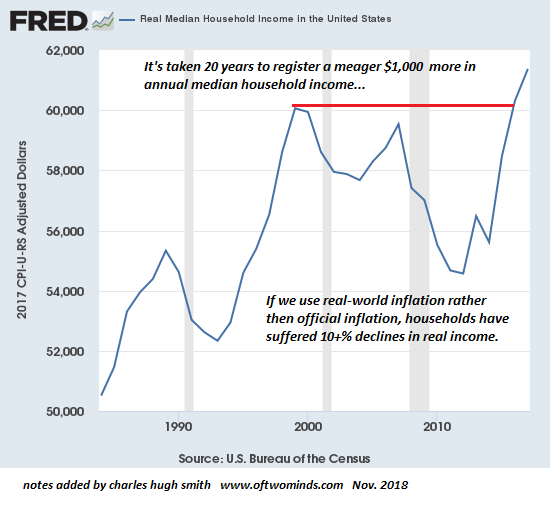
As the chart below shows, real median household income has only recently exceeded the 1998 level— and only by a meager $1,000 annually. If we use real-world inflation rather than the under-estimated official inflation, real income has plummeted by 10% or more in the past 20 years.

This reality is reflected in a new study of wages in Silicon Valley, which we might assume would keep up due to the higher value of the region’s output. The study found the wages of the bottom 90% declined when adjusted for inflation by as much as 14% over the past 20 years:

“The just-released report showed that wages for 90 percent of Silicon Valley workers (all levels of workers except for the top 10 percent)are lower now than they were 20 years ago, after adjusting for inflation. That’s in stark contrast to the 74 percent increase in overall per capita economic output in the Valley from 2001 to 2017.”

source: Why Silicon Valley Income Inequality Is Just a Preview of What’s to Come for the Rest of the U.S.

Meanwhile, the median house price has more than doubled to $325,000 while median household income has stagnated. Please note this price is not adjusted for inflation, like the median income chart. But if we take nominal household income in 1998 (around $40,000 annually) and compare it to nominal household income now in 2018 (around $60,000), that’s a 50% increase–far below the more than doubling of house prices.

To raise stagnant incomes, the Federal Reserve and other central banks have attempted to generate a wealth effect by boosting the valuations of risk-on assets such as stocks, bonds and commercial real estate. But the Fed et al. overlooked the fact that the vast majority of these assets are owned by the top 10%–and as noted above, the ownership of the top 10% is concentrated in the top 1% and .1%.

As a result, the vast majority of the wealth effect capital gains have flowed to the top 1%:

Lastly, the cartel structure of the U.S. economy has raised costs while providing no additional value. One example is higher education, a cartel that issues diplomas with diminishing economic value that now cost a fortune, a reality reflected in this chart of student loan debt, which simply didn’t exist a generation ago:

Our entire economy is characterized by cartel rentier skims, central-bank goosed asset bubbles and stagnating earned income for the bottom 90%. Given these realities, the bottom 90% are left with few pathways to get ahead in terms of financial security and building secure family wealth.


America Is on the Brink of a Nervous Breakdown

By John W. Whitehead

Source: The Rutherford Institute

“As nightfall does not come at once, neither does oppression. In both instances, there is a twilight when everything remains seemingly unchanged. And it is in such twilight that we all must be most aware of change in the air – however slight – lest we become unwitting victims of the darkness.” ― Supreme Court Justice William O. Douglas

Yet another shooting.

Yet another smear of ugliness, hatred and violence.

Yet another ratcheting up of the calls for the government to clamp down on the citizenry by imposing more costly security measures without any real benefit, more militarized police, more surveillance, more widespread mental health screening of the general population, more threat assessments and behavioral sensing warnings, more gun control measures, more surveillance cameras with facial recognition capabilities, more “See Something, Say Something” programs aimed at turning Americans into snitches and spies, more metal detectors and whole-body imaging devices at so-called soft targets, more roaming squads of militarized police empowered to do more stop-and-frisk searches, more fusion centers to centralize and disseminate information to law enforcement agencies, and more government monitoring of what Americans say and do, where they go, what they buy and how they spend their time.

All of these measures play into the government’s hands.

All of these measures add up to more government power, less real security and far less freedom.

As we have learned the hard way, the phantom promise of safety in exchange for restricted or regulated liberty is a false, misguided doctrine that has no basis in the truth.

Things are falling apart.

When things start to fall apart or implode, ask yourself: who stands to benefit?

In most cases, it’s the government that stands to benefit by amassing greater powers at the citizenry’s expense.

Unfortunately, the government’s answer to civil unrest and societal violence, as always, will lead us further down the road we’ve travelled since 9/11 towards totalitarianism and away from freedom.

With alarming regularity, the nation is being subjected to a spate of violence that not only terrorizes the public but also destabilizes the country’s fragile ecosystem, and gives the government greater justifications to crack down, lock down, and institute even more authoritarian policies for the so-called sake of national security without many objections from the citizenry.

Clearly, America is being pushed to the brink of a national nervous breakdown.

This breakdown—triggered by polarizing circus politics, media-fed mass hysteria, racism, classism, xenophobia, militarization and militainment (the selling of war and violence as entertainment), a sense of hopelessness and powerlessness in the face of growing government corruption and brutality, and a growing economic divide that has much of the population struggling to get by—is manifesting itself in madness, mayhem and an utter disregard for the very principles and liberties that have kept us out of the clutches of totalitarianism for so long.

Yet there is a method to this madness.

Remember, authoritarian regimes begin with incremental steps. Overcriminalization, surveillance of innocent citizens, imprisonment for nonviolent—victimless—crimes, etc. Bit by bit, the citizenry finds its freedoms being curtailed and undermined for the sake of national security. And slowly the populace begins to submit.

No one speaks up for those being targeted.

No one resists these minor acts of oppression.

No one recognizes the indoctrination into tyranny for what it is.

Historically this failure to speak truth to power has resulted in whole populations being conditioned to tolerate unspoken cruelty toward their fellow human beings, a bystander syndrome in which people remain silent and disengaged—mere onlookers—in the face of abject horrors and injustice.

Time has insulated us from the violence perpetrated by past regimes in their pursuit of power: the crucifixion and slaughter of innocents by the Romans, the torture of the Inquisition, the atrocities of the Nazis, the butchery of the Fascists, the bloodshed by the Communists, and the cold-blooded war machines run by the military industrial complex.

We can disassociate from such violence.

We can convince ourselves that we are somehow different from the victims of government abuse.

We can continue to spout empty campaign rhetoric about how great America is, despite the evidence to the contrary.

We can avoid responsibility for holding the government accountable.

We can zip our lips and bind our hands and shut our eyes.

In other words, we can continue to exist in a state of denial.

Whatever we do or don’t do, it won’t change the facts: the nation is imploding, and our republic is being pushed ever closer to martial law.

As Vann R. Newkirk II writes for the Atlantic:

Trumpism demands that violence be solved by local militarization: increased security at schools, the arming of teachers, and now, the adoption of guns in places intended quite literally to be sanctuaries from the scourges of the world. Taken altogether, what Trumpism seems to intend is the creation—or perhaps the expansion—of the machinery of a police state

In facing what appears to be a rising tide of violence—a tide that Trump himself elevates and encourages—the prescription of arms merely capitulates to the demands of that bloodshed. The purpose of political violence and terrorism is not necessarily to eliminate or even always to create body counts, but to disempower people, to spread the contagion of fear, to splinter communities into self-preserving bunkers, and to invalidate the very idea that a common destiny is even possible. Mandates to arm people accelerate this process. They inherently promote the idea that society cannot reduce the global level of harm, and promote the authoritarian impulses of people seeking order.

Where Newkirk misses the point is by placing the blame squarely on the Trump Administration.

This shift towards totalitarianism and martial law started long before Trump, set in motion by powers-that-be that see the government as a means to an end: power and profit.

As Paul Craig Roberts, former Assistant Secretary of the Treasury, recognized years ago, “Adolf Hitler is alive and well in the United States, and he is fast rising to power.”

Roberts was not comparing Trump to Hitler, as so many today are wont to do.

Rather, he was comparing the American Police State to the Nazi Third Reich, which is a far more apt comparison.

After all, U.S. government agencies—the FBI, CIA and the military—have fully embraced many of the Nazi’s well-honed policing tactics and have used them repeatedly against American citizens for years now.

Indeed, with every passing day, the United States government borrows yet another leaf from Nazi Germany’s playbook: Secret police. Secret courts. Secret government agencies. Surveillance. Censorship. Intimidation. Harassment. Torture. Brutality. Widespread corruption. Entrapment. Indoctrination. Indefinite detention.

These are not tactics used by constitutional republics, where the rule of law and the rights of the citizenry reign supreme. Rather, they are the hallmarks of authoritarian regimes, where the only law that counts comes in the form of heavy-handed, unilateral dictates from a supreme ruler who uses a secret police to control the populace.

The empowerment of the Gestapo, Germany’s secret police, tracked with the rise of the Nazi regime in much the same way that the rise of the American police state corresponds to the decline of freedom in America.

How did the Gestapo become the terror of the Third Reich?

It did so by creating a sophisticated surveillance and law enforcement system that relied for its success on the cooperation of the military, the police, the intelligence community, neighborhood watchdogs, government workers for the post office and railroads, ordinary civil servants, and a nation of snitches inclined to report “rumors, deviant behavior, or even just loose talk.”

In other words, ordinary citizens working with government agents helped create the monster that became Nazi Germany. Writing for the New York Times, Barry Ewen paints a particularly chilling portrait of how an entire nation becomes complicit in its own downfall by looking the other way:

In what may be his most provocative statement, [author Eric A.] Johnson says that ‘‘most Germans may not even have realized until very late in the war, if ever, that they were living in a vile dictatorship.’’ This is not to say that they were unaware of the Holocaust; Johnson demonstrates that millions of Germans must have known at least some of the truth. But, he concludes, ‘‘a tacit Faustian bargain was struck between the regime and the citizenry.’’ The government looked the other way when petty crimes were being committed. Ordinary Germans looked the other way when Jews were being rounded up and murdered; they abetted one of the greatest crimes of the 20th century not through active collaboration but through passivity, denial and indifference.

Much like the German people, “we the people” have become passive, polarized, gullible, easily manipulated, and lacking in critical thinking skills.  Distracted by entertainment spectacles, politics and screen devices, we too are complicit, silent partners in creating a police state similar to the terror practiced by former regimes.

Can the Fourth Reich happen here?

It’s already happening right under our noses. Much like the German people, “we the people” are all too inclined to “look the other way.”

In our state of passivity, denial and indifference, here are some of the looming problems we’re ignoring:

Our government is massively in debt. Currently, the national debt is somewhere in the vicinity of $21 trillion. Approximately half of our debt is owned by foreign countries, namely China, Japan and Saudi Arabia.

Our education system is abysmal. Despite the fact that we spend more than most of the world on education, we rank 36th in the world when it comes to math, reading and science, far below most of our Asian counterparts. Even so, we continue to insist on standardized programs such as Common Core, which teach students to be test-takers rather than thinkers.

Our homes provide little protection against government intrusions. Police agencies, already empowered to crash through your door if they suspect you’re up to no good, now have radar devices that allow them to “see” through the walls of our homes.

Our prisons, housing the largest number of inmates in the world and still growing, have become money-making enterprises for private corporations that rely on the inmates for cheap labor.

We are no longer a representative republic. The U.S. has become a corporate oligarchy. As a recent academic survey indicates, our elected officials, especially those in the nation’s capital, represent the interests of the rich and powerful rather than the average citizen.

We’ve got the most expensive, least effective health care system in the world compared to other western, industrialized nations.

The air pollution levels are dangerously high for almost half of the U.S. population, putting Americans at greater risk of premature death, aggravated asthma, difficulty breathing and future cardiovascular problems.

Despite outlandish amounts of money being spent on the nation’s “infrastructure,” there are more than 63,000 bridges—one out of every 10 bridges in the country—in urgent need of repair. Some of these bridges are used 250 million times a day by trucks, school buses, passenger cars and other vehicles.

Americans know little to nothing about their rights or how the government is supposed to operate. This includes educators and politicians. For example, 27 percent of elected officials cannot name even one right or freedom guaranteed by the First Amendment, while 54 percent do not know the Constitution gives Congress the power to declare war.

Nearly one out of every three American children live in poverty, ranking us among the worst in the developed world.

Patrolled by police, our schools have become little more than quasi-prisons in which kids as young as age 4 are being handcuffed for “acting up,” subjected to body searches and lockdowns, and suspended for childish behavior.

We’re no longer innocent until proven guilty.  In our present surveillance state, that burden of proof has now been shifted so that we are all suspects to be spied on, searched, scanned, frisked, monitored, tracked and treated as if we’re potentially guilty of some wrongdoing.

Parents, no longer viewed as having an inherent right to raise their children as they see fit, are increasingly being arrested for letting their kids walk to the playground alone, or play outside alone. Similarly, parents who challenge a doctor’s finding or request a second opinion regarding their children’s health care needs are being charged with medical child abuse and, in a growing number of cases, losing custody of their children to the government.

Private property means little at a time when SWAT teams and other government agents can invade your home, break down your doors, kill your dog, wound or kill you, damage your furnishings and terrorize your family. Likewise, if government officials can fine and arrest you for growing vegetables in your front yard, praying with friends in your living room, installing solar panels on your roof, and raising chickens in your backyard, you’re no longer the owner of your property.

Court rulings undermining the Fourth Amendment and justifying invasive strip searches have left us powerless against police empowered to forcefully draw our blood, forcibly take our DNA, strip search us, and probe us intimately. Accounts are on the rise of individuals—men and women alike—being subjected to what is essentially government-sanctioned rape by police in the course of “routine” traffic stops.

Americans can no longer rely on the courts to mete out justice. The courts were established to intervene and protect the people against the government and its agents when they overstep their bounds. Yet the courts increasingly march in lockstep with the police state, while concerning themselves primarily with advancing the government’s agenda, no matter how unjust or unconstitutional.

Americans have no protection against police abuse. It is no longer unusual to hear about incidents in which police shoot unarmed individuals first and ask questions later. What is increasingly common, however, is the news that the officers involved in these incidents get off with little more than a slap on the hands.

If there is any absolute maxim by which the federal government seems to operate, it is that the American taxpayer always gets ripped off. This is true, whether you’re talking about taxpayers being forced to fund high-priced weaponry that will be used against us, endless wars that do little for our safety or our freedoms, or bloated government agencies such as the National Security Agency with its secret budgets, covert agendas and clandestine activities. Rubbing salt in the wound, even monetary awards in lawsuits against government officials who are found guilty of wrongdoing are paid with taxpayer funds.

Americans are powerless in the face of militarized police. In early America, government agents were not permitted to enter one’s home without permission or in a deceitful manner. And citizens could resist arrest when a police officer tried to restrain them without proper justification or a warrant. Daring to dispute a warrant with a police official today who is armed with high-tech military weapons would be nothing short of suicidal. Moreover, as police forces across the country continue to be transformed into extensions of the military, Americans are finding their once-peaceful communities transformed into military outposts, complete with tanks, weaponry, and other equipment designed for the battlefield.

Now these are not problems that you can just throw money at, as most politicians are inclined to do.

These are problems that will continue to plague our nation—and be conveniently ignored by politicians—unless and until Americans wake up to the fact that we’re the only ones who can change things.

We’re caught in a vicious cycle right now between terror and fear and distraction and hate and partisan politics and an inescapable longing for a time when life was simpler and people were kinder and the government was less of a monster.

Our prolonged exposure to the American police state is not helping.

As always, the solution to most problems must start locally, in our homes, in our neighborhoods, and in our communities.

We’ve got to refrain from the toxic us vs. them rhetoric that is consuming the nation.

We’ve got to work harder to build bridges, instead of burning them to the ground.

We’ve got to learn to stop bottling up dissent and disagreeable ideas and learn how to work through our disagreements without violence.

We’ve got to de-militarize our police and lower the levels of violence here and abroad, whether it’s violence we export to other countries, violence we glorify in entertainment, or violence we revel in when it’s leveled at our so-called enemies, politically or otherwise.

For starters, we’ll need to actually pay attention to what’s going on around us, and I don’t mean by turning on the TV news. That will get you nowhere. It’s a mere distraction from what is really going on. In other words, if you’re watching, that means you’re not doing. It’s time to get active.

Pay attention to what your local city councils are enacting.

Pay attention to what your school officials are teaching and not teaching.

Pay attention to whom your elected officials are giving access and currying favor.

Most of all, stop acting like it really matters whether you vote for a Republican or Democrat, because in the grand scheme of things, it really doesn’t.

While you’re at it, start acting like citizens who expect the government to work for them, rather than the other way around. While that bloated beast called the federal government may not listen to you without a great deal of activism and effort brought to bear, you can have a great—and more immediate—impact on your local governing bodies.

This will mean gathering together with your friends and neighbors and, for example, forcing your local city council to start opposing state and federal programs that are ripping you off. And if need be, your local city council can refuse to abide by the dictates that continue to flow from Washington, DC. In other words, nullify everything the government does that is illegitimate, egregious or blatantly unconstitutional.

Finally, remember that when you strip away all of the things that serve to divide us, we’re no different underneath: we all bleed red, and we all suffer when violence becomes the government’s calling card.

As I make clear in my book Battlefield America: The War on the American People, the oppression and injustice—be it in the form of shootings, surveillance, fines, asset forfeiture, prison terms, roadside searches, and so on—will come to all of us eventually unless we do something to stop it now.

Unless we can learn to live together as brothers and sisters and fellow citizens, we will perish as tools and prisoners of the American police state.

The Dystopian Future of Facebook

By Mark Kernan

Source: CounterPunch

This year Facebook filed two very interesting patents in the US. One was a patent for emotion recognition technology; which recognises human emotions through facial expressions and so can therefore assess what mood we are in at any given time-happy or anxious for example. This can be done either by a webcam or through a phone cam. The technology is relatively straight forward. Artificially intelligent driven algorithms analyses and then deciphers facial expressions, it then matches the duration and intensity of the expression with a corresponding emotion. Take contempt for example. Measured by a range of values from 0 to 100, an expression of contempt could be measured by a smirking smile, a furrowed brow and a wrinkled nose. An emotion can then be extrapolated from the data linking it to your dominant personality traits: openness, introverted, neurotic, say.

The accuracy of the match may not be perfect, its always good to be sceptical about what is being claimed, but as AI (Artificial Intelligence) learns exponentially and the technology gets much better; it is already much, much quicker than human intelligence.

Recently at Columbia University a competition was set up between human lawyers and their AI counterparts. Both read a series of non-disclosure agreements with loopholes in them. AI found 95% compared to 88% by humans. The human lawyers took 90 minutes to read them; AI took 22 seconds. More incredibly still, last year Google’s AlphaZero beat Stockfish 8 in chess. Stockfish 8 is an open-sourced chess engine with access to centuries of human chess experience. Yet AlphaZero taught itself using machine learning principles, free of human instruction, beating Stockfish 8 28 times and drawing 72 out of 100. It took AlphaZero four hours to independently teach itself chess. Four hours from blank slate to genius.

A common misconception about algorithms is that they can be easily controlled, rather they can learn, change and run themselves-a process known as deep “neural” learning. In other words, they run on self-improving feed back loops. Much of this is positive of course, unthought of solutions by humans to collective problems like climate change are more possible in the future. The social payoffs could be huge too. But what of the use of AI for other means more nefarious. What if, as Yuval Noah Hariri says, AI becomes just another tool to be used by elites to consolidate their power even further in the 21stcentury. History teaches us that it isn’t luddite to ask this question, nor is it merely indulging in catastrophic thinking about the future. Rapidly evolving technology ending up in the hands of just a few mega companies, unregulated and uncontrolled, should seriously concern us all.

Algorithms, as Jamie Bartlett the author of The People Vs Tech puts it, are “the keys to the magic kingdom” of understanding deep seated human psychology: they filter, predict, correlate, target & learn. They also manipulate. We would be naive in the extreme to think they already don’t, and even more naive to think the manipulation is done only by commercial entities. After all, it’s not as if there aren’t lots of online tribes, some manufactured and some not, to be manipulated into and out of political viewpoints, our fleeced of their money.

In 2017 Facebook said they could detect teenagers’ moods and emotions such as feeling nervous and insecure by their entries, a claim they denied later, adding we do not, “offer tools to target people based on their emotional state”. The internal report was written by two Australian executives-Andy Sinn and David Fernandez. The report according to The Guardian was written for a large bank and said that, “the company has a database of its young users – 1.9 million high schoolers, 1.5 million tertiary students and 3 million young workers”.

Going one better still, Affectiva, a Boston company, claims to be able to detect and decode complex emotional and cognitive data from your face, voice and physiological state using emotion recognition technology (ECT)-amassing 12 billion “emotion data points” across gender, age & ethnicity.  Its founder has declared that Affectiva’s ECT can read your heart rate from a webcam without the you wearing any sensors, simply by using the reflection of your face which highlights blood flow-a reflection of your blood pressure. Next time you’re listening to Newstalk’s breakfast show, think of that.

Affectiva’s ultimate goal of course, when you get past all the feel-good optimistic guff about “social connectivity”, “awesome innovation”, and worst of all “empowering” is, to use their own words, to “enable media creators to optimize their content”. Profiting from decoding our emotional states in other words.

Maybe Facebook (and Google) would use this technology wisely for our benefit, then again maybe not. It isn’t such a stretch to imagine how it could be used unethically too. To microtarget customised ads and messages at us depending on our state of mind at given time, say, and allowing Cambridge Analytica to harvest the personal data of 87 million Facebook users to subvert democracy with Brexit & Trump. Facebook claims they weren’t aware of this though.  Well, maybe, maybe not, and in spite of their protests in recent years they are still not especially transparent or accountable given their enormous cultural and social power in our lives. Curiouser and Curiouser you might think, and you’d be right.

The second Facebook patent is even more interesting, if that’s the right word, or dystopian if you prefer. Patented this June, published under the code US20180167677 (with the abstract title of Broadcast Content View Analysis Based on Ambient Audio Recording, application no: 15/376,515) illustrates a process by which secret messages- ‘ambient audio fingerprints’ in the jargon-embedded in TV ads, would trigger your smart technology (phone or TV) to record you while the ad was playing. Presumably to gauge your reaction to the product being advertised at you through, perhaps, voice biometrics (i.e. the identification and recognition of the pitch and tone of your voice).

As the patent explains in near impenetrable but just about understandable jargon this is done by first, detecting one or more broadcasting signals (the advertisement) of a content item. Second, ambient audio of the content item is recorded, and then the audio feature is extracted “from the recorded ambient audio to generate an ambient fingerprint” and finally, wait for it, “ the ambient audio fingerprint, time information of the recorded ambient audio, and an identifier of an individual associated with a client device (you and your phone or smart TV) recording the ambient audio” is sent, “to an online system for determining whether there was an impression of the content by the individual.” It goes on to say that “the impression of the identified content item by the identified individual” is logged in a “data store of the online system”.

It goes on to state that “content providers have a vested interest in knowing who have listened and/or viewed their content” and that the feature described in the patent are not exhaustive, and that “many additional features and advantages will be apparent to one of ordinary skill in the art…”.

It is already obvious we don’t know how much Facebook and other big tech platforms monitor us, neither do we know how much data they hold on us individually and collectively and, critically, who has access to that data and how they could use it.

If you can sell consumer goods by such manipulation why not whole ideologies, chipping away at our human agency one dystopian tech innovation at a time, paving the way for the morphing of late stage capitalism into authoritarian capitalism; one efficiency gain at a time.

If put into place such “innovations” are designed to monitor our emotional states for monetary gain. In essence, it is a type of online mood tracking where we are the digital lab rats.  Facebook is already valued at half a trillion US dollars giving it huge economic and cultural power.

According to Private Eye magazine, Facebook’s legal team say the patent was filed “to prevent aggression from other companies”, and that “patents tend to focus on future-looking technology that is often speculative in nature and could be commercialised by other companies”. As Private Eye pointed out though, it’s not as if Facebook has been completely transparent about such secretive issues in the past or present. The fact that Facebook generates billions by manipulating our emotions is not a surprise us, their business model is based on it, but how they intend to do it in the future should surprise, and alert us. We are after all the product. Over 90% of their revenues comes from selling adverts. They have the market incentive.

How will all this play out in the future? It isn’t difficult to build a picture of a commercialised and rapacious big tech dystopia, the very opposite of the freedoms and civil liberties envisaged by the original pioneers of the internet, and the opposite of how they currently perceive themselves.

Verint, a leading multinational analytics & biometric corporation, with an office in Ireland, has been known to install and sell, “intrusive mass surveillance systems worldwide including to authoritarian governments”, according to Privacy International. Governments that routinely commit human rights abuses on their own citizens.

China, a world leader in surveillance capitalism, recently declared that by 2020 a national video surveillance network, Xueliang, will be fully operationable, Sharp Eyes in English-Kafka and Orwell must be smirking knowingly somewhere. The term sharp eyes harks back to the post war slogan in communist China of “The people have sharp eyes”, when neighbours were encouraged to spy and tell on other neighbours of counter revolutionary or defeatist gossip about the 1949 revolution.

Democracies too have built overarching systems of surveillance. Edward Snowden told us in 2013 that the NSA was given secret direct access to the servers of big tech companies (Facebook, YouTube, Google and others) to collect private communications. As Glenn Greenwald said, the NSA’s unofficial “motto of omniscience” is: Know it all, Collect it all, Process it all.

Jaron Lanier, pioneer of virtual reality technology and a tech renegade, and an apostate to some, recently called the likes of Facebook and Google “behaviour manipulation empires”. Their pervasive surveillance and subtle manipulation through “weaponised advertising” he argues debases democracy by polarising debate at a scale unthinkable even just five or ten years ago, and it’s not only advertising that can be weaponised. Facebook, Google, Twitter and Instagram all have “manipulation engines” (algorithms we know little about) running in the background Lanier says, designed specifically by thousands of psychological & “emotional engineers” (“choice architects” or “product philosophers” to use the inane corporate gobbledygook). Their job is to keep you addicted to what’s now known as the “attention economy”-and attention equals profit. A better description still might be the attention/anxiety economy. Twitter has for instance a 3 second time delay between the page loading and notification loading, Facebook something similar-and always red for urgent. They are known in psychology as intermittent variable rewards, negative reinforcement in this context which keep behaviour going by the hope of maybe being rewarded, with a like or a follower. This builds anticipation and releases feel good neurotransmitters, and taps into your need to belong, and to be heard-we’re intensely social creatures. The downside is the opposite of course,where we can be thrown into an emotional rollercoaster if the expected dopamine hit doesn’t come.

The goal is addiction into a consumption frenzy of socially approved validation. Big Tech’s social media universe is, as one reformed “choice architect” put it, “an attention seeking gravitational wormhole” that sucks you into their profit seeking universe. If you don’t think so, check how many times you look at your phone every day. The average person checks 150 times. Most of that is social media. We’re all in an attention arms race now.

There is a great German word: Zukunftsangst. It means translated, roughly, future-anxiety. Maybe it should be renamed Zuckerbergangst instead.

America’s Social Depression Is Accelerating

By Charles Hugh Smith

Source: Of Two Minds

We need to value honesty above optimism. Once we can speak honestly, there is a foundation for optimism.

Beneath the rah-rah statistics of “the greatest economy ever,” the social depression is accelerating. The mainstream is reluctantly waking up to the future of the American Dream: downward mobility for all but the top 10% of households. A 2015 Atlantic article fleshed out the zeitgeist with survey data that suggests the Great Middle Class/Nouveau Proletariat is also waking up to a future of downward mobility: The Downsizing of the American DreamPeople used to believe they would someday move on up in the world. Now they’re more concerned with just holding on to what they have.

I have been digging into the financial and social realities of what it takes to be middle class in today’s economy for years: Are You Really Middle Class?

The reality is that the middle class has been reduced to the sliver just below the top 5%–if we use the standards of the prosperous 1960s as a baseline.

The downward mobility isn’t just financial–it’s a decline in political power, control of one’s work and income-producing assets. This article reminds us of what the middle class once represented: What Middle Class? How bourgeois America is getting recast as a proletariat.

The costs of trying to maintain a toehold in the upper-middle class are illuminated in these recent articles on health and healthcare–both part of the downward mobility:

Health Care Slavery and Overwork

How a toxic workplace could, literally, destroy your health

We’re afraid our work is killing us, and we are right

This reappraisal of the American Dream is also triggering a reappraisal of the middle class in the decades of widespread prosperity: The Myth of the Middle Class: Have Most Americans Always Been Poor?

Downward mobility excels in creating and distributing what I term social defeat: In my lexicon, social defeat is a spectrum of anxiety, insecurity, chronic stress, powerlessness, and fear of declining social status.

Downward mobility and social defeat lead to social depression. Here are the conditions that characterize social depression:

1. High expectations of endless rising prosperity have been instilled in generations of citizens as a birthright.

2. Part-time and unemployed people are marginalized, not just financially but socially.

3. Widening income/wealth disparity as those in the top 10% pull away from the shrinking middle class.

4. A systemic decline in social/economic mobility as it becomes increasingly difficult to move from dependence on the state (welfare) or one’s parents to financial independence.

5. A widening disconnect between higher education and employment: a college/university degree no longer guarantees a stable, good-paying job.

6. A failure in the Status Quo institutions and mainstream media to recognize social recession as a reality.

7. A systemic failure of imagination within state and private-sector institutions on how to address social recession issues.

8. The abandonment of middle class aspirations by the generations ensnared by the social recession: young people no longer aspire to (or cannot afford) consumerist status symbols such as luxury autos or homeownership.

9. A generational abandonment of marriage, families and independent households as these are no longer affordable to those with part-time or unstable employment, i.e. what I have termed (following Jeremy Rifkin) the end of work.

10. A loss of hope in the young generations as a result of the above conditions.

The rising tide of collective anger arising from social depression is visible in many places: road rage, violent street clashes between groups seething for a fight, the destruction of friendships for holding the “incorrect” ideological views, and so on. I Think We Can Safely Say The American Culture War Has Been Taken As Far As It Can Go.

A coarsening of the entire social order is increasingly visible: The Age of Rudeness.

Depressive thoughts (and the emotions they generate) tend to be self-reinforcing, and this is why it’s so difficult to break out of depression once in its grip.

One part of the healing process is to expose the sources of anger that we are repressing. As psychiatrist Karen Horney explained in her 1950 masterwork, Neurosis and Human Growth: The Struggle Towards Self-Realization, anger at ourselves sometimes arises from our failure to live up to the many “shoulds” we’ve internalized, and the idealized track we’ve laid out for ourselves and our lives.

The recent article, The American Dream Is Killing Us does a good job of explaining how our failure to obtain the expected rewards of “doing all the right things”(getting a college degree, working hard, etc.) breeds resentment and despair.

Since we did the “right things,” the system “should” deliver the financial rewards and security we expected. This systemic failure to deliver the promised rewards is eroding social mobility and the social contract while generating frustration, anger, etc.

We are increasingly angry at the system, but we reserve some anger for ourselves, because the mass-media trumpets how well the economy is doing and how some people are doing extremely well. Naturally, we wonder, why them and not us? The failure is thus internalized.

One response to this sense that the system no longer works as advertised is to seek the relative comfort of echo chambers–places we can go to hear confirmation that this systemic stagnation is the opposing political party’s fault.

We don’t just self-sort ourselves into political “tribes” online– we are congregating in increasingly segregated communities and states:.

Americans are moving to communities that align more with their politics. Liberals are moving to liberal areas, and conservatives are moving to conservative communities. It’s been going on for decades. When Jimmy Carter was elected in 1976, 26.8% of Americans lived in landslide counties; that is counties where the president won or lost by 20% of the vote.

By 2004, 48.3% of the population lived in these counties. This trend continues to worsen. As Americans move to their preferred geographic bubbles, they face less exposure to opposing viewpoints, and their own opinions become more extreme. This trend is at the heart of why politics have become so polarizing in America.

We’re self-sorting at every level. Because of this, Americans are only going to grow more extreme in their beliefs, and see people on the other side of the political spectrum as more alien.”

Part of the American Exceptionalism we hear so much about is a can-do optimism: set your mind to it and everything is possible.

The failure to prosper as anticipated is generating a range of negative emotions that are “un-American”: complaining that you didn’t get a high-paying secure job despite having a college degree (or advanced degree) sounds like sour-grapes: the message is you didn’t work hard enough, you didn’t get the right diploma, etc.

It can’t be the system that’s failed, right? I discuss this in my book Why Our Status Quo Failed and Is Beyond Reform: the top 10% who are benefiting mightily dominate politics and the media, and their assumption is: the system is working great for me, so it must be working for everyone. That’s the implicit narrative parroted by status quo mouthpieces.

The inability to express our despair and anger generates depression. Some people will redouble their efforts, others will seek to lay the blame on “the other” (some external group) and others will give up. What few people will do is look at the sources of systemic injustice.

Perhaps we need a national dialog about declining expectations, rising inequality and the failure of the status quo that avoids the blame-game and the internalization trap (i.e. it’s your own fault you’re not well-off).

We need ways to express our resentment, anger, despair, etc. that are directed at the source, the complex system we inhabit, not “the other.” We need to value honesty above optimism. Once we can speak honestly, there is a foundation for optimism.

Lara Trace Hentz

INDIAN COUNTRY NEWS

In Saner Thought

"It is the duty of every man, as far as his ability extends, to detect and expose delusion and error"..Thomas Paine

ZEDJournAI

Human in Algorithms

Rooster Crows

From the Roof Top

Aisle C

I See This

The Free

blog of the post capitalist transition.. Read or download the novel here + latest relevant posts

अध्ययन-अनुसन्धान(Essential Knowledge of the Overall Subject)

अध्ययन-अनुसन्धानको सार