15 Questions That Are More Useful Than “What Presidential Candidate Should Americans Vote For?”

By Caitlin Johnstone

Source: CaitlinJohnstone.com

People keep asking me to weigh in on the US presidential race and its candidates, which is what always happens whenever there’s a US presidential race on because media saturation makes it so central in the minds of Americans it’s often the main issue they want to talk about, even if they’re fairly aware.

I really don’t have anything to say about who Americans should vote for, other to repeat what I’ve said already about the fact that you can’t vote your way out of a mess you never voted yourself into in the first place.

But what I can do instead is offer my American friends some questions to ask that would probably be much more helpful to them and their nation than the question “Which presidential candidate should we vote for?”

Here are 15 such questions:

1. Why does nothing change no matter who we vote for?

2. Why does US foreign policy always continue along the same trajectory regardless of the president’s party or platform?

3. What keeps our voting population split right down the middle into two political factions of equal size, with neither side ever gaining enough of a majority to democratically change society in any meaningful way?

4. Why does the stalemate described in #3 always seem to benefit the rich, the powerful, and the war-horny?

5. Why is it that the most consequential US government policies like plutocratic influence, privatization, globalization, ecocidal capitalism and nuclear brinkmanship are never on the ballot? Why do these things keep happening, against our interests, without our ever voting for them or electing anyone who campaigned on the pledge to enact them?

6. If our federal government’s behavior never changes no matter who we elect, could it be that there are other bodies involved in government policy-setting whom we did not elect, and who remain in positions of influence regardless of the comings and goings of our official elected government?

7. If the above is the case, then who is it? Who’s really calling the shots in this country?

8. Could it be that everything we’ve been told about our country, our government, our political processes and our world is untrue?

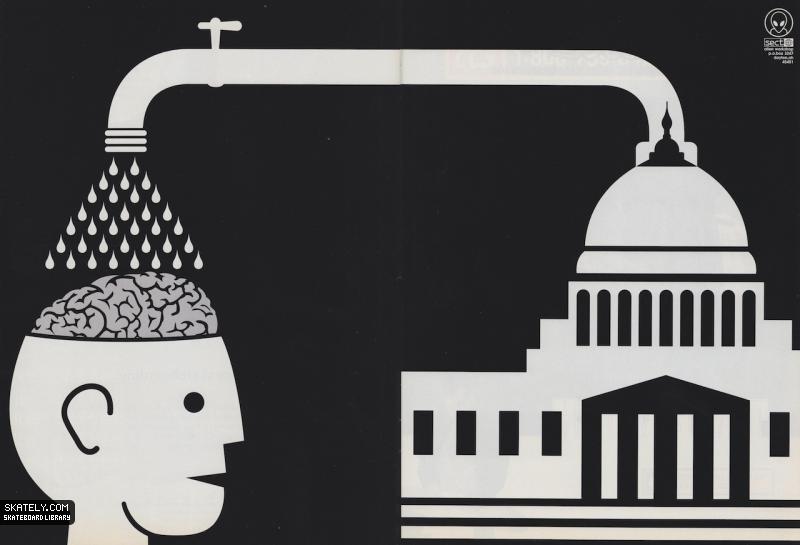
9. If so, what are the implications of the fact that our schools and our media have been feeding us lies since we were small?

10. What forces would be responsible for keeping all these lies flowing throughout our society? What might keep an ostensibly free press spinning more or less the same lies throughout the western world day after day, year after year, generation after generation?

11. Is it possible that our entire electoral system is a sham designed to give the public the illusion of control so that they’ll let oligarchs and empire managers run the country undisturbed?

12. If the electoral system is a sham, then how do we enact the changes we so desperately need?

13. Is it possible that there are other ways to effect change in the United States which don’t involve casting a pretend vote in a fake election?

14. Could it be that those other means of forcing change are precisely what the charade of casting pretend votes in fake elections is meant to divert us from?

15. Should we perhaps spend less energy bickering about who should get sworn into the White House a year and a half from now, and more energy examining other possible avenues toward advancing meaningful change?

Journalistic Malpractice on Trial: What the Dominion Voting System Tells Us About How the Media Sacrificed their Credibility to Partisan Falsehoods

By Nolan Higdon

Source: Project Censored

“This is direct evidence of knowing falsity” exclaimed RonNell Anderson Jones, Professor of Law at the University of Utah, in a February 2023 interview with Jon Stewart. Jones noted that in most defamation cases “the likelihood that you will find evidence of them [news outlets] saying, ‘We know this is a lie and we would like to move forward with it anyway is deeply unlikely.’” However, in the case of Dominion Voting Systems v. Fox News, “the filing contains just this trove of evidence of emails and text messages and internal memos that are ‘rare’ both in terms of the ‘volume of the evidence and as to the directness of the evidence.’” This sentiment was echoed by Harvard law professor Laurence Tribe who noted, “I have never seen a defamation case with such overwhelming proof that the defendant admitted in writing that it was making up fake information in order to increase its viewership and its revenues.”

In the $1.6 billion defamation lawsuit, Dominion Voting Systems accuses Fox News Channel of falsely reporting that Dominion’s voting machines fraudulently delivered victory to Joe Biden in the 2020 U.S. Presidential Election. Court documents attained by other media outlets reveal that hosts and other high-ranking Fox News Channel officials – including the Chairman and CEO of Fox’s parent company News Corporation, Rupert Murdoch – knew these reports were false, but aired them because they were more concerned with confirming their audience’s belief that Donald Trump won the election.

The evidence presented in the court documents speaks to the journalistic malpractice that plagues the cable news industry. Journalistic malpractice refers to professional journalists who privilege ideological bias and profits over truth in their reporting. Fox News Channel is patient zero for the plague of journalistic malpractice. It was created in 1996 by Rupert Murdoch and the late Roger Ailes, a media consultant for several Republican presidents, as a political project to sell conservative culture and policy to the American public with pro-conservative propaganda disguised as journalism. For example, Fox News Channel has

  • falsely claimed that other media outlets did not cover the conservative Tea Party rallies;
  • utilized videos out of context to inflate the perceived size of conservative protests;
  • labeled former President Barack Obama a racist;
  • declared Osama bin Laden as a John Kerry supporter;
  • perpetuated discredited reports on the existence of Weapons of Mass Destruction in Iraq;
  • introduced digitally altered photos to fabricate Black Lives Matter violence and make New York Timesreporters appear to be revolting.   

Liberals were right to assert that such chicanery was propaganda, not journalism. But before liberal readers scold Fox News viewers, they should remind themselves that the plague of journalistic malpractice has also infected the liberal leaning cable networks such as CNN and MSNBC. Researchers and scholars have noted that the advent of cable and then the internet saw news media outlets shift from attaining the largest audience possible to focusing on a more specific or narrow demographic of the audience. While Fox News Channel sought to cater to Republican Party voting viewers, CNN and MSNBC did the same for Democratic Party voters. This gave the Democratic Party influence over programming that was tantamount to what the Republican Party long enjoyed at Fox.

When Senator U.S. Bernie Sanders’ 2016 Presidential bid posed a threat to their desired candidate Hillary Clinton in 2016, leaders from the Democratic Party admitted they worked to undermine his campaign. Pro-Democratic party outlets like MSNBC and CNN aided in this effort by

  • creating an unfavorable debate schedule;
  • giving Clinton twice as much and more favorable coverage;
  • publishing 16 negative articles about Sanders in Washington Post (owned by major Democratic Party funder Jeff Bezos) in 16 hours;
  • ghost editing previous news articles to diminish Sanders’ quarter century of accomplishments;
  • inviting his opponent’s surrogates to attack his character under the auspices of being objective journalists.

Their smear of Sanders continued in 2020 when

  • the Democratic Party-leaning news outlets misled the public about Sanders’ polling numbers;
  • CNN’s Abby Phillips drew gasps for ignoring Sanders’ claim that he never said a “woman could not be president;”
  • James Carville on MSNBC made the baseless claim that Russia was supporting Sanders;
  • MSNBC’s Chris Matthews compared Sander’s primary victories to the Nazi’s defeat of the French, an unfortunate comparison as Sanders’ family was murdered in the holocaust.

Journalistic malpractice also plagued Covid-19 coverage. Starting in 2020, CNN’s Chris Cuomo utilized his platform – with the approval of CNN leadership – to host his brother, then New York Governor Andrew Cuomo. The jovial segments seemed like campaign advertisements as Chris treated Andrew as the anti-thesis to then President Trump: a competent executive who took decisive action to address the Covid-19 pandemic. Although, the Democratic versus Republican framing attracted partisan audiences, in reality, Andrew Cuomo and Trump were all too similar: both concealed the actual number of Covid-19 deaths in their jurisdiction, both put patients at risk with kickbacks to industry partners, and both utilized media contacts to stifle press reports about their alleged sexual crimes.

The partisan falsehoods in cable news includes the production of powerful, long- running false stories designed to convince their audiences that the other party is wrong and crazy. For years now, conservatives and Fox News Channel perpetuated the baseless Qanon conspiracy, which alleges that a cabal of Satan-worshiping pedophiles – mainly in the Democratic Party – runs global affairs but Trump will break up the conspiracy. The absurdity of this conspiracy is tantamount to liberal leaning news media’s reporting on Russiagate, which sought to discredit Republicans. Since 2016, Russiagate – the story that Russia meddled in and influenced the outcome of the U.S. election in 2016, had direct connections to Donald Trump and his associates, and worked to help defeat Hillary Clinton for the presidency – was perpetuated by a series of false stories from Democratic Party-friendly media including

  • Russia hacking a Vermont power plant;
  • putting a bounty on U.S. soldiers in Afghanistan;
  • shifting election outcomes around the world;
  • turning Trump into an asset since 1987;
  • labeling the Hunter Biden laptop story as fake news.

Conservatives rightly see this reporting and believe liberals are insane.

Both factions need to look in a mirror. While audiences can clearly see the insanity in other networks’ viewers, they rarely seem to see it in themselves. Indeed, in the same week that CNN and others were having a schadenfreude moment over the Dominion v. Fox case, they hosted a commentator on the train derailment in East Palestine, Ohio without disclosing that he had lobbied for the train company Norfolk Southern. This example of hypocrisy and journalistic malpractice is not only costly to CNN’s credibility, but our democracy as well.   

Without a robust media system that privileges truth over preaching to the choir, the public will have endless debates devoid of facts on key issues such as critical race theory, vaccine efficacy, the origins of the COVID-19 virus, climate change, transgender issues, Ukraine, mysterious balloons, and more. Democratic discourse will be reduced to seeing Republicans as MAGA-hat wearing, blue lives matter-flag waving, gun nuts, and Democrats as medical mask wearing, “this house cares about everything” front-lawn sign adorning, professional victims and virtue signalers. These caricatures have never really been accurate, but as long as the nation is infected with the plague of journalist malpractice they will surely be perpetuated.

While the courts are unlikely to deliver solace from political party propaganda disguised as journalism, they have provided some wisdom. Both Rachel Maddow and Tucker Carlson of MSNBC and Fox News Channel respectively, have been brought to court for spreading false information and were exonerated because the judges concluded that no reasonable person would believe either of them were telling the truth. That is good advice, and viewers would be wise to remember it every time they consider watching cable news.

I Used To Be Disgusted, Now I’m Disabused

By Charles Hugh Smith

Source: Of Two Minds

It’s certainly possible to be disgusted, but being disabused of the fantasy that the system is self-correcting is the healthier perspective.

I used to be disgusted, now I’m disabused: beneath all the self-serving narratives, fad-memes and over-simplifications regurgitated as serious analysis, these are the core dynamics I see:

1. Imperial corruption of democracy and open markets. I described this in Regardless of Who’s Elected, Imperial Corruption Rules the Nation: the dynamic adaptive churn of unfettered representative democracy and open markets are anathema to insiders, vested interests and elites, each of which has gained asymmetric power by subverting democracy and markets to serve their private interests rather than the public interest / common good–phrases that are meaningless to insiders, vested interests and elites except as simulacra used for PR.

2. The Deep State, the unelected and unaccountable Administrative State. I’ve been discussing the Deep State before it entered common use–for example:

Going to War with the Political Elite You Have (May 14, 2007)

The Dollar and the Deep State (February 24, 2014)

Is the Deep State Fracturing into Disunity? (March 14, 2014)

The Administrative State has existed in some form in every nation-state / empire, but the U.S. Deep State only gained its vast global powers in World War II and the Cold War, where the lesson learned was the public may choose unwisely (for example, choosing appeasement over preparation) and so the really important decisions needed to preserve the nation cannot be left to parochial politicos in elected office–those decisions must be in the hands of those who know what has to be done.

Democracy is the rubber stamp for doing what’s necessary. Beyond that, it’s a potentially fatal hindrance. That’s the mindset of the Deep State, and if you and I were in upper-echelon positions in the Administrative State, we’d agree with this mindset when things get serious.

This mindset is a self-reinforcing group-think feedback loop: those who believe the public should set policy are weeded out, either by self-selection or via being sent to bureaucratic Siberia.

We’re protecting you. That’s all you need to know.

This opens the door to functionaries who came to do good but stayed to do well, i.e. those with the right credentials and connections to enter the Power Circle to “serve the public” but soon become insiders maximizing their own private gains. That’s the problem with the Administrative State: it’s ultimately unaccountable, not just to the public or elected officials but to itself.

3. Vested interests block adaptions that threaten their share of the spoils. Any advance that increases efficiency and productivity and furthers the public good is squelched, suppressed or co-opted by vested interests who rightly fear their share of the spoils might be diminished by advances that obsolete their particular cartel, monopoly or other embedded skim, scam, fraud, embezzlement or simply unproductive dead weight.

The status quo is thus locked into a death spiral as gatekeepers, insiders, vested interests and sold to the highest bidder politicos will protect vested interests even as the engines flood and the ship begins its long descent into the void.

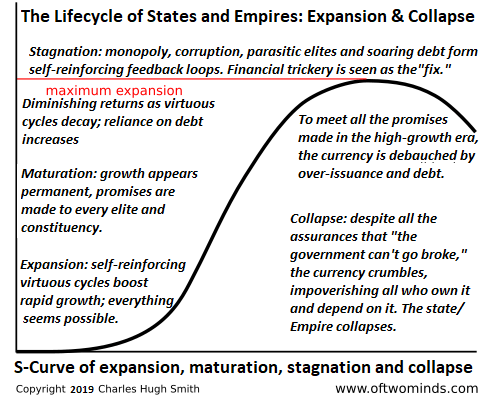
How do otherwise smart people become so blind to what’s going on? They believe the status quo is so wealthy, so powerful, so clever, etc., that it will overcome any obstacles or crises because it’s always done so in the past, and so it is permanent, immutable, forever, and our supping at the trough of free money couldn’t possibly weaken such an enduring Leviathan.

This is the fatal fantasy of every empire. We’re too successful to fail and collapse. But oddly enough, faith in the permanence of success leads to the very collapse that’s deemed “impossible.”

4. Concentrations of wealth, power, capital and production fatally distort the economy and the social order. When “competition” has been reduced to two telecoms, two healthcare insurers, two pork processors, etc., the system has been stripped of adaptability and resilience.

When 10,000 small farmers each have 100 chickens, the stock of 1 million chickens is spread over a wide geography and entrepreneurial network of suppliers, wholesalers, etc. Bird flu may spread widely but it’s far more difficult to wipe out 10,000 small farms’ poultry compared to the ease of bird flu spreading in one giant factory that concentrates 1 million chickens in one facility. Supply chains stripped of network resilience are equally fragile and prone to disruption and collapse.

Concentrating any form of capital, production and power renders the system vulnerable to collapse due to the inherent weaknesses generated by replacing complex networks with vertical-integration under the control of a few cartels, monopolies, autocrats, gatekeepers or regulators–the latter two being easily influenced by political pressure and/or private gain.

It’s certainly possible to be disgusted, but being disabused of the fantasy that the system is self-correcting is the healthier perspective. Everything is forever until systemic weaknesses reveal themselves, typically at the most inopportune junctures.

Saturday Matinee: Ukraine on Fire – The Real Story

[Originally posted on 2/24/18]

https://vimeo.com/332524840

A Documentary You’ll Likely Never See

By James DiEugenio

Source: Consortium News

It is not very often that a documentary film can set a new paradigm about a recent event, let alone, one that is still in progress. But the new film Ukraine on Fire has the potential to do so – assuming that many people get to see it.

Usually, documentaries — even good ones — repackage familiar information in a different aesthetic form. If that form is skillfully done, then the information can move us in a different way than just reading about it.

A good example of this would be Peter Davis’s powerful documentary about U.S. involvement in Vietnam, Hearts and Minds. By 1974, most Americans understood just how bad the Vietnam War was, but through the combination of sounds and images, which could only have been done through film, that documentary created a sensation, which removed the last obstacles to America leaving Indochina.

Ukraine on Fire has the same potential and could make a contribution that even goes beyond what the Davis film did because there was very little new information in Hearts and Minds. Especially for American and Western European audiences, Ukraine on Fire could be revelatory in that it offers a historical explanation for the deep divisions within Ukraine and presents information about the current crisis that challenges the mainstream media’s paradigm, which blames the conflict almost exclusively on Russia.

Key people in the film’s production are director Igor Lopatonok, editor Alex Chavez, and writer Vanessa Dean, whose screenplay contains a large amount of historical as well as current material exploring how Ukraine became such a cauldron of violence and hate. Oliver Stone served as executive producer and conducted some high-profile interviews with Russian President Vladimir Putin and ousted Ukrainian President Viktor Yanukovych.

The film begins with gripping images of the violence that ripped through the capital city of Kiev during both the 2004 Orange Revolution and the 2014 removal of Yanukovich. It then travels back in time to provide a perspective that has been missing from mainstream versions of these events and even in many alternative media renditions.

A Longtime Pawn

Historically, Ukraine has been treated as a pawn since the late Seventeenth Century. In 1918, Ukraine was made a German protectorate by the Treaty of Brest Litovsk. Ukraine was also a part of the Molotov-Ribbentrop Pact of 1939 signed between Germany and Russia, but violated by Adolf Hitler when the Nazis invaded the Soviet Union in the summer of 1941.

The reaction of many in Ukraine to Hitler’s aggression was not the same as it was in the rest of the Soviet Union. Some Ukrainians welcomed the Nazis. The most significant Ukrainian nationalist group, Organization of Ukrainian Nationalists (OUN), had been established in 1929. Many of its members cooperated with the Nazis, some even enlisted in the Waffen SS and Ukrainian nationalists participated in the massacre of more than 33,000 Jews at Babi Yar ravine in Kiev in September 1941. According to scholar Pers Anders Rudling, the number of Ukrainian nationalists involved in the slaughter outnumbered the Germans by a factor of 4 to 1.

But it wasn’t just the Jews that the Ukrainian nationalists slaughtered. They also participated in massacres of Poles in the western Ukrainian region of Galicia from March 1943 until the end of 1944. Again, the main perpetrators were not Germans, but Ukrainians.

According to author Ryazard Szawlowksi, the Ukrainian nationalists first lulled the Poles into thinking they were their friends, then turned on them with a barbarity and ferocity that not even the Nazis could match, torturing their victims with saws and axes. The documentary places the number of dead at 36,750, but Szawlowski estimates it may be two or three times higher.

OUN members participated in these slaughters for the purpose of ethnic cleansing, wanting Ukraine to be preserved for what OUN regarded as native Ukrainians. They also expected Ukraine to be independent by the end of the war, free from both German and Russian domination. The two main leaders in OUN who participated in the Nazi collaboration were Stepan Bandera and Mykola Lebed. Bandera was a virulent anti-Semite, and Lebed was rabidly against the Poles, participating in their slaughter.

After the war, both Bandera and Lebed were protected by American intelligence, which spared them from the Nuremburg tribunals. The immediate antecedent of the CIA, Central Intelligence Group, wanted to use both men for information gathering and operations against the Soviet Union. England’s MI6 used Bandera even more than the CIA did, but the KGB eventually hunted down Bandera and assassinated him in Munich in 1959. Lebed was brought to America and addressed anti-communist Ukrainian organizations in the U.S. and Canada. The CIA protected him from immigration authorities who might otherwise have deported him as a war criminal.

The history of the Cold War was never too far in the background of Ukrainian politics, including within the diaspora that fled to the West after the Red Army defeated the Nazis and many of their Ukrainian collaborators emigrated to the United States and Canada. In the West, they formed a fierce anti-communist lobby that gained greater influence after Ronald Reagan was elected in 1980.

Important History

This history is an important part of Dean’s prologue to the main body of Ukraine on Fire and is essential for anyone trying to understand what has happened there since the collapse of the Soviet Union in 1991. For instance, the U.S.-backed candidate for president of Ukraine in 2004 — Viktor Yushchenko — decreed both Bandera and his military assistant Roman Shukhevych, who was also involved in atrocitites, were both named national heroes by Yushchenko.

Bandera, in particular, has become an icon for post-World War II Ukrainian nationalists. One of his followers was Dmytro Dontsov, who called for the birth of a “new man” who would mercilessly destroy Ukraine’s ethnic enemies.

Bandera’s movement was also kept alive by Yaroslav Stetsko, Bandera’s premier in exile. Stetsko fully endorsed Bandera’s anti-Semitism and also the Nazi attempt to exterminate the Jews of Europe. Stetsko, too, was used by the CIA during the Cold War and was honored by Yushchenko, who placed a plaque in his honor at the home where he died in Munich in 1986. Stetsko’s wife, Slava, returned to Ukraine in 1991 and ran for parliament in 2002 on the slate of Yushchenko’s Our Ukraine party.

Stetsko’s book, entitled Two Revolutions, has become the ideological cornerstone for the modern Ukrainian political party Svoboda, founded by Oleh Tyahnybok, who is pictured in the film calling Jews “kikes” in public, which is one reason the Simon Wiesenthal Center has ranked him as one of the most dangerous anti-Semites in the world.

Another follower of Bandera is Dymytro Yarosh, who reputedly leads the paramilitary arm of an even more powerful political organization in Ukraine called Right Sektor. Yarosh once said he controls a paramilitary force of about 7,000 men who were reportedly used in both the overthrow of Yanukovych in Kiev in February 2014 and the suppression of the rebellion in Odessa a few months later, which are both fully depicted in the film.

This historical prelude and its merging with the current civil war is eye-opening background that has been largely hidden by the mainstream Western media, which has downplayed or ignored the troubling links between these racist Ukrainian nationalists and the U.S.-backed political forces that vied for power after Ukraine became independent in 1991.

The Rise of a Violent Right

That same year, Tyahnybok formed Svoboda. Three years later, Yarosh founded Trident, an offshoot of Svoboda that eventually evolved into Right Sektor. In other words, the followers of Bandera and Lebed began organizing themselves immediately after the Soviet collapse.

In this time period, Ukraine had two Russian-oriented leaders who were elected in 1991 and 1994, Leonid Kravchuk, and Leonid Kuchma. But the hasty transition to a “free-market” economy didn’t go well for most Ukrainians or Russians as well-connected oligarchs seized much of the wealth and came to dominate the political process through massive corruption and purchase of news media outlets. However, for average citizens, living standards went down drastically, opening the door for the far-right parties and for foreign meddling.

In 2004, Viktor Yanukovych, whose political base was strongest among ethnic Russians in the east and south, won the presidential election by three percentage points over the U.S.-favored Viktor Yushchenko, whose base was asmostly in the country’s west where the Ukrainian nationalists are strongest.

Immediately, Yushchenko’s backers claimed fraud citing exit polls that had been organized by a group of eight Western nations and four non-governmental organizations or NGOs, including the Renaissance Foundation founded by billionaire financial speculator George Soros. Dick Morris, former President Bill Clinton’s political adviser, clandestinely met with Yushchenko’s team and advised them that the exit polls would not just help in accusations of fraud, but would bring protesters out into the streets. (Cambridge Review of International Affairs, Vol. 19, Number 1, p. 26)

Freedom House, another prominent NGO that receives substantial financing from the U.S.-government-funded National Endowment for Democracy (NED), provided training to young activists who then rallied protesters in what became known as the Orange Revolution, one of the so-called “color revolutions” that the West’s mainstream media fell in love with. It forced an election rerun that Yushchenko won.

But Yushchenko’s presidency failed to do much to improve the lot of the Ukrainian people and he grew increasingly unpopular. In 2010, Yushchenko failed to make it out of the first round of balloting and his rival Yanukovych was elected president in balloting that outside observers judged free and fair.

Big-Power Games

If this all had occurred due to indigenous factors within Ukraine, it could have been glossed over as a young nation going through some painful growing pains. But as the film points out, this was not the case. Ukraine continued to be a pawn in big-power games with many Western officials hoping to draw the country away from Russian influence and into the orbit of NATO and the European Union.

In one of the interviews in Ukraine on Fire, journalist and author Robert Parry explains how the National Endowment for Democracy and many subsidized political NGOs emerged in the 1980s to replace or supplement what the CIA had traditionally done in terms of influencing the direction of targeted countries.

During the investigations of the Church Committee in the 1970s, the CIA’s “political action” apparatus for removing foreign leaders was exposed. So, to disguise these efforts, CIA Director William Casey, Reagan’s White House and allies in Congress created the NED to finance an array of political and media NGOs.

As Parry noted in the documentary, many traditional NGOs do valuable work in helping impoverished and developing countries, but this activist/propaganda breed of NGOs promoted U.S. geopolitical objectives abroad – and NED funded scores of such projects inside Ukraine in the run-up to the 2014 crisis.

Ukraine on Fire goes into high gear when it chronicles the events that occurred in 2014, resulting in the violent overthrow of President Yanukovych and sparking the civil war that still rages. In the 2010 election, when Yushchenko couldn’t even tally in the double-digits, Yanukovych faced off against and defeated Yulia Tymoshenko, a wealthy oligarch who had served as Yushchenko’s prime minister.

After his election, Yanukovych repealed Bandera’s title as a national hero. However, because of festering economic problems, the new president began to search for an economic partner who could provide a large loan. He first negotiated with the European Union, but these negotiations bogged down due to the usual draconian demands made by the International Monetary Fund.

So, in November 2013, Yanukovych began to negotiate with Russian President Putin who offered more generous terms. But Yanukovych’s decision to delay the association agreement with the E.U. provoked street protests in Kiev especially from the people of western Ukraine.

As Ukraine on Fire points out, other unusual occurrences also occurred, including the emergence of three new TV channels – Spilno TV, Espreso TV, and Hromadske TV – going on the air between Nov. 21 and 24, with partial funding from the U.S. Embassy and George Soros.

Pro-E.U. protests in the Maidan square in central Kiev also grew more violent as ultra-nationalist street fighters from Lviv and other western areas began to pour in and engage in provocations, many of which were sponsored by Yarosh’s Right Sektor. The attacks escalated from torch marches similar to Nazi days to hurling Molotov cocktails at police to driving large tractors into police lines – all visually depicted in the film. As Yanukovich tells Stone, when this escalation happened, it made it impossible for him to negotiate with the Maidan crowd.

One of the film’s most interesting interviews is with Vitaliy Zakharchenko, who was Minister of the Interior at the time responsible for law enforcement and the conduct of the police. He traces the escalation of the attacks from Nov. 24 to 30, culminating with a clash between police and protesters over the transport of a giant Christmas tree into the Maidan. Zakharchenko said he now believes this confrontation was secretly approved by Serhiy Lyovochkin, a close friend of U.S. Ambassador Geoffrey Pyatt, as a pretext to escalate the violence.

At this point, the film addresses the direct involvement of U.S. politicians and diplomats. Throughout the crisis, American politicians visited Maidan, as both Republicans and Democrats, such as Senators John McCain, R-Arizona, and Chris Murphy, D-Connecticut. stirred up the crowds. Yanukovych also said he was in phone contact with Vice President Joe Biden, who he claims was misleading him about how to handle the crisis.

The film points out that the real center of American influence in the Kiev demonstrations was with Ambassador Pyatt and Assistant Secretary of State for European Affairs Victoria Nuland. As Parry points out, although Nuland was serving under President Obama, her allegiances were really with the neoconservative movement, most associated with the Republican Party.

Her husband is Robert Kagan, who worked as a State Department propagandist on the Central American wars in the 1980s and was the co-founder of the Project for the New American Century in the 1990s, the group that organized political and media pressure for the U.S. invasion of Iraq in 2003. Kagan also was McCain’s foreign policy adviser in the 2008 presidential election (although he threw his support behind Hillary Clinton in the 2016 race).

Adept Manipulators

As Parry explained, the neoconservatives have become quite adept at disguising their true aims and have powerful allies in the mainstream press. This combination has allowed them to push the foreign policy debate to such extremes that, when anyone objects, they can be branded a Putin or Yanukovych “apologist.”

Thus, Pyatt’s frequent meetings with the demonstrators in the embassy and Nuland’s handing out cookies to protesters in the Maidan were not criticized as American interference in a sovereign state, but were praised as “promoting democracy” abroad. However, as the Maidan crisis escalated, Ukrainian ultra-nationalists moved to the front, intensifying their attacks on police. Many of these extremists were disciples of Bandera and Lebed. By February 2014, they were armed with shotguns and rapid-fire handguns.

On Feb. 20, 2014, a mysterious sniper, apparently firing from a building controlled by the Right Sektor, shot both police and protesters, touching off a day of violence that left about 14 police and some 70 protesters dead.

With Kiev slipping out of control, Yanukovich was forced to negotiate with representatives from France, Poland and Germany. On Feb. 21, he agreed to schedule early elections and to accept reduced powers. At the urging of Vice President Biden, Yanukovych also pulled back the police.

But the agreement – though guaranteed by the European nations – was quickly negated by renewed attacks from the Right Sektor and its street fighters who seized government buildings. Russian intelligence services got word that an assassination plot was in the works against Yanukovych, who fled for his life.

On Feb. 24, Yanukovych asked permission to enter Russia for his safety and the Ukrainian parliament (or Rada), effectively under the control of the armed extremists, voted to remove Yanukovych from office in an unconstitutional manner because the courts were not involved and the vote to impeach him did not reach the mandatory threshold. Despite these irregularities, the U.S. and its European allies quickly recognized the new government as “legitimate.”

Calling a Coup a Coup

But the ouster of Yanukovych had all the earmarks of a coup. An intercepted phone call, apparently in early February, between Nuland and Pyatt revealed that they were directly involved in displacing Yanukovych and choosing his successor. The pair reviewed the field of candidates with Nuland favoring Arseniy Yatsenyuk, declaring “Yats is the guy” and discussing with Pyatt how to “glue this thing.” Pyatt wondered about how to “midwife this thing.” They sounded like Gilded Age millionaires in New York deciding who should become the next U.S. president. On Feb. 27, Yatsenyuk became Prime Minister of Ukraine.

Not everyone in Ukraine agreed with the new regime, however. Crimea, which had voted heavily for Yanukovych, decided to hold a referendum on whether to split from Ukraine and become a part of Russia. The results of the referendum were overwhelming. Some 96 percent of Crimeans voted to unite with Russia. Russian troops – previously stationed in Crimea under the Sevastopol naval base agreement – provided security against Right Sektor and other Ukrainian forces moving against the Crimean secession, but there was no evidence of Russian troops intimidating voters or controlling the elections. The Russian government then accepted the reunification with Crimea, which had historically been part of Russia dating back hundreds of years.

Two eastern provinces, Donetsk and Lugansk, also wanted to split off from Ukraine and also conducted a referendum in support of that move. But Putin would not agree to the request from the two provinces, which instead declared their own independence, a move that the new government in Kiev denounced as illegal. The Kiev regime also deemed the insurgents “terrorists” and launched an “anti-terrorism operation” to crush the resistance. Ultra-nationalist and even neo-Nazi militias, such as the Azov Battalion, took the lead in the bloody fighting.

Anti-coup demonstrations also broke out in the city of Odessa to the south. Ukrainian nationalist leader Andrei Parubiy went to Odessa, and two days later, on May 2, 2014, his street fighters attacked the demonstrators, driving them into the Trade Union building, which was then set on fire. Forty-two people were killed, some of whom jumped to their deaths.

‘Other Side of the Story’

If the film just got across this “other side of the story,” it would provide a valuable contribution since most of this information has been ignored or distorted by the West’s mainstream media, which simply blames the Ukraine crisis on Vladimir Putin. But in addition to the fine work by scenarist Vanessa Dean, the direction by Igor Lopatonok and the editing by Alexis Chavez are extraordinarily skillful and supple.

The 15-minute prologue, where the information about the Nazi collaboration by Bandera and Lebed is introduced, is an exceptional piece of filmmaking. It moves at a quick pace, utilizing rapid cutting and also split screens to depict photographs and statistics simultaneously. Lopatonok also uses interactive graphics throughout to transmit information in a visual and demonstrative manner.

Stone’s interviews with Putin and Yanukovych are also quite newsworthy, presenting a side of these demonized foreign leaders that has been absent in the propagandistic Western media.

Though about two hours long, the picture has a headlong tempo to it. If anything, it needed to slow down at points since such a large amount of information is being communicated. On the other hand, it’s a pleasure to watch a documentary that is so intelligently written, and yet so remarkably well made.

When the film ends, the enduring message is similar to those posed by the American interventions in Vietnam and Iraq. How could the State Department know so little about what it was about to unleash, given Ukraine’s deep historical divisions and the risk of an escalating conflict with nuclear-armed Russia?

In Vietnam, Americans knew little about the country’s decades-long struggle of the peasantry to be free from French and Japanese colonialism. Somehow, America was going to win their hearts and minds and create a Western-style “democracy” when many Vietnamese simply saw the extension of foreign imperialism.

In Iraq, President George W. Bush and his coterie of neocons was going to oust Saddam Hussein and create a Western-style democracy in the Middle East, except that Bush didn’t know the difference between Sunni and Shiite Moslems and how Iraq was likely to split over sectarian rivalries and screw up his expectations.

Similarly, the message of Ukraine on Fire is that short-sighted, ambitious and ideological officials – unchecked by their superiors – created something even worse than what existed. While high-level corruption persists today in Ukraine and may be even worse than before, the conditions of average Ukrainians have deteriorated.

And, the Ukraine conflict has reignited the Cold War by moving Western geopolitical forces onto Russia’s most sensitive frontier, which, as scholar Joshua Shifrinson has noted, violates a pledge made by Secretary of State James Baker in February 1990 as the Soviet Union peacefully accepted the collapse of its military influence in East Germany and eastern Europe. (Los Angeles Times, 5/30/ 2016)

This film also reminds us that what happened in Ukraine was a bipartisan effort. It was begun under George W. Bush and completed under Barack Obama. As Oliver Stone noted in the discussion that followed the film’s premiere in Los Angeles, the U.S. painfully needs some new leadership reminiscent of Franklin Roosevelt and John Kennedy, people who understand how America’s geopolitical ambitions must be tempered by on-the-ground realities and the broader needs of humanity to be freed from the dangers of all-out war.

James DiEugenio is a researcher and writer on the assassination of President John F. Kennedy and other mysteries of that era. His most recent book is Reclaiming Parkland.

RESISTING TYRANNY DEPENDS ON THE COURAGE TO NOT CONFORM

By Barry Brownstein

Source: Waking Times

Social psychologist Roy Baumeister begins his book Evil: Inside Human Violence and Cruelty, with a proposition that will be counterintuitive to many: “Evil usually enters the world unrecognized by the people who open the door and let it in. Most people who perpetrate evil do not see what they are doing as evil.”

Dismissing evildoers as “insane” is an attempt to absolve both them and you of responsibility. Baumeister observes, “People do become extremely upset and abandon self-control, with violent results, but this is not insanity.” If only “insane” people commit “evil” acts, you might reason there is no need to strengthen spiritual and moral muscles. You might skip the reflection, study, and practice that builds spiritual and moral strength.

Would you, Baumeister asks, “obey orders to kill innocent civilians? Would you help torture someone? Would you stand by passively while the secret police hauled your neighbors off to concentration camps?” Baumeister writes, “Most people say no. But when such events actually happen, the reality is quite different.” Today, to the point, will you obey orders to fire upon people who refuse to comply with mandates?

In one of the most instructive books about Nazi Germany, Ordinary Men: Reserve Police Battalion 101 and the Final Solution in Poland, historian Christopher Browning explores why most people say yes and commit heinous acts even when given latitude to say no.

The men of Police Battalion 101 were not specially selected psychopathic killers. Initially, the Battalion was set up to enforce Nazi rule in occupied Poland. Eventually, their mission changed, bringing them to be the genocidal murderers of Jews they were charged with rounding up. Browning explains, “The bulk of the killers were not specially selected but drawn at random from a cross-section of German society, and they did not kill because they were coerced by the threat of dire punishment for refusing.” Mostly they were “middle-aged reserve policemen.” Battle had not driven these men to depravity, “they had not been fired on nor had they lost comrades.”

Browning explores one of their initial murderous actions, “shooting some 1,500 Jews in the Polish village of Józefów in the summer of 1942.” Major Wilhelm Trapp addressed his men before the shooting began: “Pale and nervous, with choking voice and tears in his eyes, Trapp visibly fought to control himself as he spoke. The Battalion, he said plaintively, had to perform a frightfully unpleasant task. This assignment was not to his liking; indeed, it was highly regrettable, but the orders came from the highest authorities.”

Trapp provided a “justification” for the coming slaughter—Jews were damaging Germany and threatening German troops—but then Trapp “made an extraordinary offer: if any of the older men among them did not feel up to the task that lay before him, he could step out.” The task, Trapp outlined, was the immediate killing of all women, children, and the elderly.

Only twelve of the approximately 500 in the Battalion initially took Trapp’s offer to “step out.” Browning estimated “10 to 20 percent of those actually assigned to the firing squads” extricated themselves “by less conspicuous methods or asked to be released from the firing squads once the shooting had begun.” Yet for most of the police, killing became second nature: “Many reserve policemen who were horrified in the woods outside Józefów… subsequently became casual volunteers for numerous firing squads and ‘Jew hunts.’”

Browning’s research provides insights into the mindsets that fueled obedience: “Who would have ‘dared,’ one policeman declared emphatically, to ‘lose face’ before the assembled troops.” Another said, “No one wants to be thought a coward.”

Not all who followed orders lacked moral consciousness: “Another policeman—more aware of what truly required courage—said quite simply, ‘I was cowardly.’”

Some rationalized their atrocities: “It was possible for me to shoot only children. My neighbor then shot the mother and I shot the child that belonged to her, because I reasoned with myself that after all without its mother the child could not live any longer.”

To escape moral culpability, others offered the excuse of what difference could they make: “Without me [shooting] the Jews were not going to escape their fate anyway.” How many managers are saying today, what difference can I make? If I don’t fire the unvaccinated, someone else will.

Browning explains, “The men’s concern for their standing in the eyes of their comrades was not matched by any sense of human ties with their victims. The Jews stood outside their circle of human obligation and responsibility.” Today, hospital administrators are firing workers with robust natural immunity who faithfully served during the pandemic and refuse the vaccine. Like the men in the Battalion, these administrators are just following orders.

What would have happened that terrible day in 1942 if more policemen recognized the humanity of the “other” and had the courage to not conform? Today, what would happen if more businesses, like In-N-Out Burger, refuse to obey government edicts? In October, Stephen Davis, a Florida fire battalion chief, “was fired for refusing to discipline department employees listed as unvaccinated.” What would happen if more managers had the courage of Chief Davis? Without obedience, tyranny fails.

During this time of Covid, we can learn lessons from Browning’s book about how we treat people who make choices different from our own. We can notice when we fail to see the humanity in others. We can become aware when we justify an us vs. them mindset. We can question our perceptions. To wait for Biden or Fauci to change first is to ignore our power of choice.

Lessons Learned

Browning reflects on the actions of the Battalion and asks, “If obedience to orders out of fear of dire punishment is not a valid explanation, what about ‘obedience to authority’ in the more general sense used by Stanley Milgram?”

Browning wonders if there is “a ’deeply ingrained behavior tendency’ to comply with the directives of those positioned hierarchically above, even to the point of performing repugnant actions in violation of ‘universally accepted’ moral norms.” Browning explains,

The notions of ‘loyalty, duty, discipline,’ requiring competent performance in the eyes of authority, become moral imperatives overriding any identification with the victim. Normal individuals enter an ‘agentic state’ in which they are the instrument of another’s will. In such a state, they no longer feel personally responsible for the content of their actions but only for how well they perform.

Browning recounts, “Milgram made direct reference to the similarities between human behavior in his experiments and under the Nazi regime. He concluded, ‘Men are led to kill with little difficulty.’”

Importantly, “Milgram himself notes that people far more frequently invoke authority than conformity to explain their behavior, for only the former seems to absolve them of personal responsibility.” Yet, in the Battalion case, “Many policemen admitted responding to the pressures of conformity—how would they be seen in the eyes of their comrades?—not authority.” Based on his research, Browning concludes, “Conformity assumes a more central role than authority at Józefów.”

The Covidocracy demands we all conform and shames those who make different choices. Browning explains the dangers of a culture of shame: “The shame culture, making conformity a prime virtue, impelled ordinary Germans in uniform to commit terrible crimes rather than suffer the stigma of cowardice and weakness and the ‘social death’ of isolation and alienation vis-à-vis their comrades.”

The segregation of Jews was an enabler of evil actions. Browning points to pervasive banishment of Jews from German society “and the resulting exclusion of the Jewish victims from any common ground with the perpetrators made it all the easier for the majority of the policemen to conform to the norms of their immediate community (the battalion) and their society at large (Nazi Germany).”

For some policemen who did not shoot, their commercial ties shaped their view of human beings. One said, “Through my business experience, especially because it extended abroad, I had gained a better overview of things. Moreover, through my earlier business activities I already knew many Jews.”

Harvard social psychologist Gordon Allport developed his famed contact hypothesis in the 1940s: “Increasing exposure to out-group members will improve attitudes toward that group and decrease prejudice and stereotyping.” Commercial ties bring people together.

Today, politicians work overtime demonizing, mocking, and punishing “out-group members” who won’t obey their dictates.

A Story of Nonconformity

Recently Tim, a reader and business owner from New Zealand, sent me his powerful testimony in an email:

Fifty odd years ago, as a young child I went to Ranui Primary School in suburban Auckland. There were two Māori boys in my class of 9-year-olds. Sometimes through the day they would make short comments to each other in Māori.

If the teacher heard them do it, he would keep our entire class in detention after school for 15 to 30 minutes. I always hated it because one of the boys was my friend, and a regular playmate of mine after school. The other one, used to walk home from school with me too, they were my friends.

But most of the class blamed these two Māori boys for us all being locked in after school. The majority of the kids disliked and bullied them in my class.

I couldn’t do it; I couldn’t dislike them because they were my friends. Perhaps even then as a boy I could see what our teacher was doing.

Our teacher was using the rest of the class as a weapon against those two young boys by encouraging the spiteful and discriminating attitudes towards them.

Tim’s choice to not conform to social pressure made all the difference to his Māori friends. Did Tim’s ability to see the humanity in others help him become a successful entrepreneur? After all, entrepreneurs succeed when they help serve the needs of others.

Tim continued his testimony:

Today, 50 years later, I am again feeling the same way as I did back in my Ranui Primary School class. The teacher is telling us all that we will continue to be locked in until 90% (or whatever) of the country is vaccinated. And further, we are told that it is the fault of the 20% (or so) that have so far chosen not to accept the two shots in the arm.

As a country, we are all encouraged to heap blame and hate towards anyone who has decided to not vaccinate.

Regardless of my own vaccination status, I have friends and family who I refuse to hate or blame.

I lay the blame exactly where it belongs. At the feet of my Primary School teacher for our detentions, not my two boyhood friends.

And at the feet of our Prime Minister for her lockdown rules, not my friends and family who have chosen to decline an injection that they don’t trust, rightly or wrongly.

Be like Tim. Be like the 10-20% of Battalion 101 who didn’t conform. Our scorn should be towards those who demand our obedience and split America into an in-group and an out-group. Become more aware when you allow your thinking to be hijacked by propaganda.

Many in the Battalion didn’t understand their crimes until decades after the war ended. Don’t wait to reflect until a future historian writes a book about how you supported tyranny by placing conformity above human rights.

Today Charles Eisenstein points out, “Many people trust the authorities and willingly comply with their rules. They face no dilemma, no initiatory moment, no self-defining world-creating choice point, not yet.”

Conforming, lacking courage, will not spare you from choices that life will demand of you. Eisenstein challenges us: “As the authorities’ narratives devolve into absurdity and their rules devolve into oppression, more and more of us face this choice: … To do what you know is right, or to cave in to the pressure, consoling yourself with words you don’t believe. ‘I had no choice.’”

We all have a personal responsibility for preserving freedom. The price of abdicating our responsibility is high. As Browning puts it, Germans paid a high price for “placing uncritical trust in the ‘firm leadership’ of seemingly well-intentioned political authority between 1933 and 1945.”

Freedom from Fear: Stop Playing the Government’s Mind Games

By John W. Whitehead & Nisha Whitehead

Source: The Rutherford Institute

No one can terrorize a whole nation, unless we are all his accomplices.”—Edward R. Murrow, broadcast journalist

America is in the midst of an epidemic of historic proportions.

The contagion being spread like wildfire is turning communities into battlegrounds and setting Americans one against the other.

Normally mild-mannered individuals caught up in the throes of this disease have been transformed into belligerent zealots, while others inclined to pacifism have taken to stockpiling weapons and practicing defensive drills.

This plague on our nation—one that has been spreading like wildfire—is a potent mix of fear coupled with unhealthy doses of paranoia and intolerance, tragic hallmarks of the post-9/11 America in which we live and the constantly shifting crises that keep the populace in a state of high alert.

Everywhere you turn, those on both the left- and right-wing are fomenting distrust and division. You can’t escape it.

We’re being fed a constant diet of fear: fear of a virus, fear of the unmasked, fear of terrorists, fear of illegal immigrants, fear of people who are too religious, fear of people who are not religious enough, fear of extremists, fear of the government, fear of those who fear the government. The list goes on and on.

The strategy is simple yet effective: the best way to control a populace is through fear and discord.

Fear makes people stupid.

Confound them, distract them with mindless news chatter and entertainment, pit them against one another by turning minor disagreements into major skirmishes, and tie them up in knots over matters lacking in national significance.

Most importantly, divide the people into factions, persuade them to see each other as the enemy and keep them screaming at each other so that they drown out all other sounds. In this way, they will never reach consensus about anything and will be too distracted to notice the police state closing in on them until the final crushing curtain falls.

This is how free people enslave themselves and allow tyrants to prevail.

This Machiavellian scheme has so ensnared the nation that few Americans even realize they are being manipulated into adopting an “us” against “them” mindset. Instead, fueled with fear and loathing for phantom opponents, they agree to pour millions of dollars and resources into political elections, militarized police, spy technology, endless wars, COVID-19 mandates, etc., hoping for a guarantee of safety that never comes.

All the while, those in power—bought and paid for by lobbyists and corporations—move their costly agendas forward, and “we the suckers” get saddled with the tax bills and subjected to pat downs, police raids and round-the-clock surveillance.

Turn on the TV or flip open the newspaper on any given day, and you will find yourself accosted by reports of government corruption, corporate malfeasance, militarized police, marauding SWAT teams, and egregious assaults on the rights of the citizenry.

America has already entered a new phase, one in which communities are locked down, employees are forced to choose between keeping their jobs or exercising their freedoms, children are arrested in schools, military veterans are forcibly detained by government agents, and law-abiding Americans are finding their movements tracked, their financial transactions documented and their communications monitored.

These threats are not to be underestimated.

Yet even more dangerous than these violations of our basic rights is the language in which they are couched: the language of fear. It is a language spoken effectively by politicians on both sides of the aisle, shouted by media pundits from their cable TV pulpits, marketed by corporations, and codified into bureaucratic laws that do little to make our lives safer or more secure.

Fear, as history shows, is the method most often used by politicians to increase the power of government.

So far, these tactics are working.

An atmosphere of fear permeates modern America.

Each successive crisis in recent years (a COVID-19 pandemic, terrorism, etc.)—manufactured or legitimate—has succeeded in reducing the American people to what commentator Dan Sanchez refers to as “herd-minded hundreds of millions [who] will stampede to the State for security, bleating to please, please be shorn of their remaining liberties.”

Sanchez continues:

“I am not terrified of the terrorists; i.e., I am not, myself, terrorized. Rather, I am terrified of the terrorized; terrified of the bovine masses who are so easily manipulated by terrorists, governments, and the terror-amplifying media into allowing our country to slip toward totalitarianism and total war…

“I do not irrationally and disproportionately fear Muslim bomb-wielding jihadists or white, gun-toting nutcases. But I rationally and proportionately fear those who do, and the regimes such terror empowers. History demonstrates that governments are capable of mass murder and enslavement far beyond what rogue militants can muster. Industrial-scale terrorists are the ones who wear ties, chevrons, and badges. But such terrorists are a powerless few without the supine acquiescence of the terrorized many. There is nothing to fear but the fearful themselves…

“Stop swallowing the overblown scaremongering of the government and its corporate media cronies. Stop letting them use hysteria over small menaces to drive you into the arms of tyranny, which is the greatest menace of all.”

As history makes clear, fear leads to fascistic, totalitarian regimes.

It’s a simple enough formula. National crises, global pandemics, reported terrorist attacks, and sporadic shootings leave us in a constant state of fear. Fear prevents us from thinking. The emotional panic that accompanies fear actually shuts down the prefrontal cortex or the rational thinking part of our brains. In other words, when we are consumed by fear, we stop thinking.

A populace that stops thinking for themselves is a populace that is easily led, easily manipulated and easily controlled.

The following are a few of the necessary ingredients for a fascist state:

·       The government is managed by a powerful leader (even if he or she assumes office by way of the electoral process). This is the fascistic leadership principle (or father figure).

·       The government assumes it is not restrained in its power. This is authoritarianism, which eventually evolves into totalitarianism.

·       The government ostensibly operates under a capitalist system while being undergirded by an immense bureaucracy.

·       The government through its politicians emits powerful and continuing expressions of nationalism.

·       The government has an obsession with national security while constantly invoking terrifying internal and external enemies.

·       The government establishes a domestic and invasive surveillance system and develops a paramilitary force that is not answerable to the citizenry.

·       The government and its various agencies (federal, state, and local) develop an obsession with crime and punishment. This is overcriminalization.

·       The government becomes increasingly centralized while aligning closely with corporate powers to control all aspects of the country’s social, economic, military, and governmental structures.

·       The government uses militarism as a center point of its economic and taxing structure.

·       The government is increasingly imperialistic in order to maintain the military-industrial corporate forces.

The parallels to modern America are impossible to ignore.

“Every industry is regulated. Every profession is classified and organized,” writes Jeffrey Tucker. “Every good or service is taxed. Endless debt accumulation is preserved. Immense doesn’t begin to describe the bureaucracy. Military preparedness never stops, and war with some evil foreign foe, remains a daily prospect.”

For the final hammer of fascism to fall, it will require the most crucial ingredient: the majority of the people will have to agree that it’s not only expedient but necessary. In times of “crisis,” expediency is upheld as the central principle—that is, in order to keep us safe and secure, the government must militarize the police, strip us of basic constitutional rights and criminalize virtually every form of behavior.

Not only does fear grease the wheels of the transition to fascism by cultivating fearful, controlled, pacified, cowed citizens, but it also embeds itself in our very DNA so that we pass on our fear and compliance to our offspring.

It’s called epigenetic inheritance, the transmission through DNA of traumatic experiences.

For example, neuroscientists have observed how quickly fear can travel through generations of mice DNA. As The Washington Post reports:

In the experiment, researchers taught male mice to fear the smell of cherry blossoms by associating the scent with mild foot shocks. Two weeks later, they bred with females. The resulting pups were raised to adulthood having never been exposed to the smell. Yet when the critters caught a whiff of it for the first time, they suddenly became anxious and fearful. They were even born with more cherry-blossom-detecting neurons in their noses and more brain space devoted to cherry-blossom-smelling.

The conclusion? “A newborn mouse pup, seemingly innocent to the workings of the world, may actually harbor generations’ worth of information passed down by its ancestors.”

Now consider the ramifications of inherited generations of fears and experiences on human beings. As the Post reports, “Studies on humans suggest that children and grandchildren may have felt the epigenetic impact of such traumatic events such as famine, the Holocaust and the Sept. 11, 2001, terrorist attacks.”

As I make clear in my book Battlefield America: The War on the American People and in its fictional counterpart The Erik Blair Diaries, fear, trauma and compliance can be passed down through the generations.

Fear has been a critical tool in past fascistic regimes, and it now operates in our contemporary world—all of which raises fundamental questions about us as human beings and what we will give up in order to perpetuate the illusions of safety and security.

In the words of psychologist Erich Fromm:

[C]an human nature be changed in such a way that man will forget his longing for freedom, for dignity, for integrity, for love—that is to say, can man forget he is human? Or does human nature have a dynamism which will react to the violation of these basic human needs by attempting to change an inhuman society into a human one?

FYI: There was No Coup, No Reichstag Fire

By Peter Van Buren

Source: WeMeantWell.com

We need to clear some things up before they get any further out of hand, as the Dems insist on making this stuff every day’s front page. For starters, please stop saying “Reichstag moment.”  Also there was nothing even close to a coup on January 6, and those who fan the flames claiming we were “close” to a coup, overthrow, losing our democracy, etc., have evil designs on freedom and we should not listen to them. Done.

If the aliens flying around Navy ships were to stop long enough to listen to a couple of hours of “news,” they could easily believe Trump is still president, or at least still running against Biden. The MSM has him dominate the news, typically by recycling stories from his time in office, even recently reviving that he is a Russian asset. When Grandpa Simpson and Kamala “Silent Shadow” Harris tottered into the White House, they became president. Done.

Some 500 protestors taking selfies inside the Capitol building is a tantrum not a coup. Among other things, a coup must have some path towards success, in this case, preventing Joe Biden from becoming president. The rioters at best might have delayed the largely ceremonial counting of the Electoral College votes until the next day which would not have been a coup, or forced Congress to meet at Starbucks to do its job, also not a coup. Done.

Not done. The latest addition to Coup Cannon comes from then- and somehow still- Chairman of the Joint Chiefs General Mark Milley, apparently auditioning for a retirement job as a CNN analyst. Milley was so shaken Trump might attempt a coup or take other illegal measures after the election he and other top officials planned to stop Trump. Neither Milley nor any of the others actually spells out what Trump might have realistically done in some Calvinball-like way to make said coup happen. Milley’s Strangelovian performance art is based on nothing but the spittle running down his chin. American soldiers have been required to refuse illegal orders at least since Biden wore diapers, so Milley’s histrionics are just that.

Milley nonetheless felt “growing concern” after Trump placed “loyalists” in positions of power after the November 2020 election, replacing both Defense Secretary Mark Esper and Attorney General William Barr. He feared based on his own sizable gut these moves “were the sign of something sinister to come” (Update: Nothing sinister came.) Milley failed to recognize all presidential appointees are “loyalists” and somehow Trump did not replace Milley, who clearly had not read his oath recently, especially the part about taking orders from the civilian head of government.

In fact, if anyone is a threat to democracy it is nutjobs like Milley, who feel free to weave in and out of answering to the Commander in Chief based on their personal “concerns.” The general’s tough love for the Constitution apparently did not include the right to assemble, as he referred to a pro-Trump march protesting election results as “the modern American equivalent of brownshirts in the streets.” Dems now want to make a hero out of a man who feels his judgment is superior to the Constitution.

While Milley was rewriting 230 years of military prudence in late 2020, Paul Krugman of the NYT wrote there were “substantial odds America as we know it will be damaged or even destroyed” by the election (Update: it was not.) He told us to “expect violence from Trump supporters, maybe lots of it, both to disrupt voting on Election Day and in the days that follow” until Trump “stops counting of absentee ballots, claims massive fraud, and probably tries to get the Supreme Court to overturn the result” (Update: that did not happen.)  Elsewhere in the Times’ bunker, Thomas Friedman said America today reminded him of the Beirut at war with itself he covered as a cub reporter (Update: Beruit was way worse.)

Over at The Nation they simply assumed Trump would illegally remain in power. The writer’s real concern was “we have the moral high ground. But we don’t have, frankly, the military leadership in place to direct a guerrilla campaign against an illegitimate regime. We don’t have a government-in-exile waiting to take power. We don’t have international allies. We don’t have an underground network of spies and saboteurs. . . but we can lay our bodies down in front of the tanks.” Any hope for the rule of law? Nope. “The Supreme Court too is, fundamentally, an anti-democratic institution run by people who are not subject to the popular will of our diverse society.”

The Nation should not have worried about having to go Red Dawn unarmed. General Milley said “They may try [a coup] but they’re not going to f**king succeed. You can’t do this without the military. You can’t do this without the CIA and the FBI. We’re the guys with the guns.” An interesting take on where power lies in a nation whose founding document begins with We the People…

Milley’s real plan was to prevent Trump from using the military in a coup by using the military in a coup against civilian leadership to gun down American citizens. CNN reports after January 6 Milley feared an attack on the presidential inauguration, telling senior military leaders: “Here’s the deal, guys: These guys are Nazis, they’re Boogaloo Boys, they’re Proud Boys. These are the same people we fought in World War II. We’re going to put a ring of steel around this city and the Nazis aren’t getting in.”

But Milley is also a liar, claiming publically at the same time “I foresee no role for the U.S. armed forces in this election process. We will not turn our backs on the Constitution of the United States” while planning his Ring of Steel (it sounds better in the original German, Ring aus Stahl.)

Our observer from Mars might be confused. As far as a threat to democracy, it is General Milley who was preparing to disobey the Constitution and take a patriot-sized dump on his chain of command. It is progressive porn rag The Nation telling their readers they will fight a guerrilla war against other Americans, and that the Supreme Court, the third branch of government, is an antidemocratic institution. Who again is the threat? Trump’s out of office; Milley still holds command of the entire U.S. military.

And so to the Reichstag. With as little knowledge of history as they have of coups, the MSM turned the Reichstag fire into shorthand for everything they fear Trump would do but somehow never did. The 1933 Reichstag fire was a false-flag arson attack on the home of the German parliament in Berlin. The Nazi Party used this as a pretext to claim communists were ready to overthrow the elected government. Left out of the current misuse of the analogy is Hitler had already become Chancellor before the fire. More importantly, missing when trying to connect 1933 to modern America, is a full lack of context.

Hitler had already achieved power, transparently on promises to conquer the world, implement the Final Solution, and all sorts of other Mein Kampf stuff. He had announced plans to abolish democracy via the Enabling Act, which gave him power to pass laws by decree without the involvement of parliament. That next step needed an excuse, a trigger, to crack down, not a prime mover to seize power. The Germany around him was also over ripe for change, having been humiliated in WWI and suffering near-crippling unemployment and inflation. Historically Germany had had only a few years’ taste of a wimpy democracy, and a long history of autocracy. No matter how dramatic someone wants to portray Trump’s non-actions, none of what never happened came within miles of what the real Nazis did.

If there was no coup on January 6, and no possible road to a coup, why are we still talking about all this? We should be mocking those who have no basic understanding of current events, never mind history. But we are still talking about all this (with Nancy Pelosi’s deck-is-stacked “investigation” looming) because the Biden agenda is stalled. He has decreed a few things that undecreeded a few things Trump decreed, but is unlikely to make much progress on all those promises of infrastructure, immigration reform, or student loans. Inflation is at a 13 year high even as gas prices eat away at what’s left of our middle class. There is no vision to end the COVID panic. The social justice and culture war issues which dominate Democratic mindspace seem even more flaccid with Trump out of office. So what do Democrats have left to run on?

Trump. The Democratic message for the midterms and beyond is Trump, coups, January 6, white supremacy, racism-a-go-go, militias, domestic terrorism, a veritable Nazi renaissance. Dems have little else but fear of things that never happened to work with, and hope to milk the “But at least we’re not Trump” cow one more time. So get ready to party like it is 2020. And just wait for #Reichstagification to start trending.

The State of Our Nation: Still Divided, Enslaved & Locked Down

By John W. Whitehead & Nisha Whitehead

Source: The Rutherford Institute

A house divided against itself cannot stand. I believe this government cannot endure, permanently, half slave and half free. I do not expect the Union to be dissolved—I do not expect the house to fall—but I do expect it will cease to be divided. It will become all one thing or all the other.”—Abraham Lincoln

History has a funny way of circling back on itself.

The facts, figures, faces and technology may change from era to era, but the dangers remain the same.

This year is no different, whatever the politicians and talking heads may say to the contrary.

Sure, there’s a new guy in charge, but for the most part, we’re still recycling the same news stories that have kept us with one eye warily glued to the news for the past 100-odd years: War. Corruption. Brutality. Economic instability. Partisan politics. Militarism. Disease. Hunger. Greed. Violence. Poverty. Ignorance. Hatred.

The more things change, the more they stay the same.

Brush up on your history, and you’ll find that we’ve been stuck on repeat for some time now.

Take the United States of America in the year 2021, which is not so far different from the United States of America during the Civil Rights era, or the Cold War era, or even the Depression era.

Go far enough afield, and you’ll find aspects of our troubled history mirrored in the totalitarianism of Nazi Germany, in the fascism of Mussolini’s Italy, and further back in the militarism of the Roman Empire.

We’re like TV weatherman Phil Connors in Harold Ramis’ classic 1993 comedy Groundhog Day, forced to live the same day over and over again.

Here in the American police state, however, we continue to wake up, hoping each new day, new president and new year will somehow be different from what has come before.

Unfortunately, no matter how we change the narrative, change the characters, change the plot lines, we seem to keep ending up in the same place that we started: enslaved, divided and repeating the mistakes of the past.

You want to know about the true State of our Nation? Listen up.

The State of the Union: The state of our nation is politically polarized, controlled by forces beyond the purview of the average American, and rapidly moving the nation away from its freedom foundation. Over the past year, due in part to the COVID-19 pandemic, Americans have found themselves repeatedly subjected to egregious civil liberties violations, invasive surveillance, martial law, lockdowns, political correctness, erosions of free speech, strip searches, police shootings of unarmed citizens, government spying, the criminalization of lawful activities, warmongering, etc.

The predators of the police state have wreaked havoc on our freedoms, our communities, and our lives. The government does not listen to the citizenry, refuses to abide by the Constitution, and treats taxpayers as a source of funding and little else. Police officers shoot unarmed citizens and their household pets. Government agents—including local police—remain armed to the teeth and act like soldiers on a battlefield. Bloated government agencies continue to fleece taxpayers. Government technicians spy on our emails and phone calls. And government contractors make a killing by waging endless wars abroad.

Consequently, the state of our nation remains bureaucratic, debt-ridden, violent, militarized, fascist, lawless, invasive, corrupt, untrustworthy, mired in war, and unresponsive to the wishes and needs of the electorate.

The policies of the American police state continue unabated.

The Executive Branch: All of the imperial powers amassed by Donald Trump, Barack Obama and George W. Bush—to kill American citizens without due process, to detain suspects indefinitely, to strip Americans of their citizenship rights, to carry out mass surveillance on Americans without probable cause, to suspend laws during wartime, to disregard laws with which he might disagree, to conduct secret wars and convene secret courts, to sanction torture, to sidestep the legislatures and courts with executive orders and signing statements, to direct the military to operate beyond the reach of the law, to act as a dictator and a tyrant, above the law and beyond any real accountability—were inherited by Joe Biden.

Biden has these powers because every successive occupant of the Oval Office has been allowed to expand the reach and power of the presidency through the use of executive orders, decrees, memorandums, proclamations, national security directives and legislative signing statements that can be activated by any sitting president. Those of us who saw this eventuality coming have been warning for years about the growing danger of the Executive Branch with its presidential toolbox of terror that could be used—and abused—by future presidents. The groundwork, we warned, was being laid for a new kind of government where it won’t matter if you’re innocent or guilty, whether you’re a threat to the nation or even if you’re a citizen. What will matter is what the president—or whoever happens to be occupying the Oval Office at the time—thinks. And if he or she thinks you’re a threat to the nation and should be locked up, then you’ll be locked up with no access to the protections our Constitution provides. In effect, you will disappear.

Our warnings continue to go unheeded.

The Legislative Branch:  Congress may well be the most self-serving, semi-corrupt institution in America. Abuses of office runs the gamut from elected representatives neglecting their constituencies to engaging in self-serving practices, including the misuse of eminent domain, earmarking hundreds of millions of dollars in federal contracting in return for personal gain and campaign contributions, having inappropriate ties to lobbyist groups and incorrectly or incompletely disclosing financial information. Pork barrel spending, hastily passed legislation, partisan bickering, a skewed work ethic, graft and moral turpitude have all contributed to the public’s increasing dissatisfaction with congressional leadership. No wonder only 31 percent of Americans approve of the job Congress is doing.

The Judicial Branch: The Supreme Court was intended to be an institution established to intervene and protect the people against the government and its agents when they overstep their bounds. Yet through their deference to police power, preference for security over freedom, and evisceration of our most basic rights for the sake of order and expediency, the justices of the United States Supreme Court have become the guardians of the American police state in which we now live. As a result, sound judgment and justice have largely taken a back seat to legalism, statism and elitism, while preserving the rights of the people has been deprioritized and made to play second fiddle to both governmental and corporate interests. The courts have empowered the government to wreak havoc on our liberties. Protections for private property continue to be undermined. And Americans can no longer rely on the courts to mete out justice.

Shadow Government: Joe Biden inherited more than a bitterly divided nation teetering on the brink of financial catastrophe when he assumed office. He also inherited a shadow government, one that is fully operational and staffed by unelected officials who are, in essence, running the country. Referred to as the Deep State, this shadow government is comprised of unelected government bureaucrats, corporations, contractors, paper-pushers, and button-pushers who are actually calling the shots behind the scenes right now.

Law Enforcement: By and large the term “law enforcement” encompasses all agents within a militarized police state, including the military, local police, and the various agencies such as the Secret Service, FBI, CIA, NSA, etc. Having been given the green light to probe, poke, pinch, taser, search, seize, strip and generally manhandle anyone they see fit in almost any circumstance, all with the general blessing of the courts, America’s law enforcement officials, no longer mere servants of the people entrusted with keeping the peace but now extensions of the military, are part of an elite ruling class dependent on keeping the masses corralled, under control, and treated like suspects and enemies rather than citizens. As a result, police are becoming even more militarized and weaponized, and police shootings of unarmed individuals continue to increase.

A Suspect Surveillance Society: Every dystopian sci-fi film we’ve ever seen is suddenly converging into this present moment in a dangerous trifecta between science, technology and a government that wants to be all-seeing, all-knowing and all-powerful. By tapping into your phone lines and cell phone communications, the government knows what you say. By uploading all of your emails, opening your mail, and reading your Facebook posts and text messages, the government knows what you write. By monitoring your movements with the use of license plate readers, surveillance cameras and other tracking devices, the government knows where you go. By churning through all of the detritus of your life—what you read, where you go, what you say—the government can predict what you will do. By mapping the synapses in your brain, scientists—and in turn, the government—will soon know what you remember. And by accessing your DNA, the government will soon know everything else about you that they don’t already know: your family chart, your ancestry, what you look like, your health history, your inclination to follow orders or chart your own course, etc. Consequently, in the face of DNA evidence that places us at the scene of a crimebehavior sensing technology that interprets our body temperature and facial tics as suspicious, and government surveillance devices that cross-check our biometricslicense plates and DNA against a growing database of unsolved crimes and potential criminals, we are no longer “innocent until proven guilty.”

Military Empire: America’s endless global wars and burgeoning military empire—funded by taxpayer dollars—have depleted our resources, over-extended our military and increased our similarities to the Roman Empire and its eventual demise. Black budget spending has completely undermined any hope of fiscal transparency, with government contractors padding their pockets at the expense of taxpayers and the nation’s infrastructure—railroads, water pipelines, ports, dams, bridges, airports and roads—taking the hit. The U.S. now operates approximately 800 military bases in foreign countries around the globe at an annual cost of at least $156 billion. The consequences of financing a global military presence are dire. In fact, David Walker, former comptroller general of the U.S., believes there are “striking similarities” between America’s current situation and the factors that contributed to the fall of Rome, including “declining moral values and political civility at home, an over-confident and over-extended military in foreign lands and fiscal irresponsibility by the central government.”

I haven’t even touched on the corporate state, the military industrial complex, SWAT team raids, invasive surveillance technology, zero tolerance policies in the schools, overcriminalization, or privatized prisons, to name just a few. However, what I have touched on should be enough to show that the landscape of our freedoms has already changed dramatically from what it once was and will no doubt continue to deteriorate unless Americans can find a way to wrest back control of their government and reclaim their freedoms.

So how do we go about reclaiming our freedoms and reining in our runaway government?

Essentially, there are four camps of thought among the citizenry when it comes to holding the government accountable. Which camp you fall into says a lot about your view of government—or, at least, your view of whichever administration happens to be in power at the time.

In the first camp are those who trust the government to do the right thing, despite the government’s repeated failures in this department.

In the second camp are those who not only don’t trust the government but think the government is out to get them.

In the third camp are those who see government neither as an angel nor a devil, but merely as an entity that needs to be controlled, or as Thomas Jefferson phrased it, bound “down from mischief with the chains of the Constitution.”

Then there’s the fourth camp, comprised of individuals who pay little to no attention to the workings of government. Easily entertained, easily distracted, easily led, these are the ones who make the government’s job far easier than it should be.

It is easy to be diverted, distracted and amused by the antics of politicians, the pomp and circumstance of awards shows, athletic events, and entertainment news, and the feel-good evangelism that passes for religion today.

What is far more difficult to face up to is the reality of life in America, where unemployment, poverty, inequality, injustice and violence by government agents are increasingly norms.

The powers-that-be want us to remain divided, alienated from each other based on our politics, our bank accounts, our religion, our race and our value systems. Yet as George Orwell observed, “The real division is not between conservatives and revolutionaries but between authoritarians and libertarians.”

The only distinction that matters anymore is where you stand in the American police state.

In other words, you’re either part of the problem or part of the solution.

America is at a crossroads.

History may show that from this point forward, we will have left behind any semblance of constitutional government and entered into a militaristic state where all citizens are suspects and security trumps freedom.

Certainly, we have moved beyond the era of representative government and entered a new age: the age of authoritarianism. Even with its constantly shifting terrain, this topsy-turvy travesty of law and government has become America’s new normal.

As long as we continue to put our politics ahead of our principles—moral, legal and constitutional—“we the people” will lose.

And you know who will keep winning by playing on our prejudices, capitalizing on our fears, deepening our distrust of our fellow citizens, and dividing us into polarized, warring camps incapable of finding consensus on the one true menace that is an immediate threat to all of our freedoms? The government.

As I make clear in my book Battlefield America: The War on the American People and its fictional counterpart The Erik Blair Diaries, when we lose sight of the true purpose of government—to protect our rights—and fail to keep the government in its place as our servant, we allow the government to overstep its bounds and become a tyrant that rules by brute force.