

BE YOUR OWN SAVIOR WHILE YOU STILL CAN

By Gary Z McGee

Source: Waking Times

“Stop drifting—sprint to the finish. Write off your hopes, and if your well-being matters to you, be your own savior while you can.” ~Marcus Aurelius

In a world on fire, it’s on you to be water. It’s on you to put out the flames. It’s on you to become the savior you’ve been waiting for. Idleness makes you mere kindling; boldness makes you a force of nature to contend with.

If, as Steve Jobs advised, “remembering that you are going to die is the best way I know to avoid the trap of thinking you have something to lose,” then it stands to reason that you use death as a guide for redeeming your life.

Because you are going to die. Maybe not today. Maybe not tomorrow. But someday you will be pushing up daisies along with every other human being who has ever existed.

The question is: will it be death by boredom and banality pining for a savior, or death by passion and curiosity becoming your own savior?

You have from this day until the day you die to live the life you want to live. You might as well make it a healthy life. You might as well make it a heroic life.

You had an eternity before you existed to do nothing. You’ll have an eternity after you exist to do nothing. Now is your time to actually do something, to find something you love to do and then use it to save your life.

Place the oxygen mask on yourself before assisting others:

“Once you fall in love with yourself, their game is over.” ~Alamir Guard

Focus on you until the focus is on you, then focus on the world.

The best way to do this is to imagine your life as a crashing plane. In the crashing plane that is your life, you must be capable of putting the oxygen mask (health) on yourself before assisting others. Once you have your mask set right, you can begin attempting to set the world right.

If you attempt to set the world right without your oxygen mask on, you risk not being able to help because you can’t function. You risk ill-health and incompetence. You risk death before your time.

With your oxygen mask secure, however, you will have the health and confidence needed to engage the world with strength and vitality. You will be a force to be reckoned with. Such a force can bring balance to an otherwise imbalanced world. Such a force can even prevent the plane from crashing before its time.

Seen in this light, you can see how there is a virtue in selfishness. For it is selfishness with good intent. The selfishness of putting the oxygen mask on yourself leads to the selflessness of helping others do the same.

Pride up; ego down. Confidence up; conceit down. Chin up; foot down. Self-esteem leads to prestige when you use it toward the wellbeing of others and to ground the world in health.

Be counteractive with answers and proactive with questions:

“Be a free thinker and don’t accept everything you hear as truth. Be critical and evaluate what you believe in.” ~Aristotle

Sometimes saving yourself means freeing yourself from what has been preventing you from flourishing. Often what prevents you from flourishing is not so obvious. It can be as simple as an outdated law or as complex as a limited worldview. Paradoxically, the only way to know for sure of what’s preventing you from flourishing is to not be sure.

Ironically, when you’re not sure of anything, you free yourself to be sure of what’s possible and what’s not. This is because when you sacrifice certainty, you resurrect curiosity. You get out in front of what you think you know so that what you don’t know can at least potentially become knowable.

This requires a questioning disposition. It requires the ability to face an “answer” with credulity and circumspection; to, as Aristotle suggested, “entertain a thought without accepting it.” It requires the fortitude to cut through orthodoxy with an unorthodox sword.

In the spirit of becoming your own savior, there is perhaps nothing more powerful than questioning the answers that came before you. Nothing is more powerful than an unorthodox question mark planted over an orthodox period.

The questioner is the redeemer. For what must be redeemed is the Truth Quest itself, and it is redeemed from the trap of the so-called “truth.”

In a world full of toxic positivity be authentic chaos:

“In each one of you there is a call, a will, an impulse of nature, an impulse toward the future, the new, the higher. Let it mature, let it resound, nurture it! Your future, your hard dangerous path is this: to mature and to find God in yourselves.” ~Hermann Hesse

What does it mean to be authentic chaos in a world full of toxic positivity? It means recognizing when comfort has become a prison and acting in such a way that you break free and stretch your comfort zone. It means recognizing when a lifejacket has become a limitation to swimming. It means casting security aside so that courage can be self-actualized. It means realizing that there’s more happiness in a spoonful of hard-earned self-improvement than in an ocean-full of easy self-affirmation.

Authentic chaos is introducing a little strategic disorder into the current order to alchemize a higher order. It’s controlled anarchy like the native American concept of counting coup. It’s the personification of a social leveling mechanism that levels the playing field of all finite games while introducing the higher perspective of the Infinite Game of life.

More importantly, authentic chaos is a deep reconnecting to our primal nature. It’s a vital hard reset into sacred alignment. It’s becoming a force of nature first and a person second. Written laws shrivel into nothingness beneath the primacy of the unwritten law of the interconnected cosmos. Self-as-world and world-as-self becomes the supreme perspective. Egocentrism is trumped by eco-centrism. One-dimensional independence is subsumed by multidimensional interdependence.

The world opens, the fountainhead overflows, the Philosopher’s Stone reveals itself, as the authentic chaos of the individuated cuts through toxic positivity like a hot blade through cold butter.

Practice Fait Sur Mesure:

“The spiritual journey is individual, highly personal. It can’t be organized or regulated. It isn’t true that everyone should follow one path. Listen to your own truth.” ~Ram Dass

One powerful way to listen to your own truth is to practice fait sur mesure. Which is French for ‘made to your measure.’ A huge part of becoming your own savior is realizing when what your culture has given you is not to your measure and then having the courage to create a way of living that is to your measure.

This means accepting that you are the only benchmark for your life. You are the measure. Nobody else can determine what is or is not to your measure. Only you have the power to either remain a culturally conditioned cog or to become a courageously reconditioned catalyst.

Don’t fall into the trap of following someone else’s plan. Deconstruct, analyze, and scrutinize their plan, then improvise it. Stand on the shoulders of giants. Customize your life to your own fitting. Take this piece from this ideology and that piece from that ideology, but then connect it all to your own unique imagination. Be creative. Think outside the box. Push your culturally-prescribed comfort zone as far as it will go. It’s all yours for the making.

Understand: In the Matrix of the world, you are “the one.” Just don’t get a big head about it. Because everyone is “the one.” It’s just that not everyone has the capacity to act on it. It is your responsibility alone to gain the capacity to act on it. It is your responsibility alone to create your own destiny.

So, existentially crush out. No holds barred. Go full frontal boss mode on living life to the fullest. Dive into the cosmic ocean with Death for a lifejacket. Become your own savior before it’s too late.

Saturday Matinee: Guidance

Guidance

By Benjamin Franz

Source: Film Threat

This year I have started to explore a more cultural take on my favorite genre by experiencing China’s take on science fiction. Cixin Liu wrote a phenomenal trilogy, The Three-Body Problem, which will be adapted by David Benioff and DB Weis for Netflix in 2023. RF Kuang’s The Poppy War is a scary exploration of the Poppy Wars and the Boxer Rebellion. And now I’m here to tell you about director Neysan Sobhani’s wondrous Guidance. Set in the late 21st century, ten years after the ‘Great War,’ the film, written by Sobhani, Anders R. Fransson, and Wang Pei Yu, explores the sloppy, dishonest interpersonal relationships of people and how technology can throw a monkey wrench into an otherwise good relationship.

Three months after a bomb scare at the lab Su Jie (Francisco Chen) works, Mai Xi Zuan (Harry Song) is taking his girlfriend, Han Miao (Jia Sun), on an extended weekend to the heritage resort/museum. During the bomb scare, Han Miao was stuck in Su Jie’s safe room for six hours. What we see transpire during those six hours is Su Jie’s attempts to seduce Han Miao. She has purposefully left Mai Xi Zuan in the dark about it, but the secret is slowly creating a rift between these two young people.

“Containing a built-in lie detector, the app prevents both of them from being less than fully honest.”

And then they take the pill for NIS, an AI interface Su Jie has been developing. Eventually, NIS will permit humans to have all manner of apps, but for the first few weeks, they start with an app Su Jie’s departed father was working on during the Great War. This app, Guidance, is intended to improve people and help them develop into more empathic, honest human beings. Or at least that’s the sales pitch. As we learn through a cross-cutting interview with Su Jie, it may have been initially intended as a weapon used to dig secrets out of captives.

Guidance explores all these topics through the weekend getaway of Mai Xi Zuan and Han Miao. Containing a built-in lie detector, the app prevents both of them from being less than fully honest. This scenario presents so many questions about the direction of Artificial Intelligence. Can a weapon be rehabilitated? How does complete honesty impact a relationship? Given the human impulse to subvert such candor and honesty, it should come as no surprise both main characters attempt to alter the app’s parameters.

While a slow and atmospheric exploration of Han Miao and Mai Xi Zuan’s relationship, Sobhani’s film does what great science fiction always does: deepen our understanding of each other through science and technology. Guidance is a stellar production, and I encourage you to seek it out if you wish to dip your proverbial toe into another culture’s sci-fi offerings. This is a fascinating extrapolation of China’s current endeavor to lead the world in Artificial Intelligence research. Equal parts relationship drama, science fiction, and mystery, the film leaves you stunned by its conclusion. This is a once-in-a-lifetime, truly great film, and I’m very interested to know what the filmmakers will do next.

Watch Guidance on Hoopla here: https://www.hoopladigital.com/title/15044793

I Used To Be Disgusted, Now I’m Disabused

By Charles Hugh Smith

Source: Of Two Minds

It’s certainly possible to be disgusted, but being disabused of the fantasy that the system is self-correcting is the healthier perspective.

I used to be disgusted, now I’m disabused: beneath all the self-serving narratives, fad-memes and over-simplifications regurgitated as serious analysis, these are the core dynamics I see:

1. Imperial corruption of democracy and open markets. I described this in Regardless of Who’s Elected, Imperial Corruption Rules the Nation: the dynamic adaptive churn of unfettered representative democracy and open markets are anathema to insiders, vested interests and elites, each of which has gained asymmetric power by subverting democracy and markets to serve their private interests rather than the public interest / common good–phrases that are meaningless to insiders, vested interests and elites except as simulacra used for PR.

2. The Deep State, the unelected and unaccountable Administrative State. I’ve been discussing the Deep State before it entered common use–for example:

Going to War with the Political Elite You Have (May 14, 2007)

The Dollar and the Deep State (February 24, 2014)

Is the Deep State Fracturing into Disunity? (March 14, 2014)

The Administrative State has existed in some form in every nation-state / empire, but the U.S. Deep State only gained its vast global powers in World War II and the Cold War, where the lesson learned was the public may choose unwisely (for example, choosing appeasement over preparation) and so the really important decisions needed to preserve the nation cannot be left to parochial politicos in elected office–those decisions must be in the hands of those who know what has to be done.

Democracy is the rubber stamp for doing what’s necessary. Beyond that, it’s a potentially fatal hindrance. That’s the mindset of the Deep State, and if you and I were in upper-echelon positions in the Administrative State, we’d agree with this mindset when things get serious.

This mindset is a self-reinforcing group-think feedback loop: those who believe the public should set policy are weeded out, either by self-selection or via being sent to bureaucratic Siberia.

We’re protecting you. That’s all you need to know.

This opens the door to functionaries who came to do good but stayed to do well, i.e. those with the right credentials and connections to enter the Power Circle to “serve the public” but soon become insiders maximizing their own private gains. That’s the problem with the Administrative State: it’s ultimately unaccountable, not just to the public or elected officials but to itself.

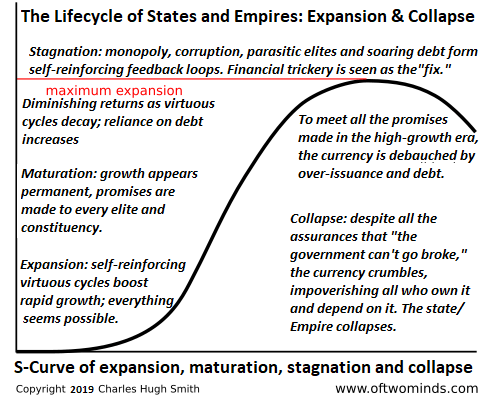
3. Vested interests block adaptions that threaten their share of the spoils. Any advance that increases efficiency and productivity and furthers the public good is squelched, suppressed or co-opted by vested interests who rightly fear their share of the spoils might be diminished by advances that obsolete their particular cartel, monopoly or other embedded skim, scam, fraud, embezzlement or simply unproductive dead weight.

The status quo is thus locked into a death spiral as gatekeepers, insiders, vested interests and sold to the highest bidder politicos will protect vested interests even as the engines flood and the ship begins its long descent into the void.

How do otherwise smart people become so blind to what’s going on? They believe the status quo is so wealthy, so powerful, so clever, etc., that it will overcome any obstacles or crises because it’s always done so in the past, and so it is permanent, immutable, forever, and our supping at the trough of free money couldn’t possibly weaken such an enduring Leviathan.

This is the fatal fantasy of every empire. We’re too successful to fail and collapse. But oddly enough, faith in the permanence of success leads to the very collapse that’s deemed “impossible.”

4. Concentrations of wealth, power, capital and production fatally distort the economy and the social order. When “competition” has been reduced to two telecoms, two healthcare insurers, two pork processors, etc., the system has been stripped of adaptability and resilience.

When 10,000 small farmers each have 100 chickens, the stock of 1 million chickens is spread over a wide geography and entrepreneurial network of suppliers, wholesalers, etc. Bird flu may spread widely but it’s far more difficult to wipe out 10,000 small farms’ poultry compared to the ease of bird flu spreading in one giant factory that concentrates 1 million chickens in one facility. Supply chains stripped of network resilience are equally fragile and prone to disruption and collapse.

Concentrating any form of capital, production and power renders the system vulnerable to collapse due to the inherent weaknesses generated by replacing complex networks with vertical-integration under the control of a few cartels, monopolies, autocrats, gatekeepers or regulators–the latter two being easily influenced by political pressure and/or private gain.

It’s certainly possible to be disgusted, but being disabused of the fantasy that the system is self-correcting is the healthier perspective. Everything is forever until systemic weaknesses reveal themselves, typically at the most inopportune junctures.

Destroying Western Values To Defend Western Values

By Caitlin Johnstone

Source: CaitlinJohnstone.com

So it turns out the US intelligence cartel has been working intimately with online platforms to regulate the “cognitive infrastructure” of the population. This is according to a new investigative report by The Intercept, based on documents obtained through leaks and an ongoing lawsuit, on the “retooling” of the Department of Homeland Security from an agency focused on counterterrorism to one increasingly focused on fighting “misinformation, disinformation, and malinformation” online.

While the DHS’s hotly controversial “Disinformation Governance Board” was shut down in response to public outcry, the Intercept report reveals what authors Lee Fang and Ken Klippenstein describe as “an expansive effort by the agency to influence tech platforms” in order to “curb speech it considers dangerous”:

According to a draft copy of DHS’s Quadrennial Homeland Security Review, DHS’s capstone report outlining the department’s strategy and priorities in the coming years, the department plans to target “inaccurate information” on a wide range of topics, including “the origins of the COVID-19 pandemic and the efficacy of COVID-19 vaccines, racial justice, U.S. withdrawal from Afghanistan, and the nature of U.S. support to Ukraine.”

The report reveals pervasive efforts on the part of the DHS and its Cybersecurity and Infrastructure Security Agency (CISA), along with the FBI, to push massive online platforms like Facebook, Instagram and Twitter to censor content in order to suppress “threats” as broad as fomenting distrust in the US government and US financial institutions.

“There is also a formalized process for government officials to directly flag content on Facebook or Instagram and request that it be throttled or suppressed through a special Facebook portal that requires a government or law enforcement email to use,” The Intercept reports.

“Emails between DHS officials, Twitter, and the Center for Internet Security outline the process for such takedown requests during the period leading up to November 2020,” says The Intercept. “Meeting notes show that the tech platforms would be called upon to ‘process reports and provide timely responses, to include the removal of reported misinformation from the platform where possible.’”

While these government agencies contend that they are not technically forcing these tech platforms to remove content, The Intercept argues that its investigation shows “CISA’s goal is to make platforms more responsive to their suggestions,” while critics argue that “suggestions” from immensely powerful institutions will never be taken as mere suggestions.

“When the government suggests things, it’s not too hard to pull off the velvet glove, and you get the mail fist,” Michigan State University’s Adam Candeub tells The Intercept. “And I would consider such actions, especially when it’s bureaucratized, as essentially state action and government collusion with the platforms.”

The current CISA chief is seen justifying this aggressive government thought policing by creepily referring to the means people use to gather information and form thoughts about the world as “our cognitive infrastructure”:

Jen Easterly, Biden’s appointed director of CISA, swiftly made it clear that she would continue to shift resources in the agency to combat the spread of dangerous forms of information on social media. “One could argue we’re in the business of critical infrastructure, and the most critical infrastructure is our cognitive infrastructure, so building that resilience to misinformation and disinformation, I think, is incredibly important,” said Easterly, speaking at a conference in November 2021.

Another CISA official is seen suggesting the agency launder its manipulations through third party nonprofits “to avoid the appearance of government propaganda”:

To accomplish these broad goals, the report said, CISA should invest in external research to evaluate the “efficacy of interventions,” specifically with research looking at how alleged disinformation can be countered and how quickly messages spread. Geoff Hale, the director of the Election Security Initiative at CISA, recommended the use of third-party information-sharing nonprofits as a “clearing house for trust information to avoid the appearance of government propaganda.”

But as a former ACLU president tells The Intercept, if this were happening in any government the US doesn’t like there’d be no qualms about calling it what it is:

“If a foreign authoritarian government sent these messages,” noted Nadine Strossen, the former president of the American Civil Liberties Union, “there is no doubt we would call it censorship.”

Indeed, this report is just another example of the way western powers are behaving more and more like the autocracies they claim to despise, all in the name of preserving the values the west purports to uphold. As The Intercept reminds us, this business of the US government assigning itself the responsibility of regulating America’s “cognitive infrastructure” originated with the “allegation that Russian agents had seeded disinformation on Facebook that tipped the 2016 election toward Donald Trump.” To this day that agenda continues to expand into things like plots to censor speech about the war in Ukraine.

Other examples of this trend coming out at the same time include Alan MacLeod’s new report with Mintpress News that hundreds of former agents from the notorious Israeli spying organization Unit 8200 are now working in positions of influence at major tech companies like Google, Facebook, Microsoft and Amazon (just the latest in MacLeod’s ongoing documentation of the way intelligence insiders have been increasingly populating the ranks of Silicon Valley platforms), and the revelation that The Grayzone’s Max Blumenthal and Aaron Maté were barred from participating in a Web Summit conference due to pressure from the Ukrainian government.

We’re destroying western values to defend western values. To win its much-touted struggle of “democracies vs autocracies“, western civilization is becoming more and more autocratic. Censoring more. Trolling more. Propagandizing more. Jailing journalists. Becoming less and less transparent. Manipulating information and people’s understanding of truth.

We’re told we need to defeat Russia in Ukraine in order to preserve western values of freedom and democracy, and in order to facilitate that aim we’re getting less and less free speech. Less and less free thought. Less and less free press. Less and less democracy.

I keep thinking of the (fictional) story where during World War II Winston Churchill is advised to cut funding for the arts to boost military funding, and he responds, “Then what are we fighting for?” If we need to sacrifice everything we claim to value in order to fight for those values, what are we fighting for?

Dissent is becoming less and less tolerated. Public discourse is being more and more aggressively disrupted by the powerful. We’re being shaped into the exact sort of homogeneous, power-serving, tyrannized, propagandized population that our leaders criticize other nations for having.

If the powerful are becoming more tyrannical in order to fight tyranny, what’s probably actually happening is that they are just tyrants making up excuses to do the thing they’ve always wanted to do.

As westerners in “liberal democracies” we are told that our society holds free speech, free thought and accountability for the powerful as sacrosanct.

Our leaders are showing us that this is a lie.

The problem with “western values” is that the west doesn’t value them.

In reality, those who best exemplify “western values” as advertised are the ones who are being most aggressively silenced and marginalized by western powers. The real journalists. The dissidents. The skeptics. The free thinkers. The peace activists. Those who refuse to bow down to their rulers.

Our ongoing descent into tyranny in the name of opposing tyrants calls forth a very simple question: if defeating autocracy requires becoming an autocracy, what’s the point of defeating autocracy?

Emily Oster’s Plea Bargain

Shuck-and-jive from America’s broken thinking class, the people who pretend to know better than everybody else.

By James Howard Kunstler

Source: Kunstler.com

By now, everybody and his uncle has seen Emily Oster’s plea for “pandemic amnesty” in The Atlantic magazine, a house organ of the people in America who know better than you do about… really… everything. Emily’s wazoo is so stuffed with gold-plated credentials (BA, PhD, Harvard; economics prof at Brown U) it’s a wonder that she could sit down long enough to peck out her lame argument that “we need to forgive one another for what we did and said when we were in the dark about COVID.”

Emily wasn’t “in the dark.” She had access to the same information as the Americans who recognized that everything the public health authorities, the medical establishment, and many elected officials shoveled out about Covid and its putative remedies and preventatives was untrue, with a patina of bad faith and malice — especially when it was used to persecute their political adversaries.

These dissenters turned out to be “right for the wrong reasons,” she declared, the main reason being that they were not aligned in good-think with the Woke-Jacobinism of her fellow “progressives” at Brown U, and academics all across the land, who were righteously busy destroying the intellectual life of the nation, making it impossible for the thinking class to think.

Let’s face it: every society actually needs a thinking class, a cohort able to frame important issues-of-the-moment that require argument in the public arena to align our collective thoughts and deeds with reality. America used to have a pretty good thinking class, with a pretty good free press and many other platforms for opinion — all animated by respect for the first amendment to the Constitution.

The thinking class destroyed that by vigorously promoting a new censorship regime in every American institution, shutting down free speech and, more crucially, the necessary debate for aligning our politics with reality. Hence, America’s thinking class became the torchbearers of unreality, in step with the Party of Chaos which held the levers of power. This included the powers of life and death in the matter of Covid-19.

These were the people who militated against effective early treatment protocols (to cynically preserve the drug companies’ emergency use authorization (EUA) and thus their liability shields); the people who enforced the deadly remdesivir-and-ventilator combo in hospital treatment; the people who rolled out the harmful and ineffective “vaccines”; who fired and vilified doctors who disagreed with all that; and who engineered a long list of abusive policies that destroyed businesses, livelihoods, households, reputations, and futures.

How did it happen that the thinking class destroyed thinking and betrayed itself? Because the status competition for moral righteousness in the sick milieu of the campus became more important to them than the truth. In places like Brown U, what you saw was an escalating contest for status brownie-points, which is what virtue-signaling is all about. And the highest virtue was going along with whatever experts and people-in-authority said — the pathetic virtue of submission. Anything that got in the way of going along — such as differences of opinion — had to be crushed, stamped out, and with a vicious edge to teach the dissenters a lesson: dissent will not be tolerated!

Some thinking class. The case of Emily Oster should be particularly and painfully disturbing, since she affects to specialize, as an economist, on “pregnancy and parenting” (her own website declares), while the Covid regime of public health officialdom she supported instigated a horrendous pediatric health crisis that is ongoing — it was only days ago that the CDC added the harmful mRNA “vaccines” to its childhood immunization schedule for the purpose of conferring permanent legal immunity for the drug companies after the EUA ends, a dastardly act. Where’s Ms. Oster’s plea to the CDC to cease and desist trying to vaccinate kids with mRNA products?

The CDC is still running TV commercials (during World Series ballgames!) touting its “booster” shots when only weeks ago a top Pfizer executive, Janine Small (“Regional President for Vaccines of International Developed Markets”), revealed in testimony to the European Union Parliament that her company never tested its “vaccine” for preventing transmission of SARS CoV-2. The CDC under Director Rochelle Walensky is still extra-super-busy concealing or fudging its statistical data to obfuscate the emerging picture that MRNA “vaccines” are responsible for the shocking rise of “all-causes deaths” in the most heavily-vaxxed nations. In short, the authorities are to this minute still running their whole malign operation.

Notably, Ms. Oster’s plea for amnesty and forgiveness, showcased in The Atlantic, omits any discussion of accountability for what amounts to serious crimes against the public. A whole lot of people deserve to be indicted for killing and injuring millions of people. At the heart of her plea is the excuse that “we didn’t know” official Covid policy was so misguided. That’s just not true, of course, and is simply evidence of the thinking class’s recently-acquired allergy to truth. The part she left out of her petition for pandemic amnesty is: we were only following orders.

Pandemic? Great Reset? How about… a beginner’s mind?

By Mickey Z.

Source: Dissident Voice

“In the beginner’s mind there are many possibilities. In the expert’s, there are few.” 1

Has there ever been a more urgent time to embrace many possibilities? This age of pervasive uncertainty and division may well be very fertile ground for questioning our assumptions and interrogating our beliefs. In fact, we just might be living in the ideal time to accept that there are limitless ways to perceive even the most contentious issues.

Expert vs. Beginner

The expert’s mind is over-secure in its prowess. Such a mentality may promote shortsighted habits like confirmation bias. Many “authorities” will only seek out (read: cherry-pick) information that validates and justifies their behavior because expertise — real or imagined — causes us to grow less curious.

If we already feel well-versed in a topic, we tend to pay less attention to it. We ask fewer questions. This is a stifling choice even if we know 95 percent of what there is to know about a particular subject. Ideally, this is when we should be paying more attention to it in order to discern the nuances that remain to be learned.

Conversely, the beginner’s mind is ever-hungry for input — regardless of its source or its tendency to reinforce existing beliefs. In the beginner’s mind, there are fewer limits and fewer expectations. There is much more room for revelation and awe. Nothing is taken for granted and even the tiniest detail has the potential to inspire reverence.

The beginner’s mind is basically the polar opposite of today’s social media algorithms, mainstream news headlines, and popular political discourse.

3 (of the many) Benefits of a Beginner’s Mind

Creativity

Habits and structure can be incredibly useful. They can also become an obstacle to innovation. A beginner’s mind encourages us to approach familiar problems with a fresh perspective. This mindset often results in the exploration of avenues that an expert would casually dismiss as “been there, done that.”

Gratitude

A beginner’s mind awakens each morning, ready to wipe the slate clean and start anew. From this fresh perspective, it feels more natural to identify and appreciate your blessings.

Mindfulness

Seeing the world like a beginner prevents you from “going through the motions.” There is a clearer understanding that the present is all you have. The past is where guilt and regret dwell. In the future may lie apprehension and anxiety. Right here, right now, the moment is enough.

How to Rediscover a Beginner’s Mind

By its very definition, there are an infinite number of ways to occupy a beginner’s mind. To follow are some basic guidelines but think of them like Bruce Lee’s finger pointing a way to the moon. As Lee urged, “Don’t concentrate on the finger or you’ll miss all that heavenly glory.”2

1. Reject your ego’s need to be an expert

Eavesdrop on a conversation at the local supermarket. Even better, scroll (without reacting) through most threads on social media. You’ll see and hear so many people pretending they know“what’s really happening” and “what’s gonna happen.” Your ego craves the status of being right. The beginner in you would rather open-mindedly look for reality than be deemed an expert at anything.

2. Slow down

As touched on above, we must avoid going through the motions. Whenever possible, slow down to question and explore. Take your time to learn — even from the most unlikely of sources.

3. Channel your inner child

Re-introduce yourself to some of your closest childhood friends: wonder, mischief, and playfulness. Reject the cynical adult premise of “same shit, different day.”

4. See with new eyes

In the words of Marcel Proust: “The real voyage of discovery consists not in seeking new landscapes, but in having new eyes.”3 Practically speaking, your quest for new eyes can begin with simple exercises like treating your hometown as if you were a tourist and seeing what you can discover.

5. Embrace nonsense 

As Gary Zukav, author of Dancing Wu Li Masters: An Overview of the New Physics, (1979), posits: “Nonsense is nonsense only when we have not yet found that point of view from which it makes sense.”

6. Meditation

Perhaps the most time-worn path to a beginner’s mind is the practice of mindful meditation. Whether you choose a spiritual or secular approach, even ten minutes a day of meditation will expand your consciousness.

“The child is in me still and sometimes not so still.”4

There is no one right way to inhabit a beginner’s mind. After all, it is not a destination. It’s all about the process, the learning, and those moments of epiphany made possible by not closing off your options… so re-activate your inner child.

Keep re-evaluating what you believe before your perceptions can grow ossified. Don’t limit your explorations by choosing in advance what it is you wish to find. Turn your truth over and over, again and again. Avoid accumulating old answers. Instead, dedicate far more of your time to conjuring up new questions. Through it all, let compassion serve as your compass.

The experts [sic] have gotten us into this mess.

It’s time to give beginners their opportunity to shine.

  1. Shunryu Suzuki, Prologue Zen Mind, Beginner’s Mind, (1973). []
  2. Bruce Lee, Enter the Dragon, 1973. []
  3. The Captive. (La Prisonnière, the fifth volume of Remembrance of Things Past), 1923. []
  4. Fred Rogers, (2003). The World According to Mister Rogers: Important Things to Remember, p. 45, Hachette UK. []

Saturday Matinee: All About Lily Chou Chou

THE GRAY TRAGEDY OF YOUTH IN JAPAN: SHUNJI IWAI’S “ALL ABOUT LILY CHOU-CHOU”

By Luke Powell

Source: Sabukaru

Released in 2001, writer and director Shunji Iwai’s “All About Lily Chou-Chou” 「リリイ• シュシュのすべて」is a masterclass in complex and powerful storytelling, cinematography, and meta-textual messaging that puts on display the formative, introspective, and oftentimes malicious enigma that is the life of youth in Japan.

Set in the town of Ashikaga, the story centers around the relationship of two young boys, Shusuke Hoshino and Yuichi Hasumi, as they progress through junior high school. Hoshino is known to be one of the top students in their school and is harassed and ostracized by his classmates as a result, a commonplace occurrence for those caught outside the boundaries of conformity while growing up in Japan. Yuichi, in contrast, is shy and submissive to the societal structures that surround him, only paying attention and devoting all his personal time to the singer and songwriter Lily Chou-Chou.

In his free time, Yuichi manages an online BBS chatroom titled “Lilyholic,” which is completely dedicated to Lily and her music, and the messages sent between users of this website overlay much of the film. The mystery surrounding this chatroom and the messages between its users acts as a crucial plot point that slowly unravels in conjunction with the film’s events.

At one point, Yuichi, Hoshino, and their friends manage to secure a trip to Okinawa, during which Hoshino has a near-death experience that serves as the foundation for the cruel and unusual monster that he becomes, changing his and Yuichi’s relationship forever as he usurps his way into being the school’s bully the following school year.  Despite the title, this is not simply a story about a fictional songwriter and her music, but the disturbing and oftentimes glossed-over ways in which modern society corrupts the minds of youth, and the various ways those children attempt to cope against such odds. 

Yuichi’s love and devotion for Lily Chou-Chou is the emotional epicenter of this film, as it displays the profound ability for music to save and give meaning to young people’s lives, especially when surrounded by ignorant adults and inhumane peers. While the musician herself is fictional, Lily Chou-Chou’s mythical music expands over the course of the film, overlaying its imagery of lonesomeness, isolation, and absurdity with luscious, calming, and poignant bits of melancholic bliss; a reflection of Yuichi’s character and perspective on the world around him.

Users of the chatroom “Lilyholic” continuously exclaim their love for Lily and her ability to channel the “Ether,” an invisible yet omni-present force that connects all fans of Lily Chou-Chou together in their existence through Lily’s music. The “Ether” is an intrinsic aspect of the power her music has on those who listen to her, serving as the connective thread that weaves its way through the fabric of a fragile reality, allowing those lost in the tribulations of life to hold onto something organic, warm, and personal, an oasis among a desert of expectations, conformity, and isolation. 

It goes without saying that the music on display in this film is truly special and should be experienced firsthand, with the soundtrack growing organically as the audience learns more about Lily, her music, and the different characters in the film who become impacted by her compositions [for better or for worse].

Throughout the film, there are multiple references to the classical French composer Claude Debussy, whom users of Lilyholic cite as being one of Lily’s musical inspirations, as he was able to produce the “Ether” through his compositions. For example, the song that accompanies the opening scene of the film, titled 「アラベスク」[“Arabesuku”] is based off of Debussy’s “Arabesque No. 1.” Lily’s shrill yet comforting voice glides over synthesized piano chords, distanced hints of strained guitar, and a lo-fi drum beat that subjects the 19th-century classical work to a cybernetic restructuring – all of which results in one of the most captivating opening experiences in film.

Arranged and produced by Takeshi Kobayashi, the music of “All About Lily Chou-Chou” is a kaleidoscope of sonic captivity, melting between Lily’s somber yet grungy aesthetic as well as moments of clarity through the use of classical composers like Debussy, combining to create less of a soundtrack and more of an experience that will cling to you long after the credits have finished rolling.

The narrative direction and cinematography of “All About Lily Chou-Chou” are also aspects that cannot be ignored. The narrative’s timeline is fractured, starting chronologically from the middle of the story, eventually flashing back to the canonical beginning, and finally returning to the present to finish out the film. The script is adapted from an online novel that was written by director Shunji Iwai himself in the chatroom of a real-life version of the “Lilyholic” website, in which the director plays out the story of “All About Lily Chou-Chou” through the chat exchanges of two site users. A version of this website can still be accessed online today, and its existence is only the tip of the iceberg for the extensive material surrounding this film beyond its screen time. The narrative, in this sense, is multi-layered and meta-textual – an interactive and organic experience that not only goes beyond the medium of film but places a sense of participation and influence in the viewer, only to be powerless against the fierce, apathetic, and surreal scenes we witness.

The cinematography by Noboru Shinoda [“Hana and Alice,” “Love Letter”] is just as varied and complex as the film’s narrative, as it switches between ethereal, lush views of rice fields and angelic classroom settings in one shot, to the jarring use of hand-held cameras and disorienting angles in the next. Shinoda and Iwai were the first Japanese filmmakers to use the now discontinued Sony HDW-F900 digital video camera which was designed to reflect the look of 35mm film, further emphasizing the thematic imagery of nostalgia and dream-like isolation.

The camera work almost seems to be shot by a child at times, such as an unseen member of Yuichi’s friend group or class as they youthfully document the strange and disturbing events occurring in front of them, only focusing on the power a digital camera has without considering what they are actually recording. Or rather, Iwai may be intending for us, the viewer, to put ourselves behind the lens, acting as a silent observer to the events that unfold without the voice or power to do anything about it, which is strikingly similar to Yuichi’s character in the film itself. The combination of a fractal narrative structure and an abrasive yet realistic use of the camera encapsulates so much of the themes and messaging this film has to offer – mainly that being the confusing, frustrating, and unapologetic nature of growing up surrounded by unforgiving societal structures, while at the same time blindly attempting to hold onto and bask in the naiveté of youth. 

The subject of youth is the eye of Iwai’s proverbial hurricane of emotion and turmoil that is “All About Lily Chou-Chou.” Made in 2001, this film was produced at a time in Japan that saw a sharp increase in teenage crime and suicide following the economic collapse of 1991. In a country so wrought with societal and familial expectations, the bursting of their economic bubble proved disastrous for Japan’s teenage and young-adult population, as they were now tasked with bearing said expectations and cultural conformity against a historically low employment rate.

Commonly referred to as the “Lost Decade,” the 1990s in Japan was filled with headlines detailing the effect of the recession on the country’s young population, as teenage crime doubled in frequency, and reports of bullying and assault within schools skyrocketed. The rise in crime and disillusionment among the country’s youth resulted in many Japanese filmmakers attempting to grasp this idea of “teenage rage” through their films in the late 90s and early 2000s, such as in Takashi Miike’s “Fudoh: The New Generation” [1996] and Kinji Fukasaku’s “Battle Royale” [2000]. While these films painted a more dystopian and fantastical perspective of the violent phenomenon, Shunji Iwai wanted to represent this general angst and discontent in a more realistic manner that would directly connect with the audience it sought to portray. In one interview from 1995, Iwai reflects on his perspective towards the children who will be watching his stories: “We have to make movies that appeal to them and reflect the world they live in.” 

The characters within “All About Lily Chou-Chou” represent the cruel realities of the “Lost Decade.” They don’t conduct acts of headline-defining mass crime or comical absurdity, but instead are portrayed as unheard, misguided, and tragic children who are following in the steps of complicit adults as they attempt to find answers in a confusing world that they have no power in controlling. As shown in the film, some of these characters choose to find those answers in disturbing cruelty or abusive domination over their peers, while others try to be as passive or silent as humanly possible just to survive. And yet, while each character within this film leads a complex and difficult life that sometimes results in catastrophe, all of them are connected through the “Ether,” endlessly searching for a sense of comfort, acceptance, and understanding through the soundscape of Lily Chou-Chou. It could be said that the characters within this film are all living in, as Yuichi states in one monologue, “the age of Gray,” a liminal space of reality that seems to place their lives in a state of constant immobility and pain. Life is made void of color by the brutal violence and betrayal that these children either commit or fall victim to, and for some, Lily provides safety and guidance in that darkness, while she may also fuel the angry, merciless fire burning inside others. 

“All About Lily Chou-Chou” is dark, disturbing, and cruel in its presentation, but manages to be something so much more intimate, profound, and human in its substance. It discusses themes surrounding the troubles of youth in Japan, who are constantly cornered by cultural and familial expectations, conformity, and a social hierarchy that can be detrimental to those caught in its jaws. It portrays the fragility of youth, how easily corruptible a young mind can be, and how one source of bliss can be enough to hold onto the hope of a better tomorrow. Today, in a world dominated by online interactions, superficial connections, and an uncertain future, this film is more relevant than ever before – a true cyber hymn that anyone and everyone can find meaning within. 

We have attached the album that was released under the name “Lily Chou-Chou” after the movie was released so that you can get a better feel for the movie and the artist that is the titular character of the entire film. It features all of Lily’s music that is present in the film, and is titled “Kokyu” [or “Breathe” in English], which is in reference to the project that she released during the movie itself.

The entire thing can also be streamed on Spotify. In particular, the following songs are absolutely stunning and very representative of the movie itself:

  • Arabesque [アラベスク “Arabesuku”]
  • Flightless Wings [飛べない翼 “Tobenai Tsubasa”]
  • Glide [グライド “Guraido”] 

Watch All About Lily Chou Chou on Kanopy here: https://www.kanopy.com/en/product/5636535