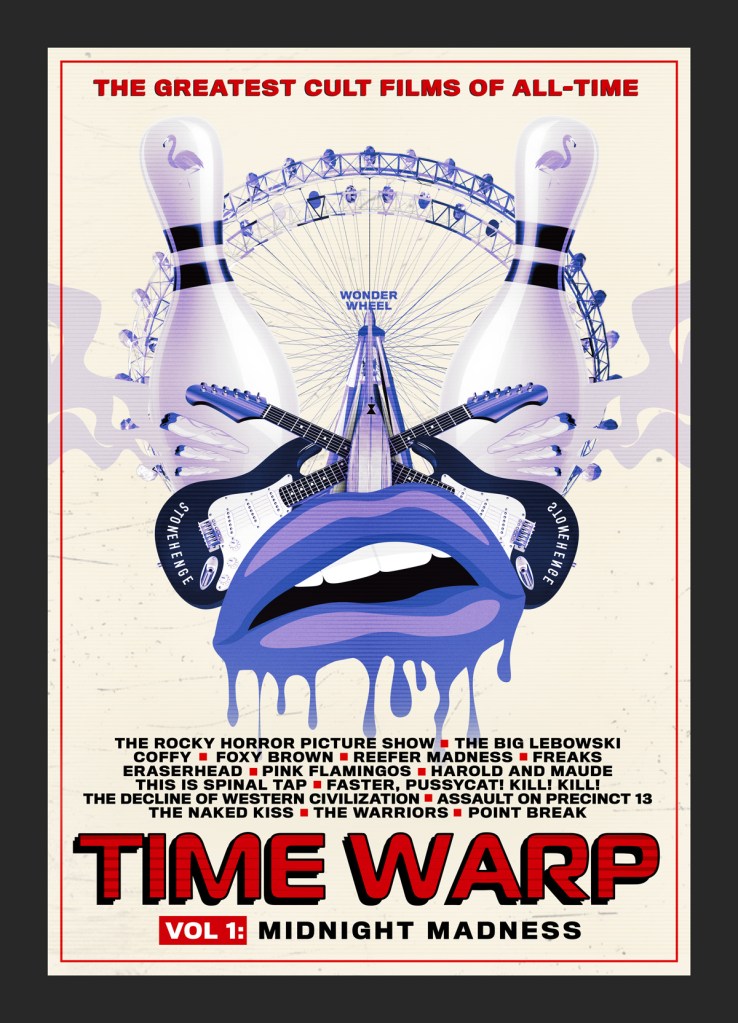
Saturday Matinee: Time Warp Vol 1-3

Documentary Review — “Time Warp: The Greatest Cult Films of All Time”

By Roger Moore

Source: Movie Nation

Ask a hundred film buffs what their favorite cult film is, and you’ll get 500 answers.

Because nobody wants to limit that pick to the obvious — “The Rocky Horror Picture Show,” “Harold & Maude,” “Eraserhead” — to admit how many times they’ve watched “The Evil Dead,” or to interrupt their latest trip to Lebowski Fest to give the question more serious thought.

So it’s no wonder that Quiver and director Danny Wolf couldn’t limit themselves to a single documentary, rounding up stars, directors, academics and critics to swoon over and deconstruct their favorites.

“Time Warp: The Greatest Cult Films of All Time” is a three-part mini-series, covering everything from “Freaks” to “The Warriors,” “Spinal Tap” to “Valley Girl.”

There are lots of opinions about the definition of a “cult” film, taking into account its “edge,” forbidden fruit “danger,” rejection by the mass movie audience (many were bonafide “flops” that found their audience over decades) and that ineffable “something” that makes you want to call your best friend and yell, “Friend, you have GOT to see this.”

I think John Cleese comes the closest to getting that definition right.

A cult film, Our Lord J.C. (of “Monty Python and the Holy Grail”) says, is one “that you think is much better than it is.”

“The Rocky Horror Picture Show (1975)” is celebrated as the greatest cult film of them all, a movie that opened to little notice, but which “never ever left the cinema,” as Patricia Quinn, one of several members of the cast speaking here, declares. Fans and critics and cult director John Waters (“Pink Flamingos”) talk of its impact on the culture, putting a “transvestite transexual” on screens where isolated, closeted fans could see someone that might be closer to their own sexuality than anything mainstream Hollywood was putting out.

Tod Browning’s still alarming “differently-abled” thriller “Freaks” (1932) is titled “the scariest movie ever made” by the likes of comic writer Bruce Vilanch and others.

Pam Grier talks of her glory days in Blaxploitation cinema like “Foxy Brown” and “Coffy.”

Gary Busey goes hyperbolic over “Point Break,” which has gained stature via a growing online fandom.

“Harold & Maude,” “The Decline of Western Civilization” punk documentaries, the films of the cleavage-cultist Russ Meyers and the down and dirty noir classics of Sam Fuller (“The Naked Kiss”), John Carpenter’s “Assault on Precinct 13” — a lot of ground is covered just in “Volume One: Midnight Madness.”

Everybody here is an enthusiast, and director Danny Wolf got Jeff Bridges and John Turturro to talk about “The Big Lebowski,” Rob Reiner and several others to speak about “Spinal Tap” and David Patrick Kelly to reminisce of the glory that was and remains “The Warriors.”

Those big names missing (Tim Curry, Keanu, Kathryn Bigelow, Tarantino, David Lynch, seen only in a ’70s interview) are barely missed.

Not all of it works. The conceit of having a “panel” consisting of directors Joe Dante (“Gremlins”) and John Waters, actress Ileana Douglas (?) and comic and actor Kevin Pollack (!?) could have left the hosting to Waters — the real authority, the Cult King.

There’s a whole subgenre of “revolting cult films” that aren’t so labeled but show up here. “Eraserhead” and any of the early warped Waters movies could turn your stomach.

Later installments will dwell on everything from masterpieces like “A Clockwork Orange” and “Blade Runner” to the obscure “Liquid Sky,” bonafide hits (no “cult” to them) like “Fast Times at Ridgemont High” to the zombie genre — “Living Dead” movies no longer having any cult appeal.

What, no “Stunt Man?” Well, they got to “Show Girls.” That’ll have to do.

But that’s the fun of it all, the arguments it starts. Because what really defines this sub-category of cinema is movies that have taken on a life of their own, taken over by fans.

And if the fans prefer “The Warriors” (popular, enduring, classic) to “Streets of Fire” (a lot more “cultish” for my money), they’re the arbiters.

“Time Warp,” in three installments, shows up via VOD and digital streaming, April 21 (ep. 1), May 19 (ep. 2) and June 23 (ep. 3).

Tune in. All the cool kids will be there.

Watch the Time Warp trilogy on Kanopy here:

Vol 1 – https://www.kanopy.com/en/product/11188290

Vol 2 – https://www.kanopy.com/en/product/11188292

Vol 3 – https://www.kanopy.com/en/product/11188294

How “Food Shortages” & Economic Collapse Protects the Status Quo

Engineered Food & Poverty Crises Secure Continued US Dominance

By Colin Todhunter

Source: Off-Guardian

In March 2022, UN Secretary-General Antonio Guterres warned of a “hurricane of hunger and a meltdown of the global food system” in the wake of the crisis in Ukraine.

Guterres said food, fuel and fertiliser prices were skyrocketing with supply chains being disrupted and added this is hitting the poorest the hardest and planting the seeds for political instability and unrest around the globe.

According to the International Panel of Experts on Sustainable Food Systems, there is currently sufficient food and no risk of global food supply shortages.

We see an abundance of food but skyrocketing prices. The issue is not food shortage but speculation on food commodities and the manipulation of an inherently flawed global food system that serves the interests of corporate agribusiness traders and suppliers of inputs at the expense of people’s needs and genuine food security.

The war in Ukraine is a geopolitical trade and energy conflict. It is largely about the US engaging in a proxy war against Russia and Europe by attempting to separate Europe from Russia and imposing sanctions on Russia to harm Europe and make it further dependent on the US.

Economist Professor Michael Hudson recently stated that ultimately the war is against Europe and Germany. The purpose of the sanctions is to prevent Europe and other allies from increasing their trade and investment with Russia and China.

Neoliberal policies since the 1980s have hollowed out the US economy. With its productive base severely weakened, the only way for the US to maintain hegemony is to undermine China and Russia and weaken Europe.

Hudson says that, beginning a year ago, Biden and the US neocons attempted to block Nord Stream 2 and all (energy) trade with Russia so that the US could monopolise it itself.

Despite the ‘green agenda’ currently being pushed, the US still relies on fossil fuel-based energy to project its power abroad. Even as Russia and China move away from the dollar, the control and pricing of oil and gas (and resulting debt) in dollars remains key to US attempts to retain hegemony.

The US knew beforehand how sanctions on Russia would play out. They would serve to divide the world into two blocks and fuel a new cold war with the US and Europe on one side with China and Russia being the two main countries on the other.

US policymakers knew Europe would be devastated by higher energy and food prices and food importing countries in the Global South would suffer due to rising costs.

It is not the first time the US has engineered a major crisis to maintain global hegemony and a spike in key commodity prices that effectively trap countries into dependency and debt.

In 2009, Andrew Gavin Marshall described how in 1973 – not long after coming off the gold standard – Henry Kissinger was integral to manipulating events in the Middle East (the Arab-Israeli war and the ‘energy crisis’). This served to continue global hegemony for the US, which had virtually bankrupted itself due to its war in Vietnam and had been threatened by the economic rise of Germany and Japan.

Kissinger helped secure huge OPEC oil price rises and thus sufficient profits for Anglo-American oil companies that had over-leveraged themselves in North Sea oil. He also cemented the petrodollar system with the Saudis and subsequently placed African nations, which had embarked on a path of (oil-based) industrialisation, on a treadmill of dependency and debt due to the spike in oil prices.

It is widely believed that the high-priced oil policy was aimed at hurting Europe, Japan and the developing world.

Today, the US is again waging a war on vast swathes of humanity, whose impoverishment is intended to ensure they remain dependent on the US and the financial institutions it uses to create dependency and indebtedness – the World Bank and IMF.

Hundreds of millions will experience (are experiencing) poverty and hunger due to US policy. These people (the ones that the US and Pfizer et al supposedly cared so much about and wanted to get a jab into each of their arms) are regarded with contempt and collateral damage in the great geopolitical game.

Contrary to what many believe, the US has not miscalculated the outcome of the sanctions placed on Russia. Michael Hudson notes energy prices are increasing, benefiting US oil companies and US balance of payments as an energy exporter. Moreover, by sanctioning Russia, the aim is to curtail Russian exports (of wheat and gas used for fertiliser production) and for agricultural commodity prices to therefore increase. This too will also benefit the US as an agricultural exporter.

This is how the US seeks to maintain dominance over other countries.

Current policies are designed to create a food and debt crisis for poorer nations especially. The US can use this debt crisis to force countries to continue privatising and selling off their public assets in order to service the debts to pay for the higher oil and food imports.

This imperialist strategy comes on the back of ‘COVID relief’ loans which have served a similar purpose. In 2021, an Oxfam review of IMF COVID-19 loans showed that 33 African countries were encouraged to pursue austerity policies. The world’s poorest countries are due to pay $43 billion in debt repayments in 2022, which could otherwise cover the costs of their food imports.

Oxfam and Development Finance International have also revealed that 43 out of 55 African Union member states face public expenditure cuts totalling $183 billion over the next five years.

The closure of the world economy in March 2020 (‘lockdown’) served to trigger an unprecedented process of global indebtedness.

Conditionalities mean national governments will have to capitulate to the demands of Western financial institutions. These debts are largely dollar-denominated, helping to strengthen the US dollar and US leverage over countries.

The US is creating a new world order and needs to ensure much of the Global South remains in its orbit of influence rather than ending up in the Russian and especially Chinese camp and its belt road initiative for economic prosperity.

Post-COVID, this is what the war in Ukraine, sanctions on Russia and the engineered food and energy crisis are really about.

Back in 2014, Michael Hudson stated that the US has been able to dominate most of the Global South through agriculture and control of the food supply. The World Bank’s geopolitical lending strategy has transformed countries into food deficit areas by convincing them to grow cash crops – plantation export crops – not to feed themselves with their own food crops.

The oil sector and agribusiness have been joined at the hip as part of US geopolitical strategy.

The dominant notion of ‘food security’ promoted by global agribusiness players like Cargill, Archer Daniel Midland, Bunge and Louis Dreyfus and supported by the World Bank is based on the ability of people and nations to purchase food. It has nothing to do with self-sufficiency and everything to do with global markets and supply chains controlled by giant agribusiness players.

Along with oil, the control of global agriculture has been a linchpin of US geopolitical strategy for many decades. The Green Revolution was exported courtesy of oil-rich interests and poorer nations adopted agri-capital’s chemical- and oil-dependent model of agriculture that required loans for inputs and related infrastructure development.

It entailed trapping nations into a globalised food system that relies on export commodity mono-cropping to earn foreign exchange linked to sovereign dollar-denominated debt repayment and World Bank/IMF ‘structural adjustment’ directives. What we have seen has been the transformation of many countries from food self-sufficiency into food deficit areas.

And what we have also seen is countries being placed on commodity crop production treadmills. The need for foreign currency (US dollars) to buy oil and food entrenches the need to increase cash crop production for exports.

The World Trade Organization’s Agreement on Agriculture (AoA) set out the trade regime necessary for this type of corporate dependency that masquerades as ‘global food security’.

This is explained in a July 2022 report by Navdanya International – Sowing Hunger, Reaping Profits – A Food Crisis by Design – which notes international trade laws and trade liberalisation has benefited large agribusiness and continue to piggyback off the implementation of the Green Revolution.

The report states that US lobby and trade negotiations were headed by former Cargill Investors Service CEO and Goldman Sachs executive – Dan Amstutz – who in 1988 was appointed chief negotiator for the Uruguay round of GATT by Ronald Reagan. This helped to enshrine the interests of US agribusiness into the new rules that would govern the global trade of commodities and subsequent waves of industrial agriculture expansion.

The AoA removed protection of farmers from global market prices and fluctuations. At the same time, exceptions were made for the US and the EU to continue subsidising their agriculture to the advantage of large agribusiness.

Navdanya notes:

“With the removal of state tariff protections and subsidies, small farmers were left destitute. The result has been a disparity in what farmers earn for what they produce, versus what consumers pay, with farmers earning less and consumers paying more as agribusiness middlemen take the biggest cut.”

‘Food security’ has led to the dismantling of food sovereignty and food self-sufficiency for the sake of global market integration and corporate power.

We need look no further than India to see this in action. The now repealed recent farm legislation in India was aimed at giving the country the ‘shock therapy’ of neoliberalism that other countries have experienced.

The ‘liberalising’ legislation was in part aimed at benefiting US agribusiness interests and trapping India into food insecurity by compelling the country to eradicate its food buffer stocks – so vital to the nation’s food security – and then bid for food on a volatile global market from agribusiness traders with its foreign reserves.

The Indian government was only prevented from following this route by the massive, year-long farmer protest that occurred.

The current crisis is also being fuelled by speculation. Navdanya cites an investigation by Lighthouse Reports and The Wire to show how speculation by investment firms, banks and hedge funds on agricultural commodities are profiting off rising food prices. Commodity future prices are no longer linked to actual supply and demand in the market but are based purely on speculation.

Archer Daniels Midland, Bunge, Cargill and Louis Dreyfus and investment funds like Black Rock and Vanguard continue to make huge financial killings, resulting in the price of bread almost doubling in some poorer countries.

The cynical ‘solution’ promoted by global agribusiness to the current food crisis is to urge farmers to produce more and seek better yields as if the crisis is that of underproduction. It means more chemical inputs, more genetic engineering techniques and suchlike, placing more farmers in debt and trapped in dependency.

It is the same old industry lie that the world will starve without its products and requires more of them. The reality is that the world is facing hunger and rising food prices because of the system big agribusiness has instituted.

And it is the same old story – pushing out new technologies in search of a problem and then using crises as justification for their rollout while ignoring the underlying reasons for such crises.

Navdanya sets out possible solutions to the current situation based on principles of agroecology, short supply lines, food sovereignty and economic democracy – policies that have been described at length in many articles and official reports over the years.

As for fighting back against the onslaught on ordinary people’s living standards, support is gathering among the labour movement in places like the UK. Rail union leader Mick Lynch is calling for a working class movement based on solidarity and class consciousness to fight back against a billionaire class that is acutely aware of its own class interests.

For too long, ‘class’ has been absent from mainstream political discourse. It is only through organised, united protest that ordinary people will have any chance of meaningful impact against the new world order of tyrannical authoritarianism and the devastating attacks on ordinary people’s rights, livelihoods and standards of living that we are witnessing.

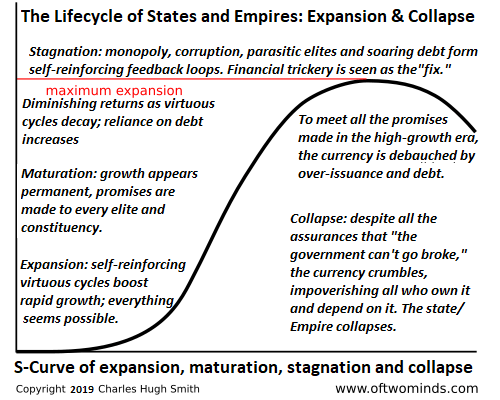
Peering Into the Crystal Ball, We See… Instability Leading to Collapse

By Charles Hugh Smith

Source: Of Two Minds

We can only choose one: open, dynamic stability (evolution) or autocracy (instability and collapse).

When the fundamentals of life change, every organism must evolve or die. This is equally true of human organizations, societies and economies.

Evolution requires conserving what still works and experimenting until something comes along that works better. We call the fundamentals changing selective pressure and the process of experimenting with mutations / variations natural selection.

In genetic and epigenetics, this process is automatic. In human organizations, those in power influence the choice of what is conserved or replaced and what it’s replaced with. Those who benefit from the current arrangement will fight to conserve it as is, while those being weakened by selective pressure and those hoping to gain advantages with a new arrangement will fight for replacing the old with the new.

Longtime correspondent Ron G. recently shared an insightful economic characterization of this dynamic: wealth defense vs wealth creation. Those holding the system’s wealth have few incentives to risk changing the system, as those changes could undermine or erode their wealth. They have incentives to limit evolutionary forces that threaten their wealth as a means of defending their wealth.

Those who have lost wealth and those with little wealth have incentives to change the system to favor wealth creation.

We can describe the first as orthodoxy–evolution threatens the stability of the status quo, so limit evolution to the margins–and heretics being the second option that tosses out the status quo in favor of a more advantageous variation.

This isn’t either / or, of course. As Ron points out, corporations have incentives to both conserve stability and embrace variations that increase revenues and profits by expanding the markets for the company’s products. In Ron’s words: “The function of orthodoxy or corporate policy / rigor is to mitigate variations that would decrease stability.”

In other words, there’s a danger of throwing the baby out with the bath water. Dynamic equilibrium is based on a constant flux of variations and experiments–that is, low-level instability–continually modifying the system to maintain core stability.

Without this constant flux of low-level instability, sources of instability pile up, unnoticed and uncorrected, until they become consequential enough to destabilize the entire system. The system implodes, crashes, unravels, etc.

We can understand this flux of variations and experiments as evolutionary churn, and this churn requires two things: a steady flow of mutations / variations to feed the process of experimentation, and transparency so advantageous variations aren’t suppressed. In a transparent evolutionary system, data and information about each variation and experiment flows freely between all nodes in the system.

You see the problem. Those benefiting from the status quo are threatened by variations that could replace whatever is defending their wealth. Those in power benefit from the status quo, so their Job One is to suppress evolution by limiting transparency and variations, which include dissent.

Theoretically, those in power favor evolutionary advances that enhance their power and wealth, but anything that powerful is generally a two-edged sword: modified slightly, it could disrupt the entire status quo and fatally undermine their power.

So the safe bet is to suppress all evolutionary churn except those improvements which can be used to further cement their power. These are by definition autocratic.

You see the delicious irony: autocrats suppress evolutionary churn and transparency as threats, but evolutionary churn and transparency are the essential forces maintaining the system’s dynamic equilibrium. Once the system’s dynamic equilibrium decays, systemic instability builds up and eventually brings the entire system crashing down.

Because this process is obscured by authoritarian suppression of transparency, “nobody saw it coming.”

As those in power adopt ever stronger authoritarian measures to limit the potential threats of evolutionary churn and transparency, they accelerate the fatal instabilities building up within their self-serving, kleptocratic social, political and economic systems.

By suppressing the evolutionary churn and transparency that maintain the system’s dynamic equilibrium, they doom their regime to collapse.

The crystal ball isn’t cloudy, it’s crystal-clear: rising instability leading to collapse. “Nobody saw it coming” except those who understand evolution requires evolutionary churn and transparency.

Collapse is a perfectly good evolutionary solution. Stability is either dynamic or it’s not actually stable; it’s merely a simulacrum of stability sliding toward instability and ruin.

The better option is to embrace evolutionary churn and transparency and accept the trade-off: we can only choose one: open, dynamic stability (evolution) or autocracy (instability and collapse). Choose wisely, for once systems collapse there’s no turning back the clock.

It’s A Fact That Needs Repeating: The Federal Reserve Is A Suicide Bomber

By Brandon Smith

Source: Alt-Market.us

For many years now I have been examining the policies and behaviors of the Federal Reserve because they are in fact the most powerful institution in the US, with far more influence over the fate of America than any single president or branch of government. They have the power to end the economic life of our country in a matter of moments. They hold their finger on the button of multiple financial nuclear bombs, and to this day there are people that still pretend as if they are a mere moderating presence subservient to the White House or Congress.

This is a fallacy proven by history and the admissions from central bankers own mouths. The Fed answers to no one in our government. They answer to a different set of masters, and the blame for the consequences of their policies falls to them and their cohorts.

Last year I published an article titled ‘The Fed’s Catch-22 Taper Is A Weapon, Not A Policy Error.’ In that article I predicted that the Fed would embark on a hiking spree on interest rates in response to inflationary/stagflationary events. I noted that:

We are now at that stage again where price inflation tied to money printing is clashing with the stock market’s complete reliance on stimulus to stay afloat. There are some that continue to claim the Fed will never sacrifice the markets by tapering. I say the Fed does not actually care, it is only waiting for the right time to pull the plug on the US economy.”

At the time I received a lot of resistance to the idea. The usual argument was: “The fed will never raise rates and put stock markets at risk. Why would they destroy the golden goose?”

This position showcases a common misconception about the central bank and its purpose. You see, a lot of people think the Fed exists to keep the US economy afloat, and specifically to keep stock markets afloat. This is incorrect. Every single policy of the Fed since its inception has been a long train of abuses designed to slowly and scientifically whittle down the US economy and bring it to the point of extinction.

The next most common argument is: “Wouldn’t the fed sabotaging the economy eventually destroy them as well?”

The answer is YES, and they don’t care. If you have read my previous work on this issue then you know that the Fed is inexorably tied to the Bank for International Settlements (the “central bank of central banks”) and that they call the shots in terms of coordinated global banking initiatives. The BIS is a globalist institution, not an American one, and its agenda is ideologically globalist in nature. The Fed is a servant of globalism; and if the US economy or our currency need to be brought down through a controlled demolition in order to make the globalist dream of a one world socialist “Utopia” come true, that is exactly what the Fed will do.

I was able to predict that the Fed would continue onward with its interest rate hikes and hawkish position only because I acknowledge what the Fed really is: A suicide bomber. And, they have decided the time is ripe to hike interest rates into economic weakness, just like they did at the onset of the Great Depression.

At the beginning of the Depression the Fed increased interest rates after years of artificially stimulating markets with low cost debt. This prolonged the deflationary crash for many years after. It was not until decades later when former Fed chair Ben Bernanke gave a speech celebrating economist Milton Friedman’s 90th birthday that a central bank official finally admitted that the organization was culpable for the Depression debacle.

In short, according to Friedman and Schwartz, because of institutional changes and misguided doctrines, the banking panics of the Great Contraction were much more severe and widespread than would have normally occurred during a downturn.

Let me end my talk by abusing slightly my status as an official representative of the Federal Reserve. I would like to say to Milton and Anna: Regarding the Great Depression. You’re right, we did it. We’re very sorry. But thanks to you, we won’t do it again.” – Ben Bernanke, 2002

What Ben Bernanke did not admit to was that the engineered deflationary crisis greatly benefited the allies of the Fed – The international corporate bankers. Companies like JP Morgan and Chase National were suddenly in a prime position to seize unlimited power in the US.

So, they’ve done it before, why wouldn’t they do it again?

The next argument that I hear constantly is that the Fed is “ignorant” and they don’t know what they are doing. This is nonsense. Jerome Powell knows EXACTLY what he is doing, and here is the proof – In October of 2012 the Fed held a meeting in which Powell warned that markets and corporations had become addicted to the Fed’s easy money policies. If they decided to taper their stimulus measures and raise rates, there would be potentially disastrous blowback. Powell argued that:

“…I think we are actually at a point of encouraging risk-taking, and that should give us pause. Investors really do understand now that we will be there to prevent serious losses. It is not that it is easy for them to make money but that they have every incentive to take more risk, and they are doing so. Meanwhile, we look like we are blowing a fixed-income duration bubble right across the credit spectrum that will result in big losses when rates come up down the road. You can almost say that that is our strategy.” – Jerome Powell

As he admitted, it is indeed their strategy. Powell was not the Fed chairman at the time, so he may not have been aware of the full agenda, but he is certainly aware now. Why would Powell undertake the exact policy action he once warned would result in a full spectrum implosion of the credit bubble? Probably because he was told to.

Powell knows the history of the Great Depression and he knows what will happen when the Fed raises rates into economic weakness and he is doing it anyway. He already tried a test run of rate hikes back in 2018 and the results were not hard to figure out; markets began to tank. We should never forget that the central banks are fully cognizant of the effects of their endeavors. As I stated back in February:

The rate hikes of 2018 were a test run for a more aggressive and deliberately engineered crisis down the road. The Fed has its own agenda, it does not care about protecting U.S. markets, nor does it even care about protecting the U.S. economy in general.

I hold that the Fed is a weapon for social and political change within America and part of its job is to greatly reduce the standard of living of the population while making it appear as if this decline is a “natural” consequence of the U.S. System.”

This leads us to the final question – What happens next?

That’s easy to answer: The fed continues to hike rates well into next year and will not reverse course or capitulate and return to stimulus. The dovish predictions were wrong. The people that said the Fed would not raise rates were wrong. The people that said the Fed would never remove support from stock markets were wrong. This process is ongoing and the effects will grow as the months pass, but those that were hoping for a manic return to the days of bailouts and QE are going to be deeply disappointed.

This is a stagflationary crash, and as such we are going to experience the worst of both deflationary and inflationary worlds. Prices will remain high while GDP goes negative. Sales will decline and jobs will decline as we enter into the end of this year. There is no way around this. The Fed will have all kinds of theories and misdirections on why these things are happening, and they will try to distract the public as much as possible in the meantime.

What the Fed will never do is admit that a crash is happening until it is too late for people to act. They will never warn the populace of the dangers and they will never tell people to prepare. Watch as they tap dance and tell the public that all the pain is “transitory.” Then, watch as the dust settles and they tell people that “no one could have seen this coming.” It’s all very predictable, because it’s all been done before.

FILMMAKER REVEALS THE TRUTH ABOUT SUBLIMINAL MESSAGES

By Dylan Charles

Source: Waking Times

We’re all being conditioned to think and believe certain things without any rational explanation through subliminal messaging in advertising, music, film, television, political propaganda, and military psychological operations.

Considering the definition of the word subliminal – ‘existing or functioning below the threshold of consciousness’ – it is easy to downplay the power of this brainwashing technique because most people are not consciously aware that it is happening, yet, it is affecting their lives. Once you realize that subliminal messaging is real and start to pay attention, it becomes much easier to recognize the we are, indeed, all being conditioned to behave a certain way, to want certain things, and to believe in ideas, without being able to rationally explain why.

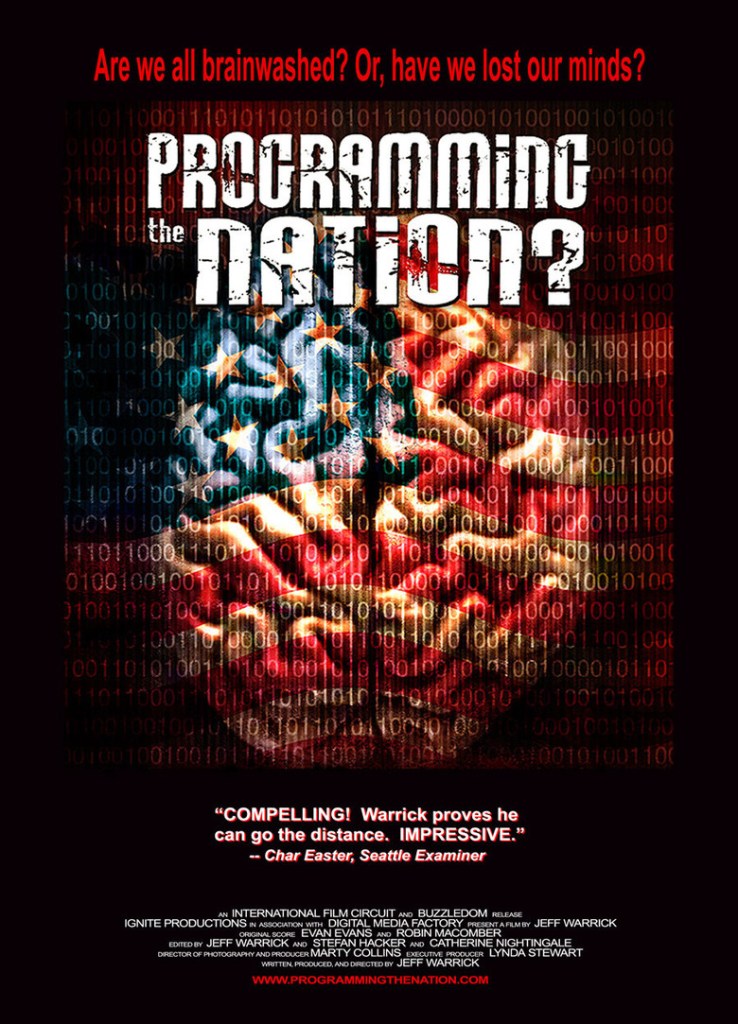
Below is a short video in which Jeff Warrick, the director of Programming the Nation (2011), offers his take on the truth about subliminal messaging. Warrick shares a few examples of messages embedded within ads, which are not likely to be seen consciously, but are admitted into the subconscious mind.

A common response to this type of revealing information is skepticism and disbelief that sexual innuendos or random words embedded in pictures or film will not impact a person’s willingness to buy a product.

Although it is a common assumption that sex sells because for most people it is associated with feelings of pleasure, excitement, enjoyment or even love, subliminal messaging is about much more than helping advertisers sell more product. These messages are designed to have an impact on general consumer behavior and affect people’s life patterns, thus molding society as a whole, creating and captivating more and more receptive consumers.

When bombarded with subliminal messaging, the mind is likely to trigger emotions, memories or feelings, without a person’s conscious recognition of why they feel a certain way. A person may not consciously realize why they start to become more attracted to certain behaviors, lifestyles or products, but they are more likely to succumb to the attraction.

“..subliminal ads are used as a technique not only to increase sales but is also used to divert youth and involve them in such type of behaviour which is only hazardous to the consumer.” ~ (Impact of Subliminal Messaging in TV Advertisements on Consumer Behaviour – A Case Study of Youth in Kashmir Province of J&K, Blue Ocean Research Journalssource)

Are subliminal messages contributing to a variety of economic, social, and political problems currently present in our culture, such as over-competitiveness, low self-esteem, obesity, over-consumption and debt? There are many examples that support this idea and demonstrate that subliminal messaging, over time, can have a powerful impact.

Take, for instance, advertising to women. If you look at any variety of ads that are targeted at women ages 18-35, an overwhelming majority will personify that women and girls should be thin, wear lots of makeup, style their hair in certain ways, and, of course, look very sexy. It almost appears as though it is the advertisers’ job to make young women feel bad about themselves.

See the following example of women in advertising in the video below:

Other examples are films such as the Rambo series of the 1980’s and the more resent American Sniper, which glorify mindless military self-sacrifice, torture and violence. They romanticize obedience to authority and unquestioning loyalty to a war-mongering government.

“‘American Sniper’ lionizes the most despicable aspects of U.S. society—the gun culture, the blind adoration of the military, the belief that we have an innate right as a “Christian” nation to exterminate the “lesser breeds” of the earth, a grotesque hypermasculinity that banishes compassion and pity, a denial of inconvenient facts and historical truth, and a belittling of critical thinking and artistic expression.” – Chris Hedges

Below is the complete documentary by Jeff Warrick, Programming the Nation, that offers a full history behind subliminal message. In the film, Warrick examines if subliminal messaging and other subconscious techniques have conditioned the United States public to become one of the highest consuming nations in the world, accounting for about 25 percent use of the worlds natural resources even though its populace makes up less than 5 percent of the global population.

Saturday Matinee: The Wailing

Film Analysis: The Wailing (2016) by Na Hong-jin screening on Fantasia International Film Festival

By Panos Kotzathanasis

Source: Asian Movie Pulse

Na Hong-jin is one of those rare cases in S. Korean cinema, which, despite having enormous success with their films, are not exactly eager to follow up. In that fashion, he has shot just three films in eight years, with the previous one (The Yellow Sea) screening six years before. His absence was quite felt in the country’s cinema, but his return fully compensates. “The Wailing” is already an international success, amassing more the $51 million in international revenue, while it has also won five Blue Dragon Awards (Director, Supporting Actor, Popularity Award, Editing, and Music). Here are seven reasons for the film’s success.

In a seemingly peaceful village, a kind of epidemic suddenly breaks out, with people losing their minds and attacking their relatives and with their skin suffering from a hideous infection. Their attacks have resulted in violent deaths, and the local police seem unable to deal with the case, eventually concluding that poisonous mushrooms are causing this behavior. Among them is officer Jong-goo, who hears a rumor about a Japanese man living on the top of a nearby hill being the actual perpetrator, a suspicion that becomes stronger after a strange young woman, named Moo-myeong confirms the fact. Eventually, he tracks down the man’s house and comes across a series of truly horrific spectacles. Being kind of coward himself, he tries to avoid the situation as much as possible, but when his little daughter, Hyo-jin, comes down with similar symptoms, Jong-doo is willing to go to extremes to save her. Meanwhile, his mother-in-law invites Il- gwang, a shaman, to perform an exorcism on the girl while a deacon  named Yang Yi-sam, is also involved, as a translator of Japanese for the police. The truth about what is really going on, and who the actual evil characters are, changes all the time, until the end. In that fashion, Na Hong-jin manages to retain the agony for the whole duration of the movie, as the twists are continuous and quite shocking.

Underneath the elaborate script, Na Hong-jin has hidden a very sharp, sociopolitical allegory, which my friend and expert on Korean film allegory, Bastian Meiresonne has pointed out to me. Moo-myeong, the shaman woman, is a direct reference to South Korea’s current president, Park Geun-hye, who has an intense connection with shamanism (or Muism, as is the Korean version of it) through the Eternal Life Church and her advisor, Choi Soon-sil, the instigator of the latest scandal that has led to her impeachment trial. In that fashion, Moo-myeong (shaman / white woman) is manipulating people to accuse the foreigner (or the past of South Korea in another interpretation). Her accusations make the people of the town become more and more racist, and to eventually kill the foreigner. It is always a dream sequence or a story told that has the Japanese man doing magic, or he is nearby, but he never actually does anything. The only time that he performs shamanism is in order to counter the woman’s sorcery.

The sequence where Moo-myeong is throwing stones at Jong-goo symbolizes how racism gets to people. It takes quite awhile, and lots of small “stones”, and people in the beginning are negative, like Jong-goo, who tells the woman to leave. Eventually though, it gets to them, and when they understand what is happening, it is too late. This allegory becomes clear during the sequence where the Japanese man turns into a monster in front of the wannabe priest, Yang Yi-sam. He says to him: “You only see me as you want to see me – and if I would tell you how I really look like (normal guy), you wouldn’t believe me anyway.” In that fashion, racism makes targeted people seem like monsters. The wannabe priest is an allegory regarding South Korea’s very troubled religious history, with Protestants and Catholics doing a lot of wrong in the country.

At one point, people call upon Korea’s traditional past – the shaman – (Il-Gwang) to help them, whose first question is how much he will be paid. As soon as the ritual is over (where he actually did nothing), he puts on his brand sportswear, in a symbolism of how old Korea has been left behind for money and western “values”. The only one who seems to realize the truth is the little girl, Hyo-jin, who symbolizes the children in general. She continuously yells “STOP”, but her parents continue to do the wrong thing and trust the shaman – Park Geun-hye – as they succumb to racism. In that fashion, Na Hong-jin means that the children will turn against their parents for the consequences they will have to pay, due to their mistakes.

Na Hong-jin directs and pens an agonizing thriller, building the tension gradually as the story progresses, until the utterly shocking finale, one of the film’s greatest sequences. He incorporates a plethora of horror-favorite elements and notions, including zombies, vampires, demons, and exorcists, although the only one majorly implemented is the latter, with the rest existing, for the most part, to create an atmosphere of supernatural horror. In that fashion, he avoids the reef of hyperbole, maintaining a very serious approach throughout the film, despite some minor moments of unexpected humor. The pace is neither fast nor slow, but has the most fitting speed for the story, which artfully escalates as the time passes, until the impressive ending with the continuous plot twists. Apart from that, there is much cursing, violence, and a number of truly grotesque bloodbaths and spectacles in general, which supplement the general aesthetics of the film. Lastly, the allegories are another element that moves the film beyond the typical horror movie, adding another level and more substance.

The cast is another point of excellence, with Kwak Do-won giving a wonderful performance as Jong-goo, an easily intimidated police officer who transforms into a relentless hunter for the sake of his daughter. Kwak has been mostly cast in secondary roles during his career, and he proves in this film that he is made of protagonist material. Hwang Jung-min is great as usual as Il-gwang, in his path to become the next Song Kang-ho. The exorcism scene is the highlight of his impressive performance. The one who truly steals the show, however, is Jun Kunimura as the mysterious Japanese man, whose acting and physique make him the perfect choice for the particular role, as he constantly exhibits a subtle but obvious threat, despite the fact that he does not speak very much. Kim Hwan-hee is also great as little Hyo-jin, in a rather difficult role that demanded her transformation from a cute and smart little girl to a violent, constantly cursing, possessed individual. Lastly, the gorgeous Chun Woo-hee shines particularly in the end, with a truly eerie performance.

Technically the film is magnificent, with Hong Kyung-pyo’s cinematography wonderfully presenting the grotesque atmosphere in the rural surroundings of the film, while exhibiting images of bucolic beauty as much as of onerous terror, particularly inside the various houses in the area. Furthermore, the extensive shooting in natural light gives the film an eerie essence that so suits its general atmosphere. Kim Sun-min’s editing is also great, retaining the agony throughout the film, while the sequencing is a work of art, particularly during the exorcism scene and the ending. Jang Young-gyu magnificently supplements the general atmosphere of the film, especially during the agonizing scenes.

All of the film’s aspects find their apogee in the exorcism scene, the movie’s most impressive and meaningful sequence. In terms of acting, Hwang Jung-min has the central role, presenting an exorcist performing a complicated ritual, as he dances around, killing a cock and chanting the whole time. Kw ak Do-won wonderfully portrays his character’s agony, particularly due to the reactions of his daughter, as Kim Hwan-hee is truly terrifying screaming and kicking as if she is being killed. Jun Kunimura is also great, as he presents his character’s stress over countering the ritual. The cinematography of the scene is extraordinary, as the difference in the two exorcisms is presented by the opposite colors (white and black) of the cocks sacrificed and the setting where they take place: the first in full light, and the second one in the darkness. Since the two rituals occur simultaneously, the editing is also masterful, as the two scenes alternate magnificently. The music, mainly produced through hand drums, heightens the tension even more.

“The Wailing” features many grotesque scenes. Cannibalism, violent killings, people acting like zombies, the terribly depicted skin infection, the cock killing ritual, and the amounts of blood all point towards an extreme horror film. The same applies to Hyo-jin’s behavior, which is very hard to watch, particularly during the ritual scene. The sequences involving the dog and the interior of the Japanese man’s house also move in the same direction. However, Na Hong-jin manages to “hide” this grotesqueness, as the other more artful elements of the film are the ones that dominate in the end. The intricate script with the deep and meaningful allegory, the well-analyzed characters, the fitting pace, and the elaborate cinematography that presents images of extreme beauty, alongside those of extreme grotesqueness, succeed in making the film watchable by anybody. The sporadic humor also moves in this direction, and this along with the aforementioned elements make “The Wailing” a great combination of artistry, meaningfulness, and entertainment, which even applies to fans of the extreme.

“The Wailing” is a truly great spectacle, a must-see for every fan of S. Korean cinema and a great return for a great filmmaker.

Watch The Wailing on Hoopla here: https://www.hoopladigital.com/title/11707489

Overthrow the Government: All the Ways in Which Our Rights Have Been Usurped

By John & Nisha Whitehead

Source: The Rutherford Institute

“We the people are the rightful masters of both Congress and the courts, not to overthrow the Constitution but to overthrow the men who pervert the Constitution.” — Abraham Lincoln

It’s easy to become discouraged about the state of our nation.

We’re drowning under the weight of too much debt, too many wars, too much power in the hands of a centralized government, too many militarized police, too many laws, too many lobbyists, and generally too much bad news.

It’s harder to believe that change is possible, that the system can be reformed, that politicians can be principled, that courts can be just, that good can overcome evil, and that freedom will prevail.

So where does that leave us?

Benjamin Franklin provided the answer. As the delegates to the Constitutional Convention trudged out of Independence Hall on September 17, 1787, an anxious woman in the crowd waiting at the entrance inquired of Franklin, “Well, Doctor, what have we got, a republic or a monarchy?” “A republic,” Franklin replied, “if you can keep it.”

What Franklin meant, of course, is that when all is said and done, we get the government we deserve.

Those who gave us the Constitution and the Bill of Rights believed that the government exists at the behest of its citizens. It is there to protect, defend and even enhance our freedoms, not violate them.

Unfortunately, although the Bill of Rights was adopted as a means of protecting the people against government tyranny, in America today, the government does whatever it wants, freedom be damned.

“We the people” have been terrorized, traumatized, and tricked into a semi-permanent state of compliance by a government that cares nothing for our lives or our liberties.

The bogeyman’s names and faces have changed over time (terrorism, the war on drugs, illegal immigration, a viral pandemic, and more to come), but the end result remains the same: in the so-called name of national security, the Constitution has been steadily chipped away at, undermined, eroded, whittled down, and generally discarded with the support of Congress, the White House, and the courts.

A recitation of the Bill of Rights—set against a backdrop of government surveillance, militarized police, SWAT team raids, asset forfeiture, eminent domain, overcriminalization, armed surveillance drones, whole body scanners, stop and frisk searches, vaccine mandates, lockdowns, and the like (all sanctioned by Congress, the White House, and the courts)—would understandably sound more like a eulogy to freedoms lost than an affirmation of rights we truly possess.

What we are left with today is but a shadow of the robust document adopted more than two centuries ago. Sadly, most of the damage has been inflicted upon the Bill of Rights.

Here is what it means to live under the Constitution, twenty-plus years after 9/11 and with the nation just emerging from two years of COVID-19 lockdowns and mandates.

The First Amendment is supposed to protect the freedom to speak your mind, assemble and protest nonviolently without being bridled by the government. It also protects the freedom of the media, as well as the right to worship and pray without interference. In other words, Americans should not be silenced by the government. To the founders, all of America was a free speech zone.

Despite the clear protections found in the First Amendment, the freedoms described therein are under constant assault. Increasingly, Americans are being persecuted for exercising their First Amendment rights and speaking out against government corruption. Activists are being arrested and charged for daring to film police officers engaged in harassment or abusive practices. Journalists are being prosecuted for reporting on whistleblowers. States are passing legislation to muzzle reporting on cruel and abusive corporate practices. Religious ministries are being fined for attempting to feed and house the homeless. Protesters are being tear-gassed, beaten, arrested and forced into “free speech zones.” And under the guise of “government speech,” the courts have reasoned that the government can discriminate freely against any First Amendment activity that takes place within a so-called government forum.

The Second Amendment was intended to guarantee “the right of the people to keep and bear arms.” Essentially, this amendment was intended to give the citizenry the means to resist tyrannical government. Yet while gun ownership has been recognized by the U.S. Supreme Court as an individual citizen right, Americans remain powerless to defend themselves against red flag gun laws, militarized police, SWAT team raids, and government agencies armed to the teeth with military weapons better suited to the battlefield.

The Third Amendment reinforces the principle that civilian-elected officials are superior to the military by prohibiting the military from entering any citizen’s home without “the consent of the owner.” With the police increasingly training like the military, acting like the military, and posing as military forces—complete with heavily armed SWAT teams, military weapons, assault vehicles, etc.—it is clear that we now have what the founders feared most—a standing army on American soil.

The Fourth Amendment prohibits government agents from conducting surveillance on you or touching you or encroaching on your private property unless they have evidence that you’re up to something criminal. In other words, the Fourth Amendment ensures privacy and bodily integrity. Unfortunately, the Fourth Amendment has suffered the greatest damage in recent years and has been all but eviscerated by an unwarranted expansion of governmental police powers that include strip searches and even anal and vaginal searches of citizens, surveillance (corporate and otherwise), and intrusions justified in the name of fighting terrorism, as well as the outsourcing of otherwise illegal activities to private contractors.

The Fifth Amendment and the Sixth Amendment work in tandem. These amendments supposedly ensure that you are innocent until proven guilty, and government authorities cannot deprive you of your life, your liberty or your property without the right to an attorney and a fair trial before a civilian judge. However, in the new suspect society in which we live, where surveillance is the norm, these fundamental principles have been upended. Certainly, if the government can arbitrarily freeze, seize or lay claim to your property (money, land or possessions) under government asset forfeiture schemes, you have no true rights.

The Seventh Amendment guarantees citizens the right to a jury trial. Yet when the populace has no idea of what’s in the Constitution—civic education has virtually disappeared from most school curriculums—that inevitably translates to an ignorant jury incapable of distinguishing justice and the law from their own preconceived notions and fears. However, as a growing number of citizens are coming to realize, the power of the jury to nullify the government’s actions—and thereby help balance the scales of justice—is not to be underestimated. Jury nullification reminds the government that “we the people” retain the power to ultimately determine what laws are just.

The Eighth Amendment is similar to the Sixth in that it is supposed to protect the rights of the accused and forbid the use of cruel and unusual punishment. However, the Supreme Court’s determination that what constitutes “cruel and unusual” should be dependent on the “evolving standards of decency that mark the progress of a maturing society” leaves us with little protection in the face of a society lacking in morals altogether.

The Ninth Amendment provides that other rights not enumerated in the Constitution are nonetheless retained by the people. Popular sovereignty—the belief that the power to govern flows upward from the people rather than downward from the rulers—is clearly evident in this amendment. However, it has since been turned on its head by a centralized federal government that sees itself as supreme and which continues to pass more and more laws that restrict our freedoms under the pretext that it has an “important government interest” in doing so.

As for the Tenth Amendment’s reminder that the people and the states retain every authority that is not otherwise mentioned in the Constitution, that assurance of a system of government in which power is divided among local, state and national entities has long since been rendered moot by the centralized Washington, DC, power elite—the president, Congress and the courts.

Thus, if there is any sense to be made from this recitation of freedoms lost, it is simply this: our individual freedoms have been eviscerated so that the government’s powers could be expanded.

It was no idle happenstance that the Constitution opens with these three powerful words: “We the people.” As the Preamble proclaims:

We, the people of the United States, in order to form a more perfect Union, establish justice, insure domestic tranquility, provide for the common defense, promote the general welfare, and secure the blessings of liberty to ourselves and our posterity, do ordain and establish this CONSTITUTION for the United States of America.

In other words, it’s our job to make the government play by the rules of the Constitution.

We are supposed to be the masters and they—the government and its agents—are the servants.

We the American people—the citizenry—are supposed to be the arbiters and ultimate guardians of America’s welfare, defense, liberty, laws and prosperity.

Still, it’s hard to be a good citizen if you don’t know anything about your rights or how the government is supposed to operate.

As the National Review rightly asks, “How can Americans possibly make intelligent and informed political choices if they don’t understand the fundamental structure of their government? American citizens have the right to self-government, but it seems that we increasingly lack the capacity for it.”

Americans are constitutionally illiterate.

Most citizens have little, if any, knowledge about their basic rights. And our educational system does a poor job of teaching the basic freedoms guaranteed in the Constitution and the Bill of Rights. For instance, a survey by the Annenberg Public Policy Center found that a little more than one-third of respondents (36 percent) could name all three branches of the U.S. government, while another one-third (35 percent) could not name a single one.

A survey by the McCormick Tribune Freedom Museum found that only one out of a thousand adults could identify the five rights protected by the First Amendment. On the other hand, more than half (52%) of the respondents could name at least two of the characters in the animated Simpsons television family, and 20% could name all five. And although half could name none of the freedoms in the First Amendment, a majority (54%) could name at least one of the three judges on the TV program American Idol, 41% could name two and one-fourth could name all three.

It gets worse.

Many who responded to the survey had a strange conception of what was in the First Amendment. For example, a startling number of respondents believed that the “right to own a pet” and the “right to drive a car” were part of the First Amendment. Another 38% believed that “taking the Fifth” was part of the First Amendment.

Teachers and school administrators do not fare much better. A study conducted by the Center for Survey Research and Analysis found that one educator in five was unable to name any of the freedoms in the First Amendment.

Government leaders and politicians are also ill-informed. Although they take an oath to uphold, support and defend the Constitution against “enemies foreign and domestic,” their lack of education about our fundamental rights often causes them to be enemies of the Bill of Rights.

So what’s the solution?

Thomas Jefferson recognized that a citizenry educated on “their rights, interests, and duties”  is the only real assurance that freedom will survive.

As Jefferson wrote in 1820: “I know no safe depository of the ultimate powers of our society but the people themselves; and if we think them not enlightened enough to exercise their control with a wholesome discretion, the remedy is not to take it from them, but to inform their discretion by education. This is the true corrective of abuses of constitutional power.”

From the President on down, anyone taking public office should have a working knowledge of the Constitution and the Bill of Rights and should be held accountable for upholding their precepts. One way to ensure this would be to require government leaders to take a course on the Constitution and pass a thorough examination thereof before being allowed to take office.

Some critics are advocating that students pass the United States citizenship exam in order to graduate from high school. Others recommend that it must be a prerequisite for attending college. I’d go so far as to argue that students should have to pass the citizenship exam before graduating from grade school.

Here’s an idea to get educated and take a stand for freedom: anyone who signs up to become a member of The Rutherford Institute gets a wallet-sized Bill of Rights card and a Know Your Rights card. Use this card to teach your children the freedoms found in the Bill of Rights.

A healthy, representative government is hard work. It takes a citizenry that is informed about the issues, educated about how the government operates, and willing to do more than grouse and complain.

As I point out in my book Battlefield America: The War on the American People and in its fictional counterpart The Erik Blair Diaries, “we the people” have the power to make and break the government.

The powers-that-be want us to remain divided over politics, hostile to those with whom we disagree politically, and intolerant of anyone or anything whose solutions to what ails this country differ from our own. They also want us to believe that our job as citizens begins and ends on Election Day.

Yet there are 330 million of us in this country. Imagine what we could accomplish if we actually worked together, presented a united front, and spoke with one voice.

Tyranny wouldn’t stand a chance.