Two for Tuesday
Reply


By Peter Van Buren
Source: We Meant Well
“What stands out for visitors?” I asked our guide during a Honolulu Chinatown tour with my out-of-town guests. “Always the same, the homeless. Even Mainlanders from big cities like San Francisco and New York are surprised how many we have here. I’m waiting to see how the Japanese and Korean guests respond when they start traveling again.”
You can’t miss his point. During our brief walk through Chinatown’s markets we saw a disturbed man dressed only in his underwear touching himself, several seriously street-worn people begging, and watched the fire department respond to a prone homeless man who was dead or simply drugged into paralysis. When someone in our party needed the toilet, the shopkeeper apologized for having to keep it locked to prevent misuse by vagrants. Many places simply had signs saying “no public toilet.” Despite some great tasting food, it was hard to keep up a holiday spirit. Same for when we passed the tent cities and parks overtaken by homeless along a drive on the Windward side.
The numbers only begin to tell the story. Pre-COVID, there were an estimated 6,458 homeless in Hawaii. The Big Island saw the biggest jump in homelessness from 2019-2020, a 16 percent increase. On Oahu the homeless population is up 12 percent. San Francisco before COVID counted over 8,000 homeless persons, and while COVID-era numbers are hard to pin down, one measure is overdose deaths among the homeless, which have tripled. New York has the highest homeless population of any American metropolis, close to 80,000 and growing. The number of homeless there today is 142 percent higher than it was 10 years ago, and currently at the highest level since the Great Depression. Some 3,000 human beings make their full-time home in the subway.
Estimates for the United States as a whole run well over half a million people living homeless. The number shoots up dramatically if one includes people living in their cars, people on their way to exhausting the good will of friends who offered a couch, and those who slide in and out of motels as money ebbs and flows. Some 21 percent of American children live in poverty, homeless or not. In the end nobody actually knows how many people are living without adequate shelter except that it is a large number and it is a growing number and there is nothing in line to lower it, only to find new ways to tolerate it.
We have in many places already surrendered our public parks and libraries. The hostile architecture of protrusions and spikes which make it impossible to sleep on a park bench are pretty much sculpted into the architecture of the city, markers of the struggle for public space. The idea even has its own Instagram account. A security firm offers tips: restrict access to sidewalk overhangs protected from inclement weather, remove handles from water spigots, and keep trash dumpsters locked. If things get too bad, the company, for a price, will deploy “remote cameras with military-grade algorithms capable of detecting people in areas they shouldn’t be in.”
Keep in mind that all of these homeless people coexist in a United States whose wealthiest citizens have their own spaceships. NYC alone is home to 70 billionaires, more than any other American city. New York is also home to nearly one million millionaires, more than any other city in the world. How is it that the nation’s wealthiest city and poorest city are the same place?
All the solutions seem to fail. There are not enough shelters we are told but even when more shelters are built the homeless are too paranoid to move in,or the shelters become too dirty, too dangerous, chaos compacted, so the transition from an encampment to supportive housing isn’t easy. In ravaged San Francisco, one out of 10 of the city’s already existing supportive housing units are empty, with the director of the Department of Homelessness (!) placing the blame on individuals. So the homeless problem becomes a mental health problem which becomes a drug and alcohol problem which becomes a public health problem. Our society will not force people into care, and it will not deport the homeless against their will to desert camps. Instead we simply do nothing absent throwing a few bucks into food programs as an expedient over stepping around too many bodies in the street. Meanwhile nobody asks why nothing seems to work.
When you look at history with enough perspective you see very little happens without cause and effect. Things are connected. Casualty matters more than randomness. Answering the question of what to do about homelessness requires first answering the question of why we have the problem in the first place. Because while homelessness exists elsewhere in the developed world, you simply do not see it at pandemic proportions in equally-developed nations across Europe, and certainly not in the economic superstates like China, Japan, Singapore, et al. Scale and size matter and America wins on both. Why?
Because the American economic system requires homelessness. That’s why we can’t solve homelessness; no matter how much solving you do the system just makes more.
The Democratic arguments over raising the minimum wage are a smokescreen. As long there is a minimum wage and businesses do not have to compete for workers, there have to be homeless people. Think of the homeless as run-off, the unfortunate but necessary waste product of an economic system designed to exploit workers for the benefit of space-traveling overlords. The homeless — no wagers — are the endpoint of an economic spectrum dominated by the minimum wagers, people whose salary and hours, and thus whose chance at lifetime wealth status, are capped by agreement between the government and industry.
Until slavery ended, human beings were considered capital, just like stock today. Now we’re “human resources” so everything’s better. Bringing up race hides the real story of how long this has been going on and how deep a part of our way of life it is. The line between controlling someone with a whip and controlling someone through ever-lower wages gets finer and finer over time.
This is what “systematic” means: a system of public-private sector agreements codified as laws which push workers into a cesspool as grab-and-go disposable labor. Those who sink end up homeless. Those who tread water are guaranteed a life of maybe just enough, their place in society fixed for others’ goals, never their own. It also assures the sales of drugs, alcohol, and lottery tickets as the working poor try to convince themselves all this can’t be true. Can it?
The next step is clear. The working poor are allowed to exist at survival levels only because they are in jobs too expensive or difficult to automate. You think there are a lot of homeless now? Wait until self-driving vehicles click in and another job category simply disappears, leaving drivers and delivery people nowhere to go (there are more than 3.5 million truck drivers in the U.S., making driving one of the most popular occupations.) Same for fast food and other service jobs. Soon enough AI and/or remote online learning will make live teachers an expensive luxury for the children of the wealthy.
If you wanted a clever term about why we have and ignore and can’t address the homeless problem, you could call it systemic inequality in tune with the times’ nomenclature. A system designed to exploit will always exploit too much at its edges. It is supposed to, in order to keep driving the center downward, from 1950s middle class to 2022’s working poor.
But in the near term the issue isn’t confronting the reality of inequality, it is navigating the society it has created, much as my tour guide directed us around the homeless nests in Chinatown so we could sample the dim sum at leisure. “Don’t make eye contact” was some of his best advice.
Related Video:
By Michael Snyder
Source: End of the American Dream
We are careening directly into an abyss of war, pain and misery, and our leaders are thunderously applauding as it happens. Ukrainian President Volodymyr Zelenskyy came to Washington this week because he wanted more money, and our politicians in Washington definitely did not disappoint him. Even though we had already given Ukraine far more money than the rest of the world combined, our politicians agreed to give him another colossal mountain of cash. On some level, we all have to respect Zelenskyy’s skills as a con man. Even though he has banned the main opposition party in Ukraine, and even though he has banned all television stations that were critical of him, and even though he just banned an entire ancient Christian denomination, our politicians continue to worship him like some sort of a pop music star. Zelenskyy has become an extremely oppressive dictator that has set himself up to rule Ukraine for as long as he wants, but members of Congress from both parties continue to hail him as a “champion of democracy” that deserves our unquestioning support.
What makes this so dangerous is that Zelenskyy has been trying very hard to pull the United States into his war with Russia.
Throughout 2022 the U.S. has been getting increasingly involved in the conflict, and at this point we are “providing most of the funding, most of the equipment, most of the ammunition, most of the high level intelligence and much of the training” for the international army that is fighting the Russians in Ukraine.
In other words, we are essentially a direct participant in the war.
For years I have been warning my readers that there would be a war with Russia, and now it is here.
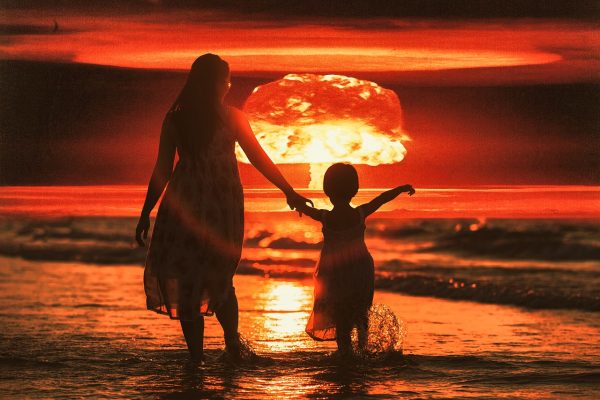
If we had rational leaders in Washington, they would be trying to end this conflict before the nukes start flying.
But instead, they are pledging to give Zelenskyy whatever he needs for as long as it takes to defeat the Russians.
When Zelenskyy visited Washington this week, the White House literally rolled out the red carpet for him.
To see such an honor bestowed upon a cruel foreign dictator that is ruthlessly oppressing anyone that opposes him should nauseate all of us.
And when Zelenskyy arrived to deliver his speech to a joint session of Congress, he was greeted with a standing ovation.
It isn’t just the Democrats that have fallen for Zelenskyy’s act.
At this point, Mitch McConnell says that showering Ukraine with money should be our “number one priority”…
“Providing assistance for Ukrainians to defeat the Russians is the number one priority for the United States right now according to most Republicans. That’s how we see the challenges confronting the country at the moment.”
Thankfully, there are still at least a few voices of reason that can see exactly what Zelenskyy is trying to do.
One of them is Tucker Carlson.
According to Carlson, it is absurd to give a foreign tyrant so much money when we have so many pressing needs here at home.
But no matter how hard Zelenskyy oppresses his own people, our politicians are going to continue to shower him with more money, and that is because Zelenskyy has done an amazing job of positioning his war as the most important “current thing”. I really like how John Nolte made this point in one of his most recent articles…
Zelensky has brilliantly — brilliantly! — positioned himself to be The Thing Through Which The Establishment Proves Its Purity.
That means the only questions anyone dares ask about Zelensky and Ukraine are…
Who can give Ukraine the most money?
Who can give Ukraine the most weapons?
Who can give Ukraine the most praise?
Who can lick Zelensky’s boots the cleanest?
Zelensky is getting everything he wants and more, including America flirting with nuclear war. Why? Because he was savvy enough to crack the code of the shallow, insecure, conformist idiots we elect and reelect as our leaders.
Nolte is quite right.
And once a con man has identified a “golden goose”, he is just going to keep coming back again and again.
So even though we have already given Ukraine more money than everyone else combined, it will never be enough to satisfy Zelenskyy.
In addition to cold, hard cash, the U.S. also continues to give the Ukrainians some of our best military equipment.
The Biden administration just agreed to send Patriot missile systems to Ukraine, and that represents another huge escalation.
The Biden administration will send to Ukraine the most advanced air defense weapon in its arsenal, the Patriot missile system, officials said Wednesday, marking the most significant addition to American military support for the government in Kyiv in months.
Meanwhile, the Russians continue to escalate the conflict as well.
In fact, it appears that the Russians have been very busy moving tanks into position for another major offensive campaign from the north.
If both sides just keep escalating matters, we will eventually reach a point where somebody crosses a line that will never be able to be uncrossed.
We have been pushed to the brink of nuclear war, and the Russians are getting ready to officially deploy their new Sarmat intercontinental ballistic missiles in January…
Putin said on Wednesday during a meeting with military chiefs that he aimed to deploy his terrifying RS-28 Sarmat missile – nicknamed Satan-2 – in January.
The world-ending missile can blast targets at almost 16,000mph – meaning it has the potential to obliterate the UK 1,600 miles away in just six minutes.
Sadly, the quote that you just read is not an exaggeration.
Each Sarmat can reportedly carry up to 15 independently-targetable nuclear warheads.
That means that one missile goes up, and 15 warheads come down.
And each one of those warheads can instantly wipe out an entire major city.
The Sarmat is the most advanced intercontinental ballistic missile in the entire world by a wide margin, and we have no way to defend against them.
So maybe we should think twice before getting into a nuclear war with Russia.
Unfortunately, our leaders seem to have gone completely mad at this point, and of course our leaders in Washington are simply a reflection of what has happened to the rest of our society.
When Ronald Reagan described the Soviet Union as the “Evil Empire” in the 1980s, he was quite correct.
But since that time just about every form of evil that you can possibly imagine has absolutely exploded in our own nation.
So are we “the baddies” now?
Sadly, most Americans will not even entertain that question.
And our leaders are just going to continue to push us toward a nuclear conflict that could ultimately mean the end of our society once and for all.
By John & Nisha Whitehead
Source: The Rutherford Institute
“When the song of the angels is stilled, when the star in the sky is gone, when the kings and princes are home, when the shepherds are back with their flocks, the work of Christmas begins: to find the lost, to heal the broken, to feed the hungry, to release the prisoner, to rebuild the nations, to bring peace among the people, to make music in the heart.”—Howard Thurman, theologian and civil rights activist
The Christmas story of a baby born in a manger is a familiar one.
The Roman Empire, a police state in its own right, had ordered that a census be conducted. Joseph and his pregnant wife Mary traveled to the little town of Bethlehem so that they could be counted. There being no room for the couple at any of the inns, they stayed in a stable (a barn), where Mary gave birth to a baby boy, Jesus. Warned that the government planned to kill the baby, Jesus’ family fled with him to Egypt until it was safe to return to their native land.
Yet what if Jesus had been born 2,000 years later.
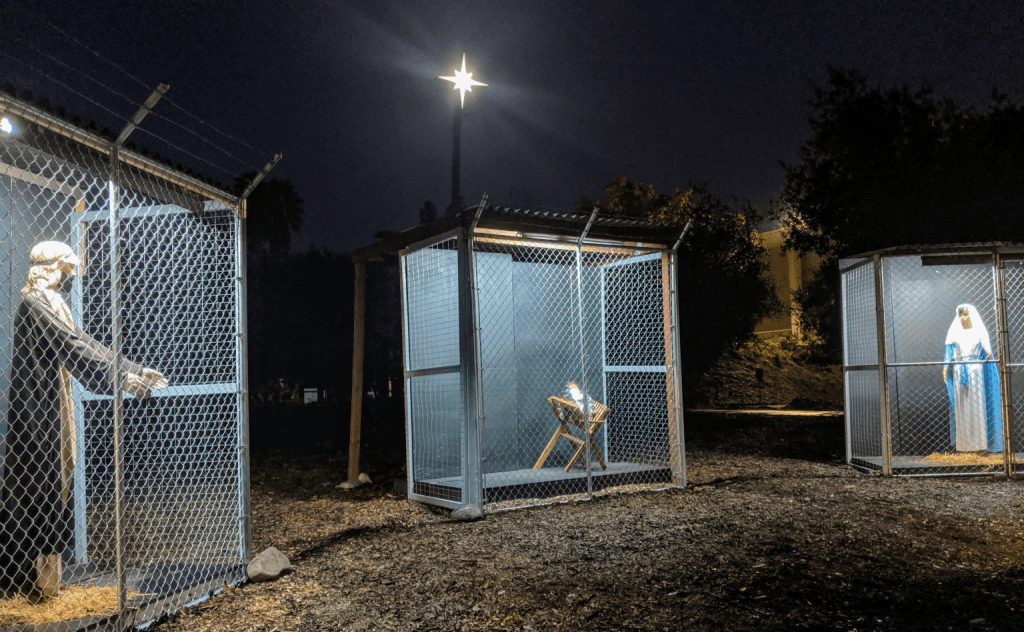
What if, instead of being born into the Roman police state, Jesus had been born at this moment in time? What kind of reception would Jesus and his family be given? Would we recognize the Christ child’s humanity, let alone his divinity? Would we treat him any differently than he was treated by the Roman Empire? If his family were forced to flee violence in their native country and sought refuge and asylum within our borders, what sanctuary would we offer them?A singular number of churches across the country have asked those very questions in recent years, and their conclusions were depicted with unnerving accuracy by nativity scenes in which Jesus and his family are separated, segregated and caged in individual chain-link pens, topped by barbed wire fencing.
Those nativity scenes were a pointed attempt to remind the modern world that the narrative about the birth of Jesus is one that speaks on multiple fronts to a world that has allowed the life, teachings and crucifixion of Jesus to be drowned out by partisan politics, secularism, materialism and war, all driven by a manipulative shadow government called the Deep State.
The modern-day church has largely shied away from applying Jesus’ teachings to modern problems such as war, poverty, immigration, etc., but thankfully there have been individuals throughout history who ask themselves and the world: what would Jesus do.
What would Jesus—the baby born in Bethlehem who grew into an itinerant preacher and revolutionary activist, who not only died challenging the police state of his day (namely, the Roman Empire) but spent his adult life speaking truth to power, challenging the status quo of his day, and pushing back against the abuses of the Roman Empire—do about the injustices of our modern age.
Dietrich Bonhoeffer asked himself what Jesus would have done about the horrors perpetrated by Hitler and his assassins. The answer: Bonhoeffer was executed by Hitler for attempting to undermine the tyranny at the heart of Nazi Germany.
Aleksandr Solzhenitsyn asked himself what Jesus would have done about the soul-destroying gulags and labor camps of the Soviet Union. The answer: Solzhenitsyn found his voice and used it to speak out about government oppression and brutality.
Martin Luther King Jr. asked himself what Jesus would have done about America’s warmongering. The answer: declaring “my conscience leaves me no other choice,” King risked widespread condemnation as well as his life when he publicly opposed the Vietnam War on moral and economic grounds.
Even now, despite the popularity of the phrase “What Would Jesus Do?” (WWJD) in Christian circles, there remains a disconnect in the modern church between the teachings of Christ and the suffering of what Jesus in Matthew 25 refers to as the “least of these.
Yet this is not a theological gray area: Jesus was unequivocal about his views on many things, not the least of which was charity, compassion, war, tyranny and love.
After all, Jesus—the revered preacher, teacher, radical and prophet—was born into a police state not unlike the growing menace of the American police state. When he grew up, he had powerful, profound things to say, things that would change how we view people, alter government policies and change the world. “Blessed are the merciful,” “Blessed are the peacemakers,” and “Love your enemies” are just a few examples of his most profound and revolutionary teachings.
When confronted by those in authority, Jesus did not shy away from speaking truth to power. Indeed, his teachings undermined the political and religious establishment of his day. It cost him his life. He was eventually crucified as a warning to others not to challenge the powers-that-be.
Can you imagine what Jesus’ life would have been like if, instead of being born into the Roman police state, he had been born and raised in the American police state.
Consider the following if you will.
Had Jesus been born in the era of the America police state, rather than traveling to Bethlehem for a census, Jesus’ parents would have been mailed a 28-page American Community Survey, a mandatory government questionnaire documenting their habits, household inhabitants, work schedule, how many toilets are in your home, etc. The penalty for not responding to this invasive survey can go as high as $5,000.
Instead of being born in a manger, Jesus might have been born at home. Rather than wise men and shepherds bringing gifts, however, the baby’s parents might have been forced to ward off visits from state social workers intent on prosecuting them for the home birth. One couple in Washington had all three of their children removed after social services objected to the two youngest being birthed in an unassisted home delivery.
Had Jesus been born in a hospital, his blood and DNA would have been taken without his parents’ knowledge or consent and entered into a government biobank. While most states require newborn screening, a growing number are holding onto that genetic material long-term for research, analysis and purposes yet to be disclosed.
Then again, had Jesus’ parents been undocumented immigrants, they and the newborn baby might have been shuffled to a profit-driven, private prison for illegals where they first would have been separated from each other, the children detained in make-shift cages, and the parents eventually turned into cheap, forced laborers for corporations such as Starbucks, Microsoft, Walmart, and Victoria’s Secret. There’s quite a lot of money to be made from imprisoning immigrants, especially when taxpayers are footing the bill.
From the time he was old enough to attend school, Jesus would have been drilled in lessons of compliance and obedience to government authorities, while learning little about his own rights. Had he been daring enough to speak out against injustice while still in school, he might have found himself tasered or beaten by a school resource officer, or at the very least suspended under a school zero tolerance policy that punishes minor infractions as harshly as more serious offenses.
Had Jesus disappeared for a few hours let alone days as a 12-year-old, his parents would have been handcuffed, arrested and jailed for parental negligence. Parents across the country have been arrested for far less “offenses” such as allowing their children to walk to the park unaccompanied and play in their front yard alone.
Rather than disappearing from the history books from his early teenaged years to adulthood, Jesus’ movements and personal data—including his biometrics—would have been documented, tracked, monitored and filed by governmental agencies and corporations such as Google and Microsoft. Incredibly, 95 percent of school districts share their student records with outside companies that are contracted to manage data, which they then use to market products to us.
From the moment Jesus made contact with an “extremist” such as John the Baptist, he would have been flagged for surveillance because of his association with a prominent activist, peaceful or otherwise. Since 9/11, the FBI has actively carried out surveillance and intelligence-gathering operations on a broad range of activist groups, from animal rights groups to poverty relief, anti-war groups and other such “extremist” organizations.
Jesus’ anti-government views would certainly have resulted in him being labeled a domestic extremist. Law enforcement agencies are being trained to recognize signs of anti-government extremism during interactions with potential extremists who share a “belief in the approaching collapse of government and the economy.
While traveling from community to community, Jesus might have been reported to government officials as “suspicious” under the Department of Homeland Security’s “See Something, Say Something” programs. Many states, including New York, are providing individuals with phone apps that allow them to take photos of suspicious activity and report them to their state Intelligence Center, where they are reviewed and forwarded to law-enforcement agencies.
Rather than being permitted to live as an itinerant preacher, Jesus might have found himself threatened with arrest for daring to live off the grid or sleeping outside. In fact, the number of cities that have resorted to criminalizing homelessness by enacting bans on camping, sleeping in vehicles, loitering and begging in public has doubled.
Viewed by the government as a dissident and a potential threat to its power, Jesus might have had government spies planted among his followers to monitor his activities, report on his movements, and entrap him into breaking the law. Such Judases today—called informants—often receive hefty paychecks from the government for their treachery.
Had Jesus used the internet to spread his radical message of peace and love, he might have found his blog posts infiltrated by government spies attempting to undermine his integrity, discredit him or plant incriminating information online about him. At the very least, he would have had his website hacked and his email monitored.
Had Jesus attempted to feed large crowds of people, he would have been threatened with arrest for violating various ordinances prohibiting the distribution of food without a permit. Florida officials arrested a 90-year-old man for feeding the homeless on a public beach.
Had Jesus spoken publicly about his 40 days in the desert and his conversations with the devil, he might have been labeled mentally ill and detained in a psych ward against his will for a mandatory involuntary psychiatric hold with no access to family or friends. One Virginia man was arrested, strip searched, handcuffed to a table, diagnosed as having “mental health issues,” and locked up for five days in a mental health facility against his will apparently because of his slurred speech and unsteady gait.
Without a doubt, had Jesus attempted to overturn tables in a Jewish temple and rage against the materialism of religious institutions, he would have been charged with a hate crime. More than 45 states and the federal government have hate crime laws on the books.
Had anyone reported Jesus to the police as being potentially dangerous, he might have found himself confronted—and killed—by police officers for whom any perceived act of non-compliance (a twitch, a question, a frown) can result in them shooting first and asking questions later.
Rather than having armed guards capture Jesus in a public place, government officials would have ordered that a SWAT team carry out a raid on Jesus and his followers, complete with flash-bang grenades and military equipment. There are upwards of 80,000 such SWAT team raids carried out every year, many on unsuspecting Americans who have no defense against such government invaders, even when such raids are done in error.
Instead of being detained by Roman guards, Jesus might have been made to “disappear” into a secret government detention center where he would have been interrogated, tortured and subjected to all manner of abuses. Chicago police have “disappeared” more than 7,000 people into a secret, off-the-books interrogation warehouse at Homan Square.
Charged with treason and labeled a domestic terrorist, Jesus might have been sentenced to a life-term in a private prison where he would have been forced to provide slave labor for corporations or put to death by way of the electric chair or a lethal mixture of drugs.
Indeed, as I make clear in my book Battlefield America: The War on the American People and in its fictional counterpart The Erik Blair Diaries, given the nature of government then and now, it is painfully evident that whether Jesus had been born in our modern age or his own, he still would have died at the hands of a police state.
Thus, as we draw near to Christmas with its celebration of miracles and promise of salvation, we would do well to remember that what happened in that manger on that starry night in Bethlehem is only the beginning of the story. That baby born in a police state grew up to be a man who did not turn away from the evils of his age but rather spoke out against it.
We must do no less.

By Matt Zoller Seitz
Source: RogerEbert.com
Brutal, sad, funny, and disarmingly sweet-natured, “Riders of Justice” is not so much a revenge movie as a movie about revenge. That might seem like a distinction without a difference until you get to the end of this surprising feature from writer/director Anders Thomas Jensen (“After the Wedding,” “Red Road,” “The Salvation“) and look back on every place that it has taken you.
The story starts a few days before Christmas in Estonia. A girl walking along a holiday-decorated street with her grandfather spots a red bicycle offered for sale by a street vendor but asks for a blue one instead. The vendor is part of a crime ring and calls an associate, who steals a blue bike belonging to Mathilde (Andrea Heick Gadeberg), which causes Mathilde’s mother Emma (Anne Birgitte Lind) to have to pick her up at the train station, only to have their car fail to start, which causes them to take a commuter train home. A statistics and probability expert named Otto (Nikolaj Lie Kaas) gives the girl’s mother his seat, and shortly after that, a freight train smashes into the commuter train and several passengers are killed, including Mathilde’s mother and a tattooed, bald, scowling fellow who was supposed to testify against a fearsome gang, Riders of Justice. Otto saw another man get off the train before the crash, oddly dropping a full beverage and a nearly uneaten sandwich in the trash on his way out, and becomes convinced that the crash was an assassination and the other victims were collateral damage. As it happens, Mathilde’s father is a stony-faced soldier named Markus (Mads Mikkelsen, a frequent leading man for the writer/director).
If this were almost any other movie, you’d be able to write the rest of this review yourself. But you soon figure out that this is not the sort of film that sets up the standard elements and switches to autopilot. For one thing, Jensen makes Otto not merely the messenger who sets the tale in motion and then disappears, but a crucial second lead, and part of a trio filled out by a fellow probability expert named Lennart (Lars Brygmann), whose secret manias and aversions are a constant source of plot complications; and a tightly wound, emotional computer hacker named Emmenthaler (Nicolas Bro). All three characters are written and performed with such skill that they form a comedy trio: a motor-mouthed intellectual answer to the Three Stooges. Like Mathilde, Markus, and everyone else who passes in front of Jensen’s viewfinder, Otto, Lennart and Emmenthaler are given endearing backstories that feed into the script’s fascination with fate, chance, justice, karma, and other subjects rarely discussed in films where the hero is a scary bald dude who can snap a man’s neck like a shingle.
“All events are products of a series of preceding events,” Otto tells an assembled panel of corporate clients who reject an algorithm he and Lennart are trying to sell them. “Because we often have insufficient data, we categorize events as coincidences.” His statement echoes through later scenes, including the church service where Mathilde’s mother and Markus’s wife is laid to rest. “When miracles happen,” the priest says, “we often attribute a divine character to them. However, when lightning strikes, when tragedy becomes reality, we have a hard time assigning a return address, and thus we refer to it as coincidence.” Once the stooges enter Markus’ life, bloodshed follows, but not in a lockstep, predictable way, thanks to the pinball-machine collisions of all the strong personalities involved (particularly Markus’s; he’s both hot-tempered and lethal, not an ideal combination).
The big question here is whether the train crash was a premeditated crime or the culmination of a series of things that quite simply happened. A large part of the charm of “Riders of Justice” (what an ironic title, in retrospect!) comes from the way that it keeps us guessing as to what side of the equation, so to speak, it’ll come down on, or whether it’ll take a position at all. What are we to make, for instance, of a seemingly precise calculation by Otto that the odds of that crash with that outcome were 234,287,121 to one? Or, for that matter, the movie’s wry awareness that no matter how bad things get, they could always be worse? “Only thing is, after all this crap, it’s unlikely more is going to happen,” Mathilde tells Otto. “That’s not how things work,” Otto replies. “A lot of awful things can happen in your life.”
Plots like the one that drive “Riders of Justice” tend to appear in crash-and-burn action thrillers wherein a curtain-raising death or atrocity is there to give the hero (or heroes) a pretext to embark on a spectacular and largely guilt-free rampage, stacking up bodies like firewood. Jensen and his cast and crew go in a different direction, creating a cast of main characters (and several colorful minor characters) with complex, contradictory psychologies that are unveiled a layer at a time, each revelation informing our understanding of what they did in a prior scene, or what they may be capable of later on. It’s hard to imagine the improvisatory, digressive, character-focused filmmaker Mike Leigh (“Secrets and Lies“) making a revenge thriller, but if he did, it might look like this. Sometimes the tangents are so out-of-nowhere, and are developed in such detail, that you and the characters sorta forget about the vengeance thing, which is the entire point.
This is a film that teaches you how to watch it. Once you’ve gotten acclimated, you understand that when a major character makes a decision that seems massively stupid—or simply counter to their self-interest—it’s always rooted in a traumatic past incident or secret, and they had no conscious control over it: it was something that had to happen, thanks to how they’re wired. Mikkelsen, the most still and reactive performer, seems a granite-faced question mark until you spend a bit of time with his character and understand the origins of his stoicism as well as his eruptions of fury. Unexpected connection points are made between him and the stooges and, more pointedly, between Mathilde and Emmenthaler, who are both sensitive about their weight; and Mathilde, Otto and Markus, who have a specific type of loss in common, and fill voids in each other’s lives.
Any of these characters could’ve been the main character in his or her own project, so attentive is the screenplay to the nuances of personality. Emmenthaler, especially, is one of the great secondary characters in action thrillers, up there with Al Powell from the original “Die Hard“—a sensitive man who sheds an angry tear when a friend makes fun of his weight, and has clearly been carrying around an unexploded bomb of suppressed rage throughout his life. He’s the first of the stooges to ask for weapons training.
But even that thread doesn’t go the way you anticipate, because this is a genre picture in which story is driven by characterization rather than the other way around. Not only are there no easy answers, the film goes out of its way to make you think it’s going to tie something off neatly, only to confound you by asking, “What would happen if these characters actually existed?” and doing that instead.
“Did a therapist write this?” is not a sentence once expects to see in one’s notes on a movie where Mads Mikkelsen guns men down with an assault rifle. But it’s consistent with the apparent mission statement of this odd, beguiling film, which is filled with philosophical, theological, moral, and ethical notions (and takes care to distinguish between them) and that weaves images of churches and snippets of religious chorales throughout its running time, as if to remind us of the Christian ideals of grace, healing, and redemption that, for many characters, remain just out of reach. The movie’s contextual scaffolding is constructed with such care that when a character insists that chess is the only game ever invented where luck isn’t a factor, your instinct is to think, “Is that true?” It is, and it isn’t. The closest Jensen gets to summing everything up is Mathilde’s statement that life “is just easier when there’s someone you can get mad at.”
What are we left with? In the best of all possible worlds, a line from Otto, offered when the gang is en route to a bloody showdown: “Let’s get this over with as a team so we can go home and eat banana cake.”
Watch Riders of Justice on Hoopla here: https://www.hoopladigital.com/title/15350298
By W.J. Astore
Source: Bracing Views
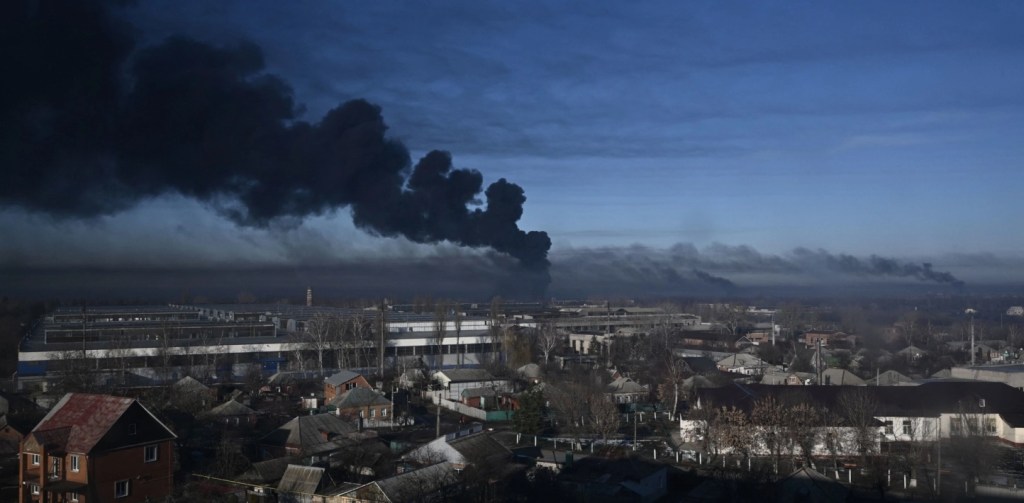
Reports that Ukraine is launching modified drones to strike airbases deep in Russia highlight the unpredictability and escalatory nature of wars. Ukraine is no longer content at defending itself against Russian aggression; Russia itself must be made a target, which will likely provoke harsher Russian counterattacks. Meanwhile, the U.S. Congress continues to authorize billions in military aid to Ukraine, which is pitched as defending democracy and freedom.
War is many things but it is rarely democratic. Indeed, as James Madison warned, war is inherently anti-democratic. It strengthens authoritarian forces and contributes to abuses of power and corruption. As the Russia-Ukraine War goes on, with no clear resolution in sight, Ukraine suffers more even as the chances of escalation rise.
James Madison warned that no nation can preserve its freedom in the midst of continual warfare
What’s needed now is resolute diplomacy — a committed effort to end the war by all parties involved, obviously Russia and Ukraine but also the U.S. and NATO. The longer this disastrous war lasts, the more unpredictable it will become, the more atrocious it will prove, and the more likely ordinary Ukrainians and Russians will suffer and die, whether at various battlefronts or on the homefront.
Negotiation is not weakness nor is it appeasement. Negotiation is sensible, rational, and life-affirming. But there’s little reason for Ukraine to negotiate when it’s enjoying a blank check of support from the U.S. and NATO.
Meanwhile, as Ukraine continues striking deep into Russia, one wonders to what extent the U.S. military and intelligence agencies are involved. Did the U.S. provide technology? Targeting information? Intelligence? Or is Ukraine doing this entirely on its own, a scenario that is less than comforting?
I sure hope the U.S. and Russia are talking. In the confusion and chaos of war, how is Russia to know for sure that an attack on one of their strategic air bases is coming from Ukraine and not from NATO territory? Even if it’s clearly coming from Ukraine, if these attacks are enabled or approved by the U.S./NATO, will the Russians see them as an act of war? Will they respond militarily, creating even more escalatory pressure?
Bizarrely, Ukraine’s defensive war against Russia has been sold as America’s “good” war, a chance to weaken Russia and Putin in the cause of defending Ukrainian “democracy.” But as Ukraine’s tactics turn more offensive, and as the Ukrainian government likely becomes more authoritarian due to the pressures of war, how wise is it for the United States to continue to send massive amounts of military aid there while discouraging diplomacy?
Policies that end in prolonging the Russia-Ukraine War in the name of teaching Putin a lesson and eroding his power may teach us all a lesson in how war is not just anti-democratic. War runs to extremes, and only fools believe they can control it in a way that is conducive to liberty and freedom and justice.

By Eric Zuesse
Source: The Duran
During this year, the U.S. Government has allocated $112 billion to Ukraine, in order to defeat Russia in the battlefields of Ukraine. Russia allocates normally $60 billion per year for its entire military, but this year has increased that 40% to $84 billion, because of its invasion of Ukraine. Russia invaded Ukraine because, on 17 December 2021, Russia had demanded that the U.S. Government and its NATO anti-Russian military alliance stop trying to place its missiles on and near Russia’s borders (especially in Ukraine, which is the nearest of all bordering nations to Moscow); and, on 7 January 2022 America and NATO said no. Russia then invaded Ukraine on 24 February 2022, in order to prevent Ukraine from becoming a launch-pad for U.S. missiles. That’s what the war in Ukraine is — and always has been — about, from the Russian viewpoint: not being faced with U.S. missiles that are only a five-minute missile-flight-time away from Russia’s central command in Moscow.
The war in Ukraine started in February 2014, by America’s coup there that overthrew Ukraine’s democratically elected neutralist Government and replaced it by a rabidly anti-Russian and pro-American one on Russia’s border, in order ultimately to become able to place just 317 miles away from the Kremlin U.S. missiles which would be only a five-minute flight-time away from nuking Russia’s central command — far too little time in order for Russia’s central command to be able to verify that launch and then to launch its own retaliatory missiles. It would be nuclear checkmate of Russia, by the U.S. (with the assistance of its NATO allies, which then would include Ukraine).
Whereas Russia’s objective is to not become nuclearly checkmated by America placing its missiles that close to Moscow, America’s objective is to nuclearly checkmate Russia in order to capture the world’s largest and most resource-rich country — to force Russia to capitulate and become another U.S. ‘ally’ (that is, vassal-nation).
President Biden had requested Congress to add $38 billion more this year for Ukraine than the $67 billion that was funded earlier in the year, but Congress decided to increase his requested amount by $7 billion (almost a 20% increase in his suggested increase), so that there will be a total of $45 billion added to the $67 billion previously allocated, for a total U.S. allocation to Ukraine this year of $112 billion. That amount is $28 billion more than Russia will have spent this year for all of its military — the vast majority of which Russian military expenditure isn’t being allocated to the war in Ukraine, but instead to other aspects of Russia’s defense against the threat to its national security from America and its allies. America alone has been spending annually on its military around 20 times what Russia has been spending on its; and, in order to make America’s expenditure appear not to be so gargantuan as it actually is, large portions of it are being paid out from other federal Departments than the Defense (or Aggression) Department, but the total annual U.S. military expenditures have, for over a decade, been over a trillion dollars per year.
On November 16th, I headlined “U.S. Will Have Spent $100B on Ukraine This Year”, and now it’s clear that my prediction was on the conservative side, by $12 billion.
—————
Investigative historian Eric Zuesse’s new book, AMERICA’S EMPIRE OF EVIL: Hitler’s Posthumous Victory, and Why the Social Sciences Need to Change, is about how America took over the world after World War II in order to enslave it to U.S.-and-allied billionaires. Their cartels extract the world’s wealth by control of not only their ‘news’ media but the social ‘sciences’ — duping the public.

By Michael Snyder
Source: End of the American Dream
Let’s be honest about what is really going on in Ukraine. The United States is providing most of the funding, most of the equipment, most of the ammunition, most of the high level intelligence and much of the training. That makes the United States a direct participant in the conflict. Yes, many other NATO countries are also contributing in various ways, and that makes them direct participants as well. But the mainstream media here in the western world continues to insist that this is Ukraine’s war and that we are just helping them out. Without a doubt, Ukraine has lost an enormous number of soldiers over the course of 2022, but at this point the Ukrainians are really a junior partner in the war. If the U.S. and NATO had not intervened on an epic scale, the war would already be over and Russia would have won. Unfortunately, now that we are so deeply invested in the conflict there is no easy way out, and that has very serious implications for all of us.
So much of the death and destruction that we have already witnessed could have been avoided so easily, and we should be constantly pushing our politicians to find a peaceful way out of this mess before nuclear weapons are used. Back in 2020, I published a book in which I specifically warned that war with Russia would be coming, and a lot of people thought that I was nuts to say such a thing. But sure enough we now have a war with Russia.
And the Russians are very clear about who they are really fighting. Earlier this month, Russian Foreign Minister Sergey Lavrov boldly declared that the U.S. and NATO are “directly participating” in the conflict in Ukraine…
“You shouldn’t say that the US and NATO aren’t taking part in this war, you are directly participating in it,” Lavrov said in a video call with reporters. “And not just by providing weapons but also by training personnel. You are training their military on your territory, on the territories of Britain, Germany, Italy, and other countries.”
I wish that this wasn’t true.
Sadly, in this particular case Lavrov is quite correct.
Most Americans don’t realize this, but Ukrainian soldiers are being flown into the United States all the time. The following comes from a BBC article about one location in Kansas where Ukrainian officers have been receiving “strategic training”…
Senior-level Ukrainian officers have been studying in the US state of Kansas, thousands of miles from Russia’s invasion and the battlefields of Donbas.
Outside the Fort Leavenworth army base, wheat fields are starting to turn. Wide, open prairie land, with softly rolling hills, stretches for miles, and the sky is huge.
This quintessentially Kansas landscape has become the backdrop for generations of international soldiers, who head to the US base to receive strategic training.
Of course Ukrainians are also being trained in the UK and in other NATO countries as well.
Unless we actually want to be considered direct participants in the war, we should not be doing this.
All of us should also be deeply alarmed by how much money we are giving to Ukraine.
According to the Kiel Institute, as of October 3rd the U.S. had already given 54.43 billion dollars worth of military and non-military aid to the Ukrainians…
Eventually I tracked down a database operated by the Kiel Institute, a German think tank. They have been tracking total military and non-military aid to Ukraine since the beginning of the conflict. Their numbers include all aid from Jan. 24, 2022 to Oct. 3, 2022 (the data is scheduled for an update on Dec. 6).
According to Kiel, the U.S. has transferred military and non-military aid worth $54.43 billion to the government of Ukraine. The database Kiel has maintained is by far the most granular and detailed accounting of what the U.S. government has provided to Ukraine, including descriptions of the individual batches of military equipment. If you’re interested, you can check it out here.
Needless to say, more aid has been authorized for the Ukrainians since October 3rd.
So the grand total is even higher now.
At this point we have actually spent far, far more money on the war than the Ukrainians have.
The Ukraine military is now outfitted with cutting edge equipment and ammunition, but all of that money is being spent in other ways as well.
Vast hordes of international mercenaries have been hired to fight, and your tax dollars are paying for them.
You see, the truth is that the Ukrainian army that existed at the beginning of the war has mostly been destroyed. To replace them, Ukraine conscripted a whole bunch of new soldiers, and they also hired large numbers of mercenaries from other nations in Europe.
Yes, there are some western Europeans and Americans among the mercenaries, but the vast majority of them appear to be from the poorer countries of eastern Europe.
Unfortunately, most of us don’t seem to care that these poor mercenaries are being fed into an endless meatgrinder that is unlike anything that we have seen since the worst days of World War I…
As Russia moved fresh formations to the area in recent weeks, including reinforcements previously in the Kherson region, the fighting in the Bakhmut sector has descended into trench warfare reminiscent of the first world war.
Over the weekend, images emerged of Ukrainian soldiers in flooded, muddy trenches and battlefields dotted with the stumps of trees cut down by withering artillery barrages.
For a moment, I would like for you to consider what it is like to be a soldier on the front lines in eastern Ukraine.
Imagine standing in a muddy trench that is filled up with water up to your waist. Your teeth are chattering like crazy because of the bitter cold, but you don’t dare crawl out of the trench because you are likely to be killed. Your socks are soaked, your underwear is soaked and everything else you are wearing is soaked. Both sides are endlessly shelling one another, and so it is almost impossible for you to sleep. There are dead bodies all around you for as far as the eye can see, and you just hope that you will be able to make it through another day somehow.
At military hospitals all across eastern Ukraine, there is an endless parade of the dead and the wounded. The following comes from the New York Times…
For almost an hour, the stream of Ukrainian casualties in the eastern city of Bakhmut seemed unending: Ambulances, an armored personnel carrier and private vehicles all screamed to a halt, one after another, and disgorged the wounded in front of the city’s only military hospital.
A soldier propped up by his comrades, his face a mass of mangled flesh, walked in the main gate. The dark green stretcher that awaited him was one of several still covered in blood.
Sadly, there is no end to the war in sight.
In fact, both sides just continue to escalate matters. The Ukrainians are now regularly shelling targets inside Russian territory, and the Russians are now systematically going after power and water systems all over Ukraine.
This is going to be an extremely bitter winter for both the Ukrainians and the Russians.
And as this war intensifies, there is a growing risk that someone could eventually use weapons of mass destruction.
Once that happens, there will be no going back.
INDIAN COUNTRY NEWS
"It is the duty of every man, as far as his ability extends, to detect and expose delusion and error"..Thomas Paine
Human in Algorithms
100% Accurate Google Sheets + KDP Book Formatting | 24hr Delivery
From the Roof Top
I See This
blog of the post capitalist transition.. Read or download the novel here + latest relevant posts
अध्ययन-अनुसन्धानको सार

