I am not a big fan of Federal Government disaster relief. Too much of the time the money never gets to those who need it most, and too often Washington’s armies of disaster “experts” are more interested in pushing people around than helping them.
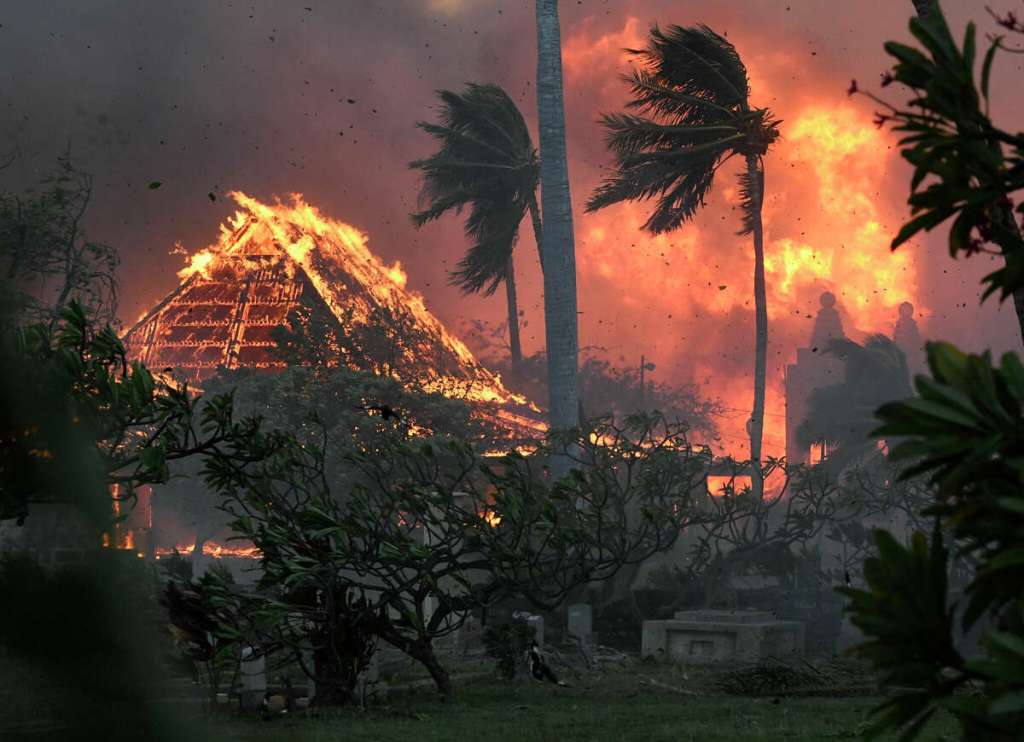
Nevertheless, it’s hard to look at recent footage of the devastation in Maui and then hear President Biden tell Congress that he needs another $24 billion for Ukraine. How can this Administration continue to justify tens of billions of dollars for this losing war that is not in our interest while the rest of the United States disintegrates?
Biden’s new $24 billion request comes on top of well over $120 billion already spent to fight the US proxy war on Russia in Ukraine. Heritage Foundation budget expert Richard Stern has done the math and determined that Biden’s spending on the Ukraine war thus far will cost each and every American household $900. How many Americans would rather have those $900 dollars back in their pocket rather than in the pockets of Lockheed-Martin, Raytheon, and Ukraine’s oligarchs?
Recent surveys have shown that a majority of Americans could not afford to cover a sudden $1,000 emergency. Will Americans connect the dots and realize that the reason they can’t find that $1,000 for an emergency is because the neocons have already sent it to Ukraine?
Ukraine has long been known as among the most corrupt countries on earth and not long ago investigative journalist Seymore Hersh wrote that Ukrainian president Vladimir Zelensky has embezzled at least $400 million in aid from the American people. Corruption scandals continue to break in Ukraine. Just last week Zelensky fired the heads of all local draft boards for corruption. Some press reports suggest that sales of luxury cars in Ukraine have broken all previous records. I wonder why.
No wonder the tide of US public opinion is turning against further involvement in the war. Recently CNN found that among all Americans, more than 55 percent are opposed to continued aid to Ukraine. Among Republicans the number opposing more aid to Ukraine rises to three-out-of-four. That is why we are finally starting to see more Republican Members raising concerns. I’d like to think they have seen the light that an aggressive and interventionist foreign policy is not in America’s interest, but most likely they are worried about losing elections. Whatever their motivation, this turning tide should be welcomed.
Yet the Biden Administration persists in backing Ukraine even as the US mainstream media is increasingly pointing out the obvious: Ukraine is not winning and cannot win, and continuing to pour money into a losing cause will just result in bankruptcy at home and more dead Ukrainians overseas.
Last week Newsweek published an article asking, “Does Ukraine Have Kompromat on Joe Biden?” In the article, Northeastern University Professor Max Abrahms wonders out loud whether Biden’s continued support for Ukraine might be related to compromising information held in Kiev about the many Biden family shady business ventures in Ukraine and the region. It is certainly worth considering.
Meanwhile, the residents of Maui that survived the recent horrific fire will take little comfort knowing that the Biden Administration is more interested in sending their money to Ukraine than in helping them recover.
The U.S. Mainstream Media Is Almost Always Pro-War
In the “liberal” New York Times today, I saw an article on “Putin’s forever war” that has the following short synopsis: “Vladimir Putin wants to lead Russians into a civilizational conflict with the West far larger than Ukraine. Will they follow him?”
Is this true? Does Putin truly seek a “civilizational conflict” with the West? One that’s “far larger” than the Ukraine war? It doesn’t seem likely. Russian forces have struggled in Ukraine. Already embroiled in a destructive regional war that’s become somewhat of a quagmire, why would Putin seek to widen it? Is Putin always the aggressor, the bad guy, and the West always the aggrieved party, the good guys, holding back a “red storm rising”? I thought the West won the Cold War more than 30 years ago.
It’s remarkable how easy it is to get alarmist articles about Russia or China published in the U.S. mainstream media (MSM). Wars and rumors of war dominate. The West is always portrayed as the defender of democracy; other countries such as China and Russia are portrayed as threats to civilization and its “rules-based order.” Strictly speaking, this is simplistic, one-sided, propaganda.
Back in 2017, I wrote about how difficult it is in the MSM to read honest accounts of war. In the runup to the Iraq War in 2003, critical voices were actively suppressed and punished. Back then, I focused my article on MSNBC, which like the New York Times is allegedly “liberal.” At “liberal” newspapers and networks, shouldn’t America expect at least a few critical critiques of war narratives? The answer here is “no,” as I wrote here:
Jesse Ventura, former governor of Minnesota (1999-2003), was a hot media commodity as the Bush/Cheney administration was preparing for its invasion of Iraq in 2003. Ventura, a U.S. Navy veteran who gained notoriety as a professional wrestler before he entered politics, was both popular and outspoken. MSNBC won the bidding war for his services in 2003, signing him to a lucrative three-year contract to create his own show – until, that is, the network learned he was against the Iraq war. Ventura’s show quickly went away, even as the network paid him for three years to do nothing.
I heard this revealing story from a new podcast, the TARFU Report, hosted by Matt Taibbi and Alex Pareene. By his own account, Jesse Ventura was bought off by the network, which back then was owned by General Electric, a major defense contractor that was due to make billions of dollars off the war.
Of course, Ventura was hardly the only war critic to run afoul of GE/NBC. Phil Donahue, the famous talk show host, saw his highly rated show cancelled when he gave dissenters and anti-war voices a fair hearing. Ashleigh Banfield, a reporter who covered the Iraq war, gave a speech in late April 2003 that criticized the antiseptic coverage of the war (extracts to follow below). For her perceptiveness and her honesty, she was reassigned and marginalized, demoted and silenced.
So much for freedom of speech, as well as the press.
As Phil Donahue said, his show “wasn’t good for business.” NBC didn’t want to lose ratings by being associated with “unpatriotic” elements when the other networks were waving the flag in support of the Iraq war. In sidelining Ventura and Donahue, NBC acted to squelch any serious dissent from the push for war, and punished Ashleigh Banfield in the immediate aftermath of the war for her honesty in criticizing the coverage shown (and constructed) by the mainstream media, coverage that was facilitated by the U.S. military and rubber-stamped by corporate ownership.
Speaking of Banfield’s critique, here are some excerpts from her speech on Iraq war coverage in April 2003. Note that her critique remains telling for all U.S. media war coverage since then:
That said, what didn’t you see [in U.S. media coverage of the Iraq war]? You didn’t see where those bullets landed. You didn’t see what happened when the mortar landed. A puff of smoke is not what a mortar looks like when it explodes, believe me. There are horrors that were completely left out of this war. So was this journalism or was this coverage? There is a grand difference between journalism and coverage, and getting access does not mean you’re getting the story, it just means you’re getting one more arm or leg of the story. And that’s what we got, and it was a glorious, wonderful picture that had a lot of people watching and a lot of advertisers excited about cable news. But it wasn’t journalism, because I’m not so sure that we in America are hesitant to do this again, to fight another war, because it looked like a glorious and courageous and so successful terrific endeavor, and we got rid of a horrible leader: We got rid of a dictator, we got rid of a monster, but we didn’t see what it took to do that.
With admirable honesty, Banfield spoke of the horrific face of war at Kansas State Univ. in 2003. Soon after her speech, she was demoted (Image courtesy of KSU)
I can’t tell you how bad the civilian casualties were. I saw a couple of pictures. I saw French television pictures, I saw a few things here and there, but to truly understand what war is all about you’ve got to be on both sides…
Some of the soldiers, according to our embeds had never seen a dead body throughout the entire three-week campaign. It was like Game Boy. I think that’s amazing in two different ways. It makes you a far more successful warrior because you can just barrel right along but it takes away a lot of what war is all about, which is what I mentioned earlier. The TV technology took that away too. We couldn’t see where the bullets landed. Nobody could see the horrors of this so that we seriously revisit the concept of warfare the next time we have to deal with it.
I think there were a lot of dissenting voices before this war about the horrors of war, but I’m very concerned about this three-week TV show and how it may have changed people’s opinions. It was very sanitized.
This TV show [Iraq invasion coverage] that we just gave you was extraordinarily entertaining, and I really hope that the legacy that it leaves behind is not one that shows war as glorious, because there’s nothing more dangerous than a democracy that thinks this is a glorious thing to do.
War is ugly and it’s dangerous, and in this world the way we are discussed on the Arab street, it feeds and fuels their hatred and their desire to kill themselves to take out Americans. It’s a dangerous thing to propagate…
I’m hoping that I will have a future in news in cable, but not the way some cable news operators wrap themselves in the American flag and patriotism and go after a certain target demographic, which is very lucrative. You can already see the effects, you can already see the big hires on other networks, right wing hires to chase after this effect, and you can already see that flag waving in the corners of those cable news stations where they have exciting American music to go along with their war coverage.
Nothing has changed since Banfield’s powerful critique. Indeed, the networks have only hired more retired generals and admirals to give “unbiased” coverage of America’s military actions. And reporters and “journalists” like Brian Williams have learned too. Recall how Williams cheered the “beautiful” U.S. Tomahawk cruise missiles as they were launched against Syria earlier this year [2017].
It’s not just that U.S. media coverage actively suppresses dissent of America’s wars: it passively does so as well, which is arguably more insidious. Any young journalist with smarts recognizes the way to get ahead is to be a cheerleader for U.S. military action, a stenographer to the powerful. Being a critic leads to getting fired (like Donahue); demoted and exiled (like Banfield); and, in Ventura’s case, if you can’t be fired or demoted or otherwise punished, you can simply be denied air time.
When you consider that billions and billions of dollars are at stake, whether in weapons sales or in advertising revenue tied to ratings, none of this is that surprising. What’s surprising is that so few Americans know about how pro-authority and uncritical U.S. media coverage of war and its makers is. If anything, the narrative is often that the U.S. media is too critical of the military to the detriment of the generals. Talk about false narratives and alternative facts!
America’s greed-wars persist for many reasons, but certainly a big one is the lack of critical voices in the mainstream media. Today’s journalists, thinking about their career prospects and their salaries (and who is ultimately their boss at corporate HQ), learn to censor themselves, assuming they have any radical thoughts to begin with. Some, like Brian Williams, even learn how to stop worrying and love the beautiful bombs.
[After I wrote this in 2017, I added this comment at the site.]
One thing that troubles me is the mindset that criticism of America’s wars undermines the troops. That it could even be a form of betrayal. This mindset is very dangerous. It not only protects the decisions and actions of those at the highest levels of the military and government. It acts to prolong wars and to endanger the lives of the troops (and of their “enemies” as well).
During the Iraq war, I recall instances of U.S. troops speaking clearly and frankly against the war. Their voices were heard, yet their advice was not taken. Instead, generals like David Petraeus were trotted out to assure the American people that the war was being won, even if the gains were characterized by weasel words like “fragile” and “reversible.” And so those gains have proved — even so, Petraeus remains in demand, and is still trotted out, now in mufti, to explain how we must stay the course and continue to defer to the military.
There’s a powerful book to be written here, and it should focus in part on the silencing or marginalization of anti-war voices (even those that wear or wore the uniform), even as pro-war elements are given the main stage as the voices of probity and sanity.
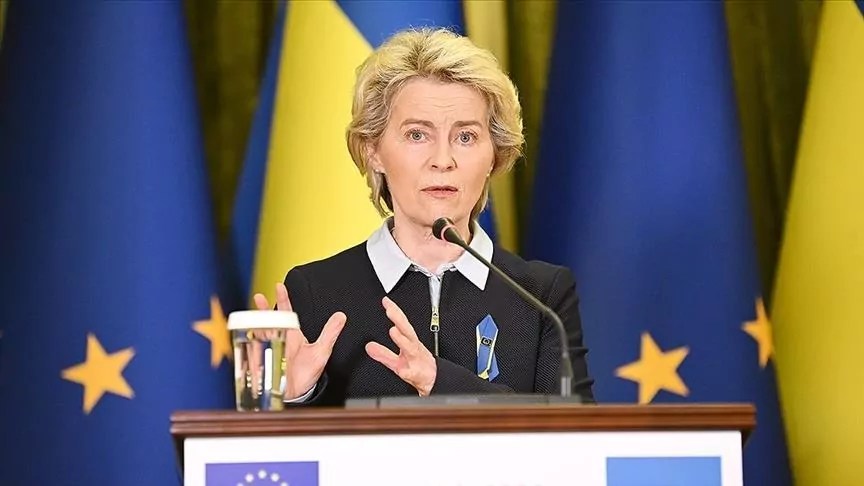
Recently, the head of the European Commission, Ursula von der Leyen, said that the European Union should double its assistance to Ukraine. She went on to say the EU should create a support fund of 50 billion euros by the end of the year and that everything should be done to ensure victory on the battlefield for the Ukrainians.
The European Union has created a “support package” for Ukraine for 2023 of up to €18 billion. This money, however, is not in the form of gifts, grants, or to create an emergency war chest. These billions are a loan under an EU macro-financial assistance program dubbed the MFA+ Instrument. In the fine print, EU member states are guaranteeing these loans as well as paying the interest for the Ukrainians. The move is extraordinary given that Ukraine is not an EU member and that, even before the current conflict, was one of the most corrupt governments on Earth. This begs the question, “Why?”
The EU is issuing special bonds to be sold to investors for this purpose at a time when many people in the European Union go without proper healthcare, services, and even employment. The European Union, EU Member States, and European financial institutions have already dispersed some €49 billion to President Zelensky’s regime. This figure, added to the $76.8 billion already funneled to Ukraine, dwarfs any assistance given to any other country in the world. This very conservative report from the Council of Foreign Relations shows the U.S. alone has shoveled more into Zelensky’s coffers than Afghanistan, Israel, Jordan, Ethiopia, and Iraq combined in 2020.
In all, some 47 countries have given money and arms to Ukraine. As of now, EU Institutions (?) handed Zelensky over €30 billion. The UK has forked over about €10 billion as their pensioners worry about what’s for dinner next. Germany has given somewhere around €8 billion, and Japan almost €7 billion. The Netherlands, Canada, and Poland have pitched in about €5 billion each, and the list of others about €14 billion. The numbers, as you would expect, do not all add up. A U.S. News & World Reports story from earlier this year claimed total aid to Zelensky’s country had exceeded €150 billion as of January of this year. Again, why?
The answer, this time, is really simple. BlackRock, and the new investment initiative to rebuild Ukraine (whatever’s left of it). You already knew this, right? Zelensky and BlackRock’s BlackRock CEO Larry Fink met late last year, and in November, the Ukrainian Ministry of the Economy (MoE) and BlackRock Financial Markets Advisory (FMA) signed a memorandum to structure Ukraine’s reconstruction funds (PDF). Also, in on the moneymaking schemes in war-torn Ukraine are Nestlé, International Finance Corporation, the private investment arm of the World Bank, Australia’s Tattarang Group,
Zelensky has called the rebuilding of his country, once it’s been used up as a proxy NATO against Russia, “the greatest opportunity in Europe since World War Two.” Earlier this year, Fink told Barron’s and other financial magazines that Western investors will be “flooding” Ukraine post-war and the country could become “a beacon to the rest of the world of the power of capitalism”. Also, JPMorgan Chase is joining BlackRock to help Ukraine set up a reconstruction bank to steer public seed capital.
This American Conservative report says, “BlackRock Plots to Buy Ukraine,” in a recent editorial. Author Bradley Devlin outlines the Ukraine case, while also revealing how Fink and BlackRock are transforming America into a nation of renters by artificially elevating the prices of normal houses. If ever a man were appropriately named, Fink is that man.
“Why?” Is there any doubt about why some poor untrained bartender from Kyiv is in a foxhole being bombarded by Russian artillery? Doesn’t all the misleading media, inflated Ukraine military gains, and Joe Biden’s cock of the walk attitude toward a peace deal make more sense now? And Ursula, the lady I fondly refer to as Frau von der Clucky for her chicken-like pecking and strutting about while millions either die or are in harm’s way because of all the Western world barnyard antics right out of Orwell’s Animal Farm. While someone’s Dad takes a bullet or shrapnel in Donetsk, our leaders keep crowing, snorting, braying, and hog-wallering in their capitalistic farm dream.
“There is more than one way to burn a book. And the world is full of people running about with lit matches.”—Ray Bradbury
What we are witnessing is the modern-day equivalent of book burning which involves doing away with dangerous ideas—legitimate or not—and the people who espouse them. Seventy years after Ray Bradbury’s novel Fahrenheit 451 depicted a fictional world in which books are burned in order to suppress dissenting ideas, while televised entertainment is used to anesthetize the populace and render them easily pacified, distracted and controlled, we find ourselves navigating an eerily similar reality.
Welcome to the age of technocensorship.
On paper—under the First Amendment, at least—we are technically free to speak.
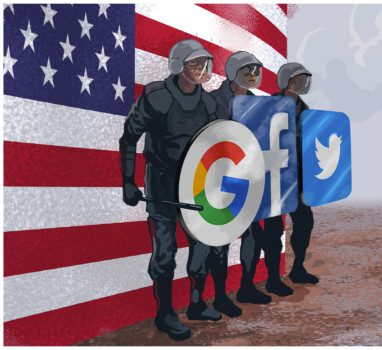
In reality, however, we are now only as free to speak as a government official—or corporate entities such as Facebook, Google or YouTube—may allow.
By “censor,” we’re referring to concerted efforts by the government to muzzle, silence and altogether eradicate any speech that runs afoul of the government’s own approved narrative.
This is political correctness taken to its most chilling and oppressive extreme.
Clothed in tyrannical self-righteousness, technofascism is powered by technological behemoths (both corporate and governmental) working in tandem to achieve a common goal.
The government is not protecting us from “dangerous” disinformation campaigns. It is laying the groundwork to insulate us from “dangerous” ideas that might cause us to think for ourselves and, in so doing, challenge the power elite’s stranglehold over our lives.
Thus far, the tech giants have been able to sidestep the First Amendment by virtue of their non-governmental status, but it’s a dubious distinction at best when they are marching in lockstep with the government’s dictates.
Nothing good can come from allowing the government to sidestep the Constitution.
The steady, pervasive censorship creep that is being inflicted on us by corporate tech giants with the blessing of the powers-that-be threatens to bring about a restructuring of reality straight out of Orwell’s 1984, where the Ministry of Truth polices speech and ensures that facts conform to whatever version of reality the government propagandists embrace.
Orwell intended 1984 as a warning. Instead, it is being used as a dystopian instruction manual for socially engineering a populace that is compliant, conformist and obedient to Big Brother.
This is the slippery slope that leads to the end of free speech as we once knew it.
In a world increasingly automated and filtered through the lens of artificial intelligence, we are finding ourselves at the mercy of inflexible algorithms that dictate the boundaries of our liberties.
Eventually, depending on how the government and its corporate allies define what constitutes “extremism, “we the people” might all be considered guilty of some thought crime or other.
Whatever we tolerate now—whatever we turn a blind eye to—whatever we rationalize when it is inflicted on others, whether in the name of securing racial justice or defending democracy or combatting fascism, will eventually come back to imprison us, one and all.
Watch and learn.
We should all be alarmed when any individual or group—prominent or not—is censored, silenced and made to disappear from Facebook, Twitter, YouTube and Instagram for voicing ideas that are deemed politically incorrect, hateful, dangerous or conspiratorial.
Given what we know about the government’s tendency to define its own reality and attach its own labels to behavior and speech that challenges its authority, this should be cause for alarm across the entire political spectrum.
Here’s the point: you don’t have to like or agree with anyone who has been muzzled or made to disappear online because of their views, but to ignore the long-term ramifications of such censorship is dangerously naïve, because whatever powers you allow the government and its corporate operatives to claim now will eventually be used against you by tyrants of your own making.
The glaring fallacy that always lies at the heart of pro-censorship sentiments is the gullible, delusional belief that censorship powers will be deployed only to suppress views one dislikes, but never one’s own views… Facebook is not some benevolent, kind, compassionate parent or a subversive, radical actor who is going to police our discourse in order to protect the weak and marginalized or serve as a noble check on mischief by the powerful. They are almost always going to do exactly the opposite: protect the powerful from those who seek to undermine elite institutions and reject their orthodoxies. Tech giants, like all corporations, are required by law to have one overriding objective: maximizing shareholder value. They are always going to use their power to appease those they perceive wield the greatest political and economic power.
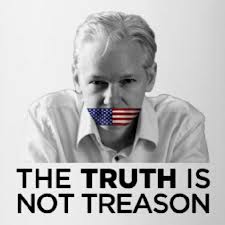
Be warned: it’s a slippery slope from censoring so-called illegitimate ideas to silencing truth.
Eventually, as George Orwell predicted, telling the truth will become a revolutionary act.
If the government can control speech, it can control thought and, in turn, it can control the minds of the citizenry.
It’s happening already.
With every passing day, we’re being moved further down the road towards a totalitarian society characterized by government censorship, violence, corruption, hypocrisy and intolerance, all packaged for our supposed benefit in the Orwellian doublespeak of national security, tolerance and so-called “government speech.”
Little by little, Americans are being conditioned to accept routine incursions on their freedoms.
This is how oppression becomes systemic, what is referred to as creeping normality, or a death by a thousand cuts.
It’s a concept invoked by Pulitzer Prize-winning scientist Jared Diamond to describe how major changes, if implemented slowly in small stages over time, can be accepted as normal without the shock and resistance that might greet a sudden upheaval.
Diamond’s concerns related to Easter Island’s now-vanished civilization and the societal decline and environmental degradation that contributed to it, but it’s a powerful analogy for the steady erosion of our freedoms and decline of our country right under our noses.
As Diamond explains, “In just a few centuries, the people of Easter Island wiped out their forest, drove their plants and animals to extinction, and saw their complex society spiral into chaos and cannibalism… Why didn’t they look around, realize what they were doing, and stop before it was too late? What were they thinking when they cut down the last palm tree?”
Much like America’s own colonists, Easter Island’s early colonists discovered a new world—“a pristine paradise”—teeming with life. Yet almost 2000 years after its first settlers arrived, Easter Island was reduced to a barren graveyard by a populace so focused on their immediate needs that they failed to preserve paradise for future generations.
The same could be said of the America today: it, too, is being reduced to a barren graveyard by a populace so focused on their immediate needs that they are failing to preserve freedom for future generations.
The forest…vanished slowly, over decades. Perhaps war interrupted the moving teams; perhaps by the time the carvers had finished their work, the last rope snapped. In the meantime, any islander who tried to warn about the dangers of progressive deforestation would have been overridden by vested interests of carvers, bureaucrats, and chiefs, whose jobs depended on continued deforestation… The changes in forest cover from year to year would have been hard to detect… Only older people, recollecting their childhoods decades earlier, could have recognized a difference. Gradually trees became fewer, smaller, and less important. By the time the last fruit-bearing adult palm tree was cut, palms had long since ceased to be of economic significance. That left only smaller and smaller palm saplings to clear each year, along with other bushes and treelets. No one would have noticed the felling of the last small palm.”
Sound painfully familiar yet?
We’ve already torn down the rich forest of liberties established by our founders. It has vanished slowly, over the decades. The erosion of our freedoms has happened so incrementally, no one seems to have noticed. Only the older generations, remembering what true freedom was like, recognize the difference. Gradually, the freedoms enjoyed by the citizenry have become fewer, smaller and less important. By the time the last freedom falls, no one will know the difference.
This is how tyranny rises and freedom falls: with a thousand cuts, each one justified or ignored or shrugged over as inconsequential enough by itself to bother, but they add up.
Each cut, each attempt to undermine our freedoms, each loss of some critical right—to think freely, to assemble, to speak without fear of being shamed or censored, to raise our children as we see fit, to worship or not worship as our conscience dictates, to eat what we want and love who we want, to live as we want—they add up to an immeasurable failure on the part of each and every one of us to stop the descent down that slippery slope.
“Emotional intelligence is the “something” in each of us that is a bit intangible. It affects how we manage behavior, navigate social complexities, and make personal decisions to achieve positive results.”
When emotional intelligence (EQ) first appeared to the masses, it served as the missing link in a peculiar finding: people with average IQs outperform those with the highest IQs 70 per cent of the time. This anomaly threw a massive wrench into the broadly held assumption that IQ was the sole source of success.
Decades of research now point to emotional intelligence as being the critical factor that sets star performers apart from the rest of the pack. The connection is so strong that 90 per cent of top performers have high emotional intelligence.
Emotional intelligence is the “something” in each of us that is a bit intangible. It affects how we manage behavior, navigate social complexities, and make personal decisions to achieve positive results.
Despite the significance of EQ, its intangible nature makes it very difficult to know how much you have and what you can do to improve if you’re lacking. You can always take a scientifically validated test, such as the one that comes with the Emotional Intelligence 2.0 book.
Unfortunately, quality (scientifically valid) EQ tests aren’t free. So, I’ve analyzed the data from the million-plus people TalentSmart has tested in order to identify the behaviors that are the hallmarks of a high EQ. What follows are sure signs that you have a high EQ.
1. You have a robust emotional vocabulary
All people experience emotions, but it is a select few who can accurately identify them as they occur. Our research shows that only 36 per cent of people can do this, which is problematic because unlabeled emotions often go misunderstood, which leads to irrational choices and counterproductive actions.
People with high EQs master their emotions because they understand them, and they use an extensive vocabulary of feelings to do so. While many people might describe themselves as simply feeling “bad,” emotionally intelligent people can pinpoint whether they feel “irritable,” “frustrated,” “downtrodden,” or “anxious.” The more specific your word choice, the better insight you have into exactly how you are feeling, what caused it, and what you should do about it.
2. You’re curious about people
It doesn’t matter if they’re introverted or extroverted, emotionally intelligent people are curious about everyone around them. This curiosity is the product of empathy, one of the most significant gateways to a high EQ. The more you care about other people and what they’re going through, the more curiosity you’re going to have about them.
3. You embrace change
Emotionally intelligent people are flexible and are constantly adapting. They know that fear of change is paralyzing and a major threat to their success and happiness. They look for change that is lurking just around the corner, and they form a plan of action should these changes occur.
4. You know your strengths and weaknesses
Emotionally intelligent people don’t just understand emotions; they know what they’re good at and what they’re terrible at. They also know who pushes their buttons and the environments (both situations and people) that enable them to succeed. Having a high EQ means you know your strengths and you know how to lean into them and use them to your full advantage while keeping your weaknesses from holding you back.
5. You’re a good judge of character
Much of emotional intelligence comes down to social awareness; the ability to read other people, know what they’re about, and understand what they’re going through. Over time, this skill makes you an exceptional judge of character. People are no mystery to you. You know what they’re all about and understand their motivations, even those that lie hidden beneath the surface.
6. You are difficult to offend
If you have a firm grasp of whom you are, it’s difficult for someone to say or do something that gets your goat. Emotionally intelligent people are self-confident and open-minded, which creates a pretty thick skin. You may even poke fun at yourself or let other people make jokes about you because you are able to mentally draw the line between humor and degradation.
7. You know how to say no (to yourself and others)
Emotional intelligence means knowing how to exert self-control. You delay gratification, and you avoid impulsive action. Research conducted at the University of California, San Francisco, shows that the more difficulty that you have saying no, the more likely you are to experience stress, burnout, and even depression. Saying no is indeed a major self-control challenge for many people. “No” is a powerful word that you should not be afraid to wield. When it’s time to say no, emotionally intelligent people avoid phrases such as “I don’t think I can” or “I’m not certain.” Saying no to a new commitment honors your existing commitments and gives you the opportunity to successfully fulfill them.
8. You let go of mistakes
Emotionally intelligent people distance themselves from their mistakes, but do so without forgetting them. By keeping their mistakes at a safe distance, yet still handy enough to refer to, they are able to adapt and adjust for future success. It takes refined self-awareness to walk this tightrope between dwelling and remembering. Dwelling too long on your mistakes makes you anxious and gun shy, while forgetting about them completely makes you bound to repeat them. The key to balance lies in your ability to transform failures into nuggets of improvement. This creates the tendency to get right back up every time you fall down.
9. You give and expect nothing in return
When someone gives you something spontaneously, without expecting anything in return, this leaves a powerful impression. For example, you might have an interesting conversation with someone about a book, and when you see them again a month later, you show up with the book in hand. Emotionally intelligent people build strong relationships because they are constantly thinking about others.
10. You don’t hold grudges
The negative emotions that come with holding onto a grudge are actually a stress response. Just thinking about the event sends your body into fight-or-flight mode, a survival mechanism that forces you to stand up and fight or run for the hills when faced with a threat. When the threat is imminent, this reaction is essential to your survival, but when the threat is ancient history, holding onto that stress wreaks havoc on your body and can have devastating health consequences over time. In fact, researchers at Emory University have shown that holding onto stress contributes to high blood pressure and heart disease. Holding onto a grudge means you’re holding onto stress, and emotionally intelligent people know to avoid this at all costs. Letting go of a grudge not only makes you feel better now but can also improve your health.
11. You neutralize toxic people
Dealing with difficult people is frustrating and exhausting for most. High EQ individuals control their interactions with toxic people by keeping their feelings in check. When they need to confront a toxic person, they approach the situation rationally. They identify their own emotions and don’t allow anger or frustration to fuel the chaos. They also consider the difficult person’s standpoint and are able to find solutions and common ground. Even when things completely derail, emotionally intelligent people are able to take the toxic person with a grain of salt to avoid letting him or her bring them down.
12. You don’t seek perfection
Emotionally intelligent people won’t set perfection as their target because they know that it doesn’t exist. Human beings, by our very nature, are fallible. When perfection is your goal, you’re always left with a nagging sense of failure that makes you want to give up or reduce your effort. You end up spending your time lamenting what you failed to accomplish and what you should have done differently instead of moving forward, excited about what you’ve achieved and what you will accomplish in the future.
13. You appreciate what you have
Taking time to contemplate what you’re grateful for isn’t merely the right thing to do; it also improves your mood because it reduces the stress hormone cortisol by 23 per cent. Research conducted at the University of California, Davis, found that people who worked daily to cultivate an attitude of gratitude experienced improved mood, energy, and physical well-being. It’s likely that lower levels of cortisol played a major role in this.
14. You disconnect
Taking regular time off the grid is a sign of a high EQ because it helps you to keep your stress under control and to live in the moment. When you make yourself available to your work 24/7, you expose yourself to a constant barrage of stressors. Forcing yourself offline and even–gulp!–turning off your phone gives your body and mind a break. Studies have shown that something as simple as an e-mail break can lower stress levels. Technology enables constant communication and the expectation that you should be available 24/7. It is extremely difficult to enjoy a stress-free moment outside of work when an e-mail that will change your train of thought and get you thinking (read: stressing) about work can drop onto your phone at any moment.
15. You limit your caffeine intake
Drinking excessive amounts of caffeine triggers the release of adrenaline, and adrenaline is the source of the fight-or-flight response. The fight-or-flight mechanism sidesteps rational thinking in favor of a faster response to ensure survival. This is great when a bear is chasing you, but not so great when you’re responding to a curt e-mail. When caffeine puts your brain and body into this hyper-aroused state of stress, your emotions overrun your behavior. Caffeine’s long half-life ensures you stay this way as it takes its sweet time working its way out of your body. High-EQ individuals know that caffeine is trouble, and they don’t let it get the better of them.
16. You get enough sleep
It’s difficult to overstate the importance of sleep to increasing your emotional intelligence and managing your stress levels. When you sleep, your brain literally recharges, shuffling through the day’s memories and storing or discarding them (which causes dreams) so that you wake up alert and clearheaded. High-EQ individuals know that their self-control, attention, and memory are all reduced when they don’t get enough–or the right kind–of sleep. So, they make sleep a top priority.
17. You stop negative self-talk in its tracks
The more you ruminate on negative thoughts, the more power you give them. Most of our negative thoughts are just that–thoughts, not facts. When it feels like something always or never happens, this is just your brain’s natural tendency to perceive threats (inflating the frequency or severity of an event). Emotionally intelligent people separate their thoughts from the facts in order to escape the cycle of negativity and move toward a positive, new outlook.
18. You won’t let anyone limit your joy
When your sense of pleasure and satisfaction are derived from the opinions of other people, you are no longer the master of your own happiness. When emotionally intelligent people feel good about something that they’ve done, they won’t let anyone’s opinions or snide remarks take that away from them. While it’s impossible to turn off your reactions to what others think of you, you don’t have to compare yourself to others, and you can always take people’s opinions with a grain of salt. That way, no matter what other people are thinking or doing, your self-worth comes from within.
The Last of Sheila is a brilliantly clever thriller which tries (and succeeds) beautifully in combining the best of a bitchy Hollywood self-satire, mixed with a traditional whodunit. Ultimately the film is tongue in cheek homage to both the murder mystery genre and the cutthroat world of movie making. It’s about playing a game, both as a diversion as well as means of controlling, manipulating, and undermining desperate people, their self-esteem, and their careers. The film is very well structured and as such, it is not a movie for those who like their plots to be obvious – the writing requires the viewer to pay close attention to each clue, plot twist, nuance, and strategically placed red herring – and trust me, there are many. Virtually every line of dialogue and visual reference, including the most blatant which is revealed later into the film, is designed to assist the viewer in playing detective.
The screenplay came from the unexpected collaboration of actor Anthony Perkins (Psycho) and composer Stephen Sondheim (of Broadway fame), who had based the film on their penchant for elaborate scavenger hunt parties the pair hosted for their show business friends in New York City in the 1960’s and 70’s. A guest to one of their parties was producer and director Herbert Ross (The Goodbye Girl, California Suite) who encouraged them to write a script based on the party and its roster of famous guests. Ultimately this conversation led to the development of the The Last of Sheila. Although there is a very clear Agatha Christie vibe to the premise, the writers wanted to differentiate their murder mystery with any others: they wanted no detective. The participants were to be isolated, and they alone were to solve the crime. This was the only film script written by either Anthony Perkins or Stephen Sondheim. Herbert Ross stepped in to direct.
The plot centers around movie producer and game-aficionado Clinton Greene (James Coburn) who invites a diverse group of business contacts and associates for a one-week cruise aboard his yacht off the southern coast of France on the one-year anniversary of the death of his wife, gossip columnist Sheila Greene (Yvonne Romain in her final acting role). Once the ship is under way, Clinton announces to the passengers that they will all partake in “The Sheila Greene Memorial Gossip Game” in which each of the six guests will be assigned “a pretend piece of gossip” on an index card, to be kept hidden from the other passengers. The object of the game is simple: discover everyone else’s “gossip” through a series of carefully planned events and clues, while protecting one’s own secret. Each night a planned event on shore will reveal the holder of one of the secrets. Following the conclusion of the first night’s activity, cumulating with revealing of the first card, “You are a SHOPLIFTER”, realization begins within the group that each guest’s card may not be a “pretend” piece of gossip as initially stated, but instead an actual, embarrassing secret about each participant.
To further tease and flaunt his dominance over the Hollywood B-List invitees, Clinton announces he is about to begin a new film project and is offering each guest the opportunity to participate in the project – with the better billing awarded to those who score higher in his game. It is no secret that being involved in a Clinton film project is precisely the lure each of the guests need to repair their damaged careers and restore their tattered reputations.
As the game progresses, the evenings begin to evolve into a macabre game of clue, with guests each sparring over who owns each dirty little secret as they compete for top billing in the elusive film project. In the midst of a particularly eerie session of the game, set in an abandoned monastery, someone protecting their own damaging secret rewrites the rules resulting in the death of one of the participants, leaving the surviving guests to play murderous musical chairs in a proverbial floating drawing room.
It is interesting to note that this really is a game to each of the guests; collectively they do not waste time grieving over another’s death, they merely clean up the blood and write off one more loser against their desperate yearning for a win.
The cast of guests / suspects and their players have been carefully and well selected for the film, including: attention starved secretary-cum-talent agent Christine (Dyan Cannon in a role based closely upon talent agent Sue Mengers); starlet Alice Wood (Raquel Welch) and her talent-manager husband Tony (Ian McShane) who holds leafy aspirations of becoming an associate producer; pessimistic “has-been” film director Philip Dexter (James Mason); Tom Parkman (Richard Benjamin), a screenwriter frustrated with only doing rewrites of others’ work and Lee, Tom’s wife, who is basically just bored and rich. These characters have been developed to represent a cross section of Hollywood personalities: people who are proud and narcissistic, who maintain their status and dominance through developing and spreading rumors about the faults of their competition. They each portray a surface air of stability and contentment, while diligently working on their social status, desperately seeking to connive their way back on top in the eyes of the Hollywood power establishment. This is what actually differentiates this film from your basic “bring a group of people together, isolate them and make one a murderer” plot, is the writers are concerned as much with who the characters are and how they interact as they are with murder itself.
Although the character conflicts and the backstory to whom-does-what-to-whom doesn’t always seem justified, the performances as demonstrated in the ever-competitive personality game, are clever, sharp-edged, quick and very entertaining. I did however find Rachael Welch as the starlet “Alice” to be quite unremarkable. She added little to nothing to the plot and in my opinion her and her character didn’t need to be in the film at all. James Mason did, howeve,r famously refer to working with her on the film, stating she was “the most selfish, ill-mannered, inconsiderate actress that I have ever had the displeasure of working with.”
Ironically, the film ends to Bette Midler’s song “Friends,” playing over its closing credits.
In 2012 New Line Cinema, division of Warner Brothers Pictures, announced a remake of The Last of Sheila was in the works, helmed by producer Beau Flynn. The project appears to have fizzled out shortly after this announcement as no further mention of the remake has been made.
Since the overthrow of Niger’s US-friendly government, West African nations of the ECOWAS bloc have threatened an invasion of their neighbor.
Before leading the charge for intervention, ECOWAS chair Bola Tinubu spent years laundering millions for heroin dealers in Chicago, and has since been ensnared in numerous corruption scandals.
Hours after Niger’s Western-backed leader was detained by the country’s presidential guard on July 28, Nigerian President and chair of the Economic Community of West African States (ECOWAS) Bola Tinubu leapt into action, warning that the group of nations “will not tolerate any situation that incapacitates the democratically-elected government.”
“As the Chairperson of ECOWAS…I state without equivocation that Nigeria stands firmly with the elected government in Niger.”
Two days later, ECOWAS imposed severe sanctions on Niger, and the bloc issued a stark ultimatum: if the newly-inaugurated junta won’t reinstall the ousted president in a week’s time, the group’s pro-Western African governments will — by military means, if necessary.
On Saturday, July 6 — one day before the deadline — ECOWAS leaders approved a plan to invade the country, with the ominous caveat that they are “not going to tell the coup plotters when and where we are going to strike.”
If ECOWAS gets its way, member states Benin, Cabo Verde, Côte d’Ivoire, The Gambia, Ghana, Guinea Bissau, Liberia, Nigeria, Sierra Leone, Sénégal and Togo will be pressured to send their soldiers to invade Niger.
These developments have thrust the typically-overlooked West African country of Niger into the Western media spotlight. But if hostilities break out, it wouldn’t just be one single impoverished African state in the crosshairs.
Neighboring Burkina Faso, Mali and Guinea, which are also governed by military administrations that recently seized power by force, have all warned that any attack on Niger will be viewed as an attack on them too. If their ECOWAS rivals make the first move, the nations which mainstream media have dubbed Africa’s “coup belt” have pledged to unleash their military forces as well — an announcement which should end any illusions that restoring the country’s previous president would be a painless process.
Leading the pro-Western coalition is the president of its most powerful country, Nigeria: Bola Tinubu. One of Nigeria’s wealthiest men, the source of the scandal-plagued president’s fortune remains unclear.
Documents reviewed by The Grayzone reveal Tinubu as a longtime US asset who was named as an accomplice in a massive drug running operation that saw him launder millions on behalf of a heroin-dealing relative.
I had a great time with other Heads of State and important dignitaries at the State Banquet hosted by President Emmanuel Macron in Paris, France, this evening. President Macron and his wife, First Lady Brigitte Macron were both gracious and warm, making the event a very pleasant… pic.twitter.com/lTHTZfTIMC
Bola Tinubu’s career marred by drug-trafficking, corruption allegations
For over 30 years, Bola Tinubu has been a major force in Nigeria’s political scene and the country’s economy, with local nicknames ranging from “the Mother of the Market” to “the Godfather of Lagos” and “the Lion of Bourdillon.” But his power inside Nigeria went largely unnoticed by international audiences until 2023, when he became ECOWAS chair after winning the presidency in an election closely tracked by the US government.
As president, Tinubu quickly instituted a regime of economic reforms backed by the US-controlled International Monetary Fund and the World Bank. Over the course of Tinubu’s political career in Nigeria, the African operator has cultivated a close relationship with the US embassy. According to a slew of classified State Department cables released by WikiLeaks, American officials relied heavily on Tinubu’s assessments of the domestic political landscape.
The ECOWAS chair’s early life is shrouded in mystery, and even his exact age is unknown. Nearly every detail of Tinubu’s personal history — prior to his appearance in Chicago on a student visa — is in dispute, including his legal birth name.
Records from Chicago State University show that Tinubu received a degree in Business Administration in 1979. In the following years, media reports indicate that Tinubu was employed in some capacity at a number of major US-based multinationals, including Mobil Oil Nigeria, consulting firm Deloitte, and GTE, which was the largest communication and utilities company in the US at the time.
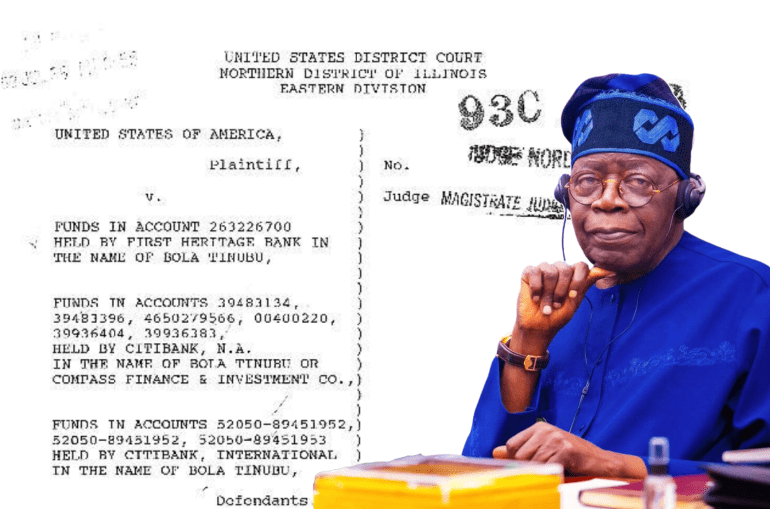
Of the few details about the Nigerian President’s early exploits which can be confirmed, many are derived from a 1993 court docket naming Tinubu as an accomplice in a massive midwestern drug smuggling operation.
As journalist David Hundeyin has detailed, court documents from the US District Court’s Northern District of Illinois make it clear that Tinubu amassed a small fortune laundering money for a heroin-trafficking relative in Chicago, and that US government officials ultimately seized well over a million dollars from various bank accounts registered under the current Nigerian president’s name.
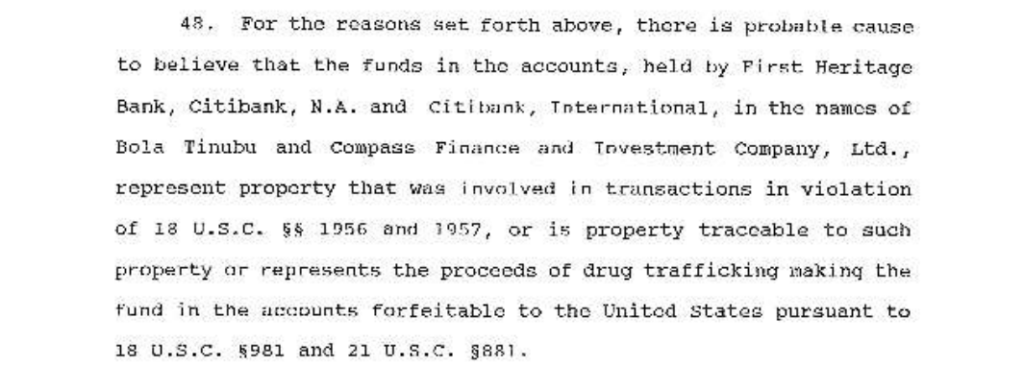
A 1993 report by IRS Special Agent Kevin Moss explained that “there is probable cause to believe that funds in certain bank accounts controlled by Bola Tinubu… represent proceeds of drug trafficking; therefore these funds are forfeitable to the United States.”
In the documents, Moss describes an extremely close working relationship between the future Nigerian president and two Nigerian heroin dealers named Abiodun Olasuyi Agbele and Adegboyega Mueez Akande, the latter of whom was listed as Tinubu’s cousin on an application for a vehicle loan.
“According to bank employees, when Bola Tinubu came to First Heritage Bank in December 1989 to open the accounts, he was introduced to them by Adegboyega Mueez Akande, who at that time maintained an account at the bank.” What’s more, bank records indicate that “Bola Tinubu also opened a joint checking account in his name and the name of his wife, Oluremi Tinubu,” who had “previously opened a joint bank account also at this bank with Audrey Akande, the wife of Adegboyega Mueez Akande,” Moss explained. In several of the applications, the addresses used by Tinubu exactly matched those previously used by Akande.
“According to bank records… Tinubu opened an individual money market account and a NOW account” at First Heritage Bank in December 1989, the special agent noted. “In the application, Tinubu stated that his address was 7504 South Stewart, Chicago, Illinois” — “the same address used previously by Akande.”
“Bank records disclosed that five days after the account was opened, on January 4, 1990, $80,000 was deposited into the NOW account at First Heritage Bank by wire transfer through First Chicago from Banc One Houston,” the report continues. According to the IRS, the money was sent by Akande.
But the Nigerian president’s financial dealings with the heroin traffickers went even further, according to the IRS special agent. He wrote that Citibank records documented “two additional corporate accounts held in the name of Compass Finance and Investment Company, Ltd. which were controlled by Bola Tinubu.”
“When Bola Tinubu opened these accounts,” he provided “a memorandum of association and articles of association” which “identified Mueez Adegboyega Akande and Abiodun Olasuyi Agbele as directors of Compass Finance and Investment Company, Ltd.,” Moss wrote.
In the end, Tinubu somehow managed to deposit over $660,000 in his First Heritage Bank account in 1990, and more than $1.2 million the next year — all while claiming to take home just $2,400 a month from his position at Mobil Oil Nigeria.
As the investigation into the money laundering scheme began to gain traction, Tinubu left the US and returned to Nigeria. Ultimately, Moss was able to speak to Tinubu by telephone on a number of occasions, and the special agent reported that the future president initially acknowledged his personal and financial dealings with the pair of drug traffickers.
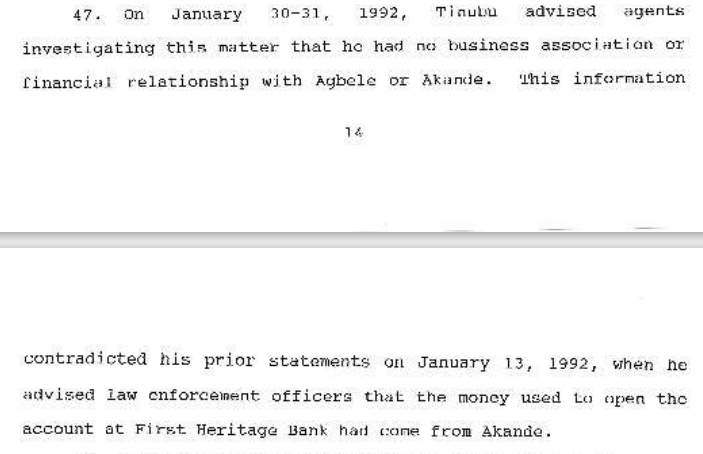
But in late January of 1992, “Tinubu advised agents investigating this matter that he had no business association or financial relationship with Abele or Akande,” Moss wrote. “This information contradicted his prior statements on January 13, 1992, when he advised law enforcement officers that the money used to open the account at First Heritage Bank had come from Akande.”
Back in Nigeria, Tinubu had already begun to transition into the political arena. By 1992, he’d been elected to the Senate, and in 1999 he became the Governor of Lagos State, a position he retained until 2007. At some point in his tenure, Tinubu established a relationship with the US Embassy which would last for years to come, according to a trove of diplomatic cables released by Wikileaks.
But even his State Department allies couldn’t help noticing Tinubu’s penchant for dishonesty. One particularly noteworthy cable pointed out that the politician was “known to play fast and loose with the facts” and “has been caught in the past embellishing his educational achievements.”
In the end, however, Tinubu’s usefulness seemed to outweigh his casual relationship with the truth, and the future Nigerian president went on to provide American officials with a near-continuous assessment of the political situation in his country. One typically intimate meeting with Tinubu ended with the US ambassador to Nigeria commenting: “as always, we found his take on the national political scene to be insightful.”
When the cables came to light in 2011, many Nigerians were shocked at the candor with which their elected officials spoke to Washington’s envoys. “The willingness of our elites to divulge unsolicited information about the nation to U.S. officials betrays an infantile thirst for a paternal dictatorship,” Nigerian-American professor and columnist Farooq Kperogi wrote.
Though Tinubu appeared to have escaped justice for his alleged role in a heroin trafficking conspiracy, accusations of corruption would continue to dog the ECOWAS chair throughout his political career in Nigeria. Since leaving office as governor of Lagos in 2007, Tinubu “picked every subsequent winning candidate,” according to German broadcaster DW, which noted earlier this year that the tycoon “is believed to be one of Nigeria’s richest politicians but the source of his wealth is unknown.”
In recent years, clues about the origins of the fortune amassed by one of Africa’s leading political players have begun to come to light.
In 2009, Tinubu came under investigation by the Metropolitan Police of London, who were probing allegations that the politician had pooled money with two other Nigerian governors to create a front company known as the “African Development Fund Incorporation.”
Investigators alleged the unusual business arrangement was actually a joint effort to illegally acquire shares of ECONET, a telecommunications firm founded by US intelligence asset and Gates Foundation trustee Strive Masiyiwa. But attempts to probe the legitimacy of the transactions in question were sidelined when the Nigerian federal government stonewalled the British investigation, which ultimately concluded without a single arrest. To this day, Nigerian authorities have yet to release the evidence requested by UK authorities.
In 2011, Tinubu was tried before the Code of Conduct Tribunal in Nigeria for illegally operating 16 foreign bank accounts. Eager to avoid the embarrassment he’d previously suffered when being photographed in court, the ECOWAS chair reportedly refused to take his place at the dock in a judicial hearing.
But the unwelcome attention appears to have done little to rein in the politician’s extravagant taste, and Tinubu once again found himself embroiled in a corruption scandal following an investigation into the luxurious 7,000-square foot mansion where the Nigerian president stays when receiving medical care in London.
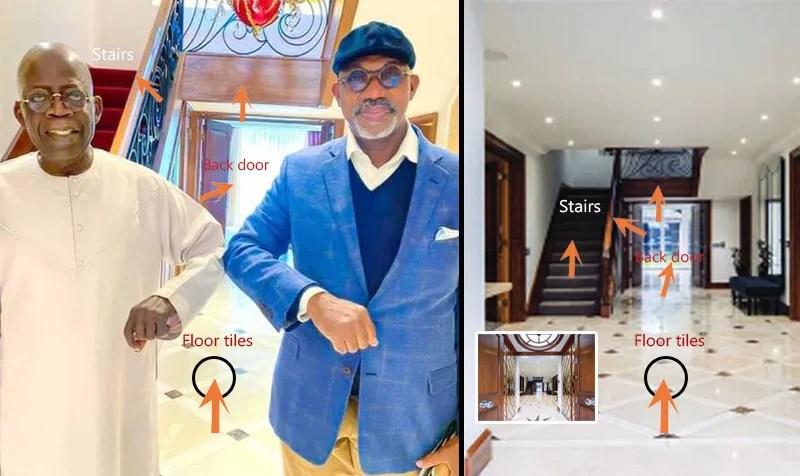
According to Nigerian outlet Premium Times, the massive villa in London’s exclusive Westminster borough was picked up for a song by Tinubu’s son, who somehow managed to purchase the property at a discount of approximately $10 million from a wealthy fugitive – even though the seller’s assets, including the mansion in question, had been frozen by a Nigerian court. Photos published on social media in 2017 show Tinubu posing inside the villa alongside Nigeria’s president at the time, Muhammadu Buhari.
The current and previous president worked closely for decades, and Tinubu has publicly claimed sole credit for Buhari’s presidency while campaigning. “If it were not for me standing before you leading the army, saying ‘Buhari, go ahead, we’re behind you,’ he could never have become the president,” he told supporters at a rally last year.
But the suspicious confluence of money and influence didn’t end with the mysterious mansion in London. During Nigeria’s 2019 general election, footage of armored trucks entering Tinubu’s residence went viral on social media, and the incident was widely seen as proof that the politician was engaged in a fraudulent vote-buying scheme. But Tinubu remained defiant, telling reporters, “I keep money wherever I want.”
“Excuse me, is it my money or government money?” he asked. “If I don’t represent any agency of government and I have money to spend, if I have money, if I like, I give it to the people free of charge,” he insisted.
This January, the official explanation for the episode evolved again when one of his party’s representatives told a Nigerian TV station that the armored trucks in question had simply “missed [their] way” and arrived at the wrong address. Asked why Tinubu had seemingly admitted to dispensing cash to the public, the party’s organizing secretary in Lagos offered the bemused presenters an equally improbable explanation: “he said that jokingly.”
ECOWAS as a neocolonial weapon
While ECOWAS was officially founded via the Treaty of Lagos in 1975, its official history notes the bloc’s origins date back to the creation of the CFA Franc in 1945, which consolidated France’s West African empire into a single-currency union. Publicly, the move was described as a benevolent attempt to shield these colonies from the consequences of the French franc’s sharp devaluation in 1945, following the creation of the US-dominated Bretton Woods system. As the French finance minister said at the time:
“In a show of her generosity and selflessness, metropolitan France, wishing not to impose on her faraway daughters the consequences of her own poverty, is setting different exchange rates for their currency.”
In reality, the introduction of the CFA Franc meant that Paris was able to maintain highly unequal trading relationships with its African colonies, at a time when its economy was ravaged by World War II and its overseas empire was rapidly disintegrating. The currency made it cheap for member states to import from France and vice versa, but prohibitively expensive for them to export anything anywhere else.
This forced dependency in Francophone West Africa created a captive market for the French, and by extension the rest of Europe. That dynamic, which has stunted regional economic development for decades, persists to this day. The CFA Franc’s continued dominance ensures West African states remain under the economic and political control of France. Those African nations are powerless to enact meaningful policy changes, as they lack control over their own monetary policy.
That the currency features so prominently in the authorized history of ECOWAS is instructive, because the bloc has long-been criticized as an extension of French imperialism. It was not for nothing that in 1960, then-French President Charles de Gaulle made membership of the CFA Franc a precondition for decolonization in Africa.
Though ECOWAS is theoretically meant to maximize member states’ collective bargaining power by fostering “interstate economic and political cooperation,” such harmonization makes it easier for former imperial powers like France to exploit and enfeeble their constituent countries. The bloc imposes a strict, Western-approved legal and financial framework upon its members, and any state deviating from these rules is harshly punished.
In January 2022, ECOWAS imposed strict sanctions on Mali, prompting thousands to take to the streets in support of the military government that seized power in January the previous year. The new government’s efforts to purge the country of malign foreign influence saw a complete ban on French media imposed, a decision which was slammed by the UN but cheered by average Malians.
ECOWAS applied similar measures to Burkina Faso in response to a September 2022 military coup, which saw Paul-Henri Sandaogo Damiba removed after just eight months in power. Though Damiba himself seized via military coup, there was little condemnation from Western officials and few suggestions that ECOWAS impose sanctions — perhaps due to the ousted leader’s pro-Western orientation and status as a graduate of multiple elite US military and State Department training courses.
Since 1990, ECOWAS has waged seven separate conflicts in West Africa, in order to protect the West’s preferred despots across the region. Meanwhile, between 1960 and 2020, Paris launched 50 separate overt interventions in Africa. Figures for clandestine activities conducted during this time are unavailable, but the country’s fingerprints are plastered all over multiple rigged elections, coups, and assassinations that have sustained compliant, corrupt governments in power throughout the continent.
As President Jacques Chirac remarked in 2008, “without Africa, France will slide down into the rank of a third [world] power.” This perspective was reaffirmed in a 2013 French Senate report, Africa is Our Future. Indeed, the mere existence of anti-imperialist governments anywhere in the region is intolerable to Paris.
Luckily for the French elite, compromised figures like Bola Tinubu are still on hand to do their dirty work for them.



 After the Crash