The Fear Driving US Nuclear Strategy

By Robert J. Burrowes

The United States Department of Defense released its latest ‘Nuclear Posture Review 2018’ (NPR) on 2 February, updating the last one issued in 2010 during the previous administration. See ‘Nuclear Posture Review 2018’.

The Executive Summary of the NPR is also available, if you prefer. See ‘Nuclear Posture Review 2018 Executive Summary’.

Several authors have already thoughtfully exposed a phenomenal variety of obvious lies, invented threats, strategic misconceptions and flaws – such as the fallacious thinking behind ‘deterrence’ and significantly increased risk of nuclear war given the delusional ‘thinking’ in the document – as well as the political fear-mongering in the NPR. For example, eminent scholar Professor Paul Rogers has pointed out: ‘The risk now is that we are on a slippery slope towards “small nuclear wars in far-off places”, which themselves could either escalate or at the very least break the 70+ year taboo on treating nuclear weapons as useable.’ See ‘Nuclear Posture Review: Sliding Towards Nuclear War?’

Stephen Lendman has reminded us that US ‘defense spending far exceeds what Russia, China, Iran and other independent countries spend combined’ and that the US ‘nuclear arsenal and delivery systems can destroy planet earth multiple times over’ with the document suggesting ‘preparation for nuclear war’. Moreover, the NPR ‘falsely claims the nation must address “an unprecedented range and mix of threats” posed by Russia, China, North Korea, Iran and other countries’ and this despite the incontrovertible fact that no nation has threatened US security since World War II and none threatens it now.

He further points out that the NPR’s claim that there is ‘an unprecedented range and mix of threats, including major conventional, chemical, biological, nuclear, space, and cyber threats, and violent nonstate actors’ is ‘utter rubbish’ and that ‘America’s rage for endless wars of aggression, along with its rogue allies, poses the only serious threat to world peace and stability.’ See ‘Trump’s Nuclear Posture Review’.

Even Andrew C. Weber, an assistant defense secretary during the Obama administration, has warned that

‘Almost everything about this radical new policy will blur the line between nuclear and conventional’ and ‘will make nuclear war a lot more likely.’ See ‘Pentagon Suggests Countering Devastating Cyberattacks With Nuclear Arms’.

Despite the obvious belligerence in the document, we are supposed to believe, according to words in the NPR, that ‘The United States remains committed to its efforts in support of the ultimate global elimination of nuclear, biological, and chemical weapons’ despite the US denunciation of the ‘UN Treaty on the Prohibition of Nuclear Weapons’ negotiated by 122 countries just a few months ago in mid-2017. See ‘U.S., UK and France Denounce Nuclear Ban Treaty’.

Presumably, we are supposed to have shorter memories than members of the US administration or to be even more terrified and unintelligent than are they. This would be difficult.

Rather than further critique the document, which several authors have done admirably, I would like to explain my observation immediately above.

Let me start by explaining why those who formulated the current US nuclear strategy, wrote the Nuclear Posture Review, now promote it and are responsible for implementing it, are utterly terrified and quite delusional, and constitute a threat to human civilization.

The NPR is full of language such as this: ‘There now exists an unprecedented range and mix of threats, including major conventional, chemical, biological, nuclear, space, and cyber threats, and violent nonstate actors. These developments have produced increased uncertainty and risk.’

Are these individuals, notably including Donald Trump, Secretary of Defense General Jim ‘Mad Dog’ Mattis, Chief of Staff Marine General John Kelly and National Security Adviser General H. R. McMaster, really frightened of countries such as Iran (with its non-existent nuclear arsenal) or North Korea (with its handful of ‘primitive’ nuclear weapons and inadequate delivery systems)? Or are they really frightened of countries such as Russia and China, whose nuclear arsenals pale in comparison to that of the United States and whose strategic posture in any case is decidedly non-aggressive (particularly towards the United States) despite its ongoing provocations of them?

Are US government leaders really so terrified of possible conventional, chemical, biological, space and cyber attacks that they need to threaten nuclear annihilation should it occur?

Well, the answer to each of these questions is that Trump, Mattis, Kelly, McMaster and other US political and military leaders are, indeed, terrified.

However, they are projecting their obvious terror away from its original source and onto a ‘safe’ and ‘approved’ target so that they can behave in accordance with their terror. They do this because the original cause of their terror – their parents and/or other significant adults in their childhood – never allowed them to feel their terror and to direct and express it safely and appropriately. For a full explanation of why this happens, see Why Violence?’ and Fearless Psychology and Fearful Psychology: Principles and Practice.

Unfortunately, and in this case potentially catastrophically, this dysfunctional behavioural response to deeply suppressed terror cannot ‘work’ either personally or politically for the individuals concerned. Let me explain why.

Evolution devised an extraordinarily powerful response to threats: it gave many organisms, including human beings, the emotion of fear to detect threats as well as other tools that can be used in conjunction with fear to respond powerfully to threats. Hence, in response to a threat, humans are meant to feel their fear and, while doing so, engage other feelings, conscience and intelligence so that the source of the threat can be accurately identified and the most powerful and effective behavioural response to that threat can be devised and implemented. In simple language: We need our fear to tell us we are under threat and to play a part in defending ourselves. In evolutionary terms, this was highly functional.

If, however, during childhood, the fear is suppressed because the individual is too frightened to feel it (usually because their parents deny them a safe opportunity to do so), then they will be unconsciously compelled to project their fear onto those who pose no threat (precisely because these people do not immobilize them with terror) and to endlessly seek to control these people (during childhood this usually means their younger siblings and/or friends, and during adulthood it usually means people of another sex, race, class, religion or nation) so that they can gain relief from experiencing their suppressed (childhood) fear.

The relief, of course, is delusionary. But once someone is terrified, it is not possible for them to behave functionally or powerfully. They will live in a world of delusion and projection, endlessly blaming those who they (unconsciously) project to be a threat precisely because these people are not frightening and not a threat and seem more likely to be able to be ‘controlled’.

This projection and behaviour happen all of the time, both in personal interactions and geopolitically, but it doesn’t usually threaten imminent annihilation, even if, to choose another example, it endlessly and perhaps disastrously impedes efforts to tackle the environmental and other assaults on our biosphere.

It is because parents are frightened to feel and experience their own fear that they also fear their child’s fear and they act (consciously or unconsciously, depending on the context) to prevent the child from feeling this fear, perhaps by doing something as simple as reassuring them.

However, parents also use a variety of methods to distract their child from feeling their feelings. They might offer the child a toy or food to distract them. But another important way in which fear is suppressed is by teaching children to use play as a distraction from having their feelings. This fear might then remanifest in the form of the child wanting others to play with them but particularly by doing so in a game of their choosing and over which they have control (so that they can ensure that their fear is not raised).

Once the child has learned to use gaining control over play to distract themselves from their terror, it might well become a lifetime addiction, subsequently manifesting as a dysfunctional desire for control within a family or perhaps even economically, politically or militarily.

Unfortunately, as some of these children grow up and the nature of their ‘game’ changes, the outcome can have deadly consequences. This is simply because there is never any guarantee that others will submit willingly to control by others. And, if they do not, this can trigger the original person’s (unconscious) terror ‘necessitating’ action – a higher-risk strategy in an attempt to secure this higher degree of control over others – to resuppress their terror.

However, for example, even if the terrified person ends up owning a major corporation and exercising a great degree of control over employees, markets and possibly countries, the terror driving their delusional need for control can never be satisfied. See ‘Love Denied: The Psychology of Materialism, Violence and War’. But the same principle applies in other domains as well, including the political and military.

And in the most dangerous collective manifestation of this major psychological disorder, the current US political/military leadership, which has been effectively merged by Trump’s appointment of military generals to his political staff, we now have the situation where a collection of individuals who are terrified and also project their dysfunctional desire for control onto other nations, are willing to threaten (and use) nuclear weapons in a delusionary attempt to feel (personally) ‘in control’.

It is little wonder that the Bulletin of the Atomic Scientists has moved the Doomsday Clock to two minutes to midnight! See It is now two minutes to midnight: 2018 Doomsday Clock Statement.

So what can we do?

Well, I would tackle the problem at several levels and I invite you to consider participating in one or more of these.

To help prevent this problem from emerging at its source, you are welcome to consider making ‘My Promise to Children’. This will play a vital role in ensuring that children do not grow up suppressing their fear.

Given the extraordinary emotional and other damage inflicted by school, you might consider educational opportunities for your child(ren) outside that framework. See ‘Do We Want School or Education?’

If you suspect that you are not as powerful as you would like, you might consider ‘Putting Feelings First’ so that you can learn to behave with awareness – a synthesis of all of the feedback that your various mental functions give you and the judgments that arise, in an integrated way, from this feedback. This will enable you to love yourself truly and always courageously act out your own self-will, whatever the consequences.

If you wish to work against the many threats, including military threats, to our environment simultaneously, you are welcome to join those participating in ‘The Flame Tree Project to Save Life on Earth’.

And if you wish to be part of efforts to end violence and war, including the threat of nuclear annihilation, you are welcome to consider signing the online pledge of ‘The People’s Charter to Create a Nonviolent World’ and/or using sound nonviolent strategy for your campaign or liberation struggle. See Nonviolent Campaign Strategy or Nonviolent Defense/Liberation Strategy.

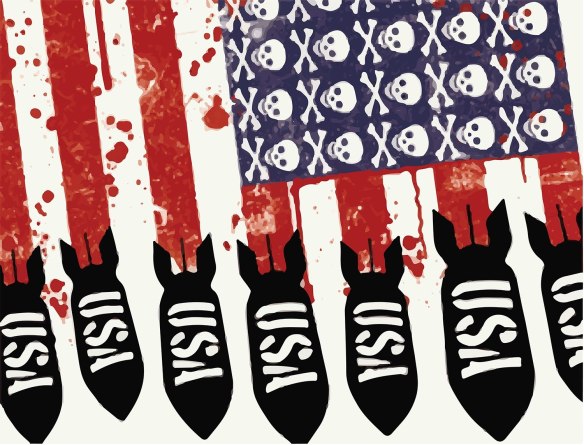
Our world is poised perilously on the brink of catastrophic nuclear war. This has happened because we have given responsibility for holding the nuclear trigger to a handful of men who, emotionally speaking, are terrified little boys cowering from the imaginary threat of the bogeyman under their bed.

There is no easy way back from this brink. But you can help, both now and in the future, by doing one or more of the suggestions above.

Biodata: Robert J. Burrowes has a lifetime commitment to understanding and ending human violence. He has done extensive research since 1966 in an effort to understand why human beings are violent and has been a nonviolent activist since 1981. He is the author of Why Violence? His email address is flametree@riseup.net and his website is here.


Robert J. Burrowes
P.O. Box 68
Daylesford
Victoria 3460
Australia
Email: flametree@riseup.net

Websites:
Nonviolence Charter
Flame Tree Project to Save Life on Earth
‘Why Violence?’
Feelings First
Nonviolent Campaign Strategy
Nonviolent Defense/Liberation Strategy
Anita: Songs of Nonviolence
Robert Burrowes
Global Nonviolence Network

Sacred Agency

By Kingsley L. Dennis

Source: Reality Sandwich

The following essay was originally published on KingsleyDennis.com


Transcendence is the only real alternative to extinction.

—Václav Havel, Independence Hall, Philadelphia, July 4, 1994

We are cosmologizing the human.

—Henryk Skolimowski, The Participatory Mind


Human consciousness has been on a long journey. Our awareness has shifted from the earlier archaic, animistic mode; to the religious and scientific; and then later to an industrial, mechanistic consciousness. Our ancestors did not live in the same world as we live in now, nor would they have exhibited the same kind of consciousness as we currently do. Consciousness is not a fixed phenomenon or static expression—it changes alongside the flows and fluxes of history, time, and environment.

An integral mode of consciousness began to emerge after the successive industrial revolutions that adapted a “machine style” perspective of control, power, and efficiency; and which eventually propelled global society toward excessive consumption and accelerated growth. This integral consciousness emerged parallel to a new era of technological innovation. That is, a consciousness that reflects dynamics of connection and communication across condensed time and space.

It can be said that we have gone from worshipping faith, then objective knowledge, to finally arriving at an understanding that everything depends upon the subjective self. Throughout this whole journey, like the hero that traverses through the underworld, we have ventured far in search of a mode of being – a state of consciousness and awareness – that can benefit us. A place of conscious self-awareness, which may be termed as sacred, has been present within humanity from the very beginning. It never went away – only we went away. This situation is similar to the behavior of individuals as observed by psychologist Abraham Maslow. Maslow noted how people step back from doing something important, believing others will do it instead. Somewhere along the way we made an internal agreement to stay back and not to overestimate our abilities. It appears that too many of us for too long have avoided being ‘fully human’ and content to remain as ‘only human.’

Regardless of how we may articulate it, the sacred presence within humanity cannot be denied as it is an expression of the evolutionary impulse. As such, it does not stop at transitional stages but is compelled to push toward ever higher states and degrees of consciousness. We are in the hands of a force that we can barely recognize. Throughout the long journey of our development human beings have been deeply involved in this sacred unfolding (for want of a better expression). What this means is that the transcendental yearning to go beyond one’s present state persists in each of us. All of this, our very humanism, should be an inherent part of our cultural mythology. Or at least should influence how we understand and perceive our reality.

Our experience of reality is never pure, but always mediated through consciousness in its various states of reception. The myths we hold as an individual, a culture, and as a collective species reflects our own state of mind. Unfortunately, humanity has for far too long considered itself separate from the cosmos. We feel as if exiled upon a dead planet somewhere upon the fringes of our galaxy. If we do not fully know ourselves it may be because our cultural myths (our narratives) place us within a cosmically isolated reality. To be truly integrated we must recognize that we participate not only upon the planet but also within a grander mythology. In other words, we should accept our responsibility as having sacred agency. After all, the history of human civilization is the history of ourselves as change agents.


Sacred Agency

The philosopher Karl Jaspers referred to the period from 800–200 BCE as the Axial Age. It was a time that, according to Jaspers, similar expressions of new thinking appeared in Persia, India, China, and the Western world. He indicated also that the Axial Age represented an in-between period, where old certainties had lost their validity and new ones were yet to emerge. The new religions that arose in this time—Hinduism, Buddhism, Confucianism, Taoism, and monotheism—influenced new thinking in terms of individuality, identity, and the human condition. These new emerging religions helped to catalyze new forms of thinking and expressions of human consciousness. And yet, over time, we have seen how they were not wholly successful in establishing permanent developmental change.

Social thinker Duane Elgin has referred to our present time as the Second Axial Age in that religions of separation are being replaced by a new spirit of communion. Elgin says that the world is moving into a spiritual communion and empathic connection with a living cosmos. Maybe we are in need of being reminded that there is nowhere else to go when the cosmos already exists within us. This empathic consciousness that Elgin speaks of can be related to the emerging integral consciousness that reflects our increased interconnectivity through our global networks. This connects with our innate, fundamental drive to seek out communion and coherence. A mode of human consciousness that seeks coherence is itself a reflection of a universal natural order. In other words, it is a self-referencing feedback loop. And so now allow me to speculate.

My suggestion is that a purpose for sentient human life upon this planet is as a driver toward establishing a coherent planetary consciousness. In other words, to act as a channel to ‘bring in’ – i.e., receive consciousness – from the consciousness field and to manifest it specifically (that is, to project it) within our earthly reality. There is a correlation here with Aurobindo’s concept of the Supermind/Overmind, in that a form of higher consciousness can be made immanent upon the material plane. Aurobindo referred to this as human evolution moving towards a suprarational or spiritual age that exhibits an intuitive or Gnostic mode of consciousness.

The finer channeling of the consciousness field would require the adequate preparation of human receptivity. That is, our minds and even perhaps our nervous system would need to be sufficiently prepared in order to successfully actualize this potential. By raising localized aspects of human consciousness through individual perceptions and awareness we may better increase the coherence of consciousness amongst the whole—a form of collective transcendence through species consciousness. And this can be made tangible by local agents – i.e., each one of us – becoming aware and conscious in everyday acts of right thinking, right behavior, and right being. It is a mode of sensitive and balanced consciousness that comes only with considerable effort and discipline. This discipline forms part of the developmental awakening within each individual, and which then influences our perceptions and life experiences.

As such, we can come to recognize that we are no longer either isolated individuals or an inarticulate mass. We are localized consciousness acting through aware individuals who consciously seek to connect, collaborate, and care about the future. Each one of us, as localized consciousness, is a reflection of the grander nonlocal consciousness. And in this way each one of us is also a reflection of the other. No individual lives within a shell separated from everybody else, but each is connected to all through our conscious humanity.

What we are seeing emerge across the world is the early stirrings of a planetary civilization; one that is driving toward diversity and coherence. And as we connect and share our thoughts, ideas, and visions we will be helping to strengthen the signal or reception of consciousness and thus the bringing in of the grander cosmic consciousness. A planetary consciousness spread across the Earth may not only be a real possibility, it may very well be a fundamental cosmic purpose.


Human Purpose in the Sacred Order

Recent scientific discoveries indicate that our reality is coded from beyond cosmic space-time; and as such our reality behaves in a way consistent with what we know as a holographic projection. That is, the totality of our reality is in-formed from a deep consciousness beyond it. The known cosmos thus acts as a nonlocal consciousness field, of which sentient life forms as localized manifestations. It has been inferred through various religious and sacred texts, and various wisdom traditions, that the universe (material reality) came into being as a way for its source to ‘know itself.’ This is reminiscent of ‘know thyself,’ the famous maxim from the Oracle of Delphi. Or, in modern language, we can say that we are the eyes through which the cosmos contemplates itself.

Self-consciousness is generally attributed to those sentient organisms at a high peak of mental development. Self-reflection is one of the prized attributes of self-consciousness. Furthermore, self-realization is something we credit to each attained individual consciousness. A realization of the self is part of the path of human actualization. It is a path in which purpose and meaning are core drivers and potentials. Human beings – or we could say human becomings – are naturally driven by a longing, a purpose, and this signifies a connection with a sacred impulse. In our times human civilization has shifted into an unprecedented era of self-actualization. The psychologist Abraham Maslow, who originated a scale of self-actualization, recognized that one of the characteristics of self-actualizers is that they have far less doubt about what is right and wrong than normal people do, and they act upon this inner knowing.

As we further speculate, what would self-realization upon a greater scale be like? That is, self-realization as a planetary consciousness? Or as a galactic consciousness? What would a fully realized and self-conscious cosmic consciousness operating through all of its localized manifestations be like? This would constitute a state of coherent self-aware consciousness beyond our imagination. We can only speculate, or internally gaze upon the possibility.

As a recap then, human consciousness is a localized expression of the greater nonlocal consciousness field. As sentient beings we receive aspects of this consciousness that pervades our space-time. We are animated by it, and we then manifest this through our own minds and human cultures. Our individual expressions of consciousness also reflect back into the greater nonlocal consciousness field. The greater our individual perceptions and conscious realization, the greater the total realization of the entire holographic field consciousness (as if in a feedback loop). To put it another way, cosmic consciousness is ‘in-formed’ through the emerging awareness of each of its conscious subparts, or components. The art of the sacred then is that we each have a role in bringing the unfinished world into existence through conscious participation.

As each one of us wakes up (to use a common metaphor) the cosmic net shines that little bit brighter. If enough individual consciousnesses awake upon this planet we may catalyze a localized planetary field into collective conscious awareness. In this case, we are each a conscious agent of cosmic realization and immanence. We each have an obligation in our existence on this planet to raise our individual, localized expressions of consciousness. In doing so, we both infect and inspire others in our lives to raise theirs, as well as reflecting back our conscious contribution into the cosmic consciousness. In this way, we can act as both citizens of the cosmos as well as caretakers for the sacred order.

We have now arrived at a place where we can recognize and accept that our reality is not a static affair but an active, fluid realm that makes demands upon us. And in knowing this we are compelled to embrace the obligations and responsibilities that come with this role. We are on a path of completion – of conscious completion and communion – which is the eternal path of the sacred. Through this sacred journey of completion we connect and commune with everything else in our reality, and beyond. As human beings we have been tasked with this sacred endeavor. We can become aware of our creative contribution to reality and this can give us meaning and purpose. Perhaps this will finally provide us with our place in the cosmos. And how can we walk this path?

We can take this journey through our small acts of conscious awareness – our thoughts, attitudes, behavior, and our everyday actions. Upon the next level, our social changes and emerging technologies may form part of this process, establishing an extended mind and empathic embrace across the face of the earth. Magic is alive; magic never died. Everything is ultimately a technology of the soul; and all magic, all science, and all human expression is a part of this soulful technology. And with each step forward we move closer to soulful communion with a grand conscious and sacred order.

The sacred impulse animates the expression of consciousness at the individual, collective, and planetary level. And one day we may witness a grand awakening, unprecedented upon this planet, and this may very well be the purpose for sentient life, as conscious agents of the sacred order. This is likely to be more reality than fantasy. The hidden treasure that is at the very core of our existence wishes to be known – for us to know ourselves – by our individual journeys of self-realization.  We are not alone. A great planetary future awaits us, as a great treasure that wishes for communion. Welcome to the new story.


Truth has to appear only once, in a single mind, for it to be impossible for anything ever to prevent it from spreading universally and setting everything ablaze.

—Teilhard de Chardin, The Heart of Matter

Saturday Matinee: Lucid

David Lynch inspired short film “Lucid” is now online!

By Kim S�nderholm

Source: Screen Anarchy

David Lynch inspired short film “Lucid”, directed by Henrik Bjerregaard Clausen, written by Mads Zaar Riisberg, produced by Stoyan Yankov and starring Kim Sønderholm is now publicly available online!

This short nightmare, clocking in just under five minutes, is a “Twin Peaks”-esque short film from Denmark (no worries, spoken language is  English) has toured festivals worldwide for a good while, gotten screened on over 75 festivals and won a lot of awards. Ending its festival run it is now public available for streaming for everyone to see. Take five minutes and enjoy!

A man wakes up from a dream and attempts to change the course of his life, but is he truly in control of his own destiny? What is in the dark forest? How can you tell if you are still dreaming?

Biggest Nunes Memo Revelations Have Little To Do With Its Content

By Caitlin Johnstone

Source: Consortium News

It’s fitting that the ever-tightening repetitive loops of America’s increasingly schizophrenic partisan warfare finally hit peak shrillness and skyrocketed into a white noise singularity on Groundhog Day. Right now, we’re right about at the part of the movie where Bill Murray is driving over a cliff in a pickup truck with a large rodent behind the wheel.

If you only just started paying attention to U.S. politics in 2017 what I’m about to tell you will blow your mind, so you might want to sit down for this: believe it or not, there was once a time when both of America’s mainstream political parties weren’t screeching every single day that there was news about to break any minute now which would obliterate the other party forever. No Russiagate, no Nunes memo, no Rachel Maddow red yarn graphs, no Sean Hannity “tick tock,” no nothing. People screaming that the end is nigh and it’s all about to come crashing down were relegated to street corners and the occasional Infowars appearance, not practicing mainstream political punditry for multimillion dollar salaries on MSNBC and Fox News.

I’m not saying it’s a bad thing that Americans are starting to look critically at the power dynamics in their country, but the partisan filters they’ve pulled over their eyes are causing mass confusion and delusion. Now everyone who questions the CIA is a Russian agent and the term “deep state” suddenly means “literally anyone who doesn’t like Donald Trump.” Your take on the contents of the Nunes memo will put you in one of two radically different political dimensions depending on which mainstream cult you’ve subscribed to, and it will cause you to completely miss the point of the entire ordeal.

The part of the memo that has everyone talking today reads as follows: “Furthermore, Deputy Director McCabe testified before the Committee in December 2017 that no surveillance warrant would have been sought from the FISC without the Steele dossier information.”

This refers to a surveillance warrant requested by the FBI’s then-Deputy Director Andrew McCabe from the Foreign Intelligence Surveillance Court seeking permission to spy on the communications of Carter Page, a member of the 2016 Trump campaign. The controversy revolves around the claim that this surveillance warrant would never have even been requested if not for the clearly biased, Clinton-funded, and error-riddled Christopher Steele dossier which is acknowledged even by its former MI6 author to be 10 to 30 percent inaccurate.

Combine that with the fact that this has never been made clear to the public, and baby you’ve got yourself a scandal. The FBI knowingly using extremely tainted evidence from one presidential campaign to get permission to spy on another would indeed be a very big deal.

There are some problems with the “BOOM! Bigger than Watergate!” exclamations that pro-Trump partisans have been parading around about this, however. The first is that the memo is only an internal communication between Republican congressmen; it’s not a sworn testimony or legal transcript or anything legally binding. It’s basically just some Republican ideas about what happened. The assertions made therein are reportedly being hotly contested by Democrats with knowledge of the situation, which is in turn being disputed by Republicans.

Another thing putting a damper on the GOP’s “KABOOM!” parade is the fact that the memo’s contents are not even entirely new; CNN reported way back in April of last year that sources had informed them that the Steele dossier had been used to get a FISA warrant on the Trump campaign. Additionally, even if every single allegation in the memo is true, the revelations are still arguably far less earth shattering than the Edward Snowden revelations of 2013 exposing the NSA’s sprawling domestic espionage network, so the expectation that these less significant new revelations would cause a radical transformation in U.S. politics when the Snowden revelations did not seems highly unrealistic.

Nonetheless, there have been some extremely important revelations as a result of this memo; they just haven’t come from the contents of the memo itself. In the same way that cybersecurity analysts observe the metadata underlying hacked files rather than the contents of the files themselves, political analysts have been pointing out that a lot can be learned about the political establishment by looking at its response to the possibility of the memo’s release.

“Memo is clearly not a blockbuster. We can tell so by reading it. Which makes Dems’ frantic efforts to prevent anyone from reading it seem even more bizarre,” observed TYT’s Michael Tracey. “Veracity of memo’s claims aside, we were told that its release would undermine the rule of law. So, just checking: is the rule of law still in tact?” he added later.

“Now it is clear to all,” WikiLeaks’ Julian Assange tweeted. “The claims about how the ‘Nunes’ memo would destroy ‘national security’ were lies. Classification stickers are used by bureaucrats trying to obtain ‘political security’ for their cronies.”

“One effect of the memo – it’s an example of how extensively we overclassify information,” wrote National Review’s David French. “I’m highly dubious that any information disclosed threatens national security in any way, shape, or form. I’d be willing to bet the Dem response is similarly harmless. Release it.”

Indeed, both the FBI and high-profile Democrats have been claiming that the memo’s unredacted release would pose a national security threat, with California Congressman (and virulent Russiagater) Eric Swalwell going so far to call it “brainwashing.” A CNN panelist wandered completely off the paddock and suggested that yesterday may have been America’s last day as a democracy. Why were they all flipping out so hysterically over a release of information that plainly poses no threat to the American people?

In addition to Assange’s assertion that government secrecy has far less to do with national security than political security (a claim he has made before which seems to be proving correct time and time again), there’s the jarring question posed by Republican Congressman Thomas Massie: “who made the decision to withhold evidence of FISA abuse until after Congress voted to renew FISA program?”

Whoa, Nelly. Hang on. What is he talking about?

It would be understandable if you were unaware of the debate over the reauthorization of FISA surveillance which resulted in unconditional bipartisan approval last month – the mainstream media barely touched it. In point of fact, though, the very surveillance practices alleged to have been abused in this hotly controversial memo are the same which was waved through by both the House and the Senate, and by the very same people promoting the memo in many cases.

The McCabe testimony was in December. FISA was renewed in January. Why is all this just coming out now? If the Republicans truly believed that McCabe said what the memo claims he said, why wasn’t the public informed before their elected representatives renewed the intelligence community’s dangerously intrusive surveillance approval? Was this information simply forgotten about until after those Orwellian powers had been secured?

Of course not. Don’t be an idiot.

This makes the kicking, screaming, wailing and gnashing of teeth by the political establishment make a lot more sense, doesn’t it? Now suddenly we’re looking at a he-said, she-said partisan battle over an issue which can only be resolved with greater and greater transparency of more and more government documents, and we can all see where that’s headed. In their rush to win a partisan battle and shield their president from the ongoing Russiagate conspiracy theory, the Republicans may have exposed too much of the establishment foundation upon which both parties are built.

The term “deep state” does not mean “Democrats and Never-Trumpers” as Republican pundits would have you believe, nor does the term refer to any kind of weird, unverifiable conspiracy theory. The deep state is in fact not a conspiracy theory at all, but simply a concept used in political analysis for discussing the undeniable fact that unelected power structures exist in America, and that they tend to form alliances and work together in some sense.

There is no denying the fact that plutocrats, intelligence agencies, defense agencies and the mass media are both powerful and unelected, and there is no denying the fact that there are many convoluted and often conflicting alliances between them. All that can be debated is the manner and extent to which this is happening.

The deep state is America’s permanent government, the U.S. power structures that Americans don’t elect. These power structures plainly have a vested interest in keeping America’s Orwellian surveillance structures in place, as evidenced by the intelligence community’s menacingly urgent demand for FISA renewal back in December. If there’s any thread to be pulled that really could make waves in the way Official Washington (hat tip to the late Robert Parry) operates, it is in the plot holes between the bipartisan scramble toward unconditional surveillance renewal and the highly partisan battle over exposing the abuse of those very powers.

If we’re going to see a gap in the bars of our cages, that’s a great place to keep our eyes trained, so keep watching. Watch what happens in a partisan war where both parties have a simultaneous interest in revealing as little of the game as possible and exposing the other party. Things could get very interesting.

The US Middle Class is Shrinking and Moving Towards a “Dual Economy”

MIT Economist Peter Temin, the author of “The Vanishing Middle Class,” explains how the US is moving towards two economies, one for the lower 80% and one for the upper 20%

By Gregory Wilpert and Peter Temin

Source: Real News Network

GREGORY WILPERT: Welcome to The Real News Network. I’m Gregory Wilpert, coming to you from Quito, Ecuador. Inequality in the world, and specifically in the United States, has been gaining more and more attention recently. Last week, the Pew Research Center, released a new study on the size of the middle class in the U.S. and in ten European countries. The study found that the middle class shrank significantly in the U.S. in the last two decades from 1991 to 2010. While it also shrank in several other Western European countries, it shrank far more in the U.S. than anywhere else. Meanwhile, another study also released last week, and published in the journal “Science”, shows that class mobility in the U.S. declined dramatically in the 1980s, relative to the generation before that. Finally, a book released last March by MIT economist Peter Temin argues that the U.S. is increasingly becoming what economists call a “dual economy”; that is, where there are two economies in effect, and one of the populations lives in an economy that is prosperous and secure, and the other part of the population lives in an economy that resembles those of some third world countries. Joining us to talk about all of this from Cambridge, Massachusetts, is Professor Temin, the author of the book, “The Vanishing Middle Class: Prejudice and Power in a Dual Economy”. He is Professor Emeritus of Economics at the Massachusetts Institute of Technology. Thanks, Professor Temin, for making the time to talk about your book today.

PETER TEMIN: Okay. Thank you. Glad to be here.

GREGORY WILPERT: You begin your book with an analysis of the middle class, kind of like what the Pew study does that I mentioned in my introduction. You show that the middle class’s income, as a percentage of all incomes, has been shrinking between 1970 and 2014. At the same time, the upper class income grew significantly. I want to ask first, how do you define the middle class, and what conclusions did you draw from the shrinking income of the middle class?

PETER TEMIN: Okay. I’ve taken my definition from the Pew Research Service. In a slightly earlier episode, they showed that the middle class was losing out. That’s the first figure in my book. And it’s defined to be from two-thirds of the median earning to twice the median earning. The median earning are the earnings of a person who is mid-way among all the incomes received by people in the United States. And so that’s kind of the middle person there, and that’s why this is called the middle class, deviating up and down around that middle person. And then… okay. The new study uses after-tax disposable income, whereas the previous study that I did used before-tax income; and so that that makes a little difference in the numbers, but the effects are exactly the same. The middle class is shrinking in the United States; and I argue in my book that this is an effect of both the advance of technology, and American policies. That is shown dramatically in the new study, because the United States is compared with many European countries; and in some of them, the middle class is expanding in the last two decades, and in others it’s decreasing. And while technology crosses national borders, national policies affect things within the country. I argue that, in the United States, our policies have divided us into two groups. Above the median income – above the middle class – is what I call the FTE sector, Finance, Technology and Electronics sector, of people who are doing well, and whose incomes are rising as our national product is growing. The middle class and below are losing shares of income, and their incomes are shrinking as the Pew studies, both of them, show. And I argue… Oh, okay. Go ahead.

GREGORY WILPERT: Yeah. No, I was just going to say, before we go into the issue of the dual economy, I just wanted to look at some of the explanations for what has been happening. That is, you show another interesting graph which shows the relationship between the average wages and productivity between 1945 and I think it was 2014; and it clearly shows that while the two lines – productivity and average wages – grew in parallel from 1945 to the 1970s, after the 1970s they began to diverge very strongly; and wages remained stagnant while productivity continued to increase at the same rate as before. What is the significance of this divergence and why do you… why would you say that these two lines have begun to diverge?

PETER TEMIN: Okay. They diverged in the 1970s by policies that were the result of a backlash against the civil rights revolution of the 1960s. And so the policies were against unions; were a reorganization of industry and a variety of things on that side. They were also the result of decontrol of the national economy. It started under President Nixon, and then were expanded greatly under President Reagan in the early 1980s. But the wage divergence from the overall productivity began almost immediately. And the progress that came was partly electronics and the things that we know about communication, that allowed businesses to control the activities of people, and allowed, then, large firms to spin off a variety of their activities; So that instead of making a wage decision about their ordinary, less-skilled workers, they made a purchasing decision to hire a company that supervised these people. And that was good for the company, because it emphasized their core value, and was reflected in their share price and in the stock market. But it was bad for consumers, because… or workers, because there was an ethical… an equity consideration on wage decision, where wages of the less-skilled workers were to keep up with the wages of the highly-skilled ones; but a purchasing decision, or a sub-contracting decision; and none of these equities avail.

GREGORY WILPERT: I just wanted to turn to now the question about the dual economy. I mean, it was established… or you’ve established that the middle class is definitely shrinking across… according to these other studies. But how do you reach the conclusion that there are two economies in the U.S., that is, a dual economy? I mean, after all, why not talk about perhaps a triple economy: one for the poor, one for the middle class, and one for the upper class? Why a dual economy?

PETER TEMIN: Well, I used that model because the model – which is an old model from the 1950s – shows that the FTE sector makes policy for itself, and really does not consider how well the low wage sector is doing. In fact, it wants to keep wages and earnings low in the low wage sector, to provide cheap labour for the industrial employment. But the people in the United States, in the FTE sector, are largely ignorant of what’s going on in the low wage sector. For example, about this time also started an increase in criminal employment, resulting now in the United States having more people in prison, relative to its population, than any other advanced country in the world. And most people in the FTE sector are not aware of this. Prisons are located in rural areas; the judicial processes take place there; and people are not conscious of this at all. But having a lot of people in prison then rebounds badly on public education in the neighborhoods that the people come from. And the discussion of urban education never refers to mass incarceration. It doesn’t really provide any extra resources to compensate the kids who are involved – who are affected by having so many adults in prison. And so the dual economy helps to take these disparate things about mass incarceration, and education, and see the connections between them.And the connections, I argue, are because the dual economy – they are in their own dual economy – and they make rules, and laws, and so on, for their own benefit, and are punitive or neglectful of things going on in the low wage sector.

GREGORY WILPERT: Well, unfortunately, we need to stop here for the end of the first part of our interview with Professor Temin, the author of the book, “The Vanishing Middle Class: Prejudice and Power in the Dual Economy”. We will return for the second part. We’ll also explore some of the reasons for how this was possible; also particularly that this 20% – or the upper part of the dual economy – is able control the economy to such a large extent, and the politics. So make sure you watch the second part of our interview here on The Real News. Thanks, Professor Temin, and we’ll connect again in a couple of minutes for the second part.

PETER TEMIN: Okay. Thank you.

GREGORY WILPERT: And thank you for watching The Real News Network.

GREGORY WILPERT: Welcome to The Real News Network. I’m Gregory Wilpert, coming to you from Quito, Ecuador. This is Part 2 of our interview with Professor Temin, the author of the book, “The Vanishing Middle Class: Prejudice and Power in a Dual Economy”. Thanks again for being here, Professor. P

ETER TEMIN: Okay. Thank you.

GREGORY WILPERT: You developed the rather provocative thesis that we started talking about in the first part of this interview; about that the bottom 80%, more or less, are beginning to live in very separate and different conditions from the other, the top 20%; and that this bottom 80% lives in conditions that begin to resemble more those of a third world country, than those of a first world country. Explain that a little bit more. How is it that… I mean, what makes this lower 80%’s living conditions resemble those of a developing country more than a developed country, such as we usually think of?

PETER TEMIN: Okay. I thank you. Well, I mentioned in the first part that urban public education was in crisis. And so that’s one way you can see this; that where the rich people live in the suburbs around public schools are fine – you know, they have their problems, but they’re good schools – but in the inner cities, they are starved of funds and having problems. This results, in part, from the great migration, where African-Americans moved out of the South – and the New Jim Crow that they were subject to in there – into the North. And court decisions, Supreme Court decisions in the 1970s, deprived the inner cities of funds. Now, in addition to education, if we take infrastructure, and think about public transportation in the cities; that the rail systems that served the larger cities – you know, the ones … Boston, New York, Washington – are aging, and they are beginning to break down. And yet nothing is being done to really help them. The American Society of Civil Engineers gave the United States a D-minus – that is, almost failing – grade for its infrastructure. Going up from subways and things; if we think of rail tunnels, Governor Christie, some years back, halted a program to build another tunnel under the Hudson River from New Jersey to New York, to enable cars and trains to go from where people could afford to live with where they were working; and so that results in much congestion and delays and problems in getting there. On the roads, also in urban roads, there are lots of potholes and so you have to drive carefully. Very much, I had better roads in Guatemala when I was there some years ago, it seems to me. Although there were some problems there, so I don’t want to say they were great roads. But of course there wasn’t as much traffic on the roads, so it was easy to avoid…

GREGORY WILPERT: Sorry. One thing that I’m wondering about, though, is… I mean, you kind of mentioned this, or alluded to it, in the first part; which is this kind of strange phenomenon where… I mean, 80% make up a vast majority of the population, yet they’re suffering from the policies that are determined by the top 20%. Supposedly — or presumably — the United States is a democracy. How is it possible, then, that we live in such a dual economy, in which the 80% don’t get a chance to change the policies that are contributing to this, so to speak, the dualization, if you will, of the economy?

PETER TEMIN: Yes. That is the big question. But another Supreme Court decision decided that money was speech; and therefore the constitutional grant that there should be freedom of speech, meant that there should be freedom of people to spend money to support political candidates. And that has resulted in a tremendous increase in the amount of money going into politics. And so the influence of this money has pushed the representatives who make the decisions toward being responsive to the upper… the FTE sector, rather than the desires of the voters. And many political scientists have found that congressional decisions — the policies that come out of congressional action — are in fact responsive more toward the moneyed group of people than they are toward the majority. And so this is coupled with another Supreme Court decision that gutted the part of the Voting Rights Act from the 1960s – that’s in the civil rights revolution – that allowed the federal government to suspend state actions, mainly in the South where the Confederacy was, but some in the North too. That was eliminated, and so voter suppression has increased. And the way… after the civil rights movement, we can’t talk about whites versus blacks as they did earlier; but you have code words that you say; for example, that several states are flirting at the moment with requiring a photo ID in order to vote. And I heard on the radio, when this was being discussed, that one of the commentators said, “Oh, yes, well, that’s no problem. Everybody has a photo ID.” Everybody in the upper sector has a photo ID, because that person has a driver’s license, or a passport, or something else related to their employment. But in the lower sector, a lot of poor people do not have photo ID; because they don’t have cars; because they use the subways, that I say are now in trouble; or they’re rural; or all kinds of reasons why poor people don’t have photo ID. But that’s a coded word for keeping African-Americans from voting. And the policies are directed towards all poor people, so they keep Latinos from voting, and they keep poor whites from voting.

GREGORY WILPERT: Sorry – just before we finish up – I just want to quickly touch on the issue of the policy recommendations that you develop in your book. In order to get the U.S. out of the dual economy, what kinds of measures could be taken – just very briefly?

PETER TEMIN: Well, the most important one, and the one I listed first, was to improve public education.That is to say, in the model that I’m using, the transition – which you say is getting harder in the United States because of the growing inequality of income –- the primary way of getting from the low wage sector into the higher sector is through education. But education requires a lot of commitment on the part of the families being educated, and a lot of support from the government, which it is not getting at this point. Support should start really with early education — the mayor of New York is trying to have early education start at three years old, and that is a very good measure; I don’t know how successful he will be; but it’s a move in the right direction – to compensate for the fact that in the upper sector children grow up with books all around them. In the lower sector, children have often not even seen books until they get to school. And so there is a whole question of acculturation to academic study for these poorer people. That is to say, that urban public schools need to have more resources than suburban schools – which serve the higher people in the higher sector – but in fact now they get fewer resources per student. And this education needs to be continued through schools; through primary school, secondary school; and then to get into the higher sector, you really need to go on to college. And college, a generation ago, let’s say before the 1970s, was open, because every state had a state university with essentially free tuition. Now, the states have withdrawn from supporting the state university, and so most of the revenue of the state universities comes from private sources; and they need to raise tuition on the student to keep the college operating. Now, when poor people try to go to college, they don’t have the money, and there are none of these free colleges available for them. They need to borrow money. And the amount of educational loans has skyrocketed in the last several decades; and so the problem of student debt is second only to the problem of mortgage debt in the United States.And the oppression of having large student debts keeps people – youngsters – from trying this effort… well, they keep trying, and that’s why they get into debt. But it keeps more of them from getting… well, more of them from trying to get into the higher sector; and those who try often find themselves so burdened by debt that they can’t get there at all.

GREGORY WILPERT: Right. Well, unfortunately we’ve run out of time. But thanks so much, Professor Temin, for having joined us today to talk about your book, “The Vanishing Middle Class”.

PETER TEMIN: Okay. Thank you very much for having me.

GREGORY WILPERT: And thank you for watching The Real News Network.

The Top 10 Outrageous Things About ISIS the Western Mainstream Media Ignores

By Robert Bridge

Source: Strategic Culture Foundation

Last week, the US said it was working to create “alternative government authorities” on Syrian territory. This latest move, aside from demonstrating once again that the US has no respect for Syria’s territorial integrity, indicates we may be seeing more from that group of mercenaries known as Islamic State.

Thus, it seems to be an appropriate time to reflect upon a set of very strange circumstances that led to the rise of this loathsome terrorist group. Here are the top 10 reasons, in no particular order, as to why we should be very suspicious about this group.

10. Convenient Timing

In late August 2013, the United States was on the verge of initiating a massive attack on the government of Syrian President Bashar Assad over a deadly chemical attack that had occurred in the town of Ghouta just days earlier. Although it would have made no sense for Assad to have resorted to such dirty tactics, Washington had found its casus belli. It should be noted that at this time the so-called Islamic State of Iraq and the Levant was largely unknown. That would change soon enough.

Meanwhile, a terrible thing happened on the way to this jolly little war. UK Prime Minister David Cameron suffered a stunning defeat in the House of Commons, voting down his effort to join the Americans in Syria. Apparently the British were America’s obedient poodle no longer.

The setback had an apparent sobering effect on Barack Obama, who suddenly – in a feigned nod to democratic procedure and all that – called for Congress to decide whether or not to use military force against Syrian. Tellingly, that vote never materialized.

What did materialize, however, and with alarming speed and viciousness, was a terrorist group that rose up like a phoenix from the ashes of Iraq known as Islamic State (ISIS)*, with evil designs to create an Islamic caliphate across a wide swath of Iraq and Syria.

In other words, the perfect casus belli for the US in Syria that would require no need for a vote from Congress.

9. Journalist Killings

As if to draw gratuitous attention to itself more than anything else, the Sunni terrorist group ISIS, under the leadership of one Abu Bakr al Baghdadi, began to grab world headlines not by its battlefield exploits, but by carrying out videotaped executions of Western journalists, as well as destroying cultural heritage sites. I still can’t help wondering: Why didn’t the group just let its fighting skills speak for itself? Why the apparent need for such outrageous publicity stunts? Was this compensation for something the group was desperately lacking?

In any case, starting in August 2014, almost one year to the day that Obama was forced to put the brakes on his Syrian attack, the beheadings began in earnest.

On August 19, US journalist James Foley, seen kneeling on the ground in some undetermined location next to his apparent executioner, ‘Jihadi John,’ reads out a short statement before being beheaded by his captor. However, Islamic State spared its audience the gore by not showing the moment of the actual beheading; the video only shows a head lying on a body following the purported act.

Even Western mainstream publications admitted that something didn’t seem quite right.

Under the headline, ‘Foley murder video may have been staged’ the Telegraph, a reputable British newspaper, interviewed forensic experts who called into question the moment in the video when Foley is allegedly being beheaded by his captor.

“After enhancements, the knife can be seen to be drawn across the upper neck at least six times, with no blood evidence to the point the picture fades to black,” the expert said.

Another expert who examined the video for the newspaper said: “I think it has been staged. My feeling is that the execution may have happened after the camera was stopped.”

Incredibly, every subsequent beheading video put out by Islamic State attracted the same amount of scepticism – not just from alternative websites, who were also noticing the many irregularities contained in the videos, but from mainstream media news sources.

Following the release of the video purported to show the beheading of Steve Sotloff, a journalist who worked with the Jerusalem Post, The Australian newspaper reported that “the apparent beheading on camera of a second US hostage by a man with a British accent was again staged, according to forensic analysis.”

Then there was the video of 21 Egyptian Coptic Christians, dressed in impeccably clean orange jumpsuits, being led along a Libyan beach by black-clad members of ISIS, all of whom appear to be members of some NBA basketball team.

Veryan Khan, editorial director of the Florida-based Terrorism Research & Analysis Consortium, told Fox News that “the speaker, “Jihad Joseph” is much larger than the sea in both the close up and wide shots, and his head is bizarrely out of proportion, meaning he was filmed indoors and the sea added behind him… In addition, the jihadists featured in the film look to be more than 7 feet tall, towering as much as two feet above their victims…”

In July 2015, yet another strange report emerged, CyberBerkut, a Ukrainian group of hackers, said it hacked John McCain’s laptop while he was on an official visit to Kiev around the first week of June 2015. In a report by TechWorm, what they purported to find was a fully staged production of an ISIS execution video, with an actor portraying an executioner who is holding a knife in preparation to behead the prisoner.

The authenticity of this video has not been independently verified.

None of this proves that the individuals in all of the ISIS beheading videos did not go on to meet some grisly fate. However, it seems worth noting that so many forensic experts have spoken out on the “staged” nature of these videos, and that the actual moment of execution during these film productions is never actually shown. Why would such a barbarous group of villains like ISIS need to script and censor their videos?

8. ISIS freedom of movement

Despite employing state-of-the-art fighter jets, like the F-16 Fighting Falcon and A-10 Warthog, the US campaign to destroy Islamic State was largely an exercise in utter futility. There is no other way to explain it. In June 2014, a convoy of hundreds of ISIS fighters drove through 200 km of the Syro-Arabian Desert in fresh-off-the-lot Toyota pickup trucks on the way to Syria. For any modern military, eliminating such a target would have been the equivalent of a lazy afternoon at the shooting range, or shooting fish in a barrel. The fact that these terrorists made it to Syria unmolested tells us everything we need to know about America’s real agenda.

“With state of the art jet fighter aircraft … it would have been – from a military standpoint – ‘a piece of cake’, a rapid and expedient surgical operation, which would have decimated the Islamic State convoys in a matter of hours,” Michel Chossudovsky wrote in Global Research.

“Instead what we have witnessed is an ongoing drawn out six months of relentless air raids and bombings, and the terrorist enemy is apparently still intact.”

“And we are led to believe that the Islamic State cannot be defeated by a powerful US led military coalition of 19 countries,” he added.

The only reasonable conclusion to make from all of this is that the air campaign was not designed to eliminate Islamic State.

7. SITE Security Group

In 2002, Rita Katz and Josh Devon founded Search for International Terrorist Entities Institute (SITE), which, according to its website, is “the world’s leading non-governmental counterterrorism organization specializing in tracking and analyzing online activity of the global extremist community.”

In 2006, in a New Yorker article entitled, “Private Jihad: How Rita Katz got into the spying business,” it was mentioned how SITE spoke directly with jihadists via various message boards:

“Katz has a testy relationship with the government, sometimes acting as a consultant and sometimes as an antagonist. About a year ago, a SITE staffer, under an alias, managed to join an exclusive jihadist message board that, among other things, served as a debarkation point for many would-be suicide bombers.

For months, the staffer pretended to be one of the jihadis, joining in chats and watching as other members posted the chilling messages known as “wills,” the final sign-offs before martyrdom. The staffer also passed along technical advice on how to keep the message board going.

When Katz called officials in Washington, she was reportedly met with resistance: ‘Oh, Rita, I’m not sure you should even be communicating with them—you might be providing material support!,” they told her.

In an interview with CNN, Katz admitted that her group was able to “beat [ISIS] with a release” of a video before it had even been disseminated.

In 2007, SITE came under fire for obtaining an alleged Bin Laden video a month prior to its formal release.

Some have raised questions as to how this small group is able to do what the government has not been able to: track ISIS and other terrorist groups with uncanny efficiency.

6. Toyota Trucks

Watching mainstream media reports detail the adventures of Islamic State as they speed carefree across wide-open desert, beards blowing in the wind, one would be forgiven for thinking they were watching a Toyota commercial.

The Times of Israel went so far as to ridicule the leaders of the West for expressing such fear over these militants in their Toyotas like hell raising teenagers speeding around the parking lot of McDonald’s on a Friday night to impress their friends.

“It’s almost unbelievable,” Avi Issacharoff wrote. “They used to say in the IDF that ‘the man in the tank will win,’ justifying the preference for armor over infantry. Now we hear that, from a US source no less, ‘the man in the Toyota’ will defeat the West.”

Somehow we are expected to believe that these shiny new trucks, along with over 2,000 Humvee vehicles, fell into the terrorists’ control by winning some battles in Iraq, like in Mosul and Palmyra. That absurd explanation falls very wide of the mark and needs far more inquiry.

5. Drone attack on Russia

On New Year’s Eve and on January 6, 2018, Russia’s Khmeimim Airbase in Syria was attacked. The first incident involved militants armed with mortars that resulted in the death of two Russian soldiers and damage to several aircraft. The second attack involved a swarm of 13 drones armed with bomblets, which Russian forces countered by means of electronic warfare and air-defense systems. Around half of the drones were electronically hijacked by Russian forces, while the others were shot down without incident. Nevertheless, the attack required a high level of expertise from a “technologically advanced country,” according to Russia.

The United States countered the claim, suggesting that such technology can be easily purchased. Pentagon spokesman Maj. Adrian Rankin-Galloway said the “devices and technologies can easily be obtained in the open market.”

Meanwhile, however, President Putin never mentioned Islamic State when he discussed the incident with the media.

“Those aircraft were only camouflaged – I want to emphasize this – to look like handicraft production. In fact, it is quite obvious that there were elements of high-tech nature there,” the Russian leader said.

So are we expected to believe that Islamic State terrorists were able to buy these UAV drones, or is it more realistic to believe, along with the Russians, that some outside major power was needed to provide the know-how?

4. Never attacked mainland Israel

In March 2016, the warriors of Islamic State picked up their pens in an effort to explain away a question that has been perplexing many observers: why don’t they ever attack Israel?

In the article, translated by a group called MEMRI, the group said it holds to the position that the Palestinian cause does not take precedence over any other jihadi struggle.

“If we look at the reality of the world today, we will find that it is completely ruled by polytheism and its laws, except for the regions where Allah made it possible for the Islamic State to establish the religion…. Therefore, jihad in Palestine is equal to jihad elsewhere,” the article said.

“The apostate [tyrants] who rule the lands of Islam are graver infidels than [the Jews], and war against them takes precedence over war against the original infidels,” the article said, as reported in the Times of Israel.

Whatever the case may be, this seems to be the first time in modern history that a radical jihadist group has had no reason to quarrel with Israel.

3. Oil Export Business

After Islamic State managed to make it across the vast desert between Iraq and Syria without attracting so much as a damaged fender, it managed to do the unthinkable: it set up a very lucrative oil-export business practically overnight in the north of the country. And this was not some small-time operation.

According to one estimate, the motley crew of mercenaries was generating profits of more than £320million a year from oil exports, or about 40,000 barrels of crude every single day.

Are we really expected to believe that a 19-member military organization led by the United States was powerless to put this rag-tag operation out of business?

The reason why the story is so utterly preposterous is that Russia, in a matter of several days, was able to do what this multinational outfit could not do in over a year. In mid-November 2015, Russia had announced that it had destroyed in a matter of days some 500 fuel trucks – and there is plenty of videotape of the Russian attacks for the naysayers who doubt the Kremlin’s claim.

According to Russian General Staff spokesman Colonel General Andrey Kartapolov: “In just the first few days, our aviation has destroyed 500 fuel tanker trucks, which greatly reduced illegal oil export capabilities of the militants and, accordingly, their income from oil smuggling.”

2. Islamic State’s Israeli medical plan

In March 2015, The Wall Street Journal reported a rather stunning revelation that Israel was treating “Al-Qaeda* fighters wounded in the Syria civil war.”

Since the outbreak of the Syrian civil war, Israel has provided medical assistance to nearly 2,000 Syrians.

The Wall Street Journal quoted “an Israeli military official” who said no questions were asked of the patients.

“We don’t ask who they are, we don’t do any screening,” the official said. “Once the treatment is done, we take them back to the border and they go on their way.”

Amos Yadlin, the former military intelligence chief, told the Journal that Hezbollah and Iran “are the major threat to Israel, much more than the radical Sunni Islamists, who are also an enemy.”

“Those Sunni elements who control some two-thirds to 90% of the border on the Golan aren’t attacking Israel. This gives you some basis to think that they understand who is their real enemy – maybe it isn’t Israel.”

The Jerusalem Post repeated a joke allegedly told by Syrian President Bashar Assad to Foreign Affairs, ‘How can you say that al-Qaida doesn’t have an air force? They have the Israeli air force…They are supporting the rebels in Syria. It is very clear.”

1. The Pentagon report that speak volumes

In May 2015, a declassified Pentagon document provided shocking evidence that the US-led campaign in Syria not only contributed directly to the rise of the Islamic State (IS), but that Washington was perfectly satisfied with such an outcome.

The US Defence Intelligence Agency (DIA) report, obtained by Judicial Watch, dated August 2012, states that the “major forces driving the insurgency in Syria” comprise “the Salafist, the Muslim Brotherhood, and AQI [al-Qaeda in Iraq].”

Furthermore, it states, these forces are being supported by a Western-led coalition – “The West, Gulf countries and Turkey support the opposition.”

It went on to predict that the takeover of Hasaka and Deir Ezzor would possibly create a militant Islamist political entity in eastern Syria:

“If the situation unravels there is the possibility of establishing a declared or undeclared Salafist Principality in eastern Syria (Hasak and Der Zor), and this is exactly what the supporting powers want, in order to isolate the Syrian regime, which is considered the strategic depth of the Shia expansion (Iraq and Iran).”

According to Nafeed Ahmez from Middle East Eye, “This extraordinary passage confirms that at least three years ago, the Pentagon anticipated the rise of a ‘Salafist Principality’ as a direct consequence of its Syria strategy – and that the ‘supporting powers’ behind the rebels ‘wanted’ this outcome ‘to isolate the Syrian regime,’ and weaken Shiite influence via Iraq and Iran.”

Let that sink in for a moment. The US-backed coalition, which seemed so inexplicably lacklustre in its fight against Islamic State, to the point where this group was actually able to open an oil export business, not to mention drive its Toyota trucks across wide-open desert unmolested, was more content to let a band of terrorists occupy Syria than the legitimate government in Damascus.

It seems safe to say, based on the findings of this incredible document, that such a rationale is exactly what guided Washington’s hand not only in Syria, but in other regime-change war zones, like Iraq and Libya. Democracy building was not the desired result in these fated places, but absolute chaos.

* Terrorist organization, banned in Russia by court order.

Release of Nunes memo throws anti-Russia campaign into disarray

By Andre Damon

Source: WSWS.org

The Democratic Party was thrown into disarray Friday after the publication of a classified memo exposing as a factionally-motivated witch-hunt the investigation by leading intelligence agencies into the Trump administration’s alleged collusion with Russia.

The so-called Nunes memo, which Democratic lawmakers, US intelligence agencies, and major newspapers had been seeking to block for days, alleges that the FBI under the Obama administration used discredited sources and withheld key information to initiate a wiretap of former Trump campaign adviser Cater Page.

The Democrats responded to the prospective release of the Nunes memo with undisguised hysteria, declaring that it threatened National Security and was insufficiently deferential to the US intelligence agencies. Now that the memo has been released, Democrats’ claim that it contains sensitive national security secrets has been exposed as lies.

The memo, written by Republican House Intelligence Committee Chairman Devin Nunes, claims that the FBI obtained a Foreign Intelligence Surveillance (FISA) court authorization to wiretap Page in the fall of 2016 based on a memo compiled by former British intelligence official Christopher Steele.

The so-called Steele dossier, which was released to the public last year, made lurid allegations that Russian government officials had recordings of Trump engaging in “perverted sexual acts” with prostitutes “which have been arranged/monitored by the FSB [Russian intelligence service].” According to the Nunes memo, FBI director James Comey called the Steele Dossier “salacious and unverified” in congressional testimony in June 2017.

In perhaps its most explosive passage, the memo alleges that Andrew McCabe, a deputy FBI director who just stepped down this past week, testified before the House Intelligence Committee in December that “no surveillance warrant would have been sought… without the Steele dossier information.”

In addition, the FISA application “ignored or concealed [Steele’s] anti-Trump financial and ideological motivations,” i.e. the fact that his “research” had been funded by the Clinton campaign.

The Republican memo does not specify what information was collected by the wiretap, or whether it captured any conversations with Trump.

The contents of the memo are another demonstration of the manufactured and partisan character of the anti-Russia campaign and the Democrats’ allegations that Trump “colluded” with Russia. What is playing out is a partisan battle between two criminal and reactionary factions of the state apparatus, centering ultimately around differences over foreign policy.

The release of the memo once again underscores the fact that the US intelligence agencies have massively intervened in US politics. This is true not only with regard to the concocted narrative about “collusion” between Trump and Russia, but equally so with James Comey’s public announcement about re-opening an investigation into Hillary Clinton’s emails just days before the presidential vote, which Clinton claimed may have cost her the election.

The memo has undermined the aura of professional impartiality that the Democrats and their semi-official news outlets, the New York Times and the Washington Post, have sought to cultivate around the so-called “intelligence community.”

The real fear of Democrats is that the exposure of the anti-Russia campaign will undermine the credibility of the FBI. “The selective release and politicization of classified information sets a terrible precedent and will do long-term damage to the intelligence community and our law enforcement agencies,” declared Rep. Adam Schiff of California, the ranking Democrat on the House Intelligence Committee, on Friday.

Schiff added, “If potential intelligence sources know that their identities might be compromised when political winds arise, those sources of vital information will simply dry up, at great cost to our national security.”

But all such arguments about “national security” have been rendered absurd by the release of the document, which contained no sensitive information besides the wrongdoing of the FBI and the Democrats—including Schiff himself.

In an editorial published Friday, ahead of the document’s publication, the New York Times accused congressional Republicans of “undermining the credibility of the law enforcement community,” which they had “once defended so ardently.”

It was left to the satirical news website the Onion to point out the obvious absurdity of such arguments:

Stressing that such an action would be highly reckless, FBI Director Christopher Wray warned Thursday that releasing the “Nunes Memo” could potentially undermine faith in the massive, unaccountable government secret agencies of the United States. “Making this memo public will almost certainly impede our ability to conduct clandestine activities operating outside any legal or judicial system on an international scale,” said Wray, noting that it was essential that mutual trust exist between the American people and the vast, mysterious cabal given free rein to use any tactics necessary to conduct surveillance on U.S. citizens or subvert religious and political groups.

Responding to the Democrats’ allegations that the publication of the document would threaten “national security,” journalist Glen Greenwald tweeted, “What conceivable argument is there that any part of the Nunes Memo could jeopardize national security?”

The Times editorial effectively argues that no documents critical of the actions of the US intelligence apparatus should be published. To make this point, the Times quotes Democratic Senator Ron Wyden, who argued against the release of the memo on the grounds that the public would “see this release as proof that selective classification is used more often to deceive them than to protect them.”

But it is, of course true that “selective classification” is used to deceive the American people. This was demonstrated by the release of the classified Pentagon Papers in 1971, which documented how flagrantly and extensively the Kennedy, Johnson, and Nixon administrations lied to the American people about the Vietnam War.

As The Post, the recently-released film by Stephen Spielberg effectively documents, the New York Times and Washington Post made the decision at the time to defy the Nixon administration and publish the Pentagon Papers, rejecting the spurious argument that their publication would harm “national security.”

The editorial published in the Times Friday reads like a cruder version of the arguments put forward by the Nixon White House to block the release of the Pentagon Papers. If one were to take the editorial at face value, one would conclude that, if the Times had the Nunes memo in its sole possession, it would never have published it.

The Times has become little more than a mouthpiece for the US intelligence agencies, whose aim is to prevent the dissemination of any information that they see as harmful to the interests of the American ruling class and the capitalist state.