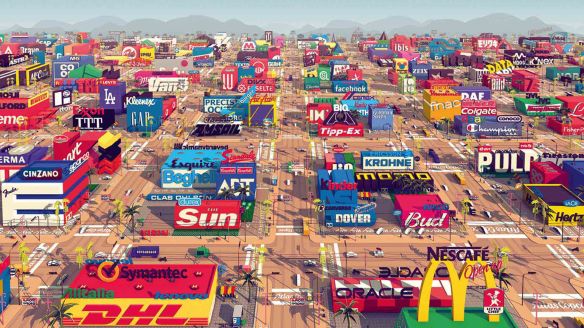
Colonizing the Western Mind

By Jason Hirthler

Source: CounterPunch

In Christopher Nolan’s captivating and visually dazzling film Inception, a practitioner of psychic corporate espionage must plant and idea inside a CEO’s head. The process is called inception, and it represents the frontier of corporate influence, in which mind spies no longer just “extract” ideas from the dreams of others, but seed useful ideas in a target’s subconscious. Inception is a well-crafted piece of futuristic sci-fi drama, but some of the ideas it imparts are already deeply embedded in the American subconscious. The notion of inception, of hatching an idea in the mind of a man or woman without his or her knowledge, is the kernel of propaganda, a black art practiced in the States since the First World War. Today we live beneath an invisible cultural hegemony, a set of ideas implanted in the mass mind by the U.S. state and its corporate media over decades. Invisibility seems to happen when something is either obscure or ubiquitous. In a propaganda system, an overarching objective is to render the messaging invisible by universalizing it within the culture. Difference is known by contrast. If there are no contrasting views in your field of vision, it’s easier to accept the ubiquitous explanation. The good news is that the ideology is well-known to some who have, for one lucky reason or another, found themselves outside the hegemonic field and are thus able to contrast the dominant worldview with alternative opinions. On the left, the ruling ideology might be described as neoliberalism, a particularly vicious form of imperial capitalism that, as would be expected, is camouflaged in the lineaments of humanitarian aid and succor.

Inception 1971

In a short span of time in the 1970s, dozens of think tanks were established across the western world and billions of dollars were spent proselytizing the tenets of the Powell Memo in 1971, which galvanized a counter-revolution to the liberal upswing of the Sixties. The neoliberal economic model of deregulation, downsizing, and privatization was preached by the Reagan-Thatcher junta, liberalized by the Clinton regime, temporarily given a bad name by the unhinged Bush administration, and saved by telegenic restoration of the Obama years. The ideology that underlay the model saturated academia, notably at the University of Chicago, and the mainstream media, principally at The New York Times. Since then it has trickled down to the general populace, to whom it now feels second nature. Today think tanks like the Heritage Foundation, the Brookings Institute, Stratfor, Cato Institute, American Enterprise Institute, Council on Foreign Relations, Carnegie Endowment, the Open Society Foundation, and the Atlantic Council, among many others, funnel millions of dollars in donations into cementing neoliberal attitudes in the American mind.

The ideological assumptions, which serve to justify what you could call neocolonial tactics, are relatively clear: the rights of the individual to be free of overreach from monolithic institutions like the state. Activist governments are inherently inefficient and lead directly to totalitarianism. Markets must be free and individuals must be free to act in those markets. People must be free to choose, both politically and commercially, in the voting booth and at the cash register. This conception of markets and individuals is most often formulated as “free-market democracy,” a misleading conceit that conflates individual freedom with the economic freedom of capital to exploit labor. So when it comes to foreign relations, American and western aid would only be given on the condition that the borrowers accepted the tenets of an (highly manipulable) electoral system and vowed to establish the institutions and legal structures required to fully realize a western market economy. These demands were supplemented with notions of the individual right to be free of oppression, some fine rhetoric about women and minorities, and somewhat more quietly, a judicial understanding that corporations were people, too. Together, an unshackled economy and an unfettered populace, newly equipped with individual rights, would produce the same flourishing and nourishing demos of mid-century America that had been the envy of humanity.

A False Promise

This ‘Washington Consensus’ is the false promise promoted by the West. The reality is quite different. The crux of neoliberalism is to eliminate democratic government by downsizing, privatizing, and deregulating it. Proponents of neoliberalism recognize that the state is the last bulwark of protection for the common people against the predations of capital. Remove the state and they’ll be left defenseless. Think about it. Deregulation eliminates the laws. Downsizing eliminates departments and their funding. Privatizing eliminates the very purpose of the state by having the private sector take over its traditional responsibilities. Ultimately, nation-states would dissolve except perhaps for armies and tax systems. A large, open-border global free market would be left, not subject to popular control but managed by a globally dispersed, transnational one percent. And the whole process of making this happen would be camouflaged beneath the altruistic stylings of a benign humanitarianism.

Globalists, as neoliberal capitalists are often called, also understood that democracy, defined by a smattering of individual rights and a voting booth, was the ideal vehicle to usher neoliberalism into the emerging world. Namely because democracy, as commonly practiced, makes no demands in the economic sphere. Socialism does. Communism does. These models directly address ownership of the means of production. Not so democratic capitalism. This permits the globalists to continue to own the means of production while proclaiming human rights triumphant in nations where interventions are staged. The enduring lie is that there is no democracy without economic democracy.

What matters to the one percent and the media conglomerates that disseminate their worldview is that the official definitions are accepted by the masses. The real effects need never be known. The neoliberal ideology (theory) thus conceals the neoliberal reality (practice). And for the masses to accept it, it must be mass produced. Then it becomes more or less invisible by virtue of its universality.

A Pretext for Pillage

Thanks to this artful disguise, the West can stage interventions in nations reluctant to adopt its platform of exploitation, knowing that on top of the depredations of an exploitative economic model, they will be asked to call it progress and celebrate it.

Washington, the metropolitan heart of neoliberal hegemony, has numerous methods of convincing reluctant developing nations to accept its neighborly advice. To be sure, the goal of modern colonialism is to find a pretext to intervene in a country, to restore by other means the extractive relations that first brought wealth to the colonial north. The most common pretexts for intervention depict the target nation in three distinct fashions.

First, as an economic basket case, a condition often engineered by the West in what is sometimes called, “creating facts on the ground.” By sanctioning the target economy, Washington can “make the economy scream,” to using war criminal Henry Kissinger’s elegant phrasing. Iran, Syria, and Venezuela are relevant examples here. Second, the West funds violent opposition to the government, producing unrest, often violent riots of the kind witnessed in Dara, Kiev, and Caracas. The goal is either to capsize a tottering administration or provoke a violent crackdown, at which point western embassies and institutions will send up simultaneously cries of tyranny and brutality and insist the leader step aside. Libya, Syria, and Venezuela are instructive in this regard. Third, the country will be pressured to accept some sort of military fettering thanks to either a false flag or manufactured hysteria over some domestic program, such as the WMD restrictions on Iraq, chemical weapons restrictions on Syria, or the civilian nuclear energy restrictions on Iran. Given that the U.S. traffics in WMDs, bioweapons, and nuclear energy itself, insisting others forsake all of these is perhaps little more than racially motivated despotry. But significant fear mongering in the international media will provide sufficient moral momentum to ram through sanctions, resolutions, and inspection regimes with little fanfare.

Schooling the Savages

Once the pretext is established, the appropriate intervention is made. There’s no lack of latent racism embedded in each intervention. Something of Edward Said’s Orientalism is surely at play here; the West is often responding to a crude caricature rather than a living people. One writer, Robert Dale Parker, described western views of Asia as little more than, “a sink of despotism on the margins of the world.” Iran is incessantly lensed through a fearful distrust of the ‘other’, those abyssal Persians. Likewise, North Korea is mythologized as a kingdom of miniature madmen, possessed of a curious psychosis that surely bears no relation to the genocidal cleansing of 20 percent of its population in the Fifties, itself an imperial coda to the madness of Hiroshima.

The interventions, then, are little different than the missionary work of early colonizers, who sought to entrap the minds of men in order to ensnare the soul. Salvation is the order of the day. The mission worker felt the same sense of superiority and exceptionalism that inhabits the mind of the neoliberal. Two zealots of the age peddling different editions of a common book. One must carry the gospel of the invisible hand to the unlettered minions. But the gifts of the enlightened interloper are consistently dubious.

It might be the loan package that effectively transfers economic control out of the hands of political officials and into the hands of loan officers, those mealy-mouthed creditors referred to earlier. It may be the sanctions that prevent the country from engaging in dollar transactions and trade with numberless nations on which it depends for goods and services. Or it might be that controversial UNSC resolution that leads to a comprehensive agreement to ban certain weapons from a country. Stipulations of the agreement will often include a byzantine inspections regime full of consciously-inserted trip wires designed to catch the country out of compliance and leverage that miscue to intensify confrontational rhetoric and implement even more far-reaching inspections.

Cracking the Shell

The benign-sounding structural adjustments of the West have fairly predictable results: cultural and economic chaos, rapid impoverishment, resource extraction with its attendant ecological ruin, transfer of ownership from local hands to foreign entities, and death from a thousand causes. We are currently sanctioning around 30 nations in some fashion; dozens of countries have fallen into ‘protracted arrears’ with western creditors; and entire continents are witnessing huge outflows of capital–on the order of $100B annually–to the global north as debt service. The profiteering colonialists of the West make out like bandits. The usual suspects include Washington and its loyal lapdogs, the IMF, World Bank, EU, NATO, and other international institutions, and the energy and defense multinationals whose shareholders and executive class effectively run the show.

So why aren’t Americans more aware of this complicated web of neocolonial domination? Italian communist Antonio Gramsci, who pioneered the concept of cultural hegemony, suggested that the ruling ideologies of the bourgeoisie were so deeply embedded in popular consciousness that the working classes often supported leaders and ideas that were antithetical to their own interests. Today, that cultural hegemony is neoliberalism. Few can slip its grasp long enough to see the world from an uncolored vantage point. You’ll very rarely encounter arguments like this leafing through the Times or related broadsheets. They don’t fit the ruling dogma, the Weltanschauung (worldview) that keeps the public mind in its sleepy repose.

But French-Algerian philosopher Louis Althusser, following Gramsci, believed that, unlike the militarized state, the ideologies of the ruling class were penetrable. He felt that the comparatively fluid zones of Ideological State Apparatuses (ISAs) were contexts of class struggle. Within them, groups might attain a kind of ‘relative autonomy’, by which they could step outside of the monolithic cultural ideology. The scales would fall. Then, equipped with new knowledge, people might stage an inception of their own, cracking open the cultural hegemony and reshaping its mythos in a more humane direction. This seems like an imperative for modern American culture, buried as it is beneath the hegemonic heft of the neoliberal credo. These articles of false faith, this ideology of deceit, ought to be replaced with new declarations of independence, of the mind if not the mainstream.


Jason Hirthler is a veteran of the communications industry and author of The Sins of Empire: Unmasking American Imperialism. He lives in New York City and can be reached at jasonhirthler@gmail.com.

No Need To Wait – Dystopia Is Almost Upon Us

Source: TruePublica

Microsoft’s CEO has warned the technology industry against creating a dystopian future, the likes of which have been predicted by authors including George Orwell and Aldous Huxley. Satya Nadella kicked off the the company’s 2017 Build conference with a keynote that was as unexpected as it was powerful. He told the developers in attendance that they have a huge responsibility, and that the choices they make could have enormous implications.

They won’t listen of course. The collection of big data along with management, selling and distribution and the systems architecture to control it is now worth exactly double global military defence expenditure. In fact, this year, the big data industry overtook the worlds most valuable traded commodity – oil.

The truth is that the tech giants have already captured us all. We are already living in the beginnings of a truly dystopian world.

Leaving aside the endemic surveillance society our government has chosen on our behalf with no debate, politically or otherwise, we already have proof of the now and where it is leading. With fingerprint scanning, facial recognition, various virtual wallets to pay for deliveries, some would say your identity is as good as stolen. If it isn’t, it soon will be. That’s because the hacking industry, already worth a mind blowing $1trillion annually is expected to reach $2.1 trillion in just 14 months time.

The reality of not being able to take public transportation, hire a car, buy a book, or a coffee – requiring full personal identification is almost upon us. Britain even had an intention to be completely cashless by 2025 – postponed only by the impact of Brexit.

Alexa, the Amazon home assistant listens to everything said in the house. It is known to record conversations. Recently, police in Arkansas, USA demanded that Amazon turn over information collected from a murder suspect’s Echo — the speaker that controls Alexa, because they already knew what information could be extracted from it.

32M is the first company in the US that provides a human chip, allowing employees “to make purchases in their break-room micro market, open doors, login to computers, use the copy machine.” 3M also confirmed what the chip could really do – telling employees to “use it as your passport, public transit and all purchasing opportunities.”

Various Apps now locate people you may know and your own location can be shared amongst others without your knowledge and we’ve known for years that governments and private corporations have access to this data, whether you like it not.

Other countries are providing even scarier technologies.  Hypebeast Magazine reports that  Aadhaar is a 12-digit identity number issued to all Indian residents based on their biometric and demographic data. “This data must be linked to their bank account or else they’ll face the risk of losing access to their account. Folks have until the end of the year to do this, with phone numbers soon to be connected through the 12 digits by February. Failure to do so will deactivate the service. ” The technology has the ability to refuse access to state supplied services such as healthcare.

Our article “Insurance Industry Leads The Way in Social Credit Systems” also highlights what the fusion of technology and data is likely to end up doing for us. An astonishing 96 per cent of insurers think that ecosystems or applications made by autonomous organisations are having a major impact on the insurance industry. The use of social credit mechanisms is being developed, some already implemented, which will determine our future behaviour, which will affect us all – both individually and negatively.”

The Chinese government plans to launch its Social Credit System in 2020. Already being piloted on 12 million of its citizens, the aim is to judge the trustworthiness – or otherwise – of its 1.3 billion residents. Something as innocuous as a person’s shopping habits become a measure of character. But the system not only investigates behaviour – it shapes it. It “nudges” citizens away from purchases and behaviours the government does not like. Friends are considered as well and individual credit scores fall depending on their trustworthiness. It’s not possible to imagine how far this will go in the end.

However to get us all there, to that situation, we need to be distracted from what is going on in the background. Some, are already concerned.


Distraction – detaching us from truth and reality

The Guardian wrote an interesting piece recently which highlighted some of the concerns of those with expert insider knowledge of the tech industry. For instance, Justin Rosenstein, the former Google and Facebook engineer who helped build the ‘like’ button –  is concerned. He believes there is a case for state regulation of smartphone technology because it is “psychologically manipulative advertising”, saying the moral impetus is comparable to taking action against fossil fuel or tobacco companies.

If we only care about profit maximisation,” he says, “we will go rapidly into dystopia.” Rosenstien also makes the observation that after Brexit and the election of Trump, digital forces have completely upended the political system and, left unchecked, could render democracy as we know it obsolete.

Carole Cadwalladre’s recent Exposé in the Observer/Guardian proved beyond doubt that democracy has already departed.  Here we learn about a shadowy global operation involving big data and billionaires who influenced the result of the EU referendum. Britain’s future place in the world has been altered by technology.

Nir Eyal 39, the author of Hooked: How to Build Habit-Forming Products writes: “The technologies we use have turned into compulsions, if not full-fledged addictions.” Eyal continues: “It’s the impulse to check a message notification. It’s the pull to visit YouTube, Facebook, or Twitter for just a few minutes, only to find yourself still tapping and scrolling an hour later.” None of this is an accident, he writes. It is all “just as their designers intended”.

Eyal feels the threat and protects his own family by cutting off the internet completely at a set time every day. “The idea is to remember that we are not powerless,” he said. “We are in control.”

The truth is we are no longer in control and have not been since we learned that our government was lying to us with the Snowden revelations back in 2013.

Tristan Harris, a 33-year-old former Google employee turned vocal critic of the tech industry agrees about the lack of control. “All of us are jacked into this system,” he says. “All of our minds can be hijacked. Our choices are not as free as we think they are.” Harris insists that billions of people have little choice over whether they use these now ubiquitous technologies, and are largely unaware of the invisible ways in which a small number of people in Silicon Valley are shaping their lives.

Harris is a tech whistleblower. He is lifting the lid on the vast powers accumulated by technology companies and the ways they are abusing the influence they have at their fingertips – literally.

“A handful of people, working at a handful of technology companies, through their choices will steer what a billion people are thinking today.”

The techniques these companies use such as social reciprocity, autoplay and the like are not always generic: they can be algorithmically tailored to each person. An internal Facebook report leaked this year, ultimately revealed that the company can identify when teenagers feel “worthless or “insecure.” Harris adds, that this is “a perfect model of what buttons you can push in a particular person”.

Chris Marcellino, 33, a former Apple engineer is now in the final stages of retraining to be a neurosurgeon and notes that these types of technologies can affect the same neurological pathways as gambling and drug use. “These are the same circuits that make people seek out food, comfort, heat, sex,” he says.

Roger McNamee, a venture capitalist who benefited from hugely profitable investments in Google and Facebook, has grown disenchanted with both of the tech giants. “Facebook and Google assert with merit that they are giving users what they want,” McNamee says. “The same can be said about tobacco companies and drug dealers.”

James Williams ex-Google strategist who built the metrics system for the company’s global search advertising business, says Google now has the “largest, most standardised and most centralised form of attentional control in human history”. “Eighty-seven percent of people wake up and go to sleep with their smartphones,” he says. The entire world now has a new prism through which to understand politics, and Williams worries the consequences are profound.

Williams also takes the view that if the attention economy erodes our ability to remember, to reason, to make decisions for ourselves – faculties that are essential to self-governance – what hope is there for democracy itself?

“The dynamics of the attention economy are structurally set up to undermine the human will,” he says. “If politics is an expression of our human will, on individual and collective levels, then the attention economy is directly undermining the assumptions that democracy rests on. If Apple, Facebook, Google, Twitter, Instagram and Snapchat are gradually chipping away at our ability to control our own minds, could there come a point, I ask, at which democracy no longer functions?”

“Will we be able to recognise it, if and when it happens?” Williams says. “And if we can’t, then how do we know it hasn’t happened already?”


The dystopian arrival

Within ten years, some are speculating that many of us will be wearing eye lenses. Coupled with social media, we’ll be able to identify strangers and work out that a particular individual, in say a bar, has a low friend compatibility, and data shows you will likely not have a fruitful conversation. This idea is literally scratching the surface of the information overload en-route right now.

It is not at all foolish to think that in that same bar a patron is shouting at the bartender, who refuses to serve him another drink because the glass he was holding measured his blood-alcohol level through the sweat in his fingers. He’ll have to wait at least 45 minutes before he’ll be permitted to order another scotch. You might even think that is a good idea – it isn’t.

Google’s Quantum Artificial Intelligence  Lab, already works with other organisations associated with NASA. Google’s boss sits on the Board of the Pentagon with links plugged directly into the surveillance architecture of the NSA in the USA and GCHQ in Britain. This world, where artificial intelligence makes its mark, as Williams mentions earlier, will deliberately undermine the ability to think for yourself.

In the scenario of the eye lenses, you might even have the ability to command your eyewear to shut down. But when you do, suddenly you are confronted with an un-Googled world. It appears drab and colourless in comparison. The people before you are bland, washed out and unattractive. The art, plants, wall paint, lighting and decorations had all been shaped by your own preferences, and without the distortion field your wearable eyewear provided, the world appears as a grey, lifeless template.

You find it difficult to last without the assistance of your self imposed augmented life, and accompanied by nervous laughter you switch it back on. The world you view through the prism of your computer eyewear has become your default setting. You know you have free will, but don’t feel like you need it. As Marcellino says the same neurological pathways as gambling and drug use drive how you choose to see the world.

This type of technology will be available and these types of scenario’s will become real, sooner than you think.

Our governments, allied with the tech giants are coercing us into a place of withering obedience with the use of 360 degree state surveillance. New technology, which is somehow seen as the road to liberty, contentment and prosperity, is really our future being shaped by a system that will destroy our civil liberties, crush our human rights and it will eventually ensnare and trap us all. This much they are already attempting in China and Japan with social credit mechanisms and pre-crime technology which is a truly frightening prospect. Without debate or our knowledge, here in western democracies, these technologies are already in use.


500 years is long enough! Human Depravity in the Congo

By Robert J. Burrowes

I would like to tell you something about human depravity and illustrate just how widespread it is among those we often regard as ‘responsible’. I am going to use the Democratic Republic of the Congo as my example.

As I illustrate and explain what has happened to the Congo and its people during the past 500 years, I invite you to consider my essential point: Human depravity has no limit unless people like you (hopefully) and me take some responsibility for ending it. Depravity, barbarity and violent exploitation will not end otherwise because major international organizations (such as the UN), national governments and corporations all benefit from it and are almost invariably led by individuals too cowardly to act on the truth.

The Congo

Prior to 1482, the area of central Africa now known as the Democratic Republic of the Congo was part of the Kingdom of the Kongo. It was populated by some of the greatest civilizations in human history.

Slavery

However, in that fateful year of 1482, the mouth of the Congo river, which flows into the Atlantic Ocean, became known to Europeans when the Portuguese explorer Diogo Cao claimed he ‘discovered’ it. By the 1530s, more than five thousand slaves a year (many from inland regions of the Kongo) were being transported to distant lands, mostly in the Americas. Hence, as documented by Adam Hothschild, the Congo was first exploited by Europeans during the Atlantic slave trade. See King Leopold’s Ghost: A Story of Greed, Terror, and Heroism in Colonial Africa.

Despite the horrific depredations of the militarized slave trade and all of its ancillary activities, including Christian priests spreading ‘Christianity’ while raping their captive slave girls, the Kingdoms of the Kongo were able to defend and maintain themselves to a large degree for another 400 years by virtue of their long-standing systems of effective governance. As noted by Chancellor Williams’ in his epic study The Destruction of Black Civilization: Great Issues of a Race from 4500 B.C. to 2000 A.D. the Kingdoms of the Congo prior to 1885 – including Kuba under Shyaam the Great and the Matamba Kingdom under Ngola Kambolo – were a cradle of culture, democracy and exceptional achievement with none more effective than the remarkable Queen (of Ndongo and Matamba), warrior and diplomat Nzinga in the 17th century.

But the ruthless military onslaught of the Europeans never abated. In fact, it continually expanded with ever-greater military firepower applied to the task of conquering Africa. In 1884 European powers met in Germany to finally divide ‘this magnificent African cake’, precipitating what is sometimes called ‘the scramble for Africa’ but is more accurately described as ‘the scramble to finally control and exploit Africa and Africans completely’.

Colonization

One outcome of the Berlin Conference was that the great perpetrator of genocide – King Leopold II of Belgium – with the active and critical support of the United States, seized violent control of a vast swathe of central Africa in the Congo Basin and turned it into a Belgian colony. In Leopold’s rapacious pursuit of rubber, gold, diamonds, mahogany and ivory, 10 million African men, women and children had been slaughtered and many Africans mutilated (by limb amputation, for example) by the time he died in 1909. His brutality and savagery have been documented by Adam Hochschild in the book King Leopold’s Ghost: A Story of Greed, Terror, and Heroism in Colonial Africa which reveals the magnitude of human suffering that this one man, unopposed in any significant way by his fellow Belgians or anyone else, was responsible for inflicting on Africa.

If you want to spend a few moments in touch with the horror of what some human beings do to other human beings, then I invite you to look at the sample photos of what Leopold did in ‘his’ colony in the Congo. See ‘“A Nightmare In Heaven” – Why Nobody Is Talking About The Holocaust in Congo’.

Now if you were hoping that the situation in the Congo improved with the death of the monster Leopold, your hope is in vain.

The shocking reality is that the unmitigated horror inflicted on the Congolese people has barely improved since Leopold’s time. The Congo remained under Belgian control during World War I during which more than 300,000 Congolese were forced to fight against other Africans from the neighboring German colony of Ruanda-Urundi. During World War II when Nazi Germany captured Belgium, the Congo financed the Belgian government in exile.

Throughout these decades, the Belgian government forced millions of Congolese into mines and fields using a system of ‘mandatory cultivation’ that forced people to grow cash crops for export, even as they starved on their own land.

It was also during the colonial period that the United States acquired a strategic stake in the enormous natural wealth of the Congo without, of course, any benefit to the Congolese people. This included its use of uranium from a Congolese mine (subsequently closed in 1960) to manufacture the first nuclear weapons: those used to destroy Hiroshima and Nagasaki. See ‘Patrice Lumumba: the most important assassination of the 20th century’.

Independence then Dictatorship

By 1960, the Congolese people had risen up to overthrow nearly a century of slavery and Belgian rule. Patrice Lumumba became the first Prime Minister of the new nation and he quickly set about breaking the yoke of Belgian influence and allied the Congo with Russia at the height of the Cold War.

But the victory of the Congolese people over their European and US overlords was shortlived: Patrice Lumumba was assassinated in a United States-sponsored coup in 1961 with the US and other western imperial powers (and a compliant United Nations) repeating a long-standing and ongoing historical pattern of preventing an incredibly wealthy country from determining its own future and using its resources for the benefit of its own people. See ‘Patrice Lumumba: the most important assassination of the 20th century’.

So, following a well-worn modus operandi, an agent in the form of (Army Chief of Staff, Colonel) Mobutu Sese Seko was used to overthrow Lumumba’s government. Lumumba himself was captured and tortured for three weeks before being assassinated by firing squad. The new dictator Mobutu, compliant to western interests, then waged all-out war in the country, publicly executing members of the pro-Lumumba revolution in spectacles witnessed by tens of thousands of people. By 1970, nearly all potential threats to his authority had been smashed. See ‘“A Nightmare In Heaven” – Why Nobody Is Talking About The Holocaust in Congo’.

Mobutu would rape the Congo (renamed Zaire for some time) with the blessing of the west  – robbing the nation of around $2billion – from 1965 to 1997. During this period, the Congo got more than $1.5 billion in US economic and military aid in return for which US multinational corporations increased their share of the Congo’s abundant minerals. ‘Washington justified its hold on the Congo with the pretext of anti-Communism but its real interests were strategic and economic.’ See ‘Congo: The Western Heart of Darkness’.

Invasion

Eventually, however, Mobutu’s increasingly hostile rhetoric toward his white overlords caused the west to seek another proxy. So, ostensibly in retaliation against Hutu rebels from the Rwandan genocide of 1994 – who fled into eastern Congo after Paul Kagame’s (Tutsi) Rwanda Patriotic Army invaded Rwanda from Uganda to end the genocide – in October 1996 Rwanda’s now-dictator Kagame, ‘who was trained in intelligence at Fort Leavenworth in the United States, invaded the Congo with the help of the Clinton Administration’ and Uganda. By May 1997 the invading forces had removed Mobutu and installed the new (more compliant) choice for dictator, Laurent Kabila.

Relations between Kabila and Kagame quickly soured, however, and Kabila expelled the Rwandans and Ugandans from the Congo in July 1998. However, the Rwandans and Ugandans reinvaded in August establishing an occupation force in eastern Congo. Angola, Zimbabwe and Namibia sent their armies to support Kabila and Burundi joined the Rwandans and Ugandans. Thus began ‘Africa’s First World War’ involving seven armies and lasting until 2003. It eventually killed six million people – most of them civilians – and further devastated a country crushed by more than a century of Western domination, with Rwanda and Uganda establishing themselves as conduits for illegally taking strategic minerals out of the Congo. See ‘Congo: The Western Heart of Darkness’.

During the periods under Mobutu and Kabila, the Congo became the concentration camp capital of the world and the rape capital as well. ‘No woman in the path of the violence was spared. 7 year olds were raped by government troops in public. Pregnant women were disemboweled. Genital mutilation was commonplace, as was forced incest and cannibalism. The crimes were never punished, and never will be.’

Laurent Kabila maintained the status quo until he was killed by his bodyguard in 2001. Since then, his son and the current President Joseph Kabila has held power in violation of the Constitution. ‘He has murdered protesters and opposition party members, and has continued to obey the will of the west while his people endure unspeakable hells.’

Corporate and State Exploitation

While countries such as Belgium, Canada, France, Germany, the Netherlands, South Korea, Switzerland and the UK are heavily involved one way or another (with other countries, such as Australia, somewhat less so), US corporations make a vast range of hitech products including microchips, cell phones and semiconductors using conflict minerals taken from the Congo . This makes ‘companies like Intel, Apple, HP, and IBM culpable for funding the militias that control the mines’. See ‘“A Nightmare In Heaven” – Why Nobody Is Talking About The Holocaust in Congo’.

But many companies are benefitting. For example, a 2002 report by the United Nations listed a ‘sample’ of 34 companies based in Europe and Asia that are importing minerals from the Congo via, in this case, Rwanda. The UN Report commented: ‘Illegal exploitation of the mineral and forest resources of the Democratic Republic of the Congo is taking place at an alarming rate. Two phases can be distinguished: mass-scale looting and the systematic and systemic exploitation of resources’. The mass-scale looting occurred during the initial phase of the invasion of the Congo by Rwanda, Uganda and Burundi when stockpiles of minerals, coffee, wood, livestock and money in the conquered territory were either taken to the invading countries or exported to international markets by their military forces or nationals. The subsequent systematic and systemic exploitation required planning and organization involving key military commanders, businessmen and government structures; it was clearly illegal. See ‘Report of the Panel of Experts on the Illegal Exploitation of Natural Resources and other Forms of Wealth of the Democratic Republic of the Congo’.

For some insight into other issues making exploitation of the Congo possible but which are usually paid less attention – such as the roles of mercenaries, weapons dealers, US military training of particular rebel groups and the secret airline flights among key locations in the smuggling operations of conflict minerals – see the research of Keith Harmon Snow and David Barouski: ‘Behind the numbers: Untold Suffering in the Congo’ and Merchants of Death: Exposing Corporate-Financed Holocaust in Africa; White Collar War Crimes, Black African Fall Guys.

Has there been any official attempt to rein in this corporate exploitation?

A little. For example, the Obama-era US Dodd-Frank Financial Reform Act of 2010 shone a spotlight on supply chains, pressuring companies to determine the origin of minerals used in their products and invest in removing conflict minerals from their supply chain. This resulted in some US corporations, conscious of the public relations implications of being linked to murderous warlords and child labor, complying with the Act. So, a small step in the right direction it seemed. See ‘The Impact of Dodd-Frank and Conflict Minerals Reforms on Eastern Congo’s Conflict’ and ‘Congo mines no longer in grip of warlords and militias, says report’.

In 2011, given that legally-binding human rights provisions, if applied, should have offered adequate protections already, the United Nations rather powerlessly formulated the non-binding ‘Guiding Principles on Business and Human Rights’.

And in 2015, the European Union also made a half-hearted attempt when it decided that smelters and refiners based in the 28-nation bloc be asked to certify that their imports were conflict-free on a voluntary basis! See ‘EU lawmakers to limit import of conflict minerals’.

However, following the election of Donald Trump as US President, in April 2017 ‘the U.S. Securities and Exchange Commission suspended key provisions of its “conflict minerals” rule’. Trump is also seeking to undo the Obama-era financial regulations, once again opening the door to the unimpeded trade in blood minerals by US corporations. See ‘“A Nightmare In Heaven” – Why Nobody Is Talking About The Holocaust in Congo’ and ‘Trump Moves to Roll Back Obama-Era Financial Regulations’.

Today

Despite its corrupt exploitation for more than 500 years, the Congo still has vast natural resources (including rainforests) and mineral wealth. Its untapped deposits of minerals are estimated to be worth in excess of $US24 trillion. Yes, that’s right: $US24trillion. With a host of rare strategic minerals – including cobalt, coltan, gold and diamonds – as well as copper, zinc, tin and tungsten critical to the manufacture of hitech electronic products ranging from aircraft and vehicles to computers and mobile phones, violent and morally destitute western governments and corporations are not about to let the Congo decide its own future and devote its resources to the people of this African country. This, of course, despite the international community paying lip service to a plethora of ‘human rights’ treaties.

Hence, violent conflict, including ongoing war, over the exploitation of these resources, including the smuggling of ‘conflict minerals’ – such as gold, coltan and cassiterite (the latter two ores of tantalum and tin, respectively), and diamonds – will ensure that the people of the Congo continue to be denied what many of those in western countries take for granted: the right to life benefiting from the exploitation of ‘their’ natural resources.

In essence then, since 1885 European and US governments, together with their corporations and African collaborators, have inflicted phenomenal ongoing atrocities on the peoples of the Congo as they exploit the vast resources of the country for the benefit of non-Congolese people.

But, you might wonder, European colonizers inflicted phenomenal violence on the indigenous peoples in all of their colonies – whether in Africa, Asia, Central and South America, the Caribbean or Oceania – so is their legacy in the Congo any worse?

Well, according to the The Pan-African Alliance, just since colonization in 1885, at least 25 million Congolese men, women and children have been slaughtered by white slave traders, missionaries, colonists, corporations and governments (both the governments of foreign-installed Congolese dictators and imperial powers). ‘Yet barely a mention is made of the holocaust that rages in the heart of Africa.’ Why? Because ‘the economy of the entire world rests on the back of the Congo.’ See ‘“A Nightmare In Heaven” – Why Nobody Is Talking About The Holocaust in Congo’.

So what is happening now?

In a sentence: The latest manifestation of the violence and exploitation that has been happening since 1482 when that Portuguese explorer ‘discovered’ the mouth of the Congo River. The latest generation of European and American genocidal exploiters, and their latter-day cronies, is busy stealing what they can from the Congo. Of course, as illustrated above, having installed the ruthless dictator of their choosing to ensure that foreign interests are protected, the weapon of choice is the corporation and non-existent legal or other effective controls in the era of ‘free trade’.

The provinces of North and South Kivu in the eastern Congo are filled with mines of cassiterite, wolframite, coltan and gold. Much mining is done by locals eking out a living using Artisanal and Small-Scale Mining (ASM); that is, mining by hand, sometimes with rudimentary tools. Some of these miners sell their product via local agents to Congolese military commanders who smuggle it out of the country, usually via Rwanda, Uganda or Burundi, and use the proceeds to enrich themselves.

Another report on South Kivu by Global Witness in 2016 – see ‘River of Gold’ and ‘Illegal gold trade in Congo still benefiting armed groups, foreign companies’ – documented evidence of the corrupt links between government authorities, foreign corporations (in this case, Kun Hou Mining of China) and the military, which results in the gold dredged from the Ulindi River in South Kivu being illegally smuggled out of the country, with much of it ending up with Alfa Gold Corp in Dubai. The unconcealed nature of this corruption and the obvious lack of enforcement of weak Congolese law is a powerful disincentive for corporations to engage in ‘due diligence’ when conducting their own mining operations in the Congo.

In contrast, in the south of the Congo in the former province of Katanga, Amnesty International and Afrewatch researchers tracked sacks of cobalt ore that had been mined by artisanal miners in Kolwezi to the local market where the mineral ore is sold. From this point, the material was smelted by one of the large companies in Kolwezi, such as Congo Dongfang Mining International SARL (CDM), which is a smelter and fully-owned subsidiary of Zhejiang Huayou Cobalt Company Ltd (Huayou Cobalt) in China, one of the world’s largest manufacturers of cobalt products. Once smelted, the material is typically exported from the Congo to China via a port in South Africa. See ‘“This is what We Die for”: Human Rights Abuses in the Democratic Republic of the Congo Power the Global Trade in Cobalt’.

In its 2009 report ‘“Faced with a gun, what can you do?” War and the Militarisation of Mining in Eastern Congo’ examining the link between foreign corporate activity in the Congo and the military violence, Global Witness raised questions about the involvement of nearly 240 companies spanning the mineral, metal and technology industries. It specifically identified four main European companies as open buyers in this illegal trade: Thailand Smelting and Refining Corp. (owned by British Amalgamated Metal Corp.), British Afrimex, Belgian Trademet and Traxys. It also questioned the role of other companies further down the manufacturing chain, including prominent electronics companies Hewlett-Packard, Nokia, Dell and Motorola (a list to which Microsoft and Samsung should have been added as well). Even though they may be acting ‘legally’, Global Witness criticized their lack of due diligence and transparency standards at every level of their supply chain. See ‘First Blood Diamonds, Now Blood Computers?’

Of course, as you no doubt expect, some of the world’s largest corporate miners are in the Congo. These include Glencore (Switzerland) and Freeport-McMoRan (USA). But there are another 20 or more mining corporations in the Congo too, including Mawson West Limited (Australia), Forrest Group International (Belgium), Anvil Mining (Canada), Randgold Resources (UK) and AngloGold Ashanti (South Africa).

Needless to say, despite beautifully worded ‘corporate responsibility statements’ by whatever name, the record rarely goes even remotely close to resembling the rhetoric. Take Glencore’s lovely statement on ‘safety’ in the Congo: ‘Ask Glencore: Democratic Republic of the Congo’. Unfortunately, this didn’t prevent the 2016 accident at a Congolese mine that one newspaper reported in the following terms: ‘Glencore’s efforts to reduce fatalities among its staff have suffered a setback with the announcement that the death toll from an accident at a Congolese mine has risen to seven.’ See ‘Glencore reports seven dead in mining accident’.

Or consider the Belgian Forrest Group International’s wonderful ‘Community Services’ program, supposedly developing projects ‘in the areas of education, health, early childhood care, culture, sport, infrastructure and the environment. The FORREST GROUP has been investing on the African continent since 1922. Its longevity is the fruit of a vision of the role a company should have, namely the duty to be a positive player in the society in which it operates. The investments of the Group share a common core of values which include, as a priority, objectives of stability and long-term prospects.’

Regrettably, the Forrest Group website and public relations documents make no mention of the company’s illegal demolition, without notice, of hundreds of homes of people who lived in the long-standing village of Kawama, inconveniently close to the Forrest Group’s Luiswishi Mine, on 24 and 25 November 2009. People were left homeless and many lost their livelihoods as a direct consequence. Of course, the demolitions constitute forced evictions, which are illegal under international human rights law.

Fortunately, given the obvious oversight of the Forrest Group in failing to mention it, the demolitions have been thoroughly documented by Amnesty International in its report ‘Bulldozed – How a Mining Company Buried the Truth about Forced Evictions in the Democratic Republic of the Congo’ and the satellite photographs acquired by the American Academy for the Advancement of Science have been published as well. See Satellite imagery assessment of forced relocations near the Luiswishi Mine.

Needless to say, it is difficult for Congolese villagers to feel they have any ‘stability and long-term prospects’, as the Forrest Group’s ‘Community Services’ statement puts it, when their homes and livelihoods have been destroyed. Are company chairman George A. Forrest and its CEO Malta David Forrest and their family delusional? Or just so familiar with being violently ruthless in their exploitation of the Congo and its people, that it doesn’t even occur to them that there might be less violent ways of resolving any local conflicts?

Tragically, of course, fatal industrial accidents and housing demolition are only two of the many abuses inflicted on mining labourers, including (illegal) child labourers, and families in the Congo where workers are not even provided with the most basic ‘safety equipment’ – work clothes, helmets, gloves, boots and facemasks – let alone a safe working environment (including guidance on the safe handling of toxic substances) or a fair wage, reasonable working hours, holidays, sick leave or superannuation.

Even where laws exist, such as the Congo’s Child Protection Code (2009) which provides for ‘free and compulsory primary education for all children’, laws are often simply ignored (without legal consequence). Although, it should also be noted, in the Congo there is no such thing as ‘free education’ despite the law. Consequently, plenty of children do not attend school and work full time, others attend school but work out of school hours. There is no effective system to remove children from child labour (which is well documented). Even for adults, there is no effective labour inspection system. Most artisanal mining takes places in unauthorized mining areas ‘where the government is doing next to nothing to regulate the safety and labour conditions in which the miners work’. See ‘“This is what We Die for”: Human Rights Abuses in the Democratic Republic of the Congo Power the Global Trade in Cobalt’.

In addition, as noted above, given its need for minerals to manufacture the hitech products it makes, including those for western corporations, China is deeply engaged in mining strategic minerals in the Congo too. See ‘China plays long game on cobalt and electric batteries’.

Based on the Chinese notion of ‘respect’ – which includes the ‘principle’ of noninterference in each other’s internal affairs – the Chinese dictatorship is content to ignore the dictatorship of the Congo and its many corrupt and violent practices, even if its investment often has more beneficial outcomes for ordinary Congolese than does western ‘investment’. Moreover, China is not going to disrupt and destabilize the Congo in the way that the United States and European countries have done for so long. See ‘China’s Congo Plan’ and ‘China vs. the US: The Struggle for Central Africa and the Congo’.

Having noted the above, however, there is plenty of evidence of corrupt Chinese business practice in the extraction and sale of strategic minerals in the Congo, including that documented in the above-mentioned Global Witness report. See ‘River of Gold’.

Moreover, Chinese involvement is not limited to its direct engagement in mining such as gold dredging of the Ulindi River. A vital source of the mineral cobalt is that which is mined by artisanal miners. As part of a recent detailed investigation, Amnesty International had researchers follow cobalt mined by artisanal miners from where it was mined to a market at Musompo, where minerals are traded. The report summarised what happens:

‘Independent traders at Musompo – most of them Chinese – buy the ore, regardless of where it has come from or how it has been mined. In turn, these traders sell the ore on to larger companies in the DRC which process and export it. One of the largest companies at the centre of this trade is Congo Dongfang Mining International (CDM). CDM is a 100% owned subsidiary of China-based Zhejiang Huayou Cobalt Company Ltd (Huayou Cobalt), one of the world’s largest manufacturers of cobalt products. Operating in the DRC since 2006, CDM buys cobalt from traders, who buy directly from the miners. CDM then smelts the ore at its plant in the DRC before exporting it to China. There, Huayou Cobalt further smelts and sells the processed cobalt to battery component manufacturers in China and South Korea. In turn, these companies sell to battery manufacturers, which then sell on to well-known consumer brands.

‘Using public records, including investor documents and statements published on company websites, researchers identified battery component manufacturers who were listed as sourcing processed ore from Huayou Cobalt. They then went on to trace companies who were listed as customers of the battery component manufacturers, in order to establish how the cobalt ends up in consumer products. In seeking to understand how this international supply chain works, as well as to ask questions about each company’s due diligence policy, Amnesty International wrote to Huayou Cobalt and 25 other companies in China, Germany, Japan, South Korea, Taiwan, UK, and the USA. These companies include some of the world’s largest and best known consumer electronics companies, including Apple Inc., Dell, HP Inc. (formerly Hewlett-Packard Company), Huawei, Lenovo (Motorola), LG, Microsoft Corporation, Samsung, Sony and Vodafone, as well as vehicle manufacturers like Daimler AG, Volkswagen and Chinese firm BYD. Their replies are detailed in the report’s Annex.’ See ‘“This is what We Die for”: Human Rights Abuses in the Democratic Republic of the Congo Power the Global Trade in Cobalt’.

As backdrop to the problems mentioned above, it is worth pointing out that keeping the country under military siege is useful to many parties, internal and foreign. Over the past 20 years of violent conflict, control of these valuable mineral resources has been a lucrative way for warring parties to finance their violence – that is, buying the products of western weapons corporations – and to promote the chaotic circumstances that make minimal accountability and maximum profit easiest. The Global Witness report ‘Faced with a gun, what can you do?’ cited above followed the supply chain of these minerals from warring parties to middlemen to international buyers: people happy to profit from the sale of ‘blood minerals’ to corporations which, in turn, are happy to buy them cheaply to manufacture their highly profitable hitech products.

Moreover, according to the Global Witness report, although the Congolese army and rebel groups – such as the Democratic Forces for the Liberation of Rwanda (FDLR), a rebel force opposed to the Rwandan government that has taken refuge in the Congo since the 1994 Rwanda genocide – have been warring on opposite sides for years, they are collaborators in the mining effort, at times providing each other with road and airport access and even sharing their spoils. Researchers say they found evidence that the mineral trade is much more extensive and profitable than previously suspected: one Congolese government official reported that at least 90% of all gold exports from the country were undeclared. And the report charges that the failure of foreign governments to crack down on illicit mining and trade has undercut development endeavors supposedly undertaken by the international community in the war-torn region.

Social and Environmental Costs

Of course, against this background of preoccupation with the militarized exploitation of mineral resources for vast profit, ordinary Congolese people suffer extraordinary ongoing violence. Apart from the abuses mentioned above, four women are raped every five minutes in the Congo, according to a study done in May 2011. ‘These nationwide estimates of the incidence of rape are 26 times higher than the 15,000 conflict-related cases confirmed by the United Nations for the DRC in 2010’. Despite the country having the highest number of UN peacekeeping forces in the world – where the United Nations Organization Stabilization Mission in the Democratic Republic of the Congo (MONUSCO) has operated since the turn of the century – the level of sexual violence soldiers have perpetrated against women is staggering. ‘Currently, there is still much violence in the region, as well as an overwhelming amount of highly strategic mass rape.’ See ‘Conflict Profile: Democratic Republic of Congo’.

Unsurprisingly, given the international community’s complete indifference, despite rhetoric to the contrary, to the plight of Congolese people, it is not just Congolese soldiers who are responsible for the rapes. UN ‘peacekeepers’ are perpetrators too. See ‘Peacekeepers gone wild: How much more abuse will the UN ignore in Congo?’

And the Congo is a violently dangerous place for children as well with, for example, Child Soldiers International reporting that with a variety of national and foreign armed groups and forces operating in the country for over 20 years, the majority of fighting forces have recruited and used children, and most still exploit boys and girls today with girls forced to become girl soldiers but to perform a variety of other sexual and ‘domestic’ roles too. See Child Soldiers International. Of course, child labour is completely out of control with many impoverished families utterly dependent on it for survival.

In addition, many Congolese also end up as refugees in neighbouring countries or as internally displaced people in their own country.

As you would expect, it is not just human beings who suffer. With rebel soldiers (such as the Rwanda-backed M23), miners and poachers endlessly plundering inadequately protected national parks and other wild places for their resources, illegal mining is rampant, over-fishing a chronic problem, illegal logging (and other destruction such as charcoal burning for cooking) of rainforests is completely out of control in some places, poaching of hippopotamuses, elephants, chimpanzees and okapi for ivory and bushmeat is unrelenting (often despite laws against hunting with guns), and wildlife trafficking of iconic species (including the increasingly rare mountain gorilla) simply beyond the concern of most people.

The Congolese natural environment – including the UNESCO World Heritage sites at Virunga National Park and the Okapi Wildlife Reserve, together with their park rangers – and the indigenous peoples such as the Mbuti (‘pygmies’) who live in them, are under siege. In addition to the ongoing mining, smaller corporations that can’t compete with the majors, such as Soco, want to explore and drill for oil. For a taste of the reading on all this, see ‘Virunga National Park Ranger Killed in DRC Ambush’, ‘The struggle to save the “Congolese unicorn”’, ‘Meet the First Female Rangers to Guard One of World’s Deadliest Parks’

and ‘The Battle for Africa’s Oldest National Park’.

If you would like to watch a video about some of what is happening in the Congo, either of these videos will give you an unpleasant taste: ‘Crisis In The Congo: Uncovering The Truth’ and ‘Conflict Minerals, Rebels and Child Soldiers in Congo’.

Resisting the Violence

So what is happening to resist this violence and exploitation? Despite the horror, as always, some incredible people are working to end it.

Some Congolese activists resist the military dictatorship of Joseph Kabila, despite the enormous risks of doing so. See, for example, ‘Release the Congolese activists still in jail for planning peaceful demonstrations’.

Some visionary Congolese continue devoting their efforts, in phenomenally difficult circumstances including lack of funding, to building a society where ordinary Congolese people have the chance to create a meaningful life for themselves. Two individuals and organizations who particularly inspire me are based in Goma in eastern Congo where the fighting is worst.

The Association de Jeunes Visionnaires pour le Développement du Congo, headed by Leon Simweragi, is a youth peace group that works to rehabilitate child soldiers as well as offer meaningful opportunities for the sustainable involvement of young people in matters that affect their lives and those of their community.

And Christophe Nyambatsi Mutaka is the key figure at the Groupe Martin Luther King that promotes active nonviolence, human rights and peace. Christophe’s group particularly works on reducing sexual and other violence against women.

There are also solidarity groups, based in the West, that work to draw attention to the nightmare happening in the Congo. These include Friends of the Congo that works to inform people and agitate for change and groups like Child Soldiers International mentioned above.

If you would like to better understand the depravity of those individuals in the Congo (starting with the dictator Joseph Kabila but including all those officials, bureaucrats and soldiers) who enable, participate in or ignore the violence and exploitation; the presidents and prime ministers of western governments who ignore exploitation, by their locally-based corporations, of the Congo; the heads of multinational corporations that exploit the Congo – such as Anthony Hayward (Chair of Glencore), Richard Adkerson (CEO of Freeport-McMoRan), George A. Forrest and Malta David Forrest (Chair and CEO respectively of Forrest Group International), Christopher L Coleman (Chair of Randgold Resources) and Srinivasan Venkatakrishnan (CEO of AngloGold Ashanti) – as well as those individuals in international organizations such as the UN (starting with Secretary-General António Guterres) and the EU (headed by Jean-Claude Juncker, President of the European Commission), who ignore, provoke, support and/or profit from this violence and exploitation, you will find the document ‘Why Violence?’ and the website ‘Feelings First’ instructive.

Whether passively or actively complicit, each of these depraved individuals (along with other individuals within the global elite) does little or nothing to draw attention to, let alone work to profoundly change, the situation in the Congo which denies most Congolese the right to a meaningful life in any enlightened sense of these words.

If you would like to help, you can do so by supporting the efforts of the individual activists and solidarity organizations indicated above or those like them.

You might also like to sign the online pledge of The Peoples Charter to Create a Nonviolent World which references the Congo among many other examples of violence around the world.

And if you would like to support efforts to remove the dictatorship of Joseph Kabila and/or get corrupt foreign governments, corporations and organizations out of the Congo, you can do so by planning and implementing or supporting a nonviolent strategy that is designed to achieve one or more of these objectives. See Nonviolent Defense/Liberation Strategy.

If you are still reading this article and you feel the way I do about this ongoing atrocity, then I invite you to participate, one way or another, in ending it.

For more than 500 years, the Congo has been brutalized by the extraordinary violence inflicted by those who have treated the country as a resource – for slaves, rubber, timber, wildlife and minerals – to be exploited.

This will only end when enough of us commit ourselves to acting on the basis that 500 years is long enough. Liberate the Congo!


Biodata: Robert J. Burrowes has a lifetime commitment to understanding and ending human violence. He has done extensive research since 1966 in an effort to understand why human beings are violent and has been a nonviolent activist since 1981. He is the author of Why Violence? His email address is flametree@riseup.net and his website is here.

Robert J. Burrowes
P.O. Box 68
Daylesford, Victoria 3460
Australia

Email: flametree@riseup.net

Websites:
Nonviolence Charter
Flame Tree Project to Save Life on Earth
‘Why Violence?’
Feelings First
Nonviolent Campaign Strategy
Nonviolent Defense/Liberation Strategy
Anita: Songs of Nonviolence
Robert Burrowes
Global Nonviolence Network

THE MONOPOLIZATION OF AMERICA: The biggest economic problem you’re hearing almost nothing about

By Robert Reich

Source: Nation of Change

Not long ago I visited some farmers in Missouri whose profits are disappearing. Why? Monsanto alone owns the key genetic traits to more than 90 percent of the soybeans planted by farmers in the United States, and 80 percent of the corn. Which means Monsanto can charge farmers much higher prices.

Farmers are getting squeezed from the other side, too, because the food processors they sell their produce to are also consolidating into mega companies that have so much market power they can cut the prices they pay to farmers.

This doesn’t mean lower food prices to you. It means more profits to the monopolists.

Monopolies all around

America used to have antitrust laws that stopped corporations from monopolizing markets, and often broke up the biggest culprits. No longer. It’s a hidden upward redistribution of money and power from the majority of Americans to corporate executives and wealthy shareholders.

You may think you have lots of choices, but take a closer look:

1. The four largest food companies control 82 percent of beef packing, 85 percent of soybean processing, 63 percent of pork packing, and 53 percent of chicken processing.

2. There are many brands of toothpaste, but 70 percent of all of it comes from just two companies.

3. You may think you have your choice of sunglasses, but they’re almost all from one company: Luxottica – which also owns nearly all the eyeglass retail outlets.

4. Practically every plastic hanger in America is now made by one company, Mainetti.

5. What brand of cat food should you buy? Looks like lots of brands but behind them are basically just two companies.

6. What about your pharmaceuticals? Yes, you can get low-cost generic versions. But drug companies are in effect paying the makers of generic drugs to delay cheaper versions. Such “pay for delay” agreements are illegal in other advanced economies, but antitrust enforcement hasn’t laid a finger on them in America. They cost you and me an estimated $3.5 billion a year.

7. You think your health insurance will cover the costs? Health insurers are consolidating, too. Which is one reason your health insurance premiums, copayments, and deductibles are soaring.

8. You think you have a lot of options for booking discount airline tickets and hotels online? Think again. You have only two. Expedia merged with Orbitz, so that’s one company. And then there’s Priceline.

9. How about your cable and Internet service? Basically just four companies (and two of them just announced they’re going to merge).

Why the monopolization of America is a huge problem

The problem with all this consolidation into a handful of giant firms is they don’t have to compete. Which means they can – and do – jack up your prices.

Such consolidation keeps down wages. Workers with less choice of whom to work for have a harder time getting a raise. When local labor markets are dominated by one major big box retailer, or one grocery chain, for example, those firms essentially set wage rates for the area.

These massive corporations also have a lot of political clout. That’s one reason they’re consolidating: Power.

Antitrust laws were supposed to stop what’s been going on. But today, they’re almost a dead letter. This hurts you.

We’ve forgotten history

The first antitrust law came in 1890 when Senator John Sherman responded to public anger about the economic and political power of the huge railroad, steel, telegraph, and oil cartels – then called “trusts” – that were essentially running America.

A handful of corporate chieftains known as “robber barons” presided over all this – collecting great riches at the expense of workers who toiled long hours often in dangerous conditions for little pay. Corporations gouged consumers and corrupted politics.

Then in 1901, progressive reformer Teddy Roosevelt became president. By this time, the American public was demanding action.

In his first message to Congress in December 1901, only two months after assuming the presidency, Roosevelt warned, “There is a widespread conviction in the minds of the American people that the great corporations known as the trusts are in certain of their features and tendencies hurtful to the general welfare.”

Roosevelt used the Sherman Antitrust Act to go after the Northern Securities Company, a giant railroad trust run by J. P. Morgan, the nation’s most powerful businessman. The U.S. Supreme Court backed Roosevelt and ordered the company dismantled.

In 1911, John D. Rockefeller’s Standard Oil Trust was broken up, too. But in its decision, the Supreme Court effectively altered the Sherman Act, saying that monopolistic restraints of trade were objectionable if they were “unreasonable” – and that determination was to be made by the courts. What was an unreasonable restraint of trade?

In the presidential election of 1912, Roosevelt, running again for president but this time as a third party candidate, said he would allow some concentration of industries where there were economic efficiencies due to large scale. He’d then he’d have experts regulate these large corporations for the public benefit.

Woodrow Wilson, who ended up winning the election, and his adviser Louis Brandeis, took a different view. They didn’t think regulation would work, and thought all monopolies should be broken up.

For the next 65 years, both views dominated. We had strong antitrust enforcement along with regulations that held big corporations in check.

Most big mergers were prohibited. Even large size was thought to be a problem. In 1945, in the case of United States v. Alcoa (1945), the Supreme Court ruled that even though Alcoa hadn’t pursued a monopoly, it had become one by becoming so large that it was guilty of violating the Sherman Act.

What happened to antitrust?

All this changed in the 1980s, after Robert Bork – who, incidentally, I studied antitrust law with at Yale Law School, and then worked for when he became Solicitor General under President Ford – wrote an influential book called The Antitrust Paradox, which argued that the sole purpose of the Sherman Act is consumer welfare.

Bork argued that mergers and large size almost always create efficiencies that bring down prices, and therefore should be legal. Bork’s ideas were consistent with the conservative Chicago School of Economics, and found a ready audience in the Reagan White House.

Bork was wrong. But since then, even under Democratic administrations, antitrust has all but disappeared.

The monopolization of high tech

We’re seeing declining competition even in cutting-edge, high-tech industries.

In the new economy, information and ideas are the most valuable forms of property. This is where the money is.

We haven’t seen concentration on this scale ever before.

Google and Facebook are now the first stops for many Americans seeking news. Meanwhile, Amazon is now the first stop for more than a half of American consumers seeking to buy anything. Talk about power.

Contrary to the conventional view of an American economy bubbling with innovative small companies, the reality is quite different. The rate at which new businesses have formed in the United States has slowed markedly since the late 1970s.

Big Tech’s sweeping patents, standard platforms, fleets of lawyers to litigate against potential rivals, and armies of lobbyists have created formidable barriers to new entrants. Google’s search engine is so dominant, “Google” has become a verb.

The European Union filed formal antitrust charges against Google, accusing it of forcing search engine users into its own shopping platforms. And last June, it fined Google a record $2.7 billion.

But not in America.

It’s time to revive antitrust

Economic and political power cannot be separated because dominant corporations gain political influence over how markets are organized, maintained, and enforced – which enlarges their economic power further.

One of the original goals of the antitrust laws was to prevent this.

Big Tech – along with the drug, insurance, agriculture, and financial giants – is coming to dominate both our economy and our politics.

There’s only one answer: It is time to revive antitrust.

How Interlinked Corporations Rule The World

By Kris Kanthan

Source: Activist Post

Globalism is just like the mafia, but with lot more complexity and respectability. If you have watched mob films such as The Godfather, you can understand how the world works. For example, in Godfather II, a bunch of mobsters get together in Havana, Cuba, to celebrate Hyman Roth’s birthday. As the birthday cake is symbolically cut into pieces and distributed, Roth tells the group how Cuba will be split up amongst the guests. Extrapolate this scene to the world, you can visualize how the world works.

Corporations to Central Banks

The power structure of global elites is like nested Russian dolls made up of corporations. How many people realize that KFC, Taco Bell and Pizza Hut are owned by the same corporation? Or that HBO, CNN, TBS, TNT, Cartoon Network all report to the same boss? Or that whether you drink Budweiser, Corona, Stella, Busch or Michelob (and dozens of others), you end up paying one giant corporation?

Who controls these corporations? It’s not the CEO, as most people believe. The real control lies in the hands of the largest shareholders and/or the Board of Directors. The Board of Directors of all giant corporations are linked to each other by one or two degrees of separation. Some elites even sit on multiple boards at the same time. For example, Rochelle Lazarus sits on the boards of Merck, GE and Blackstone; Jon Huntsman sits on the boards of Hilton, Ford, Caterpillar and Chevron; and Timothy P. Flynn is a director at JP Morgan Chase, Wal-Mart, Alcoa and United Healthcare. Think for a moment how all these corporations would seem totally unrelated to a regular person.

Below is an image that show how the Boards at Netflix and Procter & Gamble are linked to some other popular corporations. (Note: this is a partial list of connections).

The Board of Directors report to the next level of bosses, the financial overlords. All the public corporations in the West – and much of the world now – are controlled by large shareholders, who are giant financial corporations. Thus a study in 2011 showed that fewer than 150 mega corporations pretty much control all the corporations in the world! Some of these have recognizable names such as Barclays or JP Morgan; other names such as State Street or AXA are hardly known outside the financial circles, yet they have incredible influence and wealth.

For these people, it doesn’t matter if you buy Pepsi or Coke; cars from GM or Ford or Toyota; or produce from Walmart or Safeway. It also doesn’t matter to them if you watch ABC or NBC or Fox. Your money goes to the same place.

There are also a few individuals like Carl Icahn or Paul Singer who can borrow billions of dollars at 0%, buy tons of shares of a corporation, change its policies (say, the dividends given out), and make a killing few months later. This is how the financial mafia’s shakedown works.

On the top of the food chain are the central banks who have the amazing ability to create money out of thin air. As Rothschild once said, “Give me control of a nation’s money supply, and I don’t care who makes the laws.” These people are the ultimate Godfathers of globalism. They determine the winners and the losers in capitalism, and thus control all the corporations (including the media), politicians, militaries, and the Deep States around the world.

How to use Corporations

All these corporations are but tools to be used for a higher purpose – controlling people. The financial system is the primary tool used to control nations. Any nation’s debt, wealth, credit rating, stock market, etc. can be manipulated by Wall Street, which is the financial weapon of mass destruction.

There are other corporations that wield power in less obvious ways. GMOs are effective weapons in controlling nations (if a country has to buy seeds and pesticides from foreign corporations every year, that country will stay submissive). Big Pharma and medicines also create dependencies in people and nations.

Above all, globalists strive for the ability to control what people think. This is where media, entertainment and the Internet come into play. Fortunately, all are corporatized, so that Facebook, Twitter, Google, mainstream media, and Hollywood can all work together to form the Ministry of Truth and control what people all over the world feel, think and believe.

The Internet is also a great tool to spy on people and leaders of nations all over the world. This comes in handy when uncooperative leaders have to be blackmailed or overthrown (example: anti-US Brazilian president, Rousseff, was removed by a leaked phone call. The NSA had spied on her and tapped her phone).

When Corporations Need Some Help…

Corporatocracy needs a lot of help in a “free market,” and that’s where military and politics come into play. Globalism demands that all the natural resources around the world be privatized, people of all nations be ready to work for the globalists, and all the economies be open for the corporations to sell their products. When nations resist this trend, they will suddenly face extraordinary problems. (Those who are familiar with John Perkins and his work as an “Economic Hit Man” understand this process.)

An ideal nation will be a vassal nation which will generously share and privatize its natural resources, provide cheap labor, open its markets to multi-national corporations, borrow excessive amounts from the World Bank and IMF, buy a lot of US treasury bonds, host US/NATO military bases, purchase US/EU weapons, and vote in the UN as instructed.

In the mafia movies, people who need to be persuaded may receive a dead fish wrapped in a newspaper or may wake up next to a horse’s head on their beds. In geopolitics, the warnings come in the form of color revolutions (Georgia, Ukraine), attacks by Islamic terrorists (Libya, Syria, Philippines), rise of separatist movements (Kurdistan, Balochistan), hostile attitudes from neighboring countries (Qatar, Iran), etc. If those don’t work, there will be sanctions (Venezuela) and eventually a shock and awe invasion. Unlike the mobster world who can simply carry out a helicopter attack(Godfather II), globalists put in a lot of efforts to justify their overt violence. This task of selling a war is carried out by press, pundits and politicians.

In my book, “Syria – War of Deception,” I explain the geopolitics of proxy wars, Islamic terrorism, and the struggle for global hegemony.

Politicians are also key stakeholders in globalism, and they sell to the public treaties such as NAFTA, WTO and TPP that give corporations power over individual nations. Secretary of State Hillary Clinton said in a speech (exposed by WikiLeaks) that the plan is to create a “hemispheric common market” that would be a union of North, Central and South Americas. There are also political unions that go beyond trade treaties – the creation of EU being an excellent example.

The Beginning of the end? 

People who’re not caught up in the daily drama can see enormous problems with the current system. Globalists have used fake, fiat money to push the U.S. and most nations around the world into colossal debt. The entire global economy is sustained by artificial interest rates, real estate bubbles, stock market bubbles, and fictitious assets such as $500 trillion of derivatives (when the global GDP is only $75 trillion). We live in a real world that’s dependent on a Ponzi system fueled by virtual assets. While globalists keep assuring us how wonderful things are, the uber rich now have more wealth than ever before – just one-fifth of one percent of the world have a net worth of $63 trillion!

Most leaders of countries around the world have bought into this globalist system, either willingly or grudgingly. However, there are a few who are still resisting it to various degrees – North Korea does it belligerently; Syria, Iran, Venezuela and Russia do it defensively; and some such as China, Myanmar and the Philippines do it in more nuanced ways.

There’s also resistance to globalism from the left and the right of the political spectrum, albeit for different reasons.

The next twenty years may be the most significant in modern human history. Entire nations, societies and our way of life may change irrevocably. Will there be a challenge to the current world order either from sovereign nations or grassroots level organizations? Or will we say, “fuggedaboutit” and meekly go along, hoping for the best?


Chris Kanthan is the author of a new book, Syria – War of Deception. It’s available in a condensed as well as a longer version. Chris lives in the San Francisco Bay Area, has traveled to 35 countries, and writes about world affairs, politics, economy and health. His other book is Deconstructing Monsanto.

The Four Pillars of Disaster Shamanism

By Gary Z McGee

Source: The Mind Unleashed

“We need shamans, and if society doesn’t provide them, the universe will.” ~Joe Lewels

In the article The Archetypal Path to Getting Your Shit Together, I wrote about the power of archetypes. A Disaster Shaman is an example of using an archetype to make the world a better place; to become the change we want to see in the world.

The Disaster Shaman recipe combines aspects of The Shadow with aspects of The Hero and then mixes in a little Trickster tomfoolery. The combination of these archetypes creates a particular flavor of nontraditional shamanism that spearheads healthy Cosmic Law through the heart of unhealthy lawfulness.

A Disaster Shaman is a force of nature first, a person second; sowing radical revolution in order to reap progressive evolution. Healthy balance is primary. Even if it comes at the expense of comfort and security. Disaster Shamanism (otherwise known as Apocalyptic Shamanism) is the interdependent shamanic response to apocalyptic times.

The primary tasks of a Disaster Shaman are as follows:

–Heal disaster situations through shamanic cosmology and ecopsychology.

–Listen to Universal Laws to discern the difference between healthy and unhealthy.

–Live moderately so that others may moderately live.

–Diagnose and heal Nature Deprivation.

–Transform weaponry into livingry.

–Bring “water” to the Wasteland.

The sub archetypes of the Disaster Shaman archetype are The New Hero, The Fifth Horseman of the Apocalypse, The Sacred Clown, and The New Oracle. The four pillars of Disaster Shamanism subsume these sub archetypes. Let’s break them down…

Hero-expiation (New Hero or Cosmic Hero):

“Our sole responsibility is to produce something smarter than we are; any problems beyond that are not ours to solve.” ~Ray Kurzweil

The average person is not heroic (courageous). Likewise, the average hero is not prestigious (provident). A New Hero, as opposed to a typical hero, is a hero with prestige. A New Hero has gone Meta with the concept of heroism itself.

The New Hero sub archetype is the first pillar of Disaster Shamanism. New heroism is gained through hero-expiation. Hero-expiation is the voluntary, wise, honorable, moral, and compassionate distribution of power so that power doesn’t get to the point that it corrupts.

It is through the wise distribution of power that a typical hero becomes a New-hero (cosmic hero, next-level hero) with skill, power, honor, and prestige, as opposed to just a typical hero with only skill and power.

Hero expiation is all about getting power over power. Whether one’s own power or the overreaching power of others. It’s about turning the tables on entrenched power by “counting coup” on it.

A Disaster Shaman as New Hero is a social leveling mechanism par excellence. They count coup on power through strategic humiliation (shaming) so that power never has the chance to become absolute.

When a New Hero comes to town, fear-filled blue pills are swapped with wisdom-filled red pills. The Disaster Shaman has come to set the record straight. To recondition the culture that has been conditioned into believing in competition over cooperation and narrow-minded one-upmanship over open-minded compassion. They teach that competition has always been secondary to cooperation; otherwise we wouldn’t have survived as a species (Darwin).

Eco-consciousness (Fifth Horseman of the Apocalypse):

“Extreme positions are not succeeded by moderate ones, but by contrary extreme positions.” ~Friedrich Nietzsche

Eco-consciousness is about uncontrolled order overcoming controlled chaos. Whether the culture (tribe) has become too obese, too greedy, too violent or some other unhealthy excess, the Disaster Shaman arrives to set the record straight; to plant a seed of overt moderation within the covert immoderation.

The Fifth Horseman is the one that cleans up after the original Four Horsemen (the Four Horsemen is a metaphor for anyone caught up (aware or not) in any kind of unsustainable, unhealthy, violent, immoral, or mass-destructive social system). The Fifth Horseman of the Apocalypse is an archetype representing rebirth and renewal in the face of conquest, war, famine, and death.

The Fifth Horseman is ruthless with her healing powers. Her name is Providence, Phoenix-like, she rises up from the ashes of war & decay to spread self-actualized love, open-mindedness, and progressive sustainability by digging up the decay and unsustainable residue of past and present civilizations and then using it all as compost in cultivating and growing a healthier more balanced future.

In that capacity she has devoted herself to planting gardens of eco-centric heroism in the humus of war, hate, close-mindedness and greed, and anything else left behind by the original four horsemen. She is dedicated to, as Buckminster Fuller said, transforming weaponry into livingry.

She subsumes the original four horsemen by teaching them that the new definition of right & wrong must be derived from the universal dictation of healthy & unhealthy rather than the human opinion of good & evil.

The Fifth Horseman is the Goddess of Recompense. She is the Verdant Force. She is the soft hammer of evolution. She has come to blur the false boundaries that have been erected between nature and the human soul.

She is Gaia. She is Lady Justice. She is the return of the Sacred Feminine. She is all of us, men and women, realizing that we are nature first and humans second, that we are soul first and ego second. She is weighing the worth of the human world with the Scales of Justice. With or without us, she will not fail to bring water to the wasteland.

High humor (Sacred Clown):

“What is a tragedy but a misunderstood comedy.” ~Shakespeare

Most of us are familiar with the prototypical clowns: red-nosed clowns, court jesters, and Tarot fools. But sacred clowns take clowning to a whole other level.

Almost all types of sacred clowns combine trickster spirit with shamanic wisdom to create a kind of sacred tomfoolery that keeps the zeitgeist in check. Their methods are unconventional and typically antithetical to the status quo, but extremely effective. They indirectly re-enforce societal customs by directly enforcing their own powerful sense of humor into the social dynamic.

The main function of a sacred clown is to deflate the ego of power by reminding those in power of their own fallibility, while also reminding those who are not in power that power has the potential to become corrupt if it’s not balanced with other forces, namely with humor. But sacred clowns don’t out-rightly derive things. They’re not comedians, per se. Though they can be. They are more like personified trickster gods, poking holes in things that people take too seriously.

Through acts of satire and showy displays of blasphemy, sacred clowns create a cultural dissonance born from their Crazy Wisdom, from which serious anxiety is free to collapse on itself into sincere laughter.

The high humor of Sacred Clowns leads to a higher courage and the audacity to speak truth to power. And they do so with silver-tongued proficiency. There exists no perceived construct of power that’s above their enlightened rebellion. No idol too golden. No high horse too high. No pedestal too revered. No “wizard” too disguised. No God too godly. No title too contrived.

Nothing is immune to the exactness of a Sacred Clown’s rebellion. It’s all merely procrastinating compost. It’s all just well-arranged armor waiting to rust. It’s all an illusion within a delusion. And the Sacred Clown has the enlightened sense of humor to reveal that absolute fact.

Lest we write our lives off to unhealthy stagnation and devolving inertia, we must become something that has the power to perpetually overcome itself. The sacred clown has this power. Paraphrasing William Blake, “If the fool (Sacred Clown) would persist in his folly, he would become wise (New Oracle).”

Self-overcoming (New Oracle):

“To attain knowledge, add things every day. To attain wisdom, remove things every day.” ~Lao Tzu

A Disaster Shaman is a New Oracle who has come to inform the old oracles that they have failed. The self-centered “culture” has been declared a wasteland, and the unhealthy surroundings dubbed unworthy for healthy humans attempting to evolve into a more robust species.

The New Oracle teaches this, above all: Pain should not be avoided at the expense of love. Love should be embraced at the risk of pain.

As such, a master with high humor is needed to resolve the disaster of the self; to usher in an eco-centric, as opposed to an ego-centric, perspective. This master lies dormant inside us all. It can only be found by having the out-of-mind experience of no-mind, in the courageous throes of self-overcoming. There, in the stillness, the master is meditating. The master is connected to the source of all things, his thousand-petalled lotus spinning like a galaxy above his head.

He is radiating inside of you, bursting with wisdom and nth-degree-questions. She pirouettes like Shakti. He foxtrots like Shiva. He/she is the all-dancing, all-laughing oracle of the primordial self, interconnected with all things. And it can only be found there in the silence, between inhale and exhale, between being and non-being, between mind and no-mind, between finitude and infinity.

After disaster, but just before mastery, the Disaster Shaman as New Oracle persistently self-actualizes toward enlightenment.

There, above thought, is the source of human creativity: the place where artists, poets, musicians, and even scientists have discovered the secrets of the universe. Like Leonard Cohen said, “You lose your grip, and then you slip into the masterpiece.”

The mind of Everything holds the heart of Nothingness; the void of Nothingness holds the core of Everything. The masterpiece is the working, self-overcoming, canvas of the New Oracle’s life. The New Oracle is forever in the process of seizing the moment in order to seize the day in order to seize the life.

In the end, the Disaster Shaman is a healthy response to our unhealthy times. Wielding the courage of the New Hero, brandishing the mettle of the Fifth Horseman, harnessing the humor of the Sacred Clown, and channeling the wisdom of the New Oracle, the Disaster Shaman is determined to tonalize an otherwise atonal world.

Saturday Matinee: How to Get Ahead in Advertising

“How to Get Ahead in Advertising” (1989) is a British comedy written and directed by Bruce Robinson (Withnail and I) and starring Richard E. Grant and Rachel Ward.  Grant plays Denis Dimbleby Bagley, a cold but effective ad executive who suffers a nervous breakdown due to a crisis of conscience while brainstorming a promotional campaign for acne cream.  His anxiety manifests in a boil which escalates the breakdown as it increases in size. Rachel Ward stars as Julia, Denis’ long-suffering wife who becomes increasingly alarmed by the sudden and drastic changes his personality undergoes.

Watch the full film here.