
By Charles Hugh Smith
Source: Of Two Minds
The banquet of consequences for the Fed, the elites and their armies of parasitic flunkies and factotums is being laid out, and there won’t be much choice in the seating.
Words can be debased just like currencies. Take the word sacrifice. The value of the original has been debased by trite, weepy overuse to the point of cliche. Like other manifestations of derealization and denormalization, this debasement is invisible, profound and ultimately devastating.
Consider the overworked slogan of implied shared sacrifice: we’re all in this together. Pardon my cynicism, but doesn’t this sound like what the first class passengers in the lifeboats shouted to the doomed steerage passengers on the sinking Titanic?
Here is the ice-cold reality of America in 2020: Sacrifice for Thee But None For Me. This isn’t a new trend, of course. Any measurable sacrifices shared by all the socio-economic classes ended with World War II in 1945, and since then it’s been one long slide to Sacrifice for Thee But None For Me.
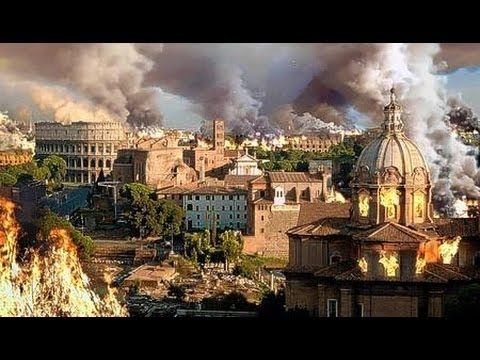
We’ve seen this slide to decay and collapse many times in history. The elites who once gained social status and political power by making real sacrifices on behalf of the nation / empire become entirely self-serving, accumulating ever greater wealth and power by transferring all the sacrifices and risks onto the lower classes.
Peter Turchin, author of War and Peace and War: The Rise and Fall of Empires, describes how civic virtue is gradually replaced by personal greed and self-interest.
This excerpt perfectly captures the current zeitgeist:
“Virtus included the ability to distinguish between good and evil and to act in ways that promoted good, and especially the common good. Unlike Greeks, Romans did not stress individual prowess, as exhibited by Homeric heroes or Olympic champions. The ideal of hero was one whose courage, wisdom, and self-sacrifice saved his country in time of peril.
Unlike the selfish elites of the later periods, the aristocracy of the early Republic did not spare its blood or treasure in the service of the common interest. When 50,000 Romans, a staggering one fifth of Rome’s total manpower, perished in the battle of Cannae, as mentioned previously, the senate lost almost one third of its membership. This suggests that the senatorial aristocracy was more likely to be killed in wars than the average citizen….
The wealthy classes were also the first to volunteer extra taxes when they were needed… A graduated scale was used in which the senators paid the most, followed by the knights, and then other citizens. In addition, officers and centurions (but not common soldiers!) served without pay, saving the state 20 percent of the legion’s payroll….
The richest 1 percent of the Romans during the early Republic was only 10 to 20 times as wealthy as an average Roman citizen.”
Now compare that to the situation in Late Antiquity when
“An average Roman noble of senatorial class had property valued in the neighborhood of 20,000 Roman pounds of gold. There was no ‘middle class’ comparable to the small landholders of the third century B.C.; the huge majority of the population was made up of landless peasants working land that belonged to nobles. These peasants had hardly any property at all, but if we estimate it (very generously) at one tenth of a pound of gold, the wealth differential would be 200,000! Inequality grew both as a result of the rich getting richer (late imperial senators were 100 times wealthier than their Republican predecessors) and those of the middling wealth becoming poor.”
Compare this to the America of World War II and the America of today. Wealthy, politically influential families such as the Kennedys could only retain their influence if their sons served in positions of combat leadership, and Joe Kennedy was killed in the European theater after volunteering for a highly risky air mission. John F. Kennedy very nearly lost his life in the South Pacific.
And how do our era’s crop of presidents and presidential contenders fare by comparison? The idea that flesh and blood should ever be at risk in defense of the nation /empire–perish the thought.
As Turchin sagely observed, it’s not just the limitless greed and avoidance of sacrifice of the elite that generates destabilizing inequality–it’s the eradication of the middle class as all the risks and sacrifices were shifted from the self-serving top to the middle and lower classes.
As I’ve often noted, risk cannot be made to disappear, it can only be transferred to others. In the grand scheme of things, the inherent risks of globalization and financialization have all been transferred to the middle and working classes (however you define them). The elite class enjoys the near-infinite support of the Federal Reserve and it’s ability to print near-infinite sums of currency to bail out the greediest, most self-serving scum of parasites and speculators.
Meanwhile, all the sacrifices required to support this unfair, corrupt, predatory system have been transferred to the middle and working classes via sleight of hand. The sacrifices weren’t transparent and up front; they were cloaked in the decline of job security, in ever-higher costs, in the decline of social mobility and the erosion of the purchasing power of wages.
The elites’ economist flunkies and factotums claimed that bailing out the freeloaders, parasites and speculators would benefit “the little people” because the grand trade-off delivered by the Federal Reserve (as correspondent R.J. pointed out to me) was: no more financial panics, which caused much misery in the working class due to business failures causing layoffs and unemployment.
But globalization, financialization and the rise of cartel-state monopolies have eviscerated the middle and working classes far more effectively and permanently than any brief financial panic, while greatly enriching the elite class–a rise in wealth that is backstopped by the Federal Reserve: profits are the elites to keep while their losses are socialized, i.e. transferred to the lower classes.
Job security, the purchasing power of wages and social mobility–nothing vital to the middle or working classes is backstopped by the Fed; the Fed’s one and only job is backstopping the wealth of our parasitic, predatory elite.
Sacrifice for Thee But None For Me. The banquet of consequences for the Fed, the elites and their armies of parasitic flunkies and factotums is being laid out, and there won’t be much choice in the seating.


By Edward Curtin
Source: Behind the Curtin
“If the world is upside down the way it is now, wouldn’t we have to turn it over to get it to stand up straight?” – Eduardo Galeano, Upside Down, 1998
For decades, Andre Vltchek, an old-school journalist and artist (but a young man) who traveled the world in search of truth and who always stood up straight, tried to revolve the world and encourage people to revolt against injustice. In this age of arm-chair reporters, he stood out for his boldness and indefatigable courage. He told it straight. This irritated certain people and some pseudo-left publications, who sensed in him a no bullshit fierceness and nose for hypocrisy that frightened them, so they stopped publishing his writing. He went where so many others feared to tread, and he talked to people in places that were often the victims of Western imperialistic violence. He defended the defenseless and encouraged their defense.
Now he is dead. He died in the back seat of a chauffeur driven rental car on an overnight drive to Istanbul, Turkey. He was sleeping, and when his wife attempted to wake him upon arrival at their hotel, she couldn’t. He was 57-years-old.
Let him sleep in peace, but let his words ring out, his passionate cries for justice and peace in a world of violent predators.
Those who knew him and his work feel a great, great loss. His friend and colleague Peter Koenig wrote this touching goodbye.
As Koenig says, Vltchek was always defending those around the world who are considered disposable non-people, the Others, the non- whites, victims of Western wars, both military and economic, in places such as West Papua, Iraq, Syria, Africa, etc. He had a chip on his shoulder, a well justified chip, against the one-sided Western media and its elites that were always lecturing the rest of the world about their realities.
He was recently in the United States, and here is what he wrote:
But notice one thing: it is them, telling us, again, telling the world what it is and what it is not! You would never hear such statements in Africa, the Middle East, or Asia. There, people know perfectly well what it really is all about, whether it is about race or not!
I have just spent two weeks in the United States, analyzing the profound crises of U.S. society. I visited Washington, D.C., Minneapolis, New York, and Boston. I spoke to many people in all those places. What I witnessed was confusion and total ignorance about the rest of the world. The United States, a country which has been brutalizing our Planet for decades, is absolutely unable to see itself in the context of the entire world. People, including those from the media, are outrageously ignorant and provincial.
And they are selfish.
I asked many times: “Do black lives matter all over the world? Do they matter in the Democratic Republic of Congo, and do they matter in West Papua?” I swear, I received no coherent answer.
Somebody has to tell them… Somebody has to force them to open their eyes.
A few years ago, I was invited to Southern California to show my documentary work from Africa (my feature documentary film Rwanda Gambit, about West-triggered genocides in both Rwanda and later in the Democratic Republic of Congo), where millions of black people are dying, in order for the vast majority of the U.S. whites to live in piggish opulence.
But before I was allowed to present, I was warned: ‘Remember, people here are sensitive. Do not show too much of brutal reality, as it could disturb them.’
Hearing that, I almost left the event. Only my respect for the organizer made me stay.
Now I am convinced: it is time to force them to watch; to see rivers of blood, which their laziness, selfishness, and greed have triggered. It is time to force them to hear shouts of the agony of the others.
But as everyone knows, it is nearly impossible to force people to open their eyes and ears when they are dead set against doing so. Andre tried so hard to do that, and his frustration grew apace with those efforts that seemed to fall on deaf ears.
He was a relentless fighter, but he was a lover, too. His love for the people and cultures of the world was profound. Like Albert Camus, he tried to serve both beauty and suffering, the noblest of vocations. A lover of literature and culture, the best art and beauty ever produced, he was appalled at the way so many in the West had fallen into the pit of ignorance, illiteracy, and the grip of propaganda so tight that “what is missing is life. Euphoria, warmth, poetry and yes – love – are all in extremely short supply there.”
He sensed, and said it, that nihilism rules in the United States beneath the compulsive consumerism and the denial of the violence that the U.S. inflicts on people across the world. It was selfishness run amok. Me me me. It was, he felt, soul death, the opposite of all the ostensible religiousness that is a cover story for despair. He wrote:
It has to be stopped. I say it because I do love this life, the life, which still exists outside the Western realm; I’m intoxicated with it, obsessed with it. I live it to the fullest, with great delight, enjoying every moment of it.
Poetry, music, great literature, these he loved as he fought on the barricades for peace.
I urge you to read his article, Love, Western Nihilism and Revolutionary Optimism.
He was a rare and courageous man. Let us ring bells in his honor.
Here’s a Kenneth Rexroth poem for Andre, the fighter with the poet’s heart:
No Word
The trees hang silent
In the heat….
Undo your heart
Tell me your thoughts
What you were
And what you are….
Like the bells no one
Has ever rung

By Caitlin Johnstone
Source: Axis of Logic
For as long as there has been human language, humans have been using it to manipulate one another. The fact that it is possible to skillfully weave a collection of symbolic mouth noises together in such a way as to extract favors, concessions, votes and consent from other humans has made manipulation so common that it now pervades our society from top to bottom, from personal relationships between two people to international relationships between government agencies and the public.
This has made it very difficult to figure out what’s going on, both in our lives and in the world. Here are some tips for navigating this complex manipulation-laden landscape, whether that be the manipulations you may encounter in your small-scale personal interactions or the large-scale manipulations which impact the entire world:
1 — Understand the fact that humans are storytelling animals, and that whoever controls the stories controls the humans. Mental narrative dominates human consciousness; thought is essentially one continuous, churning monologue about the self and what it reckons is going on in its world, and that monologue is composed entirely of mental stories. These stories can and will be manipulated, on an individual scale by people we encounter and on a mass scale by skillful propagandists. We base our actions on our mental assessments of what’s going on in the world, and those mental assessments can be manipulated by narrative control.
2 — Be humble and open enough to know that you can be fooled. Your cognitive wiring is susceptible to the same hacks as everyone else, and manipulators of all sorts are always looking to exploit those vulnerabilities. It’s not shameful to be deceived, it’s shameful to deceive people. Don’t let shame and cognitive dissonance keep you compartmentalized away from considering the possibility that you’ve been duped in some way.
3 — Watch people’s behavior and ignore the stories they tell about their behavior. This applies to people in your life, to politicians, and to governments. Narratives can be easily manipulated and distorted in many different ways, while behavior itself, when examined with as much objectivity as possible, cannot be. Pay attention to behavior in this way and eventually you’ll start noticing a large gap between what some people’s actions say and what their words say. Those people are the manipulators. Distrust them.
4 — Be suspicious of people who keep telling you what they are and how they are, because they’re trying to manipulate your narrative about them. Be doubly suspicious of people who keep telling you what you are and how you are, because they’re trying to manipulate your narrative about you.
5 — Learn to see how trust and sympathy are used by manipulators to trick people into subscribing to their narratives about what’s going on. Every manipulator uses trust and/or sympathy as a primer for their manipulations, because if you don’t have trust or sympathy for them, you’re not going to mentally subscribe to their stories. This is true of mass media outlets, it’s true of State Department press releases which implore you to have sympathy for the people of Nation X, and it’s true of family members and coworkers. Once you’ve spotted a manipulator, your task is to kill off all of your sympathy for them and your trust in them, no matter how hard they start playing the victim to suck you back in.
6 — Be suspicious of anyone who refuses to articulate themselves clearly. Word salading is a tactic notoriously used by abusive narcissists, because it keeps the victim confused and unable to figure out what’s going on. If they can’t get a clear handle on what the manipulative abuser is saying, they can’t form their own solid position in relation to it, and the abuser knows this. Insist on lucid communication, and if it’s refused to you, remove trust and sympathy. Apply this to people in your life, to government officials, and to 8chan propaganda constructs.
7 — Familiarize yourself with cognitive biases, the glitches in human cognition which cause us to perceive things in a way that is not rational. Pay special attention to confirmation bias, the backfire effect, and the illusory truth effect. Humans have an annoying tendency to seek out cognitive ease in their information-gathering and avoid cognitive dissonance, rather than seeking out what’s true regardless of whether it brings us cognitive ease or dissonance. This means we tend to choose what we believe based on whether believing it is psychologically comfortable, rather than whether it’s solidly backed by facts and evidence. This is a weakness in our cognitive wiring, and manipulators can and do exploit it constantly. And, again, be humble enough to know that this means you.
8 — Trust your own understanding above anyone else’s. It might not be perfect, but it’s a damn sight better than letting your understanding be controlled by narrative managers and dopey partisan groupthink, or by literally anyone else in a narrative landscape that is saturated with propaganda and manipulation. You won’t get everything right, but betting on your own understanding is the very safest bet on the table. It can be intimidating to stand alone and sort out the true from the false by yourself on an instance-by-instance basis, but the alternative is giving someone else authority over your understanding of the world. Abdicating your responsibility to come to a clear understanding of what’s going on in your world is a shameful, cowardly thing to do. Be brave enough to insist that you are right until such time as you yourself come to your own understanding that you were wrong.
9 — Understand that propaganda is the single most overlooked and under-appreciated aspect of our society. Everyone’s constantly talking about what’s wrong with the world, but hardly any of those discussions are centered around the fact that the public been manipulated into supporting the creation and continuation of those problems by mass media propaganda. The fact that powerful people are constantly manipulating the way we think, act and vote should be at the forefront of everyone’s awareness, not relegated to occasional discussions in fringe circles.
10 — Respect the fact that the science of modern propaganda has been in research and development for over a century. Think of all the military advancements that have been made in the last century to get an idea of how sophisticated this science must now be. They are far, far ahead of us in terms of research and understanding of the methods of manipulating the human psyche toward ends which benefit the powerful. If you ever doubt that the narrative managers could be advanced and cunning enough to pull off a given manipulation, you can lay that particular doubt to rest. Don’t underestimate them.
11 — Understand that western mass media propaganda rarely consists of full, outright lies. At most, such outlets will credulously publish the things that are told to them by government agencies which lie all the time. More often, the deception comes in the form of distortions, half-truths, and omissions. Pay more attention to discrepancies in things that are covered versus things that aren’t, and to what they’re not saying.
12 — Put effort into developing a good news-sense, a sense for what’s newsworthy and what’s not. This takes time and practice, but it lets you see which newsworthy stories are going unreported by the mass media and which non-stories are being overblown to shape an establishment-friendly narrative. When you’ve got that nailed down, you’ll notice “Why are they acting like this is a news story?” and “Why is nobody reporting this??” stories all the time.
13 — Be patient and compassionate with yourself when it comes to developing your narrative navigating skills. Like literally any skill set, you’ll suck at it for a while. If you learn you’ve been wrong about something, just take in the new information, adjust appropriately, and keep plugging away. Don’t expect to have mastered this thing before you’ve had time to master it. Like anything else, if you put in the hours you’ll get good at it.
14 — Find reliable news reporters who have a good sense for navigating the narrative matrix, and keep track of them to orient yourself and stay on top of what’s going on. Use individual reporters, not outlets; no outlet is 100 percent solid, but some reporters are pretty close on some specific subjects. Click this hyperlink for an article on one way to do build a customized and reliable news stream. Click this hyperlink for a list of all my favorite news reporters on Twitter right now.
15 — Don’t let paranoia be your primary or only tool for navigating the narrative matrix. Some people’s only means of understanding the world is to become intensely suspicious of everything and everyone, which is about as useful as a compass which tells you that every direction is north. Spend time in conspiracy and media criticism circles and you’ll run into many such people. Rejecting everything as false leaves you with nothing as true. Find positive tools for learning what’s true.
16 — Hold your worldview loosely enough that you can change it at any time in the light of new information, but not so loosely that it can be slapped out of your head by someone telling you what to think in a confident, authoritative tone. As Carl Sagan once said, “It pays to keep an open mind, but not so open your brains fall out.”
17 — Speaking of confident, authoritative tones, be suspicious of confident, authoritative tones. It’s amazing how much traction people can get with a narrative just by posturing as though they know that what they’re saying is true, whether they’re an MSNBC pundit or a popular conspiracy Youtuber. So many people are just plain faking it, because it works. You run into this all the time in debates on online political forums; people come at you with a supremely confident posture, but if you push them to present their knowledge on the subject and the strength of their arguments, there’s not actually anything there. They’re just accustomed to people assuming they know what they’re talking about and leaving their claims unchallenged, and it completely throws them off when someone doesn’t buy their feigned confidence shtick.
18 — Be aware that sociopaths exist. There are people who, to varying degrees, do not care what happens to others, and these are the types of people who will use manipulation to get their way whenever it serves them. If you don’t care about truth or other people beyond the extent to which you can use them, then there’s no disincentive to manipulating.
19 — Be aware of projection, and be aware of the fact that it cuts both ways: unhealthy people tend to project their wickedness onto others, while healthy people tend to project their goodness. Don’t let your goodness trick you into thinking there aren’t monsters who will deceive and manipulate you, and don’t let sociopaths project their own sinister motives onto you by telling you how rotten you are. This mixes a lot of good people up, especially in their personal lives. Not everyone is good, and not everyone is truthful. See this clearly.
20 — Be suspicious of those who excessively advocate civility, rules and politeness. Manipulators thrive on rules and civility, because they know how to manipulate them. Someone who’s willing to color outside the lines and get angry at someone noxious even when they’re acting within the rules makes a manipulator very uncomfortable. Often times those telling you to calm down and behave yourself when you are rightfully upset are manipulators who have a vested interest in getting you to adhere to the rules set they’ve learned to operate within.
21 — Meditation, mindfulness, self-inquiry and other practices are powerful tools which can help you understand your own inner processes, which in turn helps you understand how manipulators can manipulate you, and how they manipulate others. Just be sure that you are using them for this purpose, not for escapism as most “spiritual” types do. You’re trying to become fully aware of what makes you tick mentally, emotionally and energetically; you’re not trying to become some vapid spiritual bliss bunny. The goal isn’t to feel better, the goal is to get better at feeling. Better at consciously experiencing your own inner world.
22 — Be relentlessly honest with yourself about your own inner narratives and the various ways you engage in manipulation. You can’t navigate your way through the narrative control matrix if you aren’t clear on your own role in it. Look inside and consciously take an inventory.
23 — Understand that truth doesn’t generally move in a way that is pleasing to the ego, i.e. in a way Hollywood scripts are written to appeal to. Any narrative that points to a Hollywood ending where the bad guy gets karate kicked into lava and the hero gets the girl is manufactured. Russiagate and QAnon are both perfect examples of an egoically pleasing narrative with the promise of a Hollywood ending, either by Trump and his cohorts being dragged off in chains or by the “white hats” overcoming the Deep State and throwing all the Democrats and Never-Trumpers in prison for pedophilia. Ain’t gonna happen, folks.
24 — Try to view the world with fresh eyes rather than with your tired old grown-up eyes which have taught you to see all this as normal. Hold an image in your mind of what a perfectly healthy and harmonious world would look like; the sharp contrast between this image and the world we have now allows you see through the campaign of the propagandists to normalize things like war, poverty, ecocide, and impotent electoral systems which keep seeing the same government behavior regardless of who people vote for. None of this is normal.
25 — Know that the truth has no political party, and neither do the social engineers. All political parties are used to manipulate the masses in various ways, and nuggets of truth can and do emerge from any of them. Thinking along partisan lines is guaranteed to give you a distorted view. Ignore the imaginary lines between the parties. You may be certain that your rulers do.
26 — Remain always aware of this simple dynamic: the people who become billionaires are generally the ones who are sociopathic enough to do whatever it takes to get ahead. This class has been able to buy up near-total narrative control via media ownership/influence, corporate lobbying, think tank funding, and campaign finance, and are thus able to manipulate the public into consenting to agendas which benefit nobody but plutocrats and their lackeys. This explains pretty much every major problem that we are facing right now.
27 — Understand that nations are pure narrative constructs; they only exist to the extent that people agree to pretend that they do. The narrative managers know this, and they exploit the fact that most of us don’t. Take Julian Assange, perfect example: he was pried out of the embassy and imprisoned by an extremely obvious collaboration between the US, UK, Sweden, Ecuador, and Australia, yet they each pretended that they were acting as separate, sovereign nations completely independently of one another. Sweden pretended it was deeply concerned about rape allegations, the UK pretended it was deeply concerned about a bail violation, Ecuador pretended it was deeply concerned about skateboarding and embassy cat hygiene, the US pretended it was deeply concerned about the particulars of the way Assange helped Chelsea Manning cover her tracks, Australia pretended it was too deeply concerned about honoring the sovereign affairs of these other countries to intervene on behalf of its citizen, and it all converged in a way that just so happened to look exactly the same as imprisoning a journalist for publishing facts. You see this same dynamic constantly, whether it’s with military interventions, trade deals, or narrative-shaping campaigns against non-aligned governments.
28 — Understand that war is the glue which holds the US-centralized empire together. Without the carrot of military/economic alliance and the stick of military/economic violence, the US-centralized empire would cease to exist. This is why war propaganda is constant and sometimes so forced that glaring plot holes become exposed; it’s so important that they need to force it through, even if they can’t get the narrative matrix around it constructed just right. If they ceased manufacturing consent for the empire’s relentless warmongering, people would lose all trust in government and media institutions, and those institutions would lose the ability to propagandize the public effectively. Without the ability to propagandize the public effectively, our rulers cannot rule.
29 — Remember that when it comes to foreign policy, the neocons are always wrong. They’ve been so remarkably consistent in this for so long that whenever there’s a question about any narrative involving hostilities between the US-centralized power alliance and any other nation, you can just look at what Bill Kristol, Max Boot and John Bolton are saying about it and believe the exact opposite. They’re actually a very helpful navigation tool in this way.
30 — Notice how the manipulators like to split the population in two and then get them arguing over how they should serve the establishment. Arguing over whether it’s better to vote Democrat or Republican, arguing over whether it’s better to increase hostilities with Iran and Venezuela or with Syria and Russia, over whether you should support the US president or the FBI, arguing over how internet censorship should happen and whom should be censored rather than if censorship should happen in the first place. The longer they can keep us arguing over the best way to lick the imperial boot, the longer they keep us from talking about whether we want to lick it at all.
31 — Watch out for appeals to emotion. It’s much easier to manipulate someone by appealing to their feely bits rather than their capacity for rational analysis, which is why any time they want to manufacture support for military interventionism you see pictures of dead children on news screens everywhere rather than a logical argument for the advantages of using military violence based on a thorough presentation of facts and evidence. You see the same strategy used in the guilt trips they lay on third-party voters; it’s all emotional hyperbole that crumbles under any fact-based analysis, but they use it because it works. They go after your heart strings to
circumvent your head.
32 — Pay attention to how much propaganda goes into maintaining the propaganda machine itself. This is done this because propaganda is just that central to the maintenance of dominant power structures. Much effort is spent building trust in establishment narrative management outlets while sowing distrust in sources of dissent. You’ll see entire propaganda campaigns built around accomplishing solely this.
33 — Make a practice of asking “Who benefits from this narrative I’m being sold?” and “Who benefits from this belief I have?” Who benefits from your hating China or the Latest Official Bad Guy? Who benefits from the belief that the status quo is acceptable? Keep asking this about the narratives coming to you, and about the beliefs you already hold in your head.
34 — Learn the art of perceiving life without the perceptual filter of narrative. Mentally “mute” the narrative soundtrack and watch where all the resources are going, where the weapons are moving to and coming from, who’s being killed and imprisoned etc, to get a clear picture of what’s going on in the world.
35 — Whenever the mass media begin declaring that some dastardly deed has been committed which requires immediate military action, your default assumption should be that they’re lying, because they’ve got an extensively documented history of doing so. After lying so consistently about such things so many times, the burden of proof is always on the western power structures who are making the claim, and that burden requires mountains of independently verifiable evidence to be met.
36 — Dismiss all Latest Official Bad Guy narratives. The only ones who benefit from you hating a foreign government are the powerful people who are targeting that government and seeking to manufacture support for future actions against it. Don’t be a pro bono CIA propagandist.
37 — Be acutely aware that the only reason the status quo is accepted as “normal”, and its defenders regarded as “moderate”, is because vast fortunes are poured into making it seem that way. If we could see the status quo of this world with fresh eyes, we’d scream in horror.
From Bruce Lee’s notes for Game of Death.
By James Curcio
Source: Modern Mythology
Inthe time since his death, Bruce Lee’s legend has grown astronomically, adding his name to the pantheon of 60s and 70s superstars whose fame was in many ways sealed by their untimely demise. Despite this, his contribution to “modern mythology” is often under-scrutinized, both in terms of the role myth played both in exposing his interests and constructing his persona.
In this conversation with Alan Canvan — producer and editor of The Game of Death Redux, which can be found on Criterion’s Bruce Lee: His Greatest Hits box set — we attempt to tackle this subject… or at least crack the door open.
James Curcio: How did you get involved in the Criterion edition of Game of Death?
Alan Canvan: Game of Death has been on my periphery since first viewing it in 1979. Over the years, like many fans, I attempted to decipher the rumors and evidence of existing footage that told more to the story than what we got in the 1978 film.
Following the release of the full footage in 2000, I began reflecting on the different presentations in relation to the source material. In truth, although those renditions have their merits, I felt that much of the symbolism and dramatic narrative associatedwith Lee’s work was lost in translation.
In the Winter of 2018 I fully committed to the project, and meticulously examined and refined the Game of Death sculpture for a period of 6 months. This garnered the attention of Antony Wong of the Asian American/Asian Research Institute in New York, and resulted in a film screening at AAARI in July, 2019. My good friend Matthew Polly, (author of the outstanding biography Bruce Lee: A Life), joined me for the post panel discussion, and we chatted about various thematic elements within the story. The feedback was extremely positive, but I continued to play with the footage until December of that year.
In the interim, Criterion approached Matthew to do film commentary for their then upcoming Bruce Lee box set, and producer Curtis Tsui learned about my edit. After seeing Redux, Curtis was impressed enough to ask me if he could include it as an extra feature on the Game of Death blu-ray disc.
I also need to cite composer John Barry’s incredible score as a crucial component to the Game of Death jigsaw, and I wouldn’t have considered doing Redux without it. Going back to the concept of storytelling, what I find particularly remarkable in his compositions is how they seem to sonically narrate the story. Barry creates a work of intimate beauty that is equally classical, ominous, melancholy and heroic.
Because of this, I’ve often wondered if he had access to the full footage when creating the compositions (as opposed to the 11 minute edit we got in the 1978 film). Suffice it to say that, either way, Game of Death is all the richer with his music as the driving force of the story.
JC: I’m sure a book could be written on this subject, but in brief, how does mythology relate to a martial arts film like Game of Death?
AC: Carl Jung, a progenitor of the way in which symbols and common myths pervade our thinking, stressed the idea that certain story devices are embedded in the brain — hence, mythologies from different cultures all over the world sharing a common language. These tales often involve death and rebirth.
Mythology, at its core, attempts to examine nature’s cyclical process with stories that often convey the death-rebirth archetype through symbols, and what takes place may not necessarily be happening in the actual world but in the inner world of the mind. He referred to this process as the return of the ego to the unconscious, a momentary death, with a subsequent re-emergence or rebirth. In comparative mythology, ego death is the second phase of Campbell’s description of “The Hero’s Journey”, where the hero returns to enrich the world with his revelations.
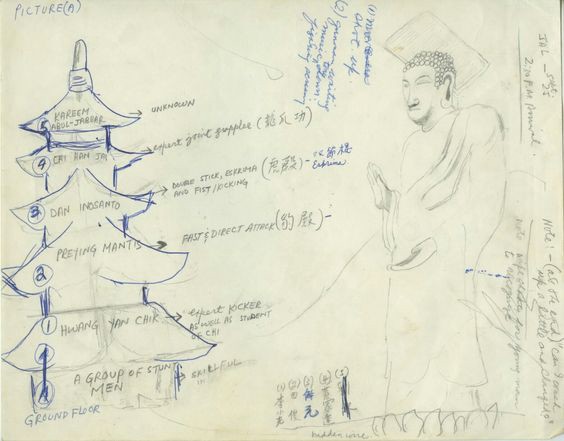
This specific arc is reflected in the pagoda sequence of Game of Death. The broader narrative sets up the protagonist to face different iterations of death, revealing early on that he is a retired martial arts champion who inadvertently killed an opponent in his last professional fight. Does this thematically tie into the climax? I believe so. Viewing the central theme being the death of the ego as a fundamental transformation of the psyche, the film’s title takes on a different meaning. The pagoda therefore stands in for the character’s emotional landscape, with the true mission being the conquest of his inner fear.
Though, according to the story treatment, his motivation was supposed to be fueled by his family being held hostage. This doesn’t quite gel with the philosophical underpinnings of the pagoda motif, which is partially why Bruce struggled with the script. In fact, a strong argument can be made that the footage itself works best as a mini movie focusing on the themes within the pagoda, as opposed to a feature length film bogged down by 50 minutes of exposition leading up to the big battle.
JC: Merging the symbolic and naturalistic elements of a story is often a struggle… that balance between “dream logic” and “waking logic.”
This leads into the next thing I wanted to talk to you about, actually… When did you realize myth played an important part in Bruce Lee’s art?
AC: Unconsciously, at a very young age. I saw my first photograph of him when I was around 7 years old, and began following him through magazines and ’stories’ long before seeing his movies. Game of Death, quite fittingly, was my introduction, and by then, he was the size of Mount Olympus to me.
Consciously, my mid to late teens is when I began making the connection between his cinema and classical mythology. At the time I was devouring the works of Homer, Sophocles, Shelley, Stevenson, Wilde, Burroughs and Poe. Adjunctly, I witnessed their heir apparents in the world of comic books — writers and artists who reinvented this stuff in a different, but equally powerful medium. An obvious example is the Biblical overtones that shape Superman’s origin. In the late 70’s and early 80’s comic book scribes Doug Moench and Frank Miller examined these tropes beautifully in their seminal works — Master of Kung Fu and Daredevil.
Bruce Lee was heavily influenced by comics in his youth, and, later, became a student of philosophy, but not quite in the way some folks believe.
JC: Can you explain what you mean by that?
AC: Bruce’s major in the University of Washington was Drama — not Philosophy, as has been reported. In his junior year, he took two Introductory Philosophy courses, which made up less than 10% of his classes. He may have considered changing his major before dropping out, but that doesn’t negate the fact that his understanding of philosophy at the time was rudimentary at best. He would later study numerous philosophies, selecting principles that could be applied to his martial training.
Over the last 30 years, the Lee Estate has relentlessly promoted the image of Bruce as a Philosopher, who not only developed his own brand philosophy, but lived and breathed it on a daily basis. This is inaccurate. To this day, they continue to release self-help books with titles such as Bruce Lee’s Wisdom for Daily Living which actually reproduce Bruce’s personal notes that paraphrase the work of Krishnamurti, Suzuki, Watts and countless others, in relation to combat. Because the sources aren’t cited, many believe these quotes to be his. I don’t believe the Estate’s intent was to plagiarize the work, but it’s obvious that those involved didn’t do their research. This plays a large part in Lee’s mythology and a contingent of fans not only buy this, but have an almost religious need to believe it.
Although Bruce studied and preached philosophy, he had considerable difficulty practicing it outside the realm of his martial arts training. He aspired to live by metaphysical principles that were fundamentally at odds with his ambitions: more than anything, Bruce wanted to be famous (and wealthy, by virtue of that). And he worked diligently at perfecting his talents to achieve this goal.
In the late 60’s, Tinsel Town had very little acting roles for Asians, and this allowed Lee to successfully build a “character” that would demand Hollywood’s attention. It didn’t happen overnight, and, in fact, took 6 years to achieve, but he was astute enough to realize he could parlay his passion for martial arts to the big screen and give the world something they had never seen before. It was a calling card to the industry that he coveted.
Consequently, he spent a great deal of time honing the image of “Bruce Lee” — the alpha and omega of everything martial — that he sought to present to the world. This went a long way in Hollywood’s perception of him, and he wowed stars and executives not only with his physical skills, but a packaged “philosophy” to boot, giving him the image of the ultimate Zen Sage/Warrior. Much of the philosophical musings he’s known for really took shape when he came in contact with Steve McQueen, James Coburn and Stirling Silliphant.
That’s not to say that he didn’t take philosophy seriously, but he was well aware of the marketing benefits in quoting Zen aphorisms. These guys became his students, and at the peak of the counter-culture movement, Lee reinvented himself as a Guru to the stars.
In fact, the “be water” speech that the world has come to identify as his mantra, was in fact written by Stirling Silliphant (for the character he created for Bruce in the Longstreet TV series).
Granted, it was inspired by Lee’s words over the course of many private lessons, but the poetry of the language is all Silliphant. In the Burton interview, Lee was asked to repeat the monologue and, over the years, that clip was used unsparingly by the Estate to promote Bruce as a real-deal philosopher.
So, to wrap up what I was saying earlier… in many ways, his ideas as a storyteller were the perfect union of both interests. It’s my opinion that the so-called “Greek Dichotomy” is more in line with the yin-yang symbol in that philosophy and mythology are intrinsically connected. They both attempt to answer universal questions and come up with similar answers… but one does it much more theatrically!
JC: Mythos and Logos could be likened to the yang and yin dynamic in some ways, for sure.
How did these insights influence your editorial decisions with Redux?
AC: I approached the footage as its own three-act structure, with each floor representing a thematic color: Yellow for the Hall of the Tiger, Red for the Hall of the Dragon and Black for the Hall of the Unknown. The Jungian symbolism was quite obvious to me and I chose to characterize this by giving each level its own distinct musical cue. Also, I linked the Inosanto and Jabbar characters with a recurring percussion that that we first hear when Bruce’s character sprints up the stairs.
A primary analysis of what the guardians personify:
Hall of the Tiger. Here, Inosanto is the undisputed Rhythm Man — he was, in fact, Lee’s inspiration for the Rhythm Man character in the unproduced Silent Flute — an excellent martial artist, who is crippled by his slavish devotion to the art. Dan’s character, in a way, could represent what Bruce was at an earlier stage in his evolution as a martial artist. There’s symbolic resonance in the way they circle and replicate one another’s physical movements in the nunchaku duel, figuratively becoming mirror images of each other. Also significant: Dan’s floor is the Hall of the Tiger, while Bruce’s character’s fighting moniker is the ‘Yellow Faced Tiger.’ A further parallel between them?
Hall of the Dragon. Jae here represents the Dragon, which is obviously the symbol commonly identified with Bruce. There’s a regality to his presence exemplified by the way he carries himself, in the way his hair is styled and the majestic gold trim of his Gi and belt. The Dragon’s claw is highlighted with a zoom close up of Ji’s hand poised like a claw ready to pounce. It’s also significant that Ji is a grappler, in that it highlights the metaphorical aspects of struggle. Interestingly, Lee’s character ends up defeating Ji by using his own grappling methods against him — right down to the back breaker employed to end the battle. Is it symbolic that Lee breaks the Dragon?
Hall of the Unknown. Here, Lee, the filmmaker, goes fully expressionistic, using Jabbar’s character to symbolize the physical manifestation of Bruce’s Shadow self. There’s a symmetry in their physical movements that echo one other, but more nuanced than in the battle with Inosanto. The character is an elemental force that matches Lee’s prowess and complete freedom in combat. The battle on this floor is less about a “physical reality” as it is a metaphorical struggle that represents the protagonist’s inner fear of death. Kareem’s physical appearance and surroundings emphasize this — a colossal figure with arachnid limbs that dwells in darkness. His physical reach is symbolic of the length one’s fears can have.
Also significant: the manner in which Kareem kills James Tien plays on James’ character running from and essentially being devoured by his fear. Lee’s character prevails only by confronting his own dark nature/fear of death, and he is symbolically reborn through the process.
JC: It can be difficult bridging the gap in public perception between ignorance towards mythic tropes, and a sort of paint-by-numbers approach — a common definition of myth that both gets at what captures our imagination and isn’t so generalized or generic that it blends everything under the same bland term can be challenging. Pretty soon it can be like, “this is a myth,” “that’s a myth”. Everything is a myth, and so what?
I encountered this a lot with fans of Joseph Campbell — he was a great popularizer, but he actually took the time to read the source material. I think from his message a lot of people took a sense of the universal monomyth too far, as if myths at their origin-point come out of a cookie-cutter mold — “this pantheon needs a trickster”, “better follow the heroic cycle with this plot”, etc. This is especially true as his ideas have permeated script-writing, and countless books and lectures now exist suggesting that everyone re-enact the same heroic cycle, since after all, there is only one.
Whereas Campbell himself was quite clear that, although commonalities form, arguably because of the commonality of our bodies and their range of possible experiences, the origin point of myth is never the result of a formula. Myths are maybe generic because of their mutual accessibility, but they’re contagious for containing something that breaks the old formula.
I noticed mythic tropes in some of Bruce Lee’s later film work, though I assumed — wrongly, I think now — that it was because of the pop cultural movement toward using mythic tropes to help sell a story. (Of course, Star Wars cashed in on that heavily in 77–78, but it didn’t begin there). I’m interested to hear more about his intentions, as I’m sure our readers will be.
AC: As you noted, the monomyth and its effect on modern mythology predates Star Wars, though I feel it wasn’t until Star Wars that we embraced it in our collective consciousness. Tangentially, over the years, I’ve had quite a few discussions with friends and colleagues on the huge influence I believe Bruce Lee to have had on George Lucas as a storyteller. When discussing Bruce Lee, the word “myth” really takes on a meta- aspect, in that his movie mythology simultaneously informed his cult of personality. This resulted in Bruce Lee, the man, being mythologized more than any other screen icon in the history of film. There are two primary reasons for this: He pioneered (and lived) a cinematic language that defined him as the emissary of all martial knowledge, and he died incredibly young and beautiful, assuming the form of a 20th century Dorian Gray.
In response to your question, though, in order to understand Bruce’s cinematic intention, one has to go back to the initial idea he had for what was to be his first martial art movie — a Hollywood production entitled The Silent Flute. This unrealized project was conceived by Bruce in collaboration with his two students, Academy Award winning screenwriter Stirling Silliphant, and actor James Coburn, and, in many ways, became the template for Lee’s personal brand of martial art films. It was a well that he would revisit often in the ensuing years, and it allowed him to cherry pick various hallmarks and integrate them into his other projects, eventually culminating in his solo treatment of the material, Southern Fist, Northern Leg (unproduced).
Game of Death, and more specifically the pagoda motif that comprised the second and third acts of the film, owes more than a passing nod to The Silent Flute’s thematic structure and subtext, with the pagoda representing the landscape of the human psyche, and the combat used as a vehicle for self-actualization, freedom and enlightenment.
JC: Another element of this that interests me is the idea of conveying a story with the body. We have a tradition of associating story with language — I’m not sure we need to trace it back to the european tradition, but there’s a definite association between story, narrative, and language — a sense that it’s fundamentally spoken or written down to be spoken later.
However, there’s a counter argument that every story begins in the body. Artaud has an interesting take on the alchemical possibilities of the body in motion (The Theater and Its Double). Artaud focused on Balinese dance, but there’s a similarly rich, mostly silent mythology contained in Noh, and it doesn’t end there.
What are your thoughts on this? Was this more akin to the direction Bruce was moving with his interest?
AC: The connection you make to Artaud is valid. Interestingly, Noh was highly influential on Chambara cinema, which in turn inspired much of Lee’s performance in Fist of Fury. In an interview conducted roughly a year before his passing, Bruce relayed his thoughts on the term “motion picture,” stressing that the word motion, by definition, suggests an absence of words (or, at the very least, minimal exposition).
Parenthetical to this, and something that’s rarely, if ever, examined, is Lee’s substitution for dialogue: the primordial war-cries he developed for film, both fierce and playful, contained their own implicit language, subliminally morphing and communicating a range of emotions underneath the surface.
A key aspect of Bruce’s brilliance lies in his ability to create intimate character studies of age-old archetypes within the dynamics of screen violence. His cinema is a meditation on the power of movement — a kinetic poetry, if you will — that not only illustrates action, but narrates rich, textured fables within the action.
Game of Death, though incomplete, is a preeminent example of Lee’s storytelling sensibilities. His camerawork takes a cinema verite approach to the combat, giving the viewer a voyeuristic sense of close proximity to the fights, but also underscoring the surreal elements within the compositions. Two examples that immediately come to mind are in the final battle against Kareem Abdul-Jabbar: the POV tracking shot of Lee strangling Jabbar that begins underneath the furniture, and tracks up as Jabbar lifts Lee into the air and slams him down into the couch, collapsing the structure; the slow pan camera glide that begins on Bruce’s face, struggling as he continues to choke Kareem out, and travels from right to left across Kareem’s arm, settling on the veins on the back of his hand. In these instances, the viewer witnesses an expressionistic representation of a central theme that governs many of Lee’s screen battles: the concept of spiritual rebirth attained through the rigors of combat, and violence, in and of itself, as a rite of passage.
These tropes are often neglected though — and that’s odd, considering the global impact he had on film. “Action Cinema” is often dismissed as a rudimentary form of escapism, but there’s a reason why we respond to it. At its best, it intuitively links us to a primal instinct that we hold vital as a species. As with literary mythology, no matter how preposterous the characters or situations seem, we unconsciously relate to the larger than life struggles that shape and reflect who we are and who we want to be. And that’s part of the appeal of mythology — it’s a platform that allows us to symbolically connect to our better selves.
JC: I think that latter point is worth exploring. The sense I get is that Bruce Lee’s “mythology” was very much based around the idea of myth as a route to self-improvement, creating heroic images that we can come to embody through a process of half-steps… and it can certainly play that role.
But there are countless examples of the other directions myth can lead people in — probably the most contrary form of this would be Adorno’s idea that myth was the primary vehicle that fascism employed for amplification. (In his work with Horkheimer in Dialectics of Enlightenment.)
What I’m getting at is that strange paradox implied in the transformative possibilities of screen violence, that it can lead us in the opposite direction that real violence quite often does. The very idea of martial arts itself also raises the question of the role of violence in self transformation. For my part, I think both of these formulations are correct in different ways, but I’m curious what your take is here…
AC: As it pertains to real violence, most martial artists often confuse the categories: 1. Martial Arts (traditional) 2. Combat Sports (MMA) 3. Reality Based Self Defense (traditional martial arts disguised in military or street clothes) and 4. Violent Encounters (chaotic attacks outside a controlled arena).
The first two require preparation and consent, the third confuses technical moves for tactical responses, and the fourth is a complete wildcard which can leave those involved dead. The mind navigates the body, and how one feels affects how they think and vice versa. Both affect movement. True martial training addresses one’s fears, and the transformational element resides in learning how to manage those fears through training.
On the big screen, violence is an extension of this — it can be catalytic to the emotional arc a character fulfills over the course of their journey. A filmmaker’s stylistic expression is equally important, as screen violence has the capability to elicit different reactions depending on the lens its filtered through. For example, a character shooting someone in Taxi Driver looks and feels very different, than Raiders of the Lost Ark. First Blood (the novel and the film) — explores the psychological ramifications of war on soldiers. In Way of the Dragon, Bruce Lee highlights the emotional aftermath of killing an opponent in battle and uses the fight to illustrate a rite of passage for both characters.
So, I believe it really comes down to the filmmaker’s intent — what are they attempting to say with the violence? Is there a point? Is there an aesthetic? These elements contribute significantly to a body of work.
Incidentally, I haven’t read Dialectics of Enlightenment in its entirety, but from what I have read, I can’t help but relate it to Frederic Wertham’s Seduction of the Innocent, a useless book that was published in 1954 warning that comic books were directly responsible for juvenile delinquency.
To answer your question, I don’t believe violent films are responsible for real world violence. There are significant psychological factors that come into play with that kind of response, including their interests, temperament, social environment, family history and personal experience.
JC: I tend to agree, although it’s complicated. There is a certain feedback between the fictional and real, for instance, real world gangsters are known to style themselves after the characters they see onscreen — the documentary The Act of Killing gives a poignant view of this — and there is ample evidence that media can be used to nudge people with fragile egos towards violent extremism. But the problem resides within the viewer. There’s absolutely no reason to believe that horror or action movies in general make people into mass-murderers, as if the “bad” is spread to the viewer as if by contagion. This moralistic approach to media studies is, among other things, incredibly reductive, and I think it mistakes the fundamental relationship between ethics and aesthetics, or the various roles that onscreen violence can actually play within the viewer.
This is something I’ve wrestled with a lot as an artist, I’m sure many do, and it came up again in writing / researching MASKS, a recent anthology that interrogates the role of a constructed persona in the life of an artist:
“We leave room for cruelty in art so that we might exorcise it from our lives. This demands actual engagement; it can’t be done by rote.” (Excerpt)
This theme also leads back with your earlier point about Bruce Lee as a constructed identity, or a brand. To some extent this is always the distorting effect of fame — everyone thinks they know you, but the person they know is a fabricated image. This may always be the case in public life, but it is accentuated by fame. We looked at Yukio Mishima and a number of other artists in this context, but in retrospect Bruce Lee would absolutely fit that mold as well.
Sometimes this role is foisted on the person, other times it’s the result of careful construction. But it can also become a trap, like a chrysalis-cocoon the artist has to repeatedly construct and then break free from. It’s interesting, also, that many of the figures who come to mind when it comes to this sort of “persona first” approach to art either died young, or obsessed over that sort of Dorian Grey concept, as Bowie did. By dying young, an artist might avoid some of this — this may have been a part of Mishima’s obsession with dying young and still in control of that image…
This idea of constant transformation so as to avoid becoming trapped in one’s own myth seems intrinsic in Bruce Lee’s ideology, “be like water” is a cliche now, but seems like sound advice in this regard.
AC: MASKS looks great, and seems right up my alley. In the excerpt, you make a wonderful point regarding the revealing and concealing aspect of art, and by extension, the artist. In each singular act, of course, there is an element of the other at play. As you state, this leads to the question of “what’s real, what’s fake?” No story is accurate, though many tell the truth.
In that respect, the highest art is really triumph over the loss of art. Bowie, I believe, was intuitively aware of this. Iggy Pop. Brando. And, to an extent, Bruce Lee.
As I mentioned previously, Bruce was extremely precise in developing the image that we’ve come to associate him with. In truth, he’d worked on “Bruce Lee” for quite a while in the US, honing his presence and stage act in martial art demos long before courting Hollywood. While the Bruce Lee chimera may be rooted in how he sought to present himself to the world, the bigger mythology began almost immediately after his passing. How did it happen? It was easy to do because the groundwork had been laid out. More importantly though, most of the western world knew next to nothing about his personal life. This allowed his wife, and later his daughter, to successfully pass him off as the character in Enter the Dragon.
Reveal/Conceal.
Was Lee self aware? He warned of the pitfalls in not distinguishing between self actualization and self image actualization, though he clearly fell in the latter category. I see him working so hard to put forth that distinct persona in the interview he did with Pierre Burton — “the word star really turns me off, because it’s an illusion” — but ultimately revealing the antithesis within the smaller beats of the discussion. Fame is an extremely seductive mistress — especially to anyone who craved it as much as Lee. As I mentioned before, part of the grand illusion lies in the myth that he was a philosopher and fighter (the two most common boxes he’s put in, neither of which are accurate).
What’s interesting to me though, is this persona was primarily built around how his characters fought on screen, rather than the actual roles themselves. Audiences often fail to realize that Bruce never once duplicated a character in any of his adult films, but to the masses his characters come across as interchangeable based on their shared physical characteristics (ie hairstyle, facial gestures, combat stances, and signature war cries). These trademarks then became the brand, and over the course of time, ended up eclipsing all nuance he gave to the roles. As a result, “Bruce Lee” hasn’t been truly recognized as an actor, rather he’s viewed as a martial athlete who just happened to make movies.
People forget that prior to his obsession with martial arts, Bruce’s first love was performing. In fact, I would argue that this passion exceeded his love for martial art. The Nureyev-like precision he brought to his fight scenes hearken back to his younger days as a cha-cha dancer, when he obsessively perfected not only the dance steps, but his presentation as a performer. Much of what made him so unique to cinema, (as opposed to other talented martial artists that would later do movies), was fueled by artistic impulses that were not necessarily related to his martial skill.
I realize that statement will ruffle a few feathers, but when you study his body of work — both as an actor and fight choreographer, it becomes increasingly apparent that a huge part of his iconic imagery came from his intuition of where to place the camera and how to specifically pose for the camera, similar to how bodybuilders spend a significant amount of time learning how to pose for the stage. Interestingly enough, Bruce once stated that he considered himself a martial artist first, and an actor second. Although he may have liked to believe so, evidence suggests otherwise.
If you study Lee’s history, including the 17 films he made as a youth in Hong Kong (from the age of six to eighteen) and particularly The Orphan (1960), a very different picture of Bruce Lee emerges. The reality is this: Bruce, an upper middle-class kid from a showbiz family, played a variety of roles throughout his vast acting career, many of which were not martial art heroes. It’s only in his posthumous existence as an icon and designated God of Martial Arts that his story is overlooked because a good portion of it doesn’t match the image that’s been popularized over the last 47 years. This is significant when attempting to distinguish the man from the myth.
Bruce Lee, the man, differed significantly from the screen characters he played. While there were aspects of his personality infused in them, overall, they bore little resemblance to who he was in real life. Of all of them, Game of Death’s Hai Tiencomes closest to Lee in terms of temperament and expression. The character is distinctly Western, both in speech and fashion, using American colloquialisms and slang, as well as choosing to wear a modern one piece tracksuit that reinforces his combative ideology.
Jeet Kune Do is truly American in spirit.

By Caitlin Johnstone
Source: CaitlinJohnstone.com
Last week Politico published a major exclusive report that the “Iranian government is weighing an assassination attempt against the American ambassador to South Africa” in retaliation for the assassination of General Qassem Soleimani earlier this year, citing (you guessed it) anonymous government officials.
The claim was nonsensical on its face; the idea that Iran would see the assassination of some random ambassador to an irrelevant country as a proportionate response to the killing of its wildly beloved top military commander would only make sense to someone with a very US-centric worldview who knows nothing about Iran. On top of that, the South African government published a statement that “the information provided is not sufficient to sustain the allegation that there is a credible threat against the United States Ambassador to South Africa”.
The flimsy nature of this allegation was of course not enough to prevent bombastic Twitter threats from America’s manchild-in-chief that this nonexistent assassination plot “will be met with an attack on Iran that will be 1,000 times greater in magnitude!” if carried out.
It also wasn’t enough to prevent the Politico article’s co-author, Natasha Bertrand, from falsely claiming that The New York Times had “confirmed” her reporting.
“The NYT has confirmed Nahal Toosi and my reporting about Iran,” Bertrand tweeted today with a link to a new Times article, quoting the excerpt “Lana Marks, the American ambassador to South Africa and a political supporter of Trump, was a potential target of an Iranian attack…Politico earlier reported that Ms. Marks was a target.”
The New York Times has in fact not confirmed Bertrand and Toosi’s reporting, and Bertrand omits a very significant portion of text from her excerpt. Here is the quote in full, bold mine:
Lana Marks, the American ambassador to South Africa and a political supporter of Mr. Trump, was a potential target of an Iranian attack, according to national security officials. But some briefed on the intelligence said Iran has not decided to directly target any American official, and other current and former officials accused the Trump administration of overstating the threat. Politico earlier reported that Ms. Marks was a target.
Awful lot of important information hiding in that ellipsis of yours, Ms Bertrand.
So NYT had in fact merely spoken to unnamed officials (probably some of the same ones) and found there to be misgivings about the claim Bertrand had promoted, and then Bertrand deceptively omitted text which contradicted the claim she was making that her report had been “confirmed”.
It should surprise no one that Bertrand would abuse the trust of her followers in such a phenomenally sleazy way. As Antiwar‘s Dave DeCamp explained after the Politico report was discredited by the South African government, Bertrand “built her career on hyping the Steele Dossier, a now-discredited document that made unverified claims about the Russian government and the Trump campaign in 2016.”
But Bertrand’s slimy manipulation is also to be expected because she knows she can get away with it. The word “confirmed” has been misused and abused to such a spectacular extent in mainstream news reporting of late that it doesn’t actually mean anything anymore when they say it.
When a news reporter announces that they have independently confirmed another outlet’s reporting, the reader imagines that they have done actual investigative journalism, traveled to the places about which the claims are being made, done deep digging and looked at the evidence with their own two eyes and found that the claim is true. In practice, all it often means is that they spoke to the same sources the other reporter spoke to and are in fact just confirming that the source did indeed make a given assertion. The reader assumes they’re confirming the source’s claim is true, but all they’re actually confirming is that the first reporter didn’t just make up the claim they’re uncritically parroting.
Take when the anonymously sourced story about Russia paying bounties to Taliban-linked fighters in Afghanistan for killing occupying coalition forces was first reported by The New York Times. We now know this story was completely baseless, but when it first broke there were a bunch of mass media reporters buzzing around claiming to have “confirmed” one another’s stories on the matter.
“The Wall Street Journal and The Washington Post have confirmed our reporting,” the NYT story’s co-author Charlie Savage tweeted after the story broke.
“We have confirmed the New York Times’ scoop: A Russian military spy unit offered bounties to Taliban-linked militants to attack coalition forces in Afghanistan,” tweeted The Washington Post‘s John Hudson.
“We matched The New York Times’ great reporting on how US intel has assessed that Russians paid Taliban to target US, coalition forces in Afg which is a pretty stunning development,” tweeted Wall Street Journal’s Gordon Lubold.
All three of these men were lying.
John Hudson’s claim that the Washington Post article he co-authored “confirmed the New York Times’ scoop” twice used the words “if confirmed” with regard to his central claim, saying “Russian involvement in operations targeting Americans, if confirmed,” and “The attempt to stoke violence against Americans, if confirmed“. This is of course an acknowledgement that these things had not, in fact, been confirmed.
The Wall Street Journal article co-authored by Gordon Lubold cited only anonymous “people”, who we have no reason to believe are different people than NYT’s sources, repeating the same unsubstantiated assertions about an intelligence report. The article cited no evidence that Lubold’s “stunning development” actually occurred beyond “people familiar with the report said” and “a person familiar with it said“.
The fact that both Hudson and Lubold were lying about having confirmed the New York Times‘ reporting means that Savage was also lying when he said they did. When they said the report has been “confirmed”, what they really meant was that it had been agreed upon. All the three of them actually did was use their profoundly influential outlets to uncritically parrot something nameless spooks wanted the public to believe, which is the same as just publishing a CIA press release free of charge. It is unprincipled stenography for opaque and unaccountable intelligence agencies, and it is odious.
Earlier this month The Intercept‘s Glenn Greenwald published an article titled “Journalism’s New Propaganda Tool: Using ‘Confirmed’ to Mean Its Opposite“, about an anonymously sourced claim by The Atlantic that Trump had said disparaging things about US troops. An excerpt:
Other media outlets — including Associated Press and Fox News — now claim that they did exactly that: “confirmed” the Atlantic story. But if one looks at what they actually did, at what this “confirmation” consists of, it is the opposite of what that word would mean, or should mean, in any minimally responsible sense. AP, for instance, merely claims that “a senior Defense Department official with firsthand knowledge of events and a senior U.S. Marine Corps officer who was told about Trump’s comments confirmed some of the remarks to The Associated Press,” while Fox merely said “a former senior Trump administration official who was in France traveling with the president in November 2018 did confirm other details surrounding that trip.”
Greenwald also documents how in 2017 CNN falsely reported that Donald Trump Jr had received an encryption key to WikiLeaks which let him preview the 2016 DNC leaks ten days before they were published, which we shortly thereafter learned was actually due to nobody involved in the story bothering to read the date on the email correctly. The whole entire story, in reality, was that Trump had merely received an email about an already published WikiLeaks drop.
Greenwald writes the following:
Very shortly after CNN unveiled its false story, MSNBC’s intelligence community spokesman Ken Dilanian went on air and breathlessly announced that he had obtained independent confirmation that the CNN story was true. In a video segment I cannot recommend highly enough, Dilanian was introduced by an incredibly excited Hallie Jackson — who urged Dilanian to “tell us what we’ve just now learned,” adding, “I know you and some of our colleagues have confirmed some of this information: What’s up?” Dilanian then proceeded to explain what he had learned:
“That’s right, Hallie. Two sources with direct knowledge of this are telling us that congressional investigators have obtained an email from a man named ‘Mike Erickson’ — obviously they don’t know if that’s his real name — offering Donald Trump and his son Donald Trump Jr. access to WikiLeaks documents. … It goes to the heart of the collusion question. … One of the big questions is: Did [Trump Jr.] call the FBI?”
How could that happen? How could MSNBC purport to confirm a false story from CNN? Shortly after, CBS News also purported to have “confirmed” the same false story: that Trump Jr. received advanced access to the WikiLeaks documents. It’s one thing for a news outlet to make a mistake in reporting by, for instance, misreporting the date of an email and thus getting the story completely wrong. But how is it possible that multiple other outlets could “confirm” the same false report?
That’s three mainstream outlets–CNN, MSNBC, and CBS, all claiming to have independently “confirmed” a story that would have been recognized as false if even one person in any of those outlets had done the tiniest bare minimum of independent investigation into the claim that its source was making, namely looking with their eyeballs at the actual information they were being presented with.
They didn’t, because that’s the state of the mass media today. That is its culture. That, in answer to Greenwald’s question above, is how this could happen: the western mass media are nothing but a bunch of lackeys mindlessly regurgitating incendiary narratives by those in power in their rapacious search for ratings.
Natasha Bertrand is acutely aware of this, which is why she feels comfortable falsely telling the world that her absurd reporting has been “confirmed”.
So now you know. Whenever you see the mass media saying an important claim has been “confirmed”, just ignore them. They have no respect for that word, and it has lost all meaning among their ranks. The western media class does not exist to tell you the truth about the world, it exists to distort your understanding of the world for the advantage of the powerful.

By Pam Martens and Russ Martens
Source: Wall Street on Parade
Every Wall Street bailout program that the Fed has created since September 17 of last year has, according to the Fed, been ostensibly created to somehow help the average American.
According to the Fed’s Term Sheet for the Term Asset-Backed Securities Loan Facility (TALF), it’s going to “help meet the credit needs of consumers and businesses by facilitating the issuance of asset-backed securities.” Not to put too fine a point on it, but asset-backed securities and related derivatives are what blew up Wall Street in 2008, creating the worst economic downturn, at that point, since the Great Depression.
According to the Fed’s most recent H.4.1 filing, it has loaned a total $11.1 billion from TALF. Eleven percent of that money, $1.2 billion, went to a company that has 4 employees (outside of clerical workers) according to its filing with the SEC.

By Andre Vltchek (1962-9/22/2020)
Source: New Eastern Outlook
COVID-19 is not just a disease; it is also a state of mind, a psychosis, a fear. It is an event that, all over the world, unleashed irrational behaviour by the governments, individuals, and media. It triggered speculations, bizarre analyses, and selective ‘cut-and-paste science.’
Result: while there are, undeniably, few optimistic success stories, including the Russian vaccine, China’s and Vietnam’s ability to contain the pandemic without ruining economy and livelihood of the citizens, the great majority of the world is undoubtfully in disarray. Hundreds of millions of people are literally tossed into a gutter. Other billions, all over Asia, Latin America, the Middle East, Africa, and to some extent, the United States and the UK are locked in, unable to travel abroad, and unwilling to accept visitors from other countries.
All this is pure insanity. Families are divided, broken apart. People are locked out of their homes in other countries. Lovers are told they cannot see each other, perhaps for years.
Extreme right-wing governments that are ripe to fall, like those in Thailand or Chile, are hiding behind the COVID-19, not allowing anyone to enter and face their downfall.
International life patterns of billions of people are ruined which leads to suicides, deep depressions, violence, as well as COVID-19 unrelated but lockdowns-related health issues.
In brief: The world is screwed! Most likely, billions of human lives are.
Apart from my work in several parts of the United States after the murder of George Floyd, and then in Aruba, from where the NATO is threatening Venezuela, I spent almost five months in a brutal lockdown in Chile. Truly brutal, because I arrived there after covering several conflict zones in Asia, with the COVID-19 at my heels. One airport after another was closing behind me, after my departure. A journey took eight days: Hong Kong to Bangkok, then Seoul, Amsterdam, Suriname, Brazilian Belem, Brasilia, Rio de Janeiro, Lima, and finally, Santiago.
At the conflict zones, including when I was filming in devastated Borneo, my guts and eyes got attacked by some vicious parasites (or was it COVID-19, after all?), and something happened to my feet; I could hardly walk. Well, once in a while, I have this tendency to run myself to the ground, after the excessive doses of Afghanistan, Syria, Indonesia, Iraq, DR Congo, Kashmir, Gaza… I never stop until it is too late, or more precisely, until I fall on my face.
But then, after I do, after I find myself flattened on the ground, I know precisely what to do. Which is: a few months of rest, rigorous exercises, foot massages, sea, diet, sun. Until I can move again, and return to performing duties, I have towards humanity.
But this time it was different. With a single digit of popularity, Chilean Pinochet-style regime utilised COVID-19 in order to stay in power, to crack on the opposition and to rob indigenous people of that little they still had left. Result: bizarre, total lockdowns with tanks on the streets, with the meaningless curfews, with even a small park at the back of my building out of reach to the tenants.
My only ‘walks’ were inside the apartment. I needed to get to my place in Bangkok; small, but with a gym and pool and with a garden. But Thailand’s rulers made sure to keep the foreigners out, too. Clearly, for political reasons.
And so, I was forced to spend the longest time in my life in one place. The longest since I was 15 years old if I remember correctly.
And instead of improving, my health deteriorated in that monstrous lockdown, where I was facing bare, depressing winter Andes, and the 160-average pollution levels (US AQI). When I was finally departing, I could hardly walk and had to use a cane.
***
I RAN away on one of the first re-introduced non-stop Iberia flights to Madrid. I was lucky that I could, as one of my passports was that of the EU.
It had to be Madrid or Italy. I would also happily run to Russia, but in August, it was still closed.
When I was very young, I used to escape to Madrid, in order to be as far away as possible from New York. I despised my life in the United States. I couldn’t write there. In Italy and Madrid, I could easily. For months I would be saving, and then disappear from the United States, for 5–6 weeks. My plan was to travel all over Spain, but Madrid was so absorbing, so fascinating that in the end, I lost all my desire to leave it. Cafes on Plaza de Olavide were where I used to write my fiction.
And now, beaten, hardly able to move, I returned. Before my interviews in Turkey and Serbia, and before at least some parts of Asia would be re-opening, Madrid became my logical destination.
***
I ANTICIPATED what would be waiting for me here. And all of my expectations came through.
In Madrid, life didn’t stop. It slowed down, to some extent, yes. Some visible and invisible barriers were erected. Many precautions have been taken. But there was no ‘full stop.’ Unlike in New York and Santiago, colours were everywhere, and so were beauty, elegance, and harsh Castellan sense of humour.
First of all, Madrid was clearly demonstrating that life is much stronger then death, but only if life is pitched against death, and lived with unwavering strength and passion.
In Prado Museum, I rediscovered one of the greatest and most frightening artworks of all times: Pieter Bruegel’s the Elder: ‘The Triumph of Death.’ I searched for it, and I found it in one of the main halls.
Here, in this surreal, powerful, and highly perverse artwork, it was depicted all. Yes, Death is frightening. Yes, it has tremendous strength, and it has its own ‘army of skeletons.’ And yes, in the end, it always wins.
But you look out, through the windows of Prado, and you see the ancient, green, and beautiful trees, you see the splendid architecture, and lovers holding hands. Death may have the last word for all human beings, but life goes on, too. It never gets defeated, and it never surrenders. There is time to live and time to die.
Bruegel, who painted his macabre masterpiece c. 1562, wanted us to live in constant fear of death.
Today’s Madrid, with its passion, wants us to forget about death, at least for that short but brilliant moment, which is called life.
This new and hopefully short-lived era of COVID-19 terror is throwing us, human beings, back to the middle ages, where continuous anxieties and images of horrors were masterfully manufactured, even mass-produced, in order to poison our existence and strip us of dreams, of power, and joy.
Throughout the middle ages, at least in Europe, suffering and fear were habitually glorified. Joy and desires were suppressed, often chastised.
In the middle ages, Christianity reached perfection in scaring humans to death, in stripping life of almost all delights, and in administering brutal, grotesque punishments. And this is when the Muslim armies arrived, liberating a large part of Spain from the religious fundamentalism. Glorious caliphate of Cordoba was erected, synonymous with the golden age of Islam; caliphate admired for knowledge, poetry, playfulness, the quest for freedom and beauty.
There, Muslims, Christians, and Jews lived together; they freely mingled together, building one mighty, tolerant, and creative society. It was a society without fear, society full of hope.
Caliphate of Cordoba also defeated death, at least from one’s birth till demise. Great Pakistani thinker, Tariq Ali, wrote beautifully about that era, many years before COVID-19 appeared on the horizon.
I took Talgo, high-speed train, to Cordoba. I had to revisit the old mosque, where the fight for tolerance began. All this was now relevant. It was not just the medicine, not just the science, which had to be mobilised.
The battle against COVID-19 has to be also fought by thinkers, by artists, by all those who can make life meaningful, or at least bearable.
***
SPAIN and its capital Madrid can easily ‘go either way.’ The city can be oppressive and harsh when it goes through the ‘bad wave.’ It can ruin millions of lives, as it did when it embarked on the horrid colonialist expeditions, religious fundamentalism, or fascist dictatorship.
But Madrid can also be highly enlightened, creative, and forward-looking. It can be light and reasonable, embracing life.
In the age of COVID-19, Madrid decisively refused to lock up millions of people in the proverbial cages. Few weeks of confusion and enough! The government tried, half-heartedly, but failed to impose full oppressive order.
By the middle of August 2020, the number of Covid-19 cases was higher in Spain, then in many other EU countries. Madrid made it to the ‘red list’ in such countries as Germany and the UK.
But walk through the streets of the city, sit in its cafes, look at children playing in the elegant parks, and then compare all this with terrible stress in those societies full of rules and regulations, such as Germany or Macron’s France.
Brueghel’s skeletons are clearly depicting destruction and death. Scenes are full of nihilism. They fit perfectly well into the devastated landscapes of the excessively locked down, terrified cities.
Some cities with a relatively small number of infections, like Bangkok, already died. How come? They lost, they handed victory to death. They threw up their hands without the battle. They surrendered, offering to death precisely what she has been demanding: voluntarily, they stopped living.
In the United States or such places like Southeast Asia, Facebook, Amazon, Apple have been making fortunes. Bookstores, museums, theatres all surrendered; they closed down.
***
MADRID introduced social distancing, imposed masks regulations, a limited number of visitors, but rapidly reopened cinemas, gardens, galleries. Cafes are functioning, too, and so are the restaurants. Soon, after the summer holidays end, the city’s theatres and concert halls will reopen.
It is not because the city is reckless. Not at all. Disinfectants are everywhere and when walking or in public places, people are wearing masks. The streets of Madrid are meticulously clean. Various safety regulations are imposed. But life goes on. Airplanes are taking off towards many parts of the world. Madrid is an open city. Not yet to all, but at least to many.
And as a reward, there are smiles. There are politeness and kindness. People do not look suicidal. They do not explode at the slightest conflict. No honking, no shouting. No animalistic, all-consuming fear.
Madrid understands that there is a certain degree of danger. But it deals with this state of siege with admirable dignity and courage.
After the panic and ugly behavioural patterns that I observed in the United States and Chile, Madrid impressed me enormously. The COVID-19 pandemic brought economic and social hardship to some, but there was no national agony so clearly noticeable in New York, Washington DC, or Santiago.
Even if they struggled, people made sure to put on their best, to behave with dignity, and confront danger with both strength and heart.
When my still weak feet let go on the third day, when I stumbled and fell on an ancient sidewalk, several people immediately ran to my rescue. They fought for me. In my own way, I came here in order to fight for them, too.
Madrid is not a perfect city. Actually, I keep repeating it again and again: there are no ‘perfect cities’ in this world.
And Madrid’s way is not the only example of how to fight and defeat the latest deadly pandemic.
But perhaps it is the most agreeable one: full of smiles, support from friends and families, with the exposure to the sun, to excellent food, nature, culture, and arts.
It is the Latin spirit, joie de vivre, which is put to work here, in order to overpower Brueghel and his army of skeletons, together with the excessive religious asceticism of El Greco.
We still don’t know how to defeat COVID-19, scientifically, but in such places as Madrid, we are learning how to prevent it from defeating us.
Nine days in Madrid did not fully ‘cure me,’ but it gave back the optimism to my scarred soul. It gave me the strength to fight again. As well as the desire to walk forward!
Originally published 8/20/20
INDIAN COUNTRY NEWS
"It is the duty of every man, as far as his ability extends, to detect and expose delusion and error"..Thomas Paine
Human in Algorithms
100% Accurate Google Sheets + KDP Book Formatting | 24hr Delivery
From the Roof Top
I See This
blog of the post capitalist transition.. Read or download the novel here + latest relevant posts
अध्ययन-अनुसन्धानको सार

