Two for Tuesday
Reply

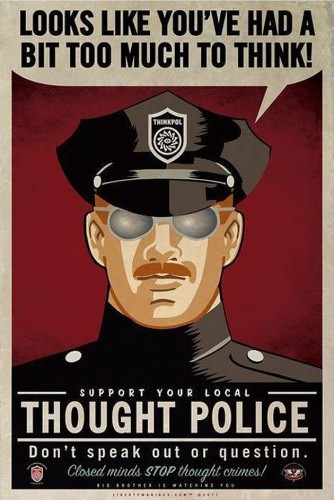
By John W. Whitehead & Nisha Whitehead
Source: The Rutherford Institute
“In a time of deceit telling the truth is a revolutionary act.”— George Orwell
The U.S. government, which speaks in a language of force, is afraid of its citizenry.
What we are dealing with is a government so power-hungry, paranoid and afraid of losing its stranglehold on power that it is conspiring to wage war on anyone who dares to challenge its authority.
All of us are in danger.
In recent years, the government has used the phrase “domestic terrorist” interchangeably with “anti-government,” “extremist” and “terrorist” to describe anyone who might fall somewhere on a very broad spectrum of viewpoints that could be considered “dangerous.” The ramifications are so far-reaching as to render almost every American an extremist in word, deed, thought or by association.
In the government’s latest assault on those who criticize the government—whether that criticism manifests itself in word, deed or thought—the Biden Administration has likened those who share “false or misleading narratives and conspiracy theories, and other forms of mis- dis- and mal-information” to terrorists.
The next part is the kicker.
According to the Department of Homeland Security’s latest terrorism bulletin, “These threat actors seek to exacerbate societal friction to sow discord and undermine public trust in government institutions to encourage unrest, which could potentially inspire acts of violence.”
You see, the government doesn’t care if what you’re sharing is fact or fiction or something in between. What it cares about is whether what you’re sharing has the potential to make people think for themselves and, in the process, question the government’s propaganda.
Get ready for the next phase of the government’s war on thought crimes and truth-tellers.
For years now, the government has used all of the weapons in its vast arsenal—surveillance, threat assessments, fusion centers, pre-crime programs, hate crime laws, militarized police, lockdowns, martial law, etc.—to target potential enemies of the state based on their ideologies, behaviors, affiliations and other characteristics that might be deemed suspicious or dangerous.
For instance, if you believe in and exercise your rights under the Constitution (namely, your right to speak freely, worship freely, associate with like-minded individuals who share your political views, criticize the government, own a weapon, demand a warrant before being questioned or searched, or any other activity viewed as potentially anti-government, racist, bigoted, anarchic or sovereign), you could be at the top of the government’s terrorism watch list.
Moreover, as a New York Times editorial warns, you may be an anti-government extremist (a.k.a. domestic terrorist) in the eyes of the police if you are afraid that the government is plotting to confiscate your firearms, if you believe the economy is about to collapse and the government will soon declare martial law, or if you display an unusual number of political and/or ideological bumper stickers on your car.
According to one FBI latest report, you might also be classified as a domestic terrorism threat if you espouse conspiracy theories, especially if you “attempt to explain events or circumstances as the result of a group of actors working in secret to benefit themselves at the expense of others” and are “usually at odds with official or prevailing explanations of events.”
In other words, if you dare to subscribe to any views that are contrary to the government’s, you may well be suspected of being a domestic terrorist and treated accordingly.
This latest government salvo against consumers and spreaders of “mis- dis- and mal-information” widens the net to potentially include anyone who is exposed to ideas that run counter to the official government narrative.
You don’t have to be a Joe Rogan questioning COVID-19 to get called out, cancelled and classified as an extremist.
There’s a whole spectrum of behaviors ranging from thought crimes and hate speech to whistleblowing that qualifies for persecution (and prosecution) by the Deep State.
Simply liking or sharing this article on Facebook, retweeting it on Twitter, or merely reading it or any other articles related to government wrongdoing, surveillance, police misconduct or civil liberties might be enough to get you categorized as a particular kind of person with particular kinds of interests that reflect a particular kind of mindset that might just lead you to engage in a particular kinds of activities and, therefore, puts you in the crosshairs of a government investigation as a potential troublemaker a.k.a. domestic extremist.
Chances are, as the Washington Post reports, you have already been assigned a color-coded threat score—green, yellow or red—so police are forewarned about your potential inclination to be a troublemaker depending on whether you’ve had a career in the military, posted a comment perceived as threatening on Facebook, suffer from a particular medical condition, or know someone who knows someone who might have committed a crime.
In other words, you might already be flagged as potentially anti-government in a government database somewhere—Main Core, for example—that identifies and tracks individuals who aren’t inclined to march in lockstep to the police state’s dictates.
As The Intercept reported, the FBI, CIA, NSA and other government agencies have increasingly invested in corporate surveillance technologies that can mine constitutionally protected speech on social media platforms such as Facebook, Twitter and Instagram in order to identify potential extremists and predict who might engage in future acts of anti-government behavior.
Where many Americans go wrong is in naively assuming that you have to be doing something illegal or harmful in order to be flagged and targeted for some form of intervention or detention.
In fact, all you need to do these days to end up on a government watch list or be subjected to heightened scrutiny is use certain trigger words (like cloud, pork and pirates), surf the internet, communicate using a cell phone, limp or stutter, drive a car, stay at a hotel, attend a political rally, express yourself on social media, appear mentally ill, serve in the military, disagree with a law enforcement official, call in sick to work, purchase materials at a hardware store, take flying or boating lessons, appear suspicious, appear confused or nervous, fidget or whistle or smell bad, be seen in public waving a toy gun or anything remotely resembling a gun (such as a water nozzle or a remote control or a walking cane), stare at a police officer, question government authority, or appear to be pro-gun or pro-freedom.
And then at the other end of the spectrum there are those such as Julian Assange, for example, who blow the whistle on government misconduct that is within the public’s right to know.
Assange, the founder of WikiLeaks—a website that published secret information, news leaks, and classified media from anonymous sources—was arrested on April 11, 2019, on charges of helping U.S. Army intelligence analyst Chelsea Manning access and leak more than 700,000 classified military documents that portray the U.S. government and its military as reckless, irresponsible and responsible for thousands of civilian deaths.
Included among the leaked Manning material were the Collateral Murder video (April 2010), the Afghanistan war logs (July 2010), the Iraq war logs (October 2010), a quarter of a million diplomatic cables (November 2010), and the Guantánamo files (April 2011).
The Collateral Murder leak included gunsight video footage from two U.S. AH-64 Apache helicopters engaged in a series of air-to-ground attacks while air crew laughed at some of the casualties. Among the casualties were two Reuters correspondents who were gunned down after their cameras were mistaken for weapons and a driver who stopped to help one of the journalists. The driver’s two children, who happened to be in the van at the time it was fired upon by U.S. forces, suffered serious injuries.
In true Orwellian fashion, the government would have us believe that it is Assange and Manning who are the real criminals for daring to expose the war machine’s seedy underbelly.
Since his April 2019 arrest, Assange has been locked up in a maximum-security British prison—in solitary confinement for up to 23 hours a day—pending extradition to the U.S., where if convicted, he could be sentenced to 175 years in prison.
This is how the police state deals with those who challenge its chokehold on power.
This is why the government fears a citizenry that thinks for itself. Because a citizenry that thinks for itself is a citizenry that is informed, engaged and prepared to hold the government accountable to abiding by the rule of law, which translates to government transparency and accountability.
After all, we’re citizens, not subjects. For those who don’t fully understand the distinction between the two and why transparency is so vital to a healthy constitutional government, Manning explains it well:
When freedom of information and transparency are stifled, then bad decisions are often made and heartbreaking tragedies occur – too often on a breathtaking scale that can leave societies wondering: how did this happen? … I believe that when the public lacks even the most fundamental access to what its governments and militaries are doing in their names, then they cease to be involved in the act of citizenship. There is a bright distinction between citizens, who have rights and privileges protected by the state, and subjects, who are under the complete control and authority of the state.
This is why the First Amendment is so critical. It gives the citizenry the right to speak freely, protest peacefully, expose government wrongdoing, and criticize the government without fear of arrest, isolation or any of the other punishments that have been meted out to whistleblowers such as Edwards Snowden, Assange and Manning.
The challenge is holding the government accountable to obeying the law.
A little over 50 years ago, the U.S. Supreme Court ruled 6-3 in United States v. Washington Post Co. to block the Nixon Administration’s attempts to use claims of national security to prevent The Washington Post and The New York Times from publishing secret Pentagon papers on how America went to war in Vietnam.
As Justice William O. Douglas remarked on the ruling, “The press was protected so that it could bare the secrets of government and inform the people. Only a free and unrestrained press can effectively expose deception in government. And paramount among the responsibilities of a free press is the duty to prevent any part of the government from deceiving the people and sending them off to distant lands to die of foreign fevers and foreign shot and shell.”
Fast forward to the present day, and we’re witnessing yet another showdown, this time between Assange and the Deep State, which pits the people’s right to know about government misconduct against the might of the military industrial complex.
Yet this isn’t merely about whether whistleblowers and journalists are part of a protected class under the Constitution. It’s a debate over how long “we the people” will remain a protected class under the Constitution.
Following the current trajectory, it won’t be long before anyone who believes in holding the government accountable is labeled an “extremist,” relegated to an underclass that doesn’t fit in, watched all the time, and rounded up when the government deems it necessary.
We’re almost at that point now.
Eventually, we will all be potential suspects, terrorists and lawbreakers in the eyes of the government.
Partisan politics have no place in this debate: Americans of all stripes would do well to remember that those who question the motives of government provide a necessary counterpoint to those who would blindly follow where politicians choose to lead.
We don’t have to agree with every criticism of the government, but we must defend the rights of all individuals to speak freely without fear of punishment or threat of banishment.
Never forget: what the architects of the police state want are submissive, compliant, cooperative, obedient, meek citizens who don’t talk back, don’t challenge government authority, don’t speak out against government misconduct, and don’t step out of line.
What the First Amendment protects—and a healthy constitutional republic requires—are citizens who routinely exercise their right to speak truth to power.
The right to speak out against government wrongdoing is the quintessential freedom.
As I make clear in my book Battlefield America: The War on the American People and in its fictional counterpart The Erik Blair Diaries, once again, we find ourselves reliving George Orwell’s 1984, which portrayed in chilling detail how totalitarian governments employ the power of language to manipulate the masses.
In Orwell’s dystopian vision of the future, Big Brother does away with all undesirable and unnecessary words and meanings, even going so far as to routinely rewrite history and punish “thoughtcrimes.”
Much like today’s social media censors and pre-crime police departments, Orwell’s Thought Police serve as the eyes and ears of Big Brother, while the other government agencies peddle in economic affairs (rationing and starvation), law and order (torture and brainwashing), and news, entertainment, education and art (propaganda).
Orwell’s Big Brother relies on Newspeak to eliminate undesirable words, strip such words as remained of unorthodox meanings and make independent, non-government-approved thought altogether unnecessary.
Where we stand now is at the juncture of OldSpeak (where words have meanings, and ideas can be dangerous) and Newspeak (where only that which is “safe” and “accepted” by the majority is permitted). The power elite has made their intentions clear: they will pursue and prosecute any and all words, thoughts and expressions that challenge their authority.

By Caitlin Johnstone
Source: Intrepid Report
Propaganda isn’t just about manufacturing consent for wars and ridiculous governmental measures we’d never normally accept. That’s what most people think of when they hear that word, but there’s so very, very much more to it than that.
The lion’s share of propaganda goes not toward convincing us to accept new agendas of the powerful, but toward keeping us entranced in the status quo dream world which enables the powerful to have power in the first place. Toward normalizing status quo systems and training us to shape ourselves to fit into them like neat little cogs in a well-oiled machine.
And it’s not even a grand, monolithic conspiracy in most cases. The giant corporations who indoctrinate us with their advertisements, their Hollywood movies and shows, their apps, their websites and their news media are all naturally incentivized to point us further and further into delusion by the fact that they benefit from the status quo systems which have elevated them to wealth.
So day in and day out we are presented with media which train us what to value, where to place our interest and attention, what success looks like, and how a normal human behaves on this planet. And it always aligns perfectly with the interests of the rich and powerful.
They don’t just teach us what to believe. They teach us who we are. They give us the frameworks upon which we cast our ambitions and evaluate our success, and we build psychological identities out of those constructs. I am a businessman. I am unemployed. My life is about making money. My life is about disappointing people. I am a success. I am a failure. They invent the test of our adequacy, and they invent the system by which we are graded.
These artificial constructs take up such vast portions of our personal psychology that people will live their entire lives completely enslaved to them, making them their entire focus. This enslavement is so pervasive that people will often even take their own lives based on what those made-up constructs tell them about who they are and what they’re worth.
And it’s all a lie. A dream world, made entirely of narrative, constructed by the powerful for the benefit of the powerful. Things as intimate as the thoughts in our heads and the movement of our interest and attention are controlled and dominated with iron-fisted force, all for the benefit of some stupid made-up games about imaginary money and fictional authority.
So most of us sleepwalk through life chasing make believe goals and fleeing artificially constructed demons. Too preoccupied with the illusion to look up and notice the thunderous majesty of life as it really is, and usually too confused to truly perceive it even on those rare occasions when we snap out of the trance for a moment to make an effort.
Untangling yourself from this dream world isn’t easy. It takes time. It takes work. It takes a deep, sustained curiosity about what’s really going on underneath all the muddled mental chatter, about what life truly is underneath all the stories we’ve been told about what life is, about who we truly are underneath all the stories we’ve been told about who we are.
The difference between what we’ve been told and what we find over the course of this investigation is the difference between dream and waking life. The real world is as different from the status quo narrative about the world as it is from any other work of fiction. The two things really could not be any more different.
And the good news is that just as your false view of yourself and your world shaped your human expression in the service of the powerful, the rolling back of that mind fog shapes your human expression into something else entirely. Something grounded in reality. Something authentic. Something primal. Something that exists not for the benefit of some faceless oligarchic empire, but for the same reason the grass grows and the galaxies spin in the cosmos.
And that’s what humanity looks like on the other side of this awkward transition phase that our species is going through at this adolescent point in its development. Free from illusion. In harmony with the real. Enslaved to nobody. Striding clear-eyed into the mystery of what’s to come.
By Brentyn J. Ramm
Source: Psyche
A prominent theme in Asian religious traditions such as the Advaita Vedanta and Zen Buddhism is that our everyday human experience is like a dream. The dream is that you are merely a person – a thing in the world bounded by your skin, a self that is separate from things and other people. But you are not separate from things and other people. And when you see through the illusion of separation, you become ‘awakened’.
In Chinese Zen Buddhism (Ch’an), a significant form of awakening experience is known as ‘Kensho’. This literally translates as ‘seeing one’s true nature’. In Zen, one’s true nature is often described as ‘empty’ – and at the same time identical with the given world. Kensho isn’t the end point of practice. It isn’t some supreme final state such as ‘enlightenment’ or ‘nirvana’ (if these states are even possible). Rather, it is the beginning, for awakening is in fact a life-long practice, never truly completed. This is the type of awakening experience that I am interested in here.
Hui Hai, an 8th-century Zen Master renowned for establishing a monastery and insisting on the importance of manual work, said that your true nature should not be sought externally. He described your true nature as follows:
Mind has no colour, such as green or yellow, red or white; it is not long or short; it does not vanish or appear; it is free from purity and impurity alike; and its duration is eternal. It is utter stillness. Such then is the form and shape of our original mind, which is also our original body.
Our true nature, then, is like a void. It lacks all objective qualities. It is shapeless, colourless, limitless, motionless. So how exactly does one see one’s own true nature, if it is so shorn of discernible features? The traditional method is to sit for many years in an intense meditation practice under the guidance of an experienced teacher. Unfortunately, most practitioners never experience ‘the void’. There is however a tradition in Zen of spontaneous awakening even in the absence of any meditation practice. This suggests that there is a far quicker and more direct means of awakening.
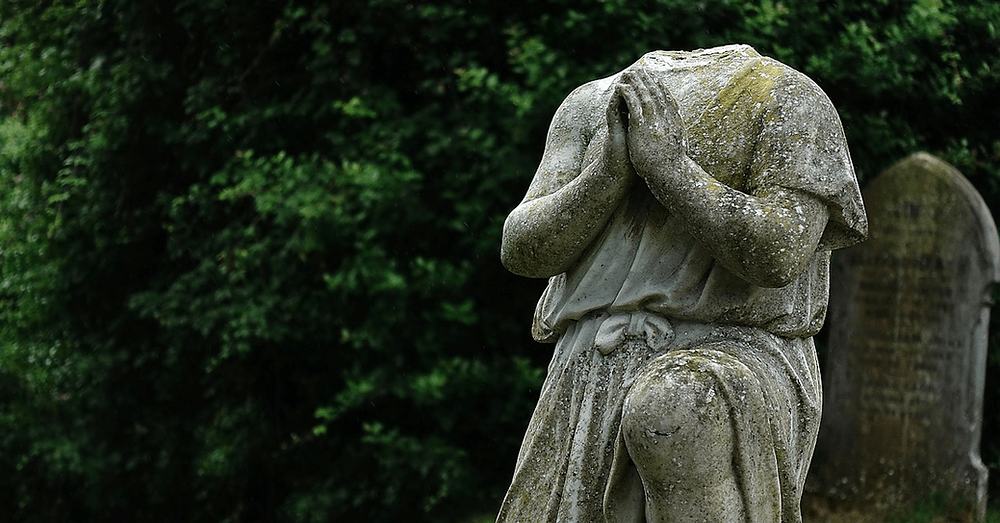
Early Chinese Zen masters referred to the need to ‘chop off one’s head’
Let’s look at a method of self-enquiry called ‘the headless way’, which provides a modern method of approaching awakening. These first-person experiments were developed by the English philosopher and mystic Douglas Harding in his influential book On Having No Head: Zen and the Rediscovery of the Obvious (1961). Harding grew up in a fundamentalist Christian sect in which he wasn’t allowed to go to the cinema and the only book he was permitted to read was the Bible. When he left the sect at 21, he was determined to seek the truth for himself and to be his own authority. The approach he developed was unconventional and can be considered a form of radical empiricism.
The key to his method is noticing that you cannot see your own head. Rather than looking out of a head, visually speaking, there is just a gap here. Indeed, early Chinese Zen masters referred to the need to ‘chop off one’s head’. Hui Hai claimed that he could teach nothing as he had no tongue to teach with. The heart sutra, which distils the essence of Zen teaching, states that ‘in emptiness there is no form, no eye, no ear, no nose, no tongue, no body, no mind.’ Zen masters also urge practitioners to recognise their ‘original face’ – another name for one’s true nature.
How does one see their true nature according to Zen? One of the best places to start is with the mysterious figure Bodhidharma, the First Patriarch of Zen, who reputedly brought Buddhism to China from India around the 5th century. A legend about him tells us that he attained enlightenment after sitting for nine years facing a cave wall, and also that he cut off his own eyelids to stop himself from falling asleep. Bodhidharma is attributed with the following verse, which is often thought to express the core of Zen teaching:
A special transmission outside the scriptures,
Not founded upon words and letters;
By pointing directly to one’s mind
It lets one see into one’s own true nature and thus attain Buddhahood.
How exactly does one directly point to one’s mind or true nature? Harding’s ‘pointing experiment’ assists in turning one’s attention within, starting with the exercise of pointing a finger literally to the spot from which you are looking. Note that if these exercises are not carried out, or if they are merely thought about, this article will make no sense. So please do the following:
Point at a distant thing, such as a wall. Notice its shape and colour. It is a thing that is extended in space. It is also opaque. You cannot see through it. Point to the floor. Again, notice the coloured expanse and its textures. Point to your foot. Again, it is a shaped and coloured thing. Point to your chest and notice its colours and shape and the movement from your breathing. Now point to where you are looking from. In your present experience, is there any colour here? Any shape? Any texture? Any movement? Are there any eyes, mouth or cheeks here? Are there any features of a person? Notice that this spot is totally lacking in any personally identifying characteristics. Is there anything at all here? Or is it just a transparent opening?
When I look within, when I turn my attention 180 degrees from objects over there to where I am, I find that I am not a coloured, limited thing in the world, but rather a colourless, unchanging capacity for the world, exactly as described by Zen. Is this the much sought-after ‘void’ that is referred to by contemplative traditions across times and cultures?
When you were an infant, you did not recognise that face in the mirror as your own. It was just a baby behind some glass
A well-known story in Zen is of Tung-Shan’s awakening, in the 9th century, which also shows intriguing parallels with Harding’s observations. Once, as a child, Tung-Shan was reading the heart sutra with his tutor when he came upon the passage ‘no eye, no ear, no nose, no tongue, no body, no mind’. He was confused. He used his hands to feel his face and then asked his tutor why the sutra said they didn’t exist. His tutor told Tung-Shan that he could not help him, so Tung-Shan spent many years searching for a worthy master to explain this and other mysteries of the Dharma to him. One day he was crossing a river and saw his face reflected in the water. He saw where his face was in his lived experience, and he instantly had a great awakening.
Zen goes beyond words and letters, so merely thinking about this story would be against the spirit of Zen. To test this out directly in your own experience, please carry out the ‘mirror experiment’:
Look into a mirror. You can now see your human face. Notice where it is. In my experience, it is over there, a couple of feet away, not on my shoulders. Is this true for you? It is also facing the wrong way. It is looking in, rather than outwards. How many faces do you see? Two, or just one? Notice the shapes, textures and colours of that little face trapped behind the glass. By contrast, notice the lack of shapes, textures, colours and indeed boundaries to the spot you are looking from.
That face over there is your acquired face. When you were an infant, you did not recognise it as your own. It was just a baby behind some glass. It took many months to learn to identify with that face. You learnt to marry that visual thing over there with the ‘facial’ sensations you feel here, and hence you became boxed in (at least apparently so). Isn’t how you are for yourself – that is, your ‘original face’ – in total contrast to that little face in the mirror? In fact, as lacking any characteristics of its own, isn’t this ‘gap’ seamlessly united with the world? Couldn’t you equally say that your ‘original face’ is the given world itself?
All this might sound a little esoteric, so let’s look at one potential practical benefit of the ‘headless’ practice in the case of personal relationships. We think that we meet each other face-to-face, thing-to-thing. Of course, this is how it looks to others from the outside. But you relate to others from your first-person perspective, not from over there. The lived experience of being with others isn’t in fact of being face-to-face, but rather face-to-no-face. My face never gets in the way of the faces of others – including those you dislike. The ‘space’ you are looking out of has no preferences. It takes on everyone completely, no matter who they are, without judgement. Noticing this is a rather simple and concrete way to see that you are not, in fact, separate from others. In theory, this could provide a basis for true compassion towards others.
One can meditate for many years without seeing their own true nature. Most never do. The precision and apparent reliability of these experiments open up a form of Zen-like awakening to empirical investigation. Yet these techniques have so far received little attention from philosophers and scientists. (I describe these experiments and discuss their relation to Zen more fully in my recent article ‘The Technology of Awakening’.) The results of the experiments suggest that it doesn’t require a lifetime or many lifetimes to see your true nature. You can do so right now. It is simply to see who or what you are at this very moment – that which is seeing these very words.

‘Perverse Preachers, Fascist Fundamentalists and Kristian Kiddie Kooks’: Insane Christian cult video
By Richard Metzger
Source: Dangerous Minds
“He’s a rewarder of those who seek him. Some say God is a punisher, but do you know what we do with child abusers today? We put child abusers in prison if we find out about ‘em. God is not a child abuser! God is a good god. Why don’t you just say that out loud with me right no? God is a good god, you always remember that! God is not gonna do you harm… (pause) There is a judgement coming someday…”
—“Mrs. Hook” from The Christian Pirates cable access show.
History will note that for a short period at the end of the 20th century, there was this “format” called “VHS” (“Video Home System” is what it stood for) that allowed people to do something called “videotaping” “off” their television sets (it didn’t work exactly like that, but it’s, you know, close enough). But what history might neglect to record is that certain things got passed around from hand to hand on this format samizdat style in what was then called the “VHS tape trading underground.” During the mid-1980s to the late 90s, traders and flea market dealers were making pirated copies of things like the banned Rolling Stones movie Cocksucker Blues, Heavy Metal Parking Lot, “Screaming Boy” (lunatic Dallas public access preacher Jonathan Bell, later made famous by The Daily Show), a tape of a groupie blowing out a candle with her pussy for guitarist Steve Vai and “The Great Satan At Large,” a satanic talk show, among hundreds of other things.
One of the most heavily circulated items during the “VHS tape trading underground” days was a synapse-frying excursion straight into the dark heart of the most deeply disturbed, bat-shit crazy 80s TV evangelism titled “Perverse Preachers, Fascist Fundamentalists and Kristian Kiddie Kooks.” When the tape began making the rounds in the early 90s, the jaw-dropping selection of low IQ buffoonery, superstitious insanity and wildly inappropriate kiddie shows made by people who should NEVER BE LEFT ALONE UNSUPERVISED WITH YOUNG CHILDREN was the centerpiece of many a weed and alcohol-fuelled viewing fest.
An unnamed Internet reviewer said this of “Perverse Preachers, Fascist Fundamentalists and Kristian Kiddie Kooks”:
Americans: See why the rest of the world thinks we’re a bunch of blithering idiots!
Rest of the world: See why Americans are a bunch of blithering idiots!
That pretty much sums it up in a nutshell.
One of the more perplexing things on exhibit in “Perverse Preachers, Fascist Fundamentalists and Kristian Kiddie Kooks” is the clips from the no budget “Christian Pirates” cable access show where godless children are forced to “walk the plank” by one-legged Captain Hook and they sing songs about hoping that Satan gets paralyzed and has to use a wheelchair. There’s Jimmy Swaggart’s tearful confession of whore mongering (a masterclass in fleecing the faithful with the “I have sinned” ploy). A Jim and Tammy Faye Bakker press conference. There’s a lot of asking for money, natch, some racist Bible prophecy, preaching against something one of them calls “Marxism” and a “joyous” man with hands growing from his shoulders who, er, counts his blessings. It’s not just Christianity that takes a beating here. New Age beliefs are lampooned and there’s even an appearance by Queen Uriel from the nutty Unarius Academy of Science.
“Perverse Preachers, Fascist Fundamentalists and Kristian Kiddie Kooks” was produced by a Boston-based zine called Zontar. It came with an attached pamphlet that you can see reproduced here. Aside from being a masterpiece of video folk art (YES, this should preserved and elevated to museum status) it’s one of the single best things ever to get stoned and watch. I guarantee you’ll be blown away by “Perverse Preachers, Fascist Fundamentalists and Kristian Kiddie Kooks” (and if you’re not, you’ll be issued a full refund…)
BONUS VIDEO: Disgraced—but still currently raking it in like a gangsta on BET—TV evangelist Robert Tilton in the infamous “Pastor Gas” video that has made the rounds on the Internet since the first days of MySpace. My VHS copy of “Perverse Preachers, Fascist Fundamentalists and Kristian Kiddie Kooks” included this:

By John W. Whitehead & Nisha Whitehead
Source: The Rutherford Institute
“The illusion of freedom will continue as long as it’s profitable to continue the illusion. At the point where the illusion becomes too expensive to maintain, they will just take down the scenery, they will pull back the curtains, they will move the tables and chairs out of the way and you will see the brick wall at the back of the theater.”—Frank Zappa
We are no longer free.
We are living in a world carefully crafted to resemble a representative democracy, but it’s an illusion.
We think we have the freedom to elect our leaders, but we’re only allowed to participate in the reassurance ritual of voting. There can be no true electoral choice or real representation when we’re limited in our options to one of two candidates culled from two parties that both march in lockstep with the Deep State and answer to an oligarchic elite.
We think we have freedom of speech, but we’re only as free to speak as the government and its corporate partners allow.
We think we have the right to freely exercise our religious beliefs, but those rights are quickly overruled if and when they conflict with the government’s priorities, whether it’s COVID-19 mandates or societal values about gender equality, sex and marriage.
We think we have the freedom to go where we want and move about freely, but at every turn, we’re hemmed in by laws, fines and penalties that regulate and restrict our autonomy, and surveillance cameras that monitor our movements. Punitive programs strip citizens of their passports and right to travel over unpaid taxes.
We think we have property interests in our homes and our bodies, but there can be no such freedom when the government can seize your property, raid your home, and dictate what you do with your bodies.
We think we have the freedom to defend ourselves against outside threats, but there is no right to self-defense against militarized police who are authorized to probe, poke, pinch, taser, search, seize, strip and generally manhandle anyone they see fit in almost any circumstance, and granted immunity from accountability with the general blessing of the courts. Certainly, there can be no right to gun ownership in the face of red flag gun laws which allow the police to remove guns from people merely suspected of being threats.
We think we have the right to an assumption of innocence until we are proven guilty, but that burden of proof has been turned on its head by a surveillance state that renders us all suspects and overcriminalization which renders us all lawbreakers. Police-run facial recognition software that mistakenly labels law-abiding citizens as criminals. A social credit system (similar to China’s) that rewards behavior deemed “acceptable” and punishes behavior the government and its corporate allies find offensive, illegal or inappropriate.
We think we have the right to due process, but that assurance of justice has been stripped of its power by a judicial system hardwired to act as judge, jury and jailer, leaving us with little recourse for appeal. A perfect example of this rush to judgment can be found in the proliferation of profit-driven speed and red light cameras that do little for safety while padding the pockets of government agencies.
We have been saddled with a government that pays lip service to the nation’s freedom principles while working overtime to shred the Constitution.
By gradually whittling away at our freedoms—free speech, assembly, due process, privacy, etc.—the government has, in effect, liberated itself from its contractual agreement to respect the constitutional rights of the citizenry while resetting the calendar back to a time when we had no Bill of Rights to protect us from the long arm of the government.
Aided and abetted by the legislatures, the courts and Corporate America, the government has been busily rewriting the contract (a.k.a. the Constitution) that establishes the citizenry as the masters and agents of the government as the servants.
We are now only as good as we are useful, and our usefulness is calculated on an economic scale by how much we are worth—in terms of profit and resale value—to our “owners.”
Under the new terms of this revised, one-sided agreement, the government and its many operatives have all the privileges and rights and “we the people” have none.
Only in our case, sold on the idea that safety, security and material comforts are preferable to freedom, we’ve allowed the government to pave over the Constitution in order to erect a concentration camp.
The problem with these devil’s bargains, however, is that there is always a catch, always a price to pay for whatever it is we valued so highly as to barter away our most precious possessions.
We’ve bartered away our right to self-governance, self-defense, privacy, autonomy and that most important right of all: the right to tell the government to “leave me the hell alone.” In exchange for the promise of safe streets, safe schools, blight-free neighborhoods, lower taxes, lower crime rates, and readily accessible technology, health care, water, food and power, we’ve opened the door to militarized police, government surveillance, asset forfeiture, school zero tolerance policies, license plate readers, red light cameras, SWAT team raids, health care mandates, overcriminalization and government corruption.
In the end, such bargains always turn sour.
We asked our lawmakers to be tough on crime, and we’ve been saddled with an abundance of laws that criminalize almost every aspect of our lives. So far, we’re up to 4500 criminal laws and 300,000 criminal regulations that result in average Americans unknowingly engaging in criminal acts at least three times a day. For instance, the family of an 11-year-old girl was issued a $535 fine for violating the Federal Migratory Bird Act after the young girl rescued a baby woodpecker from predatory cats.
We wanted criminals taken off the streets, and we didn’t want to have to pay for their incarceration. What we’ve gotten is a nation that boasts the highest incarceration rate in the world, with more than 2.3 million people locked up, many of them doing time for relatively minor, nonviolent crimes, and a private prison industry fueling the drive for more inmates, who are forced to provide corporations with cheap labor.
We wanted law enforcement agencies to have the necessary resources to fight the nation’s wars on terror, crime and drugs. What we got instead were militarized police decked out with M-16 rifles, grenade launchers, silencers, battle tanks and hollow point bullets—gear designed for the battlefield, more than 80,000 SWAT team raids carried out every year (many for routine police tasks, resulting in losses of life and property), and profit-driven schemes that add to the government’s largesse such as asset forfeiture, where police seize property from “suspected criminals.”
We fell for the government’s promise of safer roads, only to find ourselves caught in a tangle of profit-driven red-light cameras, which ticket unsuspecting drivers in the so-called name of road safety while ostensibly fattening the coffers of local and state governments. Despite widespread public opposition, corruption and systemic malfunctions, these cameras are particularly popular with municipalities, which look to them as an easy means of extra cash. Building on the profit-incentive schemes, the cameras’ manufacturers are also pushing speed cameras and school bus cameras, both of which result in hefty fines for violators who speed or try to go around school buses.
We’re being subjected to the oldest con game in the books, the magician’s sleight of hand that keeps you focused on the shell game in front of you while your wallet is being picked clean by ruffians in your midst.
This is how tyranny rises and freedom falls.
With every new law enacted by federal and state legislatures, every new ruling handed down by government courts, and every new military weapon, invasive tactic and egregious protocol employed by government agents, “we the people” are being reminded that we possess no rights except for that which the government grants on an as-needed basis.
Indeed, there are chilling parallels between the authoritarian prison that is life in the American police state and The Prisoner, a dystopian television series that first broadcast in Great Britain more than 50 years ago.
The series centers around a British secret agent (played by Patrick McGoohan) who finds himself imprisoned, monitored by militarized drones, and interrogated in a mysterious, self-contained, cosmopolitan, seemingly idyllic retirement community known only as The Village. While luxurious and resort-like, the Village is a virtual prison disguised as a seaside paradise: its inhabitants have no true freedom, they cannot leave the Village, they are under constant surveillance, their movements are tracked by surveillance drones, and they are stripped of their individuality and identified only by numbers.
Much like the American Police State, The Prisoner’s Village gives the illusion of freedom while functioning all the while like a prison: controlled, watchful, inflexible, punitive, deadly and inescapable.
Described as “an allegory of the individual, aiming to find peace and freedom in a dystopia masquerading as a utopia,” The Prisoner is a chilling lesson about how difficult it is to gain one’s freedom in a society in which prison walls are disguised within the trappings of technological and scientific progress, national security and so-called democracy.
Perhaps the best visual debate ever on individuality and freedom, The Prisoner confronted societal themes that are still relevant today: the rise of a police state, the freedom of the individual, round-the-clock surveillance, the corruption of government, totalitarianism, weaponization, group think, mass marketing, and the tendency of mankind to meekly accept his lot in life as a prisoner in a prison of his own making.
The Prisoner is an operations manual for how you condition a populace to life as prisoners in a police state: by brainwashing them into believing they are free so that they will march in lockstep with the state and be incapable of recognizing the prison walls that surround them.
We can no longer maintain the illusion of freedom.
As I make clear in my book Battlefield America: The War on the American People and in its fictional counterpart The Erik Blair Diaries, “we the people” have become “we the prisoners.”
By Charles Hugh Smith
Source: Of Two Minds
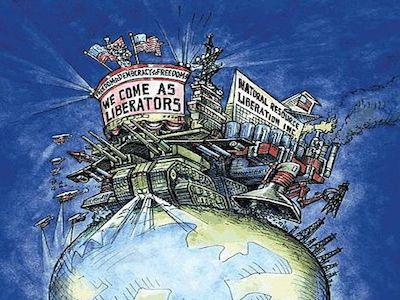
From a systems perspective, nation-states and empires arise when they are superior solutions to security compared to whatever arrangement they replace: feudalism, warlords, tribal confederations, etc.
States and empires fail when they are no longer the solution, they are the problem. As the book The Upside of Down: Catastrophe, Creativity, and the Renewal of Civilization explains, when the dissolution of the state / empire becomes the pain-reducing solution, the inhabitants withdraw their support and the empire loses its grip and expires.
As I explain in my new book, Global Crisis, National Renewal, states and markets are problem-solving structures. These structures solve problems by optimizing adaptability and beneficial synergies that reinforce one another as evolutionary advances.
The rise of the middle class is an example of beneficial synergies: as this new class gains access to credit, expertise, trade, enterprise and pricing power for their labor, they have the means to transform their labor into capital by saving earnings and investing the capital in assets, new enterprises, etc. which then generate income from capital which fuels synergistic increases in credit, expertise, assets and income from investments.
States / empires fail and expire when they elevate the fatal synergies created by self-serving elites. Rather than encourage the dynamics of adaptation–competition, transparency, accountability, experimentation and dissent– the elites suppresses these forces as threats to their monopolies, cartels and wealth.
Stripped of adaptability and beneficial synergies, the state / empire is no longer able to solve problems. It becomes the problem which cannot be resolved.
A key dynamic fueling fatal synergies is the hubristic confidence that low-cost abundance is a birthright bestowed by the state /empire, so resources can be endlessly squandered on excess and extremes of consumption and waste. The state / empire no longer focuses on securing the material sources of security (food, energy, etc.) or the accountability, competition, dissent and transparency required to solve systemic problems.
Instead, the state / empire dissolves into divisive camps seeking to protect their petty fiefdoms and expanding their wealth at the expense of the populace. The super-wealthy build $500 million yachts and palaces, politicians trade on their positions to accumulate fortunes, and corruption replaces governance.
Markets spiral into fatal synergies as low quality products and services, speculative excess, extremes of grotesque consumption and blood-soaked entertainment become “growth industries” while blackouts dim electrical grids and store shelves empty of essentials.
The market solution to everyone already owning everything is to engineer planned obsolescence into every product and form service-sector cartels that then strip services to the bone to juice profits, a.k.a. the crapification of all goods and services.
The state / empire also fails to maintain basic security and functions such as tax collection and a fair enforcement. Petty crimes are exploited by those in power (civil forfeiture) while resistance to the state is severely punished. There are two legal systems, one for the commoners and another for the elite.
The state / empire protects those profiting from the status quo and then calls this profiteering a “solution.” But this profiteering doesn’t solve any problems; it is the problem, as self-serving profiteering protects its privileges by corrupting the state, finance and the economy.
For its part, the market seeks to maximize profits in excesses of consumption, predatory lending (student loans), the wholesale destruction of quality by monopolies and cartels and extremes of speculation.Maximizing profits by any means available has no moral foundation; predatory student loans are profitable, obscure medical billing is profitable, selling products designed to fail is profitable, declaring software outdated is profitable, deceiving consumers is profitable, and so on, in an endless array of shoddy, unhealthy products, rapacious services, fraudulent overcharges, etc.
Since problems go unresolved, things fall apart and the masses veer into extremes of derangement and magical thinking: fanaticism is substituted for friendship, cults abound, common ground vanishes and all the failures of the system are papered over with Bread and Circuses, free money, gaudy entertainments and lifeless displays of conspicuous consumption that reveal the decay and degradation.
Protecting the few stripmining the system at the expense of the many is not problem-solving. It adds a layer of problems that the state /empire is incapable of resolving. Ossified, sclerotic, self-serving, corrupt, focused on virtue-signaling and the appearance of tackling problems rather than actually solving problems because some sacred cow would lose its privileges and income stream, the state / empire is the problem, not the solution.
When the state / empire loses the ability to recognize and solve core problems of security and fairness, it will be replaced by another arrangement that is more adaptable and adept at solving problems. Artifice, fantasy, magical thinking, excuses and absurd cover stories are not part of problem-solving. Problems can only be solved if reality is faced directly.
When reality is unacceptable because it negatively impacts those stripmining the system for private gain, the state / empire is already on its fatal spiral to collapse.

By Ron Unz
Source: The Unz Review
As an heir to the most famous political family in modern American history, Robert F. Kennedy, Jr. is hardly an obscure individual, and recent events have greatly elevated his national prominence.
Although he had spent most of his career as a highly-successful environmental attorney, during the early 2000s he gradually became involved with the grassroots movement questioning the safety and efficacy of our proliferating vaccines, a cause widely ridiculed or ignored by our national elites but increasingly resonating with many worried families.
Then the sudden Covid epidemic moved public health issues to the absolute center of the political debate, including the highly controversial steps taken to control the disease. For the first time in history, most Americans were suddenly subjected to lockdowns, which imposed severe restrictions upon their freedom of movement and assembly, and although these were originally presented as temporary measures expected to last only a couple of weeks, across much of the country they actually remained in place for a year or longer. Moreover, the permanent solution proposed for the crisis was the largest mass-vaccination drive in world history, with the leading vaccines relying upon a new and relatively untested mRNA biotechnology developed by our profit-hungry pharmaceutical giants, a situation that raised deep suspicions among many citizens.
Given these developments, the once marginal anti-vaxxing movement suddenly exploded onto the national stage, cutting across many existing political, social, and ideological fault-lines and encompassing perhaps 20-30% of America’s population, with Kennedy and his Children’s Health Defense non-profit soon becoming leading champions of these fearful individuals. Despite lacking any media coverage or a promotional advertising campaign, his book The Real Anthony Fauci sold over 500,000 copies by early January, spending two months on the Amazon bestseller list, much of that time at the very top.
The media establishment regards our vaccination drive as an absolutely crucial national priority and is intensely hostile to those who challenge it, so Kennedy soon became one of its leading villains. In mid-December, a team of six journalists and researchers at the Associated Press unleashed a ferocious 4,000 word assault, followed a few weeks later by a similar critique in leftist Counterpunch. But both these pieces attacked Kennedy on rather mundane grounds, claiming that his anti-vaccination arguments were wrong, dangerous, and possibly financially motivated, and neither gained much attention, nor seemed to damage his popular momentum.
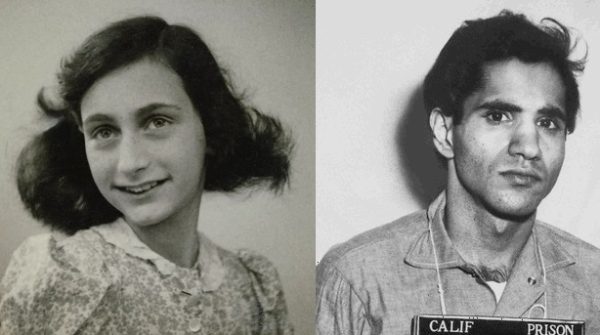
When the media targets an individual, it monitors his every utterance, seeking the slightest opening to vilify him, and last week an opportunity came as Kennedy spoke before a crowd of 30,000 anti-vaxxers at a rally in Washington, DC. Indulging in overly-heated rhetoric, he declared “We have witnessed over the last 20 months a coup d’état against democracy, and the controlled demolition of the United States Constitution and the Bill of Rights.” He further suggested that that government requirements for vaccinations and mandates were imposing “fascism” on our society, with families having nowhere to escape: “Even in Hitler’s Germany, you could cross the Alps to Switzerland. You could hide in an attic like Anne Frank did.”
In our deeply secular society, Nazi Germany has replaced Satan as the epitome of pure evil, while Anne Frank—a Jewish teenager who died of typhus in a German hospital near the end of the war—has been elevated to the status of a sacred martyr. Although drawing such historical analogies is hardly uncommon in political rhetoric, it can sometimes produce angry reactions, especially if these are orchestrated by a hostile media, and Kennedy’s supposedly scandalous references immediately provoked a firestorm of critical coverage, soon leading him to apologize.
With Kennedy’s enemies fanning the flames, his brief reference to the sad fate of a girl who died three generations ago may have received a hundred times more media coverage than the large rally he had headlined or the huge sales of his national bestseller. When the media seeks to destroy someone’s reputation, it will react with hair-trigger reflexes to his slightest misstep.
Yet oddly enough, the same media organs that created a major national controversy out of a few ill-chosen words at a political rally had previously allowed certain of Kennedy’s other, seemingly far greater vulnerabilities to pass almost entirely unnoticed.
These days being labeled a “conspiracy theorist” is a particularly serious charge, with the slur suggesting dangerous mental illness, and surely stigmatizing Kennedy in such a manner would have been an ideal means of discrediting him. But although the author had publicly proclaimed himself a conspiracy theorist of the most explicit sort last month, almost all our hostile journalists carefully averted their eyes.
In the 1960s the conspiratorial term of abuse was first applied to those who challenged the official story that President Kennedy had died at the hands of a deranged lone gunman, and was later broadened to include the many other assassinations that soon followed, including that of the president’s own brother. And on December 8th, nearly the entire Forum page of the San Francisco Chronicle was filled by a Kennedy column arguing that his father Sen. Robert F. Kennedy had been slain by a group of secret conspirators, with the convicted gunman merely being an innocent patsy who should finally be released from prison.
Yet although Kennedy’s legion of media critics attacked him on almost all other grounds, fair or unfair, they carefully avoided that seemingly easy means of branding him as delusional. The long AP attack that ran a week later mentioned not a word, nor did the January Counterpunch piece. As a consequence, I doubt whether more than a tiny slice of the public is aware that Kennedy is a “conspiracy theorist.”
The obvious reason for this strange media reticence was that Kennedy’s position was very solidly grounded in hard factual evidence. In 2018 I drew upon some of the material in David Talbot’s widely-praised 2008 book Brothers to describe the strange aspects of the assassination.
If the first two dozen pages of the Talbot book completely overturned my understanding of the JFK assassination, I found the closing section almost equally shocking. With the Vietnam War as a political millstone about his neck, President Johnson decided not to seek reelection in 1968, opening the door to a last minute entry into the Democratic race by Robert Kennedy, who overcame considerable odds to win some important primaries. Then on June 4, 1968, he carried gigantic winner-take-all California, placing him on an easy path to the nomination and the presidency itself, at which point he would finally be in a position to fully investigate his brother’s assassination. But minutes after his victory speech, he was shot and fatally wounded, allegedly by another lone gunman, this time a disoriented Palestinian immigrant named Sirhan Sirhan, supposedly outraged over Kennedy’s pro-Israel public positions, although these were no different than those expressed by most other political candidates in America.
All this was well known to me. However, I had not known that powder burns later proved that the fatal bullet had been fired directly behind Kennedy’s head from a distance of three inches or less although Sirhan was standing several feet in front of him. Furthermore, eyewitness testimony and acoustic evidence indicated that at least twelve bullets were fired although Sirhan’s revolver could hold only eight, and a combination of these factors led longtime LA Coroner Dr. Thomas Naguchi, who conducted the autopsy, to claim in his 1983 memoir that there was likely a second gunman. Meanwhile, eyewitnesses also reported seeing a security guard with his gun drawn standing immediately behind Kennedy during the attack, and that individual happened to have a deep political hatred of the Kennedys. The police investigators seemed uninterested in these highly suspicious elements, none of which came to light during the trial. With two Kennedy brothers now dead, neither any surviving members of the family nor most of their allies and retainers had any desire to investigate the details of this latest assassination, and in a number of cases they soon moved overseas, abandoning the country entirely. JFK’s widow Jackie confided in friends that she was terrified for the lives of her children, and quickly married Aristotle Onassis, a Greek billionaire, whom she felt would be able to protect them.
Over the years, the 1968 Robert Kennedy assassination has attracted merely a sliver of the books and research devoted to the earlier killing of his elder brother in Dallas, and Talbot’s text spent only a few pages sketching out the strong evidence that the convicted gunman was merely an innocent dupe, manipulated by the true conspirators. But in 2018, two additional books appeared that were entirely focused on the case.
A Lie Too Big To Fail by longtime journalist and conspiracy researcher Lisa Pease ran 500 pages and covered the events of that fatal California evening in exhaustive detail, winning the endorsements of filmmaker Oliver Stone and renowned JFK researcher James W. Douglass. When I read it a few months ago, I found the huge volume of material quite useful but felt that it relied too heavily upon the recollections of eyewitnesses, which can easily grow attenuated over the decades. I was also disturbed to note that the text sometimes seemed to gradually transform reasonable suspicions into apparent certainties, eventually arguing that 3-4 different gunmen were probably firing at the presidential candidate that evening while Sirhan’s own gun had held only blanks.
At the very end, the author also veered off into building castles in the air with regard to other assassinations, arguing that Oswald probably had multiple personalities and that Jack Ruby was operating under a post-hypnotic suggestion, thinly documented claims that seriously weakened her credibility, as did her earlier suggestion that John Lennon had been killed by a government-programmed assassin in 1980 for his past criticism of the Vietnam War. Sometimes less is better, and I think that Pease’s book would have been much stronger if it had been heavily edited and substantially cut. All those extraneous elements should have been left on the cutting-room floor rather than distracting from the central evidence she provided regarding the existence of an RFK assassination conspiracy and Sirhan’s likely innocence.
Meanwhile, The Assassination of Robert F. Kennedy by Tim Tate and the Brad Johnson was released that same year and suffered from none of these flaws. The two conspiracy researchers had spent some 25 years heavily involved in the case, and although their volume was only around half the length of the Pease book, it seemed a far more effective treatment of the topic, including eyewitness accounts but focused primarily upon the undeniable physical and forensic evidence while avoiding any damaging bouts of unwarranted speculation.
While working at CNN, one of the authors had originally obtained the audiotape establishing the number of shots fired, which probably constitutes the single strongest piece of evidence in the case. The book analyzed and evaluated that crucial item in tremendous detail, and also focused upon the fatal shot, which was fired at point-blank range from behind the candidate while Sirhan, the supposed gunman, was standing several feet in front. But since both the publisher and the lead author were British, the work seems to have received much less attention in this country, and I only discovered and read it after Kennedy cited it in his SF Chronicle column.
Unlike many other controversial American killings or terrorist attacks, the powerful evidence of a conspiracy in the case of the RFK assassination was physical and seemingly undeniable. Wikipedia is notoriously reluctant to promote conspiratorial narratives, but in this case the striking facts are presented with only rather weak challenges.
The conclusive proof from the audio recording only came to light in 2004, but I was surprised to discover that all the other strong evidence, including the large number of unexplained bullet holes, had already been known and reported for decades.
Former Congressman Allard K. Lowenstein had been heavily involved in the 1968 election campaign, playing a major role in the effort to unseat incumbent President Lyndon Johnson. In 1977 he published a long cover-story in the influential Saturday Review, setting forth the overwhelming evidence that a second gunman had been involved in the shooting, and my content-archiving system provides a convenient PDF copy. So nearly all the crucial facts in the case have been known for 45 years, but were almost always ignored by our dishonest or cowardly American media.
Three years after publicly revealing that explosive information, Lowenstein himself was dead, supposedly shot at the age of 51 by a deranged lone gunman who had been a former student of his, but I have been informed that his personal friends never believed that story.
Given this massive preponderance of evidence, we can easily understand why the harsh media attacks upon Kennedy had so carefully avoided mentioning his conspiratorial beliefs regarding his father’s assassination. Such criticism would have merely brought the issue to wider public attention, and anyone who began looking into the matter would have quickly concluded that Kennedy was probably correct while our media had spent a half-century covering up the true facts of the 1968 assassination. And if Kennedy were telling the truth and the media lying, many people would begin to wonder if the same might also be true on the vaxxing issue.
Over the last couple of months, I have noted that this pattern of media reticence has been even more pronounced with regard to the actual contents of Kennedy’s landmark book. Perhaps one might argue that his statements about the death of his father were personal matters exempt from media scrutiny, or even that the details of a particular assassination so many decades ago had no relevance to his vaxxing arguments. But it seemed utterly bizarre that all of the harsh attacks on his book had carefully avoided mentioning its major theme.
I had opened Kennedy’s book assuming that it would focus almost entirely on the vaccination issues with which the author had long been identified. Yet I soon discovered that nearly half the text—some 200 pages—was instead devoted to the disease of AIDS, an entirely different topic, and that the claims he made were absolutely incendiary. As I wrote in December:
Yet according to the information provided in Kennedy’s #1 Amazon bestseller, this well-known and solidly-established picture, which I had never seriously questioned, is almost entirely false and fraudulent, essentially amounting to a medical media hoax. Instead of being responsible for AIDS, the HIV virus is probably harmless and had nothing to do with the disease. But when individuals were found to be infected with HIV, they were subjected to the early, extremely lucrative AIDS drugs, which were actually lethal and often killed them. The earliest AIDS cases had mostly been caused by very heavy use of particular illegal drugs, and the HIV virus had been misdiagnosed as being responsible. But since Fauci and the profit-hungry drug companies soon built enormous empires upon that misdiagnosis, for more than 35 years they have fought very hard to maintain and protect it, exerting all their influence to suppress the truth in the media while destroying the careers of any honest researchers who challenged that fraud. Meanwhile, AIDS in Africa was something entirely different, probably caused mostly by malnutrition or other local conditions.
I found Kennedy’s account as shocking as anything I have ever encountered.
In 1985 AZT, an existing drug, was found to kill the HIV virus in laboratory tests. Fauci then made tremendous efforts to speed it through clinical trials as an appropriate treatment for healthy, HIV-positive individuals, with FDA approval finally coming in 1987, producing Fauci’s first moment of triumph. Priced at $10,000/year per patient, AZT was one of the most expensive drugs in history, and with the cost covered by health insurance and government subsidies, it produced an unprecedented financial windfall for its manufacturer.
Kennedy devotes an entire chapter to the story of AZT, and the tale he tells is something out of Kafka or perhaps Monty Python. Apparently, Fauci had been under enormous pressure to produce medical breakthroughs justifying his large budget, so he manipulated the AZT trials to conceal the extremely toxic nature of the drug, which rapidly killed many of the patients who received it, with their symptoms being ascribed to AIDS. So following FDA approval in 1987, hundreds of thousands of perfectly healthy individuals found to be infected with HIV were placed on a regimen of AZT, and the large number of resulting deaths was misattributed to the virus rather than to the anti-viral drug. According to the scientific experts cited in the book, the vast majority of post-1987 “AIDS deaths” were actually due to AZT.
Prior to the Covid outbreak, AIDS had spent almost four decades as the world’s highest-profile disease, absorbing perhaps a couple of trillion dollars of funding and becoming the central focus of an army of scientists and medical experts. It simply boggles the mind for someone to suggest that HIV/AIDS might have largely been a hoax, and that the vast majority of deaths were not from the illness but from the drugs taken to treat it.
My science textbooks sometimes mentioned that during the benighted 18th century, leading Western physicians treated all manner of ailments with bleeding, a quack practice that regularly caused the deaths of their patients, with our own George Washington often numbered among the victims. Indeed, some have argued that for several centuries prior to modern times, standard medical treatments inadvertently took far more lives than they saved, and those too poor or backward to consult a doctor probably benefited from that lack. But I had never dreamed that this same situation might have occurred during the most recent decades of our modern scientific age.
Since the 1980s AIDS has been an explosive topic in the public sphere, and anyone—whether scientist or layman—who questioned the orthodox narrative was viciously denounced as having blood on his hands. During the early 2000s South African President Thabo Mbeki had cautiously raised such possibilities and was massively vilified by the international media and the academic community. Yet when Kennedy’s #1 Amazon bestseller went much farther, devoting seven full chapters to making the case that HIV/AIDS was merely a medical hoax, his media antagonists carefully avoided that subject even while they attacked him on all other grounds.
Once again, the only plausible explanation is that the hostile journalists and their editors have recognized that Kennedy’s factual evidence was too strong and any such attacks might prove disastrously counter-productive. As far back as the 1990s, a former Harvard professor had publicly declared that the AIDS hoax was as great a scientific scandal as the notorious Lysenko fraud, and if a substantial portion of the American public concluded that AIDS was indeed a medical phantom that had been promoted for 35 years by our gullible and dishonest media, the credibility of the latter on current vaccination issues might be completely annihilated.
It would have been the easiest thing in the world for the media to accurately blast Kennedy as “a conspiracy theorist whose book claims that AIDS is a hoax,” and that simple, short phrase would have immediately dealt a massive body-blow to his public reputation. But many people would then have begun looking into the facts, and once they did so, the tables might have quickly turned, destroying the credibility of his critics. The total silence of the media suggests that they greatly feared that possibility.
The hostile media demanded that Kennedy immediately apologize for his heated words regarding fascism and Anne Frank, and to his credit he quickly did so. But I believe that he now has every right to demand that the same media publicly apologize for having spent the last fifty years concealing the true facts of his father’s assassination from his own family and from the American people. And he and others should also begin demanding that the media and medical establishments apologize for the catastrophic HIV/AIDS disaster they inflicted upon our society, a disaster that probably led to the horrible deaths of hundreds of thousands of perfectly healthy Americans. These two matters carry vastly greater weight than a glancing spoken reference to the events of World War II.
One reason that the remarkable silence surrounding Kennedy’s controversial disclosures was so easily apparent to me is that I have become familiar with that pattern. Over the last several years both media outlets and activist organizations have similarly shied away from the published contents of this website and my own writings, doing their best to avert their eyes from material that was many times more controversial than what they would have eagerly attacked and denounced elsewhere. I have discussed what I call this “Lord Voldemort Effect,” and have described some notable examples in the media.
Many of my own essays have dealt directly with the same controversial topics highlighted in Kennedy’s writings and public statements, and for those so interested in exploring them, they are conveniently grouped together in these categories:
Related Reading:
INDIAN COUNTRY NEWS
"It is the duty of every man, as far as his ability extends, to detect and expose delusion and error"..Thomas Paine
Human in Algorithms
From the Roof Top
I See This
blog of the post capitalist transition.. Read or download the novel here + latest relevant posts
अध्ययन-अनुसन्धानको सार
 After the Crash