LIFE… IN REVERSAL

By Kingsley L. Dennis

Source: Waking Times

‘We must distinguish between real change and fictitious change. The change that comes from without, from externally imposed training and discipline, is fictitious…Real change comes from within, by conscious work intentionally performed by the being himself.’ ~J.G. Bennett 

It is increasingly difficult in these times to speak of ‘non-verifiable’ or unprovable matters, especially concerns of the spirit-consciousness, for too many people are inculcated with fixed beliefs and thinking patterns. This is itself a sign of social conditioning and of a certain ‘management of mind.’ We should not be surprised that this situation is rife throughout our societies and cultures and is becoming increasingly predominant. Social norms are persuading many people to prefer safety and security rather than the potential discomfort that comes from gaining new realizations and understanding.

An ex-officer of the Soviet secret police who defected to the West (Gregory Klimov), revealed that in the fields of Soviet psychological warfare (and social psychology) they utilized the principles of psychoanalysis. In this, they saw the phenomena of evil as a ‘complicated, complex social illness.’ The psychoanalysts within the KGB equated evil with illness, especially an illness of the human psyche. This perspective places demonic actors and events as ‘objective realities;’ i.e., as various forms of illness of ‘psyche and soul.’ As the Russian anthroposophist G.A. Bondarev writes: ‘The devils represents an involved and complex process of degeneracy or retrogression that in the main consists of three parts: sexual deviation, psychic illnesses and some physical deformities of the organism.

The number of humans already afflicted with this degeneration is legion.’1 Bondarev goes on to say that, based on certain social-psychological testing, the greatest degeneracy exists within the so-called elite of the world (as much as 75%). What this points to, concludes Bondarev, is a drastic decline of the human spirit. What it also tells us is that the phenomenon of ‘evil’ does not necessarily need to be personified or projected into certain personages as it represents an illness of the human psyche. We can recognize its presence operating within psychic imbalance and internal disconnect and detachment. And I would concur with Bondarev’s conclusion in that such psychic dis-ease represents an inner disconnect with the transcendental impulse. This disconnect, or splintering, from a sacred source has now come to signify the nature of the reversal that epitomizes much of contemporary life.

It is within this reversal that we see much of the negating, or counter-evolutionary, forces within humanity. And these forces have been dominating much of our everyday lives and continue to do so. I would suggest that it is our individual responsibility to recognize these forces, attempt to comprehend them, and to transform them into impulses that can work for humankind’s evolvement. In this, we need to come to grips with the presence and activity of those aspects that signify a psychic illness, or dis-ease, within life. Such aspects are a feature of existence as much as positive, developmental forces. They all act within the playground of attraction, repulsion, and the expression of energy. The Rosicrucians recognized these forces when they referred to the Deus Inversus – or the ‘Reversed God.’ This nature of reversal works on humanity through the spheres of imbalance and disharmony to counteract civilizational development. The Austrian mystic Rudolf Steiner was aware of the future impact of such forces when he stated that: ‘It is essential that the forces which manifest as evil if they appear at the wrong place must be taken in hand…in such a way that humanity can achieve something with these forces of evil that will be beneficial for the future of the whole of world evolution.’2 In this regard, it is important that the individual becomes aware of the metaphysical realm that lies beyond the threshold of normal, or every day, consciousness.

If we remain unawares to our own forces of spirit-consciousness, then we are more susceptible to the manipulations of such counter-developmental forces. Those readers familiar with my writings will know that I have attempted to draw attention to certain aspects of our consensus reality in order to gain greater clarity about how we may respond to the situation in a constructive way. I stand by what was written in the Gnostic Gospel of Philip: ‘For so long as the root of wickedness is hidden, it is strong. But when it is recognized, it is dissolved. When it is revealed, it perishes.’ Recognition, through heightened awareness and perception, brings more choice into play. The individual needs to be conscious of certain facts before they can manifest the correct intention and focus of will. What is needed is a culture of revelation – of ‘uncovering’ – rather than of cover up. It is through revelation that insight into the metaphysical foundation of life can be sustained within our increasingly materialistic societies. This access to metaphysical realities can never be wholly eradicated. Yet just a cursory glance at modern life indicates that there are attempts to deepen peoples’ immersion into deteriorating forms of dissonance and distraction. This can be seen as a form of reality deceit.

Reality Deceit

The great deceit that is coming upon us is the unveiling of a so-called ‘utopia’ based on the isolation of the human spirit-consciousness. This fake promise is wrapped up in tech-salvationist terms, heralding a false ideal future. The real dis-ease of the human condition is to be in a state of estrangement. That is, estranged and alienated from any metaphysical influence or nourishment. It is not that the metaphysical background to life must necessarily be obvious to us, or tangible in our daily lives – only that we are cognizant of its existence and continual influence. Yet once this sense of recognition (the act of aware cognition) is dissolved, a barren soulless life is the result. And yet, in most circumstances, people will not be cognizant of this loss – this lack of the transcendental impulse in their lives – for they will be entrained into a reality consisting of a physical-digital mesh that keeps them attached to their lower nature and desires. This deceit consists of a most heinous form of enslavement, for it shall both be a willing one as well as an ignorant one. The splintering of the human being from its metaphysical connection shall go almost unnoticed, and the transfer into a reality of limited consciousness will have been enacted quite skillfully. This sly route to a human condition of alienation, procured through the guise of technological advancement and progress, will be a coup against the creative spirit. And this shall be the reversal of the human reality – the reality deceit.

The almost imperceptible dangers are that we have been slipping into a reversed reality, constructed through a realm of fantasy and make-believe, which now fuels the crass and superficial culture industries that dominate modern life. Any notion of Higher Reality has been twisted into an artificial lesser reality that attempts to hinder, as far as is possible, the developmental impulse from penetrating. This arrangement has culminated in dissociating humankind not only from its natural, organic, carbon-based environment, but also from an inherent contact with its origin – Source consciousness. This increasing disembodiment is reflected in such forms as the techno-digital ecosystem, extended reality (the Metaverse), computerization (including algorithms), and artificial intelligence. For many people today, their digital devices have become their instruments of salvation. But this salvation, this divine deliverance, belongs to the Deus Inversus – and we should choose our gods carefully. We should be careful too, not to be pulled into the encroaching banalization of life. And we should be on the look-out for signs and signals.

If anyone wishes to see how ‘signals’ can operate within the reality deceit, then watch all the episodes in the recent Westworld TV series (2016-2022). In Season Four, the machinic android ‘hosts’ have taken control of the world using a bioengineered virus that infects humans over the course of a generation, turning them docile and susceptible to AI and ‘host’ control. Storylines and narratives are created in order to give people their roles and characters in life, which they passively follow believing them to be their own life stories. Humankind is managed through these manufactured ‘storylines’ (a.k.a. socio-cultural narratives) that are transmitted directly to the minds and lives of humans through a series of radio-sonic transmission signals via the global technological infrastructure…But then again, this is just a fantasy story after all.

The course of external events that inform our political, economic, and cultural systems are not arbitrary, coincidental or natural. The modern human has been subtly manipulated into disconnecting from, and even shunning, the guidance of higher impulses. We are being told that the human being alone is the sole and dominant driving force for the future. And by this, we are propelled ever further into the personality construct with the human ego at the wheel. We are standing at the threshold of adopting a glorified materialistic view of life and the world. The spell of this disease is working to over-materialize materialism in a very deliberate and nefarious way. There may be some discomfort in the unfoldment of awareness, yet this is part of the transmutation of the dis-ease.

Life ‘in reversal’ is working hard and fast on this intensifying of materialism. This deepening materialism not only denies the expansion of consciousness but is actively working to stagnate it. At the same time, we are moving through an impulse of increasing individual awareness against the backdrop of this over-materialization. Yet it is an awareness through the few, and not the many (yet). By recognizing that certain forces within the world are using processes of mass suggestion to introduce a simplification – or ‘dumbing down’ – of human consciousness, we can gain greater awareness over our condition and predicament. And in this awareness, we can gain a natural resistance and protection, as recognition allows a discernment to be made. It is this discernment to step away from the negating energies and frequencies of toxicity that can help a person to attune to a resonance of perceptive consciousness. By choosing where we place ourselves – our focus and attention – we can either take a step forward or stay where we are and stagnate. As always, the choice remains with us.

Saturday Matinee: Conquest of the Planet of the Apes

Conquest of the Planet of the Apes: The

Most Violent and Bleak of the Franchise

The fourth Apes movie, Conquest of the Planet of the Apes, showcased Caesar’s controversial and timely fight for freedom.

By Don Kaye

Source: Den of Geek

On June 30, 1972, 20th Century Fox released the fourth film in the original Planet of the Apes cycle, titled Conquest of the Planet of the Apes. It followed up the previous year’s Escape from the Planet of the Apes, the first of the Apes films to deliberately end with the promise of a sequel. In that film, two intelligent chimps from the future, Cornelius (Roddy McDowall) and Zira (Kim Hunter), traveled back to our time only to be brutally slain by the U.S. government over fears that they would plant the seeds for the apes’ eventual domination of humankind. Their baby, however, secretly survived, hidden away by the circus owner Armando (Ricardo Montalban) and already beginning to form words.

As Conquest of the Planet of the Apes opens, Armando and the child ape, now grown and named Caesar (played by McDowall), arrive at an unnamed North American city. The year is 1991 and the U.S. government has turned totalitarian. A virus from space has destroyed all the world’s cats and dogs, leading humans to turn toward apes as first pets and then slaves. When Caesar expresses outrage at the cruel treatment of an ape by police, he’s forced to flee and hide — since he was officially declared dead 20 years earlier and his very existence is a threat to humanity.

Caesar makes his way to the ape training facilities and assimilates himself there, eventually going up for auction — where he is sold to the city’s ape-hating governor Breck (Don Murray) and placed under the command of Breck’s assistant MacDonald (Hari Rhodes), who is sympathetic to the plight of the apes. But when Armando is killed while in the government’s custody, an enraged Caesar begins to plot a revolution — slowly but surely organizing his fellow apes for a violent uprising that will be the first step toward the downfall of the human race.

By the time that Conquest of the Planet of the Apes was in production, Apes producer Arthur P. Jacobs and his studio partner Fox were in truly uncharted territory. Even though Planet of the Apes (1968) was a critical success and a box office smash, sequels at the time were considered quick, disposable vehicles to milk a few more bucks out of the audience. Instead, what Jacobs did — aided by the inspired efforts of screenwriter Paul Dehn — was create an ongoing sci-fi story and intricate future history over the course of his Apes movies, the likes of which had never been attempted before in the genre.

Jacobs, however, was still up against the studio mindset that sequels had to cost less, so by the time he made Conquest the budget for the film was a third of the price of the original Planet of the Apes. He had a meager $1.7 million to visualize the ape revolution that had been discussed in the previous films, economizing by using the brand new Century City high-rise complex in Los Angeles as the exterior of the city of the future — but also skimping on the makeup budget, resulting in some clearly fake-looking ape masks.

Dehn’s third screenplay for the series, following Beneath the Planet of the Apes (1970) and Escape from the Planet of the Apes, was the most explicitly political of the series. The previous Apes films had commented obliquely on race and other social issues, but against the backdrop of ongoing racial tensions in America, Dehn crafted a story that drew directly upon the 1965 Watts riots in Los Angeles for the imagery of his ape revolution. His screenplay was also the most violent of the franchise, initially ending in a bleak standoff that found Caesar ordering the cold-blooded execution of the sadistic Governor Breck and forecasting the complete subjugation of the human race.

To direct, Jacobs hired J. Lee Thompson (Cape Fear, The Guns of Navarone), who had been approached for Planet of the Apes but had to turn it down due to a previous commitment. Thompson was skilled at handling both large-scale action and low budgets, making him uniquely suited to the twin challenges of Conquest. He embraced the themes of Dehn’s screenplay with relish, giving a documentary quality to the third act’s scenes of revolution that was both realistic and unnerving in its ferocity.

As with all the Apes sequels, Conquest of the Planet of the Apes works on a very simplistic and often slapdash logic, a flaw evident in many key scenes of the film (how does Caesar, for example, know to fake being electrocuted? How does female ape Lisa magically acquire the power of speech?).

At the same time, however, Dehn’s screenplay is bolstered in a huge way by McDowall’s performance, perhaps the finest of his four in the series. His makeup similar to but also different from the appliances he wore as Cornelius, the actor makes Caesar’s transformation from frightened youth to fiery revolutionary leader believable and powerful. His climactic speech, in which he prophesizes that humanity will ultimately turn on itself and allow the apes to ascend in its place, is one of Dehn’s best pieces of writing and a haunting high point for the franchise.

That ending, as first conceived, proved controversial. The pitch-black original climax did not play well with test audiences already disturbed by the movie’s intense violence (which Thompson also trimmed to avoid a series-first R rating). With no time left for reshoots, the use of existing takes and dubbed dialogue by McDowall created a more optimistic ending, in which Caesar halts the murder of Breck and decides that it’s time for the apes to lay down their arms and find a way to live in peace with their former captors. While the idea that Caesar takes his first step toward being a true leader and not just a vengeful warrior is a sound one, the re-edited scene is clumsily handled: the timbre of McDowall’s voice is noticeably different on the new lines, and the scene uses just close-ups of his eyes or wide shots of him from a distance so that we can’t see that his mouth is not actually saying the added dialogue.

Conquest of the Planet of the Apes is a powerful film in either version (the original is available on the Blu-ray edition alongside the theatrical cut) and, despite its shortcomings, remains a riveting and frequently chilling entry. In depicting the events that launch the eventual ascendancy of the apes, it also brings the clever circular structure of the entire series dramatically into focus. The series’ 2011 reboot, Rise of the Planet of the Apes, is a loose remake of Conquest (albeit with many different plot elements) and it’s easy to see why: the ape uprising is narratively and emotionally a strong starting point from which to retell this still unique and even eccentric saga. 

Escalation: Recent Events Suggest Mounting Economic Danger

By Brandon Smith

Source: Alt-Market.us

A common refrain from people who are critical of alternative economists is that we have been predicting crisis for so long that “eventually we will be right.” These are generally people who don’t understand the nature of economic decline – It’s like an avalanche that builds over time, then breaks and quickly escalates as it flows down the mountain. What they don’t grasp is that they are in the middle of an economic collapse RIGHT NOW, and they just can’t see it because they have been acclimated to the presence of the snow and cold.

Economic decline is a process that takes many years, and while you might get an event like the market crash of 1929 or the crash of 2008, these moments of panic are nothing more than the wreckage left behind by the great wave of tumbling ice that everyone should have seen coming far in advance, but they refused.

In 2022 the job of warning people is far easier than it used to be because we are well past the midpoint of the process of decline. But, believe it or not, I still get people today who claim that we analysts are “doom mongers.” The power of willful ignorance is truly amazing. It’s enough to make a person blind to stagflationary crisis, supply chain disruptions, quickly inflating prices, stock market carnage, bond market instability, record consumer debt, and international conflict.

At this point, I think if a person can’t see the dangers ahead they are probably a waste of time and space and are destined to be buried in the ice; there’s nothing that can be done for them. Yes, there are some people out there that don’t get exposed to the information and we have to take them into account, but my priority will be people that are awake and aware and try to give them a sense of what point in the collapse process we find ourselves.

In the past month there has been a considerable uptick in economic and geopolitical activity that suggests we are entering a new phase, and not surprisingly it’s all accumulating right before we hit October. Here are the events that I find most concerning:

The European Energy Crisis

This is an event that I have been predicting since the Russian invasion of Ukraine and now it is upon us. I wrote about it extensively in my recent article ‘Europe Is Facing Energy Disaster And It’s Going To Bleed Over Into The US’ so I won’t rehash all that information here. What I do want to point out is the complete lack of planning on the part of European officials to deal with the threat. It is as if they WANT a full spectrum disaster.

Russia has now completely cut off natural gas supplies to Europe, which represent around 40% of all EU energy resources. Europe’s benchmark natural gas prices spiked by 28% a week ago, on top of already existing inflation. Oil supplies are also in steep decline for Europe and the EU government has pledged to cut what’s left of Russian oil imports by sea at the end of the year. Sadly, they have offered very little in the way of solutions to the supply-side problem.

There has been talk of increasing imports of alternative resources from other nations, but the EU is already buying up around 75% of all liquid natural gas from the US. OPEC oil producers have indicated they will not be attempting to increase production anytime soon (probably because they can’t due to inflation in operation costs). There is NO backup energy resource for Europe; it doesn’t exist right now. They will try to buy up whatever coal, oil and gas they can find on the market while driving up prices even more for other countries. They will still come up short, which means people are going to freeze this winter.

Best case scenario is that there are mostly mild temps and people barely scrape buy with minimum heating. But EU industry is going to suffer and many manufacturers are going to cut production (which mean more stress on the global supply chain).

Core Inflation Is Still Rising

As I warned last week in my article ‘It’s A Fact That Needs Repeating: The Federal Reserve Is A Suicide Bomber,’ inflation is continuing to rise despite the Fed’s continued interest rate hikes, giving the central bank even more ammunition to justify higher rates into extreme economic weakness.

The latest CPI print showed an increase to 8.3% and was a shock to markets which universally expected a drop. This is the nature of stagflation – Even with falling demand prices continue to climb or remain high for extended periods. The stagflation event of the 1970s lasted for a decade until the Fed jacked rates to 21% and then employment crumbled in the early 1980s.

This doesn’t mean that rates will go to 21% this time; they don’t need to. All it would take is a Federal Funds Rate of around 4% – 5% to crash our current QE addicted system. A 75 bps rate hike is now widely expected at the next Fed meeting this month, with some predicting a 100 bps hike. This would put us close to crash territory for markets and for employment, though I think we still have well into 2023 before unemployment really starts to spike.

Putin’s Meeting With Xi

As I write this, Vladimir Putin is set to meet with China’s Xi Jinping and the nature of the conference is not clear. There are the obvious points of agreement such as China’s continued purchases of Russian oil and other commodities, as well as the ongoing plan to build a pipeline to China by 2025. There is also strategic cooperation which is evident in the recent naval exercises between the two nations around Japan and Taiwan.

The timing of the meeting is concerning to me, because the prime season for a potential Chinese invasion of Taiwan is fast approaching (October is the best month for naval movements to avoid typhoons). China would not necessarily need to commit to a ground invasion, either. They could simply cut off all import/export trade from any source other than China and starve Taiwan until they accept unification.

There is also the issue of Ukraine and arms sales. With the amount of propaganda coming from Ukrainian Intelligence and NATO, it’s hard to say what is actually happening, but I suspect Russia is changing strategies and repositioning to deploy missile and artillery bombardment of infrastructure, including power grids and water. This is a tactic that Russia has avoided for months (until this week), which is surprising because one of the first measures usually taken by the US during an invasion is to eliminate most key infrastructure (as we did in Iraq). You would think Russia would have done the same, but perhaps they were saving that scenario for winter when it is harder for Ukraine to cope.

This would make Ukraine essentially unlivable in the coming winter for most of the population. Putin may be seeking to ensure China remains a steady economic partner should geopolitical pressures increase. They may even be making a deal of mutual support: China takes Taiwan while Russia makes Ukraine a resource wasteland and they each support the other economically when NATO counties try to impose sanctions on China. We probably won’t know until October, but the timing of the meeting should raise eyebrows.

If the manure is about to hit the fan in Taiwan along with Ukraine, then diplomatic and economic ties will be severed and western access to China’s manufacturing will be cut. This is a problem for China’s economy, certainly, which may be why they have continued their mass covid lockdowns well after every other government has abandoned them. Could this be practice for civil controls in an impending war environment?

China’s global dominance in imports/exports gives them considerable economic leverage in trade, however. Many nations would not support sanctions against them. Also, their vast holdings of US dollars and Treasuries could be used as a weapon to damage or destroy the dollar’s world reserve status. If China invades Taiwan this year, then all bets are off – The economic decline will move swiftly from that point on.

There are many other trends which factor into the crash environment but the above factors are the most recent and hold the biggest potential for causing a domino effect globally. The question that always arises is “what can we do about it?” Not much in terms of prevention. What we can do, though, is prepare locally to weather the storm. This means stocking necessities before they rise even further in price or become non-existent. Become a producer and learn a valuable skill for survival in a depleted economy Organize with people locally who are on the same page to create security and alternative trade opportunities.

Hopefully, the aware citizenry will rise to the challenge and organization will be extensive, because the worst case scenario would be great masses of completely isolated people all vying against each other rather than working towards mutual security. Even in a slow collapse scenario this is a problem in terms of rising crime; so plan on working with others if you want to avoid inevitable third world conditions.

Silencing the Lambs — How Propaganda Works

Leni Riefenstahl said her epic films glorifying the Nazis depended on a “submissive void” in the German public. This is how propaganda is done.

By John Pilger

Source: Consortium News

In the 1970s, I met one of Hitler’s leading propagandists, Leni Riefenstahl, whose epic films glorified the Nazis. We happened to be staying at the same lodge in Kenya, where she was on a photography assignment, having escaped the fate of other friends of the Fuhrer.
She told me that the “patriotic messages” of her films were dependent not on “orders from above” but on what she called the “submissive void” of the German public.

Did that include the liberal, educated bourgeoisie? I asked.  “Yes, especially them,” she said. 

I think of this as I look around at the propaganda now consuming Western societies. 

Of course, we are very different from Germany in the 1930s. We live in information societies. We are globalists. We have never been more aware, more in touch, better connected. 

Or do we in the West live in a Media Society where brainwashing is insidious and relentless, and perception is filtered according to the needs and lies of state and corporate power? 

The United States dominates the Western world’s media. All but one of the top 10 media companies are based in North America. The internet and social media – Google, Twitter, Facebook – are mostly American owned and controlled.

In my lifetime, the United States has overthrown or attempted to overthrow more than 50 governments, mostly democracies. It has interfered in democratic elections in 30 countries. It has dropped bombs on the people of 30 countries, most of them poor and defenceless. It has attempted to murder the leaders of 50 countries.  It has fought to suppress liberation movements in 20 countries. 

The extent and scale of this carnage is largely unreported, unrecognised, and those responsible continue to dominate Anglo-American political life.

Harold Pinter Broke the Silence

In the years before he died in 2008, the playwright Harold Pinter made two extraordinary speeches, which broke a silence.

“U.S. foreign policy,” he said, is

“best defined as follows: kiss my arse or I’ll kick your head in. It is as simple and as crude as that. What is interesting about it is that it’s so incredibly successful. It possesses the structures of disinformation, use of rhetoric, distortion of language, which are very persuasive, but are actually a pack of lies. It is very successful propaganda. They have the money, they have the technology, they have all the means to get away with it, and they do.”

In accepting the Nobel Prize for Literature, Pinter said this: 

“The crimes of the United States have been systematic, constant, vicious, remorseless, but very few people have actually talked about them. You have to hand it to America. It has exercised a quite clinical manipulation of power worldwide while masquerading as a force for universal good. It’s a brilliant, even witty, highly successful act of hypnosis.”

Pinter was a friend of mine and possibly the last great political sage – that is, before dissenting politics were gentrified. I asked him if the “hypnosis” he referred to was the “submissive void” described by Leni Riefenstahl. 

“It’s the same,” he replied. “It means the brainwashing is so thorough we are programmed to swallow a pack of lies. If we don’t recognise propaganda, we may accept it as normal and believe it. That’s the submissive void.”

In our systems of corporate democracy, war is an economic necessity, the perfect marriage of public subsidy and private profit: socialism for the rich, capitalism for the poor. The day after 9/11 the stock prices of the war industry soared. More bloodshed was coming, which is great for business.

Today, the most profitable wars have their own brand. They are called “forever wars” — Afghanistan, Palestine, Iraq, Libya, Yemen and now Ukraine. All are based on a pack of lies.

Iraq is the most infamous, with its weapons of mass destruction that didn’t exist. NATO’s destruction of Libya in 2011 was justified by a massacre in Benghazi that didn’t happen. Afghanistan was a convenient revenge war for 9/11, which had nothing to do with the people of Afghanistan. 

Today, the news from Afghanistan is how evil the Taliban are —not that U.S. President Joe Biden’s theft of $7 billion of the country’s bank reserves is causing widespread suffering. Recently, National Public Radio in Washington devoted two hours to Afghanistan — and 30 seconds to its starving people.

At its summit in Madrid in June, NATO, which is controlled by the United States, adopted a strategy document that militarises the European continent, and escalates the prospect of war with Russia and China. It proposes “multi domain warfighting against nuclear-armed peer-competitor.” In other words, nuclear war.

It says: “NATO’s enlargement has been an historic success.” 

I read that in disbelief. 

The news from the war in Ukraine is mostly not news, but a one-sided litany of jingoism, distortion, omission.  I have reported a number of wars and have never known such blanket propaganda. 

In February, Russia invaded Ukraine as a response to almost eight years of killing and criminal destruction in the Russian-speaking region of Donbass on their border. 

In 2014, the United States had sponsored a coup in Kiev that got rid of Ukraine’s democratically elected, Russian-friendly president and installed a successor whom the Americans made clear was their man. 

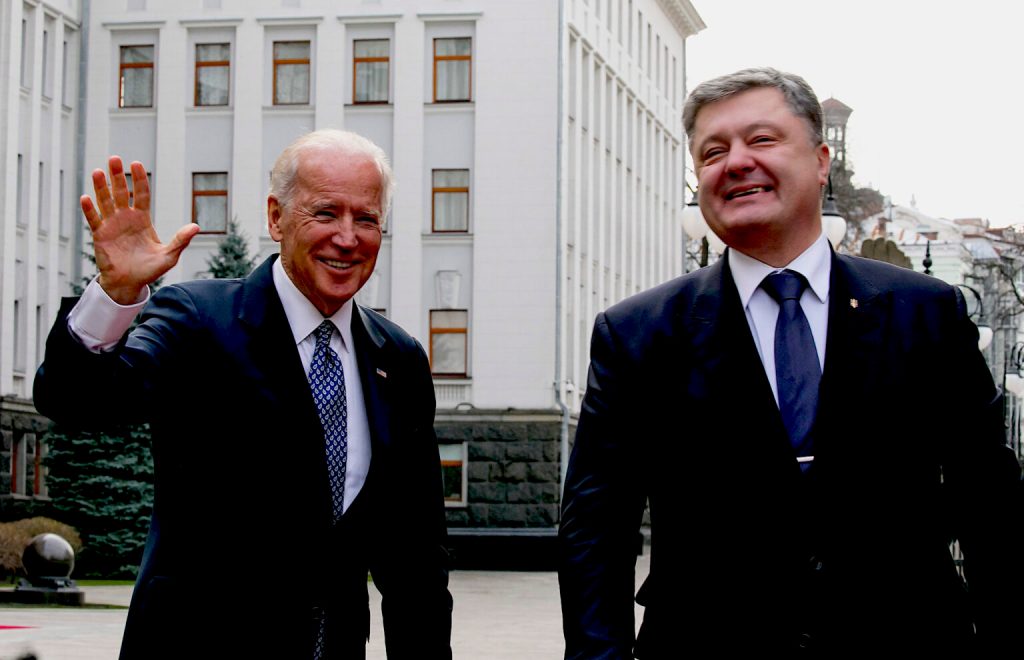
Dec. 7, 2015: U.S. Vice President Joe Biden meets with Ukrainian President Petro Poroshenko in Kiev. (U.S. Embassy Kyiv, Flickr)

In recent years, American “defender” missiles have been installed in eastern Europe, Poland, Slovenia, the Czech Republic, almost certainly aimed at Russia, accompanied by false assurances all the way back to James Baker’s “promise” to Soviet leader Mikhail Gorbachev in February 1990 that NATO would never expand beyond Germany. 

NATO on Hitler’s Borderline

Ukraine is the frontline. NATO has effectively reached the very borderland through which Hitler’s army stormed in 1941, leaving more than 23 million dead in the Soviet Union. 

Last December, Russia proposed a far-reaching security plan for Europe. This was dismissed, derided or suppressed in the Western media. Who read its step-by-step proposals? On Feb. 24, President Volodymyr Zelensky threatened to develop nuclear weapons unless America armed and protected Ukraine.  

[Related: John Pilger: War in Europe & the Rise of Raw Propaganda]

On the same day, Russia invaded — an unprovoked act of congenital infamy, according to the Western media. The history, the lies, the peace proposals, the solemn agreements on Donbass at Minsk counted for nothing. 

On April 25, U.S. Defense Secretary Lloyd Austin flew into Kiev and confirmed that America’s aim was to destroy the Russian Federation — the word he used was “weaken.” America had got the war it wanted, waged by an American bankrolled and armed proxy and expendable pawn.

Almost none of this was explained to Western audiences.

[Read:  Joe Lauria: Biden Confirms Why the US Needed This War]

Russia’s invasion of Ukraine is wanton and inexcusable. It is a crime to invade a sovereign country. There are no “buts” — except one.

When did the present war in Ukraine begin and who started it? According to the United Nations, between 2014 and this year, some 14,000 people have been killed in the Kiev regime’s civil war on the Donbass. Many of the attacks were carried out by neo-Nazis. 

Watch an ITV news report from May 2014, by the veteran reporter James Mates, who is shelled, along with civilians in the city of Mariupol, by Ukraine’s Azov (neo-Nazi) battalion.

In the same month, dozens of Russian-speaking people were burned alive or suffocated in a trade union building in Odessa besieged by fascist thugs, the followers of the Nazi collaborator and anti-Semitic fanatic Stepan Bandera.  The New York Times called the thugs “nationalists.”

“The historic mission of our nation in this critical moment,” said Andreiy Biletsky, founder of the Azov Battaltion, “is to lead the White Races of the world in a final crusade for their survival, a crusade against the Semite-led Untermenschen.”

Since February, a campaign of self-appointed “news monitors” (mostly funded by the Americans and British with links to governments) have sought to maintain the absurdity that Ukraine’s neo-Nazis don’t exist. 

Airbrushing, once associated with Stalin’s purges, has become a tool of mainstream journalism.

In less than a decade, a “good” China has been airbrushed and a “bad” China has replaced it: from the world’s workshop to a budding new Satan.  

Much of this propaganda originates in the U.S., and is transmitted through proxies and “think-tanks,” such as the notorious Australian Strategic Policy Institute, the voice of the arms industry, and by journalists such as Peter Hartcher of The Sydney Morning Herald, who has labeled those spreading Chinese influence as “rats, flies, mosquitoes and sparrows” and suggested these “pests” be “eradicated.” 

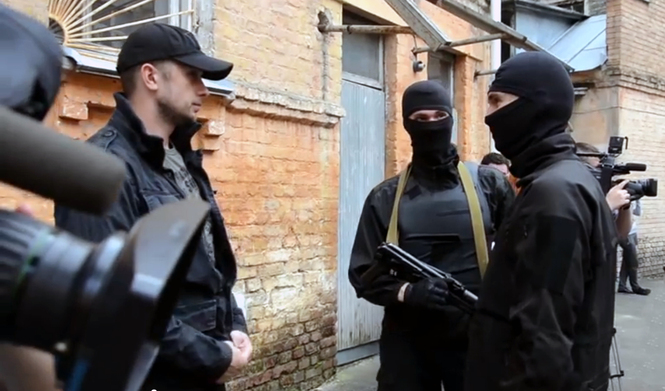
Andriy Beletsky, commanding officer of the special Ukrainian neo-Nazi police regiment Azov, with volunteers in 2014. (My News24, CC BY 3.0, Wikimedia Commons)

News about China in the West is almost entirely about the threat from Beijing. Airbrushed are the 400 American military bases that surround most of China, an armed necklace that reaches from Australia to the Pacific and south east Asia, Japan and Korea. The Japanese island of Okinawa and the Korean island of Jeju are like loaded guns aimed point blank at the industrial heart of China. A Pentagon official described this as a “noose.”

Palestine has been misreported for as long as I can remember. To the BBC, there is the “conflict” of “two narratives.” The longest, most brutal, lawless military occupation in modern times is unmentionable. 

The stricken people of Yemen barely exist. They are media unpeople.  While the Saudis rain down their American cluster bombs with British advisers working alongside the Saudi targeting officers, more than half a million children face starvation.

This brainwashing by omission is not new. The slaughter of the First World War was suppressed by reporters who were given knighthoods for their compliance.  In 1917, the editor of The Manchester Guardian, C.P. Scott, confided to Prime Minister Lloyd George: “If people really knew [the truth], the war would be stopped tomorrow, but they don’t know and can’t know.”

The refusal to see people and events as those in other countries see them is a media virus in the West, as debilitating as Covid.  It is as if we see the world through a one-way mirror, in which “we” are moral and benign and “they” are not. It is a profoundly imperial view.

The history that is a living presence in China and Russia is rarely explained and rarely understood. Vladimir Putin is Adolf Hitler. Xi Jinping is Fu Man Chu. Epic achievements, such as the eradication of abject poverty in China, are barely known. How perverse and squalid this is.

When will we allow ourselves to understand? Training journalists factory style is not the answer. Neither is the wondrous digital tool, which is a means, not an end, like the one-finger typewriter and the linotype machine.

In recent years, some of the best journalists have been eased out of the mainstream. “Defenestrated” is the word used. The spaces once open to mavericks, to journalists who went against the grain, truth-tellers, have closed.  

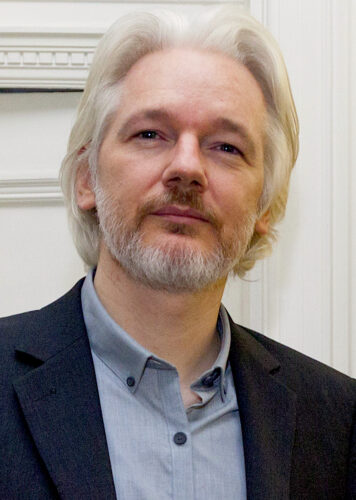
The case of Julian Assange is the most shocking.  When Julian and WikiLeaks could win readers and prizes for The Guardian, The New York Times and other self-important “papers of record,” he was celebrated. 

When the dark state objected and demanded the destruction of hard drives and the assassination of Julian’s character, he was made a public enemy. Vice President Joe Biden compared him to a “hi-tech terrorist.” Hillary Clinton asked, “Can’t we just drone this guy?” 

The ensuing campaign of abuse and vilification against Julian Assange — the U.N. rapporteur on torture called it “mobbing” — brought the liberal press to its lowest ebb. We know who they are. I think of them as collaborators: as Vichy journalists. 

When will real journalists stand up? An inspirational samizdat  already exists on the internet: Consortium News, founded by the great reporter Robert Parry, Max Blumenthal’s  The Grayzone, Mint Press News, Media Lens, DeclassifiedUK, Alborada, Electronic Intifada, WSWS, ZNet, ICH, CounterPunch, Independent Australia, the work of Chris Hedges, Patrick Lawrence, Jonathan Cook, Diana Johnstone, Caitlin Johnstone and others who will forgive me for not mentioning them here. 

And when will writers stand up, as they did against the rise of fascism in the 1930s? When will film-makers stand up, as they did against the Cold War in the 1940s? When will satirists stand up, as they did a generation ago? 

Having soaked for 82 years in a deep bath of righteousness that is the official version of the last world war, isn’t it time those who are meant to keep the record straight declared their independence and decoded the propaganda? The urgency is greater than ever.

John Pilger has twice won Britain’s highest award for journalism and has been International Reporter of the Year, News Reporter of the Year and Descriptive Writer of the Year. He has made 61 documentary films and has won an Emmy, a BAFTA and the Royal Television Society prize. His ‘Cambodia Year Zero’ is named as one of the ten most important films of the 20th century. He can be contacted at www.johnpilger.com

THE ELITES WHO ARE JUST SO OVER HUMANITY

The depth of anti-humanist sentiment related by Douglas Rushkoff in his latest book, Survival of the Richest, is harrowing and illuminating.

By Chris Barsanti

Source: PopMatters

Some things can be horrifying even if unsurprising. One such moment is the opening anecdote in Douglas Rushkoff’s Survival of the Richest: Escape Fantasies of the Tech Billionaires. In 2017, Rushkoff was paid an exorbitant fee to travel to a remote high-end resort where (he thought) he would do his usual thing: Talk about the future to investment bankers looking for a way to game the next trend.

What happened was far stranger. Rather than give a speech, Rushkoff sat at a conference room table with five fantastically rich guys from “the upper echelon of the tech investing and hedge fund world” and tried to answer their questions about how they could survive the impending apocalypse.

The scene is comical, in a Dr. Strangelove way. Assuming the world is racing toward an inevitable societal collapse they called “the Event”, the men thought it best to talk survival tactics with a self-described “Marxist media theorist” and professor at Queens/CUNY. Rather than acting like masters of the universe, they were nervous about being caught out when the Event came. They worried whether New Zealand or Alaska was the right location for their doomsday bunker; could their security guards keep the hungry mobs at bay; if an all-robot staff could be better. Rushkoff explains what seemed to lie behind these unnamed One Percenter preppers’ anxieties:

Taking their cue from Tesla founder Elon Musk colonizing Mars, Palantir’s Peter Thiel reversing the aging process, or artificial intelligence developers Sam Altman and Ray Kurzweil uploading their minds into supercomputers, they were preparing for a digital future that had less to do with making the world a better place than it did with transcending the human condition altogether. Their extreme wealth and privilege served only to make them obsessed with insulating themselves from the very real and present danger of climate change, rising sea levels, mass migrations, global pandemics, nativist panic, and resource depletion. For them, the future of technology is about only one thing: escape from the rest of us.– Douglass Rushkoff

Rushkoff calls this thinking “the Mindset”. He defines it as an “atheistic and materialistic scientism” that launders a desire for control and conquest through quasi-religious adherence to digital code and the power of the market. Expanding on his original article from 2018 (Medium)—which ironically led to his being swamped by requests from disaster-related industries to get in touch with the anonymous five they thought needed their services—Rushkoff spends the rest of Survival of the Richest explaining where the Mindset came from, how dangerous it is, and what he thinks should replace it.

Nothing that Rushkoff writes in this clipped, angry book should surprise most readers. Nobody who has spent any time tracking the pronouncements and feuds of the more futurist-minded tech elites would think many had a high opinion of or interest in improving the daily lot of carbon-based life forms. Though predictable and at times a bit too broadly defined, the depth of anti-humanist sentiment related by Rushkoff is still harrowing and illuminating.

The phenomenon of powerful men thinking themselves separate from the great unwashed and unbound by common morality is as old as human history. Although this of-the-moment book contains little context dating back more than three decades, Rushkoff does not try to claim everything about the Mindset is new. He points instead to how illogical power fantasies have merged with an Ayn Randian cult of the solitary hero and been nurtured by the Web’s seductive capacity for self-aggrandizing mythmaking. Given how much he may have contributed to those seductions, he is the right messenger.

Among the first public intellectuals to grapple seriously with the digital revolution as it washed over society in the 1990s, Rushkoff remains a go-to expert for Internet prognostication. Unlike many tech evangelizers, though, he later had second thoughts. Some of the more revealing sections in Survival of the Richest come from when the author turns his focus on himself.

Readers of a mindset will likely feel a certain wistfulness as Rushkoff writes about the early punk years of cyberspace. Just as underground music was bursting into the mainstream and indie bands were making real money, outlaw hackers were suddenly at the forefront of a technological revolution. In 1994, Rushkoff published two books: The GenX Reader, a heady anthology of alt-cultural tropes (part of the Slacker screenplay, Dan Clowes and Peter Bagge comics) that could already see the commodification of generational rebellion to come; and Cyberia, a quasi-utopian paean about the psychedelia-inspired confluence of programmers, Deadheads, libertarians, Wiccans, and ravers who seemed to be leading the nascent Web towards a consciousness- and freedom-expanding future. The 1996 “Declaration of Independence of Cyberspace,” announced ironically enough at the first ever World Economic Forum in Davos, proclaimed a borderless world where governments had no sovereignty.

Rushkoff looks back now with clearer eyes:

Deregulation sounded good at the time. We were just ravers and cyberpunks, paranoid about the government arresting us for drugs … We didn’t realize that banishing the government from the internet would create a free zone for corporate colonization. We hadn’t yet discovered that government and business balance each other out—a bit like fungus and bacteria. Get rid of one, and the other runs rampant.

In Rushkoff’s cultural history, the experimental tribal ethos of the Web’s heady early days was co-opted by business interests who saw a new frontier to monetize; less Mondo 2000, more AOL CD-ROMs. Online libertarianism seemed to evolve from a confederacy of rule-breaking rebels and pioneers to anger-prone grumps so dissatisfied with their fellow man that they started planning unintentionally funny “seasteading” ocean communities, taking their toys and leaving. Wealthy futurists imagine uploading themselves onto a cloud server, revealing a depressingly simplistic view of human consciousness and a grand view of themselves as transcendent immortals. As technology and behavioral science became more finely tooled at predicting consumer behavior, it also exacerbates hate and loneliness, assisting the all-too-easy COVID-19 pandemic pivot to increasingly tech-mediated relationships.

For the Mindset’s “tech titans and billionaire inventors”, per Rushkoff, there is no problem that technology cannot solve. And the problems are often human in form. Suppose that were true, and the world was spiraling towards a collapse (which the online tools superpowered by elites could be accelerating). In that case, the believers might wonder, why not use technology to scarper off to their Bond villain bunkers?

Rushkoff’s critique expands from what he calls this amoral “sociopathic” attitude toward the state of capitalism. Combining the digital-communitarian ethos of Cory Doctorow with the acerbic skepticism of Naomi Klein, Rushkoff does not trust that a more enlightened kind of capitalism can save the world. His argument against eternal economic growth has merit. But Rushkoff is on firmer ground when defining technological-sociological phenomena like the Mindset. That is not to say there is no case for a more sustainable economy, but Rushkoff breezes too quickly past the challenges resulting from that massive transition. Being necessary does not make a thing easy.

As with many jeremiads of this kind, Survival of the Richest loses some of its impact when delivering suggestions for how to push back (don’t give in to the inevitability of doom, buy local, fight for anti-monopoly laws). That is partly because it is difficult for them to seem equal to the magnitude of the problem. But for Rushkoff, the smallness of the solutions is part of the point: “We can still be individuals; we just need to define our sense of self a bit differently than the algorithms do.”

Saturday Matinee: Call of Heroes

CALL OF HEROES: Old School Story, New School Style

By Alexander Miller

Source: Film Inquiry

Hong Kong has been making genre films for decades, and many of them adhere to the formulaic structure that has maintained their reputation as foremost purveyors of action movies. Benny Chan is one of the few noted Hong Kong directors to have transitioned from the early nineties action movies through the handover into current action films, from period wuxia films like Shaolin 2010, to contemporary actioners like the Gen X Cops, and Jackie Chan vehicles Who am I? and New Police Story. Although Benny Chan’s filmography might suggest that of a hired gun working amid the many cogs in the modicum of action films in Hong Kong, there’s a slightly transgressive and gritty tone throughout his career.

Taking place in 1914, Call of Heroes opens when our napping protagonist, an amiable rapscallion Ma Feng (Eddie Peng), pummels some thugs who try to rob a noodle bar in the country; did the bandits offend his sense of honor and propriety? Not really, it seems Ma Feng is more annoyed that they interrupted what should have been a peaceful lunch.

After the introductory clobbering, he meets a teacher, Ms. Pak (Jiang Shuying), who has narrowly escaped (with a group of children in tow) a military siege on her school led by the sinister Cao Shaolun, who murders with impunity being the son of a general.

Meanwhile, in the village of Pucheng, led by the honorable Sheriff Yang (Lau Ching-Wan), there is an area that has become a haven for refugees as a result of the murderous military campaigns going on through the lands. While Ms. Pak and her accompanying travelers are met with resistance, they are welcomed by the locals; however, the mysterious wanderer arrives around the same time as the nefarious Cao Shaolun, and our seemingly ambivalent loner is intertwined in the ensuing intrigue.

In concert with the cultural influence, what with John Ford inspiring Kurosawa, whose samurai epics were later remade into westerns in Hollywood and Italy, Call of Heroes has the dirty look of a Cinecittà production, with the twangy electric guitar echoing Ennio Morricone as a tasteful homage.

Old School, New School

Does this incidental hybrid of east-west convey an entertaining action yarn? Considering some edges that need sanding off, Call of Heroes is a fun trip to the dusty plains of both samurai and western movies, with the now prototypical stray dog hero. Here Eddie Peng’s Ma Feng is equal parts Toshiro Mifune’s Sanjuro character with Clint Eastwood’s laconic ‘Man With No Name’ and a hint of Elliott Gould’s iteration of Phillip Marlowe – Benny Chan’s film isn’t shy about its modernist mashup, and we’re all the better for it too, because the action is fun and the drama feels genuine.

This crossover of revisionist platitudes retains its accumulative power while sturdily fitting the wuxia formula; there’s good versus bad, and the moral boundaries are clearly drawn. Its black and white ethics are a perfect fit for this handsome little epic of quality, and in the past few years Hong Kong has gotten closer to reclaiming their throne as the foremost purveyors of fun action films. Not in the bullet ballets of John Woo and Ringo Lam, but in the period dramas that have populated the Chinese film market in their post-handover era. Benny Chan’s latest is just as much a return to form as it is a continuation of (relatively) recent hits like 7 Assassins, Brotherhood of Blades, and Bodyguards & Assassins.

“A Hero is Only as Good as His Villain”

Call of Heroes has an air of familiarity in its execution, but plays towards a more mature demeanor. Koo’s performance of Cao Shaolun is more than a mustache-twirling baddie; he’s homicidal, sadistic and it shows as he mercilessly guns down man, woman, and child. The film doesn’t shy from the nasty bits of his bastardly demeanor.

Veteran actor Koo might seem hammy, but he succeeds in filling out the archetypal story, and in concert with the rest of the leading cast who are delivering top-notch work. Johnnie To mainstay Lau Ching-Wan, (who starred in Lifeline, Mad Detective, and Running out of Time) is powerful as the Pucheng village chief, but it’s baby-faced Eddie Peng who steals the show as the unkempt defender of the innocent; rightfully so, he’s funny, charming, and convincingly tough.

Influence of International Action

Deviating from the “cleaner” titles before it, Call of Heroes is as much a full-blooded action film as it is a martial arts movie; the blood flow makes the tenor of Chan’s feature feel more developed. Instead of anonymous henchman (who cease to be when they’re kicked out of frame), swords, bullets, spikes, fists and spears injure people, and violence has consequence.

The fight choreography, courtesy of martial arts guru Sammo Hung, employs a handful of fighting styles, from blunt punches and kicks, gravity-defying swordplay, as well as classic hand-to-hand combat. Call of Heroes might not have any headline martial artists such as Jackie Chan or Donnie Yen, but there’s no shortage of carefully choreographed action. Eddie Peng, under the tutelage of Sammo Hung, carries the film with stalwart Lau Ching-Wan doing some heavy lifting as well. Men, women, and children get in on the collective ass kicking, during some of the film’s exciting group brawls.

For the gravitas offered throughout, Hung and director Chan aren’t trying to mask the fantastical wire work, and in the spirit of high-flying fun it works to the film’s advantage; it’s the myth of heroism that we romanticize, and that comes off the screen every time someone trapezes themselves during the many scenes of combat.

Conclusion

What we are presented with is a thoroughly modern and satisfyingly self-aware action film; both classic, old fashioned, and authentically exciting. Fight sequences are plentiful and inventive; some standout moments include a waterside skirmish with walls of wooden spikes, a moonlit brawl with weaponized baskets and cookware; capped with a knockout finale involving Peng and accomplished martial artist Wu Jing duking it out with a mountain of clay pots.

I’d like to think of this inventive set piece as a nod to the 1976 John Woo/Jackie Chan vehicle Strike of Death (aka Hand of Death, choreography thanks to Sammo Hung), but this might be wishful thinking on my part.

Evolution in action films might take the form of stoic warriors abiding by Buddhist mantras in Jean-Pierre Melville’s heist films, or the operatic violence hyperbolized in the westerns of Sergio Leone. At the risk of evoking a cliché, action speaks every language and the more international cross pollinating that occurs the better off we all are; Hollywood’s been drawing from the eastern well for decades, and seeing the inverse in Call of Heroes is a pleasure.

Watch Call of Heroes on Hoopla here: https://www.hoopladigital.com/title/11726006

NATO prolongs the Ukraine proxy war, and global havoc

With diplomacy thwarted, the US and its allies plan for “open-ended” military and economic warfare against Russia, no matter the costs at home and abroad.

(US Dept. of Defense)

By Aaron Maté

Source: Aaron Mate Substack

Russia has announced plans to mobilize an additional 300,000 troops for the war in Ukraine. In his speech unveiling the expanded war effort, Vladimir Putin vowed to achieve his main goal of the “liberation of Donbas,” and issued a thinly veiled nuclear threat in the process. The move comes days ahead of planned referendums in breakaway Ukrainian areas to formalize Russian annexation.

Russia’s escalation ensures that the fighting is entering an even more dangerous phase. While Russia bears legal and moral responsibility for its invasion, recent developments underscore that NATO leaders have shunned opportunities to prevent further catastrophe and chosen instead to fuel it.

Putin’s announcement comes just after the Ukrainian military’s routing of Russian forces from Kharkiv, which relied extensively on US planning, weaponry and intelligence, sparked triumphant declarations that the tide has turned.

According to The Atlantic’s Anne Applebaum, “Americans and Europeans need to prepare for a Ukrainian victory,” one so overwhelming that it may well bring “about the end of Putin’s regime.”

Beyond the chorus of emboldened neoconservatives, Western officials are less sanguine.

“Certainly it’s a military setback” for Russia, a US official said of the Kharkiv retreat to the Washington Post. “I don’t know if I could call it a major strategic loss at this point.” Germany’s defense chief, General Eberhard Zorn, said that while Ukraine “can win back places or individual areas of the frontlines,” overall, its forces can “not push Russia back over a broad front.”

Whether or not it marked a major strategic loss for Russia, the battle in Kharkiv is already a major victory for NATO leaders seeking to prolong their proxy war in Ukraine and economic warfare next door.

Ukraine’s expulsion of Russian forces in the northeast, the New York Times reports, has “amplified voices in the West demanding that more weapons be sent to Ukraine so that it could win.”

“Despite Ukrainian forces’ startling gains in the war against Russia,” the Washington Post adds, “the Biden administration anticipates months of intense fighting with wins and losses for each side, spurring U.S. plans for an open-ended campaign with no prospect for a negotiated end in sight.”

As has been apparent since the Ukraine crisis erupted, US planning for open-ended proxy warfare against Russia has led it to sabotage any prospect of a negotiated end.

The US rejection of diplomacy around Ukraine has been newly substantiated by former White House Russia expert Fiona Hill. Citing “multiple former senior U.S. officials,” Hill reports that in April of this year “Russian and Ukrainian negotiators appeared to have tentatively agreed on the outlines of a negotiated interim settlement.” Under this framework, Russia would withdraw to its pre-invasion position, while Ukraine would pledge not to join NATO “and instead receive security guarantees from a number of countries.”

In confirming that US officials were aware of this tentative agreement, Hill bolsters previous news that Washington’s junior partner in London was enlisted to thwart it. As Ukrainian media reported, citing sources close to Ukrainian President Volodymyr Zelensky, UK Prime Minister Boris Johnson traveled to Kiev in April and relayed the message that Russia “should be pressured, not negotiated with.” Johnson also informed Zelensky that “even if Ukraine is ready to sign some agreements on [security] guarantees with Putin,” his Western patrons “are not.” The talks promptly collapsed.

In his speech announcing the expanded war effort, Putin invoked this episode. After the invasion began, he said, Ukrainian officials “reacted very positively to our proposals… After certain compromises were reached, Kyiv was actually given a direct order to disrupt all agreements.”

Having undermined the prospect of a negotiated peace in the war’s early weeks, proxy warriors in Washington are openly celebrating their success.

“I like the structural path we’re on here,” Republican Senator Lindsey Graham recently declared. “As long as we help Ukraine with the weapons they need and the economic support, they will fight to the last person.”

Graham’s avowed willingness to expend every “last person” in Ukraine to fight Russia is in line with a broader US strategy that views the entire world as subordinate to its war aims. As the Washington Post reported in June, the White House is willing to “countenance even a global recession and mounting hunger” in order to hand Russia a costly defeat. In Ukraine, this now means also countenancing the threat of nuclear disaster, as the crisis surrounding the Zaporizhzhia nuclear power plant has laid bare.

The prevailing willingness to sacrifice civilian well-being extends to the US public, as National Security Advisor Jake Sullivan has newly made clear. Appearing at the Aspen Security Conference, Sullivan was asked if he is worried about the “American people’s staying power” on the Ukraine proxy war, amid “criticism that we’re spending billions and billions to support Ukraine, and not spending it here.”

 “Fundamentally not,” Sullivan responded. “It’s very important for Putin to understand what exactly he’s up against from the point of view of the United States’ staying power.” That staying power, Sullivan explained, was cemented in the $40 billion war funding measure overwhelmingly approved by Congress (including every self-identified progressive Democrat) in May.

“That can go on, just on the basis of what we have already had allocated to us and resources for a considerable period of time,” Sullivan vowed. “And then, I strongly believe that there will be bipartisan support in the Congress to re-up those resources should it become necessary.”

To policymakers like Sullivan, there is not only an endless pool of money to “re-up” the war, but a “fundamentally” indifferent posture toward the taxpayers footing the bill.

Despite Biden’s reported scolding of Defense Secretary Lloyd Austin for admitting that the US goal in Ukraine is to leave Russia “weakened,” Sullivan – speaking before a friendly Beltway crowd — also forgot to stick to the script.

The US “strategic objective” in Ukraine, Sullivan explained, is to “ensure that Russia’s invasion of Ukraine… is a strategic failure for Putin,” and that “Russia pay a longer-term price in terms of the elements of its national power.” This would teach a “lesson,” he added, “to would-be aggressors elsewhere.”

By “would-be aggressors elsewhere”, Sullivan naturally precludes the US and its allies, whose aggression is not only permitted but promoted under the US-led “rules-based international order.”

President Biden has made that clear by abandoning his pledge to make Saudi Arabia a “pariah” state, notwithstanding its murderous (US-backed) aggression in Yemen. The regular aggression by US ally Israel against Gaza and Syria also continues unabated. The United Nations just reported that an Israeli strike on the Damascus international airport in June – one of hundreds of Israeli bombings on Syria that go largely ignored — “led to considerable damage to infrastructure” and “meant the suspension of U.N. deliveries of humanitarian assistance” to Syrians in need for nearly two weeks. As of this writing, the latest Israeli strike killed five Syrian soldiers, eliciting no Western media and political protest. It is more accurate to describe Israeli aggression on Syria as a joint Israeli-US effort, given that the US reviews and approves the strikes.

Allied NATO leaders are also vocally countenancing the Ukraine proxy war’s costs on their domestic populations. In response to the European sanctions, Russia has now halted gas deliveries to the EU via the key Nord Stream 1 pipeline. Having previously relied on Russia for close to 40 percent of its gas needs, European industries are facing layoffs, factory closures, and higher energy bills that “are pushing consumers to near poverty,” the Financial Times reports.

“People want to end the war because they cannot bear the consequences, the costs,” the EU’s Josep Borell observed this month. While ending the war might appeal to some, it does not interest the EU’s top diplomat. “This mentality must be overcome,” Borell declared. “The offensive on the northeastern front helps with that.”

Europe, NATO chief Jens Stoltenberg recently wrote, may even face “civil unrest,” as economies contract and temperatures drop, but “for Ukraine’s future and for ours, we must prepare for the winter war and stay the course.”

“No matter what my German voters think, I want to deliver to the people of Ukraine,” Germany’s Foreign Minister Annalena Baerbock told a conference in Prague last month. During the upcoming winter, Baerbock acknowledged, “we will be challenged as democratic politicians. People will go in the street and say ‘We cannot pay our energy prices’.” While pledging to help people “with social measures,” Baerbock insisted that the European Union’s sanctions on Russia will remain. “The sanctions will stay also in wintertime, even if it gets really tough for politicians,” she said.

Whereas Western leaders appear confident they can manage civil unrest at home, they face additional resistance abroad. In Africa, a leaked report from the European Union’s envoy to the continent warns that African nations are blaming the EU’s Russia sanctions for food shortages. The report also cautions that “the EU is seen as fueling the conflict,” in Ukraine, “not as a peace facilitator.”

Rather than address these African concerns, the envoy’s office proposes a “more transactional… approach” in which the EU makes “clear” that its “willingness” to “maintain higher levels” of foreign aid “will depend on working based on common values and a joint vision,” – in short, on Africa falling in line.

That is undoubtedly the US policy, as UN Ambassador Linda Thomas-Greenfield made clear last month. After promising a “listening tour,” Thomas-Greenfield instead came to Africa with a dictate and an outright threat. “Countries can buy Russian agricultural products, including fertilizer and wheat,” she decreed. But “if a country decides to engage with Russia” and break US sanctions, “they stand the chance of having actions taken against them.” That Africa faces a food security crisis, with hundreds of millions going hungry, is apparently of lower importance.

While Western sanctions on Russia wreak havoc worldwide, the architects in Washington seem only perturbed by their failure, so far, to inflict the intended levels of suffering on Russian civilians. “We were expecting” that US sanctions “would totally crater the Russian economy” by now, a disappointed senior US official told CNN.

Other US officials are leaving room for hope. “There’s going to be long-term damage done to the Russian economy and to generations of Russians as a result of this,” CIA Director William Burns told a cybersecurity conference this month. Burns’ long-term forecast of harming “generations of Russians” is based on extensive planning. As one US official explained it to CNN, when the sanctions were designed, Biden officials not only “wanted to keep pressure on Russia over the long term as it waged war on Ukraine,” but also “wanted to degrade Russia’s economic and industrial capabilities.” Accordingly, “we’ve always seen this as a long-term game.”

The “long-term game” of trying to destroy Russia’s economy and immiserate “generations” of its citizens is accompanied by increasing plans for a long-term fight. The Biden administration plans to formally name the US military mission in Ukraine – such as in prior campaigns like Operation Desert Storm — while also appointing a general to oversee the effort. The naming, the Wall Street Journal observes, is “significant bureaucratically, as it typically entails long-term, dedicated funding.”

The US plan for a long-term military and economic campaign against Russia is being implemented despite the awareness that Ukraine could face far worse.

“Some American officials express concern that the most dangerous moments are yet to come,” the New York Times reports. To date, “Putin has avoided escalating the war in ways that have, at times, baffled Western officials.” Unlike US military campaigns in Iraq, Russia “has made only limited attempts to destroy critical infrastructure or to target Ukrainian government buildings.”

“The current moment draws attention to a tension that underlies America’s strategy for the war,” the Washington Post observes, “as officials channel massive military support to Ukraine, fueling a war with global consequences, while attempting to remain agnostic about when and how Kyiv might strike a deal to end it.”

These rare admissions not only contradict the typical portrayal of a genocidal Russia that is used to justify the proxy war, but capture the underlying policy driving it. More than six months in, US officials are aware that Russia has “avoided escalating the war” and targeting “critical infrastructure,” – to the point where these same officials are “baffled” by Russian restraint. Despite this, their policy centers on “fueling” this same war, while remaining “agnostic” about ending it.

War being fluid – and US-led military support for Ukraine ever-expanding – it is of course possible that Ukraine will continue to defy expectations and drive out the invading Russian forces.

What the latest developments on and off the battlefield make undoubtedly clear is that NATO states are willing to use Ukraine for as long as it takes to achieve the stated aim of leaving Russia “weakened” or even achieving regime change, no matter the damage knowingly inflicted on Ukrainians, Russians, the Global South, and their own citizens.