It’s the DNC, Stupid: Democratic Party, Not Russia, Has Delegitimized the Democratic Process

By Elizabeth Vos

Source: Consortium News

Establishment Democrats and those who amplify them continue to project blame for the public’s doubt in the U.S. election process onto outside influence, despite the clear history of the party’s subversion of election integrity. The total inability of the Democratic Party establishment’s willingness to address even one of these critical failures does not give reason to hope that the nomination process in 2020 will be any less pre-ordained.

The Democratic Party’s bias against Sen. Bernie Sanders during the 2016 presidential nomination, followed by the DNC defense counsel doubling down on its right to rig the race during the fraud lawsuit brought against the DNC, as well as the irregularities in the races between former DNC Chairwoman Debbie Wasserman Schultz and Tim Canova, indicate a fatal breakdown of the U.S. democratic process spearheaded by the Democratic Party establishment. Influences transcending the DNC add to concerns regarding the integrity of the democratic process that have nothing to do with Russia, but which will also likely impact outcomes in 2020.

The content of the DNC and Podesta emails published by WikiLeaks demonstrated that the DNC acted in favor of Hillary Clinton in the lead up to the 2016 Democratic primary. The emails also revealed corporate media reporters acting as surrogates of the DNC and its pro-Clinton agenda, going so far as to promote Donald Trump during the GOP primary process as a preferred “pied-piper candidate.” One cannot assume that similar evidence will be presented to the public in 2020, making it more important than ever to take stock of the unique lessons handed down to us by the 2016 race.

Social Media Meddling

Election meddling via social media did take place in 2016, though in a different guise and for a different cause from that which are best remembered. Twitter would eventually admit to actively suppressing hashtags referencing the DNC and Podesta emails in the run-up to the 2016 presidential election. Additional reports indicated that tech giant Google also showed measurable “pro-Hillary Clinton bias” in search results during 2016, resulting in the alleged swaying of between 2 and 10 millions voters in favor of Clinton.

On the Republican side, a recent episode of CNLive! featured discussion of the Cambridge Analytica scandal, in which undecided voters were micro-targeted with tailored advertising narrowed with the combined use of big data and artificial intelligence known collectively as “dark strategy.” CNLive! Executive Producer Cathy Vogan noted that SCL, Cambridge Analytica’s parent company, provides data, analytics and strategy to governments and military organizations “worldwide,” specializing in behavior modification. Though Cambridge Analytica shut down in 2018, related companies remain.

The Clinton camp was hardly absent from social media during the 2016 race. The barely-legal activities of Clintonite David Brock were previously reported by this author to have included $2 million in funding for the creation of an online “troll army” under the name Shareblue. The LA Times described the project as meant to “to appear to be coming organically from people and their social media networks in a groundswell of activism, when in fact it is highly paid and highly tactical.” In other words, the effort attempted to create a false sense of consensus in support for the Clinton campaign.

In terms of interference in the actual election process, the New York City Board of Elections was shown to have purged over one hundred thousand Democratic voters in Brooklyn from the rolls before the 2016 primary, a move that the Department of Justice found broke federal law. Despite this, no prosecution for the breach was ever attempted.

Though the purge was not explicitly found to have benefitted Clinton, the admission falls in line with allegations across the country that the Democratic primary was interfered with to the benefit of the former secretary of state. These claims were further bolstered by reports indicating that voting results from the 2016 Democratic primary showed evidence of fraud.

DNC Fraud Lawsuit

The proceedings of the DNC fraud lawsuit provide the most damning evidence of the failure of the U.S. election process, especially within the Democratic Party. DNC defense lawyers argued in open court for the party’s right to appoint candidates at its own discretion, while simultaneously denying any “fiduciary duty” to represent the voters who donated to the Democratic Party under the impression that the DNC would act impartially towards the candidates involved.

In 2017, the Observer reported that the DNC’s defense counsel argued against claims that the party defrauded Sanders’ supporters by favoring Clinton, reasoning that Sanders’ supporters knew the process was rigged. Again: instead of arguing that the primary was neutral and unbiased in accordance with its charter, the DNC’s lawyers argued that it was the party’s right to select candidates.

The Observer noted the sentiments of Jared Beck, the attorney representing the plaintiffs of the lawsuit:

…“People paid money in reliance on the understanding that the primary elections for the Democratic nominee —nominating process in 2016 were fair and impartial, and that’s not just a bedrock assumption that we would assume just by virtue of the fact that we live in a democracy, and we assume that our elections are run in a fair and impartial manner. But that’s what the Democratic National Committee’s own charter says. It says it in black and white.”

The DNC defense counsel’s argument throughout the course of the DNC fraud lawsuit doubled down repeatedly in defense of the party’s right to favor one candidate over another, at one point actually claiming that such favoritism was protected by the First Amendment. The DNC’s lawyers wrote:

“To recognize any of the causes of action that Plaintiffs allege would run directly contrary to long-standing Supreme Court precedent recognizing the central and critical First Amendment rights enjoyed by political parties, especially when it comes to selecting the party’s nominee for public office.” [Emphasis added]

The DNC’s shameless defense of its own rigging disemboweled the most fundamental organs of the U.S. body politic.  This no indication that the DNC will not resort to the same tactics in the 2020 primary race,

Tim Canova’s Allegations

If Debbie Wasserman Schultz’s role as disgraced chairwoman of the DNC and her forced 2016 resignation wasn’t enough, serious interference was also alleged in the wake of two contests between Wasserman Schultz and professor Tim Canova in Florida’s 23rd congressional district. Canova and Wasserman Schultz first faced off in a 2016 Democratic primary race, followed by a 2018 general congressional election in which Canova ran as an independent.

Debacles followed both contests, including improper vote counts, illegal ballot destruction, improper transportation of ballots, and generally shameless displays of cronyism. After the controversial results of the initial primary race against Wasserman Schultz, Canova sought to have ballots checked for irregularities, as the Sun-Sentinel reported at the time:

“[Canova] sought to look at the paper ballots in March 2017 and took Elections Supervisor Brenda Snipes to court three months later when her office hadn’t fulfilled his request. Snipes approved the destruction of the ballots in September, signing a certification that said no court cases involving the ballots were pending.”

Ultimately, Canova was granted a summary judgment against Snipes, finding that she had committed what amounted to multiple felonies. Nonetheless, Snipes was not prosecuted and remained elections supervisor through to the 2018 midterms.

Republicans appear no more motivated to protect voting integrity than the Democrats, with The Nation reporting that the GOP-controlled Senate blocked a bill this week that would have “mandated paper-ballot backups in case of election machine malfunctions.”

Study of Corporate Power

A 2014 study published by Princeton University found that corporate power had usurped the voting rights of the public: “Economic elites and organized groups representing business interests have substantial independent impacts on U.S. government policy, while average citizens and mass-based interest groups have little or no independent influence.”

In reviewing this sordid history, we see that the Democratic Party establishment has done everything in its power to disrespect voters and outright overrule them in the democratic primary process, defending their right to do so in the DNC fraud lawsuit. We’ve noted that interests transcending the DNC also represent escalating threats to election integrity as demonstrated in 2016.

Despite this, establishment Democrats and those who echo their views in the legacy press continue to deflect from their own wrongdoing and real threats to the election process by suggesting that mere discussion of it represents a campaign by Russia to attempt to malign the perceptionof the legitimacy of the U.S. democratic process.

Hillary Clinton’s recent comments to the effect that Congresswoman Tulsi Gabbard is being “groomed” by Russia, and that the former Green Party Presidential candidate Dr. Jill Stein is a “Russian asset”, were soon echoed by DNC-friendly pundits. These sentiments externalize what Gabbard called the “rot” in the Democratic party outward onto domestic critics and a nation across the planet.

Newsweek provided a particularly glaring example of this phenomenon in a recent op-ed penned by columnist Naveed Jamali, a former FBI double agent whose book capitalizes on Russiagate. In an op-ed titled: Hillary Clinton Is Right. Tulsi Gabbard Is A Perfect Russian Asset – And Would Be A Perfect Republican Agent,” Jamali argued:

“Moscow will use its skillful propaganda machine to prop up Gabbard and use her as a tool to delegitimize the democratic process.” [Emphasis added]

Jamali surmises that Russia intends to “attack” our democracy by undermining the domestic perception of its legitimacy. This thesis is repeated later in the piece when Jamali opines: “They want to see a retreat of American influence. What better way to accomplish that than to attack our democracy by casting doubt on the legitimacy of our elections.” [Emphasis added]

The only thing worth protecting, according to Jamali and those who amplify his work (including former Clinton aide and establishment Democrat Neera Tanden), is the perception of the democratic process, not the actual functioning vitality of it. Such deflective tactics ensure that Russia will continue to be used as a convenient international pretext for silencing domestic dissent as we move into 2020.

Given all this, how can one expect the outcome of a 2020 Democratic Primary — or even the general election – to be any fairer or transparent than 2016?


Elizabeth Vos is a freelance reporter, co-host of CN Live! and regular contributor to Consortium News. 

Is the U.S. Becoming a Third World Nation?

By Charles Hugh Smith

Source: Of Two Minds

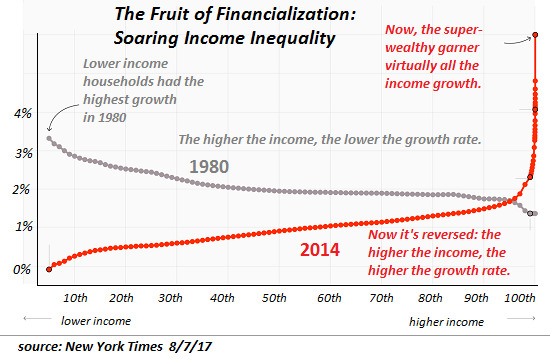
This is a chart of an informal kleptocracy which cloaks itself in the faux finery of democracy and a (rigged) “market” economy.

Back in the day, nations that didn’t qualify as either developed (First World) or developing (Second World) were by default Third World, impoverished, corrupt and what we now refer to as failed states–governments that were incapable of improving the lives of their people and the machinery of governance, generally as a result of corruption and self-serving elites, i.e. kleptocracies.

Is the U.S. slipping into Third World status? While many scoff at the very question, others citing the rise of homelessness, entrenched pockets of abject poverty and the decaying state of infrastructure might nod “yes.”

These are not uniquely Third World problems, they’re symptoms of a status quo that’s fast losing First World capabilities. What characterizes Third World/Failing States isn’t just poverty, crumbling infrastructure and endemic corruption; at a systems level these are the key dynamics in Third World/Failing States:

1. The status quo protects insiders at the expense of everyone else.

2. There is no real accountability; failure has no consequences, bureaucrats are never fired for incompetence, reforms are watered down or neutered by institutional sclerosis.

3. Pay-to-play is the most cost-effective way to influence policy or evade consequences.

4. The status quo is incapable of differentiating between complexity that serves the legitimate purposes of transparency and accountability and complexity that serves no purpose beyond guaranteeing insiders’ paper-shuffling jobs. As a consequence, complexity that adds no value chokes the economy and the government.

5. There are two sets of laws: one for insiders and the super-wealthy, and another harsher set for everyone else.

6. The super-wealthy fear nothing because the system functions to serve their interests.

7. The super-wealthy and state insiders control the media’s narratives and the machinery of governance to serve their interests. Reforms are in name only; the faces of elected officials change but nothing changes structurally.

8. Insiders, well-paid pundits and the technocrats serving the corporate and state elites believe the status quo is just fine because they’re doing fine; they are blind to the soaring inequality, systemic corruption, stupendous waste and the impossibility of real reform.

Does America’s status quo protect insiders at the expense of everyone else? Yes. As for the other seven characteristics: yes, yes, yes, yes, yes, yes and yes.

And lets’ not forget #9: the vast majority of the economic gains flow to the elite at the very top of the wealth-power pyramid: is this true in the U.S.? Definitively yes. Just look at this chart: this is a chart of an informal kleptocracy which cloaks itself in the faux finery of democracy and a (rigged) “market” economy.

That’s the very definition of a Third World failed state.

Related Video:

It’s Just An Illusion – The Management of Perception

By Kingsley L. Dennis

Inside the Submissive Void

Propaganda, Censorship, Power, & Control

By Greg Maybury

Source: OffGuardian

Nothing appears more surprising to those who consider human affairs with a philosophical eye, than the easiness with which the many are governed by the few; and the implicit submission, with which men resign their own sentiments and passions to those of their rulers.
David Hume, “Of the First Principles of Government”, 1768

The use of propaganda and censorship is more frequently associated with totalitarian, corrupt and/or despotic regimes, not our purported democracies in the West. Yet the history of how western governments and their ever-vigilant overlords in the media, financial and business spheres have controlled the political narrative of the time via these means is a long, storied and ruinous one, going back well before 1914.

Along with serving the contemporaneous political objectives of its perpetrators as contrived, such activities often continue to inform our understanding, and cement our interpretation, of history.

If as the saying goes, “history repeats itself”, we need look no further as to the main reason why. In this wide ranging ‘safari’ into the disinformation, myth-making, fake news wilderness—aka The Big Shill—Greg Maybury concludes that “It’s the narrative, stupid!”

Controlling the Proles

The following yarn may be apocryphal, but either way the ‘moral of the fable’ should serve our narrative well. The story goes like this: sometime during the height of the Cold War a group of American journalists were hosting a visit to the U.S. of some of their Soviet counterparts.

After allowing their visitors some time to soak up the media zeitgeist stateside, most of the Americans expected their guests to express unbridled envy at the professional liberties they enjoyed in the Land of the Free Press.

One of the Russian scribes was indeed compelled to express his unabashed ‘admiration’ to his hosts…in particular, for the “far superior quality” of American “propaganda”. Now it’s fair to say his hosts were taken aback by what was at best a backhanded compliment.

After some collegial ‘piss-taking’ about the stereotypes associated with Western “press freedom” versus those of the controlled media in the Soviet system, one of the Americans called on their Russian colleague to explain what he meant. In fractured English, he replied with the following:

It’s very simple. In Soviet Union, we don’t believe our propaganda. In America, you actually believe yours!”

As highly amusing as this anecdote is, it masks a disturbing reality — the Russian journo’s jibe doesn’t simply remain true now; that ‘belief’ has become even more delusional, farcical, and above all, dangerous.

One suspects that Russian journos today would think much the same.

And in few cases has the “delusional”, “farcical”, and “dangerous” nature of this conviction been more evident than with the West’s continued provocations of Russia, with “Skripalgate” in Old Blighty (see here, and here), and “Russia-Gate” stateside (see here, here, and here) being prime, though far from the only, exemplars we might point to.

Of course just recently we were all subjected to the ludicrous dog n’ pony show that was the much-touted London “media freedom” conference, organised under the auspices of the so-called Media Freedom Coalition (MFC), a UK/Canadian ‘initiative’.

As the name suggested, this was the establishment’s lip-service effort to be seen to be supporting or ‘defending’ media freedom, and initiating strategies and frameworks for the ‘protection’ of journalists. Lofty stuff to be sure. For my part I can’t recall another recent event that so unabashedly embraced the Orwellian playbook, absent any hint of irony or embarrassment from the parties involved.

To illustrate, after noting that ‘the world is becoming a more hostile place’ for journalists, the MFC website then righteously intones: [they] face dangers beyond warzones and extremism, including increasing intolerance to independent reporting, populism, rampant corruption, crime, and the breakdown of law and order…’

The cynic might be tempted to add: ‘And that’s just in our Western democracies!’

And who can forget the fatuous “integrity initiative” that preceded it, whose lofty ambitions aimed to ‘defend democracy against disinformation’? This is elite code for limiting free speech, already happening at a rate of knots, with the powers that be ‘setting up new perimeters’ online and offline.

The prevailing efforts by a range of people to make it a crime to criticise Israel or boycott the country is arguably the most insidious, egregious example. As well, the attempts by the MSM to designate genuine, independent analysis by alternative media as “fake news” is another one.

Such is the sophistication and ubiquity of the narrative control techniques used today—afforded increasingly by ‘computational propaganda’ via automated scripts, hacking, botnets, troll farms, and algorithms and the like, along with the barely veiled censorship and information gatekeeping practised by Google and Facebook and other tech behemoths — it’s become one of the most troubling aspects of the technological/social media revolution. (See also here, here, here, and here.)

Notably, the MFC conference came and went after organisers saw fit to exclude legitimate Russian news outlets RT and Sputnik, an ideological ‘fashion statement’ thoroughly at odds with the purported premise upon which it was instigated.

Moreover, there was little mention of the ‘elephant in the room’ Julian Assange—the person who embodies foremost the disconnect between the practice and the preaching of Western media freedom, to say little of underscoring the irony, self-serving opportunism, and double standards that frequently attend any mainstream debate about what it actually means.

Put bluntly, “media freedom” in the West is, increasingly, ‘more honoured in the breach than in the observance’, with the London confab all about keeping up appearances to the contrary. This was an event conceived of by soulless, demented, establishment shills, ‘…full of sound and fury, signifying nothing’.

The surreal spectacle though must have induced cognitive dissonance even amongst the pundits, and many head-shaking moments for Assange supporters and genuine truth-seekers alike.

As for Wikileaks and Assange himself, it’s worth noting the attitude of the national security state toward him. After accusing Assange of being a “narcissist”, “fraud”, and “a coward”, and labelling WikiLeaks a “hostile intelligence service”, Secretary of State Mike Pompeo declared he [Assange] was “>eager to do the bidding of Russia and other American adversaries.”

Either way, his comments can be taken as more or less representative of Beltway and broader Western opinion, including in my own country Australia. Along with noting that official Washington’s hatred of Assange ‘borders on rabid’, Ted Carpenter offered the following:

[Assange] symbolises a crucial fight over freedom of the press and the ability of journalists to expose government misconduct without fear of prosecution. Unfortunately, a disturbing number of “establishment” journalists in the United States seem willing—indeed, eager—to throw him to the government wolves.’

Lapdogs for the Government

Here was, of course, another surreal spectacle, this time courtesy of one of the Deep State’s most dangerous, reviled, and divisive figures, a notable protagonist in the Russia-Gate conspiracy, and America’s most senior diplomat no less.

Not only is it difficult to accept that the former CIA Director actually believes what he is saying, well might we ask, “Who can believe Mike Pompeo?”

And here’s also someone whose manifest cynicism, hypocrisy, and chutzpah would embarrass the much-derided scribes and Pharisees of Biblical days.

We have Pompeo on record recently in a rare moment of honesty admitting – whilst laughing his ample ass off, as if recalling some “Boy’s Own Adventure” from his misspent youth with a bunch of his mates down at the local pub – that under his watch as CIA Director:

…We lied, cheated, we stole…we had entire training courses.’

It may have been one of the few times in his wretched existence that Pompeo didn’t speak with a forked tongue.

At all events, his candour aside, we can assume safely that this reactionary, monomaniacal, Christian Zionist ‘end-timer’ passed all the Company’s “training courses” with flying colours.

According to Matthew Rosenberg of the New York Times, all this did not stop Pompeo however from name-checking Wikileaks when it served his own interests. Back in 2016 at the height of the election campaign, he had ‘no compunction…about pointing people toward emails stolen* by Russian hackers from the Democratic National Committee and then posted by WikiLeaks.”

[NOTE: Rosenberg’s omission of the word “allegedly”—as in “emails allegedly stolen”—is a dead giveaway of bias on his part (a journalistic Freudian slip perhaps?), with his employer being one of those MSM marques leading the charge with the “Russian Collusion” ‘story’. For a more insightful view of the source of these emails and the skullduggery and thuggery that attended Russia-Gate, readers are encouraged to check this out.]

And this is of course The Company we’re talking about, whose past and present relationship with the media might be summed up in two words: Operation Mockingbird (OpMock). Anyone vaguely familiar with the well-documented Grand Deception that was OpMock, arguably the CIA’s most enduring, insidious, and successful psy-ops gambit, will know what we’re talking about. (See here, here, here, and here.) At its most basic, this operation was all about propaganda and censorship, usually operating in tandem to ensure all the bases are covered.

After opining that the MSM is ‘totally infiltrated’ by the CIA and various other agencies, for his part former NSA whistleblower William Binney recently added, ‘When it comes to national security, the media only talk about what the administration wants you to hear, and basically suppress any other statements about what’s going on that the administration does not want get public. The media is basically the lapdogs for the government.’

Even the redoubtable William Casey, Ronald Reagan’s CIA Director back in the day was reported to have said something along the following lines:

We know our disinformation program is complete when almost everything the American public believes is false.’

In order to provide a broader and deeper perspective, we should now consider the views of a few others on the subjects at hand, along with some history. In a 2013 piece musing on the modern significance of the practice, my compatriot John Pilger ecalled a time when he met Leni Riefenstahl back in 70s and asked her about her films that ‘glorified the Nazis’.

Using groundbreaking camera and lighting techniques, Riefenstahl produced a documentary that mesmerized Germans; as Pilger noted, her Triumph of the Will ‘cast Adolf Hitler’s spell’. She told the veteran Aussie journalist the “messages” of her films were dependent not on “orders from above”, but on the “submissive void” of the public.

All in all, Riefenstahl produced arguably for the rest of the world the most compelling historical footage of mass hysteria, blind obedience, nationalistic fervour, and existential menace, all key ingredients in anyone’s totalitarian nightmare. That it also impressed a lot of very powerful, high profile people in the West on both sides of the pond is also axiomatic: These included bankers, financiers, industrialists, and sundry business elites without whose support Hitler might’ve at best ended up a footnote in the historical record after the ill-fated beer-hall putsch. (See here, and here.)

Triumph” apparently still resonates today. To the surprise of few one imagines, such was the impact of the filmas casually revealed in the excellent 2018 Alexis Bloom documentary Divide and Conquer: The Story of Roger Ailesit elicited no small amount of admiration from arguably the single most influential propagandist of recent times.

[Readers might wish to check out Russell Crowe’s recent portrayal of Ailes in Stan’s mini-series The Loudest Voice, in my view one the best performances of the man’s career.]

In a recent piece unambiguously titled “Propaganda Is The Root Of All Our Problems”, my other compatriot Caitlin Johnstone also had a few things to say about the subject, echoing Orwell when she observed it was all about “controlling the narrative”.

Though I’d suggest the greater “root” problem is our easy propensity to ignore this reality, pretend it doesn’t or won’t affect us, or reject it as conspiratorial nonsense, in this, of course, she’s correct. As she cogently observes,

I write about this stuff for a living, and even I don’t have the time or energy to write…about every single narrative control tool that the US-centralised empire has been implementing into its arsenal. There are too damn many of them emerging too damn fast, because they’re just that damn crucial for maintaining existing power structures.’

The Discreet Use of Censorship and Uniformed Men

It is hardly surprising that those who hold power should seek to control the words and language people use’ said Canadian author John Ralston Saul in his 1993 book Voltaire’s Bastards–the Dictatorship of Reason in the West.

Fittingly, in a discussion encompassing amongst other things history, language, power, and dissent, he opined, ‘Determining how individuals communicate is’…an objective which represents for the power elites ‘the best chance’ [they] have to control what people think. This translates as: The more control ‘we’ have over what the proles think, the more ‘we’ can reduce the inherent risk for elites in democracy.

Clumsy men’, Saul went on to say, ‘try to do this through power and fear. Heavy-handed men running heavy-handed systems attempt the same thing through police-enforced censorship. The more sophisticated the elites, the more they concentrate on creating intellectual systems which control expression through the communications structures. These systems require only the discreet use of censorship and uniformed men.’

In other words, along with assuming it is their right to take it in the first place, ‘those who take power will always try to change the established language’, presumably to better facilitate their hold on it and/or legitimise their claim to it.

For Oliver Boyd-Barrett, democratic theory presupposes a public communications infrastructure that facilitates the free and open exchange of ideas.’ Yet for the author of the recently published RussiaGate and Propaganda: Disinformation in the Age of Social Media, ‘No such infrastructure exists.’

The mainstream media he says, is ‘owned and controlled by a small number of large, multi-media and multi-industrial conglomerates’ that lie at the very heart of US oligopoly capitalism and much of whose advertising revenue and content is furnished from other conglomerates:

The inability of mainstream media to sustain an information environment that can encompass histories, perspectives and vocabularies that are free of the shackles of US plutocratic self-regard is also well documented.’

Of course the word “inability” suggests the MSM view themselves as having some responsibility for maintaining such an egalitarian news and information environment. They don’t of course, and in truth, probably never really have! A better word would be “unwilling”, or even “refusal”. The corporate media all but epitomise the “plutocratic self-regard” that is characteristic of “oligopoly capitalism”.

Indeed, the MSM collectively functions as advertising, public relations/lobbying entities for Big Corp, in addition to acting as its Praetorian bodyguard, protecting their secrets, crimes, and lies from exposure. Like all other companies they are beholden to their shareholders (profits before truth and people), most of whom it can safely be assumed are no strangers to “self-regard”, and could care less about “histories, perspectives and vocabularies” that run counter to their own interests.

It was Aussie social scientist Alex Carey who pioneered the study of nationalism, corporatism, and moreso for our purposes herein, the management (read: manipulation) of public opinion, though all three have important links (a story for another time). For Carey, the following conclusion was inescapable: ‘It is arguable that the success of business propaganda in persuading us, for so long, that we are free from propaganda is one of the most significant propaganda achievements of the twentieth century.’ This former farmer from Western Australia became one of the world’s acknowledged experts on propaganda and the manipulation of the truth.

Prior to embarking on his academic career, Carey was a successful sheep grazier. By all accounts, he was a first-class judge of the animal from which he made his early living, leaving one to ponder if this expertise gave him a unique insight into his main area of research!

In any event, Carey in time sold the farm and travelled to the U.K. to study psychology, apparently a long-time ambition. From the late fifties until his death in 1988, he was a senior lecturer in psychology and industrial relations at the Sydney-based University of New South Wales, with his research being lauded by such luminaries as Noam Chomsky and John Pilger, both of whom have had a thing or three to say over the years about The Big Shill. In fact such was his admiration, Pilger described him as “a second Orwell”, which in anyone’s lingo is a big call.

Carey unfortunately died in 1988, interestingly the year that his more famous contemporaries Edward Herman and Chomsky’s book Manufacturing Consent: The Political Economy of the Mass Media was published, the authors notably dedicating their book to him.

Though much of his work remained unpublished at the time of his death, a book of Carey’s essays – Taking the Risk Out of Democracy: Corporate Propaganda Versus Freedom and Liberty — was published posthumously in 1997. It remains a seminal work.

In fact, for anyone with an interest in how public opinion is moulded and our perceptions are managed and manipulated, in whose interests they are done so and to what end, it is as essential reading as any of the work of other more famous names. This tome came complete with a foreword by Chomsky, so enamoured was the latter of Carey’s work.

For Carey, the three “most significant developments” in the political economy of the twentieth century were:

  1. the growth of democracy
  2. the growth of corporate power; and
  3. the growth of propaganda as a means of protecting corporate power against democracy.

Carey’s main focus was on the following:

  1. advertising and publicity devoted to the creation of artificial wants;
  2. the public relations and propaganda industry whose principal goal is the diversion to meaningless pursuits and control of the public mind; and
  3. the degree to which academia and the professions are under assault from private power determined to narrow the spectrum of thinkable (sic) thought.

For Carey, it is an axiom of conventional wisdom that the use of propaganda as a means of social and ideological control is ‘distinctive’ of totalitarian regimes. Yet as he stresses: the most minimal exercise of common sense would suggest a different view: that propaganda is likely to play at least as important a part in democratic societies (where the existing distribution of power and privilege is vulnerable to quite limited changes in popular opinion) as in authoritarian societies (where it is not).’ In this context, ‘conventional wisdom” becomes conventional ignorance; as for “common sense”, maybe not so much.

The purpose of this propaganda barrage, as Sharon Bader has noted, has been to convince as many people as possible that it is in their interests to relinquish their own power as workers, consumers, and citizens, and forego their democratic right to restrain and regulate business activity. As a result the political agenda is now…confined to policies aimed at furthering business interests.’ 

An extreme example of this view playing itself right under our noses and over decades was the cruel fiction of the “trickle down effect” (TDE)—aka the ‘rising tide that would lift all yachts’—of Reaganomics. One of several mantras that defined Reagan’s overarching political shtick, the TDE was by any measure, decidedly more a torrent than a trickle, and said “torrent” was going up not down. This reality as we now know was not in Reagan’s glossy economic brochure to be sure, and it may have been because the Gipper confused his prepositions and verbs.

Yet as the GFC of 2008 amply demonstrated, it culminated in a free-for all, dog eat dog, anything goes, everyman for himself form of cannibal (or anarcho) capitalism — an updated, much improved version of the no-holds-barred mercenary mercantilism much reminiscent of the Gilded Age and the Robber Barons who ‘infested’ it, only one that doesn’t just eat its young, it eats itself!

Making the World Safe for Plutocracy

In the increasingly dysfunctional, one-sided political economy we inhabit then, whether it’s widgets or wars or anything in between, few people realise the degree to which our opinions, perceptions, emotions, and views are shaped and manipulated by propaganda (and its similarly ‘evil twin’ censorship,) its most adept practitioners, and those elite, institutional, political, and corporate entities that seek out their expertise.

It is now just over a hundred years since the practice of propaganda took a giant leap forward, then in the service of persuading palpably reluctant Americans that the war raging in Europe at the time was their war as well.

This was at a time when Americans had just voted their then-president Woodrow Wilson back into office for a second term, a victory largely achieved on the back of the promise he’d “keep us out of the War.” Americans were very much in what was one of their most isolationist phases, and so Wilson’s promise resonated with them.

But over time they were convinced of the need to become involved by a distinctly different appeal to their political sensibilities. This “appeal” also dampened the isolationist mood, one which it has to be said was not embraced by most of the political, banking, and business elites of the time, most of whom stood to lose big-time if the Germans won, and/or who were already profiting or benefitting from the business of war.

For a president who “kept us out of the war”, this wasn’t going to be an easy ‘pitch’. In order to sell the war the president established the Committee on Public Information (aka the Creel Committee) for the purposes of publicising the rationale for the war and from there, garnering support for it from the general public.

Enter Edward Bernays, the nephew of Sigmund Freud, who’s generally considered to be the father of modern public relations. In his film Rule from the Shadows: The Psychology of Power, Aaron Hawkins says Bernays was influenced by people such as Gustave le Bon, Walter Lippman, and Wilfred Trotter, as much, if not moreso, than his famous uncle.

Either way, Bernays ‘combined their perspectives and synthesised them into an applied science’, which he then ‘branded’ “public relations”.

For its part the Creel committee struggled with its brief from the off; but Bernays worked with them to persuade Americans their involvement in the war was justified—indeed necessary—and to that end he devised the brilliantly inane slogan, “making the world safe for democracy”.

Thus was born arguably the first great propaganda catch-phrases of the modern era, and certainly one of the most portentous. The following sums up Bernays’s unabashed mindset:

The conscious, intelligent manipulation of the organised habits and opinions of the masses is an important element in democratic society. Those who manipulate this unseen mechanism of society constitute an invisible government which is the true ruling power of our country.’

The rest is history (sort of), with Americans becoming more willing to not just support the war effort but encouraged to view the Germans and their allies as evil brutes threatening democracy and freedom and the ‘American way of life’, however that might’ve been viewed then. From a geopolitical and historical perspective, it was an asinine premise of course, but nonetheless an extraordinary example of how a few well chosen words tapped into the collective psyche of a country that was decidedly opposed to any U.S involvement in the war and turned that mindset completely on its head.

[S]aving the world for democracy’ (or some ‘cover version’ thereof) has since become America’s positioning statement, ‘patriotic’ rallying cry, and the “Get-out-of-Jail Free” card for its war and its white collar criminal clique.

At all events it was by any measure, a stroke of genius on Bernays’s part; by appealing to people’s basic fears and desires, he could engineer consent on a mass scale. It goes without saying it changed the course of history in more ways than one. That the U.S. is to this day still using a not dissimilar meme to justify its “foreign entanglements” is testament to both its utility and durability.

The reality as we now know was markedly different of course. They have almost always been about power, empire, control, hegemony, resources, wealth, opportunity, profit, dispossession, keeping existing capitalist structures intact and well-defended, and crushing dissent and opposition.

The Bewildered Herd

It is instructive to note that the template for ‘manufacturing consent’ for war had already been forged by the British. And the Europeans did not ‘sleepwalk’ like some “bewildered herd’ into this conflagration.

For twenty years prior to the outbreak of the war in 1914, the then stewards of the British Empire had been diligently preparing the ground for what they viewed as a preordained clash with their rivals for empire the Germans.

To begin with, contrary to the opinion of the general populace over one hundred years later, it was not the much touted German aggression and militarism, nor their undoubted imperial ambitions, which precipitated its outbreak. The stewards of the British Empire were not about to let the Teutonic upstarts chow down on their imperial lunch as it were, and set about unilaterally and preemptively crushing Germany and with it any ambitions it had for creating its own imperial domain in competition with the Empire upon which Ol’ Sol never set.

The “Great War” is worth noting here for other reasons. As documented so by Jim Macgregor and Gerry Docherty in their two books covering the period from 1890-1920, we learn much about propaganda, which attest to its extraordinary power, in particular its power to distort reality en masse in enduring and subversive ways.

In reality, the only thing “great” about World War One was the degree to which the masses fighting for Britain were conned via propaganda and censorship into believing this war was necessary, and the way the official narrative of the war was sustained for posterity via the very same means.  “Great” maybe, but not in a good way!

In these seminal tomes—World War One Hidden History: The Secret Origins of the First World War and its follow-up Prolonging the Agony: How the Anglo-American Establishment Deliberately Extended WWI by Three-And-A-Half YearsMacgregor and Docherty provide a masterclass for us all of the power of propaganda in the service of firstly inciting, then deliberately sustaining a major war.

The horrendous carnage and destruction that resulted from it was of course unprecedented, the global effects of which linger on now well over one hundred years later.

Such was the enduring power of the propaganda that today most folks would have great difficulty in accepting the following; this is a short summary of historical realities revealed by Macgregor and Docherty that are at complete odds with the official narrative, the political discourse, and the school textbooks:

  1. It was Great Britain (supported by France and Russia) and not Germany who was the principal aggressor in the events and actions that let to the outbreak of war;
  2. The British had for twenty years prior to 1914 viewed Germany as its most dangerous economic and imperial rival, and fully anticipated that a war was inevitable;
  3. In the U.K. and the U.S., various factions worked feverishly to ensure the war went on for as long as possible, and scuttled peacemaking efforts from the off;
  4. key truths about this most consequential of geopolitical conflicts have been concealed for well over one hundred years, with no sign the official record will change;
  5. very powerful forces (incl. a future US president) amongst U.S. political, media, and economic elites conspired to eventually convince an otherwise unwilling populace in America that U.S. entry onto the war was necessary;
  6. those same forces and many similar groups in the U.K. and Europe engaged in everything from war profiteering, destruction/forging of war records, false-flag ops, treason, conspiracy to wage aggressive war, and direct efforts to prolong the war by any means necessary, many of which will rock folks to their very core.

But peace was not on the agenda. When, by 1916, the military failures were so embarrassing and costly, some key players in the British government were willing to talk about peace. This could not be tolerated. The potential peacemakers had to be thrown under the bus. The unelected European leaders had one common bond: They would fight Germany until she was crushed.

Prolonging the Agony details how this secret cabal organised to this end the change of government without a single vote being cast. David Lloyd George was promoted to prime minister in Britain and Georges Clemenceau made prime minister in France. A new government, an inner-elite war cabinet thrust the Secret Elite leader, Lord Alfred Milner into power at the very inner-core of the decision-makers in British politics.

Democracy? They had no truck with democracy. The voting public had no say. The men entrusted with the task would keep going till the end and their place-men were backed by the media and the money-power, in Britain, France and America.

Propaganda Always Wins

But just as the pioneering adherents of propaganda back in the day might never have dreamt how sophisticated and all-encompassing the practice would become, nor would the citizenry at large have anticipated the extent to which the industry has facilitated an entrenched, rapacious plutocracy at the expense of our economic opportunity, our financial and material security, our physical, social and cultural environment, our values and attitudes, and increasingly, our basic democratic rights and freedoms.

We now live in the Age of the Big Shill—cocooned in a submissive void no less—an era where nothing can be taken on face value yet where time and attention constraints (to name just a few) force us to do so; [where] few people in public life can be taken at their word; where unchallenged perceptions become accepted reality; where ‘open-book’ history is now incontrovertible not-negotiable, upon pain of imprisonment fact; where education is about uniformity, function, form and conformity, all in the service of imposed neo-liberal ideologies embracing then prioritising individual—albeit dubious—freedoms.

More broadly, it’s the “Roger Ailes” of this world—acting on behalf of the power elites who after all are their paymasters—who create the intellectual systems which control expression through the communications structures, whilst ensuring…these systems require only ‘the discreet use of censorship and uniformed men.’

They are the shapers and moulders of the discourse that passes for the accepted lingua franca of the increasingly globalised, interconnected, corporatised political economy of the planet. Throughout this process they ‘will always try to change the established language.’

And we can no longer rely on our elected representatives to honestly represent us and our interests. Whether this decision making is taking place inside or outside the legislative process, these processes are well and truly in the grip of the banks and financial institutions and transnational organisations. In whose interests are they going to be more concerned with?

We saw this all just after the Global Financial Crisis (GFC) when the very people who brought the system to the brink, made billions off the dodge for their banks and millions for themselves, bankrupted hundreds of thousands of American families, were called upon by the U.S. government to fix up the mess, and to all intents given a blank cheque to so do.

That the U.S. is at even greater risk now of economic implosion is something few serious pundits would dispute, and a testament to the effectiveness of the snow-job perpetrated upon Americans regarding the causes, the impact, and the implications of the 2008 meltdown going forward.

In most cases, one accepts almost by definition such disconnects (read: hidden agendas) are the rule rather than the exception, hence the multi-billion foundation—and global reach and impact—of the propaganda business. This in itself is a key indicator as to why organisations place so much importance on this aspect of managing their affairs.

At the very least, once corporations saw how the psychology of persuasion could be leveraged to manipulate consumers and politicians saw the same with the citizenry and even its own workers, the growth of the industry was assured.

As Riefenstahl noted during her chinwag with Pilger after he asked if those embracing the “submissive void” included the liberal, educated bourgeoisie? “Everyone,” she said.

By way of underscoring her point, she added enigmatically: ‘Propaganda always wins…if you allow it’.

Guns for Hire: No, the Government Shouldn’t Be Using the Military to Police the Globe

By John W. Whitehead

Source: The Rutherford Institute

“Of all the enemies to public liberty war is, perhaps, the most to be dreaded because it comprises and develops the germ of every other. War is the parent of armies; from these proceed debts and taxes… known instruments for bringing the many under the domination of the few.… No nation could preserve its freedom in the midst of continual warfare.” — James Madison

Eventually, all military empires fall and fail by spreading themselves too thin and spending themselves to death.

It happened in Rome.

It’s happening again.

At the height of its power, even the mighty Roman Empire could not stare down a collapsing economy and a burgeoning military. Prolonged periods of war and false economic prosperity largely led to its demise. As historian Chalmers Johnson predicts:

The fate of previous democratic empires suggests that such a conflict is unsustainable and will be resolved in one of two ways. Rome attempted to keep its empire and lost its democracy. Britain chose to remain democratic and in the process let go its empire. Intentionally or not, the people of the United States already are well embarked upon the course of non-democratic empire.

The American Empire—with its endless wars waged by U.S. military servicepeople who have been reduced to little more than guns for hire: outsourced, stretched too thin, and deployed to far-flung places to police the globe—is approaching a breaking point.

War has become a huge money-making venture, and America, with its vast military empire and its incestuous relationship with a host of international defense contractors, is one of its best buyers and sellers. In fact, as Reuters reports, “[President] Trump has gone further than any of his predecessors to act as a salesman for the U.S. defense industry.”

Under Trump’s leadership, the U.S. military is dropping a bomb every 12 minutes.

This follows on the heels of President Obama, the so-called antiwar candidate and Nobel Peace Prize winner who waged war longer than any American president and whose targeted-drone killings resulted in at least 1.3 million lives lost to the U.S.-led war on terror.

Most recently, the Trump Administration signaled its willingness to put the lives of American troops on the line in order to guard Saudi Arabia’s oil resources. Roughly 200 American troops will join the 500 troops already stationed in Saudi Arabia. That’s in addition to the 60,000 U.S. troops that have been deployed throughout the Middle East for decades.

As The Washington Post points out, “The United States is now the world’s largest producer — and its reliance on Saudi imports has dropped dramatically, including by 50 percent in the past two years alone.”

So if we’re not protecting the oil for ourselves, whose interests are we protecting?

The military industrial complex is calling the shots, of course, and profit is its primary objective.

The military-industrial complex is also the world’s largest employer.

America has long had a penchant for endless wars that empty our national coffers while fattening those of the military industrial complex.

Aided and abetted by the U.S government, the American military-industrial complex has erected an empire unsurpassed in history in its breadth and scope, one dedicated to conducting perpetual warfare throughout the earth.

Although the U.S. constitutes only 5% of the world’s population, America boasts almost 50% of the world’s total military expenditure, spending more on the military than the next 19 biggest spending nations combined. Indeed, the Pentagon spends more on war than all 50 states combined spend on health, education, welfare, and safety.

Unfortunately, this level of war-mongering doesn’t come cheap to the taxpayers who are forced to foot the bill.

Having been co-opted by greedy defense contractors, corrupt politicians and incompetent government officials, America’s expanding military empire is bleeding the country dry at a rate of more than $32 million per hour.

In fact, the U.S. government has spent more money every five seconds in Iraq than the average American earns in a year.

With more than 800 U.S. military bases in 80 countries, the U.S. is now operating in 40 percent of the world’s nations at a cost of $160 to $200 billion annually.

Despite the fact that Congress has only officially declared war eleven times in the nation’s short history, the last time being during World War II, the United States has been at war for all but 21 of the past 243 years.

It’s cost the American taxpayer more than $4.7 trillion since 2001 to fight the government’s so-called “war on terrorism.” That’s in addition to “$127 billion in the last 17 years to train police, military and border patrol agents in many countries and to develop antiterrorism education programs, among other activities.” That does not include the cost of maintaining and staffing the 800-plus U.S. military bases spread around the globe.

The cost of perpetuating those endless wars and military exercises around the globe is expected to push the total bill upwards of $12 trillion by 2053.

The U.S. government is spending money it doesn’t have on a military empire it can’t afford.

As investigative journalist Uri Friedman puts it, for more than 15 years now, the United States has been fighting terrorism with a credit card, “essentially bankrolling the wars with debt, in the form of purchases of U.S. Treasury bonds by U.S.-based entities like pension funds and state and local governments, and by countries like China and Japan.”

War is not cheap, but it becomes outrageously costly when you factor in government incompetence, fraud, and greedy contractors.

For example, a leading accounting firm concluded that one of the Pentagon’s largest agencies “can’t account for hundreds of millions of dollars’ worth of spending.”

Unfortunately, the outlook isn’t much better for the spending that can be tracked.

Consider that the government lost more than $160 billion to waste and fraud by the military and defense contractors. With paid contractors often outnumbering enlisted combat troops, the American war effort dubbed as the “coalition of the willing” has quickly evolved into the “coalition of the billing,” with American taxpayers forced to cough up billions of dollars for cash bribes, luxury bases, a highway to nowhere, faulty equipment, salaries for so-called “ghost soldiers,” and overpriced anything and everything associated with the war effort, including a $640 toilet seat and a $7600 coffee pot.

A government audit found that defense contractor Boeing has been massively overcharging taxpayers for mundane parts, resulting in tens of millions of dollars in overspending. As the report noted, the American taxpayer paid:

$71 for a metal pin that should cost just 4 cents; $644.75 for a small gear smaller than a dime that sells for $12.51: more than a 5,100 percent increase in price. $1,678.61 for another tiny part, also smaller than a dime, that could have been bought within DoD for $7.71: a 21,000 percent increase. $71.01 for a straight, thin metal pin that DoD had on hand, unused by the tens of thousands, for 4 cents: an increase of over 177,000 percent.

That price gouging has become an accepted form of corruption within the American military empire is a sad statement on how little control “we the people” have over our runaway government.

There’s a good reason why “bloated,” “corrupt” and “inefficient” are among the words most commonly applied to the government, especially the Department of Defense and its contractors. Price gouging has become an accepted form of corruption within the American military empire.

It’s not just the American economy that is being gouged, unfortunately.

Driven by a greedy defense sector, the American homeland has been transformed into a battlefield with militarized police and weapons better suited to a war zone. Trump, no different from his predecessors, has continued to expand America’s military empire abroad and domestically, calling on Congress to approve billions more to hire cops, build more prisons and wage more profit-driven war-on-drugs/war-on-terrorism/war-on-crime programs that pander to the powerful money interests (military, corporate and security) that run the Deep State and hold the government in its clutches.

Mind you, this isn’t just corrupt behavior. It’s deadly, downright immoral behavior.

Essentially, in order to fund this burgeoning military empire that polices the globe, the U.S. government is prepared to bankrupt the nation, jeopardize our servicemen and women, increase the chances of terrorism and blowback domestically, and push the nation that much closer to eventual collapse.

Making matters worse, taxpayers are being forced to pay $1.4 million per hour to provide U.S. weapons to countries that can’t afford them. As Mother Jones reports, the Pentagon’s Foreign Military Finance program “opens the way for the US government to pay for weapons for other countries—only to ‘promote world peace,’ of course—using your tax dollars, which are then recycled into the hands of military-industrial-complex corporations.”

Clearly, our national priorities are in desperate need of an overhauling.

As Los Angeles Times reporter Steve Lopez rightly asks:

Why throw money at defense when everything is falling down around us? Do we need to spend more money on our military (about $600 billion this year) than the next seven countries combined? Do we need 1.4 million active military personnel and 850,000 reserves when the enemy at the moment — ISIS — numbers in the low tens of thousands? If so, it seems there’s something radically wrong with our strategy. Should 55% of the federal government’s discretionary spending go to the military and only 3% to transportation when the toll in American lives is far greater from failing infrastructure than from terrorism? Does California need nearly as many active military bases (31, according to militarybases.com) as it has UC and state university campuses (33)? And does the state need more active duty military personnel (168,000, according to Governing magazine) than public elementary school teachers (139,000)?

The illicit merger of the global armaments industry and the Pentagon that President Dwight D. Eisenhower warned us against more than 50 years ago has come to represent perhaps the greatest threat to the nation’s fragile infrastructure today.

The government is destabilizing the economy, destroying the national infrastructure through neglect and a lack of resources, and turning taxpayer dollars into blood money with its endless wars, drone strikes and mounting death tolls.

This is exactly the scenario Eisenhower warned against when he cautioned the citizenry not to let the profit-driven war machine endanger our liberties or democratic processes:

“Every gun that is made, every warship launched, every rocket fired signifies, in the final sense, a theft from those who hunger and are not fed, those who are cold and are not clothed. This world in arms is not spending money alone. It is spending the sweat of its laborers, the genius of its scientists, the hopes of its children. The cost of one modern heavy bomber is this: a modern brick school in more than 30 cities. It is two electric power plants, each serving a town of 60,000 population. It is two fine, fully equipped hospitals. It is some fifty miles of concrete pavement. We pay for a single fighter plane with a half million bushels of wheat. We pay for a single destroyer with new homes that could have housed more than 8,000 people. This is, I repeat, the best way of life to be found on the road the world has been taking. This is not a way of life at all, in any true sense. Under the cloud of threatening war, it is humanity hanging from a cross of iron.”

We failed to heed Eisenhower’s warning.

The illicit merger of the armaments industry and the government that Eisenhower warned against has come to represent perhaps the greatest threat to the nation today.

What we have is a confluence of factors and influences that go beyond mere comparisons to Rome. It is a union of Orwell’s 1984 with its shadowy, totalitarian government—i.e., fascism, the union of government and corporate powers—and a total surveillance state with a military empire extended throughout the world.

This is how tyranny rises and freedom falls.

As I make clear in my book Battlefield America: The War on the American People, the growth of and reliance on militarism as the solution for our problems both domestically and abroad bodes ill for the constitutional principles which form the basis of the American experiment in freedom.

After all, a military empire ruled by martial law does not rely on principles of equality and justice for its authority but on the power of the sword. As author Aldous Huxley warned: “Liberty cannot flourish in a country that is permanently on a war footing, or even a near-war footing. Permanent crisis justifies permanent control of everybody and everything by the agencies of the central government.”


Billionaires are a Sign of Economic Failure

Inherited wealth and crony capitalism have created an aristocratic class that undermines social mobility and democracy

By Max Lawson

Source: Inequality.org

The New York Times published an editorial comment on its front page in January 2019, provocatively entitled “abolish billionaires.” The editorial raised a serious question: what if instead of being a sign of economic success, billionaires are a sign of economic failure?  In what ways can the boom in billionaires, and the dramatic increase in extreme wealth generally, be harmful?

To answer this question, we need to understand the origins of billionaire wealth, and to understand how that wealth is used once it is gained.  The answer to both these questions I think rightly casts doubt on the value of the super-rich in our society.

Approximately one third of billionaire wealth comes from inheritance. It is very hard to make the case for the economic utility of inherited wealth, and instead there is a strong case for the fact that it undermines social mobility and economic progress. It creates instead a new aristocracy who are rich simply because their parents were rich which is hard to see as a good thing.

Whether inherited or secured in other ways, extreme wealth takes on a momentum of its own.  The super-rich have the money to spend on the best investment advice, and billionaire wealth has increased since 2009 by an average of 11 percent a year, far higher than rates ordinary savers can obtain.

Bill Gates is worth nearly $100 billion dollars in 2019, almost twice what he was worth when he stepped down as head of Microsoft.  This is despite his admirable commitment to giving his money away.  As Thomas Piketty said in his book Capital in the 21st Century, “No matter how justified inequalities of wealth may be initially, fortunes can grow beyond any rational justification in terms of social utility.”

My Oxfam colleague Didier Jacobs calculated a few years ago that another third of billionaire wealth comes from crony connections to government and monopoly.  This could be for example when billionaires secure concessions to provide services exclusively from government, using crony connections and corruption.  The Economist has developed a similar measure of crony capitalism with similar findings. What is clear it seems to me is that corruption and crony connections to governments are behind a significant proportion of billionaire wealth.

Almost all sectors of our global economy are also now characterized by monopoly power, as is detailed by Nick Shaxson in his great new book, the Finance Curse. Whether food, pharmaceuticals, media, finance, or technology, each sector is characterized by a handful of huge corporations.

Decades of largely unquestioned mergers and acquisitions, where corporations have bought up competitors, have led to this.  Historically, and especially in the United States in the early part of the 20th century, monopoly power was rightly viewed as a serious threat to the economy and to society, and steps were taken to break up monopolies.  It was President Franklin Roosevelt who famously said that “government by organized money is just as dangerous as government by organized mob.” However, in recent decades, neoliberal economics has led a much more benign view of monopoly power, and very little action is now taken to dismantle them. I think this is a key distinction between neoliberalism and classical liberal economics.  These monopolies impose hidden monopoly taxes on every consumer, as it enables these companies, and their wealthy shareholders, to extract excessive profits from the market, directly fueling the growth in extreme wealth at the expense of ordinary citizens.

The actions of corporations, including the move towards monopoly, are driven by a relentless focus on ever-increasing returns to shareholders — shareholders who are primarily the very same extremely wealthy people.  Our new Oxfam paper on the “Seven Deadly Sins” of the G7, released this week, shows how returns to shareholders have increased dramatically whilst real wages have barely increased.

Behind corporate power and corporate actions is increasingly the power of super-rich shareholders.

Once billionaire wealth is accumulated, the way it is used also casts doubt on how useful it is to have billionaires.  The super-rich use their wealth to pay as little tax as possible, making active use of a secretive global network of tax havens, as revealed by the Panama Papers and other exposes.

One ground-breaking study that made use of this leaked information showed that the super-rich are paying as much as 30 percent less tax than they should, denying governments billions in lost tax revenue, that could have been spent on schools or on hospitals.  The super-rich are supported in this by the Society of Trust and Estate Practitioners (STEP), a secretive organization of over 20,000 wealth managers that actively pressures governments to reduce taxes on the richest.

Billions are not just used to ensure lower taxes. They can also be used to buy impunity from justice, to buy politicians, or to buy a pliant media.  The use of “dark” money to influence elections and public policy is a growing problem all over the world. The Koch brothers — Charles and the recently deceased David — two of the richest men in the world, have had a huge influence over conservative politics in the United States.

Another recent Oxfam study  showed the many ways in which politics has been captured by the very rich in Latin America.  Many of today’s new breed of nationalist, racist leaders have substantial financial backing.

This active political influencing by the super-rich directly drives greater inequality, by constructing reinforcing feedback loops, in which the winners of the game get even more resources to win even bigger next time.

For all these reasons, I think there is a strong case to be made that rather than being celebrated, as one U.S. commentator recently said, “every billionaire is a policy failure,” and that in particular if we are to end poverty and build fairer societies, we need to bring an end to extreme wealth.

Nuclear War: Just Another Day


By Colin Todhunter

Source: OffGuardian

Catastrophic events that send the world into turmoil happen on ‘just another day’. The atom bomb that exploded over Hiroshima took place while thousands of ordinary folk were just going about their everyday business on ‘just another day’.

A missile attack on a neighbourhood in Gaza or a drone attack on unsuspecting civilians in Afghanistan: death and destruction come like a bolt from the blue as people shop at the local market or take their kids to school on ‘just another day’.

Will it be ‘just another day’ when the next nuclear bomb is exploded in anger, an ordinary day when people are just going about their daily business? By then it might be too late to do anything, too late to act to try to prevent an unfolding global catastrophe on a scale never before witnessed by humans.

Yet so many appear too apathetic and wrapped up in a world of gadgets, technology, shopping malls, millionaire sports players and big-time sports events to think that such a thing could be imminent.

Are they so preoccupied with the machinations of their own lives in cotton-wool cocooned societies to think that what is happening in Syria or Iraq is just too boring to follow or that it doesn’t really concern them or it is ‘not my problem’?

Do they think they are untouchable, that only death, war and violence happens in faraway places?

Could any of us even contemplate that on some not-too-distant day a series of European cities could be laid waste within a matter of minutes? It isn’t worth thinking about. Or is it.

The US (and the West’s) foreign policy is being driven on the basis of fake morality and duplicity. Millions lie dead in Iraq, Afghanistan, Syria and Libya as a result of US-led imperialism, and nuclear-armed Russia is constantly demonised simply because it will not acquiesce to Washington and serve as a vassal state.

And now, as the US continues to stir up tensions with Iran and as China warns neighbouring countries about allowing US nuclear missiles aimed at it on their territories, much of the Western public and media remain oblivious to the dangers of conflict escalation and the biggest immediate threat to all life on Earth: nuclear war.

The threat of mass murder

Some fell to the ground and their stomachs already expanded full, burst and organs fell out. Others had skin falling off them and others still were carrying limbs. And one in particular was carrying their eyeballs in their hand.”

The above extract comes from an account by a Hiroshima survivor talking about the fate of her schoolmates. In 2016, it was read out in the British parliament by Scottish National Party MP Chris Law during a debate about Britain’s nuclear arsenal.

In response to a question from MP George Kereven, the then British PM Theresa May said without hesitation that, if necessary, she would authorise the use of a nuclear weapon that would kill hundreds of thousands of innocent men, women and children. May also implied that those wishing to scrap Britain’s nuclear weapons are siding with the nation’s enemies.

Politicians like May read from a script devised by elite interests. This transnational capitalist class dictates global economic policies and decides on who lives and who dies and which wars are fought and inflicted on which people.

The mainstream narrative tends to depict individuals who belong to this class as ‘wealth creators’. In reality, however, these ‘high flyers’ have stolen ordinary people’s wealth, stashed it away in tax havens, bankrupted economies and have imposed a form of globalisation that results in devastating destruction and war for those who attempt to remain independent or structurally adjusted violence via privatisation and economic neo-liberalism for millions in countries that have acquiesced.

While ordinary folk across the world have been subjected to policies that have resulted in oppression, poverty and conflict, this is all passed off by politicians and the mainstream media as the way things must be.

The agritech sector poisons our food and agriculture. Madelaine Albright says it was worth it to have killed half a million kids in Iraq to secure energy resources for rich corporations and extend the wider geopolitical goals of ‘corporate America’. The welfare state is dismantled and austerity is imposed on millions. The rich increase their already enormous wealth.

Powerful corporations corrupt government machinery and colonise every aspect of life for profit. Environmental destruction and ecological devastation continue apace.

And nuclear weapons hang over humanity like the sword of Damocles.

The public is supposed to back this status quo in support of what? Austerity, powerlessness, imperialism, propping up the US dollar and a moribund system. For whom? Occidental Petroleum, Soros, Murdoch, Rothschild, BP, JP Morgan, Boeing and the rest of the elite and their corporations whose policies are devised in think tanks and handed to politicians to sell to a largely ignorant public: those who swallow the lie about some ‘war on terror’ or Washington as the world’s policeman, protecting life and liberty.

Rejecting hegemonic thought

Many believe nuclear weapons are a necessary evil and fall into line with hegemonic thinking about humanity being inherently conflictual, competitive and war-like.

Such tendencies do of course exist, but they do not exist in a vacuum. They are fuelled by capitalism and imperialism and played upon by politicians, the media and elite interests who seek to scare the population into accepting a ‘necessary’ status quo.

Co-operation and equality are as much a part of any arbitrary aspect of ‘human nature’ as any other defined characteristic. These values are, however, sidelined by a system of capitalism that is inherently conflict-ridden and expansionist.

Much of humanity has been convinced to accept the potential for instant nuclear Armageddon hanging over its collective head as a given, as a ‘deterrent’. However, the reality is that these weapons exist to protect elite, imperialist interests or to pressure others to cave into their demands.

If the 20th century has shown us anything, it is these interests are adept at gathering the masses under notions of flag, god and country to justify their slaughter.

To prevent us all shuddering with the fear of the threat of instant nuclear destruction on a daily basis, it’s a case of don’t worry, be happy, forget about it and watch TV.

It was the late academic Rick Roderick who highlighted that modern society trivialises issues that are of ultimate importance: they eventually become banal or ‘matter of fact’ to the population.

People are spun the notion that nuclear-backed militarism and neoliberalism and its structural violence are necessary for securing peace, defeating terror, creating prosperity or promoting ‘growth’. The ultimate banality is to accept this pack of lies and to believe there is no alternative, to acquiesce or just switch off to it all.

Instead of acquiescing and accepting it as ‘normal’, we should listen to writer and campaigner Robert J Burrowes:

Many people evade responsibility, of course, simply by believing and acting as if someone else, perhaps even ‘the government’, is ‘properly’ responsible. Undoubtedly, however, the most widespread ways of evading responsibility are to deny any responsibility for military violence while paying the taxes to finance it, denying any responsibility for adverse environmental and climate impacts while making no effort to reduce consumption, denying any responsibility for the exploitation of other people while buying the cheap products produced by their exploited (and sometimes slave) labour, denying any responsibility for the exploitation of animals despite eating and/or otherwise consuming a range of animal products, and denying any part in inflicting violence, especially on children, without understanding the many forms this violence can take.”

Burrowes concludes by saying that ultimately, we evade responsibility by ignoring the existence of a problem. The evasion of responsibility, acquiescence and acceptance are, of course, part of the conditioning process.

The ‘problem’ encompasses not only ongoing militarism, but the structural violence of neoliberal capitalism, aided and abetted by the World Bank, IMF and the WTO. It’s a type of violence that is steady, lingering and a daily fact of life under globalised capitalism.

Of course, oppression and conflict have been a feature throughout history and have taken place under various economic and political systems. Indeed, in his various articles, Burrowes goes deep into the psychology and causes of violence.

But there is potentially a different path for humanity.

In 1990, the late British MP Tony Benn gave a speech in parliament (above) that indicated the kind of values that such a route might look like.

Benn spoke about having been on a crowded train, where people had been tapping away on calculators and not interacting or making eye contact with one another. It represented what Britain had apparently become under Thatcherism: excessively individualistic, materialistic, narcissistic and atomised.

The train broke down. As time went by, people began to talk with one another, offer snacks and share stories. Benn said it wasn’t too long before that train had been turned into a socialist train of self-help, communality and comradeship.

Despite the damaging policies and ideology of Thatcherism, these features had survived her tenure, were deeply embedded and never too far from the surface.

For Tony Benn, what had been witnessed aboard that train was an aspect of ‘human nature’ that is too often suppressed, devalued and, when used as a basis for political change, regarded as a threat to ruling interests.

It is an aspect that draws on notions of unity, solidarity, common purpose, self-help and finds its ultimate expression in the vibrancy of community, the collective ownership of productive resources and co-operation.

The type of values far removed from the destructive, divisive ones of imperialism and capitalism which key politicians and the corporate media protect and promote.


The 5-Step CEO pay scam

Grossly widening inequalities of income and wealth cannot be separated from grossly widening inequalities of political power in America. This corruption must end.

By Robert Reich

Source: Nation of Change

Average CEO pay at big corporations topped 14.5 million dollars in 2018. That’s after an increase of 5.2 million dollars per CEO over the past decade, while the average worker’s pay has increased just 7,858 dollars over the decade. 

Just to catch up to what their CEO made in 2018 alone, it would take the typical worker 158 years.

This explosion in CEO pay relative to the pay of average workers isn’t because CEOs have become so much more valuable than before. It’s not due to the so-called “free market.”

It’s due to CEOs gaming the stock market and playing politics.

How did CEOs pull this off? They followed these five steps:

First: They made sure their companies began paying their executives in shares of stock.

Second: They directed their companies to lobby Congress for giant corporate tax cuts and regulatory rollbacks.

Third: They used most of the savings from these tax cuts and rollbacks not to raise worker pay or to invest in the future, but to buy back the corporation’s outstanding shares of stock.

Fourth: This automatically drove up the price of the remaining shares of stock.

Fifth and finally: Since CEOs are paid mainly in shares of stock, CEO pay soared while typical workers were left in the dust.

How to stop this scandal? Five ways:

1. Ban stock buybacks. They were banned before 1982 when the Securities and Exchange Commission viewed them as vehicles for stock manipulation and fraudThen Ronald Reagan’s SEC removed the restrictions. We should ban buybacks again.

2. Stop corporations from deducting executive pay in excess of 1 million dollars from their taxable income – even if the pay is tied to so-called company performance. There’s no reason other taxpayers ought to be subsidizing humongous CEO pay.

3. Stop corporations from receiving any tax deduction for executive pay unless the percent raise received by top executives matches the percent raise received by average employees.

4. Increase taxes on corporations whose CEOs make more than 100 times their average employees.

5. Finally, and most basically: Stop CEOs from corrupting American politics with big money. Get big money out of our democracy. Fight for campaign finance reform.

Grossly widening inequalities of income and wealth cannot be separated from grossly widening inequalities of political power in America. This corruption must end.