Facebook and Google Ready to Kill Alternative Media for the Government

facebook-censorship

By Jake Anderson

Source: AntiMedia

This week three media goliaths — Facebook, Google, and Twitter, who collectively act as information gatekeepers for the Internet — announced they would begin implementing censorship practices against news sites they deem misleading.

Websites that publish “fake,” misleading, or even satirical news will now be subject to a sliding scale of infractions that will target ad revenue and social media algorithms. Without ad revenue from monetization platforms like Google Adsense, many of these sites would not be able to continue publishing, and without Facebook’s distribution platform, even sites with good organic reach could find their traffic severely crippled.

“Moving forward, we will restrict ad serving on pages that misrepresent, misstate, or conceal information about the publisher, the publisher’s content, or the primary purpose of the web property,” Google stated, following the lead of Mark Zuckerberg.

On a proprietary note, do these companies have the right to restrict users of their services who they deem to be in breach of contract? Yes. Is it understandable to want to exert some control over hacks who manipulate search engine and social media algorithms at the expense of a misinformed public? Yes. Does this exonerate the intellectual and cultural crime of using the specter of online ‘yellow journalism’ to deliver a crippling blow to the revenue streams of independent media…?

The move comes after Facebook and Google found themselves taking a lot of heat after the election. (Liberal) detractors went so far as to blame Facebook and Google for Trump’s win, claiming the constant online echo chamber of sensationalist news, unsubstantiated claims, and apocryphal headlines paved the way for Clinton’s electoral collapse.

The new restrictions will target a wide variety of websites: sites whose editorial content is deemed (by, Google, Facebook and Twitter’s board of directors, presumably?) false or misleading; sites that intend to invoke outrage with clickbait-y titles; and even sites that are purposely fake (such as the Onion’s sister site, Clickhole) for satirical purposes.

The websites on the new blacklist include Zero Hedge, The Free Thought Project, Collective Evolution, Disclose.TV, and dozens of others. The selections run the gamut from partisan propagandistic sites to alternative philosophy and healing resources. Unsurprisingly, alt-right darlings Infowars and Breitbart, both of which will soon wield vast power in the Trump administration, are targeted. In the case of Infowars, one might surmise the conservative Trumpland publication’s insistence that Hillary Clinton’s inner-circle practices satanic rituals had something to do with their inclusion on the list.

Some of the other sites on the list are surprising. Collective Evolution, as an example, may be considered by some to have New Age influences, but many of their articles practice sound journalistic ethics.

Why such a draconian response? Some analysts believe “fake news” had a role in flipping the results of the election away from what the mainstream media had predicted — away from their carefully groomed candidate. Their conscription of Google, Facebook, and Twitter (which may institute something called ‘mute’ filters) in order to exact revenge may cripple, if not destroy, an alternative media infrastructure that has grown into a formidable challenge to the traditional media establishment.

Because of how blatantly fascistic this move is, I struggle to respond to those who say, ‘Well, some of these sites are bad.’

Yes, some of them are, but that’s not the point. The point is that this is a Pandora’s Box scenario. Once we give the Corporate State the ability to curate online content via punitive measures, we’ve bestowed upon them the power to act as gatekeeper for a stunning amount of public knowledge. This is crony capitalism integrated into the very ethos of the fourth estate, using groupthink and the free market to drown out sites that don’t make the cut of acceptable. They will now be able to go through all news stories and delegate carte blanche which ones are “false” and must therefore be algorithmically and punitively castrated. They already used Russia as an excuse to not acknowledge Wikileaks impeccably researched leaks. What won’t they stoop to in order to conceal their future transgressions?

It will actually likely end up resembling aspects of the TPP (Trans-Pacific Partnership). In that (hopefully dead) trade agreement, corporate tribunals would have been given the power to overrule national laws that hurt their profits. Similarly, with the “fake news” control mechanism, the political-media-industrial complex will be able to determine which stories are damaging to their geopolitical and domestic narratives and then use Google, Facebook, and Twitter to suffocate any news articles that challenge these narratives. Half-truths and controversial op-eds will be cited as reasons for bans. Hacked information from Wikileaks cables could be cited as specious and without corroboration, or, more likely, Russian espionage (well, if Clinton were still around, at least).

There is another parallel, and it’s nothing less than 9/11 itself. After the terrorist attacks that tragically took the lives of over three thousand Americans, the government used the nation’s fear and collective trauma to ram through the Patriot Act, which created a matrix of laws that has been stripping us of our civil liberties for over 15 years. It appears the political establishment wants to use Clinton’s loss in a similar way: to bottle public anger over the election into the deliverable censorship of grassroots media. I’ve been claiming for months that the government’s next war would be on hackers and publishers of hacked material. It appears I may have been wrong (oops, I guess Google and Facebook ought to break our site over their knee). The next war could be on independent media, who the establishment rightfully believes is one of their biggest enemies at the moment. Who else can expose to everyday Americans that the government and their corporate goon-slaves are full of the worst kind of shit?

Let’s be clear: there are certainly sites on the list that publish bad journalism, sloppy journalism, or straight up lies. And sometimes it’s easy to find them. After all, Professor Melissa Zimdars (who contributed to the list) made the following astute point:

Odd domain names generally equal odd and rarely truthful news.”

But whether or not some sites practice questionable editorial standards is completely beside the point. By attacking the finances of alternative media sites who publish controversial but well-researched journalism, the government is blacklisting an entire movement. The precedent Google and Facebook will establish with this move will have incalculable ramifications on the future of alternative media and the Corporate State’s ability to censor any story they deem dangerous. This is nothing short of a two-step with fascism.

If they don’t want “misleading” news, they better kill the networks.

Let’s unpack this for a moment and pretend that truthful journalism is really what Google and Facebook are after. If that were the case, they would need to cut off the revenue streams of CNN, MSNBC, NBC, ABC, Fox, CBS, and all of the other mainstream news channels — you know, the same ones that collectively manipulated us into accepting the Iraq War and the subsequent regime change policies that have killed millions in the Middle East. And, see, that’s precisely the reason the mainstream media would never be held to these kinds of standards: they are a division of the State Department; they help manufacture consensus. You see, their “fake” news is important; the government’s fake news is real news.

Beyond just propagating blatantly misleading and fraudulent news (I’d be remiss if I didn’t mention that the link I just used, which catalogs instances of mainstream media perpetuating false news, is on the new official list of “fake” news), the networks have long been guilty of commission by omission — curating the news cycles so that stories on critical issues like Standing Rock, TPP and others get a fraction of the air time of, say, an airplane crash or Trump’s latest gaffe.

This is Trojan horse for the government

In the Deep State (which you won’t hear even a mention of on network news), the government operates as a series of revolving doors between private defense contractors, media conglomerates, the surveillance apparatus, and giant financial institutions. After the revelations of Snowden (source is another from the list of fake news – be wary!), it became clear that the government was spying on and data mining American citizens with impunity in ways far worse than even 1984 had imagined.

Caught with their pants down, the government stopped, right? No. In fact, they doubled down, except they did something smart: they farmed it out to corporations and created a new synergistic surveillance state. Without Silicon Valley, many of the NSA’s transgressions could have never come to pass. Similarly, the government will now outsource its censorship game to corporations. Ironically, it will be Google and Facebook, two companies that represent the 21st century Information Age, who will be holding the cuffs.

This is another example corporations pitch hitting for the government, and it sets a horrifying precedent.

What can you do?

1. Don’t listen to them. Trust independent media (while being extremely discerning) over corporate media.

2. Help in the effort to create alternative and underground internet and social media infrastructure. A huge part of this is holding independent media accountable to accurate reporting, confirming sources, and obtaining original documents. Alt. media doesn’t have the same financial resources available to them, but with the ubiquity of the Internet, there’s no excuse for sloppy reporting.

3. Support alternative media with donations and content sharing.

4. Boycott mainstream media.

5. Tell Google and Facebook you disagree with censorship.

6. Encrypt (always encrypt). This isn’t necessary for some journalists — but if you are breaking a big story you should be using anonymous web tools like Tor, a VPN, as well as using encryption to transmit and unlock messages. Take a look at the Twitter account of information activist Cory Doctorow. He lists a long string of numbers and letters. That is his public key, otherwise known as asymmetric cryptography, which allows him to communicate information privately and anonymously. In the future, it will be unthinkable for journalists to not protect themselves, their data, and their sources in this way.

Polarity and the Genetic Cellular Database

maxresdefault

By rahkyt

Source: Sacred Space in Time

We are not alone in this world. None of us. We are alone in this world. All of us. We are connected to each other. All of us. We are not connected to each other. None of us.

Each statement is true. Each is also, false.

This is the expression of polarity and has to do with perspective and scope. Where we each come from in engaging an issue. I cannot gauge your perspective nor can you gauge mine from a few simple conversations. It takes exploration at depth to truly understand where another is coming from.

We are each the sum total of our genetic cellular database. That is the collective totality of experience as encoded in our genes through the entirety of not only human history but all history of life. To make this idea relatable, consider your most recent ancestors. They are there. Here. With me. With you. Here. Now. Connected because they are a part of us. Their traumas and challenges are there. Here. Their joys and happiness are there. Here. Their sins and their transcendent impulses are there. Here.

Out thoughts are not all our own. We are collectives. Within us are smaller biological collectives with their own needs. Viruses and bacteria that have colonized different parts of our bodies and that communicate with us with electrical impulses that we interpret as imagery and claim as our own. Our sense of danger is often heavily influenced by these colonies as they react to perceived danger and thrill us in order to save themselves.

We are planets and universes unto ourselves.  Orbiting each other, pulled in by gravitational perturbations, repelled and attracted by magnetic flows of interpersonal energy. Our connections are quantum-based and sublime, mysterious and etheric energetics bind us in space, time and beyond. Consideration of this reality opens up fields of infinite potentiality and boundless creativity.

Reconciling these databases is one of the jobs of material incarnation. Equalizing the individual and the collective. Working through imbalances imprinted into genomes across centuries. Making the choices that our ancestors did not. Or reinforcing them with our own. Influencing our families, friends, communities and nations in manners most expressive of our internal, spiritual barometers.

Following our paths – regardless of whether they be dark or light – and manifesting our individual fate in the context of our collective destiny. All choices are valid. All happenings are “meant-to-be”.

All manifestations are necessary.

This reality offends the sensibilities of most but it is the world we live in. By dint of infinite human creativity we build material realities that attempt to modify or sublimate natural law in favor of human desire. Then we moan and complain when these institutions and mores are determined to be rife with corruption. In the attempt to create ‘more perfect unions’ it is forgotten that union within leads to union without. That until the inner landscape – the genetic cellular database – is reconciled, the outer landscape will remain chaotic and corrupt.

We are not our bodies. All of us. We are our bodies. None of us. We live for ourselves. None of us. We live for others. All of us.

Each statement is false. Each is also, true.

Punishment is Violent and Counterproductive

stpp

By Robert J. Burrowes

Punishment is a popular pastime for humans. Parents punish children. Teachers punish students. Employers punish workers. Courts punish lawbreakers. People punish each other. Governments punish ‘enemies’. And, according to some, God punishes evildoers.

What is ‘punishment’? Punishment is the infliction of violence as revenge on a person who is judged to have behaved inappropriately. It is a key word we use when we want to obscure from ourselves that we are being violent.

The violence inflicted as punishment can take many forms, depending on the context. It might involve inflicting physical injury and/or pain, withdrawal of approval or love, confinement/imprisonment, a financial penalty, dismissal, withdrawal of rights/privileges, denial of promised rewards, an order to perform a service, banishment, torture or death, among others.

Given the human preoccupation with punishment, it is perhaps surprising that this behaviour is not subjected to more widespread scrutiny. Mind you, I can think of many human behaviours that get less scrutiny than would be useful.

Anyway, because I am committed to facilitating functional human behaviour, I want to explain why using violence to ‘punish’ people is highly dysfunctional and virtually guarantees an outcome opposite to that intended.

Punishment is usually inflicted by someone who makes a judgment that another person has behaved ‘badly’ or ‘wrongly’. At its most basic, disobedience (that is, failure to comply with elite imposed norms) is often judged in this way, whether by parents, teachers, religious figures, lawmakers or national governments.

But is obedience functional or even appropriate?

Consider this. In order to behave optimally, the human organism requires that all mental functions – feelings, thoughts, memory, conscience, sensory perception (sight, sound, touch, smell, taste), truth register, intuition… – must be developed and readily involved, without interference, in our life. If this happens, then all of these individual functions will play an integrated role in determining our behaviour in any given circumstance. This is a very sophisticated mental apparatus that has evolved over billions of years and if it was allowed to function without interference in each individual, human beings would indeed be highly functional.

So where does obedience fit into all of this? It doesn’t. A child is genetically programmed to seek to meet their own needs, not obey the will of another. And they will behave functionally in endeavouring to meet these needs unless terrorized out of doing so. Moreover, they will learn to meet their own needs, by acting individually in some circumstances and by cooperating with others when appropriate, if their social environment models this.

However, if a child is terrorized into being obedient – including by being punished when they are not – then the child will have no choice but to suppress their awareness of the innate mental capacities that evolved over billions of years to guide their behaviour until they have ‘learned’ what they must do to avoid being punished. For a fuller explanation of this, see ‘Why Violence?’ and ‘Fearless Psychology and Fearful Psychology: Principles and
Practice’.

Unfortunately, as you can probably readily perceive, this process of terrorizing a child into suppressing their awareness of what they want to do so that they do what someone else directs is highly problematical. And it leads to a virtually infinite variety of dysfunctional
behaviours, even for those who appear to have been successfully ‘socialized’ into performing effectively in their society. This is readily illustrated.

Perhaps the central problem of terrorizing individuals into obedience of conventions, commands, rules and the law is that once the individual has been so terrorized, it is virtually impossible for them to change their behaviour because they are now terrified of doing so. If the obedient behaviours were functional in the circumstances then, apart from the obviously enormous damage suffered by the individual, there would be no other adverse social or environmental consequences.

Unfortunately, when all humans have been terrorized into behaving dysfunctionally on a routine basis (in the Western context, for example, by engaging in over-consumption) then changing their behaviour, even in the direction of functionality, is now unconsciously associated with the fear of violence (in the form of punishment) and so desirable behavioural change (in the direction of reduced consumption, for example) is much more difficult. It is not just that many Western humans are reluctant to reduce their consumption in line with environmental (including climatic) imperatives, they are unconsciously terrified of
doing so.

By now you might be able to see the wider ramifications of using violence and threats of violence to force children into being obedient. Apart from terrorizing each child into suppressing their awareness of their innate mental capacities, we create individuals whose entire (unconscious) ‘understanding’ of human existence is limited to the notion that violence, mislabeled ‘punishment’, drives socialization and society.

As just one result, for example, most people consider punishment to be appropriate in the context of the legal system: they expect courts to inflict legally-sanctioned violence on those ‘guilty’ of disobeying the law. As in the case of the punishment of children, how many people ask ‘Does violence restore functional behaviour? Or does it simply inflict violence as revenge? What do we really want to achieve? And how will we achieve that?’

Fundamentally, the flaw with violence as punishment is that violence terrifies people. And you cannot terrorize someone into behaving functionally. At very best, you can terrorize someone into changing their behaviour in an extremely limited context and/or for an extremely limited period of time. But if you want functional and lasting change in an individual’s behaviour, then considerable emotional healing will be necessary. This will allow the suppressed fear, anger, sadness and other feelings resulting from childhood terrorization to safely resurface and be expressed so that the individual can perceive their own needs and identify ways of fulfilling them (which does not mean that they will be obedient). For an explanation of what is required, see ‘Nisteling: The Art of Deep Listening’ which is referenced in ‘My Promise to Children‘.

So next time you hear a political leader or corporate executive advocating or using violence (such as war, the curtailment of civil liberties, an economically exploitative and/or ecologically destructive initiative), remember that you are observing a highly dysfunctionalized individual. Moreover, this dysfunctional individual is a logical product of our society’s unrelenting use of violence, much of it in the form of what is euphemistically called ‘punishment’, against our children in the delusional belief that it will give us obedience and hence social control.

Or next time you hear a public official, judge, terrorist or police officer promising ‘justice’ (that is, retribution), remember that you are listening to an emotionally damaged individual who suffered enormous violence as a child and internalized the delusional message that ‘punishment works’.

You might also ponder how bad it could be if we didn’t require obedience and use punishment to get it, but loved and nurtured children, by listening to them deeply, to become the unique, enormously loving and powerful individuals for which evolution genetically programmed them.

I am well aware that what I am suggesting will take an enormous amount of societal rethinking and a profound reallocation of resources away from violent and highly profitable police, legal, prison and military systems. But, as I wrote above, I am committed to facilitating functional human behaviour. I can also think of some useful ways that we could allocate the resources if we didn’t waste them on violence.

If you share this commitment and working towards this world appeals to you too, then you are welcome to consider participating in the fifteen-year strategy outlined in ‘The Flame Tree Project to Save Life on Earth‘ and to consider signing the online pledge of ‘The People’s Charter to Create a Nonviolent World‘.

Punishment can sometimes appear to get you the outcome you want in the short term. The cost is that it always moves you further away from any desirable outcome in the long run.


Biodata: Robert J. Burrowes has a lifetime commitment to understanding and ending human violence. He has done extensive research since 1966 in an effort to understand why human beings are violent and has been a nonviolent activist since 1981. He is the author of ‘Why Violence?‘ His email address is flametree@riseup.netand his website is at http://robertjburrowes.wordpress.com

Robert J. Burrowes
P.O. Box 68
Daylesford
Victoria 3460
Australia
Email: flametree@riseup.net

Websites:
Nonviolence Charter
Flame Tree Project to Save Life on Earth
‘Why Violence?’
Nonviolent Campaign Strategy
Nonviolent Defense/Liberation Strategy
Anita: Songs of Nonviolence
Robert Burrowes
Global Nonviolence Network

The world wide cage

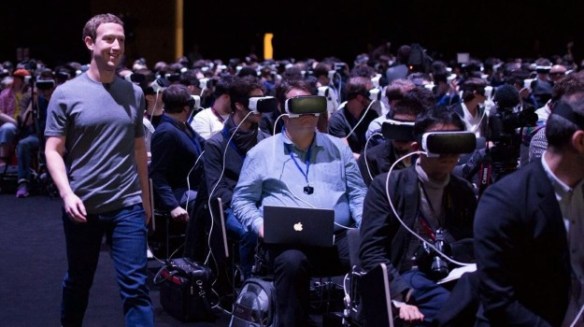
zuckerberg_VR_people-625x350

Technology promised to set us free. Instead it has trained us to withdraw from the world into distraction and dependency

By Nicholas Carr

Source: Aeon

It was a scene out of an Ambien nightmare: a jackal with the face of Mark Zuckerberg stood over a freshly killed zebra, gnawing at the animal’s innards. But I was not asleep. The vision arrived midday, triggered by the Facebook founder’s announcement – in spring 2011 – that ‘The only meat I’m eating is from animals I’ve killed myself.’ Zuckerberg had begun his new ‘personal challenge’, he told Fortune magazine, by boiling a lobster alive. Then he dispatched a chicken. Continuing up the food chain, he offed a pig and slit a goat’s throat. On a hunting expedition, he reportedly put a bullet in a bison. He was ‘learning a lot’, he said, ‘about sustainable living’.

I managed to delete the image of the jackal-man from my memory. What I couldn’t shake was a sense that in the young entrepreneur’s latest pastime lay a metaphor awaiting explication. If only I could bring it into focus, piece its parts together, I might gain what I had long sought: a deeper understanding of the strange times in which we live.

What did the predacious Zuckerberg represent? What meaning might the lobster’s reddened claw hold? And what of that bison, surely the most symbolically resonant of American fauna? I was on to something. At the least, I figured, I’d be able to squeeze a decent blog post out of the story.

The post never got written, but many others did. I’d taken up blogging early in 2005, just as it seemed everyone was talking about ‘the blogosphere’. I’d discovered, after a little digging on the domain registrar GoDaddy, that ‘roughtype.com’ was still available (an uncharacteristic oversight by pornographers), so I called my blog Rough Type. The name seemed to fit the provisional, serve-it-raw quality of online writing at the time.

Blogging has since been subsumed into journalism – it’s lost its personality – but back then it did feel like something new in the world, a literary frontier. The collectivist claptrap about ‘conversational media’ and ‘hive minds’ that came to surround the blogosphere missed the point. Blogs were crankily personal productions. They were diaries written in public, running commentaries on whatever the writer happened to be reading or watching or thinking about at the moment. As Andrew Sullivan, one of the form’s pioneers, put it: ‘You just say what the hell you want.’ The style suited the jitteriness of the web, that needy, oceanic churning. A blog was critical impressionism, or impressionistic criticism, and it had the immediacy of an argument in a bar. You hit the Publish button, and your post was out there on the world wide web, for everyone to see.

Or to ignore. Rough Type’s early readership was trifling, which, in retrospect, was a blessing. I started blogging without knowing what the hell I wanted to say. I was a mumbler in a loud bazaar. Then, in the summer of 2005, Web 2.0 arrived. The commercial internet, comatose since the dot-com crash of 2000, was up on its feet, wide-eyed and hungry. Sites such as MySpace, Flickr, LinkedIn and the recently launched Facebook were pulling money back into Silicon Valley. Nerds were getting rich again. But the fledgling social networks, together with the rapidly inflating blogosphere and the endlessly discussed Wikipedia, seemed to herald something bigger than another gold rush. They were, if you could trust the hype, the vanguard of a democratic revolution in media and communication – a revolution that would change society forever. A new age was dawning, with a sunrise worthy of the Hudson River School.

Rough Type had its subject.

The greatest of the United States’ homegrown religions – greater than Jehovah’s Witnesses, greater than the Church of Jesus Christ of Latter-Day Saints, greater even than Scientology – is the religion of technology. John Adolphus Etzler, a Pittsburgher, sounded the trumpet in his testament The Paradise Within the Reach of All Men (1833). By fulfilling its ‘mechanical purposes’, he wrote, the US would turn itself into a new Eden, a ‘state of superabundance’ where ‘there will be a continual feast, parties of pleasures, novelties, delights and instructive occupations’, not to mention ‘vegetables of infinite variety and appearance’.

Similar predictions proliferated throughout the 19th and 20th centuries, and in their visions of ‘technological majesty’, as the critic and historian Perry Miller wrote, we find the true American sublime. We might blow kisses to agrarians such as Jefferson and tree-huggers such as Thoreau, but we put our faith in Edison and Ford, Gates and Zuckerberg. It is the technologists who shall lead us.

Cyberspace, with its disembodied voices and ethereal avatars, seemed mystical from the start, its unearthly vastness a receptacle for the spiritual yearnings and tropes of the US. ‘What better way,’ wrote the philosopher Michael Heim in ‘The Erotic Ontology of Cyberspace’ (1991), ‘to emulate God’s knowledge than to generate a virtual world constituted by bits of information?’ In 1999, the year Google moved from a Menlo Park garage to a Palo Alto office, the Yale computer scientist David Gelernter wrote a manifesto predicting ‘the second coming of the computer’, replete with gauzy images of ‘cyberbodies drift[ing] in the computational cosmos’ and ‘beautifully laid-out collections of information, like immaculate giant gardens’.

The millenarian rhetoric swelled with the arrival of Web 2.0. ‘Behold,’ proclaimed Wired in an August 2005 cover story: we are entering a ‘new world’, powered not by God’s grace but by the web’s ‘electricity of participation’. It would be a paradise of our own making, ‘manufactured by users’. History’s databases would be erased, humankind rebooted. ‘You and I are alive at this moment.’

The revelation continues to this day, the technological paradise forever glittering on the horizon. Even money men have taken sidelines in starry-eyed futurism. In 2014, the venture capitalist Marc Andreessen sent out a rhapsodic series of tweets – he called it a ‘tweetstorm’ – announcing that computers and robots were about to liberate us all from ‘physical need constraints’. Echoing Etzler (and Karl Marx), he declared that ‘for the first time in history’ humankind would be able to express its full and true nature: ‘we will be whoever we want to be.’ And: ‘The main fields of human endeavour will be culture, arts, sciences, creativity, philosophy, experimentation, exploration, adventure.’ The only thing he left out was the vegetables.

Such prophesies might be dismissed as the prattle of overindulged rich guys, but for one thing: they’ve shaped public opinion. By spreading a utopian view of technology, a view that defines progress as essentially technological, they’ve encouraged people to switch off their critical faculties and give Silicon Valley entrepreneurs and financiers free rein in remaking culture to fit their commercial interests. If, after all, the technologists are creating a world of superabundance, a world without work or want, their interests must be indistinguishable from society’s. To stand in their way, or even to question their motives and tactics, would be self-defeating. It would serve only to delay the wonderful inevitable.

The Silicon Valley line has been given an academic imprimatur by theorists from universities and think tanks. Intellectuals spanning the political spectrum, from Randian right to Marxian left, have portrayed the computer network as a technology of emancipation. The virtual world, they argue, provides an escape from repressive social, corporate and governmental constraints; it frees people to exercise their volition and creativity unfettered, whether as entrepreneurs seeking riches in the marketplace or as volunteers engaged in ‘social production’ outside the marketplace. As the Harvard law professor Yochai Benkler wrote in his influential book The Wealth of Networks (2006):

This new freedom holds great practical promise: as a dimension of individual freedom; as a platform for better democratic participation; as a medium to foster a more critical and self-reflective culture; and, in an increasingly information-dependent global economy, as a mechanism to achieve improvements in human development everywhere.

Calling it a revolution, he said, is no exaggeration.

Benkler and his cohort had good intentions, but their assumptions were bad. They put too much stock in the early history of the web, when the system’s commercial and social structures were inchoate, its users a skewed sample of the population. They failed to appreciate how the network would funnel the energies of the people into a centrally administered, tightly monitored information system organised to enrich a small group of businesses and their owners.

The network would indeed generate a lot of wealth, but it would be wealth of the Adam Smith sort – and it would be concentrated in a few hands, not widely spread. The culture that emerged on the network, and that now extends deep into our lives and psyches, is characterised by frenetic production and consumption – smartphones have made media machines of us all – but little real empowerment and even less reflectiveness. It’s a culture of distraction and dependency. That’s not to deny the benefits of having easy access to an efficient, universal system of information exchange. It is to deny the mythology that shrouds the system. And it is to deny the assumption that the system, in order to provide its benefits, had to take its present form.

Late in his life, the economist John Kenneth Galbraith coined the term ‘innocent fraud’. He used it to describe a lie or a half-truth that, because it suits the needs or views of those in power, is presented as fact. After much repetition, the fiction becomes common wisdom. ‘It is innocent because most who employ it are without conscious guilt,’ Galbraith wrote in 1999. ‘It is fraud because it is quietly in the service of special interest.’ The idea of the computer network as an engine of liberation is an innocent fraud.

I love a good gizmo. When, as a teenager, I sat down at a computer for the first time – a bulging, monochromatic terminal connected to a two-ton mainframe processor – I was wonderstruck. As soon as affordable PCs came along, I surrounded myself with beige boxes, floppy disks and what used to be called ‘peripherals’. A computer, I found, was a tool of many uses but also a puzzle of many mysteries. The more time you spent figuring out how it worked, learning its language and logic, probing its limits, the more possibilities it opened. Like the best of tools, it invited and rewarded curiosity. And it was fun, head crashes and fatal errors notwithstanding.

In the early 1990s, I launched a browser for the first time and watched the gates of the web open. I was enthralled – so much territory, so few rules. But it didn’t take long for the carpetbaggers to arrive. The territory began to be subdivided, strip-malled and, as the monetary value of its data banks grew, strip-mined. My excitement remained, but it was tempered by wariness. I sensed that foreign agents were slipping into my computer through its connection to the web. What had been a tool under my own control was morphing into a medium under the control of others. The computer screen was becoming, as all mass media tend to become, an environment, a surrounding, an enclosure, at worst a cage. It seemed clear that those who controlled the omnipresent screen would, if given their way, control culture as well.

‘Computing is not about computers any more,’ wrote Nicholas Negroponte of the Massachusetts Institute of Technology in his bestseller Being Digital (1995). ‘It is about living.’ By the turn of the century, Silicon Valley was selling more than gadgets and software: it was selling an ideology. The creed was set in the tradition of US techno-utopianism, but with a digital twist. The Valley-ites were fierce materialists – what couldn’t be measured had no meaning – yet they loathed materiality. In their view, the problems of the world, from inefficiency and inequality to morbidity and mortality, emanated from the world’s physicality, from its embodiment in torpid, inflexible, decaying stuff. The panacea was virtuality – the reinvention and redemption of society in computer code. They would build us a new Eden not from atoms but from bits. All that is solid would melt into their network. We were expected to be grateful and, for the most part, we were.

Our craving for regeneration through virtuality is the latest expression of what Susan Sontag in On Photography (1977) described as ‘the American impatience with reality, the taste for activities whose instrumentality is a machine’. What we’ve always found hard to abide is that the world follows a script we didn’t write. We look to technology not only to manipulate nature but to possess it, to package it as a product that can be consumed by pressing a light switch or a gas pedal or a shutter button. We yearn to reprogram existence, and with the computer we have the best means yet. We would like to see this project as heroic, as a rebellion against the tyranny of an alien power. But it’s not that at all. It’s a project born of anxiety. Behind it lies a dread that the messy, atomic world will rebel against us. What Silicon Valley sells and we buy is not transcendence but withdrawal. The screen provides a refuge, a mediated world that is more predictable, more tractable, and above all safer than the recalcitrant world of things. We flock to the virtual because the real demands too much of us.

‘You and I are alive at this moment.’ That Wired story – under headline ‘We Are the Web’ – nagged at me as the excitement over the rebirth of the internet intensified through the fall of 2005. The article was an irritant but also an inspiration. During the first weekend of October, I sat at my Power Mac G5 and hacked out a response. On Monday morning, I posted the result on Rough Type – a short essay under the portentous title ‘The Amorality of Web 2.0’. To my surprise (and, I admit, delight), bloggers swarmed around the piece like phagocytes. Within days, it had been viewed by thousands and had sprouted a tail of comments.

So began my argument with – what should I call it? There are so many choices: the digital age, the information age, the internet age, the computer age, the connected age, the Google age, the emoji age, the cloud age, the smartphone age, the data age, the Facebook age, the robot age, the posthuman age. The more names we pin on it, the more vaporous it seems. If nothing else, it is an age geared to the talents of the brand manager. I’ll just call it Now.

It was through my argument with Now, an argument that has now careered through more than a thousand blog posts, that I arrived at my own revelation, if only a modest, terrestrial one. What I want from technology is not a new world. What I want from technology are tools for exploring and enjoying the world that is – the world that comes to us thick with ‘things counter, original, spare, strange’, as Gerard Manley Hopkins once described it. We might all live in Silicon Valley now, but we can still act and think as exiles. We can still aspire to be what Seamus Heaney, in his poem ‘Exposure’, called inner émigrés.

A dead bison. A billionaire with a gun. I guess the symbolism was pretty obvious all along.

Why Are There So Many Psychopaths in Positions of Power?

what-people-think-psychopaths-are-streetdemocracy

By Anna LeMind

Source: Waking Times

A 2010 study that examined a sample of 203 individuals from different companies’ management development programs revealed something interesting. It was found that about 3% of business managers scored in the psychopath range while the incidence of psychopathy in the general population is approximately 1%. So why are there so many psychopaths in senior management positions?

The Study

A more recent study, published in 2014 in the Journal of Forensic Psychiatry and Psychology, shed new light on the behavior of psychopaths, which could explain this phenomenon.

During an experiment, a group of people were given a standard test of psychopathy. At the same time, the participants were shown a series of picture aimed to test their levels of empathy. For this purpose, the researchers measured their galvanic skin response to examine their emotional reaction to the shown pictures.

The research showed that psychopaths with average or high levels of intelligence were able to control their galvanic skin response. As a result of this, their responses appeared normal. At the same time, psychopaths with low IQ exhibited abnormal test results, which are typical for individuals with psychopathic tendencies.

What the Results Mean

Psychopaths are great manipulators, and this research provides new evidence for that. The results of the study suggest that psychopaths with high IQs are able to hide their true identity, faking their emotional responses and probably personality traits as well. As a result, they often show a different picture of themselves and trick others into believing this is their real self.

Carolyn Bate, the first author of the study, said:

“The ones who are at the top of businesses are often charming and intelligent, but with emotional deficits, as opposed to psychopaths who are quite erratic and tend to commit gruesome crimes and are often caught and imprisoned.”

She also thinks that psychopaths in positions of power could be far more than 3%, because if people are aware they are psychopathic they can also lie – they are quite manipulative and lack empathy.”

These findings are quite interesting to consider and could apply to other spheres except for the business world. I’m sure that if psychologists had the opportunity to study those in positions of political power, the figure would go beyond 3%. Being manipulative and able to fake one’s emotions is a quality that certainly helps one become a successful politician. Not even to mention that in order to reach the highest levels of political power, some lack of empathy and conscience is a must.

Dr. Paul Babiak writes in his book, Snakes in Suits: When Psychopaths Go to Work:

They are masters of impression management; their insight into the psyche of others combined with a superficial – but convincing – verbal fluency allows them to change their situation skillfully as it suits the situation and their game plan.”

Doesn’t this sound like most of our politicians? They are just playing their game, tricking people into believing that their concerns about the world and society are sincere. They pretend to care while in reality, they only want more power and money. And we don’t even need a study to know this for sure.

Resistance is Fertile: The Art of Having No Masters

518d2cb7d767433a327846150d5be280

By Gary ‘Z’ McGee

Source: Waking Times

“You don’t become completely free by just avoiding being a slave; you also need to avoid becoming a master.” ~Naseem Nicholas Taleb

In the midst of a hyper-violent culture blinded by the statist agenda of control, militarized cops brainwashed by the statist notion of law and order, and a bloated military with the monopoly on power through tyranny, it’s difficult for the would-be-resister to live with any confidence that their freedom will not be compromised by the violent thugs in power or by the indoctrinated statists that represent the majority.

Difficult time to be free. Made even more difficult because of the level of psychosocial statist programming causing the majority to believe that everything is okay as long as they keep voting. Caught up in their hyper-realities, going through the motions of being an abstraction of an abstraction, the ignorant statists are convinced that everything is just fine, that the authority of the state is necessary, that the militarization of the police will help keep them protected, that an obese, money-sucking, terrorist-generating military will somehow make them more secure. What is this, 1984? What’s next? War is peace? Freedom is slavery? Ignorance is strength? Sadly, in some ways, we’re already there.

The problem with statism is that everything seems okay inside the bubble, but the bubble is always about to burst. Statism is slavery by consent. It hoodwinks people into enjoying their servitude. It (brain)washes out logic and reasoning through nationalism and patriotism, thus scrambling the ignorant statist’s brain into exploitable soup. Bombarded by state-engineered symbols that the statist marries their fragile ego to, statism is by far the most dangerous religion. Made all the more dangerous because people are born and bred into being statists and cannot even imagine thinking outside its box.

But resistance is not futile. It only seems that way because we are surrounded by the Goliath that is the state. No, on a long enough timeline, resistance is fruitful. Resistance always has, and always will, lead to human flourishing. It might not always be pretty, but resistance to any and all standing orders (manmade laws), is the key to a healthy, sustainable, and progressive evolution for our species.

The art of having no masters is perfecting the science of resistance. But resistance isn’t fairytale romantic. It’s not pretend confliction. It takes effort. It takes perseverance. It takes counterintuitive ruthless compassion, usually in the face of those you care about. Definitely not for the faint of heart. But, then again, having a faint heart is for statists who imagine they need a master, not for anarchists who know they need only master themselves. Yes, resistance is fertile but, more than anything, it’s courageous, uncomfortable, and dangerous.

Let’s break it down…

Resistance is Courageous

“I’d rather attempt to do something great and fail than to attempt to do nothing and succeed.” ~Robert H. Schuller

The art of having no masters cannot be rationalized until one has the audacity to question things as they are. As Chomsky famously stated, “The general population doesn’t even know what’s happening, and it doesn’t even know that it doesn’t know.” Indeed. Until the individual stands up and dares to jut his/her head above the sea of status quo conformity, they will continue to be ruled. But being ruled, or not, is always a state of mind. Until the individual has the audacity to change their state of mind to self-rule despite those who seek to rule them, their “soft slavery” will continue.

Statism is the epitome of soft slavery. Statists are like house slaves. There just happen to be a lot more of them, and the “house” is the state. As long as the house slave (statist) doesn’t disobey the house master (the state), they live relatively comfortable and secure lives. All their needs are met. Except, of course, the need for freedom and self-ownership.

Thus, it takes a particular flavor of courage to rise above the comfort and security in order to actualize self-mastery. The statist who merely goes along with the state’s agenda, attempts nothing great, and succeeds. The anarchist who rises above the washed-out conformity of it all, attempts something great and, though he may fail, he at least gains self-authority and takes his first steps toward self-mastery and perfecting the art of having no masters.

Resistance is Uncomfortable

“To live by the dice or accept death with confidence requires a consummate self-possession, which is the essence of character. No one becomes a hero staying at home, going to the office, or attending church.” ~Michael Dirda

The art of having no masters is not a pleasant art. It is in all ways disruptive. It is completely unsettling. Much cognitive dissonance must be successfully navigated. And there are always setbacks. Because the art of having no masters means having the courage to (at least attempt to) master the individual self, despite those who seek to rule the individual’s self, it is never comfortable. Though one can glean much comfort out of owning oneself, it’s never easy. Especially in a world that thinks everything should be owned.

One is constantly outnumbered. Whether it’s the giant goliath of the state itself or the tiny goliath of the inured statist, it can be painfully and awkwardly uncomfortable. But resisting those who would rule you was never meant to be comfortable. As Brene’ Brown stated, “You can have courage or you can have comfort, but you can’t have both.”

Indeed. Those seeking to perfect the art of having no masters must embrace the discomfort that comes with rocking the boat. It’s a double-edged sword, for sure. On the one side is sweet freedom, but on the other side is taking the painful responsibility for that freedom. But the genuinely autonomous, the authentic seekers of freedom, the true anarchists, will always choose to stab themselves with that double-edged sword, no matter how uncomfortable or painful it might be. Thereby taking the next step toward self-mastery and further perfecting the art of having no masters.

Resistance is Dangerous

“The Matrix is a system, Neo. That system is our enemy. But when you’re inside, you look around, what do you see? Businessmen, teachers, lawyers, and carpenters; the very minds of the people we are trying to save. You have to understand, most of these people are not ready to be unplugged. And many of them are so inured, so hopelessly dependent upon the system, they will fight to protect it.” ~Morpheus, The Matrix

If resistance is dangerous, then the art of having no masters is doubly dangerous. Especially in a world where the majority of the people are dead-set on having masters. In a world where the majority are convinced they need a queen, or a king, or a president, it makes it problematic for those who are seeking to take responsibility for their own power and who are teaching self-leadership. It’s dangerous because people are afraid of what they don’t understand. And the majority of people simply cannot understand a world without rulers and masters. Talk about not being able to think outside the box, let alone the Matrix.

Everyone wants to give their power to an authority, never stopping to think that authority should be themselves. Everyone wants to be Neo, but nobody wants to take responsibility for their own power. Sure, give credit where credit is due (as Neo did with Morpheus), for true leadership is an honorable thing indeed, but not to the extent that your freedom is discredited and your power is taken away. Self-empowerment is the key to unlocking the door of having no masters. And it leads to authentic leadership.

With all these people giving up their power, in Stockholm-syndrome-esque proportions, it makes it difficult for the would-be self-master to work on his/her self-mastery. But work on it they should. We need more leaders who are able to resist. We need more courageous individuals who are not afraid of getting uncomfortable or facing the danger of being right when the majority of people are wrong. We need more self-empowered individuals seeking to empower others, despite a world that’s attempting to take that power away. We need more trailblazers who are not afraid to spearhead self-authority straight through the heart of state-authority. We need leaders who have the audacity to teach self-leadership and self-rule through self-empowerment, despite the state which only seeks to rule by the illusion of authority through the overreach of violent power.

In short: we need more people who care about life to resist those who do not, because life is freedom and freedom is life. That is the heart and soul of the art of having no masters. As Derrick Jensen said, “We are the governors as well as the governed. This means that all of us who care about life need to force accountability onto those who do not.”

We Don’t Need A Government, We Need A Purpose

psychedelic-trippy-abstract-art-poster-soul-universe-time-cameron-gray-font-b-spiritual-b-font-art

By Lance Schuttler

Source: The Mind Unleashed

What truly motivates a person? Years ago I would have answered, “well, money of course. Money helps to to be able to pay for our food, shelter, some entertainment and allows us to (sometimes) further our education.”

While that answer is true in ways, today I would take it further and say that a purpose is what motivates us. It is not that money itself it motivating for us, but it is the security money can provide by allowing us to pay for our basic needs like food, shelter and clothing.

From our childhood, we have been conditioned to believe that it is necessary to have money and the institutions that direct the flow of money to the greater populace. However, if we analyze that deep enough, we see that it is a fact that such a means of rationing resources (which money does) and the institutions that control the rationing are not necessary, but are by choice.

Sure, in some ways government has served it’s purpose. It has allowed us to build an infrastructure on this planet where we can travel pretty much wherever we would like. It has also built schools, hospitals and allowed for the creation of all sorts of public services as well as public entertainment. However, what is important to remember is that it wasn’t governments who built these things. It was people. People made the choice each and every morning to wake up and go to their job to help create whatever it was they were working on.

Though money was almost certainly and incentive for many of these people, I believe that we human beings have an innate desire to help serve a greater cause. Perhaps for many of these people, an additional incentive for doing their work was that they knew on a deeper level, that this was in some way, big or small, to allow our civilization to develop and grow in a positive direction.

In today’s world, with the internet, 3-D printing and the ability to harness unlimited energy for the entire world in the forms of solar, wind, tidal and geothermal, not to mention the numerous patented “free energy” devices which are currently suppressed, the need for money and government has passed us. We no longer need money as a way to ration resources when we have the technology to create unlimited abundance for everyone on the planet. With no longer needing money, we no longer need a system such as governance who acts as the hub of rationing these resources through the means of money. 

While I do not think that immediately stopping the usage of money and governance simultaneously around the world would be a wise or even positive decision in the short-term, I do believe that we could easily begin the process of scaling these back tremendously with the intention of completely ridding them of our reality. 

It is no secret that many people today do not like their jobs or the work they do. However, people realize that the money that is paid to them allows them to pay for a place to live and for food to eat, which in turn allows them to continue their life. In a very real way, many people are working a job they couldn’t care less about, just in order to stay alive. Some say, “well, that’s life. Get used to it.” Or, “You have to work. Stop complaining.”

I say, “with the technology we have today that could easily provide abundance in all forms for every person on this planet, it is counter-productive to use our time doing things we do not enjoy doing.” If you knew that if we as a planet really want to, we can cleanly power the entire world, which will allow us to grow the food and resources needed to feed, house and clothe everyone. This in turn will allow the basic needs of everyone to be met. From there, we will stop doing the work we’ve been doing to earn the money, which in turns allows us to pay for our basic needs.

At that point, we will start doing things that are passionate about. We will move away from the need of a government and move into finding what is of purpose for us. Perhaps at that point we can move from competition to cooperation. We can begin to heal ourselves, our family and friends. We can then begin to heal our pets, the water and land of the Earth. We can create a truly peaceful paradise.

For those arguing, “this sounds like communism,” I say, “this has nothing to do with politics or money and is several levels evolved past such barbaric methods.” Remember, communism is a political system who also has been enslaved via the monetary system, just as every other political system has been, whether that is capitalism, feudalism, communism or fascism.

Again, powering, feeding, clothing and housing the entire world has nothing to do with politics. It does, however, have everything to do with the human spirit and the deservability that each person naturally has. Remember, we are human beings living on a planet that is flying through our solar system, who receives it’s warmth from a massive ball of gas known as the Sun. We are human beings. We are each a miracle. This planet’s existence is a miracle. We needn’t do a thing but simply exist to deserve the abundance this Earth can and one day will easily provide to all of us.

With that, I ask you: What is it that you can do, whether as a “job” or as a hobby that allows you feel a sense of purpose? What do you get passionate about? Maybe you are already in your purpose.

I do believe strongly that with the advancements we have made and continue to make technologically, but most importantly emotionally/spiritually, we are beginning the transition away from a monetary world and into a world where abundance, peace and purpose are the norm. What can you do to help add to this momentum?

Pokémon and the Age of Augmented Hyper-Surreality

maxresdefault

By Luther Blissett

Imagine walking to a park in a fairly average medium-sized city on a warm Summer day. There you see groups, pairs and individuals of different ages and races slowly milling about, some with dogs, some with baby carriages. Approaching closer, you realize nearly everyone in the park other than yourself is staring intently at their phone, occasionally tapping and swiping the screen. It seems odd, though not completely out of the ordinary in this day and age. Then, off in the distance at the far end of the park, someone shouts what sounds like a word in an alien language or dialect triggering a crowd to rapidly swarm towards the general area; most speed-walking or jogging but all aiming their phones at the same destination. Soon everyone in the vicinity of the park (except yourself a few vagrants and junkies of a less tech-savvy sort) surges towards the center of the swarm of over a hundred participants as if sucked into a vortex. As quickly as it started, the crowd disperses and an “normalcy” resumes, albeit temporarily since the pattern repeats continuously at half hour to one hour intervals throughout different areas of the park.

This dream-like scenario is an outsider’s description of a Pokémon Go session on a typical Summer weekend at Bellevue Downtown Park. The crowd might have been slightly larger than usual due to the balmy weather, but numerous videos posted on YouTube indicate such occurrences aren’t completely anomalous.

An example:

Still, the relative newness and novelty of the experience doesn’t make it feel any less like being in a dystopian narrative such as a Philip K. Dick novel or an episode of Charlie Brooker’s “Black Mirror”. However, the sense of social displacement and alienation for non-gamers is dampened by nearly a decade of collective exposure to increasingly advanced internet-enabled cellphones whose ubiquity and usage has steadily increased over the years.

Prior to the release of Pokémon Go more people have been spending increasing hours using smartphones for talking, texting, email, news, entertainment and social media, selfies, etc. In the context of modern industrial society it’s almost an aberration to be without a device, or to not be heavily reliant on one. What sets Pokémon Go apart is its ability to simulate a fusion of material and virtual worlds by depicting through phone screens digital sprites superimposed on real-time images of physical environments to its users.

Just as shamans would use entheogens to peer behind the veil of reality, augmented reality allows users to perceive additional veils over reality. This is not necessarily a bad thing because there’s potential for “digital veils” to assist us in seeing what certain interests might prefer to keep hidden. For example, what if everyone could literally see the interests orchestrating a politician’s rise to power? What if we could walk into any store and instantly know which products were made by war-profiteers, polluters, and/or sweatshop owners? Would people want to know? How much of an impact would it have on decisions and actions in the context of a media environment inundated with heavily financed government/corporate PR and marketing? Of course, even without augmented reality the virtual realm affects the “real world”, most notably with the economic dominance of the tech industry as well as the social, political and economic havoc wreaked by hackers; but rarely is such influence immediately manifested as when crowds swarm newly spawned Pokémon sprites.

In many ways, Pokémon Go was the ideal vehicle to bring augmented reality to the masses. Many apps have utilized it for different purposes such as navigating, translating, finding dates, viewing celestial objects, narrating self-guided tours, weather forecasting, image enhancement, etc., but only Pokémon was able to use the technology to bring a fictional universe closer to life by creating a cross-generational craze. Alfie Brown of ROAR Magazine, characterized virtual Pokémon as the perfect example of what Jacques Lacan called the objet petit a, a fetishized yet ephemeral and unobtainable object of desire, a key concept behind consumerist neoliberalism’s push towards cheap, chronically obsolete, ephemeral and now digital goods and services.

But what makes Pokémon creatures so desirable? In regard to children, they seem naturally drawn towards cute and brightly colored cartoon characters. The mechanics of the game taps into natural tendencies to collect things and to display one’s collection to others (a phenomenon South Park astutely critiqued on episodes lampooning World of Warcraft and “freemiums”). In consumer societies children and adults are prone to feeling prestige and power from the size and perceived value of their collections; however, children are mostly limited in terms of the acquisitive power: video games elicit a rare opportunity to gain more prestige and power than adults have in real life.

As for older folks, there’s a variety of additional interconnected factors. For teens and young adults, peer pressure alone might be enough to hook some people, but the mainstreaming of geek culture no doubt plays a part, making fandom, quirkiness and technological obsession more accepted and valued. The transition to adulthood also happens to be a time when there’s increased pressure to establish one’s sense of identity, become more independent and to succeed academically and professionally. Games are a means of escape from such pressures (as real life opportunities for economic advancement continue to dwindle) while at the same time functioning as structured activities for social interaction and, more broadly, to build communities. For adults, reasons may include all of those previously mentioned in addition to fascination with technology, bonding with younger friends and family, the feeling of being part of a global phenomena, or nostalgia for the original Pokémon games, for example.

Returning to Pokémon Go’s more dystopian aspects, the game has been used as a tool by the unscrupulous for crimes such as robbery and sexual assault. Though crowds created by Pokémon Go spawning areas or “gyms” (locations where players battle each other in teams to increase their avatars’ abilities) have been a benefit to some local businesses, residential neighbors in some cases view game players as unwanted loiterers invading their privacy. There have also been news reports of video game battles escalating to physical brawls and innocent gamers being racially profiled as suspicious threats.

As with most online tools, there’s a risk of the app and users being exploited for surveillance, social control, to extract money and personal data, etc. Modern media literacy requires an understanding of how businesses benefit from our use of game and service apps (especially “free” ones) and how intentional or unknowing misuse of collected data could serve government/corporate/criminal interests. Augmented reality games are an exciting new media with potential to be used in novel and fun ways, but we should be vigilant of its potential to influence beliefs as well as decisions regarding how we spend time and resources.

Pokémon Go is at the forefront of the increasing power of tech companies such as Google and Niantic (the software developer behind Pokémon Go) to control and use information to manipulate the masses. Such power in itself is disturbing, but more sensational examples might include news reports of car accidents caused by drivers mindlessly following Google Maps off the road or colliding into other cars while playing Pokémon Go. Such cases may seem absurd but they prompt a number of important questions. Why do some prioritize and trust mediated information over their own senses? As online personas increase in perceived importance, at what lengths will people go to sustain it and would it be at the expense of others things (such as personal safety)? Are we becoming addicted to cognitive “skinner boxes” with our needs perpetually triggered and gratified by apps? In an increasingly hyperreal world in which the boundary between the real and virtual becomes more permeable, what new hazards await?