THE ART OF THE UNDECEIVED

Strong confident woman.

By Gary Z McGee

Source: Waking Times

“Here the ways of men divide. If you wish to strive for peace of soul and happiness, then believe; if you wish to be a disciple of truth, then search.” ~Nietzsche

What does it mean to be undeceived?

To a certain extent, we are always deceived. For we are only human, all too human. But to the extent that we can become aware of deception—both self-deception and the deception of others—being undeceived means being ahead of the curve of the human condition.

First, it means embracing deception as an integral part of life. Then it means being strategically circumspect while creating your own meaning. It means taking everything that you’ve learned into consideration with humility and a good sense of humor. It means becoming so healthy that your very existence is a catalyst for healthy change. It means connecting courage to curiosity. It means taking a leap of courage. It means putting things into proper perspective by using health as a benchmark.

It is, paraphrasing Bruce Lee, “absorbing what is useful, discarding what is not, and adding what is uniquely your own.” Let’s break it down…

Absorb what is useful:

“If everyone is thinking alike, then no one is thinking.” ~Benjamin Franklin

What is useful? Well, if your goal is not only basic survival but also progressive evolution, then what is useful is what is healthy. Contrastingly, what is not useful is what is unhealthy.

So, how do you figure out what is healthy or not? Through logic, reason, and critical thinking. You cannot wish something into being healthy. You cannot simply believe something is healthy and, by your strong faith alone, expect it to be valid. You can only reason through if something is healthy or not. Once you have reasoned a thing to be healthy, you free yourself to absorb what is useful.

Absorbing what is useful is absorbing what is healthy. The path is then clear to question with a good conscience. You become undeceived. In a state of undeception, you are free to wield the question mark sword, the Sword of Truth, and to use it in a way that distinguishes what’s healthy from what’s not.

What is healthy is absorbed as something useful for progressive evolution. What is unhealthy can then be discarded as something useless, so as to avoid an unhealthy society.

Discard what is not useful:

“A fool thinks himself wise, a wise man knows himself to be a fool.” ~William Shakespeare

Discarding what is not useful (what is unhealthy) requires self-discipline. It requires vigilance. Most people don’t even know that they don’t know the difference between healthy and unhealthy. Especially people who have grown up, culturally conditioned and indoctrinated, in a profoundly sick society.

How do you know if you were born into a profoundly sick society?

1.) Any society that pollutes the air it needs to breathe is a profoundly sick society.

2.) Any society that pollutes the water it needs to drink is a profoundly sick society.

3.) Any society that pollutes the food it needs to eat is a profoundly sick society.

4.) Any society that pollutes the minds it needs to evolve with is a profoundly sick society.

You must have the self-discipline to daily question what is healthy and what is not. For health is not a matter of opinion. Health is a benchmark. Without this benchmark, you cannot discern what is useful from what is not useful.

As such, belief and certainty are the greatest obstacles blocking us from being able to discard what is not useful. This is especially dangerous when those beliefs and certainties are derived from the cultural conditioning of a profoundly sick society. Hence the importance of vigilance and strategic prudence.

In order to remain undeceived, we must remain circumspect. The Sword of Truth must be unleashed daily so that it may cut through the red tape of wishful thinking, irrational beliefs, and whimsical certitude.

It is only when our naïve beliefs have been shattered upon the hard concrete of reality that we are free to distinguish between what is healthy and what is not. As we begin to piece things together, we become undeceived. We are liberated to absorb what is useful and discard what is not.

Add what is uniquely your own:

“Small minds discuss people. Average minds discuss events. Great minds discuss ideas.” ~Henry Thomas Buckle

Once you have successfully threshed the chaff (unhealthy/useless) from the grain (healthy/useful), you are free to unleash your creativity. From swords to plowshares, your Sword of Truth becomes a Pen of Truth. With it, you are free to create high art; art that shatters molds, stretches comfort zones, and initiates wake up calls. You become free to prove why the pen will always be mightier than the sword.

Here, still, we must remain vigilant. For even art can become dogmatic. In order not to be deceived, we must always be in a state of questioning what we think we know and weighing it against the nonnegotiable scales of healthy/unhealthy. Should our art become dogmatic, we would be wise to absorb what is useful from it and discard what is not. This way we will always be openminded and openhearted enough to add what is uniquely our own.

Outdated truth must die so that it doesn’t taint the updated truth of the times. God must die so that God can be reborn. Creativity thrives off the ashes of old art. Evolution progresses or stagnates in proportion to how creative we can be after having absorbed what is useful (healthy) and discarding what is not (unhealthy).

The art of being undeceived is more like the juggler’s art than the interrogator’s. It should be flexible and adaptable to meet results which are sudden and unexpected. The undeceived understand that the self is masks all the way down perceiving delusions all the way up, and they have the acumen and the wherewithal to juggle both masks and delusions into a state of high humor and even higher art.

We Won’t Be Free Until Our Minds Are Free

By Caitlin Johnstone

Source: CaitlinJohnstone.com

There’s a quote from an ancient Buddhist text called the Dhammapada that’s often translated as, “We are what we think. All that we are arises with our thoughts. With our thoughts we make the world.”

In other words our mental habits shape our personality and determine how that personality will behave, and that behavior contributes to the shaping of the world.

We see a similar line in the Upanishads of Hinduism: “As is your desire, so is your intention. As is your intention, so is your will. As is your will, so is your deed. As is your deed, so is your destiny.”

These are two different ways of expressing the same timeless observation we see pop up in various forms throughout philosophical traditions around the world: that our actions arise from our thoughts and our thoughts arise from our conditioned mental habits, so we need to be very careful about what those mental habits are since it will ultimately determine our destiny.

But the people who pour the most energy and attention into this timeless observation as a group are not the Buddhists, nor the Hindus, nor any religious or philosophical tradition at all. Those who are the most interested in studying and acting upon this insight are the powerful people who rule this world.

The powerful understand that because people’s actions follow from their thoughts and the destiny of the world follows from people’s actions, if you can control the thoughts people think at mass scale you can control the destiny of the world.

Control the way people collectively think about things and you can control the way they act, you can control the way they organize, and you can control the way they vote. This is important because people have become more literate and better at sharing information over the years, and therefore more aware of the value of freedom and equality, so it’s gotten harder and harder to deny them freedom and equality without sparking violent revolutions and winding up with your head in a basket.

Power structures of more “enlightened” societies have addressed this dilemma by giving people the illusion of freedom snd equality while still keeping them enslaved to the agendas of their rulers via mass-scale psychological manipulation. Media institutionsonline platforms and think tanks are dominated by plutocrats in coordination with secretive government agencies to ensure that the information the majority of people consume serves the social, political, military and geostrategic interests of the ruling power structure.

This is why when you watch the news on TV it always kind of feels like they are deceiving you; that’s exactly what’s happening. Information that is inconvenient for the powerful is omitted, while information that serves the powerful is amplified and twisted in the most convenient light possible.

This happens not because the media-controlling class is personally leaning over the shoulder of every news reporter and instructing them to lie, but because if you control who runs a media outlet then you control who they will hire and who they will elevate, naturally giving rise to a system wherein reporters understand that the only way for them to advance their careers is to promote narratives which serve the ruling power establishment and marginalize narratives which don’t.

The best way to manipulate people without their knowing it is to appeal to their strongest and most unconscious impulses. In practice this means tugging at the psychological hooks of the ego, which at their base level are fear and identity. If you’ve made a strong identity out of something like belonging to a certain political party or a certain ideological or ethnic group, then it will carry a lot of egoic weight for you. If you’re in a fear state then there will be a lot of egoic contraction and you’ll consequentially take your thoughts very seriously.

If you can appeal to people’s base impulses of fear and identification it becomes very easy to insert ideas into their minds and give them new mental habits, and that’s exactly what propagandists do. You need to fear the terrorists, the Russians and the Chinese, because they’re going to harm you. You need to support the Democratic Party and everything its pundits tell you, because that’s your tribe. Those anti-vaxxers over there are your real enemy, not the nuclear-armed globe-spanning power structure that is driving our world to its doom in myriad ways. And on and on and on.

They give us the illusion of freedom, but as long as they chain our minds with propaganda we are not free. It wouldn’t matter if they gave us every personal liberty imaginable if a critical mass of us were still thinking in ways which benefit the powerful, because those thoughts would cause us to act, organize and vote in a way that benefits our rulers and not us.

If we want to free our minds from the chains of power, it’s not enough to do research and memorize a bunch of facts about what’s really going on in our nation and our world. The most important step to freeing our minds from their shackles is to remove from ourselves the psychological hooks of fear and identity to which those shackles are attached. This means freeing ourselves from the delusions of egoic consciousness, which, funny enough, brings us right back around to the central tenets of Buddhism and Hinduism again.

As long as humanity is enslaved to the ego it will remain enslaved to abusive power structures, because manipulators will always be able to use our egoic hooks to propagandize us into supporting their interests at mass scale. Until then it won’t ultimately matter how many civil liberties we gain or lose, because we’ll still be unable to move beyond the bonds of our psychological chains.

Not until humanity collectively breaks free from the gravitational pull of egoic consciousness will we truly blast off into the real potentiality of our species.

THE UGLINESS (AND HIDDEN BEAUTY) OF REAL AWAKENING

By Gary Z McGee

Source: Waking Times

“In order to be effective truth must penetrate like an arrow—and that is likely to hurt.” ~Wei Wu Wei

The path toward true awakening is painful and bumpy. It’s not pretty. In fact, it can be downright ugly. There are egoic pitfalls. There are soul-snaring brambles. There are existential knots. The way is never clear, until it is. And even then, it usually turns out to be an illusion.

The path is not soft and sweet but jagged and elusive. It is not artificially blissful but authentically painful. The joy of discovery on the one side is deep and can be genuinely ecstatic, but the agony on the other side cuts to the soul and can be devastatingly dismal.

Real awakening is both a reckoning and a wrecking, both an expansion and an annihilation. It is not pretend reconciliation. Authentic awakening is painfully transcendent. It grips the soul by the throat and doesn’t let go. Infinity casts its hook, and you’re taken—hook, line, and sinker—into Growth.

The key is to remain flexible and circumspect. The secret is to somehow find comfort within the discomfort. Easier said than done, sure. But as Spinoza said, “All things excellent are as difficult as they are rare.”

Heartbreaking Cognitive dissonance:

“Make no mistake about it – enlightenment is a destructive process. It has nothing to do with becoming better or being happier. Enlightenment is the crumbling away of untruth. It’s seeing through the facade of pretense. It’s the complete eradication of everything we imagined to be true.” ~Adyashanti

The Ugliness: psychological discomfort, ignorance, the pain of being wrong.

Cognitive dissonance is a humdinger of a psychosocial malady. It’s a counterintuitive glitch in the matrix, causing us to believe that belief is black and white. It’s not. Belief is relative to the observer. And when the “observer” is a fallible, imperfect, barely evolved, naked ape who’s prone to be mistaken about a great many things, belief can be downright blinding.

Cognitive dissonance is merely the discomfort experienced when two incongruent worldviews clash. It accounts for our hidden fears, our willful ignorance, and our tendency to cling to our comfort zone. It shines a spotlight on our utter inept ability to shine a spotlight. It’s the psychosocial irony of ironies. Indeed. It reveals that we are the fly in the ointment.

The Hidden beauty: clarity, clearness, curiosity, recalibration.

But if we can embrace our cognitive dissonance, if we can reconcile the discomfort of having been wrong, and if we can correct our incorrections, a deep clarity overcomes us. We’re suddenly able to reprogram outdated programming.

An overwhelming relation to Socrates quip “The only thing I know is that I know nothing,” grips us—balls to bones, ovaries to marrow. And our mind opens so wide that the only thing that can fit is everything.

Soulbreaking Mortal dread:

“What is above knows what is below, what is below does not know what is above.” ~Rene Daumal

The Ugliness: mortality, impermanence, soulbreak.

Existential Angst can be a soul-crippling thing. Death is a precipice; one in which we all share a natural fear of “heights.” Our mortality is a slap in the face to our immortal dreams. We wear our mortal coils like choke chains around our necks, gasping in sheer terror at the impermanence of all things.

But we ignore it at our own detriment. The more we repress our existential angst the uglier it gets. It festers within, eating away at our logic and reasoning. It becomes a blister of suppressed darkness that mercilessly sucks in love and light. It makes us ugly despite the beauty of life.

The Hidden beauty: honesty, adaptability, fearlessness, love.

Truly waking up to our mortality is allowing death to put life into perspective. This is a double-edged sword that cuts as it heals. It cuts with honesty and truth. It heals with the same, but a robustness comes from it, a resilience is born, tantamount to antifragility.

When we shine a light onto our mortal dread, we make an ally of our shadow. Absolute vulnerability trumps naïve invulnerability. Fear is transformed into fuel for the fire (fearlessness) of falling in love with our preciously short life.

Dark Night of the Soul:

“Undifferentiated consciousness, when differentiated, becomes the world.” ~Vedanta

The Ugliness: the existential black hole, ego death, choking on the red pill of truth.

Honestly facing our flaws, our wrongness, and our mortality creates a void. This void is the place where our ego goes to die. Where before, we naively clung to our beliefs and worldview through sheer ignorance, now, our innocence is burned away and the existential black hole opens wide before us, fierce and menacing, and threatening to consume all meaning.

Here, the egoic perspective is in deep crisis. The certainties of life fall apart. The puzzle becomes terribly more puzzling. We choke on the red pill. It gets lodged in our throat. We falsely imagine that all we need is the blue pill to wash it down. But as the ego dies, the soul is being born.

The Hidden beauty: transcendence, nonattachment, Soul initiation.

When we face our wrongness and our mortality with dignity and honor, with humor and honesty, with love and appreciation, we discover our ability to adapt and overcome. Our ego is baptized by the soul, becoming a workhorse for selflessness and growth as opposed to selfishness and comfort.

We transcend egocentric codependence through soulcentric interdependence. We learn how not to take ourselves too seriously. For we see how everything is transitory. All things are fleeting. The be-all-end-all is always beginning and always ending. We have learned the wisdom of practicing detachment as a way to remain connected to everything else.

Crushing Nihilism:

“Only to the extent that we can expose ourselves over and over to annihilation can that which is indestructible in us be found.” ~Pema Chodron

The Ugliness: deconstructed invulnerability, meaninglessness, Master’s Complex.

The higher we rise in our soulwork, the more meaningless the universe becomes. This is a crushing truth for a truth seeker. In our naivete and youthful ignorance, we imagined a universe full of meaning and purpose. We imagined a heavenly blueprint and a loving masterplan. But then we faced our cognitive dissonance and our mortal dread. We experienced ego-death, and it all came unraveled. The unrealistic, pie-in-the-sky, magical thinking center simply could not hold.

We were faced with a decision: remain stuck in comforting deception or discover the heartbreaking truth; remain blissfully ignorant or discover painful knowledge. We chose the latter, and it made all the difference. Nihilism, ennui, meaninglessness was the price we paid, but it was a whetstone we honed our souls against and now we are sharp enough to cut God.

The Hidden beauty: humor, absolute vulnerability, responsibility, meaning creation.

True awakening is a heartbreaking, soul shattering, meaning crushing experience. The wise develop a loving sense of humor regarding the cruelty of the cosmic joke. They smile though their heart is breaking. They laugh though their soul is trembling. They create meaning despite the collapse of meaning.

As Joseph Campbell profoundly stated, “Suddenly you’re ripped into being alive. And life is pain, and life is suffering, and life is horror, but my god you’re alive and it’s spectacular.” Indeed. And it is this spectacular experience that launches us into a state of reverence for the sharpening of suffering greatly.

Sharpness does not just come to a knife. Luster does not just come to a pearl. Crystallization does not just come to a diamond. The knife must be tested. The grit must be rubbed. The coal must be pressurized. Had we not been sharpened, had we not been rubbed, had we not been pressured by a cruel universe, then all we would have is grit, coal, and dullness. But we took the ugliness of our awakening and we transformed it into the beauty of living a life well-lived.

Are We Human? Are We Free? Defeating The World Economic Forum’s ‘Great Reset’ Before It Destroys Us

By Robert J. Burrowes

For most people, 2020 will be remembered as the year of the ‘virus’ and 2021 will be remembered as the year of the ‘vaccine’.

What most people will probably never know is that 2021 is shaping to be the year in which humanity and freedom are both destroyed.

Not because a virus will kill us, because the virus does not exist. For just two of the myriad demonstrations of this point, see ‘COVID-19: The virus does not exist – it is confirmed!’ and ‘Statement On Virus Isolation (SOVI)’. And for an account of one researcher’s fruitless search over the course of a year to find evidence of an isolated virus, via Freedom of Information requests to 90 health/science institutions all over the world, watch ‘Does the Virus Exist? Has SARS-CoV-2 Been Isolated? Interview with Christine Massey’.

Rather, the injectable being marketed as a ‘vaccine’ will kill a substantial proportion of the human population – for one of the most straightforward explanations of this fact by three highly qualified experts (Professor Dolores Cahill, Dr Judy Mikovits & Dr Sherri Tenpenny) watch ‘The Truth about the Covid-19 Vaccine’ – and turn most others into a human relic, known technically as a ‘transhuman’ or, if you like, ‘cyborg’. See ‘Beware the Transhumanists: How “Being Human” is being Re-engineered by the Elite’s Covid-19 Coup’.

But while the injectable will have devastating consequences on the human population and must be strenuously resisted, it is the hidden and complementary measures being introduced by the criminal global elite under the guise of the World Economic Forum’s ‘Great Reset’ that will ensure the fundamental transformation of life for those humans and transhumans left alive.

If you doubt this, I can only invite you to read what ‘The Great Reset’ portends for humanity. If you want to read a summary, see: ‘Killing Democracy Once and for All: The Global Elite’s Coup d’état That Is Destroying Life as We Know It’.

In essence, the net outcome of the many measures that are being implemented, most of them ‘hidden’ behind the worldwide focus on the non-existent virus, will be a substantial human depopulation and enslavement of the rest. For more detail explaining what is already in train and how things will unfold, see the explanation, analysis and many references cited on ‘We Are Human, We Are Free’.

Options for Resistance

There are many options for resisting what is happening but most that are familiar are doomed to fail. Here, in brief, is why.

If you believe that mass protests will compel governments to respond to movement demands to cease implementing their heinous agenda, it would be useful for you to think a little more deeply about what is taking place. For a start, governments are not driving ‘The Great Reset’; it is an initiative of the global elite and governments are simply elite puppets. Moreover, movements that rely on mass protests only and which are focused too narrowly – such as on resisting lockdown measures, mandatory injection or ‘injection passports’ – cannot impact the elite program overall.

To do that, we need a combination of strategically-focused actions that undermine elite power to promote and implement its ‘Great Reset’ agenda which has very many components. And to achieve that outcome, protests are simply the wrong tactic (unless they are specifically used to raise awareness of strategic means of resisting ‘The Great Reset’ and its associated measures in relation to the fourth industrial revolution, eugenics and transhumanism).

If you believe that ‘democratic’ processes will save us, you might be interested to know that these have long been under the control of the global elite and simply provide a convenient mechanism for dissipating the dissent of those who are unaware. For a full explanation of this point, see ‘Killing Democracy Once and for All: The Global Elite’s Coup d’état That Is Destroying Life as We Know It’.

And if you believe that challenges through the legal system will deliver us justice, be aware that these too were long ago captured by the global elite and are used to thwart fundamentally progressive initiatives, whatever occasional victories (invariably on issues that do not concern the global elite) in limited jurisdictions appear to suggest otherwise. In any case, there is no court in the world that has jurisdiction to require the global elite to appear before it to answer for its many outstanding crimes against peace, war crimes and crimes against humanity, nor those crimes it is inflicting now. As discussed by a diverse range of scholars and activists in the 18th , 19th and early 20th centuries, the rule of law is the rule of elite violence. See ‘The Rule of Law: Unjust and Violent’.

Finally, if you believe that violence, in any form, will get us out of this mess, you are giving inadequate consideration to the preeminent geopolitical reality of our time: the military forces at the command of the global elite, starting with the national military forces, including nuclear arsenals, committed to the NATO Alliance. Not to mention the police forces of each jurisdiction. And given the elite agenda includes substantial depopulation, from their viewpoint how this occurs, militarily or otherwise, is really immaterial. So a key strategic consideration is devising the appropriate ways to mobilize military and police forces in support of us.

Given that military and police personnel have far more in common with the communities in which they live than they have in common with the global elite, history offers many examples in which thoughtful nonviolent activists were able to achieve this very effectively. Moreover, while it might be counterintuitive, strategic nonviolent struggle is superior to military violence, as strategic theory explains and history has demonstrated. See the Strategy of Nonviolent Defense: A Gandhian Approach.

Conclusion

In essence then, effective resistance to this elite coup depends on mobilizing enough ‘ordinary’ people to take the strategically-focused nonviolent action – essentially acts of noncooperation to thwart key elite initiatives – that will shift power from the global elite to us. No other option is genuinely realistic or has the sheer power to be as effective.

Hence, as part of the ‘We Are Human, We Are Free’ strategy, earlier this year Anita McKone and I launched ‘The 7 Days Campaign to Resist the Great Reset’, carefully explaining why each of the actions nominated was important in undermining elite power. And recently, Henna Maria in Spain created the beautiful flyers, outlining essential elements of the campaign, displayed with this article.

If you wish to play a vital role in the defence of humanity and human freedom, you are invited to undertake the actions indicated on these flyers, and share them with those who you think might be interested. Provided enough people take these actions on an ongoing basis, the global elite’s capacity to kill or enslave each one of us can be defeated.

What you choose to do, one way or the other, will help shape the fate of humanity.

Biodata: Robert J. Burrowes has a lifetime commitment to understanding and ending human violence. He has done extensive research since 1966 in an effort to understand why human beings are violent and has been a nonviolent activist since 1981. He is the author of ‘Why Violence?’ His email address is flametree@riseup.net and his website is here.

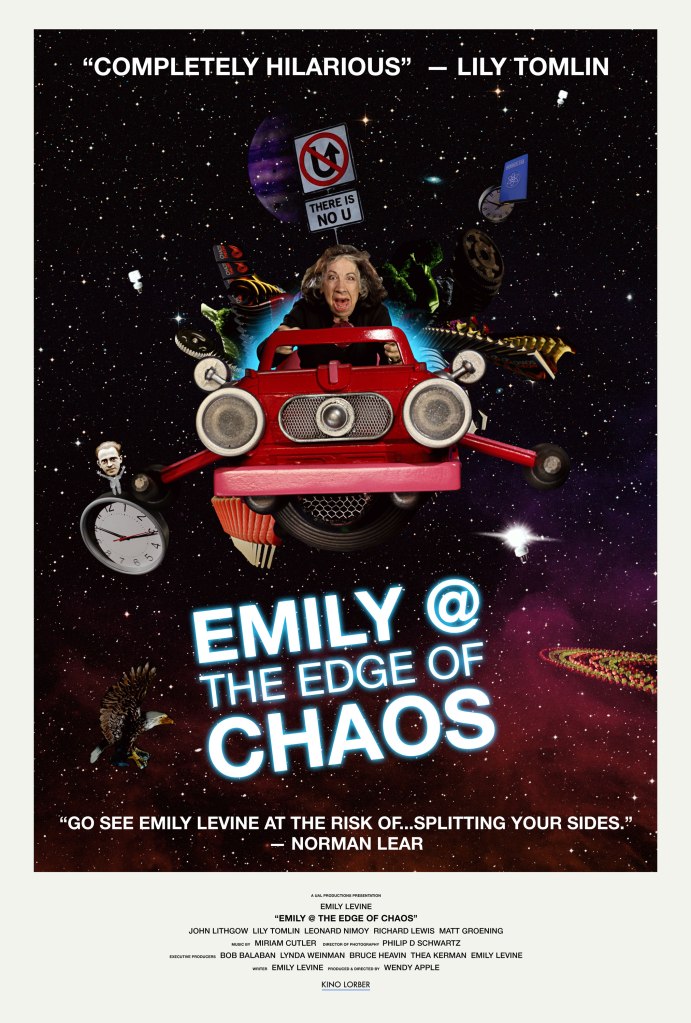
Saturday Matinee: EMILY @ THE EDGE OF CHAOS

Synopsis by Kino Lorber

The brilliantly illuminating Emily @ the Edge of Chaos interweaves Emily Levine’s live performance with animation, appearances by scientists, and animated characters (John Lithgow as Sir Isaac Newton, Lily Tomlin as Ayn Rand, Leonard Nimoy as Sigmund Freud, Richard Lewis as Aristotle, Matt Groening as Aldo Leopold). The film uses physics – which explains how the universe works – to explain our metaphysics – the story of our values, our institutions, our interactions. Using her own experience and a custom blend of insight and humor, provocation and inspiration, personal story and social commentary, Emily takes her audience through its own paradigm shift: from the Fear of Change to the Edge of Chaos.

Emily Levine, like her film, was one-of-a-kind. She was a television writer, a stand-up performer, and an out-of-the box-thinker, whose brilliant TED talks have been seen by millions. She made this film with Wendy Apple, who produced and directed it. Wendy died in 2017 and Emily continued working on the film until she also passed away in 2019.

Watch Emily @ The Edge of Chaos on Kanopy here: https://www.kanopy.com/product/emily-edge-chaos

MASS PSYCHOSIS – HOW AN ENTIRE POPULATION BECOMES MENTALLY ILL

By Dylan Charles

Source: Waking Times

“Mass psychosis is an epidemic of madness and it occurs when a large portion of reality loses touch with reality and descends into illusions.”

When most people hear the term mass psychosis they think that it applies to everyone else but themselves. In the reality we’re sharing, however, we are all heavily influenced by the same negative forces, which have been assaulting the public psyche for decades now, and have only become increasingly more scientific and efficient in their ability to covertly influence the subconscious mind.

We are all targets in a war that aims to kill the mind, and cut it off from the ability to engage in rational thought and logical, reasonable discourse.

“Logic can be met with logic, while illogic cannot. It confuses those who think straight.”

In my quest to understand what is happening to people as a result of the mass-conditioning, mind-control and indoctrination oozing from every seam of our society, I’ve found that in order to root these forces out of your own mind, you can equip yourself with the same tools used against you, namely the reprogramming of the subconscious mind.

With the situation we are in now, we cannot expect for the current trends in media, propaganda and censorship to change in our favor any time soon. If we don’t turn the light of truth onto our own lives, we risk being swept away with the herd, going along just to be part of a tribe that only keeps you unhealthy, dysfunctional and afraid.

The following presentation does a helpful job of distilling the historical and philosophical understanding of what mass psychosis is, and how it manifests in our world as the most devastating social disasters and tragedies.

As a self-mastery coach, I help individuals ferret out the delusions that have been constructed in their own lives by their personal history and by the cultural influences hounding us to conform and join in the panic. They want us to lose touch with reality, therefore, we have to fight back by seizing total control of our own minds, bodies and behaviors.

Totalitarianism is on our door step. It is the obliteration of the individual. Your weapon in this war is your unique individuality, and when you step fully into this possibility, you become, simply, ungovernable and unencumbered by the forces tearing this society apart. If you’d like help in seeing how these forces are compelling you to sabotage your own life and never pursue the path of self mastery, contact me here. I love helping people remember who they really are amongst this insane backdrop of mass psychosis.

Nature Is Not a Machine—We Treat It So at Our Peril

By Jeremy Lent

Source: resilience

From genetic engineering to geoengineering, we treat nature as though it’s a machine. This view of nature is deeply embedded in Western thought, but it’s a fundamental misconception with potentially disastrous consequences.

Climate change, avers Rex Tillerson, ex-CEO of ExxonMobil and erstwhile US Secretary of State,  “is an engineering problem, and it has engineering solutions.” This brief statement encapsulates how the metaphor of the machine underlies the way our mainstream culture views the natural world. It also hints at the grievous dangers involved in perceiving nature in this way.

This mechanistic worldview has deep roots in Western thought. The great pioneers of the Scientific Revolution, such as Galileo, Kepler, and Newton, believed they were decoding “God’s book,” which was written in the language of mathematics. God was conceived as a great clockmaker, the “artificer” who constructed the intricate machine of nature so flawlessly that, once it was set in motion, there was nothing more to do (bar the occasional miracle) than let it run its course. “What is the heart, but a spring,” wrote Thomas Hobbes, “and the nerves but so many strings?” Descartes flatly declared: “I do not recognize any difference between the machines made by craftsmen and the various bodies that nature alone composes.”

In recent decades, the mechanistic conception of nature has been updated for the computer age, with popularizers of science such as Richard Dawkins arguing that “life is just bytes and bytes and bytes of digital information” and as a result, an animal such as a bat “is a machine, whose internal electronics are so wired up that its wing muscles cause it to home in on insects, as an unconscious guided missile homes in on an aeroplane.” This digital metaphor of nature pervades our culture and is used unreflectively by those in a position to direct our society’s future. According to Larry Page, co-founder of Google, for example, human DNA is just “600 megabytes compressed, so it’s smaller than any modern operating system . . .  So your program algorithms probably aren’t that complicated.”

But nature is not in fact a machine nor a computer—and it can’t be engineered or programmed like one. Thinking of it as such is a category error with ramifications that are both deluded and dangerous.

A four-billion-year reversal of entropy

Ultimately, this machine metaphor is based on a simplifying assumption, known as reductionism, which approaches nature as a collection of tiny parts to investigate. This methodology has been resoundingly effective in many fields of inquiry, leading to some of our greatest advances in science and technology. Without it, most of the benefits of our modern world would not exist—no electrical grids, no airplanes, no antibiotics, no internet. However, over the centuries, many scientists and engineers have been so swept up by the success of their enterprise that they have frequently mistaken this assumption for reality—even when advances in scientific research uncover its limitations.

When James Watson and Francis Crick discovered the shape of the DNA molecule in 1953, they used metaphors from the burgeoning information revolution to describe their findings. The genotype was a “program” that determined the exact specifications of an organism, just like a computer program. DNA sequences formed the “master code” of a “blueprint” that contained a detailed set of “instructions” for building an individual. Prominent geneticist Walter Gilbert would begin his public lectures by pulling out a compact disk and proclaiming “This is you!”

Since then, however, further scientific research has revealed fundamental defects in this model. The “central dogma” of molecular biology, as coined by Crick and Watson, was that information could only flow one way: from the gene to the rest of the cell. Biologists now know that proteins act directly on the DNA of the cell, specifying which genes in the DNA should be activated. DNA can’t do anything by itself—it only functions when certain parts of it get switched on or off by the activities of different combinations of proteins, which were themselves formed by the instructions of DNA. This process is a vibrant, dynamic circular flow of interactivity.

This leads to a classic chicken-and-egg problem: if a cell is not determined solely by its genes, what ultimately causes it to “decide” what to do? Biologists who have researched this issue generally agree that the emergence of life on Earth was most likely a self-organized process known as autopoiesis—from the Greek words meaning self-generation—performed originally by non-living molecular structures.

These protocells essentially staged a temporary, local reversal of the Second Law of Thermodynamics which describes how the universe is undergoing an irreversible process of entropy: order inevitably becomes disordered and heat always flows from hot regions to colder regions. We see entropy in our daily lives every time we stir cream into our coffee, or break an egg for an omelet. Once the egg is scrambled, no amount of work will ever get the yolk back together again. It’s a depressing law, especially when applied to the entire universe which, according to most physicists, will eventually dissipate into a bleak expanse of cold, dark nothingness. Those first protocells, however, learned to turn entropy into order by ingesting it in the form of energy and matter, breaking it apart, and reorganizing it into forms beneficial for their continued existence—the process we know as metabolism.

Ever since then, for roughly four billion years, the defining quality of life has been its purposive self-organization. There is no programmer writing a program; no architect drawing up a blueprint. The organism is the weaver of its own fabric, using DNA as an instrument of transmission. It sculpts itself according to its own inner sense of purpose, which it inherited ultimately—like all of us—from those first autocatalytic cells: the drive to resist entropy and generate a temporary vortex of self-created order in the universe. In the words of philosopher of biology Andreas Weber,

“Everything that lives wants more of life. Organisms are beings whose own existence means something to them.”

This implies that, rather than being an aggregation of unconscious machines, life is intrinsically purposive. In recent decades, carefully designed scientific studies have revealed the deep intelligence throughout the natural world employed by organisms as they fulfil their purpose of self-generation. The inner life of a plant, biologists have discovered, is a rich plethora of complex experience. Plants have their own versions of our five senses, as well as up to fifteen other ways of sensing their environment for which we don’t have analogues. Plants act intentionally and purposefully: they have memories and learn, they communicate with each other, and can even allocate resources as a community through what biologist Suzanne Simard calls the “wood-wide web” of mycorrhizal fungi linking their roots together underground.

Extensive studies now point to the profound realization that every animal with a nervous system is likely to have some sort of subjective experience driven by feelings that, at the deepest level, are shared by all of us. Bees have been shown to feel anxious when their hives are shaken. Fish will make trade-offs between hunger and pain, avoiding part of an aquarium where they’re likely to get an electric shock, even if that’s where the food is—until they get so hungry that they’re willing to take a risk. Octopuses, one of the earliest groups to evolve separately from other animals about 600 million years ago, live predominantly solitary lives, but just like humans, get cozy with others when given a dose of the “love-drug” MDMA.

The ideology of human supremacy

As we confront the existential crises of the twenty-first century, the mechanistic thinking that brought us to this place may be driving us headlong toward catastrophe. As each new global problem appears, attention gets focused on short-term, mechanistic solutions, rather than probing deeper systemic causation. In response to the worldwide collapse of butterfly and bee populations, for example, some researchers have designed tiny airborne drones to pollinate trees as artificial substitutes for their disappearing natural pollinators.

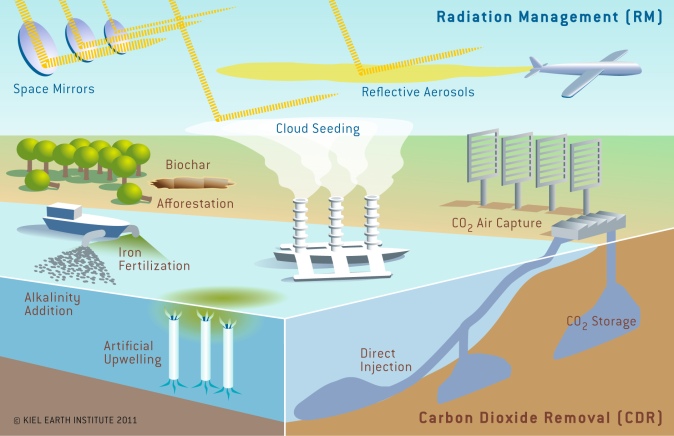
As the stakes get higher through this century, the dangers arising from this mechanistic metaphor of nature will only become more harrowing. Already, in response to the acceleration of climate breakdown, the techno-dystopian idea of geoengineering is becoming increasingly acceptable. Following Tillerson’s misconceived logic, rather than disrupt the fossil fuel-based growth economy, policymakers are beginning to seriously countenance treating the Earth as a gigantic machine that needs fixing, and developing massive engineering projects to tinker with the global climate.

Given the innumerable nonlinear feedback loops that generate our planet’s complex living systems, the law of unintended consequences looms menacingly large. The eerily named field of “solar radiation management”, for example, which has received significant financing from Bill Gates, envisages spraying particles into the stratosphere to cool the Earth by reflecting the Sun’s rays back into space. The risks are enormous, such as causing extreme shifts in precipitation around the world and exacerbating damage we’ve already done to the ozone layer. Additionally, once begun, it could never be stopped without immediate catastrophic rebound heating; it would further increase ocean acidification; and would likely turn the blue sky into a perpetual white haze. These types of feedback effects, arising from the innumerable nonlinear dynamic interdependencies of Earth’s complex systems, get marginalized by a worldview that ultimately sees our planet as a machine requiring a quick fix.

Further, there are deep moral issues that arise from confronting the inherent subjectivity of the natural world. Ever since the Scientific Revolution, the root metaphor of nature as a machine has infiltrated Western culture, inducing people to view the living Earth as a resource for humans to exploit without regard for its intrinsic value. Ecological philosopher Eileen Crist describes this as human supremacy, pointing out that seeing nature as a “resource” permits anything to be done to the Earth with no moral misgivings. Fish get reclassified as “fisheries,” and farm animals as “livestock”—living creatures become mere assets to be exploited for profit. Ultimately, it is the ideology of human supremacy that allows us to blow up mountaintops for coal, turn vibrant rainforest into monocropped wastelands, and trawl millions of miles of ocean floor with nets that scoop up everything that moves.

Once we recognize that other animals with a nervous system are not machines, as Descartes proposed, but likely experience subjective feelings similar to humans, we must also reckon with the unsettling moral implications of factory farming. The stark reality is that around the world, cows, chicken, and pigs are enslaved, tortured, and mercilessly slaughtered merely for human convenience. This systematic torment administered in the name of humanity to over 70 billion animals a year—each one a sentient creature with a nervous system as capable of registering excruciating pain as you or I—quite possibly represents the greatest cataclysm of suffering that life on Earth has ever experienced.

The “quantum jazz” of life

What, then, are metaphors of life that more accurately reflect the findings of biology—and might have the adaptive consequence of influencing our civilization to behave with more reverence toward our nonliving relatives on this beleaguered planet which is our only home?

Frequently, when cell biologists describe the mind-boggling complexity of their subject, they turn to music as a core metaphor. Denis Noble entitled his book on cellular biology The Music of Life, depicting it as “a symphony.” Ursula Goodenough describes patterns of gene expression as “melodies and harmonies.” While this metaphor rings truer than nature as a machine, it has its own limitations: a symphony is, after all, a piece of music written by a composer, with a conductor directing how each note should be played. The awesome quality of nature’s music arises from the fact that it is self-organized. There is no outside agent telling each cell what to do.

Perhaps a more illustrative metaphor would be a dance. Cell biologists increasingly refer to their findings in terms of “choreography,” and philosopher of biology Evan Thompson writes vividly how an organism and its environment relate to each other “like two partners in a dance who bring forth each other’s movements.”

Another compelling metaphor is an improvisational jazz ensemble, where a self-organized group of musicians spontaneously creates fresh melodies from a core harmonic theme, riffing off each other’s creativity in a similar way to how evolution generates complex ecosystems. Geneticist Mae-Wan Ho captures this idea with her portrayal of life as “quantum jazz,” describing it as “an incredible hive of activity at every level of magnification in the organism . . . locally appearing as though completely chaotic, and yet perfectly coordinated as a whole.”

What might our world look if we saw ourselves as participating in a coherent ensemble with all sentient beings interweaving together to collectively reverse entropy on Earth? Perhaps we might begin to see humanity’s role, not to re-engineer a broken planet for further exploitation, but to attune with the rest of life’s abundance, and ensure that our own actions harmonize with the Earth’s ecological rhythms. In the profound words of 20th century humanitarian Albert Schweitzer, “I am life that wills to live, in the midst of life that wills to live.” How, we may ask, might our future trajectory change if we were to reconstruct our civilization on this basis?


IT’S NO TIME TO BE NORMAL

By Paul Levy

Source: Waking Times

These times of the new normal are not normal times at all. Psychoanalyst Joyce McDougall coined the term normopathy to connote an excessive—and pathological—attachment and adaptation to conventional social norms. English psychoanalyst Christopher Bollas has coined a term with a similar meaning – normotic, which seems to be a variation of and play on the word neurotic. Not having developed an independent sense of self, people who are normopathic or normotic have a neurotic obsession with appearing normal, to fit in – they are abnormally normal. At the bottom of this malady is an insecurity of being judged and rejected. Normotics are overly concerned with how others view them, rendering them afraid to creatively express their unique individuality (which remains undeveloped as a result), which results in being afraid of participating in the call of their own individuation. As Jung counsels, we should be afraid of being too healthy-minded, as, ironically, this can easily become unhealthy.

Many families, groups or societies are afflicted with normopathy (according to whatever the group’s rules are regarding what is considered “normal”), such that it is considered normal to be normotic. The strange thing is if that if almost everyone in the group is normotic, the pathology is seen as normal and healthy, which makes the person in the group who isn’t subscribing to being normotic appear to be ab-normal, the one with the pathology. Insanely, in a case of projecting their own craziness, the ones with the pathology then pathologize the one who doesn’t have it. Something of this nature is going on in our world at the present time.

One of the greatest dangers about unconsciousness is proneness to suggestion, where we take on other peoples’ perspective of the world—and of who we are—thereby easily falling prey to the prevailing collective groupthink of the herd. The proclivity towards hive-mindedness strongly correlates with being susceptible to having our minds hijacked, manipulated and controlled by forces outside of ourselves.

Whatever term we use—normopathic or normotic—there are many people who depend upon and derive their self-worth through external validation by others. Being social creatures, we have an unconscious undertow to want to belong to a group, which opens us up to the possibility of disconnecting from our own intrinsic urge to uniquely individuate. Instead of seeing the world through our own eyes, we then see the world—and ourselves, i.e., our own self-image—not through how others see us, but how we imagine others see us. The source of this process lies in our own creative imagination, which we have out-sourced to others. To connect with our own sovereignty, we have to find the source within ourselves from which our true creative power derives.

In the challenging times that we are living through, it is crucially important for us to not “fit in,” but rather, express our unique creative spirit that more than anything wants to come through us and find its place in the world. Instead of blindly and passively subscribing to the new normal, let us create “the new abnormal,” in which we step into the radical act of being our naturally creative selves. Whereas repressed and unexpressed creativity is the greatest poison there is to the human psyche, creativity given free license to express itself is the greatest medicine imaginable.