IT’S ALL A DISTRACTION… BUT A DISTRACTION FROM WHAT, EXACTLY?

By Dylan Charles

Source: Waking Times

In a recent conversation with a close friend we were talking about the insane firehose of fear-inducing narratives coming from the talking heads on TV, and she commented that, ‘it was all just a big distraction.’

I hear that a lot. It’s all just a big distraction.

Perhaps it’s true.

But a distraction from what, exactly?

I’m going to zoom all the way out for a few hundred words here. All the way out beyond the distraction from the economic and globalist reality bearing down on all of us. All the way out beyond the cultural revolution underpinning the agendas being pimped on us by mainstream media. All the way out beyond the technocratic, bio-fascist takeover coming from the world’s largest and most-overfunded organizations, like the WEF. All the way out, even, beyond the dehumanization and depopulation agenda becoming evermore clear to the layman in today’s post-Covid authoritarian world.

I’m going full spiritual here, because there’s something big that warrants your attention. Something which all the news, narratives and punditry never even skirt around, much less touch upon.

And that is the fact that you are so much more that what the material scientists and policy makers would have you believe. You’re being distracted from your connection to your higher self, to spirit itself.

It’s been a fascinating journey writing and publishing at Waking Times for over ten years. We’ve discussed in great detail the works of pioneering thinkers like Rupert Sheldrake and Graham Hancock, and even brought renewed attention to the works of people like Rudolf Steiner, Carl Jung and other intellectuals who’ve helped to walk us over the gap between science and spirit. The message that always stuck with me is that the true value of being human, as opposed to a mind-controlled robot, is their uniqueness, individuality and our unique human capacity experience wonder, mystery, and inspiration.

And we need inspiration right now. It’s the antidote to fear. And we need to wonder about the big picture. Your connection to your higher self and all the courage and humanity to be found within that. We need to wonder what we truly are, without all the dense commentary and negative social thought loops keeping us bound to the stupidity inherent in pop culture and group think.

What are you, truly?

“The cosmos is within us. We are made of star-stuff. We are a way for the universe to know itself.” ~Carl Sagan

Yeah, something like that.

The thing is, when you lose track of, or allow yourself to be distracted from, this reality, the walls of the world close in on you. You forget about the present moment and look at the future as a foe whose power comes from the failures of your past. You forget that you’re endowed with the power to create, as Paul Levy reminded us in a podcast I did with him. You forget that your natural state is independence and courage, and you forget that you always have instant access to access these qualities, should you desire to call them in.

When you’re distracted from the reality of your own sovereign standing as a unique and potentially powerful spiritual being, you’re unable to set your own sails according to your own life passions. You are rudderless in a sea of mediocrity and conformity, and thereby perpetually seek the false sense of security and safety that comes from thinking you’re part of a tribe. You self-sabotage and engage in all kinds of senseless self-destruction in order to numb the pain of denying your

Your connection to spirit is what gives your life meaning in a world where phoniness is front page news all day, everyday.

The reason why this connection matters is because you’re being put to the test. The test is whether or not you can keep yourself together through all of the bullshit we’re doggie-paddling around in, so that you can still manage to be effective in your own life rather than becoming food for the hostile beings that feed off fear and anxiety.

So, above all the information, data and reasoning required to find material truth in this world, you need to be connected to who you really are, and you need to know what’s right for you. Not what they say is right for you. These are distinctly different things. You need a connection to your spirit. Your higher self. You need access to the best part of your being.

The part of you that doesn’t need public consensus in order to make a decision regarding your personal health. That part of you that doesn’t check to see what everyone else is doing before declaring whatever it is you truly want out of this magical life. That part of you that wants to you be healthy, balanced and vital in a world of poison and pollution.

When you don’t know who or what you are, you look outward towards others to complete this complex puzzle. When you don’t know who you are, you deny your own inner wisdom. You concern yourself with things you have no power over. You live your life seeking approval, people pleasing and over-obligating yourself. When you don’t know who you are, you leave the door wide open for fear, self-doubt, worry, and overwhelm.

If it’s all a distraction, then it’s time you refocus and recover your energy and power from the rigid, thought-controlling social discredit system being built up around you. The only thing that can save any of us is if all us remember who we are.

“A man with outward courage dares to die; a man with inner courage dares to live.” ~Lao Tzu

M=EC2 – THE MEDITATION EQUATION

By Kingsley Dennis

Source: Waking Times

‘When one begins to meditate, one accomplishes the only really free deed in this human life… we are completely free in this. Meditation is the archetypal free deed. – Rudolf Steiner

Arguably one of the world’s most famous equations is Einstein’s E = mcwhere energy equals mass times the speed of light squared. I am now proposing my own equation, which likely will be nowhere near as recognized or celebrated. Nevertheless, I feel it has worth sharing. Here it is: M = ECWhat does it signify? It means: meditation equals extended mind times contact and communication. At this point, I feel that some explanation is required. Here goes.

Philosophers, artists, and scientists have been debating for centuries the questions concerning human consciousness: what it is and how it emerges. The question of human consciousness has also been at the heart of many wisdom teachings, although these have tended to be based on revelation rather than investigation and empirical research. Over the course of these varied discussions, debates have been divided between the materialistic approach (the mind is contained in the brain), and what may be rather loosely termed as the ‘spiritual-metaphysical’ worldview (the mind exists outside of the brain). In recent decades, thanks largely to the advance in technologies, scientists have been able to map and study the human brain – including neuronal patterns, brain disorders, and pathways of human thinking. Yet this has led, in main, to an increased certitude among many scientists of a material view of human consciousness.

In other words, consciousness exists as a by-product of the physical brain and, as such, cannot exist without brain function. This is the dominant view amongst materialist thinkers and scientists. In more recent years however, and with the further research into nonlocal and field phenomena, investigators have been re-visiting mainstream theories of human consciousness. Specifically, as the unified field theory gains more support pointing to the nature of a nonlocal, interconnected cosmos, a different perspective is emerging on how consciousness may operate. And an understanding on the true nature of consciousness will validate and give meaning to the act of meditation; specifically, how meditation may provide access to contact, and possibly communication, beyond the material realm. First, we need to explore current concepts and perspectives on human consciousness.

Concepts of Consciousness: 1 – The Turbine Theory

The dominant mainstream narrative concerning human consciousness is that it is generated by the brain as a form of by-product. This has been referred to as the ‘turbine theory,’ whereby just how electricity would be generated by a working turbine as a by-product, so too is human consciousness the by-product of a functioning human brain (motor). This theory postulates human consciousness as being local and produced from something tangible. Also, when this producer/motor stops functioning – i.e., the brain ceases to be alive – then consciousness, and related streams of experience, likewise stop. Medical science has gone a long way to validate the ‘turbine theory’ of consciousness by repeated experiments on how impaired brain functioning results in distorted consciousness.

The basic premise of this understanding of consciousness is that neuronal networks in the human brain have evolved to such a high state of complexity that they produce a level of self-consciousness above that of any other animal on the planet (except perhaps dolphins, porpoises, and whales). Here, the degree of consciousness produced by each specific living creature is related to the level of biological complexity. In recent years, there have been renewed calls for a neurological basis for consciousness. For many scientists working in this field, consciousness is a by-product of complexity; thus, complex systems produce varying levels of consciousness, and ‘how much consciousness they have depends on how many connections they have and how they’re wired up.’[1] Despite recent scientific theories of consciousness, most still cling to the basis of an old paradigm ‘turbine theory.’

In other words, that consciousness is a secondary phenomenon resulting from primary activity located in the human brain. Regardless of the attempts by mainstream science to strengthen their outlook on consciousness, this ‘complexity-produces-consciousness as a by-product’ perspective has so many holes. The many holes in this dominant yet conservative theory is owing to a range of experiences that throw doubt upon its validity. Challenges to the turbine theory of consciousness have come, as one example, from increasing evidence of ‘after death’ conscious experiences.

Concepts of Consciousness: 2 – The Cloud Theory

According to the orthodox view, consciousness ceases when the brain dies – i.e., no generator, no current. For many, this may seem like an obvious deduction. However, evidence to the contrary clearly contradicts this theory. Many cases have shown that human consciousness is maintained even though a person is technically declared brain dead. The near-death experience (known as NDE) has been reported by sufficiently large numbers of people who were declared brain-dead. Conscious experience in brain dead people has been reported in almost 25 percent of tracked cases. The NDE phenomenon has now been widely researched and discussed by many credible sources.[2] Furthermore, this phenomenon is not new and there are accounts of NDEs occurring in medieval times.[3] The existence of consciousness – a by-product of brain activity – in the absence of brain function cannot be accounted for by the mainstream turbine theory. There are also numerous indications that human consciousness exists in cases of permanent death. That is, many years after a person has died their consciousness remains available for contact and communication, such as through channelling or forms of ESP. There is now enough credible evidence to put doubt into the mainstream theory that consciousness is solely a by-product of localized brain activity.

One way to account for these anomalies would be to suggest that consciousness is in some way conserved beyond the brain – that is, as a nonlocal phenomenon. In this hypothesis, consciousness is something stored external to the brain. This can be framed in terms of a ‘cloud theory’ of consciousness, as this is similar to how information would be conserved on digital platforms accessed by computer networks or other cloud-enabled devices. Likewise, using this analogy, the mainstream ‘turbine theory’ of consciousness would be akin to an old-fashioned computer without Internet or built-in-memory that would lose all its data once switched off. In this regard, the cloud theory posits consciousness as nonlocal, rather than localized within the brain. Furthermore, the cloud theory allows for not only individual consciousness to be stored, and be recalled, but multiple.

This perspective of accessing multiple consciousnesses, beyond the individual one, is reminiscent of Jung’s collective unconscious. This theory would appear to support the observations of psychiatrists and consciousness researchers who have induced altered states of consciousness in their clients, including past life regression. When in altered states a vast majority of people have the capacity to recall almost everything that has happened to them, as well as in previous life incarnations. Moreover, their recall is not limited solely to their own experience but can also include the experiences of other people as well.[4] This cloud theory therefore suggests something akin to a collective field of consciousness that makes complete information available relative to the mode of access. This perspective shares similarities with the scientific research on the Akashic Field[5] and Morphic Resonance.[6] However, despite the appropriateness of the cloud theory of consciousness, it too does not account for all observations.

Concepts of Consciousness: 3 – The Unified Field Theory

In various recorded accounts of altered state consciousness, it appears that contact/access is not only made with traces of one’s nonlocal consciousness but also with distinctive separate conscious intelligence. That is, with an active consciousness that is not the consciousness of a human being. Such experiences, once the realm of mystical, shamanic, or indigenous traditions, has increasingly entered mainstream culture. Previously, such ‘encounters’ were labelled as supernatural or simply conveniently ignored as a quirky anomaly. However, as western science has developed its exploration of the inner realms (such as in transpersonal psychology and similar practices), such experiences have become more widespread and thus need to be accounted for. From this evidence a remarkable conclusion arises: that human consciousness can connect, and often communicate, with conscious entities that not only manifest a sense of self, but also carry distinct memories and information. This experience can neither be accounted for in the mainstream turbine theory nor the cloud theory of consciousness. We now need to consider yet another concept – that consciousness is a unified field phenomena with holographic qualities.

The unified field theory posits that consciousness may manifest in spacetime yet originates from a source that exists in a realm beyond spacetime.  In other words, consciousness has its origins in a deeper dimension (in a ‘unified source field’) and yet manifests through physical-material reality. This concept would suggest that all forms of localized consciousness are expressions of a unified consciousness field that is beyond spacetime. The implications of this understanding are that consciousness is not ‘in’ the brain, ‘produced’ by the brain, nor ‘stored’ beyond the brain. Rather, the human mind is a localized aspect of a conscious intelligence that infuses the cosmos from its source beyond spacetime.

This may be a hard pill to swallow for many people. However, when we examine the phenomena that is consciousness, this perspective makes a lot of sense. The viewpoint of this new model says that the brain receives and interprets consciousness, which is an interrelated aspect of the cosmos, and then projects this as the individual mind. Yet the brain does not produce consciousness. This understanding, which is now increasingly supported by the very latest scientific findings, points toward a Unified Source Field (USF) as generating what we perceive as spacetime. The materiality of spacetime is thus a holographic projection, coded from an underlying cosmic intelligence-field. It is this underlying intelligence-field that is the source of all material reality and conscious life. Every element that emerges into physical reality is simultaneously interrelated with the underlying Unified Source Field. As such, each material element in existence is also in contact and communication with this unified intelligence-field. Human consciousness – the human mind – is at all times connected to a deeper dimension of Source consciousness.

A Deeper Dimension: Consciousness, Contact, Communication

The understanding that consciousness originates from a deeper dimension of reality beyond spacetime has been embraced by many well-known spiritual figures, mystics, visionaries, artists, and even a handful of intuitive scientists. It may one day come to represent the dominant understanding amongst humanity (as it perhaps once was). The universe has already been recognized by mainstream science as exhibiting an incredible – almost impossible – degree of coherence. Now we may know why this is. It is because there is no random cosmos, no separation of materiality and immateriality, no empty space, no ‘out there’ and ‘in here.’ Everything – absolutely everything – is an integral part of a nonlocal conscious field whose origin is a Unified Source Field (USF) existing beyond the spacetime dimension. What this implies is that there is an inherent form of order to the material dimension. The cosmos, and all aligned aspects within it, adheres to an intelligent, conscious impulse toward coherence and connection.[7] Perception too, as an attribute of consciousness, trends toward greater conscious coherence (awareness) and connection. At the core of this drive for connectivity, I suggest, is an urge for conscious awareness of Source (the Unified Source Field). And so, this leads me back to the equation at the beginning of this essay; what I call the meditation equation: M = EC2.

Meditation equals extended mind times contact and communication. Meditation has from time immemorial been a part of human life, even if not formally recognized as so. Meditation can take only a second. A quick pause of chatter in the mind. A momentary close of the eyes. A transitory step back from the entanglement in physical reality. A fleeting respite from external stimuli. A brief break from the outer world to focus upon the inner. And the inner world is expansive – it is where the origin resides. And in this state, contact can be made with those aspects in existence beyond our material reality. And with contact can also come communication.

As human beings, we are already in contact and communication with aspects beyond our perception or acknowledgment. We only do not recognize such contacts as so. The inner nudge, the inspirational idea, the coincidental happening, the inexpressible sense, the indescribable knowing. These are the contacts humanity has. What if we consciously take it to the next level by intending to listen to such contact? What if we then ask for communication? We can give ourselves permission to start asking for contact and communication whilst in a meditative state. By showing acceptance, and readiness to allow for contact and communication beyond our physical senses and sense-reality, we are acknowledging the interrelatedness of all life. And life wishes to communicate amongst itself. Sentient life wishes to be heard, and to share.

Life is not meaningless nor without purpose. Our inherent connectivity transcends localized space and time. The human being is intrinsically connected with the cosmos and with Source consciousness. One day, it is hoped, this understanding will be, for all of us, as clear as pure water; and we will laugh gently to ourselves thinking how it could ever have been otherwise.

Pop Culture Has Become an Oligopoly

By Adam Mastroianni

Source: Experimental History

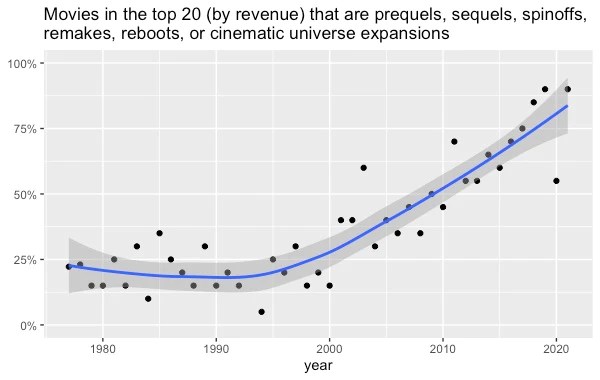
You may have noticed that every popular movie these days is a remake, reboot, sequel, spinoff, or cinematic universe expansion. In 2021, only one of the ten top-grossing films––the Ryan Reynolds vehicle Free Guy––was an original. There were only two originals in 2020’s top 10, and none at all in 2019.

People blame this trend on greedy movie studios or dumb moviegoers or competition from Netflix or humanity running out of ideas. Some say it’s a sign of the end of movies. Others claim there’s nothing new about this at all.

Some of these explanations are flat-out wrong; others may contain a nugget of truth. But all of them are incomplete, because this isn’t just happening in movies. In every corner of pop culture––movies, TV, music, books, and video games––a smaller and smaller cartel of superstars is claiming a larger and larger share of the market. What used to be winners-take-some has grown into winners-take-most and is now verging on winners-take-all. The (very silly) word for this oligopoly, like a monopoly but with a few players instead of just one.

I’m inherently skeptical of big claims about historical shifts. I recently published a paper showing that people overestimate how much public opinion has changed over the past 50 years, so naturally I’m on the lookout for similar biases here. But this shift is not an illusion. It’s big, it’s been going on for decades, and it’s happening everywhere you look. So let’s get to the bottom of it.

(Data and code available here.)

Movies 

At the top of the box office charts, original films have gone extinct. 

I looked at the 20 top-grossing movies going all the way back to 1977 (source), and I coded whether each was part of what film scholars call a “multiplicity”—sequels, prequels, franchises, spin-offs, cinematic universe expansions, etc. This required some judgment calls. Lots of movies are based on books and TV shows, but I only counted them as multiplicities if they were related to a previous movie. So 1990’s Teenage Mutant Ninja Turtles doesn’t get coded as a multiplicity, but 1991’s Teenage Mutant Ninja Turtles II: The Secret of the Ooze does, and so does the 2014 Teenage Mutant Ninja Turtles remake. I also probably missed a few multiplicities, especially in earlier decades, since sometimes it’s not obvious that a movie has some connection to an earlier movie.

Regardless, the shift is gigantic. Until the year 2000, about 25% of top-grossing movies were prequels, sequels, spinoffs, remakes, reboots, or cinematic universe expansions. Since 2010, it’s been over 50% ever year. In recent years, it’s been close to 100%.

Original movies just aren’t popular anymore, if they even get made in the first place.

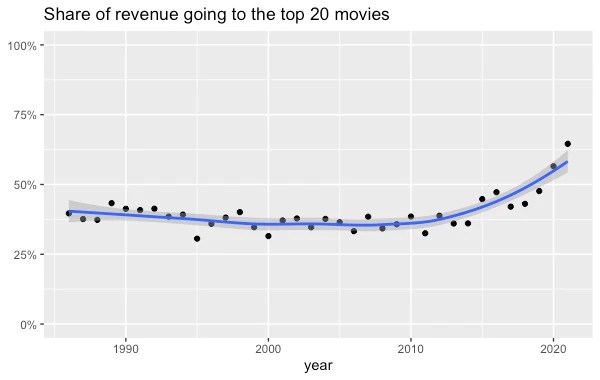
Top movies have also recently started taking a larger chunk of the market. I extracted the revenue of the top 20 movies and divided it by the total revenue of the top 200 movies, going all the way back to 1986 (source). The top 20 movies captured about 40% of all revenue until 2015, when they started gobbling up even more.

Television

Thanks to cable and streaming, there’s way more stuff on TV today than there was 50 years ago. So it would make sense if a few shows ruled the early decades of TV, and now new shows constantly displace each other at the top of the viewership charts.

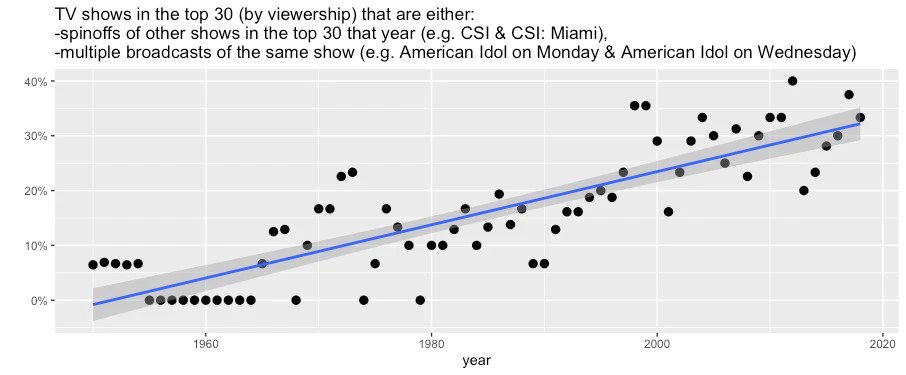
Instead, the opposite has happened. I pulled the top 30 most-viewed TV shows from 1950 to 2019 (source) and found that fewer and fewer franchises rule a larger and larger share of the airwaves. In fact, since 2000, about a third of the top 30 most-viewed shows are either spinoffs of other shows in the top 30 (e.g., CSI and CSI: Miami) or multiple broadcasts of the same show (e.g., American Idol on Monday and American Idol on Wednesday). 

Two caveats to this data. First, I’m probably slightly undercounting multiplicities from earlier decades, where the connections between shows might be harder for a modern viewer like me to understand––maybe one guy hosted multiple different shows, for example. And second, the Nielsen ratings I’m using only recently started accurately measuring viewership on streaming platforms. But even in 2019, only 14% of viewing time was spent on streaming, so this data isn’t missing much.

Music

It used to be that a few hitmakers ruled the charts––The Beatles, The Eagles, Michael Jackson––while today it’s a free-for-all, right?

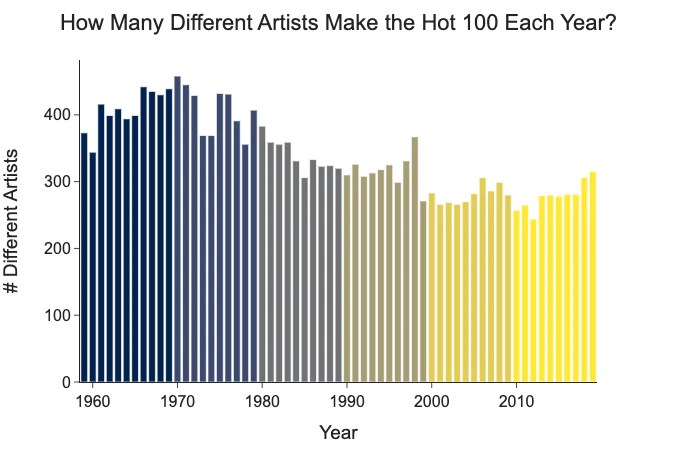
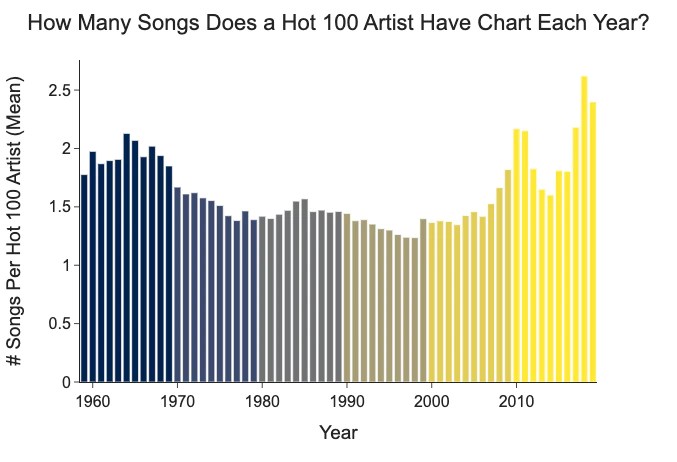
Nope. A data scientist named Azhad Syed has done the analysis, and he finds that the number of artists on the Billboard Hot 100 has been decreasing for decades.

And since 2000, the number of hits per artist on the Hot 100 has been increasing. 

(Azhad says he’s looking for a job––you should hire him!)

A smaller group of artists tops the charts, and they produce more of the chart-toppers. Music, too, has become an oligopoly.

Books

Literature feels like a different world than movies, TV, and music, and yet the trend is the same.

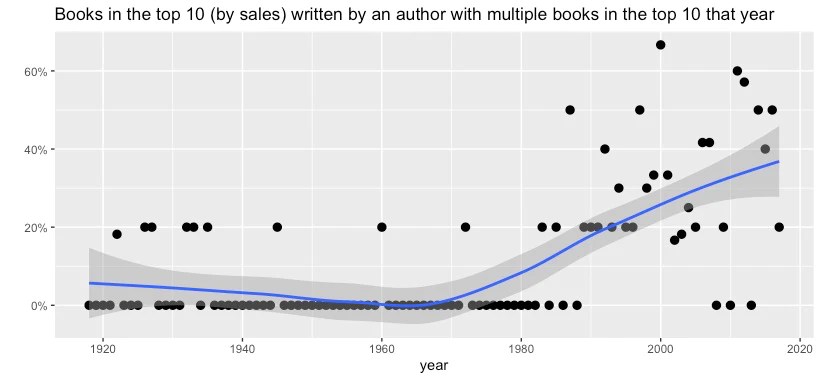
Using LiteraryHub’s list of the top 10 bestselling books for every year from 1919 to 2017, I found that the oligopoly has come to book publishing as well. There are a couple ways we can look at this. First, we can look at the percentage of repeat authors in the top 10––that is, the number of books in the top 10 that were written by an author with another book in the top 10.

It used to be pretty rare for one author to have multiple books in the top 10 in the same year. Since 1990, it’s happened almost every year. No author ever had three top 10 books in one year until Danielle Steel did it 1998. In 2011, John Grisham, Kathryn Stockett, and Stieg Larsson all had two chart-topping books each.

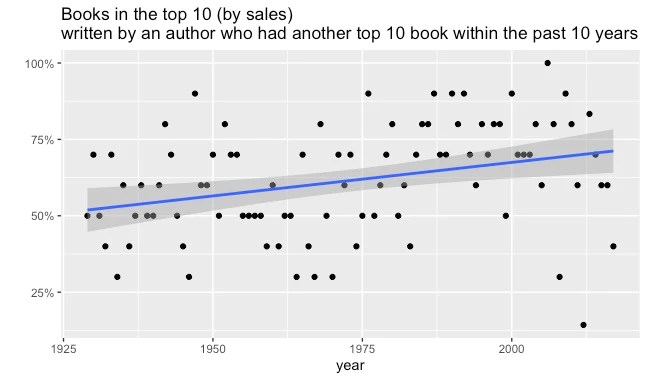
We can also look at the percentage of authors in the top 10 were already famous––say, they had a top 10 book within the past 10 years. That has increased over time, too. 

In the 1950s, a little over half of the authors in the top 10 had been there before. These days, it’s closer to 75%.

Video games

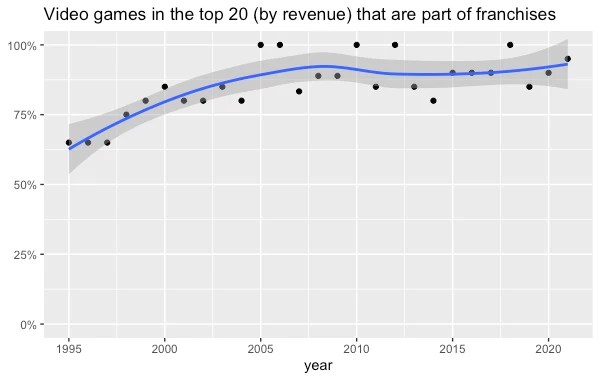
I tracked down the top 20 bestselling video games for each year from 1995 to 2021 (sources: 1234567) and coded whether each belongs to a preexisting video game franchise. (Some games, like Harry Potter and the Sorcerer’s Stone, belong to franchises outside of video games. For these, I coded the first installment as originals and any subsequent installments as franchise games.)

The oligopoly rules video games too:

In the late 1990s, 75% or less of bestselling video games were franchise installments. Since 2005, it’s been above 75% every year, and sometimes it’s 100%. At the top of the charts, it’s all Mario, Zelda, Call of Duty, and Grand Theft Auto.

Why is this happening?

Any explanation for the rise of the pop oligopoly has to answer two questions: why have producers started producing more of the same thing, and why are consumers consuming it? I think the answers to the first question are invasionconsolidation, and innovation. I think the answer to the second question is proliferation.

Invasion

Software and the internet have made it easier than ever to create and publish content. Most of the stuff that random amateurs make is crap and nobody looks at it, but a tiny proportion gets really successful. This might make media giants choose to produce and promote stuff that independent weirdos never could, like an Avengers movie. This can’t explain why oligopolization started decades ago––YouTube only launched in 2005, for example, and most Americans didn’t have broadband until 2007––but it might explain why it’s accelerated and stuck around.

Consolidation

Big things like to eat, defeat, and outcompete smaller things. So over time, big things should get bigger and small things should die off. Indeed, movie studiosmusic labelsTV stations, and publishers of books and video games have all consolidated. Maybe it’s inevitable that major producers of culture will suck up or destroy everybody else, leaving nothing but superstars and blockbusters. Indeed, maybe cultural oligopoly is merely a transition state before we reach cultural monopoly.

Innovation

You may think there’s nothing left to discover in art forms as old as literature and music, and that they simply iterate as fashions change. But it took humans thousands of years to figure out how to create the illusion of depth in paintings. Novelists used to think that sentences had to be long and complicated until Hemingway came along, wrote some snappy prose, and changed everything. Even very old art forms, then, may have secrets left to discover. Maybe the biggest players in culture discovered some innovations that won them a permanent, first-mover chunk of market share. I can think of a few:

  • In books: lightning-quick plots and chapter-ending cliffhangers. Nobody thinks The Da Vinci Code is high literature, but it’s a book that really really wants you to read it. And a lot of people did!
  • In music: sampling. Musicians seem to sample more often these days. Now we not only remake songs; we franchise them too.
  • In movies, TV, and video games: cinematic universes. Studios have finally figured out that once audiences fall in love with fictional worlds, they want to spend lots of time in them. Marvel, DC, and Star Wars are the most famous, but there are also smaller universe expansions like Better Call Saul and El Camino from Breaking Bad and The Many Saints of Newark from The Sopranos. Video game developers have understood this for even longer, which is why Mario does everything from playing tennis to driving go-karts to, you know, being a piece of paper.

Proliferation

Invasion, consolidation, and innovation can, I think, explain the pop oligopoly from the supply side. But all three require a willing audience. So why might people be more open to experiencing the same thing over and over again?

As options multiply, choosing gets harder. You can’t possibly evaluate everything, so you start relying on cues like “this movie has Tom Hanks in it” or “I liked Red Dead Redemption, so I’ll probably like Red Dead Redemption II,” which makes you less and less likely to pick something unfamiliar. 

Another way to think about it: more opportunities means higher opportunity costs, which could lead to lower risk tolerance. When the only way to watch a movie is to go pick one of the seven playing at your local AMC, you might take a chance on something new. But when you’ve got a million movies to pick from, picking a safe, familiar option seems more sensible than gambling on an original.

This could be happening across all of culture at once. Movies don’t just compete with other movies. They compete with every other way of spending your time, and those ways are both infinite and increasing. There are now 60,000 free books on Project Gutenberg, Spotify says it has 78 million songs and 4 million podcast episodes, and humanity uploads 500 hours of video to YouTube every minute. So uh, yeah, the Tom Hanks movie sounds good.

What do we do about it?

Some may think that the rise of the pop oligopoly means the decline of quality. But the oligopoly can still make art: Red Dead Redemption II is a terrific game, “Blinding Lights” is a great song, and Toy Story 4 is a pretty good movie. And when you look back at popular stuff from a generation ago, there was plenty of dreck. We’ve forgotten the pulpy Westerns and insipid romances that made the bestseller lists while books like The Great GatsbyBrave New World, and Animal Farm did not. American Idol is not so different from the televised talent shows of the 1950s. Popular culture has always been a mix of the brilliant and the banal, and nothing I’ve shown you suggests that the ratio has changed.

The problem isn’t that the mean has decreased. It’s that the variance has shrunk. Movies, TV, music, books, and video games should expand our consciousness, jumpstart our imaginations, and introduce us to new worlds and stories and feelings. They should alienate us sometimes, or make us mad, or make us think. But they can’t do any of that if they only feed us sequels and spinoffs. It’s like eating macaroni and cheese every single night forever: it may be comfortable, but eventually you’re going to get scurvy. 

We haven’t fully reckoned with what the cultural oligopoly might be doing to us. How much does it stunt our imaginations to play the same video games we were playing 30 years ago? What message does it send that one of the most popular songs in the 2010s was about how a 1970s rock star was really cool? How much does it dull our ambitions to watch 2021’s The Matrix: Resurrections, where the most interesting scene is just Neo watching the original Matrix from 1999? How inspiring is it to watch tiny variations on the same police procedurals and reality shows year after year? My parents grew up with the first Star Wars movie, which had the audacity to create an entire universe. My niece and nephews are growing up with the ninth Star Wars movie, which aspires to move merchandise. Subsisting entirely on cultural comfort food cannot make us thoughtful, creative, or courageous.

Fortunately, there’s a cure for our cultural anemia. While the top of the charts has been oligopolized, the bottom remains a vibrant anarchy. There are weird books and funky movies and bangers from across the sea. Two of the most interesting video games of the past decade put you in the role of an immigration officer and an insurance claims adjuster. Every strange thing, wonderful and terrible, is available to you, but they’ll die out if you don’t nourish them with your attention. Finding them takes some foraging and digging, and then you’ll have to stomach some very odd, unfamiliar flavors. That’s good. Learning to like unfamiliar things is one of the noblest human pursuits; it builds our empathy for unfamiliar people. And it kindles that delicate, precious fire inside us––without it, we might as well be algorithms. Humankind does not live on bread alone, nor can our spirits long survive on a diet of reruns.

MATERIALISM & THE LOSS OF SOUL

By Kingsley L. Dennis

Source: Waking Times

The non-material, or non-visible, realm does not lie dormant. It is active, constantly. It is what infuses and makes possible the world we know and see. The intangible realm of vital forces is what we often call the ‘spiritual’ dimension for within it lies the conscious intelligences that establish material life. Spiritual matters have long been an abstract thing for many people. Yet they are no longer to remain abstract – they are now to flow into culture not only through ‘spiritual channels,’ but through all manner of ways, including people. The flow and merger between the suprasensory world and the sensory world (the realm of the phenomenal), has always been in operation. Only now, it looks set to increase.

Materialism is all good and well – yet up to a certain point. This is recognized by some as the ‘Fall’ – the deep immersion into physical reality. To a certain degree, this immersion into physicality was necessary for developing individualism and to perceive existence in relation to Source. Once this recognition is gained, then begins the ‘return journey’ back to Source/Origin consciousness. However, if a species remains too long within the grip of materialistic forces, then a hardening – or deadening – can occur that crystallizes certain faculties and organs of perception, which leads to an evolutionary stagnation. As such, the stagnation of evolvement can be due to the over-influence of entropic forces. The impulse of spiritual knowledge (developmental forces) descending into the physical world has been opposed by other forces that do not wish for people to discover their inner freedom. Yet this time, this moment in human development, has been foreseen and, on some levels, even planned for. What is to come about has been viewed as inevitable by those who know what is at stake.

The entropic forces that exist in opposition aim to ‘over-materialize’ materialism. They intend to deepen the entanglement within physical matter, and to create artificial material forms that would not have arisen in the natural course of human evolvement. This is a matter of exercising certain powers upon the physical plane. This is being applied in such a way as to block a renewal of human culture beyond materialism and to direct it into a new form of materialism, a more etheric form that seems un-material. This is what I refer to as the ‘fallacy of materialism’ – the digital-virtual realms, whilst seeming contrary to physical-materialism, are in fact working to deepen human entanglement in material forces. These digitized spaces, because of their sense of non-physicality, are really an etheric manifestation of materialism. Or rather, a realm of theoretical materialism. Theoretical materialism signifies a reality construct that does not need to be physical to the touch, yet it is based on, or is a projection from, a material foundation. Within both the theoretical and regular mode of materialism, the human being is encapsulated within an amalgamation of material processes. It is also a world of facts and external evidence that a person becomes lost within. All life experience proceeds from this material realm, and this conditions the human being to gain a view of life that is factually based, and to accept that there is no other reality except this world of materialism and factual experience. Any notion of the soul or spirit – the transcendental impulse – is either regarded as being a by-product from material reality or is rejected altogether as a false notion. This is the power of the immersion into matter-reality.

Deep materialism finally becomes a cosmology of entropy and decline. It leads to mechanical, artificial modes of thinking that eventually brings about a stagnation in those forces driving human development. If continued, these materialistic forces carve out a path of technological advancement and evolution that further blocks vital, spiritualized forces. In this route, the human being strives for greater material benefits yet neglects the vital human forces of spiritualized connection. Our current epoch is concerned with the development of the material world; and if the human being is not to degenerate totally into a mere accomplice of machines, then a path must be found which leads from the mechanical impulse towards a life of the spirit. However, entropic forces are in play that are opposed to forms of spiritualization (spiritual freedom), and which work to reduce and, eventually, dispose of spiritual seeking and to replace it with an ethereal and otherworldly ‘virtual paradise’ where all needs can be fulfilled-by-illusion. A part of this ‘supra-materialism’ is the notion of immortality that is arising through transhumanist tropes. This can be referred to as the immortality falsehood as it works not through the spirit-soul but through a prolongation of the physical life experience by merger with machinic forms. This is a mode of potential immortality within the physical sphere but not within the spiritual. In the end, it is an entrapment for it disavows the inner spirit release from the physical domain. This can lead to a state of soullessness within the human being as the contact with Source becomes, over time, diminished. Or, perhaps this materialistic, transhumanist agenda will attract those people already without full spirit-soul incarnation.

It may be that there are people walking around in physical incarnation, in physical bodies, yet who are lacking, for want of a better word, a soul. Rudolf Steiner made note of this a hundred years ago when he stated

‘…a kind of surplus of individuals is appearing in our times who are without Egos [‘I’], who are not truly human beings. This is a terrible truth…They make the impression of a human being if we do not look closely, but they are not human in the fullest sense of the word.’ 1

Steiner warned us to be aware that what we encounter as human beings in human form may not always have to be what it appears to be. He stated that the outer appearance can be just that: appearance. He went on to state: ‘We encounter people in human form who only in their outer appearance are individuals…in truth, these are humans with a physical, etheric, and astral body, but beings are embodied in them, beings that make use of these individuals in order to operate through them.’2 What this refers to is that human bodies can be vessels for other beings to operate through.

This makes us realize that the world of ‘spirit’ may not always be what we have thought it to be. In other words, it may not be all divine light and ascension. It also involves the aspect of discernment. For there are players and forces that wield a great deal of influence within the physical world. And some of these influences act through the presence of certain individuals that may appear outwardly ‘normal.’ In this light, a completely different kind of spirituality is at work in present-day humanity. It may be inferred, without sounding dramatic, that certain power groups, and their important individual members, are influenced (and perhaps dominated) by a non-human species of being that are intent on implementing non-human objectives. Such groups and individuals would, in this case, exhibit a distinct lack of ‘soul’ – i.e., empathy and compassion – and would appear to others as displaying almost sociopathic tendencies.[i] Yet at the same time, such people can appear unusually charismatic and are able to exert great influence over other people, especially with their words and speeches, whilst being themselves emotionally stunted.

To consider this further, such beings might be motivated in their actions to attempt to block other human being’s connection to their own individual inner/spiritual impulse. By a range of actions, they could focus on distracting people away from the notion of a metaphysical reality and of their inherent connection to Source (or a realm of vital conscious intelligence beyond matter-reality). In extreme cases, such players might even target the bio-psycho human body in an attempt to sabotage the vessel so as to make it a less viable vehicle for soul-spirit incarnation. What else might they hope to achieve? Again, referring to Rudolf Steiner, he stated that: ‘Their objective is to maintain the whole of life as a mere economic life, to gradually eradicate everything else that is part of the intellectual and spiritual life, to eradicate the spiritual life precisely where it is most active…and swallow up everything through the economic life.’3

By hijacking cultural, social, and economic systems, the focus turns away from the inner life, which tends to be more active once people have satisfied their primary needs (see Maslow’s Hierarchy of Needs). Also, if there are uncertainties, disruptions, and fluctuations in these systems, then people can become psychologically influenced in a negative way. That is, for those people who come under the domination of such economic forces – i.e., are subservient through debt – they are more likely to experience a loss of personal empowerment and will. If we take only a cursory glance at the actions of many incumbent leaders, politicians, corporate businesses, financial institutions, and more, we can see a clear lack of any soulful behaviour or intent. Quite the contrary, many of these individuals and groups seem determined to curtail human freedoms, sovereignty, and inner empowerment. If Steiner were alive today, he would no doubt say that what we are currently witnessing upon the physical plane is an act of soulless terraforming of the planet and a controlling manipulation of the human life experience by nefarious forces that have anti-human aims and intentions. Perhaps this is why so many people today are experiencing depression, frustration, and apathy – a paralysis of will – from which they feel unable to resolve. This gets manifested as a sense of weariness and dissatisfaction that is projected out into their everyday lives.

Because of this, and other factors, the consciously aware person of today is being asked to step into their role as a physical representative of sacred life. It is important that metaphysical realities are never diminished or disowned, and that the life of the spirit remains healthy and strong in expression within physical life. If there is ever a struggle against the human soul, then we may be witnessing this in these current times. We would do well to remember that each person possesses that special treasure that can never be taken from them. And this is the true eternal and genuine immortality. These are the times to be soulful, and to bring forth the human spirit.

References

Cited in Grosse, Erdmuth Johannes (2021) Are There People Without A Self? Forest Row: Temple Lodge, p31-2

Cited in Grosse, Erdmuth Johannes (2021) Are There People Without A Self? Forest Row: Temple Lodge, p60

Cited in Grosse, Erdmuth Johannes (2021) Are There People Without A Self? Forest Row: Temple Lodge, p63

The Power of Presence, How “Living In The Now” Can Change Your Life

By Allie Stark

Source: Collective Evolution

Presence is the powerful practice of being in the moment.

It is created through an acute awareness of one’s thoughts, feelings, and emotions, and in our modern day society, being present doesn’t always come easily. The overstimulation and distraction that come from technology, social media, work, family life, social engagements, and the never-ending “to-do” lists regularly take us out of the now and into a memory from the past or a fear about the future.

Cultivating the power of presence comes from creating the space to observe one’s mind and one’s self. This skill of observation allows us to look at our own lives and the lives of others without attaching judgment or analysis. Using this awareness, we become mindfully attuned to all that is around us through our five senses (smell, touch, taste, sight, and sound) as well as our physical sensations — you know, those signs from our bodies that we often tend to ignore.

Our bodies are equipped with a natural mechanism called the “stress response,” also known as the “fight-or-flight” response, which was first described by Walter Cannon at Harvard. When we encounter something that feels like a threat, the amygdala in the brain experiences the emotion fear. The brain then communicates to the hypothalamus, which communicates to the nervous system, which signals to the adrenal glands to release the stress hormones cortisol, adrenaline, and noradrenaline. This assembly-line-like process of the sympathetic nervous system is a crucial part of our body’s internal self-protection mechanism. The only problem is that we are not physiologically designed to be frightened often.

In today’s world, many of us live in overdrive and operate in a constant state of “flight or flight.” This state can be a result of feeling the fear of imagined threats: financial security, societal achievement, the steadiness or demise of a relationship, a perceived health threat, the loss of a loved one, etc. Operating from this place, it is no wonder that many of us feel the perils of stress and anxiety on a daily basis. We struggle with migraines, digestive issues, difficulty breathing, lack of concentration, fatigue, depression, and innumerable other physical ailments because our body is actually attempting to flee the scene of a real threat (car crash, lion chase, assault, etc.) that simply isn’t there. 

The opposite is also true. When we practice deep breathing and mindfulness, we encourage our body to employ the “relaxation response,” our body’s counterbalance to the stress response as defined by Harvard professor Herbert Benson. Being in a state of relaxation, your body will experience physiological symptoms of ease, openness, and balance.

A few days ago, I unintentionally experimented with the topic of presence when I accidentally left my phone at home. Even though I am generally good about creating intentional space to be phone free, something felt different. Normally, I choose to not bring it on a walk, I choose to keep it in my purse during dinner with a friend, and I choose to put it on airplane mode when I am writing or working during the day. Yesterday was the middle of the work week and if I had been asked whether or not I wanted to bring my phone along for the day, my answer would have unquestionably been “yes.”

Climbing up the stairs to the train platform, my hand impulsively reached into my bag in search of my phone. I was subconsciously looking for a meditative distraction during my morning commute. Remembering that it wasn’t there, I closed my eyes, took five deep breaths, and boarded the train car upon its arrival. Within moments of taking my seat, three street performers made an announcement, turned up their boom box, and had at it with their superfly dance moves. I was engrossed and totally present: wide eyes, big smile, heart beating in my chest.

Over the course of the rest of the day, I made note of a few other observations that I could have missed if I was in the phone zone:

  • A gathering of beautiful purple flowers on the sidewalk that had fallen off a tree
  • The smile from a saxophone player on the street
  • A little girl selling brownies in front of her house (although there weren’t many left because she was eating them when she thought no one was looking!)
  • The way the breeze felt on my skin between the high-rises

Upon noticing each of these observations I felt the tension in my body dissipate, I smiled effortlessly, and my body felt calm and at ease. Being fully involved in the present moment, I didn’t have the time to become entrenched in thoughts about the past or fears about the future. I was simply aware of what was going on in the now.

Now let’s be realistic. I know that we live in a technology-focused era and that our phones and our computers are significant tools for work, connectivity, and enjoyment.

They serve a purpose, and an important one at that. We also live in an age where anxiety disorders are the most common mental illness in the U.S., affecting 40 million adults in the United States age 18 and older, or 18% of the population. Countless studies have begun to explore the effects of mindfulness on reducing anxiety and depression, with many of the results from these studies suggesting that mindfulness-based therapy is a promising intervention for treating anxiety and mood problems in clinical populations. If pills, therapies, and medical advice aren’t curing our ailments, it seems foolish not to give mindfulness a shot.

If nothing else, maybe we will get the opportunity to notice small and simple details throughout the day that put a smile on our face.

Einstein and Freud’s ‘Why War?’ Revisited: Why Anti-War Efforts Go Nowhere

By Robert J. Burrowes

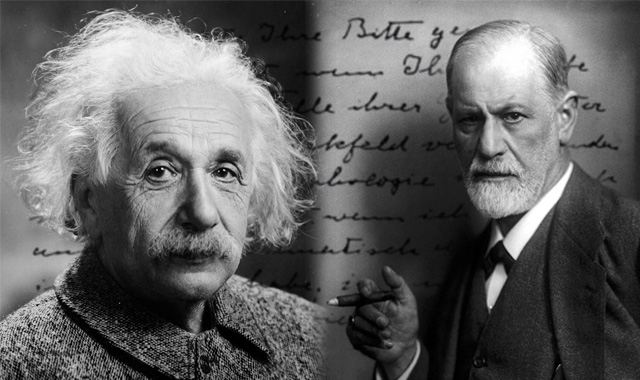
In 1932, Sigmund Freud and Albert Einstein exchanged letters, later published under the title ‘Why War?’ See ‘Why War? An exchange of letters between Freud and Einstein’.

However, whatever insight these two giants of an earlier era brought to our understanding of war, the reality is that a great deal has been learned since they corresponded.

Nevertheless, since the emergence of an identifiable, organized anti-war movement during World War I which has grown to include a diverse range of activists and organizations from across the political spectrum, as well as peace and conflict resolution scholars from various disciplines, there is little evidence that this movement, or any of the many organizations within it, has been learning from its failures by systematically undertaking or commissioning further research to understand the phenomenon of war more completely and then devising a strategy to end it based on that learning.

Hence, during its existence for more than 100 years, the organized anti-war movement – and the subsequently developed peace movement with its broader agenda – has had minimal impact in preventing or halting particular military conflicts, including wars, and zero impact in ending war generally, as the record testifies.

And so, even today, war continues in several countries in West Asia (the Middle East), Africa, elsewhere and, more recently, in Ukraine with the antiwar movement again demonstrating its ineffectiveness and, in the case of Ukraine, failing to comprehend the deeper agenda behind what is taking place in that country. See ‘The War in Ukraine: Understanding and Resisting the Global Elite’s Deeper Agenda’.

Of course, while an utterly inadequate analysis of what, fundamentally, is driving war is the critical foundation of the anti-war movement’s problems, it is still just one of the substantial range of problems it faces, some of which derive from this flawed analysis but others which a better analysis would expose. These include, for example, an understanding of why the fear of most of those within the anti-war movement is preventing the movement from mustering the commitment and courage that will be necessary if we are to undertake the many actions necessary to end war. In essence, fear makes most participants in the movement happy to complain about war but not take action themselves (or take action that has zero or minimal impact).

As Daniel Berrigan noted in his 1969 book No Bars to Manhood: ‘the waging of war, by its nature, is total – but the waging of peace, by our own cowardice, is partial.’

This cowardice means that a large proportion of the anti-war movement contents itself with a range of powerless measures – usually extending no further than signing petitions, issuing lameduck ideologically-oriented statements, writing articles, organizing conferences, issuing calls for negotiations or appeals to politicians – all invariably devoid of emotional and geopolitical reality as well as realistic measures to avert/halt the latest war.

This might include advocacy of measures, such as those developed under the guise of international humanitarian law, in relation to ‘outlawing war’ or outlawing particular weapons systems, despite the obvious observation that these legal constraints are routinely violated with impunity by any military power, starting with the United States, or non-state actor that is unconstrained by questions of legality.

Beyond this, ‘action’, when it is taken, is usually confined to conducting (notoriously ineffective) street protests or employing other tactics devoid of strategic impact in the context (of ending war). As former US Secretary of State Alexander Haig once noted about a massive anti-war demonstration: ‘Let them march all they want, as long as they continue to pay their taxes.’ See Alexander Haig. As a four-star general, Haig, not regarded as the most intelligent Secretary of State in US history, certainly understood that tactical choice is a question of strategy. Most activists have no idea.

So if we are to end war as a phenomenon in human affairs, or even meaningfully attempt to prevent or end a particular war, we need to do a number of things. Most fundamentally, we must start with a sound understanding of what causes violence to begin with because war does not emerge from a vacuum. War, when all is considered, is just another manifestation of violence, like everything from violence against women to economic exploitation to environmental destruction.

And if we are not able or willing to investigate and understand what is causing violence, and address this fundamental cause as part of our strategy, then our other efforts to end the manifestations of violence, including war, must all be in vain. Again, as the record readily testifies.

What Causes Violence?

So what is the cause of violence? Here is what 41 years (1966-2007) of concerted effort taught me.

Perpetrators of violence learn their craft in childhood. If you inflict violence on a child, they learn to inflict violence on others. The political leaders who decide to wage war, the military leaders who plan and conduct it, as well as the soldiers, sailors and aircraft personnel who fight war each suffered violence as a child. The terrorist suffered violence as a child. The neo-Nazi suffered violence as a child. The individual who inflicts violence on his (or her) partner suffered violence as a child. The corporate executive who exploits working class people and/or those who live in Africa, Asia or Central/South America suffered violence as a child. The racist or religious bigot suffered violence as a child. The individual who perpetrates violence in the home, in the schoolyard or on the street suffered violence as a child. The individual who overconsumes, or even consumes certain products and/or otherwise destroys the biosphere, suffered violence as a child.

So let me illustrate this point, in a very simplified way, by briefly explaining the parenting experience of a neo-Nazi. This individual has been terrorized by their parents and/or other significant adults in their life into projecting their fear onto particular groups of human beings and into believing that violence is a morally correct and superior way of dealing with these ‘different’ people. But for a much fuller and more nuanced explanation of this point, see the sections headed ‘The Emotional Profile of Archetype Perpetrators of Violence’ and ‘The Spectrum of the Violent Personality’ in ‘Why Violence?’

If we want to end violence in all of its manifestations, structural and otherwise, locally and globally, then we must finally end our longest and greatest war: the adult war on children. And here is an additional incentive: if we do not tackle the fundamental cause of violence, then our combined and unrelenting efforts to tackle all of its other symptoms must ultimately fail. And extinction at our own hand – by nuclear war or other means – is inevitable.

How can I claim that violence against children is the fundamental cause of all other violence? Consider this. There is universal acceptance that behaviour is shaped by childhood experience. If it was not, we would not put such effort into education and other efforts to ‘socialize’ children to ‘fit into’ their society. And this is why many psychologists have argued that exposure to war toys and violent video games shapes attitudes and behaviours in relation to violence.

But it is far more complex than this and, strange though it may seem, it is not just the ‘visible’ violence (such as hitting, screaming at and sexually abusing) that we normally label ‘violence’ that causes the main damage, although this is extremely damaging. The largest component of damage arises from the ‘invisible’ and ‘utterly invisible’ violence that we adults unconsciously inflict on children during the ordinary course of the day. Tragically, the bulk of this violence occurs in the family home and at school. See ‘Why Violence?’ and ‘Fearless Psychology and Fearful Psychology: Principles and Practice’.

So what is ‘invisible’ violence? It is the ‘little things’ we do every day, partly because we are just ‘too busy’. For example, when we do not allow time to listen to, and value, a child’s thoughts and feelings, the child learns to not listen to themSelf thus destroying their internal communication system. When we do not let a child say what they want (or ignore them when they do), the child develops communication and behavioral dysfunctionalities as they keep trying to meet their own needs (which, as a basic survival strategy, they are genetically programmed to do).

When we blame, condemn, insult, mock, embarrass, shame, humiliate, taunt, goad, guilt-trip, deceive, lie to, bribe, blackmail, moralize with and/or judge a child, we both undermine their sense of Self-worth and teach them to blame, condemn, insult, mock, embarrass, shame, humiliate, taunt, goad, guilt-trip, deceive, lie, bribe, blackmail, moralize and/or judge.

The fundamental outcome of being bombarded throughout their childhood by this ‘invisible’ violence is that the child is utterly overwhelmed by feelings of fear, pain, anger and sadness (among many others). However, mothers, fathers, teachers, religious figures and other adults also actively interfere with the expression of these feelings and the behavioral responses that are naturally generated by them and it is this ‘utterly invisible’ violence that explains why the dysfunctional behavioral outcomes actually occur.

For example, by ignoring a child when they express their feelings, by comforting, reassuring or distracting a child when they express their feelings, by laughing at or ridiculing their feelings, by terrorizing a child into not expressing their feelings (for example, by screaming at them when they cry or get angry), and/or by violently controlling a behavior that is generated by their feelings (for example, by hitting them, restraining them or locking them into a room), the child has no choice but to unconsciously suppress their awareness of these feelings.

However, once a child has been terrorized into suppressing their awareness of their feelings (rather than being allowed to have their feelings and to act on them) the child has also unconsciously suppressed their awareness of the reality that caused these feelings. This has many outcomes that are disastrous for the individual, for society and for nature because the individual will now easily suppress their awareness of the feelings that would tell them how to act most functionally in any given circumstance and they will progressively acquire a phenomenal variety of dysfunctional behaviors, including some that are violent towards themself, others and/or the Earth.

From the above, it should also now be apparent that punishment should never be used. ‘Punishment’, of course, is simply one of the words we use to obscure our awareness of the fact that we are using violence. Violence, even when we label it ‘punishment’, scares children and adults alike and cannot elicit a functional behavioural response. See ‘Punishment is Violent and Counterproductive’ and ‘The Rule of Law: Unjust and Violent’.

If someone behaves dysfunctionally, they need to be listened to, deeply, so that they can start to become consciously aware of the feelings (which will always include fear and, often, terror) that drove the dysfunctional behaviour in the first place. They then need to feel and express these feelings (including any anger) in a safe way. Only then will behavioural change in the direction of functionality be possible. See ‘Nisteling: The Art of Deep Listening’.

‘But these adult behaviors you have described don’t seem that bad. Can the outcome be as disastrous as you claim?’ you might ask. The problem is that there are hundreds of these ‘ordinary’, everyday behaviors that destroy the Selfhood of the child. It is ‘death by a thousand cuts’ and most children simply do not survive as Self-aware individuals. And why do we do this? As mentioned above, we do it so that each child will fit into our model of ‘the perfect citizen’: that is, obedient and hardworking student, reliable and pliant employee/soldier, and submissive law-abiding citizen (that is, one who pays their taxes, including those for war, and votes and/or lobbies politicians rather than acting powerfully themSelf).

The bottom line is simple: As parents, teachers, religious figures and adults generally, we want the child to be obedient to our commands, and not powerfully able to act in accord with their own Self-will. And we achieve this outcome by terrorizing the child into doing what we want rather than nurturing the child’s innate capacity to listen, deeply, to themSelf in order to follow their own will.

Moreover, once we destroy the Selfhood of a child, it has many flow-on effects. For example, once you terrorize a child into accepting certain information about themSelf, other people and the state of the world – with the bulk of this information mediated by elite agents including education systems, the entertainment industry and the corporate media – the child becomes unconsciously fearful of dealing with new information, especially if this information is contradictory to what they have been terrorized into believing. As a result, the child will unconsciously dismiss new information, no matter how truthful, out of hand.

In short, the child has been terrorized in such a way that they are no longer capable of learning (or their learning capacity is seriously diminished by excluding any information that is not a simple extension of what they already ‘know’). If you imagine any of the bigots you know, you are imagining someone who is utterly terrified. But it’s not just the bigots; virtually all people are affected in this manner making them incapable of responding adequately to new (or even important) information. This is one explanation why some people are ‘climate deniers’, most people do nothing in response to the climate catastrophe and even those people who do take action usually do so ineffectively. See ‘The Global Climate Movement is Failing: Why?’

But the same can be said for those working to end war – see ‘The War to End War 100 Years On: An Evaluation and Reorientation of our Resistance to War’ – end the nuclear weapons race or engage in other struggles, including liberation struggles, that are vital parts of the global struggle to create a more peaceful, just and sustainable human culture. See ‘Why Activists Fail’.

And to briefly put this issue in the current global context, the vast bulk of the human population, including most of those individuals whom society would regard as ‘highly intelligent’, has been readily terrorized into believing that they are threatened by a pathogenic virus (labeled ‘SARS-CoV-2’) when there is no documented, scientific proof that such an entity as a pathogenic virus even exists – see ‘Dismantling the Virus Theory – The “measles virus” as an example’ and What Really Makes You Ill? Why everything you thought you knew about disease is wrong – and certainly no documented scientific proof that a virus labeled SARS-CoV-2 exists. See ‘COVID-19: The virus does not exist – it is confirmed!’ and ‘Statement On Virus Isolation (SOVI)’. And for an account of researcher Christine Massey’s fruitless search over the course of more than a year to find evidence of an isolated virus, via Freedom of Information requests to health/science institutions all over the world, see ‘177 health/science institutions globally all failed to cite even 1 record of “SARS-COV-2” purification, by anyone, anywhere, ever’.

Despite this, the vast bulk of the human population has been terrorized into accepting a series of medical intrusions (including lockdowns, PCR tests, mask-wearing and gene-altering injectables) when, in fact, there is no documented, scientific proof that (assuming there was a ‘pathogenic virus’) lockdowns, PCR tests, mask-wearing or ‘vaccines’ even ‘work’ and/or extensive documentation of their harm. See, for example, ‘And How Are the Children? Lockdowns, Massive Fear, Deaths from Suicides and Drug Abuse’The WHO Confirms that the Covid-19 PCR Test is Flawed: Estimates of “Positive Cases” are Meaningless. The Lockdown Has No Scientific Basis’‘Conclusion Regarding Masks: They Do Not Work’‘Masks “don’t work,” are damaging health and are being used to control population: Doctors panel’‘The Truth about the Covid-19 Vaccine’A Final Warning to Humanity‘COVID Shots to “Decimate World Population,” Warns Dr. Bhakdi’ and ‘20 Facts about Vaccination Your Doctor Forgot To Tell You’.

And because the fear generated by the elite-driven ‘virus’/injectable narrative has been so debilitating and thus engendered a high level of obedience by the population at large, it is a rare individual who has investigated both the shortcomings in this narrative and the horrific agenda that this narrative is concealing, let alone identified a powerful strategy to resist it. See ‘We Are Human, We Are Free’.

So, to return to the focus of this article, let me briefly reiterate this vital point: The essence of what human beings call ‘socialization’ is the process by which each child is terrorized in such a way that they are no longer capable of learning or their learning capacity is seriously diminished. The multifaceted violence inflicted throughout childhood and adolescence ensures that the adult who emerges is suppressing awareness of an enormous amount of fear, pain, sadness and anger (among many other feelings) and must live in delusion to remain unaware of these suppressed feelings. This ensures that, as part of their delusion, the individual develops a strong sense that what they are doing already is functional and working (no matter how dysfunctional and ineffective it may actually be) while not investigating the existence of evidence that might contradict their delusion and/or unconsciously suppressing awareness of any evidence they come across that does contradict it. They do this because, unconsciously, people learn to identify obedience with ‘functional and working’ (because they do not get punished for being obedient). See ‘Why Violence?’‘Fearless Psychology and Fearful Psychology: Principles and Practice’‘Do We Want School or Education?’‘Love Denied: The Psychology of Materialism, Violence and War’ and ‘Human Intelligence or Human Awareness?’

Just one critically important outcome of this terrorization process is that a significant proportion of the human population is effectively insane, and this certainly includes the Global Elite and those primary elite agents on which it relies to generate and maintain wars. See ‘The Global Elite is Insane Revisited’.

Another critically important outcome of this terrorization process is that the international conflict resolution architecture – which is essentially a legal framework – does not take emotional factors into account. Hence it is not capable of resolving conflicts in any meaningful way. This is why negotiations often go nowhere, particularly in a timeframe that would avert adverse outcomes. And why ‘agreements’ that are reached are utterly superficial. The fundamental drivers of the conflict – invariably including suppressed terror, self-hatred and anger which are often unconsciously projected at the other party – are never addressed and will continue to manifest as violence in various forms, even if military violence is ended in a particular context. See ‘Challenges for Resolving Complex Conflicts’.

So if we want a powerfully effective anti-war movement (or peace movement, environmental movement, social justice movement….) then we need Self-aware individuals who can think, plan and act powerfully as part of strategically-oriented organizations to achieve ambitious longer-term goals. Such as ending the institution of war.

Anything less will fail. Again, as the record demonstrates.

So What Can We Do?

Ending war is possible. But it will take a courageous, sophisticated, strategic effort, given how deeply violence is embedded into the human ‘socialization’ process which makes war just one of the many approved violent behaviours in which adults are expected and encouraged to participate, beginning with paying taxes to finance it.

So while it is possible to end war, this won’t be happening any time soon.

And it can’t happen until we commit ourselves to eliminating violence against children so that human society creates adults who are psychologically whole and powerfully able to participate in conflict without resorting to violence to ‘resolve’ it.

Nevertheless, in parallel with efforts to eliminate violence against children, those powerful enough can also participate in a comprehensive strategy to end war as explained on the ‘Nonviolent Strategy’ website, starting with this list of ‘Strategic Goals to End War’. This is extrapolated from a book which explained why a strategy of nonviolent defense, understood and implemented by sufficient committed and organized individuals, is strategically superior to any military strategy. See The Strategy of Nonviolent Defense: A Gandhian Approach.

Or, if you want to participate in a strategy to end a particular war, such as that in Ukraine, particularly given the possibility of it morphing into a longer term insurgency – see ‘Ukraine And The New Al Qaeda’ – you can read how to do so here: Nonviolent Defense/Liberation Strategy.

But, as explained above, precisely because of their socialization experience during childhood, most of those who would identify as ‘anti-war’ are simply too frightened to act powerfully in resisting it. Hence, war will continue until we address its root cause: violence against children.

Biodata: Robert J. Burrowes has a lifetime commitment to understanding and ending human violence. He has done extensive research since 1966 in an effort to understand why human beings are violent and has been a nonviolent activist since 1981. He is the author of ‘Why Violence?‘ . His email address is flametree@riseup.net and his website is at http://robertjburrowes.wordpress.com

On the Edge of a Nuclear Abyss

By Edward Curtin

Source: Behind the Curtain

Two days after Russia attacked Ukraine and the day before Vladimir Putin put Russia on nuclear alert, I wrote a little article whose first sentence was: “Not wanting to sound hyperbolic, but I am starting to conclude that the nuclear madmen running the U.S./NATO New Cold War they started decades ago are itching to start a nuclear war with Russia.”

It was an intuition based on my knowledge of U.S./Russia history, including the U.S engineered coup in Ukraine in 2014, and a reading of current events.  I refer to it as intuition, yet it is based on a lifetime’s study and teaching of political sociology and writing against war.  I am not a Russian scholar, simply a writer with a sociological, historical, and artistic imagination, although my first graduate academic study in the late 1960s was a thesis on nuclear weapons and why they might be someday used again.

It no longer sounds hyperbolic to me that madmen in the declining U.S. Empire might resort, like rats in a sinking ship, to first strike use of nuclear weapons, which is official U.S. policy.  My stomach is churning at the thought, despite what most experts say: that the chances of a nuclear war are slight.  And despite what others say about the Ukraine war: that it is an intentional diversion from the Covid propaganda and the Great Reset (although I agree it achieves that goal).

My gut tells me no; it is very real, sui generis, and very, very dangerous now.

The eminent scholar Michel Chossudovsky of Global Research agrees that we are very close to the unthinkable.  In a recent historical analysis of U.S.-Russia relations and nuclear weapons, he writes the following before quoting Vladimir Putin’s recent statement on the matter. “Vladimir Putin’s statement on February 21st, 2022 was a response to U.S. threats to use nuclear weapons on a preemptive basis against Russia, despite Joe Biden’s “reassurance” that the U.S. would not be resorting to ‘A first strike’ nuclear attack against an enemy of America”:

Let me [Putin] explain that U.S. strategic planning documents contain the possibility of a so-called preemptive strike against enemy missile systems. And who is the main enemy for the U.S. and NATO? We know that too. It’s Russia. In NATO documents, our country is officially and directly declared the main threat to North Atlantic security. And Ukraine will serve as a forward springboard for the strike.” (Putin Speech, February 21, 2022, emphasis added)

Putin is absolutely correct.  It is why he put Russia’s nuclear forces on full alert.   Only those ignorant of history, which sadly includes most U.S. Americans, don’t know this.

I believe that today we are in the greatest danger of a nuclear war since the Cuban Missile Crisis of October 1962, something I vividly remember as a teenager.  The same feelings return.  Dread.  Anxiety.  Breathlessness.  I do not think these feelings are misplaced nor they are simply an emotional response. I try to continue writing on other projects that I have started but feel stymied.  The possibility of nuclear war, whether intentional or accidental, obsesses me.

In order to grasp this stomach-churning possibility within the context of Ukraine, we need to put aside all talk of morality, rights, international law, and think in terms of great power politics, as John Mearsheimer has so clearly articulated.  As he says, when a great power feels its existence is threatened, might makes right. You simply can’t understand world politics without thinking at this level.  Doing so does not mean justifying the use of might; it is a means of clarifying the causes of wars, which start long before the first shots are fired.

In the present crisis over Ukraine, Russia clearly feels existentially threatened by U.S./NATO military moves in Ukraine and in eastern Europe where they have positioned missiles that can be very quickly converted to nuclear and are within a few minutes range of Russia. (And of course there are U.S./NATO nuclear missiles throughout western and southern Europe.)  Vladimir Putin has been talking about this for many years and is factually correct.  He has reiterated that this is unacceptable to Russia and must stop. He has pushed for negotiations to end this situation.

The United States, despite its own Monroe Doctrine that prohibits another great power from putting weapons or military forces close to its borders, has blocked its ears and kept upping the ante, provoking Russian fears. This fact is not in dispute but is shrugged off by U.S./NATO as of little consequence.  Such an attitude is pure provocation as anyone with a smidgeon of historical awareness knows.

The world was very lucky sixty years ago this October when JFK and Nikita Khrushchev negotiated the end of the Cuban Missile Crisis before the world was incinerated.  Kennedy, of course, was intensely pressured by the military and CIA to bomb Cuba, but he resisted.  He also rejected the insane military desire to nuke the Soviet Union, calling such people crazy; at a National Security Council meeting on September 12, 1963, when the Joint Chiefs of Staff presented a report about a nuclear first strike against the Soviet Union which they wanted for that fall, he said, “Preemption is not possible for us.”

Such leadership, together with the nuclear test ban treaty he negotiated with the USSR that month, inter alia (such treaties have now been abrogated by the U.S. government), assured his assassination organized by the CIA.  These days, the U.S. is led by deluded men who espouse a nuclear first strike policy, which tells one all one needs to know about the danger the world is in. The U.S. has been very sick with Russia hatred for a long time.

After the terror of the Cuban Missile Crisis, many more people took the threat of nuclear war seriously.  Today very few do.  It has receded into the ”unimaginable.” In 1962, however, as James W. Douglass writes in JFK and the Unspeakable:

Kennedy saw that, at least outside Washington, D.C., people were living with a deeper awareness of the ultimate choice they faced.  Nuclear weapons were real.  So, too, was the prospect of peace.  Shocked by the Cuban Missile Crisis into recognizing a real choice, people preferred peace to annihilation.

Today the reality of nuclear annihilation has receded into unconsciousness. This despite the recent statements by U.S. generals and the U.S. Ukrainian puppet Zelensky about nuclear weapons and their use that have extremely inflamed Russia’s fears, which clearly is intentional. The game is to have some officials say it and then deny it while having a policy that contradicts your denial.  Keep pushing the envelope is U.S. policy.  Obama-Biden reigned over the U.S. 2014 coup in Ukraine, Trump increased weapon sales to Ukraine in 2017, and Biden has picked up the baton from his partner (not his enemy) in this most deadly game.  It is a bi-partisan Cold War 2, getting very hot.  And it is the reason why Russia, its back to the wall, attacked Ukraine.  It is obvious that this is exactly what the U.S. wanted or it would have acted very differently in the leadup to this tragedy.  All the current ringing of hands is pure hypocrisy, the nihilism of a nuclear power never for one moment threatened but whose designs were calculated to threaten Russia at its borders.

The media propaganda against Russia and Putin is the most extreme and extensive propaganda in my lifetime.  Patrick Lawrence has astutely examined this in a recent essay, where he writes the same is true for him:

Many people of many different ages have remarked in recent days that they cannot recall in their lifetimes a more pervasive, suffocating barrage of propaganda than what has engulfed us since the months that preceded Russia’s intervention. In my case it has come to supersede the worst of what I remember from the Cold War decades.

Engulfed is an appropriate word.  Lawrence rightly points to this propaganda as cognitive warfare directed at the U.S. population (and the rest of the world) and notes its connection to the January 2021 final draft of a “diabolic” NATO study called “Cognitive Warfare.”  He quotes it thus: “The brain will be the battlefield of the 21st century,” . . . “Humans are the contested domain. Cognitive warfare’s objective is to make everyone a weapon.”

This cognitive warfare, however, has a longer history in cutting edge science.  For each successive decade beginning with the 1990s and a declaration from President (and ex-Director of the CIA) George H. W. Bush that the 1990s would be the Decade of Brain Research, presidents have announced additional decades long projects involving the brain, with 2000-2010 being the Decade of Behavior Project, followed by mapping of the brain, artificial intelligence, etc. all organized and funded through the Office of Science and Technology Project (OSTP) and the Defense Advanced Research Projects Agency (DARPA).  This medical, military, and scientific research has been part of a long range plan to extend MK-Ultra’s mind control to the population at large under the cover of medical science, and it has been simultaneously connected to the development and funding of the pharmaceutical industries research and development of new brain-altering drugs.  RFK, Jr. has documented the CIA’s extensive connection to germ and mind research and promotion in his book, The Real Anthony Fauci: Bill Gates, Big Pharma, and the Global War on Democracy and Public Health.  It is why his book is banned from the mainstream media, who do the prime work of cognitive warfare for the government.  To put it clearly: these media are the CIA.  And the issue of U.S. bio-weapons research and development is central to these many matters, including in Ukraine.

In other words, the cognitive warfare we are now being subjected to has many tentacles connected to much more than today’s fanatical anti-Russian propaganda over Ukraine.  All the U.S. wars of aggression have been promoted under its aegis, as have the lies about the attacks of September 11, 2001, the economic warfare by the elites, the COVID crisis, etc.  It’s one piece.

Take, for example, a book written in 2010 by David Ray Griffin, a renown theologian who has written more than a dozen books about 9/11.  The book is Cognitive Infiltration: An Obama Appointee’s Plan to Undermine the 9/11 Conspiracy Theory.  It is a critique of law professor Cass Sunstein, appointed by Obama to be the Administrator of the Office of Information and Regulatory Affairs.  Sunstein had written an article with a plan for the government to prevent the spread of anti-government “conspiracy theories” in which he promoted the use of anonymous government agents to use secret “cognitive infiltration” of these groups in order to break them up; to use media plants to disparage their arguments.  He was particularly referring to those who questioned the official 9/11 narrative but his point obviously extended much further.  He was working in the tradition of the great propagandists.  Griffin took a scalpel to this call for cognitive warfare and was of course a victim of it as well.  Sunstein has since worked for the World Health Organization (WHO) on COVID psychological responses and other COVID committees.  It’s all one piece.

Sunstein’s wife is Samantha Power, Obama’s Ambassador to the United Nations and war hawk extraordinaire.  She gleefully promoted the U.S. destruction of Libya under the appellation of the “responsibility to protect,”  a “humane” cover for imperialism.  Now she is Biden’s Administrator of the United States Agency for International Development (USAID), an arm of the CIA throughout the world.  It’s all one piece.

The merry-go-round goes round and round.

I have gone off on this slight tangent to emphasize how vast and interconnected are the players and groups on Team Cognitive Warfare.  They have been leading the league for quite some time and are hoping their game plan against Team Russia will keep them there.  So far they are winning, as Patrick Lawrence says:

Look at what has become of us. Most Americans seem to approve of these things, or at least are unstirred to object. We have lost all sense of decency, of ordinary morality, of proportion. Can anyone listen to the din of the past couple of weeks without wondering if we have made of ourselves a nation of grotesques?

It is common to observe that in war the enemy is always dehumanized. We are now face to face with another reality: Those who dehumanize others dehumanize themselves more profoundly.

Perhaps people are too ignorant to see through the propaganda. To have some group to hate is always “uplifting.” But we are all responsible for the consequences of our actions, even when those actions are just buying the propaganda and hating those one is told to hate. It is very hard to accept that the leaders of your own country commit and contemplate unspeakable evil deeds and that they wish to control your mind. To contemplate that they might once again use nuclear weapons is unspeakable but necessary if we are to prevent it.

I hope my fears are unfounded.  I agree with Gilbert Doctorow that the Ukraine-Russia war separates the sheep from the goats, that there is no middle ground.  This is not to celebrate war and the death of innocent people, but it does demand placing the blame squarely where it belongs and not trying to have it both ways.  People like him, John Mearsheimer, the late badly missed Stephen Cohen, Ray McGovern, Scott Ritter, Pepe Escobar, Patrick Lawrence, Jack Matlock, Ted Postol, et al. are all cutting through the propaganda and delivering truth in opposition to all the lies.  They go gentile with fears of nuclear war, however, as if it is somewhat possible but highly unlikely, as if their deepest thoughts are unspeakable, for to utter them would be an act of despondency.

The consensus of the experts tends to be that the U.S. wishes to draw the Russians into a long protracted guerrilla war along the lines of its secret use of mujahideen in Afghanistan in 1979 and after. There is evidence that this is already happening. But I think the U.S. strategists know that the Russians are too smart for that; that they have learned their lesson; and that they will withdraw once they feel they have accomplished their goals. Therefore, from the U.S./NATO perspective, time is reasonably short and they must act quickly, perhaps by doing a false flag operation that will justify a drastic response, or upping the tempo in some other way that would seem to justify the use of nuclear weapons, perhaps tactical at first.

I appreciate the input of the Russia experts I mentioned above.  Their expertise dwarfs mine, but I disagree. Perhaps I am an excitable sort; perhaps I am one of those Patrick Lawrence refers to, quoting Carl Jung, as too emotional and therefore incapable of clear thinking. (I will leave the issue of this long held but erroneous western philosophical belief in the division of emotions and thoughts for another day.)  Perhaps I can’t see the obvious that a nuclear war will profit no one  and therefore it cannot happen. Yet Ted Postol, MIT professor of technology and international security, while perhaps agreeing that an intentional nuclear war is very unlikely, has been warning of an accidental one for many years.  He is surely right on that score and well worth listening to.

But either way, I am sorry to say, perhaps because my perspective is that of a generalist, not an expert, and my thinking is informed by art as much as social science and history, my antennae pick up a very disturbing message. A voice tells me that the danger is very, very real today.  It says:

Beware, we are on the edge of a nuclear abyss.

A World At Odds: The Great Principles Wipe

By Phil Butler

Source: New Eastern Outlook

The world of analysts has missed something critical, something fundamental for explaining what’s going on. We’re so focused on the symptoms of the great reset that’s been going on, that we’ve overlooked that which will reveal the end game. The techniques, the strategies being used, their breadth, and the essence of the psychological warfare being waged – let us know dangerous these days are. The Russians are not simply fighting to preserve Russia, they’re the footsoldiers standing against the beast. The real beast in the hearts of evil men.

“One believes things because one has been conditioned to believe them.” ― Aldous Huxley, Brave New World

Mask, or no mask. Vaccine, or no vaccine. The pandemic awakened the suspicions of millions that something other than a serious influenza epidemic is going on. But the conspiracy that was too big to be a genuine conspiracy, was meant to be unbelievable. The bug itself, likely manufactured in a Biolab by our own government, seems to have been engineered to be contagious enough, just deadly enough, to erase our principles. This bug, the manipulation of the pandemic, it set the world at odds with itself. And what about climate change? Do you think that the elites running this shit show would pass up yet another chance to befuddle us? Climate science, or climate hoax – we’re at odds even over fundamental physics. Are you sensing it, the dastardly strategies at work, I mean? I am sure many of you do. But, I am also sure most people have no conception of the depth of the mind games being played today.

We’re undergoing a morality and mind wipe no psychothriller novelist ever imagined. The idea came to me like a bolt, snapping me from a deep sleep last night. Something about all that’s been going on has gnawed at me, as I am sure it has you, for months now. And now I know what it is. We’re being prepared for those artificial wombs that Aldous Huxley conjured up for his post-dystopian Utopia in the novel Brave New World. We must have been totally blinded, not to have seen and felt it before. Trangenderism, the United States creating gender-free passports, and Walt Disney’s company being boycotted over what American moms are calling “grooming” their kids to be victims of pedophiles. A Supreme Court nominee the other day, said in her confirmation hearings the other day, that she could not define what a woman is. Think about this for a moment. Supreme court justices are the most powerful and influential officials in the U.S. government. They are justices for life, appointed to interpret the law!

Mind cleansing. The great erasure of our morality is what is happening right now. The elites in North America and in Europe have joined hands in some kind of ritual, with plans for the final takeover of Earth. And Russia is the biggest hurdle in the way of this. But also, another facet of the overall wipe – Putin bad, or Putin good, that kind of ideological dilemma. But the reader should not simply take my word here. Read the sort of academic papers the Rothschild advisors and the Queen Mother’s men would be reading. Start with “Wiping the Slate Clean: Psychological Consequences of Physical Cleansing,” which discusses how cleaning your hands with disinfectants helps absolve you morally, of past transgressions. No, I am not joking. Those billions of hand sanitizer bottles at every store, restaurant, and office have a secondary effect. I know, more to think about. But while you are thinking, here is a direct quote from this research. See if you can deduce any correlations or benefits for this Bold New World being built:

“These findings show that the psychological impact of cleansing goes beyond the conceptual metaphor of moral cleanliness (Lakoff & Johnson, 1980). The metaphoric notion of washing away one’s sins seems to have generalized to a broader conceptualization of “wiping the slate clean” (Lee & Schwarz, 2010b). This allows people to remove unwanted residues of the past, from threats to a moral self-view (Zhong & Liljenquist, 2006) to doubts about recent decisions (Lee & Schwarz, 2010b) and worries about bad luck (Xu et al., 2011).”

The ‘clean slate,” is the point I am driving at here. In order for the elites waging total war on the Russians to succeed in their ultimate plan, western societies (first) must be under total control, in harmony, willingly compliant to whatever the technocrats and their benefactors dictate. Think of this as the indoctrination young children get when they first go to a religious school. Everything is being broken down and eradicated so that something else can take the place of former reality, morality, and faith. I told you, it’s diabolical what’s going on. And I think Putin and his people know this, but hesitate to reveal the inconceivable nature of it all.

What’s taking place in the world right now is the start of the final battle for the planet, which begins with the warring within our own hearts and minds. What we see happening is an overriding strategy based on what the ancient philosophers called tabula rasa, or clean slate. This is the idea that we are born without built-in mental content, and that experience and learning imprint our desires, fears, love, hate, morality, etc. The reader might ask now, “How can these elites wipe our slate clean to imprint their orders into us now, after years or decades of experiences?” It’s a logical question, but an easy one to answer.

While these theories of the soul and the self have been bounced back and forth for centuries in the works of philosophers like Thomas Hobbes and John Locke, the concept of the “inconceivable” iterated by Diogenes Laërtius (3rd Century AD) weighs on the mind-wiping taking place in the media, in society, and with the individual right now. Our perception is what is being wiped clean so that it can be rewritten. The philosopher writes:

“Perception, again, is an impression produced on the mind, its name being appropriately borrowed from impressions on wax made by a seal; and perception they divide into, comprehensible and incomprehensible: Comprehensible, which they call the criterion of facts, and which is produced by a real object, and is, therefore, at the same time conformable to that object; Incomprehensible, which has no relation to any real object, or else, if it has any such relation, does not correspond to it, being but a vague and indistinct representation.”

The strategy, as it were, is all focused on where the source of knowledge is. First, all sources must be called into question. This is where the term “Fake News’ came in. First, anybody who did not talk nicely about Donald Trump became a fake news outlet. We all thought this was both funny, and correct, and we adopted the idea and the term wholeheartedly. But, as we see with the Ukraine crisis, news and information from Russia is totally banned, censored, and non-existent in the western psyche. And here’s where the real evil genius part comes in.

“Words can be like X-rays if you use them properly – they’ll go through anything. You read and you’re pierced.”― Aldous Huxley, Brave New World

Russia sympathetic sources of information, or those input channels, are not “good sources,” this is being established. Meanwhile, in America, people are getting the final touch of mind mopping via contrived incidents like the recent Academy Awards circus involving actor Will Smith and comedian Chris Rock. And, many other moral crises are being interjected before the final mind fuck. Half and half, like masks versus no masks, and climate change over climate hoax, Americans’ morality is being rubbed raw by the big rubber, gummy eraser of the controlling elites. And this, my friends, will lead to the powerful world order to literally dictate good and evil, right and wrong through the worldly version of what 11th-century philosopher Avicenna called the “perfect source of knowledge.” Their aim is to become, our source, our gods, our everything.

Look at how it rolls out. Western theorists and analysts, cringing because Vladimir Putin cites historical facts, or insists on legal precedent. The new generation ignorant of even 9/11 or the so-called “war on terror” is being indoctrinated. At the same time those who have experienced things like Vietnam or the Cold War, we’re being reprogrammed. Our principles are being wiped off of our cerebrums, like the spilled milk of belief in God, country, or the long-lost quest for peace. Mickey Mouse is a transvestite. Arnold Schwarzenegger does not vanquish torturing Nazis, he becomes one. And anyone who cannot be reprogrammed must be obliterated.

Finally, at the core of this wiping our slates clean strategy the original position (OP), often referred to as the veil of ignorance experiment seems to be in motion. On the one side, the elites seem convinced that humanity is capable of being totally alienated from past knowledge. And on the other, this veil cannot be applied because it is impossible for us to forget things like gender, ethnicity, the past, our complexion, or fact, as it were. Perhaps the ruling elites who have conjured up with gigantic brainwashing scheme, truly do feel like gods. Maybe their power to market and sell products and war has deluded them. At least I pray they are deluded. I pray the Russians and the other two-thirds of the world abstaining from the game, win out in the long run. I, for one, am not ready for a Brave New World of artificial wombs.