Inside the Belly of the Beast

banksy-dreams-cancelled-b223-colour-white-40366-55087_medium

The Manifold Crises Threatening Higher Education

By Vince Chernak and Henry A. Giroux

Source: Counterpunch

When Western University president Amit Chakma’s jaw-dropping income was posted recently on the Sunshine list, it put a spotlight on the inequities and conflicts that exist in the contemporary university between the administration and faculty, contract instructors and students. The corporatization of the university means the administrators are well off, while those responsible for actual education, doing the teaching, are struggling to survive.

But that may just be the tip of iceberg in this scandal. Prof. Henry Giroux, a renowned and formative thinker in critical pedagogy notes that the role of the university president has diminished into a fundraising machine and is just part of the disturbing decline in the university. “What we need to do is reimagine that the university is a place to think,” he says, “a place for peace, a place that has something to say about critical thought, about educating people to being engaged citizens. I think the public nature of the university is under siege.”

The McMaster University Professor for Scholarship in the Public Interest is the author of over 60 books, including the recent Zombie Politics and Culture in the Age of Casino Capitalism, Dangerous Thinking in the Age of the New Authoritarianism, Neoliberalism’s War on Higher Education, and The Violence of Organized Forgetting. Giroux discusses how we might retake agency in our universities and in the zombie culture at large.

Vince Chernak: Is it fair to say this situation of discord between administration and faculty is not unique to Western?

Henry A. Giroux: No, it’s a trend that’s highlighted both in the United States and the United Kingdom, but also increasingly true in Canada. What we basically see is a business model taking over the universities in which power is being concentrated more and more in the hands of administrators and faculty are basically becoming more powerless. I think the real issue here is as Noam Chomsky points out is what you have is a model in which labour costs are being reduced and what’s being increased at the same time is labour servility. I think this increasing casualization of faculty is horrendous in terms of its implications; not only are faculty powerless, their incomes are increasingly being reduced. Now, that’s not as bad in Canada as it is in the U.S. In the U.S. 70 percent of faculty are either part-time or non-tenure track. That’s horrendous. That basically is about the death of the university in my estimation as a critical institution.

So you have a neo-liberal model at work there and increasingly now under the Conservative government in the U.K. that really is destroying education as a public good. It’s no longer seen as a public good, it’s seen as a training centre for corporate interests.

VC: You’ve said 10 years ago that the university president has become a technocratic fund-raising machine. That wouldn’t have been the case a few decades ago?

HG: If you look at the university presidents of the ’60s and ’70s what you see are a number of people who are well known for producing big ideas. People who wrote books about the university, who saw it as a public good. Or at least were struggling with what it meant to maintain it as a public good in an economy that was increasingly coming into the power of financial interests. But I think what we increasingly see now is presidents being reduced to fund raisers. Of course fund raising is important but what you want to see is presidents who have some sense of vision, that can provide a model of what it means to talk about the university in ways that suggest it’s connected to public life, that address important social problems, that it’s a public good, a public trust. This is not what the Harper administration wants from universities, he wants to turn them basically into car factories. I think you have a lot of university presidents in Canada who are caught in the middle of that, who don’t buy that assessment. Certainly not the president of McMaster University. But at the same time I think the pressures are so overwhelming to instrumentalize the university, to turn it into a business culture and at the same time, produce a faculty that’s practically powerless is an ongoing problem that has to be addressed.

VC: It might be that the vociferous outrage here in London isn’t so much about Chakma bringing in a half-million or a million a year in salary, but that his job mostly entails just such fundraising and that he and the board of governors supporting him are out of touch with the real issues on campus. Before a non-confidence vote Chakma even admitted that. But when government support has been in decline, is that such a bad thing—to hire the guy who’s going to bring in revenues? What are the alternatives?

HG: The faculty have to mobilize, along with the students, like they did in the’60s and take the university back. The university is a site of struggle. I think those people who are most affected, the faculty and students, have got to find ways to link up with social movements outside of the university to be able to educate the public, mobilize, do everything they can to say, ‘Look, sorry, the model that we have now defining the university is a model that is not healthy for democracy, and it’s not healthy for students and faculty. Faculty are more than casual labour, students are more than customers and the university is more than simply a training centre for big business.’

We can’t become like Margaret Thatcher, we can’t fall into the argument that there’s no alternative. What we need to do is reimagine that the university is a place to think, a place for peace, a place that has something to say about critical thought, about educating people to being engaged citizens. I think the public nature of the university is under siege.

VC: Faculty and students are agitating to get the board of governors to see that they have lost sight of the purpose of the university. And while Chakma has said he will work diligently to understand the complaints, he recently declined a meeting with the faculty of Media and Information Studies because the faculty allowed media to observe. He’s in damage control mode and his advisors are clearly trying to protect “the brand.” It looks like administration isn’t just suppressing critical and creative thinking from the faculty, they’re almost at war with faculty.

HG: It’s sad to say that when the administrators shut down any possibility for dialogue, when administrations withdraw into cocoon-like gated communities in which they’re always on the defensive, I think that it’s probably not unreasonable to say that this is not just about an assault, this looks like a war strategy. It looks like power is functioning in such a way as to both stamp out dissent and at the same time concentrate itself in ways in which it’s not held accountable.

HG: You’ve noted the branding extends down to the student body: “the school looks like a mall.” The students are branded, and the curriculum is written by corporations. “Where are the public spaces for young people to learn a discourse that’s not commodified?” you ask. “To think about non-commodifiable values like trust, justice, honesty, integrity, caring for others, compassion. There’s no room for the imagination, for creativity.”

VC: That’s an enormously important issue. If the university is going to be a space that takes seriously what it means to educate young people to be critically engaged citizens it can’t construct the university around a set of structures and spaces and organizing principles that seem to suggest the opposite of that — that basically they’re just consumers. The reason that that’s so deadly is that when you instrumentalize and commodify the university like that and you just see students as clients who have to make choices for the marketplace, you’re really talking about the death of a formative culture that is essential for educating people to live in a real democracy. So the issue is not just that branding is becoming an organizing principle of the universities, the real issue is, at what cost? What price is paid for that? What kind of disservice do we do to students? For instance, I was reading today that between 2001 and 2013 the Koch Foundation provided $70 million to 400 campuses — they’re buying faculty, they’re buying courses — in some cases, some of these major corporations have suggested that they’ll give a donation but everyone in the freshman class has to read Atlas Shrugged. What happens when a university is so susceptible that corporate interests step in and decide who is going to be hired, what’s going to be taught? That’s truly the death of the university.

VC: One thing that’s come up under scrutiny through this Western scandal is the prioritizing of STEM (science, technology, engineering, medicine) faculty funding. I believe German post-secondary education may involve such a split between humanities and the technical or professional streams. Do we have an outmoded idea of the university, one that needs a fundamental restructuring?

HG: I think it’s outmoded, entirely. I’ll give you an example. People often talk about health faculties as simply being instrumentalized faculties, professional faculties that are really bogged down in doing practical things. If you look at health faculties today like at McMaster, they’re involved in community work, public services, interdisciplinary work…so I think that when administrators begin to separate these faculties out in ways in which they say things like, ‘Well, the humanities and liberal arts are concerned about things that are non-instrumental, non-functional, we need to diminish their power in the university… the real work is being done by professionals,’ I think that’s a joke and it’s a misrepresentation. The organizing principles in the liberal arts are so entrenched now in the professional faculties that you can’t separate them anymore. It doesn’t make any sense: nuclear scientists are obviously going to have to take in ethical considerations, right? Professional people don’t work in an ethical void. The liberal arts, people can’t simply live in gated communities and write in languages that nobody can understand. There’s going to be a melding, a bleeding into each other in these faculties in ways in which we say, okay, how do we merge questions of public values and professional skills.

But let me go back to your question. You’re right in the sense that increasingly what we see administrations doing are favouring STEM faculties as an excuse to diminish and eliminate the liberal arts and humanities. I’ll give you one example that is unbelievable. In the States you have a governor that’s instituted a policy in which he said that if you take a course that’s in the field of business, that has a direct application to the business world, we will lower your tuition. If you take courses in the liberal arts then you’re going to pay a higher tuition. Can you believe this?

VC: A lot of kids might be avoiding university these days for more practical trade school or college training that’ll lead to employment. Distinguish the value of education versus training.

HG: When I claim that education is simply a form of training I think that what I’m arguing is that you get people sort of educated to learn very specific skills in ways that completely remove from larger socio- political and economic conditions or questions or disciplines, so that people are learning how to be plumbers but they’re not learning about the nature of work and what it means to have meaningful work in a society. I think that when you place the emphasis on simply a kind of instrumental rationality and you refuse to deal with larger questions, conceptual questions about what it means to be well-rounded educationally and what it means to get a general education and what it means to be able to cross disciplines, what it means to learn how to govern and not simply be governed, I think something terrible happens and that distinction is very important. Education is not simply about an immediate fix, i.e., getting a job. Education is about preparing people for life, it’s about preparing people for the future. And I’ll tell you something else, even the rationale that education is training is not good because often the skills people get in five years, those skills are obsolete. Who wants a doctor who can’t think? I mean we don’t want to turn out Joseph Mengele. You want to have people who have some sense of compassion, who understand the world in terms of power relations, who understand that their work is always enmeshed in political relations and relations of power and never can escape from questions of ethical and social responsibility. When we cut that element of education out, I don’t know what you have. You basically have training schools. I don’t want to create mechanics, I want to create people who can think but also can fix your car.

VC: In his book, Shop Class as Soulcraft: an Inquiry into the Value of WorkMatthew Crawford notes that much of work today is mere training in following rote procedures, conceived by a systems engineer and perhaps better done by robots than humans. He argues that there can be more human excellence in working with your hands, in practical work that involves actual thinking and coming up with creative solutions.

HG: John Dewey said the same thing, he said in true experience people learn how to think. Multiple things happen when you have to solve problems and you put things together and you apply them to the real world. We do see a lot of that in the university but I think those economic, political and religious fundamentalists who really see the university as a threat… you know, look, the kind of discussion that we’re having in some ways has to have a historical context and I think that what we often forget is that in the ’60s something happened that blew the lid off the conservative mentality. All of a sudden the ’60s were an era of enormous turbulence, people were struggling over the meaning and the purpose of the university, they were arguing for more ethnic and racial representation, they wanted to broaden courses in what was available in terms of academic disciplines in ways that had something to do with the real world, and all of a sudden the university opened up in a way in which all kinds of people were now coming to the university, in the past they were excluded, ethnic groups, religious groups, minorities.

The right never got over this. I mean they never got over this. That’s why you have the Powell Memo of the 1970s saying that the right has to get together and do something about these cultural apparatuses including schools so that we indoctrinate people for capitalism, we don’t let this happen again. I think that much of what we see all over North America and increasingly in Europe is the legacy of that backlash. This is really a counter-revolution. When you talk about doubling up the salaries, all that, I get it, yeah it’s offensive morally and politically but there’s a larger issue here. When you put the context together what’s happening all over North America you have to say two things, you have to say, one, the university as a site for creating the formative cultures that make a democracy possible is a) under siege, that’s for sure. Democracy is dangerous, and the institutions that produce people who engage in it basically are dangerous. Secondly, neoliberalism as we know it is not just about the governing of the market, it’s about the governing of all social life.

VC: Let’s mention zombies for a bit: zombies are back in a big way in the cultural zeitgeist since at least the beginning of the recession in ’09. You referenced them in Zombie Politics and Culture in the Age of Casino Capitalism. I think originally George Romero cheekily used this metaphor for the numbed conspicuous consumer in the ‘60s and the age of the Cold War threat of nuclear annihilation. Tell us how the zombie is recast in your book in contemporary times.

HG: The zombies suggest two or three things. At one level, zombie becomes a metaphor for talking about the way in which life is being sucked out of a society by a financial elite who really represent the walking dead. They really have produced a death-saturated age, and in that sense the zombies, they’re unthinking, they’re unfeeling, they have no sense of the social and I think in that sense they’re reproducing both an enormous amount of misery and violence in the world and also against the planet itself. Secondly I talk about zombies in ways that suggest a kind of sleeplessness, people basically are so tied to simply surviving that in some ways they have no… time has become an utter deprivation rather than a luxury. They’re so focused on just simply staying alive as opposed to the ’50s and the ’60s when people talked about moving up, that they’ve become zombie-like in the kind of political comas that they find themselves in. They lose all sense of agency, at least a kind of agency that would be individual, collective and engaged towards addressing the world in which they live in. I think we don’t even need to use the word ‘zombie’, we can say this is a population marked by horrible precarity. I mean, we see it in students who are so burdened by debt now that their radical imagination has been eliminated. They’ve become zombies in a sense. They’ve become zombies as victims. And I think ‘zombies as victims’ because it becomes very difficult for them to think about anything else than simply paying back this debt and being able to survive. When you live in a world in which survival of the fittest is the only logic available to you, that’s a form of depoliticization.

VC: One could say we’re living in an age of mass psychopathy, madness. From the short-term thinking of governments, self-serving corporations and down to the wretched individual waiting to win the lottery, we seem to be in a very dark place culturally. Is this a terminal state of the human condition?

HG: No, no, no, it’s not terminal. I mean we see all kinds of movements that basically are fighting against this, and let me just say something about that, it’s an important question. I think first of all you can’t sort of universalize power as only a form of despair. Power is also a form of resistance and I think that what we see all over the world right now, we have seen movements fighting against this kind of neoliberal ‘juggernaut’, we see that with Podemos in Spain, Syriza in Greece, we see it with the Black Lives Matter movement, we see it all over the United States. I think young people are waking up. I’m actually more optimistic than I’ve been in a long time. I think the contradictions of neoliberal capitalism are now so severe, so unbelievable that nobody’s fooled anymore, it’s difficult to be fooled. You know when you don’t have food, you don’t have health care, you don’t have social provisions, people are chipping away at your life to make your life miserable, eliminating the conditions that would enable some sense of security, then it seems to me the space of politics opens up in a way like we haven’t seen before. Now, it doesn’t offer any guarantees, I mean, people could become Nazis, right? They could be like Golden Dawn in Greece, they could join right-wing movements. But I do think that space is opening up, that the alternative media is opening up, I think that a lot of youth movements are now all of a sudden mobilizing in ways to try addressing the most immediate problems they find themselves in, there’s an environmental movement. But the real issue here is not whether we have resistance. There’s resistance. It’s local, it’s invested, it’s serious, but it’s got to be unified. I think from the Occupy movement to the Quebec student movement, what we’ve seen is that these movements tend to fizzle out quickly. They need focus. There’s no long-term organization. The other side of this is that we don’t talk about power enough. There’s an enormous attempt to sort of talk about leaderless revolutions. I’ll be honest, I don’t know what that means. I don’t know what it means to claim that everybody is empowered, that we don’t need organizations to sort of address the issues that we find ourselves in. We’ve got to rethink something about horizontal power, to seize it in ways that suggest that power has to be seized. You have to fight for it. Do you really believe these ruling classes are going to sort of just step down? And that’s not a call for violence; that’s a call for non-violence. That’s a call for street actions, for mobilizations, people developing third parties, trying to imagine political systems outside of the traditional liberal notion of capitalism. Liberalism is dead. It’s dead. It’s simply a center-right movement now. It’s all about accommodation with Obama being the ultimate spectacle of that accommodation. And so the time does exist for reinventing the very meaning of politics and what that might mean.

VC: Do you think the digital revolution we’re going through is aiding that process?

HG: I think it has enormous potential, I really do. I think it has an enormous amount of potential. I think it has to be seized. I mean right now that revolution is in the hands of both the surveillance industry and people who in fact are wedded to privatization, putting everything up on the web, from if you wiped your baby today to when you went to the movies last night. I think that what people have to realize is that that site itself is not about entertainment, it’s not just about happiness, it’s not about instant pleasure, it’s also a site of struggle and that we know the cultural apparatuses that dominate neoliberal societies are really in the hands of financial elites. We need to educate a generation of young people who are not just cultural critics but are also cultural producers. They have to learn these technologies. They have to learn to create their own radio stations, they have to learn how to do alternative media, they have to learn how to open up alternative sites. I look at sites like TruthDig and TruthOut and Counterpunch. These sites are growing like you can’t imagine because there are very few sites that are offering up the kind of alternative languages and modes of understanding that young people really need. They need a new language. The alternative media offers enormous possibilities for that.

VC: You gave a talk at Fanshawe College last year, “A World Beyond Violence in Media.”

HG: What I was trying to say is that we need to really reclaim the radical imagination, we need to rethink the world in terms that don’t simply define it through exchange values, through privatization, commodification, deregulation. We need to invent new modes of solidarity, we need to reclaim public values, public trust, we need to reclaim a sense of the common good and we need to do it globally. We need a new understanding of politics, one that refuses to equate capitalism with democracy. I think that one of the great changes that marks the 21st century is that power is global and politics is local. The global elite, they’re not indebted to anybody, they don’t believe in political concessions anymore because they float. They’re not tied to nation states, and I think there’s an enormous need to really rethink democracy in global terms and not just simply local terms, that’s not going to work. And I think one of the greatest things we’re beginning to see is, if you look at the movements that are now developing against police brutality, I mean these kids are talking to people in Mexico, they’re talking to youth groups in France. What the internet has opened up is the possibility for creating global alliances and I think that that matters. The real crisis that we face is not simply about the crisis of economics, it’s about the crisis of ideas. The crisis of ideas does not match the crisis of economics. And I think that’s an educational and pedagogical issue. We need to make education central to politics. Central. And I don’t just simply mean that we need to recognize that education takes place outside of the schools, I think it means that we need to build those kind of sites, those kind of cultural apparatuses in which education is crucial in which it mobilizes people, it educates people, and it offers a sense of alternative and a space for agency that we haven’t seen before.

VC: You have a new book, Dangerous Thinking in the Age of the New Authoritarianism. There’s a quote, “There are no dangerous thoughts. Thinking itself is dangerous.”

HG: t comes from Hannah Arendt. One of the things that Arendt said that I love is, she said at the base of fascism was a kind of thoughtlessness. An inability to think. An inability to understand the world in terms that related different issues, that brought things together. I think what we have to recognize is, thinking is not simply a by-product of actions, it has to inform action, and thinking has to be central to how we talk about a whole range of things from education to a number of public spheres. Thinking is so crucial in that once you eliminate it or you place it under siege or you repress dissent, then what you do is you create the foundation for a kind of authoritarianism in which thinking is seen as dangerous. And I think we’re increasingly seeing that. I think that thinking is dangerous in many places, not only in the most authoritarian states like Iran and others that we can mention but increasingly in the West. When you have a Harper government that wants to censor what scientists are saying about climate change, who are criticizing it and saying it’s man-made, that’s thinking that’s dangerous. You have in the United States the head of the Senate committee on the environment who says that only God can change the environment — believe me, that’s not just an argument for religious fundamentalism, that’s an argument against critical thinking itself.

A Shorter Version of this interview appeared in the London Yodeller.

Vince Chernak writes for the London Yodeller. 

Henry A. Giroux currently holds the McMaster University Chair for Scholarship in the Public Interest in the English and Cultural Studies Department and a Distinguished Visiting Professorship at Ryerson University. His most recent books are America’s Education Deficit and the War on Youth (Monthly Review Press, 2013) and Neoliberalism’s War on Higher Education (Haymarket Press, 2014). His web site is www.henryagiroux.com.


No ‘Je Suis Charleston’?

Obama-sings-Amazing-Grace-poolvideo

The De-politicization of Black Oppression

By Ajamu Baraka

Source: Counterpunch

Where are the international marches of solidarity with African Americans? The statements from world leaders condemning the terrorist attack and calling on U.S. Authorities to crack down on the white nationalist terror networks developing in the U.S.? Where are the marches in white communities condemning racism and standing with black people? Why no ‘Je Suis Charleston’?

The fact that these questions are not being raised by most people speaks to the adroit way in which the propagandists of the U.S. state, with the corporate media in lockstep, successfully domesticated and depoliticized the murderous attack in Charleston, South Carolina.

First, President Obama, as the government’s chief propagandist, defined Dylann Roof, the white nationalist assailant, as a pathological, hateful loner who had easy access to guns. The words “terrorist” never crossed his lips or the lips of any other officials of the national government.

Then, the state and corporate media followed-up this framing with a fascinating slight-of-hand stunt: instead of focusing on the domestic security threat posed by violent, racist right-wing extremists groups in the country, the old trope of gun control – along with a new twist, removing the Confederate flag – became the new focus! The implication was that by removing the Confederate battle flag – a symbol of white supremacy and the defense of slavery – from public buildings (no one bothered to explain why, if this was the rationale for removing the Confederate flag, there would not be a discussion around the need to reject the national flag also), that would somehow move the country towards racial reconciliation, much like electing a black president was supposed to do.

The effectiveness of this propaganda effort paid off just a few days after the attack. The domestic and international press gave full coverage to the spate of “terrorist” attacks that took place in three different counties but missing from that coverage was any connection and mention of the terror attack in Charleston.

However, it was at the funeral of Rev Pinckney, the pastor of the Emanuel African Methodist Episcopal Church murdered by Dylann Roof, where the concluding act of the governments’ obscene efforts to co-opt and deflect the pain of the attack played to a world-wide audience. President Obama turned in one of his best performances of a life-time of performances for white supremacy. His eulogy was a masterful example of his special talent to embody an instrumentalist “blackness” while delivering up that blackness to the white supremacist, U.S. settler project. In his eulogy, he couched his narrative of “American exceptionalism” in the language of Christian religiosity that was indistinguishable from the proclamations of the religious right that sees the U.S. as a state bestowed with the grace of their God.

Obama sang ‘Amazing Grace’ and lulled into a stupefying silence black voices that should have demanded answers as to why the Charleston attack was not considered a terrorist attack, even though it fit the definition of domestic terrorism, or why the Obama Administration collaborated with suppressing the 2009 report from the Department of Homeland Security (DHS), which identified violent white supremacist groups as a threat to national security more lethal than the threat from Islamic ‘fundamentalists’.

Because of this threat and the depraved indifference to black life by the U.S. government, international attention and solidarity is critical for African Americans. Yet, by quickly deploying the Obama weapon – aligning the government with the victims of the attack but defining the attack as a domestic criminal act – the political space for international solidarity with the plight of African Americans was significantly reduced, at least in relationship to the Charleston attack.

There is another element of this story that compelled the Administration to get out in front of this issue. Obama needed to draw attention away from the fact that his Administration caved under the pressure from the “respectable” racist right-wingers in Congress who criticized the DHS report in 2009.

John Boehner, the leader of the House of Representatives, characterized the report as “Offensive and unacceptable.” According to Boehner, the Obama Administration should not be condemning “American citizens who disagree with the direction Washington Democrats are taking our nation.”

Instead of defending Secretary Napolitano and the report issued by her Department, or taking the opportunity provided by the report to educate the public on this internal threat, Obama threw Napolitano under the bus and the DHS pulled the report from its website. The unit responsible for monitoring white supremacist organizations and movements was dismantled, and the threat of white supremacist violence becoming the victim of Washington politics.

This is the mindset and the politics of this Administration and the political culture in the U.S., where the differential value placed on black life allows black life to be reduced to an instrumental calculation when considering issues of international public relations and domestic politics.

The result?

For all intents and purposes, the tragedy in Charleston is over, closed out on a song written by a captain on a slave ship in 1779 and sung over 200 years later by a black man still in the service of white supremacy.

Ajamu Baraka is interviewed in Episode 3 of CounterPunch Radio, available for free here.

Ajamu Baraka is a human rights activist, organizer and geo-political analyst. Baraka is an Associate Fellow at the Institute for Policy Studies (IPS) in Washington, D.C. and editor and contributing columnist for the Black Agenda Report. He is a contributor to “Killing Trayvons: An Anthology of American Violence” (Counterpunch Books, 2014). He can be reached at www.AjamuBaraka.com


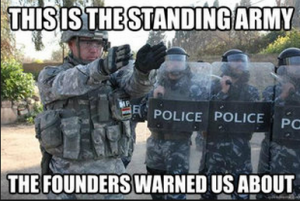
Battlefield America: The War on the American People

police-state-founders-warning

By John W. Whitehead

Source: The Rutherford Institute

“A government which will turn its tanks upon its people, for any reason, is a government with a taste of blood and a thirst for power and must either be smartly rebuked, or blindly obeyed in deadly fear.”—John Salter

We have entered into a particularly dismal chapter in the American narrative, one that shifts us from a swashbuckling tale of adventure into a bone-chilling horror story.

As I document in my new book Battlefield America: The War on the American People, “we the people” have now come full circle, from being held captive by the British police state to being held captive by the American police state. In between, we have charted a course from revolutionaries fighting for our independence and a free people establishing a new nation to pioneers and explorers, braving the wilderness and expanding into new territories.

Where we went wrong, however, was in allowing ourselves to become enthralled with and then held hostage by a military empire in bondage to a corporate state (the very definition of fascism). No longer would America hold the moral high ground as a champion of freedom and human rights. Instead, in the pursuit of profit, our overlords succumbed to greed, took pleasure in inflicting pain, exported torture, and imported the machinery of war, transforming the American landscape into a battlefield, complete with military personnel, tactics and weaponry.

To our dismay, we now find ourselves scrambling for a foothold as our once rock-solid constitutional foundation crumbles beneath us. And no longer can we rely on the president, Congress, the courts, or the police to protect us from wrongdoing.

Indeed, they have come to embody all that is wrong with America.

For instance, how does a man who is relatively healthy when taken into custody by police lapse into a coma and die while under their supervision? What kind of twisted logic allows a police officer to use a police car to run down an American citizen and justifies it in the name of permissible deadly force? And what country are we living in where the police can beat, shoot, choke, taser and tackle American citizens, all with the protection of the courts?

Certainly, the Constitution’s safeguards against police abuse means nothing when government agents can crash through your door, terrorize your children, shoot your dogs, and jail you on any number of trumped of charges, and you have little say in the matter. For instance, San Diego police, responding to a domestic disturbance call on a Sunday morning, showed up at the wrong address, only to shoot the homeowner’s 6-year-old service dog in the head.

Rubbing salt in the wound, it’s often the unlucky victim of excessive police force who ends up being charged with wrongdoing. Although 16-year-old Thai Gurule was charged with resisting arrest and strangling and assaulting police officers, a circuit judge found that it was actually the three officers who unlawfully stopped, tackled, punched, kneed, tasered and yanked his hair who were at fault. Thankfully, bystander cell phone videos undermined police accounts, which were described as “works of fiction.”

Not even our children are being spared the blowback from a growing police presence. As one juvenile court judge noted in testimony to Congress, although having police on public school campuses did not make the schools any safer, it did result in large numbers of students being arrested for misdemeanors such as school fights and disorderly conduct. One 11-year-old autistic Virginia student was charged with disorderly conduct and felony assault after kicking a trashcan and resisting a police officer’s attempt to handcuff him. A 14-year-old student was tasered by police, suspended and charged with disorderly conduct, resisting arrest and trespassing after he failed to obey a teacher’s order to be the last student to exit the classroom.

There is no end to the government’s unmitigated gall in riding roughshod over the rights of the citizenry, whether in matters of excessive police powers, militarized police, domestic training drills, SWAT team raids, surveillance, property rights, overcriminalization, roadside strip searches, profit-driven fines and prison sentences, etc.

The president can now direct the military to detain, arrest and secretly execute American citizens. These are the powers of an imperial dictator, not an elected official bound by the rule of law. For the time being, Barack Obama wears the executioner’s robe, but you can rest assured that this mantle will be worn by whomever occupies the Oval Office in the future.

A representative government means nothing when the average citizen has little to no access to their elected officials, while corporate lobbyists enjoy a revolving door relationship with everyone from the President on down. Indeed, while members of Congress hardly work for the taxpayer, they work hard at being wooed by corporations, which spend more to lobby our elected representatives than we spend on their collective salaries. For that matter, getting elected is no longer the high point it used to be. As one congressman noted, for many elected officials, “Congress is no longer a destination but a journey… [to a] more lucrative job as a K Street lobbyist… It’s become routine to see members of Congress drop their seat in Congress like a hot rock when a particularly lush vacancy opens up.”

As for the courts, they have long since ceased being courts of justice. Instead, they have become courts of order, largely marching in lockstep with the government’s dictates, all the while helping to increase the largesse of government coffers. It’s called for-profit justice, and it runs the gamut of all manner of financial incentives in which the courts become cash cows for communities looking to make an extra buck. As journalist Chris Albin-Lackey details, “They deploy a crushing array of fines, court costs, and other fees to harvest revenues from minor offenders that these communities cannot or do not want to raise through taxation.” In this way, says Albin-Lackey, “A resident of Montgomery, Alabama who commits a simple noise violation faces only a $20 fine—but also a whopping $257 in court costs and user fees should they seek to have their day in court.”

As for the rest—the schools, the churches, private businesses, service providers, nonprofits and your fellow citizens—many are also marching in lockstep with the police state. This is what is commonly referred to as community policing. After all, the police can’t be everywhere. So how do you police a nation when your population outnumbers your army of soldiers? How do you carry out surveillance on a nation when there aren’t enough cameras, let alone viewers, to monitor every square inch of the country 24/7? How do you not only track but analyze the transactions, interactions and movements of every person within the United States? The answer is simpler than it seems: You persuade the citizenry to be your eyes and ears.

It’s a brilliant ploy, with the added bonus that while the citizenry remains focused on and distrustful of each other, they’re incapable of focusing on more definable threats that fall closer to home—namely, the government and its militarized police. In this way, we’re seeing a rise in the incidence of Americans being reported for growing vegetables in their front yard, keeping chickens in their back yard, letting their kids walk to the playground alone, and voicing anti-government sentiments. For example, after Shona Banda’s son defended the use of medical marijuana during a presentation at school, school officials alerted the police and social services, and the 11-year-old was interrogated, taken into custody by social workers, had his home raided by police and his mother arrested.

Now it may be that we have nothing to worry about. Perhaps the government really does have our best interests at heart. Perhaps covert domestic military training drills such as Jade Helm really are just benign exercises to make sure our military is prepared for any contingency. As the Washington Post describes the operation:

The mission is vast both geographically and strategically: Elite service members from all four branches of the U.S. military will launch an operation this summer in which they will operate covertly among the U.S. public and travel from state to state in military aircraft. Texas, Utah and a section of southern California are labeled as hostile territory, and New Mexico isn’t much friendlier.

Now I don’t believe in worrying over nothing, but it’s safe to say that the government has not exactly shown itself to be friendly in recent years, nor have its agents shown themselves to be cognizant of the fact that they are civilians who answer to the citizenry, rather than the other way around.

Whether or not the government plans to impose some form of martial law in the future remains to be seen, but there can be no denying that we’re being accustomed to life in a military state. The malls may be open for business, the baseball stadiums may be packed, and the news anchors may be twittering nonsense about the latest celebrity foofa, but those are just distractions from what is really taking place: the transformation of America into a war zone.

Trust me, if it looks like a battlefield (armored tanks on the streets, militarized police in metro stations, surveillance cameras everywhere), sounds like a battlefield (SWAT team raids nightly, sound cannons to break up large assemblies of citizens), and acts like a battlefield (police shooting first and asking questions later, intimidation tactics, and involuntary detentions), it’s a battlefield.

Indeed, what happened in Ocala, Florida, is a good metaphor for what’s happening across the country: Sheriff’s deputies, dressed in special ops uniforms and riding in an armored tank on a public road, pulled a 23-year-old man over and issued a warning violation to him after he gave them the finger. The man, Lucas Jewell, defended his actions as a free speech expression of his distaste for militarized police.

Translation: “We the people” are being hijacked on the highway by government agents with little knowledge of or regard for the Constitution, who are hyped up on the power of their badge, outfitted for war, eager for combat, and taking a joy ride—on taxpayer time and money—in a military tank that has no business being on American soil.

Rest assured, unless we slam on the brakes, this runaway tank will soon be charting a new course through terrain that bears no resemblance to land of our forefathers, where freedom meant more than just the freedom to exist and consume what the corporate powers dish out.

Rod Serling, one of my longtime heroes and the creator of The Twilight Zone, understood all too well the danger of turning a blind eye to evil in our midst, the “things that scream for a response.” As Serling warned, “if we don’t listen to that scream – and if we don’t respond to it – we may well wind up sitting amidst our own rubble, looking for the truck that hit us – or the bomb that pulverized us. Get the license number of whatever it was that destroyed the dream. And I think we will find that the vehicle was registered in our own name.”

If you haven’t managed to read the writing on the wall yet, the war has begun.

America’s Mania for Positive Thinking and Denial of Reality Will Be Our Downfall

tomorrowland-trailer-poster-2015-movie-george-clooney

The ridiculous positivism, the belief that we are headed toward some glorious future, defies reality.

By Chris Hedges

Source: Alternet

The naive belief that history is linear, that moral progress accompanies technical progress, is a form of collective self-delusion. It cripples our capacity for radical action and lulls us into a false sense of security. Those who cling to the myth of human progress, who believe that the world inevitably moves toward a higher material and moral state, are held captive by power. Only those who accept the very real possibility of dystopia, of the rise of a ruthless corporate totalitarianism, buttressed by the most terrifying security and surveillance apparatus in human history, are likely to carry out the self-sacrifice necessary for revolt.

The yearning for positivism that pervades our corporate culture ignores human nature and human history. But to challenge it, to state the obvious fact that things are getting worse, and may soon get much worse, is to be tossed out of the circle of magical thinking that defines American and much of Western culture. The left is as infected with this mania for hope as the right. It is a mania that obscures reality even as global capitalism disintegrates and the ecosystem unravels, potentially dooming us all.

The 19th century theorist Louis-Auguste Blanqui, unlike nearly all of his contemporaries, dismissed the belief, central to Karl Marx, that human history is a linear progression toward equality and greater morality. He warned that this absurd positivism is the lie perpetrated by oppressors: “All atrocities of the victor, the long series of his attacks are coldly transformed into constant, inevitable evolution, like that of nature. … But the sequence of human things is not inevitable like that of the universe. It can be changed at any moment.” He foresaw that scientific and technological advancement, rather than being a harbinger of progress, could be “a terrible weapon in the hands of Capital against Work and Thought.” And in a day when few others did so, he decried the despoiling of the natural world. “The axe fells, nobody replants. There is no concern for the future’s ill health.”

“Humanity,” Blanqui wrote, “is never stationary. It advances or goes backwards. Its progressive march leads it to equality. Its regressive march goes back through every stage of privilege to human slavery, the final word of the right to property.” Further, he wrote, “I am not amongst those who claim that progress can be taken for granted, that humanity cannot go backwards.”

Blanqui understood that history has long periods of cultural barrenness and brutal repression. The fall of the Roman Empire, for example, led to misery throughout Europe during the Dark Ages, roughly from the sixth through the 13th centuries. There was a loss of technical knowledge (one prominent example being how to build and maintain aqueducts), and a cultural and intellectual impoverishment led to a vast historical amnesia that blotted out the greatest thinkers and artists of the classical world. None of this loss was regained until the 14th century when Europe saw the beginning of the Renaissance, a development made possible largely by the cultural flourishing of Islam, which through translating Aristotle into Arabic and other intellectual accomplishments kept alive the knowledge and wisdom of the past. The Dark Ages were marked by arbitrary rule, incessant wars, insecurity, anarchy and terror. And I see nothing to prevent the rise of a new Dark Age if we do not abolish the corporate state. Indeed, the longer the corporate state holds power the more likely a new Dark Age becomes. To trust in some mythical force called progress to save us is to become passive before corporate power. The people alone can defy these forces. And fate and history do not ensure our victory.

Blanqui tasted history’s tragic reverses. He took part in a series of French revolts, including an attempted armed insurrection in May 1839, the 1848 uprising and the Paris Commune—a socialist uprising that controlled France’s capital from March 18 until May 28 in 1871. Workers in cities such as Marseilles and Lyon attempted but failed to organize similar communes before the Paris Commune was militarily crushed.

The blundering history of the human race is always given coherence by power elites and their courtiers in the press and academia who endow it with a meaning and coherence it lacks. They need to manufacture national myths to hide the greed, violence and stupidity that characterize the march of most human societies. For the United States, refusal to confront the crisis of climate change and our endless and costly wars in the Middle East are but two examples of the follies that propel us toward catastrophe.

Wisdom is not knowledge. Knowledge deals with the particular and the actual. Knowledge is the domain of science and technology. Wisdom is about transcendence. Wisdom allows us to see and accept reality, no matter how bleak that reality may be. It is only through wisdom that we are able to cope with the messiness and absurdity of life. Wisdom is about detachment. Once wisdom is achieved, the idea of moral progress is obliterated. Wisdom throughout the ages is a constant. Did Shakespeare supersede Sophocles? Is Homer inferior to Dante? Does the Book of Ecclesiastes not have the same deep powers of observation about life that Samuel Beckett offers? Systems of power fear and seek to silence those who achieve wisdom, which is what the war by corporate forces against the humanities and art is about. Wisdom, because it sees through the facade, is a threat to power. It exposes the lies and ideologies that power uses to maintain its privilege and its warped ideology of progress.

Knowledge does not lead to wisdom. Knowledge is more often a tool for repression. Knowledge, through the careful selection and manipulation of facts, gives a false unity to reality. It creates a fictitious collective memory and narrative. It manufactures abstract concepts of honor, glory, heroism, duty and destiny that buttress the power of the state, feed the disease of nationalism and call for blind obedience in the name of patriotism. It allows human beings to explain the advances and reverses in human achievement and morality, as well as the process of birth and decay in the natural world, as parts of a vast movement forward in time. The collective enthusiasm for manufactured national and personal narratives, which is a form of self-exaltation, blots out reality. The myths we create that foster a fictitious hope and false sense of superiority are celebrations of ourselves. They mock wisdom. And they keep us passive.

Wisdom connects us with forces that cannot be measured empirically and that are outside the confines of the rational world. To be wise is to pay homage to beauty, truth, grief, the brevity of life, our own mortality, love and the absurdity and mystery of existence. It is, in short, to honor the sacred. Those who remain trapped in the dogmas perpetuated by technology and knowledge, who believe in the inevitability of human progress, are idiot savants.

“Self-awareness is as much a disability as a power,” the philosopher John Gray writes. “The most accomplished pianist is not the one who is most aware of her movements when she plays. The best craftsman may not know how he works. Very often we are at our most skillful when we are least self-aware. That may be why many cultures have sought to disrupt or diminish self-conscious awareness. In Japan, archers are taught that they will hit the target only when they no longer think of it—or themselves.”

Artists and philosophers, who expose the mercurial undercurrents of the subconscious, allow us to face an unvarnished truth. Works of art and philosophy informed by the intuitive, unarticulated meanderings of the human psyche transcend those constructed by the plodding conscious mind. The freeing potency of visceral memories does not arrive through the intellect. These memories are impervious to rational control. And they alone lead to wisdom.

Those with power have always manipulated reality and created ideologies defined as progress to justify systems of exploitation. Monarchs and religious authorities did this in the Middle Ages. Today this is done by the high priests of modernity—the technocrats, scholars, scientists, politicians, journalists and economists. They deform reality. They foster the myth of preordained inevitability and pure rationality. But such knowledge—which dominates our universities—is anti-thought. It precludes all alternatives. It is used to end discussion. It is designed to give to the forces of science or the free market or globalization a veneer of rational discourse, to persuade us to place our faith in these forces and trust our fate to them. These forces, the experts assure us, are as unalterable as nature. They will lead us forward. To question them is heresy.

The Austrian writer Stefan Zweig, in his 1942 novella “Chess Story,” chronicles the arcane specializations that have created technocrats unable to question the systems they serve, as well as a society that foolishly reveres them. Mirko Czentovic, the world chess champion, represents the technocrat. His mental energy is invested solely in the 64 squares of the chessboard. Apart from the game, he is a dolt, a monomaniac like all monomaniacs, who “burrow like termites into their own particular material to construct, in miniature, a strange and utterly individual image of the world.” When Czentovic “senses an educated person he crawls into his shell. That way no one will ever be able to boast of having heard him say something stupid or of having plumbed the depths of his seemingly boundless ignorance.”

An Austrian lawyer known as Dr. B, whom the Gestapo had held for many months in solitary confinement, challenges Czentovic to a game of chess. During his confinement, the lawyer’s only reading material was a chess manual, which he memorized. He reconstructed games in his head. Forced by his captivity to replicate the single-minded obsession of the technocrat Czentovic, Dr. B too became trapped inside a specialized world, and, unlike Czentovic, he became insane temporarily as he focused on a tiny, specialized piece of human activity. When he challenges the chess champion, his insanity returns.

Zweig, who mourned for the broad liberal culture of educated Europe swallowed up by fascism and modern bureaucracy, warns of the absurdity and danger of a planet run by technocrats. For him, the rise of the Industrial Age and the industrial man and woman is a terrifying metamorphosis in the relationship of human beings to the world. As specialists and bureaucrats, human beings become tools, able to make systems of exploitation and even terror function efficiently without the slightest sense of personal responsibility or understanding. They retreat into the arcane language of all specialists, to mask what they are doing and give to their work a sanitized, clinical veneer.

This is Hannah Arendt’s central point in “Eichmann in Jerusalem.” Technocratic human beings are spiritually dead. They are capable of anything, no matter how heinous, because they do not reflect upon or question the ultimate goal. “The longer one listened to him,” Arendt writes of the Nazi Adolf Eichmann on trial, “the more obvious it became that his inability to speak was closely connected with an inability to think, namely, to think from the standpoint of somebody else. No communication was possible with him, not because he lied but because he was surrounded by the most reliable of all safeguards against the words and presence of others, and hence against reality as such.”

Zweig, horrified by a world run by technocrats, committed suicide with his wife in 1942. He knew that from then on, the Czentovics would be exalted in the service of state and corporate monstrosities.

Resistance, as Alexander Berkman points out, is first about learning to speak differently and abandoning the vocabulary of the “rational” technocrats who rule. Once we discover new words and ideas through which to perceive and explain reality, we free ourselves from neoliberal capitalism, which functions, as Walter Benjamin knew, like a state religion. Resistance will take place outside the boundaries of popular culture and academia, where the deadening weight of the dominant ideology curtails creativity and independent thought.

As global capitalism disintegrates, the heresy our corporate masters fear is gaining currency. But that heresy will not be effective until it is divorced from the mania for hope that is an essential part of corporate indoctrination. The ridiculous positivism, the belief that we are headed toward some glorious future, defies reality. Hope, in this sense, is a form of disempowerment.

There is nothing inevitable about human existence except birth and death. There are no forces, whether divine or technical, that will guarantee us a better future. When we give up false hopes, when we see human nature and history for what they are, when we accept that progress is not preordained, then we can act with an urgency and passion that comprehends the grim possibilities ahead.

Chris Hedges, a Pulitzer Prize-winning reporter, writes a regular column for Truthdig every Monday. Hedges’ most recent book is “Empire of Illusion: The End of Literacy and the Triumph of Spectacle.”

US Empire: American Exceptionalism Is No Shining City On a Hill

american-arrogance

By Gilbert Mercier

Source: News Junkie Post

The concept of American exceptionalism is as old as the United States, and it implies that the country has a qualitative difference from other nations. This notion of being special gives Americans the sense that playing a lead role in world affair is part of their natural historic calling. However there is nothing historically exceptional about this: the Roman empire also viewed itself as a system superior to other nations and, more recently, so did the British and the French empires.

On the topic of American exceptionalism, which he often called “Americanism”, Seymour Martin Lipset noted that “America’s ideology can be described in five words: liberty, egalitarism, individualism, populism and laissez-faire. The revolutionary ideology, which became American creed, is liberalism in its eighteenth and nineteenth-century meaning. It departed from conservatism Toryism, statist communitarianism, mercantilism and noblesse-oblige dominant in monarchical state-church formed cultures.” Naturally identifying America’s system as a unique ideology, just like calling its successful colonial war against Britain a revolution, is a fallacy. For one, America was never based on social equality, as rigid class distinctions always remained through US history.

In reality, the US has never broken from European social models. American exceptionalism implies a sense of superiority, just like in the case of the British empire, the French empire and the Roman empire. In such imperialist systems, class inequality was never challenged and, as matter of fact, served as cornerstone of the imperial structure. In American history, the only exception to this system based on social inequality was during the post World War II era of the economic “miracle”. The period from 1945 to the mid 1970s was characterized by major economic growth, an absence of big economic downturns, and a much higher level of social mobility on a massive scale. This time frame saw a tremendous expansion of higher education: from 2.5 million people to 12 million going to colleges and universities, and this education explosion, naturally, fostered this upward mobility where the American dream became possible for the middle class.

Regardless of  real domestic social progress made in the United States after the birth of the empire in 1945, for the proponents of American exceptionalism — this includes the entire political class — the myth of the US being defined as a “shining city on a hill” has always been a rationale to justify the pursuit of imperialism. For example, when President Barack Obama addressed the nation to justify the US military intervention in Libya, he said that “America is different”, as if the US has a special role in history as a force for good. In a speech on US foreign policy, at West Point on May 28, 2014, Obama bluntly stated: “In fact, by most measures, America has rarely been stronger relative to the rest of the world. Those who argue otherwise — who suggest that America is in decline or has seen its global leadership slip away are misreading history. Our military has no peer….  I believe in American exceptionalism with every fiber of my being.”

In his book, Democracy In America, Frenchman Alexis de Tocqueville was lyrical in his propaganda-like adulation of American exceptionalism, defining it almost as divine providence. “When the earth was given to men by the Creator, the earth was inexhaustible. But men were weak and ignorant, and when they had learned to take advantage of the treasures which it contained, they already covered its surface and were soon obliged to earn by the sword an asylum for repose and freedom. Just then North America was discovered, as if it had been kept in reserve by the Deity and had risen from beneath the waters of the deluge”, wrote de Tocqueville.

This notion, originated by the French author, and amplified ever since, which defined the US as the “divine gift” of a moral and virtuous land, is a cruel fairy tale. It is mainly convenient to ease up America’s profound guilt. After all, the brutal birth of this nation took place under the curse of two cardinal sins: the theft of Native American lands after committing a genocide of their population; and the hideous crime of slavery, with slaves building an immense wealth for the few, in a new feudal system, with their sweat, tears and blood.

The Beginning is Here

sunrise-over-earth3-NASA-300x168

By Zen Gardner

Source: Waking Times

Waking up to the realities presented before us and even more importantly what they imply is a very profound and personal experience. Once we become aware we are living in a world that’s been deliberately fabricated in ways we never would have imagined and that even our own true nature is anything but what we’ve been told, there’s no turning back.

It may appear to be a lonely path at first, but we are by no means alone in this awakening. It is happening in all walks of life. Whether a banker or corporate employee wakes up to the scam being perpetrated on humanity and pulls out of the matrix, or a normal taxpaying worker realizes they’re contributing to a military industrial machine hell bent on control and world domination, we’re all the same.

And those are just surface issues compared to the deliberate suppression of man’s innate spiritual nature, whether we call it social liberty or the simple freedom to create and manifest as we truly are. Not the least of which control mechanisms we are faced with is religion which works hand in hand with this suppression of humanity. All part of this repressive, controlling matrix.

Triggers for Awakening

There are many such triggers that wake people up. Once someone realizes, for example, how the world was scammed on 9/11 and that the powers that be are willing to continue to perpetrate such atrocities to promote their agenda, the digging begins. When we realize we seem to be at the complete mercy of parasitic central bankers more than willing to not only implode the world’s economy, but finance both sides of any conflict for personal gain and control, and that our governments are complicit in this scheme, we start to grasp the enormity of what befalls us.

That we have rapidly evolved into an advanced militarized surveillance police state is driving many to ask some hard questions – and the answers can be startling and difficult to swallow, especially when you realize they’re attempting to cut off all avenues of recourse.

Another major issue is that it’s more evident by the day that our very health is under attack, again by complicit government and multinational corporations pushing GMOs, adulterated food, vaccines, pharmaceuticals, atmospheric aerosols, genetic alterations and the like, all of which are clearly extremely hazardous to humanity. Yet they push harder by the day, mandating program after destructive program. Meanwhile, natural and organic farming and foods, as well as supplements, are under intense attack by these very same perpetrators.

The truth about these issues and many, many more including awareness of the massive planet harming programs such as fracking, electrosmog, genetic modification, technologically driven transhumanism and the ongoing geoengineering assault on humanity are driving a major perceptual paradigm shift amongst all walks of life as we delve more deeply into who is doing all this and why.

What exactly is their agenda? Volumes of evidence points to not just control, but literal depopulation motives. Is this shadow force literally that Machiavellian?

There Is No “They” – Or Is There?

This is often the final breakthrough point for many people. As the true picture starts to crystallize, the horrific realization that the “powers that be” are fundamentally a clandestine cabal with puppet-like front men comes into focus. These are powerful minions, more interested in weakening and subjugating humanity via health degradation, dumbed down education, mindless “bread and circus” government controlled media, depraved violence and sex oriented entertainment, and a draconian militarized police crackdown. The ugly truth then comes to the fore.

It can be staggering. If you take just 9/11 and other false flag events and realize they were staged to bring about this Orwellian police state where the citizens are now terrorist suspects, it can be very difficult to swallow.

A quick perusal of history soon follows, where people realize these same false flag/false enemy tactics were used to justify almost every war, leading to such totalitarian states as Stalinist Russia, Communist China and Nazi Germany, each of which descended into horrific pogroms, decimating their own populations of anyone potentially daring to question the new regime. With that perspective, the trees we’re amongst on the edge of the forest become strikingly transparent. America and its allies are indeed exactly the same, only much much worse, being pawned off to a numbed down generation who actually believe this is all a fight for liberty and freedom when in fact it is the exact opposite.

It’s not all black and white. There are of course good people working for bad people, powers and programs, wittingly and unwittingly. Many are trying to change and improve our existing structure. Many good people are performing wonderful services within this overarching societal program thinking it can be changed constructively. What we’re addressing are the deceitful and destructive powers and mechanisms at play that are attempting to bring humanity into a weakened subservient role to some sort of worldwide fascist control state, eliminating personal and national sovereignty to support and obey a very few powerful self-appointed elites.

And it’s coming on fast.

This becomes evident as one pursues almost any avenue we’re discussing here. To realize this massive program is being orchestrated by some form of “they” soon becomes obvious. The reality of the conspiracy that JFK so eloquently pointed out before he was surgically removed from office via assassination hits squarely home. Here’s an excerpt from this landmark speech.

For we are opposed around the world by a monolithic and ruthless conspiracy that relies on covert means for expanding its sphere of influence–on infiltration instead of invasion, on subversion instead of elections, on intimidation instead of free choice, on guerrillas by night instead of armies by day.

It is a system which has conscripted vast human and material resources into the building of a tightly knit, highly efficient machine that combines military, diplomatic, intelligence, economic, scientific and political operations. Its preparations are concealed, not published. Its mistakes are buried not headlined. Its dissenters are silenced, not praised. No expenditure is questioned, no rumor is printed, no secret is revealed. – John F. Kennedy

We Have to Find Out for Ourselves

An essential element to a true awakening is investigating and learning for ourselves. One of the main control mechanisms has been teaching humanity to only trust what they’ve been told by these same agendized so-called authorities. How many times have you heard, “If 9/11 was an ‘inside job’, surely it would have been on CNN. If something was really wrong surely someone would have said something.”

Well, a lot of people have and continue to speak out. And what’s the response? Anything contrary to the official narrative is “outlandish conspiracy theory”, and results in the subsequent demonization and marginalization of any form of questioning or healthy criticism.

Waking up from that media and education entrancement is another shocker. Could they do such a thing? Could we really be facing such a totalitarian crackdown and mind and information control? Do they really have such sway on humanity?

When I was young there were over 60 media companies vying for audiences. Real investigative reporting, although it’s always been tampered with or suppressed, was still available. Today 6 mega corporations own all of the media. The very same corporations that own much of the corporate military industrial infrastructure. Conspiracy is not a stretch – of course these power brokers would twist information to suit their intentions. The word conspiracy has been stigmatized for a reason – don’t ask questions or there will be consequences.

All of this will take some serious researching, most likely in places people have never dared to look before. And this is good. Don’t let anyone tell you what the truth is, find out for yourself and be convinced in your own mind and heart. That’s a new phenomenon for most, as odd as that may seem, but stepping outside the propaganda mainstream is a must. And it is oh so refreshing.

The Shock Does Wear Off – But the Indignation Doesn’t

There are so many interconnected “rabbit holes” of similarly repressed, twisted or hidden areas of information that it can be staggering. Once we realize we’ve been lied to about any one of these serious issues, we begin to question everything. And that is extremely healthy. You may not find support for your new found perspective from those around you, but there are millions who are sharing your experience. Thanks to the internet you can find others undergoing the same transformation quite readily and derive a lot of affirmation, encouragement and support.

Battling through the naysaying of close friends and loved ones seems to act like a chrysalis, much like the cocoon a metamorphosing butterfly has to struggle to escape. And as we know, that is exactly what drives the blood into the wings of the birthing creation that will soon bear the beautiful new awakened soul to glorious new heights and vistas.

One thing that won’t wear off is your absolute disdain for what is being perpetrated on our fellow humans. As the expression goes, “If you’re not angry, you’re not paying attention.” If you knew your home was under attack and malevolent forces were coming for you and your children, you would do anything in your power to protect your family. That soon becomes an innate awareness regarding the current toxic social and physical world we’re experiencing and the need for a conscious response.

We are Responding – They Know It and Don’t Like It

Globalist adviser to 5 American presidents including Barak Obama, Zbigniew Brzezinski has clearly laid out the plan for global hegemony at any cost. His book, The Grand Chessboard even alludes to the need for a new Pearl Harbor, later echoed by the oft quoted PNAC report issued before 9/11 literally forecasting the event.

In one of his many addresses to the globalist advisory board called the Council on Foreign Relations, he made some very revealing statements. They are very aware of and afraid of the global awakening, and have surreal plans on how to control it.

Not lauding this awakening, but decrying it, Brzezinski chillingly said: [Emphasis mine]

For the first time in human history almost all of humanity is politically activated, politically conscious and politically interactive… The resulting global political activism is generating a surge in the quest for personal dignity, cultural respect and economic opportunity in a world painfully scarred by memories of centuries-long alien colonial or imperial domination… The worldwide yearning for human dignity is the central challenge inherent in the phenomenon of global political awakening… That awakening is socially massive and politically radicalizing… The nearly universal access to radio, television and increasingly the Internet is creating a community of shared perceptions and envy that can be galvanized and channeled by demagogic political or religious passions. These energies transcend sovereign borders and pose a challenge both to existing states as well as to the existing global hierarchy, on top of which America still perches…

The youth of the Third World are particularly restless and resentful. The demographic revolution they embody is thus a political time-bomb, as well… Their potential revolutionary spearhead is likely to emerge from among the scores of millions of students concentrated in the often intellectually dubious “tertiary level” educational institutions of developing countries. Depending on the definition of the tertiary educational level, there are currently worldwide between 80 and 130 million “college” students. Typically originating from the socially insecure lower middle class and inflamed by a sense of social outrage, these millions of students are revolutionaries-in-waiting, already semi-mobilized in large congregations, connected by the Internet and pre-positioned for a replay on a larger scale of what transpired years earlier in Mexico City or in Tiananmen Square. Their physical energy and emotional frustration is just waiting to be triggered by a cause, or a faith, or a hatred…

[The] major world powers, new and old, also face a novel reality: while the lethality of their military might is greater than ever, their capacity to impose control over the politically awakened masses of the world is at a historic low. To put it bluntly: in earlier times, it was easier to control one million people than to physically kill one million people; today, it is infinitely easier to kill one million people than to control one million people.

Zbigniew Brzezinski

The Conscious Awakening

This dark yet ultimately empowering information goes hand in hand with anyone experiencing this paradigm shift. If things here are so massively manipulated, what lies beyond all of this? What are we being kept from? Why do we sense we are so much more?

These are very important questions to pursue. There must be meaning in all of this. “Certainly all of humanity is not as wicked as these psychopathic control freaks.” Yes, that’s true. Unfortunately, the aggressor usually rules the day in this hierarchy of control our world has adopted for millennia. History bears this out.

The beauty of gaining a greater new found spiritual perspective is that it puts these influences in their place. We discover new ways to perceive our true indomitable nature which gives tremendous peace and confidence in spite of what we’re currently faced with. This sense of profound conscious awareness and spirituality only grows as our pursuit for truth, in love, gains momentum.

Awake, But Never Alone

A sense of isolation following the initial awakening is natural. It’s foreign to everything we’ve been taught, with implications that can be mind-boggling as well as heart breaking. However, we are very much connected and sharing a profound common experience. Knowing we are not alone is very important to keep in mind.

Building community also becomes a priority, where we can contribute to the healing of the planet at every level possible. Whether it’s activist or spiritual associations these are very important. It may only be on-line at first, that’s fine. Find kindred spirits and empowering and informative websites and blogs and even attend meet up events in your area on some of these subjects of concern.

This awakening of empowered consciousness is upon us, and is transpiring at an accelerating pace, and something to be very encouraged about. Once you get past the shock of what you’ve “found out”, it becomes easier, but it will drastically alter your life. For the better.

Enjoy it, be empowered, and take action accordingly.

The beginning is here.

Much love, Zen

ZenGardner.com


Kick Open the Doorway to Liberty: What Are We Waiting For?

0823e935c920bdf2c31447b67612bfc6

By John W. Whitehead

Source: The Rutherford Institute

“The greatness of America lies in the right to protest for right.”—Martin Luther King Jr.

Everything this nation once stood for is being turned on its head.

Free speech, religious expression, privacy, due process, bodily integrity, the sanctity of human life, the sovereignty of the family, individuality, the right to self-defense, protection against police abuses, representative government, private property, human rights—the very ideals that once made this nation great—have become casualties of a politically correct, misguided, materialistic, amoral, militaristic culture.

Indeed, I’m having a hard time reconciling the America I know and love with the America being depicted in the daily news headlines, where corruption, cronyism and abuse have taken precedence over the rights of the citizenry and the rule of law.

What kind of country do we live in where it’s acceptable for police to shoot unarmed citizens, for homeowners to be jailed for having overgrown lawns (a Texas homeowner was actually sentenced to 17 days in jail and fined $1700 for having an overgrown lawn), for kids to be tasered and pepper sprayed for acting like kids at school (many are left with health problems ranging from comas and asthma to cardiac arrest), and for local governments to rake in hefty profits under the guise of traffic safety (NPR reports that police departments across the country continue to require quotas for arrests and tickets, a practice that is illegal but in effect)?

Why should we Americans have to put up with the government listening in on our phone calls, spying on our emails, subjecting us to roadside strip searches, and generally holding our freedoms hostage in exchange for some phantom promises of security?

As I document in my new book Battlefield America: The War on the American People, it doesn’t matter where you live—big city or small town—it’s the same scenario being played out over and over again in which government agents ride roughshod over the rights of the citizenry.

In such an environment, it’s not just our Fourth Amendment rights—which protect us against police abuses—that are being trampled. It’s also our First Amendment rights to even voice concern over these practices that are being muzzled. Just consider some of the First Amendment battles that have taken place in recent years, and you too will find yourself wondering what country you’re living in:

  • Harold Hodge was arrested for standing silently in front of the U.S. Supreme Court building, holding a sign in protest of police tactics.
  • Marine Brandon Raub was arrested for criticizing the government on Facebook.
  • Pastor Michael Salman was arrested for holding Bible studies in his home.
  • Steven Howards was arrested for being too close to a government official when he voiced his disapproval of the war in Iraq.
  • Kenneth Webber was fired from his job as a schoolbus driver for displaying a Confederate flag on the truck he uses to drive from home to school and back.
  • Fred Marlow was arrested for filming a SWAT team raid that took place across from his apartment.

And then there were the three California high school public school students who were ordered to turn their American flag t-shirts inside out on May 5 (Cinco de Mayo) because school officials were afraid it might cause a disruption and/or offend Hispanic students. Incredibly, the U.S. Supreme Court actually sided with the school and the Ninth Circuit Court of Appeals, affirming that it might be disruptive for American students to wear the American flag to an American public school.

While there are all kinds of labels being put on so-called “unacceptable” speech today, from calling it politically incorrect and hate speech to offensive and dangerous speech, the real message being conveyed is that Americans don’t have a right to express themselves if what they are saying is unpopular, controversial or at odds with what the government determines to be acceptable.

Whether it’s through the use of so-called “free speech zones,” the requirement of speech permits, the policing of online forums, or a litany of laws and policies that criminalize expressive activities, what we’re seeing is the caging of free speech and the asphyxiation of the First Amendment.

Long before the menace of the police state, with its roadside strip searches, surveillance drones, and SWAT team raids, it was our First Amendment rights that were being battered by political correctness, hate crime legislation, the war on terror and every other thinly veiled rationale used to justify censoring our free speech rights.

By suppressing free speech, the government is contributing to a growing underclass of Americans who are being told that they can’t take part in American public life unless they “fit in.” Mind you, it won’t be long before anyone who believes in holding the government accountable to respecting our rights and abiding by the rule of law is labeled an “extremist” and is relegated to an underclass that doesn’t fit in and must be watched all the time.

It doesn’t matter how much money you make, what politics you subscribe to, or what God you worship: we are all potential suspects, terrorists and lawbreakers in the eyes of the government.

In other words, if and when this nation falls to tyranny, we will all suffer the same fate: we will fall together. However, if it is possible to avert such an outcome, it will rest in us remembering that we are also all descendants of those early American revolutionaries who pushed back against the abuses of the British government. These people were neither career politicians nor government bureaucrats. Instead, they were mechanics, merchants, artisans and the like—ordinary people groaning under the weight of Britain’s oppressive rule—who, having reached a breaking point, had decided that enough was enough.

The colonists’ treatment at the hands of the British was not much different from the abuses meted out to the American people today: they too were taxed on everything from food to labor without any real say in the matter, in addition to which they had their homes invaded by armed government agents, their property seized and searched, their families terrorized, their communications, associations and activities monitored, and their attempts to defend themselves and challenge the government’s abuses dismissed as belligerence, treachery, and sedition.

Unlike most Americans today, who remain ignorant of the government’s abuses, cheerfully distracted by the entertainment spectacles trotted out before them by a complicit media, readily persuaded that the government has their best interests at heart, and easily cowed by the slightest show of force, the colonists responded to the government’s abuses with outrage, activism and rebellion. They staged boycotts of British goods and organized public protests, mass meetings, parades, bonfires and other demonstrations, culminating with their most famous act of resistance, the Boston Tea Party.

On the night of December 16, 1773, a group of men dressed as Indians boarded three ships that were carrying tea. Cheered on by a crowd along the shore, they threw 342 chests of tea overboard in protest of a tax on the tea. Many American merchants were aghast at the wanton destruction of property. A town meeting in Bristol, Massachusetts, condemned the action. Ben Franklin even called on his native city to pay for the tea and apologize. But as historian Pauline Maier notes, the Boston Tea Party was a last resort for a group of people who had stated their peaceful demands but were rebuffed by the British: “The tea resistance constituted a model of justified forceful resistance upon traditional criteria.”

The rest, as they say, is history. Yet it’s a history we cannot afford to forget or allow to be rewritten.

The colonists suffered under the weight of countless tyrannies before they finally were emboldened to stand their ground. They attempted to reason with the British crown, to plea their cause, even to negotiate. It was only when these means proved futile that they resorted to outright resistance, civil disobedience and eventually rebellion.

More than 200 years later, we are once again suffering under a long train of abuses and usurpations. What Americans today must decide is how committed they are to the cause of freedom and how far they’re willing to go to restore what has been lost.

Nat Hentoff, one of my dearest friends and a formidable champion of the Constitution, has long advocated for the resurgence of grassroots activism. As Nat noted:

This resistance to arrant tyranny first became part of our heritage when Samuel Adams and the Sons of Liberty formed the original Committees of Correspondence, a unifying source of news of British tyranny throughout the colonies that became a precipitating cause of the American Revolution. Where are the Sons of Liberty, the Committees of Correspondence and the insistently courageous city councils now, when they are crucially needed to bring back the Bill of Rights that protect every American against government tyranny worse than King George III’s? Where are the citizens demanding that these doorways to liberty be opened … What are we waiting for?

What are we waiting for, indeed?

Feds Panic on Mass Common Core Test Refusals, Threaten Reprisals

Gates-HSLDA-Curriculum-aligned

By Alex Newman

Source: The New American

Public resistance to Common Core is exploding across America, and officials are not happy about it. The Obama administration’s Department of Education, along with pro-Common Core government officials across the country under pressure from the feds, appear to be in panic mode. Facing a growing nationwide “opt out” movement to refuse participation in the unconstitutional federally funded testing regime aligned with the Obama-backed national school standards, senior bureaucrats, including Education Secretary Arne Duncan, have actually started resorting to lawless threats against parents, teachers, students, and entire state governments. Some parents were threatened by officials with jail time. Even small children are being punished by the state for “opting out” of the deeply controversial tests, with one California mother telling The New American that her daughter was publicly denied ice cream in retaliation.

But so far, the threats are only emboldening the opposition.

Perhaps the most outrageous threat so far came from Obama’s education chief, Duncan, who boasted in recent years of using government schools to create “green citizens” with UNESCO (United Nations Educational, Scientific, and Cultural Organization) as a “global partner.” Late last month, Duncan, who was greeted by protesters urging him to “stop test bullying,” threatened federal intervention to force Americans to take the Common Core tests if states would not do the job. “We think most states will do that,” Duncan proclaimed at an Education Writers Association conference in Chicago. “If states don’t do that, then we [the federal government] have an obligation to step in.” In reality, of course, the federal government has an obligation under the U.S. Constitution to butt out. But despite swearing an oath to uphold and defend the Constitution, including the 10th Amendment, Duncan has led the charge in recent years to finish federalizing the government school system — and to use it as what he called a “weapon” to “change to world.”

Sounding oblivious to America’s federalist system of constitutional government, Duncan proclaimed that he expected state governments to hold “districts’ and schools’ feet to the fire on this,” as if state governments were mere administrative units to enforce decrees from the all-powerful federal executive branch. Hundreds of thousands of students in New York recently opted out. Almost nobody took the tests in some districts amid a full-scale uprising by teachers, students, and parents. In Chicago, where even the teachers’ union has blasted the federal takeover, school officials were threatened with the loss of more than $1 billion in state and federal “education aid” if not enough students were successfully coerced into taking the Common Core-aligned tests. Still, few details were provided on what it might look like to have the Obama administration “step in” and force students to take the controversial tests — an outrageous threat he also made in a discussion with Motoko Rich of the New York Times.

Critics, however, ridiculed the threat, daring the administration to try it. “Assuming that Duncan is not planning to call in the National Guard to haul off opt-outing 8 year olds, the only possible ‘sanction’ would be withholding funds,” observed Carol Burris, an award-winning New York principal who recently stepped down to fight back against what she sees as problems with the public education system. “That would surely lead to court challenges forcing the Education Department to justify penalizing schools when parents exercise their legitimate right to refuse the test — an impossible position to defend.” Noting that students of all races and backgrounds were opting out of the testing scheme, Burris pointed out that the rates “defy the stereotype that the movement is a rebellion of petulant ‘white suburban moms.’”

In a recent statement published by the Washington Post, the New York “2013 High School Principal of the Year” also highlighted a number of troubling government abuses targeting parents. Among other concerns, she said, citing activists and teachers, that administrators in some districts took advantage of non-English speaking parents by lying to them about the tests, saying they were mandatory or that children would be held back for refusal to take them. One critic called it “blatant discrimination at best.” Burris also lambasted the Common Core tests and noted that Duncan’s own children go to a non-Common Core school — as do the children of Common Core financier Bill Gates, and Common Core strongman Obama. She concluded the scathing commentary by noting that the movement to refuse the tests puts the entire “education reform” agenda in serious trouble.

Beyond targeting states and schools, education officials in some areas, responding to federal pressure, have strayed into the realm of potential criminal activity in seeking to boost participation in the tests. In one especially extreme case from Georgia, school officials, citing supposed “federal and state mandates” on the tests, said parents could not refuse to allow their children to take the tests. A meeting was scheduled for the parents to meet with the principal. However, when they arrived, they were met by a police officer, who reportedly warned them that they may be “trespassing” on school property due to their opposition to the testing regime. In the end, it was apparently sorted out without arrest, but the incident was deeply troubling to parents.

In South Carolina, education bureaucrats went even further. The officials reportedly warned parents that they could be imprisoned for 30 days for refusing to allow their children to participate in the national testing regime, which was mandated under the unconstitutional Bush-era No Child Left Behind scheme. According to news reports citing the group South Carolina Parents Involved in Education, South Carolina Education Department Chief Operating Officer Elizabeth Carpentier also threatened groups or organizations that encourage testing refusals with potential criminal charges of “aiding and abetting a crime.” School officials cited in media reports downplayed the threats, saying that parents and groups were merely threatened with existing statutes on “truancy” for not sending children to school for the testing.

In California, mother Amy Watson and her husband decided that their 10-year-old daughter would not be taking the unconstitutional federally funded Smarter Balanced Assessment Consortium (SBAC) test. She was placed in an alternate classroom each testing day with other “opt out” students. In response to the refusal, though, on the day after testing was finished, “the three girls who opted out again were identified, ‘called out,’ and given instructions to go to the same classrooms as during SBAC testing,” Watson told The New American. “The girls were sent out so the ‘test takers’ could have an ice cream party. My daughter returned to her classroom with the trashcan full of empty ice cream containers. There were three ‘left over’ containers. The three opt-out students were not permitted to have them. These three containers were given to teachers instead.” The same thing happened to opt-out students in other grades, she added, calling it an “egregious act.”

Now, Watson has filed a privacy law-violation complaint with the U.S. Department of Education after her daughter and other opt-out students were “intentionally targeted.” The 10-year old is now fearful of additional retaliation from school officials, and Watson is seeking counseling for her daughter due to the emotional and psychological impact the targeting had on her. “I described the situation to the representative at the federal Department of Education,” Watson said. “He verified that ‘yes, this is a violation of FERPA [federal privacy law to protect students].’” The outraged mother is also in contact with attorneys and vowed to continue pursuing the case. Since the scandal, school officials have tried to downplay the incident as a “misunderstanding,” Watson said. But she is not buying it.

As the rebellion against the unconstitutional Common Core testing regime continues to sweep across America like wildfire, the Obama administration is certain to continue doing everything possible to stop it — including lawlessly threatening the American people. But despite those threats, as awareness of Common Core spreads, opposition will keep spreading as well. The testing regime is crucial for enforcing Common Core, and for gathering vast amounts of private data on students for the federal government. Without it, the widely criticized standards regime foisted on America by taxpayer-funded bribes from the Obama administration may well crumble.

The education establishment is now in a serious bind. On one hand, it can rip off the mask and resort to more outright lawlessness and tyranny in an effort to enforce compliance with its deeply unpopular machinations. Such a reaction would almost certainly backfire and produce even more public outrage and resistance. Alternatively, the Obama administration and its backers can risk having the entire Common Core scheme come crashing down around them by ignoring the mushrooming national movement to refuse the tests. Either way, the American people can still win the battle for education in the long run, if the pressure stays on.