Coincidence, Chaos, & Archetypes in Our Science-Fictional World

4153262_orig

By Eric Wargo

Source: The Nightshirt

You don’t have to be a hardheaded materialist skeptic or an atheist to be troubled by the idea of synchronicity. The fundamental mystery—or really, outrage—of synchronicities is they seem arranged, stage managed, in a way that is impossible without imagining an active higher intelligence taking interest in guiding us and arranging the events of the wider world to produce unmistakeably uncanny outcomes. Even if we believe in God, many people aren’t comfortable living in a world of miracles and signs.

This was the problem faced by Philip K. Dick, whose Christianity couldn’t countenance fully divine meddling in his psyche and life. The story had to be more complex and also more rational. Hence, he tended to think that the synchronicities he experienced in 1974 reflected his own enlarged self haunting him from an orthogonal dimension of time, perpendicular to the four spacetime dimensions we ordinarily experience.

My last post sparked an interesting discussion in the comments about the apparent role of coincidence in synchronicities if they are really, as I argued, cases of misrecognized precognition or premonition. For instance, even if Jung’s famous scarab arriving at the window of his office was a purely random event that his patient had dreamed about the night before, there is still a coincidental element to it: Why a scarab, which has an archetypal meaning connected to the patient’s therapeutic situation, as opposed to some other insect?

Here’s where I think we really need to take seriously the revised picture of time that Dick grappled with through his 8-year frenetic journaling in his Exegesis: What is the connection between the archetypal world and the multidimensional nature of time? In a Eureka moment (not unlike the hundreds recorded by the manic Dick), I think I figured it out: Archetypes are an illusory effect produced by our failure to recognize self-confirmatory actions (feedback loops) made possible by the looping nature of time. Temporal feedback loops amplify the personal significance of symbolic formations, which (because we fail to recognize psi) appear as somehow objective or external to us.

For reasons I discussed in my Psi of Regret post, most information from the future should be negated by one’s own and others’ willed actions; but in a minority of cases, a self-confirming feedback effect could arise which would actually intensify or amplify the significance of the stimulating event in the future. This would happen specifically when that event involves a minor random coincidence (which are myriad) and/or fulfills some kind of unconscious thought or desire we had harbored.

Through this time-loop mechanism, minor coincidences, when they resonate with our own personal meanings and priorities, can be the nuclei of major significant moments (synchronicities) as well as meta-symbols (archetypes). Small coincidences, in other words, may be like grains of sand around which time’s oyster builds Platonic-Jungian pearls.

Bootstrapping Ourselves Toward Meaning

The idea of information from the future reaching us in the present should be unproblematic to parapsychologists and Forteans, yet we still tend to think of it somehow as a very special case. But if we grant the experimental results of Daryl Bem and Dean Radin and the observations of J.W. Dunne and others, then information must indeed be constantly rippling backwards in the time stream; this would have to produce all the paradoxical effects familiar from time travel stories in science fiction: doubling or multiplication or intensification of information (not unlike what happens in the interesting 2004 sci-fi film Primer), as well as self-cancelling effects such as I discussed in the context of Dune Messiah, and perhaps even wholesale self-negation (the famous grandfather paradox). If I am right about the future not being etched in stone (or glass, as in the Minkowski glass football)—that is, as subject to free will—then precognitive material cannot be about what is definitely going to happen but about what is probabilistic, and much of that information will be rendered inaccurate by our willed actions, and thus we would have no way of knowing it (i.e., because it didn’t come true or wasn’t close enough to how events unfolded to be discernible). It wouldn’t even be information, just noise.

However, in special circumstances, for instance when there is a slight perceived (and random) coincidence, such as between a specific genus of insect and the theme of therapeutic rebirth, it could instead have the effect of entraining our actions to the signal, in turn amplifying the felt significance of the signal into the past, generating a precognitive or premonitory experience which in turn feeds forward to intensify the uncanniness of the stimulating event, in turn boosting the signal into the past, and so on … The result would be an informatic/emotional time-loop feedback effect centered on what emerges as a truly uncanny, meaningful, and even decisive coincidence (the ’synchronicity’) that could even alter the course of a person’s life in a significant fashion going forward.

Within Jung’s larger and less radical paradigm of “individuation,” the unconscious is ever seeking out opportunities to progress and develop and change toward wholeness, and its capitalization on significant coincidences provides a way for the individual to bootstrap him/herself toward integration. The unconscious has no sense of time, so it doesn’t recognize this operation of atemporal time-looping—that is, the artificiality of the apparent coincidence (i.e., the fact that the person him/herself created the apparent coincidence through his/her actions and attributed it to objective external reality). The tendency of ‘synchronistic’ events to have a recursive, fractal, or self-similar quality, in some way being ‘about’ the whole notion of synchronicity or coincidence, reflects the tendency of the coincidence-receptive person to be attuned to coincidences in the first place. It is, quite literally, self-fulfilling prophecy.

Jung and Plato Must Die (that Psi May Live)

Thus the kinds of events that spark an emotional ripple into the past will be ones that support the ‘prophetic enjoyment’ I mentioned in the last post: Synchronicities are self-confirming effects produced by misrecognized precognition within an overall attitude of receptivity to mystery, magic, and meaningful coincidence. Belief in synchronicity produces synchronicity, which further reinforces the belief. In a larger sense, this mechanism may underlie the “law of attraction” in all its forms. It really is just like the “strange attractor” in Chaos Theory (and which is also identical to what Lacan and Žižek call the “symptom”).

What this suggests—and this is my Eureka—is that “archetypes” as such—as well as the Platonic world of “forms” that Dick suggested was the “fifth dimension” (printing out archetypes on the paper of history as on an IBM Selectric typewriter)—are really an illusory or anamorphic effect produced by not seeing or recognizing these self-confirmatory time loops, these informational/emotional eddies in the spacetime continuum, and failing to see our own role in feeding them through our perceptions and actions. We ourselves make meaning, including the intensified meaningful nuclei in the collective unconscious that so fascinated Jung and that formed the centerpiece of Platonic metaphysics.

At times, Dick came close to saying this: He suggested that synchronicities occur because we in the future are time traveling, cultivating our own development; that our own enlarged consciousess has the power to “stage manage” not because it is a white-bearded deity sitting up in a cloud reaching down and playing with us like chess pieces, but because of the nature of time itself. Coincidences may be the product of time tampering, our own time tampering in the future.

Where I’m departing from this notion is in emphasizing misrecognition and the role of the unconscious: Instead of our future (conscious) selves meddling in the past, our unconscious minds are constantly receiving and reacting to future information without knowing it comes from the future; through our actions, we thus sometimes confirm this information, particularly when it resonates with our priorities and unconscious beliefs about meaning or our own significance in the bigger cosmic picture. That sort of information will act as an ‘attractor’ in the Chaos Theory sense and give rise to the illusion of BIG coincidences and the meta-symbols that are necessary (in Jungian thinking) to make sense of them.

We live in a world that curves and bifurcates and loops back on itself, and these loopings and crossings and doublings and cancellations exert a shaping force on our lives and larger events via what we call psi, but we (a) think linearly and do not believe in time travel, (b) generally disbelieve in psi, and (c) fail to include the knower in the known even when we do believe in those possibilities. Consciously being open to coincidence and ‘larger meaning’ but failing to recognize our own role in creating significant moments, we inevitably imagine a Higher Knower who recognizes and certifies these eternal forms or archetypes, stage-managing these amazing occurrences as signals or signposts for us. But this is a mistake.

I’m suggesting we kill both Jung and Plato here in one stroke … maybe even God. Not only synchronicities but also archetypes and Ideal Forms are illusions caused by our failure to recognize the truly science-fictional way that informational-emotional time loops may intensify the potency of confluent events and symbols in our lives, and the role we ourselves play in the process.

We live in a science-fictional universe. To move forward, we need to recognize that fact.

Saturday Matinee: Mr. Robot

tumblr_np8gx9qfmA1u9q43oo2_500

“Mr. Robot” is one of the rare shows to make it to mainstream cable television with a perspective which may worry corporate sponsors of cable television. It incorporates elements of hacker and anarchist subcultures within its narrative centering on a network security programmer who moonlights as a cyber-vigilante and hacktivist ringleader. Series such as this are all too rare but much needed for their ability to introduce and/or spread important information through the collective imagination. It’s also one of the first television shows to speak to and reflect segments of contemporary countercultures.

Given the nature of its format, an episodic series on the USA Network (though it is the network that produced Night Flight), it’s vulnerable to censorship and cooptation. However, as it stands now it’s a refreshingly subversive voice in the basic cable wilderness.

(Hulu requires Adobe Flash Player 11.1 to view)
http://www.hulu.com/watch/814104

Pilot episode can also be viewed here.

The Mess that Nuland Made

nolan

By Robert Parry

Source: Consortium News

As the Ukrainian army squares off against ultra-right and neo-Nazi militias in the west and violence against ethnic Russians continues in the east, the obvious folly of the Obama administration’s Ukraine policy has come into focus even for many who tried to ignore the facts, or what you might call “the mess that Victoria Nuland made.”

Assistant Secretary of State for European Affairs “Toria” Nuland was the “mastermind” behind the Feb. 22, 2014 “regime change” in Ukraine, plotting the overthrow of the democratically elected government of President Viktor Yanukovych while convincing the ever-gullible U.S. mainstream media that the coup wasn’t really a coup but a victory for “democracy.”

To sell this latest neocon-driven “regime change” to the American people, the ugliness of the coup-makers had to be systematically airbrushed, particularly the key role of neo-Nazis and other ultra-nationalists from the Right Sektor. For the U.S.-organized propaganda campaign to work, the coup-makers had to wear white hats, not brown shirts.

So, for nearly a year and a half, the West’s mainstream media, especially The New York Times and The Washington Post, twisted their reporting into all kinds of contortions to avoid telling their readers that the new regime in Kiev was permeated by and dependent on neo-Nazi fighters and Ukrainian ultra-nationalists who wanted a pure-blood Ukraine, without ethnic Russians.

Any mention of that sordid reality was deemed “Russian propaganda” and anyone who spoke this inconvenient truth was a “stooge of Moscow.” It wasn’t until July 7 that the Times admitted the importance of the neo-Nazis and other ultra-nationalists in waging war against ethnic Russian rebels in the east. The Times also reported that these far-right forces had been joined by Islamic militants. Some of those jihadists have been called “brothers” of the hyper-brutal Islamic State.

Though the Times sought to spin this remarkable military alliance – neo-Nazi militias and Islamic jihadists – as a positive, the reality had to be jarring for readers who had bought into the Western propaganda about noble “pro-democracy” forces resisting evil “Russian aggression.”

Perhaps the Times sensed that it could no longer keep the lid on the troubling truth in Ukraine. For weeks, the Right Sektor militias and the neo-Nazi Azov battalion have been warning the civilian government in Kiev that they might turn on it and create a new order more to their liking.

Clashes in the West

Then, on Saturday, violent clashes broke out in the western Ukrainian town of Mukachevo, allegedly over the control of cigarette-smuggling routes. Right Sektor paramilitaries sprayed police officers with bullets from a belt-fed machinegun, and police – backed by Ukrainian government troops – returned fire. Several deaths and multiple injuries were reported.

Tensions escalated on Monday with President Petro Poroshenko ordering national security forces to disarm “armed cells” of political movements. Meanwhile, the Right Sektor dispatched reinforcements to the area while other militiamen converged on the capital of Kiev.

While President Poroshenko and Right Sektor leader Dmitry Yarosh may succeed in tamping down this latest flare-up of hostilities, they may be only postponing the inevitable: a conflict between the U.S.-backed authorities in Kiev and the neo-Nazis and other right-wing fighters who spearheaded last year’s coup and have been at the front lines of the fighting against ethnic Russian rebels in the east.

The Ukrainian right-wing extremists feel they have carried the heaviest burden in the war against the ethnic Russians and resent the politicians living in the relative safety and comfort of Kiev. In March, Poroshenko also fired thuggish oligarch Igor Kolomoisky as governor of the southeastern province of Dnipropetrovsk Oblast. Kolomoisky had been the primary benefactor of the Right Sektor militias.

So, as has become apparent across Europe and even in Washington, the Ukraine crisis is spinning out of control, making the State Department’s preferred narrative of the conflict – that it’s all Russian President Vladimir Putin’s fault – harder and harder to sell.

How Ukraine is supposed to pull itself out of what looks like a death spiral – a possible two-front war in the east and the west along with a crashing economy – is hard to comprehend. The European Union, confronting budgetary crises over Greece and other EU members, has little money or patience for Ukraine, its neo-Nazis and its socio-political chaos.

America’s neocons at The Washington Post and elsewhere still rant about the need for the Obama administration to sink more billions upon billions of dollars into post-coup Ukraine because it “shares our values.” But that argument, too, is collapsing as Americans see the heart of a racist nationalism beating inside Ukraine’s new order.

Another Neocon ‘Regime Change’

Much of what has happened, of course, was predictable and indeed was predicted, but neocon Nuland couldn’t resist the temptation to pull off a “regime change” that she could call her own.

Her husband (and arch-neocon) Robert Kagan had co-founded the Project for the New American Century in 1998 around a demand for “regime change” in Iraq, a project that was accomplished in 2003 with President George W. Bush’s invasion.

As with Nuland in Ukraine, Kagan and his fellow neocons thought they could engineer an easy invasion of Iraq, oust Saddam Hussein and install some hand-picked client – in Iraq, Ahmed Chalabi was to be “the guy.” But they failed to take into account the harsh realities of Iraq, such as the fissures between Sunnis and Shiites, exposed by the U.S.-led invasion and occupation.

In Ukraine, Nuland and her neocon and liberal-interventionist friends saw the chance to poke Putin in the eye by encouraging violent protests to overthrow Russia-friendly President Yanukovych and put in place a new regime hostile to Moscow.

Carl Gershman, the neocon president of the U.S.-taxpayer-funded National Endowment for Democracy, explained the plan in a Post op-ed on Sept. 26, 2013. Gershman called Ukraine “the biggest prize” and an important interim step toward toppling Putin, who “may find himself on the losing end not just in the near abroad but within Russia itself.”

For her part, Nuland passed out cookies to anti-Yanukovych demonstrators at the Maidan square, reminded Ukrainian business leaders that the U.S. had invested $5 billion in their “European aspirations,” declared “fuck the EU” for its less aggressive approach, and discussed with U.S. Ambassador Geoffrey Pyatt who the new leaders of Ukraine should be. “Yats is the guy,” she said, referring to Arseniy Yatsenyuk.

Nuland saw her big chance on Feb. 20, 2014, when a mysterious sniper – apparently firing from a building controlled by the Right Sektor – shot and killed both police and protesters, escalating the crisis. On Feb. 21, in a desperate bid to avert more violence, Yanukovych agreed to a European-guaranteed plan in which he accepted reduced powers and called for early elections so he could be voted out of office.

But that wasn’t enough for the anti-Yanukovych forces who – led by Right Sektor and neo-Nazi militias – overran government buildings on Feb. 22, forcing Yanukovych and many of his officials to flee for their lives. With armed thugs patrolling the corridors of power, the final path to “regime change” was clear.

Instead of trying to salvage the Feb. 21 agreement, Nuland and European officials arranged for an unconstitutional procedure to strip Yanukovych of the presidency and declared the new regime “legitimate.” Nuland’s “guy” – Yatsenyuk – became prime minister.

While Nuland and her neocon cohorts celebrated, their “regime change” prompted an obvious reaction from Putin, who recognized the strategic threat that this hostile new regime posed to the historic Russian naval base at Sevastopol in Crimea. On Feb. 23, he began to take steps to protect those Russian interests.

Ethnic Hatreds

What the coup also did was revive long pent-up antagonisms between the ethnic Ukrainians in the west, including elements that had supported Adolf Hitler’s invasion of the Soviet Union during World War Two, and ethnic Russians in the south and east who feared the anti-Russian sentiments emanating from Kiev.

First, in Crimea and then in the so-called Donbas region, these ethnic Russians, who had been Yanukovych’s political base, resisted what they viewed as the illegitimate overthrow of their elected president. Both areas held referenda seeking separation from Ukraine, a move that Russia accepted in Crimea but resisted with the Donbas.

However, when the Kiev regime announced an “anti-terrorism operation” against the Donbas and dispatched neo-Nazi and other extremist militias to be the tip of the spear, Moscow began quietly assisting the embattled ethnic Russian rebels, a move that Nuland, the Obama administration and the mainstream news media called “Russian aggression.”

Amid the Western hysteria over Russia’s supposedly “imperial designs” and the thorough demonizing of Putin, President Barack Obama essentially authorized a new Cold War against Russia, reflected now in new U.S. strategic planning that could cost the U.S. taxpayers trillions of dollars and risk a possible nuclear confrontation.

Yet, despite the extraordinary costs and dangers, Nuland failed to appreciate the practical on-the-ground realities, much as her husband and other neocons did in Iraq. While Nuland got her hand-picked client Yatsenyuk installed and he did oversee a U.S.-demanded “neo-liberal” economic plan – slashing pensions, heating assistance and other social programs – the chaos that her “regime change” unleashed transformed Ukraine into a financial black hole.

With few prospects for a clear-cut victory over the ethnic Russian resistance in the east – and with the neo-Nazi/Islamist militias increasingly restless over the stalemate – the chances to restore any meaningful sense of order in the country appear remote. Unemployment is soaring and the government is essentially bankrupt.

The last best hope for some stability may have been the Minsk-2 agreement in February 2015, calling for a federalized system to give the Donbas more autonomy, but Nuland’s Prime Minister Yatsenyuk sabotaged the deal in March by inserting a poison pill that essentially demanded that the ethnic Russian rebels first surrender.

Now, the Ukraine chaos threatens to spiral even further out of control with the neo-Nazis and other right-wing militias – supplied with a bounty weapons to kill ethnic Russians in the east – turning on the political leadership in Kiev.

In other words, the neocons have struck again, dreaming up a “regime change” scheme that ignored practical realities, such as ethnic and religious fissures. Then, as the blood flowed and the suffering worsened, the neocons just sought out someone else to blame.

Thus, it seems unlikely that Nuland, regarded by some in Washington as the new “star” in U.S. foreign policy, will be fired for her dangerous incompetence, just as most neocons who authored the Iraq disaster remain “respected” experts employed by major think tanks, given prized space on op-ed pages, and consulted at the highest levels of the U.S. government.


[For more on these topics, see Consortiumnews.com’s “Obama’s True Foreign Policy Weakness” and “A Family Business of Perpetual War.”]

Investigative reporter Robert Parry broke many of the Iran-Contra stories for The Associated Press and Newsweek in the 1980s. You can buy his latest book, America’s Stolen Narrative, either in print here or as an e-book (from Amazon and barnesandnoble.com). You also can order Robert Parry’s trilogy on the Bush Family and its connections to various right-wing operatives for only $34. The trilogy includes America’s Stolen Narrative. For details on this offer, click here.


FBI Tracked Chattanooga Shooter’s Family for Years

150716130834-bullet-holes-photo-chattanooga-shooting-lv-00000000-large-169

By Tony Cartalucci

Source: Land Destroyer

Once again, another convenient shooting has helped supercharge anger, hatred, fear, and division across the Western World after an alleged “Islamist extremist” opened fire on and killed 4 US Marines at a recruiting station in Chattanooga, Tennessee.

Without any knowledge of how the US has in fact created Al Qaeda and its many global affiliates, including vicious terrorist groups plaguing Southeast Asia, and the most notorious to date, the so-called “Islamic State” (ISIS), the American public will predictably react in a manner that will simply further justify America’s meddling across the globe amid its self-created and perpetuated “War on Terror.” It will also help in efforts to further tighten control over the American public itself, with increased justifications for expanding police state measures and future pushes to disarm the American people.

Yahoo News would report in their article, “Shootings at Chattanooga military facilities leave 4 Marines, gunman dead; act called ‘domestic terrorism‘,” that:

A U.S. official told the Associated Press that Abdulazeez had not been on the radar of federal law enforcement before Thursday’s shooting. 

But also added:

His father had been investigated several years ago for “possible ties to a foreign terrorist organization” and added to the U.S. terrorist watch list, according to a report in the New York Times, but that probe did not surface information about Abdulazeez, the paper said.

This means that yet another case of “domestic terror” has involved someone either investigated by the FBI, entrapped by an active FBI operation where FBI investigators posed as terrorist leaders and walked a patsy through every step of a terrorist attack before arresting them and thus “foiling” the attack, or linked directly to someone the FBI was investigating.

Ironically, the immense omnipresent police state the West has erected to combat the so-called “terrorist” threat, including the total surveillance of all communications online and across all telecommunication networks, at home and abroad under the National Security Agency (NSA) will only expand, despite it once again apparently failing, and despite attempts by special interests on Wall Street and in Washington to claim this latest attack “again” somehow circumvented these already sweeping measures.

Meanwhile, The US Continues Supporting Extremists Abroad

And while this latest attack is passed off as a “domestic terrorist attack” and the result of “Islamic extremists,” rather than a false flag event, the US continues to openly support the very “terrorists” it claims threatens its homeland and has inspired these sort of attacks.

Just recently, the Washington Post literally allowed a spokesman of Al Qaeda to defend his faction’s role in the fighting in Syria, and his condemnation of the United States for not rendering more aid for the cause of overrunning and destroying the Syrian nation – a goal the US itself is likewise pursuing.

Labib Al Nahhas, “head of foreign political relations” for terrorist organization Ahrar al-Sham, wrote in his Washington Post op-ed titled, “The deadly consequences of mislabeling Syria’s revolutionaries,” that:

Stuck inside their own bubble, White House policymakers have allocated millions of U.S. taxpayer dollars to support failed CIA efforts to support so-called “moderate” forces in Syria. But these “moderate” groups have proved to be a disappointment on nearly every count, not least of all in confronting the Islamic State.

He also states:

That question should prompt Washington to admit that the Islamic State’s extremist ideology can be defeated only through a homegrown Sunni alternative — with the term “moderate” defined not by CIA handlers but by Syrians themselves.

Essentially, the Washington Post afforded a terrorist organization space to make an appeal to the American public for military support. Ahrar al-Sham regularly coordinates with and fights within operations led by Al Qaeda’s Al Nusra Front, a US State Department designated terrorist organization from which ISIS itself sprung.

Al Nusra and Ahrar al-Sham are described as the “closest” of allies by Western think-tanks and media reports. It is also revealed that Ahrar al-Sham worked along side ISIS itself.

A Stanford University report under “Mapping Militant Organizations” explained (emphasis added):

Ahrar al-Sham quickly became one of the largest military organizations operating in Syria, and it has been active in efforts to unite the Islamist opposition under a single banner. It rejects the idea of Western intervention but sometimes works alongside Free Syrian Army brigades. It routinely cooperates with al-Nusra and, until relations soured in 2013, also worked with ISIS. In February 2014, the U.S. Director of National Intelligence called Ahrar al-Sham one of the three most effective rebel groups in Syria.

The Washington Post isn’t the only voice in the Western media promoting Al Qaeda. Foreign Policy in 2012 abhorrently proclaimed, “Two Cheers for Syrian Islamists: So the rebels aren’t secular Jeffersonians. As far as America is concerned, it doesn’t much matter.” As much as an admission that the US is backing what is essentially terrorism in Syria, the Foreign Policy article attempted even then to promote the alleged “pragmatism” of supporting Al Qaeda to eliminate America’s foreign enemies.

And while Foreign Policy and terrorists writing in the pages of the Washington Post demand more weapons and support from the West, it is already a documented fact that immense and constantly flowing supply convoys are streaming out of both NATO-member Turkey and US-ally Jordan’s territory, into Syria and Iraq, for the purpose of resupplying ISIS. This explains ISIS’ otherwise inexplicable ability to not only maintain its impressive fighting capacity as it simultaneously wages war against both the Syrian and Iraqi armies, but to expand its fighting to all fronts opposed to US regional hegemony.

This includes Yemen, Libya, and even Egypt where ISIS most recently managed to hit an Egyptian naval vessel with a missile. Foreign Policy would again weigh in. Their article, “Islamic State Sinai Affiliate Claims to Have Hit Egyptian Ship With Missile,” states:

The use of a guided missile to strike an Egyptian ship represents a higher level of technological sophistication than what has been previously observed in Sinai attacks. It is unclear, however, exactly what kind of missile was used in the attack, beyond the militant group’s claim that it was a guided munition.

Militant groups in the region have in the past used guided missiles to attack government ships in the Mediterranean. During the 2006 war between Israel and Hezbollah, an Iranian anti-ship missile fired by the militant group struck the Israeli warship Hanit, badly damaging the vessel and killing four crew members.

Of course, Foreign Policy and others across the Western media will be quick to point out that Hezbollah is a state-sponsored militant organization which receives its weapons from Syria and Iran. The question then becomes how ISIS replicated this level of “technological sophistication,” and which state-sponsors put the missiles into their hands.

The US supporting Al Qaeda is not really news. Al Qaeda was initially a joint US-Saudi venture to create a mercenary army to fight the Soviets in Afghanistan during the 1980’s. This mercenary army would again fight Russian interests in Serbia and Chechnya before eventually being used as the pretext for US invasions and occupations of both Afghanistan and Iraq from 2001 onward. In 2007, it was revealed that the US, Saudi Arabia, and Israel sought to use the terrorist organization to raise a proxy military front to overthrow Syria and Iran. The resulting bloodbath in Syria beginning in 2011 is the operational execution of this documented conspiracy.

Al Qaeda and its various affiliates serve both as a proxy mercenary front to strike where Western forces cannot, and a pretext to invade abroad. It also serves as a constant justification for increased tyranny at home. With the most recent shooting carried out by yet another target of the FBI’s “investigations,” and the predictable divisive backlash that will follow, it is assured that the American public will be further blinded to the fact that this so-called “Islamic extremism” was born in Washington and on Wall Street, in Riyadh and Tel Aviv, not in a mosque or springing forth from the pages of the Qu’ran.

In fact, the vast majority of the world’s Islamic people are locked in mortal combat with the West’s mercenary terrorist forces, with tens of thousands of them having shed their blood fighting Al Qaeda everywhere from Libya to Egypt, to Iraq and Syria. While the US attempts to pose as the leading power in the fight against extremism, its token airstrikes deep within Syrian territory are quickly undone by the torrent of supplies it itself oversees flooding into Syrian territory. For every fighter killed by a US airstrike, 10 more are being trafficked in through US and NATO-run networks stretching as far afield as Xinjiang, China.

The US presence in Iraq and Syria serves simply as one of several planned stepping stones to eventually and directly intervene militarily in toppling either or both governments, before moving on to Tehran.

The “War on Terror” is a fraud, and each “terrorist attack” a carefully orchestrated means of further perpetuating that fraud.

Real Rewilding

6ae1ed82e41b1b306efe339273279b5f-565x403

By Glenn Aparicio Parry

Source: Reality Sandwich

In an attempt to circumvent enmity toward genetically modified foods, Danish scientists are proposing what they claim is a precision breeding technique called “rewilding.” It is named rewilding because it mixes current genes from a plant with ancient genes of the same plant (old genes that were either lost or bred out somewhere along the way). The name sounds harmless, even restorative, and would likely be labelled non-GMO in the US because the genes are modified from the same plant. It could even be labelled “organic” if the introduced gene is determined not to be “foreign.” Like most genetic experiments, it is difficult to know the efficacy of this technique or if it ever will be successfully introduced. The outcome of the initiative notwithstanding, I find the name “rewilding” troubling. It reminds me of other similarly deceptive euphemisms, such as “tax relief” for millionaires. Who could be against “tax relief?” It sounds like a laxative, something we need to make it through the day.

Rewilding is exactly what we need—but not through genetic breeding. We need to rewild by reconnecting with what is wild in Nature and within ourselves if we are to save humanity and many of the other species with which we share this planet. Rewilding is a biological imperative.

So, how do we do this? One important way is to use our mind and our thoughts differently, in ways that reconnect us with our wild roots. These ancient ways of instinctual and intuitive thinking are not obsolete, just suppressed, and their recovery could help promote emotional and spiritual healing. We all need a sense of belonging, especially now. But modern abstract thinking has produced the opposite result—separating us from our “environment.” This fosters alienation, depression, and if untreated, violence.

Of course, abstract thinking has its benefits, and is largely responsible for much of high level science. But we would be wrong to assume that modern rationality is the most advanced form of thought. In my view, it has actually degenerated from its roots in ancient Greece. It is true that the Greeks prized rational thinking as the pinnacle of thought, but they also considered it to be the most beautiful form of thought. The key is in the word. “Rational” comes from “ratio,” or a relationship between things. In the right proportions (what the ancient Greeks called divine proportion or the sacred ratio) the relationship between things is beautiful. It is possible to think harmonious and beautiful thoughts that are inspired by and connect us to living nature, and this is what we should aspire to do.

Original Thinking = The Best of Old and New Thought

I find it curious that genetic rewilding seeks to bring modern and ancient genes together because I often support the idea of bringing old and new together, particularly old and new ideas. If an idea is wise, it is timeless. It can be brought back as needed, even if it has fallen out of favor for so long it is forgotten and its reintroduction is misperceived as brand new. The holistic health movement is a prime example of this phenomenon. It is only after we stopped treating people as whole that we rediscovered a need to do so. I recently saw a newspaper story proclaiming “new hospitals” that have fresh air, sunlight, and gardens for the patients to walk in. The concept is actually very old, used in the sanatoriums of the Middle Ages, where people were very much treated as whole (holy), even if the technologies were not as proficient.

I am not necessarily opposed to bringing old and new genes together providing it is something that genuinely helps the plant and if the plant wants it. That’s right. You read correctly. We should ask the plant first. I am opposed to human beings playing with the DNA of other species as if those species have no rights, as if all of nature is here merely to serve us. This is a fundamental flaw in modern Western thinking.

Of course, mainstream science would scoff at the idea of communicating with plants, but this is a self-imposed limitation. As the visionary physicist David Bohm noted, “The strength of science is that it is based in lived experience. The weakness is that it only admits certain kinds of experiences as legitimate.”

In antiquity, we possessed the ability to communicate with plants, as did Goethe, living in the late 18th and early 19th centuries, and Clive Backster (albeit through the medium of a lie detector) living in the 20th century. Contemporary Indigenous peoples (and other people who have reindigenized to the land) are still able to communicate with plants. In my opinion, all of us do this to some extent, even those who think they can’t. And why shouldn’t we be able to talk with plants? After all, plants and animals are so radically interconnected that we are in a literal conspiracy; we conspire, or breathe together, taking in what the other breathes out in a sacred circle of life.

As Paula Underwood, an Oneida elder observed, the development of one ability often disables another. Our capacities to study about nature have closed off the capacity we once had to speak directly with nature. It is also possible that our abilities to experiment upon the natural world only emerged out of necessity after we had lost our ability to listen. This would explain Frances Bacon’s frustrated cry to “put Nature on a rack and torture her” to learn her secrets.

My chief complaint about genetic engineering is that it tinkers with what ought to be left alone. We do this largely because we believe that knowledge must be obtained through trial and error, but this is one of the greatest fallacies of modern mind. We are so certain that trial and error is the only way to obtain knowledge that we have trouble imagining any other way. But there is another way.

Many intact Indigenous cultures have comprehensive knowledge of plant medicine. Ask them how they know this, and they will tell you that they learned (or their ancestors learned) by directly communicating with the spirit of the plants. The rishis of India were said to have written the Vedic texts in the same way. How else could the Native peoples of the Amazon have received the recipe for making ayahuasca? It is necessary to blend two plants together to make the brew, and one of them contains the monooxidase inhibitor necessary for transforming the DMT molecule in the other to be psychoactive. It boggles the mind to predict the odds of coming upon this by trial and error. I choose instead to believe the Indigenous peoples.

Real rewilding opens the possibility of connection, even communion, with other species. We humans have the instinctual capacity to do this. Of course, instinct has become a pejorative word, something we supposedly transcended in favor of free will. But this is misguided. Instinct serves a vital purpose, connecting us with the rest of creation. Ultimately, humans cannot thrive, or even survive, if the water, air, soil, other plants and animals we share this Earth with are not respected and protected.

Humans have free will, but that does not mean we should act in our selfish interest experimenting on the rest of nature willy-nilly. Our task is to first rewild and learn what nature wants to happen, and then use our free will to align with that sacred purpose.

Jade Helm, Terrorist Attacks, Surveillance and Other Fairy Tales for a Gullible Nation

TerrorAlert

By John W. Whitehead

Source: The Rutherford Institute

“Strange how paranoia can link up with reality now and then.” ― Philip K. Dick, A Scanner Darkly

Once upon a time, there was a nation of people who believed everything they were told by their government.

When terrorists attacked the country, and government officials claimed to have been caught by surprise, the people believed them. And when the government passed massive laws aimed at locking down the nation and opening the door to total government surveillance, the people believed it was done merely to keep them safe. The few who disagreed were labeled traitors.

When the government waged costly preemptive wars on foreign countries, insisting it was necessary to protect the nation, the citizens believed it. And when the government brought the weapons and tactics of war home to use against the populace, claiming it was just a way to recycle old equipment, the people believed that too. The few who disagreed were labeled unpatriotic.

When the government spied on its own citizens, claiming they were looking for terrorists hiding among them, the people believed it. And when the government began tracking the citizenry’s movements, monitoring their spending, snooping on their social media, and surveying their habits—supposedly in an effort to make their lives more efficient—the people believed that, too. The few who disagreed were labeled paranoid.

When the government let private companies take over the prison industry and agreed to keep the jails full, justifying it as a cost-saving measure, the people believed them. And when the government started arresting and jailing people for minor infractions, claiming the only way to keep communities safe was to be tough on crime, the people believed that too. The few who disagreed were labeled soft on crime.

When the government hired crisis actors to take part in disaster drills, never alerting the public to which “disasters” were staged, the people genuinely believed they were under attack. And when the government insisted it needed greater powers to prevent such attacks from happening again, the people believed that too. The few who disagreed were told to shut up or leave the country.

Finally, the government started carrying out covert military drills around the country, insisting they were necessary to train the troops for foreign combat, and most of the people believed them. The few who disagreed, warning that perhaps all was not what it seemed, were dismissed as conspiracy theorists and quacks.

By the time the government locked down the nation, using local police and the military to impose martial law, there was no one left in doubt of the government’s true motives—total control and domination—but there was also no one left to fight back.

Now every fable has a moral, and the moral of this story is to beware of anyone who urges you to ignore your better instincts and trust the government.

In other words, if it looks like trouble and it smells like trouble, you can bet there’s trouble afoot.

For instance, while there is certainly no shortage of foul-smelling government activities taking place right now, the one giving off the greatest stench is Jade Helm 15. This covert, multi-agency, multi-state, eight-week military training exercise is set to take place from July 15 through Sept. 15 in states across the American Southwest.

According to official government sources, “Jade Helm: Mastering the Human Domain” is a planned military exercise that will test and practice unconventional warfare including, but not limited to, guerrilla warfare, subversion, sabotage, intelligence activities, and unconventional assisted recovery. The training exercise will take place in seven different southwestern states: California, New Mexico, Colorado, Arizona, Texas, Utah and Nevada.

U.S. Army Special Operations Command will primarily lead this interagency training program but the Navy Seals, Air Force Special Operations, Marine Special Operations Command, Marine Expeditionary Units, 82nd Airborne Division, and other interagency partners will also be involved. Approximately 1,200 troops are expected to participate in these exercises.

The training is known as Realistic Military Training because it will be conducted outside of federal property. The exercises are going to be carried out on both public and private land, with the military reportedly asking permission of local authorities and landowners prior to land usage. The military map listing the locations that will host the exercise shows Texas, Utah, and the southern part of California as “hostile territory.” According to U.S. officials, these three areas are marked as hostile to simulate environments where American troops are viewed as the enemy. The other areas on the map are marked as permissive, uncertain (leaning friendly), or uncertain (leaning hostile).

Military officials claim that the southwestern states were chosen because this exercise requires large areas of undeveloped land as well as access to towns and population hubs. These states purportedly also provide a climate and terrain that is similar to that of potential areas of combat for the United States, particularly Iraq, Iran and Syria.

Now the mainstream media has happily regurgitated the government’s official explanation about Jade Helm. However, there is a growing concern among those who are not overly worried about being labeled conspiratorialists or paranoid that the government is using Jade Helm as a cover to institute martial law, bring about total population control, or carry out greater surveillance on the citizenry.

In the first camp are those who fear that Jade Helm will usher in martial law. These individuals believe that by designating the two traditionally conservative and Republican-dominated states, Utah and Texas, as hostile territory, while more Democratic states like Colorado and California are marked as friendly, the military plans to infiltrate the states with large numbers of gun owners and attempt to disarm them.

Adding fuel to the fire is the mysterious and sudden temporary closures of five Walmart stores in Texas, California, Oklahoma and Florida, two of which are located near Jade Helm training sites. Those in this camp contend that the military is planning to use the Walmart stores as processing facilities for Americans once martial law is enacted.

Pointing to the mission’s official title, “Jade Helm: Mastering the Human Domain,” there is a second camp that fears that the military exercises are merely a means to an end—namely total population control—by allowing the military to discern between friendly civilians and hostiles. This concern is reinforced by military documents stating that a major portion of Jade Helm training will be about blending in with civilians, understanding how to work with civilians, using these civilians to find enemy combatants, and then neutralizing the target.

In this way, the United States military is effectively using psychological warfare to learn how people function and how to control them.

As a study written by military personnel states, mastering the human domain, also known as identity processes, means “use of enhanced capabilities to identify and classify the human domain; to determine whether they are adversarial, friendly, neutral, or unknown.” The study later states that identity processes can be used to “manage local populations during major combat, stability, and humanitarian assistance and/or disaster relief operations.”

While the military has promised that the work they are doing is aimed for use overseas, we have seen first-hand how quickly the military’s weapons and tactics used overseas are brought home to be used against the populace. In fact, some of the nation’s evolutionary psychologists, demographers, sociologists, historians and anthropologists have been working with the Department of Defense’s Minerva Initiative to master the human domain. This security research includes “Understanding the Origin, Characteristics, and Implications of Mass Political Movements” at the University of Washington and “Who Does Not Become a Terrorist and Why?” at the Naval Academy Post Graduate School. Both studies focus on Americans and the different movements and patterns that the government can track to ensure “safety and security.”

The Department of Homeland Security (DHS) is also working to infiltrate churches across the country to establish a Christian Emergency Network, carry out emergency training exercises to prevent and prepare for disasters (active shooter drills and natural disaster preparedness), and foster two-way information sharing, while at the same time instituting a media blackout of their activities. As the DHS continues to establish itself within churches, a growing number of churches are adopting facial recognition systems to survey their congregations, identify and track who attends their events, and target individuals for financial contributions or further monitoring. As the partnership between churches and the DHS grows, their facial recognition databases may be shared with the federal government, if that is not already happening.

Finally, there is the third camp which fears that Jade Helm is merely the first of many exercises to be incorporated into regular American life so that the government can watch, study, and better understand how to control the masses. Certainly, psychological control techniques could be used in the future to halt protests and ensure that the nation runs “smoothly.”

It remains to be seen whether Jade Helm 15 proves to be a thinly veiled military plot to take over the country (one lifted straight out of director John Frankenheimer’s 1964 political thriller Seven Days in May), turn the population into automatons and psychological experiments, or is merely a “routine” exercise for troops, albeit a blatantly intimidating flexing of the military’s muscles.

However, as I point out in my book Battlefield America: The War on the American People, the problem arises when you add Jade Helm to the list of other troubling developments that have taken place over the past 30 years or more: the expansion of the military industrial complex and its influence in Washington DC, the rampant surveillance, the corporate-funded elections and revolving door between lobbyists and elected officials, the militarized police, the loss of our freedoms, the injustice of the courts, the privatized prisons, the school lockdowns, the roadside strip searches, the military drills on domestic soil, the fusion centers and the simultaneous fusing of every branch of law enforcement (federal, state and local), the stockpiling of ammunition by various government agencies, the active shooter drills that are indistinguishable from actual crises, the economy flirting with near collapse, the growing social unrest, the socio-psychological experiments being carried out by government agencies, etc.

Suddenly, the overall picture seems that much more sinister. Clearly, there’s a larger agenda at work here, and it’s one the American people had better clue into before it’s too late to do anything about it.

Call me paranoid, but I think we’d better take James Madison’s advice and “take alarm at the first experiment on our liberties.”


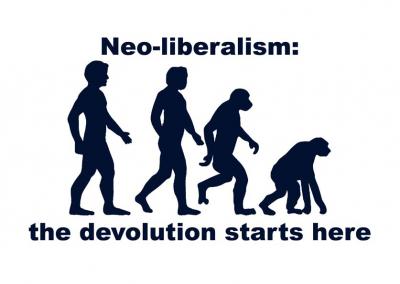
Neoliberalism Is Changing Our World Without Our Even Noticing

neo_liberalism_devolution_via_permanentculturenow.com_

Wendy Brown charts the ‘stealth revolution’ that’s transforming every aspect of society — and now has democracy in its sights.

By Hans Rollmann

Source: PopMatters

‘Neoliberalism’ is a much confused and maligned term these days. Progressive activists deploy it derisively as a general sort of derogatory label; learned professors write articles on the topic without really saying anything more penetrating. It’s as over-used an idiom as globalization (or as capitalism and socialism were 70 years ago). Even Anti-Flag take up the subject in their 2012 track “The Neoliberal Anthem”: “Strap in and watch the world decay!” they proclaim. Blunt, but not inaccurate.

Yet for all its confounded usages, what exactly does it signify?

In a 2013 review essay in the Los Angeles Review of Books that is more useful – if less straightforward – than Anti-Flag, Michael W. Clune described neoliberalism as “an economic doctrine that favors privatization, deregulation, and unfettered free markets over public institutions and government.” (”What Was Neoliberalism?”, 26 February 2013)

But it’s much more than that. Now, in Undoing the Demos: Neoliberalism’s Stealth Revolution, political theorist Wendy Brown contributes a truly useful text on an over-wrought topic, and one which focuses not only on the economic manifestations of neoliberalism, but on its broader effects on our political and social thinking. “Neoliberalism is a distinctive mode of reason, of the production of subjects, a ‘conduct of conduct,’ and a ‘scheme of valuation,’” she writes. It’s a mode of thinking, and the manner in which it emerges can be infinitely varied. We must be alert to neoliberalism’s “inconstancy and plasticity”, she warns, and its ability to reconfigure itself in new guises. Neoliberalism “takes diverse shapes and spawns diverse content and normative details, even different idioms. It is globally ubiquitous, yet disunified and nonidentical with itself in space and over time.” It’s a slippery beast, in other words – hard to define and even harder to see when it’s happening.

Brown’s work is an important and vital contribution at this time insofar as it takes aim at the beating heart of neoliberalism: its insinuation in the very institutions and identities which were hitherto used to limit its spread; institutions which, it was once hoped, would sustain deeper and more profound values implicit to democratic society and human sociality.

Brown is less interested than other scholars in the grim economics of neoliberalism: what she focuses on is its implicit threat to democracy. She opens her book by charting the emergence and contestation between ‘homo politicus’ and ‘homo oeconomicus’; between the human who uses politics to shape their world, and the human who is driven by self-interest and sees the world as always already shaped by economics. French philosopher Michel Foucault discussed this dichotomy in his 1978-79 College de France lectures on the Birth of Biopolitics, and Brown analyzes what Foucault saw – and failed to see – about this early emergence of neoliberal rationality.

In a superb if lamentably short section on gender she also discusses the question: “Does homo economicus have a gender? Does human capital? Is there a femina domestica invisibly striating or supplementing these figures…?” Her point is that “liberalism’s old gender problem is intensified by neoliberalism”, or that neoliberalism impacts women with particular vehemence.

Having discussed Foucault’s early charting of neoliberal political rationality, and expanded on his ideas in light of neoliberalism’s trajectory in the past 30 years, Brown analyzes some modern examples of neoliberalism’s diverse expressions. She looks at how it has insinuated itself in governance – in the notion of building consensus, rather than appreciating contestation; in the depoliticization of government; in the valorization of benchmarking and best practices. All of these deliver destructive blows against democratic political will, against the notion that humans can determine their own destiny and ought to shape their own reality. Instead of making their own decisions, governments appoint ‘external consultants’ to tell them what they should be doing; instead of inventing new ideas and ways of doing things, governments survey ‘best practices’ and see what everyone else is doing. It represents, in many ways, the triumph of mediocrity.

Neoliberal rationality infects law and legal reason, as well. Brown offers an in-depth analysis of the Citizens United case, which protected the right of corporations and the wealthy to dominate democratic elections in the US with their overwhelming power of capital. She also offers one of the best and most thorough analyses of how neoliberal rationality is destroying higher education: the post-WWII dream of an educated and equal society has been twisted into an economistic view, which holds that universities exist only to enhance capital; and that the purpose of an education is not to become better able to contribute to the broader political community, but rather to enhance one’s own ability to generate further capital.

Brown’s book is theoretical yet accessible; it’s an important and vital interjection which reveals and casts bare the neoliberal rationality that increasingly governs our world.

Dismantling Neoliberal Rationality

There’s an implicit warning in Brown’s text, which she addresses briefly but is worth some additional reflection. Audre Lorde famously cautioned against using the master’s tools to dismantle the master’s house, and increasingly this is precisely the direction in which efforts to limit the ravages of neoliberal thinking have turned, using economistic arguments in an effort to preserve institutions and principles that are premised on other-than-economistic values. Some examples serve to illustrate this.

In the ‘80s and ‘90s, public-private partnerships (P3’s) emerged as a neoliberal strategy transferring control and responsibility for public infrastructure – roads, bridges, hospitals, schools – into private hands. The basic argument held that the private sector, not beholden to political interests but rather to principles of efficiency and maximization of cost and utility, would prove more efficient custodians of public infrastructure. This neoliberal argument piggybacked nicely onto the drive to lower taxes. In an environment where lower taxes resulted in reduced state budgets, maximizing cost and efficiency would ensure public dollars stretched as far as possible.

This argument was received sympathetically by a public which had been worked up (by conservative pundits and politicians) into a collective sense of outrage over personal tax obligations and a sense of diminishing consumer power. It struck an affective chord, even though it was not based on any solid research. Yet P3’s became a dominant and accepted approach to building and maintaining public infrastructure and services.

In the past decade, efforts to fight back against public-private partnerships have achieved some limited success and have taken as their point of departure the fact that these partnerships are in fact not very efficient or effective. The private sector, it turns out, is often even more inefficient and ineffective than the public sector, given that it is driven by values such as greed and profit as opposed to public accountability. Analyses of several P3 projects have revealed massive cost over-runs, invariably subsidized by taxpayers to a cost far in excess of what it would have cost the state to produce the infrastructure on its own. (”The Problem with Public-Private Partnerships”, by Toby Sanger and Corina Crawley, CCPA, 1 April 2009) Contractual stipulations often guarantee corporate profits at public expense, requiring the state to assume all the risk, using public funds to rescue projects when private partners fail or walk away, and in some cases even using public funds to top-up corporate profits that fail to meet agreed-upon projections. (”Ontario Auditor breaks new ground with review of public private partnerships methodology”, by Keith Reynolds, Policy Note, 5 January 2015)

All this is true, and revealing the truly ineffective and inefficient nature of P3s has been critical to turning them back in many cases. However, there’s a problem with this. These campaigns against P3s adopt the same economistic principles as were used to promote the notion of P3s in the first place: namely, that efficiency, cost maximization and capital enhancement ought to be the driving principles of the demos, or public state. The implicit argument is that P3s are wrong not because they transfer public ownership into private hands, but because they do so inefficiently and at the expense of the taxpayer. Granted, there is often a reference to P3s being ‘unaccountable’ to the public, but this is rarely interrogated or explored as deeply as it should be. In fact, it ought to lie at the core of public resistance to P3s. Public-private partnerships are wrong simply because the state ought never to allow public goods to fall under private control, even if it might save more money. Economization ought never to hold sway over the values, principles and political power of the public.

Similarly, neoliberal logic has infected other efforts to fight back against neoliberal initiatives. Labour unions – a common target of neoliberalism—are increasingly defended on the basis that they benefit the economy (through ensuring consistent and safe workplace practices as well as strong wages to bolster consumer spending in the community), rather than on the simpler basis that workers deserve the right to control their working conditions. Efforts to reduce tuition fees for out-of-province/state or international students are often predicated on the notion that their economic contribution to the local economy exceeds the value of their fiscal contribution to the university through tuition fees. Nowhere – or rarely – is the argument presented that post-secondary ought to be a public good and universal right in and of itself.

The danger, in other words, is that efforts to resist neoliberalism are increasingly being expressed in such a way that they serve to entrench and legitimize neoliberal values – economization, efficiency, capital enhancement—rather than questioning or challenging the desirability and social and political consequences of those values in the first place.

Brown acknowledges the urgency of the problem. It’s quite possible, she observes, for neoliberal economic policy to be paused or reversed but for “the deleterious effects of neoliberal reason on democracy” to survive, undermining the potential for substantive, entrenched change. Without tackling neoliberal reason, neoliberal economics and governance will inevitably emerge again. It is the ongoing sense of surrender to the inevitability of economics; of the bottom line; of finance as key determiner of what is politically possible, that dooms the political potential of democracy. Although only emerging at the end of the book, this is one of the key lessons it offers: that efforts to resist or reverse the ravages of neoliberal economics are fatally flawed when “NGOs, nonprofits, schools, neighborhood organizations, and even social movements that understand themselves as opposing neoliberal economic policies may nonetheless be organized by neoliberal rationality.”

Fascism’s Forbidden Face

Brown comes close to a forbidden truth in closing. She notes, with great delicacy and hesitation, the similarities between neoliberal rationality and fascism. “This is not to say that neoliberalism is fascism or that we live in fascist times,” comes the inevitable caveat. But what if it is an emerging form of fascism?

One of the troubling trends that’s emerged in recent decades and needs to be challenged more forcefully is the notion that it’s intellectually taboo, inaccurate or excessive to call something ‘fascist’, or to draw analogies to fascist states like Nazi Germany. An example of this taboo is ‘Godwin’s Law’ – the notion that referring to Hitler (or by extension, fascism broadly) destroys the credibility of your argument. It’s a trendy term, but intellectually dangerous. The fact is, fascism was – and is – very real, and the notion that no one should talk about fascism as seriously emerging in the present day is very much a product of our neoliberal era.

In fact we do need to talk about it. The skepticism with which the term ‘fascism’ is treated; the dismissal of arguments which make reference to Nazis, all collaborate in erasing and masking the very real resemblances that exist between historical fascism and contemporary forms of governance like neoliberalism. In its demand for self-sacrifice to the heartless whole – a demand iterated, for instance, in the sacrifice of millions of homeowners and mortgage defaulters in order to save the banks during the subprime mortgage crisis – neoliberal rationality resembles the demand for citizen self-sacrifice that characterized fascism.

George Orwell (in his remarkable book review of Adolf Hitler’s Mein Kampf) warned against underrating the emotional appeal of fascism. While socialism and even capitalism offered a vision of the good life – fewer working-hours, health and education, leisure and pleasure – people appear inevitably lured by the attraction of struggle and self-sacrifice. “Whereas Socialism, and even capitalism in a more grudging way, have said to people ‘I offer you a good time,’ Hitler has said to them ‘I offer you struggle, danger and death,’ and as a result a whole nation flings itself at his feet,” he wrote. The same could easily be said of neoliberalism: people have a remarkable knack of voting for economic tough-guys who promise to make life harder on individuals and communities in order to ‘save the economy’, whatever that’s supposed to mean.

Brown’s book is essential reading not only for academics but for anyone concerned with our collective political future, and with the defense of democratic politics. Her book ends on a grim note: “Despair” is the title of its final section. Brown has eloquently elucidated the problem, and made a profound contribution to understanding the complex nature of neoliberal rationality and its threat to democracy.

So what is the solution? Brown doesn’t have one, but notes there is no alternative but to keep struggling to find an alternative. We have reached a state of “civilizational despair”, she writes; modernism is dead and with it the hope and belief that we can create a better world. How do we counter this despair, and re-inject hope and alternatives into the world? Such a task “is incalculably difficult, bears no immediate reward, and carries no guarantee of success. Yet what, apart from this work, could afford the slightest hope for a just, sustainable, and habitable future?”


Hans Rollmann is a writer and editor based in Eastern Canada. He’s a columnist, writer and opinions editor with the online news magazine TheIndependent.ca as well as editor of Landwash, a journal of literary and creative arts published out of Newfoundland and Labrador. His work has appeared in a range of other publications both print and online, from Briarpatch Magazine to Feral Feminisms. In addition to a background in radio-broadcasting, union organizing and archaeology, he’s currently completing a PhD in Gender, Feminist & Women’s Studies in Toronto. He can be reached by email at hansnf@gmail.com or @hansnf on Twitter.


Sumerian Economics

sumerian-king-list

By Peter Lamborn Wilson

Source: Reality Sandwich

Public secret: everyone knows but no one speaks. Another kind of public secret: the fact is published but no one pays attention.

A cuneiform tablet called The Sumerian King List states that “kingship first descended from heaven in the city of Eridu,” in the south of Sumer. Mesopotamians believed Eridu the oldest city in the world, and modern archaeology confirms the myth. Eridu was founded about 5000 BC and disappeared under the sand around the time of Christ.

Eridu’s god Ea or Enki (a kind of Neptune and Hermes combined) had a ziggurat where fish were sacrificed. He owned the ME, the fifty-one principles of Civilization. The first king, named “Staghorn,” probably ruled as Enki’s high priest. After some centuries came the Flood, and kingship had to descend from heaven again, this time in Uruk and Ur. Gilgamesh now appears on the list. The flood actually occurred; Sir Leonard Wooley saw the thick layer of silt at Ur between two inhabited strata.

Bishop Ushher once calculated according to the Bible that the world was created on October 19th 4004 BC at 9 o’clock in the morning. This makes no Darwinian sense, but provides a good date for the founding of the Sumerian state, which certainly created a new world. Abraham came from Ur of the Chaldees; Genesis owes much to the Enuma Elish (Mesopotamian Creation Myth). Our only text is late Babylonian but obviously based in a lost Sumerian original. Marduk the wargod of Babylon has apparently been pasted over a series of earlier figures beginning with Enki.

Before the creation of the world as we know it a family of deities held sway. Chief among them at the time, Tiamat (a typical avatar of the universal Neolithic earth goddess) described by the text as a dragon or serpent, rules a brood of monsters and dallies with her “Consort” (high priest) Kingu, an effeminate Tammuz/Adonis prototype. The youngest gods are dissatisfied with her reign; they are “noisy,” and Tiamat (the text claims) wants to destroy them because their noise disturbs her slothful slumber. In truth the young gods are simply fed up with doing all the shitwork themselves because there are no “humans” yet. The gods want Progress. They elect Marduk their king and declare war on Tiamat.

A gruesome battle ensues. Marduk triumphs. He kills Tiamut and slices her body lengthwise in two. He separates the halves with a mighty ripping heave. One half becomes sky above, the other earth below.

Then he kills Kingu and chops his body up into gobs and gobbets. The gods mix the bloody mess with mud and mold little figurines. Thus humans are created as robots for the gods. The poem ends with a triumphalist paean to Marduk, the new king of heaven.

Clearly the Neolithic is over. City-god, war-god, metal-god, vs. country-goddess, lazy goddess, garden goddess. The creation of the world equals the creation of civilization, separation, hierarchy, masters and slaves, above and below. Ziggurat and pyramid symbolizes the new shape of life.

Combining Enuma elish and the King List we get an explosive secret document about the origin of civilization not as gradual evolution towards inevitable future, but as violent coup, conspiratorial overthrow of primordial rough-egalitarian Stone Age society by a crew of black magic cult cannibals. (Human sacrifice first appears in the archaeological record at Ur III. Similar grisly phenomena in the first few Egyptian dynasties.)

About 3100 writing was invented at Uruk. Apparently you can witness the moment in the strata: one layer no writing, next layer writing. Of course writing has a prehistory (like the State). From ancient times a system of accounting had grown up based on little clay counters in the shapes of commodities (hides, jars of oil, bars of metal, etc.) Also glyptic seals had been invented with images used heraldically to designate the seals’ owners. Counters and seals were pressed into slabs of wet clay and the records were held in Temple archives-probably records of debts owed to the Temple. (In the Neolithic Age the temples no doubt served as redistribution centers. In the Bronze Age they began to function as banks.)

As I picture the invention of real writing took place within a singly brilliant family of temple archivists over three or four generations, say a century. The counters were discarded and a reed stylus was used to impress signs in clay, based on the shapes of the old counters, and with further pictograms imitated from the seals. Numbering was easily compacted from rows of counters to number-signs. The real break-through came with the flash that certain pictographs could be used for their sound divorced from their meaning and recombined to “spell” other words (especially abstractions). Integrating the two systems proved cumbersome, but maybe the sly scribes considered this an advantage. Writing needed to be difficult because it was a mystery revealed by gods and a monopoly of the New Class of scribes. Aristocrats rarely learned to read and write — a matter for mere bureaucrats. But writing provided the key to state expansion by separating sound from meaning, speaker from hearer, and sight from other senses. Writing as separation both mirrors and reinforces separation as “written,” as fate. Action-at-a-distance (including distance of time) constitutes the magic of the state, the nervous system of control. Writing both is and represents the new “Creation” ideology. It wipes out the oral tradition of the Stone Age and erases the collective memory of a time before hierarchy. In the text we have always been slaves.

By combining image and word in single memes or hieroglyphs the scribes of Uruk (and a few years later the pre-dynastic scribes of Egypt) created a magical system. According to a late syncretistic Greco-Egyptian myth, when Hermes-Toth invents writing he boasts to his father Zeus that humans never need forget anything ever again. Zeus replies, “On the contrary my son, now they’ll forget everything.” Zeus discerned the occult purpose of the text, the forgetfulness of the oral/aural, the false memory of the text, indeed the lost text. He sensed a void where others saw only a plenum of information. But this void is the telos of writing.

Writing begins as a method of controlling debt owed to the Temple, debt as yet another form of absence. When full-blown economic texts appear a few strata later we find ourselves already immersed in a complex economic world based on debt, interest, compound interest, debt peonage as well as outright slavery, rents, leases, private and public forms of property, long distance trade, craft monopolies, police, and even a “money-lenders bazaar.” Not money as we understand it yet, but commodity currencies (usually barley and silver), often loaned for as much as 33 1/3rd % per year. The Jubilee or periodic forgiveness of debts (as known in the Bible) already existed in Sumer, which would have otherwise collapsed under the load of debt.

Sooner or later the bank (i.e. the temple) would solve this problem by obtaining the monopoly on money. By lending at interest ten or more times its actual assets, the modern bank simultaneously creates debt and the money to pay debt. Fiat, “let it be.” But even in Sumer the indebtedness of the king (the state) to the temple (the bank) had already begun.

The problem with commodity currencies is that no one can have a monopoly on cows or wheat. Their materiality limits them. A cow might calve, and barley might grow, but not at rates demanded by usury. Silver doesn’t grow at all.

So, the next brilliant move, by King Croesus of Lydia (Asia Minor, 7th century BC) was the invention of the coin, a refinement of money just as the Greek alphabet (also 7th cen.) was a refinement of writing. Originally a temple token or souvenir signifying one’s “due portion” of the communal sacrifice, a lump of metal impressed with a royal or temple seal (often a sacrificial animal such as the bull), the coin begins its career with mana, something super-natural, something more (or less) than the weight of the metal. Stage two, coins showing two faces, one with image, the other with writing. You can never see both at once, suggesting the metaphysical slipperiness of the object, but together they constitute a hieroglyph, a word/image expressed in metal as a single meme of value.

Coins might “really” be worth only their weight in metal but the temple says they’re worth more and the king is ready to enforce the decree. The object and its value are separated; the value floats free, the object circulates. Money works the way it works because of an absence not a presence. In fact money largely consists of absent wealth-debt — your debt to king and temple. Moreover, free of its anchor in the messy materiality of commodity currencies, money can now compound unto eternity, far beyond mere cows and jars of beer, beyond all worldly things, even unto heaven. “Money begets money,” Ben Franklin gloated. But money is dead. Coins are inanimate objects. Then money must be the sexuality of the dead.

The whole of Greco-Egypto-Sumerian economics compacts itself neatly into the hieroglyphic text of the Yankee dollar bill, the most popular publication in the history of History. The owl of Athena, one of the earliest coin images, perches microscopically on the face of the bill in the upper left corner of the upper right shield (you’ll need a magnifying glass), and the Pyramid of Cheops is topped with the all-seeing eye of Horus or the panopticonical eye of ideology. The Washington family coat of arms (stars and stripes) combined with imperial eagle and fasces of arrows, etc.; a portrait of Washington as Masonic Grand Master; and even an admission that the bill is nothing but tender for debt, public or private. Since 1971 the bill is not even “backed” by gold, and thus has become pure textuality.

Hieroglyph as magic focus of desire deflects psyche from object to representation. It “enchains” imagination and defines consciousness. In this sense money constitutes the great triumph of writing, its proof of magic power. Image wields power over desire but no control. Control is added when the image is semanticized (or “alienated”) by logos. The emblem (picture plus caption) gives desire or emotion an ideological frame and thus directs its force. Hieroglyph equals picture plus word, or picture as word (“rebus”), hence hieroglyph’s power and control over both conscious and unconscious — or in other words, its magic.