Overcoming the American Dream

george-carlin-american-dream

By Frank Castro

Source: The Hampton Institute

“Anyone who has ever struggled with poverty knows how extremely expensive it is to be poor.” – James Baldwin
My house sat tucked a mile deep, wrapped in 500 acres of sprawling oaks and towering pines. Dense thickets crisscrossed the land like formidable barricades protecting masses of forests from the intrusions of bored, yet curious children. They would leave you picking daggers from your sides and forearms if you journeyed too far. I grew up in a remote place called Farmhaven, the midway point between Canton and Carthage, Mississippi. Driving through you would never know you were somewhere with a name. Farmhaven is one of those places marked by only an intersection and a road that always goes somewhere else. It is here though, with my father and my brother, in the heart of the South, that I learned the most important lesson life could teach me.

When I was very young the world was a place of limitless potential. Like a naïve summer breeze still clinging to the fantasy that winter will never come, I was no different than most children who believe the world is theirs. You do not have to be rich to dream such dreams. A swift run and leap off the South end of our porch, where the ground was soft and the magnolia leaves puddled, was all it took. With my arms stretched wide I pretended to be a fighter pilot leaving the deck of an aircraft carrier. I never really knew or cared what fighter pilots do; I just wanted to see the world through a bird’s eyes. It was my own American Dream. And the further from the porch I landed, the more I believed I would someday soar.

It’s probably not an unfamiliar story. After all, in children imagination abounds. About this time we start being told to follow our dreams, as if the world were built in such a way that the realization of all our dreams is possible. Certainly that’s what I believed, that people just out to make the imagined real. Life is not without a cruel sense of irony though, and elders rarely mention to adolescents the kind of world in which we live. They shield us from it, understandably not wanting to damage the authenticity and fragility of our youthful ambition. But reality will come knocking. It always does. It will come to tell us that the world has been built in such a way that our dreams will be withheld from us, that the joys of making them real cannot be ours, but rather, with and atop our backs, they must be forfeited to erect someone else’s.

This is the price of poverty.
Knock, Knock

“Capitalism is cruel and heartless and tears people apart, mentally, physically and socially.” - Susan Rosenthal

My father taught me the value of work. For all his faults, I could never question how hard he labored to provide for my brother and me, or how determined he was to instill in us a love for building with our own hands. He tried to teach us how to work the land. We plowed and planted. We built homes for our chickens, turkeys, and ducks. We constructed wooden and wire fences for rotating our goats and horses from one field to another. During the winter months when our grazing fields turned to tundra, I hoisted buckets of feed to the troughs I had built. My brother and I became so proficient with our hands that often my father would drop us off in the woods with supplies and expect a job to be done when he returned with lunch.

But neither our farm nor all the work we put into it was ever what kept a roof over our heads. Even after the fruits of our labor yielded plates for our table, we still needed money. I knew this all too well, even as a seven year old. My room was in the middle of our house. You could not get from the kitchen to the living room without first walking through it. Often a door was left cracked open, not intentionally, but because door frames shift with age and require a firm snug to be pulled completely shut. Through the years while I had a step-mother I heard my father and her argue about bills when the doors where ajar. Always more bills. They both worked in addition to our farm. She worked at a cigarette store. His job always changed. And still it was never enough. Sometimes they got loud. Her voice screeched. His slurred. And mine would make lists in my head of everything I was going to do the next day to make it all better.

I began doing my own laundry about that time because I wanted my step-mother to stay. My child’s mind thought it would make a difference. She left after a few more years though, and when it happened I really could not blame her. My father had begun turning to his bottles more often than he turned to her. When he got drunk enough one night to put a shotgun to my brother’s head, she lost all composure. Refrigerator doors flung open. Voices thundered. Walls shook. Glass bottles clanked and flew further off the porch than I ever had, exploding all over the lawn - just like my family, exploding. My screams were equal only to my tears. Every little list I had made in my head was useless. The gun landed in the yard too after my step-mother snatched it. My brother and I spent that night in the shadow of two people we loved parting ways forever. Soon we lost the farm… and our father too.

I never soared into those magnolia leaves again. In the years to come dreams of a family and a home where I belonged replaced all desire to fly.

Not till much later did I realize that nothing I did then would have made a significant difference. Neither my brother nor I held fault for our poverty and, despite his drinking, it was not entirely my father’s fault either. Addiction, I learned, is most often endemic of a society that generates addicts. Something bigger loomed, something far more pervasive and far-reaching than the lives of a few backwoods Mississippians. Reflecting on how expensive poverty had been for my family, asking why I was poor and why were we ripped apart, I found myself on an inescapable trajectory to discover the origins of inequality.
Their Gluttony Is Our Starvation

“The class which has the power to rob upon a large scale has also the power to control the government and legalize their robbery.” - Eugene V. Debs

My family’s farm was bought by a group of wealthy men who wanted a hunting resort. For the majority of the year our old home sits empty and rotting. It is a reminder that in the halls of country clubs and on the decks of overpriced yachts, poverty is, in the most acute sense of the word, the abundant currency of the rich. Their very existence is predicated on the existence of the poor.

This is not a fact we like to grapple with in America. Here everybody believes they can get rich. We believe the realization of ALL of our dreams is possible. We call this belief the American Dream, and it has been incredibly successful at stifling plausible attempts at equality outside the capitalist framework. To paraphrase John Steinbeck, socialism never took root in America because the poor see themselves not as an exploited proletariat but as temporarily embarrassed millionaires. It is the worst sort of fabrication because it makes us believe the preposterous - my family could have our house, our farm, a decent living with ample food, and an environment where addiction would stymy, while simultaneously rich folks could use it all to shoot animals for sport.

If it sounds ridiculous, it’s because it is.

Under capitalism one party was always going to lose, and generally the party which loses is the one with significantly less money. Our socioeconomic realities are structured this way. “Losers” are a necessity for capitalism’s survival. My family’s misfortune was a microcosm of structured events that play out against billions of poor people in orchestrated symphony every day. They (we) find ourselves in battles with people, organizations, and nations who have enormous financial capabilities, and therefore power, and because our global political system was built around empowering the moneyed class, before the battle ever starts our circumstances are engineered for defeat. Scaled up or down, this predisposition between those with power and those without is consistent. It is why my family lacked the financial agency over our lives to survive. But it is also why entire poor communities are displaced and gentrified by wealthy developers, or entire swaths of the planet are exploited by wealthy nations and their corporations. Where ever we are, our struggles are connected.

The American Dream then has at least two primary functions. Its first is to generate a mythology around itself which can effectively negate the reality that within capitalism not everybody can realize their dreams, that there must be an oppressed class. Such a mythology atomizes people from collective struggle. It induces a form of hyper individualism often seen in the “Boot-Strap Myth,” or the idea that anybody of little means, with hard work and determination, can lift themselves to the highest rungs of bourgeoisie society (the richest of the rich). By focusing on individual stories of capitalist success, the Bill Gates and Sam Waltons of the world, the vast poverty and suffering required for the emergence of massive fortunes is left out of the picture. One can point to Gates and believe their own ascendance is possible without understanding its possibility is predicated on the systematic exploitation of tens of thousands of workers in mines and factories across the globe. And more importantly, focus on the few success stories of the super-rich invisibilizes the structure which keeps wealth within their hands at the direct expense of the poor and makes it beyond examination or reproach.

A second primary function of the American Dream is to facilitate an overpowering sense of entitlement through exploitive competition. It cleaves us from cooperative modes of thinking and existing by constantly pitting us against each other. Through competing with fellow human beings for the necessities of life - work, housing, education, affection, nourishment, social belonging, etc. - an individual is conditioned to accept that competition is the natural state of human existence, and therefore competition necessitates winners and losers. Here, belief of capitalist mythology graduates into acceptance of capitalist power structures, and then finally into the endorsement and full-fledged participation in them. The latter is crucial, for in order to amass a huge fortune a person has to endorse a sort self-maximizing choice which, in their minds, justifies widespread exploitation. At this point it is believed that “losers” (the exploited) are inevitable, thus the more losers, or the greater number of exploited, the richer (and fewer) the winners. If you play the game ruthlessly enough to win, or even thrive, the logic follows that you are entitled to all the rewards and privileges expropriated from the oppressed.

With little doubt, I imagine the men who bought our farm thought nothing of it. In their minds having the money for it was the only requisite needed, and since they had played by the rules of capitalism well enough to be rewarded with the money needed to purchase it, they were “entitled” to it. But it was never their home. They had never toiled in the fields for crops. They had never spent a birthday or Christmas Eve in the house. They had never fished the ponds. They had never run around the yard filling the trees with laughter, or fed the hummingbirds from the clotheslines. They had never made peace with the bees that burrowed into the oak joists beneath the porch. They had never labored with an axe to stock firewood or climbed beneath the house and wrapped the pipes for winter. They knew nothing of the land or the house but its acreage and price. And that was enough, because the memories of children don’t fetch power when money talks.
Poverty Is a Weapon of Mass Destruction

“You cannot call a society which has 3.5 million homeless and 18.5 million vacant homes civil. That’s violent and morally bankrupt.” - Frank Castro

Poverty is a weapon of mass destruction. We just do not see it that way because we have a very limited understanding of what violence looks like. Statistics paint a broad picture, like the fact that 7.7 million people die of hunger every year (21,000 a day), or the fact that 3.5 Americans remain homeless despite 18.5 million vacant homes; but unless we know those individuals’ stories, and they resonate with us in some way, a culture of competition and entitlement keeps us preoccupied with trying to realize our own ambitions - or resolve our own problems. Whatever the reason, often we are concerned more with ourselves than our collective struggle.

Myths like the American Dream condition us to accept that an elite minority profiting off widespread misery is the way of the world. But remember, the hungry don’t choose to starve, and few houseless people choose homelessness. They are starved and put on the streets by a system which structurally denies them access to food and shelter. If we are to get a realistic picture of how destructive global capitalism is, it requires a broader and deeper understanding of violence.

In 2013, Peter Joseph tried reframing the parameters of violence:

“If I put a gun to someone’s head, say, a 30-year-old healthy male, pull the trigger, and kill him, assuming an average life expectancy of, say, 84, you can argue that possibly 54 years of life [were] stolen from that person in a direct act of violence.
However, if a person is born into poverty in the midst of an abundant society where it is statistically proven that it would hurt no one to facilitate meeting the basic needs of that person and yet they die at the age of 30 due to heart disease, which has been found to statistically relate to those who endure the stress and effects of low socioeconomic status, is that death, the removal of those 54 years once again, an act of violence? And the answer is “Yes, it is.” You see, our legal system has conditioned us to think that violence is a direct behavioral act. The truth is that violence is a process, not an act, and it can take many forms. You cannot separate any outcome from the system by which it is oriented.”

***Distributed equally, the grains produced throughout the world would provide each person 3,600 calories per day . The average person requires 2,000 calories a day to maintain a healthy diet.

If we can understand the scenario Peter explains as a process of violence multiplied by millions of starving and homeless people, then little more evidence is needed to indict and convict capitalism as the sadistic, murderous, and megalomaniacal system it is. Contrary to what the Boot Straps Myth and the American Dream tell us, poverty sits infinitely more on the shoulders of structures we are born into than it does personal choice, ambition, or determination. If more understood this, perhaps then finally the lie that billions like me were born into poverty because our parents were lazy, untalented, or lack the ambition to succeed, could die.
Dream Differently

“You have to act as if it were possible to radically transform the world. And you have to do it all the time.” - Angela Davis

When poverty consumed my family it destroyed any understanding of unity I had. To this day my dream remains to rediscover what family means for me, what it will look and feel like; but through the pain and the loss this much has become clear: There is no room left for “America” in my dreams. I imagine a world where families are no longer faced with the looming pistol of starvation and homelessness. No borders, rules, or regulations will rip our homes from us. No person or institution will dangle over us the future we strive toward like a tree that grows inches with every stretch for fruit. Instead we will live in cooperation with each other, a cooperation which builds beyond blood and yields families the breadth of communities. I have survived this long by doing what most people with dreams do - by continuing to live every day to make them reality. And while I struggle every day to keep mine alive, I am inspired by the building happening all around me, and by the friends who have been my family.

My story is only one of billions across the globe though - one among a sea of poverty’s victims. Ensuring billions more are not to follow suit requires shedding America’s myths. When we tell children to follow their dreams without empowering them to envision a world beyond global capitalism, and beyond America, we limit them to the possibilities afforded through oppression. We preclude the possibility of starting our lives with visions of a world that centers liberation, cooperation, love, and justice.

As Wolfi Landstreicher once said, “If one loves life, if one wants to expand and flourish, it is absolutely necessary to free desire from the channels to constrain it, to let it flood our minds and hearts with passion that sparks the wildest dreams. Then one must grasp these dreams and from them hone a weapon with which to attack this reality, a passionate rebellious reason capable of formulating projects aimed at the destruction of that which exists and the realization of our most marvelous desires. For those of us who want to make our lives our own, anything less would be unrealistic.”

To us then has fallen the challenge of taking back the power of imagination, of dreaming beyond ourselves and beyond America.

Liberation Is Unprofitable

c91b81d1dcb043acfb1eed41207da8b5

By Charles Hugh Smith

Source: Of Two Minds

12 examples of how liberation is not profitable and therefore it must be marginalized, outlawed, proscribed or ridiculed.

If we had to summarize the sickness of our economy and society, we could start by noting that liberation is unprofitable, and whatever is not profitable to vested interests is marginalized, outlawed, proscribed or ridiculed. Examples of this abound.

Liberation from digital communication servitude is not profitable. Don’t have a smart phone on 18 hours a day, every day? Loser! Luddite! Liberation from digital communication servitude is not profitable, therefore it is ridiculed.

Liberation from debt is not profitable. Only the wealthy can afford to buy a vehicle without debt, a home without debt or a university education without debt. For everyone else, liberation from debt is not an option, because debt is highly profitable to our financial Overlords and the politicos they buy/own.

This Is How Little It Cost Goldman To Bribe America’s Senators (Zero Hedge)

Liberation from political elites is not profitable. Dependence on the state for monthly payments binds the recipients to the political elites that control the money and payments, and to the financial elites who control the political elites.

Liberation from the staged, soap-opera political drama of elections is not profitable. Election advertising generates staggering profits for media companies, and the ceaseless nurturing of fear, resentment and indignation fuels acceptance of centralized power and control.

Vote all you want. The secret government won’t change.

Liberation from the consumerist mindset is not profitable. Aspirational purchases in the pursuit of appearances are the most profitable of all spending; re-use, repair and informal peer-to-peer sharing are all intrinsically unprofitable.

Narcissistic Consumerism and Self-Destruction (October 20, 2012)

Liberation from the tyranny of central banks is not profitable. Our entire financial system is built on the simple dynamic that everyone is forced to use money issued by the central bank (Federal Reserve) to its member banks and their financier cronies.

Money that is decentralized and not issued by central banks is not profitable.

Common-sense, minimal regulations are not profitable. Regulations feed government fiefdoms and the revolving-door spoils system between the state and private industry, and erect formidable barriers to new competitors. As a result, over-regulation is immensely profitable.

Regulation Run Amok—And How to Fight Back

The ability to think independently is not profitable. The control mechanisms that keep the various classes of serfs in permanent servitude all depend on a dumbed-down populace that has been stripped of the ability to think independently by propaganda, group-think, medications, the education industry and lifelong dependency on the state.

Anti-Intellectualism and the “Dumbing Down” of America

An economy/society without corruption is not profitable. Buying favors, cronyism and cartel control of pricing are the primary sources of corruption. Cartels and the auctioning of favors are highly profitable to politicos and the vested interests who control the tollways of finance, political influence and social mobility.

America’s Main Problem: Corruption

Degrowth is not profitable. Needing fewer, quality things that last for decades is not profitable. Reparing things for nearly-free is not profitable. Giving stuff away to others for free is not profitable. Making do with what you have is not profitable.

Degrowth, Anti-Consumerism and Peak Consumption (May 9, 2013)

A scarcity of stress and anxiety is not profitable. Stress, anxiety and financial insecurity are all highly profitable, as these drive profitably addictive behaviors such as going deep into debt, shopaholic binge buying, multiple anti-anxiety/anti-depression medications, costly therapy and various forms of self-medication.

The Silent Epidemic in a Broken, Deranged System: Stress (April 18, 2013)

Opting out is not profitable. Opting out of debt-serfdom and the burdens of being a tax donkey is not profitable to vested interests or the state. Adopting self-reliance and low-cost/low-impact living and opting out of the status quo culture of consumerism, debt and complicity with a parasitic, exploitive cartel-state Aristocracy/ Plutocracy/ Oligarchy/ Kleptocracy (take your pick–it’s still the same rapacious Elite whatever name you choose)–is not profitable.

Tune In, Turn On, Opt Out (May 17, 2013)


Washington Protects Its Lies With More Lies

fake_bin-laden

By Paul Craig Roberts

Source: PaulCraigRoberts.org

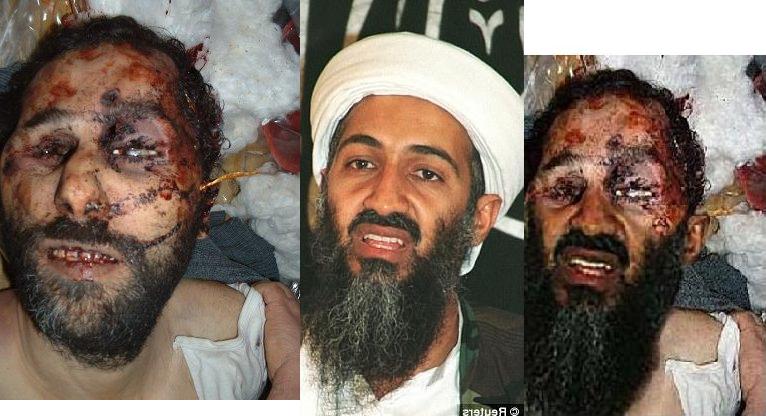
My distrust has deepened of Seymour Hersh’s retelling of the Obama regime’s extra-judicial murder of Osama bin Laden by operating illegally inside a sovereign country. http://www.paulcraigroberts.org/2015/05/11/seymour-hersh-succumbs-disinformation-paul-craig-roberts/ That Hersh’s story, which is of very little inherent interest, received such a large amount of attention, is almost proof of orchestration in order to substantiate the Obama regime’s claim to have killed a person who had been dead for a decade.

Americans are gullible, and thought does not come easily to them, but if they try hard enough they must wonder why it would be necessary for the government to concoct a totally false account of the deed if Washington kills an alleged terrorist. Why not just give the true story? Why does the true story have to come out years later from anonymous sources leaked to Hersh?

I can tell you for a fact that if SEALs had encountered bin Laden in Abbottabad, they would have used stun grenades and tear gas to take him alive. Bin Laden would have been paraded before the media, and a jubilant White House would have had a much photographed celebration pinning medals on the SEALs who captured him.

Instead, we have a murder without a body, which under law classifies as no murder, and a story that was changed several times by the White House itself within 48 hours of the alleged raid and has now been rewritten again by disinformation planted on Hersh.

Perhaps the release of book titles allegedly found in bin Laden’s alleged residence in Abbottabad is part of the explanation. Who can imagine the “terror mastermind” sitting around reading what the presstitute London Telegraph calls bin Laden’s library of conspiracy theories about 9/11 and Washington’s foreign and economic policies? http://www.telegraph.co.uk/news/worldnews/al-qaeda/11619270/Osama-bin-Ladens-bookshelf-featured-conspiracy-theories-about-his-terror-plots.html

Keep in mind that the government’s claim that these books were in bin Laden’s Abbottabad library comes from the same government that told you Saddam Hussein had weapons of mass destruction, that Assad used chemical weapons, that Iran has a nuclear weapons program, and that Russia invaded Ukraine. There is no evidence whatsoever that bin Laden had these books, just as there is no evidence for any claim made by Washington. In the absence of evidence, Washington’s position amounts to this: “It is true if we say so.”

I would wager that the Hersh story was planted in order to gin up renewed interest in the bin Laden saga, which could then be used to discredit Washington’s critics. Notice that the authors in bin Laden’s alleged library are those careful and knowledgeable people who have severely whipped Washington with the truth. The whip wielders are Noam Chomsky, David Ray Griffin, Michel Chossudovsky, Greg Palast, Michael Scheuer, William Blum. You get the picture. You mustn’t believe these truth-tellers, because bin Laden approved of them and had their books in his library. By extension, will these truth-tellers be accused of aiding and abetting terrorism?

Obama claims to have settled the score in mafia godfather fashion with bin Laden for 9/11. But there is no body and not even a consistent story about what happened to the body. The sailors aboard the ship from which the White House reported bin Laden was given a burial at sea report no such burial took place. The SEAL unit that allegedly supplied the team that killed an unarmed and undefended bin Laden was mysteriously wiped out in a helicopter crash. It turns out that the SEALs were flown into combat against the Taliban in an antique, half-century-old 1960s vintage helicopter. Parents of the dead SEALs are demanding to have unanswered questions answered, a story that the presstitute media has conveniently dropped for Washington’s convenience.

Other than 9/11 itself, never has such a major event as bin Laden’s killing had such an enormous number of contradictory official and quasi-official explanations, unanswered questions and evasions. And the vast number of evasions and contradictions arouse no interest from the Western media or from the somnolent and insouciant American public.

Now it turns out that Washington has “lost” the bin Laden “death files,” thus protecting in perpetuity the fabricated story of bin Laden’s killing. http://www.globalresearch.ca/pentagon-orders-purge-of-osama-bin-ladens-death-files-from-data-bank/5342055

Here is Tom Hartman’s interview with David Ray Griffin: Is bin Laden dead or alive:
https://www.youtube.com/watch?v=fI5b3Ir012k

Here is Philip Kraske’s OpEdNews article on Steve Kroft’s orchestrated “60 Minutes” interview with Obama on the killing of Osama bin Laden: http://www.opednews.com/populum/printer_friendly.php?content=a&id=143300

On the Unasked Question of Morality in Police Shootings of Black Bodies

15713475938_299bf78d0b

By Dr. Jason Michael Williams

Source: The Hampton Institute

In the past year much has happened regarding police shootings of Black bodies, and the majority of these shootings go unpunished. They go unpunished due to defensive statements such as, “I followed procedure” or “I feared for my life”. Nevertheless, these two quintessential defense statements are disproportionately applied to instances where Blacks are killed by police, yet as a society the United States does or says very little to contextualize the impact such defensive statements have on our collective consciousness and morality. However, it should be noted that this silence is deliberate, historical, and quintessentially American. Thus, morality, to many on the margins, is nonexistent at the foundation of the criminal justice system and many of the laws that govern society specifically laws that disproportionately target the poor.

There is a social-historical pathology attached to the ways in which the American public responds to the killing of Black bodies. Just as police officers claim fear today, so did white mobs during Jim Crow. Black men were hunted and killed countless times out of so-called fear due to often false allegations of rape, murder, and a myriad of other unreasonable accusations. Black women were often murdered for trivial reasons too. Nevertheless, these false and unreasonable accusations were justifiable to the American public whose barbarity knew no measures when directed at Black bodies. This pathology exists today, in the hearts and minds of many mainstreamers who dare utter “#AllLivesMatter”, as if to suppose that the murdering of Black bodies is somehow contemporary. Some mainstreamers have considered #BlackLivesMatter as a form of reverse racism. Thus arguing that the statement is somehow exclusive to other people who are killed, but this is, of course, a testament to the lack of critical thinking and historical intelligence writ large in America.

In modern society, this pathology is played out most vividly via the tumultuous relationship between Blacks and police officers. There had been countless murders of Black citizens by police, and yet many of them have been legally justified-that is, these cases have gone through the investigative processes of so-called fact-finding and rendered permissible. However, every so often, there are cases that wreck the consciousness of even the greatest conformers to the social order. For example, the case of Eric Garner, to many Americans of all colors was a prima facie case of wrongdoing, and yet the officer involved in Mr. Garner’s death faced no punishment. Another case in Cleveland where two Black bodies were shot 137 times by police officers has too failed to accomplish moral justice. Cleveland police officer, Michael Brelo cried as he heard his verdict of not-guilty. Brelo was accused of firing 49 shots of which 15 were shot while on the hood of the victims’ car. In clear opposition to an increasingly irritated public regarding police brutality, Judge John P. O’Donnell uttered, “I will not sacrifice him to a public frustrated by historical mistreatment at the hands of other officers.” If the judge were truly neutral to the concerns of the irritated public, such a reckless and defining statement would not have been made.

Nevertheless, the Judge’s rationale coexists with the feelings of many throughout the country. Whether one is scrolling through social media commentary, internet articles or watching mainstream media, the mainstream narrative is quite clear: Black lives don’t matter! And the insistence of this reality is cemented each time a Black is immorally murdered by the state. These ceremonial constants have caused many people throughout the nation to lose faith in the American justice system, including mainstreamers. Although Judge O’Donnell in the Cleveland case believed that the evidence was not solid to convict Officer Brelo, like the Garner case, many feel discontent. This discontentment is the proper manifestation of people realizing that justice in America isn’t always the moral outcome, a concept that a true justice system would strive to achieve. In fact, when “fact-finding” exist within an adversarial system easily corrupted by extralegal factors (race, gender, wealth, power, etc.), justice will undoubtedly fail those who aren’t privy to the game. Thus, American justice isn’t always about siding with moral rights, but rather it often swings on the side of barbarity and injustice as it falsely masquerades as one of the world’s most advanced and civilized systems.

The countless cases of police officers walking free from killing American citizens who happen to be Black is a testament to the limitations of American justice. Black lives don’t matter. As a result, demonstrators of late have continued to take to the streets against the immorality of American justice. They have continued to expose lady justice for the two-faced symbolism that she represents, as the global community pays witness. For these courageous individuals, the legality of justice and the majoritarian trickery invested in trying fact does not seem to fit within a moralistic frame. To these people, lives were unjustly lost, and police officers can get away with murder for simply stating what White men were able to hide behind since slavery: Fear of a Black body.

The Black lives matter movement at best should force the public to question the purpose of the criminal justice system seriously, and whether or not the processes that are currently embraced serve the interest of justice. The subjective citizenship of Black Americans should be the next topic of discussion. For instance, are Blacks to be treated as human beings, citizens, and, therefore, worthy of the right to live, breathe, and seek justice? These are key discussions that must begin to happen if justice is to be taken seriously in America. This conversation should also be raw, wide-reaching, and aided by both historical and contemporary facts. Certain acts of “justice” should be studied as violence. For example, the deliberate mass incarceration of minorities and poor people is, in fact, violence. Mass incarceration breaks up families (much like how slavery did), predisposes people to crime, destroys communities (politically, economically, and ecologically) thus pushing these spaces further beyond the margins, and render most to a life of poverty and outcast. The effects of so-called justice seem to perpetuate further inequality. In a real democracy, the state would not engage in such violence.

Furthermore, the creation of immoral laws like the war on drugs that create the contexts for Michael Browns are inhumane and violent. Such laws are neither safe for its targets (predominantly Black and Brown although now increasingly White) nor police officers. Also, the over policing of the poor is violent and extremely telling for a nation that considers itself a democracy. Over policing is violent, repressive, and undemocratic, as it mandates surveillance for the bottom and liberty for those at the top. While many people advocate for community policing in America’s ghettos, such arguments should be met with extreme caution, as community policing furthers the paternalistic mindset that the poor must be governed. Meanwhile, there are zero discussions regarding the need for community policing or surveillance programs on Wall Street or within other corporate spaces that are obviously privileged against the criminal justice system. These basic statements are more than enough for a conversation to be had on the purpose of the criminal justice system. Who does it serve? Who is most affected by it? What are the collateral consequences? Is a system of violence capable of delivering justice? Is the system morally bankrupt? Does there need to be a revolution regarding the criminal justice system?

Who is Afraid of Conspiracy Theories?

conspiracy-theory-definition

By Lance deHaven-Smith

Source: Waking Times

In his book Philosophical Investigations, philosopher of science Ludwig Wittgenstein demonstrated that words are more than designations or labels. They are signals in a context of activity, and are invested with many assumptions about the roles and social status of speakers and listeners.

In the 20th century, men often called women “girls.” This term, while indeed referring to something real – to women – was more than merely a label; it was demeaning and implicitly conveyed a subservient status. Wittgenstein called the common sense view of words standing for things, the “naming theory of language.” However, he pointed out, if words were merely labels, you could not teach language to children. If you pointed at a table and said “table,” how would a child know you are referring to the piece of furniture and not to the rectangular shape of its top, or the table’s colour, or its hardness, or any number of other attributes? Language is taught in the context of activity. You say to the child, “the cup is on the table,” “slide the cup across the table top,” “I am setting the table for dinner,” and slowly the child learns what a table is and how the word table is used.

Wittgenstein’s observation may seem simple, but it posed a profound challenge to all of Western philosophy since Plato, who had asked: What is beauty? What is truth? What is justice? Wittgenstein’s critique of the naming theory of language suggested these were the wrong questions. What needs philosophical investigation is who uses such words in what circumstances and with what implications.

The term conspiracy theory did not exist as a phrase in everyday conversation before 1964. The conspiracy theory label entered the lexicon of political speech as a catchall for criticisms of the Warren Commission’s conclusion that US President Kennedy was assassinated by a lone gunman with no assistance from, or foreknowledge by any element of the United States government. Since then, the term’s prevalence and range of application have exploded. In 1964, the year the Warren Commission issued its report, the New York Times published five stories in which conspiracy theory appeared. In recent years, the phrase has occurred in over 140 New York Times stories annually. On Amazon.com, the term is a book category that includes in excess of 1,300 titles. In addition to books on conspiracy theories of particular events, there are conspiracy theory encyclopedias, photographic compendiums, website directories, and guides for researchers, sceptics and debunkers.

Initially, conspiracy theories were not an object of ridicule and hostility. Today, however, the conspiracy theory label is employed routinely to dismiss a wide range of anti-government suspicions as symptoms of impaired thinking akin to superstition or mental illness. For example, in his 2007 book on the assassination of President Kennedy, former prosecutor Vincent Bugliosi says people who believe JFK conspiracy theories are “as kooky as a three dollar bill in their beliefs and paranoia.” Similarly, in Among the TruthersCanadian journalist Jonathan Kay refers to 9/11 conspiracy theorists as “political paranoiacs” who have “lost their grip on the real world.” Making a similar point, if more colourfully, in his popular book Wingnuts journalist John Avlon refers to conspiracy believers as “moonbats,” “Hatriots,” “wingnuts,” and the “Fright Wing.”

As these examples illustrate, conspiracy deniers adhere unwittingly to the naming theory of language. They assume that what qualifies as a conspiracy theory is self-evident. In their view, the phrase conspiracy theory as it is conventionally understood, simply names this objectively identifiable phenomenon. Conspiracy theories are supposedly easy to spot because they posit secret plots that are too wacky to be taken seriously. Indeed, the theories are deemed so far-fetched they require no reply or rejoinder; they are objects of derision, not ideas for discussion. In short, while ridiculing conspiracy beliefs, conspiracy deniers take the conspiracy theory concept itself for granted.

This is remarkable, not to say shocking, because the concept is both fundamentally flawed and in direct conflict with English legal and political traditions. As a label for irrational political suspicions about secret plots by powerful people, the concept is obviously defective because political conspiracies in high office do, in fact, happen. Officials in the Nixon administration did conspire to steal the 1972 presidential election. Officials in the Reagan administration did participate in a criminal scheme to sell arms to Iran and channel profits to the Contras, a rebel army in Nicaragua. The Bush-Cheney administration did collude to mislead Congress and the public about the strength of its evidence for Iraqi weapons of mass destruction. If some conspiracy theories are true, then it is nonsensical to dismiss all unsubstantiated suspicions of elite intrigue as false by definition.

This fatal defect in the conspiracy theory concept makes it all the more surprising that most scholars and journalists have failed to notice that their use of the term to ridicule suspicions of elite political criminality betrays the civic ethos inherited from British legal and political traditions. The Magna Carta placed limitations on the King, guaranteed trial by one’s peers, assigned historic revenue sources to London, and in other ways recognised the dangers of unrestrained political authority. More generally, the political institutions of the English speaking peoples presuppose political power is a corrupting influence which makes political conspiracies against the people’s interests and liberties almost inevitable. One of the most important questions in Western political thought is how to prevent top leaders from abusing their powers to impose arbitrary rule or tyranny. The men and women who fought for citizens’ rights, the rule of law, and constitutional systems of checks and balances would view today’s norms against conspiratorial suspicion as not only arrogant, but also dangerous and historically illiterate.

The founders of English legal and political traditions would also be shocked that conspiracy deniers attack and ridicule individuals who voice conspiracy beliefs, and yet ignore institutional purveyors of conspiratorial ideas, even though the latter are the ideas that have proven truly dangerous in modern history. Since at least the end of World War II, the citadel of theories alleging nefarious political conspiracies has been, not amateur investigators of the Kennedy assassination and other political crimes and tragedies, but political elites and governments. In the first three decades of the post-World War II era, officials asserted that communists were conspiring to take over the world, Western governments were riddled with Soviet spies, and various social movements of the 1960s were creatures of Soviet influence. More recently, Western governments have accepted US claims that Iraq was complicit in 9/11, failed to dispose of its biological weapons, and attempted to purchase uranium in Niger so it could construct nuclear bombs. Although these ideas were untrue, they influenced millions of people, fomented social panic, fuelled wars, and resulted in massive loss of life and destruction of property. If conspiracy deniers are so concerned about the dangers of conspiratorial suspicions in politics and civic culture, why have they ignored the conspiracism of top politicians and administrators?

In my book Conspiracy Theory in America, I reorient analysis of the phenomenon that has been assigned the derisive label of conspiracy theory. In a 2006 peer-reviewed journal article, I introduced the concept of State Crimes Against Democracy (SCAD) to displace the term conspiracy theory. I say displace rather than replace because SCAD is not another name for conspiracy theory; it is a name for the type of wrongdoing which the conspiracy theory label discourages us from speaking. Basically, the term conspiracy theory is applied pejoratively to allegations of official wrongdoing that have not been substantiated by public officials themselves.

Deployed as a derogatory putdown, the label is a verbal defence mechanism used by political elites to suppress mass suspicions that inevitably arise when shocking political crimes benefit top leaders or play into their agendas, especially when those same officials are in control of agencies responsible for preventing the events in question, or for investigating them after they have occurred. It is only natural to wonder about possible deception when a US president and vice president bent on war in the Middle East are warned of impending terrorist attacks, and yet fail to alert the public or increase the readiness of their own and allies’ armed forces. Why would people not expect answers when Arabs with poor piloting skills manage to hijack four planes, fly them across the eastern United States, somehow evade America’s multilayered system of air defence, and then crash two of the planes into the World Trade Center in New York City and one into the Pentagon in Washington, DC? By the same token, it is only natural to question the motives of President Bush and Vice President Cheney when they dragged their feet investigating this seemingly inexplicable defence failure and then, when the investigation was finally conducted, they insisted on testifying together, in secret, and not under oath. Certainly, citizen distrust can be unwarranted and overwrought, but often citizen doubts make sense. People around the world are not crazy to want answers when a US president is assassinated by a lone gunman with mediocre shooting skills who manages to get off several lucky shots with an old bolt-action carbine that had a misaligned scope. Why would there not be doubts when an alleged assassin is apprehended, publicly claims he is just a patsy, interrogated for two days but no one makes a recording or even takes notes, and then shot to death at point-blank range while in police custody at police headquarters?

In contrast, the SCAD construct does not refer to a type of allegation or suspicion; it refers to a special type of transgression: an attack from within on the political system’s organising principles. For these extremely grave crimes, English legal and political traditions use the term high crime and included in this category istreason and conspiracies against the people’s liberties. SCADs, high crimes, and antidemocratic conspiracies can also be called elite political crimes and elite political criminality. The SCAD construct is intended not to supersede traditional terminology or monopolise conceptualisation of this phenomenon, but rather to add a descriptive term that captures, with some specificity, the long-recognised potential for representative democracy to be subverted by people on the inside – the very people who have been entrusted to uphold the constitutional order.

If political conspiracies in high office do, in fact, happen; if it is therefore unreasonable to assume conspiracy theories are, by definition, harebrained and paranoia; if constitutional systems of checks and balances are based on the idea that power corrupts and elite political conspiracies are likely; if, because it ridicules suspicion, the conspiracy theory label is inconsistent with the traditional Western ethos of vigilance against conspiracies in high office; if, in summary, the conspiracy theory label is unreasonable and dangerous, how did the label come to be used so widely to begin with?

Most people will be shocked to learn the conspiracy theory label was popularised as a pejorative term by the Central Intelligence Agency (CIA) in a global propaganda program initiated in 1967. This program was directed at criticisms of the Warren Commission Report. The propaganda campaign called on media corporations and journalists around the world to criticise conspiracy theorists and raise questions about their motives and judgments. The CIA informed its contacts that “parts of the conspiracy talk appear to be deliberately generated by communist propagandists.” In the shadows of McCarthyism and the Cold War, this warning about communist influence was delivered simultaneously to hundreds of well-positioned members of the press in a global CIA propaganda network, infusing the conspiracy theory label with powerfully negative associations. In my book, I refer to this as the “conspiracy theory conspiracy.”

About the Author

LANCE DEHAVEN-SMITH is Professor in the Reubin O’D. Askew School of Public Administration and Policy at Florida State University. A former President of the Florida Political Science Association, deHaven-Smith is the author of more than a dozen books, including The Battle for Florida, which analyses the disputed 2000 US presidential election, as well as The Hidden Teachings of Jesus: The Political Meaning of the Kingdom of God (Phanes Press, 2001). His latest book is Conspiracy Theory in America (University of Texas Press, 2013). DeHaven-Smith has appeared on Good Morning America, the Today Show, NBC Nightly News with Tom Brokaw, CBS Nightly News with Dan Rather, the NewsHour with Jim Lehrer, and other US TV and radio shows. His website is www.dehaven-smith.com.

The Top 5 Moves That the 1% Uses to Maintain Dominance

By George Lakey

Source: Waking Times

How Do You Beat the 1 Percent? Start by Learning Their Favorite Moves… 

Gandhi confronted a number of adversaries in his day, including a world empire. He sometimes called them “a worthy opponent” — one that used shrewd strategy to try to defeat his movement. Even though Gandhi was deeply concerned with ethical issues, he didn’t think that taking a moral stand excused him from the need to strategize. That meant paying attention to the moves coming at him.

In keeping with my last two columns on this subject (see part one and part two), here are five more of the economic elite’s favorite moves, as it seeks to maintain dominance in the United States and elsewhere.

Create a lesser-of-two-evils choice

When the nonviolent campaign against the Keystone XL pipeline upset the “done deal” between Canada and the United States, a flurry of discussion took place among environmentalists. A prominent expert took to the airwaves to argue that, since the Alberta tar sands oil was going to be extracted anyway, wouldn’t it be better to have it transported by pipeline rather than dangerous railcars?

Many liberals bought her argument, overlooking the assumption beneath it: “the Alberta tar sands oil is going to be extracted anyway.” They (and the environmental expert) fell into the trap; they failed to notice that the very framing of choices supported the elite’s goal and created an environmental disaster.

The current energy debate in Philadelphia is over whether to accept a new vision of the region as a fossil fuel “energy hub,” enlarging pipelines for Marcellus Shale natural gas and North Dakota fracked oil, gearing up Philadelphia’s refineries and tanker shipping, and stimulating petrochemical manufacturing. Here the framing is: Would you rather create new jobs and expand our tax base to support our schools through this exciting vision, or stick with the status quo left by past deindustrialization?

At the moment, the Philadelphia climate justice campaign fights for traction because the choice appears to be between the lesser of two evils. There’s not a vivid climate-friendly vision for economic development with an abundance of green jobs. U.S. political culture habituates the public to “lesser-of-two-evils” choices, and overlooks the question: who sets up this framing? If we follow the money the answer is obvious, and raises the next question: Why leave vision work to the 1 percent?

For a long time the 1 percent has supported a division of labor for the two major political parties. The Republicans focus on meanness and repression, while the Democrats focus on compromise with progressive movements and co-optation. This division of labor works well for the economic elite, because they win no matter what party is in power. The track record of the Democrats, even when they control both houses of Congress and the White House, supports the ever-increasing wealth and control of the elite, while distracting movements from more effective options for exerting grassroots power.

Interestingly, the division of labor between the parties grows sharper as the 1 percent faces the potential political dynamite of a growing wealth gap. At times when income distribution in the United States is a bit closer to equality, bipartisanship in Congress is frequent. When income inequality becomes more extreme, the parties distance themselves from each other. Partisan polarization generates drama, as we saw during the health reform days early in the Obama administration. The healthcare reform coalition carefully avoided drama, disregarding the lessons of the civil rights movement on what actually works to bring about major change. The vacuum was filled by Tea Party Republicans, whose drama of course upstaged the reformers and resulted in the loss of a public option in the Affordable Care Act. Tens of millions of Americans still have no health insurance, while the private health care industry reaps additional profits paid by taxpayers.

The emotion of drama comes from somewhere. The Republicans give voice to the growing fear and anger of millions who feel, and are, oppressed. While it’s odd to hear millionaire white male Republicans speechify about how pushed around and marginalized they are, the narrative plays well among white, middle class older men who now recognize their relative powerlessness.

Extreme and outrageous behavior among Republican office-holders is helpful to the Democrats, who look ever more rational and “grown-up” even while failing to deliver major gains for labor, women and environmentalists.

On the ground, this means that any progressive grassroots campaign that looks as though it has legs can expect overtures from Democratic Party operatives to “help.” It feels great, especially for people who have been marginalized, to “have a seat at the table.”

Results are something else. In Wisconsin, a powerful grassroots direct action campaign resisting the 1 percent’s attack on labor was co-opted a few years ago by the Democratic Party, and went down to defeat. On the macro level, anyone can spend 20 minutes on the Internet comparing the United States with the Nordic countries to see how allowing ourselves to be co-opted has worked out for us.

Make it vertical, then lop off the bottom rungs

This move beguiles middle class groups committed to measurement and the rational use of scarce resources. In Pennsylvania, a historic system of 14 state universities exists separate from the better-known Pennsylvania State University. One of the 14, for a variety of reasons, is booming, giving the opportunity for the elite to apply its verticalizing strategy: first “reward” the prospering one by loosening its link to the other 14. This step encourages a couple of others to seek the same status, over time supporting the urge to rank the 14 from “best to worst.” It then becomes easier to abandon the “worst-performing” schools. Fitting into the racist narrative is that the oldest historically black college in the country, Cheyney State University, will be on the chopping block. (Full disclosure: I’m a graduate of Cheyney.)

Verticalizing not only enhances competition and back-stabbing, usually a good thing in the eyes of the 1 percent, but produces an attractive (to them) bottom line: less overall public funding going to the schools that are left standing.

Set up a study commission

This move has enormous appeal as long as we forget about the reality of power. The governmentally-sponsored study commission is a graveyard for good ideas that threaten the economic elite. It also drains off the talent and brains of progressive intellectuals who could instead be working for a people’s movement, generating the vision that such movements too often lack.

Discredit the truth-tellers

Like the other strategy tools employed by the 1 percent, this move does not always work. The failure of this move in the case of Edward Snowden is instructive. Enough people stood up to defend Snowden as a whistle-blower such that the combined machinery of media and the White House didn’t fully work. This shows why activists should be careful not to exaggerate the power of the economic elite. When a radical voice is attacked, activists need to be ready to go on the offensive. At the height of the anti-Communist hysteria in the 1950s, for instance, U.S. civil libertarians in Philadelphia rented the Academy of Music and filled its 3,000 seats for a speech by a U.S. Communist Party leader who had been indicted as a criminal for violating the Smith Act.

There are many ways to counter the economic elite, depending on the specifics of the situation, but all are enhanced by preparation and going on the offensive. Not everyone who cares about justice loves strategy, but those who have a knack for it can join progressive movements and lend a hand.


About the Author

George Lakey co-founded Earth Quaker Action Group which just won its five-year campaign to force a major U.S. bank to give up financing mountaintop removal coal mining. Along with college teaching he has led 1,500 workshops on five continents and led activist projects on local, national, and international levels. Among many other books and articles, he is author of “Strategizing for a Living Revolution” in David Solnit’s book Globalize Liberation (City Lights, 2004). His first arrest was for a civil rights sit-in and most recent was with Earth Quaker Action Team while protesting mountain top removal coal mining.


Language Leaps and the Information Shuffle

George-Orwell-political-speech-638x322

By Zen Gardner

Source: ZenGardner.com

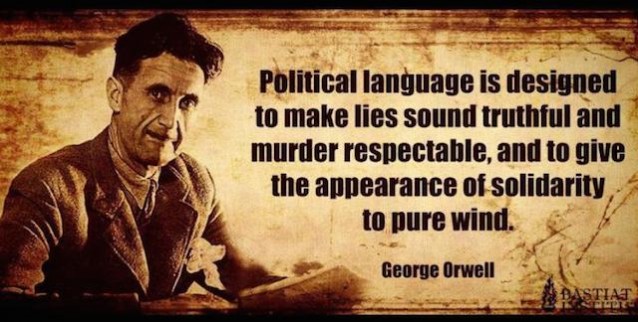
So much can be told by language shifts. Both what’s being used more frequently in general as well as substantial new additions, and deletions, to the lexicon. This goes two ways. The controllers keep shifting their language and euphemisms to blanket their intentions, while the awakening community grabs hold of and proliferates empowering and revealing words and concepts that grow in usage at an astounding and truly inspiring rate.

This is a powerful manifestation of the awakening.

Just look how easily and readily words like Zionism, the matrix, the Illuminati, social engineering, transhumanism, freemasonry, psychopathy, cognitive dissonance, geoengineering, false flags and big brother surveillance are being used now. These were considered side line or taboo issues discussed by whack jobs not long ago. Now? They’re mainstays of conversation that bleed more and more into the mainstream dialogue.

That speaks volumes as to the effect the onslaught of true information is having. And something to be very encouraged and inspired about.

Droning Psychopaths Tell No Truth

The official narrative of the “powers that shouldn’t be” is also a changing landscape. While our language is rooted in truth, theirs is a constant smokescreen of disinformation designed to deceive, decoy and disempower.

Examples du jour? We’re all too familiar with misleading names like the “Patriot Act” or the always ready handle “national security” and the like, but lately they’ve taken to covering their tracks even more, no doubt due to the awakening taking place, even in simple language recognition they’re no doubt following with all of their invasive computer algorithms.

Mass surveillance has now become “bulk data collection” while torture is conveniently labelled “extraordinary renditions” and “enhanced interrogation programs.” All arrogantly perpetrated as if no one even notices. But these shifts in contrived perception work on the unwary, which is why the official narrative is laden with such misleading and obfuscating terms and labels couched in complete blather like any one of Obama’s wet cardboard speeches.

After all, to them, truth isn’t the issue, it’s control and getting their program across as seamlessly as possible. Therein lies the rub, and a very important one to identify.

Look for Real Empathy

What really resonates with you? And what confuses or disanimates you? These are ways to discern between the lines in the barrage of information coming at us. It’s truly an informational war going on in so many ways, but thankfully one that the truth is always destined to win.

It may be ever so incremental, but Truth stands its ground no matter what assails it.

There is no resonant sense of love or down to earth practical truth with propaganda. It always falls flat and only appeals to very dry and distant programmed self justification mechanisms. That’s the intent. Keep us in our self circumscribed socially engineered limits in a dazed state of some far off distant “belief” guaranteed by some voice from somewhere leading people on with some promised carrot to chase after.

However, real, good information feeds. It nourishes. It’s clear and empowering in some way. It embraces your soul, encourages your convictions, and leads you to new understandings that positively affect your life.

Know the difference.

You already do, just listen to your heart. And respond accordingly.

Much love always, Zen

Commerical Militarism is Pricey: Uncle Sam Paying Millions to NFL to Promote Warfare State

8155265791_319c7c1a6a_b

“I’ll Pay You To Salute Me”: Government Takes Hard Line On NFL

By Josie Wales

Source: The Free Thought Project

For those unaware, the National Football League operates as a type of legal monopoly thanks to a political situation so cozy it makes the cable companies and Big Pharma look like rogue enemies of the state.

The NFL pays no taxes. Billionaires own all but one of these teams (the Green Bay Packers are owned by shareholders), and unlike with other sports, every NFL team makes a profit. The NFL itself is classified as a 501(c)6, much like your local Chamber of Commerce. Therefore, they don’t have to give the Capitol Hill mafia a cut of their income.

You may expect, given the preferential treatment the NFL receives from Congress and their very close relationship with legislators, that a typical NFL game would include multiple appeals to emotion designed to make citizens love Big Brother.

And you’d be right.

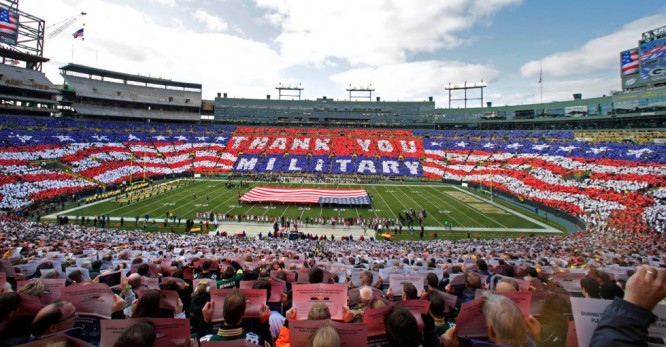
The national anthem is a long, drawn-out, pregame event. There’ll be a flyover by the Blue Angels at the perfect, climactic moment. During a break in the action, some soldier returning from Afghanistan or any other foreign war-zone will be reunited with his family while the stadium erupts in deafening applause and heart wrenching sobs.

Well, hold off on purchasing those tickets just yet, because the Washington Post found something interesting this week. All this patriotic propaganda- the troop-salutes, the banner ads, even the community service events where troops and NFL teams “build or re-build” a playground together, come with a price tag.

Fourteen NFL teams were paid a total of $5.4 million by the Department of Defense to cover the nationalistic propaganda filling downtime during the games.

No word yet on whether the Patriots were one of the fourteen teams.

The Post reports:

U.S. Sen. Jeff Flake (R-Ariz.) called the spending wasteful and disingenuous, Baxter and Salant report:

“Those of us go to sporting events and see them honoring the heroes,” Flake said in an interview. “You get a good feeling in your heart. Then to find out they’re doing it because they’re compensated for it, it leaves you underwhelmed. It seems a little unseemly.” …

“They realize the public believes they’re doing it as a public service or a sense of patriotism,” Flake said. “It leaves a bad taste in your mouth.”

According to the Post, this is what the National Guard (who coughed up all but $100,000 of the millions) receives in return for its spending:

A Hometown Heroes Salute segment, online advertising and meeting space for a meeting or events, digital advertising on stadium screens, and advertising and marketing services including a kickoff video message from the Guard. Furthermore, according to the Post,

“…soldiers attended the annual kickoff lunch in New York City to meet and take pictures with the players for promotional use, and the Jets allowed soldiers to participate in a charity event in which coaches and players build or rebuild a playground or park. The Jets also provided game access passes.”

Just remember, the next time you purchase a ticket to a football game, you may very well be funding the promotion of armed forces invading foreign countries with no regard for collateral murder.

Go Jets. Literally.