The Deepening Deep State

cia-deep-state-inside-washingtons-shadowy-power-elite

By James Howard Kunstler

Source: Clusterfuck Nation

One amusing angle on the news media broadside about Russia “hacking” the US election is the failure to mention — or even imagine! — that the US incessantly and continually runs propaganda psy-ops against every other country in the world. And I’m not even including the venerable, old, out-in-the-open propaganda organs like Voice of America and Radio Free Europe (reminder: the Iron Curtain came down a quarter century ago). Do you suppose that nobody at Langley, or the Pentagon, or the NSA’s sprawling 1.5 million square foot Utah Data Center is laboring night and day to sow confusion among other societies to push our various agendas?

The main offensive started with The Washington Post’s publication on Nov 26 of “The List,” a story calling out dozens of blogs and web news-sites as purveyors of “fake news” fronting for Russian disinformation forces. The list included Zero Hedge, Naked Capitalism, and David Stockman’s blog. There were several whack-job sites mixed in the list for seasoning — The Daily Stormer (Nazis), Endtime.com (Evangelical apocalyptic), GalacticConnection (UFO shit). The rest range between tabloid-silly and genuine, valuable news commentary. What else would you expect in a society with an Internet AND a completely incoherent consensus about reality?

Pretty obviously, the struggle between mainstream news and Web news climaxed over the election, with the mainstream overwhelmingly pimping for Hillary, and then having a nervous breakdown when she lost. Desperate to explain the loss, the two leading old-line newspapers, The New York Times and The Washington Post, ran with the Russia-Hacks-Election story — because only Satanic intervention could explain the fall of Ms. It’s-My-Turn / I’m-With-Her. Thus, the story went, Russia hacked the Democratic National Committee (DNC), gave the hacked emails to Wikileaks, and sabotaged not only Hillary herself but the livelihoods of every myrmidon in the American Deep State termite mound, an unforgivable act.

Also interestingly, these newspapers and their handmaidens on TV, were far less concerned as to whether the leaked information was true or not — e.g. the Clinton Foundation donors’ influence-peddling around arms deals made in the State Department; the DNC’s campaign to undermine Bernie Sanders in the primaries; DNC temporary chair (and CNN employee) Donna Brazille conveying debate questions to HRC; the content of HRC’s quarter-million-dollar speeches to Wall Street banks. All of that turned out to be true, of course.

Then, a few weeks after the election, the US House of Representatives passed H.R. 6393, the Intelligence Authorization Act for Fiscal Year 2017. Blogger Ronald Thomas West reports:

Section 501 calls for the government to “counter active measures by Russia to exert covert influence … carried out in coordination with, or at the behest of, political leaders or the security services of the Russian Federation and the role of the Russian Federation has been hidden or not acknowledged publicly.”

The measure has not been passed by the Senate or signed into law yet, and the holiday recess may prevent that. But it is easy to see how it would empower the Deep State to shut down whichever websites they happened to not like. My reference to the Deep State might even imply to some readers that I’m infected by the paranoia virus. But I’m simply talking about the massive “security” and surveillance matrix that has unquestionably expanded since the 9/11 airplane attacks, creating a gigantic NSA superstructure above and beyond the Central Intelligence Agency, the Department of Defense’s DIA, and the hoary old FBI.

A little paranoia about the growing fascist behavior of the US government is a useful corrective to trends that citizens ought to be concerned about — for instance, the militarization of police; the outrageous “civil forfeiture” scam that allows police to steal citizens cash and property without any due process of law; the preferential application of law as seen in the handling of the Clinton Foundation activities and the misconduct of banking executives; the attempt to impose a “cashless society” that would herd all citizens into a financial surveillance hub and eliminate their economic liberty.

These matters are especially crucial as the nation stumbles into the next financial crisis and the Deep State becomes desperate to harvest every nickel it can to rescue itself plus the cast of “systemically important” (Too-Big-To-Fail) banks and related institutions like Fannie Mae and Freddie Mac, which are about to once again be left holding colossal bags of worthless non-performing mortgages, not to mention the pension funds and insurance companies that will also founder in the Great Unwind that is likely to commence as Trump hangs his golden logo over the White House portico.

‘Fake news stories’ eclipse ‘conspiracy theories’ in globalist/Sorosite lexicon

fakenews

By Wayne Madsen

Source: Intrepid Report

The corporate news media, allied with “media watchdog” groups, many financed with global billionaire troublemaker George Soros, have trotted out a new dog whistle to attack their opponents: “fake news stories.” The issue of “fake news stories” was even raised by outgoing President Barack Obama in a news conference in Berlin with German chancellor Angela Merkel. Both leaders cited “fake news stories” as something that threatens international stability.

Of course, there are an ample number of fake news stories that emanate from disreputable and discredited websites, many of them vanity sites intending to serve as “click bait” for the unsuspecting web surfer and even a few professional journalists taken in by alarmist headlines. A number of individuals have been duped by totally fake stories written by “Sorcha Faal,” a pseudonym for David Booth, allegedly a U.S. computer programmer and which may also be a pseudonym for another individual or group of individuals. Faal, Booth, or whatever his name is acts as a cyber version of an arsonist who releases fake stories attributed to Russian intelligence sources and then sits back to assess the impact of his prankster works. The fact that a number of Russian news organizations have re-published Faal/Booth fake articles as actual news leads some to believe that U.S. intelligence plays a role in the obvious disinformation operation. Faal/Booth has a number of competitors in the field of cyber-pranksterism.

However, the most prominent purveyors of fake news stories are the very corporate media entities that decry “fake news.” There are a number of examples of corporate media trafficking in fake news. The following are a few stark examples:

  • In 1981, Washington Post reporter Janet Cooke was awarded a Pulitzer Prize for a story about an 8-year old heroin addict named “Jimmy.” Washington, DC, Mayor Marion Barry was taken in by the story and launched a city-wide effort to search for “Jimmy” and provide him with treatment. Barry claimed “Jimmy” was real but, in fact, Cooke made up the entire story of “Jimmy’s World” and Barry lied about the supposed existence of the boy. Although Cooke’s story was totally fake, Post assistant managing editor Bob Woodward submitted it to the Pulitzer committee for an award for best feature writing. Woodward, who concocted the fictional “Deep Throat” source in his Watergate reporting for the Post, was never sanctioned for advancing a fake story for a supposed serious professional journalism honor. The Post can be attributed to two major “fake news stories”—”Jimmy” the heroin addict and “Deep Throat” the high-level Nixon administration source who was not FBI deputy director Mark Felt.
  • New York Times reporter Jayson Blair wrote a series of fake news stories for the so-called “paper of record.” The following are a few of his fake news headlines that appeared in the Times:


October 30, 2002—”US Sniper Case Seen as a Barrier to a Confession.”
February 10, 2003—”Peace and Answers Eluding Victims of the Sniper Attacks.”
March 3, 2003—”Making Sniper Suspect Talk Puts Detective in Spotlight.”
March 27, 2003—”Relatives of Missing Soldiers Dread Hearing Worse News.”
April 3, 2003—”Rescue in Iraq and a ‘Big Stir’ in West Virginia.”
April 7, 2003—”For One Pastor, the War Hits Home.”
April 19, 2003—””In Military Wards, Questions and Fears from the Wounded.”

Blair made up from whole cloth stories about the DC sniper and Iraq war veterans. In all, 36 of the 73 national stories penned by Blair were fake. However, a number of media outlets, including the Times, reported as fact fake stories about Saddam Hussein’s “weapons of mass destruction,” all of which were false. New York Times reporter Judith Miller reported as fact information from Iraqi exiled leader Ahmed Chalabi alleging that Iraq possessed mobile weapons laboratories. The information was false, as was other U.S. “intelligence” on Iraq that was fed Miller and other reporters that was all bogus, including stories on Saddam Hussein allegedly trying to procure yellow cake uranium from Niger.

  • In May 1998, Stephen Glass of The New Republic wrote an article titled “Hack Heaven” about a 15-year old hacker and a non-existent software firm called “Jukt Micronics.” It was later determined that 27 articles Glass wrote for The New Republic were fabrications.
  • USA Today reporter and Pulitzer nominee Jack Kelly allegedly fabricated a number of stories for the newspaper, including a 1999 story alleging that the Yugoslavian armed forces was ordered to ethnically cleanse an Albanian village in Kosovo.
  • The Dateline NBC story of November 17, 1992, titled “Waiting to Explode” and alleging that poor fuel tank design caused General Motors’ pick-up trucks to explode on impact was based on rigged tests and staged explosions.
  • NBC anchor Brian Williams was suspended after making several false claims about his prior reporting. He claimed to have been riding on board an Army Chinook helicopter that was forced to land in an Iraqi desert after it was hit by a rocket-propelled grenade. The story was false as was another in which Williams claimed to have flown into Baghdad with Navy SEAL Team 6. Williams also falsely claimed to have seen a man commit suicide in the New Orleans Superdome in the aftermath of hurricane Katrina. Williams also claimed to have personally witnessed the Berlin Wall coming down. He was not in Berlin until a day after the wall fell.
  • In 2013, CBS “60 Minutes” interviewed a U.S. security contractor who claimed he witnessed the attack on the U.S. compound in Benghazi, Libya on September 11, 2012. The contractor was not in Benghazi during the attack and the account was bogus.
  • Rolling Stone published a falsified story in 2014 about a University of Virginia gang rape victim named “Jackie” and school administrator Nicole Eramo. The magazine falsely claimed that Eramo covered up rape incidents at the university. A federal jury later found that Rolling Stone libeled Eramo.
  • Several news organizations falsely claimed that security guard Richard Jewell was the chief suspect in the July 27, 1996, bombing of Centennial Olympic Park in Atlanta. Jewell successfully sued CNN, The Atlanta Journal-Constitution (“FBI suspects ‘hero’ guard may have planted bomb”), NBC, and The New York Post for libel.
  • Fox News often featured a commentator named Wayne Simmons, described by the network as a former CIA “operative.” In fact, Simmons never worked for the CIA and he was a fraud. He was later sentenced to 33 months in prison for his fraudulent activities.

The corporate media is legitimized by a very phony “arbiter” of what and what does not constitute accurate news: the very problematic Snopes.com. Snopes traffics in as much fakery in its “debunking” of alternative media articles as does the corporate media in its national and international reporting.

It is clear that Obama, Merkel, the Soros operation, and others are attacking “fake news stories” in order to hide the real target for their invective rhetoric: the alternative media, which does not kow-tow to corporate executives, advertisers, and special interests ranging from Big Pharma to the Israeli Lobby. The alternative media provides the lifeblood for the First Amendment guarantee of freedom of the press. The corporate media is a bloated and deceitful artifice whose time is coming to an end.


Related Videos:

Public School or Prison? Here Are 10 Ways It’s Hard To Tell

sprongg-700x466

By Alice Jones Webb

Source: The Mind Unleashed

Every weekday morning, from September through June, parents across the country get up earlier than they want to, rush like crazy, wrangle kids into appropriate clothing, and wait in exhausting drop-off lines to get their children to school on time. Why? Because punctuality is a virtue? Or because they are afraid of getting in trouble?

In big cities and small communities, the same routine is repeated with minor variations. Small children and near adult adolescents will spend the majority of their waking hours somewhere they would rather not be. But few people question the set-up. Parents send their kids to school with the best of intentions, wanting to produce happy, healthy, productive adults. Public school is supposed to be for their own good. Very few question its necessity and virtue. No one questions the fact that our country’s public schools are looking less and less like places of learning and more and more like places of detention (and I don’t mean The Breakfast Club type either).

When you stop and think about it (which few people actually do), our public schools have more in common with our prison system than any parent would care to admit. Most of us are products of the system and will defend its honor and integrity like sufferers of severe Stockholm Syndrome. So let me break it down into a list of glaring similarities that even those of us who went to public school can easily understand.

1. Both School and Prison Take Away Freedom. To get into prison, a person has to be convicted of a crime (although all of us know that prisons are full of people convicted of pretty bogus crimes… just stick with me). Children in school are only guilty of the crime of being children. Since school attendance is compulsory, children, much like criminal prisoners, don’t get to choose whether they get locked up for seven or more hours a day. They are forced to go to school by strict truancy laws until they are at least 16, at which point their youth has already been squandered inside constrictive cinder block walls.

2. Both School and Prison use Security as a Means of Control. Prisons and public schools both use metal detectors, surveillance cameras, police patrols, drug-sniffing dogs, and lock downs to create a facade of greater security. In most elementary schools, there is an emphasis on moving students from location to location in a rigidly ordered manner. The straight line of silent children walking with hands behind their backs look frighteningly like lines of prisoners. The strict codes of conduct used in the majority of schools, as well as the consistent use of handcuffs and pepper spray on unruly high school students, work together to condition young people to the cultural normalcy of over-policing.

Stay in line. Do as you’re told. Don’t make trouble. These are the messages we send to both our prisoners and our school children. But it’s okay. It’s for their own good.

3. Both Schools and Prisons Serve Undesirable Food. The cafeterias in public schools are scarily similar to prison cafeterias, often even sharing the same menus. Unappetizing, bland, processed meals with little nutritional value are the norm in both institutions. And bringing a lunch from home is banned in many school districts. Add in the armed security guards that patrol most public school lunch rooms and a casual observer might not be able to tell the difference.

4. Both Schools and Prisons Enforce Strict Dress Codes. Like prisons, some schools obligate their students to wear uniforms, limiting self-expression, and encouraging a herd mentality that makes control easier (for safety’s sake, of course). But even in schools without required uniforms, strict dress codes are generally in place. Failure to tuck in a shirt tail can land a student in detention. Donning a blouse that doesn’t adequately cover a girl’s shoulders could get her sent home. Sometimes the dress code guidelines are so arbitrary and so strictly detailed, it seems like they are in place just to get students in trouble. In 2008, Gonzales High School in Texas made the national news for requiring dress code violators to wear actual prison jumpsuits. It’s like officials want the students to seem like criminals. Perhaps it makes the policing of students at their own hands seem more justified.

5. Both Students and Prisoners are Tracked. Many prisons use electronic bracelets or other tracking devices to keep track of prisoners’ locations. Many schools are doing the same thing. ID badges with built-in RFID chips can track the location of a child wherever they are wearing it, and many schools require ID badges to be worn during school hours. Some schools have even started using fingerprints and iris scanners to keep track of their prisoners… I mean students.

6. Both Schools and Prisons Have Armed Guards. Often referred to as SROs (school resource officers), most school buildings are patrolled by armed police officers. They are generally uniformed and carry pepper spray, tasers, and batons that they can use on students should the need arise. These officers police hallways and lunchrooms, administer searches of children’s lockers and school bags, and man the TSA-style checkpoints at the entrances to the buildings our children enter to learn.

7. Both Schools And Prisons do not Allow Anger. Although anger is a justifiable emotion toward constrictive and oppressive political structures, neither students nor prisoners have the power to express their emotions. In prison, angry convicts are locked away in solitary confinement, their movements and small remaining freedoms restricted for safety’s sake. In public school, anger is interpreted as a failing of the individual rather than the system that creates it. There, anger is seen as “disruptive behavior” or “cognitive impairment” or a “social or learning disability”. Often the angry student is marginalized by placement in special education classes, enrolled in “alternative schools”, or medicated to control their disruptions, all of which are just differing forms of confinement.

8. Both Students and Prisoners are Forced to Work. The scene of the prison chain gang in striped clothing, hacking away at rocks and debris is one that most people have seen in old films. Today’s prisoner work force looks a little different, with prisoners wearing orange jumpsuits and doing highway clean-up minus the bulky steel chains. Students are often forced to work, too. Sometimes they are forced to work cleaning up school grounds as a disciplinary action. But in some school systems, volunteer work or “community service” is required each year for a passing grade. Interesting to note that “community service” is frequently doled out as punishment to citizens convicted of minor crimes, but our children are only guilty of being kids.

9. Both Schools and Prisons Follow Strict Schedules. A rigid schedule of walking, eating, learning, exercise, and bathroom use is followed in both institutions. It doesn’t matter when you have to pee, or need to stretch your legs, or want a breath of fresh air. Those things can only be done during allotted times defined by those in authority.

10. Both Schools and Prisons Have Zero-Tolerance Policies. Most public schools now have policies of zero-tolerance when it comes to violence, bullying, drug possession, etc. Interestingly, much of the verbiage in our schools’ disciplinary policies come straight from the nation’s “War on Drugs” (which is directly responsible for the vast majority of our country’s prisoners). Zero-tolerance policies require harsher penalties for sometimes minor classroom offenses and often result in law enforcement being called in to handle school disciplinary actions. The result has been what many refer to as the “School-to-prison pipeline”. The policies make criminals out of students, pushing kids out of the classroom and into the criminal justice system at alarming rates. At least the transition will be easy. Those school children have already spent the majority of their lives in a system that matches the penitentiary where they’ll be spending most of the rest of it.

With such dark and intimidating surroundings, focusing on learning becomes difficult. It’s no wonder most kids don’t want to go to school. When you’re treated like a prisoner, it’s easy to feel like one.

About the Author

Alice Jones Webb is a writer, homeschooling mother of four, black belt, autodidact, free-thinker, avid reader, obsessive recycler, closet goth, a bit of a rebel, but definitely not your typical soccer mom. You can usually find her buried under the laundry and also on Facebook, Twitter, and her blog, DifferentThanAverage.com, where she blogs about bucking the status quo.

Seeking the True Path

thelesseroftwoevils_e2e98a_4912688

Cartoon by Loren Fishman. See more of his work at https://humoresquecartoons.com

Robert J. Burrowes

One of the more subtle manifestations of the intimate link between
(unconscious) human emotions and behaviour is illustrated by the simple
concept of choice and how this is so often reduced to a dichotomy
between two bad options. In such circumstances, most people choose
whatever they consider to be ‘the lesser evil’.

But how often are there only two options, even if they appear ‘good’ and
‘bad’? Frankly, I cannot think of one circumstance in which my choices
are limited to two, however good or bad they appear to be.

Why does this belief in just two options arise?

When we are born, our evolutionary inheritance includes a phenomenally
powerful capacity to feel a complex range of emotions. However, because
what sociologists refer to as ‘socialization’ (a process by which babies
and children are supposedly taught the ways of their society) is
actually a process of terrorizing babies and children into suppressing
their awareness of these emotions so that they can be forced to conform
to societal ‘norms’ (no matter how dysfunctional), the disastrous
outcomes of ‘socialization’ are obscured. If you wish to read more about
the terrorization of children, you can do so in ‘Why Violence?‘ and
Fearless Psychology and Fearful Psychology: Principles and Practice‘.

This terrorizing of babies and children takes many forms but one of the
most common ways it occurs is through simply telling a child what they
must do under threat of punishment for non-compliance which all parents,
teachers, religious figures and other adults do routinely. This
imperative to obey will always run counter to the child’s own Self-will.
Why is this? Because every single human baby is genetically programmed
to follow their own Self-will, not to obey the will of another.

This individual Self-will is generated by the integrated sense of how to
behave in response to the mental and physical feedback – including
feelings, thoughts, memory, conscience, sensory perception (sight,
smell, sound, touch, taste), truth register, intuition… – which each
person receives and which their mind processes and integrates to
crystallise the precisely appropriate behaviour in any given
circumstance.

But once a child is routinely terrorized into submitting to the will of
another – no matter how benign either the person giving the instruction
or the instruction itself – they lose trust and faith in their own
capacity to decide on a course of action and undertake it powerfully.
They are now adrift without clear internal guidance and, as they grow
up, they are now readily vulnerable to the ‘persuasion’ of others
whether it be the opinion of someone else, the advice of an ‘expert’ or
the inanity of an advertisement for a commercial product.

Adrift from their own unique and powerful internal mental processor –
with its emotional, intellectual, sensory, intuitive, memory, conscience
and other components – they are the victim of their own fear of being
disobedient, wrong, in the minority, isolated … if they follow their own
Self-will.

Unconsciously, the child feels trapped. They are terrified to do what
they want without permission (which is routinely denied) but
unconsciously angry about this (because they have been scared out of
being openly angry at their parents and teachers) which usually
manifests as something powerless such as resentment.

What does the child do in this circumstance? Obey the parent/teacher or
attempt to follow their own Self-will and risk (and probably receive)
punishment for doing so? What is the ‘good’ option here? Or is the child
faced with a choice between two evils and must try to choose the
‘lesser’ one? In the words of Anita McKone: ‘It feels like you must
either put up with abuse or die.’

Routine abuse of the child in this manner by their parents, teachers and
other adults throughout their early life leaves virtually all adults
with an unconscious belief that life is a series of choices between
‘lesser evils’ with an occasional ‘good’ choice allowed in limited
circumstances. We might choose our meal, the color and style of our
clothing, what film to watch and other such trivia. But what of anything
important? No way!

Most people end up believing that there are only ever two choices on
anything that matters and neither is particularly desirable.
Unconsciously, they feel trapped and it makes no sense when they are
told that they have many options from which to choose. This is not their
experience and it just feels untrue. They will endlessly choose the
lesser evil of two bad options on virtually everything that matters in
their life and accept the trinket ‘goods’ they are allowed to choose,
such as the nature of their hairstyle.

Long before adulthood, the child accepts a lifepath of conformity to the
most mundane human existence imaginable: school, work, the occasional
holiday, illness and death. A life never lived.

In essence, the terrorized child, now an adult, never looks beyond the
choices given, even when both are ‘bad’ or one is trivially ‘good’.

Most people have no sense of their own Self-will in the profound sense,
no faith in where this Self-will might take them if followed and, if
they could/can feel it, no courage to do what their Self-will tells
them.

The tragedy of virtually every human life is that they never seek out
what was taken from them as a child: the Self-will that would guide them
unerringly to seek out and become everything they were born to be. They
are so full of fear, self-hatred and powerlessness as a result of the
violence they suffered as a child, that they endlessly settle for ‘the
lesser evil’ on anything important and settle for trinkets in the form
of ‘good’: the choice of ice-cream flavour, the color of their socks,
the novel to read, the holiday destination.

Is there a way out? Yes, but it requires you to feel your fear, anger,
sadness and other feelings at what has happened to you until you are
powerful enough to reject both/all ‘bad’ options and to refuse the
trinkets that parody ‘good’. And to ask ‘What do I want?’ It is only by
consciously and deliberately rejecting all ‘lesser evil’ options that
the magnificent array of incredible opportunities which you have never
contemplated/discovered will open before you to choose as you wish.

And that is why it is so difficult. You must have the courage to cut
off, without the option of turning back, all options that do not give
you what you need. This is because what matters is not whether you get
what you need in the short term, but whether you live your truth, no
matter how difficult this might be in the immediate sense.

It is the fear of burning all bridges that holds us back because, as a
child, we were too scared to walk out on those who told us, one way or
another, that we had no choice but to suffer their abuse or die.

But the more bridges you burn, the more magnificent will be the vista of
undreamt opportunities that will open before you. And you will wonder
why you never considered/saw them before. Imagine if everyone had the
courage to burn the bridges of fear and to set out on their own unique
path.

And to experience the sheer joy of living powerfully in every moment of
their life.

But our own personal effort does not need to exclude the possibility of
making it easier for others in future too. So if you would like to
participate in the ongoing effort to create a world in which living
powerfully is more possible for each of us, you are welcome to consider
signing the online pledge of ‘The People’s Charter to Create a Nonviolent World‘.

If people are not afraid of violence, they are genuinely free to seek
their true path.


Biodata: Robert J. Burrowes has a lifetime commitment to understanding and ending human violence. He has done extensive research since 1966 in an effort to understand why human beings are violent and has been a nonviolent activist since 1981. He is the author of ‘Why Violence?‘ His email address is flametree@riseup.netand his website is at http://robertjburrowes.wordpress.com

Robert J. Burrowes
P.O. Box 68
Daylesford
Victoria 3460
Australia
Email: flametree@riseup.net

Websites:
Nonviolence Charter
Flame Tree Project to Save Life on Earth
‘Why Violence?’
Nonviolent Campaign Strategy
Nonviolent Defense/Liberation Strategy
Anita: Songs of Nonviolence
Robert Burrowes
Global Nonviolence Network

Facebook and Google Ready to Kill Alternative Media for the Government

facebook-censorship

By Jake Anderson

Source: AntiMedia

This week three media goliaths — Facebook, Google, and Twitter, who collectively act as information gatekeepers for the Internet — announced they would begin implementing censorship practices against news sites they deem misleading.

Websites that publish “fake,” misleading, or even satirical news will now be subject to a sliding scale of infractions that will target ad revenue and social media algorithms. Without ad revenue from monetization platforms like Google Adsense, many of these sites would not be able to continue publishing, and without Facebook’s distribution platform, even sites with good organic reach could find their traffic severely crippled.

“Moving forward, we will restrict ad serving on pages that misrepresent, misstate, or conceal information about the publisher, the publisher’s content, or the primary purpose of the web property,” Google stated, following the lead of Mark Zuckerberg.

On a proprietary note, do these companies have the right to restrict users of their services who they deem to be in breach of contract? Yes. Is it understandable to want to exert some control over hacks who manipulate search engine and social media algorithms at the expense of a misinformed public? Yes. Does this exonerate the intellectual and cultural crime of using the specter of online ‘yellow journalism’ to deliver a crippling blow to the revenue streams of independent media…?

The move comes after Facebook and Google found themselves taking a lot of heat after the election. (Liberal) detractors went so far as to blame Facebook and Google for Trump’s win, claiming the constant online echo chamber of sensationalist news, unsubstantiated claims, and apocryphal headlines paved the way for Clinton’s electoral collapse.

The new restrictions will target a wide variety of websites: sites whose editorial content is deemed (by, Google, Facebook and Twitter’s board of directors, presumably?) false or misleading; sites that intend to invoke outrage with clickbait-y titles; and even sites that are purposely fake (such as the Onion’s sister site, Clickhole) for satirical purposes.

The websites on the new blacklist include Zero Hedge, The Free Thought Project, Collective Evolution, Disclose.TV, and dozens of others. The selections run the gamut from partisan propagandistic sites to alternative philosophy and healing resources. Unsurprisingly, alt-right darlings Infowars and Breitbart, both of which will soon wield vast power in the Trump administration, are targeted. In the case of Infowars, one might surmise the conservative Trumpland publication’s insistence that Hillary Clinton’s inner-circle practices satanic rituals had something to do with their inclusion on the list.

Some of the other sites on the list are surprising. Collective Evolution, as an example, may be considered by some to have New Age influences, but many of their articles practice sound journalistic ethics.

Why such a draconian response? Some analysts believe “fake news” had a role in flipping the results of the election away from what the mainstream media had predicted — away from their carefully groomed candidate. Their conscription of Google, Facebook, and Twitter (which may institute something called ‘mute’ filters) in order to exact revenge may cripple, if not destroy, an alternative media infrastructure that has grown into a formidable challenge to the traditional media establishment.

Because of how blatantly fascistic this move is, I struggle to respond to those who say, ‘Well, some of these sites are bad.’

Yes, some of them are, but that’s not the point. The point is that this is a Pandora’s Box scenario. Once we give the Corporate State the ability to curate online content via punitive measures, we’ve bestowed upon them the power to act as gatekeeper for a stunning amount of public knowledge. This is crony capitalism integrated into the very ethos of the fourth estate, using groupthink and the free market to drown out sites that don’t make the cut of acceptable. They will now be able to go through all news stories and delegate carte blanche which ones are “false” and must therefore be algorithmically and punitively castrated. They already used Russia as an excuse to not acknowledge Wikileaks impeccably researched leaks. What won’t they stoop to in order to conceal their future transgressions?

It will actually likely end up resembling aspects of the TPP (Trans-Pacific Partnership). In that (hopefully dead) trade agreement, corporate tribunals would have been given the power to overrule national laws that hurt their profits. Similarly, with the “fake news” control mechanism, the political-media-industrial complex will be able to determine which stories are damaging to their geopolitical and domestic narratives and then use Google, Facebook, and Twitter to suffocate any news articles that challenge these narratives. Half-truths and controversial op-eds will be cited as reasons for bans. Hacked information from Wikileaks cables could be cited as specious and without corroboration, or, more likely, Russian espionage (well, if Clinton were still around, at least).

There is another parallel, and it’s nothing less than 9/11 itself. After the terrorist attacks that tragically took the lives of over three thousand Americans, the government used the nation’s fear and collective trauma to ram through the Patriot Act, which created a matrix of laws that has been stripping us of our civil liberties for over 15 years. It appears the political establishment wants to use Clinton’s loss in a similar way: to bottle public anger over the election into the deliverable censorship of grassroots media. I’ve been claiming for months that the government’s next war would be on hackers and publishers of hacked material. It appears I may have been wrong (oops, I guess Google and Facebook ought to break our site over their knee). The next war could be on independent media, who the establishment rightfully believes is one of their biggest enemies at the moment. Who else can expose to everyday Americans that the government and their corporate goon-slaves are full of the worst kind of shit?

Let’s be clear: there are certainly sites on the list that publish bad journalism, sloppy journalism, or straight up lies. And sometimes it’s easy to find them. After all, Professor Melissa Zimdars (who contributed to the list) made the following astute point:

Odd domain names generally equal odd and rarely truthful news.”

But whether or not some sites practice questionable editorial standards is completely beside the point. By attacking the finances of alternative media sites who publish controversial but well-researched journalism, the government is blacklisting an entire movement. The precedent Google and Facebook will establish with this move will have incalculable ramifications on the future of alternative media and the Corporate State’s ability to censor any story they deem dangerous. This is nothing short of a two-step with fascism.

If they don’t want “misleading” news, they better kill the networks.

Let’s unpack this for a moment and pretend that truthful journalism is really what Google and Facebook are after. If that were the case, they would need to cut off the revenue streams of CNN, MSNBC, NBC, ABC, Fox, CBS, and all of the other mainstream news channels — you know, the same ones that collectively manipulated us into accepting the Iraq War and the subsequent regime change policies that have killed millions in the Middle East. And, see, that’s precisely the reason the mainstream media would never be held to these kinds of standards: they are a division of the State Department; they help manufacture consensus. You see, their “fake” news is important; the government’s fake news is real news.

Beyond just propagating blatantly misleading and fraudulent news (I’d be remiss if I didn’t mention that the link I just used, which catalogs instances of mainstream media perpetuating false news, is on the new official list of “fake” news), the networks have long been guilty of commission by omission — curating the news cycles so that stories on critical issues like Standing Rock, TPP and others get a fraction of the air time of, say, an airplane crash or Trump’s latest gaffe.

This is Trojan horse for the government

In the Deep State (which you won’t hear even a mention of on network news), the government operates as a series of revolving doors between private defense contractors, media conglomerates, the surveillance apparatus, and giant financial institutions. After the revelations of Snowden (source is another from the list of fake news – be wary!), it became clear that the government was spying on and data mining American citizens with impunity in ways far worse than even 1984 had imagined.

Caught with their pants down, the government stopped, right? No. In fact, they doubled down, except they did something smart: they farmed it out to corporations and created a new synergistic surveillance state. Without Silicon Valley, many of the NSA’s transgressions could have never come to pass. Similarly, the government will now outsource its censorship game to corporations. Ironically, it will be Google and Facebook, two companies that represent the 21st century Information Age, who will be holding the cuffs.

This is another example corporations pitch hitting for the government, and it sets a horrifying precedent.

What can you do?

1. Don’t listen to them. Trust independent media (while being extremely discerning) over corporate media.

2. Help in the effort to create alternative and underground internet and social media infrastructure. A huge part of this is holding independent media accountable to accurate reporting, confirming sources, and obtaining original documents. Alt. media doesn’t have the same financial resources available to them, but with the ubiquity of the Internet, there’s no excuse for sloppy reporting.

3. Support alternative media with donations and content sharing.

4. Boycott mainstream media.

5. Tell Google and Facebook you disagree with censorship.

6. Encrypt (always encrypt). This isn’t necessary for some journalists — but if you are breaking a big story you should be using anonymous web tools like Tor, a VPN, as well as using encryption to transmit and unlock messages. Take a look at the Twitter account of information activist Cory Doctorow. He lists a long string of numbers and letters. That is his public key, otherwise known as asymmetric cryptography, which allows him to communicate information privately and anonymously. In the future, it will be unthinkable for journalists to not protect themselves, their data, and their sources in this way.

Punishment is Violent and Counterproductive

stpp

By Robert J. Burrowes

Punishment is a popular pastime for humans. Parents punish children. Teachers punish students. Employers punish workers. Courts punish lawbreakers. People punish each other. Governments punish ‘enemies’. And, according to some, God punishes evildoers.

What is ‘punishment’? Punishment is the infliction of violence as revenge on a person who is judged to have behaved inappropriately. It is a key word we use when we want to obscure from ourselves that we are being violent.

The violence inflicted as punishment can take many forms, depending on the context. It might involve inflicting physical injury and/or pain, withdrawal of approval or love, confinement/imprisonment, a financial penalty, dismissal, withdrawal of rights/privileges, denial of promised rewards, an order to perform a service, banishment, torture or death, among others.

Given the human preoccupation with punishment, it is perhaps surprising that this behaviour is not subjected to more widespread scrutiny. Mind you, I can think of many human behaviours that get less scrutiny than would be useful.

Anyway, because I am committed to facilitating functional human behaviour, I want to explain why using violence to ‘punish’ people is highly dysfunctional and virtually guarantees an outcome opposite to that intended.

Punishment is usually inflicted by someone who makes a judgment that another person has behaved ‘badly’ or ‘wrongly’. At its most basic, disobedience (that is, failure to comply with elite imposed norms) is often judged in this way, whether by parents, teachers, religious figures, lawmakers or national governments.

But is obedience functional or even appropriate?

Consider this. In order to behave optimally, the human organism requires that all mental functions – feelings, thoughts, memory, conscience, sensory perception (sight, sound, touch, smell, taste), truth register, intuition… – must be developed and readily involved, without interference, in our life. If this happens, then all of these individual functions will play an integrated role in determining our behaviour in any given circumstance. This is a very sophisticated mental apparatus that has evolved over billions of years and if it was allowed to function without interference in each individual, human beings would indeed be highly functional.

So where does obedience fit into all of this? It doesn’t. A child is genetically programmed to seek to meet their own needs, not obey the will of another. And they will behave functionally in endeavouring to meet these needs unless terrorized out of doing so. Moreover, they will learn to meet their own needs, by acting individually in some circumstances and by cooperating with others when appropriate, if their social environment models this.

However, if a child is terrorized into being obedient – including by being punished when they are not – then the child will have no choice but to suppress their awareness of the innate mental capacities that evolved over billions of years to guide their behaviour until they have ‘learned’ what they must do to avoid being punished. For a fuller explanation of this, see ‘Why Violence?’ and ‘Fearless Psychology and Fearful Psychology: Principles and
Practice’.

Unfortunately, as you can probably readily perceive, this process of terrorizing a child into suppressing their awareness of what they want to do so that they do what someone else directs is highly problematical. And it leads to a virtually infinite variety of dysfunctional
behaviours, even for those who appear to have been successfully ‘socialized’ into performing effectively in their society. This is readily illustrated.

Perhaps the central problem of terrorizing individuals into obedience of conventions, commands, rules and the law is that once the individual has been so terrorized, it is virtually impossible for them to change their behaviour because they are now terrified of doing so. If the obedient behaviours were functional in the circumstances then, apart from the obviously enormous damage suffered by the individual, there would be no other adverse social or environmental consequences.

Unfortunately, when all humans have been terrorized into behaving dysfunctionally on a routine basis (in the Western context, for example, by engaging in over-consumption) then changing their behaviour, even in the direction of functionality, is now unconsciously associated with the fear of violence (in the form of punishment) and so desirable behavioural change (in the direction of reduced consumption, for example) is much more difficult. It is not just that many Western humans are reluctant to reduce their consumption in line with environmental (including climatic) imperatives, they are unconsciously terrified of
doing so.

By now you might be able to see the wider ramifications of using violence and threats of violence to force children into being obedient. Apart from terrorizing each child into suppressing their awareness of their innate mental capacities, we create individuals whose entire (unconscious) ‘understanding’ of human existence is limited to the notion that violence, mislabeled ‘punishment’, drives socialization and society.

As just one result, for example, most people consider punishment to be appropriate in the context of the legal system: they expect courts to inflict legally-sanctioned violence on those ‘guilty’ of disobeying the law. As in the case of the punishment of children, how many people ask ‘Does violence restore functional behaviour? Or does it simply inflict violence as revenge? What do we really want to achieve? And how will we achieve that?’

Fundamentally, the flaw with violence as punishment is that violence terrifies people. And you cannot terrorize someone into behaving functionally. At very best, you can terrorize someone into changing their behaviour in an extremely limited context and/or for an extremely limited period of time. But if you want functional and lasting change in an individual’s behaviour, then considerable emotional healing will be necessary. This will allow the suppressed fear, anger, sadness and other feelings resulting from childhood terrorization to safely resurface and be expressed so that the individual can perceive their own needs and identify ways of fulfilling them (which does not mean that they will be obedient). For an explanation of what is required, see ‘Nisteling: The Art of Deep Listening’ which is referenced in ‘My Promise to Children‘.

So next time you hear a political leader or corporate executive advocating or using violence (such as war, the curtailment of civil liberties, an economically exploitative and/or ecologically destructive initiative), remember that you are observing a highly dysfunctionalized individual. Moreover, this dysfunctional individual is a logical product of our society’s unrelenting use of violence, much of it in the form of what is euphemistically called ‘punishment’, against our children in the delusional belief that it will give us obedience and hence social control.

Or next time you hear a public official, judge, terrorist or police officer promising ‘justice’ (that is, retribution), remember that you are listening to an emotionally damaged individual who suffered enormous violence as a child and internalized the delusional message that ‘punishment works’.

You might also ponder how bad it could be if we didn’t require obedience and use punishment to get it, but loved and nurtured children, by listening to them deeply, to become the unique, enormously loving and powerful individuals for which evolution genetically programmed them.

I am well aware that what I am suggesting will take an enormous amount of societal rethinking and a profound reallocation of resources away from violent and highly profitable police, legal, prison and military systems. But, as I wrote above, I am committed to facilitating functional human behaviour. I can also think of some useful ways that we could allocate the resources if we didn’t waste them on violence.

If you share this commitment and working towards this world appeals to you too, then you are welcome to consider participating in the fifteen-year strategy outlined in ‘The Flame Tree Project to Save Life on Earth‘ and to consider signing the online pledge of ‘The People’s Charter to Create a Nonviolent World‘.

Punishment can sometimes appear to get you the outcome you want in the short term. The cost is that it always moves you further away from any desirable outcome in the long run.


Biodata: Robert J. Burrowes has a lifetime commitment to understanding and ending human violence. He has done extensive research since 1966 in an effort to understand why human beings are violent and has been a nonviolent activist since 1981. He is the author of ‘Why Violence?‘ His email address is flametree@riseup.netand his website is at http://robertjburrowes.wordpress.com

Robert J. Burrowes
P.O. Box 68
Daylesford
Victoria 3460
Australia
Email: flametree@riseup.net

Websites:
Nonviolence Charter
Flame Tree Project to Save Life on Earth
‘Why Violence?’
Nonviolent Campaign Strategy
Nonviolent Defense/Liberation Strategy
Anita: Songs of Nonviolence
Robert Burrowes
Global Nonviolence Network

The world wide cage

zuckerberg_VR_people-625x350

Technology promised to set us free. Instead it has trained us to withdraw from the world into distraction and dependency

By Nicholas Carr

Source: Aeon

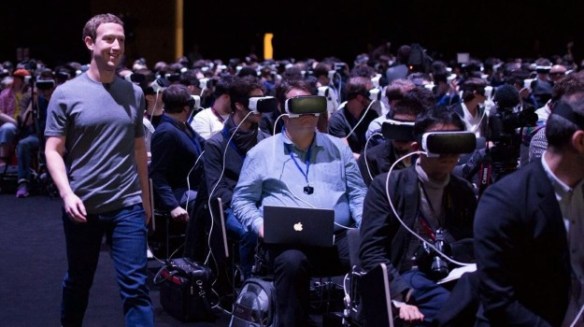
It was a scene out of an Ambien nightmare: a jackal with the face of Mark Zuckerberg stood over a freshly killed zebra, gnawing at the animal’s innards. But I was not asleep. The vision arrived midday, triggered by the Facebook founder’s announcement – in spring 2011 – that ‘The only meat I’m eating is from animals I’ve killed myself.’ Zuckerberg had begun his new ‘personal challenge’, he told Fortune magazine, by boiling a lobster alive. Then he dispatched a chicken. Continuing up the food chain, he offed a pig and slit a goat’s throat. On a hunting expedition, he reportedly put a bullet in a bison. He was ‘learning a lot’, he said, ‘about sustainable living’.

I managed to delete the image of the jackal-man from my memory. What I couldn’t shake was a sense that in the young entrepreneur’s latest pastime lay a metaphor awaiting explication. If only I could bring it into focus, piece its parts together, I might gain what I had long sought: a deeper understanding of the strange times in which we live.

What did the predacious Zuckerberg represent? What meaning might the lobster’s reddened claw hold? And what of that bison, surely the most symbolically resonant of American fauna? I was on to something. At the least, I figured, I’d be able to squeeze a decent blog post out of the story.

The post never got written, but many others did. I’d taken up blogging early in 2005, just as it seemed everyone was talking about ‘the blogosphere’. I’d discovered, after a little digging on the domain registrar GoDaddy, that ‘roughtype.com’ was still available (an uncharacteristic oversight by pornographers), so I called my blog Rough Type. The name seemed to fit the provisional, serve-it-raw quality of online writing at the time.

Blogging has since been subsumed into journalism – it’s lost its personality – but back then it did feel like something new in the world, a literary frontier. The collectivist claptrap about ‘conversational media’ and ‘hive minds’ that came to surround the blogosphere missed the point. Blogs were crankily personal productions. They were diaries written in public, running commentaries on whatever the writer happened to be reading or watching or thinking about at the moment. As Andrew Sullivan, one of the form’s pioneers, put it: ‘You just say what the hell you want.’ The style suited the jitteriness of the web, that needy, oceanic churning. A blog was critical impressionism, or impressionistic criticism, and it had the immediacy of an argument in a bar. You hit the Publish button, and your post was out there on the world wide web, for everyone to see.

Or to ignore. Rough Type’s early readership was trifling, which, in retrospect, was a blessing. I started blogging without knowing what the hell I wanted to say. I was a mumbler in a loud bazaar. Then, in the summer of 2005, Web 2.0 arrived. The commercial internet, comatose since the dot-com crash of 2000, was up on its feet, wide-eyed and hungry. Sites such as MySpace, Flickr, LinkedIn and the recently launched Facebook were pulling money back into Silicon Valley. Nerds were getting rich again. But the fledgling social networks, together with the rapidly inflating blogosphere and the endlessly discussed Wikipedia, seemed to herald something bigger than another gold rush. They were, if you could trust the hype, the vanguard of a democratic revolution in media and communication – a revolution that would change society forever. A new age was dawning, with a sunrise worthy of the Hudson River School.

Rough Type had its subject.

The greatest of the United States’ homegrown religions – greater than Jehovah’s Witnesses, greater than the Church of Jesus Christ of Latter-Day Saints, greater even than Scientology – is the religion of technology. John Adolphus Etzler, a Pittsburgher, sounded the trumpet in his testament The Paradise Within the Reach of All Men (1833). By fulfilling its ‘mechanical purposes’, he wrote, the US would turn itself into a new Eden, a ‘state of superabundance’ where ‘there will be a continual feast, parties of pleasures, novelties, delights and instructive occupations’, not to mention ‘vegetables of infinite variety and appearance’.

Similar predictions proliferated throughout the 19th and 20th centuries, and in their visions of ‘technological majesty’, as the critic and historian Perry Miller wrote, we find the true American sublime. We might blow kisses to agrarians such as Jefferson and tree-huggers such as Thoreau, but we put our faith in Edison and Ford, Gates and Zuckerberg. It is the technologists who shall lead us.

Cyberspace, with its disembodied voices and ethereal avatars, seemed mystical from the start, its unearthly vastness a receptacle for the spiritual yearnings and tropes of the US. ‘What better way,’ wrote the philosopher Michael Heim in ‘The Erotic Ontology of Cyberspace’ (1991), ‘to emulate God’s knowledge than to generate a virtual world constituted by bits of information?’ In 1999, the year Google moved from a Menlo Park garage to a Palo Alto office, the Yale computer scientist David Gelernter wrote a manifesto predicting ‘the second coming of the computer’, replete with gauzy images of ‘cyberbodies drift[ing] in the computational cosmos’ and ‘beautifully laid-out collections of information, like immaculate giant gardens’.

The millenarian rhetoric swelled with the arrival of Web 2.0. ‘Behold,’ proclaimed Wired in an August 2005 cover story: we are entering a ‘new world’, powered not by God’s grace but by the web’s ‘electricity of participation’. It would be a paradise of our own making, ‘manufactured by users’. History’s databases would be erased, humankind rebooted. ‘You and I are alive at this moment.’

The revelation continues to this day, the technological paradise forever glittering on the horizon. Even money men have taken sidelines in starry-eyed futurism. In 2014, the venture capitalist Marc Andreessen sent out a rhapsodic series of tweets – he called it a ‘tweetstorm’ – announcing that computers and robots were about to liberate us all from ‘physical need constraints’. Echoing Etzler (and Karl Marx), he declared that ‘for the first time in history’ humankind would be able to express its full and true nature: ‘we will be whoever we want to be.’ And: ‘The main fields of human endeavour will be culture, arts, sciences, creativity, philosophy, experimentation, exploration, adventure.’ The only thing he left out was the vegetables.

Such prophesies might be dismissed as the prattle of overindulged rich guys, but for one thing: they’ve shaped public opinion. By spreading a utopian view of technology, a view that defines progress as essentially technological, they’ve encouraged people to switch off their critical faculties and give Silicon Valley entrepreneurs and financiers free rein in remaking culture to fit their commercial interests. If, after all, the technologists are creating a world of superabundance, a world without work or want, their interests must be indistinguishable from society’s. To stand in their way, or even to question their motives and tactics, would be self-defeating. It would serve only to delay the wonderful inevitable.

The Silicon Valley line has been given an academic imprimatur by theorists from universities and think tanks. Intellectuals spanning the political spectrum, from Randian right to Marxian left, have portrayed the computer network as a technology of emancipation. The virtual world, they argue, provides an escape from repressive social, corporate and governmental constraints; it frees people to exercise their volition and creativity unfettered, whether as entrepreneurs seeking riches in the marketplace or as volunteers engaged in ‘social production’ outside the marketplace. As the Harvard law professor Yochai Benkler wrote in his influential book The Wealth of Networks (2006):

This new freedom holds great practical promise: as a dimension of individual freedom; as a platform for better democratic participation; as a medium to foster a more critical and self-reflective culture; and, in an increasingly information-dependent global economy, as a mechanism to achieve improvements in human development everywhere.

Calling it a revolution, he said, is no exaggeration.

Benkler and his cohort had good intentions, but their assumptions were bad. They put too much stock in the early history of the web, when the system’s commercial and social structures were inchoate, its users a skewed sample of the population. They failed to appreciate how the network would funnel the energies of the people into a centrally administered, tightly monitored information system organised to enrich a small group of businesses and their owners.

The network would indeed generate a lot of wealth, but it would be wealth of the Adam Smith sort – and it would be concentrated in a few hands, not widely spread. The culture that emerged on the network, and that now extends deep into our lives and psyches, is characterised by frenetic production and consumption – smartphones have made media machines of us all – but little real empowerment and even less reflectiveness. It’s a culture of distraction and dependency. That’s not to deny the benefits of having easy access to an efficient, universal system of information exchange. It is to deny the mythology that shrouds the system. And it is to deny the assumption that the system, in order to provide its benefits, had to take its present form.

Late in his life, the economist John Kenneth Galbraith coined the term ‘innocent fraud’. He used it to describe a lie or a half-truth that, because it suits the needs or views of those in power, is presented as fact. After much repetition, the fiction becomes common wisdom. ‘It is innocent because most who employ it are without conscious guilt,’ Galbraith wrote in 1999. ‘It is fraud because it is quietly in the service of special interest.’ The idea of the computer network as an engine of liberation is an innocent fraud.

I love a good gizmo. When, as a teenager, I sat down at a computer for the first time – a bulging, monochromatic terminal connected to a two-ton mainframe processor – I was wonderstruck. As soon as affordable PCs came along, I surrounded myself with beige boxes, floppy disks and what used to be called ‘peripherals’. A computer, I found, was a tool of many uses but also a puzzle of many mysteries. The more time you spent figuring out how it worked, learning its language and logic, probing its limits, the more possibilities it opened. Like the best of tools, it invited and rewarded curiosity. And it was fun, head crashes and fatal errors notwithstanding.

In the early 1990s, I launched a browser for the first time and watched the gates of the web open. I was enthralled – so much territory, so few rules. But it didn’t take long for the carpetbaggers to arrive. The territory began to be subdivided, strip-malled and, as the monetary value of its data banks grew, strip-mined. My excitement remained, but it was tempered by wariness. I sensed that foreign agents were slipping into my computer through its connection to the web. What had been a tool under my own control was morphing into a medium under the control of others. The computer screen was becoming, as all mass media tend to become, an environment, a surrounding, an enclosure, at worst a cage. It seemed clear that those who controlled the omnipresent screen would, if given their way, control culture as well.

‘Computing is not about computers any more,’ wrote Nicholas Negroponte of the Massachusetts Institute of Technology in his bestseller Being Digital (1995). ‘It is about living.’ By the turn of the century, Silicon Valley was selling more than gadgets and software: it was selling an ideology. The creed was set in the tradition of US techno-utopianism, but with a digital twist. The Valley-ites were fierce materialists – what couldn’t be measured had no meaning – yet they loathed materiality. In their view, the problems of the world, from inefficiency and inequality to morbidity and mortality, emanated from the world’s physicality, from its embodiment in torpid, inflexible, decaying stuff. The panacea was virtuality – the reinvention and redemption of society in computer code. They would build us a new Eden not from atoms but from bits. All that is solid would melt into their network. We were expected to be grateful and, for the most part, we were.

Our craving for regeneration through virtuality is the latest expression of what Susan Sontag in On Photography (1977) described as ‘the American impatience with reality, the taste for activities whose instrumentality is a machine’. What we’ve always found hard to abide is that the world follows a script we didn’t write. We look to technology not only to manipulate nature but to possess it, to package it as a product that can be consumed by pressing a light switch or a gas pedal or a shutter button. We yearn to reprogram existence, and with the computer we have the best means yet. We would like to see this project as heroic, as a rebellion against the tyranny of an alien power. But it’s not that at all. It’s a project born of anxiety. Behind it lies a dread that the messy, atomic world will rebel against us. What Silicon Valley sells and we buy is not transcendence but withdrawal. The screen provides a refuge, a mediated world that is more predictable, more tractable, and above all safer than the recalcitrant world of things. We flock to the virtual because the real demands too much of us.

‘You and I are alive at this moment.’ That Wired story – under headline ‘We Are the Web’ – nagged at me as the excitement over the rebirth of the internet intensified through the fall of 2005. The article was an irritant but also an inspiration. During the first weekend of October, I sat at my Power Mac G5 and hacked out a response. On Monday morning, I posted the result on Rough Type – a short essay under the portentous title ‘The Amorality of Web 2.0’. To my surprise (and, I admit, delight), bloggers swarmed around the piece like phagocytes. Within days, it had been viewed by thousands and had sprouted a tail of comments.

So began my argument with – what should I call it? There are so many choices: the digital age, the information age, the internet age, the computer age, the connected age, the Google age, the emoji age, the cloud age, the smartphone age, the data age, the Facebook age, the robot age, the posthuman age. The more names we pin on it, the more vaporous it seems. If nothing else, it is an age geared to the talents of the brand manager. I’ll just call it Now.

It was through my argument with Now, an argument that has now careered through more than a thousand blog posts, that I arrived at my own revelation, if only a modest, terrestrial one. What I want from technology is not a new world. What I want from technology are tools for exploring and enjoying the world that is – the world that comes to us thick with ‘things counter, original, spare, strange’, as Gerard Manley Hopkins once described it. We might all live in Silicon Valley now, but we can still act and think as exiles. We can still aspire to be what Seamus Heaney, in his poem ‘Exposure’, called inner émigrés.

A dead bison. A billionaire with a gun. I guess the symbolism was pretty obvious all along.

The real Hunger Games: the Capitalist recipe to maximise profits while ‘having fun’

peacekeeper

By Sky Wanderer

Source: Investment Watch

Introduce a political economy upon the arbitrary axiom that Capitalism is the one and only economic system for mankind, and introduce a narcissistic moral philosophy that you as a Capitalist represent unsurpassable objective moral virtues.

You as a Capitalist hire politicians to implement policy as per your moral and economic philosophy and redefine ‘democracy’ as the political system to sustain Capitalism. Then from such position of self-established authority, abolish unions and all labour-representation, thus force your employees into a race-to-the-bottom contest to compete for jobs by accepting lower and lower wages.

Give decent jobs and benefits to only those who belong to your noble circles. For everyone else reintroduce slavery in the form of “workfare”. The goal is that you pay the lowest wages for jobs done by the fittest slaves, who will survive the contest. If you wish, you can call the contest “real Hunger Games”.

To speed up the process, extend the race-to-the-bottom into global scope so that you will have access to the cheapest and fittest labour everywhere on the planet. Never mind that your slaves will have to live out of a suitcase and every time when you lay them off and labour demand calls them elsewhere, they will have to relocate to yet another continent.

To further accelerate the process, make good use of your 3rd-world colonies, your Mideast colonising wars and your secretly sponsored mercenaries (ISIS). Via your “leftist” assistants, organise a massive refugee crisis to import the cheapest possible workforce via your war-refugees and economic migrants. These migrants are the fittest contestants who – glad just to escape your bombs – will worship you as their saviours and will work for you for literally zero payment. The migrants will not only boost your profits to sky-high levels but will rapidly pull down the overall wages of your domestic employees.

Meanwhile keep increasing the prices so your slaves can’t pay for food, energy, heat and shelter from their next-to-zero incomes. If some of them attempt to survive by taking bank-loans to acquire shelter, education and meet other basic needs, but they can’t repay the loans from their low incomes, you can just evict them from their homes via your banks.

When you made them homeless this way, make sure their ugly presence won’t spoil the beauty of your city. Install pretty anti-homeless spikes, so when they crush onto the pavement they will die, and you can just collect their bodies. To project your capitalist moral virtues into eternity, incorporate the beauty of your anti-homeless spikes into the modern concept of art and beauty.

Introduce private banking to enable yourself to creating new money when you wish. This way you can easily indebt the entire society, soon you can even purchase the whole planet.

Meanwhile dismantle public healthcare, so those of your slaves who are still alive but get sick, will die without treatment. Eliminate (privatise) all affordable public services, destroy the public sphere, abolish all public spaces and welfare benefits. To have a dandy excuse for such policy, make sure to keep the country in ever increasing debt by taking countless £ billions of government loans, and transfer the responsibility of these odious debts onto your slaves. Refer to these debts as the reason for the crisis, then refer to the crisis as the reason for these debts, then refer to the debts and the crisis as the reason for austerity and spending cuts. Then you can increase the public debt again and continue the same loop ad infinitum.

Make sure your very own mainstream media and academia would never reveal the truth that the never-ending crisis and mass-unemployment are due to your private banking and debt- and profit-mongering dysfunctional capitalist system, and keep the real disastrous indicators of the state of economy in secret.

Instead of admitting the truth, use the divide et impera strategy to make your victims blame themselves and one another. To increase the fun, produce reality shows where the still active part of your slaves will blame the disabled and the unemployed, meanwhile make the local poor blame the immigrant poor for the overall misery that you inflicted. Then establish offices where the local poor dressed as fancy clerks will evict the immigrant poor, meanwhile watch how all of them are begging for their lives until they give up and commit suicide.

Enjoy!