Seeing Wetiko: On Capitalism, Mind Viruses, and Antidotes for a World in Transition

images

By Alnoor Ladha and Martin Kirk

Source: Reality Sandwich

It’s delicate confronting these priests of the golden bull
They preach from the pulpit of the bottom line
Their minds rustle with million dollar bills
You say Silver burns a hole in your pocket
And Gold burns a hole in your soul
Well, uranium burns a hole in forever
It just gets out of control.
– Buffy Sainte-Marie, “The Priests of the Golden Bull”1

What if we told you that humanity is being driven to the brink of extinction by an illness? That all the poverty, the climate devastation, the perpetual war, and consumption fetishism we see all around us have roots in a mass psychological infection? What if we went on to say that this infection is not just highly communicable but also self-replicating, according to the laws of cultural evolution, and that it remains so clandestine in our psyches that most hosts will, as a condition of their infected state, vehemently deny that they are infected? What if we then told you that this ‘mind virus’ can be described as a form of cannibalism. Yes, cannibalism. Not necessarily in the literal flesh-eating sense but rather the idea of consuming others—human and non-human—as a means of securing personal wealth and supremacy.

You may dismiss this line of thinking as New Age woo-woo or, worse, a lefty conspiracy theory. But this approach of viewing the transmission of ideas as a key determinant of the emergent reality is increasingly validated by various branches of science, including evolutionary theory, quantum physics, cognitive linguistics, and epigenetics.

The history of this infection is long, strange, and dark. But it leads to hope.

Viruses of the Mind

The New World fell not to a sword but to a meme.
~ Daniel Quinn2

One of the most well-accepted scientific theories that helps explain the power of idea-spreading is memetics.

Memes are to culture what genes are to biology: the base unit of evolution. The term was originally coined by the evolutionary biologist Richard Dawkins in his 1976 book, The Selfish Gene. Dawkins writes, “I think that a new kind of replicator has recently emerged . . . It is still drifting clumsily about in its primeval soup, but already it is achieving evolutionary change at a rate which leaves the old gene panting far behind.” He goes on, “Examples of memes are tunes, ideas, catch-phrases, clothes fashions, ways of making pots or of building arches. Just as genes propagate themselves in the gene pool by leaping from body to body via sperms or eggs, so memes propagate themselves in the meme pool by leaping from brain to brain, via a process which, in the broad sense, can be called imitation.”3

One of the high priests of rationalism, the scientific method, and atheism, is also the father of the meme of ‘memes.’ However, like all memes or ideas, there can be no ownership in a traditional sense, only the entanglement that quantum physics reminds us characterizes our intra-actions.4

Of course, similar notions of how ideas move between us have been around in Western traditions for centuries. Plato was the first to fully articulate this through his Theory of Forms, which argues that non-physical forms—i.e., Ideas—represent the perfect reality from which material reality is derived.

Modern articulations of the Theory of Forms can be seen in Pierre Teilhard de Chardin’s idea of the Noosphere (the sphere of human thought) and Carl Jung’s Collective Unconscious, where structures of the unconscious are shared among beings of the same species. For Jung, the idea of the marauding cannibal would first be an archetype that manifests in the material world through the actions of those who channel or embody it.

For those who prefer their science more empirical, the growing field of epigenetics provides some intellectual concrete. Epigenetics studies changes in organisms caused by modification of gene expression rather than any physical alteration of the gene itself. In other words, how traits vary from generation to generation is not solely a question of material biology but is partly determined by environmental and contextual factors that affected our ancestors.5

The Wetiko Virus

We did not think of the great open plains, the beautiful rolling hills, and the winding streams with tangled growth as “wild.” Only to the White man was nature a “wilderness” and only to him was the land infested by “wild” animals and “savage” people. To us it was tame. Earth was bountiful and we were surrounded with the blessings of the Great Mystery. Not until the hairy man from the east came and with brutal frenzy heaped injustices upon us and the families we loved was it “wild” for us.
~ Luther Standing Bear, Land of the Spotted Eagle6

Many spiritual traditions, including Buddhism, Sufism (the mystical branch of Islam), Taoism, Gnosticism, as well as many Indigenous cultures, have long understood the mind-based nature of creation. These worldviews have at their core a recognition of the power of thought-forms to determine the course of physical events.

Various First Nations traditions of North America have specific and long established lore relating to cannibalism and a term for the thought-form that causes it: wetiko. We believe understanding this offers a powerful way of understanding the deepest roots of our current global polycrisis.

Wetiko is an Algonquin word for a cannibalistic spirit that is driven by greed, excess, and selfish consumption (in Ojibwa it is windigo, wintiko in Powhatan). It deludes its host into believing that cannibalizing the life-force of others (others in the broad sense, including animals and other forms of Gaian life) is a logical and morally upright way to live.

Wetiko short-circuits the individual’s ability to see itself as an enmeshed and interdependent part of a balanced environment and raises the self-serving ego to supremacy. It is this false separation of self from nature that makes this cannibalism, rather than simple murder. It allows—indeed commands—the infected entity to consume far more than it needs in a blind, murderous daze of self-aggrandizement. Author Paul Levy, in an attempt to find language accessible for Western audiences, describes it as ‘malignant egophrenia’—the ego unchained from reason and limits, acting with the malevolent logic of the cancer cell. We will use the term wetiko as it is the original, and reminds us of the wisdom to be found in Indigenous cultures, for those who have the ears to hear.

Wetiko can describe both the infection and the body infected; a person can be infected by wetiko or, in cases where the infection is very advanced, can personify the disease: ‘a wetiko.’ This holds true for cultures and systems; all can be described as being wetiko if they routinely manifest these traits.

In his now classic book Columbus and Other Cannibals, Native American historian Jack D. Forbes describes how there was a commonly-held belief among many Indigenous communities that the European colonialists were so chronically and uniformly infected with wetiko that it must be a defining characteristic of the culture from which they came. Examining the history of these cultures, Forbes laments, “Tragically, the history of the world for the past 2,000 years is, in great part, the story of the epidemiology of the wetiko disease.”7

We would presumably all agree that behavior of the European colonialists in North America can be described as cannibalistic. Their drive for conquest and material accumulation was a violent act of consumption. The engine of the invading culture suckedin lives and resources of millions of others and turned them into wealth and power for themselves. The figures are still disputed, but it is safe to place the numbers killed in the tens of millions, certainly one of the most brutal genocides in history. And the impact on non-human life was equally vast. Moreover, it was all done with a moral certainty that all destruction was justified in the name of ‘progress’ and ‘civilization.’

This framing belies the extent of the wetiko infection in the invader culture. So blinded were they by self-referential ambition that they could not see other life as being as important as their own. They could not see past ideological blinders to the intrinsic value of life or the interdependent nature of all things, despite this being the dominant perspective of the Indigenous populations they encountered. Their ability to see and know in ways different from their own was, it seems, amputated.

This is not an anti-European rant. This is the description of a disease whose vector was determined by deep patterns of history, including those that empowered Europeans to drive ‘global exploration’ as certain technologies emerged.

The wetiko meme has almost certainly existed in individuals since the dawn of humanity. It is, after all, a sickness that lives through and is born from the human psyche. But the origin of wetiko cultures is more identifiable.

Memes can spread at the speed of thought but they usually require generations to change the core characteristics of cultures. What we can say is that the fingerprints of wetiko-like beliefs can be traced at least as far back as the Neolithic revolution, when humans in the Fertile Crescent first learned to dominate their environment by what author Daniel Quinn calls ‘totalitarian agriculture’ — i.e., settled agricultural practices that produce more food than is strictly needed for the population, and that see the destruction of any living entity that gets in the way of that (over-)production—be it other humans, ‘pests’ or landscaping—as not only legitimate but moral.

This early form of wetiko-logic received an amplifying power of indescribable magnitude with the arrival of Christianity. “Let us make mankind . . . rule over the fish in the sea and the birds in the sky, over the livestock and all the wild animals, and over all the creatures that move along the ground,” said an authority no less than God in Genesis 1:26. After 8,000 years of totalitarian agriculture spreading slowly across the region, it is perhaps not surprising that the logic finds voice in the holy texts that emerged there. Regardless, it was driven across Europe at the point of Roman swords in the two hundred years after Christ’s death. It is no coincidence that, in order for Christianity to become dominant, the existing pagan belief-system, with its understanding of humanity’s place within rather than above nature, had to be all but annihilated.8

The point is that the epidemiology of wetiko has left clear indicators of its lineage. And although it cannot be pathologized along geographic or racial lines, the cultural strain we know today certainly has many of its deepest roots in Europe. It was, after all, European projects—from the Enlightenment to the Industrial Revolution, to colonialism, imperialism, and slavery—that developed the technology that opened up the channels that facilitated the spread of wetiko culture all around the world. In this way, we are all heirs and inheritors of wetiko colonialism.

We are all host carriers of wetiko now.

Wetiko Capitalism: Removing the Veils of Context

I don’t know who discovered water, but I can tell you it wasn’t a fish.
~ Attributed to Marshall McLuhan

When Western anthropologists first started to study wetiko, they believed it to be only a disease of the individual and a literal form of flesh-eating cannibalism.9 On both counts, as discussed, their understanding was, if not wrong, certainly limited. They did, however, accurately isolate two traits that are relevant for thinking about cultures: (1) the initial act, even when driven by necessity, creates a residual, unnatural desire for more; and (2) the host carrier, which they called the ‘victim,’ ended up with an ‘icy heart’— i.e., their ability for empathy and compassion was amputated.

The reader can probably already sense from the two traits mentioned above the wetiko nature of modern capitalism. Its insatiable hunger for finite resources; its disregard for the pain of groups and cultures it consumes; its belief in consumption as savior; its overriding obsession with its own material growth; and its viral spread across the surface of the planet. It is wholly accurate to describe neoliberal capitalism as cannibalizing life on this planet. It is not the only truth—capitalism has also facilitated an explosion of human life and ingenuity—but when taken as a whole, capitalism is certainly eating through the life-force of this planet in service of its own growth.

Of course, capitalism is a human conception and so we can also say that we are phenomenal hosts of the wetiko mind virus. To understand what makes us such, it is useful to consider a couple of the traits that guide the evolution of human cultures.

We have decades of evidence from social science describing just what highly contextual beings we are. Almost all aspects of our behavior, including our moral judgments and limits, are significantly shaped in response to the cultural signifiers that surround us. The Good Samaritan studies, for example, show that even when people are primed with the idea of altruism, they will walk by others in need when they are in a rush or some other contextual variable changes.10 And the infamous Stanley Milgram experiments show how a large majority of people are capable of shocking another human to a point they know can cause death simply because an authority figure in a white lab coat insists they do so.11

We really are products of our environment, and so it should be taken as inevitable that those who live in a wetiko culture will manifest, to one degree or other, wetiko beliefs and behaviors.

Looking through the broader contextual lens, we must also account for the self-perpetuating nature of complex systems. Any living network that becomes sufficiently complex will become self-organizing, and from that point on will demonstrate an instinct to survive. In practical terms, this means that it will distribute its resources to support behavior that best mimics its own logic and ensures its survival.12

In other words, any system that is sufficiently infected by wetiko logic will reward cannibalistic behavior. Or, in Jack Forbes’ evocative language, “Those who squirm upwards [in a wetiko system] are, or become, wetiko, and they only perpetuate the system of corruption or oppression. Thus the communist leaders in the Soviet Union under Stalin were at least as vicious, deceitful and exploitative as their czarist predecessors. They obtained ‘power’ without changing their wetiko culture.”13

This ensures that the essential logic of cultures spreads down through generations as well as across them. And it explains why they self-organize resources to maintain a high degree of continuity in distributions of power, when those distributions efficiently serve their survival and growth. When this continuity is interrupted or broken, revolutions occur and the system is put under threat.

However, as the above quote suggests, the disruption must happen at the right level. Merely trading one wetiko for another at the top of an otherwise unchanged wetiko infrastructure (as in the case of Stalin replacing the czars or, more contemporarily, Obama replacing Bush) is largely pointless. At best, it might result in the softening of the cruelest edges of a wetiko machine. At worse, it does nothing except distract us from seeing the true infection.

The question, then, for anyone interested in excising the wetiko infection from a culture is, where is it? In one respect, because it is a psychic phenomenon that lives in potential in all of us, it is non-local. But this, though ultimately important to understand, is not the whole truth. It is also true that there is a conceptual place where the most powerful wetiko logic is held, and that, at least in theory, makes it vulnerable.

In the same way that a colony of bees will instinctively house its queen in the deepest chambers of the hive, so a complex adaptive system buries its most important operating logic furthest from the forces that can challenge them. This means two things: first, it means siting the logic in the deep rules that govern the whole. Not just this national economy or that, this government or that, but the mother system—the global operating system. And second, it means making these rules feel as intractable and inevitable as possible.

So what is this deep logic of the global operating system?

It comes in two parts. First, there is the ultimate purpose, which we might call the Prime Directive, which is to increase capital.

We often dress this up in a narrative that says capital generation is not the end but the means, the engine of progress. This makes the idea of dethroning it feel dangerous and even contrary to common sense. But the truth is, we have created a system that artificially treats money as sacred. At this point in capitalism’s history, life is controlled by, more than it controls, the forces of capital. The clue is really in the name. But if you need further proof, look no further than how we define and measure progress: GDP. More on that below.

Then, there is the logic for how we, the living components of this system, should behave, which we would summarize with the following epithet:

Selfishness is rational and rationality is everything; therefore selfishness is everything.14

This dictates that if we all prioritize ourselves and maximize our own material wealth, an invisible hand (ah, what a seductive meme!) will create an equilibrium state and life everywhere will be made better. We are pitted against each other in a form of distributed fascism where we cocoon ourselves in the immediate problems of our own circumstances and consume what we can. We then couch this behavior in the benign language of family matters, national interests, job creation, GDP growth, and other upstanding endeavors.

Put these two parts of the puzzle together and it’s easy to see why the banker who generates excess capital receives vast rewards and is labelled ‘productive’ and ‘successful,’ almost regardless of the damage s/he causes. Those who are less ‘successful’ at producing excess capital, meanwhile, are rewarded far less, regardless of the life-affirming good they may be doing. Nurses, mothers, teachers, journalists, activists, scientists—all receive far less reward because they are less efficient at obeying the Prime Directive and may even be countermanding the ‘self-interest’ operating principle. And as for those who are actually poor—well, they are effortlessly labelled not just as practical but also moral failures.

This infection is so far advanced that the system now requires exponential capital growth. The World Bank tells us that we have to grow the global economy by at least 3 percent per year to avoid recession.15 Let’s think about what this means. Global GDP in 2014 (the last full year of data) was roughly USD $78 trillion.16 We grew that pie by 2.4% in 2015, which resulted in the commodification and subsequent consumption of roughly another $2 trillion in human labor and natural resources. That’s roughly the size of the entire global economy in 1970. It took us from the dawn of civilization to 1970 to reach $2 trillion in global GDP, and now we need that just in the differential so the entire house of cards doesn’t crumble. In order to achieve this rate of growth year-on-year, we are destroying our planet, ensuring mass species extinction, and displacing millions of our brothers and sisters (who we commonly refer to as ‘poor people’) from around the world.

So when people tell us that the market knows best, or technology will save us, or philanthrocapitalism will redistribute opportunities (pace Bill Gates), we have to understand that all of these seemingly common sense truisms are embedded in a broader operating system, a wetikonomy, with all that that means. And the more they are presented as ‘unchangeable,’ the more often we’re told, ‘there is no alternative,’ the more we should question. There is actually a beautiful irony in the fact that, when we know what we’re up against, such statements are our signposts for where to look.

It is not that we are against markets, technology, or philanthropy — they can all be wonderful, in the right context—but we are against how they are being used as alibis to excuse the insanity of the wetiko paradigm that they are inseparable from. We are reminded of Jack Forbes’ heavy words; “It is not logical to allow the wetikos to carry out their evil acts and then to accept their assessment of the nature of human life. For after all, the wetiko possess a bias created by their own evil lives, by their own amoral or immoral behavior. And too, if I am correct, they were, and are, also insane.”17

Information Tribalism, starring Terence McKenna, Marshall McLuhan and Alan Watts.

Seeing Wetiko: Antidote Logic

Launch your meme boldly and see if it will replicate—just like genes replicate, and infect, and move into the organism of society. And, believing as I do, that society operates on a kind of biological economy, then I believe these memes are the key to societal evolution. But unless the memes are released to play the game, there is no progress.
~ Terence McKenna, Memes, Drugs and Community18

You might just be a black Bill Gates in the making.
~ Beyoncé, Formation19

A key lesson of meme theory is that when we are conscious of the memetic viruses we are less likely to adhere to them blindly. Conscious awareness is like sunlight through the cracks of a window.

Thus, one of the starting points for healing is the simple act of ‘seeing wetiko’ in ourselves, in others, and in our cultural infrastructure. And once we see, we can name, which is critical because words and language are a central battleground. To quote McKenna again:

The world is not made of quarks, electromagnetic wave packets, or the thoughts of God. The world is made of language.. Earth is a place where language has literally become alive. Language has invested matter; it is replicating and defining and building itself. And it is in us.20

His last line is critical for exploring our own agency in the replication of wetiko. We are all entangled in the unfolding of reality that is happening both to and through us. In place of traditional certainties and linear cause-and-effect logic, we can recast ourselves “as spontaneously responsive, moving, embodied living beings—within a reality of continuously intermingling, flowing lines or strands of unfolding, agential activity, in which nothing (no thing) exists in separation from anything else, a reality within which we are immersed both as participant agencies and to which we also owe significant aspects of our own natures.”21

If wetiko exists, it is because it exists within us. It is also entangled with the broader superstructure, relationships, and choice architecture that we are confronted with within a neoliberal system on the brink of collapse.

Forbes reminds us that we cannot ‘fight’ wetiko in any traditional sense: “One of the tragic characteristics of the wetiko psychosis is that it spreads partly by resistance to it. That is, those who try to fight wetiko sometimes, in order to survive, adopt wetiko values.

Thus, when they ‘win,’ they lose.”22 A lot of reform-based initiatives, from the sharing economy to micro-lending have succumbed to the co-optation and retaliation of wetiko capitalism.

However, once we are in the mode of seeing wetiko, we can hack the cultural systems that perpetuate its logic. It is not difficult to figure out where to start. Following the money usually leads us to the core pillars of wetiko machinery. Those of us that are within these structures, from the corporate media to philanthropy to banking to the UN, have access to the heart of the wetiko monster.

For those of us on the outside, we can organize our lives in radically new ways to undermine wetiko structures. The simple act of gifting undermines the neoliberal logic of commodification and extraction. Using alternative currencies undermines the debt–based money system. De-schooling and alternative education models can help decolonize and de-wetikoize the mind. Helping to create alternative communities outside the capitalist system supports the infrastructure for transition. And direct activism such as debt resistance can weaken the wetiko virus, if done with the right intention and state of consciousness.

By contracting new relationships with others, with Nature, and with ourselves, we can build a new complex of entanglements and thought-forms that are fused with post-wetiko, post-capitalist values.

We have to simultaneously go within ourselves and the deep recesses of our own psyches while changing the structure of the system around us. Holding a structural perspective and an unapologetic critique of modern capitalism—i.e., holding a constellational worldview that sees all oppression as connected—serves our ability to see the alternatives, and indeed, all of us, as intricately connected.

Plato believed that ideas are the ‘eyes of the soul.’ Now that the veils obscuring wetiko are starting to be lifted, let us give birth to, and become, living antigens, embracing the polyculture of ideas that are challenging the monoculture of wetiko capitalism. Let us be pollinators of new memetic hives built on altruism, empathy, inter-connectedness, reverence, communality, and solidarity, defying the subject-object dualities of Cartesian/Newtonian/Enlightenment logic. Let us reclaim our birth right as sovereign entities, free of deluded beliefs in market systems, invisible hands, righteous greed, chosen ones, branded paraphernalia, techno utopianism and even the self-salvation of the New Age. Let us dance with thought-forms through a deeper understanding of ethics, knowing, and being,23 and the intimate awareness that our individual minds and bodies are a part of the collective battleground for the soul of humanity, and indeed, life on this planet. And let us re-embrace the ancient futures of our Indigenous ancestors that represent the only continuous line of living in symbiosis with Mother Nature. The dissolution of wetiko will be as much about remembering as it will be about creation.

Endnotes

1 These are lyrics from a song entitled “The Priests of the Golden Bull” by the Na-
tive Canadian singer/songwriter Buffy Sainte-Marie from her 1992 album entitled Coincidence and Likely Stories. The authors believe this was their first encounter
with the memetic mind virus of wendigo (a version of wetiko). This will all make sense at the end of this article.
2 Quinn, D. Beyond civilization: Humanity’s next great adventure. Broadway Books (2008), p. 50.
3 Dawkins, R. The selfish gene. Oxford University Press (1990).
4 ‘Intra-action’ is a neologism created by Karan Barad and described in her book, Meeting the Universe Halfway (2007). Barad writes about intra-action, rather than interaction, to illustrate how entanglement precedes thingness. In other words, there are no things as such, just relationships—and these ongoing relational dynamics are co-responsible for how things emerge.
5 Recent research, for example, has shown how the grandchildren of Holocaust survivors have different stress hormone profiles than those from otherwise very similar circumstances but whose grandparents did not suffer through the Holocaust. Rodriguez, T. “Descendants of Holocaust survivors have altered stress hormones,” Scientific American (March 2015), accessed at: http://www.scientificamerican.com/article/descendants-of-holocaust-survivors-have-altered-stress-hormones/
6 Luther Standing Bear. Land of the spotted eagle. Bison Books (2006).
7 Forbes, Jack D. Columbus and other cannibals: The wetiko disease of exploitation, imperialism and terrorism. Seven Stories Press (2008), p.46.
8 See Not in His Image (2006) by John Lamb Lash for a comprehensive account of the systematic annihilation of paganism by the new Christian religion.
9 Cooper, J.M. “The Cree Witiko Psychosis” in Primitive Man, Vol. 6, No. 1 (Jan., 1933), pp. 20-24: The George Washington University Institute for Ethnographic Research.
10 Darley, J. M., and Batson, C.D. “From Jerusalem to Jericho: A study of situational and dispositional variables in Helping Behavior.” Journal of Personality and Social Psychology (1973), Vol. 27, Number 1, pp. 100-108.
11 See https://en.wikipedia.org/wiki/Milgram_experiment.
12 Capra F, Luisi P, A systems view of life: A unifying vision. Cambridge (2014), Chapter 8.
13 Forbes, Jack D. Columbus and other cannibals: The wetiko disease of exploitation, imperialism and terrorism. Seven Stories Press (2008), p.46.
14 A version of this argument was originally published on Occupy.com by the authors in a two-part essay entitled “Capitalism is Just a Story and Other Dangerous Thoughts.” See more at: http://www.occupy.com/article/capitalism-just-story-and-other-dangerous-thoughts-part-i#sthash.INKCFdNs.dpuf.
15 For example, see this forecast report by the World Bank: http://www.worldbank.org/content/dam/Worldbank/GEP/GEP2016a/Global-Economic-Prospects-January-2016-Global-Outlook.pdf
16 See http://databank.worldbank.org/data/download/GDP.pdf
17 Forbes, Jack D. Columbus and other cannibals: The wetiko disease of exploitation, imperialism and terrorism. Seven Stories Press (2008), p.37.
18 See https://www.youtube.com/watch?v=NO6-1sqQme0
19 These lyrics are from Beyoncé’s song “Formation,” which was originally debuted at the 2015 Super Bowl. For a critical analysis, see Dianca London’s article entitled Beyoncé’s capitalism, masquerading as radical change.
20 McKenna, T. The archaic revival: Speculations on psychedelic mushrooms, the Amazon, virtual reality, UFOs, evolution, shamanism, the rebirth of the goddess, and the end of history. Harper Collins (1992).
21 John Shotter, “Agential realism, social constructionism, and our living relations to our surroundings: Sensing similarities rather than seeing patterns’’ Theory and Psychology, 2014.
22 Forbes, Jack D. Columbus and other cannibals: The wetiko disease of exploitation, imperialism and terrorism. Seven Stories Press (2008), p.61.
23 Karan Barad talks about the confluence of ethics, knowing, and being as an ‘onto-ethico-politico-epistemology.’ Ontology refers to what is in the world. Epistemology is about how we know what is in the world. And ethics is how we should engage in the world. These are not separate, but emerge materially in an ongoing dynamic. The nature of reality and the nature of knowledge are entangled—not fixed or final or determinate— and thus cannot be divorced from power and what we find valuable or just.


Lessons from George Orwell’s ‘1984’

1984

By Ethan Indigo Smith

Source: Waking Times

“Political language is designed to make lies sound truthful and murder respectable, and to give an appearance of solidity to pure wind.” — George Orwell

Some fictional literature is so profound as to be relevant for decades. George Orwell’s timeless 1984 is one such literary work. One of the most influential books of our time, its message resonates today as much as it did when it was first published over 65 years ago — as shown by its recent surge to the #1 spot on Amazon’s bestseller list.

So what can 1984 teach us about the modern day?

At its core, 1984 is a post-WWII interpretation of the relationship between individuals and institutions. It changed the course of social history by spawning new language relating to the structure and mechanisms of our society, expanding the scope of human language and thought, and therefore, humanity’s understanding of itself. And that legacy seems perfectly fitting, for in the story of 1984, the world is controlled by so many restrictions that even the expressiveness of the official language, “Newspeak”, is deliberately narrowed by the ruling institutions in a way that limits the ability of individuals to express “thoughtcrime” — that which is deemed illegal by the “Inner Party”, the State.

As a work of fiction, 1984 provides a stark view of a burgeoning culture of totalitarianism. As a work of symbolism, however, it stands as a reflection of modern fact in The U.S.A. and the world today. Within its narrative, the five freedoms of the First Amendment of the United States Constitution were infringed and removed; in particular, the freedom of speech was so restricted that there was only one source of news operated by the official governing body and an entire branch of government was dedicated to steadily eliminating language deemed detrimental to the State.

Orwell created new phrases like “Newspeak” (the official, limited language) and its antonym “Oldspeak”, “Goodthink” (thoughts that are approved by the Party) and its antonym “Crimethink”, and “Doublethink” (the normalized act of simultaneously accepting two contradictory beliefs). The new language allowed his narrative to portray and expose age-old structures of thought and language manipulation – structures that have exponentially escalated in the modern day.

In 1984 all opposition is controlled and absorbed into the background. ‘Big Brother’ is the human image that represents The Inner Party (and the Party line) via the Telescreen providing an ‘official’ narrative while appropriating and misrepresenting the notion of brotherhood and unity into a ‘brand name’ — one that actually instills a psychology of collectivism, not brotherhood, just as the controllers in our own world instill nationalism and war-mindedness in the name of “freedom” and “liberty”. Indeed, the Telescreen is the primary means through which norms were forced on the society and false imagery and narratives embedded in its collective consciousness. Totally transfixed on the Party line, as told by the Telescreen, the fictional society of 1984 has lost the ability to think such that it will believe two plus two is five, as the saying goes, as long as it is presented as such on the Telescreen. They have been captive to this set up their entire lives, and, with language and thought restricted and outlawed, they are blind to their own captivity, unable to discern for themselves. Thus, lies are made to be “truths” using logic so distorted that it not only convinces the masses that two plus two equal five, but that war is peace, freedom is slavery, and ignorance is strength.

In reality, individual ignorance is strength to institutions. Such distortions of language and thought (and, incidentally, history) are the perfect means by which to disempower and co-opt an entire society — means that are not limited to the works of fiction. Orwell knew that ideas do not exist separately from language. Language, in both spoken and written forms, is essential to our ability to form and communicate thoughts and ideas. That is why today the United States government, the shadow powerbrokers that control it, and the mainstream media that support it (the entirety of which is owned by only 6 corporations) continue their war on “fake news” — i.e. ideas that are skeptical of government pronouncements, and information that proves them to be false — taking aim not just at independent journalism but independent thought itself. While government surveillance of its own people continues to increase, government secrecy is at an all-time high, the sharing of ideas that challenge the status quo is becoming more heavily censored, releasing information on institutional and State activity is now punishable by law, and whistleblowers from inside the State are systematically destroyed. If that wasn’t Orwellian enough, Donald Trump’s advisors have begun coining phrases like “alternative facts”, and we have even seen the creation of an Orwellian “Ministry of Truth”, an “international fact-checking network” charged with deciding what is “truth” and what is “fake news”.

If the events of 1984 continue to hold true, and the ruling Party of today gets its way, words and ideas will soon become not only censored, but illegal and eliminated altogether, controlled by increasingly totalitarian governments steering our society down a dystopian path of censorship, blind belief, and misinformation — all in the name of the State. However, as our minds are freed, one at a time, we are ultimately finding that our society is heavily embedded with such norms and structures that perpetuate false imagery, preserving the status quo of the State from the ‘threat’ of individual thinking — hence the modern war on “fake news”. We are beginning, as a society, to question such falsehood, and exercise our inherent freedom to expose it.

“Freedom is the freedom to say that two plus two make four. If that is granted, all else follows”. ~ George Orwell

The Last Man in Europe

The original working title to 1984 was ‘The Last Man in Europe.’ This descriptive and evocative title idea provides a clear glimpse into George Orwell’s intent, and encapsulates a main point of 1984, a title perhaps too revealing to be anything but a working title. Certainly, that is the way many of us feel when we first become aware of lies and partial-truths that are presented as reality by those in control of our society today, and accepted in totality by seemingly everyone else – it is as if we are the last lone person. Indeed, the road of the freethinker can be a lonely one, and the story’s protagonist, patriot Winston Smith, is made to believe he is the last person who questions, who looks, listens and speaks.

In a totalitarian society — be it Orwell’s fictional world or the increasingly authoritarian political regimes of today — the official narratives portrayed by the “official” media portray that a society is in consensus with the State, and that those engaged in Thoughtcrime (whether or not it is legally a crime) are isolated social outcasts and lunatics, and demeaned as “rebels” and “conspiracy theorists” (despite the existence of actual conspiracy, against which the truly conscious mind must inevitably rebel.) Yet in reality, Crimethink is what differentiates we freethinkers from those who are lost in the spell of societal illusion and, therefore, pose a threat to the status quo of the State. But this is part of the trap of Goodthink — it creates the illusion of consensus, and therefore, engenders isolation in those who do not concede.

As a master of his craft, nothing Orwell wrote was off the cuff. Now it is not overtly spoken in the book, but there are four types of people in the fictional realm of 1984. There are three described classes and a suggested fourth, only later is it implied that the Brotherhood, anti-establishment rebels — has been eliminated from the narrative jut as those in power sought to eliminate them from the society.

The Secret to 1984 is ‘4’

1984 is in part an expose on the four basic types of people in a society, the four types of institutions and the four types of institutional lies that enable them.

Characterized by how they respond to information, modern societies are made up of four archetypes of people — idiots, zealots, elitists and patriots. Idiots refuse information, zealots blindly refute information, elitists misuse information, and patriots seek and distribute information. Despite dramatic alterations in the world’s geopolitical landscape, and some fluctuation of individuals from one group/role to another over time, the dynamic between these groups has historically remained the same, and are inevitably intertwined: Idiots avoid all new pertinent information in order to maintain their perspective, never questioning the status quo. Zealots ask certain questions of certain information, ignoring unaligned information in order to maintain their perspective, supporting the status quo at all costs. Elitists question information in order to manipulate and reap gains off those who don’t know, benefiting from the status quo. Patriots question information to educate themselves and share it with others, in order that we might enhance our lives and progress beyond the status quo.

It is no wonder, then, that the patriot has been all but deleted from today’s socio-political landscape, with those acting as true patriots being demonized by the State, and the meaning of the word “patriot” distorted and confused (by the likes of George W. Bush Jr.) to mean an unquestioning, flag-waving, with-us-or-against-us brand of nationalistic idiocy. (Check out my article, The First Amendment – The REAL Patriot Act for a deeper discussion of this.) Using a practice so well-defined by Orwell that it is known today as Orwellian speak, institutions transfer and confuse words and ideas by mixing up themselves, their policies and their products with patriotic ideas and words. They take the meaning of words and archetypes, and flip them on their heads: War is peace, freedom is slavery, ignorance is strength, and true patriotism (such as that shown by government whistleblowers) is traitorous.

In reality, the true patriots, the rebels who see through the lies of institutions and act accordingly, are removed from public consciousness in exactly the same way. In “Orwellian” fashion, the fourth deleted class of people in 1984, the Brotherhood, who are working to bring down the fascist Inner Party, are deleted through the admission of language. The other three types, which are specifically mentioned in the-book-within-the-book, the fictional The Theory and Practice of Oligarchical Collectivism, are the High, the Middle and the Low castes. Similarly, the other three types of people depicted in the society of Oceania are the Inner Party, the Outer Party and the Proles. The social classes interact very little.

The Inner Party and Outer Party make up 2% of the population, and are the institutionalized controllers of Oceania. They are akin to modern politicians and the financial elite, working with and against one another, and clamoring to gain and maintain power. They have privileges the other castes do not, including being able to (temporarily) turn off the propaganda-spewing Telescreens.

However, there is a pecking order within the Party. The Outer Party are given state administrative jobs and are composed of the more educated members of society. They are responsible for the direct implementation of the Party’s policies but have no say in decision making. They are the “artificial middle class” and as such, have strict rules applied to them. They are allowed “no vices other than cigarettes and Victory Gin”, are spied on via their Telescreens, and are encouraged to spy on each other, and to report suspicious activities to Big Brother.

The lower class of workers that perform the majority of menial tasks and labors are known as the Proles. They live in the poorest of conditions, are not educated, and instead are kept entertained with alcohol, gambling, sports, fiction and pornography (called “prolefeed”) — the 1984 equivalent of “bread and circus”.

According to the Inner Party and the Telescreen it controls, those who might challenge the system – the important fourth type of person – simply do not exist. The Brotherhood, the organization of patriots, are portrayed by the controlling ‘Inner Party’ as only a rumor, and the notion of their existence is belittled by the Inner Party, via the Telescreen. In Oceania, if the Telescreen is t be believed, there are no patriots, nor is such action allowed — and any who think that way are isolated by the divide-and-conquer tactic used by empires past and present. Thus, like so many in our failing society, Smith believes himself to be ‘The Last Man in Europe’…

“During times of universal deceit, telling the truth becomes a revolutionary act.” – George Orwell

And yet, as the character of Winston Smith accurately observes in his diary, “If there is any hope, it lies with the Proles” — just as our hope for today lies with the so-called “99%”. The “proles” in our society must begin to look beyond the bread and circus, beyond the prolefeed, and become a true brotherhood, and sisterhood, by questioning information, educating themselves, and sharing what they learn with others in order that we might overcome institutional oppression and finally create the ‘golden age’ that is our combined potential.

God and Gold is Within

“We shall meet in the place where there is no darkness.” — George Orwell, 1984

Nothing Orwell wrote was by accident. The name of the character who leads the Brotherhood rebellion is named Emmanuel Goldstein, a name that translates roughly to mean God (Emmanuel) and gold are within (Goldstein). The use of this character name by Orwell asserts a developed, even transmuted human being, who has transcended the imposed limitations of the system he is opposed to, and grown from dull to refined, disempowered to empowered. It also reveals Orwell’s knowledge of how such patriotism and rebellion can become revolution.

The word “prole” is short for prolétariat, a French word derived from the Latin proletarius, meaning “a man whose only wealth is his offspring, or whose sole service to the state is as father”. A word evoking pure institutionalized collectivism, it suggests that the individual has no value other than the labor and progeny he provides to the State. (If you’re only value to the state is as a breeder and consumer, well what kind of world does, sorry, would that result in??) Now compare that definition to the name Emmanuel Goldstein, Golden Godliness is Within. In complete contrast, it is a statement of inner development, of individual enlightenment and empowerment — which, as Orwell knew, are the only forces that can successfully lead a rebellion against the institutional oppression of both fiction and reality.

So, you see, the secret to 1984 is ‘4’. Its most powerful message is in its omissions: in the omission of information, which is the only way the Party/State can maintain authoritarian control, and in the deliberately-omitted fourth human archetype, the righteous rebel, the marginalized voice of descent who is led to believe he is the “last man in Europe”. But in fact, the last man in Europe is you and I. We are everywhere. And, as we open our minds and our mouths, and embrace the gold within, we re-tell the lost narrative of the Brotherhood, and turn our Proles into our Brothers.

The Future of Crime

mindinvaders

(Editor’s note: This essay was originally published in G-Spot 14 Winter 1994 and later included in the anthology book Mind Invaders: A Reader in Psychic Warfare, Cultural Sabotage and Semiotic Terrorism [Home, 1997]. Though intended as speculative satire, aspects of it now seem eerily prophetic.)

By Stewart Home

Source: Stewart Home Society

In the nineteen-sixties a group of French radicals called the Situationists suggested that ‘freedom is the crime that contains all other crimes’. Things have changed a lot since then, although those at the top of the social heap still believe that the vast mass of humanity are simply cattle to be fattened and slaughtered. It sounds like a cliche, but it’s now ten years since 1984 and the hardware for our total electronic control not only exists, it is also completely obsolete.

The industrial economy based around railways, electricity and the car is a historical curiosity. Until recently, the technological innovations revolutionising society were centred on the generation, storage, processing and transmission of information. Today, we are witnessing the rise of a new technological revolution, a bioeconomy dependent upon genetic engineering, nanotechnology and neurocomputers. Obviously, the level of scientific, technological and cultural development within any given society dictates the types of crime that may be committed within it. Among nomadic tribes, the chief crimes are rape and murder. With the establishment of agriculture and the development of a class system, theft became the major concern of those who controlled the fast expanding, and increasingly bureaucratic, legal system.

A lot of would-be trendy magazines and tv programmes like to pretend they’re covering the cutting edge of crime by running features on computer hacking. Basically, what these people present as the future of crime is hi-tech theft, with cybernauts ripping off money from bank accounts and credit card facilities. When you think about it, this scenario isn’t so different from some farmer of three thousand years ago stealing his neighbour’s cow. A theft, is a theft, is a theft, despite the fact that the methodology of larceny is transformed by technological developments.

What isn’t being reported by the mainstream media is the way in which biotechnology, based on genetic engineering, is being used to boost the profits of multinational corporations as it simultaneously destroys the health of ordinary people. At its most simple, this consists of drugs like Thalidomide being prescribed to pregnant women in Brazil, despite the fact that Thalidomide is banned in Europe because it causes children to be born without limbs. Biotechnology gets even sicker when it’s combined with pre-existing forms of mind control based on psychiatric and electro-shock treatments.

While RoboCop and Terminator were presented to the public as futuristic scenarios, they portray a situation that already exists. The technology required to remake a man or woman, either psychologically or physically, has existed for years. This is where the future of crime really lies, because the police and intelligence services require criminal activity to keep them in a job. While biotechnology is being used to transform the bulk of the population into obedient slaves, the psychological aspect of such mass brainwashing works much more effectively when a minority of individuals are programmed to act as violent psychopaths. The passive majority already accept that the constant surveillance of both public places and cyberspace is fully justified to protect them from those maniacs who threaten the smooth functioning of a well ordered society.

A huge body of publicly available literature exists on CIA experiments such as MK-Ultra, which used LSD as a means of turning ordinary men and women into mind controlled zombies. A number of MK-Ultra test subjects were programmed to slaughter their fellow citizens. Everyone from Luc Jouret and Charles Manson, to Jim Jones and Mark Chapman, the bloke who murdered former Beatle John Lennon, is a victim of coercive psychiatry which transformed them from a regular guy into a murder maniac. During LSD sessions, these future killers were subjected to ‘psychic driving’, a torture technique which consists of revelations extracted under psychoanalysis being played back over and over again, via a helmet the victim can’t remove. In the future, virtually every piece of mayhem to gain widespread publicity will be the involuntary act of some helpless sap whose murderous antics were pre-programmed in a government institution.

Alongside increasingly sophisticated mass murder programmes sponsored by the security services and multinational corporations, there will be resistance from those groups who have already been criminalised for wanting the freedom to party. The Criminal Justice Act, now in force, makes raves illegal and worse is to follow. Fortunately there are still plenty of people about who want to defend themselves from this crackdown. In England, the resistance will be led by the London Psychogeographical Association, who will use games of three-sided football to free people from the shackles of dualistic thinking. Already, the state is preparing to outlaw football played on triangular pitches, with three goals, where a tally of the goals conceded reveals who has won. The shifting allegiances this game brings into play teaches people to break out of the dualistic system of thought that tricks them into becoming victims of the mind control techniques employed by the ruling class.

When three-side football is banned, which will certainly happen in the next two or three years, the London Psychogeographical Association will organise games in abandoned multi-storey car parks and the basements of deserted office blocks. Some games will be played for a full ninety minutes, while others will be broken up by the cops. Anyone arrested will have been told in advance to claim that they are Luther Blissett, a name which has been appearing mysteriously on buildings all over Bologna, Italy, in recent weeks.  Some of those who are nicked during games of three-sided football will later reappear among their friends, and with great sadness they will be killed, to free them from the programming that’s destroyed their personality and will compulsively drive them to murder anyone who resists the state. This is the future of crime and it demonstrates that the Situationists were right. FREEDOM IS THE CRIME THAT CONTAINS ALL OTHER CRIMES.

Former World Bank Staffer Explains How Neoliberalism Is Destroying The World

neoliberal

By Dylan Charles

Source: Waking Times

More destructive than bombs, money has become the weapon of choice for the global elite, for the hidden hand of finance can plunder and conquer entire nations, assimilate whole cultures, exploit resources and rape the earth while forcing billions into poverty, all with the surprising stealth of pen-strokes and business contracts.

Neoliberalism is the economic and political philosophic driving force in the world today. It suggests that human progress is the result of competition, best expressed by an extremist version of unfettered capitalism, where privatization of profits and socialization of losses are acceptable ethics, regardless of human and environmental costs incurred along the way.

Neoliberalism is the killer plague of the 21st century. Neoliberalism is economic fascism. It is a criminal doctrine. Globalized neoliberalism privatizes public goods for private profit. Neoliberalism led by Washington with the shameful complicity of Europe has in the last fifteen years killed between 12 and 15 million people by wars, famine, deprived health services… forced refugees. Today a small world elite of corporate and Wall Street CEOs and selected politicians call the shots. ~Peter Koenig

First defined in 1938, its global implementation today is the product of the Washington Consensus of 1989 which describes a set of economic prescriptions for developing and crisis-wracked nations created by the World Bank, the International Monetary Fund and the U.S. Treasury Department. It is a policy which relies on the creation of social and financial crises to distract and soften target nations and peoples, creating problems while providing the ‘solutions.’

At present, Mexico is on the brink of revolution, a direct result of the fallout of three decades of neoliberal policy.

It [Neoliberalism] finds that representative democracy has been perverted through fear, putting central political decisions in the hands of power groups with special interests.The social impact of this process has been devastating, with a polarized income distribution, falling wages, increased precarious jobs, rising inequality, and extreme violence. Health conditions have also deteriorated and disorders associated with violence, chronic stress, and a changing nutritional culture have become dominating. [Source]

Journalist George Monbiot describes neoliberalism as follows:

Neoliberalism sees competition as the defining characteristic of human relations. It redefines citizens as consumers, whose democratic choices are best exercised by buying and selling, a process that rewards merit and punishes inefficiency. It maintains that “the market” delivers benefits that could never be achieved by planning.

Attempts to limit competition are treated as inimical to liberty. Tax and regulation should be minimised, public services should be privatised. The organisation of labour and collective bargaining by trade unions are portrayed as market distortions that impede the formation of a natural hierarchy of winners and losers. Inequality is recast as virtuous: a reward for utility and a generator of wealth, which trickles down to enrich everyone. Efforts to create a more equal society are both counterproductive and morally corrosive. The market ensures that everyone gets what they deserve. ~[Source]

Economic hitman turned whistleblower, John Perkins, wrote in detail of his ‘boots-on-the-ground’ experiences in conquering third-world nations through economic aid and infrastructure financing in his seminal classic, Confessions of an Economic Hitman. He’s since been on a world crusade to expose the madness of neoliberalism, seeking redemption by connecting with many of the indigenous cultures he previously had worked to enslave and oppress.

In recent years, Greece has become a more visible victim of this policy as the IMF and the European Union have forced the people of this ancient culture into austerity and starvation as part of a plan of economic restructuring to force repayment of illegitimate debts to international bankers.

Speaking at The Delphi Initiative in 2015, economist, geopolitical analyst, and former World Bank staffer, Peter Koenig, explained the scourge of this political and economic philosophy and how it is destroying our world today.

What we are confronted with today is the globalization, and the globalization basically that we are living is like a fetish of the neoliberals. The neoliberals who want to reduce the world to one culture, to one set of values, all based on greed consumption and maximizing profits. ~Peter Koenig

Koenig also speaks of neoliberalism as the root of the type of endless global conflict we see today, including wars of occupation and their resulting terrorism, noting that the U.S. economy is now so dependent on military spending that if peace were to break out, our economy would collapse.

Although from 2015, Koenig’s message is critically important today as the world continues to wake up to the reality that our lives are in the hands of a small exploitative group of inhumane corporations and governments who will stop at nothing to control the resources which make life possible, including water, destroying any civilization that stands in its way.


The Deep State’s Dominant Narratives and Authority Are Crumbling

By Charles Hugh Smith

Source: Of Two Minds

This is why the Deep State is fracturing: its narratives no longer align with the evidence.

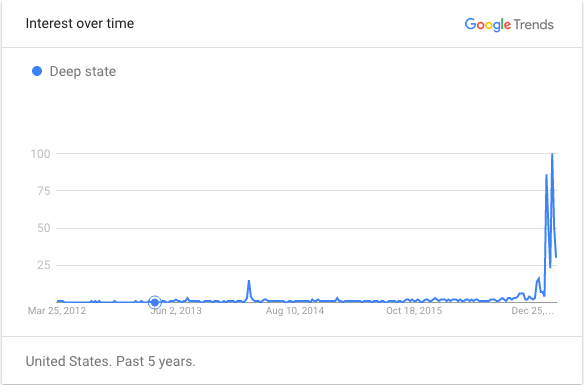
As this chart from Google Trends illustrates, interest in the Deep State has increased dramatically in 2017. The term/topic has clearly moved from the specialist realm to the mainstream. I’ve been writing about the Deep State, and specifically, the fractures in the Deep State, for years.

Amusingly, now that “Progressives” have prostituted themselves to the Security Agencies and the Neocons/Neoliberals, they are busy denying the Deep State exists. For example, There is No Deep State (The New Yorker).

In this risible view, there is no Deep State “conspiracy” (the media’s favorite term of dismissal/ridicule), just a bunch of “good German” bureaucrats industriously doing the Empire’s essential work of undermining democracies that happen not to prostrate themselves at the feet of the Empire, murdering various civilians via drone strikes, surveilling the U.S. populace, planting bugs in new iPhones, issuing fake news while denouncing anything that questions the dominant narratives as “fake news,” arranging sweetheart deals with dictators and corporations, and so on.

The New Yorker is right about one thing–the Deep State is not a “conspiracy:” it is a vast machine of control that is largely impervious to the views or demands of elected representatives or the American people. The key to understanding this social-political-economic control is to grasp that control of the narratives, expertise and authority is control of everything. Allow me to illustrate how this works.

The typical politician has a busy daily schedule of speaking at the National Motherhood and Apple Pie Day celebration, listening to the “concerns” of important corporate constituents, attending a lunch campaign fundraiser, meeting with lobbyists and party committees, being briefed by senior staff, and so on.

Senior administrators share similarly crowded schedules, minus the fundraising but adding budget meetings, reviewing employee complaints and multiple meetings with senior managers and working groups.

Both senior elected officials and senior state administrators must rely on narratives, expertise and authority because they have insufficient time and experience to do original research and assessment.

Narratives create an instant context that “makes sense” of various data points and events. Narratives distill causal factors into an explanatory story with an implicit teleology–because of this and that, the future will be thus and so.

For example: because Iraq has weapons of mass destruction (WMD), the future promises the terrible likelihood (more than a possibility, given Iraqi deployment of poison gas in the Iraq-Iran War) that America or its allies will be devastated by Iraqi weapons of mass destruction. This teleology leads to the inescapable need to eliminate Iraq’s weapons of mass destruction by any means necessary, and remove the political will to use them by removing Iraq’s leader from power.

Politicos and senior administrators rely on expertise and authority as the basis of deciding whether something is accurate and actionable. Professional specialists are assumed to have the highest available levels of expertise, and their position in institutions that embody the highest authority give their conclusions the additional weight of being authoritative. The experts’ conclusion doesn’t just carry the weight of expertise, it has been reviewed by senior officials of the institution, and so it also carries the weight of institutional authority.

So when the C.I.A. briefing by its experts claims Iraq has WMD, and the briefing includes various threads of evidence that the institution declares definitive, who is a non-expert to challenge this conclusion and teleology? On what technical basis does the skeptic reject the expertise and authority of the institution?

We can now define the Deep State with some precision. The Deep State is fundamentally the public-private centralized nodes that collect, archive and curate dominant narratives and their supporting evidence, and disseminate these narratives (and their implicit teleologies) to the public via the media and to the state agencies via formal and informal inter-departmental communication channels.

By gaining control of the narratives, evidence, curation and teleology, each node concentrates power. the power to edit out whatever bits contradict the dominant narrative is the source of power, for once the contradictory evidence is buried or expunged, it ceases to exist.

For example, the contradictory evidence in the Pentagon Papers was buried by being declared Top Secret. The bureaucratic means to bury skeptical (i.e. heretical) views or evidence are many. Sending the authors to figurative Siberia is remarkably effective, as is burying the heretical claims in a veritable mountain of data that few if any will ever survey.

Curation is a critical factor in maintaining control of the narrative and thus of control; the evidence is constantly curated to best support the chosen narrative which in turn supports the desired teleology, which then sets the agenda and the end-game.

The senior apparatchiks of the old Soviet Union were masters of curation; when a Soviet leader fell from favor, he was literally excised from the picture–his image was erased from photos.

This is how narratives are adjusted to better fit the evidence. Thus the accusation that “the Russians hacked our election” has been tabled because it simply doesn’t align with any plausible evidence. That narrative has been replaced with variants, such as “the Russians hacked the Democratic National Committee.” Now that this claim has also been shown to be false, new variants are popping up weekly, with equally poor alignment with evidence.

The primary claim of each Deep State node is that its expertise and authority cannot be questioned. In other words, while the dominant narrative can be questioned (but only cursorily, of course), the expertise and authority of the institutional node cannot be questioned.

This is why the Deep State is fracturing: the expertise and authority of its nodes are delaminating because its narratives no longer align with the evidence. If various Security Agencies sign off on the narrative that “Russia hacked our election” (a nonsense claim from the start, given the absurd imprecision of the “hacking”–hacking into what? Voting machines? Electoral tallies?), and that narrative is evidence-free and fact-free, i.e. false, then the expertise and authority of those agencies comes into legitimate question.

Once the legitimacy of the expertise and authority is questioned, control of the narrative is imperiled. The control of the narrative is control of the teleology, the agenda and the end-game–in other words, everything. If the institution loses control of the dominant narrative, it loses its hold on power.

This is why the Deep State is in turmoil–its narratives no longer make sense, or are in direct conflict with other nodes’ narratives or have been delegitimized by widening gaps between “definitive” claims and actual evidence.

There is indeed a Deep State, but its control of dominant narratives, and thus its source of control and power, is crumbling. The gap between the narratives and the evidence that supports them has widened to the point of collapse.


Bureaucratic Insanity is Yours to Enjoy

1980

Reposted below is Dmitry Orlov’s review of the new publication from Club Orlov Press: “Bureaucratic Insanity: The American Bureaucrat’s Descent into Madness” by Sean J. Kerrigan.

By Dmitry Orlov

Source: ClubOrlov

In contemporary United States a child can be charged with battery for throwing a piece of candy at a schoolfriend. Students can be placed in solitary confinement for cutting class. Adults aren’t much better off: in 2011 the Supreme Court decided in 2011 that anyone the police arrest, even for an offense as minor as an unpaid traffic ticket, can be strip-searched. These acts of official violence are just the tip of the iceberg in our society.

The number of rules and laws to which Americans, mostly unbeknownst to them, are subject, is hilariously excessive. But what makes this comedy unbearable is that these rules and laws are often enforced with an overabundance of self-righteous venom. Increasingly, contemporary American bureaucrats—be they police, teachers or government officials—are obsessed with following strict rules and mercilessly punishing all those who fail to comply (unless they are very rich or politically connected).

In so doing, these bureaucrats have become so liberated from the constraints of common sense that the situation has gone far beyond parody and is now a full-blown farce. Consider this recent news story involving a Virginia sixth-grader, the son of two schoolteachers and a member of the school’s program for gifted students. The boy was targeted by school officials after they found a leaf, probably a maple leaf, in his backpack. Someone suspected it to be marijuana. The leaf in question was not marijuana (as confirmed by repeated lab tests). End of story, wouldn’t you think?

Not at all! The 11-year-old was expelled and charged with marijuana possession in juvenile court. These charges were eventually dropped. He was then forced to enroll in an alternative school away from his friends, where he is subjected to twice-daily searches for drugs and periodic evaluation for substance abuse problems—all of this for possession of a maple leaf.

“It doesn’t matter if your son or daughter brings a real pot leaf to school, or if he brings something that looks like a pot leaf—okra, tomato, maple, buckeye, etc. If your kid calls it marijuana as a joke, or if another kid thinks it might be marijuana, that’s grounds for expulsion,” the Washington Post cheerfully reassures us.

A reasonable school official would recognize the difference between a technical violation caused by an oversight and a conscious attempt to smuggle drugs into the school. But school officials were intent on ignoring their own better sense, instead favoring harsh punishments.

In his new book, Bureaucratic Insanity: The American Bureaucrat’s Descent into Madness, Sean Kerrigan documents dozens of eyebrow-raising examples in which America’s rule-enforcers perversely revel in handing out absurd and unfair punishments for minor infractions. They demand total and complete submission, driven by a perverse compulsion to “put us in our place” and to “teach us a lesson.” They mercilessly punish even the most inconsequential transgressions in order to maximize our terror and humiliation.

When Sean first began following this story several years ago, he became mesmerized by this bizarre carnival of unreason. “Where is all this pent-up rage coming from?” he wondered, “and why is it being directed toward the weakest and most vulnerable members of society?” And then news stories like those mentioned above grew more and more common. Eventually, he started compiling a list of the most egregious abuses, trying to detect patterns, searching for some explanation for why your average garden-variety bureaucrat has morphed into a monster and has started to take sadistic pleasure in the suffering of innocent people.

Some people might argue that this kind of behavior is the result of political correctness gone amok. Others point to the irrational fear of terrorism and mass shootings. Yet others might think that it has to do with the bureaucrats’ fear of losing their jobs—merely for failing to comply with the exact letter of some rule. While there may be some truth to each of these explanations, they are far from adequate. Many of these bureaucratic abuses have nothing to do with political constraints on free speech, or with guns or terrorism, and in most cases the bureaucrats have the power to minimize harm, but instead they choose to maximize it.

In looking closer at each individual instance, it became clear that most of the offending bureaucrats weren’t even attempting to use their judgment but were mindlessly following written rules. Even in the most nurturing and humanistic professions—teachers and physicians—their practitioners have been robotized to such an extent that they now perform a very narrow range of actions. Thanks to all the progress in IT, their work is now quite detached from physical reality. Much of their work now consists of monotonously, mindlessly pounding at the computer keyboard. Consequently, a large portion of their waking lives has taken on an ethereal, pointless quality. Even teachers, who once had a relatively free reign in forming the minds of the next generation, are now forced to behave like machines, teaching to standardized tests and working a grueling average of 53 hours a week.

The psychological effects of this pressure have been profound. Minus the opportunities to make their own decisions and to see those positive effects of their efforts, their work has become personally meaningless, alienating, depersonalizing and psychologically damaging. As a result of this damage, American bureaucrats, although they may look like mild-mannered professionals, have become prone to sudden bouts of aggressive, sadistic behavior. They are unable to act out their repressed rage in any socially acceptable way other than by doling out punishments, fines, rejections, expulsions and other forms of objective, systemic violence.

The road to hell is paved with good intentions, and rest assured that this is all being done for our own good. The purpose of all of these rules and laws, from the perspective of the American system of governance, is to maximize control over everything that can be controlled and to micromanage every possible detail of our lives—in order to make them better! From student testing all the way to global trade, those in leadership positions are trying to centralize as much authority as possible in order to maximize efficiency, profit, American power… while minimizing our dignity, well-being and happiness. Oops!

In his book Bureaucratic Insanity, Sean traces the development of this trend from the early years of the industrial revolution to the modern day, from its initial appearance in factory life and in the military, to it later metastasizing to the office, and now taking over America’s schools. He argues persuasively, based on a careful and thorough review of literature in history, philosophy, psychology, anthropology and social criticism, that the average American bureaucrat is literally, clinically insane. The average American bureaucrat has a warped perception of reality and an intense, repressed self-hatred. Their only way to vent their rage is by punishing others using bureaucratic methods. They demand absolute conformity because it is their only way to give their meaningless lives some semblance of meaning. They suppress all thoughts that might lead them to discover the true nature of their condition, because that would cause them to spiral down into outright schizophrenia.

The book concludes with an assessment of what we can do to insulate ourselves from this seemingly unstoppable trend, and of how we can reinvigorate our lives by giving it real meaning.


The U.S. Deep State Rules – On Behalf of the Ruling Class

By Glen Ford

Source: Black Agenda Report

“The U.S. Deep State is unlike any other, in that there is no other global superpower bent on world domination.”

The Deep State is busy denying that it exists, even as it savages a sitting president and brutally bitch-slaps its host society, demanding the nation embrace its role as global psycho thug and kick some Russian ass. The New York Times, always available to divert attention from the essential facts of who rules America, points to Egypt, Turkey and Pakistan as the natural habitats of Deep States. Apparently, Deep State-infected countries tend to be nations with majority Muslim populations, whose military-intelligence apparatus hovers over society and periodically seizes control of the civil government.

The Times quoted high-ranking operatives of the Deep State to prove that such structures are alien to the U.S. Michael V. Hayden, who ran the CIA under Democratic President Obama and Republican George Bush, recoiled at the term. He “would never use” the words Deep State in connection with his own country. “That’s a phrase we’ve used for Turkey and other countries like that, but not the American republic.”

Loren DeJonge Schulman, a former Obama National Security Council official, claimed to be repelled by the very idea of an American Deep State. “A deep state, when you’re talking about Turkey or Egypt or other countries, that’s part of government or people outside of government that are literally controlling the direction of the country no matter who’s actually in charge, and probably engaging in murder and other corrupt practices,” she said.

Apparently, Ms. Schulman did not consider it murder when Obama and his top national security advisors met every Tuesday at the White House to decide who would be assassinated by drone or other means. But she is “shocked” to hear “that kind of [Deep State-phobic] thinking from” President Trump “or the people closest to him.”

Once the Times had located the nexus of Deep Statism in the Muslim world, the lesser lights at The New Yorker endorsed the corporate media consensus that the U.S. is Deep State-free. Staff writer David Remnick admits that U.S. presidents “have felt resistance, or worse, from elements in the federal bureaucracies,” citing Eisenhower’s warnings against the military-industrial complex, Lyndon Johnson’s “pressure from the Pentagon,” and the “rebuke” of Obama’s Syria policy through the State Department’s “dissent channel.” However, he denies that any “subterranean web of common and nefarious purpose” threatens the orderly and transparent processes of the U.S. political system.

In reality, the U.S. Deep State is by far the world’s biggest and most dangerous version of the phenomenon; a monstrous and not-so subterranean “web of common and nefarious purpose” that is, by definition, truly global, since its goal is to rule the planet. Indeed, the Deep States of Turkey, Egypt and Pakistan — all nominal U.S. allies – are midgets in comparison and must operate in a global environment dominated by Washington’s Deep State apparatus. So vast is the imperial Deep State, that its counterparts in other nations exist largely to collaborate with, resist, or keep tabs on the U.S. behemoth, the predator that seeks to devour all the rest.

What is a Deep State? The U.S. Deep State is unlike any other, in that there is no other global superpower bent on world domination. (Washington’s political posture is also unique; no other nation claims to be “exceptional” and “indispensable” and thus not subject to the constraints of international law and custom.) Indeed, the U.S. is so proudly and publicly imperialist that much of what should be secret information about U.S. military and other capabilities is routinely fed to the world press, such as the 2011 announcement that the U.S. now has a missile that can hit any target on the planet in 30 minutes, part of the Army’s “Prompt Global Strike” program. Frightening the rest of the world into submission — a form of global terrorism — is U.S. public policy.

However, arming and training Islamic jihadist terrorists to subvert internationally recognized governments targeted by the U.S. for regime change is more than your usual variety of covert warfare: It is a policy that must forever be kept secret, because U.S. society would suffer a political breakdown if the facts of U.S. and Saudi nurturing of the international jihadist network were ever fully exposed. This is Deep State stuff of the highest order. The true nature of U.S. foreign policy in the 21st century, and the real character of the current wars in Syria and Iraq, must be hidden from the U.S. public at all cost. An alternative reality must be presented, through daily collaboration between corporate media, corporate universities, and the public and covert organs of the U.S. State.

What part of the New York Times coverage of the war against Syria is a lie? Damn near all of it. What role does the Deep State play in crafting the lies dutifully promulgated by the corporate media? That’s impossible to answer, because the Deep State is a network of relationships, not a clearly delineated zone or space or set of organizations. The best way to describe the imperial Deep State is: those individuals and institutions that are tasked with establishing the global supremacy of the corporate ruling class. Such activities must be masked, since they clash with the ideological position of the ruling class, which is that the bourgeois electoral system of the United States is the world’s freest and fairest. The official line is that the U.S. State is a work of near-perfection, with checks and balances that prevent any class, group or section from domination over the other. The truth is that an oligarchy rules, and makes war on whomever it chooses — internationally and domestically — for the benefit of corporate capital.

The Deep State and its corporate imperatives manifestly exists when corporate lobbyists and lawyers are allowed to draw up the Trans Pacific Partnership global “trade” agreement, but the contents are kept secret from the Congresspersons whose duty is to vote on the measure. The Deep State is where corporate power achieves its class aims outside the public processes of government. It’s where the most vicious class warfare takes place, whether on a foreign killing field, or in the corporate newsroom that erases or misrepresents what happened on that battlefield.

At this stage of capitalism, the U.S. ruling class has less and less use for the conventional operations of the bourgeois state. It cannot govern in the old way. More and more, it seeks to shape events through the levers of the collaborating networks of the Deep State. It’s number one global priority is to continue the military offensive begun in 2011, and to break Russia’s resolve to resist that offensive. The ruling class and its War Party, now consolidated within the Democratic Party and regrouping among Republicans, have effectively neutralized a sitting president whose party controls both Houses of Congress, less than two months into his term.

Only a Deep State could pull that off.


BAR executive editor Glen Ford can be contacted at Glen.Ford@BlackAgendaReport.com.

Glen Ford’s blog

Why Do Some Men Rape?


By Robert J. Burrowes

A recent report from Equality Now titled ‘The World’s Shame: The Global
Rape Epidemic‘ offered a series of recommendations for strengthened laws to deter and
punish sexual violence against women and girls.

However, there is substantial evidence that legal approaches to dealing
with violence in any context are ineffective. For example, the empirical
evidence on threats of punishment (that is, violence) as deterrence and
the infliction of punishment (that is, violence) as revenge reveals
variable impact and context dependency, which is readily apparent
through casual observation. There are simply too many different reasons
why people break laws in different contexts. See, for example, ‘Crime
Despite Punishment‘.

Moreover, given the overwhelming evidence that violence is rampant in
our world and that the violence of the legal system simply contributes
to and reinforces this cycle of violence, it seems patently obvious that
we would be better off identifying the cause of violence and then
designing approaches to address this cause and its many symptoms
effectively. And reallocating resources away from the legal and prison
systems in support of approaches that actually work.

So why do some men rape?

All perpetrators of violence, including rapists, suffered enormous
violence during their own childhoods. This violence will have usually
included a great deal of ‘visible’ violence (that is, the overt physical
violence that we all readily identify) but, more importantly, it will
have included a great deal of ‘invisible’ and ‘utterly invisible’
violence as well: the violence perpetrated by adults against children
that is not ordinarily perceived as violent. For a full explanation, see
Why Violence?‘ and ‘Fearless Psychology and Fearful Psychology: Principles and Practice‘.

This violence inflicts enormous damage on a child’s Selfhood leaving
them feeling terrified, self-hating and powerless, among other horrific
feelings. However, because we do not allow children the emotional space
to feel their emotional responses to our violence, these feelings of
terror, self-hatred and powerlessness (among a multitude of others),
become deeply embedded in the child’s unconscious and drive their
behaviour without their conscious awareness that they are doing so.

So what is ‘invisible’ violence? It is the ‘little things’ we do every
day, partly because we are just ‘too busy’. For example, when we do not
allow time to listen to, and value, a child’s thoughts and feelings, the
child learns to not listen to themSelf thus destroying their internal
communication system. When we do not let a child say what they want (or
ignore them when they do), the child develops communication and
behavioural dysfunctionalities as they keep trying to meet their own
needs (which, as a basic survival strategy, they are genetically
programmed to do).

When we blame, condemn, insult, mock, embarrass, shame, humiliate,
taunt, goad, guilt-trip, deceive, lie to, bribe, blackmail, moralize
with and/or judge a child, we both undermine their sense of Self-worth
and teach them to blame, condemn, insult, mock, embarrass, shame,
humiliate, taunt, goad, guilt-trip, deceive, lie, bribe, blackmail,
moralize and/or judge.

The fundamental outcome of being bombarded throughout their childhood by
this ‘invisible’ violence is that the child is utterly overwhelmed by
feelings of fear, pain, anger and sadness (among many others). However,
parents, teachers and other adults also actively interfere with the
expression of these feelings and the behavioural responses that are
naturally generated by them and it is this ‘utterly invisible’ violence
that explains why the dysfunctional behavioural outcomes actually occur.

For example, by ignoring a child when they express their feelings, by
comforting, reassuring or distracting a child when they express their
feelings, by laughing at or ridiculing their feelings, by terrorizing a
child into not expressing their feelings (e.g. by screaming at them when
they cry or get angry), and/or by violently controlling a behaviour that
is generated by their feelings (e.g. by hitting them, restraining them
or locking them into a room), the child has no choice but to
unconsciously suppress their awareness of these feelings.

However, once a child has been terrorized into suppressing their
awareness of their feelings (rather than being allowed to have their
feelings and to act on them) the child has also unconsciously suppressed
their awareness of the reality that caused these feelings. This has many
outcomes that are disastrous for the individual, for society and for
nature because the individual will now easily suppress their awareness
of the feelings that would tell them how to act most functionally in any
given circumstance and they will progressively acquire a phenomenal
variety of dysfunctional behaviours, including some that are violent
towards themselves, others and/or the Earth.

So what is happening psychologically for the rapist when they commit the
act of rape? In essence, they are projecting the (unconsciously
suppressed) feelings of their own victimhood onto their rape victim.
That is, their fear, self-hatred and powerlessness, for example, are
projected onto the victim so that they can gain temporary relief from
these feelings. Their fear, temporarily, is more deeply suppressed.
Their self-hatred is projected as hatred of their victim. Their
powerlessness is temporarily relieved by a sense of being in control,
which they were never allowed to be, and feel, as a child. And similarly
with their other suppressed feelings. For example, a rapist might blame
their victim for their dress: a sure sign that the rapist was endlessly,
and unjustly, blamed as a child and is (unconsciously) angry about that.

The central point in understanding violence is that it is psychological
in origin and hence any effective response must enable the suppressed
feelings (which will include enormous rage at the violence they
suffered) to be safely expressed. For an explanation of what is
required, see ‘Nisteling: The Art of Deep Listening’ which is referenced
in ‘My Promise to Children’.

The legal system is simply a socially endorsed structure of violence and
it uses violence, euphemistically labeled ‘punishment’, in a perverse
attempt to terrorise people into controlling their behaviours or being
treated violently in revenge by the courts if they do not. This approach
is breathtakingly ignorant and unsophisticated in the extreme and a
measure of how far we are from responding powerfully to the pervasive
problem of violence in our world. See ‘The Rule of Law: Unjust and
Violent’  and ‘Punishment is Violent and Counterproductive’.

So what are we to do?

Well we can continue to lament violence against women (just as some
lament other manifestations of violence such as war, exploitation and
destruction of the environment, for example) and use the legal system to
reinforce the cycle of violence by inflicting more violence as
‘punishment’.

Or we can each, personally, address the underlying cause of all
violence.

It might not be palatable to acknowledge and take steps to address your
own violence against children but, until you do, you will live in a
world in which the long-standing and unrelenting epidemic of violence
against children ensures that all other manifestations of human violence
continue unchecked. And our species becomes extinct.

If you wish to participate in the worldwide effort to end human
violence, you might like to make ‘My Promise to Children’ outlined in
the article cited above and to sign the online pledge of ‘The People’s
Charter to Create a Nonviolent World‘.

You might also support initiatives to devote considerable societal
resources to providing high-quality emotional support (by those expert
at nisteling) to those who survive rape. This support cannot be provided
by a psychiatrist. See ‘Defeating the Violence of Psychiatry‘. Nisteling
will enable those who have suffered from trauma to heal fully and
completely, but it will take time.

Importantly, the rapist needs this emotional support too. They have a
long and painful childhood from which they need a great deal of help to
recover. It is this healing that will enable them to accurately identify
the perpetrators of the violence they suffered and about whom they have
so many suppressed (and now projected) feelings which need to be felt
and safely expressed.

You need a lot of empathy and the capacity to nistel to address violence
in this context meaningfully and effectively. You also need it to raise
compassionate and powerful children in the first place.


Biodata: Robert J. Burrowes has a lifetime commitment to understanding
and ending human violence. He has done extensive research since 1966 in
an effort to understand why human beings are violent and has been a
nonviolent activist since 1981. He is the author of ‘Why Violence?
His email address is flametree@riseup.net
and his website is at http://robertjburrowes.wordpress.com


Robert J. Burrowes
P.O. Box 68
Daylesford
Victoria 3460
Australia
Email: flametree@riseup.net

Websites:
Nonviolence Charter
Flame Tree Project to Save Life on Earth
‘Why Violence?’
Nonviolent Campaign Strategy
Nonviolent Defense/Liberation Strategy
Anita: Songs of Nonviolence
Robert Burrowes
Global Nonviolence Network